PART 2: HOA President Hid the Books for Years—One Certified Complaint Opened a State Attorney’s Criminal File
PART 2
The first response from the HOA did not come from Karen.
It came from their lawyer.
That told me two things immediately.
First, Karen was worried.
Second, whatever was hidden in those books was worse than a sloppy budget.
The envelope was thick, expensive, and full of the kind of legal language designed to make ordinary people feel stupid before they even reach the second page. I sat at Helen’s desk, Gunner asleep beside my chair, and read it with a cup of coffee going cold near my elbow.
According to the HOA attorney, my request was improper because I had not used Form 7B, Records Inspection Request.
No such form had been included.
The letter further stated that the form had to be notarized and submitted in person to the HOA secretary during official office hours, which were listed as the fifth Monday of each month between 10:00 and 11:00 a.m.
The fifth Monday.
Some months don’t have one.
I read that line three times, then laughed so hard Gunner lifted his head.
The letter continued. If my request was approved, I would be permitted one hour to inspect records under supervision of HOA counsel, billed to me at $450 per hour. Copying fees would apply. Certain records might be redacted. Certain contracts might be withheld. Certain financial summaries might be unavailable due to ongoing “administrative reconciliation.”
It was nonsense.
Not random nonsense.
Structured nonsense.
A wall of inconvenience built brick by brick to exhaust anyone who asked where the money went.
I had seen versions of it before overseas. Contractors who buried missing inventory under revised forms, delayed signatures, incomplete manifests, and “temporary accounting holds.” The scale was smaller here, but the smell was the same.
Rot smells the same whether it’s a defense warehouse or a retirement community clubhouse.
I put the attorney’s letter in the green binder.
Exhibit One.
Then I made coffee and started walking.
Not aimlessly. Not emotionally. Deliberately.
Gunner and I changed our route every morning. Different streets. Different times. Different neighbors.
I talked first about ordinary things.
Weather.
Dogs.
Grandchildren.
The lake.
Only after people relaxed did I mention the assessment.
Their stories came slowly.
Maria Ortiz, who lived in Villa 3B, had been fined $500 because the beige paint she used to touch up her shutters was allegedly the wrong shade. She had bought the paint from the HOA’s approved vendor list.
Tom and Rachel Miller had spent nearly a year trying to build a simple four-foot fence behind their villa so their toddler could play safely. The HOA denied them again and again, claiming it would obstruct community views, even though their property backed up to a wetland so dense you couldn’t see ten feet into it.
George Bennett, a retired electrician, was fighting a lien over his central air-conditioning unit. He had installed it exactly where the guidelines required, with photographs, permits, and contractor paperwork to prove it.
Each story sounded ridiculous alone.
Together, they formed a pattern.
Karen’s HOA did not enforce rules.
It monetized fear.
The first meeting at my house was small.
Maria came with a folder clutched against her chest. Tom and Rachel arrived together, both looking like they might apologize for existing. George showed up last, silent and grim, carrying a stack of papers bound with a rubber band.
I had coffee and cookies on the dining room table because people tell the truth more easily when the room feels like a kitchen instead of a courtroom.
They spoke in low voices.
Maria said Karen drove past her villa slowly whenever she missed a payment.
Rachel said their daughter cried because she couldn’t understand why every other kid had a safe fenced yard and she didn’t.
George said the lien notice had made his blood pressure spike so badly his doctor changed his medication.
When they finished, I opened the green binder.
“She wants you isolated,” I said. “She wants each of you to believe you are the only problem. You are not.”
Maria wiped her eyes.
“What can we do?”
“Document everything.”
George leaned forward.
“That’s it?”
“That’s the beginning.”
I explained the plan.
Every letter saved.
Every envelope kept.
Every phone call followed by written confirmation.
Every fine photographed.
Every board interaction recorded in notes immediately afterward.
Every certified mail receipt preserved.
No angry emails. No hallway confrontations. No shouting at meetings. We would fight with paper, patience, and procedure.
“That sounds slow,” Tom said.
“It is,” I replied. “So is rust. But it takes down bridges.”
For the first time that night, someone smiled.
### Dave Martinez
After the neighbors left, I called Dave Martinez.
Dave and I had served together in Iraq. He worked criminal investigations while I handled logistics, and he had a talent for finding missing money that bordered on supernatural. After the Army, he became a forensic accountant in Tampa. He could look at a budget for ten minutes and tell you which line item was wearing a disguise.
He answered on the fourth ring.
“Jack Wallace,” he said. “Either you need money traced or someone lied on a spreadsheet.”
“Both, probably.”
I told him everything.
The $15,000 assessment.
The refusal to provide records.
The lawyer’s letter.
The neighbor stories.
The retaliation pattern.
When I finished, Dave was quiet for a moment.
Then he said, “Send me everything.”
“Speculation, too?”
“No. Documents. Receipts. Notices. Corporate names. Dates. Give me facts, not feelings.”
That was why I trusted him.
Within two days, I scanned and encrypted every document we had.
Dave called me the following Monday.
His voice had changed.
“Jackie boy, your HOA stinks.”
“How bad?”
“Bad enough that I’m annoyed before breakfast.”
That meant very bad.
He had begun with the special assessment notice and looked for the vendor name buried in one board summary: Evergreen Prestige Landscaping LLC.
The company had been formed three months earlier.
Its registered agent was a woman named Shirley Pinter.
Shirley Pinter was Karen’s sister.
I sat very still.
“Say that again.”
“The landscaping company getting the big assessment money is tied to Karen’s sister.”
“The board disclosed that?”
Dave laughed once.
“No disclosure in anything you sent me. No conflict statement. No competitive bid detail. Nothing.”
I looked at Helen’s picture on the desk.
The assessment notice sat beside it.
Fifteen thousand dollars per home.
For hedges.
“How much are we talking?”
“If every villa pays, over a million dollars comes in. I haven’t seen real invoices, but based on the project description, I’d be shocked if legitimate work cost even half that.”
“That’s fraud.”
“That’s potentially fraud,” Dave corrected. “Don’t get ahead of the documents. But yes, it’s dirty.”
That night, I drafted the state complaint.
Not a rant.
A mission briefing.
Ten pages.
Chronology. Statutes. Exhibits. Witness statements. Certified mail receipts. The obstructive lawyer letter. Maria’s paint receipts. The Millers’ fence file. George’s lien documents. Evergreen Prestige corporate records. Dave’s preliminary analysis.
I printed five complete copies.
One for the state oversight division.
One for Karen.
One for the treasurer.
One for the vice president.
One for the HOA’s registered agent.
If they were all part of the machine, they would all know the machine had been named.
I sent every package certified mail.
When the postal clerk handed me the receipts, I felt something I had not felt since my last command.
The moment before an operation becomes real.
### Retaliation
Karen’s response was immediate.
She did not deny the allegations.
She punished the witnesses.
Tom and Rachel received a $2,000 fine for “failure to maintain property harmony” because their rejected fence plans remained in their file.
Maria received a violation notice for “excessive floral vibrancy.”
Her roses were too red.
I read that notice twice because I thought I had misunderstood.
Too red.
A woman who had survived breast cancer, widowhood, and Florida summers was being fined because her roses had the audacity to bloom brightly in a neighborhood run by people who preferred obedience in muted beige.
George received a new warning about “mechanical visibility” for the air-conditioning unit already documented as compliant.
Then they came for me.
An oil stain on my driveway the size of a quarter.
A garden hose allegedly coiled in a disorderly fashion.
A claim that my woodworking hobby constituted an illegal commercial enterprise because a neighbor heard my table saw.
The fines were petty, but the message was not.
Back down.
Pay up.
Stop asking.
Karen also used the monthly Lakeside Meadows newsletter to paint me as a disruptive newcomer. She wrote about “certain residents” who did not understand community harmony, “outside influences” encouraging conflict, and “aggressive complaints” designed to divide neighbors.
I watched friendly faces turn away on my morning walks.
Some people crossed the street.
Some pretended to check their mail.
Fear had become part of the landscaping.
One afternoon, my daughter Sarah stopped by with Leo.
She found me at the dining room table surrounded by binders.
“Dad,” she said softly, “you look exhausted.”
“I am.”
“Is this worth it?”
I looked toward the backyard where Leo was kneeling beside Gunner, trying to teach an old dog a new trick.
“They want people too tired to fight,” I said. “That’s the whole system.”
Sarah sat across from me.
“They’re making your life miserable.”
“Yes.”
“You could move.”
“I could.”
“Why won’t you?”
I looked at my grandson laughing in the yard.
“Because someday Leo is going to meet a bully with a title. A boss. A landlord. A board president. A man with a badge of authority but no integrity. And when that day comes, I don’t want him remembering that his grandfather ran because paperwork was inconvenient.”
Sarah’s eyes softened.
“Mom would say you’re being stubborn.”
I smiled.
“She married me knowing the risks.”
“She would also say you’re right.”
That nearly broke me.
I looked down at the binder.
“Then I’d better finish it.”
### David Chen
The state finally answered six weeks later.
The envelope was plain, official, and thin.
Thin letters are usually bad in the Army. They mean no explanation, no detail, no chance.
But this one was different.
Based on the documentation provided, the state oversight division had opened a formal investigation into Lakeside Meadows HOA. A lead investigator had been assigned.
His name was David Chen.
He called the next day.
His voice was clipped, calm, and free of wasted motion.
“Major Wallace, I reviewed your submission.”
“Yes, sir.”
“It is unusually thorough.”
“I’ve had practice.”
“So I gathered.”
He scheduled interviews at the public library instead of the clubhouse. That detail told me he understood power dynamics. Neutral ground matters when people have been intimidated.
Maria came first.
Then the Millers.
Then George.
Then me.
Mr. Chen was compact, impeccably dressed, and carried a small notebook instead of a laptop. He asked precise questions. He did not react dramatically. He did not promise justice. He simply wrote facts in black ink and asked for dates, names, and records.
When I gave him the updated binder, he weighed it in his hands.
“Operation Lakeside Justice?” he asked, reading the spine.
I almost felt embarrassed.
“Old habit.”
For the first time, he almost smiled.
“I’ve seen worse habits.”
His next stop was the clubhouse.
I was not there, but I heard about it from a sympathetic part-time office clerk who had no love for Karen after being yelled at for using blue sticky notes instead of yellow.
Karen tried to control the interview.
Of course she did.
She described me as disgruntled, Maria as confused, George as combative, and the Millers as emotional young parents who didn’t understand architectural standards.
Then Mr. Chen asked for the unredacted financial records, vendor bids, contracts, bank statements, meeting minutes, and conflict disclosures connected to the assessment.
Karen smiled and said the records were undergoing a comprehensive audit with an off-site accounting firm.
Mr. Chen asked for the firm’s name.
The treasurer, Bob, couldn’t provide it.
Mr. Chen asked for the firm’s address.
Nobody had it.
Mr. Chen asked when the audit began.
Karen gave a month. Bob gave a different month. The vice president stared at the table.
Mr. Chen thanked them, closed his notebook, and left.
They probably thought they had stalled him.
They had actually given him exactly what he needed.
Proof that they were refusing lawful access.
### The second front
State investigations move slowly.
Karen knew that.
She used time as a weapon.
Fines accumulated. Legal letters multiplied. Maria stopped sleeping. Rachel cried on the phone because the Millers’ daughter asked why grown-ups were mad about a fence. George considered paying the lien just to make the stress stop.
My own attorney, Ben Carter, told me the truth during a late-night call.
“Jack, the state is good, but Karen is betting she can bleed everyone dry before they act.”
“She might be right.”
“Only if we wait.”
“What’s the alternative?”
“We petition the circuit court for a receiver.”
I leaned back in my chair.
“A receiver?”
“A court-appointed custodian. Someone neutral takes control of the HOA’s assets and records because the current board cannot be trusted to preserve evidence or act in good faith.”
“That’s a big ask.”
“Yes.”
“Can we win?”
“With your documentation? We have a real shot.”
The lawsuit was expensive.
I called the group to my house and laid out the cost.
Before I could offer to cover it all, George pulled out his checkbook.
“I’m in.”
Maria shook her head.
“I don’t have much.”
“You don’t have to,” I said.
She looked at me with tears in her eyes.
“I want to. If I don’t put something in, I’ll feel like fear still owns part of me.”
The Millers contributed what they could.
I covered the rest.
We became plaintiffs.
That word changed us.
Victims wait.
Plaintiffs move.
The emergency hearing took place two weeks later.
Karen arrived in a floral dress that looked cheerful enough for a church picnic. Bob sat beside her, sweating through his collar. Their lawyer looked confident, almost bored.
Ben did not shout.
He did not dramatize.
He simply walked the judge through the record.
The $15,000 assessment.
The refusal to show books.
The fake procedural obstacles.
The retaliatory fines.
The “excessive floral vibrancy” notice.
The denied fence.
The lien against George.
The Evergreen Prestige corporate records.
The judge, a stern woman with silver hair and no patience for fog, listened without interrupting.
Then she turned to the HOA’s lawyer.
“Counsel, were the financial records requested by the residents?”
“Yes, Your Honor, but—”
“Were they produced?”
“The association required proper procedure—”
“That is not what I asked. Were they produced?”
“No, Your Honor.”
“Were they requested by a state investigator?”
“Yes, but—”
“Were they produced?”
“No, Your Honor.”
She removed her glasses.
“Motion granted. A receiver is appointed effective immediately.”
The room gasped.
Karen’s face went white.
Not pale.
White.
As if every light inside her had been cut at once.
She looked at me across the courtroom, and for the first time since I had met her, there was no contempt in her eyes.
Only fear.
### Eleanor Albright
The receiver arrived the next morning.
Eleanor Albright was tall, severe, and dressed in a charcoal suit that looked like it had never wrinkled in its life. She came to the clubhouse with two sheriff’s deputies, a locksmith, and the court order.
Karen tried to block her from entering.
That lasted approximately ten seconds.
Ms. Albright served the order, changed the locks, secured the office, froze discretionary spending, suspended all enforcement fines pending review, and removed Karen’s access to association bank accounts.
By lunchtime, Karen’s reign had been reduced to a key that no longer fit.
But the office records were useless.
Sanitized summaries.
Incomplete ledgers.
Missing invoices.
Redacted bank statements.
Vendor folders with nothing inside but cover sheets.
Ms. Albright knew exactly what it meant.
“The real books are somewhere else,” she told me.
For two weeks, her accounting team searched what they had and found only shadows.
Then the break came from a former board member named Alan Price.
He had resigned a year earlier after a falling out with Karen. He had stayed quiet because he was ashamed of having nodded along for too long.
His conscience finally won.
He called Ms. Albright’s office and told her about a storage unit on the other side of town.
The unit was not rented under the HOA’s name.
It was rented under the maiden name of Bob’s wife.
Bob went there once a month, usually after dues were deposited.
Ms. Albright notified Mr. Chen.
Mr. Chen obtained a warrant.
The state attorney’s office joined.
On a Thursday evening, my phone rang.
“Major Wallace,” Mr. Chen said. “I cannot provide details, but I thought you should know that a search warrant is being executed tonight.”
“The storage unit?”
A pause.
“Watch the ten o’clock news.”
Then he hung up.
I spent the next four hours pacing my living room while Gunner watched me like I had lost my mind.
I tried to eat dinner.
Couldn’t.
Tried to read.
Couldn’t.
At ten o’clock, I turned on the television.
The anchor’s face grew serious.
Breaking news from Lakeside Meadows.
The screen cut to a storage facility lit by red and blue flashes.
Sheriff’s deputies carried gray file tubs from an open orange storage unit. Not one or two. Dozens.
The reporter said investigators had discovered a “treasure trove of evidence” connected to alleged financial misconduct inside the HOA.
Then they said the investigation began after complaints from residents led by a retired Army major.
A photograph of me appeared on screen.
Not a flattering one.
I was standing at that first meeting, jaw tight, holding a folder.
Then Karen’s photo appeared beside mine, smiling from an HOA newsletter.
The contrast made me feel strangely sad.
Not for her.
For all the people who had trusted that smile.
### The double books
The next morning, Ms. Albright called an emergency meeting at the library.
She sat at the head of the table with a binder of her own.
“We found everything,” she said.
Nobody spoke.
She opened the binder.
“There were two sets of books.”
Maria crossed herself.
“One sanitized set for residents and annual meetings,” Ms. Albright continued. “One real set tracking actual payments, kickbacks, and cash distributions.”
Tom Miller muttered something under his breath.
Rachel gripped his hand.
Ms. Albright turned a page.
“The landscape project actual projected cost was less than one-third of the assessment. The rest was routed through Evergreen Prestige Landscaping, then partially kicked back to Karen Whitcomb and Treasurer Bob Ellison.”
George’s face hardened.
“And the rest?”
“It appears this pattern extends across multiple vendors. Pool maintenance. Road sealing. Clubhouse repairs. Security patrols. Legal consulting. Several companies are connected to board relatives or personal associates.”
I felt the old cold anger return.
“How much?”
“Preliminary estimate exceeds five hundred thousand dollars over several years.”
Maria made a small wounded sound.
Five hundred thousand dollars.
Stolen through dues, fines, assessments, and fear.
Ms. Albright continued.
“They also found evidence of fabricated fines being moved into a discretionary account used for personal expenses.”
“What kind of personal expenses?” Rachel asked.
“Restaurants. Travel. Vehicle payments. Country club charges. Gift cards. Cash withdrawals.”
George stood and walked to the window.
Nobody stopped him.
Ms. Albright’s voice softened.
“There is more.”
I already knew I did not want to hear it.
“Ballot records indicate the last three board elections were manipulated. Proxy forms appear forged. Several ballots were cast for homeowners who were out of state, hospitalized, or deceased at the time.”
That landed harder than the money.
Because theft was terrible.
But stolen elections meant the whole structure of community consent had been fake.
Karen had not simply abused power.
She had manufactured it.
The state attorney’s office was preparing warrants.
The state oversight division had opened a criminal referral.
The receiver would continue managing the HOA until new lawful elections could be held.
Maria looked at me through tears.
“She fined my roses,” she whispered. “She stole from us and fined my roses.”
I had no answer.
Sometimes cruelty is so petty it becomes obscene.
### Arrests
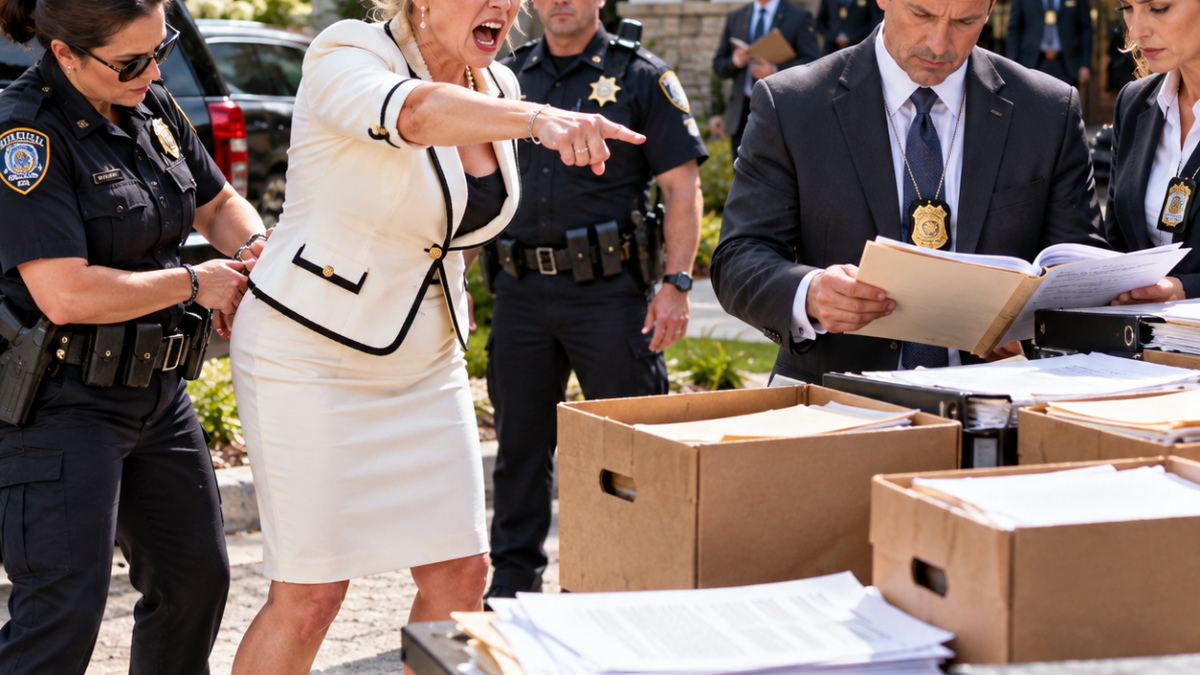
Karen was arrested on a bright Friday morning.
I was on my porch drinking coffee when the first news van rolled past the gate.
Then another.
Then two unmarked sedans and a sheriff’s cruiser stopped in front of Karen’s villa.
I did not walk over.
I did not want to be part of the spectacle.
But I could see from my living room window.
Two detectives and one uniformed deputy went to her door.
They knocked.
Firmly.
Officially.
For a while, nothing happened.
Then the door opened.
I could not hear what was said, but I saw enough.
Karen stepped outside in a wrinkled robe, her hair unbrushed, her face bare of the makeup she wore like armor.
She looked smaller than I expected.
Power does that. It inflates people while everyone is afraid.
When fear leaves the room, some people shrink back to their actual size.
They turned her gently and placed handcuffs around her wrists.
That was when she looked across the lawn and saw me.
For a second, our eyes met.
There was no fury there.
No command.
No insult.
Just stunned confusion, as if she still could not understand how a man she had dismissed in a clubhouse had become the first loose thread in the unraveling of her life.
Then they put her in the cruiser.
The door shut.
Ten minutes later, Bob was arrested.
Then the vice president.
Then two vendors.
The news spread through Lakeside Meadows faster than any newsletter ever had.
People stepped outside.
Not cheering.
Not yet.
Just standing in driveways, stunned by the sight of consequences arriving in daylight.
Maria came to my porch first.
She hugged me so tightly my ribs hurt.
“She’s gone,” she whispered.
“For now.”
“No,” Maria said, pulling back. “The fear. The fear is gone.”
That evening, Ms. Albright held a community meeting in the clubhouse.
The same room where Karen had told me the books were none of my business.
Every seat was filled.
People stood along the walls, in the doorway, even outside the windows.
Ms. Albright stood at the lectern and explained the arrests, the investigation, the receiver’s role, and the path forward.
“The old board no longer controls this association,” she said. “Effective immediately, this community belongs to its homeowners again.”
People applauded.
Not wildly.
Not theatrically.
Like people afraid the sound might wake up the nightmare.
Then she announced the first order of business.
An interim board.
Nominations opened.
George was nominated.
Tom Miller was nominated.
Maria was nominated.
She shook her head at first, but the room would not allow it.
“You stood up over your roses,” Rachel said, voice trembling. “You can stand up for us.”
Then someone nominated me.
The applause grew.
I stood slowly.
“Thank you,” I said. “But no.”
The room quieted.
“My mission was to help you take back your community. Not to replace one strong hand with another. I’ll advise. I’ll help. I’ll review any document you put in front of me. But leadership needs to come from the people who will build what comes next.”
Tom nodded.
Maria cried.
George looked relieved, which told me he had hoped I would say exactly that.
They elected a five-person interim board that night.
Good people.
Scared people.
People who had been hurt and still chose responsibility.
That was the beginning of Lakeside Meadows becoming a community instead of a collection of homes under surveillance.
### Trial
The case took months.
Real justice is slower than outrage.
There were hearings, motions, continuances, forensic audits, vendor interviews, bank subpoenas, plea negotiations, and enough paperwork to fill a supply truck.
I testified.
I wore my dress uniform jacket because Helen had always said it made me stand straighter.
On the stand, I told the story from the beginning.
The assessment.
The question.
Karen’s public insult.
The certified letters.
The lawyer’s obstruction.
The retaliatory fines.
The state complaint.
The Evergreen Prestige discovery.
The receiver.
The storage unit.
The double books.
The prosecutor entered Operation Lakeside Justice into evidence.
The green binder looked almost ridiculous in the courtroom, thick and worn, tabs sticking out at uneven angles. But inside it was the spine of the case.
Dates.
Facts.
Receipts.
Proof.
Karen sat at the defense table looking gray.
Bob stared down at his hands.
The vice president had already taken a plea and testified.
Several vendors admitted they had inflated invoices and kicked back money to keep contracts.
One confessed that the road sealing project had been billed at nearly triple the legitimate cost.
Another admitted the pool maintenance contract included monthly payments for services never performed.
The forged ballots became the part the jury seemed to hate most.
A woman on the jury shook her head when the prosecutor showed that one ballot had been submitted in the name of a homeowner who had died three months earlier.
The defense tried to paint Karen as an overworked volunteer who relied on professionals.
But overworked volunteers do not keep double books in a storage unit under another woman’s maiden name.
The jury deliberated less than four hours.
Guilty.
Racketeering.
Grand theft.
Fraud.
Conspiracy.
Several related charges.
Karen and Bob received ten years in state prison. Others received lesser sentences but still faced time, restitution, and permanent damage to the reputations they had used as shields.
The court ordered full restitution to the HOA. Assets were seized. Vendor contracts were voided. The stolen funds began making their slow way back to the people they belonged to.
A few weeks later, I received an envelope from the new Lakeside Meadows board.
Inside was a check for $15,000.
Full refund of the fraudulent assessment.
Attached was a handwritten note from Tom Miller.
*Major, this belongs to Leo now.*
I sat at Helen’s desk for a long time holding that check.
Then I drove to the bank and opened a college savings account for my grandson.
Money Karen tried to steal for fake hedges would one day buy books for a child.
That felt like the cleanest kind of revenge.
### Rebuilding
The first official act of the new board was not financial.
It was symbolic.
They repealed the absurd rules.
No more fines for rose color.
No more garden hose coiling standards.
No more weaponized beige.
No more architectural denials without written findings and an appeal process.
No more secret vendor contracts.
No more closed-door budgets.
Every contract would require competitive bids and conflict disclosures. Every financial statement would be posted monthly. Every homeowner had the right to inspect records without nonsense forms, impossible office hours, or $450-an-hour intimidation.
The Millers’ fence was approved in less than five minutes.
When it was built, half the neighborhood came over for a barbecue.
Their little girl ran across the yard with Gunner lumbering behind her like an old golden guardian.
Rachel cried when the gate closed.
“Look,” she whispered. “She’s safe.”
That was worth every certified letter.
Maria kept her roses.
Not just kept them.
Expanded them.
The new board asked her to chair the landscaping committee, and she planted a row of crimson roses near the clubhouse entrance. Someone joked they were excessively vibrant.
Maria said, “Good.”
George became facilities chair and immediately found three maintenance problems the old board had ignored while fining people for nonsense.
The community garden started on a patch of unused land near the lake. People who had lived twenty feet apart for years finally learned each other’s names while planting tomatoes, herbs, and flowers in soil that belonged to everyone.
Ms. Albright stayed until lawful elections could be held.
Mr. Chen closed his investigation with a report that became required reading for the new board.
Dave Martinez refused payment for his preliminary work.
“Watching suburban crooks fall apart is payment enough,” he said.
Ben Carter accepted payment but cut his bill in half and called the rest a veteran discount.
I told him I was retired Army, not poor.
He said, “Jack, shut up and take the discount.”
So I did.
### Helen’s bench
The final thing I requested from the new board was small.
A bench by the lake.
Teak wood.
Simple design.
No ornament except a brass plaque with Helen’s name.
Under Karen’s regime, such a request would have taken six months, three hearings, two inspections, and perhaps a fine for excessive sentimentality.
The new board approved it unanimously.
No drama.
No power play.
No lecture about harmony.
Just yes.
The bench was installed on a quiet Friday afternoon.
I went there at sunset with Gunner.
He was slower by then, his muzzle white, his hips stiff. He rested his head on my knee as the sky turned orange and purple over the water.
I ran my thumb over the brass plaque.
**Helen Wallace**
**Beloved wife, mother, grandmother**
**She made every place feel like home.**
My daughter Sarah arrived with Leo a few minutes later.
Leo climbed into my lap, all elbows and questions.
“Grandpa, is this Grandma Helen’s bench?”
“Yes.”
“Can she see it?”
Sarah looked at me carefully.
I looked at the lake.
“I think love sees the things we build for it.”
Leo accepted that because children are often wiser than adults.
He leaned back against me.
“This is a good bench.”
“The board approved it.”
“What’s a board?”
Sarah laughed softly.
I kissed the top of Leo’s head.
“A group of people who are supposed to help take care of a place.”
“Like soldiers?”
I thought about that.
“Sometimes. If they remember who they serve.”
We sat in silence for a while.
The community behind us sounded alive.
Not tense.
Not watched.
Alive.
Somewhere, Maria was probably fussing over roses. George was probably checking a light fixture without being asked. The Millers’ daughter was probably running safely inside her fence. People were probably opening monthly financial statements and actually understanding them.
I had come to Lakeside Meadows seeking peace.
Instead, I found a war.
But wars, when fought for the right reasons and ended properly, can clear ground for something better.
Sarah touched my shoulder.
“Mom would be proud of you.”
My throat tightened.
“She’d say I took too long to make friends.”
Sarah smiled.
“She would.”
Gunner sighed against my knee.
The lake reflected colors Karen would have absolutely banned if she could have controlled sunsets.
That made me laugh.
Sarah looked at me.
“What?”
“Nothing,” I said. “Just thinking that orange and purple are probably not approved colors.”
She laughed, too.
For the first time in a long while, the sound of laughter did not feel out of place beside Helen’s memory.
It felt like something she had left behind for us to find.
### What one complaint can do
People later called me brave.
I don’t think that’s the right word.
Bravery sounds clean.
This was not clean.
This was fear, anger, insomnia, legal bills, certified mail, awkward conversations, and neighbors crying at my dining room table because someone with a title had made them feel powerless in their own homes.
I was not fearless.
I was trained.
That is different.
Training teaches you to act while fear is present. To check the map. Count supplies. Verify signatures. Secure records. Find allies. Keep moving.
Karen’s mistake was assuming ordinary homeowners had no discipline.
She assumed Maria would pay.
The Millers would give up.
George would stay quiet.
I would write the check and swallow the insult.
She assumed shame was stronger than evidence.
She was wrong.
One complaint did not open a criminal file because I was special.
It opened because the complaint was documented.
Because neighbors signed affidavits.
Because Dave followed the money.
Because Ben knew where to push.
Because Mr. Chen did his job.
Because Ms. Albright took control before the records vanished.
Because one former board member finally chose conscience over fear.
Because people who had been isolated found each other.
That is what tyrants, even small suburban ones, fear most.
Not anger.
Not insults.
Not shouting at meetings.
They fear organized truth.
Years after the arrests, Lakeside Meadows changed in ways I never expected.
Dues went down.
Maintenance improved.
The clubhouse stopped feeling like a throne room and started feeling like a public space.
Neighbors brought casseroles to people recovering from surgery.
The newsletter published budgets in plain English.
Board meetings became boring, which is exactly what honest board meetings should be.
Maria’s roses bloomed so brightly each spring that visitors stopped to photograph them.
The Millers had another child.
George taught a workshop on basic home maintenance for anyone who wanted to learn.
And me?
I still walked Gunner every morning until his legs finally gave out, and when he passed, the community planted a small tree near Helen’s bench.
No committee fight.
No citation.
No debate over approved species.
Just a tree for an old dog who had attended more meetings than most residents.
On the day we planted it, Leo patted the soil and said, “Now Gunner can watch the lake with Grandma Helen.”
I had to walk away for a minute.
Nobody followed.
They understood.
That was community.
Not rules.
Not paint palettes.
Not fear.
People knowing when to stand beside you and when to give you space.
### The last meeting
The final time I spoke formally at an HOA meeting, the room looked nothing like it had that first night.
Same clubhouse.
Same fluorescent lights.
Same carpet.
But the air was different.
No one stared at their laps.
No one flinched when the president asked for questions.
Tom Miller was board president by then, and he ran meetings with the calm efficiency of a man who knew exactly what bad leadership cost.
The agenda included a routine annual audit review.
Routine.
That word nearly made me smile.
The accountant presented clean books, transparent reserves, properly bid contracts, and no unexplained vendor relationships.
When she finished, Tom asked if anyone had questions.
Maria raised her hand.
Everyone laughed because Maria always had questions now.
Good questions.
Sharp questions.
Questions no one feared anymore.
After the meeting, Tom asked me to say a few words.
I hadn’t prepared anything.
So I stood where Karen had once stood.
For a moment, I could almost hear her voice again.
*The financials are for the board to worry about, Major.*
I looked at the room.
At Maria.
At George.
At Rachel and Tom.
At neighbors who had once been strangers hiding behind curtains.
“The first time I stood in this room,” I said, “I asked to see the books.”
A few people nodded.
“I was told to write my check and mind my business.”
Soft laughter moved through the room.
“But the books were our business. The money was our business. The rules were our business. This place was our business.”
I paused.
“That is the lesson I hope Lakeside never forgets. A community does not belong to the loudest person with a title. It belongs to the people who show up, ask questions, read the documents, and refuse to let fear do the voting.”
The room was quiet.
Then George stood and clapped.
Maria followed.
Soon the whole room was standing.
I did not enjoy being applauded.
But I let myself accept it.
Not as praise.
As proof.
Proof that the silence from that first meeting had finally been replaced by something stronger.
### The retirement I earned
That evening, I walked to Helen’s bench alone.
The sun was low.
The lake was still.
The little tree planted for Gunner moved lightly in the wind.
I sat down and looked at the plaque.
“Well, Helen,” I said softly, “you were right.”
The breeze moved across the water.
“You always said I’d get bored with too much peace.”
I smiled.
“I tried.”
For a while, I said nothing.
I thought about the war I never wanted and the people it had brought into my life.
Maria with her roses.
The Millers with their fence.
George with his quiet courage.
Dave with his forensic instincts.
Ben with his blunt kindness.
Mr. Chen with his little notebook.
Ms. Albright with her iron posture and court order.
My daughter Sarah, who kept asking if I was okay even when she knew I would lie and say yes.
Leo, whose college account now held money that had once been aimed at Karen’s pocket.
And Helen.
Always Helen.
The woman who taught me that home was not walls, or lawns, or bylaws, or gates.
Home was the place where people could be safe enough to be themselves.
Lakeside Meadows had not been that place when I arrived.
But it was becoming it.
I had moved there to live quietly after losing my wife.
Instead, I had been handed a fight.
A petty tyrant.
A hidden set of books.
A corrupt board.
A state attorney’s criminal file.
A courtroom.
A reckoning.
And finally, a community worth staying for.
I rested my hand on the bench beside me, where Helen would have sat.
“I think you’d like it now,” I whispered.
Across the lake, the sky burned orange, purple, and gold.
Completely unapproved.
Completely beautiful.
For the first time in years, I did not feel like I was waiting for the next battle.
I felt peace.
Not the fragile peace of silence.
The earned peace of truth brought into daylight.
Karen had hidden the books for years.
All it took to begin the end was one complaint, one binder, and enough neighbors willing to stop being afraid.
The fight was over.
We had won.
**[THE END]**








