PART 2: HOA President Had My Father’s “Junk” Shelby Crushed—Then She Learned What It Was Worth and What I Did for a Living
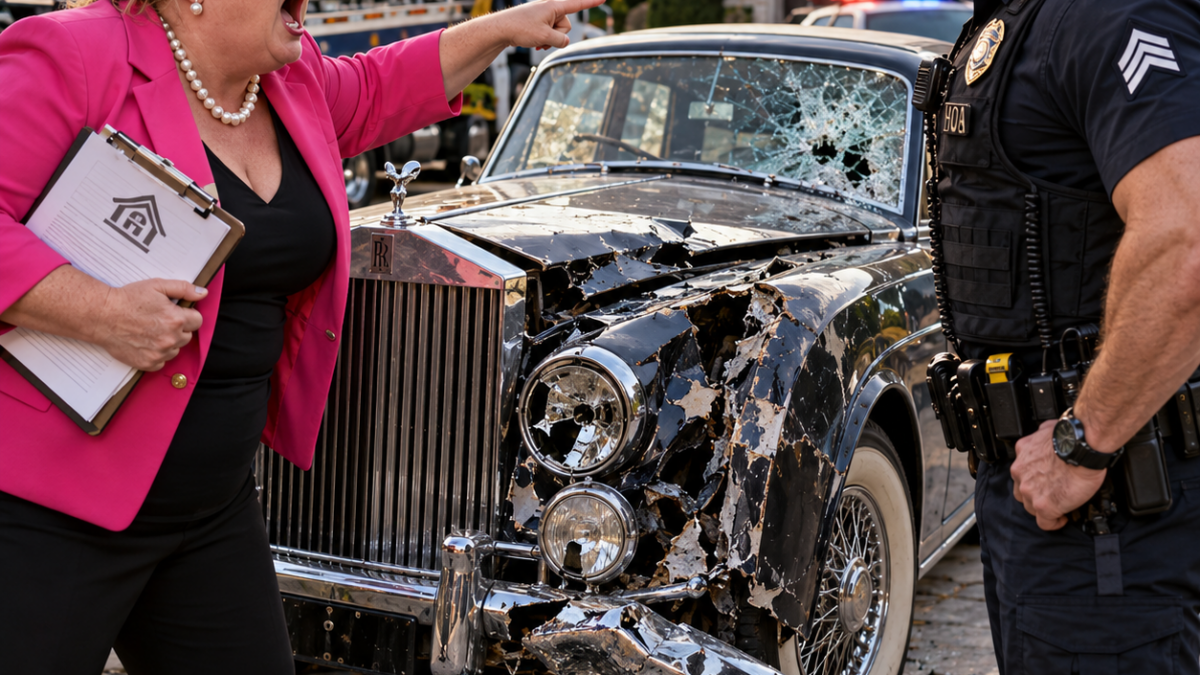
PART 2:
I didn’t tell her either of those things.
That was the hardest decision I made that morning.
My first instinct was not professional.
It was personal.
I wanted to tell Christine Rogers exactly what she had destroyed.
I wanted to watch the expression leave her face when she heard the number.
Two point one million dollars.
I wanted to tell her I was Detective Terry Robinson with the Phoenix Police Department’s Financial Crimes Unit and that what she had just described to me sounded less like HOA enforcement and more like theft, fraudulent documentation, criminal damage, and potentially conspiracy.
Most of all, I wanted to ask her how she had stood there smiling while telling me that the last physical thing my father and I had built together had been flattened into scrap.
But twenty-three years in law enforcement teaches you something anger never learns.
The first story a suspect tells is often the cleanest evidence you’ll ever get.
Once they understand the stakes, stories change.
Lawyers arrive.
Memories improve.
Documents appear.
Documents disappear.
So instead of raising my voice, I asked, “Who authorized the disposal?”
“I did.”
“Personally?”
“I’m HOA president.”
“Was there a board vote?”
Christine gave a short laugh.
“I don’t need a board vote every time somebody refuses to follow neighborhood standards.”
“Did you send me written notice?”
“We follow all required procedures.”
“That wasn’t my question.”
Her smile thinned.
“Any notices would have been mailed.”
“To what address?”
“This address.”
“I’ve received no tow notice.”
“Then perhaps you overlooked it.”
“What about post-tow notice?”
“That would be Gerald’s department.”
“How long was the car held before destruction?”
She looked irritated now.
“Mr. Robinson, I don’t memorize operational details.”
“You knew it was crushed.”
“Because Gerald told me.”
“When?”
“Yesterday evening.”
“And you didn’t think to contact me before destroying it?”
“It was junk.”
That word again.
Junk.
My father’s hands flashed through my memory.
Grease under his fingernails.
The scar across his right thumb from an accident when I was nine.
The way he would run that thumb across the Shelby’s wood steering wheel whenever he was thinking.
I pushed the memory down.
“Christine, I’m going to need documentation.”
“For what?”
“The violation notice, proof of service, tow authorization, board approval if one exists, towing records, storage records, disposal authorization, and the contract between Westbrook Estates and Rogers Towing.”
She actually laughed.
Not nervously.
Confidently.
“Feel free to file a complaint with the board.”
“I’m asking you directly.”
“And I’m telling you there is a process.”
She started closing the door.
“Submit your concerns in writing.”
“Christine.”
She paused.
“One more question.”
“What?”
“Did you ever enter my garage?”
“No.”
“Did Gerald?”
“No.”
“Then how did his driver remove a vehicle from inside a closed garage?”
For the first time, her face changed.
Not much.
A tiny pause.
Then: “Your garage was open.”
“When?”
“When enforcement arrived.”
“Who opened it?”
“I have no idea.”
She shut the door.
I stood on the porch staring at the wreath hanging above the brass handle.
Everything about the house looked respectable.
Trimmed hedges.
Flag near the garage.
Clean walkway.
No hint that the woman inside had just admitted she ordered somebody else’s property removed and destroyed without knowing what it was worth.
I walked home.
The empty garage seemed larger than before.
I sat at my kitchen table and opened the folder where I kept the Shelby’s records.
Restoration receipts.
Insurance policy.
Appraisal.
Photographs.
Engine numbers.
Original purchase documents from 1967.
Dad’s handwritten notes.
Ten years of work reduced to paper.
The most recent certified appraisal had been performed by Mason Torres four months earlier.
Mason had evaluated collector cars for more than thirty years.
His report was thirty-six pages.
Vehicle identification.
Originality percentage.
Restoration documentation.
Engine and transmission matching.
Market comparables.
Auction trends.
Final insured replacement value:
$2,100,000.
I stared at the figure.
The money mattered.
Of course it did.
But I would have traded the entire appraisal for one more Saturday in the garage with Dad.
That was the part Christine would never understand.
I called my supervisor before I did anything else.
Captain Elena Garcia answered on the second ring.
“Terry?”
“I have a personal situation.”
“How personal?”
“My vehicle was taken from my garage and destroyed.”
Silence.
“Destroyed?”
“HOA tow.”
Another silence.
“What vehicle?”
“The Shelby.”
Elena knew about the car.
Almost everyone in my unit did.
“Oh, God.”
“I need to report it, but I can’t touch the investigation.”
“You absolutely cannot.”
“I know.”
“Where are you?”
“Home.”
“Stay there.”
“I’m not going anywhere.”
“Terry.”
“I said I know.”
Her voice softened.
“You sure?”
I looked toward the garage.
“No.”
That was the first honest thing I had said all morning.
Elena assigned the initial report to officers outside my unit.
I gave a statement as a victim.
Nothing more.
The patrol officer who arrived, Ben Calder, had seen the Shelby once at a department charity event.
He stood inside my garage looking at the empty spot.
“That car?”
“Yes.”
“The blue one?”
“Nightmist blue.”
“Your dad’s?”
“Yes.”
He removed his notebook from his pocket.
“Okay.”
His tone changed.
Not because he knew the value.
Because he understood this wasn’t going to be a neighborhood disagreement.
He photographed the garage door.
There were scratches near the emergency release area.
The lock on the side entry showed no obvious damage.
The main garage door could have been opened using an emergency-release bypass if someone knew how.
My security camera?
I hadn’t installed one inside the garage.
That mistake would bother me for years.
Ben asked, “Do you have any exterior footage?”
Doorbell camera.
Driveway camera.
I pulled the clips.
At 1:13 the previous afternoon, a Rogers Towing flatbed arrived.
At 1:16, Gerald Rogers himself stepped out of the passenger side.
I recognized him from HOA functions.
Big man.
Late fifties.
Gray hair.
He walked around the side of my house.
The camera lost him.
Three minutes later, the garage door started rising.
My stomach turned.
Christine hadn’t merely authorized removal from private property.
Someone had entered the property and opened my garage.
The video showed the Shelby being rolled onto the flatbed at 1:29.
Gerald watched.
He signed something on a clipboard.
Then the truck left.
No police.
No city inspector.
No court order.
No owner.
Ben watched the footage twice.
“You want my opinion?”
“Not yet.”
“Good.”
He continued writing.
“Because officially, I need evidence before I say what I’m thinking.”
“That makes two of us.”
I sent the footage through the evidence portal.
Then I sat alone in the house.
That evening was worse than the morning.
During the day, procedure gave me something to do.
At night, the garage was simply empty.
I found myself opening the door repeatedly.
Not because I expected the car to reappear.
Because some part of my mind still refused to accept absence.
My father had died fourteen months earlier.
The grief had settled into something manageable.
Then Christine crushed the car and reopened everything.
I could hear Dad laughing the day we finally started the rebuilt engine.
Three years into the restoration.
We had spent hours troubleshooting an electrical problem.
When the engine finally caught, he threw both hands in the air like we had won the Super Bowl.
“You hear that?”
“I hear it.”
“That’s what patience sounds like.”
I sat at the kitchen table with his restoration notebook open in front of me.
Patience.
Fine.
I would be patient.
The following morning, I sent Westbrook Estates a formal written request for records.
Every document connected to the tow.
Notice.
Photographs.
Violation history.
Board authorization.
Meeting minutes.
Contract with Rogers Towing.
Invoices.
Disposal records.
Communications between Christine and Gerald.
I requested preservation of all related electronic records too.
Three days later, a single-page response arrived.
REQUEST DENIED.
Christine cited “confidential board deliberations.”
No documents.
No explanation.
That denial was useful.
Not because it proved guilt.
Because it showed resistance.
I sent it to the detective assigned to the case.
His name was Jason Roberts.
Jason had spent six years beside me in Financial Crimes before transferring to a broader investigative squad.
Elena chose him precisely because he knew me well enough to recognize when I was overstepping.
Our first conversation began with:
“You’re not investigating this.”
“I know.”
“You’re not interviewing witnesses.”
“I know.”
“You’re not running databases.”
“I know.”
“You’re not pulling financial records.”
“I know.”
“Terry.”
“What?”
“You’re already doing the face.”
“What face?”
“The one where you pretend you agree while mentally building a spreadsheet.”
Despite everything, I smiled.
“I have public documents I can legally obtain as a homeowner.”
“Fine.”
“And personal records.”
“Fine.”
“And I can give you leads.”
“You can give me information as a complainant.”
“Same thing.”
“It is absolutely not the same thing.”
That boundary mattered.
It frustrated me.
But if Christine was charged, her attorney would attack my profession before discussing her conduct.
A detective angry over a destroyed family heirloom makes an easy villain if police procedures are sloppy.
So I stepped back from official investigative acts.
I focused on my own records.
Christine did not step back.
The first retaliation notice arrived four days after my complaint.
WELCOME MAT EXCEEDS APPROVED DIMENSIONS.
Twenty-five dollars.
I measured it.
Three inches too wide.
The next notice:
UNAUTHORIZED LANDSCAPING.
A weed near the driveway.
Fifty dollars.
Then:
VEHICLE STORAGE NONCOMPLIANCE.
My daily driver.
One hundred dollars.
The phrase at the bottom caught my attention.
Continued violations may result in additional enforcement action, including vehicle removal.
A warning.
Or a reminder.
I photographed every notice.
Saved every envelope.
Logged delivery dates.
I did not respond.
At the monthly HOA meeting, Christine gave a speech about “individual residents who believed community rules did not apply to them.”
She never said my name.
She didn’t need to.
People looked at me.
A week later, an anonymous note appeared in my mailbox.
Maybe you’d be happier somewhere without standards.
No signature.
I bagged it rather than throw it away.
Not because it was automatically criminal.
Because patterns matter.
Neighbors stopped waving.
The couple across the street who used to invite me over for Sunday football suddenly became busy.
I understood how Christine had lasted eighteen years.
Social pressure costs nothing to administer.
You make one person difficult to defend.
Then everyone else begins enforcing silence for you.
The breakthrough came on a Tuesday afternoon.
I was collecting mail when a woman walked quickly toward me from the corner.
Mid-forties.
Dark hair.
Nervous eyes.
“Mr. Robinson?”
“Yes.”
“I’m Pamela Smith.”
I recognized the name.
HOA board member.
She looked toward Christine’s street.
Then pressed a USB drive into my palm.
“There was no board vote.”
“For my car?”
“For most of the things Christine does.”
“What’s on this?”
“Meeting recording.”
“Did you make it?”
“Yes.”
“Why?”
Her eyes filled with something close to shame.
“Because I knew someday somebody would need proof.”
I kept my voice low.
“How long have you been on the board?”
“Eleven years.”
“And you stayed?”
She flinched.
That was answer enough.
“I’m sorry,” I said.
“No. You’re right.”
“I didn’t say anything.”
“You didn’t have to.”
She looked toward my garage.
“I saw your car once.”
“At the summer picnic?”
“Yes.”
“My father’s.”
“I know.”
“How?”
“You talked about him.”
That hurt more than I expected.
Pamela stepped backward.
“Please don’t tell Christine I gave you that.”
“This needs to go to the assigned investigator.”
“Fine.”
“She may learn eventually.”
“I know.”
“Are you willing to speak to police?”
Her breathing changed.
“I don’t know.”
“Then I’m not going to pressure you.”
She nodded.
Started walking away.
Then turned.
“She’s done it before.”
“Cars?”
“Cars. Boats. People.”
“People?”
“She doesn’t tow people.”
Despite myself, I almost laughed.
Pamela didn’t.
“She makes them leave.”
Then she was gone.
I called Jason.
He met me at the station.
I handed him the USB without playing it.
“You haven’t listened?”
“No.”
He looked impressed.
“That physically hurt you, didn’t it?”
“Yes.”
“Good.”
He processed it properly.
Pamela later provided consent and a statement.
The recording had been made during a regular board meeting.
At thirty-two minutes, another member asked about “the Robinson vehicle.”
Christine’s voice answered:
“I already handled it.”
A man asked, “Was there a vote?”
Christine laughed.
“I don’t need board approval for enforcement actions.”
Another voice:
“The car was inside his garage.”
Christine:
“Then he shouldn’t have stored junk where it could affect neighborhood appearance.”
Pamela:
“Christine, we should probably send notice first.”
Christine:
“I have discretionary authority. I’ve been doing this for eighteen years.”
Then Gerald’s voice.
I hadn’t known he attended the meeting.
“You want it gone or not?”
Christine:
“Gone.”
Jason stopped playback.
He looked at me.
“That’s useful.”
“That’s one word.”
“Do not get excited.”
“I’m not.”
“You look excited.”
“I look homicidal.”
“That’s worse.”
I rubbed both hands over my face.
“Sorry.”
Jason leaned back.
“I understand.”
“No, you don’t.”
He didn’t argue.
That was why I trusted him.
The next development came from the tow paperwork.
Some records were public through licensing and local regulatory filings.
Others came through subpoenas once Jason established probable cause for further investigation.
Rogers Towing had served Westbrook Estates exclusively for eleven years.
Sixty-three HOA-directed vehicle removals.
Sixty-three.
Westbrook had only 212 homes.
The financial structure was strange.
The HOA paid Rogers Towing an “enforcement service fee” of roughly $1,500 per removal.
Gerald’s actual towing and disposal expenses were usually between $200 and $400.
Some difference could have been legitimate profit.
But the volume and contract raised conflict concerns because Christine approved the invoices.
Her husband owned the vendor.
The contract had never been competitively rebid.
And board minutes rarely documented the towing actions.
Jason obtained the authorization form for my Shelby.
It read:
ABANDONED VEHICLE.
INOPERABLE.
OWNER NONRESPONSIVE AFTER NOTICE.
All false.
Every word.
The car was registered.
Insured for $1.8 million with a separate collector policy endorsement and updated appraisal.
It ran.
I had driven it forty-eight hours before removal.
I had never received towing notice.
Gerald had entered private property to remove it.
Then there was disposal timing.
The Shelby was towed at 1:29 p.m.
It reached Desert Valley Recycling at 2:17.
The salvage intake record was signed at 2:31.
It was marked for dismantling and crushing the same afternoon.
No meaningful holding period.
No effort to contact me.
No VIN ownership verification beyond the form supplied by Rogers Towing.
Jason stared at the timeline.
“Why the rush?”
“Maybe they always do it.”
“That’s not an answer.”
“No.”
“Maybe the car’s value made somebody nervous.”
“They thought it was junk.”
“Christine did.”
I looked at him.
“You think Gerald knew?”
“I think we ask Gerald.”
That question opened another door.
Gerald’s company had sold certain removed vehicles rather than scrapping them.
A truck.
A vintage motorcycle.
A boat trailer.
A restored pickup.
Some went through auction channels linked to an associate.
Suddenly, Christine’s “community enforcement” looked less like aesthetics and more like inventory acquisition.
But my Shelby had been crushed.
Why destroy the most valuable thing they ever touched?
The answer was simple.
They didn’t recognize it.
To Christine, faded paint meant worthless.
The car looked rough externally because Dad had insisted on completing mechanical originality before final cosmetic work.
The interior was partly restored.
The engine compartment was pristine.
The exterior still carried old paint and surface rust in places.
A casual observer could mistake it for a project car.
A knowledgeable collector wouldn’t.
Gerald apparently never looked closely.
That stupidity did not make the destruction less criminal.
It made it irreversible.
The junkyard manager, Rey Mendoza, remembered the car.
When Jason interviewed him, Rey said, “I asked Gerald if he was sure.”
“Why?”
“It looked old but special.”
“Did you check VIN?”
“I wrote what they supplied.”
“Did you search the model?”
“No.”
“What did Gerald say?”
Rey hesitated.
Then: “He said the HOA owner wanted it gone before the resident could make trouble.”
That phrase became important.
Before the resident could make trouble.
Not before the car caused danger.
Not before a deadline.
Before I could object.
Jason expanded the investigation.
I stayed out.
At home, I did the only things I was allowed to do.
Grieve.
Document retaliation against me.
And search my own family records.
Dad and I had spent approximately $340,000 over ten years restoring the Shelby.
Receipts.
NOS parts.
Specialist labor.
Engine work.
Body preservation.
Transmission rebuild.
Suspension.
Correct wheels.
Interior components.
Rare documentation.
The car had a known history.
The 2.1 million appraisal wasn’t fantasy.
Comparable Shelbies had sold near or above that level depending on provenance and condition.
My insurer dispatched its own adjuster.
When he saw the garage footage, appraisal, and tow records, he said, “This is going to be ugly.”
“I know.”
“Were you adequately insured?”
“Not for full current appraisal.”
“Policy limit is 1.8.”
“Yes.”
“You know subrogation is going to come.”
“Yes.”
He looked at me.
“You’re very calm.”
“No.”
“You sound calm.”
“That’s different.”
After he left, I went into the garage and sat on the floor.
Dad’s old toolbox remained against the wall.
I opened the top drawer.
His gloves were still inside.
I hadn’t touched them since he died.
Leather cracked.
One thumb stained black.
I put my face in my hands.
That was the night I finally admitted something to myself.
I had been using the investigation to avoid grief.
As long as Christine was a suspect and the HOA was a pattern and the invoices were evidence, I didn’t have to think about Dad.
Evidence is organized.
Grief is not.
The next morning, I called Mason Torres.
The appraiser.
He remembered the car immediately.
“Terry, I heard.”
“News travels.”
“Collector community travels faster.”
“You still have your work file?”
“Every photo.”
“I need a new statement.”
“For police?”
“Yes.”
“Value at time of loss?”
“Yes.”
He paused.
“You okay?”
“No.”
“Good answer.”
Mason later gave Jason the full appraisal basis.
He also explained something that changed the way prosecutors viewed the damage.
The car’s value wasn’t simply market hype.
It had matching drivetrain components.
Extensive provenance.
Original purchase documentation.
Rare factory configuration.
Family ownership from new.
Long-term restoration records.
That provenance was part of the value.
Destroying the car destroyed irreplaceable authenticity.
You could buy another Shelby.
You could not buy Dad’s.
That mattered emotionally more than legally.
But even legally, provenance mattered.
The case was growing beyond my vehicle.
Jason found fifty-one towing actions with no clear board authorization.
Twelve had explicit votes.
The rest were directed through presidential “discretion.”
He identified fourteen homeowners who sold their properties within sixty days of major enforcement disputes.
Correlation isn’t causation.
But fourteen was enough to justify interviews.
The third person he located was David Parker.
David had owned a nineteen-foot fishing boat.
Stored on a trailer.
Covered.
Inside his side-yard fence.
Christine decided it violated aesthetics.
While David traveled for work, Rogers Towing removed it.
By the time he returned, the boat had been sold at an auction connected to one of Gerald’s business associates.
David hired an attorney.
Christine responded with new violations.
Roof color.
Trash storage.
Fence condition.
Landscape maintenance.
“Every week something,” David told Jason.
I wasn’t present for the official interview, but I later read his statement after the case became public.
One sentence stayed with me.
“I stopped fighting because I realized she had more time to ruin my life than I had money to defend it.”
That was Christine’s real weapon.
Not bylaws.
Cost asymmetry.
She could generate a violation in five minutes.
A homeowner might spend five hundred dollars asking a lawyer to challenge it.
Do that enough times and being right becomes unaffordable.
David sold at a loss.
Moved.
Never returned.
Another former resident, Lisa Brenner, described a similar pattern.
Her son’s old pickup disappeared after warnings.
She challenged Christine.
Suddenly landscaping violations arrived weekly.
Then noise complaints.
Then a pet violation for a dog she didn’t own.
She sold after eight months.
“I thought I was losing my mind,” Lisa told investigators.
That phrase reminded me of financial-abuse victims I had interviewed professionally.
Power doesn’t only take property.
It teaches people not to trust their own interpretation of events.
Jason called me one Tuesday morning.
“We need to talk.”
“Bad?”
“Complicated.”
We met at a diner outside Westbrook.
Neutral location.
He brought no case file into public view, just a legal pad.
“We have probable cause developing on more than the car.”
“Christine?”
“And Gerald.”
“What charges?”
“Prosecutor decides final counts.”
“Jason.”
He sighed.
“Potential criminal damage. Theft-related offenses. Fraudulent schemes. Conspiracy. Depending on how financial records land.”
“And the towing contract?”
“Bad.”
“How bad?”
“Gerald billed the HOA significantly above actual tow and disposal costs.”
“Profit isn’t illegal.”
“No.”
“Kickbacks?”
“We’re examining distributions.”
“To Christine?”
“They’re married.”
“Again, not illegal.”
“Terry.”
“I’m being difficult.”
“Yes.”
“Occupational hazard.”
Jason lowered his voice.
“We found transfers from Rogers Towing into an account Christine used for HOA campaign mailers, travel, and personal expenses.”
That was different.
“HOA money?”
“Potentially.”
“How?”
“HOA pays Gerald. Gerald moves money. Christine receives benefits.”
“Board know?”
“Not according to Pamela.”
I leaned back.
“This is bigger than my car.”
Jason looked at me.
“It was bigger before your car.”
That sentence changed my anger.
Until then, some ugly piece of me wanted Christine punished because she hurt me.
Now I understood I was simply the latest person in line.
The difference was I knew how lines of evidence connected.
I knew people who could investigate.
I had insurance.
I had resources.
David Parker had not.
Lisa Brenner had not.
Dad’s Shelby was the mistake large enough to force everyone to look.
The investigation moved slowly.
Painfully slowly.
Search warrants require affidavits.
Financial subpoenas take time.
Records arrive incomplete.
Witnesses contradict themselves.
Defendants hire attorneys.
Nothing resembles television.
Two months passed.
Christine stayed HOA president.
That was the worst part.
Every few weeks I watched her walk past my house with her clipboard.
The violation notices continued.
Then stopped abruptly.
I later learned her attorney had advised her to stop contacting me.
Pamela became more frightened.
Someone left another note near her mailbox.
KEEP YOUR MOUTH SHUT.
She reported it.
No fingerprints.
No camera.
Could have been unrelated.
Could have been intimidation.
Investigators documented it without overclaiming.
Christine held a board meeting where she accused “outside forces” of attacking community sovereignty.
Pamela recorded that one openly.
A resident asked whether Rogers Towing’s contract created a conflict of interest.
Christine responded:
“My husband has served this community faithfully for over a decade.”
Someone asked whether other companies had been allowed to bid.
Christine ended discussion.
More residents started asking questions.
That was something she couldn’t control.
Once people smell secrecy, even loyal followers become amateur auditors.
Copies of old invoices circulated.
Board members found discrepancies.
An HOA treasurer named Mark Ellison discovered that certain “emergency enforcement” expenses had been approved under Christine’s signature alone.
Pamela resigned from the board and agreed to cooperate fully.
That shook the community.
Christine responded by calling her disloyal.
Pamela posted one sentence publicly.
“Transparency is not disloyalty.”
It received more support than anything Christine had posted in years.
Power shifts before authority notices.
The criminal case reached a turning point when Gerald’s accountant cooperated.
Her name was Monica Reyes.
No relation to anyone else involved.
Monica had repeatedly advised Gerald to separate HOA-related income from personal household transfers more clearly.
He ignored her.
She kept emails.
One from Christine read:
Make sure Westbrook invoices stay at the standard enforcement rate. Board members don’t need disposal-level detail.
Another:
If residents start asking where vehicles go, refer them back to me.
Then the message tied directly to my Shelby:
Terry Robinson car is approved. Get it out Tuesday before he comes off nights. Don’t store it. I don’t want him creating a scene.
I read that email months later after discovery.
Before he comes off nights.
She knew my schedule.
Someone had watched.
The car was removed while I was on shift intentionally.
“Don’t store it.”
That explained the immediate destruction.
Christine didn’t accidentally fail to provide reclamation time.
She wanted the vehicle gone before I could object.
The email did not mention value.
She truly believed she was crushing junk.
But ignorance of value didn’t create authority.
If anything, it showed how casually she exercised control over other people’s property.
Jason called me again.
“We’re getting close.”
“How close?”
“Don’t ask.”
“Then why call?”
“Because the prosecutor wants to know whether you’d testify.”
I laughed.
“Seriously?”
“Terry.”
“Yes.”
“About your father too?”
That stopped me.
“Why?”
“Value and emotional context may matter at sentencing and restitution. But trial evidence stays focused.”
“Fine.”
“One more thing.”
“What?”
“The monthly HOA meeting.”
I had mentioned months earlier that I wanted Christine to answer publicly before any arrest.
Jason had dismissed it as risky.
Now he said, “The prosecutor may permit contact as long as you remain strictly a resident asking legitimate questions and we don’t manufacture statements.”
“You have warrants?”
“Not answering.”
“That means yes.”
“Stop being a detective.”
“I literally am one.”
“Tonight, you’re a homeowner.”
The third Thursday of October arrived cool for Phoenix.
Westbrook’s community center was full.
About forty residents.
Christine sat at the center of the board table wearing a cream blazer and pearl earrings.
Gerald wasn’t there.
Pamela sat in the audience now.
Not at the board table.
She looked exhausted.
I took a chair in the back.
Jason and the arrest team waited away from the building.
Not for a “signal” from me exactly.
They had their own operational plan.
That distinction matters.
Christine moved through the agenda.
Budget.
Landscaping.
Holiday decorations.
Pool maintenance.
She sounded completely normal.
That was almost surreal.
A woman under criminal investigation discussing acceptable Christmas wreath dimensions.
Then came resident questions.
I raised my hand.
Her eyes found me.
The room changed.
“Yes, Mr. Robinson.”
“I have questions about vehicle towing.”
“That matter is pending and inappropriate for public discussion.”
“I’m asking about HOA procedure.”
“Submit questions in writing.”
“I did.”
“You received a response.”
“You denied access to the records.”
Murmurs.
Christine’s jaw tightened.
“Board records contain privileged material.”
“I’m not asking for attorney communications.”
“Mr. Robinson—”
“Did you authorize the removal of my 1967 Shelby GT500 on September fourteenth?”
The room went quiet.
Christine looked around.
She had a choice.
Refuse.
Or perform authority.
She chose performance.
“Yes.”
“Personally?”
“Yes.”
“Was there a board vote?”
“I have discretionary authority.”
“Where?”
“Section Twelve.”
I held up the bylaws.
“Section Twelve allows enforcement consistent with applicable law. It does not authorize unilateral destruction of resident property.”
“I disagree.”
“What happened to my car after your husband’s company removed it?”
“It was properly disposed of.”
“Meaning?”
“You know what it means.”
“I want the board to hear you say it.”
Her eyes narrowed.
“It was scrapped.”
“Crushed?”
“Yes.”
“Before I was notified?”
“You had been warned repeatedly that the vehicle violated community standards.”
“Was I given a towing notice seventy-two hours before removal?”
“Our procedures were followed.”
“That’s not an answer.”
“Terry,” one board member said, “let her answer.”
Christine shot him a look.
That mattered.
A month earlier, no board member would have challenged her.
She said, “Notices were sent.”
“To what address?”
“The address on file.”
“Can you produce one?”
“Not from memory.”
“Post-tow notice?”
“Handled by Rogers Towing.”
“Reclamation period?”
“Again, operational matter.”
I held up the authorization form.
“This describes my car as abandoned, inoperable, and belonging to an owner who failed to respond to notice.”
She didn’t speak.
“The car was inside my private garage.”
People turned toward one another.
“I drove it forty-eight hours before removal.”
More murmurs.
“I received no pre-tow notice, no post-tow notice, and no opportunity to reclaim it.”
Christine stood.
“This meeting is not a courtroom.”
“No.”
I stood too.
“That’s why I’m asking as a homeowner.”
Her face hardened.
“You’ve spent months attacking this association because you refuse to accept community standards.”
I picked up a document.
“Would you like to know what you destroyed?”
“It was an old Mustang.”
“Shelby GT500.”
“Whatever.”
That word did it.
Not emotionally.
Strategically.
I placed Mason Torres’s certified appraisal on the table in front of the first row.
“Certified market valuation four months before destruction: two million one hundred thousand dollars.”
Nobody spoke.
Christine stared.
Then laughed.
A nervous sound.
“That’s absurd.”
“No.”
“It looked like scrap.”
“The exterior restoration was incomplete. The drivetrain, provenance, matching components, rarity, documentation, and market history were all evaluated.”
I handed a copy to the board secretary.
“Mason Torres. Thirty-two years appraising collector vehicles. Accepted by insurers, auction houses, and courts.”
Christine sat slowly.
Her face had lost color.
A man near the front whispered, “Two million dollars?”
Another resident said, “She crushed two million?”
Christine snapped, “This is manipulation.”
I continued.
“The insurance policy, restoration receipts, photographs, operating videos, and appraisal have all been preserved.”
Then she asked the question I knew was coming.
“Who exactly are you?”
I almost felt sorry for her.
Almost.
“My name is Terry Robinson.”
“I know your name.”
“I’m a detective with the Phoenix Police Department Financial Crimes Unit.”
The room erupted.
Not loudly at first.
Gasps.
Whispers.
Then voices.
Christine gripped the edge of the table.
“You’re a cop?”
“Yes.”
“You’ve been investigating me?”
“No.”
That answer mattered.
“I have not participated in the official criminal investigation beyond providing evidence as a victim and witness.”
Her eyes widened at the word criminal.
“What criminal investigation?”
I heard the rear door open.
Jason Roberts entered with two officers.
The room fell silent again.
Christine looked from Jason to me.
Then back.
Jason approached the board table.
“Christine Rogers?”
She didn’t answer.
“Mrs. Rogers, stand up, please.”
Her voice shook.
“What is this?”
Jason identified himself.
Then informed her she was under arrest based on signed warrants involving suspected criminal damage, theft-related conduct, fraud, and conspiracy.
Her attorney would later argue about precise legal characterization.
That night, what mattered was simpler.
For eighteen years, Christine had been the person telling others what happened next.
Now she wasn’t.
She stood.
One officer moved beside her.
Nobody cheered.
I was glad.
Real arrests are not movie endings.
They are procedures.
Handcuffs.
Rights advisement.
Property inventory.
Transportation.
Christine looked at me as she walked past.
For the first time since I met her, there was no condescension in her face.
Only confusion.
“How could you let me—”
She stopped herself.
Let her what?
Destroy the car?
Lie?
Retaliate?
Keep talking?
I said nothing.
Gerald was arrested separately at home.
The state case was only the beginning.
Searches of Rogers Towing produced records from four other HOA communities.
Similar contracts.
Similar inflated “enforcement” billing.
Vehicle removals that bypassed ordinary procedures.
Some vehicles auctioned.
Some scrapped.
Money moved between business accounts and family accounts.
The broader pattern attracted state financial investigators and eventually federal attention because transactions, electronic payments, and business practices crossed jurisdictional lines.
What began with one destroyed Shelby exposed years of questionable enforcement.
The community center remained silent after Christine left.
Finally, Pamela stood.
Her hands shook.
“I think we need to adjourn.”
Nobody objected.
As residents filed out, several tried to speak to me.
I couldn’t.
I walked to my daily driver.
Sat behind the wheel.
Closed the door.
Then broke down.
Not loudly.
No dramatic sobbing.
Just tears.
I had spent months imagining Christine’s arrest as a finish line.
It wasn’t.
Justice could punish Christine.
It could return money.
It could dissolve contracts.
It could expose Gerald.
It could help David.
It could help Pamela.
It could not rebuild Dad’s Shelby.
The steering wheel in front of me was plastic.
Dad’s had been wood.
I remembered his hands.
The final drive.
He had been weak by then.
Couldn’t stay out long.
We drove fifteen miles through the desert just after sunrise.
He rested his hand on the dash.
“You’ll finish her.”
“The car?”
“What else?”
“I don’t know if I can get the paint right.”
“You’re too worried about perfect.”
“That from you?”
He laughed.
“You got that problem from your mother.”
It was the last time he laughed in the Shelby.
Two weeks later, he went into the hospital.
He never came home.
I finished the remaining restoration details alone.
The first complete drive after final mechanical adjustment felt wrong because the passenger seat was empty.
Now the entire car was gone.
I started my daily driver.
Went home.
Opened the empty garage.
And finally allowed myself to understand that no verdict would fix that space.
The legal process took months.
Christine’s attorney attacked the appraisal.
Mason defended it.
They attacked the tow footage.
Forensics authenticated it.
They claimed Christine believed she had HOA authority.
The prosecution produced bylaws, legal guidance, board testimony, and her own emails showing she bypassed votes and wanted my car removed before I came off shift.
They attacked the allegation of financial misconduct.
Investigators produced eleven years of towing records.
Pamela testified.
Mark Ellison testified.
Former residents came forward.
David Parker agreed to speak.
Lisa Brenner too.
Then Gerald’s business records expanded everything.
Christine did not go to trial.
On the third day of jury selection, after months of pretrial litigation and discovery, she accepted a plea agreement.
The final state charges and sentencing were narrower than every theory investigators had considered.
That is normal.
Prosecutors charge what they can prove and negotiate around risk.
Christine received three and a half years in state prison.
Gerald received a shorter custodial exposure under his agreement, followed by probation, and lost his towing business licensing.
Separate financial proceedings connected to broader activity continued.
Restitution for my Shelby was set using the certified valuation and available insurance offsets, with liability allocated through court orders, asset recovery, and civil claims.
People heard “$2.1 million restitution” and assumed a check arrived.
It didn’t work that way.
Assets had to be identified.
Insurance paid according to policy limits.
Subrogation claims followed.
Christine and Gerald did not magically possess two million dollars in cash.
Their home was sold.
Business equipment liquidated.
Accounts frozen where legally authorized.
The process stretched.
I stopped caring about the number.
Not completely.
Money matters.
But the check could have been ten million and the garage would still have been empty.
Twelve additional residents came forward after Christine’s arrest.
Some had lost vehicles.
Some had paid questionable fees.
Others described years of retaliation.
Civil suits followed.
Westbrook’s insurer fought coverage on intentional acts.
Residents became angry because HOA funds were suddenly needed for lawyers and audits.
There was an ugly period when some homeowners blamed me.
One man confronted me outside a grocery store.
“You couldn’t just sue her?”
I stared at him.
“She took my car from inside my garage and destroyed it.”
“Now all our dues are going up.”
“Talk to the person who authorized sixty-three towing actions.”
“She’s in prison.”
“Exactly.”
He walked away angry.
I understood more than I wanted to.
Accountability has costs.
Communities sometimes prefer hidden wrongdoing because exposing it sends a bill.
That doesn’t make hiding it right.
Three months after the arrest, Westbrook held a special election.
Pamela Smith ran reluctantly.
She won by nearly four to one.
Her first meeting was uncomfortable.
Half the residents distrusted the board automatically.
Good.
Pamela published vendor contracts.
Conflict disclosures.
Enforcement logs.
Appeal procedures.
No vehicle tow could be authorized solely by the president.
No immediate disposal.
Independent legal review for contested high-value property.
Documented notice requirements.
Some residents complained the process was too slow.
Pamela said, “Slow is cheaper than prison.”
Nobody argued.
I attended one meeting.
Sat in the back.
Didn’t speak.
An older man stopped me afterward.
“Thank you.”
“For what?”
“For finally stopping her.”
“I didn’t.”
He frowned.
“You did.”
“No.”
I looked toward Pamela gathering papers.
“She stopped herself. People just finally documented it.”
The man nodded.
Then said, “Still. Thank you.”
I accepted it.
Six weeks after the arrest, I got a phone call from Desert Valley Recycling.
Rey Mendoza.
“Terry?”
“Yes.”
“I found something.”
My heart started beating faster.
“What?”
“I don’t want to get your hopes up.”
Too late.
“What did you find?”
“Part of the Shelby.”
I drove there Saturday morning.
The junkyard sat outside Phoenix where the desert flattened into industrial lots.
Rows of stripped vehicles.
Metal stacked like collapsed buildings.
Rey met me near the office.
He looked uncomfortable.
“I’m sorry about what happened.”
“It wasn’t your decision.”
“I should’ve asked more.”
“Gerald gave you paperwork.”
“Bad paperwork.”
“Yes.”
He led me inside.
On his desk sat a steering wheel.
Three-spoke.
Wood rim.
Shelby center emblem.
Dad’s steering wheel.
I stopped in the doorway.
For a second, I was nine years old.
Sitting in the driver’s seat while Dad stood beside the open door.
“Hands at ten and two.”
“I know.”
“You don’t know anything. You’re nine.”
I reached for the wheel on Rey’s desk.
My fingers touched the wood.
Same worn spot near the upper left.
Dad’s thumb.
Thirty years of habit.
Rey said quietly, “Workers stripped some pieces before crushing. Most got sold or processed. One guy set this aside because he thought it looked collectible.”
“Who?”
“Luis.”
“Can I meet him?”
“He’s off today.”
“I want to thank him.”
“I’ll tell him.”
“How much?”
Rey shook his head.
“No.”
“I’m paying.”
“No.”
“Rey.”
He pushed the wheel toward me.
“Take it.”
I couldn’t speak for a few seconds.
Finally, “Thank you.”
He nodded.
That steering wheel went on my mantel beside the last photograph of Dad with the Shelby.
In the picture, he leaned against the passenger fender.
Arms crossed.
Baseball cap.
Thin from treatment but smiling.
The paint still looked rough.
He didn’t care.
We had taken the photograph two months before he died.
He never saw the restoration fully finished.
The final adjustments happened afterward.
For a long time, that fact made me sad.
Then I realized Dad never cared about completion the way I did.
He cared about the work.
The time.
Saturday mornings.
Arguments.
Teaching.
Coffee balanced on toolboxes.
Running to the parts store because we bought the wrong gasket.
He had already gotten what he wanted from the car.
Me.
Years passed.
Christine served her sentence.
Gerald’s business disappeared.
Broader financial cases and civil actions moved through their own slow systems.
Some former residents received settlements.
Some claims failed.
Some could not be proved after too much time had passed.
David Parker called me one evening.
“You know what’s weird?”
“What?”
“I finally bought another boat.”
“That’s good.”
“I spent twenty minutes checking whether my new HOA allows it.”
I laughed.
“Trauma.”
“Absolutely.”
“What did they say?”
“No HOA.”
“Smart man.”
Pamela remained president for two terms.
Then stepped down voluntarily.
At her final meeting, residents gave her a standing ovation.
She called me afterward.
“I hated every minute of that job.”
“You were good at it.”
“That’s not a reason to keep doing something.”
I thought about Dad.
“No.”
“It isn’t.”
The first anniversary of the Shelby’s destruction was harder than I expected.
I came home after work.
6:41 a.m.
Almost the same time.
Opened the garage.
Still empty in that space.
I had intentionally never parked another car there.
That suddenly seemed ridiculous.
Dad would have hated the shrine mentality.
He used tools.
He didn’t worship them.
So that weekend, I moved my daily driver into the garage.
It felt wrong.
Then normal.
That was important.
Loss needs room.
But if you give it every room, eventually you have nowhere left to live.
I kept the steering wheel inside the house.
Sometimes visitors asked why.
I told the short version.
“My dad’s car.”
People who knew the news asked, “The two-million-dollar one?”
I hated that description.
The two-million-dollar car.
As if price explained grief.
One afternoon, Mason Torres visited.
He looked at the wheel.
“Only thing left?”
“Mostly.”
He ran a hand near it without touching.
“You going to buy another Shelby?”
“I could.”
“You thinking about it?”
“Sometimes.”
“Don’t.”
I looked at him.
“Why?”
“You’d spend the rest of your life trying to make it become that car.”
He pointed toward the wheel.
“It never will.”
He was right.
So I bought something else.
A 1972 Ford F-100 pickup in terrible condition.
Not valuable.
Not rare.
Faded green paint.
Cracked bench seat.
Oil leak.
The kind of truck Dad would have loved because it required work.
I brought it home and parked it in the garage.
Then did something I hadn’t done since he died.
I opened his toolbox.
Not as memory.
To use it.
The first repair was simple.
Fuel pump.
I could have finished in an hour.
It took three because I kept remembering Dad’s voice.
“Don’t force the bolt.”
“Clean the surface first.”
“If you’re going to do it twice, you had time to do it right once.”
At some point, I started laughing.
Alone in the garage.
Grease on my hands.
Dad’s wrench in mine.
The old pain was there.
But something else existed beside it.
Continuity.
Christine destroyed the Shelby.
That was real.
She did not destroy what Dad taught me.
That sounded sentimental when I first thought it.
Then I realized it was literally true.
My hands worked differently because of him.
I checked threads before tightening.
Organized removed parts.
Photographed assemblies.
Labeled bags.
Used torque specifications.
Every habit came from Dad.
The car had been evidence of our relationship.
It was never the relationship itself.
The criminal case taught me something professionally too.
I became more careful about victims who started with what sounded like “small” complaints.
An HOA took my boat.
A contractor kept my equipment.
A family member changed the account.
A manager charged fees I don’t understand.
Financial exploitation often wears boring clothes.
Forms.
Invoices.
Policies.
Rules.
Receipts.
People imagine major fraud as men moving millions through offshore accounts.
Sometimes it begins with a woman holding a clipboard and saying:
“That’s junk. I can remove it.”
My unit began coordinating more closely with elder-fraud and property-crime investigators on repeated civil-looking complaints.
Not every HOA dispute became a criminal case.
Almost none did.
But we asked better questions.
Who benefits?
Where does the money go?
Is there a pattern?
Do the same vendors appear repeatedly?
Are records consistent?
Does pressure escalate when someone challenges the process?
Those questions came directly from Westbrook.
Three years after Christine’s arrest, I ran into Gerald.
Not intentionally.
Hardware store.
He looked older.
Much older.
He saw me near the plumbing aisle.
Stopped.
For a moment, neither of us moved.
Then he said, “Terry.”
“Gerald.”
His eyes dropped.
“I’m sorry about the car.”
I had imagined that sentence many times.
In those imaginary versions, I said something devastating.
Something that made him understand.
Reality was quieter.
“I know.”
He looked surprised.
“You do?”
“I know you’re sorry now.”
His face tightened.
“I didn’t know what it was worth.”
There it was.
I looked at him.
“That was never the point.”
He swallowed.
“I know.”
“Do you?”
“Yes.”
He stared at the floor.
“I should never have entered the garage.”
“No.”
“I should’ve checked ownership.”
“Yes.”
“I should’ve refused Christine.”
“Yes.”
His jaw moved.
“She always said nobody would fight.”
“That worked for a long time.”
He nodded.
Then asked, “Do you hate me?”
I thought about it.
“No.”
That was true.
He seemed almost disappointed.
“I did.”
“When?”
“For a while.”
“What changed?”
“I got tired.”
He nodded slowly.
“I’m sorry.”
Then he walked away.
Forgiveness is an overused word.
I did not absolve Gerald.
I did not forget.
He had consequences.
He deserved them.
But carrying active hatred felt like continuing to let him rent space in the garage after the Shelby was gone.
I didn’t want that.
Five years after Dad died, I completed the F-100.
Not a concours restoration.
Not expensive.
Reliable engine.
New brakes.
Rebuilt suspension.
Kept the faded green paint.
On the first drive, I placed Dad’s old coffee mug in the cup holder.
It rattled terribly.
He would have complained.
I drove out into the desert before sunrise.
No destination.
Just road.
For the first time in years, I understood why Dad loved driving old machinery.
Modern cars isolate you.
Old vehicles communicate every imperfection.
Steering vibration.
Gear noise.
Heat.
Smell.
You participate.
At a turnout, I stopped.
The horizon turned orange.
I sat on the tailgate with coffee.
My phone showed a news reminder.
Christine Rogers had completed her state sentence months earlier.
I had known.
Seeing her name did almost nothing.
That surprised me.
There had been a time when her name could ruin an entire day.
Now it was simply information.
She moved away from Westbrook after release.
The house had been sold during the restitution process.
I didn’t know where she lived.
I didn’t search.
Some people asked whether I wanted to know if she regretted it.
No.
Regret was hers.
Memory was mine.
When I got home, the steering wheel caught the morning light.
The wood grain looked almost gold.
I stood there holding my coffee.
Dad’s photograph beside it.
He was smiling at the Shelby.
Not because it was worth two million dollars.
At that point, it wasn’t finished.
He smiled because we had worked on it that morning.
That was enough for him.
It should have been enough for me.
The following Christmas, my sister visited.
She brought her son, Evan.
Fourteen.
Restless.
Always on his phone.
He wandered into the garage and saw the F-100.
“You built this?”
“Rebuilt.”
“Why?”
“It needed it.”
“That sounds expensive.”
“Less than your phone habits.”
He ignored that.
“Can I start it?”
“No.”
“Why?”
“You don’t know how.”
“Teach me.”
The words hit unexpectedly.
Teach me.
I heard Dad.
I opened the driver door.
“Sit.”
Evan climbed in.
“Foot on brake.”
“Which one?”
I stared at him.
“Get out.”
He laughed.
“I’m kidding.”
“Not funny.”
It was exactly something I would have done to Dad.
We spent an hour going through basics.
Fuel.
Ignition.
Choke.
Gear position.
Listening to the engine.
By the end, Evan’s phone was still in his pocket.
My sister stood in the garage doorway watching.
Later she said, “Dad would’ve loved that.”
“Yeah.”
“You okay?”
I looked toward the mantel through the open interior door.
The steering wheel was visible.
“Yeah.”
And I meant it.
The Shelby remained gone.
Some losses do not shrink.
You simply become large enough to carry them differently.
Christine had spent eighteen years believing authority meant being able to decide what mattered.
Which car was junk.
Which resident was difficult.
Which complaint deserved attention.
Which rule could be bent.
Which board vote could be skipped.
Which family would eventually give up.
She was wrong about all of it.
But the mistake that finally exposed her wasn’t choosing a cop.
People always told the story that way.
“HOA Karen crushed a detective’s two-million-dollar car.”
Catchy.
Viral.
Incomplete.
She could have destroyed a teacher’s $2,000 truck and still been wrong.
She could have taken David Parker’s boat and still been wrong.
She could have pressured Lisa Brenner and still been wrong.
My badge did not make my property more legitimate.
My car’s value did not make the unauthorized taking more offensive in principle.
Those things simply made the case impossible to ignore.
That distinction mattered to me.
Years later, Pamela invited me to the Westbrook community center for one final meeting before she moved.
The building looked different.
New paint.
Different chairs.
Same room.
She handed me a small framed document.
“What’s this?”
The original Rogers Towing contract.
Stamped:
TERMINATED.
I laughed.
“Why would I want this?”
“Because I’m moving and cleaning files.”
“Excellent emotional gift.”
She smiled.
Then turned serious.
“People still talk about your father’s car.”
“I know.”
“I’m sorry.”
“You already said that years ago.”
“Still.”
I looked around.
Residents were arguing about pool hours.
A man complained about landscaping costs.
A woman demanded three bids before replacing community lights.
Pamela followed my gaze.
“Annoying, isn’t it?”
“Beautiful.”
She laughed.
“That’s a very strange word for an HOA meeting.”
“No one’s afraid to ask questions.”
Pamela nodded.
“That part is beautiful.”
On the drive home, I thought about Christine’s first words when I challenged her.
It was junk.
I had the right.
Two sentences.
That was the whole problem.
She confused judgment with ownership.
Because she considered something ugly, she thought she could control it.
Because she held office, she thought she could skip consent.
Because nobody challenged her for years, she mistook lack of resistance for legitimacy.
Then she met consequences.
Not revenge.
Consequences.
Those are different.
Revenge would have been me using my badge to frighten her.
Calling friends.
Sending officers.
Humiliating her publicly without process.
Consequences were slower.
Evidence.
Independent investigators.
Subpoenas.
Witnesses.
Courts.
Appeals.
Financial audits.
Loss of office.
Restitution.
Prison.
Much less emotionally immediate.
Far more durable.
That was how Dad taught me to work on cars too.
Do every step.
Even when nobody sees it.
Especially then.
One evening, I found his old restoration notebook while cleaning a cabinet.
Most pages contained part numbers.
Measurements.
Torque values.
Suppliers.
Near the back, Dad had written something unrelated to the car.
Terry gets impatient when he can see the finish line.
Remind him that rushing the last ten percent ruins the first ninety.
I laughed aloud.
Dad had known me too well.
That sentence described the entire Christine case.
The first morning, I wanted immediate confrontation.
The last months required patience.
If I had flashed my badge at her door, the result might have been a settlement.
Maybe an apology.
Maybe insurance.
Maybe nothing.
Instead, because the case was handled correctly, investigators found sixty-three tows.
Fifty-one questionable authorizations.
Financial conflicts.
Former victims.
A pattern across multiple communities.
The Shelby was gone either way.
But at least its destruction stopped the machine that took it.
That didn’t make the loss “worth it.”
I hate when people say things happen for a reason.
Sometimes terrible things happen because somebody makes a selfish decision.
Meaning comes later from what people do with the damage.
The steering wheel still sits on my mantel.
Not in a glass case.
I dust it occasionally.
Evan once asked why I don’t restore it.
“Restore what?”
“The wood.”
“Because those marks are Dad.”
He understood.
Years of his hands had darkened part of the rim.
One small section was smoother than the rest.
When I hold it, my thumb naturally lands near the same place.
The first time I noticed that, I had to sit down.
Across decades, our hands had chosen the same spot.
No appraisal measured that.
No restitution order could price it.
That was the thing Christine never had the power to destroy.
She destroyed steel.
Glass.
Rubber.
Paint.
Rare parts.
Serial-numbered components.
She destroyed a $2.1 million collector car.
She did not destroy the Saturday mornings.
She did not destroy Dad’s laugh.
She did not destroy the lessons.
She did not destroy the promise I kept by finishing what we started.
And in the end, she couldn’t even destroy the part his hands touched most.
Sometimes that feels like luck.
Sometimes it feels like Dad got the last word.
I know better than to turn coincidence into a sign.
But I still like the thought.
On the tenth anniversary of the day Dad and I began the restoration, I drove the F-100 to his grave.
I brought no flowers.
Dad disliked cut flowers.
“Paying money for dead plants,” he called them.
I sat on the grass.
“Car’s gone.”
Saying it there felt strange.
“I know you know.”
Wind moved through the cemetery trees.
“I finished it.”
I smiled.
“You would’ve complained about the paint.”
No answer.
Obviously.
“I kept the wheel.”
I sat for a while.
Then said the thing that had taken me years to understand.
“I thought finishing the car was the promise.”
My voice caught.
“It wasn’t.”
I looked toward the road where the F-100 waited.
“The promise was remembering how you taught me to do things.”
I stood.
Brushed grass from my jeans.
“Still impatient, by the way.”
Then I left.
The F-100 started on the first turn.
Dad would have approved.
Mostly.
When I got home, evening light came through the living room windows.
It landed across the steering wheel on the mantel.
The wood turned amber.
The photograph beside it showed Dad leaning against the Shelby, smiling like a man who had nowhere else he needed to be.
I poured coffee.
Sat down.
And looked at the two things for a long time.
There had been a period when every glance at that steering wheel brought Christine back.
Her doorway.
Her smile.
“Crushed, Mr. Robinson.”
Not anymore.
Now I saw Dad.
That was how I knew the story was finally over.
Not when Christine was arrested.
Not when the sentence came down.
Not when restitution was ordered.
Not when Westbrook elected a new board.
The story ended when the surviving piece of the Shelby stopped feeling like evidence of what she took and became, once again, something that belonged to my father.
I reached out and rested one hand on the wood.
The same worn section.
The same place his thumb had rested.
For a moment, I could almost hear him beside me in the garage.
“Don’t rush it.”
I smiled.
“I didn’t, Dad.”
Outside, the desert sunset turned the sky orange.
Inside, the steering wheel caught the last light.
And that was enough.
[END OF STORY]








