PART 2: HOA President Had My 200-Year-Old Oaks Topped for Her View—Then Every Certified Arborist Refused to Defend Her
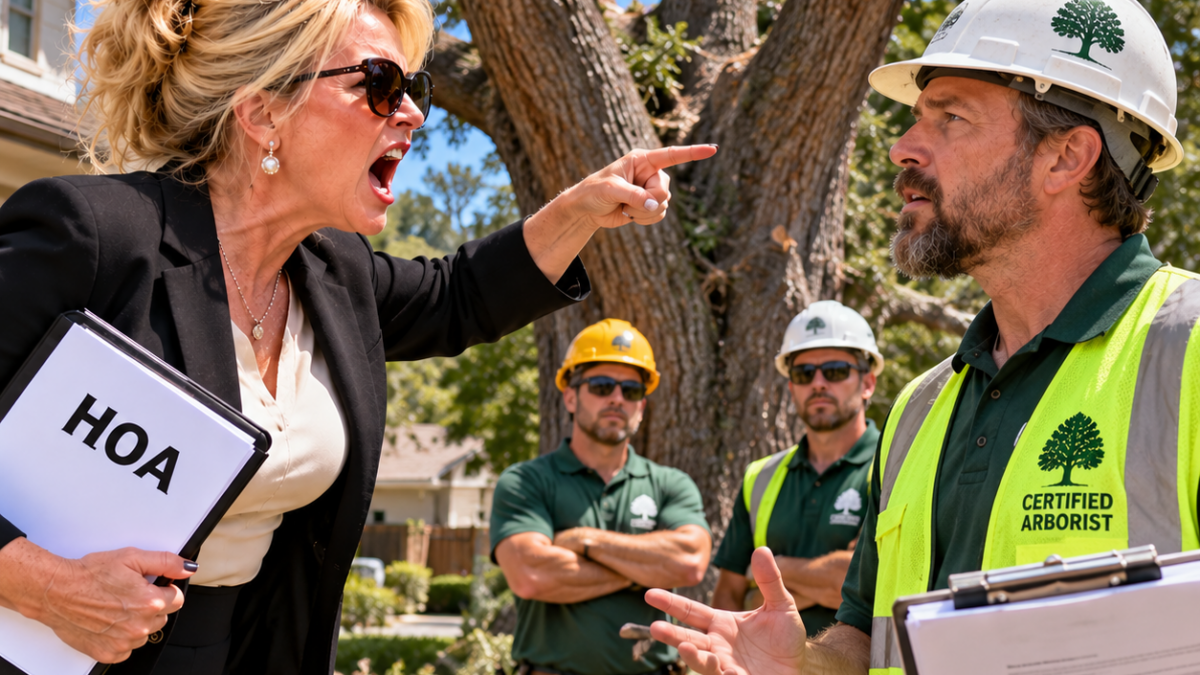
PART 2
I stared at him.
“What do you mean, worth?”
“Monetary value.”
“They’re trees.”
“They’re much more than trees.”
Finch placed his field notebook on the hood of his truck.
“Species, trunk diameter, canopy, condition before damage, placement, contribution to the property, environmental value, historical significance—all of that matters.”
I looked back toward the mutilated crowns.
“I have photographs from last month.”
“Good.”
“Family photographs going back decades.”
“Even better.”
“My father documented them when the development was built.”
Finch nodded.
“Get me everything.”
He paused before climbing into his truck.
“And Jack?”
“Yes?”
“Do not let anyone touch these trees again until we know what we’re dealing with.”
I spent the afternoon walking through debris.
The larger branches had landed where my grandfather once set up picnic tables for summer reunions.
One had crushed a flower bed Sarah had planted the previous spring.
I found an old rope mark on one lower limb that had survived.
When I was ten, my father had hung a tire swing from that branch.
Later, my daughter had used the same tree.
I sat on the grass beneath it.
For the first time that day, the anger gave way to grief.
Sarah came outside carrying two glasses of water.
She sat beside me.
“I keep thinking about your dad.”
“So do I.”
“He would’ve lost his mind.”
“He would’ve gotten arrested.”
That earned a small laugh.
My father had been a good man.
Patient in most things.
Not when it came to those trees.
He once stopped a developer’s bulldozer by parking his pickup in front of it and refusing to move until the project manager produced the approved site plan.
I was twelve.
I thought he was insane.
Thirty-five years later, I understood him perfectly.
Sarah rested her head on my shoulder.
“What do we do?”
“We document everything.”
“You sound like you’re back in uniform.”
“I feel like I am.”
She looked at the stripped canopy.
“I don’t want a war, Jack.”
“Neither do I.”
“You already named it in your head, didn’t you?”
I looked at her.
She knew me too well.
“Not yet.”
“Don’t lie to your wife.”
I sighed.
“Operation Oak Shield.”
Sarah closed her eyes.
“Of course.”
Three days later, Finch returned with a twenty-page preliminary assessment.
We sat at our dining table.
He spread photographs beside his report.
“These two oaks were in exceptionally good health for their age.”
“Were?”
“I’m using past tense because their condition has changed dramatically.”
He pointed at one photograph.
“Look at the size of these cuts. Mature oaks do not compartmentalize wounds like this easily. Every exposed surface becomes a potential entry point for decay organisms.”
“What happens next?”
“They’ll try to survive.”
“How?”
“Epicormic growth. Water sprouts. Dormant buds will activate below the cuts. You’ll see a rush of shoots.”
“That sounds good.”
“It isn’t.”
He shook his head.
“Those shoots are a panic response. They grow quickly but attach weakly. In several years they can become large enough to fail in storms.”
“So topping makes trees more dangerous?”
“Exactly.”
“And Karen’s lawyers will say they were dangerous before.”
Finch looked at me.
“Were they?”
“No.”
“Then make them prove otherwise.”
He slid a final page toward me.
At the bottom was a number.
**Estimated pre-damage contributory and amenity value: $180,000 combined.**
I stared.
“One hundred eighty thousand dollars?”
“Approximately.”
“How?”
He explained the valuation methodology.
No single giant oak could simply be replaced with another two-hundred-year-old oak.
You couldn’t go to a nursery and buy two centuries.
Their size, condition, location, shade value, ecological value, contribution to the property, and history mattered.
The exact number could be challenged.
But the damage was unquestionably substantial.
Finch had estimated that the topping had destroyed roughly ninety-five percent of their preexisting landscape and amenity value.
“They may survive,” he said.
“But economically and structurally, the damage has already occurred.”
I rubbed my forehead.
“And you’ll put your name behind this?”
He looked offended.
“I already did.”
The next morning, the HOA sent me a violation notice.
I opened it standing at the mailbox.
Then I had to read it again because my mind refused to accept the words.
**VIOLATION: UNAPPROVED AND DESTRUCTIVE MODIFICATION OF HERITAGE LANDSCAPING.**
Fine:
$500.
Additional penalty:
$100 per day until corrected.
I laughed once.
Then stopped.
Karen had ordered the trees butchered.
Now she was fining me because they had been butchered.
Sarah found me at the dining table with the notice beside Finch’s report.
“What now?”
I slid it toward her.
She read silently.
Then looked up.
“She did this.”
“I know.”
“She literally hired the people.”
“I know.”
“And she’s fining us?”
“Yes.”
Sarah placed the paper down very carefully.
“I changed my mind.”
“About?”
“The war.”
I looked at her.
“Win.”
That afternoon, I pulled my father’s old HOA documents from a steel file cabinet in the basement.
He saved everything.
Closing papers.
Developer correspondence.
Survey maps.
Original charter drafts.
Meeting notes.
One folder had my name written on it in his block handwriting.
**JACK — KEEP THESE.**
Inside was the document I needed.
Article Nine, Section 4B.
Our five acres were specifically designated as a preservation parcel.
Mature pre-development trees could not be removed or materially altered without the owner’s consent except where a certified professional identified an imminent safety hazard.
I read it three times.
Then photographed it.
Scanned it.
Backed it up.
Printed five copies.
The next board meeting was in two weeks.
I submitted a formal appeal of the fine and requested agenda time to address unauthorized entry onto my property and destruction of protected trees.
No response.
I emailed again.
Nothing.
Called.
Voicemail full.
Sent certified mail.
That finally produced a one-line response.
**Your appeal will be heard during the homeowner compliance portion of the next regular meeting.**
Finch completed the final report.
Twenty pages.
Photos.
Measurements.
Diagrams.
Assessment of topping damage.
Historical condition.
Valuation.
Professional opinion.
I spent the night before the meeting assembling exhibits.
Sarah came into my office after midnight.
“You’re still awake.”
“I want the chronology clean.”
“It’s clean.”
“I’m missing the original development map.”
“It’s under your left hand.”
I looked down.
She smiled.
“Go to bed, Colonel.”
“I’m retired.”
“Apparently not.”
The clubhouse held about thirty people when we arrived.
Karen sat in the center behind a folding table as if it were a judicial bench.
Gary sat to her right.
Brenda to her left.
Gary rarely spoke.
Brenda rarely disagreed with Karen.
Karen called through mundane agenda items first.
Pool maintenance.
Holiday lights.
Pet waste.
Then:
“Next, Mr. Jack Miller, 1200 Oak Lane, landscaping violation appeal.”
I stood.
She glanced at the clock.
“Five minutes.”
“I’ll be concise.”
I walked to the lectern.
“I’m not appealing the underlying facts of the landscaping condition.”
Karen smiled.
“Good.”
“I’m stating that the condition was caused by an unauthorized contractor hired by you.”
Her smile vanished.
A few residents shifted in their chairs.
I connected my laptop to the projector.
The first image appeared.
Before.
Two enormous oaks.
Healthy crowns stretching above our house.
Second image.
After.
The room murmured.
Karen raised her hand.
“Mr. Miller—”
“This is Dr. Alister Finch’s assessment.”
I placed a copy before each board member.
“He is a certified arborist. His conclusion is that both trees suffered catastrophic damage due to topping.”
Karen flipped through the report without reading.
“Your expert works for you.”
“I hired him to assess the damage.”
“So he is not neutral.”
“Fine.”
I looked toward the audience.
“Hire another certified arborist.”
Karen paused.
“Excuse me?”
“Have the HOA hire one. Pick anyone qualified. Ask whether topping two mature heritage oaks like this was professionally acceptable.”
She tapped her pen.
“We don’t need another opinion.”
That response interested me.
I moved to the next slide.
Article Nine, Section 4B.
The preservation clause.
“This is part of the original charter.”
Gary leaned forward.
Brenda stopped pretending not to listen.
I read the key portion aloud.
Karen interrupted.
“Article Five protects community vistas.”
“Article Nine specifically protects this parcel.”
“Rules must be interpreted together.”
“Agreed.”
I looked at her.
“So where is the certified hazard assessment required for overriding the preservation clause?”
Silence.
“Who determined these trees were dangerous?”
“They obstructed a protected view.”
“That’s different.”
“They were overgrown.”
“They were two hundred years old. That tends to happen.”
Someone laughed.
Karen slammed the gavel.
“Order.”
I continued.
“Who authorized the contractor?”
“The executive committee.”
“Meeting date?”
Karen’s jaw tightened.
“Mr. Miller—”
“Resolution?”
“This is not a courtroom.”
“Invoice?”
“Your five minutes are nearly up.”
“Was there a vote?”
Gary looked down.
Brenda shuffled papers.
Karen leaned into the microphone.
“The president has emergency authority to remedy urgent covenant violations.”
“Show me the emergency clause.”
Her face reddened.
“This discussion is over.”
“Then I’m formally requesting the minutes and authorization.”
She struck the gavel.
“Your appeal is denied.”
The room became silent.
Then Karen added:
“Given your hostile and belligerent behavior tonight, the board is increasing the outstanding fine to one thousand dollars.”
I stood there for a second.
Even Gary looked uncomfortable.
“You’re increasing a property fine because you don’t like my attitude?”
“I said your time is over.”
I gathered my papers.
“Please put that reason in the minutes.”
Karen’s face twitched.
I returned to my chair.
Sarah whispered:
“Did she really just do that?”
“Yes.”
“In front of everyone?”
“Yes.”
“Good.”
I looked at her.
“Good?”
“She’s documenting herself.”
Fair point.
After the meeting, people avoided me at first.
Not because they disagreed.
Because they were afraid of being seen agreeing.
Then an elderly woman approached.
Mrs. Gable.
She touched my elbow.
“I’m sorry about your trees.”
“Thank you.”
She glanced toward Karen.
“She’s done things like this before.”
That sentence opened the next phase.
I started walking the neighborhood with Gus, our golden retriever.
Not interrogating anyone.
Just talking.
Weather.
Dogs.
Gardens.
Children.
People eventually tell you what matters when they stop feeling questioned.
Mrs. Gable became the first.
Her garden held about twenty ceramic gnomes.
Her late husband George had collected them during road trips.
Karen called them lawn clutter.
Fifty dollars a month.
Mrs. Gable had paid more than six hundred dollars in fines.
“I know they’re silly,” she said.
“They aren’t silly if they matter to you.”
She picked up one holding a fishing pole.
“George bought this in Wisconsin.”
Her eyes filled.
“I tried putting them away.”
“What happened?”
“I couldn’t.”
“Why?”
“Because it felt like putting him away.”
That landed harder than I expected.
I asked for copies of the violation letters.
Then came the Rodriguez family.
Three front-door repaints.
Three thousand dollars.
Karen kept deciding the beige was not quite right.
The Lees had been fined for a plastic toddler slide visible above their backyard fence.
Another family received repeated warnings over a basketball hoop.
A retired teacher was cited for a birdbath.
None of these cases alone proved corruption.
Together, they showed a culture.
Karen enforced rules as though conformity itself were the objective.
Then I found Marcus Thompson.
Colonel, retired.
JAG Corps.
He had watched my board presentation.
When he opened his door, he recognized me immediately.
“Colonel Miller.”
“Retired.”
“So am I. Doesn’t seem to stick.”
He invited me inside.
I showed him everything.
Finch’s report.
Preservation clause.
Fine.
Video.
Board meeting notes.
Records from other residents.
Marcus read slowly.
Then took off his glasses.
“How much do you like Karen Peters?”
“Not much.”
“Good. Because I’m about to disappoint you.”
I frowned.
“Why?”
“This won’t be fast.”
“I didn’t expect fast.”
“It may not be satisfying either.”
“I’m listening.”
“Courts don’t exist to punish people for being obnoxious. We need causes of action supported by evidence.”
“Unauthorized entry.”
“Potential trespass.”
“Trees.”
“Property damage.”
“HOA money.”
“Potential fiduciary issues.”
“Retaliatory fine.”
“Useful evidence.”
He tapped the video.
“This is useful too.”
“So we sue?”
“Eventually.”
“Eventually?”
“First we send notice.”
“To Karen?”
“To everyone.”
Marcus drafted a preservation letter demanding that the HOA retain all emails, texts, invoices, minutes, photographs, and communications relating to my property.
Then a formal demand.
Rescind the fine.
Cease additional penalties.
Disclose who authorized the work.
Identify the contractor.
Preserve insurance information.
Pay for professional remediation and proven damages.
The response came from a downtown law firm.
Three pages of expensive stationery saying, essentially, no.
They claimed Karen acted under covenant enforcement authority.
They characterized the topping as routine maintenance.
They rejected Finch’s valuation.
They threatened to seek legal fees if I sued.
Marcus smiled.
“They’ve committed.”
“To what?”
“A story.”
He pointed at their letter.
“They’re saying this was legitimate pruning performed under valid authority.”
“And?”
“Now we see whether the documents agree.”
We filed.
The complaint named the HOA and Karen individually, subject to what the evidence ultimately supported.
Trespass.
Property damage.
Breach of fiduciary duty theories.
Declaratory and injunctive relief.
Damages.
Karen’s response arrived through counsel.
Frivolous.
Meritless.
Disgruntled homeowner.
Routine covenant enforcement.
Standard legal language.
Then she published an HOA newsletter.
It did not name me.
It did not need to.
She warned residents about “litigious individuals attempting to undermine the community for personal financial gain.”
I read it at breakfast.
Sarah watched my face.
“Angry?”
“Yes.”
“Going to answer?”
“No.”
That surprised her.
“Why?”
“Discovery will answer.”
Marcus requested emails.
Texts.
Minutes.
Invoices.
Contractor communications.
Financial records.
The HOA objected.
Overbroad.
Burden.
Privilege.
Irrelevant.
Marcus filed a motion to compel.
The hearing lasted less than twenty minutes.
Judge Esposito looked at the HOA attorney.
“Your client claims this work was authorized?”
“Yes, Your Honor.”
“Then produce the authorization.”
“It involves confidential board deliberations.”
“Authorization is not magically confidential because it is inconvenient.”
The attorney tried again.
Judge Esposito raised a hand.
“Produce the responsive records consistent with applicable privileges. Thirty days.”
Outside the courthouse, Marcus looked at me.
“That went well.”
“Was that your excited voice?”
“Very.”
Thirty days later, two boxes arrived.
Then a hard drive.
Disorganized.
Duplicates everywhere.
Missing chronology.
Marcus looked at the pile.
“Document dump.”
I smiled.
“What?”
“You’re forgetting who you’re working with.”
I spent years managing military construction logistics.
Chaos with labels was practically recreation.
For six days, Marcus and I sorted.
Sarah helped.
Dates.
Authors.
Subjects.
Attachments.
Invoices.
Board votes.
Contractors.
By day four, we could reconstruct almost every step.
Karen had not requested approval.
She had informed people.
Her emails routinely said things like:
**I have decided.**
**I instructed management.**
**I told the vendor.**
Then we found the tree-service thread.
**A-1 Affordable Tree Service.**
Not the HOA’s regular tree contractor.
Not the company listed in annual maintenance records.
Karen had contacted them directly.
The first email stopped me cold.
**Need quote to top two large oaks at 1200 Oak Lane to improve view from ridge. Discretion important.**
I read it twice.
“View from ridge.”
Marcus leaned over my shoulder.
“Who lives on the ridge?”
“Karen.”
“Anyone else affected?”
“Several houses, but hers has the direct line.”
The next email was from Sal, the contractor.
**Do you have homeowner permission? Need written authorization before scheduling.**
Then Karen’s response.
**I am HOA president. My authority is the only permission required. Owner is noncompliant. Get it done. We will handle the fallout.**
The room became silent.
Sarah sat across from us.
She had one hand over her mouth.
Marcus printed the email.
Then printed it again.
“That,” he said, “is very bad for her.”
I looked at the words.
**We will handle the fallout.**
“She knew.”
“At minimum, she knew the contractor wanted owner consent.”
“And lied.”
“She represented that her office substituted for it.”
Marcus lifted a finger.
“Let’s stay precise.”
I nodded.
Old habit met lawyer habit.
He was right.
We did not need exaggeration.
Karen had written enough.
Another email came from Brenda.
**Are you sure Jack won’t sue?**
Karen answered:
**He can complain all he wants. The association carries insurance for a reason.**
Gary had responded with a thumbs-up emoji.
I almost felt sorry for him.
Almost.
Then came the contractor deposition.
Sal arrived with his own attorney.
He looked nothing like the men who had been on my property that morning, though his company name had been on their invoice.
Marcus kept his tone polite.
“You own A-1 Affordable Tree Service?”
“Yes.”
“Did your company perform work at 1200 Oak Lane?”
“Yes.”
“Who retained you?”
“Mrs. Peters.”
“Personally or on behalf of the HOA?”
“She said HOA.”
“Did you speak with Mr. Miller before entering his property?”
“No.”
“Did you have written permission from him?”
“No.”
“Did you request it?”
Sal looked toward his lawyer.
“Yes.”
Marcus showed the email.
“Is this that request?”
“Yes.”
“And this response came from Mrs. Peters?”
“Yes.”
“She told you her authority was sufficient?”
“Yes.”
“Why did you accept that?”
“She was the president.”
“That was enough?”
“She said the homeowner had been warned.”
“Did she provide an easement?”
“No.”
“Court order?”
“No.”
“Owner authorization?”
“No.”
“Board resolution?”
“No.”
Sal shifted.
“I figured an HOA knows its rules.”
Marcus looked down at his notes.
“Who specified topping?”
“She did.”
“Did you recommend topping?”
Sal hesitated.
“That’s complicated.”
“How?”
“I told her we could reduce some limbs.”
“Did you tell her removing the upper third could hurt the trees?”
His attorney objected.
Marcus waited.
Sal sighed.
“Yeah.”
My hands tightened beneath the table.
Marcus did not react.
“What did she say?”
“That she wanted the view opened.”
There it was.
Not safety.
Not disease.
Not storm damage.
View.
Marcus asked:
“Did Mrs. Peters ever use the phrase hazard tree?”
“Not with me.”
“Did you inspect for disease?”
“No.”
“Structural failure risk?”
“No.”
“Root problems?”
“No.”
“Did she ask you to?”
“No.”
Afterward, I walked to the parking garage with Marcus.
“I wanted to punch him.”
“I noticed.”
“He knew topping was bad.”
“Yes.”
“And did it.”
“He also just gave us useful testimony.”
“That doesn’t make me like him.”
“You are under no legal obligation to like him.”
Karen’s deposition came next.
She arrived with two attorneys.
She was composed.
Expensive suit.
Neat folder.
Expression of mild annoyance.
Marcus began with the charter.
“Mrs. Peters, please read Article Nine, Section 4B.”
She read.
Her voice slowed at the preservation language.
“Were you aware of this provision before October fifteenth?”
“I was generally familiar with the covenants.”
“That wasn’t my question.”
“Yes.”
“Did Mr. Miller consent to topping the trees?”
“No.”
“Did a certified arborist declare them an imminent hazard?”
“We had concerns.”
“Did a certified arborist?”
“No.”
“Did the board pass a resolution authorizing the work?”
“The executive committee—”
“Was there a recorded vote?”
“Our procedures permit—”
“Yes or no?”
Her lawyer objected.
Marcus waited.
Karen finally said:
“Not a formal vote.”
Then the A-1 email.
“Is this your email?”
“Yes.”
“You wrote, ‘My authority is the only permission you need’?”
“In context.”
“What context makes that statement accurate?”
“I was acting as president.”
Marcus placed the preservation clause beside the email.
“Where does this document give you unilateral authority to order destructive work on protected vegetation?”
Her attorney objected again.
Karen interrupted him.
“I was protecting property values.”
Marcus looked at her.
“Whose?”
Karen stopped.
“What?”
“Whose property value were you protecting?”
“The community’s.”
“Was your home’s sunset view improved after the trees were topped?”
Her face changed.
“My property is irrelevant.”
“Did it improve?”
“I don’t know.”
“You live directly behind Mr. Miller on the ridge?”
“Yes.”
“You complained about those trees?”
“So did others.”
“Names?”
She named two residents.
We later contacted both.
One said he had mentioned that the sunset view was “a little blocked” during casual conversation but never requested tree removal.
The second said Karen asked whether he would prefer fewer branches and he answered, “I guess.”
Neither had filed a complaint.
Then Marcus placed Finch’s report in front of her.
“You call this routine maintenance?”
“I’m not an arborist.”
“Exactly.”
Karen’s attorney looked at her.
Marcus paused.
Then asked:
“So what arborist advised you that topping was appropriate?”
Karen stared at him.
“I relied on the contractor.”
“The contractor testified you instructed him.”
“He is protecting himself.”
“So your current position is that the trees required this work for safety?”
“Yes.”
That was new.
I felt Marcus notice it too.
He leaned back.
“Safety?”
“They were old.”
“Old does not mean unsafe.”
“They were enormous.”
“Enormous does not mean unsafe.”
“They could have fallen.”
“Any inspection?”
“No.”
“Any history of limb failure?”
“I don’t know.”
“Lightning damage?”
“I don’t know.”
“Root failure?”
“I don’t know.”
“Decay?”
“I don’t know.”
Marcus folded his hands.
“Then what evidence supported your safety concern?”
Karen’s face hardened.
“Common sense.”
That became their new defense.
Safety.
Not views.
Not aesthetics.
Hazard mitigation.
The legal team needed an expert.
Someone credentialed enough to tell a judge or jury that topping mature healthy oaks could reasonably be considered hazard reduction.
They called Dr. Finch first.
He told me later.
I was drinking coffee in his office when he described it.
“They offered a substantial expert fee.”
“How substantial?”
“Enough to buy a very nice used truck.”
“And?”
“I told them no.”
“Because you’re my expert?”
“That alone would create obvious conflicts.”
He adjusted his glasses.
“But even if I had never met you, I would not say topping these trees was appropriate.”
“They only need you to say it might have been.”
“No.”
He shook his head.
“Professional opinions are not souvenirs. You don’t buy one because the first answer was inconvenient.”
He told them topping removed large portions of the crown without sound arboricultural justification and could increase future structural risk.
Their attorney asked whether he would at least testify that topping could sometimes be used in emergency circumstances.
Finch responded:
“Not as performed here.”
They called someone else.
Then someone else.
Word traveled.
One arborist later told Finch:
“They wanted me to call mutilation hazard mitigation.”
Another declined after reviewing the photographs.
A consulting arborist from the next county refused after seeing the cut pattern.
A fifth said he would assess the trees independently but would not promise what his conclusions would be.
The defense never hired him.
Marcus received notice that their expert disclosure deadline was approaching.
Then the HOA requested an extension.
**Unforeseen difficulty securing an appropriate arboricultural expert.**
Marcus read the motion aloud.
Sarah smiled.
“Translation?”
“They can’t find a credible arborist who agrees with them.”
The judge granted two weeks.
Karen’s lawyers widened the search.
Eventually they disclosed a man from several states away.
His résumé looked strange.
Tree-removal company owner.
Online pruning credentials.
No meaningful experience evaluating mature oaks in our region.
No site visit.
No independent testing.
His report mostly repeated assumptions supplied by counsel.
Marcus read it.
Then looked at me.
“I hope they keep him.”
“Why?”
“Because cross-examining this report would be recreational.”
Instead, he filed a motion challenging the expert’s qualifications and methodology.
The defense withdrew him before the hearing.
They never disclosed another.
Karen had an alleged safety case.
But no qualified arborist willing to support it.
That mattered to the insurer.
Until then, the carrier had been paying defense costs subject to its policy.
Insurance companies are not moral institutions.
They assess risk.
And the risk had changed.
Karen’s own emails showed she knew the contractor wanted owner permission.
Sal said the objective was view improvement.
The charter protected the trees.
There had been no formal authorization.
The defense had shifted from aesthetics to safety only after discovery.
And now they could not produce a credible expert to support that safety argument.
The annual HOA meeting arrived at exactly the wrong time for Karen.
Legal expenditures had climbed.
Residents noticed.
The clubhouse was packed.
Karen opened with budget formalities.
Mr. Rodriguez raised his hand.
“Yes?”
“Legal expenses.”
Karen stiffened.
“What about them?”
“The report says seventy-five thousand dollars.”
“That is correct.”
“Why?”
“The association has been forced to defend itself against litigation.”
He looked at me.
Then back at her.
“For the trees?”
Karen’s tone sharpened.
“For enforcement of our governing documents.”
Another resident called:
“Seventy-five grand over trees?”
“Please follow meeting procedure.”
A woman behind me said:
“Whose trees?”
That was when I stood.
I had one page.
No binder.
No projector.
Karen looked at me.
“Mr. Miller, this is not on the agenda.”
“New business.”
Her secretary checked the rules.
I was entitled to speak.
Karen’s eyes narrowed.
“Three minutes.”
I walked forward.
“My lawsuit has been described as an attack on this community.”
I looked around.
“It isn’t.”
I held up the charter.
“My five-acre property is specifically designated as a preservation parcel.”
Then Finch’s report.
“Two protected oaks were topped without my permission.”
Then Karen’s email.
“The contractor asked for owner authorization. Karen told him her authority was sufficient.”
The room went quiet.
Karen grabbed the microphone.
“That communication is being taken out of context.”
I continued.
“The contractor testified under oath that the work was requested to open the view.”
Her face reddened.
“Our attorneys dispute that characterization.”
“And after changing the defense to safety, the association has been unable to find a certified arborist willing to testify that what happened was acceptable hazard mitigation.”
A murmur moved through the room.
“Not one?”
Someone asked from the back.
Karen struck the gavel.
“This is pending litigation. Stop discussing privileged matters.”
“I’m discussing my own case.”
“You are exposing this association to additional liability.”
“No.”
I looked at the residents.
“I’m telling them what their seventy-five thousand dollars is defending.”
Karen stood.
“This is a witch hunt.”
Before she could continue, Mrs. Gable rose.
She was holding her stack of violation notices.
Her hands trembled.
Her voice did not.
“I have paid more than six hundred dollars because Karen doesn’t like my garden gnomes.”
Karen stared.
Mrs. Gable continued.
“My husband George bought them for me over forty-three years.”
She held up the fishing gnome.
“This one came from Wisconsin.”
A few people laughed softly.
Mrs. Gable’s eyes filled.
“My husband is dead.”
The laughter stopped.
“I kept these because they remind me of him.”
She looked directly at Karen.
“You called them clutter.”
Silence.
Mr. Rodriguez stood next.
Then the Lees.
Then another homeowner.
And another.
Petty fines.
Threats.
Rejected paint.
Basketball hoops.
Children’s toys.
Mailboxes.
Satellite dishes.
A pattern that had survived because every person thought he or she was alone became visible because everyone was finally standing in the same room.
Karen kept pounding the gavel.
Nobody listened.
Then Dave Holloway, a quiet accountant who had lived in Oak View for eleven years, stood.
“I move for a vote of no confidence in the president and an independent audit of association finances.”
“Second,” someone called.
Then another.
Gary looked sick.
Brenda stared at Karen.
Karen slammed the gavel again.
“This meeting is adjourned.”
She stood.
“No vote will be taken.”
Dave answered:
“The members are requesting it.”
“I said adjourned.”
“You’re not the association.”
Karen froze.
Dave continued.
“You’re an officer of it.”
That was the first time I saw something in Karen’s face I had never seen before.
Fear.
Not anger.
Not irritation.
Fear.
She picked up her briefcase and left.
By morning, a petition was circulating.
Within forty-eight hours, more than seventy percent of homeowners had signed.
Gary and Brenda called an emergency board session.
Karen was excluded from discussion of allegations directly involving her.
Then the insurer sent its letter.
Marcus called me.
“Come over.”
“What happened?”
“Insurance.”
I drove to his house.
He handed me a copy.
Reservation of rights.
Dense language.
Definitions.
Policy exclusions.
Marcus pointed to the relevant paragraph.
“The carrier will continue defending the HOA as an entity for now.”
“And Karen?”
“They’re reserving the right to deny indemnity for intentional, fraudulent, knowing, or otherwise excluded conduct attributed to her personally.”
“What does that mean in normal English?”
“If you win covered damages against the HOA, insurance may pay depending on the policy and final findings.”
“And Karen?”
“If a court finds she intentionally committed conduct excluded by the policy, she could be personally responsible for her share.”
I read the paragraph again.
“So they’re not backing her.”
“Not blindly.”
“Can they stop paying her lawyers?”
“Coverage is more complicated than that.”
He pointed at the letter.
“But psychologically, this is devastating.”
“How?”
“For months, she has operated as though the insurance policy were a personal force field.”
He leaned back.
“It isn’t.”
Karen’s law firm requested settlement discussions the following week.
Marcus refused to negotiate around the board.
“The association belongs to the membership,” he said. “Leadership needs to be resolved first.”
That accelerated everything.
Gary and Brenda finally broke with Karen.
Their lawyers had apparently explained personal exposure to them.
Dave later told me the emergency session lasted three hours.
Karen arrived anyway.
She demanded admission.
Gary met her outside.
“You can’t come in.”
“I am president.”
“This concerns your conduct.”
“I appoint this board.”
“No.”
She tried to push past him.
He blocked the doorway.
Later, Gary admitted his hands were shaking.
Karen pointed at him.
“You wouldn’t have that seat without me.”
He answered:
“That’s the problem.”
The board voted.
Unanimously.
Karen Peters was removed as president and director under the applicable provisions for conduct exposing the association to severe legal and financial liability.
Dave became interim president.
The next morning, every homeowner received notice.
Audit.
Reform.
Settlement negotiations.
Review of fines.
Karen was gone.
Not physically.
Not yet.
Her house still sat on the ridge.
But the title that had protected her identity was gone.
I drove past two days later.
A real-estate agent was hammering a sign into her yard.
Sarah saw it too.
“You feel bad?”
“A little.”
“Why?”
I thought about it.
“Because none of this had to happen.”
“No.”
“She could’ve asked.”
“For what?”
“To prune one limb.”
Sarah looked toward the damaged oaks.
“Would you have?”
“Maybe.”
That was the part that bothered me.
There had been possible compromise.
Selective pruning.
Crown management.
View corridors designed by an arborist.
Reasonable conversation.
Karen had skipped every smaller solution because she wanted control more than resolution.
The settlement conference took place in Marcus’s office.
Dave represented the new board.
Karen came with counsel.
An insurance representative attended for the carrier.
Karen looked exhausted.
No bright clothing.
No gavel.
No entourage.
Marcus began with damages.
The carrier agreed to fund the HOA’s settlement of the tree-damage claim in an amount matching Finch’s supported valuation:
$180,000.
I expected negotiation.
There was almost none.
Their risk calculation had changed.
Then Marcus addressed punitive damages.
We had sought an additional $50,000.
“My client is prepared to waive that demand.”
Karen looked up.
Her lawyer relaxed slightly.
“Subject to several nonmonetary terms.”
The lawyer’s expression tightened again.
First:
Karen would repay five thousand dollars to the HOA toward legal costs attributable to the conduct at issue.
Her lawyer objected.
The insurance representative said:
“Let him finish.”
Second:
Karen would agree to an enforceable settlement term permanently barring her from serving again on the Oak View board and, to the extent legally enforceable by agreement, from seeking association office in another HOA.
Karen stared at Marcus.
“No.”
Nobody responded.
“I said no.”
Her attorney whispered to her.
She shook her head violently.
“You cannot decide where I volunteer.”
Marcus folded his hands.
“We aren’t deciding.”
He nodded toward the settlement papers.
“You are.”
“I won’t sign it.”
“Then we continue.”
Her attorney whispered again.
I caught fragments.
Trial.
Email.
Personal exposure.
Experts.
Karen looked at me.
“This is what you wanted.”
I answered honestly.
“No.”
“Don’t insult me.”
“I wanted my trees left alone.”
“You want to humiliate me.”
“I want you away from the authority you abused.”
Her lips tightened.
“The whole neighborhood turned against me because of you.”
“No.”
I shook my head.
“They turned against you because they compared notes.”
That landed.
Karen looked away.
The room stayed silent.
Finally she said:
“Fine.”
Marcus continued.
The new HOA would adopt a Heritage Tree Protection Amendment clearly reinforcing protections for pre-development trees.
Physical alteration of protected trees would require owner consent except documented emergencies.
Any claimed hazard would require qualified professional evaluation.
Major tree work would require approved vendors.
No single board officer could authorize destruction of protected private landscaping.
Dave nodded.
“Agreed.”
A formal apology would be mailed to residents.
Agreed.
My retaliatory fines would be erased.
Agreed.
Questionable fines from the prior administration would be reviewed.
Agreed.
Karen signed last.
Her hand shook when she wrote the five-thousand-dollar check.
When she finished, she dropped the pen.
“Happy?”
I looked at her.
“No.”
For the first time, she seemed surprised.
“I have two dying trees outside my house.”
She looked down.
“I’m not happy.”
Nobody spoke.
I continued.
“But I’m done.”
Karen gathered her papers.
At the door, she stopped.
For a moment, I thought she might say something.
Apology.
Insult.
Explanation.
Anything.
She left.
Three weeks later, movers emptied her house.
The new owners arrived before Christmas.
They were a young couple with a little boy.
They introduced themselves one Saturday.
The husband looked up at the oaks.
“Those are incredible.”
“They used to be.”
He seemed confused.
I told him the short version.
He stared toward his new house on the ridge.
“So that’s why the disclosure packet had six pages about protected trees.”
I laughed.
“That would be why.”
He looked at the view.
Then back at me.
“For what it’s worth, I’d rather have the trees.”
That helped more than he knew.
The money felt strange when it arrived.
People imagine large settlements like prizes.
They aren’t.
I looked at the number in the account and saw missing branches.
My grandfather.
My father.
Summer shade.
Sarah standing beneath raw stumps crying.
I called Finch.
“What can we save?”
He hesitated.
“Jack—”
“I know you said recovery is unlikely.”
“I said full recovery is unlikely.”
“What can we do?”
“Everything reasonable.”
I hired him.
Then I hired two additional consulting arborists.
Not because I distrusted him.
Because after what had happened, I wanted consensus.
They inspected.
Measured.
Tested.
Mapped decay risk.
Designed a long-term management plan.
Damaged wood came off gradually.
Not another violent cutting.
Careful reduction.
Selective removal.
Monitoring.
Mulch.
Soil improvement.
Irrigation during drought.
Cabling was considered and rejected for the moment.
Annual inspections.
The objective was not to make the oaks beautiful again.
It was to help them survive.
Finch stood beneath the western tree after the first restoration session.
“They’ll never have the same architecture.”
“I know.”
“You need to understand that.”
“I do.”
“They may still decline.”
“I know.”
He touched the bark.
“But I’ve seen old trees surprise people.”
Sarah joined us.
“Do they have a chance?”
“A chance.”
That was enough.
Spring came.
For weeks, I saw nothing.
I checked every morning.
Sarah finally told me:
“You are going to kill them by staring.”
Then one April afternoon, I noticed green.
Tiny shoots.
Not dramatic.
Not the old crown returning.
Just buds opening lower on surviving limbs.
I called Sarah.
She came running outside.
“Where?”
I pointed.
She stared.
Then laughed.
“Oh my God.”
We stood beneath those scarred trees celebrating leaves the size of quarters.
Finch warned us again.
Epicormic growth required management.
Some shoots would need to be removed.
Others could eventually be trained as replacement leaders.
The trees had survived the first winter.
That did not guarantee anything.
But they were alive.
I used another portion of the settlement for something I had not planned.
A community legal-defense fund.
Small.
Professionally administered.
Designed to help homeowners obtain initial legal advice when facing questionable enforcement they could not afford to challenge.
Marcus agreed to oversee the structure but refused to let me name it after him.
Mrs. Gable suggested:
**THE KAREN PETERS MEMORIAL FREEDOM FUND.**
I nearly choked on my coffee.
Marcus stared at her.
“That is legally provocative.”
Mrs. Gable smiled.
“I’m eighty. Sue me.”
We named it the Oak View Homeowner Assistance Fund.
Less entertaining.
More useful.
Mrs. Gable got every dollar of her gnome fines refunded after review.
The Rodriguez family recovered a portion of their unnecessary repainting costs through an HOA resolution.
The Lees’ playground fine disappeared.
Dozens of old enforcement files were audited.
Not every homeowner won.
Some violations had been legitimate.
That mattered.
The new board’s goal was not to eliminate rules.
It was to restore procedure.
Dave became president only because nobody else wanted the job.
He complained constantly.
That made me trust him.
At his first annual meeting, he opened with:
“I would like to remind everyone that this position pays zero dollars, consumes approximately seven hours per week, and causes strangers to email me photographs of trash cans.”
The room laughed.
Then he published the financial report.
Every dollar.
Legal expenses.
Insurance.
Repairs.
Reserve funds.
The audit found poor governance and unauthorized decisions but no giant secret account or cinematic theft scheme.
I was almost relieved.
Karen had been controlling.
Reckless.
Vindictive.
She did not need to be a criminal mastermind to do enormous damage.
Sometimes the truth is simpler.
One person acquires authority.
Others stop challenging her.
Small exceptions become habits.
Habits become entitlement.
Then one morning three men arrive with chainsaws because nobody asks who actually signed off.
Gary apologized to me.
Brenda did not.
She sold her house the following year.
Gary stayed.
One afternoon he came to my driveway carrying a folder.
“I found something.”
“What?”
“Old photographs.”
He had served on an early landscaping committee before Karen became president.
The folder contained aerial photographs of Oak View during construction.
In one image, our two oaks towered above everything.
Bare roads.
Half-built houses.
Fresh foundations.
The trees were already massive.
On the back, someone from the developer had written:
**PRESERVATION OAKS — DO NOT DISTURB.**
I ran my thumb over the handwriting.
“Where was this?”
“Storage cabinet in the clubhouse.”
“Karen ever see it?”
“I don’t know.”
He shifted his weight.
“Jack, I should have stopped her.”
“You voted for the work?”
“No.”
“That isn’t what I asked.”
Gary looked away.
“She told us she had authority.”
“And you believed her?”
“I didn’t want to fight.”
There it was.
The sentence behind half the disaster.
“I didn’t want to fight either.”
He nodded.
“I know.”
I held up the photograph.
“Can I keep this?”
“It’s yours.”
I framed it.
It hangs in my office now.
The following spring, Sarah and I bought two oak saplings.
We did not plant them as replacements.
Nothing replaces two centuries.
We planted them because eventually every old tree needs a younger tree nearby.
The nursery delivered them on a Saturday.
Our daughter Emily came with her husband and our grandson Noah.
Noah was seven.
He watched me dig.
“Grandpa, why are we planting more if you already have those?”
He pointed at the giants.
“Because those won’t be here forever.”
He frowned.
“Are they dying?”
“Someday.”
“That’s sad.”
“Yes.”
He considered that.
“Will these get that big?”
“Maybe.”
“When?”
“Long after I’m gone.”
He stopped digging.
“Then why are you planting them?”
I smiled.
“My great-grandfather could’ve asked the same question.”
Noah looked toward the old oaks.
Then started digging again.
That evening, after everyone left, Sarah and I sat beneath what remained of the canopy.
The new saplings looked absurdly small.
Thin trunks.
A few branches.
Plastic watering bags.
“You think anyone will remember why we planted them?” Sarah asked.
“Probably not.”
“Does that bother you?”
“No.”
I looked at the old trees.
“My great-grandfather didn’t leave instructions explaining why he planted those either.”
Sarah smiled.
“Maybe he just liked oaks.”
“Maybe.”
We sat quietly.
Wind moved through the damaged crowns.
The sound was different than before.
Lighter.
Less full.
It hurt.
But it was still there.
Two years passed.
The western oak did better.
Several shoots developed into promising leaders under Finch’s management.
The eastern tree struggled.
Fungal decay appeared around one major topping wound.
We removed deadwood.
Monitored cavities.
Adjusted soil conditions.
By the third year, Finch gave me news I did not want.
“The eastern tree is declining faster.”
“How long?”
“I can’t predict exactly.”
“Five years?”
“Possibly.”
“Ten?”
“Maybe.”
“Twenty?”
He shook his head.
“Jack.”
I looked away.
“This is the part I hate.”
“So do I.”
“I did everything.”
“Yes.”
“And it still might die.”
“Yes.”
The engineer in me hated uncontrollable outcomes.
Finch understood.
He placed his hand on the trunk.
“Care is not the same thing as control.”
I looked at him.
“That sounds suspiciously philosophical for a scientist.”
“I’m old.”
He smiled.
“We get privileges.”
The eastern oak survived six more years.
It leafed out each spring.
Less each time.
Then one winter storm split a weakened upper leader.
No house damage.
No injuries.
But the fracture exposed more decay.
Finch inspected the tree.
This time he did not need to explain.
I could see his answer.
“It’s time?”
He nodded.
“For safety.”
The word struck me.
Safety.
Karen had used that word after the fact to justify what she had done.
Now a qualified arborist stood beside me with years of documented decline and said the same word honestly.
I signed the removal authorization.
That was harder than suing Karen.
The crew arrived on a clear February morning.
Certified arborists.
Rigging.
Cranes.
Protective mats.
Careful cuts.
Nobody rushed.
Nobody shouted about views.
Before they started, the crew leader asked:
“You want a section of the trunk saved?”
“Yes.”
“How much?”
I looked up.
“Enough for a table.”
They dismantled the oak piece by piece.
I stayed outside for the entire operation.
Sarah came and went.
At one point she stood beside me.
“You don’t have to watch.”
“Yes, I do.”
The final trunk section came down just before sunset.
The stump measured nearly five feet across.
I put my hand against it.
Two hundred years ended at ground level.
Except it hadn’t.
Not really.
Acorns from that tree had already produced seedlings.
The second old oak remained alive.
The new saplings were taller than Noah.
Wood from the eastern oak was milled instead of chipped.
I stored the boards in my workshop.
They dried for more than a year.
Then I began building.
A dining table.
Not perfect.
The wood carried dark staining from old wounds.
Small pockets of decay.
Color variations.
One section contained a faint line from embedded metal.
The sawmill operator believed it might have been from an old nail driven decades earlier.
I left several imperfections visible.
Sarah ran her hand across the finished surface.
“This came from the tree?”
“Yes.”
“All of it?”
“Most.”
She looked toward the window.
“What are you going to do with it?”
“Eat dinner on it.”
She laughed.
“Of course.”
Our family gathered around that table the following Thanksgiving.
Emily.
Her husband.
Noah.
My sister.
Cousins.
People who had once picnicked under the oak now sat around wood from the oak.
Noah asked about a dark mark near his plate.
“Is that damage?”
“Partly.”
“Why didn’t you cut it out?”
“Because then it wouldn’t be the same tree.”
He considered that.
“Looks cool.”
Good enough.
Karen’s name came up less and less.
I heard she had moved closer to her daughter.
A few years after the settlement, I received an envelope with no return address.
Inside was a handwritten note.
Short.
**Mr. Miller,**
**I have thought many times about what happened. I still believe communities need standards and people willing to enforce them. But I was wrong to order work on your property without permission, and I was wrong about those trees. I am sorry for what my decisions cost you and your family.**
**Karen Peters**
No request for forgiveness.
No excuse.
No attempt to become friends.
Sarah read it.
“What are you going to do?”
“Nothing.”
“Write back?”
“I don’t think so.”
“You believe her?”
I read it again.
“I believe she believes it now.”
“Enough?”
“Yes.”
I put the letter in the same file as the lawsuit.
Then closed the drawer.
The western oak is still standing.
It does not look like the tree in the old photographs.
Its crown is irregular.
Scar tissue surrounds the largest topping cuts.
Carefully managed replacement leaders rise where the original limbs once spread.
Finch calls it structurally complicated.
Sarah calls it stubborn.
I call it family.
Every year, an arborist inspects it.
Every year, I hold my breath.
The two young oaks are no longer saplings.
Their trunks are still slim compared with the old giant, but they cast actual shade now.
Noah is a teenager.
The last time he visited, he stood beneath one and said:
“These are the ones we planted?”
“Yes.”
“I remember them being tiny.”
“You were tiny.”
“I wasn’t that tiny.”
“You were approximately squirrel-sized.”
He rolled his eyes.
Teenagers are a blessing.
Especially when they leave eventually.
He looked at the surviving old oak.
“Is that the one the HOA lady cut?”
“Yes.”
“Still alive?”
“Still alive.”
He stepped closer.
The massive scars were impossible to miss.
“Looks kind of messed up.”
“It is.”
He glanced at me.
“But good?”
I looked up through the uneven crown.
Sunlight came through gaps that had never existed before Karen’s crew arrived.
New limbs grew around old wounds.
Some sections were dead.
Others were surprisingly vigorous.
“Yes.”
I smiled.
“Different kind of good.”
That afternoon, Noah helped me spread mulch around the younger trees.
Not against the trunks.
Finch would appear from nowhere and kill me if I volcano-mulched an oak.
When we finished, Noah carried the empty wheelbarrow toward the shed.
I stayed behind.
The ridge house that had once belonged to Karen was visible through parts of the damaged canopy.
The view she had wanted.
It probably was beautiful.
Sunset across the valley.
Rolling hills.
Trees glowing orange.
For years, I had hated that view because of what it represented.
Then something shifted.
The people living there now had nothing to do with Karen.
Their kids played in the yard.
They had planted a maple.
They waved when we passed.
The view was not guilty.
Neither was the house.
I had finally stopped assigning memory to things that had never hurt me.
Sarah came outside.
“Dinner.”
“In a minute.”
She stood beside me.
We looked at the old oak.
Tiny leaves moved high above us.
Then at the young ones.
Their branches had begun reaching toward each other.
“You know,” she said, “eventually those are going to block the ridge again.”
I laughed.
“Probably.”
“Think the HOA will complain?”
“They wrote a rule specifically protecting them.”
“Because of you.”
“Because of Karen.”
Sarah looked at me.
“That’s generous.”
“It’s accurate.”
Without Karen’s mistake, there might never have been a stronger Heritage Tree Protection Amendment.
No requirement for certified assessments.
No limits on unilateral board authority.
No homeowner assistance fund.
No community-wide reckoning with how easily people had allowed one office to become one person’s private weapon.
I would never call what she did a gift.
Some damage is too real for that.
But consequences can produce structures that outlast the person who caused them.
I had learned that as an engineer.
A failure tells you where reinforcement is needed.
A few days later, Dave emailed me the agenda for the HOA’s annual meeting.
I replied:
**Why are you sending this to me?**
His answer came immediately.
**Tradition.**
I wrote:
**I am not on the board.**
**Exactly why we trust you.**
I went.
The biggest controversy that year concerned whether residents could install black aluminum mailboxes instead of dark bronze.
The debate lasted forty-one minutes.
Mrs. Gable, now in her late eighties, stood up halfway through and said:
“If we survived Karen, we can survive a black mailbox.”
Motion passed.
Meeting adjourned.
Perfect.
Outside, Dave caught up with me.
“You miss the excitement?”
“No.”
“Not even a little?”
“Not even microscopically.”
He laughed.
“We’re renewing the tree-care contract next month.”
“Certified company?”
“Yes.”
“Insurance verified?”
“Yes.”
“Written scope?”
“Yes, Colonel.”
I stopped walking.
“You’re learning.”
“Against my will.”
Mrs. Gable shuffled past us.
“Both of you talk too much.”
“Yes, ma’am.”
She still had the gnomes.
Twenty-seven now.
After George died, each new one became less about preserving his memory and more about continuing a joke he would have enjoyed.
That seemed healthy.
One held a tiny sign reading:
**PRIVATE PROPERTY. ASK FIRST.**
She placed it nearest the sidewalk.
I never asked where she bought it.
Some questions do not improve the answer.
The following fall, Finch retired.
He came to inspect the oak one last time before transferring my file to a younger arborist named Dr. Maya Evans.
We walked beneath the tree.
He tapped the bark.
“You know, I thought we’d lose this one.”
“So did I.”
“It still may go someday.”
“So will we.”
He looked at me.
“Now who’s philosophical?”
“I’m getting old.”
“Privileges.”
We shook hands.
Before leaving, Finch looked up through the surviving crown.
“It’s ugly.”
I laughed.
“You’re not supposed to say that.”
“I’m an arborist. We value accuracy.”
He smiled.
“It’s also magnificent.”
That I understood.
Not beautiful because nothing happened.
Beautiful because something did.
The scars did not disappear.
The tree simply learned to grow around them.
Several years later, Sarah and I celebrated our fortieth anniversary beneath that oak.
Not because we planned some symbolic ceremony.
Our family planned it for us.
Emily hung small lights from approved lower limbs under the arborist’s supervision.
No nails.
No screws.
No damage.
No HOA violation.
Dave attended.
Marcus Thompson came with his wife.
Mrs. Gable arrived wearing a hat decorated with tiny ceramic gnomes.
I refused to ask.
After dinner, Noah pulled me aside.
“I got you something.”
He handed me a small wrapped box.
Inside was an acorn.
I stared.
“An acorn.”
“From the old oak.”
“I own several thousand.”
“This one’s different.”
“How?”
“I’m taking it with me to school.”
He had been accepted to an engineering program in another state.
I looked at him.
“What?”
“There’s an arboretum near campus. They have a student tree-planting program.”
“You checked whether the species is suitable?”
He sighed.
“Mom said you’d ask that.”
“Important question.”
“Yes. I checked.”
“And provenance rules?”
“Grandpa.”
“Fine.”
He smiled.
“I want to grow one there.”
For a moment, I couldn’t speak.
Noah looked uncomfortable.
“You okay?”
“Yeah.”
“You’re doing the old-guy thing.”
“What old-guy thing?”
“Where you stop talking because you’re emotional.”
“I was evaluating the genetics.”
“Sure.”
I closed the box.
“That’s a good idea.”
He nodded.
“Thought so.”
Six months later, he sent me a photograph.
A small oak seedling protected by a wire guard beside a university walking path.
A temporary marker read:
**Quercus — Miller Family Heritage Line**
I stared at that photograph longer than I expected.
A tree Karen tried to erase had reached another state.
Not the same trunk.
Not the same branches.
But continuity.
My great-grandfather planted two saplings without knowing me.
I protected what remained without knowing who would stand beneath their descendants.
That was enough.
One evening not long after, I walked outside just before sunset.
The old oak’s shadow stretched across the lawn.
The younger trees stood beyond it.
Their crowns were fuller now.
Not giants.
Not yet.
Sarah was watering flowers near the porch.
I looked toward the ridge.
The sunset was spectacular.
Orange along the horizon.
Purple higher up.
Light filtering through the scars and new branches of the surviving oak.
Years earlier, Karen had decided those branches were an obstruction.
Something between her and the view she believed she deserved.
Standing there, I realized she had misunderstood the landscape completely.
The tree was not blocking the view.
It was part of it.
Sarah turned off the hose.
“You coming inside?”
“In a minute.”
She followed my gaze.
“Pretty tonight.”
“Yeah.”
A breeze moved through the canopy.
The old oak creaked softly.
The sound used to worry me after the topping.
Now I knew its language.
I knew which limbs were sound.
Which wounds were monitored.
Which new leaders Finch had trained.
Where lightning had scarred the bark decades before Karen ever arrived.
Where my father had once tied a swing.
Where the tree had lost branches.
Where it had chosen to grow again.
I placed my palm against the trunk.
The bark was rough beneath my hand.
Still alive.
Across the yard, the two younger oaks moved in the same wind.
Three generations of trees.
One badly scarred.
Two just beginning.
Sarah called again.
“Jack.”
“Coming.”
I took one last look toward the ridge.
Karen had wanted an unobstructed sunset.
She got it for a while.
I ended up with something else.
The surviving oak.
Two new ones.
A table made from the one we lost.
A grandson planting its descendant hundreds of miles away.
An HOA rule that made sure the next president could never touch another heritage tree on a whim.
And a neighborhood that had finally learned that authority was supposed to protect what belonged to people, not decide what mattered to them.
I turned toward the house.
Behind me, leaves moved against the evening sky.
Not the same canopy my grandfather knew.
Not the same trees my father fought to preserve.
But enough remained.
Enough had grown back.
And beneath the scars, the roots had never stopped holding on.
[END OF STORY]








