PART 2: HOA President Chained My Private Gate Shut—Then the Sheriff Read Her Own Paperwork Back to Her
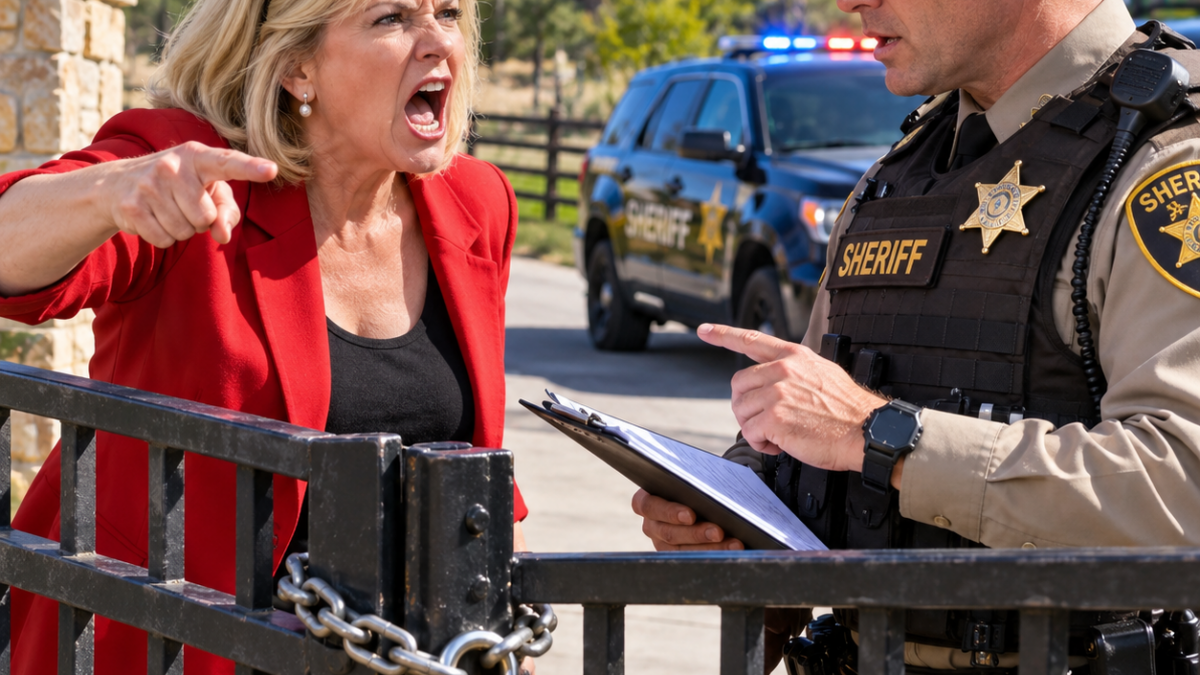
At 6:12 on a Tuesday morning, I drove up Pine Hollow Road and found a brand-new chain wrapped around the only gate to my family’s forty-two acres, a padlock I had never seen hanging from it, and a laminated HOA sign warning me not to enter my own property.
Behind that locked gate, my eighty-four-year-old mother was waiting for an oxygen delivery that was due within the hour, while across the road HOA president Darlene Pruitt stood beside her SUV sipping coffee and watching me discover what she had done.
I had spent five weeks telling myself she was just another neighborhood tyrant with too much confidence and too little jurisdiction, but when she handed me the document she claimed gave her control of my gate, I realized this was no longer a disagreement about paint, trailers, or property values.
My name is Walter Brennan, though everybody around Pine Hollow has called me Walt since I was old enough to carry a hay hook.
My grandfather bought our farm in 1961. The house, barns, pasture, gravel lane, and steel gate at the road were all ours long before Willow Bend Estates was built across from us in 2004. We shared one corner of a boundary and nothing else—no easement, covenant, road agreement, membership, or HOA authority of any kind.
That never seemed complicated until Darlene became president.
Her first letter arrived in March.
It demanded I repaint my gate in what she called a “community-approved neutral tone,” move my hay trailer so Willow Bend residents wouldn’t have to see it, and pay a $600 annual streetscape fee.
I read the letter at my kitchen table while my mother, Evelyn, drank tea across from me.
“What’s streetscape?” she asked.
“Apparently looking at my gate costs money now.”
She held out her hand.
I passed her the letter.
Mom read slowly these days because her eyesight wasn’t what it used to be.
When she finished, she looked toward the front window.
“Your grandfather built that gate.”
“I know.”
“He hated beige.”
I laughed.
“So do I.”
Across the top of the letter, I wrote:
**NOT A MEMBER. NO JURISDICTION.**
Then I mailed it back.
Two weeks later, another envelope arrived.
This one included a $1,500 fine.
Same result.
Back it went.
The third letter was different.
It came certified.
The language was colder.
The HOA claimed it was “evaluating assumption of management responsibility” over my entrance because the gate allegedly affected neighborhood security and appearance.
That phrase bothered me enough that I drove into town and put the letter on attorney Norah Whitfield’s desk.
Norah had handled land disputes in our county for more than twenty years. She pulled my deed, the recorded survey, and Willow Bend’s plat map.
Then she placed all three side by side.
“Your gate,” she said.
“I know.”
“Your lane.”
“I know.”
“Your land.”
“I’m sensing a theme.”
She didn’t smile.
“Walt, I’m serious. They have no recorded right here. If this woman touches that gate, do not get into an argument.”
“You think she actually would?”
“I think people who write nonsense like ‘assumption of management responsibility’ sometimes convince themselves paperwork is the same thing as ownership.”
“What should I do?”
“Cameras.”
So I installed two.
One faced the county road.
The other covered the gate.
For weeks, nothing happened.
Then came Tuesday morning.
Before I even got out of my truck, I checked the camera app.
At 4:47 a.m., Darlene’s SUV had pulled onto the shoulder.
Two men from a landscaping crew climbed out of a second truck.
One carried bolt cutters.
The footage showed Darlene pointing at my lock.
The man cut it.
They wrapped a new chain through the gate.
Darlene snapped on an HOA-tagged padlock.
Eleven minutes.
That was how long it took her to decide my deed no longer mattered.
I crossed the road with my phone recording.
Darlene smiled.
“Good morning, Walt.”
“Why did you cut my lock?”
“The board has assumed management of the entrance.”
“You mean my entrance.”
“It now affects community safety.”
“Show me the vote.”
“It was handled at board level.”
“Show me the paperwork.”
She opened a folder and handed me a sheet titled:
**EMERGENCY ENTRY MANAGEMENT RESOLUTION.**
Near the bottom was a signature.
**W. Brennan.**
I stared at it.
Then at her.
“I never signed this.”
She took another sip of coffee.
“That can be addressed at the next board meeting.”
“When is that?”
“Six weeks.”
My mother’s oxygen delivery was due at seven.
And Darlene knew it.
PART 2
I held the paper between two fingers and looked at the signature again.
It was close enough to my handwriting that I understood immediately what she expected.
Confusion.
Delay.
Maybe fear.
Maybe she thought I would spend the next six weeks trying to prove that my own name wasn’t mine while she treated possession of a chain as possession of forty-two acres.
I handed the page back.
“My mother’s oxygen delivery is coming this morning.”
Darlene tucked the paper into her folder.
“That’s unfortunate.”
I stared at her.
“She’s eighty-four.”
“I understand that.”
“She uses supplemental oxygen.”
“You’ve mentioned it before.”
“The delivery truck needs to get through this gate.”
Her expression didn’t change.
“Then you should have thought about access before refusing to cooperate with the association.”
My phone captured every word.
For several seconds, all I heard was the hum of her SUV and birds waking in the trees behind me.
I had known Darlene for two years.
I had seen her irritated.
Smug.
Condescending.
Performatively polite.
But until that moment, I had never understood how far she was willing to carry an argument once she decided losing would embarrass her.
I put the phone to my ear.
“Who are you calling?”
“The sheriff.”
She gave a small laugh.
“This is a civil matter.”
“We’ll let him decide.”
“You’re being theatrical.”
“No.”
I looked at the new chain on my gate.
“You did that.”
I called dispatch.
The woman who answered asked for the nature of the complaint.
“My private property has been chained shut by a homeowners association that has no interest in my land.”
“Are you a member of the association?”
“No.”
“Is there a dispute over an easement?”
“No.”
“Do you have access to your residence?”
“No.”
“Anyone inside?”
“My mother.”
I paused.
“She’s eighty-four and expecting a medical oxygen delivery within the hour.”
The dispatcher became more focused.
“Is she in immediate distress?”
“No. She has enough oxygen for now. The delivery is scheduled.”
“Do you know who placed the lock?”
“Yes. The HOA president is standing across from me.”
There was a pause.
“Sir, do not confront her physically.”
“I’m not.”
“Do not cut the lock.”
“I won’t.”
“We’ll send someone.”
“I’d like Sheriff Castellin if he’s available.”
The dispatcher knew exactly who I was.
Pine Hollow was that kind of county.
“Let me see where he is.”
Ray Castellin had known my family since before his mustache turned gray.
When he was a rookie deputy, he once helped my father pull a calf out of a drainage ditch during a spring storm because he happened to drive past and refused to leave until the animal was safe.
But that wasn’t why I asked for him.
I asked because Ray was the sheriff, and I knew Darlene would be less likely to turn a land dispute into theater if the man arriving carried the county badge on his own chest.
I was wrong about that part.
At 6:35, headlights appeared around the bend.
Three minutes later, Sheriff Castellin pulled onto the shoulder, followed by two deputies.
At almost the same moment, a white medical supply van turned onto Pine Hollow Road.
It slowed.
The driver saw the locked gate.
Then me.
Then the sheriff vehicles.
He stopped and rolled down his window.
“Brennan residence?”
“Yes.”
“Oxygen delivery.”
“I know.”
He looked at the chain.
“Problem?”
“You could say that.”
I glanced beyond the gate.
My mother had stepped onto the farmhouse porch.
Even from a hundred yards away, I could recognize the way she held the rail when her breathing was bothering her.
My anger sharpened instantly.
Ray saw her too.
He walked to the gate.
“Morning, Walt.”
“Morning.”
He examined the chain.
Then the HOA sign.
**PROPERTY OF WILLOW BEND HOMEOWNERS ASSOCIATION. UNAUTHORIZED ENTRY PROHIBITED.**
His eyebrows moved slightly.
“Interesting.”
“That’s one word for it.”
“Got documentation?”
I opened the folder I’d already pulled from my truck.
Norah had told me weeks ago to keep copies of the deed and survey nearby until the nonsense stopped.
At the time I’d thought she was overly cautious.
Now I wanted to send her flowers.
I handed Ray the deed and survey.
He read them without rushing.
Darlene crossed the road.
“Sheriff.”
“Morning.”
“I can explain.”
“I was hoping somebody could.”
She positioned herself beside him, folder tucked under one arm.
“This entrance has become a persistent safety and appearance issue for Willow Bend residents, and after Mr. Brennan refused multiple requests to cooperate, the board exercised emergency authority to assume management.”
Ray looked at her.
Then back at the deed.
Darlene continued.
“The gate visually defines the entrance corridor. It affects traffic patterns. It affects property values. Our counsel has advised us that community-impacting access structures may fall within—”
Ray raised one hand.
Darlene stopped.
He asked, “Whose name is on the deed to the land behind this gate?”
She blinked.
“The HOA’s authority extends beyond individual parcels when a structure affects common access or public—”
“Whose name is on the deed?”
“I don’t have the deed in front of me.”
Ray held it up.
“Well, I do.”
Darlene’s mouth tightened.
He tapped the page with one finger.
“Walter Brennan.”
A car slowed on the Willow Bend side of the road.
Then another.
Residents had noticed the sheriff.
People began coming out of houses.
Coffee mugs in hand.
Phones.
Bathrobes under jackets.
Darlene noticed them too.
For the first time, I saw something flicker in her face.
Not fear.
Awareness.
An audience had arrived.
She opened her folder.
“We have a signed resolution.”
Ray held out his hand.
“Let’s see it.”
She gave him the page.
He read it once.
Then again.
He looked at me.
“Walt, is this your signature?”
“No, sir.”
Darlene jumped in.
“The association relied on that document in good faith.”
Ray ignored her.
“Ever authorize anybody to sign for you?”
“No.”
“Sign electronically?”
“No.”
“Agree verbally?”
“No.”
“Receive any consideration?”
“No.”
Darlene’s voice rose.
“This is exactly why these matters belong in civil court. HOA governance cannot be adjudicated on the side of a road.”
Ray folded the resolution once.
He handed it to Deputy Carla Baggett.
“Bag it.”
Darlene stared.
“Excuse me?”
Baggett took out an evidence sleeve.
Darlene reached toward the paper.
The deputy moved it away.
“That document belongs to the association.”
Ray looked at her for a long moment.
Then he said, quietly enough that everybody leaned in to hear him.
“Ma’am, I’m going to explain something once, and I recommend you listen instead of planning what you’re going to say next.”
Her jaw tightened.
He pointed at the gate.
“That is private property.”
Then the chain.
“You had a lock cut that did not belong to you.”
The HOA sign.
“You placed a notice asserting ownership over property the deed says belongs to Mr. Brennan.”
Then the evidence bag.
“And you’re presenting a document bearing a signature the owner says he did not make.”
Darlene opened her mouth.
Ray kept going.
“So you don’t have an HOA problem anymore.”
Silence.
“You have a criminal investigation.”
Nobody moved.
The oxygen delivery driver stopped tapping his fingers against his steering wheel.
A woman across the road lowered her coffee.
Darlene laughed once.
Too quickly.
“Sheriff, you’re being dramatic.”
“No.”
He nodded toward my porch.
“I’m being careful because an eighty-four-year-old woman who depends on medical oxygen is currently behind a gate you ordered chained shut.”
Darlene’s face changed.
“She isn’t trapped.”
Ray looked at the chain.
Then at her.
“How does the delivery van get in?”
“Mr. Brennan could have contacted management for temporary access.”
I stared at her.
“You told me to wait six weeks.”
“I said you could appeal at the next meeting.”
“You told me I should’ve thought about my mother’s oxygen before refusing to cooperate.”
“That isn’t what I meant.”
I held up my phone.
“I recorded it.”
That did it.
Her confident expression finally cracked.
Just slightly.
But everybody saw it.
Ray asked me, “Recording started before the conversation?”
“Yes.”
“Don’t edit it.”
“I won’t.”
Darlene turned toward the growing crowd.
“This entire situation is being misrepresented.”
A man near the back said, “Then explain it.”
I recognized him.
Howard Teague.
Retired accountant.
HOA board member.
Quiet fellow I’d waved to a hundred times and spoken to maybe twice.
Darlene saw him.
“Howard, thank God. Tell the sheriff about the board’s authorization.”
Howard did not move.
Ray turned.
“You’re on the board?”
“Yes.”
“Did you vote to assume control of this gate?”
Howard looked at Darlene.
Then at me.
“No.”
Darlene’s head snapped toward him.
“You were informed.”
“That’s not what he asked.”
“Howard—”
“I never voted on this.”
A murmur passed through the residents.
Darlene’s face flushed.
“We discussed the Brennan issue at dinner.”
“You said it would be resolved.”
“That was a strategic discussion.”
“You told us legal counsel had already confirmed jurisdiction.”
Ray asked, “Did you sign this resolution?”
“No.”
“Who did?”
Howard looked toward the page in the evidence sleeve.
“I don’t know.”
Darlene interrupted.
“Board authority does not require every director’s individual signature.”
Ray turned to Baggett.
“Bolt cutters.”
Darlene stepped forward.
“You cannot destroy association property.”
Ray didn’t even look at her.
“Deputy.”
Baggett walked to her cruiser.
Darlene’s voice became sharper.
“Sheriff Castellin, if you cut that chain, the association will pursue the county.”
Ray finally looked at her.
“Feel free.”
Baggett returned carrying long-handled cutters.
She positioned them around one link.
The jaws closed.
Metal snapped.
The chain dropped against the gravel with a heavy clank.
For me, that sound was the first real breath I’d taken all morning.
Baggett picked up the chain.
Ray pointed to the lock.
“Give that to Mr. Brennan after it’s photographed.”
Darlene stared at him.
“That lock was purchased with association funds.”
“Then the association can explain why it purchased equipment to lock private property.”
I walked to the gate.
My grandfather had welded it himself in 1961.
It wasn’t pretty.
Never had been.
Rusted patches.
Old repairs.
One hinge that complained in wet weather.
But when I wrapped my hand around the steel bar and pulled, it opened.
The oxygen van rolled forward.
The driver gave me a quick nod.
As he passed, he looked toward Darlene and muttered through the open window, “Unbelievable.”
My mother remained on the porch.
When the van reached the house, she lifted one hand.
I raised mine back.
For one second, everything else disappeared.
The HOA.
The crowd.
The forged paper.
The sheriff.
All I saw was Mom standing where she’d stood every morning since my father died, waiting for a delivery she should never have had to worry about.
Then Ray said behind me, “We’re not finished.”
I turned.
Neither did Darlene.
The color had drained from her face.
Ray asked, “Who cut the original lock?”
Darlene hesitated.
“The landscaping contractor performed the work.”
“At whose direction?”
“Under association authority.”
“Name.”
She looked annoyed.
“EverGreen Community Landscaping.”
“Specific workers?”
“I don’t know.”
“I have video.”
She looked at me.
I opened the camera footage.
At 4:47 a.m., Darlene stepped into frame.
Two men followed.
At 4:50, one man held bolt cutters.
At 4:51, Darlene pointed at my padlock.
At 4:52, it was cut.
At 4:56, she handed them the new chain.
At 4:58, she secured the HOA sign herself.
Ray watched once.
Then again.
He asked, “Those the men?”
“Yes.”
Darlene folded her arms.
“They were acting as contractors.”
“What did you tell them about ownership?”
She didn’t answer.
“Ms. Pruitt.”
“Our legal position was that the structure fell under HOA management.”
“That isn’t what I asked.”
“I explained that the association had authority.”
“So you told them they had permission to cut the lock.”
She glanced toward the crowd.
“I told them the work had been authorized.”
Ray nodded slowly.
“That distinction may matter to them.”
For the first time that morning, Darlene seemed to understand that the two workers might not protect her.
People rarely volunteer to share legal consequences out of loyalty to someone else’s title.
Ray gave instructions to the deputies.
Photograph everything.
Take statements.
Preserve video.
Identify the landscaping crew.
Then he looked at Darlene.
“Do not return to this property.”
“I was never on his property.”
I almost laughed.
Ray nodded toward the camera.
“We’ll review that.”
“I stood in the road.”
“You were at the gate at 4:47.”
“That shoulder is public right-of-way.”
“Then we’ll measure it.”
She opened her mouth.
He said, “You should call your attorney.”
That finally silenced her.
I spent the next hour giving statements.
Norah arrived at 7:28.
She drove up, saw the sheriff vehicles, the crowd, the cut chain, and the oxygen van beside my farmhouse.
Then she looked at me.
“I told you cameras.”
“You did.”
“I enjoy being right.”
“Today I’ll allow it.”
She met Ray near his truck.
They spoke quietly for several minutes.
Then Norah asked to see the resolution.
Baggett showed her the evidence sleeve.
Norah read through the plastic.
“Interesting.”
“You lawyers need more adjectives.”
She ignored me.
“Look at paragraph four.”
I did.
It claimed I had voluntarily consented to the association’s management of the entrance after repeated safety consultations.
“I never did.”
“I know.”
“Paragraph seven says I’ve accepted association maintenance services since 2021.”
“Also false.”
“Any landscaping?”
“No.”
“Gate work?”
“No.”
“Snow removal?”
“County plow handles the road. I handle the lane.”
She nodded.
“Good.”
“Good?”
“Another factual representation that should be easy to disprove.”
I glanced toward Darlene.
She was standing by her SUV talking rapidly on the phone.
“What’s going to happen?”
“Today?”
“Yes.”
“Investigation.”
“Arrest?”
“Maybe. Maybe not. Don’t make the mistake of thinking immediate handcuffs are the only consequence that matters.”
“I don’t.”
“Good.”
I did, a little.
Not because I wanted revenge.
Not yet.
I wanted certainty.
I wanted the woman who had chained my mother behind a gate to understand, right then, that she had crossed a line no board vote could erase.
But criminal cases don’t exist to satisfy anger.
They exist to prove things.
So we proved things.
The first proof came faster than anyone expected.
At 2:17 that afternoon, a landscaping employee named Cody Ransom called the sheriff’s office.
I learned about it later through the investigative report.
Cody was twenty-six.
He had been one of the men in my camera footage.
The moment his boss heard deputies wanted statements, he told both employees to tell the truth.
Cody did.
He said Darlene had met them at Willow Bend’s clubhouse before dawn.
She handed him bolt cutters.
She told him the Brennan gate was now HOA-controlled infrastructure.
He asked whether the owner knew.
Darlene showed him the emergency resolution.
Cody remembered seeing my signature.
He asked if that meant the owner had agreed.
Darlene said:
“It’s fine. It’s my authority.”
He believed her.
His coworker told the same story.
Neither man had known the farm wasn’t HOA property.
Neither had been told I had repeatedly denied jurisdiction.
When Norah called me that evening, I was sitting at Mom’s kitchen table.
The replacement oxygen tanks stood beside the hallway wall.
“You eating?” she asked.
“Eventually.”
“You always say eventually.”
Norah’s voice came through the phone.
“We have the landscaper statements.”
“And?”
“They hurt Darlene.”
Mom put a bowl of stew in front of me.
“Good.”
Norah laughed.
“Was that your mother?”
“Yes.”
“Tell Evelyn I approve.”
Mom leaned toward the phone.
“I heard you.”
Norah continued.
“Both workers say Darlene represented herself as having lawful authority.”
“What about the fake signature?”
“We’ll send it for examination.”
“Can they prove who wrote it?”
“Maybe. Handwriting alone may not identify an author conclusively, but the document’s digital history could help.”
“Digital history?”
“If it was created electronically.”
I looked at Mom.
She was pretending not to listen.
“Anything I need to do?”
“Give me examples of your signatures.”
“How many?”
“A lot.”
I opened a drawer.
“You want cattle invoices, seed orders, insurance forms, bank documents, fertilizer receipts, or Christmas cards?”
“Everything except Christmas cards.”
“Why not?”
“Because I don’t want a forensic examiner learning what sentimental nonsense you write in December.”
Mom laughed so hard she coughed.
I reached for her oxygen tubing automatically.
She waved me off.
“I’m fine.”
I didn’t feel fine.
For the rest of that evening, every time I looked toward the new oxygen tanks, I saw that chain again.
Not because Mom had actually run out.
She hadn’t.
We’d had enough reserve.
But Darlene hadn’t known exactly how much.
She hadn’t asked.
She had decided a property dispute mattered more than whether an old woman could receive medical equipment.
That part stayed under my skin.
The next morning, Mom found me replacing the gate lock.
I had bought a temporary heavy-duty padlock in town.
She walked slowly down the lane carrying her portable oxygen concentrator.
“You’re not supposed to walk this far alone.”
“I’ve been walking this lane since before you knew what legs were for.”
“You’re eighty-four.”
“So?”
“So sometimes numbers matter.”
She stopped beside me.
The cut mark on the old lock was still bright metal.
Mom touched it with one finger.
“Your grandfather bought that lock?”
“No. Dad did.”
“Your grandfather would’ve chased that woman down the road with a shovel.”
“Norah says that would’ve been legally unhelpful.”
“Your grandfather didn’t know Norah.”
I smiled.
Then she became serious.
“Walt.”
“What?”
“Don’t let this make you ugly.”
The sentence caught me off guard.
“What does that mean?”
“You know exactly what it means.”
“I want her held responsible.”
“That isn’t ugly.”
“She locked you in.”
“I know.”
“She knew about the oxygen.”
“I know.”
“And she stood there smiling.”
Mom looked across the road toward Willow Bend.
Then back at me.
“You can spend the next year wanting her frightened, humiliated, broke, hated, arrested, whatever makes you feel even.”
I didn’t answer.
“Or you can want the truth put where everybody can see it.”
“That’s not the same thing.”
“No.”
She touched my shoulder.
“But one of them lets you sleep afterward.”
I remembered that months later.
At the time, I was still angry enough that sleep didn’t interest me.
The forensic report on the signature came four days later.
Norah drove to the farm instead of calling.
That told me it mattered.
She spread the report on the table.
“The examiner sees evidence of tracing or simulation.”
“Meaning?”
“Your normal signatures are faster. Variable. Natural. The resolution signature has hesitation marks and abnormal pressure changes.”
“Can they tell where it came from?”
“Maybe not from handwriting alone.”
She pulled out another page.
“But the digital document helps.”
The emergency resolution had been created from a template on a computer inside Willow Bend’s management office.
Metadata showed the file had been created two days before my lock was cut.
The author profile matched the HOA administrator’s account.
That wasn’t automatically Darlene.
But then investigators interviewed the management office assistant.
She said Darlene had used that computer for almost two hours after closing.
Darlene had asked her how to insert scanned signatures into PDF documents.
The assistant thought she was working on board correspondence.
My stomach tightened.
“Scanned signature?”
Norah nodded.
“Do you know where she could’ve gotten yours?”
I thought.
Invoices?
Letters?
Checks?
Then I remembered.
Three months earlier, Willow Bend had hired a tree service to remove a storm-damaged oak near the road.
Their truck briefly blocked my driveway.
The crew supervisor asked me to sign a note acknowledging they’d cleared access and caused no damage.
The HOA management office received a copy.
My signature was on it.
Norah wrote that down.
“That’s probably enough to investigate.”
“Probably?”
“Walt, cases are built from pieces.”
“I know.”
“You don’t sound like you know.”
I stood and walked to the window.
Across the road, the Willow Bend entrance sign gleamed in morning light.
Perfect stone.
Perfect flowers.
Everything Darlene liked.
“I’m tired of pieces.”
Norah came beside me.
“Then don’t watch every piece arrive.”
“Easy for you.”
“No, it isn’t.”
I looked at her.
She spoke more quietly.
“My father lost land in an easement dispute when I was in law school.”
I had never known that.
“He had paperwork?”
“He had assumptions.”
“What happened?”
“A developer had a better lawyer.”
She looked toward my gate.
“That’s why I read deeds twice.”
I nodded.
“Fair.”
She folded the report.
“Let me do my job.”
So I tried.
For approximately twenty-four hours.
Then Howard Teague called.
“I need to talk to you.”
“About what?”
“Darlene.”
That narrowed nothing.
“Come by.”
He arrived after supper carrying a binder.
Mom was at the table doing a crossword puzzle.
Howard seemed uncomfortable entering the house.
“Mrs. Brennan.”
“Howard.”
“You know me?”
“I know everybody.”
He glanced at me.
“She does.”
Mom pointed toward the living room.
“Sit down before your nervousness scratches my floor.”
Howard sat.
He put the binder on his knees.
“I’ve been going through HOA financial records.”
“Why?”
“Because after Tuesday I started wondering what else Darlene called authorized.”
He opened the binder.
“There’s eleven thousand four hundred dollars in legal consulting charges connected to something called the Gate Project.”
I stared at him.
“The what?”
“Gate Project.”
Mom stopped writing.
Howard handed me an invoice.
**PROPERTY ACCESS STRATEGY CONSULTING**
Vendor: Hensley Municipal Advisory.
Amount: $4,800.
Second invoice.
$3,600.
Third.
$3,000.
“Who’s Hensley?”
Howard swallowed.
“Darlene’s brother-in-law.”
I looked at him.
“Lawyer?”
“No.”
“Land consultant?”
“No.”
“What does he do?”
“Insurance sales.”
Mom said, “Sounds qualified.”
Howard almost smiled.
“Those payments were never voted on.”
“What was the consulting?”
“I don’t know. There are no reports.”
“Then why pay him?”
“That’s what I’m trying to determine.”
He turned pages.
“There is more.”
Of course there was.
People who are comfortable inventing one kind of authority often become comfortable inventing others.
Howard had found something called a **Streetscape Integration Program**.
For nearly three years, Willow Bend had mailed fee notices to six neighboring property owners who were not HOA members.
Not me until recently.
Others.
A mechanic.
A nursery.
Two older homeowners.
A small church.
And a horse property.
Some had ignored the letters.
Two had paid.
One elderly widow had paid $600 every year because she thought the notices came from the county.
Howard looked sick when he told me.
“How much?”
“About nine thousand collected from non-members.”
Mom put her pencil down.
“You’re telling me that woman was charging people to look at her neighborhood?”
Howard rubbed his forehead.
“Essentially.”
“Did the board know?”
“I didn’t.”
“Other members?”
“I’m asking.”
I called Norah.
Then Howard called the sheriff.
That binder widened the investigation overnight.
By Friday, Willow Bend announced an emergency meeting.
Darlene sent residents an email calling the allegations “a coordinated effort by outside interests to destabilize community governance.”
Daniel Mercer forwarded it to me even though I hadn’t asked.
The phrase **outside interests** made me laugh.
Apparently I was a foreign power because my farm sat across the road.
Norah wanted me at the meeting.
“I don’t live there.”
“You’re central to the issue.”
“I don’t want to be.”
“Neither does anybody who ends up in litigation.”
Mom wanted to go too.
“No.”
“Why?”
“Because there may be shouting.”
“I’ve heard shouting.”
“Because your oxygen—”
“Walt.”
I stopped.
She lifted one eyebrow.
I had been on the receiving end of that eyebrow since 1967.
“Fine.”
“Good.”
“You sit near the door.”
“I’ll sit where I please.”
We compromised.
She sat near the door.
The clubhouse was full by the time we arrived.
Residents who had spent years complaining quietly were suddenly sitting in the front row.
Trash-can fines.
Mailbox violations.
Holiday decoration disputes.
Parking warnings.
Dog-leash notices.
Chalk on driveways.
Darlene had governed through irritation.
People tolerated it because each fight seemed too small to justify becoming the next target.
Then she chained the wrong gate.
Howard sat at the front table.
Darlene entered five minutes late with an attorney.
No fleece vest.
No coffee.
Dark suit.
Controlled expression.
She saw me.
Then Mom.
For half a second, her eyes dropped toward Mom’s oxygen tubing.
She looked away first.
The association’s vice president called the meeting to order.
Immediately, residents shouted questions.
“Did you forge the signature?”
“Where did the legal money go?”
“Why are we paying your family?”
“Did the board authorize the lock?”
The attorney raised both hands.
“Please.”
Nobody listened.
Then Howard stood.
He had never wanted attention.
That was obvious.
His hands shook slightly as he opened the binder.
But his voice was steady.
“I’ve served as treasurer for eighteen months.”
Darlene interrupted.
“Howard, financial matters subject to pending investigation should not be discussed publicly.”
He looked at her.
“I’m discussing association expenditures with association members.”
“You’ve been advised—”
“By whose lawyer?”
The room quieted.
Darlene’s attorney leaned toward her.
Howard continued.
“I found eleven thousand four hundred dollars paid under the heading Gate Project.”
A woman near the front said, “What gate?”
Howard pointed toward the road.
“Mr. Brennan’s.”
People turned toward me.
I wanted to disappear into the wall.
Howard read each invoice.
Then named Darlene’s brother-in-law.
The room erupted.
Darlene grabbed her microphone.
“These payments were for legitimate strategic consultation involving property-value protection and boundary management.”
Howard asked, “Where are the work products?”
“My office has documentation.”
“I requested it.”
“You are not authorized to demand privileged materials.”
“Then produce the non-privileged ones.”
Her attorney whispered again.
Howard changed pages.
“Next.”
He explained the streetscape fees.
Residents looked confused at first.
Then angry.
“What do outside owners have to do with us?”
“Why were we charging them?”
“Did they know they weren’t members?”
Howard looked toward Darlene.
She answered.
“The program encouraged compatible land-use standards around Willow Bend.”
Mom whispered beside me, “That doesn’t mean anything.”
“No.”
Darlene continued.
“It was voluntary.”
Howard lifted several notices.
“They say payment required.”
Silence.
“Some include late fees.”
A woman shouted, “That’s not voluntary.”
Darlene snapped, “It was a compliance incentive.”
That phrase hurt her more than she understood.
A laugh moved through the room.
Then another.
Soon people were openly mocking it.
“Compliance incentive?”
“For people who don’t live here?”
Howard raised his hand.
“Please.”
The room settled.
He turned toward me.
“Walt, would you come up?”
I looked at Norah.
She nodded.
I stood.
Mom squeezed my hand once.
At the front, Howard gave me the microphone.
“I don’t know what you want me to say.”
“Tell them whether you ever joined Willow Bend.”
“No.”
“Signed the emergency resolution?”
“No.”
“Agreed to management of your gate?”
“No.”
“Received HOA maintenance services?”
“No.”
“Authorized Darlene or contractors to cut your lock?”
“No.”
“Did she know your mother needed medical deliveries?”
I looked toward Darlene.
“Yes.”
Her attorney stood.
“I object to this becoming a quasi-trial.”
A resident shouted, “We’re not a court.”
Another shouted, “We’re the people paying the bills.”
Applause.
I lifted the microphone.
“I don’t want to prosecute anybody in this room.”
That quieted them.
“I just want to say one thing.”
I looked toward Darlene.
“For weeks, I thought this was about my gate being ugly.”
Her mouth tightened.
“Then I thought it was about control.”
I glanced at Howard’s binder.
“Now I think it was about something simpler.”
“What?” someone asked.
I looked at the residents.
“She expected nobody to challenge her.”
The room went still.
Darlene stood.
“That is outrageous.”
“Maybe.”
“You’ve turned a routine community dispute into a criminal circus.”
“You cut my lock.”
“You refused reasonable standards.”
“I don’t belong to your association.”
“You benefit from the community.”
“So does the gas station down the highway. You planning to fine them next?”
People laughed.
Her face reddened.
She pointed at me.
“This is exactly the hostility I’ve dealt with.”
Mom stood.
Slowly.
Every eye in the room went to her.
I said, “Mom—”
She waved me off.
Darlene looked uncertain.
Mom’s voice wasn’t loud.
It didn’t need to be.
“My husband worked that land until the week before he died.”
Nobody moved.
“His father bought it when there wasn’t a subdivision across the road. There was mud, cattle, and one bad telephone line.”
She looked at Darlene.
“You don’t have to like the gate.”
Darlene said nothing.
“You don’t have to like the hay trailer.”
Still nothing.
“But when my oxygen man couldn’t reach my house because you wanted to prove a point, you stopped arguing about appearances.”
Mom placed one hand against her chest.
“You made yourself dangerous.”
Darlene’s face went pale.
Her attorney whispered something.
Mom sat down.
I swallowed.
Howard took the microphone.
“I move that Darlene Pruitt be removed as president immediately pending the outcome of the criminal and financial investigations.”
The vice president hesitated.
A board member seconded.
Darlene laughed.
“You cannot remove an elected officer based on hysteria.”
The association attorney—not Darlene’s private attorney, but the HOA’s lawyer—stood from a side table.
“Under Article Seven, the board may remove an officer by majority vote.”
Darlene stared at him.
“You represent the association.”
“Yes.”
“I retained you.”
“The association retained the firm.”
That distinction landed like a stone.
Roll call began.
One vote.
Remove.
Second.
Remove.
Third.
Remove.
Howard.
Remove.
Vice president.
Remove.
It was unanimous.
Darlene sat motionless.
Nobody cheered.
I was glad.
A celebration would have made the moment smaller.
What I saw instead was a room full of people realizing how much authority they had surrendered because questioning it had seemed inconvenient.
Darlene packed her papers.
Before leaving, she stopped beside me.
“This isn’t over.”
“No.”
“You’ll be hearing from my attorney.”
“Probably.”
“You think you’ve won.”
I looked at Mom.
Then at her.
“My gate’s open.”
Her jaw tightened.
She walked away.
The criminal case took months.
Norah warned me about that from the beginning.
Evidence has to be authenticated.
Witnesses interviewed.
Financial records subpoenaed.
Intent proved.
Defenses considered.
Darlene’s attorney argued she had acted in good faith based on advice.
Investigators asked a simple question.
What advice?
The brother-in-law’s invoices led nowhere helpful for her.
He admitted he wasn’t a lawyer.
He said he had provided “general strategic discussion.”
Asked whether he had told Darlene the HOA could seize my gate, he said no.
Asked whether he had drafted the emergency resolution, he said no.
Asked what $11,400 purchased, his answers became vague.
He eventually refunded part of the money to the association.
The forged signature remained worse.
Digital evidence showed the file had been created at the HOA office.
A scanned image of my signature from the old tree-service acknowledgment had been stored in a temporary folder on the same computer.
Forensic comparison found the image used in the resolution had characteristics consistent with that scan.
Darlene denied creating it herself.
The management assistant remembered Darlene using the computer after hours.
No one else admitted touching the file.
The prosecutor didn’t need a confession to see the problem.
Then Cody Ransom testified before the grand jury.
I wasn’t there.
Norah later told me the important part.
Cody described Darlene handing him the bolt cutters.
The prosecutor asked:
“Did you ask whether she owned the gate?”
“Yes.”
“What did she say?”
“She said the association had authority.”
“Did she show you anything?”
“A paper.”
“What did you believe that paper meant?”
“That the owner agreed.”
“Would you have cut the lock if you knew the owner had not agreed?”
“No.”
Simple.
Human.
Devastating.
Darlene’s defense began shifting.
First she had authority.
Then she believed she had authority.
Then board members supposedly misled her.
Howard produced emails showing the opposite.
One message from a month before the lock said:
**We need to make Brennan understand that refusing membership doesn’t exempt him from community impact.**
Another:
**If he won’t consent voluntarily, we may need to create an access-management record first and let legal catch up afterward.**
That sentence appeared in the prosecutor’s filing.
**Let legal catch up afterward.**
Norah read it aloud in her office.
I stared at the page.
“She wrote that?”
“Yes.”
“That’s almost too stupid.”
“Confidence often is.”
I thought about Mom’s warning not to become ugly.
By then the anger had changed.
I still wanted consequences.
But I no longer imagined shouting at Darlene.
The documents were doing a better job.
Her own words.
Her own invoices.
Her own resolution.
Her own instructions.
I could never have designed revenge as effective as simply preserving what she had done.
The association sent letters to every outside property owner who had received streetscape fee notices.
Refunds followed.
The elderly widow who had paid for three years got her money back with interest.
She came by the farm one afternoon.
Her name was Clara Miles.
Seventy-nine.
Tiny woman with enormous sunglasses.
“You’re Brennan?”
“Yes, ma’am.”
“You the gate man?”
I laughed.
“Apparently.”
She handed me a pie.
“What is this?”
“Peach.”
“I can see that.”
“Then why’d you ask?”
“I mean why are you giving it to me?”
“Because I got eighteen hundred dollars back.”
“I didn’t refund it.”
“You started the mess.”
“I think Darlene started the mess.”
Clara waved one hand.
“You made the mess useful.”
She walked back to her car before I could argue.
Mom ate half the pie.
The new Willow Bend board changed its bylaws.
No contract above a modest amount without a recorded vote.
No action involving property outside the HOA without independent legal review.
All invoices publicly available to members.
All meetings open except those legitimately requiring executive session.
Howard agreed to serve one year as president.
He hated every minute of the title.
Which was probably why he was good at it.
Residents began attending meetings.
Real attendance.
Not three bored board members and Darlene talking for ninety minutes.
People asked questions.
Why this vendor?
Why that fine?
Where is the reserve study?
What authority covers this?
Howard answered when he knew.
When he didn’t, he said, “I don’t know. I’ll find out.”
That sentence impressed me more than any speech Darlene ever gave.
One evening, he stopped by the gate.
“No complaint letter?”
I asked.
“Not tonight.”
“What do you want?”
He held out an envelope.
Formal Willow Bend letterhead.
My stomach tightened out of habit.
I opened it.
The association formally acknowledged that it possessed no ownership, easement, covenant authority, management right, or other interest in my gate, lane, farmhouse, or land.
No HOA officer or contractor could enter or alter the property without my written permission except under lawful emergency authority.
I read it twice.
Howard shifted awkwardly.
“Our attorney suggested we record a boundary acknowledgment too.”
“That necessary?”
“Probably not.”
“Then why?”
He looked across the road.
“Because apparently we need some things written in letters large enough for future presidents.”
I smiled.
“Fair.”
I framed the letter.
Mom told me not to.
“You hate HOA letters.”
“This one’s different.”
“Still ugly.”
“It’s staying.”
I hung it in the farmhouse kitchen beside a black-and-white photograph of my grandfather standing at the gate in 1961.
He was thirty-one in the picture.
Lean.
Dirty boots.
Cigarette in one hand.
Brand-new steel gate behind him.
For most of my life, that photo had just been Grandpa.
After everything happened, I noticed the gate differently.
He hadn’t built it to make a statement.
He built it because cattle wander.
Practical.
Ordinary.
Necessary.
Darlene had turned it into a battlefield because she couldn’t tolerate a boundary she hadn’t created.
The plea negotiations began in late summer.
Prosecutors charged her with forgery-related offenses, criminal trespass, tampering with private property, and misuse of association funds.
Some charges overlapped.
Some were negotiated.
Her attorney argued that no one was physically harmed.
That part bothered me.
Mom heard me complain over breakfast.
“She’s right.”
I stared at her.
“What?”
“No one was physically harmed.”
“That doesn’t make it okay.”
“I didn’t say it did.”
“She blocked your oxygen delivery.”
“It arrived.”
“Because the sheriff cut the chain.”
“Yes.”
“She didn’t know that would happen.”
“No.”
I put my coffee down harder than necessary.
“So why are you defending her?”
Mom frowned.
“I’m not.”
“Sounds like it.”
“I am preventing you from needing the worst possible ending to feel satisfied.”
I said nothing.
She continued.
“If you need her to suffer exactly as much as you imagined I might have suffered, you’ll never get enough.”
That was irritatingly wise.
I hated when she did that.
“What do I need?”
“The record corrected.”
“It is.”
“The gate yours.”
“It is.”
“The people paid back.”
“They’re being paid.”
“The woman removed.”
“She is.”
“And whatever lawful punishment a judge decides.”
I looked at her.
“You rehearsed this?”
“I’ve had eighty-four years.”
The plea agreement came in October.
Probation.
Restitution.
Repayment to Willow Bend for unauthorized expenditures.
My legal expenses covered.
No contact with my property.
And, as part of the civil settlement tied to the association matter, a permanent prohibition against serving as an officer or board member of a homeowners association in the state.
I asked Norah whether that last part was common.
“No.”
“Good.”
She smiled.
“You like that one.”
“I do.”
“You’re allowed.”
Darlene sold her Willow Bend house the following spring.
Not because a judge seized it.
Not because I sued her into bankruptcy.
At least not directly.
From what I heard, she no longer wanted to live in a neighborhood where every mailbox reminded people of her.
I saw her once before she left.
Hardware store.
Aisle seven.
I was buying fencing staples.
She came around the corner pushing a cart.
We stopped.
Neither of us spoke.
She looked older.
Not dramatically.
Just tired.
I expected her to turn away.
Instead she said, “Your mother okay?”
That surprised me.
“Yes.”
She nodded.
“I never intended to hurt her.”
I felt anger rise again.
Lower than before.
Manageable.
“You intended to make me choose between obeying you and getting her delivery through.”
“That isn’t the same thing.”
“No.”
I looked at her.
“It’s worse.”
She flinched.
Then her face hardened.
“You were impossible from the beginning.”
“Because I wouldn’t join your HOA?”
“Because you treated every request like an insult.”
“You fined me fifteen hundred dollars for not painting a gate you didn’t own.”
“You could have compromised.”
“On ownership?”
“On appearance.”
“Then ask.”
“I did.”
“You demanded.”
She looked past me toward the end of the aisle.
For once, there was no board.
No audience.
No coffee cup.
No folder.
Just two people between shelves of hardware.
Her voice softened.
“I spent two years trying to keep that neighborhood from looking like every other subdivision that gets old and sloppy.”
I believed her.
That was the strange part.
I believed she had cared.
At first.
She cared about property values.
Consistency.
Order.
Then being right became more important than the reason she’d wanted authority in the first place.
“You could’ve done that inside Willow Bend.”
She looked at me.
“I thought what happened around us affected us.”
“It does.”
“Then you understand.”
“No.”
I shook my head.
“Being affected by something doesn’t mean you own it.”
She stared at me.
I picked up the box of staples.
After a moment she said, “I lost everything.”
“No.”
Her eyes narrowed.
“You lost a position.”
“My reputation.”
“That too.”
“My home.”
“You sold your home.”
“Because people made it impossible to stay.”
I almost answered sharply.
Then I thought of Mom.
I kept my voice quiet.
“Darlene, when you put that chain on my gate, you expected me to live with the consequences because you decided your purpose mattered more than my rights.”
She said nothing.
“What you’re feeling now is what happens when other people stop carrying consequences for you.”
Her eyes filled.
Not much.
Enough.
I didn’t enjoy seeing it.
That surprised me too.
I nodded once.
Then walked away.
I never saw her again.
Life returned to ordinary things.
Hay.
Fence repair.
Vet bills.
Fuel.
Rain when I didn’t need it.
No rain when I did.
Mom’s oxygen deliveries continued every ten days.
Same driver most weeks.
His name was Marcus Bell.
After the gate incident, he would slow dramatically every time he approached, lean out the window, and shout:
“Am I authorized to enter?”
The first time, I laughed.
The second time, Mom came onto the porch and yelled:
“Only if you brought my tanks.”
By winter it had become a ritual.
Howard came by occasionally.
Mostly to ask property-line questions before the HOA did anything near the road.
The first time he did, he carried a survey.
I looked at him.
“You know that’s already more preparation than the last administration.”
“That bar is underground.”
“Still counts.”
Willow Bend replaced its entrance landscaping.
Nothing dramatic.
A few shrubs.
New lighting.
They didn’t touch my side.
Nobody asked me to paint the gate.
Nobody mentioned the hay trailer.
One Saturday morning, I found a small handwritten note zip-tied to the gate.
My first reaction was anger.
Then I read it.
**Mr. Brennan—my son likes your cows. Thank you for letting us wave at them from the road. —Kelsey, Lot 18**
I left it there for a week.
Mom teased me.
“Community engagement.”
“Don’t start.”
“You’ll be on the HOA board next.”
“I’d sell the farm first.”
“No, you wouldn’t.”
She was right.
A few months later, Sheriff Castellin stopped by.
No lights.
No deputies.
Just his truck.
I was standing at the gate replacing the temporary padlock with a better one.
He leaned out.
“Trouble?”
“No.”
“That seems suspicious.”
I held up the new lock.
“Upgrade.”
He parked and walked over.
“Same one from the morning?”
“The old one is in two pieces in an evidence bag somewhere.”
“Actually, I brought something.”
He reached into the truck and handed me a folder.
Copies of records no longer needed for the closed portion of the case.
Photographs.
Statements.
Evidence inventory.
A still image from my security video.
Darlene at 4:47 a.m., pointing at my gate.
I stared at it.
Ray saw.
“You want that?”
“No.”
“You sure?”
“Yes.”
He put it back.
“Good.”
I slid the new padlock through the latch.
Click.
Ray tested it once.
“Fancy.”
“Forty dollars.”
“Inflation.”
“Government probably caused it.”
“Careful. I’m government.”
“That explains everything.”
He laughed.
Then he became quiet.
“How’s Evelyn?”
“Mean as ever.”
“Good.”
“She likes you.”
“That’s because I cut the chain.”
“I opened the gate.”
“After my deputy cut the chain.”
“Details.”
He looked across the road toward Willow Bend.
“Strange morning.”
“You’ve had stranger.”
“Not many involving an HOA president trying to annex a cattle gate.”
I laughed.
He tipped his hat.
Then he said, “You handled it right.”
“I wanted to cut the chain myself.”
“I know.”
“How?”
“You were Walt Brennan standing next to bolt cutters in your truck and not using them.”
I smiled.
“Norah told me not to.”
“Good lawyer.”
“Expensive.”
“Still cheaper than bail.”
He got back in the truck.
Before leaving, he looked at the new padlock.
“This one going to do okay?”
I pulled on it.
“Doing just fine.”
He drove away.
I stood there longer than necessary.
Across the road, Willow Bend looked exactly as it had before.
Stone entrance.
Trim lawns.
Mailboxes all the same color.
Cars moving quietly through the gates.
For two years, Darlene had acted as if that neatness gave her authority over everything she could see from the entrance.
My rusted gate.
My trailer.
My field.
My lane.
Me.
But a boundary isn’t an insult.
It’s information.
This is mine.
That is yours.
Ask before crossing.
Simple.
Mom called from the porch.
“Walt!”
“What?”
“You planning to marry that gate?”
“No.”
“Then come eat.”
I laughed and started walking up the lane.
Halfway to the house, I turned.
The gate looked old.
Uneven.
Rust along the bottom rail.
Exactly the way Darlene hated it.
For about thirty seconds, I considered painting it.
Mom would’ve never let me hear the end of it.
I kept walking.
That fall, we had a harder season.
Mom was hospitalized twice with respiratory infections.
The second one frightened me.
She recovered.
But slower.
After bringing her home, I became obsessive about checking oxygen levels, delivery schedules, backup tanks.
She noticed.
Of course she noticed.
One night, I was counting cylinders in the utility room.
“You’ve counted those three times.”
“No.”
“Yes.”
“Twice.”
“Walt.”
I stopped.
“What?”
She sat at the kitchen table with her portable cannula in place.
“You’re still at that gate.”
I looked at her.
“No, I’m counting oxygen.”
“You’re at the gate.”
I knew what she meant.
“You could’ve been without it.”
“But I wasn’t.”
“You don’t know how close—”
“I know exactly.”
She pointed to the chair.
“Sit.”
I sat.
She reached across the table.
Her hand looked smaller than I remembered.
“You did what you were supposed to do.”
“I should’ve stopped her sooner.”
“How?”
“Taken the letters more seriously.”
“You went to a lawyer.”
“Could’ve filed something.”
“Before she touched anything?”
“Maybe.”
“You could also have bought ten tanks, hired guards, built another road, and slept beside the gate with a shotgun.”
“Mom.”
“My point is there is always another imaginary thing you could’ve done.”
I looked down.
She squeezed my hand.
“You called the sheriff.”
“Yes.”
“The oxygen came.”
“Yes.”
“I am here.”
“Yes.”
“Then stop turning one bad morning into every morning after it.”
That sentence stayed with me longer than anything Ray or Norah ever said.
I gradually stopped checking the gate camera every time my phone buzzed.
Stopped keeping the deed in my truck.
Stopped watching Willow Bend cars to see who slowed near my entrance.
Trust did not come back all at once.
It came back in boring pieces.
An oxygen truck arriving normally.
A delivery driver opening the gate and closing it behind him.
Howard calling before survey crews worked near the road.
Children waving at cattle.
No letters.
No fees.
No warnings.
Nothing happening.
There is no better evidence that a property dispute is truly over than nothing happening.
The next year, Mom turned eighty-five.
Howard sent flowers from the Willow Bend board.
I thought it was ridiculous.
Mom loved them.
The card read:
**TO MRS. BRENNAN — WITH OUR BEST WISHES, AND NO JURISDICTION WHATSOEVER OVER YOUR BIRTHDAY.**
I laughed so hard I had to sit down.
Mom framed the card.
Of course she did.
“Now we have two HOA letters in the kitchen,” I said.
“This one’s prettier.”
“You’re encouraging them.”
“Relax.”
Her birthday party was small.
Family.
Neighbors.
Ray stopped by.
Norah brought pie.
Howard came for twenty minutes and somehow ended up helping me move folding chairs.
At sunset, Mom asked to walk down to the gate.
“Why?”
“I feel like it.”
So we went slowly.
She held my arm.
Her portable oxygen concentrator hummed softly.
When we reached the road, she touched the steel.
“Your grandfather would laugh.”
“At what?”
“All of it.”
“He would’ve chased Darlene with a shovel.”
“He’d have caught her too.”
We stood there watching evening traffic.
A car leaving Willow Bend slowed.
The driver waved.
Mom waved back.
Then she looked at me.
“Paint still looks terrible.”
I stared at her.
“You defended this gate.”
“I defended your right to have an ugly gate.”
“That is very different.”
She smiled.
I laughed.
The following spring, I painted it.
Not beige.
Dark green.
Same green my father had once used on the barn doors.
I sanded the rust.
Replaced one hinge.
Straightened the latch.
Owen Mercer from down the road helped weld a cracked brace.
When we finished, I stood back.
It looked good.
Mom came outside.
She stared.
“Darlene finally win?”
“No.”
“Looks suspiciously improved.”
“I chose the color.”
“Then I approve.”
“That means less than you think.”
She smiled.
“So does most approval.”
I left Grandpa’s old hand-painted farm sign exactly where it was.
**BRENNAN FARM — EST. 1961**
Weathered.
Crooked.
Ours.
The new Willow Bend board never commented.
That mattered.
Not because they liked the green.
Because they understood they didn’t need to.
Years after the incident, people still occasionally asked me about the morning the sheriff “put the HOA president in her place.”
The story got exaggerated.
Some versions had six deputies.
Some had Darlene arrested immediately at gunpoint.
One had a SWAT team.
None of that happened.
Reality was quieter.
A sheriff read a deed.
A signature was questioned.
A chain was cut.
An oxygen van drove through.
Then records did what records do when honest people finally look at them.
They remembered.
The camera remembered 4:47 a.m.
The computer remembered when the resolution was created.
Bank accounts remembered where money went.
Emails remembered what Darlene wrote.
Cody remembered who handed him the bolt cutters.
Howard remembered that he never voted.
And I remembered that my mother was waiting behind the gate.
That was enough.
One afternoon, years later, I found the old broken padlock in a box Norah had returned after every matter was officially closed.
The shackle was cleanly cut.
I held it in my palm.
For a moment, I thought about mounting it beside the HOA acknowledgment letter.
A trophy.
Proof.
Then I heard Mom from the kitchen.
“What are you doing?”
“Found the old lock.”
She came to the doorway.
“Throw it away.”
“Maybe I’ll keep it.”
“Why?”
“History.”
She rolled her eyes.
“You have a photograph of your grandfather.”
“Different history.”
“Walt, if you need broken things on the wall to remember who you are, you’ve got bigger problems than an HOA.”
I looked at the lock.
Then laughed.
I threw it in the scrap bucket.
A week later, it went out with metal recycling.
I never missed it.
The gate didn’t need the broken lock.
Neither did I.
The last time Sheriff Castellin visited before retirement, he stopped on a clear October afternoon.
I was stacking hay.
He sat on the fence.
“You hear Howard is stepping down?”
“He said one year.”
“He served three.”
“That’s what happens when you’re competent.”
“Dangerous habit.”
Ray was retiring too.
Thirty years in law enforcement.
Eleven as sheriff.
I handed him a bottle of water.
“You’ll miss it.”
“No.”
“You’re lying.”
“Probably.”
We looked toward the road.
A Willow Bend maintenance truck passed.
The driver waved.
Ray nodded toward the gate.
“Still yours?”
“Last I checked.”
“Anybody voted otherwise?”
“Not recently.”
He laughed.
Then he looked serious.
“You ever wonder what would’ve happened if you cut that chain yourself?”
“Sometimes.”
“Probably nothing dramatic.”
“Really?”
“Maybe Darlene would’ve called us. Claimed you destroyed HOA property.”
“She would’ve.”
“We’d still have figured it out.”
“Eventually.”
“Eventually.”
He took a drink.
“But because you waited, the scene stayed clean.”
I nodded.
“Norah told me the same.”
“Lawyers stealing my wisdom.”
“Pretty sure she told me first.”
“That sounds like Norah.”
He stood.
“Take care of Evelyn.”
“I do.”
“I know.”
He drove away.
I watched until his truck disappeared.
Then I closed the gate.
Not because I was afraid.
Because cattle still wander.
That winter, Mom’s health declined.
Slowly at first.
Then not so slowly.
She slept more.
Talked less.
Oxygen became constant instead of occasional.
I spent long nights at the kitchen table listening to the concentrator.
Sometimes my eyes drifted to the framed Willow Bend acknowledgment beside Grandpa’s photograph.
The paper that had once felt like victory now seemed small.
Mom had been right.
The real victory was that we had time afterward.
Normal time.
Birthdays.
Bad jokes.
Green paint.
Pie.
Arguments about whether I checked oxygen too often.
One January morning, snow covered Pine Hollow.
Mom wanted the curtains open.
I pulled them back.
From her chair she could see part of the lane.
The gate was barely visible through the snow.
“Still ugly,” she whispered.
I smiled.
“You approved the paint.”
“Mistake.”
Her voice was weak.
I sat beside her.
For a while neither of us spoke.
Then she said, “Promise me something.”
“What?”
“Don’t sell because you’re scared.”
I looked at her.
“Scared of what?”
“People.”
“I’m not.”
“Yes, you are.”
She closed her eyes.
“You’re scared somebody will try again.”
I didn’t answer.
She knew.
“Keep the land if you love it.”
“I do.”
“Sell it if you don’t.”
“Okay.”
“But don’t spend your life guarding a gate.”
My throat tightened.
“I won’t.”
She opened her eyes.
“Good.”
Mom died that spring.
Peacefully.
At home.
The oxygen delivery had come two days earlier.
The gate was open when the hospice nurse arrived.
After the funeral, I found myself standing at it alone.
People had filled the house for days.
Food everywhere.
Flowers.
Condolence cards.
Then everyone left.
The quiet was enormous.
Across the road, Willow Bend’s entrance lights came on.
Howard had sent a wreath from the association.
Ray came in uniform even though he had retired.
Norah sat in the back row at the church.
Clara Miles brought peach pie.
Life had become tangled with people I would never have known without that terrible morning.
I put one hand on the green steel gate.
For years I’d associated it with Darlene.
Then the sheriff.
Then Mom.
Standing there after she died, I finally understood that the gate belonged to none of those moments.
It was just a gate.
Grandpa built it.
Dad repaired it.
I painted it.
It opened when invited people came in.
It closed when livestock needed to stay put.
That was enough.
The following summer, Willow Bend asked if they could install a pedestrian safety sign near the corner where our properties almost touched.
Howard called me personally.
“We’ve had complaints about visibility.”
“Where exactly?”
“I’ll bring the survey.”
He did.
We walked the boundary together.
The proposed sign would’ve stood six feet onto my land.
Howard saw it.
“That’s yours.”
“Yes.”
“We’ll move it.”
No argument.
No resolution.
No chain.
They shifted the sign ten feet.
Problem solved in four minutes.
As he left, Howard said, “Funny how easy that was.”
“Terrifying.”
“What?”
“Apparently asking permission works.”
He laughed.
“Don’t tell the government.”
I looked toward the house.
For a moment, I could almost hear Mom saying something rude.
Years passed.
The gate rusted again in spots.
I repainted.
Willow Bend changed presidents twice.
Neither one sent me a violation notice.
The hay trailer remained visible.
Nobody died.
Property values survived.
Children still drew chalk on Willow Bend driveways.
The new boards stopped fining them.
One little girl drew an enormous rainbow that covered almost half a cul-de-sac.
Howard sent me a picture.
**Civilization appears to be collapsing.**
I replied:
**Deploy emergency entry management immediately.**
He called laughing.
Eventually, the story became something we joked about.
That took time.
Pain has to lose its authority before humor becomes honest.
One morning, a young couple from Willow Bend stopped at the gate.
They had moved in recently.
The husband pointed at my farm sign.
“Mr. Brennan?”
“Yes.”
“We heard there’s some kind of agreement between your property and the HOA.”
I sighed.
“Who told you that?”
“Our realtor said there’d been a historic access dispute.”
“That part is true.”
“Do we have any walking rights through here?”
“No.”
“Okay.”
He nodded.
That was it.
His wife smiled.
“Thanks.”
They left.
I stood there stunned by how ordinary the conversation was.
They asked.
I answered.
They accepted.
No lawyers.
No sheriff.
No forged signature.
That simplicity felt almost luxurious.
Later that afternoon, I went into the farmhouse kitchen.
Grandpa’s photo still hung on the wall.
Beside it, the Willow Bend acknowledgment.
Below both, Mom’s birthday card:
**NO JURISDICTION WHATSOEVER OVER YOUR BIRTHDAY.**
I had never taken it down.
I probably never would.
I poured coffee and looked out the window.
The lane stretched toward the gate.
Sunlight caught the green paint.
A delivery truck approached.
Not oxygen this time.
Farm parts.
The driver stopped.
Opened the gate.
Drove through.
Closed it behind him.
No permission form.
No board vote.
No emergency resolution.
Just a man delivering what I’d ordered.
I smiled.
That was the ending Darlene had never understood.
She believed power was the ability to close something.
A gate.
A meeting.
A conversation.
She believed putting a chain where she wanted one proved control.
But the strongest boundary I ever had wasn’t steel.
It was one sentence printed on a deed.
**Walter Brennan.**
She tried to replace that with confidence.
Then paperwork.
Then a forged signature.
Then an HOA tag hanging from a padlock.
For eleven minutes before dawn, she probably believed she’d succeeded.
By 6:12, I was standing in front of it.
By 6:41, the sheriff was reading the deed.
A few minutes later, the chain hit the gravel.
And after that, every lie she used to tighten control became one more piece of evidence loosening it.
I finished my coffee.
Walked outside.
The farm needed mowing along the south fence.
A hinge on the equipment shed needed oil.
Hay would be ready by the end of the week if the weather held.
Ordinary work.
The kind that doesn’t make headlines.
At the gate, I stopped and ran my hand over the steel.
Grandpa’s welds were still visible beneath layers of paint.
I checked the lock once.
Not twice.
Once was enough.
Then I looked toward the porch where Mom used to stand.
For just a second, I could picture her there with one hand raised.
I raised mine back.
After that, I turned toward the field.
There was work waiting.
And the gate, exactly where it had always belonged, stayed mine.
[END OF STORY]








