PART 2: HOA President Called 911 on My 50th Birthday—Then the Deputies Recognized the Navy SEALs at My Table
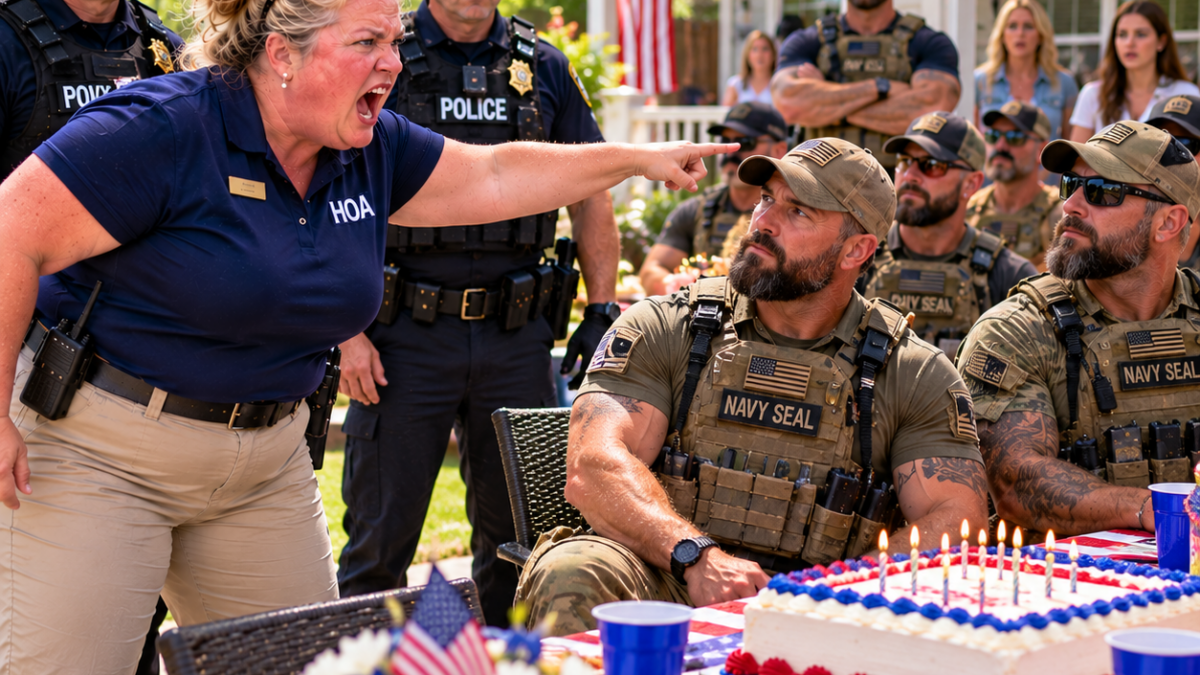
The HOA president stood in the middle of my fiftieth birthday party, pointed at the men sitting around my porch table, and told the 911 dispatcher she was surrounded by armed criminals and needed deputies sent immediately.
Seventeen minutes later, two sheriff’s SUVs tore up my gravel drive with lights flashing, while Meredith Price folded her arms and smiled like she had finally found the weapon she needed to force me off the land I had refused to sell her.
What she did not know was that every man at that table had spent years serving beside me in places we rarely talked about, and one face in that group was about to make the entire story she had invented collapse in front of a hundred witnesses.
I turned fifty on a Saturday in early fall, three years after my wife, Anna, died.
For the first time since losing her, I woke before sunrise and felt something close to peace.
My daughter Lily had been planning the party for weeks. By seven that morning, blue and gold balloons were tied along the porch rail, folding tables filled the yard, and a bakery van had delivered a ridiculous cake with a gold number 50 standing upright in the frosting.
“You get one day,” Lily told me.
“One day for what?”
“To stop pretending birthdays are stupid.”
“They are stupid.”
“You’re smiling.”
I had spent twenty-two years in the Navy, most of them with the SEAL teams, and retired as a master chief. After Anna got sick, we bought the lodge outside the Blue Ridge foothills because she wanted a place where old friends could disappear for a weekend without schedules or uniforms.
After she died, I stayed because leaving felt worse.
At the head of the long outdoor table sat one empty chair.
A folded flag rested across it beside a challenge coin.
That place belonged to Danny Brooks.
Danny had been my closest friend in the teams. We lost him overseas years earlier. Every time our old crew met, we set a place for him.
Around noon, the first black pickup came up the drive.
Mike “Bulldog” Donnelly climbed out, bald, broad, and still built like he expected every doorway to challenge him personally. Tony “Ghost” Marino arrived next, followed by Doc Whitaker and Reed Lawson.
Bulldog hugged me hard.
“Fifty,” he said. “You look terrible.”
“You look pregnant.”
“That’s tactical insulation.”
For the next hour, the porch sounded the way it had not sounded since Anna died.
Laughter, arguments, terrible stories becoming worse with each retelling, Lily moving between tables with a smile I had missed seeing on her face.
For a little while, I was not a widower trying to hold together a lodge full of memories.
I was just Cal Thatcher, sitting with men I trusted.
Then Doc lifted his bottle.
“To Danny.”
Every man at our table stood.
Nobody needed a speech.
The empty chair was enough.
What I did not see then was the white Range Rover parked at the bend below my property.
Meredith Price was inside it.
Meredith ran Ridge View Estates, the HOA development downhill from my land. My parcel had never belonged to her association, but that had not stopped her from sending notices about my mailbox, gravel drive, flagpole, and shed.
Three months earlier, she had offered to buy the lodge and surrounding acreage for a price so low I thought she had misplaced a zero.
I declined.
She leaned toward me and said, “Everyone has a price, Mr. Thatcher.”
“Mine isn’t on your paperwork.”
Her smile vanished.
“You may regret being difficult.”
I had treated it like an empty threat.
At 1:18 that afternoon, I looked up and saw Meredith walking up my driveway in a cream dress, pearl earrings, and heels completely wrong for gravel.
She stopped in front of the porch.
“Who authorized this gathering?”
“I did.”
“This violates Ridge View community covenants.”
“This property isn’t in Ridge View.”
She raised a tablet.
“Our records say otherwise.”
Then her eyes moved to Bulldog, Ghost, Doc, and Reed.
“And who exactly are these people?”
“Friends.”
“They look like hired security.”
Bulldog slowly put down his burger.
Reed stared at his plate, already trying not to laugh.
Meredith turned toward Lily.
Then she said the one thing that made me stand.
“You should be ashamed of helping your father host people like this.”
Lily’s face fell.
I pushed my chair back.
“You can argue with me all afternoon, ma’am.”
My voice stayed quiet.
“But you will not speak to my daughter that way.”
Meredith smiled, pulled out her phone, and tapped three numbers.
“Fine,” she said. “Let’s see how calm you are when the sheriff gets here.”
Then, right in front of us, she began telling the dispatcher a story that was not true.
PART 2
“Armed men,” Meredith said into the phone. “Several of them. They’re intimidating me.”
I stared at her.
Nobody at our table moved.
Bulldog had both hands around his burger.
Ghost leaned back in his chair.
Doc’s bottle sat untouched beside his plate.
Reed looked toward me.
His expression had changed.
The joking was gone.
Meredith paced farther into my driveway.
“Yes, there are a lot of people here. It looks organized. Military-style.”
I almost interrupted.
Then Lily touched my forearm.
“Dad.”
She held up her phone.
Recording.
I looked toward the porch corner.
The security camera I installed after Anna died covered almost the entire driveway.
Audio too.
Good.
Meredith kept talking.
“One of them just threatened me.”
Nobody had.
“They’re refusing to disperse.”
It was my private property.
“They may have weapons.”
She had not seen one.
“Please send someone immediately.”
Then she ended the call.
For a few seconds, all we heard was wind moving through the trees and distant conversation from guests who had not yet realized what had happened.
Meredith slid her phone into her handbag.
“There.”
She looked satisfied.
“Now maybe you’ll understand that rules apply to you too.”
I kept my voice level.
“You told 911 we threatened you.”
“You did.”
“Who?”
She pointed toward Bulldog.
“Him.”
Bulldog looked around.
“Me?”
“Yes.”
He blinked.
“I asked if you wanted mustard.”
Reed covered his mouth.
I said:
“Mike.”
“Sorry.”
Meredith’s cheeks reddened.
“This isn’t funny.”
“No,” I said. “It isn’t.”
She looked at me.
“Your little intimidation routine may work on other people, Mr. Thatcher.”
“My intimidation routine?”
“Gathering a group of tattooed men on the boundary of a residential community.”
I looked down the hill.
Ridge View began nearly half a mile away.
“You walked onto my property.”
“You are adjacent to our community.”
“Adjacent isn’t inside.”
“Our legal documents say otherwise.”
That again.
The tablet.
The mysterious “records.”
I had asked three times over the previous months for Meredith to show me anything proving Ridge View had authority over my land.
She always changed the subject.
Now she had finally brought something.
“Show me.”
She hugged the tablet against her side.
“You can see it through counsel.”
“You came here claiming my land belongs to your HOA.”
“You’ve ignored six compliance notices.”
“Because you have no authority to send them.”
She smiled.
“We’ll see.”
Lily came beside me.
“Dad, should people leave?”
“No.”
I looked at the yard.
Nearly a hundred guests.
Family.
Neighbors from outside Ridge View.
Old Navy friends.
A couple who ran the bakery.
Two of Lily’s coworkers.
Children chasing each other around the trees.
A birthday party.
Nothing more.
“You’re not sending everybody home because Meredith lied to a dispatcher.”
Meredith’s eyes narrowed.
“You keep saying I lied.”
“You said someone threatened you.”
“You were aggressive.”
“No.”
“You stood up.”
I almost laughed.
“So standing is a threat now?”
“You know exactly what you were doing.”
“Cal.”
Doc’s voice.
Quiet.
I looked at him.
He shook his head once.
Not worth it.
He was right.
Training teaches you things you use long after leaving the service.
One of them is that once the authorities are coming, the smartest thing you can do is make the scene boring.
No shouting.
No unnecessary movement.
No dramatic confrontation.
Nothing that can be misunderstood from the top of a driveway.
I turned toward the table.
“Everybody sit.”
Bulldog grinned.
“I am sitting.”
“You know what I mean.”
Ghost looked around at the others.
“Any of you geniuses carrying anything we need to tell the deputies about?”
A couple men shook their heads.
Reed said:
“Pocketknife.”
“Leave it on the table.”
He did.
I looked toward Lily.
“Keep recording, but don’t get in anybody’s way.”
“Okay.”
Meredith laughed.
“What are you doing, preparing your story?”
“No.”
I looked at her.
“Making sure nobody mistakes yours for the truth.”
Her expression hardened.
Then we heard the sirens.
Faint at first.
Getting louder.
Conversations around the yard stopped one by one.
A few guests moved instinctively toward the porch.
I raised a hand.
“Stay where you are.”
The first sheriff’s SUV appeared around the bend.
Then the second.
They came quickly but slowed as they reached the gravel.
No screeching tires.
No dramatic weapons drawn.
Professionals arriving to a call involving alleged weapons tend to become more cautious, not more theatrical.
The first SUV stopped twenty yards from the porch.
Deputy Tom Harland stepped out.
One hand rested near his belt.
The second deputy, Ellis Ward, came from the passenger side.
Harland looked across the yard.
Birthday balloons.
Children.
Cake.
Several middle-aged men seated around a table.
Then Meredith rushed toward him.
“Officer.”
“Ma’am, stay where you are.”
She stopped.
“That man threatened me.”
She pointed directly at me.
Harland looked my way.
“Sir, your name?”
“Calvin Thatcher.”
“You own this property?”
“Yes.”
“Anybody injured?”
“No.”
“Any weapons involved?”
“No weapons have been displayed or threatened.”
Meredith interrupted.
“They’re military men.”
Harland looked at her.
“That wasn’t my question.”
“They’re dangerous.”
Bulldog looked down at his burger as if it had become extremely interesting.
Harland spoke to me.
“Mr. Thatcher, I’m going to ask everybody to keep their hands visible while we sort this out.”
“Understood.”
“Anyone legally carrying?”
I answered honestly.
“Some guests may have lawful firearms secured in vehicles, but nobody at this table is displaying or handling one.”
Harland nodded.
That was the kind of answer he wanted.
Clear.
Calm.
No surprises.
Deputy Ward moved toward the table.
“Gentlemen, just stay seated.”
Doc nodded.
“No problem.”
Meredith stepped closer to Harland.
“This property is under Ridge View jurisdiction. He is holding an unauthorized event and these men are trespassing.”
I looked at her.
“My guests are trespassing at my invitation?”
Harland held up a hand.
“Sir.”
I stopped.
He turned to Meredith.
“Ma’am, are you the property owner?”
“No. I’m president of the homeowners association.”
“Is this parcel inside the HOA?”
“Yes.”
“No,” I said.
Harland gave me a look.
I raised both hands slightly.
“Sorry.”
He turned back to Meredith.
“Do you have documentation?”
She lifted her tablet.
“Yes.”
Ward called from near his cruiser.
“I can pull county parcel records.”
“Do it.”
Meredith looked offended.
“My documents are official.”
Harland said:
“Then they should match.”
A third vehicle came up the road.
Unmarked county SUV.
Sergeant Hal Ramirez stepped out.
I did not know him.
At least, I didn’t think I did.
Forty-something.
Close-cropped hair.
Calm posture.
He took in the scene before approaching.
Harland gave him a quick summary.
“Caller says armed gathering, threats, HOA property dispute. No weapon observed. Property owner disputes HOA jurisdiction.”
Ramirez nodded.
Then he looked toward our table.
His eyes passed Bulldog.
Ghost.
Reed.
Then stopped on Doc.
Something changed in his face.
He walked closer.
Doc squinted at him.
Ramirez stopped six feet away.
“Whitaker?”
Doc stared.
Then his mouth opened.
“Ramirez?”
The sergeant gave a short laugh that sounded like it got caught halfway through becoming something else.
“Doc Whitaker.”
Doc stood slowly.
Harland tensed for half a second.
Ramirez lifted one hand.
“It’s okay.”
He looked at Doc.
“You probably don’t remember me.”
Doc tilted his head.
Then his expression changed.
“Ramirez.”
The sergeant nodded.
“Convoy accident.”
Doc’s face went soft.
“Yeah.”
Ramirez swallowed.
“You were in the back of the vehicle with me.”
Doc looked down.
“I was the medic.”
“You kept me awake.”
“Part of the job.”
“You held my hand for half the ride.”
Bulldog stared at Doc.
“You held his hand?”
Doc didn’t look at him.
“Mike, I swear to God.”
Nobody laughed.
Ramirez’s eyes had gone wet.
“I never got to thank you.”
Doc shook his head.
“You made it home. That’s enough.”
The yard became very quiet.
Then Ramirez looked toward me.
Not casually.
Recognition slowly appeared.
“Master Chief Thatcher?”
I stood.
“Yes.”
He straightened.
Not because I was still in his chain of command.
I wasn’t.
Not because retired rank gave me authority over him.
It didn’t.
It was simply recognition between people who understood what the title meant.
“Sir.”
I shook his hand.
“Sergeant.”
He looked around the table.
“Donnelly?”
Bulldog raised his bottle.
“Still ugly.”
“Marino?”
Ghost nodded.
“Lawson?”
Reed smiled.
“Depends who’s asking.”
Ramirez stared at the empty chair.
The folded flag.
Danny’s coin.
His expression changed again.
“I’m sorry.”
I nodded.
“Thank you.”
Meredith stepped forward.
“Why are we doing this?”
Nobody answered.
She raised her voice.
“Sergeant, these people are violating HOA rules.”
Ramirez turned.
“They’re guests at a birthday party.”
“They are men with military backgrounds gathered in large numbers.”
“That is not illegal.”
“They intimidated me.”
“Who threatened you?”
She hesitated.
“That man.”
She pointed at me again.
“What exactly did he say?”
“That I wasn’t allowed to speak to his daughter.”
Lily blinked.
Ramirez looked at her.
“Miss, are you the daughter?”
“Yes.”
“What happened?”
Lily looked at me.
“Tell him.”
Meredith interrupted.
“She’s obviously biased.”
Ramirez’s face hardened slightly.
“Ma’am, let her answer.”
Lily explained.
Meredith insulting the guests.
Calling her disgraceful.
Me standing.
My exact words.
Ramirez looked at Harland.
“Dispatch recording?”
Harland nodded.
“Available.”
“And porch video?”
Lily raised her phone.
“I have my own recording too.”
Meredith stared at her.
For the first time, the confidence left her eyes.
Not all of it.
Just enough.
Deputy Ward called from his SUV.
“Sergeant.”
Ramirez walked over.
Ward turned the laptop toward him.
They spoke quietly.
Meredith tried to follow.
Harland stopped her politely.
“Please stay here.”
“What are they doing?”
“Checking property records.”
“I already gave you the association documents.”
“We’re checking independent records.”
She looked at me.
“You’re enjoying this.”
“No.”
And I wasn’t.
Not yet.
Something about the way she had said our records say otherwise bothered me.
This had gone beyond another ridiculous compliance notice.
Ward called me over.
I stayed on my side of the vehicle.
He pointed at the county parcel map.
“Mr. Thatcher, this your parcel?”
“Yes.”
“Parcel number ends in 417?”
“Yes.”
“No HOA declaration attached in the county index.”
“I know.”
“Ridge View boundary ends here.”
He traced the line.
My property sat outside it.
Separate parcel.
Separate deed.
Separate access.
Ramirez looked toward Meredith.
“Mrs. Price.”
She came closer.
“What?”
“County records do not show this property inside Ridge View Estates.”
Her face tightened.
“That’s outdated.”
“Do you have a recorded annexation?”
“Yes.”
She unlocked her tablet.
Pulled up a PDF.
“I have it right here.”
Ramirez read.
Then Ward.
Then Harland.
Ward frowned.
“Where is this recorded?”
“Our association counsel has it.”
“That isn’t what I asked.”
“It was executed three years ago.”
I heard that.
Three years.
Something in my chest tightened.
“When?”
Meredith looked at me.
“What?”
“What date?”
Ramirez read the document.
“October seventeenth.”
My whole body went still.
Lily looked at me.
“Dad?”
I already knew.
Anna died October eleventh.
We buried her October fifteenth.
October seventeenth, I had not left the lodge except to sit beside her grave.
I barely ate.
Barely slept.
I certainly had not signed my property into an HOA.
“Let me see it.”
Ramirez hesitated.
Then turned the tablet enough that I could read.
ANNEXATION CONSENT.
Calvin J. Thatcher.
My address.
My parcel.
My supposed signature.
It looked close.
Too close.
My name curved the way I sign it.
But the T was wrong.
Anna used to tease me about that T.
Mine always leaned backward.
This one stood straight.
I looked at the date again.
October seventeenth.
Lily moved beside me.
“Dad.”
“I didn’t sign this.”
Meredith exhaled sharply.
“It may have been handled through your attorney.”
“No.”
“You were dealing with a lot at the time.”
I turned toward her.
“What did you just say?”
Her face changed.
Slightly.
She knew she had said too much.
Ramirez stepped between us before I could move closer.
“Mr. Thatcher.”
I stopped.
He looked at Meredith.
“How did the HOA obtain this document?”
“Our legal files.”
“Who prepared it?”
“I don’t remember.”
“You’re president.”
“We process hundreds of documents.”
“Who witnessed the signature?”
She looked at the tablet.
“I’d have to check.”
“Who notarized it?”
Another pause.
That was a good question.
Ward zoomed in.
“Notary block is incomplete.”
Meredith’s breathing changed.
Harland said:
“This is no longer something we’re going to resolve standing in a driveway.”
Meredith raised her hands.
“Exactly. It’s a civil records issue.”
Ramirez looked at her.
“Maybe.”
Then Lily spoke.
“Sergeant?”
“Yes?”
“I recorded the 911 call.”
Meredith turned fast.
“You had no right—”
“She was standing in our driveway,” Lily said.
“Lily.”
My daughter looked at me.
“You told me not to let her talk to me like that.”
Fair.
Ramirez asked:
“May I hear it?”
Lily held the phone.
“I can play it.”
She did.
Meredith’s voice came through clearly.
Armed men.
Threatening.
Militia-style gathering.
Send someone quickly.
We all listened.
The actual scene remained visible around us.
Cake.
Balloons.
Guests.
Children.
No threatening movement.
No armed display.
Ramirez looked at Meredith.
“You told dispatch men were threatening you.”
“They were.”
“Which statement constituted the threat?”
She pointed at me.
“He told me what I could and could not say.”
“I told you not to insult my daughter.”
“That was intimidating.”
Ramirez remained calm.
“Did anyone tell you they were going to harm you?”
“No, but—”
“Did anyone display a weapon?”
“I believed they had them.”
“That is different.”
Meredith crossed her arms.
“This is absurd.”
Then her phone rang.
She looked at the screen.
Ignored it.
It rang again.
Ramirez said:
“You’re free to answer your phone, ma’am.”
She declined.
The third time, she looked visibly angry.
Lily could see the screen.
“Alan Peek.”
Meredith snapped:
“Do not read my phone.”
Lily stepped back.
“Sorry.”
Ramirez said nothing.
The phone rang a fourth time.
Finally Meredith answered.
“What?”
Alan’s voice was loud enough that several of us heard the first words.
“Meredith, where are you?”
“Busy.”
“We have a serious problem.”
“Not now.”
“The auditors found the Redmond transfer.”
Her face changed.
“Alan.”
“Eighty-five thousand dollars from the reserve.”
“Stop talking.”
Several heads turned.
Alan continued, too panicked to understand.
“You told us it was for drainage repairs, but the receiving account belongs to Clint Redmond’s development company.”
Meredith looked around.
Then took the phone off speaker.
Too late.
“I will call you back.”
She hung up.
Nobody said anything.
Ramirez looked at Harland.
Harland looked at Ward.
I looked at Meredith.
That name meant something to me.
Clint Redmond.
I had seen it.
Where?
Then I remembered.
The offer letter.
Three months earlier.
The developer who wanted my land.
The company had been Redmond Holdings.
I walked toward the house.
Ramirez said:
“Mr. Thatcher?”
“Getting something.”
“Tell me what.”
“Purchase offer.”
I returned with the folder.
Redmond Holdings.
Clint Redmond.
Offer for the lodge and acreage.
Meredith had delivered it personally.
I handed it to Ramirez.
He read.
Then looked toward her.
“You know Mr. Redmond?”
“He is a developer.”
“That wasn’t the question.”
Ridge View residents had begun gathering beyond my lower fence.
They had heard sirens.
Then seen sheriff’s vehicles.
Mrs. Dobbins from the corner house stood near the front.
Meredith noticed them.
Her posture changed.
She suddenly cared very much about controlling the scene.
“This has gotten completely out of hand.”
Ramirez nodded.
“On that, we agree.”
“I came here because an unauthorized event was disrupting the community.”
“It’s nearly half a mile from your nearest common property.”
“Sound travels.”
“We haven’t received a noise complaint.”
“That doesn’t mean—”
“And you reported armed men threatening you.”
“They made me feel unsafe.”
Ramirez looked toward the table.
Doc had sat back down.
Bulldog was eating again.
Ghost was helping a child retrieve a balloon caught on a chair.
Reed was cutting a second slice of cake.
Ramirez looked back.
“Mrs. Price, Deputy Harland is going to speak with dispatch and review the original call.”
She stiffened.
“Why?”
“Because false information to emergency services can be a criminal matter depending on the facts and intent.”
“I did not make a false report.”
“That will be determined.”
“And this document?”
She pointed toward her tablet.
“Civil.”
“Possibly. The authenticity issue will be referred for investigation.”
“You cannot take my tablet.”
“Nobody said we were taking it without legal authority.”
That was the first point where the source story I later heard repeated around the county became more dramatic than reality.
Nobody snatched Meredith’s phone.
Nobody instantly arrested her for embezzlement because a nervous treasurer called.
Law enforcement does not work like television.
But what happened next was worse for her in a different way.
Her story began coming apart piece by piece while everyone watched.
Harland contacted dispatch.
The call had been recorded.
Of course it had.
Ward confirmed my property records.
Lily’s recording preserved Meredith’s words.
My porch camera preserved everything from the moment she entered the driveway.
The annexation document contained an unverified signature dated forty-eight hours after my wife’s funeral.
And Alan Peek’s panicked call had introduced an entirely separate financial question involving the same developer who wanted my land.
Ramirez stepped away and made several calls.
Meredith waited.
So did we.
For almost twenty minutes, my birthday party turned into the strangest silent picnic in Virginia.
Bulldog finally held up the mustard.
“Anybody?”
Half the table laughed.
Even Harland smiled.
Meredith did not.
Ramirez returned.
“Mrs. Price, based on the information we have right now, we need you to remain available while deputies complete the report.”
“I have an HOA meeting.”
“You are not under arrest at this moment.”
“At this moment?”
“I’m being precise.”
Her face reddened.
“I want my attorney.”
“That is your right.”
She called someone.
While she spoke, Ramirez walked over to me.
“Master Chief.”
“Cal.”
He nodded.
“Cal.”
“Thank you.”
“For what?”
“Not turning this into something worse.”
I looked toward Lily.
“Had good supervision.”
She heard.
“Correct.”
Ramirez smiled.
Then looked at Danny’s empty chair.
“You mind?”
“No.”
He walked over.
Read the name engraved on the challenge coin.
“Danny Brooks.”
“You know him?”
“Everybody in my old unit knew stories.”
Doc said:
“Most of them are lies.”
“Probably.”
For the first time since the deputies arrived, the tension loosened.
Then another vehicle turned onto the property.
Black sedan.
Lily looked at me.
“Oh.”
“What?”
She suddenly looked guilty.
“What did you do?”
“Nothing.”
“Lily.”
The sedan stopped.
A tall older man stepped out.
Silver hair.
Straight posture.
Retired Vice Admiral Paul Granger.
I had not seen him in six years.
I stared at my daughter.
“You invited Granger?”
She shrugged.
“He RSVPed late.”
“That man has never been on time for anything.”
Granger heard.
“Still insubordinate, Thatcher.”
I smiled despite myself.
“Admiral.”
“Retired.”
“So am I.”
He hugged me.
No ceremony.
No salute.
Just two old men who had known each other through years neither wanted to explain.
Then the passenger door opened.
A small silver-haired woman stepped out holding a wooden box.
Everything in me stopped.
Margaret Brooks.
Danny’s mother.
Lily took my hand.
“I wanted her here.”
Margaret looked toward the table.
Toward the empty chair.
Then at me.
“Cal.”
I walked to her.
For a second I could not speak.
“You came.”
“Of course I came.”
She touched my cheek the way she had when I was twenty-eight and Danny had first brought me home for Thanksgiving.
“You got old.”
Granger said:
“Finally, someone said it.”
I laughed.
Then Margaret opened the wooden box.
Inside was a framed photograph.
Danny in uniform.
Young.
Grinning like he had just gotten away with something.
He usually had.
Margaret held it against her chest.
“He would have been fifty-one.”
“I know.”
“He would have hated missing this.”
My throat tightened.
“Yes.”
She looked toward the chair.
“May I?”
I moved the folded flag carefully.
“You never have to ask.”
She sat in Danny’s place.
Not replacing him.
Nobody could.
But for the first time, the empty chair held someone who carried the same loss we did.
Bulldog turned away.
Ghost stared toward the mountains.
Doc wiped his eyes without pretending otherwise.
Reed looked down.
Lily squeezed my arm.
And for several minutes, Meredith Price became completely irrelevant.
That was the first victory of the day.
Not her embarrassment.
Not the deputies.
Not the property record.
The fact that she could no longer control my birthday.
We returned to the table.
Granger sat near Margaret.
Ramirez stayed long enough to speak quietly with Doc.
Harland and Ward continued their report.
Meredith remained near her vehicle with her attorney on the phone.
Eventually Harland approached her.
“Mrs. Price, I need to advise you that based on the dispatch recording and witness evidence, we have probable cause to take further action regarding the emergency report.”
Her attorney said something through the phone.
She raised a hand.
“Am I under arrest?”
Harland answered carefully.
“Yes, ma’am, for the suspected false emergency report. Other matters will be investigated separately.”
No one cheered.
At least not immediately.
That matters to me when I tell the story now.
There were children present.
Lily was standing beside me.
Margaret was sitting at Danny’s chair.
Watching somebody be placed in handcuffs is not a birthday entertainment.
Meredith looked stunned.
“You’re arresting me?”
“For the report, ma’am.”
“But them?”
Harland looked toward us.
“There is no evidence at this time that they committed the conduct you reported.”
“I am the HOA president.”
“That does not change the evidence.”
“You don’t understand what this man has done.”
I finally answered.
“What did I do, Meredith?”
She stared at me.
“You refused every reasonable offer.”
There.
The truth slipped out.
Ramirez heard it.
So did Lily.
“So this is about the land?” I asked.
Meredith realized too late.
“I didn’t say that.”
“You just did.”
“No.”
Harland guided her toward the SUV.
Ridge View residents lined the lower fence.
Mrs. Dobbins began clapping.
I looked at her.
She stopped.
Then shrugged.
“Sorry.”
Another neighbor laughed.
The mood broke.
Meredith looked back at me.
Mascara had begun streaking beneath one eye.
For a moment I almost felt sorry for her.
Then I remembered Lily’s face when Meredith called her a disgrace.
I remembered the annexation date.
October seventeenth.
Two days after I buried Anna.
I said nothing.
That bothered Meredith more.
The cruiser door closed.
Harland and Ward eventually left.
Ramirez stayed.
He walked to the table.
“I’m sorry your birthday turned into paperwork.”
“Not your fault.”
He looked at Doc.
“Can I stay five minutes?”
Doc smiled.
“Only if you eat.”
Ramirez sat.
Lily brought him a plate.
Margaret placed Danny’s photograph beside the challenge coin.
Then she looked at me.
“Cake.”
I laughed.
“Yes, ma’am.”
Lily brought the ridiculous blue-and-gold cake.
Fifty candles.
Bulldog counted.
“Forty-nine.”
“It’s fifty.”
“Prove it.”
“You ate one.”
“No evidence.”
Reed pointed at frosting on his thumb.
“Compelling evidence.”
For the first time that day, I laughed hard enough that my ribs hurt.
Everyone gathered.
My old teammates.
Lily.
Margaret.
Granger.
Ramirez.
Neighbors who had wandered up after the commotion.
People from town.
There should have been one person beside me.
Anna.
That absence was always there.
Birthdays after loss are strange.
You are grateful and angry at the same time.
Grateful for everyone who came.
Angry at the one person who can’t.
Lily leaned close.
“Mom would’ve hated the HOA drama.”
I smiled.
“No.”
“She would’ve loved it?”
“She would’ve made Meredith cry before lunch.”
Lily laughed.
“That sounds right.”
Fifty flames moved in the breeze.
“Make a wish,” Margaret said.
I looked around.
At Danny’s picture.
At Anna’s daughter.
At the men who had carried pieces of my past with them for decades.
I made one.
Then blew out the candles.
That should have ended the story.
It didn’t.
At 7:30 the next morning, Alan Peek knocked on my door.
The HOA treasurer looked like he had not slept.
I opened it but did not invite him inside.
“What do you want?”
“To apologize.”
“For what?”
He looked toward Ridge View.
“For a lot.”
“Start with one.”
He swallowed.
“We should never have sent violation notices.”
“No.”
“Meredith insisted your parcel had been annexed.”
“Did you see the document?”
“Yes.”
“Did you verify it?”
“No.”
“Why?”
“She said association counsel handled it.”
“Which counsel?”
Alan looked embarrassed.
“I don’t know.”
That answer told me how Ridge View had been governed.
“What about Redmond?”
His eyes shifted.
“You heard.”
“Everybody within fifty feet heard.”
Alan ran a hand over his face.
“The board authorized eighty-five thousand dollars for drainage and road repairs.”
“Was it spent on that?”
“No.”
“Where?”
“A consulting agreement.”
“With Redmond?”
“Yes.”
“Why?”
“Meredith said it was preliminary planning for expansion.”
I stared at him.
“Expansion where?”
He didn’t answer.
My land.
Of course.
“Did the board approve buying my property?”
“No.”
“Then why pay a developer to plan around land you didn’t own?”
“That’s what the auditors asked.”
“Who ordered the audit?”
“I did.”
That surprised me.
“When?”
“Six weeks ago.”
“Why?”
“Reserve numbers weren’t matching.”
“And Meredith knew?”
“Not until Friday.”
The day before my birthday.
That explained some of her desperation.
I crossed my arms.
“Alan, why are you here?”
He pulled out an envelope.
Inside were copies of board minutes.
Emails.
A map.
Ridge View Phase Four Concept.
The proposed development consumed my lodge and most of my acreage.
Where Anna’s garden sat, the map showed twelve luxury homes.
My porch became a cul-de-sac.
The barn became a stormwater basin.
Danny’s table didn’t exist.
The price estimate at the bottom projected the finished expansion at more than ten million dollars.
I felt something colder than anger.
It is one thing for someone to offer to buy your land.
It is another to plan what they will do after you say no.
“How long?”
“About a year.”
“You knew?”
“Not the forged annexation.”
“That isn’t what I asked.”
Alan looked down.
“I knew she wanted the property.”
“And?”
“I believed negotiations were ongoing.”
“They weren’t.”
“I know.”
“Did you know she was sending me HOA violations?”
“Yes.”
“Did you know my parcel wasn’t part of Ridge View?”
He took too long.
“Alan.”
“Yes.”
There it was.
“You knew.”
“I told her the county map didn’t match.”
“When?”
“Months ago.”
“And you did nothing.”
“I argued.”
“Privately.”
“Yes.”
I stepped back.
“You should go.”
“Cal.”
“Go.”
He left the envelope.
I didn’t stop him.
Lily found me twenty minutes later sitting at the long table.
Danny’s chair was empty again.
The balloons were drooping.
Half the cake remained under plastic wrap.
She sat opposite me.
“What happened?”
I handed her the map.
She looked.
Then looked again.
“That’s Mom’s garden.”
“I know.”
“They put houses on it.”
“It’s a concept plan.”
“They planned houses on Mom’s garden.”
Her voice changed.
I reached for her hand.
“Lily.”
“No.”
She stood.
“Dad, you kept telling me Meredith was annoying.”
“She was.”
“You didn’t tell me she was trying to take the lodge.”
“I didn’t know it was this far.”
“She forged your signature.”
“Allegedly.”
She glared.
“You’re doing the legal-word thing.”
“It matters.”
“Fine.”
She paced.
“She allegedly forged your signature during the week Mom died.”
“Yes.”
“And they designed a subdivision on our land.”
“Yes.”
“And she called us criminals at your birthday.”
“Yes.”
Lily stopped.
“Now I’m angry.”
“I noticed.”
“What are we doing?”
I almost said nothing.
That instinct came from service.
Collect information.
Don’t react until you know the whole picture.
Then I looked at the Phase Four map.
Anna’s garden.
Danny’s table.
The lodge.
“No more ignoring letters.”
That became our strategy.
Not revenge.
Documentation.
For years I had thrown Meredith’s ridiculous notices into a desk drawer because responding felt like giving them legitimacy.
Now every one became evidence.
Unapproved mailbox.
Unapproved gravel.
Unauthorized flagpole.
Exterior lighting violation.
Commercial lodging violation.
Noise warning.
Landscape nonconformity.
Twenty-three notices in fourteen months.
All issued against property not inside the HOA.
I laid them across the dining table.
Lily photographed each.
We found dates.
Patterns.
Several appeared shortly after I rejected purchase offers.
One arrived two days after Redmond Holdings increased its bid.
Another followed my refusal to let an HOA survey crew cross the land.
The pressure was not random.
My attorney, Rebecca Sloan, saw it immediately.
She was fifty-eight, direct, and apparently incapable of pretending nonsense was complicated.
She read the annexation form.
“This is bad.”
“How bad?”
“If the signature is fabricated, very.”
“Can we prove it?”
“Maybe.”
“It’s dated two days after Anna’s funeral.”
“That proves context, not forgery.”
“I was home.”
“Witnesses?”
“Lily.”
“Others?”
“Half my old team.”
“Records?”
“My phone barely moved.”
“Good.”
She examined the supposed notarization.
“This is stranger.”
“What?”
“The notary commission number is incomplete.”
“Meaning?”
“It may be invalid, copied incorrectly, or fabricated.”
“What do we do?”
“First, title search.”
The title company confirmed what county records already showed.
No valid annexation recorded.
No declaration binding my parcel.
No HOA lien.
No covenant.
Ridge View had no recorded authority over my land.
Second, Rebecca requested the HOA’s full annexation file.
Ridge View’s attorney responded that the document was “under review.”
Third, the sheriff’s office opened a separate inquiry into the false emergency report and referred the questionable property document to investigators.
Fourth, the HOA’s own auditors expanded their financial review.
That was when Clint Redmond reappeared.
Not at my house.
Through email.
Rebecca called me.
“I have something.”
“What?”
“Redmond wants to talk.”
“With me?”
“Through counsel.”
“Why?”
“He is apparently reconsidering his relationship with Meredith.”
“Meaning?”
“He knows investigators are looking at the eighty-five thousand dollars.”
“Does he want immunity?”
“That’s a prosecutor question.”
“What does he want from us?”
“Probably to separate his development proposal from the forged-document issue.”
I hated even hearing his name.
“Tell him no.”
Rebecca paused.
“No to what?”
“Talking.”
“That may be emotionally satisfying.”
“Yes.”
“And strategically stupid.”
I sighed.
“When?”
“Thursday.”
We met Redmond and his attorney in Rebecca’s office.
Clint Redmond looked exactly like the kind of man who sold expensive houses.
Sixties.
Tailored jacket.
Soft hands.
Practiced concern.
He shook mine.
“Mr. Thatcher.”
I did not shake back immediately.
Then I did.
“Mr. Redmond.”
He opened with:
“I want you to understand that I never authorized any improper conduct toward you.”
“Good start.”
His attorney shifted.
Rebecca said:
“Cal.”
I leaned back.
Redmond continued.
“Meredith approached us almost eighteen months ago regarding a possible expansion of Ridge View.”
“Across my property.”
“Yes.”
“Which she didn’t own.”
“She represented that the HOA had a path to acquire it.”
“What path?”
“Negotiated sale.”
“I said no.”
“She told us you were reconsidering.”
“I wasn’t.”
“She later said your parcel had been annexed and that the association had leverage through compliance enforcement.”
There.
“Did that concern you?”
“Yes.”
“When?”
Redmond looked at his lawyer.
“Eventually.”
I laughed once.
“Eventually.”
“We develop property, Mr. Thatcher. We don’t administer HOAs.”
“You took eighty-five thousand dollars from one.”
“For planning and design work.”
“On land none of you owned.”
“We completed concept studies requested by the association.”
Rebecca stepped in.
“Did Meredith ever represent that Mr. Thatcher signed annexation consent?”
“Yes.”
“Did you see the document?”
“A copy.”
“When?”
Redmond gave the date.
Three months after Anna died.
“Did you verify the recording?”
“No.”
“Why?”
“We assumed HOA counsel had.”
“Which counsel?”
He named a small firm.
Rebecca wrote it down.
That firm later denied preparing or recording the annexation document.
Another layer disappeared.
Redmond eventually provided emails.
Some hurt to read.
Meredith describing me as:
emotionally unstable after spouse’s death.
likely to sell once carrying costs become burdensome.
isolated.
resistant but pressure-sensitive.
I stopped reading.
Rebecca watched me.
“You okay?”
“No.”
Lily was not in the meeting.
Good.
That line about Anna would have destroyed her.
I looked at Redmond.
“You knew my wife died?”
He looked uncomfortable.
“Yes.”
“And you still let her describe grief as leverage.”
His attorney began:
“Mr. Thatcher—”
“No.”
I stared at Redmond.
“You drew houses over her garden while she was barely cold in the ground.”
His face tightened.
“We should have handled things differently.”
“That is the first intelligent thing you’ve said.”
Rebecca let the silence sit.
Then resumed.
The investigation moved slowly after that.
People who hear the story want the birthday-party moment.
The Navy SEAL table.
The deputies.
Meredith’s face.
Real consequences came from months of boring work.
Digital records.
Notary records.
Title history.
Email metadata.
Bank transfers.
Audit files.
Board minutes.
Witness interviews.
Meredith’s tablet was eventually obtained through lawful process.
Investigators found draft versions of the annexation consent.
The metadata tied at least one version to her HOA account.
My signature appeared as an inserted image.
Not written ink.
An image.
Copied from another document I had actually signed years earlier.
A clubhouse-access agreement for a charity event Anna and I hosted before she died.
My signature had been scanned.
Cut out.
Placed onto an annexation form.
The date added later.
October seventeenth.
The week grief had made me too exhausted to know what day it was.
That detail angered Lily most.
“She picked that week because Dad wouldn’t remember.”
Rebecca said:
“We can’t know motive without evidence.”
Lily answered:
“I know.”
I understood both women.
The notary section had never been validly completed.
No recording existed because anyone at the county office would likely have rejected it.
But inside the HOA, Meredith had treated the fake document as authority to issue violations and pressure me.
The association board had never formally approved annexation either.
Alan Peek admitted that.
So did two other members.
Meredith had simply presented the parcel as already covered.
Most board members believed her.
That was its own lesson.
Power grows fastest when everyone assumes someone else checked the paperwork.
The eighty-five thousand dollars became another case.
The audit found Redmond had performed some planning work.
So the whole amount was not simply “stolen.”
But invoices were misleading.
Some charges had been classified as infrastructure repair.
Board members were told the money related to drainage studies and road resilience.
Instead, substantial work supported the proposed expansion onto my property.
Investigators also found personal communications between Meredith and Redmond discussing future compensation if the project closed.
That crossed lines the auditors could no longer explain as sloppy bookkeeping.
The HOA suspended Meredith before the criminal case finished.
She fought the suspension.
Called it political.
Sent letters to homeowners.
Blamed me.
Blamed Alan.
Blamed Redmond.
Blamed sheriff’s deputies.
Blamed “military intimidation.”
That one almost made Bulldog frame the letter.
“Military intimidation.”
He read it aloud at my kitchen table.
“You offered her mustard.”
“Hostile mustard.”
Ghost said:
“Possibly tactical.”
Doc shook his head.
“We used to be serious people.”
“No evidence,” Reed said.
Those nights helped.
I had not realized how lonely I had become after Anna died.
The birthday brought the old crew back.
The investigation kept them around.
Not physically every day.
But calls.
Messages.
Visits.
Bulldog showed up one weekend with lumber and announced my porch steps were unsafe.
“They’ve been fine twenty years.”
“You’re fifty.”
“So?”
“Fall risk.”
“I hate you.”
He rebuilt them anyway.
Ghost fixed exterior lights.
Doc convinced me to get a physical I had been delaying.
Reed taught Lily several card games Anna used to hate.
Margaret came more often too.
She and Lily became close.
One afternoon, I found them in Anna’s garden.
Margaret was holding a handful of seed packets.
“What is this?”
“Intervention,” Lily said.
“For what?”
“The garden.”
“It’s fine.”
“It’s weeds.”
“It’s rustic.”
Margaret pointed toward me.
“Your wife would haunt you.”
“She already does.”
Margaret’s expression softened.
“I know.”
We replanted.
That day, Margaret told me something I had never heard.
Danny had planned to leave the Navy before he died.
“He wanted a place like this.”
“The lodge?”
“Yes.”
She touched the porch rail.
“He used to talk about you two buying land somewhere.”
I laughed.
“He had a hundred plans.”
“He said men like you needed somewhere quiet after the noise.”
That stayed with me.
Months later, when Lily suggested turning part of the lodge into a veterans retreat, I understood where the idea came from.
But first, Meredith’s case had to end.
The HOA recall meeting took place in winter.
Ridge View’s clubhouse was packed.
I attended only because Rebecca wanted me present for the property issue.
Meredith stood at the front.
No cream dress.
Dark suit.
Attorney beside her.
Alan presented the audit findings.
Not accusations beyond what could be documented.
Improperly classified development payments.
Lack of board authorization.
Misrepresentation of my parcel’s HOA status.
Questionable annexation record.
Residents were furious.
Mrs. Dobbins spoke first.
She had been fined three times for landscaping.
“Did you know his property wasn’t in the association?”
Meredith answered:
“My understanding was that annexation had been completed.”
“By who?”
“Legal.”
“Which lawyer?”
Meredith’s attorney objected to the tone.
Mrs. Dobbins said:
“This isn’t court.”
The room laughed.
Then a younger homeowner stood.
“You spent our reserve money planning houses on his land?”
Meredith answered:
“Planning for future expansion can benefit property values.”
“But he said no.”
“Negotiations evolve.”
I felt Rebecca’s hand on my sleeve.
Stay seated.
I did.
Another resident asked:
“Why did you call police on his birthday?”
Meredith’s face tightened.
“I perceived a threat.”
“From five retired guys eating hamburgers?”
Applause.
The moderator called for order.
Meredith looked toward me.
“You weren’t there.”
The resident said:
“We’ve seen the video.”
That changed everything.
Lily had not posted it publicly.
But sheriff records and evidence had become known through proceedings.
Enough residents had seen the porch video during internal review.
Meredith’s version no longer controlled the room.
She tried one final argument.
“My job was to protect Ridge View.”
I believed she believed part of that.
That was important.
Meredith was not a cartoon villain who woke up wanting to destroy a widower’s birthday.
She wanted control.
Expansion.
Property values.
Recognition.
A bigger association.
A successful development project.
She believed my land was an obstacle.
Then, step by step, she convinced herself that pressure was leadership.
Rules became leverage.
Grief became opportunity.
A false document became paperwork.
A false emergency report became self-defense.
People rarely walk from ordinary ambition to serious wrongdoing in one step.
They build a staircase.
Meredith had built hers carefully.
Now she stood at the top with nowhere left to go.
The recall vote was overwhelming.
She was removed.
Alan Peek became interim president despite repeatedly saying he did not want the job.
Bulldog heard that and said:
“Best qualification.”
Ridge View sent me a formal written apology.
I appreciated it.
Then I wrote back:
Please stop sending me landscaping notices.
Alan called.
“I deserved that.”
“Yes.”
Criminal proceedings came later.
The false emergency-report charge moved first.
Then the property-document investigation.
Then financial allegations tied to the reserve funds and Redmond arrangement.
Eventually Meredith entered a plea agreement resolving multiple counts, including the knowingly false emergency report, document forgery-related conduct, and financial wrongdoing connected to HOA funds.
I am deliberately careful with those words.
Because by then I had learned something from Rebecca.
Justice is not improved by exaggeration.
The truth was enough.
Meredith was removed permanently from HOA leadership.
She paid restitution.
Her financial situation deteriorated badly.
She eventually sold her Ridge View home.
I heard residents say she “lost the house because of me.”
That wasn’t true.
I did not take her house.
Consequences accumulated from legal fees, restitution, financial penalties, and her own decisions.
Clint Redmond cooperated extensively with investigators.
His company paid back disputed HOA funds under settlement terms and abandoned the Ridge View expansion.
The Phase Four map disappeared.
Anna’s garden remained where Anna planted it.
That mattered more to me than any sentence.
Alan was elected president properly the following spring.
His first act was to invite me to a board meeting.
I declined.
His second act was to ask again.
I attended.
He handed me an envelope.
Inside:
Formal confirmation that my parcel had never been and would not be represented as part of Ridge View Estates.
Recorded boundary map attached.
Association counsel certification.
No covenant jurisdiction.
No assessments.
No enforcement authority.
I read it.
“Good.”
Alan looked nervous.
“That’s it?”
“What do you want?”
“I don’t know.”
“Forgiveness?”
His face changed.
“Maybe.”
I closed the folder.
“You knew the county map didn’t match.”
“Yes.”
“You stayed quiet.”
“Yes.”
“Why?”
He looked around the clubhouse.
“Meredith made disagreement expensive.”
I understood that.
Not enough to excuse it.
But enough to understand.
“I’m not going to pretend that didn’t matter.”
“I know.”
“But you ordered the audit.”
“Yes.”
“You came to me.”
“Yes.”
“You testified.”
“Yes.”
I held out my hand.
“We start there.”
He shook it.
That was not forgiveness.
Not yet.
It was the possibility of it.
The lodge changed too.
After the investigation ended, Lily brought me a notebook.
“What is this?”
“Business plan.”
“No.”
“You didn’t read it.”
“Still no.”
Margaret sat across from us.
“You should read it.”
I looked at both of them.
“This is an ambush.”
“Yes,” Lily said.
I opened the notebook.
DANNY BROOKS VETERANS RETREAT.
I stopped.
The proposal was simple.
Use the lodge’s extra rooms.
No charge for veterans and immediate family members needing a quiet place after hospitalization, deployment transition, bereavement, or other difficult periods.
Small scale.
Donations.
Volunteer-run.
No speeches.
No giant nonprofit bureaucracy.
Just rooms.
Meals.
Trails.
A long table.
I looked at Margaret.
“Your idea?”
“Danny’s.”
My throat tightened.
She repeated what she had told me in the garden.
“He wanted men like you to have somewhere quiet after the noise.”
Lily added:
“Mom wanted this lodge full of people.”
I looked around.
Anna had said exactly that.
A house is only alive when somebody needs a chair.
That was one of her lines.
I closed the notebook.
“How much?”
Lily smiled.
“I knew you’d ask that.”
“Don’t smile yet.”
“Too late.”
We opened six months later.
Not with a giant ceremony.
That would have embarrassed Danny.
A small gathering.
Margaret.
My old team.
Granger.
Ramirez.
A few Ridge View residents.
Alan.
Mrs. Dobbins.
Rebecca.
Lily.
At the entrance, a simple wooden sign:
DANNY BROOKS VETERANS RETREAT.
No rank.
No list of medals.
Just his name.
Inside, the long table remained.
Danny’s chair stayed at the head.
Folded flag.
Challenge coin.
Photo Margaret brought to my birthday.
The first family to stay was a Marine veteran, his wife, and their two children.
I will call him Eric.
He had recently left a hospital after months of treatment following an accident.
He did not need therapy from me.
I was not qualified.
He needed quiet.
Coffee.
A porch.
People who did not ask him to explain everything.
On the second morning, I found him sitting at Danny’s table before sunrise.
“You sleep?”
“A little.”
“Coffee?”
“Yes.”
I poured two cups.
He looked at the empty chair.
“Who’s Danny?”
“Friend.”
“Good one?”
“The best.”
Eric nodded.
We sat.
No more questions.
That became the model.
Some guests wanted to talk.
Some didn’t.
Both were fine.
Bulldog handled grilling weekends.
Which terrified everyone because he believed flames should be visible from space.
Doc helped connect families to actual medical and counseling resources when needed.
Ghost maintained the trails.
Reed created a library that was mostly military history and terrible crime novels.
Margaret came once a month.
Lily ran everything better than I ever could.
I mostly fixed broken things and pretended I was in charge.
Ridge View residents started volunteering.
That surprised me.
Mrs. Dobbins organized meal trains.
Alan secured an association vote allowing residents to donate voluntarily to the retreat.
No HOA money.
I insisted.
We had learned enough about blurred boundaries.
Sergeant Ramirez came to our first anniversary dinner.
Doc saw him and said:
“You again?”
Ramirez laughed.
“Still alive.”
“Good work.”
At dinner, Ramirez told me something I had not known.
The 911 call from my birthday had changed department training.
“How?”
“We use an anonymized version in scenario review.”
“For what?”
“Call information versus observed facts.”
That pleased me.
Not because Meredith became an example.
Because deputies had handled the scene correctly.
They arrived cautiously.
They checked.
They did not assume the caller was right simply because she sounded confident.
They did not assume we were harmless because we were veterans either.
They verified.
That distinction mattered.
Being Navy SEALs did not make us above the law.
It did not make Meredith automatically wrong.
Evidence did that.
I told Ramirez:
“Make sure they know the table wasn’t proof of innocence.”
He nodded.
“I do.”
“Good.”
“The birthday cake helped.”
I laughed.
Years passed.
The story around Ridge View became exaggerated.
Depending on who told it, Meredith called the National Guard.
Not true.
There were twenty armed SEALs at my party.
Not true.
A vice admiral ordered deputies to arrest her.
Absolutely not true.
Granger arrived after the situation was under control and had no authority over local law enforcement anyway.
Bulldog supposedly threatened to throw Meredith into a lake.
Also false.
There wasn’t even a lake.
Real life was less ridiculous.
And better.
A woman made a knowingly false emergency report because she believed authority could pressure me.
Deputies arrived.
Facts contradicted her.
A suspicious HOA document led to a deeper investigation.
Financial records exposed more.
Residents removed a leader who had abused their trust.
Courts and investigators handled the rest.
That story was enough.
The emotional part took longer.
On my fifty-first birthday, Lily planned another party.
I protested.
Obviously.
“Absolutely not.”
“You survived the last one.”
“Barely.”
“No HOA presidents this year.”
“You can’t guarantee that.”
“I invited Alan.”
“Cancel everything.”
She ignored me.
The old team came back.
Bulldog brought a shirt that said:
UNAUTHORIZED GATHERING.
I refused to wear it.
Margaret wore it instead.
That was worse.
Ramirez arrived without a patrol car.
Good sign.
Alan brought a birthday card signed by half of Ridge View.
One note said:
SORRY ABOUT THE SWAT TEAM.
There had never been a SWAT team.
Another:
THANK YOU FOR NOT BUILDING A TOLL BOOTH.
I laughed.
At sunset, we gathered around Danny’s chair.
Doc raised his glass.
“To Danny.”
We stood.
Then Margaret surprised us.
“And Anna.”
I looked at her.
She nodded toward me.
“To the people who made sure these stubborn men had somewhere to come home to.”
That hit harder than anything.
I looked toward Lily.
Her eyes filled.
“To Anna,” I said.
Everyone repeated it.
The empty chair still belonged to Danny.
But loss had expanded the table.
That was something I understood better as I got older.
We think remembering someone means protecting one perfect empty space.
Sometimes it means using the space they left to make room for somebody else.
Anna left the lodge.
Not legally.
Emotionally.
She gave it purpose.
Danny left the idea.
Lily gave it structure.
Margaret gave it his name.
My teammates filled it with laughter.
Veterans and families gave it life.
Meredith, accidentally and unwillingly, gave me the shove I needed to stop living alone inside a memorial.
That is the one thing I can thank her for.
Not what she did.
What we built after surviving it.
I saw her once more.
Five years after the birthday.
I was at a hardware store.
Lumber aisle.
She turned the corner.
Older.
Hair shorter.
No pearls.
We both stopped.
I expected anger.
Maybe hers.
Maybe mine.
Instead, I felt almost nothing.
She looked at the boards in my cart.
“Still at the lodge?”
“Yes.”
“I heard about the retreat.”
I nodded.
She looked down.
For a few seconds, neither of us moved.
Then she said:
“I was wrong about your land.”
That was not a full apology.
But it was more than I expected.
“Yes.”
She swallowed.
“I thought if the expansion happened, property values would rise.”
“Probably.”
“I told myself everyone would benefit.”
“Not everyone.”
“No.”
She looked toward me.
“I’m sorry about what I said to your daughter.”
That mattered more.
“Tell Lily.”
“I don’t think she wants to hear from me.”
“Probably not.”
Meredith nodded.
Fair.
Then:
“I didn’t think it would go as far as it did.”
I remembered all the people who say that after consequences arrive.
Douglas Pratt in another story.
Bad contractors.
Bad board members.
Ordinary people who keep taking one more step because turning around means admitting the last step was wrong.
“You could’ve stopped a lot earlier.”
“I know.”
That was all.
No dramatic reconciliation.
No forgiveness speech.
She walked away.
I bought lumber.
Life continued.
Lily eventually married.
Her wedding took place at the lodge.
Of course.
She walked down the porch steps Anna had chosen.
Bulldog cried openly.
Denied it.
Ghost gave him a handkerchief.
Reed took a picture.
Doc officiated because apparently we had lost all standards.
Danny’s chair remained set at the long table.
Next to it sat another chair with a small photograph of Anna.
Not empty.
Reserved.
During the reception, Sergeant Ramirez danced badly enough that his wife apologized to everyone nearby.
Alan Peek came with several Ridge View residents.
Nobody mentioned covenants.
At midnight, Lily and I sat alone on the porch after most guests left.
“You happy?”
I asked.
She leaned her head on my shoulder.
“Yes.”
“Your mother would be.”
“I know.”
Then she looked toward the long table.
“Remember your fiftieth?”
“No.”
“Liar.”
“I’ve repressed it.”
“You almost got arrested.”
“I absolutely did not.”
“Meredith wanted you arrested.”
“Different.”
“She called my friends criminals.”
“Your friends were Reed and Bulldog.”
“Fair.”
She laughed.
Then became quiet.
“Dad?”
“Yes?”
“I’m glad you didn’t sell.”
I looked across the land.
Anna’s garden.
The barn.
Trees.
The lights from Ridge View in the distance.
“Me too.”
“If you had, none of this would be here.”
“No.”
“The retreat.”
“No.”
“My wedding.”
“No.”
“You.”
I looked at her.
“I would still be somewhere.”
“Not like this.”
She was right.
After Anna died, I had not planned on dying.
But I had stopped planning on living.
There is a difference.
The lodge became a place where I repeated old routines and guarded old memories.
Meredith saw grief and thought it made me easier to move.
In one sense, she was right.
I had become passive.
I ignored letters.
Avoided neighbors.
Let weeds grow.
Stopped inviting people.
I was not protecting peace.
I was hiding.
Then she walked up my driveway on my birthday and insulted my daughter.
Everything after that forced me back into the world.
Lawyers.
Deputies.
Neighbors.
Old friends.
Margaret.
The retreat.
Lily’s future.
I would never tell Meredith she did me a favor.
She didn’t.
But sometimes another person’s worst decision forces you to make one of your best.
At sixty, I threw another birthday party.
Lily tried to make it enormous.
I limited her to sixty guests.
She invited ninety.
Bulldog was still alive and somehow larger.
Ghost had gray hair.
Doc walked with a slight limp.
Reed continued telling jokes nobody wanted.
Ramirez had retired.
Granger was gone by then.
So was Margaret.
Loss kept taking seats from us.
That is what time does.
We set photographs.
Not to turn the table into a shrine.
To remember who helped build it.
Danny.
Anna.
Margaret.
Granger.
Others.
The retreat had hosted more than two hundred families by then.
Still small.
Still quiet.
No giant organization.
Lily ran the nonprofit side.
I ran repairs.
Bulldog ran the grill badly.
On my sixtieth, a young veteran staying at the lodge asked why one chair always remained empty.
Before I could answer, Lily said:
“That’s why the whole place exists.”
I looked at her.
She shrugged.
“Short version.”
It was true enough.
That evening, someone from Ridge View came up the drive carrying a casserole.
No security gate.
No complaint.
No permit demand.
Just a neighbor.
Alan had retired from the HOA board years earlier.
The association was boring now.
That was the highest compliment I could give it.
Budgets.
Landscaping.
Pool repairs.
Parking disputes.
Actual HOA problems.
No forged annexations.
No fake jurisdiction.
No developer schemes.
No birthday arrests.
Boring institutions are underrated.
Before cake, Doc stood.
He was slower now.
Still Doc.
He raised his glass.
“To Danny.”
We stood.
Then he added:
“To Anna.”
Lily raised hers.
“To Margaret.”
Bulldog said:
“To Granger.”
Then voices began adding names.
Friends.
Teammates.
Spouses.
Parents.
People missing from the table.
When it reached me, I realized there were too many.
That hurt.
But there were also more people standing around that table than there had been ten years earlier.
Children.
Spouses.
Veterans.
Neighbors.
My daughter.
Her husband.
Their little boy.
My grandson stood on a chair because otherwise nobody could see him.
He held up a cup of lemonade.
“To Grandpa.”
Everyone laughed.
I looked at him.
“Still here.”
He grinned.
That was the best toast.
Still here.
Later, after everyone left, I walked to the edge of the driveway.
The same place Meredith had stood with her phone.
The gravel had been replaced twice.
Trees taller.
Porch rebuilt.
Ridge View lights spread farther along the valley, but never onto my land.
The Phase Four development never happened.
Anna’s garden still grew every spring.
Danny’s chair still waited at the table.
No legal document could measure why those things mattered.
That was the flaw in Meredith’s plan.
She saw acreage.
Development yield.
Property values.
Expansion.
I saw where Anna drank coffee while she was sick.
Where Lily learned to drive.
Where Danny once slept on the porch because Bulldog’s snoring drove him out of the guest room.
Where Margaret sat in her son’s chair and touched his challenge coin.
Land can be worth money and still be worth more than money.
People who only understand the first kind of value always miscalculate the second.
I walked back toward the house.
Lily was cleaning.
“Leave it.”
“I’m almost done.”
“Tomorrow.”
“You said that at fifty.”
“And I was right.”
She smiled.
On the table, Danny’s coin caught the porch light.
I picked it up.
Turned it over.
Then placed it back beside the folded flag.
Ten years earlier, Meredith Price had called deputies to my birthday because she thought uniforms and sirens would make me surrender.
She saw four weathered men at a table and invented a threat.
She saw my grief and invented weakness.
She saw my land and invented ownership.
Every mistake came from the same belief:
That if she described something confidently enough, reality would eventually agree.
But reality is stubborn.
County lines remain where they were recorded.
A forged signature does not become real because it looks close.
A false call remains false even when delivered with confidence.
And old friends do not become criminals because someone dislikes the way they look.
The deputies did not save my birthday because they recognized Navy SEALs.
That is the version people tell because it sounds good.
They saved it because they did their job.
They looked.
They asked.
They verified.
The SEALs at the table only made Meredith’s mistake impossible to hide.
The real victory came later.
When the lodge stayed ours.
When Lily stopped crying.
When Danny’s mother sat in his chair.
When Anna’s garden survived the developer’s map.
When a place that had become a monument to loss turned into somewhere wounded families came to breathe.
I turned off the porch lights one by one.
Before I closed the door, I looked at the long table.
One chair still set.
One coin still waiting.
And for the first time in years, an empty chair did not make the house feel empty.
It reminded me how many people had found their way back to it.
[END OF STORY]





