PART 2: HOA President Butchered My 200-Year-Old Oaks for Her View—Then Every Certified Arborist Refused to Defend Her
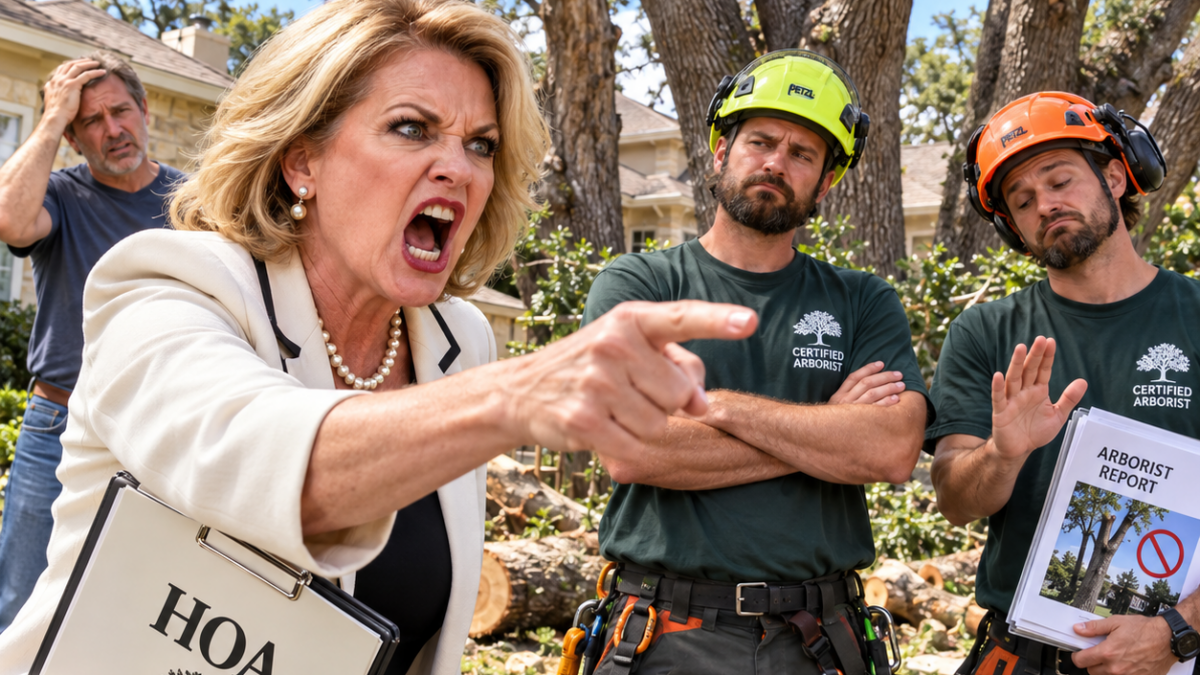
PART 2
The story of those trees began almost two centuries before Karen Peters decided they were inconvenient.
My great-grandfather bought the original tract when this part of the county was still mostly pasture, timber and family farms separated by stone walls instead of privacy fences. According to an entry in an old family Bible, he planted two young oak saplings on the day my grandfather was born. Nobody knew their exact species at the time beyond “white oak,” but later arborists estimated that both trees were somewhere between one hundred eighty and two hundred years old.
They grew with the family.
My grandfather grew up beneath them, climbed them, married beneath them and eventually raised his own children in a farmhouse nearby. There were photographs of my father as a boy sitting on one of the lower branches with his shoes dangling three feet above the ground. There was another photograph from 1962 showing twenty relatives beneath the canopy at a Fourth of July picnic. One oak appeared behind my grandparents in their fiftieth-anniversary portrait.
By the time I inherited the five-acre parcel, the trees were enormous.
Their trunks were wider than I could wrap my arms around.
Their root systems spread across half the front lawn.
They were healthy.
Dr. Alister Finch, a certified arborist I had hired years earlier to inspect an elm, once told me the two oaks were “the sort of trees you manage around, not the sort of trees you manage.”
That was how Sarah and I treated them.
When we built our retirement home after I left the Army, the architect originally proposed shifting the foundation eighteen feet toward the west.
I rejected it immediately.
“Root zone.”
He looked at me.
“What?”
“The western oak.”
“We can compensate.”
“No.”
He laughed.
“You’re willing to redesign the house for a tree?”
“Two trees.”
Sarah sat across the conference table smiling.
“Don’t argue with him.”
“Because he’s an engineer?”
“Because he already made a spreadsheet.”
I had.
We moved the footprint.
Adjusted the driveway.
Rerouted utilities.
Paid more.
Worth every dollar.
In summer, the canopy cooled the house.
In autumn, the leaves turned bronze and gold.
In winter, bare branches formed a black cathedral against the sky.
They were the first thing I saw through the bedroom window every morning.
Then developers came.
My father had fought the subdivision harder than I ever understood as a teenager.
The original family tract had already been divided through inheritance, sales and necessity. By the late 1990s, developers controlled much of the surrounding acreage.
They wanted everything.
My father refused to sell the final five acres.
Negotiations lasted months.
Eventually Oak View Estates moved forward around us.
But Dad insisted on protections.
He was not a lawyer.
He was stubborn enough to compensate.
The original HOA charter contained special language designating our parcel as a preservation property.
Existing mature vegetation, historical landscape features and pre-development trees received explicit protection.
I still remember Dad showing me the clause.
“They’ll try eventually.”
“Who?”
“Somebody.”
“What for?”
“A view. A driveway. A pool. People always find reasons to cut old trees.”
I laughed at the time.
Dad didn’t.
“Keep the paper.”
So I did.
Karen moved into Oak View years later.
Her house sat higher on the ridge behind our property.
The first time she visited, before she became HOA president, she stood near our driveway and looked west.
“Beautiful sunset.”
“It is.”
“Those trees block a lot of it from our upper windows.”
I thought she was making conversation.
“They’ve been blocking sunsets since before either of us was born.”
She didn’t laugh.
That should have warned me.
Two years later, Karen maneuvered herself into the HOA presidency.
Her first battles were small.
Flagpole height.
Basketball hoops.
Decorative planters.
Mailbox stains.
Then views.
She became obsessed with language in one covenant requiring homeowners to avoid “unreasonable obstruction of designated common vistas.”
The clause had originally been written to prevent new structures from blocking certain ridge overlooks.
Karen interpreted it as authority to reshape vegetation throughout the neighborhood.
Residents pushed back.
Most eventually compromised.
Trim a hedge.
Reduce a tree.
Move a flagpole.
Then she reached my oaks.
Her first letter requested “selective crown reduction.”
I responded with the preservation clause.
Second letter:
“View maintenance consultation.”
Same response.
Third letter threatened enforcement.
I requested formal board review.
Nothing.
Then one Tuesday afternoon I came home from a hardware store and heard chainsaws.
By the time I reached the front lawn, one-third of the first canopy was gone.
That was where Part One began.
An hour after the crew left, I called Dr. Finch.
He arrived before sunset.
He didn’t say hello at first.
He simply got out of his truck and stared.
His mouth tightened.
“My God.”
Sarah stood beside me.
“Can they survive?”
“Let me inspect them.”
For two hours, he worked.
Diameter measurements.
Photographs.
Root-zone assessment.
Cut analysis.
Bark condition.
He used a small increment borer in limited areas.
He examined the wounds through binoculars.
Every few minutes he muttered something I couldn’t hear.
Finally he walked toward us carrying his clipboard.
“I want to be careful about prognosis.”
“Meaning?”
“Trees are biological systems. They surprise us.”
Sarah looked relieved for half a second.
Then he continued.
“But this is catastrophic.”
Her face fell.
Dr. Finch pointed upward.
“A mature oak develops a canopy architecture over decades. Those primary leaders don’t regenerate in a healthy way once you remove them like this. The tree will respond with epicormic growth—fast shoots trying to replace lost leaf area—but those attachments are weak. Decay can enter these large wounds. Sunscald can become a problem on previously shaded bark. Root reserves get depleted.”
“Will they die?”
“One may.”
“Which?”
“Too early.”
“And the other?”
“Even if it survives, it will never return to its original structure.”
Sarah covered her mouth.
Dr. Finch looked genuinely angry.
“I need you to understand something, Jack.”
“I do.”
“No. Professionally.”
He pointed to the flat cuts.
“This is not pruning.”
“I know.”
“This is not crown reduction.”
“I know.”
“This is topping.”
His voice hardened.
“Every reputable arboricultural standard warns against doing this to mature trees.”
He took off his glasses.
“Who hired them?”
“Karen.”
“The HOA?”
“She claims so.”
“Certified arborist on site?”
“Not that I saw.”
“Company name?”
“Truck was unmarked.”
He frowned.
“That bothers me.”
The preliminary assessment came the next day.
Twenty pages followed later.
Catastrophic canopy removal.
Severe structural compromise.
High probability of decay.
Significant long-term management costs.
Loss of environmental benefits.
Loss of property value.
Then the valuation.
$180,000 combined pre-damage value.
I called Finch.
“One hundred eighty thousand?”
“That’s conservative.”
“For trees?”
“For trees of that age, size, condition and site contribution.”
“I’m not replacing two ornamental maples.”
“Exactly.”
He explained appraisal methodology.
Size.
Species.
Condition.
Location.
Replacement impossibility.
Landscape contribution.
Historical significance.
Shade benefits.
Real-estate enhancement.
The number wasn’t sentimental.
It was professional.
Two days later, Karen’s violation notice arrived.
I opened the envelope at breakfast.
Read it.
Then stared.
Sarah looked up.
“What?”
I handed it to her.
She read.
Her face changed.
“She’s fining us?”
“Yes.”
“For damaging the trees?”
“Yes.”
“She damaged them.”
“Yes.”
Sarah put down the paper.
“I am going to her house.”
“No.”
“Jack.”
“No.”
“She had them destroyed and now she’s blaming us.”
“I know.”
“How are you this calm?”
“I’m not.”
The fine was $500.
Unapproved destructive modification of heritage landscaping.
One hundred dollars per day until the “violation” was remediated.
The phrase was almost surreal.
How do you remediate two centuries of growth?
I placed Karen’s notice beside Finch’s report.
Then went to my office.
Opened a legal pad.
At the top:
**OPERATION OAK SHIELD**
Sarah stood in the doorway.
“You named it.”
“Yes.”
“That means this is serious.”
“It became serious when she started the chainsaw.”
I appealed.
Registered mail.
Requested HOA hearing.
Included Finch’s report.
Preservation clause.
Photographs.
My video.
Karen delayed responses until the monthly meeting.
The clubhouse was fuller than usual.
Thirty residents.
Karen at center.
Gary to one side.
Brenda to the other.
Neither looked dangerous.
That was part of Karen’s system.
She did the fighting.
They supplied legitimacy.
Karen reached my item.
“Mr. Jack Miller. Landscaping violation appeal.”
She glanced toward me.
“Five minutes.”
I approached the lectern.
“I’m not here primarily to appeal a landscaping fine.”
Karen sighed.
“Then stay on agenda.”
“I’m here to report the unauthorized destruction of private property by the HOA president.”
The room changed.
People looked up.
I projected a photograph.
Before.
The two oaks in full canopy.
Then after.
Gasps.
Karen shifted.
“On October fifteenth, Karen Peters hired a contractor who entered my private property without permission and topped two heritage oak trees.”
I displayed the preservation clause.
Then Finch’s assessment.
“Professional valuation before destruction: approximately one hundred eighty thousand dollars.”
Someone whispered:
“Jesus.”
Karen banged the gavel.
“Language.”
I continued.
“The contractor’s own worker warned Ms. Peters that the work could kill them.”
“Unverified.”
I held up my phone.
“Recorded.”
Karen’s mouth tightened.
I displayed her violation notice.
“After ordering the damage, the president issued a fine accusing me of committing the same damage.”
Now people openly murmured.
Karen interrupted.
“The board received complaints concerning blocked views.”
“Show the vote authorizing entry onto my land.”
“The executive committee has emergency enforcement powers.”
“For trees that have stood two hundred years?”
“Aesthetic obstruction can materially affect property value.”
“Show the emergency determination.”
Her eyes flicked toward Gary.
He looked down.
“Show the contractor authorization.”
Brenda adjusted papers.
Karen’s voice sharpened.
“Your five minutes are nearly over.”
“Show the board minutes.”
“Mr. Miller—”
“Show where the preservation clause was considered.”
“Your time is up.”
She slammed the gavel.
“The appeal is denied.”
A stunned silence followed.
Then Karen added:
“Given the hostile and belligerent posture Mr. Miller has displayed tonight, the fine is increased to one thousand dollars.”
Even Brenda looked surprised.
I stood there for two seconds.
Then packed my documents.
As I returned to my chair, Mrs. Gable whispered from the row beside me:
“She’s insane.”
I looked at Karen.
No.
Not insane.
Protected.
There is a difference.
People abuse authority because they believe consequences cannot reach them.
My task was to correct that belief.
After the meeting, I started walking more.
Gus, our golden retriever, became my excuse.
First Mrs. Gable.
Eighty years old.
Twenty garden gnomes.
Her late husband had collected them during trips.
Karen fined her monthly.
Six hundred dollars so far.
Mrs. Gable touched one holding a fishing rod.
“George bought this in Maine.”
“Why keep paying?”
“Because I’m afraid they’ll lien the house.”
That phrase again.
Fear attached to home.
Then the Rodriguez family.
Three repaints of one front door.
Karen rejected Beige Sand.
Then Warm Biscuit.
Then Heritage Linen.
Three thousand dollars between labor and materials.
The Lees.
Toddler slide visible above fence.
Fine.
Others.
Satellite dish.
Basketball hoop.
Wind chime.
I saw the pattern.
Not safety.
Not values.
Conformity.
Then Marcus Thompson answered his door.
Retired Army colonel.
Former JAG.
He recognized me from the meeting.
“Jack Miller.”
“Marcus Thompson.”
“I saw what happened.”
“I’m sorry you did.”
“I’m not.”
That surprised me.
“Why?”
“Because now you have witnesses.”
We spent four hours in his study.
He read everything.
Finch.
Charter.
Fine.
Video.
Karen’s letters.
Finally:
“She’s exposed.”
“How much?”
“Potentially badly.”
“Trespass?”
“Yes.”
“Property destruction?”
“Yes.”
“Fiduciary duty?”
“If she used HOA funds without authority, absolutely a serious issue.”
“Personal liability?”
“Possibly.”
I leaned back.
“What would you do?”
Marcus smiled.
“I’d stop treating this as a tree dispute.”
“What is it?”
“A governance dispute with $180,000 trees attached.”
He offered representation pro bono.
I protested.
He refused.
“I spent my career fighting people who believed power excused conduct.”
He closed the file.
“I’m bored in retirement.”
The lawsuit named Karen personally and the HOA.
Trespass.
Property damage.
Breach of fiduciary duty.
Other related claims Marcus believed supported.
Damages based on Finch’s valuation.
Punitive damages sought.
Karen was served at home.
Her response came through a major city firm.
Frivolous.
Meritless.
Counterclaim threats.
Standard intimidation.
Marcus smiled.
“Excellent.”
“How is that excellent?”
“They believe their own press release.”
Karen sent a community newsletter portraying herself as victim.
Anonymous “litigious homeowner.”
Personal gain.
Threat to community.
Some neighbors avoided me afterward.
That hurt more than I expected.
Sarah noticed.
“Mrs. Walker didn’t wave.”
“I saw.”
“You okay?”
“Yes.”
“You’re lying.”
I looked toward the damaged trees.
“I hate that she gets to tell the story first.”
“Then tell the truth slower.”
That was Sarah.
Always the sentence I needed.
Discovery began.
Marcus requested emails.
Texts.
Invoices.
Board minutes.
Contracts.
Financial records.
Tree-company communications.
HOA counsel objected.
Too broad.
Burdensome.
Irrelevant.
Marcus moved to compel.
Judge Esposito heard it.
HOA attorney argued that discovery invaded internal board communications.
Marcus stood.
“Your Honor, Ms. Peters claims board authorization. We seek the authorization.”
Simple.
Then:
“If it exists, production helps her.”
The judge looked toward opposing counsel.
“Does it exist?”
They dodged.
Bad choice.
Motion granted.
Thirty days.
All responsive documents.
Karen’s lawyers dumped boxes.
Thousands of pages.
Marcus called.
“Bring coffee.”
For one week, his dining room became an intelligence center.
I sorted chronologically.
Marcus handled legal relevance.
Sarah built a spreadsheet.
Then we found the email.
Karen to A-1 Affordable Tree Service.
**Need quote to top two large oaks at 1200 Oak Lane to improve ridge view. Discretion is important.**
I read it twice.
Marcus leaned over.
“Keep going.”
Next message.
Contractor asked:
**You have homeowner’s written permission?**
Karen:
**I am the HOA president. My authority is the only permission you need. The homeowner is non-compliant. We’ll handle fallout.**
Sarah whispered:
“Oh my God.”
Marcus smiled without humor.
“There.”
“She knew.”
“She knew they lacked homeowner authorization.”
“Can she explain that away?”
“She can explain anything.”
He tapped the paper.
“The question is whether anyone believes it.”
Then we found payment.
HOA reserve fund.
Not standard landscaping budget.
No formal vote.
No minutes authorizing the expense.
Karen had acted first.
Board legitimacy came later.
A-1 owner Sal was deposed.
He looked miserable.
He admitted they had no owner permission.
He relied on Karen.
“She said she was the HOA.”
Marcus repeated:
“She said she was the HOA.”
Sal shifted.
“She made it sound like she controlled the property.”
“Did you verify?”
“No.”
“Licensed arborist?”
“No.”
“Did your crew warn her topping could damage the trees?”
Sal hesitated.
“Yes.”
“Did she tell them to stop?”
“No.”
“What did she say?”
He looked toward his lawyer.
Then answered.
“Finish the job.”
That became devastating.
Karen’s deposition followed.
For two hours she tried to dominate the room as she dominated meetings.
Marcus didn’t fight.
He asked.
One question.
Then another.
“Read Article Nine, Section Four-B.”
She read the preservation clause.
“Does it mention heritage trees?”
“Yes.”
“Do Mr. Miller’s oaks qualify?”
“I dispute the definition.”
“Did you obtain a professional arboricultural determination before ordering work?”
“No.”
“Written homeowner permission?”
“No.”
“Full board vote?”
“We operated under executive authority.”
“Show me.”
Her lawyer objected.
Marcus waited.
No document.
Then the email.
“My authority is the only permission you need.”
Marcus placed it before her.
“True statement?”
Her face hardened.
“I acted in the community’s best interest.”
“That wasn’t the question.”
Her lawyer objected.
Marcus rephrased.
“Where in the governing documents is the HOA president granted unilateral authority to authorize destructive work on privately owned heritage trees?”
Silence.
“I acted in good faith.”
Marcus looked at me.
It was over.
Not legally.
But strategically.
The next defense became safety.
The trees had supposedly been dangerous.
Suddenly Karen wasn’t improving a view.
She was protecting residents from hazardous limbs.
Problem.
They needed an expert.
A certified arborist willing to say topping two healthy mature oaks was appropriate hazard mitigation.
Their first call went to Dr. Finch.
He called me afterward.
“They offered an embarrassing amount.”
“For what?”
“For my dignity.”
I laughed.
“They wanted me to characterize topping as legitimate crown reduction.”
“What did you say?”
“I asked if the lawyer had ever opened an arboriculture manual.”
“They take it well?”
“Not especially.”
Then Dr. Evans.
Refused.
Third.
Refused.
Fourth.
Refused.
Fifth.
Refused.
Word spread in the professional community.
Not because we orchestrated a blacklist.
Because certified arborists knew the standards.
You can disagree about many things in tree care.
Topping healthy mature trees is not respected practice.
Karen’s lawyers expanded search.
Another county.
Another region.
Entire state.
Nothing credible.
At one point Marcus received their motion for additional expert-disclosure time.
He laughed.
“They can’t find anybody.”
“Maybe they will.”
“They’ll find someone.”
“Qualified?”
He smiled.
“That’s the entertainment.”
They eventually disclosed a man from three states away.
Online “master pruning” credential.
Tree-cutting business.
No recognized high-level arboricultural certification comparable to Finch.
Never inspected my oaks in person.
Marcus filed to exclude.
Their lawyers withdrew him before hearing.
No expert.
That mattered enormously.
Karen had a story.
We had science.
An email.
A video.
A contractor’s sworn admission.
A charter clause.
And Dr. Finch.
Her insurer noticed.
Then the annual meeting arrived.
The legal fees had reached roughly seventy-five thousand dollars.
Residents noticed.
The clubhouse overflowed.
Karen wore black.
Gary and Brenda looked like people who had realized too late that loyalty has invoices.
Mr. Rodriguez asked:
“Where did seventy-five thousand dollars in legal expenses go?”
Karen glared toward me.
“Defending the community against a frivolous lawsuit.”
A voice:
“Defending us from Jack’s trees?”
Another:
“Or defending you?”
Gavel.
Order.
Then new business.
I went to the lectern.
One page.
No binder.
“Many people have heard rumors.”
I looked around.
“The association has spent tens of thousands defending this case. That is your money. You deserve facts.”
I summarized.
HOA funds paid A-1.
No homeowner permission.
Heritage clause.
Email.
Contractor testimony.
Finch valuation.
Then:
“The defense attempted to establish that topping was legitimate safety work.”
Karen shifted.
“They were unable to find a single credible certified arborist in this state willing to support that position.”
Murmurs.
“Not one.”
Mrs. Gable stood next.
She brought her gnome notices.
“Six hundred dollars.”
Her voice shook.
“My George is gone.”
She held a photograph of one gnome.
“These are memories.”
Silence.
Rodriguez.
Three thousand dollars repainting one door.
Lees.
Slide.
Others stood.
The dam broke.
Karen finally exploded.
“Disgruntled residents!”
The room shouted back.
For the first time, her gavel was meaningless.
Then Dave—the quiet accountant—stood.
“I move for a formal vote of no confidence and independent audit.”
Seconded.
Karen tried adjournment.
No one left.
The petition circulated the next morning.
Seventy percent in forty-eight hours.
Gary and Brenda called an emergency executive session.
The insurer issued a reservation-of-rights letter.
Intentional acts may not be covered.
Karen could face personal exposure.
That changed everything.
Lawyers who had once promised aggressive defense began recommending settlement.
Marcus refused private side deals.
“New board first.”
Emergency board session.
Karen was removed.
Dave became interim president.
Official notice sent community-wide.
Pending fines suspended.
Independent audit ordered.
Settlement authorized.
Karen’s house went up for sale.
But before she left, we met one final time.
Marcus’s conference room.
Me.
Marcus.
Dave.
Karen.
Her attorney.
Insurance representative.
Karen looked smaller.
Not physically.
Power changes posture.
Without the gavel, title and audience, she was simply a woman who had made an extraordinarily expensive decision.
Marcus laid out terms.
Tree value.
$180,000.
Insurance representative agreed.
Punitive claim:
We were willing to compromise.
But not free.
Karen would personally reimburse the HOA $5,000 toward legal costs caused by her conduct.
Then governance protection.
A binding agreement preventing her from serving again on that HOA board under the settlement terms.
Karen looked at me.
“You want to humiliate me.”
“No.”
“Then why this?”
“Because money isn’t what caused this.”
Her jaw tightened.
“You hate that I had authority.”
“No.”
I looked directly at her.
“I hate that you believed authority made permission unnecessary.”
She stared.
Then Marcus added the final community term.
Heritage Tree Protection Amendment.
Stronger.
Clear.
No destructive work on protected private trees without owner consent, required professional assessment and lawful authorization.
Public HOA apology.
Karen’s lawyer whispered to her.
Personal liability.
Trial risk.
Email.
Video.
No expert.
She signed.
Her hand shook.
The war ended.
But the trees were still damaged.
That mattered more than the check.
When the settlement funds arrived, I didn’t feel rich.
I felt sick.
Sarah found me staring at the bank notice.
“You okay?”
“No.”
“It’s what Finch valued them at.”
“I know.”
“It’s justice.”
“No.”
She sat beside me.
“What is it?”
“Compensation.”
“That’s different?”
“Yes.”
Money replaced value on paper.
Not history.
You cannot buy two hundred years.
I hired Dr. Finch and a specialized restoration team.
They climbed carefully.
Removed unstable damaged wood.
Made corrective cuts.
Installed monitoring systems.
Soil work.
Irrigation.
Nutrient management.
Long-term inspections.
Finch stood beside me.
“They won’t ever look like the old photographs.”
“I know.”
“They may survive.”
“That’s enough.”
He touched the bark.
“Survival creates another kind of beauty.”
Tiny shoots appeared the next spring.
Weak at first.
Then stronger.
Sarah cried when she saw leaves.
“Look.”
“I see.”
“They’re alive.”
“Yes.”
We planted two young oak saplings farther across the property.
Not replacements.
Successors.
Sarah knelt beside one pressing soil around its root ball.
“What do we name them?”
“They’re trees.”
“So?”
“No names.”
She smiled.
“I’m naming this one Justice.”
“Absolutely not.”
“And that one Karen.”
I stared at her.
She started laughing.
“You should see your face.”
We left them unnamed.
The new HOA passed the Heritage Tree Protection Amendment unanimously.
Mrs. Gable attended the vote with three gnomes.
Rodriguez repainted his door blue.
Dave asked whether the color was approved.
Rodriguez said:
“Try me.”
They both laughed.
The Lees’ slide remained visible.
No civilization collapsed.
The independent audit found governance failures beyond my case, though not every neighborhood rumor was true.
That mattered.
I refused to turn Karen into a monster responsible for everything anyone disliked.
Facts were enough.
Poor documentation.
Questionable spending decisions.
Selective enforcement.
Improper unilateral actions.
The board rewrote procedures.
Mandatory recorded votes.
Vendor approval controls.
Appeal rights.
Conflict disclosures.
Professional consultation before acting on major private property.
And an emergency legal-defense fund was established with part of my settlement money.
Marcus administered it independently.
Sarah questioned that decision.
“You don’t have to give money back.”
“I know.”
“She destroyed your trees.”
“I know.”
“Then why?”
“Because next time it might be Mrs. Gable.”
Sarah looked toward the oaks.
Then nodded.
“Okay.”
Karen moved away.
New family bought her ridge house.
A couple with two children.
The first time the father introduced himself, he looked uncomfortable.
“I heard there was some history between this house and yours.”
“Trees.”
“So I heard.”
He looked toward them.
From his property, the view was wide.
The sunset Karen wanted.
“You know…”
“What?”
“I kind of wish they were still full.”
I stared at him.
He shrugged.
“Shade. Framing. The view feels exposed.”
I laughed so suddenly he looked confused.
“What?”
“Nothing.”
Karen had destroyed two ancient trees for a view.
The next owner preferred the trees.
There was poetry in that.
Years passed.
The damaged oaks did survive.
Not unchanged.
One developed a hollow section we monitored.
The other produced new leaders that required careful structural management.
They were shorter.
Scarred.
Asymmetrical.
But alive.
People driving past sometimes assumed storms had damaged them.
I rarely corrected anyone.
The story did not need to be retold every day.
One autumn, my granddaughter visited.
She was seven.
She stood beneath the older oak looking upward.
“Why does this tree look funny?”
“Someone cut it badly a long time ago.”
“Why?”
“They thought they had a good reason.”
“Did they?”
“No.”
She touched the bark.
“Did it die?”
“No.”
“Then it won.”
Children simplify things.
Sometimes they improve them.
“It did.”
She walked toward the new saplings.
“These are babies?”
“Teenagers now.”
“How old is that one?”
“Maybe twelve.”
“And the big one?”
“Almost two hundred.”
Her eyes widened.
“Was it here when dinosaurs were alive?”
“No.”
“Are you sure?”
“Pretty sure.”
She ran off.
I remained under the canopy.
The new growth filtered afternoon light.
Not the old canopy.
Different.
Finch had been right.
A different kind of beautiful.
Sarah came outside with coffee.
“You’re staring again.”
“Thinking.”
“Dangerous.”
“Granddaughter says the tree won.”
“She’s right.”
“Trees don’t win.”
“Neither do retired colonels. Yet here you are.”
I smiled.
Sarah leaned against me.
For years, the scars made me angry.
Every flat cut reminded me of Karen.
Then eventually they didn’t.
They became part of the tree.
That mattered.
Damage can become identity without remaining defeat.
Oak View changed too.
Dave served as president for two years.
Then stepped down voluntarily.
That was new.
No empire.
No permanent throne.
Mrs. Gable finally stopped receiving decorative fines.
At one meeting she proposed an official “garden gnome freedom clause.”
It failed.
She displayed forty gnomes in protest.
Nobody fined her.
Rodriguez became architectural committee chair.
His first act was creating an actual published color list.
He included blue.
The Lees’ toddler became a teenager.
Their plastic slide disappeared because she outgrew it.
Not because anyone forced them.
Again, difference matters.
One spring, Oak View hosted a community tree day.
I was invited to speak.
I refused.
Then Mrs. Gable threatened to speak for me.
I accepted.
Families planted twenty native trees in common areas.
Dr. Finch attended.
He gave a short talk about proper pruning.
At the end, he looked toward the crowd.
“If anyone ever recommends topping a mature tree…”
He paused.
“Run.”
People laughed.
I did too.
Karen had unknowingly turned our subdivision into a place where residents understood arboriculture.
There are worse legacies.
Afterward, Finch and I walked to my oaks.
He examined the new leaders.
“Better than I expected.”
“Meaning?”
“Meaning I’m happy to be wrong about how pessimistic I was.”
“You said they might survive.”
“I also said recovery was highly improbable.”
“Lawyer language.”
“Arborist language.”
He tapped the trunk.
“They’re stubborn.”
“Family trait.”
He smiled.
Then he became serious.
“You know, Jack, people misunderstand old trees.”
“How?”
“They think because a tree survived two centuries, it’s indestructible.”
He looked upward.
“It isn’t.”
“Neither are people.”
“No.”
“But both can compartmentalize damage.”
I knew the term.
Trees isolate decay chemically and structurally.
They don’t heal like skin.
They seal damage off and grow around it.
“Compartmentalization.”
“Yes.”
Finch nodded.
“Maybe that’s what you did too.”
I didn’t answer.
Later that night, I thought about it.
Maybe.
For months after Karen’s attack, every part of life revolved around the case.
Emails.
Depositions.
Invoices.
Board politics.
Anger.
Then slowly, other rings of life grew around it.
Grandchildren.
Coffee with Sarah.
Projects.
Neighbors.
Tree day.
The injury remained.
But no longer occupied the center.
That might be healing.
Years after Karen moved away, I received an envelope.
No return address.
Inside was a short handwritten note.
Jack,
I have thought many times about what happened.
I still believe maintaining views and property standards can be legitimate HOA concerns.
But I had no right to authorize work on your property without permission.
I knew I did not have written authorization when I told the contractor to proceed.
I was angry because you refused to accept my interpretation of the rules, and I allowed that anger to become personal.
I cannot undo what happened to the trees.
I am sorry.
Karen
I sat at the kitchen table.
Sarah read over my shoulder.
“Well.”
“What?”
“Did you expect that?”
“No.”
“Do you believe her?”
I read it again.
“Some of it.”
“That enough?”
“It doesn’t have to be enough.”
I placed the letter in Operation Oak Shield.
Last page.
Sarah looked at the cabinet.
“You’re keeping it?”
“Documentation.”
“Of course.”
I never answered Karen.
Forgiveness isn’t always correspondence.
Sometimes it is simply refusing to carry the argument anymore.
The trees kept growing.
One eventually required cabling after a storm exposed weakness in new growth.
Finch supervised.
The other suffered minor fungal infection around one old wound.
Managed.
Neither became the original tree.
Both became something else.
When our fiftieth wedding anniversary approached, Sarah wanted a family photograph beneath them.
I hesitated.
“Why?”
“They’re ugly.”
She stared at me.
“What?”
“They’re scarred.”
“So are you.”
“Thank you.”
“You know what I mean.”
We gathered children.
Grandchildren.
Neighbors.
Photographer.
Mrs. Gable insisted on bringing one gnome.
I objected.
Lost.
We stood beneath the oaks.
The same place my grandfather had married.
Sarah beside me.
Granddaughter holding my hand.
New saplings visible farther back.
The photographer said:
“Everybody ready?”
I looked upward.
Branches.
New leaves.
Scars.
Life.
“Yes.”
The photograph hangs in our hallway now.
Beside an older black-and-white picture of my grandparents under the same trees when the trunks were half their current size.
Two images.
Generations apart.
Different canopy.
Same ground.
That became the real ending for me.
Not Karen writing a check.
Not losing her presidency.
Not lawyers failing to find an arborist willing to defend topping.
Not even the settlement.
Family beneath trees.
Again.
The thing she tried to destroy still serving its purpose.
Shelter.
Memory.
Continuity.
People sometimes ask whether I enjoyed watching Karen lose everything.
That phrasing bothers me.
She didn’t lose everything.
She lost authority she abused.
She lost money because her choices caused expensive damage.
She lost the neighborhood because neighbors stopped trusting her.
Those are consequences.
I did enjoy one part.
I’ll admit it.
The arborists.
There was something deeply satisfying about watching Karen’s lawyers discover that expertise cannot always be purchased.
They had money.
A sophisticated firm.
A narrative.
But every serious arborist they approached had to look at the same basic fact.
Two healthy mature oaks had been topped for view enhancement.
Professional standards didn’t bend because a client needed a defense.
Dr. Finch later told me one attorney became frustrated.
“There must be someone willing to say this was acceptable.”
Finch answered:
“There are people willing to say anything.”
Then:
“You asked for an arborist.”
That line still makes me smile.
Karen’s whole system depended on authority overruling reality.
She could call gnomes clutter.
A blue door disharmonious.
A toddler slide a violation.
My heritage oaks a view obstruction.
Then, eventually, dangerous trees.
Words had always been enough inside her HOA.
Until she reached a profession where words had standards attached.
Arboriculture had definitions.
Topping.
Crown reduction.
Hazard assessment.
Tree appraisal.
Karen couldn’t simply rename what she had done.
That was why the arborists refused her.
Not loyalty to me.
Professional integrity.
Facts.
By then I had learned something I wish every homeowner understood.
Rules are not power.
Knowledge of the rules is power.
Records are power.
Independent expertise is power.
Neighbors talking to each other is power.
And people in authority knowing they can be challenged is healthy.
Karen’s greatest advantage had been isolation.
Every resident thought their own fight was too small.
Mrs. Gable’s gnomes.
Rodriguez’s paint.
The Lees’ slide.
My trees.
Individually, each story could be dismissed.
Together they showed a system.
Once neighbors compared notes, Karen’s authority evaporated faster than I expected.
The HOA still exists.
I want to emphasize that.
We didn’t abolish it.
Rules still exist.
You can’t dump a junk vehicle in the common park.
You can’t paint your house neon green.
You can’t build a twelve-foot wall.
Hazardous trees in common areas get removed.
But now evidence is required.
Process.
Notice.
Vote.
Appeal.
Professional assessment when appropriate.
Boring things.
Good governance should be boring.
If your HOA meeting feels like a military coup every month, something is wrong.
One summer storm arrived after midnight.
Wind harder than expected.
Sarah woke me.
“Trees.”
We went to the window.
The damaged crowns moved violently.
I watched one new leader bend.
For the first time in years, I was afraid.
Not of Karen.
Physics.
At dawn, I went outside.
Branches down everywhere.
One major limb from the western oak had failed.
Not toward the house.
Thank God.
Finch arrived.
Examined it.
“Old topping wound contributed.”
Of course.
Consequences continue.
“Can we keep it?”
“Yes.”
“For how long?”
He shrugged.
“Trees don’t sign contracts.”
We removed the failed limb.
Installed additional support.
Another scar.
Another adaptation.
That evening, I sat beneath the tree.
Sarah brought two beers.
“You look sad.”
“I am.”
“It’s alive.”
“Yes.”
“Then stop burying it before it dies.”
I looked at her.
“Have I mentioned you’re irritating?”
“Frequently.”
We drank.
A squirrel crossed one branch.
Leaves moved.
Still alive.
That became my rule too.
Don’t bury things before they die.
Not trees.
Not communities.
Not people.
Years later, Mrs. Gable passed away.
Her niece inherited the house.
At the estate sale, I bought one garden gnome.
The fisherman.
George’s Maine gnome.
Sarah found it near our oak.
“You bought a gnome?”
“Yes.”
“Who are you?”
“Mrs. Gable would haunt me if strangers got all of them.”
She smiled.
We placed it beneath the younger oak.
No approval application.
Dave, former president, walked past.
“Violation.”
I looked at him.
“Try it.”
He laughed.
Oak View had learned humor.
Another sign of recovery.
Eventually the original $180,000 settlement became less important financially.
Some paid for tree care.
Some legal-defense fund.
Some long-term property restoration.
But I kept the original valuation report.
Not because I wanted to remember the money.
Because Finch’s before photographs were inside.
The trees as they were.
Sometimes my grandchildren look.
“That’s the same tree?”
“Yes.”
“Wow.”
They never knew the full canopy.
They know the scarred version.
To them, scarred is normal.
That moved me.
Children don’t mourn the version they never knew.
They love what is present.
Maybe that is why each generation survives what the previous one thought unbearable.
One day, long after the case, the young owner of Karen’s old house came down the hill.
His name was Matt.
He carried a folder.
I almost laughed.
“What?”
“I want to plant two oaks near our back property line.”
“Good.”
“My landscaper says they could eventually interfere with the sunset.”
I stared.
Matt smiled.
“I figured I should ask the expert.”
“I’m not the arborist.”
“Expert on tree wars.”
“Plant them.”
“You sure?”
“Your property.”
He nodded.
“I like the idea that someday somebody will complain they’re too big.”
We both laughed.
He planted them.
I helped.
The first shovel went into the ground where Karen once believed the sunset belonged to her.
Time has a sense of humor.
By the twentieth anniversary of Operation Oak Shield—yes, Sarah still mocks the name—the two original oaks remained alive.
One had declined more than the other.
Finch had retired.
His former associate, Dr. Evans, now managed their care.
She had been one of the arborists who refused Karen’s lawyers years earlier.
At our annual inspection, she stood beneath the eastern tree.
“Still fighting.”
“Finch said that.”
“He was right.”
“How much longer?”
“Could be five years.”
Pause.
“Could be thirty.”
I laughed.
“That’s useful.”
“Welcome to biology.”
Then she looked toward the younger oaks.
“Those will outlive you.”
“That’s the plan.”
Sarah squeezed my hand.
Legacy doesn’t require permanence.
Nothing is permanent.
The old oaks will eventually die.
Maybe while I’m alive.
Maybe after.
When that happens, we will not pretend Karen alone killed them.
Age matters.
Storms matter.
Decay matters.
But her cuts shortened and changed their lives.
That truth remains.
And so does another.
She didn’t get the final word.
When one old oak eventually comes down, its wood will not become trash.
I already have plans.
Some will be milled.
A dining table for the family.
Benches for Oak View’s common park.
A section preserved with growth rings marked.
Maybe the trunk tells its own history.
Birth of my grandfather.
World wars.
Subdivision.
Karen.
Recovery.
Years after.
I told Sarah.
“You planned the tree’s funeral?”
“Resource utilization.”
“You are impossible.”
“I prefer prepared.”
She looked upward.
“Table would be nice.”
Yes.
A table.
Future generations eating dinner on wood from the tree their ancestors once picnicked beneath.
That feels right.
Karen’s mistake was believing destruction was the opposite of preservation.
Sometimes preservation changes form.
Tree.
Lumber.
Furniture.
Memory.
Story.
New sapling.
The line continues.
That is why the ending satisfies me now in a way punishment never could.
Karen wanted a view.
She got it briefly.
Then lost the house.
We kept the trees.
Scarred.
But alive.
We kept the land.
We changed the rules.
We built protections.
We created a legal fund.
We turned frightened neighbors into actual neighbors.
And we planted more oaks.
Her decision reduced two crowns.
Our response increased the number of trees.
That is better revenge than destruction.
Build more than somebody tried to take.
Protect more than they tried to harm.
Teach more people than they tried to silence.
Years after the lawsuit, Oak View’s community newsletter featured a photograph from Tree Day.
Children planting native oaks.
Headline:
**ROOTED FOR THE FUTURE**
Sarah brought it to me.
“Look.”
I read.
The article mentioned the Heritage Tree Protection Amendment.
Not Karen.
Not lawsuit.
Not me.
Good.
“That bother you?”
“No.”
“You started it.”
“The trees started it.”
She rolled her eyes.
The following spring, my granddaughter planted her own oak on a piece of land she and her husband bought.
She sent me a photograph.
Caption:
**No panoramic vista guaranteed.**
I laughed until my eyes watered.
Sarah framed it.
Generations learn stories in strange ways.
Maybe one hundred years from now, somebody will sit beneath that tree and know nothing about Karen Peters.
I hope so.
Not every lesson needs the villain’s name attached forever.
The important part is the rule.
Ask permission before touching what belongs to someone else.
Authority has boundaries.
Expertise matters.
Old things deserve thoughtful stewardship.
And if every qualified arborist tells you the same thing, perhaps the problem is not the arborists.
Sometimes visitors still ask about the strange form of our oaks.
I give the short answer.
“They were topped illegally years ago.”
“What happened?”
“Long story.”
“Did you sue?”
“Yes.”
“Win?”
I look at the leaves.
“Yes.”
They usually assume I mean money.
I don’t correct them.
One cool October afternoon, Sarah and I sat beneath the western oak.
Leaves fell around us.
She picked one up.
Bronze.
Perfect.
“You remember the day after?”
“The chainsaws?”
“Yes.”
“I remember everything.”
“I thought they were dead.”
“So did I.”
“You looked like you wanted to kill Karen.”
“I was evaluating options.”
She laughed.
“You were furious.”
“Yes.”
“Are you still?”
I looked toward the ridge.
Karen’s old house.
Matt’s new oaks now visible.
Then the young trees in our yard.
Mrs. Gable’s gnome.
Our granddaughter’s swing.
“No.”
Sarah nodded.
“Good.”
We stayed until the sun dropped.
The view through the damaged canopy was probably spectacular.
I barely noticed.
I was looking at the trees.
That was the irony Karen never understood.
A view is not always improved by removing what stands in front of it.
Sometimes the thing you think is blocking the view is the view.
Those oaks were mine.
My grandfather’s.
My father’s.
My children’s.
Our history made visible.
Karen looked through them and saw something beyond.
I looked at them and saw everything that mattered.
She topped them because she believed authority meant she could choose which view had value.
The arborists refused to defend her because science did not care about her title.
The court record did not care about her title.
The insurer did not care about her title.
Eventually the homeowners did not care either.
And once that title disappeared, so did nearly all the power she thought belonged to her personally.
That is what I remember whenever somebody calls Karen’s downfall revenge.
Maybe it started with anger.
I won’t lie.
Watching her lose the presidency felt satisfying.
Watching her attorneys fail to locate a credible arborist felt satisfying.
Watching the insurer tell her she might personally pay for her conduct?
Very satisfying.
But revenge burns quickly.
What lasts is repair.
The Heritage Tree Protection Amendment.
The legal-defense fund.
Mrs. Gable keeping her gnomes.
Rodriguez getting to choose his own reasonable door color.
Children playing without parents worrying about arbitrary fines.
Professional tree care.
New saplings.
Family photographs.
That is what victory looked like after the anger cooled.
Not Karen losing everything.
Us keeping what mattered.
My great-grandfather planted two saplings without knowing who would someday sit beneath them.
My father protected them in a charter because he suspected somebody would eventually try to cut them.
I defended them because I promised myself that inherited things come with obligations.
My grandchildren will inherit trees that no longer look the way my grandfather knew them.
But they will also inherit the young ones Sarah and I planted after the fight.
Maybe that is enough.
Maybe legacy was never about preserving everything exactly as it was.
Maybe it is about making sure damage does not become the end of the story.
One morning in early spring, I walked outside and saw the first buds opening on the western oak.
Tiny.
Green.
Ordinary.
I stood there longer than necessary.
Sarah came out.
“What?”
“Leaves.”
“There are leaves every year.”
“I know.”
She looked upward.
Then understood.
Every spring after the topping still felt a little miraculous.
Not because trees were magical.
Because survival was never guaranteed.
I reached up and touched the scarred bark.
The same tree that Karen’s crew had reduced under chainsaws.
Still alive.
Behind it, the younger oak had doubled in height.
Farther up the ridge, Matt’s saplings were establishing.
More trees than before.
Sarah slipped her hand into mine.
“You have the better view.”
I smiled.
“Yes.”
I did.
Not because Karen’s house was gone.
Not because the lawsuit was over.
Not because an insurance company had written a large check.
Because I could stand on my own land, beneath trees my family planted generations earlier, beside the woman I loved, and know that one person’s arrogance had failed to become the final chapter.
Karen wanted the tops gone.
The arborists told her what that meant.
She ignored them.
Later, when she desperately needed an expert to say she had been right, they refused.
Every one of them.
Because truth does not become false simply because somebody powerful needs it to.
And authority does not become permission simply because the person holding the clipboard says it does.
The old oaks are still standing.
So are the new ones.
And every year, their branches reach a little higher.
That is the only verdict I need.








