PART 2: HOA President Buried My Only Ranch Road Under an 8-Foot Berm—Then the County Asked One Question She Couldn’t Answer
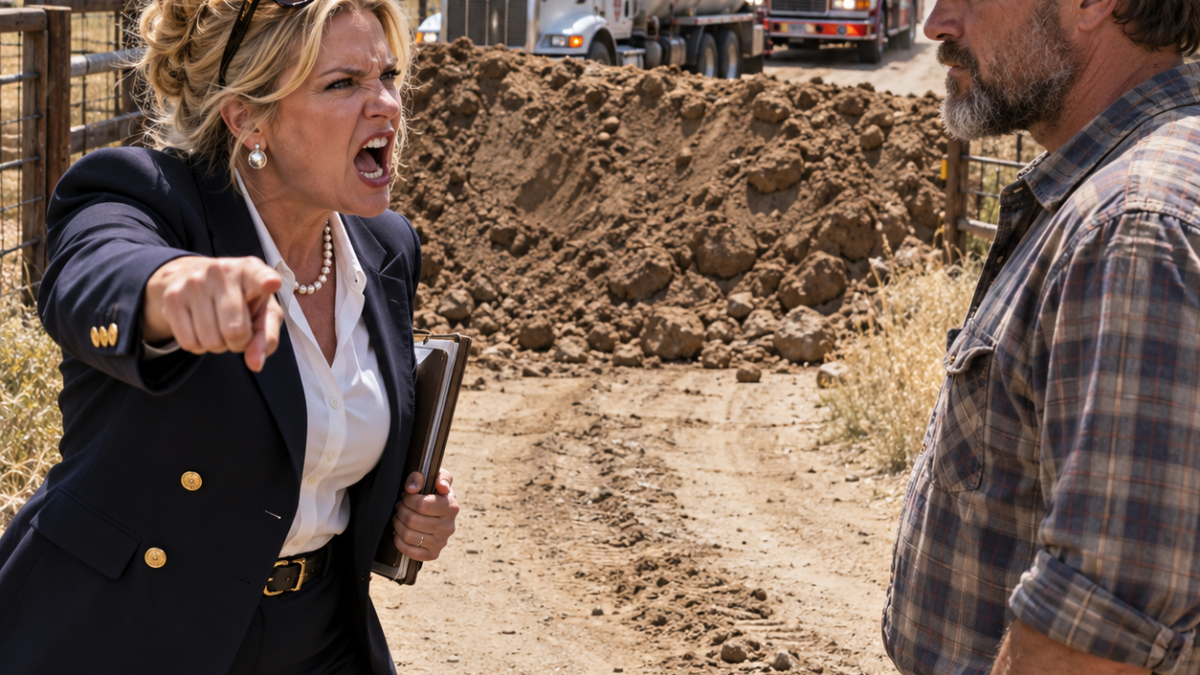
The bulldozer blade dropped in front of my only road at 6:47 that morning, pushing wet dirt, broken stone, and torn grass into a wall nearly eight feet high while Karen Miller stood beside the machine with her arms folded and told me, with a smile, that I could “find another way out” if I refused to respect her HOA.
What Karen apparently hadn’t considered was that the half-mile gravel lane she was burying wasn’t merely the road to my five-acre property—it was a recorded access easement serving both our homes, the route used by propane trucks, utility crews, ambulances, and the fire department whenever anything went wrong at the two houses sitting beyond the county pavement.
I could have charged across that road and tried to stop the operator myself, but when I looked past the growing berm toward Karen’s mansion on the hill, I noticed something that made me lower my hands, take out my phone, and let her finish.
My name is Arthur Donaldson.
After twenty years in the service, I bought five rough acres at the far edge of Willow Creek Estates because I wanted the kind of silence you could only get when your nearest neighbor wasn’t sharing a wall with you.
The house wasn’t fancy.
Brick ranch. Old roof. Huge detached garage.
Perfect.
The only unusual part was the road.
A private gravel lane ran roughly half a mile from the county road, crossed the edge of Karen’s parcel, passed my gate, then continued uphill to her oversized house.
My deed contained a permanent recorded easement granting access over the entire lane.
Karen had the same right.
Neither of us owned the road in the way she seemed to imagine.
But Karen was president of Willow Creek’s HOA, and imagination had never limited her authority before.
The problems started small.
Mailbox.
Vegetable garden.
My old Ford pickup.
Every disagreement ended with Karen saying some version of the same thing.
“We have standards here.”
I never objected to standards.
I had lived under rules most of my adult life.
What bothered me was how Karen confused rules with personal permission.
Then came the propane truck.
Both our houses ran on propane.
My tank held five hundred gallons.
Karen’s was twice that size because she heated a large house, a pool, and a backup generator.
One Tuesday, the same delivery truck filled both tanks.
An hour later Karen called.
“That truck damaged the access road.”
“It filled your tank too.”
“My delivery wasn’t today.”
“I watched it drive to your house.”
Silence.
Then:
“You’re responsible for the ruts.”
“It’s a gravel road.”
“You owe the association five hundred dollars for regrading.”
“I’m not paying that.”
Her voice turned quiet.
“Then perhaps your access privileges need to be reconsidered.”
I almost laughed.
“You can’t revoke a recorded easement.”
“Don’t tell me what I can do.”
Two mornings later, the bulldozer arrived.
The operator looked uncomfortable from the beginning.
“Ma’am,” he called down to Karen, “you sure this is where you want it?”
“Across the road.”
“All the way?”
“All the way.”
I stepped toward him.
“This is a recorded access easement.”
Karen moved between us.
“This is HOA business.”
“My property isn’t trapped by HOA business.”
She pointed toward my pickup.
“You refused to pay for road damage. The board is protecting community property.”
“Which board?”
Her face tightened.
“Excuse me?”
“Which board meeting approved this?”
“That is none of your concern.”
“It becomes my concern when a bulldozer blocks my driveway.”
The operator killed the engine.
Good man.
Karen immediately snapped:
“I am paying you to work.”
He looked at me.
“Sir, you got paperwork showing an easement?”
“Inside.”
Karen shouted:
“He does not own this road!”
“I didn’t say I did.”
I looked at the operator.
“I said neither of us has the right to obstruct it.”
Karen stepped close enough that I could smell her perfume over diesel exhaust.
“You’ve challenged me on the mailbox.”
She raised one finger.
“The garden.”
Another.
“The road assessment.”
Another.
“I am done allowing you to undermine this community.”
There it was.
Not safety.
Not gravel.
Punishment.
I looked behind her.
Her silver Lexus sat on the county-road side of the forming berm.
My truck sat on my side.
Her mansion, however, was uphill behind me.
Along with her thousand-gallon propane tank.
And the only driveway wide enough for a full-size fire engine.
I looked at the bulldozer operator.
Then at Karen.
“Go ahead,” I said.
Karen blinked.
“What?”
“If you’re determined to build it, finish.”
Even the operator stared at me.
Karen smiled slowly.
She thought I had surrendered.
I walked back toward my house.
Behind me, the diesel engine roared to life.
Dirt rolled across the lane.
And when the berm finally sealed the road from ditch to ditch, Karen still hadn’t realized who else she had just cut off.
PART 2
I did not call Karen.
I did not call the sheriff first.
I did not walk back down the road to explain consequences she had been too angry to consider.
I made coffee.
That sounds ridiculous until you have spent enough years around bad decisions.
There is a moment after somebody creates a disaster when the most useful thing you can do is refuse to join their panic.
I carried my mug into the office and opened the fireproof document box I had kept since closing.
Deed.
Title policy.
Survey.
Recorded easement.
Subdivision plat.
The road was shown clearly.
A twenty-four-foot access easement running from the county road through the adjoining parcels and serving my property and Karen’s.
The language was simple.
Permanent ingress and egress.
No unilateral obstruction.
No gate, barrier, structure, or alteration materially interfering with the other dominant users’ reasonable access.
I read it three times anyway.
Then I photographed every page.
My second folder was Willow Creek’s HOA documents.
Karen liked to imply the entire world belonged to the association if she could see it from her upstairs windows.
The truth was narrower.
My property was technically one of the original edge lots subject to several basic Willow Creek covenants, but the easement itself predated parts of the later development and was governed primarily by the recorded grant.
The HOA did not own it.
Karen definitely did not own it.
The phrase she had used—“This is my property now”—would eventually come back to haunt her.
But first I needed proof.
I took my DSLR outside.
Wide photographs.
Close photographs.
Berm height.
Width.
Drainage ditch.
Bulldozer tracks.
Disturbed shoulder.
Uprooted saplings.
My stranded pickup.
Karen’s mansion visible above the ridge.
Then video.
“It is 7:32 a.m. Thursday, October twelfth,” I said calmly into the microphone. “This is the shared access easement serving 1187 and 1191 Willow Creek Road. A newly constructed earth berm now blocks the full travel surface.”
I panned slowly.
No insults.
No assumptions.
Only facts.
Then I launched my drone.
I used it for property photography and checking fence lines.
That morning it gave me a view nobody standing at ground level could ignore.
From two hundred feet up, the situation looked absurd.
County road.
Straight gravel easement.
Eight-foot mound in the middle.
My home and garage behind it.
Karen’s mansion even farther beyond.
Her Lexus stranded outside because she had driven down before construction.
Her house stranded inside.
I hovered above the hill.
There was the white propane tank behind her house.
The pool equipment.
The generator shed.
The turnaround large enough for a fire engine.
All inaccessible by vehicle now.
I landed the drone and backed up the files three times.
Local drive.
External drive.
Cloud.
Only then did I start making calls.
The first went to county planning and development.
The clerk transferred me to grading enforcement when I said the words “unpermitted earthwork across a recorded access easement.”
A woman named Brenda answered.
“Address?”
I gave it.
“Permit number?”
“I don’t believe there is one.”
Keyboard.
“No active grading permit at that location.”
“The berm is approximately eight feet high.”
Her typing stopped.
“Eight?”
“Yes.”
“Across an access road?”
“Yes.”
“Any drainage involvement?”
“It crosses the roadside swale.”
“Send photos.”
She gave me an email address.
I sent the drone image first.
Her response came three minutes later.
**Inspector assigned.**
My second call went to Frank Nolan.
Frank had spent years as an Army JAG officer before becoming a real-estate attorney.
He was one of those men whose voice became quieter as a problem became more interesting.
I explained everything.
He interrupted once.
“She actually had a bulldozer build an eight-foot berm across a recorded easement?”
“Yes.”
“And you recorded it?”
“Yes.”
“Did you threaten her?”
“No.”
“Touch the equipment?”
“No.”
“Move the berm?”
“No.”
There was a pause.
Then a laugh.
Not loud.
Almost appreciative.
“Arthur.”
“Yeah?”
“Do absolutely nothing.”
“I assumed you’d say that.”
“Do not touch the dirt.”
“Okay.”
“Do not give her an argument that you damaged her work or escalated the situation.”
“Understood.”
“Send me the easement language and everything you recorded.”
“What are we looking at?”
“Potential interference with easement rights, nuisance, damages, emergency injunctive relief if necessary. But first I want title confirmed and I want the county to document the physical condition.”
“What about access?”
“You have any emergency?”
“Not currently.”
“Then patience.”
I looked toward the berm through my office window.
“I’m getting good at that.”
“No, you’re getting good at pretending.”
He knew me.
Then I remembered the propane truck.
“Frank.”
“What?”
“She uses propane.”
“So do you.”
“Her tank is behind the berm.”
Silence.
“Large?”
“Thousand gallons.”
“Generator?”
“Propane.”
“Pool heater too.”
“Yep.”
“Do not gloat.”
“I haven’t.”
“I heard you thinking.”
“I’m calling the supplier.”
“Not to threaten.”
“Safety issue.”
“Correct.”
The regional operations manager at the propane company was named Bill Mercer.
At first he sounded mildly interested.
Then I emailed the aerial photograph.
His tone changed.
“That is the only road to the tank?”
“Yes.”
“No secondary service lane?”
“No.”
“Can a bobtail get around the berm?”
“Not without crossing landscaped private ground and a drainage ditch.”
“How close is the excavation to buried propane lines?”
“I don’t know.”
“That’s the part I care about.”
He asked for Karen’s account address.
I gave it.
Then stopped.
“You can discuss that account with me?”
“No.”
“Fair.”
“But I can tell you we won’t send an eighteen-thousand-pound propane delivery truck through an unverified excavation site.”
“What happens?”
“Our safety department assesses access. If it’s unsafe, delivery stops until safe access is restored.”
“Good.”
Bill’s voice sharpened.
“That is not punishment, Mr. Donaldson.”
“I understand.”
“We don’t get involved in neighborhood disputes.”
“I’m not asking you to.”
“Then we understand each other.”
We did.
My fourth call was the one that changed the entire tone.
County fire prevention.
I had not initially thought of it as a fire issue.
Frank had.
“Ask whether the berm obstructs emergency apparatus access.”
So I did.
Fire Marshal Rebecca Stone called me back.
“What’s behind the obstruction?”
“Two residences.”
“How far from the county road?”
“Mine roughly a quarter mile beyond the berm. Other house farther uphill.”
“Any alternate vehicle access?”
“No.”
“Width before obstruction?”
“Approximately eighteen to twenty feet of usable gravel, wider at turnouts.”
“And now?”
“Zero.”
She asked for photographs.
I sent the same aerial shot.
She called back ten minutes later.
“Do not alter the berm yourself unless there is an immediate life-safety emergency.”
“I wasn’t planning to.”
“We’ll inspect today.”
That was when my anger changed.
Until then, the berm had been personal.
Karen had trapped me.
Threatened my access.
Tried to punish me.
But a recorded road serving occupied residences is not just about convenience.
What if I had chest pain?
What if her kitchen caught fire?
What if a propane regulator failed?
A pickup might find another route over open ground in dry weather.
A fire engine could not gamble with that.
Karen had not only tried to control me.
She had interfered with the one route emergency crews depended on to reach both of us.
That afternoon, three government vehicles arrived.
Planning inspector.
Fire marshal.
Sheriff’s deputy.
They stopped on the county side because that was as far as they could drive.
I walked down to meet them.
Karen appeared from the mansion side, having apparently walked nearly half a mile.
Her shoes were covered in mud.
For the first time that day, she did not look triumphant.
The planning inspector, a man named Eric Dalton, pointed at the berm.
“Who ordered this?”
Karen answered immediately.
“I did.”
I almost admired her efficiency.
“Permit?”
“This is private property.”
“That wasn’t my question.”
Her expression hardened.
“I did not need a permit to landscape my own property.”
Eric looked at the mound.
“This is not normal landscaping.”
“It’s a privacy berm.”
Fire Marshal Stone stared.
“Across a driveway?”
“It is not a public driveway.”
Stone replied:
“I don’t care whether it’s public.”
Karen turned.
“And you are?”
“County fire marshal.”
Something shifted in Karen’s face.
Stone continued.
“This road provides apparatus access to occupied residences.”
“My house has another driveway.”
“Where?”
Karen pointed vaguely toward the west side of her property.
We all looked.
There was lawn.
Trees.
A steep drainage channel.
No road.
Stone said:
“That is not an all-weather fire apparatus route.”
“It can be used.”
“By a passenger vehicle maybe. Not by a twenty-ton engine.”
Karen folded her arms.
“You people are making this much larger than it is.”
Deputy Mills spoke for the first time.
“Ma’am, did Mr. Donaldson authorize the obstruction?”
“He caused damage to the road.”
“That’s not what I asked.”
“No.”
Eric handed Karen a bright red notice.
“Work is stopped. No further grading. The site requires engineering review because of the berm height, drainage impact, and road obstruction.”
Karen stared.
“I already finished.”
“Then corrective work will require approval.”
He hammered a stake beside the berm and attached the stop-work order.
Karen looked at me.
Pure hatred.
I said nothing.
That was difficult.
But Frank had given instructions.
Let professionals talk.
Stone placed a second notice.
**EMERGENCY ACCESS DEFICIENCY — CORRECTIVE ACTION REQUIRED.**
Karen finally snapped.
“This is his fault!”
Stone looked at me.
“How?”
“He refuses to follow our road-maintenance requirements.”
“Did he build the berm?”
“No.”
“Then I’m having trouble following.”
Karen pointed at me.
“He forced me to enforce standards.”
That sentence went into three separate government reports.
I did not have to do anything.
By sunset, the mound Karen had built as a symbol of control had two red notices attached to it and a sheriff’s incident number associated with the obstruction.
The next morning, Bill Mercer called.
“We inspected the propane account.”
“And?”
“I can’t discuss customer details.”
“Of course.”
“But generally, our company requires safe truck access to tanks.”
I waited.
He added:
“The access shown in your photographs would not meet our standard.”
That was enough.
Forty-eight hours later, I heard Karen yelling into her phone from the other side of the berm.
Sound travels well in cold air.
“No, you don’t understand! My tank is on a regular schedule!”
Pause.
“Then use a smaller truck!”
Longer pause.
“I am the property owner!”
She walked away still shouting.
I went inside.
I did not smile.
All right.
I smiled a little.
That weekend, Frank sent Karen and the HOA a demand letter.
He did not use phrases like “we’re going to own you.”
That is how fictional lawyers talk.
Real demand letters are scarier.
Dates.
Recorded instrument numbers.
Photographs.
County citations.
Emergency-access determination.
Economic impact.
Demand for immediate restoration of the easement.
Preservation of records.
Notification to the HOA’s liability carrier.
Reservation of claims for attorney fees where available, loss of access, property damage, and any consequential losses supported by evidence.
Karen responded through the HOA’s attorney.
His name was Stephen Clay.
The tone was defensive but professional.
The HOA claimed the berm was a temporary erosion-control measure related to maintenance of the shared road.
Frank read that line twice.
Then looked at me.
“Did she say anything about erosion?”
“No.”
“Any erosion project?”
“No.”
“Board vote?”
“Not that I know.”
He tapped Karen’s earlier $500 road-assessment letter.
“She threatened your access after you refused this assessment.”
“Yes.”
“And two days later built the berm.”
“Yes.”
“Good.”
“Good?”
“Good evidence.”
He leaned back.
“Now we ask for board records.”
That brought us into Willow Creek itself.
For months I had treated Karen as an individual nuisance.
Frank wanted to know whether she was acting for the association.
Minutes.
Votes.
Invoices.
Contractor authorization.
Payment source.
Emails.
Insurance notices.
If the board had approved the berm, the HOA could face liability.
If Karen acted without authority, she could face more personal exposure.
Either way, somebody would have to explain.
Before those records arrived, I met Arthur Henderson.
I found his name while reviewing old subdivision sales.
Frank told me not to play detective.
I told him I was curious why several long-term owners had sold during Karen’s presidency.
He sighed.
“You’re going anyway.”
“Yes.”
“Don’t harass anyone.”
“I know.”
“Don’t record secretly.”
“I know.”
“Don’t promise legal outcomes.”
“Frank.”
“I know you.”
Arthur lived in a downtown condominium.
Late seventies.
Thin.
Quiet.
His balcony was packed with potted roses.
When I mentioned Willow Creek, his expression changed instantly.
“The queen still there?”
“That’s what some people call her.”
“What happened?”
“She built a dirt wall across my road.”
Arthur stared.
Then began laughing.
Not because it was funny.
Because it was exactly the sort of escalation he apparently expected.
He invited me inside.
His wife Eleanor’s photograph sat beside a vase of roses.
He told me about her garden at Willow Creek.
Prize-winning roses.
Trellises.
Climbing varieties.
A small greenhouse.
Then Karen became president.
Notices multiplied.
Unauthorized structures.
Plant lists.
Fertilizer complaints.
A dispute over a mature oak and sidewalk cracking.
Special assessment.
Attorney letters.
Arthur and Eleanor had savings.
But they were tired.
Eleanor’s health had already begun declining.
Every envelope made her anxious.
Every meeting became another sleepless week.
Finally, they sold.
“She died six months after we moved,” Arthur said.
I did not know what to say.
He looked toward her photograph.
“I’m not saying Karen killed my wife.”
I nodded.
“That wouldn’t be fair.”
“No.”
He rubbed one hand over the other.
“But she took something from her.”
“What?”
“Peace.”
That word stayed with me.
I had bought my house for the same thing.
Arthur opened a cabinet.
Files.
Notices.
Emails.
Appeals.
Assessments.
He had saved everything.
“Would you be willing to let my lawyer review these?”
Arthur looked at me.
“Are you going after her?”
“I’m trying to restore my road.”
“That’s not what I asked.”
Fair.
“I think people inside Willow Creek may need to decide whether she should still be president.”
Arthur’s eyes sharpened.
“Then yes.”
He signed a written authorization allowing Frank to review copies.
That was the first story.
The Garcias were the second.
Miguel and Sarah Garcia came to me.
They parked on the county side and walked because the berm still blocked vehicles.
Their six-year-old son had a small wooden swing set.
Karen had cited it.
Two hundred dollars a week.
Their backyard was fenced.
The structure was not visible from the main road.
Sarah Garcia was a paralegal.
She had challenged the fine.
Karen responded with late fees.
“We saw the county notices,” Miguel said.
“Then somebody told us she blocked the fire marshal.”
“She blocked everybody.”
Sarah looked at the berm.
“This is insane.”
“Yes.”
“Can she make the HOA pay for her lawyer?”
“Possibly, depending on whether they treat this as board conduct.”
Sarah’s expression changed.
“So we could all be financing her defense.”
“Potentially.”
That was the issue that got homeowners’ attention faster than my inconvenience.
Money.
I wish people were always mobilized by principle.
Usually they are mobilized by realizing someone else’s terrible decision might appear on their next assessment.
Sarah helped us read Willow Creek’s bylaws.
Twenty-five percent of owners could petition for a special meeting.
There were sixty voting lots.
Fifteen valid signatures.
Removal procedures were more complicated than the source rumors suggested.
Karen could not simply be “voted out as president” by a crowd unless the governing documents allowed members to remove her board seat.
Fortunately, Willow Creek’s bylaws did.
A majority of votes cast at a properly noticed special meeting, assuming quorum.
Frank reviewed every step.
“You get one procedural mistake and she challenges the election.”
“So we make none.”
“Exactly.”
Miguel created a one-page fact sheet.
No insults.
No “Karen is corrupt.”
Just verifiable facts.
HOA president directed construction of an unpermitted berm across the only shared vehicle access.
County issued grading violation.
Fire marshal identified emergency-access deficiency.
HOA may face legal and insurance exposure depending on board authorization.
Residents with relevant enforcement experiences were invited to contact the organizing group.
We did not put flyers in mailboxes because federal rules about mail receptacles can become annoying.
We placed them legally at doors and handed them directly to residents.
The response was slow for two days.
Then fast.
Satellite-dish dispute.
Lawn color.
Basketball hoop.
Fence stain.
Children’s play equipment.
A veteran fined over an accessibility modification.
Some complaints were trivial.
Some legitimate.
We separated them.
Sarah Garcia was ruthless about that.
A homeowner showed us a notice for leaving a trailer on the street for six weeks.
“That one’s probably valid,” she said.
“But Karen hates me.”
“Maybe. Trailer’s still against the rule.”
I liked Sarah immediately.
You cannot expose selective enforcement credibly if you pretend no rule should ever exist.
Our file grew.
So did the petition.
Nine signatures.
Twelve.
Fourteen.
Then Mrs. Patel signed after showing us three years of violation letters over landscaping.
Fifteen.
Minimum reached.
We kept going.
Nineteen valid owners signed.
The special meeting was required.
Karen learned about it the same afternoon.
My phone rang at 5:40.
“Arthur.”
Her voice sounded different.
“Karen.”
“You are organizing residents against the board.”
“I signed a petition.”
“You are coordinating with people who have no understanding of association governance.”
“Apparently nineteen of them understand signatures.”
“You are going to bankrupt this community.”
I almost laughed.
“Karen, I didn’t build the berm.”
“You forced my hand.”
“No.”
“You refused a lawful road-maintenance assessment.”
“No board record has been produced showing the assessment was approved.”
Silence.
I continued.
“Was it?”
She hung up.
Two days later, document production arrived.
No board vote authorizing the berm.
No board vote authorizing the $500 assessment against me.
No engineering proposal.
No erosion plan.
No fire-access review.
An invoice existed from A1 Excavation.
Customer:
**Karen Miller / Willow Creek HOA**
Payment method:
HOA operating account.
Amount:
$4,850.
Karen had used association money.
Without documented board authorization.
That changed everything for the other directors.
The treasurer, Donna Reeves, called Frank.
He could not discuss privileged information from the HOA with us, but later public records and meeting statements showed what happened.
Donna had been told the excavation was routine road repair.
The invoice description said:
**Easement drainage correction and gravel control.**
No mention of an eight-foot blockade.
The HOA secretary, Paul Newman, claimed he never saw the work order.
Karen had apparently approved it under emergency maintenance authority.
Emergency.
For ruts in gravel.
The insurer noticed too.
Willow Creek’s carrier sent a reservation-of-rights letter after receiving Frank’s claim notice.
Not a denial.
But a warning that intentional obstruction or conduct outside authorized board duties might create coverage problems.
Karen had gone from having the HOA behind her to forcing the HOA to ask whether it wanted to stand behind her at all.
Then the temperature dropped.
Not a dramatic blizzard.
Just late-autumn cold.
High twenties overnight.
Karen’s propane tank was not empty.
People later exaggerated that part.
She was not sitting in a frozen mansion wrapped in curtains.
But she was low enough that she needed delivery soon.
And the propane company would not bring its truck down the obstructed road.
The generator issue became more serious because that unit also relied on the same fuel.
Karen called excavation companies.
The original contractor refused to return without county-approved corrective plans.
A second company called me.
“Ms. Miller says we can access the berm through your yard.”
“No.”
He sounded tired.
“She said you agreed.”
“I did not.”
“We’d need to bring an excavator and dump truck across your grass.”
“That requires written access terms, proof of insurance, a restoration plan, and coordination with my attorney.”
There was silence.
“Sir, she says this needs to happen today.”
“I understand.”
“Are you saying no?”
“I’m saying have her attorney contact Frank Nolan.”
Karen came to the berm herself that afternoon.
Not screaming.
That worried me more.
“Arthur.”
I was repairing a hinge on the garage.
“We need to talk.”
“About?”
“You know about what.”
I set the wrench down.
She stood halfway up the berm.
Mud covered her boots.
She looked exhausted.
“I’m prepared to resolve this.”
“Through lawyers?”
“Neighbor to neighbor.”
“That opportunity ended when the bulldozer arrived.”
Her jaw tightened.
Then relaxed again.
“I will remove the road assessment.”
“You didn’t have authority to issue it.”
“I’ll remove the garden citation.”
“That was already resolved.”
“The mailbox issue.”
“Grandfathered.”
She exhaled.
“Fine. Everything.”
“What do you need?”
Her eyes flickered toward my yard.
“Let the contractor through.”
“To remove the berm?”
“Yes.”
“Why can’t he access from your side?”
“You know why.”
The mound itself prevented equipment from reaching its own uphill face safely without an alternate staging route.
I understood.
“What does the county-approved removal plan say?”
Her face changed.
“What?”
“Eric Dalton told you corrective work needed an approved plan.”
“They are processing it.”
“So there isn’t one yet.”
“That is paperwork.”
“Paperwork was important when you fined my mailbox.”
“Arthur.”
“No.”
Her expression hardened.
“What do you mean, no?”
“No equipment crosses my yard until the county approves the remediation and my lawyer approves temporary access.”
“You’re doing this because of my propane.”
“No.”
“Yes, you are.”
“I did not cut off your propane.”
“You called them.”
“I informed a fuel supplier that its delivery route had an eight-foot unpermitted berm across it.”
“You knew what they would do.”
“I assumed they would make their own safety decision.”
Karen’s eyes filled with anger.
“Do you want me without heat?”
That question stopped me.
Because however much satisfaction I had taken in consequences, I did not actually want an elderly woman—or anyone—sitting in a dangerous house to prove a point.
“No.”
She looked surprised.
I continued.
“If you are at risk of losing heat, call the county emergency-management office. Use electric heaters safely. Stay with family. Book a hotel. Your lawyer can ask Frank for expedited temporary access once the removal plan is approved.”
“So you’ll help?”
“I will cooperate with a lawful repair.”
“Today?”
“Not without the plan.”
Her face twisted.
“There’s always another condition with you.”
“No.”
I looked directly at her.
“That is the first condition I have given you.”
She had no answer.
Then I added:
“You gave me a wall.”
She climbed down the berm and walked home.
That night the fire marshal called me.
“We may have an issue.”
“What?”
“Medical dispatch received an address clarification request involving the upper property.”
“Karen?”
“I cannot discuss medical information.”
“Understood.”
“No active emergency now.”
My stomach tightened.
Stone continued.
“But this illustrates why the access order is not optional.”
The next morning, the county accelerated the correction approval.
Not for me.
Not for Karen.
For life safety.
An approved contractor was allowed temporary passage over a narrow reinforced section at the edge of my property under a written license Frank prepared.
Protective mats.
Insurance certificate.
No general access.
Work limited to berm removal.
Restoration required.
I signed.
Karen did not thank me.
She did not need to.
The excavator arrived two days later.
The berm came down in controlled stages.
Not because Karen won.
Because a blocked emergency road is too dangerous to preserve as a revenge prop.
I stood with Fire Marshal Stone as the last large bucket of dirt moved.
She said:
“Glad you let them through.”
“So am I.”
“You could’ve made this uglier.”
“I thought about it.”
She looked at me.
“At least you admit it.”
By sunset, one narrow lane was passable for emergency vehicles.
The full easement still needed grading and gravel repair.
Propane service resumed after the supplier inspected the route.
Karen got her delivery.
That mattered later.
Because at the annual meeting she would claim I had deliberately tried to freeze her out of her home.
We had documents showing the opposite.
I had granted access under a safety-controlled agreement once the county approved repair.
Revenge is satisfying in stories.
Evidence is more satisfying in court.
The Willow Creek annual meeting took place twelve days later.
Usually fifteen people attended.
More than fifty voting households sent someone.
Arthur Henderson came too.
He was no longer an owner, so he could not vote.
But the petitioners invited him to speak during member comment.
He wore a navy tie covered with tiny red roses.
I noticed immediately.
“For Eleanor?” I asked.
He touched the tie.
“She bought it.”
The Garcias sat beside him.
Frank stood at the back.
Not to perform.
To keep us from doing anything stupid.
Karen entered five minutes late.
She looked composed again.
Hair done.
Dark blazer.
No floral muumuu.
For the first time since I met her, she looked like somebody preparing to defend a job rather than command a neighborhood.
Donna Reeves, the treasurer, avoided her eyes.
Paul Newman, the secretary, sat at the opposite end.
The meeting began.
Financial report.
Landscaping.
Common-area maintenance.
Karen tried to move quickly.
Then Paul said:
“Next agenda item: petition for removal of Director Karen Miller.”
The room changed.
Karen gripped the gavel.
“The petition contains misinformation generated by a disgruntled homeowner.”
Miguel raised his hand.
Karen ignored him.
Paul said:
“The bylaws allow member discussion before the vote.”
Karen looked at him.
“I know the bylaws.”
That sentence had become almost funny.
Miguel spoke first.
He did not mention me.
He talked about his swing set.
Repeated fines.
Appeals.
Legal expense.
Then Sarah Garcia explained the berm.
Not emotionally.
Chronology.
Karen assessed $500 road charge.
I disputed it.
Two days later, Karen hired an excavator using HOA funds.
No recorded board vote authorizing the project.
The contractor built an unpermitted eight-foot berm across the shared access road.
County issued violations.
Fire marshal issued emergency-access deficiency.
HOA insurer issued coverage reservation.
Legal claim followed.
Sarah held up the A1 invoice.
“Whether you like Mr. Donaldson or not is irrelevant. Association money paid for this.”
Someone asked:
“How much?”
“Four thousand eight hundred fifty dollars for construction, before removal and restoration.”
Murmurs.
“Removal?”
Sarah looked toward Donna.
Donna answered.
“Current estimate including emergency stabilization is approximately fourteen thousand.”
That number hit.
Then she added:
“Not including legal fees.”
Someone else:
“How much are those?”
Donna hesitated.
Karen said:
“That information is privileged.”
Frank leaned toward me and whispered:
“Some billing detail may be. Total expenditures generally aren’t.”
Donna apparently knew the same thing.
“Approximately twenty-seven thousand association counsel and insurance-related expense since the berm incident, though not all may ultimately be borne by the HOA.”
Now people were angry.
Not because of a mailbox.
Because one woman’s personal battle had become tens of thousands of dollars in community exposure.
Karen stood.
“This entire narrative ignores the damage Mr. Donaldson caused to our private roadway.”
I stood.
Karen pointed.
“You will wait until recognized.”
I sat.
Frank almost smiled.
Karen continued.
“He brought commercial vehicles onto the easement without approval.”
Propane truck.
There it was.
I was recognized afterward.
I stood.
“The vehicle she is referring to was a propane delivery truck.”
A few people laughed.
“Not a commercial contractor doing work for me. A fuel-delivery vehicle.”
I looked toward Donna.
“The same company and class of truck services Karen’s house.”
Karen interrupted.
“Mine is scheduled differently.”
“That doesn’t change the truck.”
I held up the shared propane invoice record I had from my own delivery, not hers.
“The question is not whether gravel developed ruts. Gravel develops ruts. The question is whether any person had authority to block the sole vehicle route to two occupied residences in response to a billing dispute.”
I placed the drone photograph on an easel.
Poster size.
The whole road.
My house.
Karen’s mansion.
The berm.
People stared.
“This is what was built.”
Karen said:
“It was temporary.”
“Then why was there no removal plan?”
She did not answer.
I continued.
“The county did not approve it.”
No answer.
“The fire marshal found it obstructed emergency access.”
Karen snapped:
“You’re making it sound as if fire engines were sitting outside while houses burned.”
“No.”
I shook my head.
“That never happened.”
Important.
Then I looked around the room.
“But if one had needed to reach either house before the correction, it could not have used the road.”
Silence.
“That is enough.”
I sat.
Then Arthur Henderson walked to the podium.
Everything before him had been about liability.
Arthur made it human.
He told them about Eleanor.
He did not blame Karen for her death.
He said so clearly.
“My wife had heart disease.”
His voice shook.
“She died because she was sick.”
He looked toward Karen.
“But the last years in our home should have been roses.”
No one moved.
“They became envelopes.”
That line broke something in the room.
Arthur described Eleanor seeing the mail truck and asking whether another violation had arrived.
Removing a trellis.
Stopping her gardening-club visits because she was embarrassed.
Selling the home they had expected to die in.
“She was afraid in her own yard.”
His hands trembled on the podium.
“I was too tired to help her fight.”
He looked at the members.
“Maybe that’s what I regret most.”
Karen’s face had gone pale.
A woman in the back wiped her eyes.
Arthur touched his rose-covered tie.
“I’m not here to punish anybody.”
He stepped away from the microphone.
“I just don’t want somebody else getting old under a pile of letters because everyone was too polite to say enough.”
He sat.
No applause.
It would have felt wrong.
Just silence.
Then Karen spoke.
Her voice was lower.
“You have heard one side.”
Frank whispered:
“Fair.”
Karen continued.
“I have served this neighborhood for seven years.”
She listed accomplishments.
Landscaping improvements.
Road maintenance.
Reserve funding.
Property-value gains.
Community events.
Some were real.
That mattered.
Karen was not a cartoon.
She had worked.
She had cared.
She had simply reached a point where she believed caring gave her ownership.
“I have made decisions people dislike,” she said.
“That is leadership.”
She looked toward me.
“And sometimes maintaining standards means confronting people who believe rules do not apply to them.”
Several heads turned toward me.
She had supporters.
Two or three spoke.
One homeowner praised Karen for getting abandoned vehicles removed years earlier.
Another said she had successfully pushed the county to repair drainage near the subdivision entrance.
A third worried that removing her during litigation would create instability.
Those were legitimate concerns.
For twenty minutes, it was uncertain.
That made the final vote matter more.
Before ballots were distributed, Donna Reeves asked to speak.
Karen looked surprised.
Donna stood beside the board table.
“I supported Karen for years.”
Nobody expected what came next.
“She worked harder than any of us.”
Karen’s shoulders relaxed slightly.
Donna continued.
“That became part of the problem.”
Karen stared.
“We stopped questioning.”
Donna’s voice shook.
“If she said a violation was valid, I assumed it was. If she said a purchase was necessary, I signed checks. When the excavation invoice came, it said drainage correction.”
She looked toward Karen.
“You told me the road had failed.”
“It had.”
“No.”
Donna’s eyes filled.
“It had ruts.”
Karen’s mouth tightened.
Donna continued.
“I should have asked more.”
She looked at the homeowners.
“I didn’t.”
Then at me.
“And association money should never have been used to settle a personal power struggle.”
That was the turning point.
Not my drone footage.
Not the propane.
Not the fire marshal.
Her own treasurer.
Ballots went out.
Frank watched procedure.
Sign-in list.
Quorum confirmed.
Proxy validity checked.
Votes cast.
Then counted by three homeowners, one chosen by Karen’s supporters, one by petitioners, one neutral.
Nobody spoke.
Final result:
Forty-six votes to remove.
Eleven to retain.
Three abstentions.
Karen closed her eyes.
For several seconds, she sat completely still.
Then Paul Newman said quietly:
“Under the bylaws, Director Miller is removed effective immediately.”
No cheering.
Miguel had asked our group beforehand not to.
“This isn’t a football game.”
He was right.
Karen stood.
“I hope you all understand what you’ve done.”
Someone muttered.
Paul lifted a hand.
Let her speak.
Karen looked across the room.
“You think running this association is easy?”
Nobody answered.
“You think rules enforce themselves?”
Still nothing.
Her gaze found Donna.
“I protected this place.”
Donna replied:
“You started believing it was yours.”
Karen flinched.
Then looked at me.
This was the confrontation I thought I wanted.
Months earlier, I would have enjoyed it.
Now Arthur sat three chairs away holding Eleanor’s old tie between his fingers.
I felt tired.
Karen said:
“Are you happy?”
I thought before answering.
“No.”
That surprised her.
“I want my road back.”
“You got your road.”
“I want the lawsuit resolved.”
She said nothing.
“I want your HOA to stop paying for a fight that never should have existed.”
Nothing.
“And I want to go home.”
Karen’s face changed.
Maybe because there was no victory speech for her to fight.
She gathered her bag.
Walked out.
The door closed softly.
That was the end of her presidency.
Not the end of the consequences.
The new board elected Sarah Garcia interim president.
She tried to refuse.
Miguel laughed.
“You created spreadsheets.”
Apparently that qualified her.
Donna stayed as treasurer long enough to complete the transition, then stepped down voluntarily.
Paul remained secretary.
Two new directors joined.
Their first motion authorized professional restoration of the shared easement.
Second:
Independent review of enforcement files from Karen’s tenure.
Third:
Outside legal review of the governing documents.
Fourth:
No director could authorize non-emergency spending above a threshold without board approval.
Fifth:
True emergency spending had to be ratified at the next meeting.
I was not appointed to anything.
I considered that a personal triumph.
The road repair took three days.
Not just berm removal.
The excavation had damaged drainage.
The road base needed reconstruction.
New gravel.
Compaction.
Ditch shaping.
Culvert inspection.
The HOA’s insurer eventually agreed to cover portions of the claim subject to deductible and exclusions, while other costs were paid from association funds and, as part of later settlement, Karen personally reimbursed the HOA for part of the unauthorized expenditure.
Frank negotiated my case.
I stayed out of the room whenever possible.
The settlement was far less cinematic than I had imagined.
No mansion transferred to me.
No million-dollar punitive check.
What I got was what actually mattered.
Permanent injunction-style agreement recognizing the easement could not be obstructed by Karen or the HOA except for legitimate temporary maintenance with required notice and emergency provisions.
Legal fees reimbursed substantially.
Compensation for documented loss of access and property damage.
Restoration costs.
Withdrawal of the questionable HOA violations.
Formal written acknowledgment that the road assessment had not been properly authorized.
And a written apology.
Karen hated that part.
I knew because she revised it six times.
Frank showed me version three.
“Would you accept ‘regret any inconvenience’?”
“No.”
“Thought not.”
Final version:
**I acknowledge that directing construction of the berm across the shared easement was improper, interfered with Mr. Donaldson’s lawful access, created avoidable emergency-access concerns, and should not have occurred.**
No groveling.
No confession of being an evil queen.
Facts.
Enough.
County penalties remained Karen’s and the HOA’s separate problem according to the enforcement resolution.
The grading violation was settled after full remediation and payment of assessed civil penalties.
The fire marshal closed the emergency-access file only after driving the route personally in a county SUV and verifying turning clearance.
I stood beside her.
“Happy?”
She looked at the rebuilt lane.
“Reasonably.”
“That’s glowing praise.”
“We try not to encourage homeowners.”
“Good policy.”
Propane trucks returned.
So did delivery vans.
Utility service.
Garbage pickup.
Emergency access.
Normal traffic.
The first large vehicle to drive the restored road was not Karen’s propane truck.
It was a fire engine.
Fire Marshal Stone arranged a route familiarization drill.
Not as theater.
Rural and private roads change.
Departments like updated access knowledge.
The engine stopped near my house.
Then continued to Karen’s turnaround.
No problem.
The driver came back down.
Stone looked at me.
“That’s how it’s supposed to work.”
I nodded.
“That’s all I wanted.”
She raised an eyebrow.
“Was it?”
Fair.
“No.”
“What else?”
“For a while I wanted her embarrassed.”
“And now?”
“I want everybody to stop talking about dirt.”
Stone laughed.
“You built an eight-foot story. People are going to talk.”
The association review produced mixed results.
Some Karen-era fines were rescinded.
Others remained.
The Garcias’ swing-set penalties were canceled because the enforcement process had not matched the applicable architectural language.
Several landscaping cases were refunded.
A satellite-dish case had to be reviewed under federal antenna protections.
But plenty of violations were upheld.
A homeowner really had run an auto-repair business from his driveway in violation of clear covenants.
Another had stored construction dumpsters for months.
One had ignored repeated drainage problems damaging a neighbor.
Sarah Garcia told residents at a meeting:
“Replacing arbitrary enforcement with no enforcement would be another form of bad governance.”
That sentence became the new board’s philosophy.
Rules became clearer.
Appeals were scheduled.
Directors documented votes.
Vendor bids were posted.
Legal spending reported.
Nobody loved the HOA.
That was probably healthy.
Arthur Henderson attended one meeting.
Only one.
Sarah had asked him to advise the covenant-review committee on gardening rules.
He sat at the long table holding photographs of Eleanor’s roses.
The revised standard did not regulate rose varieties.
No list of approved colors.
No arbitrary trellis ban if structures met reasonable size and placement requirements.
Arthur read the draft.
“Eleanor would have called this common sense.”
Sarah said:
“Common sense still needs to be written down sometimes.”
Arthur smiled.
“You’re learning.”
A month later, he arrived at my house carrying a rose bush.
Small.
Potted.
Deep red blooms.
“This was propagated from one of Eleanor’s old plants.”
I took it carefully.
“You still have them?”
“Four.”
“I thought the originals died.”
“Most did.”
He touched one leaf.
“She gave a cutting to our daughter years before we moved. We started again from that.”
There was something about that sentence.
Started again from that.
I looked toward the front of my house.
“Where should it go?”
Arthur pointed near the porch.
“There.”
“Too much afternoon sun?”
He smiled.
“You’ve been reading.”
“Trying.”
We planted it together.
The first year it barely grew.
Second year, stronger.
Third year, flowers.
Arthur came every spring.
He would kneel beside it, despite his knees, and inspect the canes.
“Don’t overprune.”
“You tell me every year.”
“Because every year you look tempted.”
“I like neat lines.”
“That’s your problem.”
He was probably right.
Karen sold the mansion eighteen months after the berm incident.
Not because the settlement bankrupted her.
It did not.
She could still afford the place.
She sold because Willow Creek had become something she no longer controlled.
The listing stayed up for months.
Big house.
Large lot.
Pool.
Generator.
Thousand-gallon propane tank.
And, according to the revised property disclosure, a shared recorded easement subject to a recent access dispute and settlement.
I appreciated the honesty.
A family from Denver eventually bought it.
The Parkers.
Three children.
Two dogs.
No interest in HOA politics.
Mr. Parker introduced himself by walking down the shared road with a six-pack and saying:
“I understand I’m legally forbidden from building mountains in the driveway.”
I stared at him.
He looked terrified for half a second.
Then I laughed.
We became friends.
He reduced the pool temperature from eighty-five to seventy-eight.
His propane bill thanked him.
Karen moved to another county.
I heard rumors she joined a condominium committee.
I deliberately did not investigate.
Some battles deserve sequels.
Not mine.
Years passed.
The road needed maintenance again.
Of course it did.
Gravel does not care about history.
One spring, after heavy rain, potholes appeared.
Parker called.
“You want to split a grading job?”
“Sounds reasonable.”
“Should we form a committee?”
“Hang up.”
We hired a local contractor.
Obtained the simple county approval required for ditch work.
Sent notice to the HOA because a portion affected shared maintenance responsibilities.
Work took half a day.
The road looked perfect.
No one got sued.
No fire marshal appeared.
Nobody threatened anyone’s access.
I stood beside Parker afterward.
“That was disappointing.”
“What?”
“No eight-foot berm.”
“Next year.”
“Don’t joke.”
He laughed.
The vegetable garden stayed too.
Tomatoes.
Peppers.
Cucumbers.
I discovered deer had more authority over my garden than Karen ever managed.
The mailbox finally rusted through.
I replaced it.
Not with the $400 faux-bronze model Karen once tried to require.
With another black metal mailbox.
Twenty-eight dollars.
I kept the receipt out of spite.
Then forgot where I put it.
That felt like progress.
Willow Creek changed in small ways.
Children played outside more.
Not because the new board legalized childhood.
Because parents stopped treating every yard item as a possible compliance crisis.
The Garcias kept the swing set until their son outgrew it.
When Miguel finally dismantled it, he sent me a picture.
**KAREN FINALLY WON.**
I replied:
**YOU DECIDED. DOESN’T COUNT.**
Arthur’s visits became less frequent.
Age.
He eventually stopped driving.
I went downtown instead.
We drank coffee beside his balcony roses.
One afternoon he asked:
“Did you ever hate her?”
I knew who.
“Yes.”
“Still?”
I thought about it.
“No.”
“Forgive her?”
“That’s different.”
He nodded.
“Eleanor was better at forgiving.”
“I never met her.”
“You’d have liked her.”
“I know.”
He looked toward the roses.
“I blamed Karen for years.”
“For Eleanor?”
“For everything.”
He rubbed his hands slowly.
“It gave me somewhere to put grief.”
I stayed quiet.
“Then you came.”
“Sorry.”
He smiled.
“No. You gave me a fight.”
“I didn’t mean to.”
“I needed one.”
He looked at me.
“But after the meeting, after Karen was gone, the grief was still there.”
That landed harder than I expected.
“You can win against a person,” Arthur said. “Doesn’t mean you win against what happened.”
I looked at the rose leaves moving in the breeze.
“What do you do?”
“Keep something alive.”
That was Arthur.
No speeches.
Just roses.
He died the following winter.
His daughter called me.
At the memorial, she gave me his gardening notebook.
Most pages were practical.
Feeding schedules.
Pruning dates.
Varieties.
Weather.
Near the back, one line:
**Eleanor’s cutting at Arthur D.’s place doing well. Tell him not to prune it like a hedge.**
I laughed in the church parking lot.
Then stood there crying with the notebook pressed against my chest.
The rose by my porch bloomed harder the next spring than it ever had.
I did not prune it.
Much.
The road became less important over time.
That surprised me.
For months it had been everything.
Access.
Freedom.
Emergency safety.
Property rights.
Then life filled back in.
My garage became what I wanted when I bought the place.
Project car.
Woodworking bench.
Old radio.
Tools.
A place where nobody cared if I made noise at three in the afternoon.
I restored a 1969 Camaro slowly.
Parker helped badly.
He was a lawyer by profession and somehow believed that qualified him to set ignition timing.
It did not.
One Saturday, we had the garage door open when Fire Marshal Stone drove past.
She retired from the county a year later but still lived nearby.
She stopped.
“Road’s clear.”
“Ten years now.”
“Good.”
She looked at the Camaro.
“Fire extinguisher?”
I pointed to two.
“Still terrified of you.”
“As you should be.”
Parker asked:
“Is this the woman who saved you from the dirt mountain?”
Stone stared at him.
“No.”
She pointed at me.
“He saved himself by not doing something stupid before we arrived.”
Then she looked at me.
“That may be the nicest thing I ever said about you.”
“I’ll frame it.”
“Don’t.”
She drove away.
She was right, though.
The decision I was proudest of had happened before the county.
Before Frank.
Before the petition.
When the bulldozer operator looked at me and I said:
“Finish.”
That sounds passive.
It was not.
I knew rage wanted me to intervene physically.
To climb the berm.
To block the dozer.
To make Karen’s stupidity my stupidity too.
Instead, I documented.
Waited.
Used processes designed for exactly that kind of conflict.
Not because systems are perfect.
Because they work better when you give them clean facts instead of muddy ones.
Still, I changed one thing after Arthur died.
At the road entrance, beside my property marker, I planted another rose.
A cutting from the plant by the porch.
Parker saw me digging.
“What’s that for?”
“Arthur.”
“The old gentleman?”
“Yeah.”
“Why by the road?”
I looked along the gravel lane.
Because that road had carried too much anger.
Bulldozers.
Inspectors.
Lawyers.
Propane trucks.
Fire engines.
Moving vans.
Maybe it deserved something else.
“Seemed like a good spot.”
The plant struggled the first year.
Road dust.
Heat.
Winter salt blown from the county pavement.
But it lived.
Three years later, it flowered.
Red.
Drivers slowed sometimes to look.
One neighbor asked whether it violated Willow Creek’s landscaping plan.
Sarah Garcia, still living in the neighborhood though long retired from the board, heard about the question.
She called me.
“If they cite the rose, I’m coming out of retirement.”
“They’re not citing the rose.”
“Good.”
“You miss it.”
“Absolutely not.”
“Liar.”
She laughed.
Willow Creek eventually celebrated its fortieth anniversary.
The HOA organized a picnic.
Parker talked me into attending.
The new president was a software engineer named Natalie Brooks.
Mid-thirties.
Efficient.
Boring.
Excellent.
She gave a five-minute speech.
Five.
Karen once spoke forty minutes about mailbox uniformity.
Natalie talked about reserve funding, thanked volunteers, and sat down.
I applauded enthusiastically.
Parker elbowed me.
“Big fan?”
“Greatest president in HOA history.”
“She said nothing.”
“Exactly.”
At the picnic, Miguel Garcia found me.
His son was in college.
Sarah had gone back to work full time.
Miguel still designed things for a living.
“Remember the newsletter?”
“I remember.”
“I found the original file.”
“Delete it.”
“Thinking of framing it.”
“Same disease I had.”
He looked toward the road.
“Hard to believe.”
“What?”
“All of that because of five hundred dollars.”
“No.”
I shook my head.
“It wasn’t the five hundred.”
“What was it?”
“Someone hearing no and deciding no couldn’t apply to her.”
Miguel nodded.
Then:
“You think she learned?”
“I don’t know.”
“Does that bother you?”
“Not anymore.”
That was true.
For years, part of me wanted Karen to understand.
To recognize exactly where she had gone wrong.
Eventually I realized accountability does not require enlightenment.
The berm was removed whether she understood.
The board changed whether she understood.
The road remained open whether she understood.
Arthur’s rose bloomed whether she understood.
That was enough.
One November night, long after the whole thing had become neighborhood history, I woke to flashing red light against my bedroom wall.
For one second, old adrenaline returned.
I looked out.
Fire engine.
Ambulance.
Going uphill.
Parker’s house.
I pulled on jeans and boots.
By the time I reached the road, crews were already there.
No fire.
His wife had experienced severe chest pain.
Paramedics were inside.
Parker stood near the ambulance looking terrified.
I walked toward him.
“What happened?”
“She woke me up. Said she couldn’t breathe.”
“Kids?”
“With a neighbor.”
He looked at the engine.
Then down the road.
I knew what he was thinking before he said it.
“They got here fast.”
“Yeah.”
The ambulance left for the hospital.
She turned out to have a heart rhythm problem.
Serious.
Treatable.
She recovered.
But that night stayed with me.
The emergency vehicles drove down the same gravel road Karen once buried beneath eight feet of soil because she wanted to prove she could.
There was no dramatic irony in the moment.
No one said Karen’s name.
Firefighters did not know the story.
Paramedics did not care.
They simply had access.
That was the point.
A road works best when nobody thinks about it.
The same can probably be said for decent governance.
Years later, after I finally finished the Camaro, I drove it down that lane for the first time.
Slowly.
Windows open.
Engine rumbling.
The rose near the entrance was blooming.
I stopped beside it.
Not because anything blocked the road.
Because nothing did.
I shut the engine off.
Sat there.
Silence settled.
The good kind.
Birds.
Wind.
A tractor somewhere beyond the ridge.
No bulldozer.
No shouting.
No clipboard.
I could see all the way from my gate to the county road.
Clear.
Open.
Ordinary.
When I bought the five acres, ordinary was what I had wanted.
It just took me years to understand how valuable ordinary could be.
I restarted the Camaro.
Then noticed one rose cane leaning slightly toward the gravel.
For half a second, the old version of me wanted to get out, straighten it, tie it back, make sure nothing reached into the road.
Then I remembered Arthur.
Do not prune it like a hedge.
I left it alone.
The road had plenty of room.
I drove home.
[END OF STORY]








