PART 2: HOA Poured a $906K Pickleball Court Over My Storm-Shelter Exit—Then Every Phone in the Neighborhood Screamed at Once
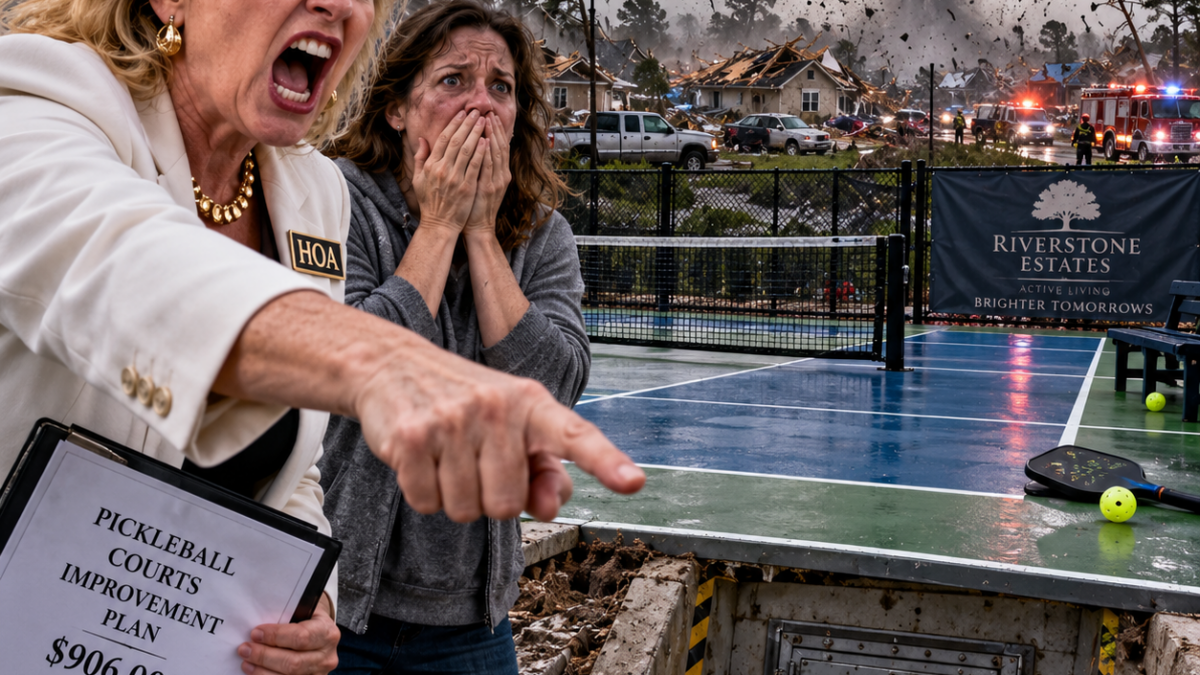
PART 2
I didn’t argue with her in front of the crowd.
That surprised Vanessa.
She was prepared for anger.
People like her often are.
Anger gives them something useful—a raised voice, a threatening gesture, a sentence they can quote without context.
Evidence is harder.
I put the steel probe back in my truck and called Mara Singh.
Mara was a licensed surveyor from Red Valley. Twenty years in the business had given her a particular kind of patience.
“How fast can you locate three missing corners?”
“Tomorrow afternoon.”
“I need you tomorrow morning.”
“That sounds expensive.”
“I’ll pay.”
She paused.
“What happened?”
“Someone built a pickleball court eleven feet into my parcel.”
Another pause.
“Tomorrow morning.”
I looked west.
High cirrus clouds had begun feathering across the sky.
There are skies that mean nothing.
There are skies that make people who have lived in tornado country check the weather twice.
This was the second kind.
That night I walked the main entrance of the Merritt shelter alone.
The western door opened through a sloped concrete passage beside my barn.
I turned on the overhead lights.
The chamber smelled like limestone, oil, and old steel.
Three rows of benches lined the walls.
Emergency water sat in sealed storage.
First-aid kits were mounted beside the radio shelf.
I had spent years returning every part of that room to working condition.
Not because I thought I could undo what happened to Miriam.
Grief doesn’t work backward.
It changes what you do next.
I reached the main steel door and operated the electric actuator.
The motor started.
Hesitated.
Then continued.
I frowned.
It had done that twice during winter drills.
I had ordered a replacement controller and then delayed installation because the manual wheel still worked.
Next week, I kept telling myself.
There is a dangerous phrase.
Next week.
I wrote the controller number on my hand.
Then I checked the backup ventilation panel.
The indicator for Vent Two showed normal.
That didn’t make sense.
If the HOA equipment building sat over the second shaft, airflow should have changed.
I opened the steel utility cabinet beside the barn.
The lock looked fine.
I told myself I would inspect it in daylight.
I regret that.
Not because it caused everything.
Because in a story full of other people ignoring warnings, I had ignored one of my own.
Mara arrived at seven the next morning.
She parked beside my barn, unloaded a robotic total station, and asked me to show her the last known corners.
Eight minutes later, Vanessa arrived.
Same security guard.
Same red confidence.
“This is private HOA property.”
Mara didn’t even look up.
“I’m on Mr. Mercer’s parcel.”
“According to our community plan, his property stops at the cedar fence.”
Mara finally raised her eyes.
“A community plan is not a recorded survey.”
Vanessa handed her a laminated drawing.
Green shading covered the recreation area.
All four courts appeared neatly inside something labeled HOA RECREATION TRACT.
It looked professional.
That’s the danger of a clean map.
People assume clean means official.
Mara turned it over.
“No recording stamp.”
“Our attorney reviewed it.”
“No surveyor’s seal.”
“It came from the developer.”
“No legal description.”
Vanessa’s jaw tightened.
“You’re being argumentative.”
“No. I’m being a surveyor.”
I almost smiled.
By ten, Mara had recovered the first iron pin beneath six inches of soil.
The second had been bent nearly flat and covered with gravel.
The third was missing, but its location could be reconstructed using permanent county monuments.
She drove bright orange flags into the soil.
One by one.
The line appeared.
The eastern fence was wrong.
The equipment building crossed onto my parcel by six feet.
Court Three crossed by eleven at its widest point.
And the location of the buried escape hatch sat almost directly beneath the painted service box.
Neighbors had started gathering.
Denise Holloway stood closest.
Her eight-year-old son, Micah, held her hand.
Denise pointed toward the flags.
“Are you saying we spent almost a million dollars building on somebody else’s land?”
Vanessa answered before Mara could.
“No. We are saying an outdated metal pin conflicts with the subdivision master plan.”
Mara looked at her.
“This pin matches two county monuments and the recorded legal description.”
Vanessa ignored her.
I held up the laminated plan.
“Who made this?”
“The developer.”
“Who certified it?”
“Our attorneys reviewed everything.”
“That still isn’t an answer.”
Her eyes narrowed.
Mara finished photographing her marks.
Before leaving, she handed me a preliminary field sketch.
“There’s another issue.”
“What?”
“The county index references an emergency access exhibit associated with Willow Trace.”
“Where is it?”
“Not attached to the digital plat.”
“Missing?”
“Maybe. Maybe misindexed.”
“How fast can you find it?”
“I’ll request the paper volume.”
I looked toward the western sky.
“Today.”
She nodded.
After Mara left, Denise stayed behind.
She looked uncomfortable.
“Vanessa told us you were trying to force the HOA to buy your land.”
“I never offered it.”
“She said you demanded two hundred thousand dollars.”
“For what?”
“The strip under the courts.”
I looked toward Vanessa.
She was talking to the security guard near the clubhouse.
“That conversation never happened.”
Denise lowered her voice.
“My assessment is on a payment plan.”
“I’m sorry.”
“So are a lot of people.”
She looked at Court Three.
“If they have to tear this out, what happens to our money?”
Micah leaned against her.
I looked at him and saw another crowded shelter hallway from eleven years earlier.
Miriam standing under fluorescent lights.
Her hair wet.
Her hand touching my arm.
The last time I saw her alive.
“I don’t want your money,” I said.
“Then what do you want?”
“To know why they poured over an emergency exit after being warned.”
Vanessa lifted her phone across the parking lot.
She took a photograph of us talking.
That afternoon, every homeowner received an HOA email.
SUBJECT: DELIBERATE INTERFERENCE WITH COMMUNITY IMPROVEMENTS.
It accused me of trespassing.
Intimidating residents.
Spreading false information.
Claiming an unsafe private underground structure was a public shelter.
Then it announced an emergency board meeting to authorize legal action against me.
Before the email reached every inbox, an HOA security contractor installed a chain across the service lane leading toward my shelter entrance.
A yellow notice hung from it.
REMOVAL OR DAMAGE TO HOA SAFETY BARRIER: $500 FINE.
I stood beside the chain for a long time.
I could have cut it.
I had bolt cutters in the barn.
But that would give Vanessa another photograph.
So I documented it.
Time.
Date.
Location.
Then I read the community email again.
One sentence was bold.
THERE IS NO CERTIFIED COMMUNITY SHELTER BENEATH THE RACQUET PAVILION.
Again.
Careful language.
Not no shelter.
No certified community shelter.
Why qualify the sentence unless you knew the shelter existed?
I walked to the ventilation cabinet.
The lock had been cut.
Not broken from age.
Cut.
Inside, two alarm wires hung loose.
Both clipped cleanly at nearly identical angles.
I stopped breathing for a second.
Those wires connected the second ventilation shaft to the fault alarm inside my house.
If airflow failed, the panel should have warned me.
It hadn’t.
Because somebody had silenced it.
I photographed everything before touching the cabinet.
Then I called the sheriff.
Deputy Mark Ellison arrived forty minutes later.
He examined the cut lock, wires, disturbed soil, and tire marks near the service lane.
“You know who did this?”
“No.”
“Suspect anyone?”
“Yes.”
“That’s different.”
“I know.”
He photographed the cabinet.
“Any camera?”
“Mine doesn’t cover this angle.”
“Neighbors?”
“Maybe.”
He wrote the report number on a card.
“No handcuffs today, Mr. Mercer.”
“I didn’t ask for any.”
“Good.”
He looked toward the court.
“People get disappointed when evidence doesn’t immediately look like television.”
“I used to inspect structural failures.”
“Then you know.”
I did.
Real cases are often built from boring things.
Timestamps.
Invoices.
Photographs.
Emails.
One unremarkable record beside another.
That evening, forty residents packed the clubhouse.
Vanessa stood at the front.
I sat in the back with a manila folder.
“The sheriff found no evidence linking anyone associated with Willow Trace to Mr. Mercer’s allegations,” she announced.
Technically true.
No proof yet.
She projected the developer’s marketing map on the wall.
My six-acre parcel stopped neatly at the cedar fence.
The shelter wasn’t shown.
Vanessa pointed toward my property.
“Mr. Mercer maintains an unpermitted private structure under land adjacent to Willow Trace. The HOA cannot assume liability for something it does not own, operate, or certify.”
Then she proposed a solution.
Willow Trace would take control of the shelter.
Commission its own inspection.
Manage access.
I would sign a transfer agreement granting the HOA exclusive operational authority.
In return, the board would consider resolving the boundary conflict without litigation.
For three weeks she had said the shelter didn’t exist.
Now she wanted ownership.
I waited for public comment.
When my turn came, I stood.
“If the shelter is imaginary and unsafe, why do you need me to transfer it?”
Silence.
Vanessa glanced at the timer.
I held up the county plat index.
“This references an emergency easement recorded when Willow Trace was created.”
She looked away.
“The attachment is missing.”
“Then until the county finds it, no one should be pouring concrete, locking access lanes, or transferring anything.”
“Your three minutes are over.”
She turned off the microphone.
After the meeting, treasurer Walter Bell waited near my truck.
Walter lived directly across from the recreation area.
He was in his late sixties and had installed cameras after tools disappeared from his garage the previous year.
“You said someone cut wires.”
“Yes.”
“What time?”
“I don’t know. Sometime before yesterday.”
He held out a memory card.
“Take a look.”
At home, I opened the footage.
2:17 a.m.
The morning before the concrete pour.
A white utility truck rolled through the Willow Trace service gate.
Headlights off.
When it passed under a street lamp, the HOA crest appeared on the driver’s door.
Two figures got out carrying a ladder and tool bags.
They walked toward my ventilation cabinet.
Forty-three minutes later, they returned.
The distance was too great to identify faces.
The truck number was not.
UNIT 4.
The next morning I called the HOA maintenance contractor.
A man named Jeff Carver answered.
“Unit Four?”
He paused.
“That truck was at our yard.”
“At 2:17 Tuesday morning?”
“All night.”
“I have video of it at Willow Trace.”
Silence.
“Send me the clip.”
Twenty minutes after I emailed it, Vanessa called.
“You are contacting HOA vendors without authorization.”
“I contacted the owner of a truck recorded beside my cut lock.”
“You are creating unnecessary panic.”
“Who used Unit Four?”
“Our counsel will respond.”
“You know which truck I’m talking about.”
She went silent.
I hadn’t told her the number.
She already knew.
Then she hung up.
At noon, Mara returned carrying a cardboard tube and a photograph of an old ledger page.
“I found it.”
We spread the document across my dining table.
The missing emergency exhibit had never been destroyed.
It had been filed under the Merritt ranch name instead of Willow Trace.
The shelter appeared in precise detail.
Entrance A.
The western sloped passage beside my property.
Entrance B.
A vertical escape shaft through the ridge.
Exactly beneath Court Three.
Entrance C.
A service corridor terminating beneath the clubhouse storage room.
Two ventilation shafts were marked in red.
One beside my barn.
The other beneath the location now occupied by the HOA equipment building.
Around the entire system ran a forty-foot emergency access easement.
The language was clear.
Shelter inspection.
Maintenance.
Emergency use.
Subdivision residents.
Local emergency personnel.
Then I found the clause that mattered.
NO PERMANENT OBSTRUCTION MAY BE PLACED ABOVE ANY EMERGENCY EXIT WITHOUT WRITTEN APPROVAL OF COUNTY EMERGENCY MANAGEMENT.
I called Aaron Pike.
Aaron ran Red Valley County Emergency Management.
He arrived that afternoon with a building inspector and an air-monitoring technician.
He didn’t recognize me.
Not at first.
We entered through the western passage.
He inspected the reinforced ribs.
Bench anchors.
Drainage sump.
Ventilation hardware.
Emergency lighting.
Manual override systems.
“Structure looks better than I expected.”
“I’ve been restoring it.”
“For who?”
“Anybody who needs it.”
“HOA pays?”
“No.”
He looked at me.
“Why?”
I didn’t answer.
Not yet.
We checked Entrance C beneath the clubhouse.
A steel security door blocked the passage.
Shelving had been bolted to the floor in front of it.
Boxes of HOA records filled the shelves.
“How long has this been closed?” Aaron asked.
Vanessa had joined us with an attorney.
“About eighteen months. The storage room was renovated.”
“This is marked as emergency access.”
“It was not identified to the board as operational.”
Aaron looked at her.
“It is identified on a recorded emergency easement.”
Her attorney stepped forward.
“We dispute whether that easement remains active.”
Aaron ignored him.
Then we examined the ventilation system.
Vent Two barely moved air.
The equipment-building slab had compressed the upper duct.
That left one reliable intake.
One currently usable entrance.
One blocked escape hatch.
For a chamber designed for ninety-six people.
Aaron tested the main electric door.
The actuator started.
Paused.
Then continued.
He looked at me.
“Do that again.”
I did.
Same hesitation.
“How long?”
I hated the answer.
“First happened during a winter drill.”
“And?”
“I ordered a controller.”
“Installed?”
“No.”
“Why?”
“Manual wheel still works.”
Aaron wrote something on his clipboard.
I felt defensive.
Then ashamed of feeling defensive.
Vanessa had buried two routes.
But I had allowed the remaining main entrance to become less reliable than it should have been.
“I should’ve replaced it immediately.”
Aaron nodded.
“Yes.”
No comfort.
No excuse.
Just yes.
That was fair.
He looked at me again.
“Mercer?”
“Yes.”
“Were you with Mercer Structural after the Bridge Creek outbreak?”
“For nine years.”
He pointed toward a reinforcement plate.
My old inspection stamp was still visible beneath newer paint.
“You wrote the West County shelter retrofit.”
“Load-path section. A team wrote the rest.”
Vanessa folded her arms.
“So Mr. Mercer designed and inspected the structure he now claims is safe.”
“No,” I said. “I did not certify this shelter after buying the land. I restored equipment. Your contractor buried two exits and one ventilation shaft.”
Aaron nodded.
“We don’t need Mr. Mercer’s resume to measure obstructions.”
He issued a written notice.
Restore emergency access.
Remove or remedy obstructions.
Verify both ventilation paths.
Until then, Merritt Shelter could not be counted as fully available in the county response plan.
Vanessa’s attorney asked the obvious question.
“Are you ordering immediate demolition of a $906,000 recreation facility?”
Aaron checked the weather bulletin on his phone.
“I’m ordering safe emergency access.”
He looked toward the darkening western sky.
“How you created the obstruction is your problem. How fast you fix it may become mine.”
For the first time, two board members physically moved away from Vanessa.
Walter asked to see the original plat.
Vanessa snapped the folder closed.
“The board will review this privately.”
Walter stared at her.
It wasn’t guilt on his face.
It was surprise.
That mattered.
He had approved the project.
But he had apparently never seen the document underneath it.
By Friday evening, the severe-weather forecast had worsened.
Warm, humid air surged north from Texas.
A powerful upper-level system approached from the west.
Meteorologists avoided certainty.
Good meteorologists do.
They couldn’t tell us exactly where tornadoes would form.
But the ingredients were lining up.
The highest threat window was now Saturday afternoon into evening.
Less than twenty-four hours.
Vanessa sent another HOA email.
She called the shelter dispute “administrative.”
Then she told residents the clubhouse interior restroom could serve as an approved alternative.
I read the sentence twice.
The restroom had an exterior wall.
No reinforced ceiling.
A row of large windows less than twenty feet away.
I forwarded the email to Aaron.
His reply contained one sentence.
I DID NOT APPROVE THAT STATEMENT.
At 8:40 Friday night, someone knocked on my back door.
Denise stood there alone.
No Micah.
She carried a grocery bag stuffed with paper.
“Can I come in?”
“Of course.”
She sat at my kitchen table.
“I used to be the board recording secretary.”
“Vanessa said you resigned because you were moving.”
“I’m not moving.”
“Why did you leave?”
Her mouth tightened.
“Because I got tired of being told minutes should reflect what the board meant instead of what people actually said.”
She pulled out two documents.
Same meeting.
Same date.
Two versions.
The first was her draft.
Under RACQUET PAVILION SITE REVIEW, one paragraph had been highlighted.
Existing subsurface shelter and access easement require field verification. No slab placement above Exit B or Ventilation Shaft Two pending county review.
I looked at the final approved minutes.
That entire warning had become:
Site conditions discussed. Contractor to proceed.
“Who changed this?”
“Vanessa sent the revision.”
“Board voted on the change?”
“No.”
Denise pulled another page from the bag.
An email from Vanessa to the contractor.
Opening date cannot move. Pour first. We can settle any ownership issue afterward.
Attached was the unrecorded map.
Then another file name caught my eye.
MERCER STRUCTURAL SAFETY GROUP — PRELIMINARY HAZARD REVIEW.
My old company.
The same name I had seen in Vanessa’s folder at the ribbon cutting.
“Did you read it?”
“No. Vanessa said attorney-client privilege.”
I called the current director of Mercer Structural the next morning.
His name was Paul Henley.
I had hired him twenty years earlier as a young engineer.
“Caleb?”
“Morning, Paul.”
“I heard about Willow Trace.”
“I need to ask something you may not be able to answer.”
“That’s usually how these calls begin.”
“Did the firm perform a preliminary review of the Merritt shelter for the HOA project?”
Silence.
“I can’t release a client report.”
“I’m not asking you to.”
“What are you asking?”
“Did you send one?”
“Yes.”
“When?”
“Six weeks before the pour.”
“Did it warn against placing load over the escape hatch without an approved protection design?”
Another silence.
“Yes.”
I closed my eyes.
“Who received it?”
“I can only tell you the client contact listed in the file.”
“Vanessa Crow?”
“Yes.”
That explained the envelope.
Vanessa hadn’t discovered the shelter after construction.
She hadn’t relied only on an old map.
She had received a professional warning from the company carrying my own name.
And poured anyway.
“Paul.”
“Yes?”
“If county emergency management requests that report?”
“We’ll respond through counsel immediately.”
“Thank you.”
I hung up.
Denise had one more set of papers.
“This may explain why she wouldn’t stop.”
The first was the HOA reserve ledger.
One line had been circled.
$186,000 transferred from EMERGENCY REPAIR RESERVE to PAVILION CHANGE ORDERS.
No recorded board vote.
“When?”
“Over three months.”
“Who authorized it?”
“Vanessa and the property manager.”
“Walter know?”
“Not according to the minutes I have.”
Then she gave me a management proposal from Hearthstone Residential.
If the pavilion opened before the annual election, Hearthstone would take over management services for Willow Trace.
Vanessa would receive a $12,000 transition-consulting payment.
Potential annual consulting work followed.
If construction stalled, Hearthstone retained the right to withdraw pending an independent audit.
I understood.
Vanessa wasn’t protecting four pickleball courts.
She was protecting the opening date.
The opening protected the Hearthstone deal.
The deal protected her future position.
And if the project stopped before opening, an audit might expose the missing reserve money.
I scanned Denise’s documents.
We placed her originals in my fire-resistant file box.
At 1:01 Saturday morning, Aaron called.
“The risk corridor shifted east.”
“I saw.”
“County operations activates at dawn.”
“Understood.”
“I need that second exit exposed.”
“Vanessa won’t authorize her contractor.”
“Then tomorrow we find somebody who understands concrete is cheaper than people.”
Saturday morning felt wrong from sunrise.
Warm.
Heavy.
Low clouds moved quickly north while trees near the ground barely stirred.
At eight, Aaron posted a county inspector at Willow Trace.
A crew from Red Valley Concrete Cutting arrived beside Court Three.
The owner examined the slab.
Then looked at the county directive.
“Who signs for damage?”
Aaron pointed at the order.
“We’re restoring emergency access.”
“I understand. I still need somebody contractually responsible for cutting a nearly million-dollar HOA amenity.”
Vanessa arrived with her attorney.
She already had a document.
“Caleb,” she said. “Inside.”
We met in the clubhouse.
The agreement sat on the table.
I read it.
Permanent HOA ownership and operational control of the shelter.
I would accept liability for prior repairs.
Willow Trace would authorize removal of the necessary portion of Court Three.
The threatened lawsuit against me would be dismissed.
“Sign it,” Vanessa said.
“The crew starts immediately.”
I looked at her.
“You want me to give you the shelter before you stop blocking its exit.”
“The community paid for infrastructure above it.”
“The community paid because you used the wrong map.”
“That remains disputed.”
“The survey is signed.”
“Our legal position remains unchanged.”
I slid the agreement back.
“No.”
She leaned toward me.
Her voice dropped.
“If the storm comes and this shelter stays closed, residents will know you could have opened it with one signature.”
For several seconds, I couldn’t speak.
Not because I didn’t know the answer.
Because she had found the cruelest possible weapon.
Miriam.
Eleven years earlier, I spent months asking myself whether one faster inspection, one different decision, one phone call could have changed what happened.
Survivors become experts at impossible alternate timelines.
If I had called.
If I had checked.
If I had stayed.
If I had known.
Vanessa wanted to place that same burden in front of me.
Sign away the shelter.
Or carry whatever happened.
Grief had taught me one thing she did not understand.
Responsibility and coercion are not the same thing.
“The shelter is open,” I said.
She stared at me.
“You blocked the exits.”
I walked outside.
Mara stood beside Aaron.
She held the recorded easement.
The county attorney had reviewed it.
During a declared local emergency, the instrument authorized county personnel to enter the access corridor and remove life-safety obstructions.
At 9:26 a.m., Red Valley County issued an emergency access directive.
The cutting crew finally unloaded.
Their foreman, Rick, marked a square around the hatch.
I stopped him.
“Don’t cut that.”
He lowered the chalk.
“Why?”
“The shaft carries load through two narrow side walls.”
“I’m cutting around the opening.”
“If you release both sides at once, the slab can drop into the tunnel.”
Aaron opened the original retrofit drawing.
I knelt and marked a different sequence.
Two shallow relief cuts.
Temporary center anchors.
Alternating cuts along the load path.
Rick studied it.
Aaron looked at me.
“That’s the West County sequence.”
“I wrote that section after Bridge Creek.”
Rick erased his marks.
“Then we do it your way.”
The diamond blade started.
The sound went through your teeth.
Blue court coating disappeared under wet concrete slurry.
Residents watched from driveways.
Vanessa stood beyond the safety barrier filming.
“This destruction is being conducted over the HOA’s formal objection,” she said into her phone. “Owners should document what is being done to your investment.”
Nobody answered her.
The first concrete section lifted.
Then everyone went silent.
The emergency hatch hadn’t merely been covered.
Its upper steel frame had been filled with concrete.
Reinforcing bar crossed the opening.
Someone had removed the original top plate.
Inserted steel.
Poured directly into the escape shaft.
That was not accidental.
No concrete crew could have done it without seeing the hatch.
Aaron crouched beside the exposed rebar.
“Who approved this?”
The site superintendent looked at Vanessa.
Vanessa looked at her attorney.
Her attorney looked at the concrete.
Walter stepped forward.
“The board approved a slab.”
He pointed downward.
“We did not approve filling an emergency tunnel.”
I examined the reinforcement.
A metal tag was tied to one bar.
REVISION C — FIELD CONDITION.
“Somewhere,” I said, “there’s a drawing.”
Mara looked at the tag.
“And a signature.”
At 11:05, a tornado watch was issued.
Storms were forming southwest of Red Valley.
The abstract thirty-six-hour threat became colored boxes on radar.
The concrete crew estimated four hours to expose the escape shaft safely.
They could go faster.
But if a concrete plug fell into the chamber, it could damage the lower door.
Or kill somebody working beneath it.
I entered the shelter with two workers.
We installed temporary braces under the shaft.
Anchors came down from above.
At noon, the power flickered.
At 12:18, the HOA entrance gate stopped closed.
Construction trucks backed up on the road.
Vanessa blamed the utility.
Walter checked his camera.
Then he came running.
“Caleb.”
“What?”
“You need to see this.”
The video showed an HOA maintenance employee entering the clubhouse electrical room.
He opened a breaker panel.
Flipped the gate circuit off.
When confronted, the employee looked terrified.
“Mrs. Crow told me construction vehicles weren’t authorized.”
Aaron stepped closer.
“Turn it on.”
“The breaker’s locked out.”
“Emergency crank.”
“Should be in the gate cabinet.”
It wasn’t.
Missing.
The gate controlled the main route from subdivision streets toward the shelter lane.
Residents would need that path.
I brought my tractor.
Wrapped a padded strap around the gate arm.
Pulled it free of the track without damaging the stone columns.
Vanessa ran toward me.
“You are destroying association property!”
“The motor is intact.”
“You have no authority—”
Aaron stepped between us.
“He has mine.”
Vanessa stopped.
That was when residents began arriving.
Water bottles.
Flashlights.
Medication bags.
Pet carriers.
Blankets.
Children wearing bicycle helmets because parents had been taught that head protection matters in tornadoes.
Denise started a roster.
Walter opened the clubhouse storage room.
He moved the shelves.
Then stared.
The steel door for Entrance C had been concealed behind shelving bolted into the floor.
Another route blocked.
Another “renovation.”
Another decision someone had made because emergency infrastructure was inconvenient to everyday appearance.
At 1:07, Mara found Revision C in the contractor’s online permit folder.
Filled escape shaft.
Relocated ventilation line.
The engineer-of-record approval box was blank.
Vanessa Crow’s electronic signature appeared under OWNER/CLIENT AUTHORIZATION.
No engineer had signed it.
No county reviewer.
Vanessa had.
At 1:34, the first tornado warning appeared two counties southwest.
The storm was moving northeast.
Vanessa stood beneath the clubhouse awning making phone calls.
Board counsel.
Hearthstone.
The management company.
Maybe insurers.
I didn’t know.
Her red suit stood out beneath a sky turning dark gray-green.
The cutting crew lifted another concrete section.
Cold air rushed upward from the shaft.
For the first time in months, Exit B was breathing.
Then I heard grinding below.
I froze.
The main entrance actuator.
I ran down the western passage.
The door had stopped halfway through its test cycle.
Voltage fluctuations had damaged the controller.
The same controller I should have replaced months earlier.
I stared at it.
Vanessa hadn’t caused this.
No contractor had touched it.
This one belonged to me.
Walter came down behind me.
“What happened?”
“Controller failed.”
“Can we open manually?”
“Yes.”
“How long?”
“Two people. Two or three minutes.”
His face changed.
“That’s too long if everyone comes at once.”
“I know.”
I put my hand on the motor housing.
For months, I had told myself the manual wheel was enough.
I had made the same category of mistake I despised professionally.
Treating redundancy like an excuse to postpone maintenance.
The difference was I had to admit it before it hurt someone.
“We prioritize that exit,” I told Walter.
“Court Three?”
“Yes.”
“At any cost?”
I thought of Miriam.
“Yes.”
At 2:11 p.m., every phone sounded.
TORNADO WARNING.
Strong rotation west of Red Valley.
Take shelter immediately.
The concrete crew had cleared most of the shaft.
The lower steel door remained pinned by one final wedge of concrete.
Rick looked at me.
“Twenty minutes.”
“You have ten.”
“If I rush—”
“I know.”
I turned to Denise.
“Start moving everybody underground.”
Residents formed a line.
Elderly neighbors first.
Children.
Families.
People with mobility issues.
Walter and the security guard guided them down Entrance A.
Hail began hammering the equipment-building roof.
Some stones were golf-ball sized.
The noise made children cry.
Denise knelt beside Micah.
“Helmet on.”
“I’m scared.”
“I know.”
“Is Mr. Mercer scared?”
She looked at me.
“Yes.”
Micah seemed surprised.
I crouched.
“Being scared is why we use the shelter.”
He nodded.
Then followed his mother down.
Vanessa was inside the clubhouse office.
Loading financial boxes onto a rolling cart.
Walter saw her.
“Leave those!”
“They contain association records.”
“Then let the records get wet!”
She pushed the cart toward the corridor.
One wheel caught on the threshold.
A window shattered across the clubhouse.
Glass blew inward.
Vanessa abandoned the boxes.
The security guard ran toward her.
The weather alert upgraded.
TORNADO EMERGENCY.
Large and destructive tornado confirmed on the ground.
I counted underground.
Eighty-one.
Two missing.
Vanessa.
The security guard.
Walter stood beside the manual door wheel.
“We close?”
I could have said yes.
No one underground would have blamed me.
Vanessa had buried the exit.
Altered records.
Threatened me.
Tried to trade life safety for ownership.
If I closed that door, nobody inside would accuse me of malice.
But shelters are not courtrooms.
Storms don’t care who deserves what.
“Keep it open.”
I ran up the passage.
Rain moved horizontally.
The western horizon had become a moving wall.
Insulation spiraled through the air above rooftops.
A trampoline lifted, flipped, disappeared behind a house.
The security guard came from behind the clubhouse carrying Vanessa under one arm.
Blood ran down her lower leg.
“She fell!”
I grabbed her other side.
“Can you walk?”
“Yes.”
She tried.
Her knee buckled.
We half-carried her toward Entrance A.
The air pressure changed.
Every clubhouse door slammed at once.
My ears popped.
We reached the passage.
Walter and another resident grabbed Vanessa.
I followed.
“Close it!”
Two men turned the manual wheel.
The heavy door moved.
Slowly.
One revolution.
Another.
Then a cottonwood beside the lane snapped.
The sound was violent and clean.
The upper trunk crashed onto the concrete entrance canopy.
The shelter structure held.
The outer door frame shifted.
Only slightly.
Enough.
The door jammed sixteen inches from closed.
Wind screamed through the gap.
Walter forced the wheel.
“It’s stuck!”
I grabbed it.
Together we pulled.
Nothing.
“We reopen?”
The wheel wouldn’t reverse either.
The frame had trapped it.
Entrance A was now neither open nor closed.
I looked through the shelter.
Eighty-three people.
Children.
Families.
Vanessa on the bench with a towel around her leg.
Then I looked toward the vertical ladder.
Exit B.
Court Three.
The escape route Vanessa had buried.
The cutting crew had exposed most of it.
But the last concrete wedge still pinned the lower steel door.
I grabbed a hydraulic spreader.
“Walter, stay here.”
“Caleb—”
“If this entrance fails, we need the other one.”
Two concrete workers followed me.
We climbed the internal ladder.
Dust fell from above.
Cold rain leaked through the cuts.
I placed the spreader between the steel door and frame.
Pump.
The jaw widened.
Metal groaned.
Pump.
The wedge held.
Below me, children cried.
Denise started counting.
“One hundred.”
Several children joined.
“Ninety-nine.”
Pump.
“Ninety-eight.”
Steel bent.
“Ninety-seven.”
I repositioned the tool.
“Ninety-six.”
Pump.
A crack ran through the concrete wedge.
“Ninety-five.”
Again.
The wedge fractured.
The door opened three inches.
Then six.
A worker squeezed his arm through.
“Chain!”
The crew above attached a chain to the broken plug.
The excavator lifted.
Concrete scraped against steel.
Then daylight exploded down the shaft.
Wind.
Rain.
Air.
A second route.
“Exit clear!”
I had barely shouted the words when the tornado reached Willow Trace.
People compare tornadoes to freight trains.
I’ve always disliked that comparison.
Trains have rhythm.
Direction.
Mechanical order.
This had none.
It was a continuous roar layered with impacts.
Wood.
Metal.
Glass.
Roofing.
Objects I couldn’t identify.
The shelter lights went out.
Emergency battery lamps came on.
Then flickered.
Concrete walls vibrated.
Dust fell from ceiling joints.
Somebody prayed.
Someone else vomited.
Dogs barked wildly.
I climbed down from the escape shaft.
Vanessa sat against the wall.
Blood had soaked part of the towel around her leg.
In the dim light, she looked at the open shaft above me.
For the first time since I had met her, she had nothing to say.
The worst noise lasted less than four minutes.
Inside that room, it felt like an hour.
Then it weakened.
Not stopped.
Changed.
I knew enough not to open anything immediately.
Tornado-producing storms cycle.
One circulation can follow another.
Aaron’s voice came through the emergency radio.
“Shelter One, hold position. Gas leaks reported north side. Fire crews entering Willow Trace.”
I answered.
“Eighty-three civilians. Three minor injuries known. Main Entrance A partially jammed. Exit B open.”
“Copy. Remain underground.”
Walter sat across from Vanessa.
He stared at her for a long time.
“You told us the engineer cleared the site.”
Her voice was weak.
“The contractor was responsible for construction methods.”
“Your signature is on Revision C.”
“It was administrative acknowledgement.”
Denise spoke from the next bench.
“And the minutes?”
Vanessa looked toward her.
“What minutes?”
“The warning you removed.”
“Those were drafts.”
“The final minutes are official.”
Denise opened the document bag she had carried into the shelter.
“The warning was also attached to our insurance renewal.”
Vanessa stopped moving.
That changed everything.
Months earlier, Willow Trace had applied for a lower property-insurance premium.
One safety asset listed in the application:
MERRITT COMMUNITY STORM SHELTER.
Three available access routes.
Two independent ventilation paths.
Active maintenance program.
The insurer requested supporting documentation.
Denise, still board secretary at the time, uploaded the original engineering warning.
The carrier’s system retained the upload.
Timestamp.
Confirmation.
And the automatic email sent to Vanessa.
I understood the contradiction immediately.
To residents, the shelter was unsafe and private.
To county officials, Vanessa implied it wasn’t a recognized community shelter.
To the HOA insurer, it was fully operational community safety infrastructure.
All three claims ran through the same board.
The same project.
The same president.
Vanessa closed her eyes.
For a moment, I felt something I hadn’t expected.
Not triumph.
Pity.
She was injured.
Trapped underground with the very people her decisions had endangered.
That was enough consequence for one afternoon.
I handed her another clean towel.
“Put pressure here.”
She looked at me.
“Why are you helping me?”
I almost laughed.
Not because it was funny.
Because the question revealed how she saw conflict.
“You’re bleeding.”
“That’s not what I asked.”
“It’s the answer.”
At 3:06, firefighters opened the damaged main entrance from outside.
We evacuated in small groups.
The first thing I saw was sky.
Then devastation.
Willow Trace looked as if something enormous had dragged a blade diagonally across the subdivision.
Roofs were stripped on the northwest side.
Two garages had collapsed.
The clubhouse windows were gone.
Pieces of fencing wrapped around trees.
Court netting hung from power lines.
Court Three was cracked, cut open, and covered in concrete slurry.
In its center, the emergency escape shaft stood open.
All eighty-three people who entered that shelter walked out alive.
The security guard had a broken wrist.
Vanessa needed stitches.
Three residents were treated for minor injuries.
No one died.
That was the only number that mattered that evening.
Two days later, the National Weather Service surveyed the tornado path.
EF3 at its strongest point southwest of Willow Trace.
Damage through our subdivision ranged mostly from EF1 to EF2.
The shelter had done what it was built to do.
The same shelter Vanessa’s project nearly made unusable.
Monday morning, Mara placed her signed survey beside the county permit file.
Court Three encroached onto my parcel.
The equipment building obstructed a protected ventilation route.
Revision C lacked engineering approval.
County officials closed Court Three until the entire emergency system was restored.
Then records began arriving.
The HOA insurer demanded meeting minutes.
Reserve ledgers.
Construction documents.
Safety disclosures.
The contractor produced dispatch records.
Unit Four—the truck captured on Walter’s camera—had been checked out to the Willow Trace property manager on the night my ventilation alarm was cut.
Not stolen.
Not sitting at the contractor yard.
Released to Willow Trace.
Jeff Carver called me.
“I owe you an apology.”
“What happened?”
“My dispatcher assumed the request came through authorized HOA maintenance.”
“Who signed?”
“The property manager.”
“Crew?”
“Two temporary employees.”
“Work description?”
He hesitated.
“Access equipment inspection.”
“Did they cut my alarm wires?”
“Our attorney is handling statements.”
Fair enough.
But the timeline had closed another gap.
Hearthstone Residential withdrew its management proposal.
So did Vanessa’s consulting offer.
They issued a short statement about “governance concerns and pending independent review.”
Translation:
They wanted nowhere near it.
Three weeks after the tornado, Willow Trace held a special membership meeting.
The clubhouse couldn’t be used.
We met in a rented church hall.
Attendance exceeded the previous four HOA elections combined.
People stood along the walls.
Vanessa sat at the front.
No red suit.
No white heels.
Her attorney handled most of the speaking.
Walter presented the financial timeline.
The $186,000 transfer.
The pavilion change orders.
The missing board vote.
The Hearthstone proposal.
Then Denise presented the minutes.
Draft.
Final.
Vanessa’s revision email.
Insurance upload.
Mara displayed the recorded boundary and emergency easement.
Aaron Pike spoke about three-access design.
“Redundancy exists because tornado damage is unpredictable,” he explained. “A tree can block one entrance. Structural debris can block another. Power can fail. That is why no individual officer, property manager, or association has authority to casually remove an access route from a functioning emergency system.”
One resident asked, “Would anyone have died if Court Three hadn’t been opened?”
Aaron didn’t take the bait.
“We don’t answer safety questions by inventing the disaster that didn’t happen. We identify failures and restore redundancy before the next emergency.”
That was exactly the right answer.
I spoke last.
I didn’t ask for revenge.
I proposed a repair plan.
Remove every encroaching section.
Restore Exit B.
Relocate the equipment building.
Reopen Entrance C through the clubhouse.
Record a modern emergency-access agreement.
Annual inspections.
Public maintenance logs.
Two drills each year.
Independent resident safety committee.
The remaining pickleball courts could reopen after county approval.
Denise raised her hand.
“Caleb?”
“Yes.”
“Why?”
“What do you mean?”
“Why let Willow Trace keep using it?”
The hall went quiet.
Micah sat beside her.
I looked at him.
Then at the residents.
“The board isn’t the community.”
Nobody spoke.
I continued.
“Children didn’t pour the concrete. Families didn’t cut those wires. Most of you paid an assessment because people you elected told you the project was safe.”
I looked toward Vanessa.
“I’m not turning a storm shelter into punishment.”
The vote followed.
Vanessa was removed.
Two directors who had voted to proceed after receiving the engineering warning were removed with her.
Walter remained temporarily to help the audit, subject to a new election in sixty days.
The vote wasn’t unanimous.
It didn’t need to be.
Some residents still believed Vanessa had been trying to improve Willow Trace.
Maybe she had been, in the beginning.
That didn’t erase what she did when improvement became more important than warning signs.
The financial audit took months.
So did reconstruction.
The contractor’s insurer paid a substantial portion of the physical restoration after the record showed construction crews had seen the hatch and followed Revision C without engineering approval.
Consultants contributed through their carriers.
The HOA used reserve funds.
Several cosmetic projects were cancelled.
Some residents were furious.
I understood.
They had already paid $7,500.
Now some of what they thought they bought had to be cut apart.
One afternoon, Denise found me watching crews remove the portion of Court Three crossing my property.
“You okay?”
“Yes.”
“You don’t look okay.”
“They’re tearing up almost a million-dollar project.”
“That isn’t your money.”
“It’s everybody’s money.”
She folded her arms.
“You didn’t pour it.”
“No.”
“Didn’t hide the survey.”
“No.”
“Didn’t bury the hatch.”
“No.”
“Then stop carrying every bill because you survived the argument.”
That sentence stayed with me.
Miriam used to say something similar.
I had a habit of accepting responsibility simply because I could imagine a way I might have prevented something.
Engineering encourages that instinct.
Every failure becomes a question.
What load?
What assumption?
What inspection?
What missed condition?
Grief can turn the same habit against you.
Miriam’s death had become an equation I tried solving for eleven years.
There was no solution.
Only consequences.
That autumn, roofs were repaired across Willow Trace.
The broken cottonwood beside Entrance A was removed.
The main shelter door received a new frame.
New actuator.
Independent battery controller.
Manual override.
And something Aaron insisted on after hearing my admission.
A maintenance tag with the next replacement date printed in large letters.
No more “next week.”
Entrance C was cleared.
The shelving moved.
The steel corridor received illuminated emergency signage.
The second ventilation shaft was relocated away from the equipment building and protected by bollards.
Exit B became impossible to ignore.
The reconstructed shaft rose through a protected concrete enclosure beside the recreation area.
Bright yellow.
Steel handrails.
Lighting.
A sign:
EMERGENCY SHELTER EXIT
KEEP CLEAR AT ALL TIMES
Court Three was rebuilt nine feet narrower and shifted entirely onto HOA property.
The four-court symmetry was gone.
Nobody complained.
At least not to me.
The modern emergency agreement took longer.
Lawyers argued about ownership.
Liability.
Maintenance.
Access.
I refused to transfer my property.
Willow Trace no longer wanted exclusive control anyway.
The final agreement was simple where it mattered.
I retained ownership of my land and shelter structure.
An elected safety committee controlled community operating procedures.
The county retained emergency access rights.
Maintenance logs were public to residents.
Annual inspection.
Two drills each year.
Three routes must remain usable.
No permanent construction within the protected corridor without county review.
No map could override the recorded easement.
No board president could change that with an email.
The first drill happened on a warm September evening.
Eighty-seven residents participated.
Denise managed the roster.
Walter tested the radio system.
The new safety committee stationed volunteers at all three routes.
Children had colored lines to follow.
Blue for Entrance A.
Yellow for Exit B.
Green for the clubhouse corridor.
Aaron timed everything.
“Start.”
Doors opened.
Families moved.
No panic.
No confusion.
Six minutes later, everyone was underground.
Aaron checked his watch.
“Five forty-eight.”
Walter grinned.
“Better than the church youth group.”
Micah stood near the yellow route.
“Mr. Mercer?”
“Yes?”
“Do we have to climb that ladder during a real tornado?”
“Only if another entrance is blocked.”
“What if this one is blocked?”
“Then we use another.”
He nodded seriously.
“That’s why there are three.”
“Yes.”
He smiled.
Children understand redundancy faster than adults when you stop hiding it behind legal language.
I stood near the western entrance after everyone left.
For eleven years, every storm-shelter door had reminded me of Miriam.
Steel frame.
Hinge.
Latch.
Clearance.
Everything became that night.
The public shelter she entered had one main door damaged by debris.
There was a secondary route.
Rescuers eventually used it.
Too late.
For years I told myself that restoring Merritt Shelter was private.
My grief.
My ritual.
A way to make steel behave when memory wouldn’t.
The tornado changed that.
Not because it healed anything.
Nothing erases a person you loved.
It changed what the work meant.
I had not spent eleven years fixing a room underground.
I had spent eleven years trying to make sure another husband never stood outside a damaged shelter wondering whether the door had failed the person he loved.
Residents wanted to install a plaque.
The first proposal embarrassed me.
IN HONOR OF CALEB MERCER, WHOSE COURAGE SAVED WILLOW TRACE.
“No.”
Denise looked at me.
“No what?”
“No hero plaque.”
“You ran outside during a tornado warning.”
“Bad judgment is not a plaque qualification.”
She laughed.
“Then what do you want?”
“Nothing with my name.”
Walter suggested the shelter history.
Aaron suggested emergency instructions.
Micah solved it.
“Put Mrs. Mercer’s name.”
I looked at him.
“Why?”
“Because you said she’s why you fix doors.”
Children also understand grief faster than adults sometimes.
The final plaque was small.
Bronze.
Mounted beside the western entrance.
MIRIAM MERCER
A WARNING MATTERS ONLY IF SOMEONE LEAVES THE DOOR OPEN.
The first time I saw it installed, I couldn’t read it all the way through.
I walked back to my barn.
Sat on the step.
Stayed there a while.
Denise eventually came over.
“You want it removed?”
“No.”
“You sure?”
“Yes.”
I looked toward the shelter.
“It’s right.”
Vanessa never returned to the board.
The independent audit became part of civil disputes involving the reserve transfer, construction approvals, and insurance representations.
I didn’t follow every filing.
I testified when asked.
Provided documents.
Answered questions.
Then I stopped reading about her.
Some residents expected me to enjoy watching her lose influence.
I didn’t.
She lost the Hearthstone job.
Lost her HOA position.
Lost control of the project she had treated as her legacy.
The records she tried to separate ended up on one table.
Survey.
Cut wires.
Altered minutes.
Revision C.
Structural warning.
Reserve ledger.
Insurance application.
Each piece looked explainable alone.
Together, they told the truth.
That was enough for me.
One day that fall, I saw Vanessa again.
Not at a hearing.
Not with lawyers.
At a pharmacy in Red Valley.
She had a faint scar on her lower leg where the clubhouse glass cut her.
We ended up standing in the same aisle.
For a moment, neither of us spoke.
Then she said, “The courts reopened.”
“Three and a half.”
She gave a tired smile.
“People seem happy.”
“They are.”
Her hand tightened around her shopping basket.
“I never wanted anyone hurt.”
I believed that.
The hardest truths are sometimes like that.
People can create dangerous situations without wanting the dangerous result.
Intent matters.
So do decisions.
“You were warned,” I said.
Her eyes dropped.
“I thought the engineers were being conservative.”
“That’s what safety engineers are paid to be.”
“The project was out of control.”
“You could have stopped.”
“You say that now.”
“I said it before the pour.”
That landed.
She looked away.
“Hearthstone was going to change things for me.”
“I know.”
“I’d spent years doing that job for free.”
“That doesn’t make the reserve transfer okay.”
“No.”
She surprised me with that.
No argument.
No qualification.
Just no.
Then she looked directly at me.
“When you came back for me during the warning…”
I waited.
“You didn’t have to.”
“Yes, I did.”
“Why?”
“Because there were eighty-one people underground and two people outside.”
“That’s all?”
“That’s enough.”
Her eyes filled slightly.
She blinked it away.
Then walked toward the register.
I never spoke to her privately again.
Over the following year, the Merritt shelter became something Willow Trace had never treated it as before.
Visible.
Children knew where it was.
New homeowners received emergency-access maps at closing.
Maintenance reports were posted online.
When a hinge squeaked, someone submitted a ticket.
When a battery approached replacement age, the committee replaced it before failure.
No one called those things ugly.
No one worried that yellow emergency paint ruined the recreation pavilion.
The pickleball courts became popular again.
Every warm evening, I heard the sharp hollow pop of plastic balls carrying over the ridge.
Pop.
Pause.
Pop-pop.
Laughter.
Court lights shut off at ten.
Beyond the fence, the yellow escape enclosure remained visible.
That visibility became a strange source of pride.
Visitors asked about it.
Residents explained.
“That’s the shelter exit.”
“Why is it in the middle of the recreation area?”
“Long story.”
The short version was usually enough.
Because the important part wasn’t Vanessa.
It wasn’t even the tornado.
The important part was that the door opened.
One spring evening, another tornado watch was issued.
Nothing like the outbreak that hit us.
Still, the safety committee activated the shelter early.
I walked down to check the main door.
New actuator.
Smooth motion.
No hesitation.
Green indicator.
Vent One.
Green.
Vent Two.
Green.
Entrance C clear.
Exit B clear.
Micah—now nine—arrived wearing the same bicycle helmet from the previous year.
“You know we have helmets in the shelter now,” I told him.
“I like mine.”
“Fair.”
Denise followed.
“Radar looks ugly.”
“It does.”
“Scared?”
“Yes.”
She smiled.
“Good answer.”
Families came in.
Nobody waited until sirens.
Nobody argued about certification.
Nobody asked whether visible safety equipment hurt property values.
The storm passed north.
No tornado touched Willow Trace.
Around nine, residents began leaving.
I stayed behind to shut lights off.
The shelter became quiet.
I walked toward Miriam’s plaque.
Ran my thumb across the letters.
Eleven years earlier, I couldn’t save her.
That sentence used to be the center of everything.
Slowly, another sentence had taken its place.
I could still save something because of her.
Not her life.
Not our old future.
Something smaller.
A hinge maintained.
A second door.
A child who knows where to go.
A community that reads warnings instead of hiding them.
Sometimes that is what grief gives you when it finally stops asking to be solved.
A direction.
I turned out the final light.
Walked up the western passage.
Closed the steel door.
The latch seated cleanly.
Above ground, the clouds were breaking apart.
From the recreation area came the yellow reflection of the secondary exit light.
Vanessa had buried that hatch because she believed exposed emergency infrastructure would make her luxury pavilion look unfinished.
In the end, the pavilion was rebuilt around it.
The court became smaller.
The escape route became larger.
And the one feature she tried hardest to hide became the part of Willow Trace nobody would ever allow anyone to cover again.
On warm evenings, I can still hear pickleballs from my porch.
Beyond them, I can see the bright yellow emergency shaft standing at the edge of Court Three.
It isn’t elegant.
It isn’t subtle.
It doesn’t improve anyone’s property listing.
That is exactly why I like it.
Because the next time Oklahoma turns green-black and the sirens start, nobody in Willow Trace has to wonder what lies under the concrete.
They know where the door is.
And more importantly, they know it will open.
[END OF STORY]








