PART 2: HOA Ordered My Grandfather’s Stone Wall Torn Down—Then Learned It Was the Only Thing Holding Back Their Entire Cul-de-Sac
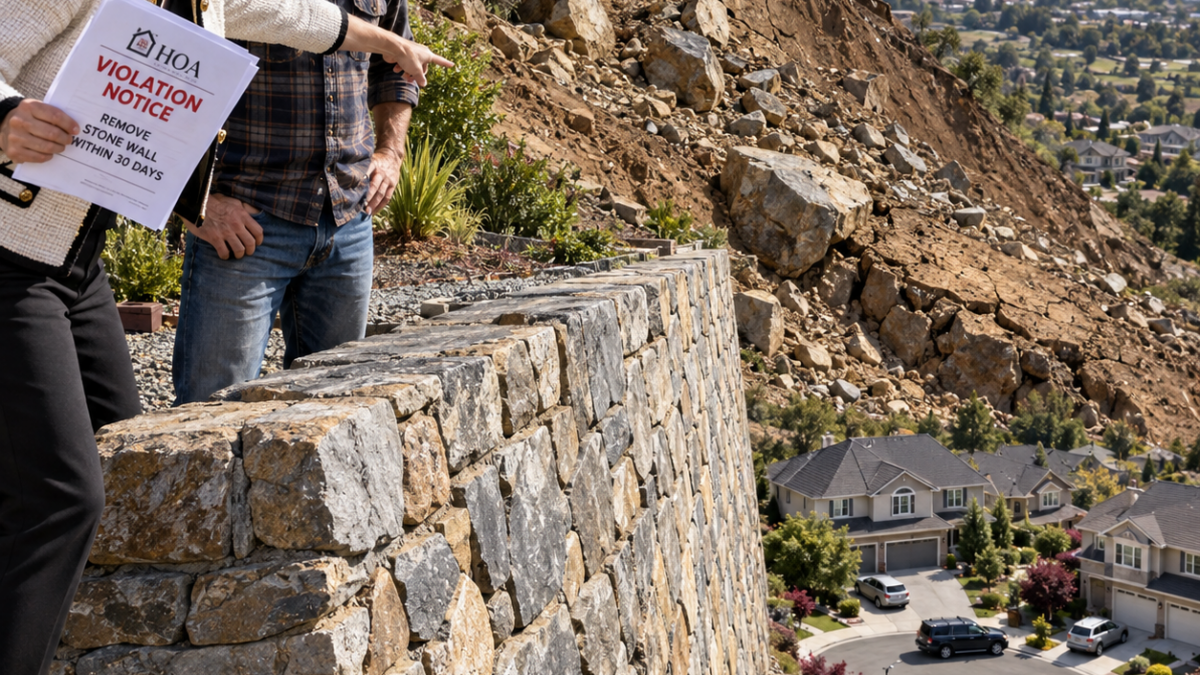
PART 2
The first thing I did was not call Karen.
That would have been useless.
People like Karen do not listen when the facts are inconvenient. They hear disagreement as disrespect and warnings as personal attacks. If I marched down to her beige palace at the end of Harmony Court and tried to explain soil mechanics over her decorative wreath, she would simply quote another subsection at me and shut the door feeling victorious.
So I did what the Army taught me to do.
I defined the mission.
Preserve the wall.
Document the risk.
Identify the enemy’s assumptions.
Build the record.
I sat at my grandfather’s oak desk, the same one where he used to pay farm bills in pencil, and opened a file on my computer. I named it Operation Keystone because that was exactly what the wall was. The piece that held everything else together.
My grandfather, Thomas Reid, had been a quiet man with hands like root knots and a back permanently bent from working land that had never once made his life easy. He built that wall in the early 1960s after a wet spring sent a slow mudslide into the lower field. It took out fencing, buried a shed, and nearly reached the county road. Most men would have patched the fence and cursed the hill.
Granddad studied it.
For weeks, he watched how the water moved. He dug test pits. He looked at where the shale broke under the clay. He talked to old quarry men and a retired highway engineer who drank coffee at the feed store. Then he and his brothers began hauling stone.
They built without mortar.
Dry-stack.
Gravity-based.
Wide at the bottom, slightly battered back into the slope, keyed into bedrock where they could reach it. Each stone chosen for weight, shape, and purpose. It looked rough to people who did not understand it, but it was one of the most intelligent things on the property.
It let water pass.
It held soil back.
It moved just enough not to fail.
For sixty years, that wall had done its job quietly.
Then a subdivision showed up beneath it and forgot to be grateful.
Harmony Ridge Estates had been built on the lower parcel my grandfather sold a decade before he died. He did not want to sell, but taxes, medical bills, and age have a way of prying land from even the most stubborn hands. The developer, Northstar Homes, had wanted the whole lower slope. Granddad refused until they signed a notarized condition stating that the stone retaining wall on his remaining property was a permanent fixture essential to hillside stability and would never be disturbed.
I found that agreement in his file cabinet, wrapped in a folder marked DO NOT THROW AWAY in his blocky handwriting.
The warning had been there from the beginning.
Northstar took the land, built the cul-de-sac, sold the houses, created the HOA, and disappeared into the corporate fog developers love so much. Years passed. People moved in. Lawns grew. Children learned to ride bikes in the circle below my pasture.
And the wall kept holding.
No one mentioned it.
No one inspected it.
No one thanked it.
Then Karen became president of Harmony Ridge Estates.
She had the kind of power people underestimate because it looks ridiculous from the outside. She was not a mayor. Not a judge. Not a sheriff. She was an HOA president with a clipboard, a binder, and an endless appetite for obedience. But in a small suburban kingdom, that was enough to make people nervous.
Within a year, residents learned to fear her white SUV crawling along the streets.
A porch light too warm.
A mailbox flag too faded.
Mulch that did not match the approved tone.
A basketball hoop visible from the road.
A bench painted the wrong shade of green.
Karen did not enforce rules.
She harvested compliance.
My wall, sitting above her perfect cul-de-sac like something from an older, wilder America, was always going to bother her. It had moss. It had asymmetry. It had history. It did not ask permission to exist.
That alone made it dangerous to her.
I drafted my first response that night. Polite. Professional. Cold.
I stated that the wall was a pre-existing structural retaining wall located entirely on my private property. I attached the original land-sale agreement and highlighted the clause protecting the wall. Then I added the part I knew mattered most.
This structure is not decorative. It is a critical retaining wall that provides geotechnical stability to the hillside above Harmony Ridge Estates. Any attempt to remove or alter it may create a significant risk of slope failure affecting the homes below.
I strongly recommend that the board consult a licensed geotechnical engineer before taking any action.
I sent the letter certified mail.
Karen signed for it herself.
A week later, she replied by email.
Mr. Reid,
The board is in receipt of your letter. The document you provided is not relevant to the current covenants governing properties within visual range of Harmony Ridge Estates. The architectural review committee has deemed the wall noncompliant. Your personal opinion regarding its alleged structural purpose does not supersede community standards.
Your fines will continue accruing.
A formal hearing has been scheduled.
Attendance is optional.
Decision will be binding.
I read it three times.
Then I printed it, three-hole punched it, and placed it in the binder.
That was the first moment I stopped thinking of Karen as merely arrogant.
She had been warned of a safety risk.
She had chosen to call it personal opinion.
That matters.
In engineering, ignorance can be corrected. Arrogance can be managed. But willful disregard is the thing that kills people.
I needed data she could not dismiss.
The next morning, I called Apex Geotechnical Services and spoke to a man named Arthur Vance.
Arthur sounded bored for the first ninety seconds. Then I described the wall.
“Twelve feet high in places?” he asked.
“Yes.”
“Dry stack?”
“Yes.”
“Built into a slope above active residences?”
“Yes.”
“And an HOA wants it demolished for aesthetics?”
“That’s right.”
There was a pause.
Then Arthur said, “I’ll come tomorrow.”
He arrived in an old truck with mud on the tires and a toolbox full of instruments that looked like they had seen actual fieldwork. He was tall, lean, sun-browned, and moved with the slow confidence of a man who trusted dirt more than people.
He walked the wall without speaking at first.
He tapped stones with a hammer.
Measured batter angle.
Checked the base.
Examined weep paths.
Took soil samples.
Studied the upper slope.
Looked down at the cul-de-sac where Karen’s neighborhood sat like a row of expensive ducks beneath a loaded shotgun.
After four hours, he stood beside me near the largest stone in the wall and shook his head.
“Your grandfather was not guessing.”
“I know.”
“No, Mr. Reid. I mean he really was not guessing. This wall is sophisticated. Base width, back lean, drainage gaps, stone selection. Whoever built this understood gravity better than most contractors I meet today.”
“That would have made him happy to hear.”
Arthur looked down the hill.
“The people below this wall should be sending flowers to his grave.”
“Instead, they want to demolish it.”
He gave a dry laugh.
“Then they’re fools.”
His written report came six days later.
Twenty pages.
Soil composition charts.
Slope stability calculations.
Drainage behavior.
Risk modeling under saturated conditions.
The conclusion was blunt enough for a child and terrifying enough for an insurance company.
The wall was the primary stabilizing structure preventing a significant slope failure. The hillside consisted of colluvium over weathered shale, a combination highly susceptible to movement when saturated. Removal or modification of the wall would likely trigger a landslide event affecting property and potentially life in Harmony Ridge Estates below.
The estimated cost of replacing the wall with a modern engineered retaining system?
High six figures.
Maybe more.
I printed ten copies.
Then I hired a surveyor.
The survey crew came out two days later and planted bright orange stakes along the property line. Every marker confirmed what my grandfather’s documents already showed. The wall sat entirely on my land, at least five feet inside my boundary at its closest point.
I photographed everything.
The stakes.
The wall.
The cul-de-sac below.
The distance.
The slope.
The homes.
The binder grew thick.
When the HOA hearing arrived, I walked into the community center carrying it under one arm.
The room smelled like stale coffee, floor polish, and suburban resentment. Karen sat at the head of a folding table with her board beside her: two nodding men I had already seen at the fence, and a sour-faced treasurer named Linda who looked like joy had once insulted her personally.
A dozen residents sat in folding chairs.
Most looked bored.
A few looked curious.
Karen smiled when my case was called.
“Mr. Reid,” she said, “you may present your appeal.”
Appeal.
As if I were asking permission to keep gravity functioning.
I stood before them and handed each board member a packet.
Inside were the land-sale agreement, the fresh survey, photographs of the property markers, and Arthur Vance’s geotechnical report.
“My position is straightforward,” I said. “The wall is on my private property. It predates the HOA by decades. Its protection was a condition of the original land sale. And according to a licensed geotechnical engineer, removing it would create a serious risk of catastrophic slope failure affecting the homes below.”
The two men opened their packets.
Linda squinted at the report.
Karen did not look at hers.
She pushed it aside with two fingers like it was junk mail.
“Mr. Reid,” she said, “we appreciate the effort you put into your little homework project.”
A few people in the audience shifted.
I stayed still.
“But this board is not here to debate your personal theories. We are here to enforce the covenants. The wall is visible from Harmony Court, is aesthetically inconsistent with the community, and has been deemed a blight by the architectural review committee.”
“It is not a theory,” I said. “It is an engineering report.”
“We are not engineers.”
“That is exactly why you should listen to one.”
Karen’s smile vanished.
“The board does not respond to intimidation.”
“A landslide is not intimidation. It is physics.”
That earned a nervous laugh from somewhere behind me.
Karen’s eyes flashed.
She hated being laughed at more than she hated being wrong.
“We have a motion to uphold the violation,” she said sharply. “All in favor?”
Four hands went up.
Just like that.
They had not read the report.
They had not questioned Arthur.
They had not reviewed the deed.
They had been handed a warning that their own homes could be in danger, and they voted as if choosing table linens.
“The motion carries,” Karen said. “Your fines now stand at thirty-four hundred dollars. You have until the deadline to comply.”
I gathered my binder slowly.
Then I turned toward the audience.
“For the record,” I said loud enough for every person to hear, “the board has been formally presented with a licensed engineer’s report warning of catastrophic risk to homes below the wall, and the board has chosen to ignore it.”
Karen banged her gavel.
“This case is closed.”
No.
It had just opened.
My next step was finding allies.
I started with the people who lived closest to danger.
The first was George Henderson, whose house sat at the end of the cul-de-sac nearest the base of my hill. He was in his late seventies, with silver hair, sharp eyes, and a classic Ford Mustang in his garage polished so brightly you could read regret in its reflection.
I introduced myself and explained why I had come.
When I finished, he wiped wax from his hands and sighed.
“Son,” he said, “let me tell you about Karen.”
Then he told me.
Last spring, he and his wife had repainted their house an HOA-approved eggshell. They submitted the sample. Karen approved it. The crew painted the whole place. Two days later, Karen cited them because the color looked half a shade too bright in afternoon sun.
“She made us repaint the whole house,” George said.
“You’re serious.”
“Four thousand dollars the first time. Four thousand again. She said if we didn’t comply, the fines would stack daily.”
“Why didn’t the board stop her?”
George gave me a tired look.
“The board is Karen wearing different shoes.”
He signed an affidavit that day.
Then he gave me names.
The Miller family had been fined into financial exhaustion over a permanent basketball hoop built for their son, a cancer survivor rebuilding his strength. The Lees had been forced to tear down a treehouse. Mrs. Alvarez had been harassed over a vegetable garden. Another family had been cited for leaving chalk drawings visible on the driveway.
The pattern was familiar.
Karen isolated people.
Made them feel unreasonable.
Threatened liens.
Threatened attorney fees.
Threatened public shame.
Most paid and moved on.
Not because Karen was right.
Because peace was expensive, and she knew exactly how much people would pay for it.
I tracked down the Millers in the next town over. They were no longer in Harmony Ridge because Harmony Ridge had priced them out through fear. Their son was healthy now, taller than his father, but Mrs. Miller still cried when she talked about the hoop.
“He had just finished chemo,” she said. “His friends built it for him because basketball was the first thing he wanted to try again. Karen said it was visually incompatible with community character.”
She gave me every notice.
Every invoice.
Every fine.
Every letter.
The binder became three binders.
Then I went to town hall.
That was where the fight changed from HOA stupidity to something much darker.
For two days, I pulled planning records, zoning minutes, old developer submissions, variance applications, and archived geotechnical documents from when Harmony Ridge was built. In a dusty file box labeled NORTHSTAR HOMES PRELIMINARY REVIEW, I found the original slope report.
It said the same thing Arthur Vance said.
Unstable hillside.
Saturated clay over shale.
High risk of slope movement.
Recommended no homes be built within a two-hundred-foot setback unless a substantial engineered retaining system was installed.
Yet Harmony Court sat directly inside that zone.
How?
The planning board minutes answered that.
Northstar’s representative had told the town that the existing stone wall on the upper property, owned by my grandfather, was substantial, permanent, and sufficient to stabilize the hillside. They claimed they had a private agreement ensuring the wall would remain undisturbed.
They used my grandfather’s wall to get approval.
Then they created HOA documents that forgot the wall existed.
Or pretended to.
I sat in the records office staring at the copy machine while anger turned cold in my chest.
This was bigger than Karen’s taste.
The homes below that wall had been sold under a system that depended on the wall while failing to educate the HOA responsible for living beneath it. Karen was not just threatening my property. She was threatening the safety of people who had no idea their cul-de-sac existed because my grandfather’s stones held back the hill.
I needed a lawyer.
A real one.
A friend from my old unit recommended Frank Miller, a retired Marine JAG officer with a small office, a sharp mind, and the kind of posture that made chairs look unnecessary. He listened to the story without interrupting. I laid out the deed, survey, Arthur’s report, the developer records, the planning minutes, the affidavits from George and the Millers, and Karen’s email dismissing my warning.
When I finished, Frank leaned back and smiled.
Not a happy smile.
A predator’s smile.
“Jack,” he said, “this is not an HOA dispute. This is gross negligence, slander of title if they touch your deed, breach of fiduciary duty, and potentially reckless endangerment.”
“That bad?”
“For them? Worse.”
His first letter went out the next day.
Cease and desist.
Remove all fines.
Withdraw the violation.
Preserve all records.
Notify insurance.
Do not approach or alter the wall.
He named the HOA.
He named Karen.
He named the board members individually.
“Amateur tyrants love power,” Frank said. “They love it less when their personal assets are on the table.”
Karen responded by placing a lien on my property for the fines, interest, and attorney fees.
Frank laughed when I called him.
“She did it.”
“That sounds bad.”
“It is. For her.”
The lien gave us the legal opening to file suit and demand discovery. Emails. Board minutes. Insurance communications. Financial records. Contractor bids. Everything Karen thought was hidden inside her little kingdom.
The emails were a gold mine.
Karen called me a stubborn redneck.
She called George a bitter old man.
She referred to the Millers as “financially unstable people trying to weaponize sympathy.”
She told the board my engineer’s report was “dramatic nonsense” and said the wall was “just rocks stacked by some farmer who probably never pulled a permit.”
That farmer was my grandfather.
I printed that email and stared at it for a long time.
Then I put it in the binder.
Frank deposed Linda, the treasurer.
Under oath, she admitted the board received Arthur’s report.
She admitted she had not read it fully.
She admitted no independent engineer had been hired.
She admitted the HOA’s insurer had not been notified.
“Why not?” Frank asked.
Linda shifted in her chair.
“Karen said it was a scare tactic.”
“So you relied on the opinion of a board president with no engineering qualifications over a licensed geotechnical engineer warning of potential catastrophic slope failure?”
Linda looked down.
“Yes.”
Frank let the silence sit.
That silence was worth more than any speech.
Then the rain came.
For seven straight days, the storm parked over the ridge and poured water into the mountain. The pasture turned soft. The creek at the bottom of my land turned brown and violent. Water seeped from places on the hill that had been dry my entire life.
I walked the wall three times a day in old rain gear.
The wall held.
But the hill was talking.
A large oak above the wall had begun to lean. Not much. Enough. The soil at its base bulged outward in a crescent. Fresh cracks appeared in the ground above the slope. Muddy water leaked through the wall’s drainage gaps in steady veins.
Arthur came out in the rain, looked at the hillside, and stopped smiling.
“This is active creep,” he said.
“How bad?”
“If the wall holds, manageable. If anyone touches it, catastrophic.”
I sent one final warning to the HOA, Karen, the board, Frank, and the HOA attorney. I attached timestamped photos and Arthur’s urgent note.
The slope is under acute stress. Residents in the cul-de-sac should be warned. No person or contractor should approach, modify, dismantle, or disturb the wall under current conditions.
Karen’s response came three hours later as a community-wide email.
Dear residents,
It has come to the board’s attention that a disgruntled landowner adjacent to our community is attempting to create unnecessary panic during current weather conditions. Please be assured that there is no cause for alarm. The board is handling the matter. Harmony Ridge remains a safe and beautiful place to live.
She had done it.
She had not only ignored the danger.
She had told people not to worry.
Frank’s reply to me was three words.
See you tomorrow.
The annual HOA meeting was the next night.
The rain was still hammering the roof when I walked into the community center with Frank beside me. The room was packed. People were nervous, annoyed, damp, and curious. Karen sat at the front beaming like the full room proved her importance.
She handled the usual business first.
Treasurer’s report.
Landscaping budget.
Pool furniture.
Then she cleared her throat.
“We must address the ongoing compliance issue with the property at 1120 Old Mill Road.”
Every head turned toward me.
Karen smiled.
“As many of you know, Mr. Reid has refused to remove an unsightly wall visible from Harmony Court. He has responded with legal threats and inflammatory scare tactics. Tonight, the board seeks community authorization to hire a contractor to remove the structure and assess all costs against Mr. Reid’s property.”
She wanted them to vote for their own disaster.
Then she gestured toward me.
“In fairness, we will allow Mr. Reid a few minutes to speak.”
I stood.
“Thank you.”
I connected my laptop to the projector.
The first slide was the survey.
“This wall is not in HOA jurisdiction. It is on my private property.”
Murmurs.
The second slide was the original developer report.
“This report existed before your houses were built. It warned that homes should not be placed within the slope hazard zone unless a major retaining system was present.”
The room quieted.
The third slide was the planning board minutes.
“Northstar Homes received approval by telling the town my grandfather’s wall would stabilize the slope.”
A man in the third row whispered, “What?”
The fourth slide was Arthur’s modern report.
“This is from a licensed geotechnical engineer. I gave it to your board. It says removing the wall could result in catastrophic slope failure.”
Karen’s smile was gone.
The fifth slide showed the leaning oak, the bulging soil, and the muddy water seeping from the hill.
“These photos were taken in the last forty-eight hours.”
The room changed.
You can feel when curiosity becomes fear.
Then I showed Karen’s email.
No cause for alarm.
Baseless scare tactics.
Safe and beautiful place to live.
I let them read it.
Then I said, “Your president received expert warnings, ignored them, and reassured you anyway.”
The room erupted.
“Karen, is that true?”
“Did you read the report?”
“You said we were safe!”
“My kids sleep on that side of the house!”
Karen banged her gavel.
“This is a distortion! He is trying to avoid fines!”
Then a man near the front answered his phone.
His face went pale.
He stood.
“My wife says our back fence just disappeared,” he said. “There’s mud on our patio.”
The room froze.
The threat had stopped being theoretical.
At that exact moment, the back doors opened.
A man in a yellow rain slicker stepped inside with a uniformed police officer behind him.
“Mike Henderson,” he announced. “City chief building inspector.”
Karen looked like the floor had vanished beneath her.
The inspector walked to the front.
“We received an emergency complaint regarding geotechnical instability and potential board negligence. We have reviewed documentation provided to our office, including engineering reports and correspondence from the HOA board.”
He looked directly at Karen.
“Is it correct that you sent residents an email yesterday advising there was no cause for alarm?”
Karen opened her mouth.
Nothing came out.
The inspector continued.
“Effective immediately, the city is issuing a stop-work order on any activity involving the retaining wall on Mr. Reid’s property. Any attempt to alter, remove, demolish, or disturb that wall will result in enforcement action. Given current conditions, residents of Harmony Court should prepare for possible evacuation if slope movement continues.”
A woman began crying.
Someone shouted at Karen.
The police officer moved closer to the board table.
Frank leaned toward me and said quietly, “That’s checkmate.”
He was right.
Karen’s power died in that room.
Not dramatically, with one final speech, but visibly. You could watch the authority drain out of her as the people she had controlled realized she had risked their homes, maybe their lives, to win a fight over an old wall.
The city opened an investigation.
The HOA’s insurer sent a reservation of rights letter, warning that gross negligence might not be covered. The board members resigned within a week. Karen tried to fight, but without allies, insurance protection, or credibility, she was finished.
George Henderson led the recall petition.
The vote was nearly unanimous.
Karen was removed from office in the same community center where she had planned to humiliate me.
The lien on my property was withdrawn.
The fines were erased.
The HOA settled the lawsuit and paid my legal fees, Arthur’s expert fees, the survey costs, and damages for slander of title. They issued a public apology to me and to the residents of Harmony Ridge. More importantly, they agreed to fund annual inspections of the wall by Apex Geotechnical Services and created a dedicated reserve account for long-term slope safety.
My grandfather’s wall went from violation to vital infrastructure in one signed settlement.
Karen’s house went up for sale two weeks later.
She left without a farewell.
No clipboard.
No gavel.
No floral muumuu at the fence line.
Just a moving truck in the rain and a neighborhood that no longer looked away from her damage.
Months later, after the repairs to the lower yards were finished and the hillside dried out, I walked the fence line at sunset. The wall glowed gold in the last light. Moss softened the stones. Ferns moved in the breeze. Water trickled through the drainage gaps exactly as it was supposed to.
I rested my hand on one of the granite blocks my grandfather had set sixty years earlier.
It was cool, rough, and steady.
I thought about how easy it is for people like Karen to mistake old things for useless things. How quickly they dismiss anything that does not match their version of beauty. How dangerous it becomes when authority is held by someone who cares more about appearances than truth.
That wall was never just stones.
It was memory.
Labor.
Engineering.
Warning.
Protection.
My grandfather built it to hold back a hillside.
I fought to hold back something else.
Arrogance.
Negligence.
The kind of petty power that becomes deadly when nobody challenges it.
Harmony Ridge is calmer now. George runs the board with the enthusiasm of a man who never wanted the job, which makes him perfect for it. Meetings are short. Rules are clearer. Safety reports are read out loud. The wall is inspected every year, and the residents below it now understand exactly what stands between their homes and the hill.
Some even wave when I walk the pasture.
I wave back.
I did not set out to save their cul-de-sac.
I set out to protect my grandfather’s wall.
But sometimes defending the truth does more than protect what belongs to you.
Sometimes it protects people who did not know they were in danger.
And sometimes the thing a Karen calls an eyesore turns out to be the only reason her perfect little world is still standing.
The strange thing about winning a fight like that is how quiet the days feel afterward.
For months, my life had been measured in certified letters, engineering reports, legal deadlines, rainfall totals, and the slow, sick pressure of knowing that a woman with too much power and too little humility was trying to destroy the one structure keeping an entire street safe. Then, almost overnight, Karen was gone. The lien was removed. The fines disappeared. The board changed hands. The annual inspection clause became official. The settlement checks were issued. The HOA mailed its apology in a stiff white envelope that probably cost them more pride than postage.
And still, every morning for weeks, I woke before sunrise and walked the wall.
Old habits do not vanish just because the paperwork says the danger is contained. I would pull on my boots, take a flashlight if the sky was still dark, and follow the fence line through the wet grass. The hill had dried, but I still watched for movement. New cracks. Settling stones. Fresh seepage. A root ball lifting. A bulge in the slope that had not been there the day before.
The wall held.
Every time.
It stood beneath the pasture like it had stood for sixty years, old and patient and unimpressed by human drama.
At first, the residents of Harmony Court avoided me.
Not rudely. More like people who had survived an accident they did not fully understand and did not know whether to thank the person who warned them or apologize for ignoring him. I would see curtains move when I walked the wall. A garage door would close too quickly. A man getting into his car would lift one hand halfway, then seem to think better of it.
I understood.
Fear makes people awkward.
Shame makes them worse.
They had believed Karen because believing Karen had been easy. She had a title, a gavel, a newsletter, and the confidence of a person who had never confused volume with truth. I was the man on the hill with the old wall and the binder. To them, at least at first, I had looked like the obstacle.
Then the rain came.
Then the ground moved.
Then the city inspector stood under fluorescent lights and told them Karen had concealed a safety risk.
After that, simple neighborhood conversations became difficult. What do you say to the man whose grandfather’s stones kept your living room from being full of mud? What do you say when you remember nodding along while your HOA president called him reckless, stubborn, and dangerous?
The first person to cross that silence was George Henderson.
He walked up my gravel drive one Saturday morning carrying a paper bag and wearing the expression of a man who had rehearsed something and already hated the sound of it. I was sharpening a chainsaw in the shed when he called my name.
“Jack?”
I set the file down.
“Morning, George.”
He looked past me toward the pasture.
“Wall still standing?”
“Better than most people.”
That almost got a smile out of him.
He held up the bag. “My wife made biscuits. She said if I came empty-handed, I shouldn’t come at all.”
“Smart woman.”
“The smartest.”
We sat on the tailgate of my truck, drinking coffee from a thermos while the sun climbed over the ridge. For a while, we talked about ordinary things. The storm damage. His Mustang. The price of gravel. How the county road crew had somehow made the potholes worse while pretending to fix them.
Then George went quiet.
“I owe you an apology,” he said.
I did not answer right away.
He stared down at his hands.
“I knew Karen was wrong about a lot of things. I knew she bullied people. I knew the board had become useless under her. But when it came to your wall, I didn’t want to think too hard about it. That wall is right behind my house, Jack. If I admitted you were right, then I had to admit my wife and I were living below a loaded gun.”
“That’s human,” I said.
“It’s cowardly.”
“Sometimes those are the same thing.”
He looked at me then, and for the first time since I had met him, the old man looked his age.
“My wife slept in the upstairs guest room for two weeks after that meeting. Wouldn’t sleep in the back bedroom. Said she could hear the hill breathing.”
I knew exactly what she meant.
Earth under pressure has a language. Most people never hear it until it is too late. The slow creep of saturated soil. The tick of a stone shifting against another stone. The trickle of water finding an easier path. The soft crack of roots pulling through clay.
“She wasn’t wrong to be scared,” I said.
“No. But she shouldn’t have had to find out like that.”
He looked toward Harmony Court, where the roofs sat clean and innocent below the slope.
“We all should have known. The developer should have told us. The HOA should have known. Karen should have told us the second you brought that report.”
“Yes.”
He exhaled slowly.
“I’m trying to fix what I can.”
That was true.
George had been elected interim HOA president mostly because nobody else wanted to touch the job after Karen poisoned it. His campaign speech had been twelve words: “I don’t want power, which is why you should trust me with it.”
That was enough.
Under George, the first real act of the new board was not about mailbox colors, holiday decorations, or mulch tone. It was an emergency safety audit. Apex Geotechnical Services inspected the wall, the hill, the cul-de-sac drainage, the stormwater channels, and the neglected ditch system Northstar Homes had installed badly and the HOA had ignored completely.
Arthur Vance led the inspection himself.
He showed up with two younger engineers, a drone, survey equipment, moisture probes, and the expression of a doctor examining a patient whose family had denied symptoms for years.
I walked with him along the wall while the HOA board followed behind like nervous students.
Arthur pointed out things I had seen but never fully named.
“The wall is doing its job,” he said, tapping one broad capstone with his boot, “but it has been carrying too much load because the subdivision drainage was never maintained correctly. Water from those streets should be routed away from the slope, not toward it.”
George looked sick.
“You’re saying we’ve been sending runoff toward the hill?”
“For years,” Arthur said.
Linda, the former treasurer, was already gone from the board by then, but I almost wished she had been there to hear it. Karen had wanted to demolish the wall because it looked damp and mossy, never understanding that her own neglected drainage system had been feeding the very conditions she complained about.
Arthur continued.
“You’ll need to clear and regrade the upper diversion swales, install additional collection drains behind the lower properties, and put monitoring pins in the wall and slope so movement can be measured over time.”
“How much?” George asked quietly.
Arthur did not soften it.
“Initial stabilization and drainage correction? Maybe eighty to one hundred twenty thousand. Annual monitoring after that is manageable. Ignoring it would cost millions if the slope failed.”
One of the new board members, a young woman named Elena who had replaced one of Karen’s nodding men, whispered, “We don’t have that kind of reserve.”
Arthur looked at her.
“Then create one.”
That sentence became the first honest budget conversation Harmony Ridge had ever had.
Karen had spent years obsessing over flowers at the entrance sign, seasonal banners, approved house colors, and decorative lighting around the clubhouse. She had funded appearances while ignoring infrastructure. The reserve account was thin. The drainage map was outdated. Maintenance records were incomplete. The wall, the most important safety feature affecting the entire cul-de-sac, had not appeared in a single annual budget.
Because Karen had not found it attractive.
At the first open budget meeting, the residents were furious.
Not at me anymore.
At the truth.
People shouted about special assessments. They wanted to know why they were paying now for failures that belonged to the developer, the old board, and Karen. They wanted to know why the previous budgets included thousands for “community beautification” but nothing for slope stability. They wanted to know whether they could sue Northstar Homes, even though the company had long since dissolved into a different name and a different liability shield.
Frank Miller attended that meeting at George’s request, not as my lawyer that night, but as a legal advisor hired by the new board.
He stood at the front with his arms folded while people vented.
Then he said, “You can be angry, and you should be. But anger doesn’t move water away from a slope.”
That quieted the room.
He continued.
“You have three separate issues. First, past negligence. Second, current safety. Third, long-term governance. Do not confuse them. You can investigate the first, but you must fund the second immediately, and you must reform the third permanently.”
A man in the second row snapped, “So we just pay?”
Frank looked at him.
“No. You survive first. Then you recover what you can.”
That was the adult answer.
No one liked it.
Everyone needed it.
By the end of the meeting, the HOA approved a temporary emergency assessment, a grant application to the county hazard mitigation program, and a reserve restructuring plan. Nobody clapped. Nobody smiled. But they voted for the work.
That was the difference between Karen’s reign and George’s leadership.
Karen demanded obedience for aesthetics.
George asked for sacrifice for safety.
One is tyranny.
The other is community.
The stabilization work began in late spring.
For three weeks, Harmony Ridge looked less like a gated residential dream and more like a construction zone. Crews cleared the clogged swales above the cul-de-sac. They pulled out years of leaves, silt, and roots from drainage channels that should have been maintained annually. They discovered one culvert completely blocked by mulch washed down from decorative beds Karen had insisted on installing near the entrance road.
Arthur was furious when he saw it.
“Who designed this?”
George looked embarrassed. “Karen’s beautification committee.”
Arthur stared at the clogged culvert, then up at the ornamental shrubs planted directly in the runoff path.
“Of course they did.”
The crews installed new drains, reinforced the lower swale, and placed survey monuments along the slope to monitor movement. On my side, with my permission and under a formal easement agreement drafted by Frank, Apex installed stainless monitoring pins in several points along the wall. Tiny, unobtrusive, precise. Every year, they would be measured for movement.
I signed the access agreement because it was the right thing to do, but I made sure it was clear.
The wall remained mine.
No HOA control.
No aesthetic authority.
No Karen clause hidden in legal language.
Frank reviewed every comma.
“Trust, but notarize,” he said.
That became something of a neighborhood joke.
George put it on a coffee mug and gave it to me.
I still have it.
During the work, I spent a lot of time outside, partly because crews were near my land and partly because I could not stay away. Watching modern machines work around my grandfather’s wall stirred something complicated in me. Pride, yes. Relief. But also a grief I had not expected.
My grandfather had built that wall because he understood the hill. Not because a code required it. Not because a board demanded it. Not because an engineer stamped it. He did it because he looked at the land, respected what it could do, and took responsibility for the people and things below it.
Standing there while men with drones, lasers, and moisture sensors confirmed what he had known with a shovel and his eyes made me miss him so sharply it almost embarrassed me.
One afternoon, Arthur found me sitting on a flat stone near the upper pasture, watching the crews.
“You okay?” he asked.
“Just thinking.”
“Dangerous habit.”
“My grandfather would have liked you.”
Arthur smiled slightly.
“He built better than most licensed people.”
“He had a sixth-grade education.”
“Education and intelligence are related, not identical.”
I looked at the wall.
“He never got to see anyone admit what he built mattered.”
Arthur was quiet for a moment.
“Maybe he didn’t need them to.”
That stayed with me.
Because maybe that was the difference between men like my grandfather and people like Karen. My grandfather built something useful and let it stand without applause. Karen tried to destroy something useful because it did not applaud her.
Near the end of the stabilization project, George organized a community meeting at the base of the cul-de-sac. Not in the community center this time. Outside, under the open sky, facing the wall.
I almost did not go.
Public attention made me uncomfortable. My part, as I saw it, was done. The wall was safe. The lawsuit was settled. The HOA had changed. Karen was gone. But George called me personally.
“You need to be there.”
“No, I don’t.”
“Yes, you do.”
“George, I’m not a resident.”
“No, Jack. You’re the reason we still have residences.”
That was unfair and effective.
So I went.
The evening was cool, and the ground still smelled faintly of turned soil from the drainage work. Folding chairs were arranged in a loose semicircle at the end of the cul-de-sac. Residents stood in small groups, talking quietly. The atmosphere was different from the old HOA meetings. Less polished. More human.
Arthur gave a brief explanation of the stabilization work. He used simple language, showing how water moved through the slope, how the wall relieved pressure, how the new drainage would reduce load. People listened closely, not because they enjoyed soil mechanics, but because they finally understood that ignoring boring things could become deadly.
Then George stood.
He held a folder, but he did not open it.
“For years,” he said, “this community concerned itself with the wrong things. We worried about shades of beige, porch decorations, mailbox flags, and whether a stone wall looked pretty from the street. We trusted people who sounded certain instead of people who brought evidence. We mistook control for competence.”
A few heads lowered.
George turned slightly toward the wall.
“That wall was here before our houses. It protected this land before most of us knew there was anything to be protected from. And when Mr. Reid warned us, we did not listen quickly enough.”
I looked at the grass.
He continued.
“We cannot undo that. But we can choose not to repeat it.”
Then he surprised me.
He pulled a small bronze plaque from the folder.
“We have voted to place this at the base of the public access point, not on Mr. Reid’s property, but where residents can see it.”
He read the inscription aloud.
THE REID STONE WALL
Built by Thomas Reid and family, 1962.
Recognized as critical hillside protection for Harmony Ridge Estates.
A reminder that safety, truth, and stewardship must come before appearance.
I could not look up for a few seconds.
When I finally did, the wall was blurry.
George walked over and handed me the plaque.
“We’d like your permission.”
“For the public side?”
“Yes. Not on your land. Not on your wall. Just where it belongs in our memory.”
I ran my thumb over my grandfather’s name.
He had spent his life avoiding attention. He would have grumbled about the plaque. Called it foolish. Said the wall did not need a nameplate to do its job.
But I think, privately, he would have kept a photo of it in his Bible.
“You have my permission,” I said.
The plaque went up the next week.
Small.
Tasteful.
Weatherproof.
Karen would have hated it.
That made several people like it more.
By summer, Harmony Ridge had become almost normal again, though not the same kind of normal. The old normal had been silence and compliance. The new normal was noisier, messier, and healthier.
People argued at meetings.
Respectfully, mostly.
They asked for documents.
They questioned budgets.
They demanded expert opinions before major decisions.
They voted down a proposed decorative fountain at the entrance because, as Elena put it, “We are not spending money on water that performs no drainage function.”
That line got applause.
George hated being president, which is why people kept reelecting him.
He made meetings short, published agendas early, and banned surprise enforcement actions. The architectural review committee was restored, but its authority was limited. No more one-person decisions. No fines without notice, evidence, and appeal. No liens without outside legal review and full board vote. No safety issue could be dismissed without an expert evaluation.
And there was one new rule everyone referred to unofficially as the Karen Rule.
Any board member who knowingly misrepresents a material safety concern to residents is subject to immediate removal.
It passed unanimously.
I heard about it from George.
“Congratulations,” he said. “You have a rule named after your enemy.”
“She must be thrilled.”
“She doesn’t live here anymore.”
That was true.
Karen’s old house sold in July to a family with three children, two dogs, and no visible interest in ruling anyone. The first week they moved in, one of the kids put a bright blue plastic slide in the front yard. Under Karen, it would have lasted six hours before a notice appeared.
Under George, it stayed there all summer.
I found myself watching it sometimes from the upper pasture. A ridiculous little blue slide, shining in the sun below a wall once declared an aesthetic violation. It became, in its own way, a symbol of victory.
Not my victory.
Theirs.
People were living again.
One evening, the youngest child from Karen’s old house wandered near the public edge of the drainage path with his father. I was on my side of the fence, clearing brush. The boy pointed at the stone wall.
“Dad, is that the wall?”
His father glanced up and saw me.
“I think so.”
The boy cupped his hands around his mouth.
“Thank you for saving our house!”
I froze.
His father looked embarrassed.
“Sorry,” he called. “He heard the story from George.”
I rested one hand on the fence rail.
“You’re welcome,” I said.
The boy waved with his whole arm.
Then he ran back toward the blue slide.
I stood there longer than I meant to.
Saving a house sounds heroic when a child says it. The truth felt more complicated. I had been angry. I had been stubborn. I had wanted to protect my grandfather’s work. I had wanted Karen stopped. If those motives also protected families below, I was grateful. But I did not want to turn myself into some kind of neighborhood savior.
I had known enough real heroes to be suspicious of that word.
That night, I went back through my grandfather’s old files.
I do that sometimes when I miss him.
Receipts from feed stores that closed decades ago. Pencil notes about fence repairs. Seed catalogs. A faded photograph of him and his brothers standing beside the unfinished wall in 1962, shirts soaked with sweat, faces serious, stones piled behind them like a second mountain they intended to rearrange by hand.
In the back of the folder marked DO NOT THROW AWAY, I found something I had missed before.
A single sheet of lined paper.
Granddad’s handwriting.
Not a formal document. More like a note to himself.
Wall built after spring slide. Lower hill unstable when soaked. Stone base set deep. Leave drainage open. Do not mortar. Water must pass. Tell whoever owns this after me: don’t let fools seal it, move it, or pretty it up. Hill doesn’t care what men prefer.
I sat at the desk and read that last line again.
Hill doesn’t care what men prefer.
I laughed then.
Not loudly.
Just enough.
That was my grandfather. Practical, blunt, and dead right.
The next day, I made a copy of that note and gave it to Arthur.
He read it twice, then said, “I want this framed in my office.”
I gave a copy to George too.
He asked permission to read it at the next meeting.
I hesitated, then said yes.
When George read that line aloud—Hill doesn’t care what men prefer—the room was silent for a moment.
Then someone said, “That should be on the entrance sign.”
It did not go on the entrance sign.
But it did go at the bottom of the annual safety report.
That might have pleased Granddad more.
The legal aftermath with Karen stretched quietly into autumn.
Most people thought the story ended when she sold her house and left, but consequences have long shadows. Frank kept me informed only when necessary, because I told him I did not want to turn my life into a permanent courtroom. Karen had attempted to deny personal responsibility for part of the settlement, claiming she had acted in good faith as HOA president. The emails destroyed that argument.
Her own words followed her.
Stubborn redneck.
Scare tactic.
Just rocks.
No cause for alarm.
Frank said her attorney stopped trying to defend the statements and focused on limiting financial damage. There were rumors she had tried to blame the old board, then the developer, then the residents for “pressuring” her to maintain high standards. None of it worked well. Her title had once protected her. Now it trapped her. Every letter she signed as president became evidence that she was acting with authority; every reckless decision she made outside professional advice became evidence that she abused it.
I did not attend her final settlement conference.
Frank handled it.
When he called afterward, his voice was satisfied but not gleeful.
“It’s done.”
“How done?”
“She signed. Personal contribution. Confidential amount, but enough to hurt. Permanent non-disparagement clause. No future claims against you related to the wall. No contact.”
“Good.”
“There’s more.”
I waited.
“She has to send a correction letter to the state HOA oversight office withdrawing her complaint against you.”
I had almost forgotten that part. During the height of the fight, Karen had filed a complaint accusing me of harassment, unsafe property conditions, and malicious interference with community governance.
“What does the correction say?”
“That her prior complaint was based on incomplete and inaccurate information.”
“That sounds like lawyer language for ‘I lied.’”
“It is.”
I looked out the window at the pasture.
“Send me a copy when you can.”
“I already did.”
The letter arrived by email five minutes later.
I printed it and placed it in the binder.
Then, after a long pause, I closed the binder and carried it to the shelf in my study.
Operation Keystone was over.
Not forgotten.
Just over.
There is a difference between keeping records and living inside them. For months, those binders had sat on my desk like ammunition. Every tab, every highlighted paragraph, every photograph had been part of the fight. But once the fight ended, leaving them there felt like letting Karen keep a chair in my house.
So I shelved them.
My grandfather’s note stayed on the desk.
That deserved the space.
Winter came early that year.
The first frost silvered the pasture grass and made the stone wall look older than memory. Without leaves, you could see the whole line of it from the upper field, curving slightly with the contour of the hill, dark stones locked together under a pale sky.
Harmony Ridge quieted down. Kids went back to school. Lawn crews came less often. The blue slide disappeared into a garage for the season. George sent out the most boring HOA newsletter I had ever read.
Drainage work completed.
Reserve account funded.
Annual wall inspection scheduled for April.
Holiday decoration guidelines simplified.
No enforcement notices issued this quarter.
I read that last line twice.
No enforcement notices issued this quarter.
For Karen, that would have been failure.
For George, it was proof of health.
On Thanksgiving morning, I found a basket on my porch.
No note on the outside.
Inside were small envelopes, maybe twenty of them, tied with string. I opened the first.
Thank you for fighting when we didn’t understand.
The second.
My son sleeps in the back bedroom again.
The third.
I’m sorry I believed Karen.
The fourth.
Your grandfather built more than a wall.
I sat on the porch steps in the cold and read every one.
Some were signed.
Some were not.
George later admitted the basket had been Elena’s idea. She thought the residents owed me something more personal than an official letter drafted by counsel. She was right, though I would never have asked for it.
One note stayed with me most.
It was from Mrs. Henderson.
George’s wife.
Mr. Reid,
For weeks after that storm, I was afraid of the hill. Then I realized I had been afraid of the wrong thing. The hill was only doing what hills do. The real danger was people who refused to listen. Thank you for listening when no one else would.
I folded that note carefully and placed it with my grandfather’s.
Not in the legal binder.
In the desk drawer where I kept things that mattered.
Spring returned slowly.
The first annual inspection happened on a clear April morning. Arthur came back with his crew, checked every monitoring pin, reviewed moisture readings, inspected drainage channels, and walked the wall end to end.
George, Elena, and half the cul-de-sac showed up. Not because they understood all the measurements, but because they understood the importance of paying attention.
Arthur finished his review and gave the unofficial summary.
“No significant movement. Drainage improvements are working. Wall remains stable.”
People actually applauded.
Arthur looked deeply uncomfortable.
I loved it.
Afterward, George invited everyone to a neighborhood picnic at the cul-de-sac. I almost made an excuse, but Elena intercepted me.
“No disappearing, Jack.”
“I have work.”
“You always have work.”
“That’s how farms function.”
“It’s burgers and potato salad. The hill can spare you for an hour.”
So I went.
The picnic was informal and slightly chaotic, which made it better than anything Karen had ever organized. Children ran in loops around lawn chairs. Someone’s dog stole a hamburger bun. George burned the first round of burgers and insisted they were “smoke enhanced.” Mrs. Alvarez, who had moved to Harmony Ridge from another HOA and immediately joined the reform committee out of what she called “civic spite,” brought three trays of food and scolded everyone into eating.
For the first time, I stood among the people below my hill and did not feel like an outsider.
That was unexpected.
I had inherited land, not neighbors. For years after leaving the Army, solitude had suited me. The pasture did not ask questions. The trees did not need explanations. The wall did not require small talk. But community, real community, is not the same thing as noise. Sometimes it is simply people knowing the truth about one another and choosing to stand nearby anyway.
During the picnic, a man named Aaron approached me. He was the accountant whose wife had called during the meeting when mud hit their patio.
“I never thanked you,” he said.
“You don’t have to.”
“I do.”
He looked up at the slope.
“When Karen sent that email saying there was no danger, I forwarded it to my wife and told her not to worry. I told her the board had it handled.”
His jaw tightened.
“Then twenty-four hours later, mud came through our fence.”
I said nothing.
He needed to finish.
“If that wall had failed, she might have been home alone with our daughter.”
“I’m glad it didn’t.”
“So am I. But I keep thinking about how easily I believed the person with the title.”
“That’s how titles work.”
“Not anymore.”
He extended his hand.
I shook it.
That was enough.
Later, when the sun started lowering behind the ridge, George stood on a patio chair with a paper cup in his hand.
“Don’t fall,” someone shouted.
“If I fall, I’m suing the HOA,” George said.
People laughed.
He raised his cup.
“To boring meetings, working drainage, and old walls that know better than us.”
Everyone lifted a cup.
I did too.
That night, I walked home through the pasture instead of taking the road. The sky was turning purple, and the wall held the last warmth of the day. Down below, the cul-de-sac lights flickered on one by one.
For the first time, they did not look like an intrusion.
They looked like lives.
Messy, fragile, ordinary lives sitting under a hill that had no malice but no mercy either.
My grandfather understood that. He did not build the wall because he hated the land. He built it because he respected it.
That is what Karen never understood.
Respect is not the same as control.
Control says, “Make this look the way I prefer.”
Respect says, “Tell me what this is, and I will act accordingly.”
The hill had told its story for decades in water, shale, mud, and pressure. Granddad listened. Northstar exploited it. Karen ignored it. The new Harmony Ridge, finally, had learned to hear it.
In early summer, I installed a small bench near the upper pasture, on my side of the fence, where I could sit and look down the length of the wall. It was not fancy. Cedar planks. Iron brackets. Solid enough to outlast me if the weather was kind.
I sat there often in the evenings.
Sometimes George would walk up from the public path and stand at the fence.
He never crossed without asking.
I appreciated that more than he knew.
One evening, he came carrying two bottles of root beer.
“Thought you might be out here,” he said.
“You spying on me now?”
“HOA presidents have eyes everywhere.”
I gave him a look.
He held up both hands.
“Too soon?”
“Always.”
He laughed and passed one bottle over the fence.
We drank in silence for a while.
Then George said, “I heard from Karen.”
I turned.
“Why?”
“She sent a letter to the board.”
“What did she want?”
“To complain about the plaque.”
I stared at him.
George nodded solemnly.
“She said it creates a hostile implication that her leadership was unsafe.”
For a moment, neither of us spoke.
Then I started laughing.
Not a polite laugh. Not a controlled laugh. The kind that comes from somewhere deep and tired and finally free.
George joined in.
We stood there laughing like fools over root beer while the wall watched us both.
“What did you tell her?” I asked when I could breathe again.
“Nothing. Elena drafted the response.”
“That sounds dangerous.”
“It was one sentence.”
“What did it say?”
George smiled.
“The board considers this matter closed.”
Perfect.
Absolutely perfect.
And that was the last I ever heard of Karen Jensen.
Not because she stopped being herself. I doubt that. People like Karen carry their own weather. But she no longer mattered here. Her complaints had no teeth. Her opinions had no office. Her need for control had no audience.
Harmony Ridge had learned the most important lesson any community can learn.
Never give unchecked power to someone who enjoys using it.
Years will pass, and the details will soften. New families will move in. Children who watched the mudslide scare from upstairs windows will grow up and leave. George will eventually hand the board to someone younger. The plaque will weather. The annual inspection reports will become routine. People will stop thinking of the wall as dramatic and start thinking of it as normal.
That is good.
Safety should become boring.
Truth should become ordinary.
A wall should not need a war to be respected.
But I hope one part of the story stays sharp.
I hope when some future board member gets a little too excited with power, someone remembers Karen. I hope when a resident brings evidence that complicates a convenient decision, someone reads it before voting. I hope when the hill weeps after rain, somebody walks outside and looks, not because they are afraid, but because they understand stewardship.
As for me, I still walk the wall.
Not every morning anymore.
Most mornings are just coffee, chores, fence checks, and whatever repairs old land demands. But after heavy rain, I go. I follow the stones from end to end, brushing away leaves, checking drainage gaps, watching how water moves. Sometimes I talk to my grandfather under my breath.
“Still holding, old man.”
And it is.
So far, it always is.
One evening, long after the lawsuit, after the settlement, after the plaque and the picnic and the first clean inspection, I stood with my hand on the largest stone in the wall. The same stone my grandfather had set at the center point. It was massive, too large for one man, maybe too large for three, but somehow he and his brothers had moved it into place.
I pressed my palm against it and felt the coolness stored inside.
Below, Harmony Ridge was quiet.
A child laughed somewhere near Karen’s old house.
A dog barked once.
Someone started a lawn mower, then shut it off almost immediately, probably realizing it was too late in the evening.
The world felt ordinary.
That was the victory.
Not Karen leaving.
Not the apology letter.
Not the settlement.
Not even the plaque with my grandfather’s name.
The victory was ordinary life continuing because the thing that needed to hold had held.
I thought then about what my grandfather wrote.
Hill doesn’t care what men prefer.
He was right.
The hill did not care about covenants, paint colors, egos, emails, liens, board votes, or floral muumuus. It cared about water, weight, angle, friction, stone, and time.
Facts do not become less true because arrogant people dislike them.
Warnings do not become threats because cowards refuse to hear them.
And old things do not become useless just because someone with a clipboard fails to understand why they were built.
Karen looked at my grandfather’s wall and saw an eyesore.
The developer looked at it and saw a shortcut to approval.
The old board looked at it and saw someone else’s problem.
But the wall never changed.
It remained what it had always been.
A promise in stone.
A quiet act of protection.
A line between safety and disaster.
And when the rain came, when arrogance failed, when paperwork burned away and everyone finally looked at the hill itself, the wall gave them the only answer that mattered.
It held.








