PART 2: HOA Official Wore My Dead Aunt’s Apron and Called 911 on Me in My Own House—Then I Saw the 13-Day Deadline Hidden on Her Table
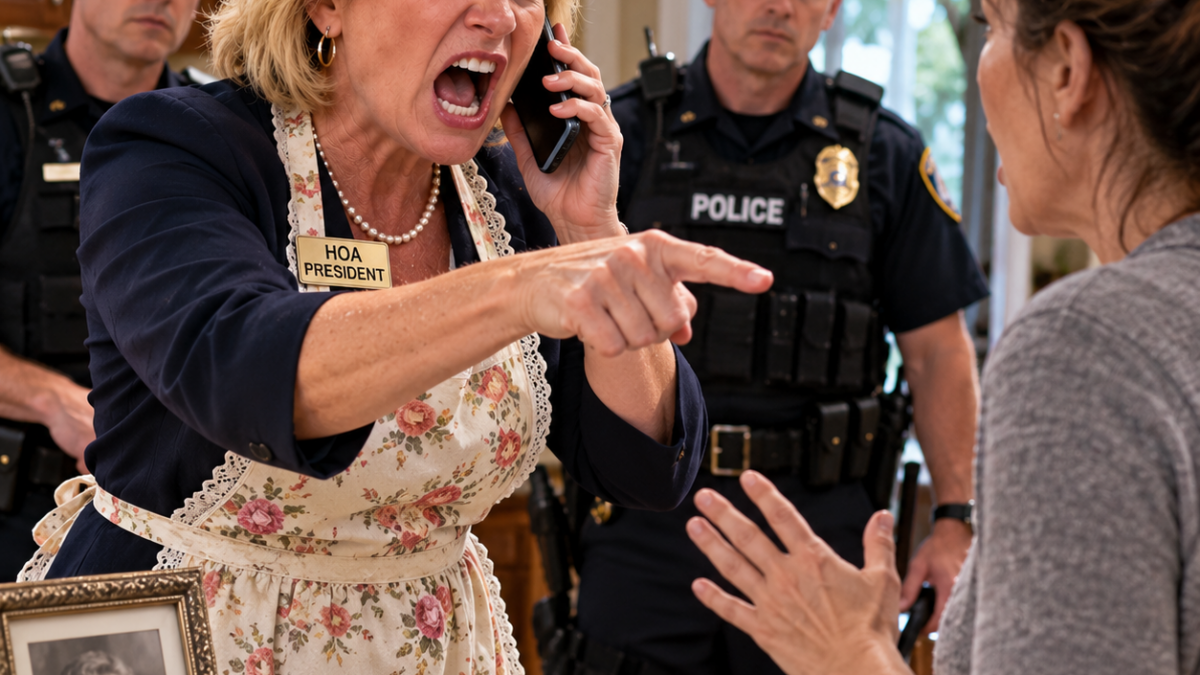
PART 2
Not because Dana had authority.
Because she had already told 911 she didn’t know whether I was armed.
I’d spent twenty-four fire seasons working structure protection across the West.
Most of my job wasn’t heroic.
It was thinking about what could go wrong before it went wrong.
Bad access.
Bad assumptions.
People panicking.
A truck parked where an engine needed to turn.
Fear entering a scene before facts.
I knew better than to give an armed deputy arriving at a property dispute one extra uncertainty.
Dana removed Ruth’s apron before the sheriff’s vehicle reached the driveway.
That detail stayed with me.
One minute she was standing in my kitchen dressed like she lived there.
Seven minutes later, when Deputy Ben Alvarez pulled in, Dana was wearing a scarlet blazer over a white blouse.
The apron was gone.
So was the coffee mug she had been holding.
The performance had changed.
Ben was in his early fifties, compact, gray beginning at his temples, and careful in the way experienced deputies become careful when both parties insist the law is obvious.
Dana met him before I could.
“Deputy, thank you. I was conducting an authorized property inspection when this man forced entry.”
“I used my key.”
Ben looked at me.
“Until?”
“Until I discovered someone changed the deadbolt.”
Dana folded her arms.
“He was informed this property was under temporary association care.”
“No, I wasn’t.”
Ben raised one hand.
“One at a time.”
He asked for my identification.
I gave it to him.
Then I pulled up the county parcel record on my phone.
Ben studied the address.
Looked at the lodge.
Looked back at me.
Dana opened her binder.
“I have documentation.”
She produced a notarized page.
The heading read:
**TEMPORARY PROPERTY CARE AUTHORIZATION**
It gave Red Willow Shores HOA the right to enter, secure, inspect, maintain, and temporarily manage Red Willow Lodge during my seasonal absence.
At the bottom was my signature.
Not something similar.
Mine.
Ben looked at the paper.
Then at my driver’s license.
“Did you sign this electronically on April twenty-second?”
“No.”
Dana exhaled sharply.
“The association received it through the county wildfire compliance portal.”
That sentence caught my attention.
In April, before leaving for New Mexico, I had filed a defensible-space acknowledgment with the county.
It contained my electronic signature.
I looked more closely at Dana’s document.
The signature wasn’t just similar.
It was the exact image.
Same angle.
Same spacing.
Same small break in the upper stroke of the K.
Someone hadn’t forged my name with a pen.
They had harvested my real signature from a government form.
Ben called dispatch.
The deed was easy.
Ownership wasn’t disputed.
My name was on the property.
My taxes were current.
But the fake authorization created a different problem.
Dana claimed she had current authority.
I claimed the document was fabricated.
A deputy standing on my porch wasn’t going to perform a forensic document examination.
And Ben didn’t pretend he could.
He separated us.
Photographed the documents.
Took statements.
Then looked at Dana.
“You’re leaving.”
Her composure shifted.
“The association has contractors scheduled.”
“Cancel them.”
“You don’t understand the deadline.”
Ben pointed toward her Lexus.
“You can explain it through counsel.”
Dana shut the binder.
When she passed me, she lowered her voice.
“Thirteen days, Mr. Kincaid.”
I looked at her.
“Thirteen days until what?”
Her face went flat.
“After that, this becomes much more expensive for everyone.”
Then she drove away.
Inside, the lodge felt wrong.
Not burglarized.
Converted.
New towels hung in the bathroom.
A printer sat on Ruth’s roll-top desk.
There were legal pads beside the telephone.
Someone had replaced the old entry mat.
My family photographs had been removed from the mantle and stacked face down in a cardboard box.
Nothing was broken.
That made it worse.
Dana hadn’t come to destroy the lodge.
She had come to erase who it belonged to.
The site plan was gone.
But one page remained under the dining table.
I picked it up.
It showed my lodge.
The western shoreline.
The HOA common parcel to the north.
And a thick red boundary wrapped around everything under one title:
**RED WILLOW RESERVE — PHASE ONE**
At the bottom:
**SLOAN MOUNTAIN DEVELOPMENT**
I knew the name.
Graham Sloan had built several luxury communities around Jackson.
He had also been attached to a resort project outside Bozeman that collapsed after financing problems.
For more than a year, people around Red Willow Lake had whispered that he wanted the western shoreline.
Ruth had refused to meet with him twice before she died.
I went to the cabinet where she kept property records.
Deed.
Tax receipts.
Forestry plan.
Old surveys.
All there.
Except one folder.
Thick green binder.
Handwritten label:
**NORTH MEADOW LEASE**
Missing.
That worried me more than the fake authorization.
The next morning I drove forty miles to see Elena Park.
Elena was a land-use attorney who had represented Ruth in her final years.
She read Dana’s authorization.
Then I placed my April wildfire acknowledgment beside it.
Elena leaned closer.
“Same signature.”
“I know.”
“No, I mean literally.”
She pointed.
“See that pixel break above the K?”
“Yes.”
“Same file artifact.”
“So they copied it.”
“Almost certainly.”
“Can we prove who?”
“We can prove source. Attribution will take records.”
I showed her the partial site plan.
Her eyes stopped on the north meadow.
“When does the HOA lease expire?”
“Ruth said sometime this fall.”
Elena opened an archived scan.
“Seventeen days.”
I stared at her.
“Seventeen?”
“From today.”
The lease dated back to 1996.
Ruth and my grandfather had leased thirty-four acres to the newly formed Red Willow Shores Association.
The deal was generous.
The HOA could operate the clubhouse.
Boat launch.
Tennis courts.
Walking paths.
Seasonal fire lane.
Rent was modest.
Ruth wanted families to have access to the lake without turning the shoreline into a commercial strip.
But the lease was specific.
No hotel.
No public marina.
No transfer to a developer.
No mortgage or security interest against the land without the Kincaid family’s written consent.
When the lease expired, permanent improvements remained on the land unless both sides executed a new agreement.
I looked at Elena.
“People think the HOA owns that clubhouse.”
“They own the use rights under the lease. They do not own the ground.”
“What about the houses?”
“Completely separate parcels. Not yours.”
She tapped the map.
“This is important. Do not let anger turn this into something larger than it is.”
I appreciated that.
Some lawyers tell angry clients exactly what they want to hear.
Elena did the opposite.
She reduced everything to the smallest provable fact.
The homes weren’t mine.
Their streets weren’t mine.
Their private lots weren’t mine.
But the thirty-four-acre common parcel was.
Then Elena showed me another section.
The HOA had an option to buy that common parcel at fair market value.
I sat forward.
“They can buy it?”
“Only if they satisfied four conditions throughout the lease.”
She counted them.
“Maintain the shoreline buffer.”
“Keep the seasonal fire lane clear.”
“Operate and maintain the dry hydrant and pump system.”
“Provide annual maintenance reports to the Kincaid family.”
“Did they?”
I thought about it.
“Not since Ruth died.”
“Did you request them?”
“Twice.”
“What happened?”
“Dana said they were internal HOA material.”
Elena leaned back.
“Then we verify.”
“You think the purchase option is dead?”
“I think we prove whether it is. If they complied, they may have rights. If they didn’t, the lease expires without the option.”
I nodded slowly.
“You don’t sound very excited.”
“I’m your lawyer. Excitement is expensive.”
That was why I trusted her.
She sent preservation notices to Red Willow Shores HOA, Dana Voss, Sloan Mountain Development, and the county portal administrator.
She disputed the property-care authorization formally.
She warned that nobody had permission to reenter the lodge.
At noon, a courier delivered an HOA violation packet.
I almost admired the nerve.
They accused my property of creating wildfire danger.
Deadfall.
Unapproved fuel storage.
Obsolete septic system.
They scheduled an emergency compliance hearing for the next evening.
And although my property lay outside the HOA, the packet threatened to assess inspection and mitigation costs against any future ground-lease negotiation.
“They can’t fine me,” I told Elena.
“Not under their covenants.”
“So this is meaningless?”
“No.”
She tapped the letter.
“They’re creating pressure.”
“Through the lease.”
“Exactly.”
If they couldn’t control my lodge through HOA rules, they could tell residents I was jeopardizing the common parcel.
They could make every negotiation ugly.
I walked the property with a camera.
The supposed deadfall consisted of three habitat logs marked under an approved forestry plan.
My fuel tank had passed inspection in April.
The septic tag was current.
Then I reached the north meadow.
Orange survey stakes ran through the grass.
New.
I followed them.
They began near the HOA clubhouse.
Crossed a trail.
Curved around cottonwoods.
Then continued toward my western shoreline.
Small white flags identified:
POWER.
WATER.
FIBER.
The last stake stopped fifteen feet from my lodge porch.
Someone had already surveyed utilities for the resort.
I photographed every stake.
Then I called Luis Ortega, a licensed surveyor I had worked with on fire-access mapping.
By late afternoon, Luis had recovered two old boundary monuments and loaded the 1996 lease onto his tablet.
He walked the orange line.
Stopped.
Checked coordinates.
Walked again.
“How bad?”
He looked up.
“At the lodge, eight hundred twelve feet outside the lease.”
I stared at him.
“Eight hundred?”
“At the shoreline bend, one thousand forty-six.”
“So not a mistake.”
“This is not a rounding error.”
We kept walking.
Near the seasonal fire lane, Luis stopped beside a landscaped planter.
Decorative gravel covered something metallic.
We dug down six inches.
A brass boundary cap.
The HOA had built two stone planters and installed a coded ornamental gate directly across the seasonal lane three years earlier.
The lease required twenty feet of clear width.
Luis measured.
“Eleven feet, four inches.”
I looked through the gate toward the clubhouse.
“A Type Three engine won’t fit.”
Luis glanced toward the dry ridge west of the lake.
“Has anybody tested it?”
I already knew.
I called the county fire district.
No annual access test appeared in their records.
Yet the HOA had certified the lane as open.
That night, the clubhouse meeting was packed.
Sixty or seventy residents sat in folding chairs.
Dana stood at the front in her scarlet blazer.
Beside her was Graham Sloan.
Silver hair.
Tailored jacket.
The relaxed smile of a man accustomed to arriving after other people had done the uncomfortable work.
Dana projected photographs of my fuel tank.
Then the habitat logs.
“The association has a duty to protect our residents from unmanaged hazards adjacent to our community.”
She clicked to another photograph.
“Mr. Kincaid’s prolonged absence forced temporary emergency intervention.”
I waited until public comment.
Then I stood.
“Why were you in my kitchen wearing my dead aunt’s apron?”
The room went silent.
Dana’s eyes hardened.
“I was conducting a documented inspection under authorization provided by the owner.”
“The authorization used a signature copied from my county wildfire form.”
Graham leaned toward his microphone.
“Those allegations are more appropriately handled by counsel. Tonight is about public safety.”
“Good.”
I looked at him.
“Then show everyone the last inspection date for the clubhouse fire pump.”
Dana glanced down.
“The system is maintained under contract.”
“What date?”
“This is not an interrogation.”
A man near the aisle raised his hand.
“I’m on the safety committee.”
He looked at Dana.
“I’d like the date too.”
Dana closed public comment six minutes early.
Afterward, Graham approached me near the boat launch.
The lake reflected clubhouse lights in long gold lines.
He stood beside me as though we were old business partners.
“Your aunt understood what this community needed.”
“She understood contracts.”
“Contracts evolve.”
“Ownership doesn’t.”
“The resort would bring jobs. Modern fire infrastructure. Higher values. A substantial payment to you.”
“Then why does your plan label my lodge as an amenity center before we ever negotiated?”
His smile tightened.
“Preliminary concepts.”
“On land you don’t own.”
“Thirteen days from now, our lender performs site verification.”
There it was.
The deadline.
“If title and control remain unresolved,” Graham said, “our financing window closes.”
“Sounds like your problem.”
“It becomes everyone’s problem.”
“Not everyone.”
I walked away.
The next morning, Luis delivered his full survey.
The proposed utility corridor crossed sixty-three acres outside the HOA lease.
Not just the lodge.
Not just the north meadow.
Sixty-three acres.
He also documented three sections of shoreline where native willows had been cleared to create sightlines for proposed docks.
Elena filed the survey with our request for temporary relief.
She did not ask a court to throw residents out of the clubhouse.
She did not ask to lock families away from the lake.
She asked for three things.
Stop new construction entry onto my ninety-six acres.
Preserve records.
Stop representing that the HOA owned land it leased.
That restraint was intentional.
I didn’t blame sixty-eight families for believing their board.
Most of them had probably never read the ground lease.
Then the county portal records arrived.
Elena and I met with Priya Shaw, a systems analyst who managed electronic land and wildfire filings.
Priya projected the access timeline.
“July seventh, 1:05 p.m.”
A user account registered to Red Willow Shores Management requested a copy of my April defensible-space form.
“At 1:10, file downloaded.”
Then:
“1:11:42, a Temporary Property Care Authorization is uploaded.”
Elena leaned forward.
“Does the county issue that form?”
“No.”
“Was it approved?”
“No.”
“But Dana told the deputy it came through the county portal.”
Priya nodded.
“The portal stores supporting documents. Upload acceptance is not legal approval.”
That was the trick.
Someone created a private document.
Uploaded it into a government system.
Then used the government receipt to make it look official.
Priya enlarged the signatures.
“The compression artifacts match.”
“So copied?”
“Same source image.”
“Can you tell who did it?”
“No.”
I frowned.
“You have the account.”
“I have an account. I don’t have a person sitting at the keyboard.”
That distinction mattered.
Careful truth isn’t always dramatic.
But it survives cross-examination.
By then we had two independent lines of evidence.
Luis had physical geography.
Priya had digital access.
One showed someone crossing my property line.
The other showed someone crossing my identity.
Neither yet explained the whole resort.
That changed with Marjorie Bell.
Marjorie was sixty-three.
Retired credit union manager.
Former Red Willow Shores treasurer.
She asked to meet at a diner twenty miles from the lake.
She arrived carrying a grocery bag full of board packets.
Before sitting down, she looked around the room.
“Dana says you refused every lease-renewal offer.”
“I never received one.”
“I know.”
She pulled out two certified envelopes.
Both addressed to me.
Both returned.
The address wasn’t mine.
It was the HOA management office.
“Your contact address was changed in our system fourteen months ago.”
“By whom?”
“Dana.”
I looked at Elena.
“Why?”
Marjorie opened a reserve ledger.
“Three years ago residents approved a six-hundred-eighty-thousand-dollar assessment.”
“For what?”
“Dry hydrant pump replacement. Widening the fire lane. Fuel reduction around the clubhouse.”
I flipped through the pages.
“How much was spent?”
“Ninety-two thousand on actual safety work.”
“And the rest?”
“Four hundred thousand moved to an account called Strategic Lake Enhancement.”
She pointed to another line.
“One hundred fifty thousand to Sloan Mountain Development.”
“For what?”
“Design and exclusivity services.”
I stared at her.
“They paid Graham for the exclusive right to negotiate with Graham?”
“That was my question.”
“What happened when you asked?”
“I was removed from executive session the following week.”
She slid another document across the table.
Board certification.
Signed by Dana.
It stated Red Willow Shores owned the thirty-four-acre common parcel in fee simple and controlled adjacent shoreline required for the proposed resort.
The date was two months earlier.
My fake property-care authorization had been created three weeks later.
The sequence changed everything.
Dana didn’t fabricate authority because she needed to inspect an empty lodge.
She had already promised Graham and his lender that the HOA controlled land it didn’t own.
My signature came later.
It filled a hole.
Then Marjorie produced the document that explained the apron.
Mountain Frontier Bank term sheet.
First financing draw:
**$4.8 million**
Conditions for lender site verification:
1. Possession and control of Red Willow Lodge.
2. Control of the thirty-four-acre common parcel beyond lease expiration.
3. Continuous utility corridor to the western shoreline.
Inspection date:
Thirteen days after I came home.
I looked at Elena.
Then at Marjorie.
Dana hadn’t been making coffee in my kitchen because she wanted to live there.
She was creating possession.
A lender inspector could walk in.
See HOA keys.
See HOA paperwork.
See an HOA official occupying the lodge.
Photograph it.
Check a box.
That was why she wore the apron.
Not sentiment.
Staging.
Elena copied Marjorie’s documents and preserved them carefully.
“No social media,” she said.
Marjorie looked almost offended.
“I wasn’t planning to post them.”
“Good.”
I asked, “Why?”
“Evidence handled for applause gets messy.”
On the drive home, I kept thinking about the safety assessment.
Residents had paid almost seven hundred thousand dollars because they were afraid of fire.
Most of the money had gone toward a resort they hadn’t been told they were financing.
By evening, Dana changed tactics.
Her attorney sent a settlement offer.
Sloan Mountain would pay me $1.2 million for the lodge and twenty-two shoreline acres.
The HOA would receive another thirty-year lease at the old rent.
In exchange, I would withdraw the forgery allegation and acknowledge Dana entered under a good-faith misunderstanding.
Offer expired at noon.
Elena read it.
“They’re buying your silence cheaper than they’re buying your land.”
I thought for a minute.
“Ask for one thing.”
“What?”
“A recorded title report identifying every acre Graham says the HOA owns.”
She sent the request.
The offer was withdrawn within twenty minutes.
The next morning, somebody cut the padlock on my equipment shed.
Nothing valuable disappeared.
Instead, my two gasoline cans had been moved outside.
Placed beside a pile of dry slash.
Visible from the county road.
It looked terrible.
Fuel.
Dead vegetation.
Negligent landowner.
Exactly the sort of photograph Dana had been describing.
The trail camera showed a white maintenance pickup entering at 4:38 a.m.
The driver wore a Red Willow Shores facilities jacket.
He moved the cans.
Stepped back.
Took six photographs.
Left.
I recognized him.
Eric Danner.
HOA maintenance contractor.
Deputy Ben Alvarez came out again.
He watched the footage.
“Camera helps.”
“Seems pretty clear.”
“It proves he moved the cans.”
“He works for Dana.”
“It doesn’t prove who told him.”
I exhaled.
Ben almost smiled.
“People think cameras solve things.”
“What do they do?”
“Mostly create better questions.”
Eric answered the biggest one through his attorney.
Dana had ordered him to photograph unsafe storage before the emergency hearing.
His defense was almost impressive.
He said he moved the cans because their original placement “did not adequately demonstrate the hazard.”
In other words, the hazard didn’t photograph well enough, so he built a better one.
Then Eric produced work orders.
Clubhouse fire pump.
Failed pressure test eleven months earlier.
Replacement estimate:
$84,000.
Dana had written across it:
**DEFERRED PENDING REDEVELOPMENT**
The dry hydrant at the center of her public-safety campaign could not supply an engine reliably.
Elena added it to the court filing.
The county fire marshal scheduled an inspection.
Until then, the system was posted out of service.
The district ordered the seasonal fire lane kept open.
Dana emailed residents that I was jeopardizing their insurance by refusing to cooperate with the HOA’s comprehensive safety upgrade.
That message backfired.
Marjorie, through association counsel, distributed the real pump estimate and reserve ledger to residents.
The safety committee demanded an independent audit.
Twenty-one owners signed a petition for a special meeting.
Graham still had seven days before the lender inspection.
He became aggressive.
Tuesday morning, a drilling contractor arrived in the north meadow with a compact boring rig.
Luis was already there checking monuments.
He stopped the crew.
Their superintendent showed a county utility-exploration permit.
Valid permit.
Wrong parcel.
Coordinates belonged to Sloan Mountain land two miles east of the lake.
Graham arrived forty minutes later.
“The county authorized exploratory work.”
Luis held up his tablet.
“On your parcel.”
Graham looked at me.
“Every day you delay costs these residents money.”
“Then stop sending machinery onto land you don’t own.”
“You think this ends because one lease expires?”
“I think ownership matters.”
“The association invested in those improvements for thirty years. Equity matters. Reliance matters.”
That was the first thing Graham said I couldn’t dismiss.
He was right about one narrow point.
Courts consider reliance.
Course of dealing.
Improvements.
Notice.
This wasn’t a children’s story where one old paper automatically erased decades of community use.
Elena answered him.
“Then preserve your evidence and make the argument properly.”
Graham looked at the boring rig.
She continued.
“You do not manufacture new reliance by drilling after receiving notice.”
The crew loaded out.
That evening, Dana left me a voicemail.
“Nolan, we need to stop treating each other like enemies.”
I listened without answering.
“If the lease expires without transition, residents lose access to the clubhouse, boat launch, and the value they built their lives around.”
Then she used Ruth.
“Is that what you want your aunt’s legacy to become?”
That landed.
Ruth had cared about those families.
She leased the property cheaply because she didn’t want Red Willow Lake to become a private fortress.
She liked children riding bicycles down to the boat launch.
She liked community picnics.
She hated developers who treated open land as wasted land.
Dana’s argument worked because it contained one true thing.
Residents could get hurt.
I called her back with Elena listening.
“Open the books.”
Silence.
“Cancel the resort option.”
Silence.
“Restore the fire reserve.”
Then I said, “Do those things, and we can discuss a new community lease.”
“Graham’s agreement cannot simply be canceled.”
“Then it isn’t the residents you’re protecting.”
She went quiet.
Finally:
“You have no idea what happens if the financing collapses.”
“Tell me.”
Another pause.
“The HOA owes Sloan Mountain $1.4 million in design, option, and termination fees.”
Elena sat forward.
I said, “The residents voted on that?”
Dana didn’t answer.
Elena spoke loudly enough for the phone.
“Did the membership approve the obligation?”
The call ended.
Two days later, the development agreement appeared in document production.
No membership vote.
Board minutes described “preliminary planning at no net cost to owners.”
But buried in an attachment was Graham’s termination fee.
$1.4 million.
Dana had backed sixty-eight households with debt tied to a resort they didn’t own the land to build.
Mountain Frontier Bank postponed the site inspection after Elena sent the title notice and Luis’s survey.
They didn’t cancel.
They gave Graham five business days to cure the exceptions.
The deadline moved.
The pressure increased.
Then Friday came.
Red flag warning.
Southwest wind at twenty-eight miles an hour.
Single-digit humidity.
Three days of dry lightning in the mountains.
The county already had two fires burning.
At 2:16 p.m., I saw smoke above the western ridge.
Thin gray column.
Bending northeast.
Toward Red Willow Shores.
My phone alert came seconds later.
Power-line fault.
Grass ignition near the county road.
People later called the timing unbelievable.
It wasn’t.
Everyone in fire country had seen the forecast.
The blocked access lane already existed.
The broken pump already existed.
The fire didn’t create those weaknesses.
It tested them.
I pulled on my yellow field shirt.
Grabbed two radios.
Drove my utility truck toward the north meadow.
I was not part of the incident command team.
I didn’t act like I was.
I checked in with Battalion Chief Rosa Delgado.
Gave her my qualifications.
Offered maps.
Local access.
Water information.
The fire had crossed six acres and was climbing into scattered pine.
Embers were spotting ahead into grass.
Voluntary evacuations began.
Rosa pointed toward the clubhouse.
“I need a Type Three on the west flank. Seasonal lane?”
“Blocked.”
“How blocked?”
“Ornamental gate. Eleven feet, four inches.”
Her expression changed.
“Alternate?”
I showed her Ruth’s old maintenance track.
Private.
Narrow.
Crossed a timber-deck drainage.
“Type Six and tender only. Not a Type Three.”
She made the call.
The lighter engine used my route.
The larger engine went around east.
I opened my gate.
Stood at the drainage.
Guided units through one at a time.
At the clubhouse, firefighters connected to the dry hydrant.
The pump started.
Coughed.
Lost pressure.
Dana stood in the parking lot with ash landing on her scarlet blazer.
“Why isn’t it working?”
The engine operator looked at his gauge.
Then at her.
“Ask whoever deferred replacement.”
People heard him.
Residents standing at the evacuation point.
Safety committee members.
Parents loading children.
The truth had finally become mechanical.
The district switched to tanker shuttle.
I drove uphill to Ruth’s gravity-fed irrigation cistern.
Eighteen thousand gallons.
Not enough to fight the whole fire.
Enough to hold the west meadow and refill lighter units while water tenders cycled to the municipal hydrant eight miles away.
I opened the valve.
Crews stretched line.
Graham arrived in a black SUV.
He tried directing a contractor to knock down the ornamental gate with a skid steer.
Chief Delgado stopped him.
“We can open it in five minutes,” Graham argued.
“You had three years.”
He stared at her.
She pointed toward the road.
“Get out of my traffic path.”
That sentence changed more minds than any legal brief.
For four hours, nobody discussed title.
We moved hose.
Checked structures.
Killed spot fires.
Directed residents.
Marjorie organized names at the clubhouse.
Eric Danner used his truck to drag a disabled car off an evacuation lane.
Even Dana helped families once she understood nobody was going to let her command operations.
The fire reached the edge of the common meadow at 4:07.
Crews held it along Ruth’s old mowed firebreak and the wet line supplied by the cistern.
Two sheds burned on a vacant lot.
No houses.
One firefighter twisted an ankle.
By midnight, containment was declared at 131 acres.
I sat on the lodge steps after the last engine left.
Ash drifted across the porch where Dana had called me an intruder nine days earlier.
I could have kept my maintenance gate locked.
Could have told the HOA to solve its own fire problem.
Could have watched their dead pump become their lesson.
Maybe the law would have allowed me.
But Ruth wouldn’t have.
Property rights mattered to her.
So did responsibility.
She never confused a boundary with an excuse to let neighbors burn.
The following morning, Chief Delgado issued a preliminary incident note.
Kincaid maintenance access and cistern materially supported suppression.
Ornamental gate delayed west-flank access.
HOA dry hydrant failed to provide usable pressure.
Those findings didn’t settle the land case.
They destroyed Dana’s public-safety story.
She could no longer claim she entered my lodge because I neglected fire risk.
The equipment funded under her leadership had failed in front of fifty witnesses.
Residents scheduled a special meeting for Sunday.
Dana did not control the agenda.
Marjorie presented the reserve ledger.
Eric authenticated the failed pump estimate.
Chief Delgado explained the access problem.
Elena displayed the 1996 lease.
Then she separated the map into three colors.
Privately owned homes.
Association-owned streets and residential common infrastructure.
Thirty-four-acre Kincaid ground lease.
She pointed at the homes.
“No resident is losing a house.”
The room relaxed slightly.
Then Elena displayed the development agreement.
$1.4 million termination exposure.
$4.8 million first financing draw.
Dana’s certification claiming the HOA owned the common parcel.
A father named Sam Whitaker stood.
“Were our fire-safety funds used to pay this developer?”
Dana leaned toward the microphone.
“The redevelopment would have delivered a complete modern fire system.”
Sam stared at her.
“That wasn’t my question.”
Marjorie read the transfers.
Another resident asked:
“Why did a lender require possession of Nolan’s lodge?”
Another:
“Why was his signature copied?”
Dana’s attorney advised her not to answer.
Residents voted to strip Dana of operational authority pending audit.
Two board members resigned.
Independent counsel was appointed.
The association’s insurer was notified.
Dana didn’t scream.
She didn’t storm out.
She closed her black binder.
Then looked at Graham.
And I watched her understand something.
He was not going to protect her from any responsibility he could move onto her.
Outside, Graham caught up with me.
“You think they’ll thank you when the lease expires and I’m gone?”
“They don’t need to thank me.”
“The clubhouse becomes yours.”
“The land already is.”
“You could close everything.”
“I could.”
He stared.
“You will?”
“Not if there’s a fair agreement.”
His face tightened.
“Your aunt left money on the table for thirty years.”
“She left neighbors at the lake.”
“You see vacant shoreline.”
“You see revenue where other people see home.”
For once, Graham stopped smiling.
I walked toward my truck.
A woman stepped into my path.
Ava Monroe.
She had two daughters and lived near the east entrance.
I remembered her from the fire.
She’d carried water to elderly residents during evacuation.
“Are you really taking the clubhouse?”
“The ground lease expires.”
“That sounds like yes.”
“It means the old agreement ends.”
She folded her arms.
“We bought here because of lake access.”
“I understand.”
“Our closing documents call it a permanent community amenity.”
“Did they include the ground lease?”
She looked away.
“No.”
“Then somebody should have.”
She looked frightened, not hostile.
“What are we supposed to trust?”
I took a page from my truck.
Elena had prepared it that morning.
A transition outline.
Resident use would continue while negotiations proceeded.
No commercial resort development.
No public marina.
Community facilities separated from Graham’s debt.
I handed it to her.
“Trust the deed.”
She read.
“The lease.”
She kept reading.
“And anything new we’re willing to sign in daylight.”
She looked up.
“You could charge us anything.”
“I could refuse a new agreement.”
“That’s worse.”
“Could be.”
She waited.
“But charging anything I want and expecting a stable community next door would be stupid.”
Ava stared.
“Will you put that in writing?”
I pointed at the page.
“That’s why you’re holding paper.”
For the first time, she almost smiled.
That conversation changed how I thought about the whole dispute.
There were two audiences now.
One wanted to know who won.
The other wanted to know what would still exist afterward.
Courtrooms answer the first question.
Owners have to answer the second.
Monday’s hearing was about temporary relief.
Not final guilt.
Judge Evelyn Shaw reviewed the deed.
Lease.
Luis’s survey.
Signature comparison.
Portal logs.
Reserve ledger.
Development contract.
Fire-system records.
Chief Delgado’s incident note.
Graham’s attorney made the best argument he had.
The HOA had invested millions into improvements over three decades.
Residents relied on lake access.
My family knew the community treated those amenities as permanent.
Elena didn’t deny the history.
“The residents’ reliance is precisely why Mr. Kincaid has proposed continued community access.”
Then she pointed at Dana’s certification.
“But reliance does not authorize a developer to certify ownership.”
She pointed at Luis’s survey.
“It does not create a utility corridor across sixty-three acres outside the lease.”
Then my copied signature.
“And it does not authorize manufacturing landowner consent after financing commitments have already been made.”
Judge Shaw asked Dana’s attorney who uploaded the property-care authorization.
The portal log showed Dana’s credentials.
The HOA office network.
11:42 p.m.
Her attorney said multiple employees had access.
The judge did not call Dana a forger.
She did not order an arrest.
She preserved the question for investigation.
Then ruled on what she could.
Preliminary injunction.
Sloan Mountain and former HOA leadership could not enter my ninety-six acres.
No surveys.
No shoreline alteration.
No lodge access.
No claims that they controlled disputed land.
Residents could continue ordinary use of clubhouse, courts, trails, and boat launch during a sixty-day transition.
Records had to be preserved.
The $1.4 million termination obligation could not be collected from residents until its authorization was reviewed.
The ornamental gate had to be removed.
The fire lane restored under district supervision.
It was a narrow order.
It killed the resort financing anyway.
Mountain Frontier Bank canceled its lender inspection.
Its title insurer added exceptions for:
Lease expiration.
Owner-consent dispute.
Utility corridor.
Possession of the lodge.
Graham couldn’t fix any of those with another rendering.
The independent audit took six weeks.
It found $550,000 in fire-reserve money had been diverted without the membership approval required by the HOA’s governing documents.
Then another finding surfaced.
A $60,000 consulting payment.
The recipient firm belonged to Dana’s brother.
The state licensing board opened a review of her community-management credential.
The county prosecutor investigated the copied signature, false authorization, staged shed photographs, and ownership certification.
Those cases moved slowly.
Real investigations usually do.
Graham sued the HOA for his termination fee.
Independent counsel responded that the development agreement lacked required authority and relied on false representations about land control.
Eventually, the dispute settled for a fraction of the original demand.
Insurance and recoveries from responsible vendors covered much of it.
There was no surprise million-dollar assessment dumped on residents.
Then came the hardest decision.
The 1996 lease expired.
The clubhouse stood on my land.
So did the boat launch.
Tennis courts.
Trails.
Under the old terms, the improvements remained with the property.
I could have closed the gates.
Some people would have called that justice.
I understood the appeal.
Dana entered my home.
Copied my signature.
Used my dead aunt’s kitchen as lender theater.
Moved safety money into a resort plan.
Tried to make me look negligent.
It would have been easy to tell every resident:
Ask Dana where your lake access went.
But that would have punished people who paid for a fire pump and got architectural drawings instead.
So I proposed a fifteen-year community recreation license.
Existing facilities remained available to Red Willow Shores residents.
No commercial resort.
No public marina.
No transfer to a developer.
No debt secured against my land.
Rent increased to a fair level based on the thirty-four-acre common parcel.
Half the rent went into an independently controlled fire-and-shoreline reserve.
Maintenance reports went to both me and HOA members.
The fire lane required district inspection.
Any future purchase option required:
Supermajority resident vote.
Independent appraisal.
My recorded consent.
The membership approved it.
Seventy-nine percent.
Twenty-one percent opposed.
I wasn’t universally popular.
That was fine.
Good agreements shouldn’t depend on people liking each other.
Marjorie became interim treasurer.
Sam Whitaker chaired the safety committee.
Eric Danner kept his maintenance contract after reimbursing costs related to the staged fuel photographs and cooperating fully.
Some people thought I should have demanded he be fired.
I didn’t.
He had made a bad decision.
Then told the truth.
Proportionate consequences build better systems than theatrical punishment.
The fire district installed a new pump before the next summer.
Widened the fire lane to twenty-two feet.
Tested the hydrant under full load.
My irrigation cistern became an approved secondary emergency source under a written agreement.
Every use had to be logged.
No assumptions.
No borrowed access.
No hidden authority.
The lodge stayed private.
I replaced the deadbolt Dana installed.
Then I carried my family photographs back to the mantle.
One by one.
Grandfather beside the original dock.
Ruth holding a trout.
My parents before the accident.
Me at seventeen pretending I didn’t want my picture taken.
Then I went to the kitchen drawer.
Ruth’s apron was folded inside.
It smelled faintly of citrus cleaner.
Dana’s cleaner.
I washed it twice.
By hand.
Hung it on the wooden peg beside the stove.
For weeks, I had thought the apron was the deepest insult.
Eventually, I understood why it bothered me.
Dana had mistaken symbols of care for evidence of control.
Wear the apron.
Make coffee.
Put out towels.
Move photographs.
Change the lock.
Act like the owner long enough that an outsider believes it.
But belonging doesn’t come from performance.
Ruth belonged there because she spent decades taking responsibility.
She maintained the land.
Honored the lease.
Shared the lake.
Protected the shoreline.
Kept boundaries clear.
Helped neighbors without giving away what wasn’t theirs.
I had inherited the property.
It took the conflict to make me understand the judgment behind it.
The biggest surprise wasn’t that I technically controlled a clubhouse worth millions.
It was that ownership gave me choices Graham never understood.
I could preserve the community value without selling the shoreline.
I could protect residents without surrendering the land.
I could enforce a boundary without turning it into a weapon.
One year after I found Dana in my kitchen, I attended the annual fire-lane test.
A Type Three engine drove through the restored opening with more than three feet to spare.
The new pump started.
Held pressure.
Firefighters flowed water through the dry hydrant.
Children watched from the clubhouse lawn.
Sam Whitaker stood beside me with the inspection sheet.
“You want a copy?”
“Send it to everyone.”
He smiled.
“Everyone?”
“Everyone who paid for it.”
That was the difference.
No hidden folder.
No internal report residents were too ordinary to see.
No signature borrowed from another purpose.
Just a test.
A result.
And the people who funded it watching it work.
That afternoon I returned to Red Willow Lodge.
The lake was calm.
Graham’s twenty-four luxury cabins existed nowhere except archived plans and old renderings.
Native willows were growing back along the abandoned utility route.
Red Willow Shores still had its clubhouse.
I still had my shoreline.
Residents still launched boats.
The lender had its answer.
The fire district had a real access lane.
Dana had entered my home believing possession could be staged long enough to become authority.
Graham believed money and deadlines could turn an unsigned plan into ownership.
Both made the same mistake.
They thought facts became true when enough official-looking paper repeated them.
Paper can transfer a right.
Limit one.
Create one.
Prove one.
But a document built on deception doesn’t become stronger because an HOA votes on it.
Or because a developer finances it.
Or because somebody uploads it to a county portal.
Or because a stranger carries it into your kitchen wearing your dead aunt’s apron.
That evening, I made coffee.
I reached for a dish towel.
Then stopped.
Ruth’s apron hung beside the stove.
I took it down.
For a second, I considered putting it on.
I didn’t.
I folded it.
Placed it back in the second drawer.
Exactly where Ruth had kept it.
Then I walked onto the porch.
Across the north meadow, the clubhouse lights came on.
Families were still there.
Children ran toward the boat launch.
Somebody laughed from the tennis courts.
My property line hadn’t destroyed the community.
Their continued access no longer depended on somebody pretending they owned my land.
That mattered.
I watched the lake darken between the pines.
Thirteen days earlier, Dana had believed a deadline could force me into surrendering something my family had protected for generations.
A year later, the deadline was gone.
The fake authorization was gone.
The resort plan was gone.
But the lodge remained.
The community remained.
And the agreement between us finally said what everyone should have been told from the beginning.
They were welcome to use what had been honestly shared.
They were not entitled to take what had never been given.








