PART 2: HOA Marked My Fallout Shelter for Demolition—Then I Found $47,200 Charged to a Bunker They Never Touched
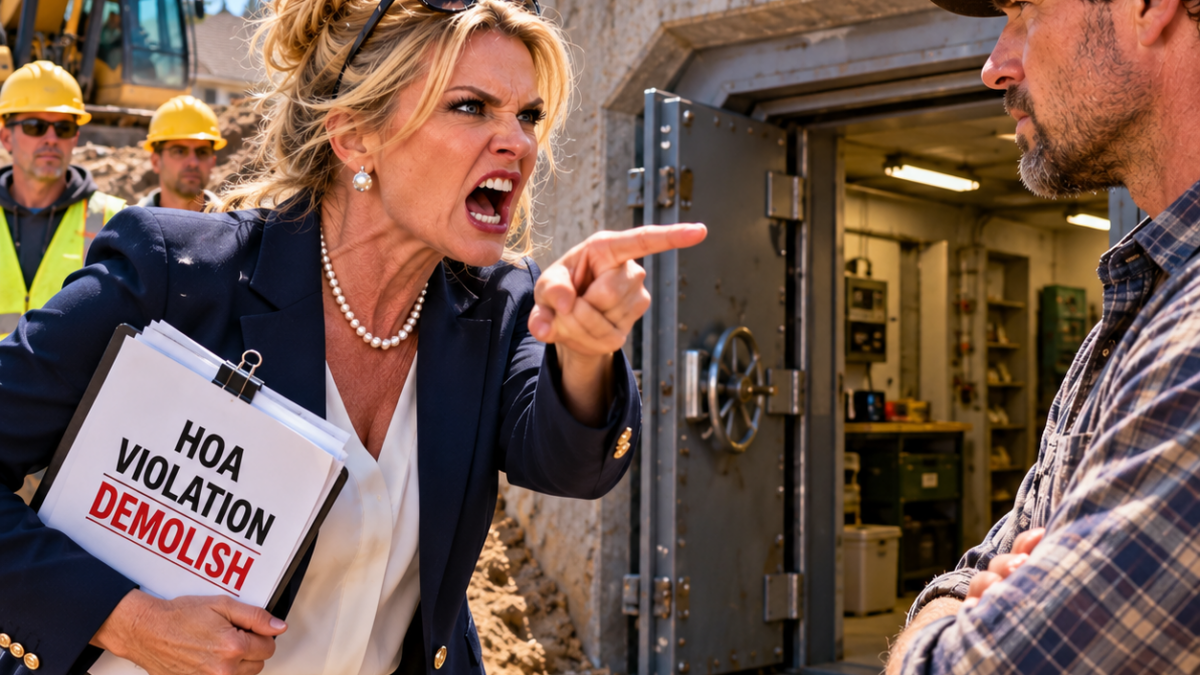
PART 2
My name is Nathan Cole.
At the time, I was thirty-eight years old and lived at 214 Juniper Trace, on the western edge of Fairbrook Ridge, a ninety-six-home subdivision outside Sacramento.
I had spent eleven years in the Army working as an ordnance and mechanical technician. That meant generators, hydraulic systems, vehicle components, electrical faults, fuel systems, and equipment that punished people who became careless around it.
By the time I left the service, I had developed a simple preference.
I liked problems that obeyed physics.
If a generator would not start, there was a reason.
If hydraulic pressure dropped, there was a reason.
If an alternator failed under load, there was a reason.
People were harder.
People could decide what answer they wanted first and then spend months inventing reasons for it.
That distinction became important.
When I bought the house on Juniper Trace, I knew about the fallout shelter.
It was not hidden.
It was on the survey.
It was in the historical property file.
It had been built in 1963 by the original owner, during the years when suburban developers sometimes sold preparedness as aggressively as they sold two-car garages.
The structure was about fifteen by twenty feet, reinforced concrete, buried beneath roughly six feet of soil.
The main entrance sat inside my yard.
A heavy slanted steel hatch opened into a short concrete stairwell.
Two galvanized ventilation risers came up through the grass beside it.
There was also a narrow emergency shaft leading west from the shelter toward the green belt behind my property.
That secondary shaft ended beneath an old steel cap sitting several feet into HOA common land.
I did not buy the place because I expected nuclear war.
I bought it because the bunker was perfect for a workshop.
Some men want boats.
Some want fishing cabins.
Some spend ridiculous money building immaculate garages.
I wanted a concrete room where humidity stayed low, nobody moved my tools, and I could rebuild a carburetor at midnight without hearing a television through the wall.
I cleaned the place.
Installed LED lighting.
Serviced the old ventilation system.
Mounted a steel bench.
Stored gauges, generator components, surplus mechanical parts, test equipment, and several half-finished projects inside.
No ammunition.
No explosives.
No weapons cache.
No secret radio room.
The most dangerous thing down there was probably an old bench vise that liked pinching fingers.
And for eight years, nobody from Fairbrook Ridge HOA had ever called it a community asset.
Until the week somebody apparently needed it to become one.
After Diane left that Monday morning, I locked the side gate, downloaded the camera footage, and spread every closing document I owned across my kitchen table.
Deed.
Survey.
Title report.
Historical disclosures.
County records.
The property line was exactly where I remembered.
The entire shelter sat inside my lot.
The secondary shaft crossed beneath the final fourteen feet of my yard and ended under the green belt cap.
Then I found the document that made me sit back in my chair.
1964 CIVIL DEFENSE ACCESS EASEMENT.
That explained part of Diane’s claim.
The original developer had reserved limited emergency access to the shelter during the civil defense era.
But immediately beneath that entry was another.
1989.
RELEASE AND TERMINATION OF CIVIL DEFENSE ACCESS RIGHTS.
I read the reference twice.
Then I went online and ordered the certified copy from the county recorder.
It arrived electronically less than an hour later.
The language was not vague.
The civil defense program had been abandoned.
The old secondary access obligation ended.
Control of the underground improvements returned to the owner of the residential parcel.
The cap in what later became common green belt could remain as ventilation and emergency egress.
But neither the developer nor its successor association retained an operational right to the bunker.
That should have ended the argument.
Instead, it gave me three bigger questions.
Why was Diane calling my shelter an HOA emergency asset?
Why did the annual reserve review depend on it?
And what exactly did she mean when she said money had already been spent on it?
At 9:30 that morning, I called the county building department.
A permit technician named Elena Ruiz searched my address.
“We have the original shelter plan,” she said. “A residential addition permit from 1987, and the survey associated with your later purchase.”
“Do you have any active demolition order?”
“No.”
“Any order declaring it unsafe?”
“Not that I see.”
“HOA notice says it’s unregistered.”
She paused.
“It is in the county historical property file. That doesn’t necessarily resolve every question about modern use, but it is not an unknown structure.”
That answer immediately told me more than Diane’s entire notice had.
Elena was careful.
Specific.
Limited.
She did not pretend to know more than the records showed.
I trusted that.
I asked whether I could request an inspection.
She transferred me to a building safety inspector named Marisol Vega.
Marisol asked direct questions.
“Current use?”
“Private workshop.”
“Sleeping quarters?”
“No.”
“Stored fuel?”
“One drained generator tank. No fuel inside.”
“Ammunition?”
“No.”
“Explosives?”
“No.”
“Compressed gas?”
“No.”
“Solvents?”
“Parts washer solvent stays in the detached garage.”
“Good. Don’t rearrange the shelter before I arrive.”
“Why?”
“Because if somebody raised a safety complaint, I want to see what was there when the complaint existed.”
I liked her immediately.
She scheduled Wednesday morning.
Then I emailed Diane.
Attached was the certified 1989 release.
I also explained that the county had no current demolition order on file.
Finally, I requested everything supporting “Community Emergency Asset 3.”
Reserve study pages.
Inspection records.
Invoices.
Work orders.
Maps.
Board approvals.
Vendor reports.
Photographs.
Everything.
Diane answered twenty minutes later.
THE BOARD WILL PROVIDE MATERIALS THROUGH THE ESTABLISHED MEMBER RECORD PROCESS.
THE FRIDAY REVIEW REMAINS SCHEDULED.
CONTINUED OBSTRUCTION MAY RESULT IN ADDITIONAL ENFORCEMENT.
Nothing about the 1989 release.
Nothing about the county.
Nothing explaining what had supposedly been spent.
That afternoon, my neighbor Walt Higgins knocked on my door.
Walt was sixty-something, retired, friendly, and possessed the unfortunate tendency to talk until information became community property.
He looked embarrassed.
“Nathan, I think I might’ve started some of this.”
I leaned against the doorframe.
“That sounds promising.”
“You remember that crate?”
“The diesel parts?”
“Yeah.”
“What about it?”
“I saw you unloading it.”
“So?”
“I joked about it to Linda.”
His wife.
“Then somebody at the holiday committee asked what you did in the Army.”
I closed my eyes.
“Go on.”
“I said ordnance.”
“Mechanical ordnance.”
“I know that now.”
“Walt.”
He rubbed the back of his neck.
“Somebody apparently decided you were storing restricted military equipment underground.”
I stared at him.
“That crate contained fuel filters.”
“I know.”
“One alternator.”
“I know.”
“An alternator which, to my knowledge, has never overthrown a government.”
“I’m sorry.”
I almost laughed.
Almost.
“Did Diane ask you about the crate?”
He nodded.
“When?”
“Late November.”
That caught my attention.
“What exactly did she ask?”
“When I saw it. How big it was. Whether it had hazard markings. Whether you moved it at night.”
“Did you tell her it did?”
“I told her there was faded military writing. Nothing dangerous.”
I looked toward the green belt.
It was April now.
If Diane genuinely believed a dangerous military cache sat under my yard, she had apparently waited almost five months before warning me.
No sheriff.
No fire department.
No county inspector.
No emergency action.
Nothing.
Until the same week as an annual reserve review.
People postpone paperwork.
They do not usually postpone explosions.
“Walt, can you email me what you just said?”
“Sure.”
“Dates if you remember them.”
He sent it before leaving my driveway.
That night, at 11:43, my phone woke me.
Motion alert.
Rear camera.
That camera did not face the main bunker hatch.
It covered my back fence and the green belt.
A flashlight beam moved through the trees.
I sat up.
Watched again.
Somebody was near the secondary exit.
I pulled on boots and went outside.
The path lights behind my property were dark.
Not one light.
Three separate sections.
Forty yards west, someone crouched beside the old steel egress cap.
I heard metal.
A socket wrench.
“Leave the bolts where they are.”
The person stood.
Diane.
She was wearing a black windbreaker.
Dark pants.
No red blazer now.
In one hand was a wrench.
In the other was a small brass plate.
I knew the plate.
It had been bolted to that cap since before I bought the house.
SECONDARY EGRESS — SHELTER 3.
DO NOT OBSTRUCT.
I had a photograph of it from my home inspection eight years earlier.
“What are you doing?”
She stood straighter.
“That marker belongs to the association.”
“The release says that exit remains part of my shelter system.”
“The cap is on common property.”
“Then why are you taking the warning plate off at midnight?”
Her face hardened.
“It’s obsolete.”
“Interesting time for maintenance.”
“Residents have complained about tripping hazards.”
I looked around.
There was no walkway within ten feet.
No disturbed soil.
No bench nearby.
Nothing a person could trip over without deliberately walking into brush.
“Put it back.”
“I’ll have maintenance document it tomorrow.”
“You are maintenance tonight.”
For the first time since I had known Diane, the polished board-president voice cracked.
“You’ve turned a straightforward safety review into a personal war.”
I stared at the wrench in her hand.
“I was asleep.”
I pointed at it.
“You brought the wrench.”
She placed the plate on top of the steel cap.
Did not reinstall it.
Then she walked away.
I took pictures.
Removed bolts.
Fresh wrench marks.
Plate.
Dark path lights.
I saved the video clip to my phone, computer, cloud storage, and an external drive.
The Army teaches redundancy.
Mostly because people eventually learn that the one copy you failed to duplicate is always the one you need.
Wednesday morning, Marisol arrived at 8:15.
County vehicle.
Clipboard.
Work boots.
No drama.
I showed her everything before opening the bunker.
The deed.
Survey.
1964 easement.
1989 release.
HOA notice.
Then we went inside.
She spent forty-five minutes looking at things most people would have ignored.
Stair angle.
Hatch hardware.
Ventilation.
Electrical panel.
Moisture.
Shelving.
Generator tank.
Stored materials.
She opened the famous military crate.
Pulled out an injector pump.
Looked at me.
“This is the dangerous equipment?”
“Apparently democracy barely survived.”
She smiled.
Barely.
Then kept working.
Eventually she asked, “Secondary exit?”
I showed her the interior steel door.
Beyond it ran the narrow concrete shaft.
At the far end, normally, daylight leaked around the exterior cap.
That morning there was almost none.
Marisol frowned.
She stepped closer.
“Operate the release.”
I pulled the lever.
It moved about two inches.
Stopped.
Metal struck metal.
“What is that?”
“I don’t know.”
She used a flashlight.
Then took photographs.
Somebody had installed a steel crossbar across the outside release mechanism.
The crossbar was new.
The surrounding structure was old.
Clean bolts.
Fresh hardware.
Marisol looked at me.
“Did you install this?”
“No.”
“Can you open the cap from inside at all?”
I tried again.
No.
The alleged danger beneath my property suddenly had a different shape.
Nothing inside the bunker had blocked emergency escape.
Somebody had disabled that exit from HOA land.
Marisol made a call to her supervisor.
Then she said, “I’m going to be precise.”
“Please.”
“I observed no immediate hazardous-material condition inside.”
I waited.
“The interior appears orderly. Main access operates. I have normal maintenance recommendations.”
“And the exit?”
“The exterior egress mechanism is obstructed.”
“By the crossbar.”
“Yes.”
“Does that make the shelter illegal?”
“I’m not making that conclusion.”
“Does the hatch need emergency demolition?”
“I see no county basis for emergency demolition today.”
Those were the most useful words anybody had spoken all week.
No rhetoric.
No accusation.
Just an inspector saying there was no county basis to tear my bunker apart.
Her written field observation arrived later that afternoon.
Service ventilation motor.
Install illuminated exit marker.
Restore secondary release if the exit was intended for emergency use.
Normal things.
Fixable things.
Nothing resembling the apocalyptic danger Diane had been selling.
But now I had a new question.
Who installed the crossbar?
And why would an HOA worried about my “dangerous shelter” deliberately disable one of its exits?
I went to the management office that afternoon.
Thomas Bell, the property manager, was behind the desk.
I submitted a formal records request.
Twelve categories.
Reserve schedules.
Vendor invoices.
Canceled checks.
Maps.
Inspection records.
Project photographs.
Maintenance requests.
Emails.
Board approvals.
Anything referring to Shelter 3.
Thomas read the list twice.
“This will take time.”
“My hearing is Friday.”
He looked uncomfortable.
“Thursday.”
“What?”
“Diane moved it.”
“When?”
“This morning.”
I stared at him.
“So my five-day deadline just became four.”
He glanced toward his office door.
Then lowered his voice.
“Off the record?”
“I’m listening.”
“Ask specifically for the reserve study site photographs.”
“Why?”
“Because I’ve never seen one taken inside your shelter.”
Before I could ask more, he stood and opened the office door.
Conversation over.
That afternoon, Diane emailed me a settlement proposal.
I expected another threat.
Instead, she offered something completely different.
The HOA would withdraw enforcement if I signed a ten-year access license.
The license would allow the association to inspect my bunker.
Designate it as an emergency shelter during declared events.
Maintain the green belt exit.
The agreement would bind future owners.
I would receive no compensation.
I read it twice.
Then I called Diane.
She answered.
“If my bunker is too dangerous to exist,” I said, “why do you want the right to use it for ten years?”
Silence.
Then:
“Remediation may be more economical than removal.”
“Your contractors had a demolition worksheet.”
“The board is evaluating alternatives.”
“And the reserve review?”
“Association business.”
“You listed my property as an association asset.”
“That gives the board a legitimate interest.”
“It gives me a legitimate interest in your records.”
Her voice became colder.
“Sign the license, Nathan.”
“No.”
“The violation goes away.”
“No.”
“The hearing goes away.”
“No.”
“The association repairs the secondary exit.”
I stopped.
“Who installed the crossbar?”
Silence.
“Diane?”
She hung up.
I set the phone down.
And for the first time, I stopped thinking the reserve review was simply an accounting deadline.
I began thinking Diane needed one of two things before Friday.
Either she needed a legal document making my bunker an HOA asset.
Or she needed the bunker gone.
At 4:26 that afternoon, I received an email from someone I barely knew.
Priya Anand.
HOA treasurer.
One sentence.
YOU ARE ASKING ABOUT A PROJECT I NEVER APPROVED IN THE FORM THAT WAS ULTIMATELY PAID.
Attached was one page from the current reserve schedule.
I opened it.
Line 12B.
COMMUNITY EMERGENCY ASSET 3.
SHELTER VENTILATION.
EGRESS STABILIZATION.
PATH LIGHTING.
$47,200.
COMPLETE.
Project location:
214 JUNIPER TRACE.
My address.
I stared at the number.
$47,200.
No contractor had repaired my bunker ventilation.
No association representative had entered it.
No one had worked on the interior.
Nobody had stabilized the exit for my benefit.
Half the lights behind my property did not even work.
Yet the reserve schedule claimed forty-seven thousand two hundred dollars of completed work at my address.
Suddenly Monday morning made sense.
If a consultant inspected the shelter, he would not merely see an old concrete bunker.
He would see forty-seven thousand dollars worth of improvements that did not exist.
I called Priya immediately.
“How did my address get attached to this?”
“That,” she said, “is what I’ve been asking.”
“Was the bunker in the project the board approved?”
“No.”
“What was?”
She opened her records while we talked.
The original safety project had three components.
Green belt path lighting.
Playground emergency call box.
Pond fence.
And a condition survey of old common-area structures.
Nothing authorizing work inside a private residential parcel.
“Then when did my shelter become Asset 3?”
“After approval.”
“Who changed it?”
“Diane and management consolidated the categories.”
“Did you object?”
“Yes.”
“What did she tell you?”
“That an old civil defense map established HOA control and counsel had reviewed it.”
“Did you see the legal opinion?”
“No.”
I emailed Priya the 1989 release.
She was quiet for almost a minute.
Finally she said, “That was not in the packet I received.”
That sentence was more serious than any accusation.
Boards make mistakes.
Files go missing.
People misunderstand old maps.
But there is a difference between a missing document and a document someone knew about but chose not to circulate.
We met that evening at a coffee shop several miles away.
Priya brought copies of materials she could access as treasurer.
Original approval packet.
Updated reserve schedule.
Three canceled checks.
We spread them across a corner table.
The original $47,200 project had been broken down like this:
$9,400 for fourteen green belt path lights.
$5,600 for the playground call box and pond fencing.
$32,200 for condition assessment and safety work related to legacy green belt structures.
No private residential address.
No bunker.
No ventilation repairs at 214 Juniper Trace.
Then Priya showed me the checks.
$9,400 to Northgate Electrical.
$31,800 to Hearthstone Grounds.
$6,000 to a reserve study consultant.
I looked up.
“That totals $47,200.”
“Yes.”
“What did Hearthstone build?”
Priya hesitated.
“A gathering point.”
“Where?”
“Larksburg Court.”
I knew the place.
Diane lived at 14 Larksburg Court.
It was a five-house cul-de-sac at the northern end of Fairbrook Ridge.
Behind her home, the common green belt widened.
A year earlier, that area had been grass, two oak trees, and a dirt maintenance path.
Now it had stone pillars.
Low landscaping walls.
Decorative lighting.
Flagstone.
A seating area.
The community newsletter had called it the Larksburg Gathering Point.
I assumed the homeowners nearby had financed some of it themselves.
They had not.
“Is it actually open to everybody?” I asked.
“Technically.”
“That sounds dangerous.”
Priya smiled despite herself.
“The main finished entrance is next to Diane’s driveway.”
“What about from the green belt?”
“Dirt path.”
I leaned back.
So reserve money had paid for real work.
That mattered.
I did not yet have proof of theft.
Hearthstone had apparently built something.
Northgate had apparently done electrical work.
The problem was that those expenditures were now showing up under my bunker.
Priya opened another page.
Reserve consultant map.
Old.
Faded.
1964 civil defense plan.
Shelter Station 3 appeared on my parcel, with the emergency shaft extending toward what later became HOA land.
“What’s missing?” she asked.
I knew immediately.
“The 1989 release.”
“Yes.”
“Who gave the consultant this map?”
“Diane.”
“Who told the consultant the shelter remained an association asset?”
“Diane.”
“Who certified the project complete?”
“The management system has her electronic approval attached.”
That still did not prove she pocketed money.
And I did not want to make an accusation the records did not support.
But it proved something else.
Real money had been spent on one location.
Then the final accounting described something different at my address.
I asked Priya why Friday mattered so much.
“The HOA is refinancing the clubhouse repair.”
“So?”
“Reserve review is part of the lender package. Master insurance renewal is also happening.”
“And Asset 3?”
“Selected for verification.”
My stomach tightened.
“Why?”
“No interior photographs. No completion documentation. No access authorization.”
There it was.
If I signed Diane’s ten-year license, the missing access authorization problem vanished.
If the HOA “retired” my bunker and demolished it, the consultant might close the old project as an asset-disposal issue instead of comparing physical improvements with the accounting record.
Either outcome gave Diane a cleaner explanation.
I sat there staring at my address on a forty-seven-thousand-dollar line item.
I have always had a low tolerance for paperwork used as camouflage.
A document should describe reality.
It should not manufacture it.
The next morning, Priya used her authority as treasurer to request the original invoices directly from Northgate and Hearthstone.
Both companies responded.
Northgate’s invoice was simple.
Five path lights replaced.
Not fourteen.
Crew note:
Remaining fixtures require trenching authorization due to damaged underground cable.
Authorization never received.
Hearthstone’s invoice was even clearer.
Stone pillars.
Grading.
Drainage gravel.
Flagstone.
Seating walls.
Location:
Larksburg Court common area.
No mention of my address.
No bunker.
No ventilation.
No emergency shaft.
No egress stabilization.
The contractors had not disguised what they did.
The accounting description had changed afterward.
Priya forwarded the invoices to the full board and the association attorney.
Less than an hour later, Thomas Bell sent a preservation notice.
Nobody was to delete email.
Alter records.
Modify project files.
Destroy communication.
That was when the situation stopped being an HOA argument and became an internal investigation.
At 2:17 that afternoon, I got a call.
Luis Ortega.
HOA maintenance supervisor.
“I installed the crossbar.”
I stood up from my workbench.
“On my secondary exit?”
“Yes.”
“Why?”
“I was told the shaft was abandoned.”
“Who told you?”
“The work order.”
“Signed by?”
He was quiet.
“Diane.”
“When?”
“December twelfth.”
I felt something cold move through my chest.
December.
Four months before the violation notice.
Months before I was supposedly told my bunker presented an emergency safety problem.
Luis emailed the work order.
It stated:
SECURE ABANDONED SHAFT AGAINST UNAUTHORIZED ENTRY PENDING ASSET RETIREMENT.
Attached was a small photograph.
The old brass plate was still mounted.
SECONDARY EGRESS — SHELTER 3.
DO NOT OBSTRUCT.
Then I saw the special instruction.
REMOVE IDENTIFYING MARKER AFTER FINAL BOARD AUTHORIZATION.
Final board authorization had never happened.
Diane had tried to remove it herself Monday night.
I called Luis back.
“You knew where the shaft went?”
“Not when I installed it.”
“You were working on HOA property.”
“Yes.”
“I’m not blaming you.”
He exhaled.
“I should’ve checked.”
“You followed the order you had.”
“That doesn’t make it a good order.”
I respected him for saying that.
I sent everything to Marisol.
She added it to her file and recommended nobody alter the crossbar until ownership and responsibility were documented.
It was evidence now.
By Wednesday evening, Diane realized the dispute had escaped her control.
She emailed the entire community.
SAFETY CLARIFICATION.
She described an undisclosed underground workshop.
Military surplus equipment.
Blocked association access.
An uncooperative owner.
She never wrote the word explosives.
She didn’t have to.
Within two hours, the neighborhood forum had twenty-seven comments.
Someone demanded an immediate search.
Someone asked why the county had not evacuated nearby homes.
Another person said the nearest six houses should be cleared until “the bunker” was secured.
Walt commented.
He wrote that the mysterious military crate contained mechanical parts and that he had personally started the rumor months earlier.
Twenty minutes later, his comment disappeared.
I took screenshots.
That evening I walked to my mailbox.
A woman I had known casually for years was walking the green belt with two children.
Normally she waved.
That day she crossed the street.
I stood beside my mailbox after she passed.
That bothered me more than I expected.
A violation notice was paperwork.
A demolition estimate could be challenged.
A blocked exit could be repaired.
But fear did something different.
It allowed people to build pictures in their heads without checking whether those pictures had ever existed.
I went home and posted one response.
The county inspected the shelter.
No explosives.
No ammunition.
No immediate hazardous-material condition.
The HOA had received the report.
I would address both property records and financial records at Thursday’s hearing.
Then I stopped posting.
Rumors become stronger through repetition.
Documents become stronger through reading.
I knew which one I wanted in the room.
At 8:40 that night, Diane called.
“You’re creating unnecessary exposure for the association.”
I almost laughed.
“Your reserve schedule lists forty-seven thousand two hundred dollars of completed work at my address.”
“That schedule consolidates related safety projects.”
“Then why is my bunker the controlling asset?”
“The emergency shaft reaches common property.”
“The access easement ended in 1989.”
“Our counsel hasn’t accepted your interpretation.”
“Your counsel just issued a preservation notice.”
Silence.
Then her tone changed.
Not friendlier.
Just more honest.
“If this reserve review fails, the clubhouse loan could be delayed.”
I listened.
“The insurance carrier may ask for expanded inspection. Costs can increase. Assessments could rise. Ninety-six families are affected, Nathan.”
That was the first credible argument she had made.
And it mattered.
My neighbors had not created the accounting problem.
They should not be punished unnecessarily because one board officer mishandled a file.
But protecting them did not require lying about ownership of my bunker.
It required correcting the records before more decisions were built on top of them.
“Withdraw the enforcement notice,” I said.
She said nothing.
“Restore the exit.”
Silence.
“Correct Asset 3.”
Still nothing.
“Then explain where the money went.”
“Sign the license.”
“No.”
“Nathan.”
“No.”
“Then tomorrow becomes public.”
I looked at the community email she had sent that afternoon.
“You already made it public.”
She hung up.
Thursday evening, the Fairbrook Ridge clubhouse exceeded comfortable capacity long before the meeting started.
By 6:45, more than a hundred residents were inside.
Another dozen stood near the open doors.
Diane sat at the center of the board table.
Red suit.
Perfect posture.
Priya sat two chairs away with a banker’s box at her feet.
Thomas Bell sat beside the association attorney, Mara Chen.
The agenda had two items.
First:
Enforcement regarding underground structure at 214 Juniper Trace.
Second:
Review of discrepancies concerning Reserve Project 12B.
Diane had put them in that order.
She opened with photographs.
My steel hatch.
Ventilation pipes.
The old military crate.
She described unresolved risk.
Denied access.
Historic civil defense infrastructure.
An owner who had resisted a cooperative safety review.
She did it well.
That was something people later forgot.
Diane was not incompetent.
She had been president for six years because she knew how to make control sound like responsibility.
She never yelled.
Never called me dangerous outright.
Never said explosives.
She only arranged enough facts close together that frightened residents could build the accusation themselves.
When she finished, Mara Chen spoke.
“This is not a county demolition proceeding.”
The room quieted.
“The HOA is considering whether to continue internal enforcement, seek judicial review, negotiate access, or suspend action pending further investigation.”
That sentence removed the biggest exaggeration from Diane’s notice.
No immediate bulldozer authority.
No magic HOA power to tear up my yard.
Just a dispute.
Then I was given the floor.
I did not start with the money.
I started with safety.
Marisol’s report appeared on the screen.
Clean interior.
Generator tank drained.
Mechanical components.
Ordinary tools.
Operating main hatch.
No immediate hazardous-material condition.
No county basis for emergency demolition observed.
I looked across the room.
“The county inspected what the HOA described as a public danger.”
Then I displayed the secondary shaft.
Interior release.
New exterior crossbar.
December work order.
Diane’s signature.
Luis Ortega’s statement.
I waited until everyone had time to read the photograph of the brass plate.
SECONDARY EGRESS.
DO NOT OBSTRUCT.
Then I said:
“The association called my bunker unsafe after an association maintenance order disabled its second exit.”
Nobody spoke.
Diane’s face did not change.
But Cliff Bannister, one of the board members, looked toward her.
I placed the 1964 easement on the screen.
Then the 1989 release.
“One created limited civil defense access.”
Next page.
“One ended it.”
I read the operative section.
Control returned to the residential parcel owner.
No surviving association right to enter or operate the shelter.
Then I showed the reserve consultant’s map.
1964 plan.
No release.
Cliff leaned toward Diane.
“Did legal review the 1989 release before the notice went out?”
Diane answered carefully.
“The release was not in the project file at the time the original notice was prepared.”
Cliff nodded.
“Nathan emailed it Monday.”
“Yes.”
“Before you moved the hearing forward?”
Silence.
“Before the community safety email?”
Diane looked down at her papers.
“The board still had unresolved safety concerns.”
Not an answer.
Then I put her ten-year access license on the screen.
“Monday morning, according to the HOA, the bunker was dangerous enough to be demolished.”
I changed pages.
“Tuesday afternoon, the HOA offered to withdraw enforcement if I gave it a ten-year right to use the same bunker as an emergency shelter.”
People started whispering.
I looked at Diane.
“Those positions cannot both be about an immediate safety threat.”
She spoke immediately.
“Adaptive reuse was one of several options under consideration.”
“For an asset the HOA did not own.”
Mara Chen raised a hand.
“Let Mr. Cole finish.”
I closed the first folder.
“The county found no emergency basis for demolition. The association disabled an exit it now criticizes. Recorded access rights ended decades ago. And the proposed cure was not a repair order.”
I tapped the license.
“It was my signature.”
Then I sat down.
That was the property case.
Priya stood.
And the room got quieter.
She did not call Diane a thief.
She did not accuse anyone of embezzlement.
She did something more damaging.
She reconciled the numbers.
Original approved project:
$47,200.
Fourteen path lights.
Emergency call box.
Pond fence.
Assessment and safety improvements relating to legacy common structures.
Then Northgate’s invoice.
Five lights replaced.
Remaining work incomplete.
Then Hearthstone.
$31,800.
Stone pillars.
Flagstone.
Drainage.
Seating walls.
Larksburg Court common area.
Then the consultant fee.
$6,000.
Priya showed the reserve schedule.
COMMUNITY EMERGENCY ASSET 3.
214 JUNIPER TRACE.
VENTILATION.
EGRESS STABILIZATION.
PATH LIGHTING.
COMPLETE.
“The invoices do not support this description,” she said.
A resident in the second row raised his hand.
“Are you saying forty-seven grand disappeared?”
Priya shook her head.
“No.”
That answer surprised people.
“I’m saying money was spent. The issue is where, under what authorization, and why the completed accounting schedule describes work that was not performed at the listed address.”
That distinction mattered.
Then came the page that changed the room.
Hearthstone invoice:
LARKSBURG COURT COMMON AREA.
Next page:
Internal management coding summary three weeks later.
SHELTER ASSET 3.
214 JUNIPER TRACE.
Cliff looked at Thomas.
“Who changed the location?”
Thomas opened a folder.
“Management entered the revised coding following written instruction from the board president.”
You could hear people moving in their chairs.
Then Thomas projected the email.
From Diane.
CONSOLIDATE LARKSBURG HARDSCAPE AND NORTHERN SAFETY WORK UNDER PROJECT 12B.
USE SHELTER ASSET 3 AS THE CONTROLLING LOCATION SO THE EXPENDITURE REMAINS WITHIN THE APPROVED RESERVE CATEGORY.
Then one more line.
DO NOT ATTACH THE OWNER RELEASE DOCUMENT UNTIL COUNSEL CONFIRMS WHETHER IT AFFECTS ASSET CONTINUITY.
The room stopped moving.
I looked at Diane.
There it was.
The distinction I had been waiting for.
This was no longer an old document accidentally missing from a file.
Diane knew the release existed.
She knew the reserve coding depended on treating my bunker as an HOA asset.
And she had explicitly told management not to attach the release while using my shelter to hold the expenditure inside the desired category.
Diane read her own email on the screen.
Slowly.
Then said:
“That communication is being stripped of context.”
Priya stayed standing.
“What context changes the project location?”
“The Larksburg work improved common property.”
“I agree.”
“It was part of the same northern safety corridor.”
Priya nodded.
“Then why does the completed schedule say shelter ventilation and egress stabilization?”
“Those were planned components.”
“Were they completed?”
“Access was unavailable.”
“Nathan had never been asked for access before Monday.”
That was the moment the residents stopped listening like spectators.
They started listening like owners.
Questions came from everywhere.
Why had only five lights been repaired if fourteen were paid under the project?
Why had the call box never been fixed?
Why was pond fencing included in approval but apparently never ordered?
Why was landscaping behind Diane’s cul-de-sac coded to a shelter across the neighborhood?
Why was my address being used?
A woman near the eastern wall asked the question that mattered most.
“Can reserve money be moved like this after a vote?”
Mara Chen did not speculate.
“The answer depends on the governing documents, notice requirements, reserve restrictions, and the exact board action. I recommend independent review.”
That was enough.
Cliff made the first motion.
Suspend enforcement against my shelter pending completion of the property and financial review.
Second motion.
Restore the secondary egress under neutral supervision.
No entry onto my parcel without written permission or lawful order.
Third.
Appoint an independent accountant and outside counsel to review Project 12B, the reserve coding, and the Larksburg work.
Fourth.
Remove Diane Worth from the office of HOA president pending that review.
All four motions passed.
Four to one.
Diane cast the only opposing vote.
Nobody applauded.
I was glad.
I had not come there to watch a public execution.
I wanted one thing.
Stop the machinery before it reached my yard.
Put the records into hands that did not need a particular answer.
Friday morning, the reserve consultant came to my house.
Priya came.
Thomas came.
The interim board president came.
I opened the steel hatch myself.
That mattered to me.
They had asked.
I said yes.
Permission freely given after facts are known is completely different from authority taken because somebody believes they deserve it.
The consultant photographed everything.
Old ventilation equipment.
My LED lights.
Generator parts.
Secondary shaft.
Serial numbers.
Repairs.
Nothing inside matched the supposed reserve-funded improvements.
Because none had been done there.
That afternoon the reserve schedule changed.
COMMUNITY EMERGENCY ASSET 3 disappeared.
The bunker was relabeled:
PRIVATELY OWNED PRE-ASSOCIATION STRUCTURE.
NO CURRENT HOA ACCESS RIGHT.
Project 12B changed from COMPLETE to UNDER AUDIT.
And something else happened.
Nothing.
The clubhouse loan did not vanish.
Insurance did not cancel the neighborhood.
Nobody lost their house.
The sky stayed where it had been.
The lender requested a corrected reserve plan and the audit.
Closing was delayed twenty-three days.
Professional fees went up.
Annoying?
Absolutely.
Catastrophic?
No.
That is one of the most useful things I learned from the entire fight.
Sometimes the “disaster” used to pressure everybody into silence is mostly a deadline somebody does not want examined.
The independent report took seven weeks.
Seven long weeks.
I kept working.
Neighbors slowly stopped crossing the street.
Walt brought beer one evening and apologized again.
I told him to stop.
“You made a dumb joke.”
“I helped create a rumor.”
“You also corrected it.”
“After it got ugly.”
“That’s usually when corrections matter.”
Eventually the report came.
No evidence showed that Hearthstone had falsified invoices.
No evidence Northgate had falsified invoices.
Both contractors performed the work they were actually hired to perform.
The problem was inside the HOA process.
The report found that $31,800 in reserve funds paid for the Larksburg gathering point without the notice and classification required for that project.
It found that $9,400 paid for electrical work even though only five of the fourteen planned lights had been completed.
The emergency call-box and pond-fence portions remained unfinished.
The reserve consultant had been given the obsolete 1964 civil defense map.
Not the 1989 release.
Most importantly, the report concluded that Diane directed management to code unrelated improvements under Shelter Asset 3 after Priya questioned whether the Larksburg work fit the approved reserve category.
It was not a movie ending.
Nobody kicked down Diane’s front door.
No federal agents appeared.
No handcuffs clicked shut beneath dramatic music.
Real consequences moved more slowly.
And, in my opinion, more usefully.
Three days before residents were scheduled to vote on recalling her from the board, Diane resigned her director seat.
The association negotiated a civil settlement.
She reimbursed a substantial portion of the improperly allocated project cost.
The HOA’s fidelity carrier and management company addressed the remaining accounting loss.
Most importantly for my neighbors, there was no special assessment imposed to clean up that mistake.
The Larksburg gathering point stayed.
I supported that.
People later asked why I wasn’t demanding they tear it down.
Because the stone walls had not lied to anyone.
The flagstone had not changed an accounting code.
The seating area was real.
What mattered was making it what the paperwork had claimed.
The decorative entry beside Diane’s driveway was altered.
A proper public path was completed from the main green belt.
Signs were added.
The amenity finally became accessible to the broader community rather than feeling like a private garden built beside one cul-de-sac.
Northgate returned.
All fourteen path lights were repaired.
The underground cable was fixed.
The playground emergency call box received a new battery and weather enclosure.
The pond fence was replaced before summer.
Then came the part I cared about most.
My secondary exit.
Luis Ortega returned with a neutral contractor and Marisol present.
I stood inside the bunker while they removed the crossbar.
Luis called through the shaft.
“Try it.”
I pulled the release.
The mechanism moved.
For the first time in months, the cap opened.
Daylight cut down the concrete tunnel.
A simple stripe of light.
Nothing dramatic.
Yet I stood there staring at it longer than I expected.
Luis reinstalled the brass plate outside with stainless hardware.
SECONDARY EGRESS — SHELTER 3.
DO NOT OBSTRUCT.
He came back carrying the old crossbar.
“You want this?”
I looked at it.
Heavy steel.
Fresh bolt holes.
The physical piece of the entire argument.
I could have hung it on the workshop wall.
A trophy.
Proof.
Something to point at when people asked about Diane.
Instead I shook my head.
“Scrap it.”
“You sure?”
“I have enough reminders.”
And I did.
The HOA recorded the 1989 release in its permanent property file.
They adopted a policy requiring current title support before any privately owned structure could be listed as an HOA-controlled asset.
Changing the location assigned to an approved reserve project after a vote now required written approval from two directors.
Documentation had to include the original invoice.
No more making an address fit the money after the fact.
My bunker stayed mine.
Several residents later suggested converting it voluntarily into an official community shelter.
I declined.
Not because I hated my neighbors.
Not because I wanted revenge.
Because a sixty-year-old bunker being used by one man as a workshop is a completely different thing from a designated emergency facility responsible for dozens of people.
Ventilation capacity.
Occupancy.
Emergency power.
Liability.
Accessibility.
Sanitation.
Communication.
Maintenance.
Those questions deserved engineering.
Not emotion.
I said exactly that at the meeting.
For once, everybody accepted the answer.
But something unexpected did change.
On the first Saturday of every month, I started opening the workshop to a few neighbors by invitation.
Not as a shelter.
Not as an HOA asset.
As a workshop.
Walt brought over a generator that had not run in three years.
We cleaned the carburetor.
Changed the fuel line.
Replaced a cracked primer bulb.
It started on the fourth pull.
He smiled like we had resurrected a horse.
Frank Delgado rolled in a riding mower with a fuel problem.
Two teenagers from the next block came down one Saturday and learned how to use a multimeter without blowing the fuse or electrocuting themselves.
I showed them how to trace voltage properly.
How to check continuity.
Why guessing at electrical problems is usually more expensive than measuring them.
One asked me whether the shelter really had been built for nuclear war.
“Yes.”
“Was anybody ever inside during an attack?”
“No.”
“So it spent sixty years waiting for something that never happened?”
I thought about it.
“Pretty much.”
He looked around the concrete room.
“That’s kind of sad.”
“No.”
“Why not?”
“Because now it has tools.”
He laughed.
The first night after the secondary exit was fully restored, I went downstairs alone.
No project.
No repair.
I closed the main hatch.
Turned off the LEDs.
For a second, the bunker went black.
Then my eyes adjusted.
At the far end of the emergency shaft, a thin line of moonlight appeared around the cap.
Exactly the way it should.
I stood there in the dark thinking about the previous months.
Diane had treated that bunker as three different things depending on what she needed.
When she wanted me frightened, it was a dangerous underground structure.
When she wanted my signature, it was a valuable emergency shelter.
When she needed the reserve numbers to balance, it became Asset 3.
Same room.
Three stories.
None of them created ownership.
None of them created access.
None of them changed the title record.
I learned something from that.
Concern and control often sound similar at the beginning.
Both can say:
“We need to make sure this is safe.”
But concern asks questions.
Concern gathers evidence.
Concern changes its conclusion when the facts change.
Control chooses the conclusion first.
Then it searches for a form, a map, a rumor, a deadline, or a frightened audience willing to carry it.
Diane’s mistake was not asking questions about an old fallout shelter.
Old underground structures should be inspected.
Mine benefited from Marisol’s recommendations.
I serviced the ventilation motor.
Added the illuminated marker.
Checked the hatch seals.
Those were reasonable things.
Her mistake came earlier.
She decided that concern gave her permission.
Permission to enter.
Permission to disable an exit.
Permission to remove identifying hardware.
Permission to hide a release from an accounting file.
Permission to code somebody else’s property as a financial asset.
Permission to demand a signature after creating the problem the signature would supposedly solve.
That distinction became even clearer several months later.
I was in the workshop on a Saturday afternoon when someone knocked against the open steel hatch.
Priya came down the stairs.
She was carrying a cardboard folder.
“I found something you might want.”
“If it says Asset 3, burn it.”
She laughed.
“No.”
She handed me a copy of the final corrected reserve schedule.
Everything had been reclassified.
Larksburg improvements properly listed.
Electrical work separated.
Call box.
Pond fence.
Green belt.
Private bunker removed.
I looked at the bottom.
There was a new notation in the review procedure.
PRIVATE PROPERTY SHALL NOT BE INCLUDED AS AN ASSOCIATION RESERVE ASSET WITHOUT RECORDED OWNERSHIP, EASEMENT, OR EXECUTED ACCESS AGREEMENT.
I read it twice.
“You wrote this?”
“The accountant recommended it.”
“Good accountant.”
“She charges accordingly.”
“I believe that.”
Priya leaned against the workbench.
“For what it’s worth, I’m sorry.”
“You didn’t do it.”
“I was treasurer.”
“You objected.”
“Not hard enough.”
I understood that feeling.
People see a bad decision developing and convince themselves someone else will stop it.
A lawyer.
Another director.
Management.
An auditor.
The homeowner.
Sometimes everybody waits.
Then suddenly a contractor is standing in somebody’s yard holding orange paint.
“You stopped it when you had proof,” I told her.
She looked around.
“Diane really thought you would sign.”
“I know.”
“Why didn’t you?”
I considered the question.
It would have been easier.
Sign the license.
Make the violation disappear.
Avoid the hearing.
Avoid the rumors.
Let the HOA maintain the green belt cap.
Maybe even let them treat the bunker as some odd community emergency resource.
Ninety-six homeowners might never have known about the accounting problem.
The clubhouse loan would have closed on schedule.
I would have saved myself weeks of stress.
“Because every document after that would say I agreed they had a right they never had.”
Priya nodded.
That was exactly it.
The fight was never really about concrete.
It was about whether pressure could manufacture consent.
A month later, I ran into Diane.
Not at a board meeting.
Not at the clubhouse.
Grocery store.
Cereal aisle.
She saw me before I saw her.
For half a second we both stood there with shopping carts between us.
I expected anger.
Maybe resentment.
Maybe some carefully rehearsed accusation about what the investigation had cost her.
Instead she said:
“Your shelter still there?”
“Yes.”
She nodded.
“I figured.”
I almost kept walking.
Then she said:
“I never thought the accounting would become what it became.”
I looked at her.
“That isn’t what happened.”
Her face tightened.
“What do you mean?”
“The accounting didn’t become anything.”
I kept my voice low.
“You changed the code.”
She glanced down the aisle.
“Nathan—”
“You told management to keep the release out of the file.”
“That was pending legal review.”
“You sent contractors onto my property before that review.”
“I believed we had authority.”
“Then why did you need my ten-year license?”
She did not answer.
There it was again.
Not yelling.
Not revenge fantasy.
Just the question that never fit her version of events.
If the association already owned the right, why did they need me to create it?
She gripped her cart.
“You embarrassed me in front of the entire neighborhood.”
“No.”
I shook my head.
“The records embarrassed you.”
Her eyes flashed.
“You think you won.”
I considered that.
Then I looked at the box of cereal in her cart, at my bag of coffee, at two ordinary people standing beneath fluorescent grocery-store lights months after the most dramatic dispute either of us had ever had.
“No,” I said.
“I think the hatch is still mine.”
Then I walked away.
That was enough.
People often imagine revenge as taking something.
Money.
Position.
Reputation.
Property.
I discovered that the most satisfying kind can be much simpler.
Make somebody return what they tried to take.
Not merely the physical thing.
The boundary.
The truth.
The right to say no.
Diane lost the presidency.
Then her board seat.
She had to reimburse money.
Those were consequences.
But they were not the part I remembered most.
I remembered standing inside that emergency shaft when the crossbar came off.
I remembered pulling the lever.
I remembered seeing daylight.
For months, someone else’s paperwork had told me the exit was an association concern.
Someone else’s work order had physically blocked it.
Someone else’s accounting had listed my property as their asset.
Someone else’s deadline had tried to force my signature.
Then, one by one, each thing was corrected.
Crossbar removed.
Brass plate restored.
Asset schedule changed.
Release permanently recorded.
Reserve project audited.
Access claim withdrawn.
And the steel hatch stayed where it had been since 1963.
Years ago, during my Army days, an older warrant officer taught me something while we were troubleshooting a generator that everyone swore had a fuel problem.
He said, “Never repair the story. Repair the machine.”
I didn’t understand what he meant at first.
Then he showed us.
Every mechanic before us had accepted the same explanation.
Bad fuel.
They changed filters.
Drained tanks.
Cleaned lines.
Nothing worked.
The actual fault was electrical.
A damaged connector intermittently cut voltage to the shutoff solenoid.
The machine had never cared what everybody believed.
It only responded to what was true.
That lesson stayed with me.
During the HOA fight, Diane had a story.
Dangerous bunker.
Secret military equipment.
Uncooperative owner.
Community asset.
Emergency obligation.
Financial deadline.
Each piece sounded believable if you looked at it alone.
So I stopped fighting the story.
I checked the machine.
County file.
1989 release.
Inspection report.
Crossbar.
Work order.
Vendor invoice.
Canceled check.
Reserve schedule.
Internal email.
One fact at a time.
And the story eventually failed because reality did not match it.
The bunker still looks nearly the same today.
Concrete walls.
Steel bench.
Old ventilation ducting.
Modern LEDs.
One generator waiting for me to finish rebuilding it.
A shelf full of carburetors.
Gauges.
Parts.
Nothing glamorous.
Nothing worth forty-seven thousand two hundred dollars.
Sometimes when neighbors visit, they ask where the “HOA improvements” are.
I point toward an old wrench.
“Maybe that.”
Most of them laugh.
Walt laughs the hardest.
He still feels bad about the rumor.
I keep telling him the same thing.
The rumor started the fear.
But the rumor did not alter financial records.
The rumor did not block an emergency exit.
The rumor did not bring contractors through my gate.
People made those choices.
That matters because blame becomes useless when we spread it so widely nobody is responsible anymore.
Fear did not sign the work order.
A person did.
An outdated map did not conceal the release.
A person gave that instruction.
An accounting system did not independently move Larksburg expenses to my address.
Someone told management to do it.
And no amount of saying “for community safety” changed those facts.
The brass plate remains above the secondary cap.
Luis cleaned it before reinstalling it.
The metal has scratches from the night Diane tried to remove it.
I never replaced it.
Not because I wanted a monument.
I had refused the crossbar as a trophy.
But the scratches on that plate belonged there.
They told the truth without needing a meeting.
SECONDARY EGRESS.
DO NOT OBSTRUCT.
Simple words.
Almost embarrassingly simple.
The entire dispute could have been reduced to something equally simple.
Ask.
Show authority.
Use current records.
Spend money where the board approved it.
Tell homeowners where their money went.
Correct mistakes before they become lies.
And when someone says no, figure out whether you actually possess the right to override them before you send people through their gate.
My fallout shelter survived the Cold War without ever serving its original purpose.
More than sixty years later, it survived something much less dramatic but probably more common.
A line on an old map.
A deadline.
A board officer convinced that administrative convenience could substitute for consent.
One Friday evening near the end of summer, I was finishing a generator repair when the two teenagers who had been learning electrical work came down the bunker stairs.
One of them noticed the framed copy of the 1989 release I had finally hung beside the workbench.
“What’s that?”
I looked over.
“Paperwork.”
He laughed.
“You framed paperwork?”
“It saved the room you’re standing in.”
He read a few lines.
“That boring thing?”
“That boring thing.”
He looked around at the heavy concrete walls.
“So paper beat a bulldozer?”
I smiled.
“No.”
“What did?”
“The right paper.”
He thought about that longer than I expected.
Then he pointed toward the multimeter.
“Can we finish checking the generator?”
“Yeah.”
And we did.
Because eventually the bunker went back to being what it had always been for me.
A place where broken things could be understood.
A place where facts mattered.
A place where you measured before deciding.
A place where if the machine would not run, you opened the panel and found the reason instead of blaming whatever rumor was convenient.
Sometimes, late at night, I still shut off the LEDs before climbing back upstairs.
The darkness settles quickly.
Then the moonlight appears at the end of the emergency shaft.
A narrow line.
Always there when the exit is clear.
I still check it.
Maybe I always will.
Not because I’m afraid Diane will come back with a wrench.
She won’t.
Not because I think the HOA will try to claim the bunker again.
The new records are too clear.
I check because that line of light reminds me what the entire fight became about.
Access.
Truth.
And whether someone else gets to block either one simply because they have a title, a deadline, and a clipboard.
They don’t.
That was the lesson Fairbrook Ridge paid far too much money to learn.
And the lesson I kept was even simpler.
Never let somebody’s confidence substitute for evidence.
Never let a highlighted sentence outrank your deed.
Never surrender a permanent right just to make a temporary threat disappear.
And when someone shows you only part of the paperwork, find the rest.
Because in my case, the truth was not hidden behind the six-foot-thick bunker wall.
It was sitting in an accounting file.
Forty-seven thousand two hundred dollars.
Marked “complete.”
At an address where the work had never happened.
Diane thought the steel hatch was the thing standing between her and a clean reserve review.
She was wrong.
The hatch was just metal.
The thing she could not get through was the paper trail.








