PART 2: HOA Made My $1 Million Equipment Vanish Overnight—Then One Quiet Security Guard Asked to Speak to Me Alone
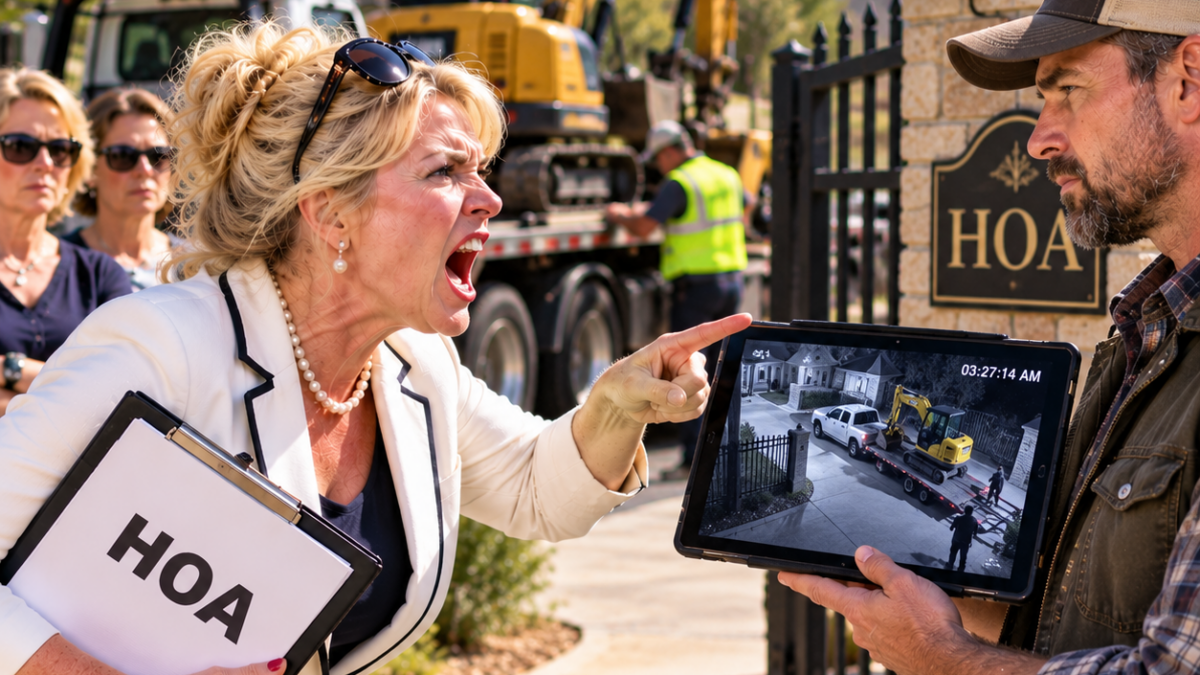
At 6:10 on a Monday morning, I unlocked the gate to the commercial yard where I had legally stored more than a million dollars of equipment and found two excavators, a drilling rig, and a trailer packed with survey gear gone so completely that the only things left were tire tracks and a few dark drops of hydraulic fluid in the gravel.
Less than twenty minutes later, the president of the HOA across the road walked over carrying coffee, smiled at my empty lot, and calmly informed me that my machines had been declared abandoned, removed, and sold before I had even known anyone was coming for them.
I had spent fifteen years building that fleet one machine at a time, but the first detail that made me realize this was bigger than an HOA dispute wasn’t what Lorraine Pike said—it was what somebody had gone out of their way to remove before sunrise.
I’m Rowan Teague, owner of Teague Excavation, and until that morning I had eleven employees, a full schedule, and enough equipment to start one of the biggest contracts our company had ever landed.
Now I had eleven employees and almost nothing for them to operate.
My foreman, Dwayne Kesler, pulled in ten minutes after me, climbed out of his truck, and stopped so suddenly the driver’s door remained hanging open behind him.
“Rowan.”
“I know.”
“Where’s the 350?”
“Gone.”
“The smaller excavator?”
“Gone.”
He looked toward the far corner.
“Drill rig?”
“Gone.”
Dwayne muttered a word I’d never heard him use in twelve years of working together, then walked into the center of the empty lot and slowly turned around.
The property didn’t belong to Pine Hollow Estates. I had a signed ninety-day lease from the commercial trust that owned it, paid $3,200 a month, carried the required insurance, and had exclusive use of the gate while my main yard was being resurfaced.
Yet Lorraine had been trying to push me out almost from the day my machines arrived.
Noise violation.
Unauthorized storage.
Commercial equipment visible from residential property.
Then a $1,500 fine from an HOA I didn’t belong to.
My attorney, Naomi Castelin, had already warned Lorraine in writing that touching my equipment could turn a petty property dispute into something far more serious.
Apparently Lorraine had decided to test that theory.
I called the sheriff first.
Naomi second.
Insurance third.
The insurance adjuster started asking about locks, fencing, and policy conditions.
“We’ll need to investigate,” he said.
“How long?”
“Potentially several weeks.”
I looked at the empty gravel.
“I don’t have several weeks.”
Nine of my eleven employees were supposed to report to a new excavation job that morning.
Without the fleet, payroll didn’t stop.
Loan payments didn’t stop.
Contract deadlines didn’t stop.
Then Dwayne looked toward the road.
“She’s coming.”
Lorraine Pike crossed from Pine Hollow carrying a leather folder and a white coffee cup.
She didn’t look shocked.
That bothered me immediately.
“Morning, Rowan.”
I stared at her.
“Where is my equipment?”
She gave me a small, almost pitying smile.
“You were warned.”
My hands went still.
“Where is it?”
“The association exercised its right to remove abandoned nuisance property.”
“From a lot your association doesn’t own?”
“You ignored repeated compliance notices.”
“You have no jurisdiction here.”
She opened her folder and handed me a document titled:
**NOTICE OF ABANDONED PROPERTY AND AUTHORIZATION FOR REMOVAL**
It was dated twenty-one days earlier.
It claimed I had received three written abandonment warnings.
I hadn’t received one.
At the bottom sat Lorraine’s signature and a notary seal.
I read it twice.
“Who removed the machines?”
“That information is confidential.”
“Where are they?”
“Disposed of.”
I looked up.
“What does that mean?”
Her eyes met mine.
“Sold.”
The word landed harder than I expected.
Dwayne moved closer because he knew what it meant when I got quiet.
Lorraine lowered her voice.
“Machines like those don’t stay in one place very long, Rowan. Consider this an expensive lesson in respecting community standards.”
By ten o’clock, Naomi and Deputy Anna Brewer were standing with me in the lot, photographing the cut lock somebody had left near the fence.
Brewer asked the obvious question.
“Any cameras?”
I pointed toward the pole near the entrance.
Then stopped.
The mounting bracket was empty.
Not damaged.
Empty.
The camera, cable, and housing had been carefully removed.
Brewer stared up at it.
“That wasn’t random.”
“No.”
That was when a man appeared at the far end of the fence.
Marcus Doyle.
The night security guard.
He had gone home hours earlier, but now he stood there with both hands buried in his jacket pockets, looking sick.
“Mr. Teague?”
“Yes?”
“I need to tell you something about last night.”
Naomi stepped between us.
“Whatever you have to say, say it in front of Deputy Brewer.”
Marcus looked toward Lorraine’s neighborhood, swallowed hard, and slowly reached into his pocket.
When his hand came back out, he was holding something small enough to fit between two fingers.
And the moment Deputy Brewer saw it, she stopped writing.
PART 2
It was a black flash drive.
Marcus held it as though it weighed far more than it did.
Deputy Brewer looked from the drive to his face.
“What’s on it?”
Marcus glanced toward the road again.
“I think you need to hear it.”
Naomi’s voice stayed level.
“What exactly did you record?”
Marcus hesitated.
“I was working last night.”
“We know that.”
“I wasn’t supposed to leave the north lot.”
I folded my arms.
“But you did.”
“My dispatcher called at one-thirty.”
“Why?”
“He said there was a scheduling change and I needed to clear the area for ninety minutes.”
Brewer’s pen started moving again.
“Who requested the change?”
Marcus swallowed.
“Dispatcher said the request came from Pine Hollow Estates.”
I felt Dwayne shift beside me.
Naomi asked, “From whom at Pine Hollow?”
“He didn’t say.”
“Did that happen often?”
“No.”
“Had it ever happened before?”
“No.”
Marcus stared at the flash drive.
“That’s why I left the recorder running.”
Brewer stopped writing.
“What recorder?”
Marcus pointed toward his patrol SUV parked farther down the road.
“Our company cars have dash units. Video, audio, dispatch radio. Mostly liability stuff. They loop unless something gets flagged.”
“You intentionally kept yours recording?”
“Yes.”
“Why?”
“Because the whole thing felt wrong.”
I looked at him.
“You parked where?”
“Around the corner, outside the lot.”
“Could you see the gate?”
“Part of it.”
“What did you hear?”
His face tightened.
“I’d rather you hear it yourselves.”
Naomi looked at Brewer.
Brewer took the drive but didn’t plug it into anything immediately.
“Before we touch this, I need some information.”
Marcus nodded.
She documented his full name, employer, shift time, vehicle number, and exactly how he had copied the file.
Marcus answered carefully.
“I got home around four-thirty. Couldn’t sleep. I knew the truck stores local backup for twenty-four hours, so I pulled the file before it recycled.”
“Did you edit it?”
“No.”
“Trim it?”
“No.”
“Send it to anyone?”
“No.”
“Play it?”
“Yes.”
“How many times?”
“Twice.”
“And then?”
“I came here.”
Brewer looked at him.
“Your employer may have an issue with you copying company footage.”
“I know.”
“You understand that?”
“Yes.”
“Why bring it?”
Marcus looked at my empty lot.
“Because I heard what they said.”
Nobody spoke for a moment.
Then Naomi said, “My car.”
We climbed into her SUV because it had enough room to sit around her laptop.
Brewer stayed near the passenger door.
Marcus sat in the back.
I sat beside him.
Dwayne stood outside.
Naomi inserted the flash drive.
Several files appeared.
One carried the patrol vehicle number and overnight timestamp.
She clicked.
At first, only low engine noise and static.
Then radio traffic.
Marcus’s dispatcher telling him to relocate.
A little after that, headlights moved across the corner of the frame.
Truck.
Then another.
Then a lowboy trailer.
My stomach tightened.
Naomi glanced at me.
“You okay?”
“Play it.”
The recording continued.
A distant diesel engine.
Metal.
Voices too faint to understand.
Then Marcus’s dash microphone picked up a phone call through the open patrol window.
A woman’s voice.
Clear.
Confident.
Familiar.
I knew it before she finished her first sentence.
Lorraine Pike.
“Dell, the lock won’t be a problem. You’ve got ninety minutes.”
My hand froze on my knee.
A man answered.
“Owner gonna be a problem?”
Lorraine laughed.
Actually laughed.
“He sleeps like a baby. By the time he wakes up, those machines will be across the state line.”
Nobody in Naomi’s SUV moved.
The man—Dell—said something about paperwork.
Lorraine replied:
“I already backdated it, and the notary’s a friend.”
Naomi closed her eyes.
Just for a second.
Then Dell asked:
“What if he calls the sheriff?”
Lorraine’s answer came without hesitation.
“Let him. By the time anyone looks into it, the money will be spent.”
The audio kept running.
For nearly ten seconds, nobody inside the car said anything.
I could hear my own breathing.
Dwayne opened the rear door.
“What?”
Nobody answered him.
He leaned inside.
“What happened?”
Brewer removed the drive carefully.
She pulled an evidence envelope from her kit.
Wrote the time.
Marcus’s name.
File description.
Then sealed it.
Dwayne looked at me.
“Rowan?”
I stared straight ahead.
“She planned it.”
He went still.
“Lorraine?”
I nodded.
“She planned all of it.”
Brewer’s tone changed.
Until that moment, she had been taking a property theft report.
Now she sounded like someone already thinking several steps ahead.
“Mr. Teague, don’t contact Ms. Pike.”
“I wasn’t planning to.”
“Don’t threaten her, don’t message her, don’t tell her we have this recording.”
“All right.”
She looked at Marcus.
“And you do not discuss this with anyone from Pine Hollow, your employer, or anyone connected to the removal until a detective contacts you.”
Marcus nodded.
“Am I in trouble?”
Brewer considered him.
“For bringing this?”
“For copying the recording.”
“That’s not my call.”
His face dropped.
Then she added:
“But I’m glad you came.”
Marcus nodded.
It seemed to matter.
Naomi closed her laptop.
“Anna.”
Brewer looked at her.
“This isn’t a civil HOA dispute anymore.”
“I know.”
“It may involve theft, conspiracy, forgery, and movement of stolen equipment across state lines.”
“I know.”
I listened to them talk as if I were sitting outside myself.
Grand theft.
Forgery.
Conspiracy.
Those were legal words.
All I could picture was my empty yard.
Two excavators.
A drilling rig.
Survey gear.
Equipment I had purchased across fifteen years.
Gone in ninety minutes.
Dwayne touched my shoulder.
“You need to call the crew.”
I looked at him.
He was right.
My employees were still waiting for instructions.
The contract was supposed to start that morning.
I stepped out of Naomi’s SUV and called my superintendent.
“Hold everybody.”
“For how long?”
“I don’t know.”
“Equipment issue?”
“Yes.”
“How bad?”
I looked at the empty yard.
“All of it.”
There was a long silence.
Then:
“Damn.”
“We’ll figure it out.”
“You sure?”
“No.”
That was the first honest answer I had given anybody all morning.
“We’ll figure it out anyway.”
After I hung up, Naomi stood beside me.
“You have rental options?”
“Some.”
“At what cost?”
“Enough.”
“Do it.”
“What if insurance refuses reimbursement?”
“We deal with that later.”
“Easy for the lawyer to say.”
She looked at me.
“If you lose the contract, Lorraine succeeds even if she goes to prison.”
That sharpened everything.
This wasn’t only about recovering property.
If Teague Excavation missed the Monday start, the general contractor could replace us.
That one project represented months of work.
Payroll.
Vendor commitments.
Fuel contracts.
Future referrals.
Lorraine had not merely taken machines.
She had tried to cripple the company before I had time to respond.
I called every rental house within two counties.
Most had some equipment.
Nobody had everything.
By noon, Dwayne had pieced together an ugly temporary fleet.
One rented excavator from fifty miles north.
One from a quarry contractor who owed me a favor.
A drilling unit that cost so much per day I physically winced when I signed the agreement.
Two rented trailers.
Temporary survey equipment.
Not ideal.
Enough to work.
Nine employees reported late that afternoon.
I stood in front of them beside machines that weren’t ours.
“I’m not going to lie to you.”
Nobody spoke.
“Our equipment was stolen.”
A younger operator named Caleb said:
“All of it?”
“Almost everything stored here.”
“Insurance?”
“Working on it.”
“Job still happening?”
“Yes.”
I made myself say that firmly.
“We start tomorrow morning.”
Dwayne looked at me.
“We’re not losing this contract.”
I nodded.
“No.”
One of the laborers asked:
“Who stole it?”
I paused.
“There’s an investigation.”
“That mean you know?”
“It means I’m not talking about it yet.”
Dwayne understood.
He changed the subject.
“Everybody be here at five-thirty. Rentals handle differently from our machines, so nobody gets clever.”
A few men laughed weakly.
The mood lifted just enough.
After everyone left, I sat on the tailgate of Dwayne’s truck.
He handed me a coffee.
“You look terrible.”
“Thank you.”
“You eaten?”
“No.”
“Naomi will yell.”
“She usually does.”
He sat beside me.
For a while neither of us spoke.
Then he said:
“You remember when we bought the first excavator?”
I smiled faintly.
“Used 2006 machine with a hydraulic leak.”
“Seller said it was sweating.”
“It was hemorrhaging.”
Dwayne laughed.
“You kept it seven years.”
“Eight.”
“That machine built the company.”
I looked toward the tire tracks where our newer excavator had sat.
The missing fleet represented money on paper.
A little over a million dollars.
But that was not how I had acquired it.
I bought machines after good years.
Paid down loans after bad years.
Skipped upgrades when payroll needed protection.
Replaced one piece at a time.
Every machine represented jobs I had finished.
Nights I had worried.
Bids I had won.
Mistakes I had survived.
My father had lent me money for the first down payment.
He had been dead six years by then.
When Lorraine told me to “consider the loss a lesson,” something inside me had gone very still.
Dwayne had recognized it.
He had seen me like that only once before.
The day my father died.
“I should’ve taken her more seriously,” I said.
“Lorraine?”
“Yes.”
“You hired a lawyer.”
“I should’ve moved the equipment.”
“To where?”
“Anywhere.”
“Your main yard was torn up.”
“I could’ve found somewhere.”
Dwayne shook his head.
“Don’t do that.”
“Do what?”
“Make her theft your failure.”
I stared at the coffee.
He continued.
“You had a lease.”
“I know.”
“Locked lot.”
“I know.”
“Insurance.”
“I know.”
“You told her to stay out.”
“Yes.”
“She stole the machines anyway.”
He stood.
“That part belongs to her.”
I wanted to believe him.
By late afternoon, Deputy Brewer called.
“Detective taking lead.”
“Who?”
“Regional property crimes. Ethan Ward.”
“Good?”
“Annoyingly.”
“That sounds promising.”
“He’ll contact you.”
“What about the recording?”
“Preserved.”
“Can you act on it?”
“We already are.”
That was all she would say.
The next forty-eight hours moved faster than the previous six weeks.
Marcus had written down the license plate of the pickup he saw photographing serial numbers days earlier.
He had almost thrown the note away.
Instead, it was sitting in the small notebook he used during shifts.
Detectives ran the plate.
Registered owner:
Delmare Cross.
Owner of Cross Salvage & Equipment Hauling.
Two counties away.
Naomi called me Saturday morning.
“Don’t drive there.”
“I didn’t say I would.”
“You were thinking it.”
“Yes.”
“Don’t.”
“You lawyers ruin everything.”
“Correct.”
Detectives visited Delmare’s yard Sunday.
I learned the details later from reports and testimony.
Behind one warehouse sat my lowboy trailer.
They obtained a warrant.
Inside the building was one of my excavators.
Or what was supposed to be one of my excavators.
It had been yellow when I last saw it.
Now it was gray.
Fresh paint still smelled inside the building.
Dwayne stared at the police photograph when Detective Ward showed us.
“They painted the whole thing?”
“Most of it.”
Dwayne pointed toward the cab.
“That’s ours.”
“How can you tell?”
“Dent above the right window.”
Ward smiled.
“Serial confirms too.”
“They didn’t remove it?”
“Not yet.”
Another machine had moved farther.
The second excavator was listed for online auction Tuesday morning.
Starting bid:
$90,000.
Its value was many times that.
The serial plate had been ground down.
Ward said:
“Whoever was doing this was trying to move quickly.”
I thought of Lorraine’s voice.
**Machines like those don’t stay in one place for long.**
She had not been warning me.
She had been bragging.
Delmare lasted less than an afternoon under questioning.
He was not loyal to Lorraine.
People who enter conspiracies for easy money rarely are once prison becomes real.
He told detectives Lorraine had approached him five weeks before the theft.
Five weeks.
That meant she was planning before Naomi’s warning letter.
She introduced herself as HOA president.
Told him abandoned commercial machinery needed to be removed from a nearby property.
Claimed the owner had ignored notices.
Told him all paperwork was legitimate.
Then offered him a percentage of whatever the equipment brought at sale.
Delmare asked why the association didn’t simply tow and store it.
Lorraine said storage created problems.
Selling solved them.
He should have walked away.
Instead, the money looked too easy.
She paid him a $20,000 deposit.
From a Pine Hollow Estates association account.
Investigators took his phone.
Forty-one text messages.
Some were vague.
Some were not.
One read:
**Need everything gone before Monday business hours.**
Another:
**Do not leave local yard stickers visible.**
Then the one that became impossible for anyone to explain away:
**Make sure the serial numbers disappear before the auction.**
When Naomi read that line to me, I leaned back in my chair.
“She wrote that?”
“Yes.”
“From her phone?”
“According to the warrant return.”
I laughed once.
Not because it was funny.
“She spent six weeks pretending she was enforcing neighborhood standards.”
Naomi closed the folder.
“People often become careless when they think the other person won’t get the chance to examine the evidence.”
“I got the chance.”
“You did.”
“The recording gave us the chance.”
She nodded.
“Marcus did.”
That name mattered more each day.
Monday afternoon, investigators got another unexpected witness.
Walter Finch.
Pine Hollow’s treasurer.
Retired accountant.
Gray hair.
Soft voice.
The kind of man I remembered seeing at one HOA meeting years earlier, sitting near the wall with a calculator while Lorraine dominated the room.
He asked Detective Ward to meet privately.
Then arrived carrying a ledger.
Lorraine had withdrawn $62,000 from association reserves over the previous month.
Descriptions included:
**Community Compliance Services**
**Hazardous Equipment Mitigation**
**Enforcement Logistics**
**Legal Property Abatement**
Walter had questioned the transactions.
Lorraine told him the board had approved them in executive session.
Walter checked minutes.
No approval.
He asked again.
She told him to stop undermining the president during an active compliance matter.
And Walter did.
For a while.
When he later testified, he admitted something that made half the room uncomfortable.
“I wanted there to be an explanation.”
The prosecutor asked:
“Why?”
“Because the alternative meant I had signed checks I shouldn’t have signed.”
That was painfully human.
People imagine complicity always looks like greed.
Sometimes it looks like embarrassment.
You notice something is wrong.
Then realizing how wrong it is would force you to admit you should have acted earlier.
So you wait.
Each day of waiting makes the admission harder.
Walter eventually decided fear was more expensive than honesty.
He gave investigators everything.
Invoices.
Bank statements.
Email authorizations.
Copies of checks.
The notary was next.
Gwyn Sorel.
Small insurance office downtown.
She knew Lorraine socially.
Not close friends.
Friendly enough for favors.
When a detective asked for her notary journal, Gwyn’s hands started shaking.
There was no proper entry for Lorraine’s abandonment notice.
Because Gwyn had not actually witnessed the document being signed.
Lorraine brought her a pre-signed paper and asked her to stamp it.
“Routine HOA matter,” she said.
Gwyn did.
No personal appearance.
No proper journal entry.
No verification.
A shortcut.
A favor.
One seal.
Gwyn told investigators she had regretted it almost immediately.
“But I thought the worst thing that could happen was some fine got challenged,” she said.
Then she learned equipment worth more than a million dollars was gone.
She cooperated.
Full statement.
The abandonment notice collapsed.
Every layer of Lorraine’s “lawful removal” was failing.
No legitimate abandonment.
No valid notice history.
No HOA jurisdiction.
Improper notary act.
Planned removal.
Sale arranged before I even knew the equipment was gone.
Attempt to erase serial numbers.
Association money used to finance the operation.
And one recording where Lorraine practically narrated the conspiracy.
Yet on Tuesday afternoon, Lorraine called an emergency HOA meeting.
That told me she still believed she could survive.
Three hundred residents packed the Pine Hollow clubhouse.
I did not want to go.
Naomi did.
“You should hear what she says.”
“Why?”
“Because she’s going to commit herself to a version.”
“She’s already on tape.”
“People like Lorraine don’t surrender because evidence exists.”
“So?”
“They surrender when they understand everyone else has seen it.”
Dwayne insisted on coming.
“Why?”
“I want to watch.”
“This isn’t entertainment.”
“It’s a little entertainment.”
We arrived early.
The room was overflowing.
People stood along the walls.
Some residents nodded at me.
Others looked suspicious.
Lorraine had been talking about my equipment for weeks.
To them, I was the outsider whose heavy machinery had appeared beside their manicured neighborhood.
They had heard about noise.
Property values.
Safety.
Abandonment.
Some believed her.
I understood why.
They had not heard Marcus’s recording.
Lorraine entered wearing a navy dress.
Composed.
Hair perfect.
Documents arranged neatly.
The woman had been interviewed by detectives and somehow still walked into that room looking like she was preparing to approve landscaping.
She tapped the microphone.
“This meeting has been called to address a campaign of misinformation concerning a lawful compliance action undertaken by Pine Hollow Estates.”
Dwayne leaned toward me.
“She has guts.”
“Or no survival instinct.”
Lorraine continued.
She said I abandoned hazardous commercial equipment.
She claimed three formal warnings had been sent.
She said I refused to cooperate.
She accused me of using “outside legal pressure” to avoid fines.
A few residents nodded.
That hurt more than I expected.
Not because I needed strangers to like me.
Because while Lorraine spoke, my employees were operating rented machinery that was costing me thousands of dollars a day.
My actual equipment was sitting in police storage, salvage warehouses, or God knew where else.
And she was describing herself as the victim.
Lorraine held up the abandonment notice.
“This document authorized removal after all required deadlines expired.”
Naomi stood from the third row.
“Ms. Pike.”
Lorraine’s eyes narrowed.
“This is a board meeting.”
“I understand.”
“Public comment will occur later.”
Naomi smiled.
“I’m here as invited counsel for Mr. Teague.”
Murmurs.
Lorraine looked toward the board members.
“His attorney does not have special speaking privileges.”
Walter Finch stood.
“As treasurer, I’m asking that she be permitted to speak.”
Lorraine turned.
“Walter.”
He did not sit.
“I’m asking.”
A board member beside him said:
“Second.”
Lorraine’s jaw tightened.
“Fine.”
Naomi stepped into the aisle.
“I only have one request.”
“What?”
“Play a recording.”
Lorraine’s reaction was immediate.
“No.”
The room shifted.
Naomi tilted her head.
“No?”
“This is not a courtroom.”
“No.”
“Then there is no evidentiary foundation.”
Walter said:
“I want to hear it.”
Lorraine stared at him.
“You have no idea where it came from.”
Deputy Brewer was standing near the back door.
I hadn’t noticed her enter.
Neither had Lorraine.
Naomi looked toward Brewer.
“Deputy?”
Brewer stepped forward.
“The original recording is preserved in evidence.”
Now the room became truly quiet.
Lorraine’s face changed.
Only slightly.
Naomi plugged a laptop into the clubhouse sound system.
I could hear the air-conditioning vents overhead.
The first crackle came through the speakers.
Then Lorraine’s voice.
**Dell, the lock won’t be a problem. You’ve got ninety minutes.**
Someone near the front turned around.
Then:
**He sleeps like a baby. By the time he wakes up, those machines will be across the state line.**
A woman covered her mouth.
Lorraine said:
“This is manipulated.”
Naomi did not stop playback.
**I already backdated it, and the notary’s a friend.**
Walter lowered his head.
Then the final line.
**Let him call the sheriff. By the time anyone looks into it, the money will be spent.**
The recording stopped.
Nobody moved.
I had heard it before.
Several times.
But hearing it in that room was different.
Lorraine’s voice still seemed to hang in the air after the speakers went silent.
The people she had led for years were looking at her.
Not at me.
Not at Naomi.
Her.
Lorraine pushed back from the table.
“That recording is edited.”
Deputy Brewer spoke.
“Ms. Pike, the source file has been forensically preserved.”
Lorraine pointed toward the laptop.
“Anyone can manipulate audio.”
Brewer continued.
“We also obtained records confirming a call between your number and Delmare Cross during the relevant time.”
Lorraine froze.
Walter whispered:
“Delmare?”
Apparently he had not known the name.
Naomi looked at Lorraine.
“Would you like us to play it again?”
“No.”
Her voice broke slightly.
Then she regained control.
“This association has been targeted by an aggressive commercial operator who never respected our community.”
I stood.
Naomi touched my arm.
Too late.
“Don’t.”
I stopped.
Lorraine saw me.
“There.”
She pointed.
“Look at him. He stores industrial machinery beside family homes and then acts surprised when residents object.”
I wanted to answer.
Naomi whispered:
“Let her talk.”
Lorraine continued.
“This has always been about protecting our homeowners.”
Walter stood again.
“No.”
She turned.
He placed a ledger on the table.
“This is about sixty-two thousand dollars.”
Lorraine went pale.
Residents started whispering.
Walter opened the binder.
“Association reserve withdrawals.”
Lorraine snapped:
“Those were authorized expenditures.”
“By whom?”
“The board.”
“Show me the vote.”
“Executive session.”
“There wasn’t one.”
“Walter, sit down.”
“No.”
It was the first time I had ever heard him raise his voice.
Not loudly.
Just enough.
“No.”
That single word changed the room.
He held up a bank statement.
“Twenty thousand dollars to Cross Salvage & Equipment Hauling.”
Someone shouted:
“You paid the people who took the machines?”
Walter looked toward Lorraine.
“Yes.”
She said:
“For lawful removal.”
Walter held up another document.
“Then why is it coded Community Compliance Services?”
“Accounting classification.”
“Why did you tell me the board approved it?”
“They did.”
“No.”
Another board member said:
“We never voted.”
Another:
“I never saw this.”
Then another.
One by one.
Lorraine looked around the table and realized the board was no longer functioning as her shield.
The room became loud.
Residents shouted questions.
“How much money?”
“Were those machines really sold?”
“Did we pay for this?”
“Why did you backdate anything?”
“Is that really your voice?”
Lorraine reached for the microphone.
“Everyone needs to calm down.”
Nobody did.
She struck the small wooden gavel.
The sound only made people angrier.
Naomi stepped beside me.
“This is the part where authority disappears.”
I looked at her.
Lorraine shouted:
“I am still president of this association!”
And that sentence proved Naomi right.
Titles only work while people agree they mean something.
Walter made a motion to suspend Lorraine’s authority immediately pending the criminal investigation and an independent audit.
Three board members seconded at once.
Lorraine stood.
“You cannot do this based on stolen audio.”
Brewer spoke from the back.
“The evidence was voluntarily provided by a witness.”
Lorraine’s face tightened.
“Who?”
Marcus was not there.
I was glad.
His life was already about to become difficult.
Walter called the vote.
Unanimous.
Every board member except Lorraine.
She did not cast a vote.
She stood there staring at people who had followed her for years.
Then she gathered her folder.
“I have done nothing except protect this community.”
A woman near the back called out:
“You stole his equipment!”
Lorraine looked toward me.
For one second, the room disappeared.
She and I simply stared at each other.
I expected anger.
Maybe hatred.
What I saw looked more like disbelief.
She still could not understand how the situation had escaped her control.
She had planned the timing.
Removed the camera.
Moved the guard.
Backdated the paper.
Used a notary she believed would stay quiet.
Paid Delmare.
Scheduled sale.
Moved equipment across jurisdictions.
And yet one security patrol vehicle sitting around a corner had heard everything.
Lorraine walked out.
Deputy Brewer followed.
Dwayne leaned close.
“They arresting her?”
“I don’t know.”
We found out five minutes later.
When we stepped outside, Lorraine was beside her Range Rover.
Brewer stood near her.
Detective Ward approached with another officer.
The parking lot lights illuminated the same stone entrance sign Lorraine had used in newsletters about “community security.”
Ward spoke briefly.
Then turned Lorraine around.
Handcuffs.
The crowd leaving the clubhouse stopped.
Nobody cheered.
I’m glad.
Real arrests are not sports.
Lorraine looked once toward the building.
Then toward me.
I did not smile.
Charges ultimately included grand theft, conspiracy, forgery, evidence tampering, and misappropriation of association funds.
Delmare accepted a plea agreement.
Gwyn did too.
Both agreed to testify.
That mattered because criminal cases are rarely built on one dramatic recording alone.
The recording told investigators where to look.
The texts showed intent.
The money showed financing.
The false notice showed preparation.
The notary explained the seal.
The removed camera showed concealment.
The repainted excavator and damaged serial plate showed what was supposed to happen after the theft.
One fact reinforced another.
That’s what Lorraine had not accounted for.
She had thought each piece would remain isolated.
The association would see a compliance issue.
The towing crew would see an abandonment order.
The notary would see a favor.
Delmare would see cheap equipment.
Residents would see an eyesore being removed.
Insurance would see a theft claim.
Police would see missing machinery.
Nobody was supposed to see the whole picture.
Marcus’s recording connected the pieces.
Recovery teams eventually located five of the six major equipment units or grouped assets intact enough to return.
The drilling rig took longer.
It had crossed into another state.
By the time investigators found it, part of the assembly had already been dismantled.
A hydraulic system was damaged.
Several components were missing.
The survey trailer was recovered, but some instruments had disappeared.
The first excavator’s gray paint had to be stripped and refinished.
The second had damage around the identification area.
The lowboy needed repairs.
Insurance adjusters documented everything.
I kept renting equipment.
Every day hurt.
Rental fees.
Lost efficiency.
Operators learning unfamiliar controls.
Schedule delays.
Overtime.
I started waking up around three every morning.
Not from fear Lorraine would steal something else.
From arithmetic.
Rental cost multiplied by days.
Payroll.
Revenue.
Insurance reimbursement.
Legal bills.
Repair estimates.
Potential contract penalties.
I would sit in the kitchen with a yellow legal pad.
Sometimes the numbers worked.
Sometimes they didn’t.
Dwayne caught me in the office one morning before sunrise.
“You sleep?”
“Enough.”
“Lie.”
“Occupational.”
He put coffee down.
“We’re only two days behind.”
“I know.”
“General contractor’s happy.”
“I know.”
“So stop looking like the company died.”
I leaned back.
“It almost did.”
“No.”
“It could have.”
“But it didn’t.”
“That doesn’t mean I stop thinking about how close.”
Dwayne sat.
“You know what I think?”
“Usually against my will.”
“I think you’re mad because she made you feel stupid.”
That hit.
I looked at him.
“She didn’t.”
“Yes, she did.”
“No.”
“You had a lawyer. Lease. Insurance. Lock. Camera. Guard.”
He counted them off.
“And she still got everything out in ninety minutes.”
I said nothing.
“You keep replaying it because you think you should’ve predicted it.”
Maybe he knew me too well.
“I run a company built around anticipating problems.”
“This wasn’t a blown hydraulic hose.”
“I know.”
“She committed a felony.”
“I know.”
“So quit treating it like a scheduling mistake.”
I looked at the yard.
Rental machines sat where ours should have been.
“Easy advice.”
“I’m not paid for advice.”
“No?”
“No. I’m paid because you refuse to fire me.”
He left.
Annoying man.
Right too often.
The independent audit of Pine Hollow found almost $140,000 in questionable expenditures.
Not all of it was directly related to my equipment.
That surprised everybody.
Lorraine had used reserve funds for consultants, “compliance research,” legal reviews the association attorney never performed, and payments connected to her enforcement initiatives.
Walter was devastated.
He called me one afternoon.
“Can I come by?”
“Sure.”
He arrived carrying no ledger this time.
Just himself.
He stood in my temporary office and looked uncomfortable.
“I wanted to apologize.”
“You already helped investigators.”
“Late.”
“You still did it.”
“I should’ve done it sooner.”
Probably true.
I did not say that.
He sat.
“I kept thinking she’d explain the withdrawals.”
“Why?”
“She always had an explanation.”
I understood.
“Some people sound most convincing when they’re lying to themselves.”
Walter looked at me.
“You think she believed she was right?”
“I think she believed she had the right to make herself right.”
He considered that.
“I voted for her.”
“So did most of Pine Hollow.”
“I defended her.”
“Until you didn’t.”
He looked down.
“I signed two checks.”
“That bothering you?”
“Yes.”
“Good.”
His eyes lifted sharply.
I continued.
“If it didn’t bother you, I’d worry.”
A faint smile.
“I suppose.”
“You gave investigators the ledger.”
“Yes.”
“Then make sure the next board can’t hide spending the same way.”
That became his project.
Pine Hollow rewrote its financial controls.
No president could authorize large expenditures alone.
Vendor payments over a threshold required board approval.
Invoices had to name the real vendor service.
Reserve withdrawals required dual signatures.
Notary documents involving property needed legal review.
The association also adopted a rule that sounded so obvious it almost felt embarrassing:
No HOA enforcement action could be taken against property outside the association’s jurisdiction.
Naomi read that section and laughed.
“Your legacy.”
“I don’t want an HOA legacy.”
“Too late.”
The criminal case moved slower than the community drama.
Evidence takes time.
Experts authenticated recordings.
Phone records were matched.
Bank accounts traced.
Equipment ownership established.
Witnesses interviewed repeatedly.
Lorraine’s attorney attacked Marcus’s recording.
He questioned whether Marcus had authority to preserve it.
Whether audio picked up from outside a patrol vehicle carried privacy issues.
Whether any portion had been altered.
Prosecutors answered with the original system file, metadata, company specifications, dispatch logs, phone records, and Marcus’s testimony.
Then Delmare testified.
Then Gwyn.
Then Walter.
Lorraine’s strongest defense gradually became that she had genuinely believed my equipment was abandoned and subject to association removal.
That might have sounded plausible if she hadn’t said:
**By the time he wakes up, those machines will be across the state line.**
Or:
**I’ve already backdated it.**
Or texted:
**Make sure the serial numbers disappear before the auction.**
Intent has a way of becoming visible when people write things down.
My civil case ran separately.
Naomi asked me about punitive damages.
“No.”
She frowned.
“You haven’t even heard the number.”
“No.”
“Rowan.”
“What?”
“She coordinated theft of more than a million dollars in equipment.”
“I know.”
“She tried to liquidate it.”
“I know.”
“Your company nearly lost a major contract.”
“I know.”
“Why are you saying no before I finish?”
“Because I want what she cost me.”
Naomi leaned back.
“That can still be substantial.”
“Then document it.”
Rental fees.
Equipment repair.
Missing survey instruments.
Business interruption.
Lost productivity.
Legal expenses.
Contract impacts we could prove.
Insurance deductibles.
Security upgrades.
The total passed $410,000.
I stared at the figure.
“That much?”
Naomi nodded.
“Crime is expensive.”
“I don’t want anything invented.”
“Nothing here is invented.”
She flipped pages.
“Rental invoices.”
Another.
“Repair estimates.”
Another.
“Documented work delays.”
Another.
“Lost revenue.”
Then legal fees.
I winced.
“You charge too much.”
“Absolutely.”
The judgment ultimately exceeded $410,000.
Most liability landed personally on Lorraine because the conduct went far beyond any legitimate HOA role.
Liens attached to her house and vehicle.
Pine Hollow faced its own smaller costs and insurance disputes.
The court did not hand me a giant symbolic fortune.
Good.
I had no interest in building a monument to Lorraine Pike’s collapse.
I wanted my company whole.
Or as close to whole as money could make it.
There was one person money could not easily make whole.
Marcus.
His security employer fired him within a week.
Official reason:
Unauthorized retention and disclosure of patrol recording.
Half the town was furious.
I was worse.
I called his company.
They would not discuss personnel.
Naomi told me not to threaten them.
“I’m not threatening.”
“You sound like you are.”
“They fired the guy who preserved evidence of a million-dollar theft.”
“They may have contractual policies.”
“Then their policies are stupid.”
“Possibly.”
“What is Marcus supposed to do?”
Naomi looked at me.
“What does your new security plan look like?”
I stopped.
She smiled.
“That’s what I thought.”
I called Marcus.
He answered cautiously.
“Mr. Teague?”
“Rowan.”
“Okay.”
“You working?”
A pause.
“No.”
“You want to?”
Another pause.
“What kind of work?”
“Head of yard security.”
He laughed once.
I didn’t.
“You serious?”
“Yes.”
“I’m a night guard.”
“You’re a night guard who saw something wrong, kept evidence, and walked into a theft investigation knowing it might cost your job.”
Silence.
“That’s the exact personality I want watching my equipment.”
“Rowan…”
“Company truck. Raise over what you were making. Benefits.”
He did not answer.
“Marcus?”
“Why?”
The question surprised me.
“Why what?”
“Why me?”
I looked through the office window at the repaired fence.
“Because the night a lot of people decided minding their own business was easier, you didn’t.”
His voice went quiet.
“I almost did.”
“But you didn’t.”
“I sat in my apartment for two hours before coming back.”
“Still came back.”
“What if I’d stayed home?”
I looked toward the empty section where the drilling rig had once sat.
“I don’t like thinking about it.”
Neither did he.
He started Monday.
I handed him a letter on his first day.
Not formal.
Just something I had written the night before.
It said:
**Marcus,**
**A company can replace cameras, locks, and gates. It cannot easily replace someone willing to speak when staying quiet would be safer. Your decision preserved evidence that helped save this business and the livelihoods attached to it. I won’t forget that.**
**— Rowan**
He read it once.
Then again.
Folded it carefully.
Put it in his wallet.
“You didn’t need to write this.”
“Yes, I did.”
He looked embarrassed.
“Dwayne says you hate emotional conversations.”
“Dwayne talks too much.”
From outside, Dwayne shouted:
“I heard that.”
Marcus smiled.
That was the beginning of something good that came out of something terrible.
He upgraded our entire security system.
Not because I told him to build a fortress.
Because he understood weak points.
Cameras with independent backups.
Gate sensors.
Remote alerts.
Vehicle tracking.
Separate power.
Clear audit logs.
Most importantly, no single person could erase everything.
He told me:
“Security isn’t making it impossible.”
“What is it?”
“Making sure anybody who does something leaves a story behind.”
I thought about his recorder.
“Sounds right.”
The hardest moment came when our drilling rig finally returned.
It was several months after the theft.
A recovery truck brought it in late afternoon.
I knew it was ours.
But it barely looked like ours.
Panels removed.
Hydraulic hoses cut.
Control components missing.
Paint markings stripped.
One identifying plate partially destroyed.
Dwayne stood beside me.
“Jesus.”
Marcus stopped near the gate.
Nobody said anything for a while.
I walked around the rig.
Placed one hand on the frame.
Cold steel.
Scratches.
Fresh tool marks.
That machine had been one of our best.
A major purchase.
The kind of purchase that had scared me when I signed the financing agreement.
Dwayne said:
“We can rebuild it.”
“How long?”
“Couple months.”
“Cost?”
He hesitated.
“A lot.”
Insurance would cover much of it.
That wasn’t the point.
I suddenly pictured eight men working in darkness, stripping away our company markings as if the machine had no history.
Like ownership could be erased with a grinder.
I stepped away.
Marcus watched me.
“You okay?”
“No.”
That surprised both of us.
I laughed softly.
“No, actually.”
Dwayne put his hands in his pockets.
I continued.
“I keep telling everybody it’s just equipment.”
“It’s not.”
Dwayne said it immediately.
I looked at him.
He pointed toward the rig.
“First big drilling contract we ever landed. You bought that thing because nobody would rent to us long-term.”
I remembered.
He smiled slightly.
“You didn’t sleep for a month because of the payment.”
“Two months.”
“Exactly.”
Marcus looked between us.
That afternoon, for the first time, I understood why recovering stolen property doesn’t erase theft.
You get the thing back.
You don’t get back the version of yourself who thought a locked gate meant it would still be there tomorrow.
We rebuilt the rig.
New components.
New panels.
New identification plates documented through proper channels.
When it finally ran again, Dwayne climbed into the cab.
Engine started.
He grinned through the window.
“Ugly.”
“Always was.”
“Runs.”
“That’s enough.”
The criminal proceedings eventually reached their turning point.
Lorraine could have taken responsibility early.
She didn’t.
She challenged the recording.
Then the texts.
Then the association payments.
Then Delmare’s testimony.
Each challenge failed.
At one hearing, prosecutors displayed the timeline.
Five weeks before theft:
Lorraine contacts Delmare.
Three weeks before theft:
serial-number photographs begin.
Twenty-one days before discovery:
abandonment notice supposedly created and backdated.
Days before theft:
Marcus sees suspicious vehicle.
Night of theft:
security diverted at 1:30.
1:42:
Lorraine recorded discussing ninety-minute window.
Equipment removed.
Local camera taken.
Machines moved.
One repainted.
One listed for auction.
Serial numbers targeted.
By the time the timeline was finished, “HOA compliance mistake” no longer sounded remotely plausible.
Lorraine eventually entered the consequences of a case prosecutors could prove.
Delmare and Gwyn received reduced outcomes tied to cooperation.
Neither walked away untouched.
Walter was not charged.
His cooperation and records mattered.
Pine Hollow elected a new board.
Walter served as interim president only long enough for the election.
He told me:
“I never want this chair permanently.”
“Probably why you’re safe in it.”
He smiled.
The new president was a woman named Denise Harper.
First thing she did was cross the road and visit me.
No folder.
No violation notice.
No clipboard.
She stood outside the gate.
“Mr. Teague?”
“Rowan.”
“Denise Harper.”
“I know.”
“Can we talk?”
“Depends.”
She smiled.
“I deserved that.”
I opened the gate.
We sat in the small office.
“I want to apologize on behalf of Pine Hollow.”
“You didn’t steal my equipment.”
“No.”
“But the association helped finance it.”
I said nothing.
She continued.
“We’re changing procedures.”
“I heard.”
“We also want written confirmation that the commercial lot is outside our jurisdiction.”
“It already exists.”
“I know.”
“Then why?”
“So no future board president gets to pretend it doesn’t.”
That I respected.
Naomi drafted an acknowledgment.
Pine Hollow had no jurisdiction over the commercial trust lot.
No authority to fine tenants there.
No authority to remove property.
No right to control its commercial use beyond whatever actual public law provided.
The board voted unanimously.
Recorded in minutes.
Distributed to residents.
Boring.
Excellent.
Denise also asked:
“Would you object if we planted a thicker tree screen along our side?”
I stared.
“You’re asking?”
“Yes.”
I smiled.
“Plant whatever you want on your property.”
She laughed.
“That simple?”
“Usually.”
Within months, Pine Hollow planted evergreens along part of the boundary.
The residents saw less machinery.
I kept my leased staging access during the remainder of my main-yard repairs.
No wars.
No theft.
Amazing what happens when everyone stays on their side of a property line.
Lorraine’s house eventually carried liens from the civil judgment.
Her vehicle too.
The association recovered some misused funds through insurance and legal claims.
Residents faced costs anyway.
Lawyers.
Audit.
Premium increases.
Administrative repairs.
That bothered me.
Not enough to abandon my claim.
But enough that I never enjoyed hearing residents complain about what Lorraine had cost them.
Most of those people had not known what she was doing.
Some had cheered her enforcement.
Some had complained about my equipment.
That did not mean they deserved financial ruin.
Justice spreads costs imperfectly.
That is one reason preventing misconduct matters more than celebrating punishment afterward.
Months later, a Pine Hollow resident named Evelyn Marks walked over while I was checking the gate.
She looked nervous.
“Can I say something?”
“Sure.”
“I complained about your machines.”
“I figured somebody did.”
“More than once.”
“Okay.”
She waited for anger.
I didn’t have any left for her.
“I thought Lorraine was right.”
“She wasn’t.”
“I know.”
She looked at the yard.
“I hated seeing excavators from my back porch.”
“Still do?”
“A little.”
I laughed.
“Fair.”
She smiled reluctantly.
“But I didn’t want them stolen.”
“I appreciate the distinction.”
“I feel stupid.”
“Why?”
“Because she kept saying you were ignoring lawful orders.”
“I ignored unlawful ones.”
“I know that now.”
She looked toward the new evergreens.
“Denise asked what would actually solve the visual issue.”
“And?”
“Trees.”
I nodded.
“Turns out trees are cheaper than grand theft.”
She laughed despite herself.
That became one of my favorite lines from the whole mess.
The company recovered.
Not instantly.
The big contract finished eighteen days later than the original ideal schedule but still within the revised completion window.
The general contractor kept us.
More importantly, my employees stayed.
Not one left during the crisis.
I remembered that.
At our winter company dinner, I stood to say a few words.
Public speaking isn’t my thing.
Dwayne enjoyed watching me suffer.
I held a glass of iced tea.
“This year was terrible.”
Everybody laughed.
“That’s the speech?” Dwayne called.
“Sit down.”
More laughter.
I continued.
“We had a million dollars in equipment disappear.”
The room quieted slightly.
“We spent months rebuilding, renting, repairing, talking to investigators, talking to insurance people, talking to Naomi.”
From the back, Naomi raised her glass.
“Billable.”
Everyone laughed.
I smiled.
“But nobody walked.”
I looked around.
“That’s what I remember.”
Caleb lowered his eyes.
One of the mechanics nodded.
“We finished the work.”
I pointed toward Marcus.
“And we gained a security chief who apparently thinks I need fourteen cameras to watch one gate.”
Marcus said:
“Sixteen.”
Laughter again.
I looked at him.
“Sixteen.”
Then I got serious.
“A business is machines on paper.”
I paused.
“In reality, it’s people who show up after the machines disappear.”
Nobody said anything for a second.
Dwayne finally lifted his glass.
“To boring Mondays.”
Everyone repeated it.
That became a company joke.
Boring Mondays.
No stolen excavators.
No police.
No court filings.
No insurance emergency.
Just work.
We learned to appreciate them.
By spring, my main yard resurfacing was finished.
The ninety-day temporary lease had long since become unnecessary, but the commercial trust allowed us time to finish evidence-related matters and recovery logistics.
Eventually, we moved everything home.
I stood at the temporary lot on the last morning.
Same gravel.
Same fence.
Different gate.
The old cut padlock had been evidence.
Marcus had installed a new heavy one during the investigation.
Dwayne backed the repaired excavator onto the trailer.
Yellow again.
Scratched.
Ours.
Marcus checked the camera system.
“You good?”
I asked.
“Recorder good. Cloud good. Gate sensor good.”
“We’re leaving.”
“Still like things working.”
Fair.
Dwayne climbed out.
“You taking the lock?”
I held it.
“Probably.”
“Souvenir?”
“No.”
“Then why?”
I looked toward Pine Hollow.
The stone entrance.
New trees.
Normal traffic.
No Lorraine.
“Not sure.”
Dwayne grinned.
“Emotional attachment to hardware.”
“Get in the truck.”
He laughed.
Before we left, a Pine Hollow maintenance worker drove past.
He waved.
I waved back.
That simple gesture would have been unremarkable a year earlier.
Now it felt like proof that the world had reset.
Marcus followed us to the main yard.
His office sat beside the new entrance.
Not large.
He had better equipment than furniture.
On the wall was a framed piece of paper.
The letter I had written when I hired him.
I noticed it the first time I walked in.
“You framed that?”
He looked embarrassed.
“My wife did.”
“You told me you kept it in your wallet.”
“Made a copy.”
I nodded.
“Good.”
He looked toward the monitors.
“You know I almost didn’t come back that morning.”
“You’ve told me.”
“No, I mean I was in my apartment with the drive in my hand.”
I waited.
“I thought about deleting it.”
That was new.
“Why?”
“Job.”
He shrugged.
“My supervisor told me to leave. I left. Technically that was it.”
“But you heard them.”
“Yes.”
“I kept thinking maybe I’d misunderstood.”
I knew that feeling.
“When did you decide?”
He looked at the screen.
“When she said the money would be spent before anyone looked.”
“Why that line?”
“Because that isn’t something you say if you think what you’re doing is legal.”
He was right.
He continued.
“I remember sitting there thinking, if I stay quiet, maybe nobody ever knows I heard it.”
“That scare you?”
“Yeah.”
“Losing your job scared you too.”
“More at the time.”
I smiled.
“Reasonable.”
He looked at me.
“Then I thought about walking past you someday after the company went under.”
That shut me up.
“I didn’t know you.”
“I know.”
“Still.”
He folded his arms.
“I didn’t want to be the guy who knew why and said nothing.”
That was Marcus.
Not fearless.
Fearless is overrated.
He was afraid and came anyway.
Courage is usually less cinematic than people imagine.
Sometimes it is a tired night guard driving back to a gravel lot with a flash drive in his pocket.
Lorraine’s final legal consequences became public gradually.
I did not attend every hearing.
Naomi did when necessary.
I testified when required.
I answered questions.
Then went back to work.
People expected more interest from me.
One reporter asked:
“Don’t you want to watch her face when the sentence is handed down?”
“No.”
“Why?”
“I already watched her face when the recording played.”
That was enough.
The clubhouse silence remained the real climax in my memory.
Not the arrest.
Not court.
The recording.
Because until then, Lorraine could still tell herself the story belonged to her.
She controlled HOA emails.
The board agenda.
The abandonment notice.
The fines.
The contractors.
She had spent weeks defining me as irresponsible.
Then her own voice entered the room.
No interpretation.
No argument.
Just her.
**He sleeps like a baby.**
**I’ve already backdated it.**
**The money will be spent.**
Everything she had built collapsed in less than a minute.
That is the strange thing about lies.
They can require weeks to construct and seconds to destroy.
But only if someone preserved the truth.
The drilling rig eventually returned to service.
The first excavator got new yellow paint.
The second kept one scar near the cab where someone had started stripping identification.
Dwayne asked whether I wanted the repair shop to make it perfect.
“No.”
“Why?”
“Leave it.”
He knew better than to ask.
That mark reminded me.
Not of Lorraine.
Of recovery.
The machine worked.
Scar and all.
So did we.
Pine Hollow became quieter under new leadership.
Residents still cared about property values.
They still disliked noise.
They still complained when dump trucks traveled on the county road.
That’s normal.
We worked within zoning limits.
They planted trees.
Occasionally Denise called.
“Rowan, dust is bad today.”
“I know.”
“Can you run the water truck?”
“Already moving.”
No threat.
No fake fine.
No theft.
Problem.
Conversation.
Solution.
People make coexistence complicated when they confuse cooperation with control.
Lorraine never understood that difference.
She could have walked across the road the first day and said:
“Your machines are ugly from our houses. Is there anything we can do?”
I might have moved them deeper into the lot.
Changed parking orientation.
Helped with screening.
Instead, she opened with authority she did not possess.
Once I refused to recognize it, the conflict became personal.
She needed me to submit.
Eventually, keeping that image of herself cost her everything.
There was one final surprise from the investigation.
Detective Ward called months after sentencing issues had mostly settled.
“We’re releasing property.”
“What property?”
“The original lot camera.”
I paused.
“The one they removed?”
“Found in Cross’s warehouse.”
“Working?”
“Probably.”
“Why take it?”
“Evidence concealment.”
“Obviously.”
“Want it back?”
“It belonged to the property trust.”
“They said you can have it.”
I collected it.
Small camera.
Gray housing.
Scratched mounting bracket.
Nothing special.
Marcus turned it over in his hands.
“This thing would’ve caught them.”
“That’s why they took it.”
He opened the housing.
“They cut the cable clean.”
“Planned.”
“Yep.”
I expected to feel angry.
Instead, I felt almost amused.
Lorraine had remembered the obvious camera.
She had not known about Marcus’s patrol recorder.
That mistake changed everything.
Security is rarely about having one perfect system.
It’s layers.
Camera.
Witness.
Plate number.
Phone record.
Bank ledger.
Notary journal.
Text message.
Each alone might have been challenged.
Together, they became a story nobody could rewrite.
We mounted the recovered camera inside Marcus’s office.
Not active.
Just on a shelf.
Dwayne hated it.
“Creepy.”
“Historical.”
“You said the lock was historical too.”
“I never said that.”
“You thought it.”
Maybe.
Years later, when younger employees joined the company, somebody always told them about the theft.
The story grew.
In one version, Lorraine personally drove an excavator away.
False.
In another, Marcus hid in bushes filming the whole operation.
Also false.
According to Caleb, the FBI crossed state lines in helicopters.
Absolutely false.
I corrected them whenever I heard it.
Dwayne complained.
“Your version is less fun.”
“My version has a million dollars of stolen machinery.”
“Needs a helicopter.”
“No.”
The truth did not need help.
At 2:00 in the morning, three flatbeds and a lowboy entered a locked leased yard.
Eight men removed equipment.
An HOA president coordinated the operation.
A local camera disappeared.
Documents were backdated.
A notary shortcut gave the paper false credibility.
Association money financed the removal.
A salvage operator prepared the machines for resale.
Serial numbers were targeted.
And one guard left a recorder running because something felt wrong.
That is enough drama.
The part that matters most to me came afterward.
Marcus built a career with us.
Within three years, he supervised security across every Teague Excavation site.
We eventually expanded.
Second yard.
More equipment.
More employees.
Marcus designed the systems before we moved anything in.
Dwayne became operations manager.
He complained the title gave him more meetings and less dirt.
“Promotion.”
“Punishment.”
“You accepted.”
“You tricked me.”
Naomi remained our attorney.
Unfortunately.
She reminded me every year that keeping her was cheaper than discovering another Lorraine.
She was probably right.
The first time our fleet value crossed two million dollars, I sat at my desk looking at the insurance renewal.
Dwayne walked in.
“What’s wrong?”
“Nothing.”
“You look worried.”
“Fleet value.”
He read the page.
“Nice.”
“Terrifying.”
He smiled.
“Remember when we had one leaking excavator?”
“Yes.”
“Remember when you told me we’d never finance another machine?”
“I was young.”
“Stupid.”
“Careful.”
He looked through the window.
Machines lined up beyond the shop.
Every one tagged.
Tracked.
Insured.
Recorded.
“You built it twice.”
I frowned.
“What?”
“The fleet.”
“No.”
“First over fifteen years.”
He nodded toward the machines.
“Then after Lorraine tried to make it disappear.”
I looked outside.
He was partly right.
Most machines came back.
But psychologically, rebuilding trust in the business took longer.
Expansion felt different after the theft.
Every purchase carried a new question:
How do we protect it?
I eventually learned that question didn’t have to become fear.
It could become discipline.
Good records.
Good people.
Good systems.
Not paranoia.
Preparedness.
The old commercial lot eventually changed ownership.
The trust sold it to a warehouse developer.
Before closing, one of the trustees called.
“Thought you’d appreciate this.”
“What?”
“Pine Hollow sent us a letter.”
My stomach tightened automatically.
“What kind?”
“Welcome letter.”
I waited.
“That’s it?”
“That’s it.”
“No demand?”
“No.”
“No fine?”
“No.”
“No abandoned warehouse declaration?”
He laughed.
“Apparently they’ve changed.”
“Good.”
They had.
Denise later told me new board member orientation included a section called:
**Jurisdiction and Property Boundaries**
I asked:
“Am I in it?”
She smiled.
“Not by name.”
“Liar.”
“Maybe one footnote.”
I laughed.
There are worse legacies.
The civil judgment against Lorraine followed her.
Liens are less dramatic than handcuffs but often more persistent.
Her house eventually became part of satisfying those obligations.
So did other assets.
I did not track every detail.
I did not need to.
The money that came to Teague Excavation went where it belonged.
Rental debts.
Repairs.
Replacement survey equipment.
Legal costs.
Security.
Working capital lost during the disruption.
I gave every employee a retention bonus at the end of the year.
Dwayne objected.
“You don’t owe us.”
“I know.”
“Then why?”
“Because you stayed.”
He shrugged.
“Where were we going?”
“Anywhere.”
He took the check.
“Fine.”
Marcus stared at his longer than everyone else.
“You okay?”
“Yes.”
“You look confused.”
“I’ve never gotten a bonus.”
“Well, don’t get used to it.”
He smiled.
That money felt better to spend than anything I could have bought for myself.
Because Lorraine’s plan depended on collapse.
No machines.
No job.
No payroll.
No company.
Instead, the employees who carried the business through the worst months received part of what came back.
That felt like justice I could understand.
One spring morning, almost two years after the theft, I arrived before six.
Marcus’s security lights glowed over the yard.
Dwayne was already there.
Of course.
He stood beside the repaired excavator.
“You know what day it is?”
“Tuesday?”
“Anniversary.”
I checked my phone.
He was right.
Two years since the empty lot.
“Why do you know that?”
“Trauma.”
“Dramatic.”
“You found a million dollars missing.”
“Fair.”
Marcus walked over holding coffee.
“What are we celebrating?”
“Nothing.”
Dwayne said:
“Rowan loves anniversaries.”
“I don’t.”
“Should reenact the phone call.”
“No.”
Dwayne held up his phone.
“They’re taking everything.”
Marcus laughed.
I shook my head.
“Both of you are fired.”
“No,” Marcus said. “I have job security.”
That got me.
We stood between machines in the early morning.
Engines started one by one.
Operators arrived.
Normal noise.
Dwayne looked toward the gate.
“Think about it.”
“I try not to.”
“If Marcus hadn’t kept that recorder…”
“I know.”
Marcus looked uncomfortable.
“Don’t.”
Dwayne ignored him.
“By the time police figured it out, auction would’ve happened.”
“Probably.”
“Machines split up.”
“Yes.”
“Serial numbers gone.”
“Some.”
“Company?”
I looked around.
That was the question I had stopped asking myself.
Would Teague Excavation have survived?
Insurance might eventually have paid some portion.
Maybe enough.
Maybe not fast enough.
We could have borrowed.
Rented.
Sold assets.
Missed contracts.
Laid people off.
I don’t know.
That’s what bothers me most.
There is a version of that Monday morning where Marcus goes home.
Deletes nothing.
Saves nothing.
Says nothing.
Lorraine’s abandonment notice becomes one piece of paper against my denial.
The machines move farther.
Delmare strips them.
Auction buyers scatter them.
Money disappears.
Lorraine claims she acted in good faith.
The association calls it civil.
Weeks pass.
Evidence gets weaker.
Maybe we still win eventually.
Maybe.
I hate the word maybe.
Marcus changed maybe into evidence.
I looked at him.
“That’s why I hired you.”
He smiled.
“I figured it was my sparkling personality.”
“No.”
Dwayne nodded.
“Definitely not.”
We went to work.
The company kept growing.
Pine Hollow kept being a neighborhood.
Naomi kept sending invoices.
Life became normal.
That is the part of justice stories people often skip.
After the arrest.
After court.
After the headlines.
Most people do not spend the rest of their lives thinking about the villain.
They go back to work.
They fix equipment.
They hire people.
They complain about fuel.
They bid jobs.
They pay taxes.
They lose keys.
They argue about lunch.
That is the victory.
Lorraine had made herself enormous in my life for six weeks.
Years later, she became a name on an old case file.
The company became bigger than the memory.
Marcus once asked if I forgave her.
We were checking a new gate installation.
“I don’t know.”
“You don’t?”
“No.”
“You still hate her?”
“No.”
“Then what’s left?”
I tightened a bolt.
“Nothing.”
He considered that.
“Isn’t that forgiveness?”
“Maybe.”
I looked at him.
“Or maybe I just stopped renting space to her in my head.”
He laughed.
“Naomi tell you that?”
“No.”
“Sounds like lawyer nonsense.”
“Agreed.”
I never needed Lorraine to apologize.
She never did.
At least not to me.
Court statements expressed regret in legal language.
Responsibility.
Poor judgment.
Consequences.
Whatever.
I had heard her real voice when she believed I would never hear it.
That was more honest than any apology could have been.
**He sleeps like a baby.**
She thought I was harmless because I wasn’t watching.
She thought evidence disappeared when the obvious camera disappeared.
She thought friendship made a fake notary seal safe.
She thought a board account could become her personal enforcement fund.
She thought the machines would move faster than law enforcement.
On that last point, she was nearly right.
Machines do move fast.
A million dollars vanished in under ninety minutes.
The thing she failed to understand was that evidence could move faster once the right person decided to hand it over.
A flash drive.
A plate number.
A phone.
A ledger.
A notary journal.
Each opened the next door.
Years after the case, I asked Marcus one question I had never asked before.
“Why was your patrol car parked around the corner instead of driving away like dispatch told you?”
He smiled.
“I didn’t trust them.”
“Who?”
“Dispatch.”
“Why?”
“They never move a guard without relief on a commercial property.”
I nodded.
“That all?”
“No.”
“What else?”
“The pickup.”
“The one photographing serial numbers.”
“Yes.”
“You recognized it?”
“Not exactly.”
He paused.
“I remembered the plate ended the same way.”
“So you stayed close.”
“Yes.”
“You were suspicious before the trucks arrived.”
“Yes.”
“Why didn’t you call me?”
He looked uncomfortable.
“I thought maybe I was being paranoid.”
I laughed softly.
“Funny.”
“What?”
“How many disasters survive because the first person who notices something doesn’t want to look paranoid?”
He nodded.
“A lot, probably.”
“Next time call.”
“Next time?”
“No.”
We both laughed.
There was never a next time.
At least not like that.
The final object from the case still sits in my desk.
Not the recording.
Police kept original evidentiary copies.
Marcus has authorized archival versions.
Not Lorraine’s abandonment notice.
Naomi keeps that in the file.
Not the cut gate lock.
That disappeared somewhere in evidence processing.
I kept the replacement padlock.
The ordinary heavy one I closed on the last morning at the temporary yard.
Nothing special.
Steel body.
Scratched shackle.
No symbolism when I bought it.
Now, once in a while, I take it out.
Not because it reminds me locks make things safe.
The old lock proved they don’t.
It reminds me something simpler.
A lock is only one layer.
So is a contract.
So is insurance.
So is a camera.
So is a badge.
So is a court order.
The thing that actually saved us was a person deciding that what he knew mattered more than how inconvenient telling the truth might become.
Marcus lost his job for that decision.
He gained another.
My company nearly lost everything.
We rebuilt.
Dwayne still tells new hires the story incorrectly.
Naomi still corrects my legal terminology.
Deputy Brewer eventually made detective.
Walter helped Pine Hollow rebuild financial controls and then happily resigned from the board.
Denise stayed president long enough to make the HOA boring again.
That might be her greatest accomplishment.
And every spring, when the equipment yard fills with early sunlight, I sometimes think about the morning I stood in an empty gravel lot turning slowly in a circle.
I remember how impossible it looked.
A million dollars.
Gone.
I remember Lorraine crossing the road with coffee.
The casual way she said **sold**.
The quiet threat:
**Machines like that don’t stay in one place for long.**
She was right.
They didn’t.
One almost went to auction.
Another crossed a state line.
A drilling rig started coming apart for pieces.
Paint changed.
Serial numbers were attacked.
Paperwork was fabricated.
Money began moving.
Everything was designed around speed.
Get the machines out.
Change what they look like.
Separate them.
Sell them.
Spend the money.
Make recovery too slow.
But Lorraine forgot something.
People remember.
Marcus remembered a license plate.
Gwyn remembered stamping a paper she should not have stamped.
Walter remembered invoices that didn’t make sense.
Delmare’s phone remembered forty-one messages.
Bank accounts remembered payments.
The patrol recorder remembered Lorraine’s voice.
None of those things cared that she was HOA president.
They simply held what happened.
And when the recording played in that crowded clubhouse, everybody heard the same woman who had spent weeks claiming she was protecting them explain, in her own words, exactly how she planned to take my property and make the money disappear before anyone could stop her.
I never needed a better revenge than that.
I didn’t have to invent a trap.
Didn’t have to humiliate her.
Didn’t have to take her home, her car, or her position by force.
She built the case herself.
The recording simply let everyone hear it.
One bright morning the following spring, Dwayne backed our repaired excavator down a trailer ramp at the main yard.
Its paint was yellow again.
Not perfect.
There were scratches beneath the new finish.
I liked them.
Marcus stood near the gate checking a camera angle.
“Two inches left,” he called.
Dwayne leaned out the cab.
“You’re security, not traffic control.”
“Two inches.”
Dwayne moved it anyway.
I stood at the entrance holding the new padlock.
Heavy.
Ordinary.
Boring.
Exactly what I wanted.
I closed the gate after the last truck came in.
Slid the lock through.
Clicked it shut.
Then pulled once to make sure.
The sound echoed across the yard.
Dwayne looked over.
“Feel better?”
I looked at the equipment.
At Marcus.
At the yard full of people already arguing over the day’s schedule.
“Yeah.”
And this time, when I turned away from the gate, I didn’t look back.
[END OF STORY]








