PART 2: HOA Locked the Only Road to My Farm Before Harvest—Then I Found the 1952 Federal Easement They Never Expected
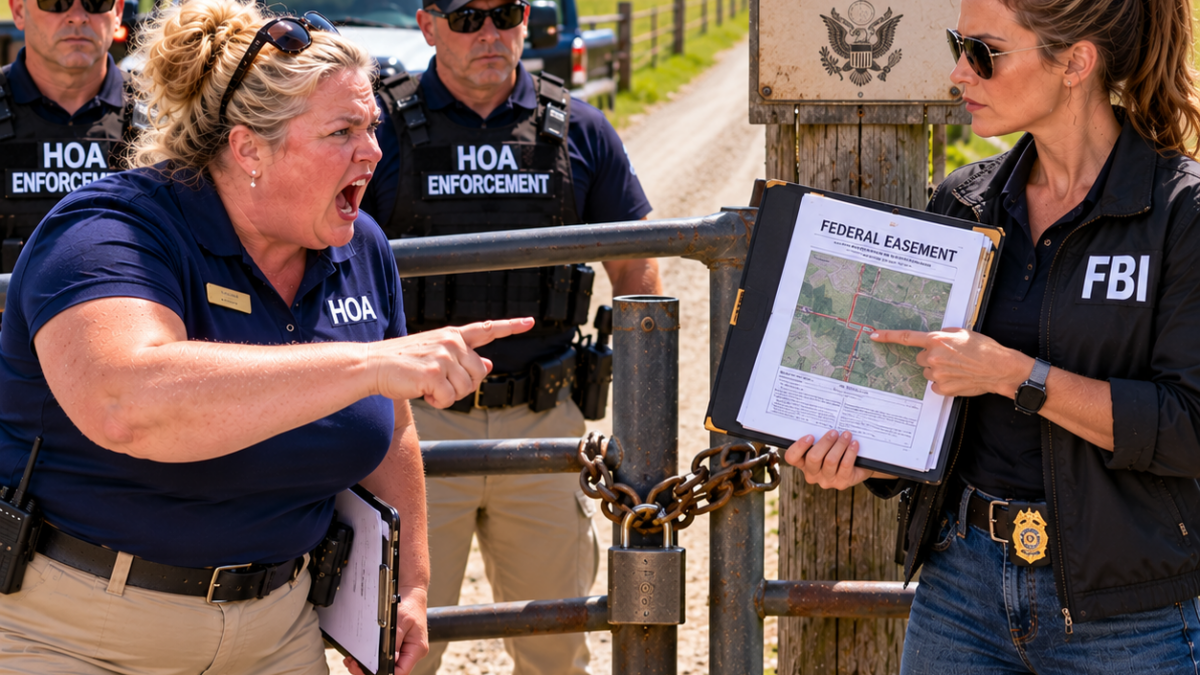
The HOA locked the only road to my 300-acre farm on the morning we were supposed to begin a $400,000 soybean harvest, leaving four combines stranded outside the gate while a storm capable of destroying half the crop moved toward us.
When my seventy-eight-year-old father’s oxygen delivery was turned away by the same guard, HOA president Vivian Archer looked me in the eye and said the road belonged to her community now—and maybe losing the farm would finally convince me to sell.
By midnight, with my lender already warning me about default and rain less than thirty-six hours away, Dad called me to his bedside and told me there was something hidden beneath the third floorboard of our barn that my grandfather had ordered him never to touch unless somebody locked that gate.
My family had farmed Calhoun Ridge for more than seventy years.
The farm existed before Willow Crest Estates, before the iron entrance gate, before anyone started calling our road “private community property.”
Calhoun Ridge Road was our only practical access.
When Willow Crest was developed around us in 1998, nobody objected to our using it.
For twenty-five years, I drove tractors through that neighborhood.
Dad drove through.
Seed trucks came through.
Veterinarians came through.
Fuel deliveries came through.
We waved at residents.
They waved back.
Then Vivian Archer became HOA president.
Three months later, everything changed.
Harvest morning started before sunrise.
Manny Salazar, who had worked our fields for fourteen seasons, had four combines lined up behind my pickup.
Dark clouds were already forming far west of us.
“Two clean days,” Manny said through my open window. “Maybe less.”
“I know.”
I pulled to the Willow Crest gate and entered the code I had used for ten years.
Red light.
I tried again.
Red.
A security guard stepped out.
“Access denied.”
I stared at him.
“My farm is through there.”
He checked a clipboard.
“Your property isn’t on the authorized-resident list.”
“I’m not a resident. I own the farm behind the subdivision.”
“Orders from the board.”
Manny climbed down from his truck.
“What’s going on?”
Before I could answer, a white SUV approached from inside Willow Crest.
Vivian stepped out wearing a red blazer, pearls, and a gold HOA badge that looked official until you remembered an HOA badge had roughly the legal power of a grocery-store rewards card.
“Mr. Calhoun,” she said.
“Open the gate.”
“This road is for Willow Crest residents.”
“It’s the only access to my farm.”
“That is unfortunate.”
“You know we’ve used this road for decades.”
“Previous boards were overly accommodating.”
I stared at her.
“My combines are sitting on a county road.”
She glanced past me.
“Then perhaps you should reconsider what you’re doing with the property.”
That sentence brought back a letter I had thrown into my desk drawer one month earlier.
Ridgeline Land Partners.
An offer to buy all 300 acres for less than half what the farm was worth.
I had rejected it without a second thought.
Now Vivian stood between me and the harvest.
“Are you trying to force me to sell?”
She smiled.
“You’re being dramatic.”
Two sheriff’s cruisers arrived.
Vivian immediately pointed at me.
“He’s trespassing.”
Deputy Vaughn stepped between us.
“We’re keeping the peace.”
“This is private HOA property,” Vivian snapped. “Remove him.”
The deputy looked at the gate, then at me.
“This sounds like an access dispute. Civil issue.”
Vivian folded her arms.
“Then he can resolve it from outside.”
Behind me, Manny’s operators began shutting down equipment.
My phone rang.
Dad.
His voice was thin.
“Bo, the nurse can’t get in.”
My stomach dropped.
“What?”
“They stopped her.”
Then he said the words that changed the entire morning.
“The oxygen truck turned around too.”
Dad had undergone heart surgery less than two weeks earlier.
His oxygen wasn’t optional.
I called 911.
When the ambulance arrived, the HOA guard hesitated before opening the gate.
Deputy Vaughn walked up, took the remote from him, and opened it himself.
“I’m not delaying medical care over an HOA dispute.”
Vivian screamed that he had no authority.
The ambulance went through anyway.
The combines didn’t.
By afternoon, we were still locked out.
Manny stood beside me watching storm clouds build.
“If we don’t start tomorrow morning, we could lose half the crop.”
Two hundred thousand dollars.
Gone.
That evening, another envelope arrived.
My lender.
PRE-DEFAULT NOTICE.
The access dispute had been reported to them two days before Vivian locked the gate.
I read that date three times.
Someone had known exactly what the lockout would do to us.
At 11:38 that night, Dad called from his bedroom.
“Bo.”
I sat beside him.
His breathing was steady now.
“Your grandfather made me promise something in 1998.”
“What?”
“In the barn.”
He gripped my wrist.
“Third floorboard from the door. There’s a steel tube underneath it.”
I stared at him.
“What’s inside?”
Dad looked toward the dark window.
“The reason he told me never to worry about anyone locking that road.”
PART 2
I was halfway to the barn before I realized I had forgotten my flashlight.
The yard was black except for the porch light behind me and the distant glow from Willow Crest beyond the trees.
I went back.
Dad was sitting upright in bed when I passed his room.
“You know which board?” I asked.
“Third one from the big sliding door.”
“That floor has fifty boards.”
“Third.”
“You sure?”
He gave me the look he had been using on me since I was twelve.
“Bo.”
“Right.”
I grabbed a flashlight and crowbar.
The barn had stood on Calhoun Ridge longer than I had.
Grandpa built part of it himself and expanded it when Dad was a teenager.
The floor creaked in familiar places.
I counted from the sliding door.
One.
Two.
Three.
The third plank looked exactly like the others.
I wedged the crowbar into the seam.
Nothing.
Tried the other side.
The board lifted half an inch.
Beneath it was packed dust and something metallic.
My pulse changed.
I pulled the plank free.
A rusted steel tube lay between two joists.
About three feet long.
Both ends capped.
I dragged it out.
Grandpa had wrapped part of it in oily canvas.
The canvas practically dissolved in my hands.
One cap took several minutes to loosen.
Inside was a rolled document wrapped in waxed paper.
And a folded note.
The paper had yellowed.
A blue federal seal sat near the bottom.
The heading read:
FEDERAL AID FARM ACCESS AGREEMENT — 1952.
I stopped breathing for a second.
My grandfather’s name appeared in the first paragraph.
Caleb Calhoun.
The United States government.
County representatives.
A right-of-way.
Permanent access.
Calhoun Ridge parcel.
I took the papers into the house.
Dad was waiting.
“You found it.”
“What is this?”
He looked at the document.
“Your grandfather called it insurance.”
“Against what?”
“Progress.”
That sounded exactly like Grandpa.
I sat beside Dad.
“Why didn’t you tell me about it?”
“I forgot.”
“You forgot a federal document was under the barn floor?”
“I’m seventy-eight.”
“Dad.”
He smiled weakly.
“I remembered the road part.”
He took the handwritten note.
His father’s handwriting had faded but remained readable.
Edward—
The government paid us to allow the road project to connect Route 12 with the ridge farms. Access to our parcel remains permanent. If anyone ever closes this road against Calhoun land, find the original county plat and the federal agreement. Do not argue at a gate. Read the deed.
A road is a promise.
—Dad
I read it twice.
“What does ‘read the deed’ mean?”
Dad shook his head.
“Grandpa never explained.”
“You never checked?”
“Nobody ever locked us out.”
Fair.
I called my attorney, Howard Winters.
At 12:17 a.m.
He answered sounding half dead.
“Someone better be injured.”
“No.”
“Then someone better have discovered oil.”
“Federal easement.”
Silence.
“What?”
I read him the heading.
He woke up immediately.
“Do not text me photographs.”
“Why?”
“I want scans first thing in the morning and I want the originals protected.”
“They’re already seventy years old.”
“That is not the concern.”
“Okay.”
“County records office opens at eight.”
“I’ll be there.”
“Bo?”
“Yes?”
“Do not confront Vivian tonight.”
“I wasn’t planning to.”
“That means you were.”
“I’m hanging up.”
“Do not lose that document.”
I put the original in Dad’s fireproof safe.
Then I copied everything.
At 2:00 a.m., I was still awake.
The lender’s pre-default notice lay beside Grandpa’s note.
That date kept bothering me.
Monday.
Two days before the gate closure.
Why would a lender know about an access problem before I did?
I pulled Ridgeline Land Partners’ offer from my desk.
The letter was dated five weeks earlier.
Their purchase deadline had expired.
At the bottom:
Offer subject to title and access review.
Access.
Maybe coincidence.
But I no longer believed in convenient coincidences where Vivian Archer was concerned.
At 7:40 the next morning, I left Dad with his nurse.
Deputy Vaughn had arranged for medical deliveries to pass through temporarily.
Farm equipment remained blocked.
The storm forecast had worsened.
Rain beginning sometime between late afternoon Wednesday and early Thursday.
We had perhaps twenty-six hours.
County recorder Doris Mayer met me behind the counter.
She was in her sixties, glasses hanging from a chain, the sort of person who seemed personally offended by badly organized public records.
“I need the original Willow Crest subdivision plat from 1998.”
“Phase one?”
“Everything involving Calhoun Ridge Road.”
She typed.
Then looked at me.
“Calhoun?”
“Yes.”
“Farm?”
“Yes.”
Her expression changed slightly.
“Give me a minute.”
She disappeared into the records room.
Returned pushing a large archival book.
She opened it carefully.
Willow Crest Estates.
Recorded 1998.
Road dedication.
Utility easements.
Drainage.
I found Calhoun Ridge Road.
There it was.
A notation beside the road corridor:
DEDICATION SUBJECT TO EXISTING PERPETUAL FEDERAL FARM ACCESS EASEMENT SERVING PARCEL 7.
“Parcel seven?”
Doris turned pages.
Parcel seven was my farm.
I stared.
“This has been here since 1998?”
“Yes.”
“Then how can an HOA call the road resident-only?”
Doris frowned.
“They can call it whatever they want.”
“Legally?”
“I didn’t say that.”
Good answer.
I photographed the page.
Then noticed something odd.
Page three.
Then page six.
“Where are four and five?”
Doris looked down.
Turned backward.
Forward.
She frowned harder.
“That’s not right.”
“You sure?”
“The archival plats are sequential.”
She checked the binding.
Two sheets had been removed.
Not torn accidentally.
Removed cleanly.
Doris looked genuinely unsettled.
“When was this book last accessed?”
“I’d have to check the log.”
She disappeared again.
Came back holding a checkout register.
“Last Tuesday.”
“By who?”
“A law firm runner.”
“Which firm?”
She pointed.
Barton, Hale & Archer.
I stared at the last name.
“Archer?”
“Could be unrelated.”
Could be.
Doris was already moving.
“Microfilm.”
“What?”
“We have backup.”
Ten minutes later, she fed an old reel into a reader.
Pages four and five appeared.
She printed them.
I read the first paragraph.
Then the second.
Then the clause near the bottom.
If access serving Parcel 7 was ever substantially obstructed, discontinued, or restricted by the subsequent private development, the road corridor serving said parcel would revert according to the underlying grant terms and recorded federal agreement.
I read it again.
“Doris.”
“Yes?”
“If I understand this…”
“I’m not giving legal advice.”
“Of course.”
“But?”
She looked at the page.
“You need your lawyer.”
Howard Winters read the documents in silence.
His office smelled like coffee and old books.
He removed his glasses.
Cleaned them.
Put them back on.
Then said:
“Bo.”
“That tone isn’t comforting.”
“This is either very good or very complicated.”
“Pick good.”
“The 1952 agreement appears to establish a perpetual access easement tied to your parcel.”
“I got that part.”
“The 1998 plat expressly preserves it.”
“Also got that.”
He tapped the missing pages.
“And this reversion language may mean the underlying road interest shifts back if the development blocks your access.”
“Meaning?”
“Possibly that Willow Crest just lost control of the very road it locked.”
I leaned back.
“How possibly?”
“Because seventy-year-old land records are not fortune cookies.”
“What?”
“They require title analysis.”
“Can we open the gate?”
“Not yet.”
“My crop is sitting there.”
“I know.”
“Rain is coming.”
“I know.”
“My father needs medical access.”
“That part helps establish emergency harm.”
Howard pulled the lender letter toward him.
“Where did this come from?”
“Yesterday.”
His eyes stopped on the date.
“Monday.”
“Yes.”
“Gate closed Wednesday.”
“Yes.”
“Why did your lender know about an access dispute Monday?”
“That’s what I’d like to know.”
Howard read Ridgeline’s old offer.
Then he asked:
“Who owns Ridgeline Land Partners?”
“I haven’t checked.”
“Do that while I draft.”
“Draft what?”
“Emergency motion.”
“For state court?”
He looked at the federal agreement.
“Maybe not.”
Two hours later, Howard had contacted a title specialist.
The preliminary opinion was stronger than I expected.
The access right had never been extinguished.
Willow Crest’s 1998 development approvals were conditioned on preserving farm access.
The road could not legally be converted into resident-only access against Parcel 7.
More importantly, the reversion clause had teeth.
Whether it transferred full road ownership immediately would eventually require a court ruling.
But we had more than enough for emergency relief.
Howard filed in federal court because the original agreement arose from a federal-aid right-of-way instrument and the requested relief implicated that recorded federal interest.
I called Manny.
“Status?”
“Machines ready.”
“How fast can you start if the gate opens?”
“Ten minutes.”
“How fast can we finish?”
“With four combines?”
“Push hard.”
He exhaled.
“Twenty hours if nothing breaks.”
“We may have less.”
“Then we don’t stop.”
I drove home.
A man was waiting near my mailbox.
Walt Brewer.
Eighty years old.
Willow Crest resident.
Former grain buyer.
He had known Dad before the subdivision existed.
Walt looked toward the HOA gate before walking closer.
“Bo.”
“Walt.”
“I probably shouldn’t be here.”
“That’s a promising opening.”
He did not smile.
“Vivian’s been moving money.”
“What money?”
“HOA reserve.”
“For what?”
“Consulting.”
“Road security.”
“Legal.”
He lowered his voice.
“And Ridgeline.”
I felt my stomach tighten.
“What about Ridgeline?”
“Registered to her sister.”
“How do you know?”
“I saw corporate paperwork on Vivian’s desk.”
“Why were you in her office?”
“I’m on the finance committee.”
That changed things.
Walt pulled a folded photocopy from his jacket.
Arizona corporate registration.
RIDGELINE LAND PARTNERS LLC.
Managing member:
Lydia Archer.
Vivian’s younger sister.
I looked at Walt.
“Why give me this?”
“Because your dad helped me after my wife died.”
He swallowed.
“And because something smells wrong.”
“Did Vivian use HOA money for Ridgeline?”
“I can’t prove that.”
“Then don’t say it.”
Walt nodded.
“But I saw payments to a consulting company with the same mailing address.”
“How much?”
“About forty-two thousand this year.”
“Copies?”
“Not yet.”
“Don’t steal anything.”
“I’m eighty.”
“That isn’t a defense.”
He almost smiled.
“I can request records legally.”
“Do that.”
Walt looked toward the farm.
“How bad is the crop situation?”
“Very.”
“They know?”
“Yes.”
“Bo…”
“What?”
“They held a closed board session Sunday.”
“Before the lockout?”
“Yes.”
“What about?”
“I wasn’t invited.”
“Anything afterward?”
“Vivian told security to expect ‘agricultural resistance.’”
That phrase made my jaw tighten.
“Agricultural resistance?”
Walt shrugged.
“She talks like she’s invading France.”
Before he left, he touched my shoulder.
“Your grandfather used to say the road belonged to whoever needed to get home.”
I looked at him.
“Dad showed me a note saying almost the same thing.”
Walt smiled.
“Sounds like Caleb.”
At 4:15, Howard called.
“Federal judge wants a hearing tonight.”
“How tonight?”
“Emergency motions move quickly when you document crop loss and medical access.”
“When?”
“Eight.”
“Where?”
“Video conference.”
“What do you need?”
“You.”
The hearing lasted ninety minutes.
Vivian appeared with HOA counsel.
She looked very different on a courtroom screen.
No gold badge.
No guard.
No gate.
Just a woman at a conference table.
Howard presented the 1952 agreement.
The 1998 plat.
Medical delay.
Crop timeline.
Lender letter.
The HOA attorney argued that Willow Crest owned and maintained the road.
Howard replied:
“Maintenance does not extinguish a recorded superior access right.”
The judge asked the HOA lawyer:
“Do you dispute that Parcel 7 has historically accessed the property through this road?”
“No, Your Honor.”
“Do you dispute the easement notation on the recorded plat?”
“We dispute its present scope.”
“Did the HOA provide notice before disabling access?”
“Our position is that Mr. Calhoun was not entitled to unrestricted use of a private residential road.”
The judge leaned forward.
“His family has used it for twenty-five years under your subdivision?”
“Yes.”
“Before that?”
“The road predates the subdivision.”
The judge looked at the lender notice.
“Why is there evidence a third party knew of the access restriction before Mr. Calhoun?”
The HOA attorney hesitated.
“I can’t answer that tonight.”
Neither could I.
At 11:40 p.m., Howard called.
“Order signed.”
I stood from the kitchen table so fast my chair hit the wall.
“What does it say?”
“Immediate temporary restoration of access pending full title determination.”
“So we harvest?”
“Yes.”
“Who opens the gate?”
Howard paused.
“Federal court directed enforcement assistance because of the recorded federal interest.”
“What does that mean in English?”
“United States Marshals Service will be there at nine.”
I stared at him through the phone.
“You’re serious.”
“Very.”
“Why nine?”
“Because that’s when the marshal assigned to execute the order can coordinate with local deputies.”
“Rain may start by afternoon.”
“Then tell Manny to be ready.”
I hung up.
Dad was awake.
He had heard enough.
“Gate opens?”
“At nine.”
“How?”
“Federal court order.”
He smiled.
“Your grandfather would enjoy that.”
“I think Grandpa has caused me enough trouble for one day.”
Dad reached for his old note.
“A road is a promise.”
“Yeah.”
“Don’t forget the rest.”
I knew.
Not for yourself.
For everyone who needs to get home.
At 8:40 the next morning, Manny’s combines lined Route 12.
The clouds had gone from gray to nearly black along the western horizon.
Humidity clung to everything.
The Willow Crest gate remained locked.
A white HOA security SUV was parked sideways behind it.
Vivian stood on the inside.
Red blazer again.
Pearls.
Two guards.
Deputies Vaughn and Dell had arrived.
Vaughn looked miserable.
Vivian shouted across the bars:
“You are not entering this community.”
I kept my hands in my pockets.
“I’m going to my farm.”
“You are legally prohibited from using Willow Crest roads.”
“Not today.”
She pointed.
“If he steps through this gate, arrest him.”
Deputy Vaughn looked at her.
“Ma’am, I’m not taking instructions from an HOA president.”
“You’re here at our request.”
“We’re here to keep the peace.”
Vivian’s face reddened.
A dark government SUV turned onto Route 12.
Then another.
The lead vehicle stopped near the gate.
A woman stepped out wearing a navy jacket.
Large yellow letters across the back:
U.S. MARSHALS.
Deputy Marshal Elena Marquez walked toward the gate holding a folded court order.
Conversation stopped.
Even Vivian.
Marquez reached the bars.
“Who controls the gate?”
The guard looked at Vivian.
Marquez followed his eyes.
“Mrs. Archer?”
Vivian recovered.
“Yes.”
Marquez held up the order.
“This is a federal court order directing immediate restoration of access to Parcel 7 through Calhoun Ridge Road.”
Vivian’s chin lifted.
“This road is privately owned.”
“That issue is before the court.”
“You cannot simply—”
Marquez interrupted.
“I’m not here to litigate ownership.”
She pointed toward the gate.
“I’m here to execute this order.”
Vivian looked at the deputies.
Neither moved.
“You’re obstructing private property.”
Marquez’s voice did not change.
“Open the gate.”
“This HOA has regulations.”
“Open the gate.”
“You don’t understand our security concerns.”
Marquez stepped slightly closer.
“Mrs. Archer, I will not debate your HOA policies on the side of the road.”
Silence.
“The court has ordered access.”
She looked at the guard.
“If you control the mechanism, activate it.”
The guard swallowed.
Vivian snapped:
“Don’t.”
Marquez looked back at her.
“Ma’am, do not instruct someone to disobey a federal order.”
For the first time since this started, Vivian looked uncertain.
Really uncertain.
Her hand moved toward the guard’s remote.
Then stopped.
“Open it,” she hissed.
The guard pressed the button.
The gate moved.
Slowly.
Black iron separating in the middle.
For twenty-five years, I had driven through without thinking.
That morning, watching it open felt like breathing after being underwater.
Marquez stepped aside.
“Mr. Calhoun?”
“Yes.”
“Proceed directly to your property.”
Manny radioed:
“Boss?”
I turned.
“Bring them in.”
Four combine harvesters rolled forward.
Then grain trucks.
Fuel support.
Crew vehicles.
The sound filled Willow Crest.
Residents came outside.
Some watched silently.
Some recorded.
Walt Brewer stood near his mailbox.
He took off his cap.
Then started clapping.
One person joined.
Then another.
I did not enjoy Vivian’s face.
Not exactly.
I was too focused on the clock.
We had fields to cut.
I climbed into my truck.
Marquez stopped me.
“Mr. Calhoun.”
“Yes?”
“That restores access.”
“I know.”
“It doesn’t resolve everything else.”
“I know.”
She nodded toward a gray sedan pulling up behind the marshal vehicles.
“And apparently you have more problems.”
A man stepped out.
Dark suit.
Federal credentials.
He introduced himself as Special Agent Greg Hollander.
FBI.
My first thought was that somebody had made a mistake.
“My attorney sent your office the missing plat pages?”
“Yes.”
“Why is the FBI interested in my road?”
“Not the road.”
He opened a folder.
“Ridgeline Land Partners.”
I looked toward Vivian.
She had begun walking toward her SUV.
Hollander continued.
“We’ve been reviewing financial activity connected to Ridgeline for approximately two weeks.”
“Before my lockout?”
“Yes.”
“How?”
“Separate complaint.”
He showed me a corporate page.
Vivian Archer’s name appeared in email metadata attached to a financing file.
Then her sister.
Lydia Archer.
Then a development company.
The plan came together in pieces.
Ridgeline had approached my lender months earlier regarding possible acquisition if the Calhoun property entered default or foreclosure.
That alone could have been legitimate business scouting.
But the investigation had uncovered communications suggesting something much more deliberate.
Disable access.
Interrupt harvest.
Trigger financial distress.
Acquire the farm cheaply.
Package it with adjacent development rights.
Sell the assembled land to a developer planning a third phase of Willow Crest.
Potential future value:
Around twelve million dollars.
I looked at Hollander.
“You’re telling me she locked my road to bankrupt the farm.”
“I’m telling you that is the theory investigators are evaluating based on communications and financial records.”
Careful language.
Good.
“Do you have evidence?”
He showed me an email.
From an account tied to Vivian.
To the gate contractor.
Disable Parcel 7 access code effective 12th.
Do not issue replacement credentials without board authorization.
Another email referenced “harvest pressure.”
My hands tightened around the folder.
Then Hollander showed me something worse.
A payment record.
Five thousand dollars.
To the HOA guard captain.
The same captain who controlled access records.
“For what?”
“We’re determining that.”
“Missing county pages?”
Hollander looked at me.
“One individual has agreed to cooperate.”
I understood.
Vivian reached her SUV.
Marquez called:
“Mrs. Archer.”
Vivian ignored her.
Opened the door.
Hollander said:
“Mrs. Archer, we need to speak with you.”
She got inside.
The engine started.
Two marshal vehicles were positioned near the exit because of the court-order operation.
Vivian stopped.
Not a chase.
No dramatic crash.
No reason for one.
Marquez approached the driver’s side.
“Mrs. Archer, turn the vehicle off.”
Vivian stared straight ahead.
Then complied.
She stepped out.
The pearl necklace snagged briefly on the door frame.
The string broke.
Pearls hit the pavement.
Tiny white beads bounced between her shoes.
For one absurd second, everyone looked down.
Then Hollander identified himself formally.
The agents took over.
I did not stay.
Manny’s radio cracked.
“Bo, we burning daylight or what?”
I looked toward the fields.
“Harvest.”
I drove home.
Dad stood on the porch with his oxygen tubing in place.
He lifted one hand as the first combine came through.
Manny honked.
Dad laughed.
That sound was better than any arrest.
We started cutting.
Four combines.
Three hundred acres.
No breaks except fuel and mechanical checks.
The storm accelerated.
Weather radar showed the front reaching us around dusk.
Manny ran the operation like a military campaign.
“North field first.”
“Why?”
“Lowest ground.”
“Then west.”
“Truck three to elevator.”
“Truck five standby.”
Neighbors from Willow Crest began showing up.
At first, I was suspicious.
Walt arrived with bottled water.
Then a family brought sandwiches.
A teenager volunteered to move empty coolers.
One retired farmer offered to drive a grain truck.
Manny looked at me.
“You know him?”
“No.”
“Can he drive?”
The old man yelled:
“I harvested corn before you were born!”
Manny shrugged.
“Qualified.”
The sky darkened.
Rows disappeared behind us.
Soybeans poured into hoppers.
Dust hung in the air.
Every time a combine unloaded, I did math.
Acres remaining.
Minutes remaining.
Rain distance.
At 3:30, one machine threw a belt.
Manny swore.
I jumped down.
“Time?”
“Twenty minutes if we have the part.”
“We do?”
He looked toward his service truck.
“If God loves farmers.”
Apparently God had a spare belt.
Eighteen minutes.
Back running.
Dad watched from the porch.
Nurse beside him.
At one point he called me over.
“You’re limping.”
“I’m fine.”
“You look terrible.”
“Thank you.”
“Eat.”
“I will.”
“Now.”
Even with federal agents on the road and a storm destroying my future, I remained twelve years old around my father.
I ate half a sandwich.
At 5:47, rain appeared on the western ridge.
Not falling here yet.
Visible curtain.
Manny’s voice came over the radio.
“Forty acres.”
We pushed.
Neighbors held flashlights near equipment staging areas as daylight vanished.
Thirty acres.
Twenty.
Ten.
The first drop hit my windshield at 6:31.
Big.
Cold.
I radioed:
“How much?”
Manny answered:
“Last pass.”
The final combine moved through the soybeans.
Rain began tapping faster.
Then the header reached the end of the row.
Manny lifted it.
“Field clear.”
I leaned my forehead against the steering wheel.
Three hundred acres.
Saved.
Every last harvestable section.
Rain exploded across the windshield seconds later.
The crew cheered over the radio.
I laughed.
Then cried.
Not dramatically.
Just sat there while relief came out however it wanted.
When I returned to the house, Dad was holding Grandpa’s note.
Power had flickered.
We sat under a kitchen light while rain hammered the roof.
Dad read the final lines aloud.
“A road is not property. A road is a promise. If someone locks it, you must unlock it. Not for yourself, but for everyone who needs to get home.”
His voice cracked.
I looked at him.
“Grandpa was dramatic.”
“He was right.”
“Sometimes.”
Dad folded the note.
“You saved the farm.”
“We saved the crop.”
“No.”
He shook his head.
“The farm.”
The next weeks became less cinematic.
Court filings.
Interviews.
Board records.
Bank records.
Title research.
Federal and local investigations.
The story people wanted was simple.
Greedy HOA president locks farmer out.
Farmer finds federal easement.
Federal government crushes HOA.
Reality was messier.
Willow Crest residents had not conspired against me.
Most knew nothing.
Some board members believed Vivian’s claim that agricultural traffic posed security concerns.
Others were told my farm was already under negotiation for sale.
Some believed the road easement had expired.
Several had never seen the 1998 pages.
The gate guards largely followed instructions.
One guard captain knew more.
Much more.
According to investigators, he admitted receiving cash connected to changing access records and removing county pages.
The county recovered the missing original pages during execution of a lawful search.
Doris cried when they returned.
Not because she loved paper.
Actually, she did love paper.
But because public records are supposed to survive powerful people.
Howard called me after the documents were restored.
“Good news.”
“What?”
“The originals match the microfilm.”
“We knew that.”
“Courts enjoy originals.”
“What about the road?”
“Title hearing in two weeks.”
“And the reversion?”
“Strong.”
“How strong?”
“Stop asking lawyers for percentages.”
“Seventy?”
“I’m hanging up.”
The lender withdrew its pre-default notice after Howard sent the federal order and documentation showing the access disruption had been wrongfully imposed.
That alone saved me months of financial panic.
The loan officer apologized.
I asked:
“How did your bank know about the access issue Monday?”
Silence.
Then:
“We received notice from a prospective purchaser that access might become impaired.”
“Ridgeline?”
Another pause.
“Yes.”
There it was.
Ridgeline had contacted my lender before I was locked out.
Not afterward.
Before.
That fact became significant in the fraud investigation.
Walt obtained HOA financial records lawfully through his committee role and formal member requests.
Payments to consultants.
Security vendor changes.
Legal retainers.
A series of transfers connected to companies sharing addresses or business relationships with Ridgeline affiliates.
Not all criminal.
Some legitimate expenses.
Some suspicious.
Investigators separated them.
I learned quickly to stop using words like “stolen” unless a prosecutor used them first.
Evidence is stronger when you don’t oversell it.
The HOA held an emergency meeting.
Vivian could not attend because the board had suspended her pending investigation and she faced release conditions that limited certain contacts.
I went.
Not because I wanted revenge.
Because the road was literally connected to my property.
The clubhouse was packed.
Walt sat at the front.
The old board president pro tem opened.
Before he finished his first paragraph, people started shouting.
“Did she use our dues?”
“Who knew?”
“Why was the farmer locked out?”
“Is the road ours?”
“Are we losing our entrance?”
That last question changed the room.
People finally understood that Vivian may have endangered them too.
If the reversion clause was enforced broadly, Calhoun Ridge Road might no longer be under HOA control.
Their gate.
Their entrance.
Their assumption of ownership.
Potentially gone.
I stood.
The room quieted slowly.
A woman asked:
“Are you going to close our road?”
“No.”
That surprised them.
Another resident:
“If you win ownership?”
“I said no.”
“Charge tolls?”
“No.”
“Then what do you want?”
I looked around.
“My father’s nurse to reach him.”
Silence.
“My harvest equipment to reach the farm.”
More silence.
“My lender not to receive advance notice that someone plans to destroy my access.”
Nobody spoke.
“And nobody should ever be able to lock that gate against people who have a legal right to get home.”
Walt nodded.
A younger man stood.
“My wife called you greedy online.”
“That happens.”
“She wants to apologize.”
“She doesn’t have to.”
“She should.”
I shrugged.
“We had a wildfire last year.”
Another resident said.
“I know.”
“We worry about security.”
“I understand.”
“So what happens?”
“I don’t know yet.”
That was honest.
Federal court answered three weeks later.
The judge ruled that the 1952 access agreement remained valid and had been explicitly preserved in Willow Crest’s 1998 plat.
The HOA’s unilateral lockout violated that access right.
The court also gave effect to the reversion language as it applied to the road interest serving the farm.
Howard called me before I received the written order.
“You own it.”
I sat down.
“The whole road?”
“The controlling underlying road interest subject to existing public and private rights.”
“That was extremely lawyer.”
“You asked an extremely title-law question.”
“Can the HOA lock it?”
“No.”
“Can I?”
He paused.
“Technically, you now have substantial control, but there are existing rights and emergency considerations.”
“Howard.”
“What?”
“I’m not locking it.”
“Good.”
“What about damages?”
“Separate issue.”
The civil settlement followed.
Crop-loss risk.
Medical-access delay.
Legal fees.
Damage tied to the wrongful lockout.
Investigation-related costs where recoverable.
The HOA’s insurer and association ultimately agreed to payments exceeding six hundred thousand dollars across covered damages, fees, and related claims.
I did not treat that money like a prize.
Some went to legal expenses.
Some stabilized the farm loan.
Some covered operational losses created by the disruption.
I set aside part for Dad’s medical care.
The association itself suffered financially.
That bothered me.
Residents paid dues.
Most had done nothing wrong.
Which is why the next decision mattered.
Howard called.
“Ready to record your ownership documents?”
“Yes.”
“What restrictions do you want?”
“None that allow another gate lockout.”
“Be precise.”
I had thought about Grandpa’s note for weeks.
A road is a promise.
“I want a permanent easement.”
“For whom?”
“Public access consistent with lawful road use.”
Howard was silent.
“You understand you could retain much more exclusive control?”
“Yes.”
“You could negotiate substantial HOA payments.”
“I already have settlement compensation.”
“You could charge for certain rights.”
“No.”
“Bo.”
“What?”
“I am ethically required to make sure you understand you are giving away value.”
“I understand.”
“Why?”
I looked through my window.
A Willow Crest resident drove past on the road.
Then another.
Dad sat on the porch.
He raised one hand.
The driver waved.
“Because Grandpa was right.”
Howard sighed.
“I hate sentimental clients.”
“You love billing us.”
“That too.”
We recorded a permanent easement designed to ensure the road could not be locked against lawful access again.
The old HOA gate came down.
A new traffic-control system remained for safety and emergency purposes, but it could not be used to exclude the farm or eliminate the rights established in the recorded documents.
A sign went up.
CALHOUN RIDGE ROAD
OPEN ACCESS — RECORDED EASEMENT
Dad hated the wording.
“Sounds like a government form.”
“It is.”
“Grandpa’s line would be better.”
“What?”
“A road is a promise.”
“We are not putting poetry on a road sign.”
Dad eventually convinced Walt.
A smaller plaque appeared beneath it.
A ROAD IS A PROMISE.
I pretended to be annoyed.
I liked it.
The criminal cases developed over months.
Vivian’s situation was more serious than an HOA dispute.
Federal prosecutors alleged she participated in a coordinated effort involving Ridgeline Land Partners, financial pressure, access manipulation, and interference with public records.
Her sister faced charges tied to the shell company and transaction plan.
The guard captain cooperated.
That cooperation mattered.
Emails mattered more.
Disable code for Parcel 7.
Harvest pressure.
Foreclosure timing.
Acquisition projections.
The government argued the plan depended on creating enough financial distress that I either accepted Ridgeline’s offer or lost the property through default.
The hoped-for development value after acquisition was enormous.
Millions.
That gave motive a number.
Vivian eventually entered a guilty plea to conspiracy and fraud-related charges, along with responsibility connected to record interference established by the investigation.
Her sister negotiated a plea.
The guard captain did too.
I did not attend every hearing.
I attended the one where Vivian entered her plea.
Red blazer gone.
No gold HOA badge.
She looked smaller.
Not physically.
Contextually.
A courtroom reduces titles.
HOA president.
Farmer.
Developer.
Guard.
All become names before a judge.
After the hearing, she passed me in a hallway.
For a moment, we stopped.
Her attorney stood beside her.
Mine stood beside me.
Vivian looked at me.
“You destroyed me.”
I almost answered angrily.
Then remembered the gate.
Dad’s oxygen.
The lender notice dated Monday.
Grandpa’s steel tube.
I said:
“No.”
She stared.
“You made choices before I even knew there was a fight.”
Her jaw tightened.
“You could have sold.”
“There it is.”
“What?”
“The part you still don’t understand.”
I stepped aside.
“My farm was never yours to decide.”
That was the last conversation we had.
Willow Crest’s entire board resigned or cycled out during the following months.
Not because every member had committed wrongdoing.
Several simply understood the community needed a clean start.
Walt Brewer somehow became interim president.
At eighty.
I laughed when he told me.
“You’re insane.”
“They nominated me while I was in the bathroom.”
“That’s democracy.”
“I hate meetings.”
“You gave me corporate documents in a parking lot.”
“That was different.”
“No.”
His first board meeting lasted four hours.
I called Dad afterward.
“How’d Walt do?”
“Terrible.”
“Good.”
“He forgot the agenda.”
“Better.”
“But nobody stole a farm.”
“Progress.”
The new board hired independent counsel.
Audited finances.
Reviewed vendor contracts.
Separated gate security from HOA leadership.
Required conflict disclosures.
Created formal access policies.
Most importantly, they stopped treating Calhoun Ridge Farm like an inconvenient hole in their subdivision map.
We became neighbors again.
Not immediately.
Trust is slower than court orders.
Some residents still blamed me for the settlement.
I understood.
Their dues increased.
Insurance premiums changed.
Their president’s misconduct cost the community.
One man confronted me at the feed store.
“My HOA bill went up because of you.”
“No.”
He frowned.
“You got six hundred grand.”
“I didn’t lock my own road.”
“You could’ve settled quietly.”
“We did settle.”
“You know what I mean.”
I did.
He wanted the consequences without public embarrassment.
“Your president tried to force my farm into default.”
He looked away.
“That wasn’t us.”
“I know.”
That answer surprised him.
I continued.
“I don’t blame you.”
His posture softened slightly.
“Then why make us pay?”
“I didn’t decide insurance coverage or association liability.”
He nodded reluctantly.
“Still hurts.”
“I know.”
That conversation helped me understand the cost of accountability.
When leaders abuse shared institutions, innocent people often inherit part of the bill.
That is why oversight matters before the crisis.
Six months after harvest, Dad returned to ordinary routines.
His heart improved.
Oxygen use decreased.
The nurse drove in without problems.
Every Tuesday, a medical delivery van came up Calhoun Ridge Road.
Nobody stopped it.
Dad sat on the porch most evenings.
He became obsessed with watching cars.
“Why?”
I asked.
“To see if the road works.”
“It is a road.”
“That’s the point.”
Spring came.
Then planting.
The first seed trucks approached the entrance.
I still felt tension when I saw them.
Old memory.
Gate.
Red light.
Access denied.
But there was no locked gate anymore.
The trucks rolled through.
Manny followed in his pickup.
He stopped beside me.
“Feels weird.”
“What?”
“No argument.”
“Give it time.”
He laughed.
We planted soybeans again.
Not because soybeans were romantic.
Because farms survive by doing the next season’s work.
That was something the legal case almost made me forget.
Court orders saved access.
Federal records saved title.
Investigations stopped the scheme.
But none of those planted a crop.
Manny did.
My crew did.
I did.
Rain came.
Then heat.
Then weeds.
Then equipment repairs.
Ordinary problems.
I loved every one of them.
At the next harvest, Manny lined up the combines outside Willow Crest just to irritate me.
“You could stage inside.”
“I know.”
“Why are we out here?”
“Tradition.”
“This happened once.”
“Exactly.”
He entered the road first.
No red light.
No guard.
No Vivian.
Dad watched from the porch.
Harvest went smoothly.
At dinner, he pulled Grandpa’s note from a plastic sleeve.
“You still carrying that?”
“Yes.”
“Why?”
“Because you’d lose it.”
“It belongs in the safe.”
Dad read the line again.
A road is a promise.
“You know,” he said, “your grandfather probably meant the government agreement.”
“Probably.”
“You made it philosophical.”
“You put it on a sign.”
“That was Walt.”
“You convinced Walt.”
“No evidence.”
I laughed.
Dad looked toward the window.
A car passed.
Someone waved.
He waved back.
“Grandpa would like this.”
“The cars?”
“The fact you didn’t lock them out.”
That had been the biggest temptation.
Not because I wanted revenge forever.
For one angry week, I imagined it.
My road now.
My gate.
My rules.
Vivian had made me wait outside.
I could make Willow Crest wait.
Then Grandpa’s own note ruined the fantasy.
Not for yourself, but for everyone who needs to get home.
Revenge would have made me the next person treating a road like leverage.
I had spent months proving access should not be weaponized.
It would have been absurd to weaponize it myself the moment the law put control in my hands.
So the road stayed open.
Walt asked for permission to organize a neighborhood picnic near the old gate location.
“No.”
“Why?”
“Because that sounds awful.”
“Bo.”
“Fine.”
Families showed up.
Children.
Older residents.
Farm crew.
Even Deputy Vaughn.
Marshal Marquez was invited but working.
Howard came purely because somebody told him there would be barbecue.
I accused him of billing me for attendance.
He denied it.
Doris Mayer from the county recorder’s office brought a framed reproduction of the missing plat pages.
I stared.
“You made me a public-records decoration?”
“Yes.”
“I already framed a federal agreement.”
“Then your house has a theme.”
Dad loved her.
Walt gave a short speech.
Too long, actually.
He thanked residents who demanded the audit.
Deputy Vaughn.
Doris.
Howard.
Manny.
Then me.
I hated that part.
Finally, Dad stood.
Slowly.
Everyone quieted.
“I have one thing to say.”
He held Grandpa’s note.
“My father wrote this in 1952.”
He read:
“A road is not property. A road is a promise. If someone locks it, you must unlock it. Not for yourself, but for everyone who needs to get home.”
Nobody clapped immediately.
Good.
The words needed a second.
Then applause came.
Dad sat.
I looked toward the road.
Children were riding bicycles where Vivian’s SUV had once blocked the gate.
That image stayed with me.
Years later, the farm was still there.
Ridgeline’s development plan never happened.
Phase Three remained soybeans, winter cover crop, drainage ditches, and the stubborn old farmhouse my father refused to leave.
Walt eventually stepped down as HOA president.
He said:
“Never again.”
Residents replaced him with a younger board member who actually enjoyed spreadsheets.
Perfect.
The permanent road easement remained.
The federal agreement remained in the title file.
The old steel tube remained under the barn floor.
Empty now.
I considered throwing it out.
Dad wouldn’t let me.
“Family history.”
“It’s rust.”
“History rusts.”
“That doesn’t even mean anything.”
“It sounded good.”
We kept it.
Grandpa’s original agreement went into professional archival storage.
A copy stayed at home.
A copy with Howard.
A digital copy in three places.
No more hidden-floorboard estate planning in my family.
I made Sam—my own son, by then old enough to understand the case—sit down with me and review every farm-access document.
He complained.
“This is boring.”
“Good.”
“Why good?”
“Boring documents saved the farm.”
He stared.
“You’re turning into Grandpa.”
“Get out.”
He smiled.
Then kept reading.
I showed him the 1952 agreement.
The 1998 plat.
The reversion clause.
The permanent public easement I recorded afterward.
“Why give the road away if the court said we controlled it?”
He asked the same question everyone did.
I pointed at Grandpa’s note.
Sam read it.
Then said:
“That sounds like something Dad would say.”
“Your great-grandfather.”
“I know.”
“Then why’d you say Dad?”
“Because you say the same stuff now.”
I considered grounding him despite his being an adult.
Instead I said:
“Road stays open.”
He nodded.
“Road stays open.”
That mattered.
Property rights are powerful.
So is choosing what to do with them.
Vivian believed ownership meant domination.
Her HOA controlled the gate, therefore she could decide who deserved access.
When the law shifted control back toward my family, I could have repeated the same mistake from the other side.
Instead, we recorded the promise.
No future Calhoun should be able to wake up angry one morning and decide two hundred neighbors can’t get home.
No future HOA president should be able to decide the farmer beyond the ridge has become inconvenient.
The road survives all of us.
That is the point.
Dad lived long enough to watch five more harvests.
His heart never fully recovered, but he remained stubbornly alive.
On his last autumn at the farm, he sat on the porch wrapped in a blanket while combines moved through the field.
I sat beside him.
He was thinner.
Quiet.
But his eyes followed everything.
“Manny still drives too fast.”
“Yes.”
“You still plant too late.”
“No.”
“Yes.”
“You are literally retired.”
“Still know farming.”
A neighbor from Willow Crest drove past.
She waved.
Dad lifted his hand.
Then said:
“Remember when they locked us out?”
“How could I forget?”
“You were mad.”
“I remain charming under pressure.”
“You were impossible.”
“Also hereditary.”
He smiled.
A few minutes passed.
Then:
“Your grandpa knew.”
“What?”
“That somebody would eventually try to control the road.”
“Maybe.”
“Why hide the document?”
“I don’t know.”
Dad looked toward the barn.
“He didn’t trust developers.”
“Smart man.”
“He didn’t hate them.”
“No?”
“No.”
“He hated people who thought paper could erase history.”
I thought about the missing county pages.
The federal agreement.
Ridgeline.
Vivian.
“He was right about that too.”
Dad died the following spring.
Peacefully.
At home.
Not in a hospital.
The nurse reached the farm without anyone stopping her.
The hospice team reached us.
Family reached us.
Neighbors reached us.
Walt came.
Manny came.
People from Willow Crest brought food until I had enough casseroles to feed the county.
At the funeral, I included one line from Grandpa’s note in Dad’s program.
Not the whole thing.
Just:
A road is a promise.
After everyone left, I sat on the porch alone.
Cars moved along Calhoun Ridge Road.
For the first time in my life, Dad wasn’t there to wave.
That hurt more than losing any court case ever could.
I almost wished the road were empty.
Then a Willow Crest resident drove by slowly.
An older woman.
She saw me.
Placed one hand over her heart.
Then continued.
Another car came.
Then another.
Life moving through.
Grandpa had written:
Everyone who needs to get home.
Dad had gotten home.
That thought helped.
Years after Vivian Archer, people still occasionally asked about “the federal convoy.”
Stories exaggerate.
According to one version, thirty federal vehicles stormed Willow Crest.
Not true.
There were a few government vehicles serving an order.
No tanks.
No helicopters.
No dramatic siege.
The real power was a folded court order held by a deputy marshal who never raised her voice.
“Open the gate.”
That was enough.
People assume authority looks loud.
Usually, lawful authority is paperwork someone bothered to read.
Vivian’s HOA badge looked impressive.
The 1952 document looked old.
One of them mattered.
That was another lesson.
I never framed Vivian’s arrest photograph.
Never saved news stories.
Never kept her pearls when one rolled near my boot.
Yes, one did.
I picked it up.
Handed it to an agent.
It was evidence or personal property or simply not mine.
The point is, I did not need trophies.
The farm was the trophy.
Harvest was the trophy.
Dad sitting on the porch was the trophy.
The road remaining open was the trophy.
One evening, nearly a decade after the lockout, I walked down to the entrance.
The newer sign had weathered.
CALHOUN RIDGE ROAD.
OPEN ACCESS.
Beneath it, Walt’s little plaque still read:
A ROAD IS A PROMISE.
Somebody had placed wildflowers beneath it.
I had no idea who.
I leaned against the fence.
A pickup came through from Willow Crest.
Driver waved.
I waved.
Then Manny’s son drove a tractor toward the farm.
He had taken over more of the harvesting operation after Manny retired.
Two worlds passing on the same road.
Subdivision.
Farm.
Neither owning the other.
Both depending on access.
That was how it should have been from the start.
Vivian had seen Calhoun Ridge as trapped land.
A parcel worth more as houses than soybeans.
She saw Dad’s illness.
My loan.
A harvest deadline.
A gate.
All as pressure points.
Maybe she thought it was business.
Maybe she convinced herself the subdivision expansion was progress.
Maybe she thought I would sell, recover financially, and eventually thank everyone.
People can justify astonishing things when the outcome benefits them.
But land remembers.
Records remember.
Families remember.
And sometimes an eighty-year-old steel tube under a barn floor remembers better than everybody.
I went back to the barn.
The third board had been screwed down after the case.
I removed the screws.
Lifted it.
The steel tube was still there.
Empty.
I placed Grandpa’s handwritten note inside a protective sleeve.
Not the federal document.
That stayed safe elsewhere.
Just the note.
I put it inside the tube.
Then added one of my own.
To whoever finds this—
If you’re reading this because someone has locked Calhoun Ridge Road again, first call a lawyer.
Do not argue at the gate.
The federal agreement is archived with the county, our attorney, and the farm records.
But before you fight, remember why we kept the road open after we won.
Access is not leverage.
People live beyond that gate.
People work beyond this one.
Protect the farm.
Protect the road.
And don’t be stupid enough to hide the only copy under a floorboard.
—Bo
I laughed while writing the last line.
Dad would have approved.
I sealed the tube.
Placed it back.
Screwed down the board.
Outside, sunset spread across three hundred acres that Ridgeline had once planned to turn into another development phase.
Soybeans moved in the wind.
The farmhouse windows glowed.
A vehicle passed along Calhoun Ridge Road.
Then another.
No guard stopped them.
No red light flashed.
No HOA president decided whether they belonged.
The road stayed open.
Exactly as promised.
[END OF STORY]





