PART 2: HOA Locked Me Out of My Private Bridge and Gave Me 14 Days—Then Their Own Contractor Walked Into Court
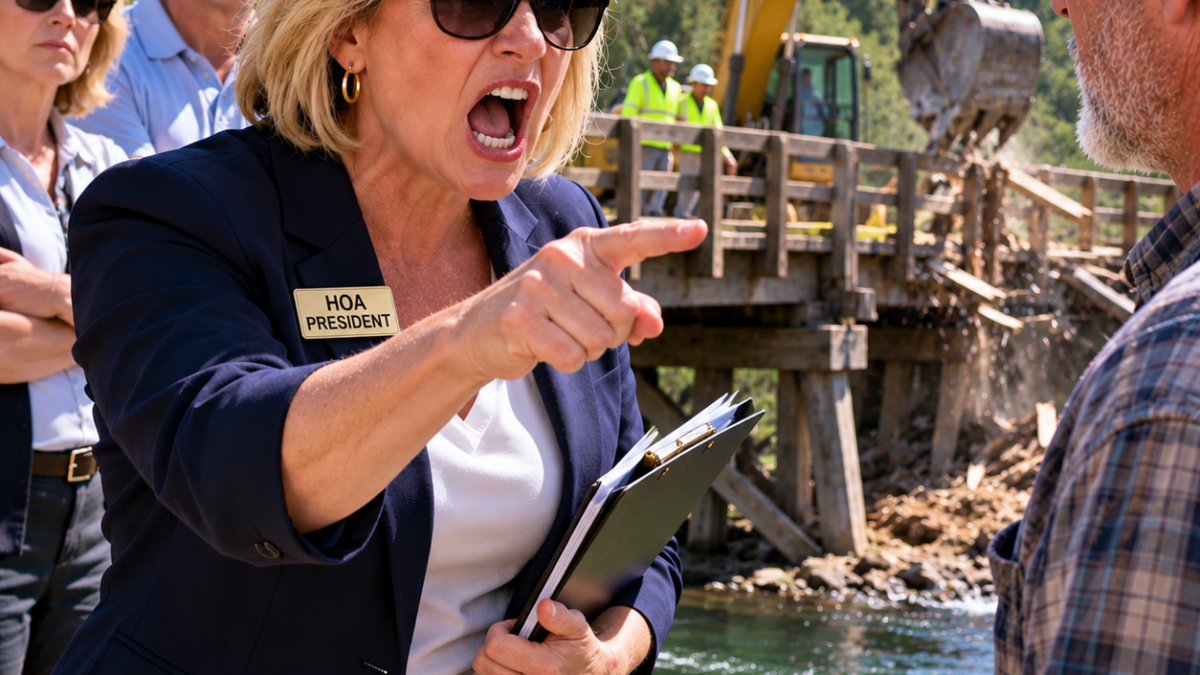
PART 2
Dale Whitmore stood in the middle of Earl’s Bridge with a survey tablet in one hand and a fluorescent range pole in the other.
He had been surveying land in that county longer than Creekide Meadows had existed.
More importantly, Dale had worked on the subdivision’s original plat before the first foundation was poured.
If anyone was going to tell me that some forgotten easement or boundary call put the bridge inside HOA land, I wanted it to be someone who could prove it with monuments instead of a laminated notice.
His crew had spent most of the morning recovering points.
At eleven-thirty, Dale called me over.
“You want the short answer?”
“Yes.”
“The HOA isn’t close.”
“How far?”
He pointed toward the new gate.
“That hinge post is fifty-three feet inside Parcel 0411722.”
“My parcel.”
“Your parcel.”
“And the bridge?”
“Both abutments, every beam, the entire deck.”
I looked toward Creekide Meadows.
Its nearest recorded boundary followed an old fence line east of Mineral Creek.
“Any argument the creek moved?”
Dale shook his head.
“Not here. Your deed uses fixed monuments and calls. The creek could move twenty feet and your legal boundary would stay where the monuments put it.”
He walked onto the deck.
Then stopped over one of the orange markings.
“What?”
He crouched.
Several marks had been sprayed in pairs.
Two near the northern bearing.
Two near midspan.
Two farther south.
Dale stood.
“These aren’t gate marks.”
“I didn’t think so.”
“If I had to guess?”
“Go ahead.”
“Centerline references and lift locations.”
“For what?”
He looked at the steel beneath us.
“If someone planned to pick this bridge apart with a crane, those are the kinds of locations I’d mark.”
The wind came through the creek bottom carrying the smell of wet leaves.
I stared at the orange paint my father and I had worked around on our knees five years earlier.
Dad had been seventy-nine then.
Too old to be lifting oak planks, which of course meant he insisted on lifting them.
He died eighteen months after we finished.
For me, those boards weren’t just lumber.
They were the last major job we had done together.
Now somebody had painted removal marks across them.
“Document every one,” I told Dale.
“I already am.”
Gerald sent Creekide Meadows a formal preservation notice that afternoon.
It attached my deed.
Dale’s certification.
The recorded Creekide plat.
Photographs of the new gate.
It demanded removal of the gate within seven days and instructed the HOA, its employees, contractors, and agents not to alter, damage, relocate, or perform any work on the bridge while ownership was disputed.
Three days later Ranata replied.
Four pages.
Lots of confident language.
No deed.
No easement.
No license.
No recorded instrument showing Creekide Meadows owned anything west of its boundary.
Instead, the HOA claimed a prescriptive right based on years of community use.
Gerald called me after reading it.
“She’s trying to convert occasional permission into permanent access.”
“Can she?”
“Not by using the word ‘prescriptive’ in bold.”
He paused.
“Historic use matters. So do duration, continuity, hostility, notice, permission, interruptions. We don’t guess. We find records.”
Then he asked something I should have asked sooner.
“Why does an HOA east of your property suddenly need operational control over a bridge that leads farther into your ranch?”
I didn’t know.
Howard Briggs did.
Howard owned forty acres north of me and had retired from teaching American history at the high school.
He also attended county meetings the way some men watched football.
That afternoon he walked down my drive carrying a folded planning notice.
“Creekide’s expanding.”
“Where?”
“Mercer tract.”
I knew it.
An old parcel southeast of the subdivision.
Forty-some acres of scrub field and second-growth woods.
Howard handed me the notice.
**CREEKIDE MEADOWS PHASE 2**
Thirty-eight proposed homes.
Planning hearing November ninth.
Near the bottom, one condition appeared in bold.
**FINAL APPROVAL REQUIRES DOCUMENTATION OF A COMPLIANT SECONDARY EMERGENCY ACCESS ROUTE.**
Howard tapped it.
“Their first route was supposed to go south along the logging road.”
“What happened?”
“Wetland review killed it in August.”
“How do you know?”
He shrugged.
“I read agendas when I can’t sleep.”
The next morning Gerald and I went to the county planning office.
The Phase 2 file was public.
Sheet C7 showed a dashed emergency route leaving the future development, crossing the old eastern fence line, joining my south pasture road, and continuing across Earl’s Bridge toward County Road 16.
Beside my bridge were the words:
**EXISTING HOA-CONTROLLED EMERGENCY BRIDGE**
I stared at them.
Under the drawing was a certification.
Signed by Ranata Voss.
She certified that Creekide Meadows possessed sufficient operational control over the crossing to guarantee secondary emergency access.
The document had been submitted six weeks before the steel gate appeared.
Gerald looked at me.
“The gate wasn’t to protect an existing right.”
“It was to make one look real.”
We kept reading.
County planning staff had already asked for proof.
One email said:
**Please provide recorded easement or other legal instrument demonstrating permanent emergency access over Calhoun crossing.**
Ranata’s answer:
**Access rights are currently being formalized through existing association authority.**
No instrument followed.
Howard’s sleep problems had just explained my fourteen-day deadline.
North Pine Residential had a purchase contract on the Mercer tract.
The contract expired December fifteenth if preliminary approval wasn’t secured.
Projected completed value exceeded seven million dollars.
More importantly, my fourteen-day “compliance” deadline ended two days before the scheduled planning hearing.
The gate was a prop.
A photographable object.
Something Ranata could point to and say, *See? We control the route.*
Gerald sent the planning department my deed, Dale’s survey, and the preservation letter.
He did not write “fraud.”
He did not call Ranata a criminal.
He stated one narrow fact:
The proposed emergency route crossed private property without an easement, license, or owner authorization.
The county responded the next business day.
Phase 2 emergency access status:
**UNRESOLVED**
The November hearing would remain on the calendar for discussion, but no final approval would issue until legal access was established.
Ranata called me at 5:42 that evening.
“You contacted planning staff.”
“I corrected their property information.”
“You interfered with a community safety project.”
“Your project crosses my land.”
“Thirty-eight families could lose housing because you refuse to cooperate.”
“There are no thirty-eight families yet, Ranata. There’s a developer and a contract deadline.”
Silence.
Then her tone changed.
“The board is willing to offer a license fee.”
“How much?”
“One dollar annually, with the association assuming maintenance responsibilities.”
I actually laughed.
“A permanent easement for one dollar.”
“A cooperative arrangement.”
“Send it to Gerald.”
“If attorneys become necessary, that offer changes.”
“Attorneys became necessary when you poured concrete into my approach road.”
She hung up.
The written proposal arrived the next morning.
It was worse than the phone call.
Perpetual easement.
Twenty-four-hour access.
Right to widen, replace, relocate, or reconstruct the bridge.
Right to transfer use to developers and successor entities.
And buried in paragraph eighteen, I would indemnify Creekide Meadows against claims arising from use of the emergency route.
Gerald circled it.
“They want your land, your bridge, and your liability coverage.”
“Generous.”
“Very.”
We declined.
Ranata responded two days later with a violation notice.
According to the HOA, Earl’s Bridge was twelve feet wide and failed a newly adopted twenty-foot emergency-road standard.
Daily fine:
Five hundred dollars.
Effective after the fourteen-day deadline.
There were two problems.
First, my parcel wasn’t inside Creekide Meadows.
Second, the standard had been adopted that summer.
Gerald laid the violation beside their easement proposal.
“They create a width violation.”
“Then offer to cure it by taking permanent widening rights.”
“Exactly.”
I had seen versions of that tactic during my county career.
Define an emergency.
Then make yourself the only acceptable solution.
But Creekide Meadows had existed for years.
Years meant archives.
Newsletters.
Maintenance records.
Old meeting minutes.
And Howard Briggs had time.
Two days later he arrived carrying a printed newsletter from 2007.
The headline looked harmless.
**THANK YOU TO OUR NEIGHBORS**
The article thanked my father, Raymond Calhoun, for allowing Creekide residents temporary use of Earl’s Bridge while the subdivision entrance was resurfaced.
Dates:
May 14 through May 28.
Gerald read the paragraph twice.
“Their own publication calls it temporary permission.”
“And identifies Dad as the person granting it.”
“We need every similar example.”
We found more.
County photographs from a 2008 road closure.
My father’s handwritten maintenance log showing the bridge closed during deck repair.
An HOA email from 2014 requesting permission for two utility carts.
I had approved one.
Denied the other.
That mattered because Ranata’s prescriptive-use theory depended on use inconsistent with the owner’s permission.
Their own records repeatedly showed permission requested, granted, limited, and sometimes refused.
The legal argument wasn’t finished.
But it was getting smaller.
Then came the October twenty-sixth board meeting.
Howard came with me.
Forty residents filled the clubhouse.
Ranata sat beside HOA president Mark Vale.
Mark was a homebuilder.
He also held financial interests in three proposed Phase 2 lots.
I knew that before entering.
Most residents didn’t.
Mark opened the bridge agenda item.
“We are addressing a misunderstanding with an adjacent property owner concerning a long-established community emergency asset.”
An asset.
My bridge had become an asset simply because he said it into a microphone.
When public comment opened, I stood.
“My name is Thomas Calhoun. The bridge shown on your Phase 2 plan is fifty-three feet inside Parcel 0411722. I own that parcel. No easement is recorded against it. Your association installed a gate without permission, then certified to the county that you controlled the crossing.”
Murmurs moved through the chairs.
Ranata leaned toward her microphone.
“Mr. Calhoun is presenting only one side of a complex legal matter.”
“Then show everyone the other side.”
I looked around the board table.
“Show them the recorded easement.”
Ranata turned toward Mark.
Mark picked up the gavel.
“The board will not debate privileged legal matters in public session.”
A man at the far end of the board table raised his hand.
Carl Dennis.
Treasurer.
“I asked for that easement before we voted on Resolution 2023-14.”
Mark’s head turned.
Carl continued.
“I was told counsel had reviewed it.”
Ranata said, “The matter was reviewed.”
Carl frowned.
“By whom?”
Mark struck the gavel.
“We are not waiving attorney-client privilege in an open meeting.”
It sounded official.
It did not answer the question.
I held up the 2007 newsletter.
“Your association thanked my father for temporary permission to use this crossing. Your own archive recognized the bridge as his.”
The room became still.
Then residents started asking questions.
“Are our dues paying for this?”
“Why wasn’t Mark’s interest in Phase 2 disclosed tonight?”
“Who is liable if a fire engine crosses a bridge the HOA doesn’t own?”
Ranata tried to redirect.
Then she made a mistake.
“The gate will remain until rights are fully adjudicated.”
I raised the violation notice.
“And the five-hundred-dollar daily fine?”
“It will continue to accrue.”
Several people actually laughed.
Not because it was funny.
Because the answer was so unreasonable it broke the room.
After the meeting Carl caught Gerald and me in the parking lot.
“I voted against that resolution.”
“What resolution?” Gerald asked.
“2023-14.”
“The minutes say unanimous.”
Carl looked toward the clubhouse doors.
“I know.”
Gerald’s posture changed.
“Do you have the draft minutes?”
“Yes.”
“Recording?”
“We record meetings so staff can prepare minutes.”
“Preserve both.”
Carl swallowed.
“There was never a vote to claim Thomas’s bridge.”
“What did you vote on?”
“Procedures for controlling common amenities the HOA already owns.”
He looked embarrassed.
“Ranata inserted the Calhoun bridge into the implementation memo afterward.”
That changed the structure of the case.
Resolution 2023-14 had never authorized the gate.
It authorized access controls on actual association property.
Ranata had treated it as a blank check.
Worse, the published minutes had changed Carl’s no vote to yes.
The following morning, Gerald filed our complaint in Atasca County District Court.
By then the gate had blocked me for twenty-nine days.
We requested:
A declaration of ownership.
Temporary removal of the gate.
Damages for trespass.
Restoration of the approach.
And an injunction preventing the HOA from asserting control or performing work on the bridge.
Our exhibits were boring.
That was their strength.
Deed.
Plat.
Survey.
Photographs.
County planning submission.
2007 newsletter.
Maintenance records.
Violation letters.
The judge didn’t need a dramatic story to understand where the property line was.
A temporary injunction hearing was set for November sixteenth.
The court allowed limited expedited discovery focused on ownership, authority, and threatened construction.
Then Creekide Meadows produced what Ranata had been calling its “legal review.”
It was six sentences.
An attorney had been asked whether Creekide Meadows could adopt rules controlling access to association amenities.
His answer:
Yes, assuming those amenities were owned by or legally dedicated to the association.
Final sentence:
**This opinion does not address title, easement rights, or property outside the recorded community.**
Ranata had forwarded the email to the board with her own summary:
**Counsel confirms authority to control the Calhoun crossing.**
I read those two sentences side by side.
In engineering, small omitted qualifications kill people.
A load limit.
A soil assumption.
A wind condition.
A phrase like *provided that.*
Ranata hadn’t merely omitted the qualification.
She had turned the lawyer’s warning into the opposite conclusion.
At her deposition, Gerald placed the email in front of her.
“Where does counsel confirm authority over Mr. Calhoun’s bridge?”
“The opinion confirms the board’s procedural authority.”
“That was not my question.”
She folded her hands.
“The crossing functioned as a community amenity historically.”
“Did you order a title search before installing the gate?”
“I relied on institutional history.”
“Did you review the 2007 newsletter thanking Raymond Calhoun for temporary permission?”
“I do not recall every historical newsletter.”
“Did you possess a recorded easement when you certified operational control to the county?”
Her attorney objected.
Ranata still had to answer.
“The rights were being formalized.”
Gerald waited.
“Did you have a recorded instrument?”
“No recorded document had been located at that time.”
Careful.
Not a confession.
But much more damaging than a denial.
Gerald showed her North Pine’s purchase deadline.
“You knew the purchase agreement could terminate December fifteenth.”
“I was aware of the schedule.”
“You knew Mark Vale held interests in three proposed lots?”
“Mr. Vale disclosed his interests.”
“When?”
Her attorney shifted.
Gerald repeated the question.
“Before or after county planning requested proof of access?”
Ranata hesitated.
“After.”
Outside the conference room, Gerald closed his folder.
“This is no longer just an employee getting overconfident.”
“What is it?”
“A board officer and a board president using association power to protect a development deadline in which one of them has a direct financial interest.”
The injunction hearing lasted about ninety minutes.
Judge Miriam Aldico had already read everything.
The HOA’s attorney argued historic reliance.
Residents had crossed for years.
Emergency planning referenced the route.
Removing the gate, he said, could jeopardize public safety.
Judge Aldico asked:
“What recorded instrument gives the association a present right to control this parcel?”
The attorney referred to long use and the pending prescriptive claim.
“That is not an instrument.”
Silence.
“Where is the deed, easement, dedication, or license?”
He admitted none had been produced.
The judge ruled from the bench.
Creekide Meadows had seventy-two hours to remove:
Gate.
Chain.
Hinge post.
Signs.
Fresh concrete associated with the installation.
Then she added something Gerald had specifically requested because Dale noticed the orange paint.
Until further order, Creekide Meadows, its officers, employees, contractors, and agents were prohibited from removing, relocating, modifying, damaging, dismantling, or entering upon Earl’s Bridge except as necessary for removal of the gate under an agreed written work plan.
The HOA’s attorney agreed to provide the contractor plan before work began.
Outside court, Ranata stood with Mark.
She saw me.
“You may have delayed thirty-eight homes.”
“Your false certification delayed them.”
“That bridge will never carry traffic required by the county.”
“Then your project never had a bridge.”
For the first time since this started, something flickered behind her expression.
Not fear.
Recognition.
She realized I understood.
The fight wasn’t about whether my twelve-foot farm bridge could become a twenty-foot subdivision road.
It was about whether she could force me to accept a replacement.
That evening, opposing counsel emailed the removal plan.
Two-person crew.
Friday morning.
Cut concrete around hinge post.
Remove gate.
Fill hole.
Rake gravel.
No heavy machinery except compact loader.
Approximately three hours.
Friday came.
Nobody arrived.
At noon, Gerald called their lawyer.
Contractor rescheduled Sunday morning.
Still inside the seventy-two-hour deadline.
At four, Howard called me.
“There are flatbeds behind Phase 2.”
“What kind?”
“Big ones.”
I drove the boundary.
Through bare trees, I saw a tracked excavator.
Mobile crane.
Two trailers.
Company:
**BRACKEN SITE SERVICES**
Same name printed on the reflective jackets worn by the men measuring my bridge the first morning.
I photographed everything.
Gerald immediately emailed opposing counsel.
**Equipment observed is inconsistent with agreed gate-removal plan. No heavy equipment may enter the Calhoun parcel or contact the bridge absent advance written agreement.**
Response came at 6:11 p.m.
**My client confirms only gate-removal work has been authorized.**
That should have reassured me.
It didn’t.
After midnight, a November front came through.
Wind.
Sleet.
Mineral Creek rose enough to swallow small sounds.
My house sat nearly three-quarters of a mile from the bridge with a timbered rise between us.
At 1:18 a.m., the east-fence trail camera sent one photograph.
Two white work lights moving between the trees.
The next image never came.
I was pulling on boots before I finished opening the notification.
I drove toward the bridge.
A Bracken pickup was parked sideways across my north approach.
Empty.
Beyond it, white lights flashed in sleet.
Then I heard it.
Diesel.
Hydraulic whine.
Chain striking steel.
I called the sheriff’s non-emergency line.
Then Gerald.
Someone had already removed the gate.
That wasn’t what stopped me.
Two sections of my white-oak deck were gone.
Stacked beside the creek.
A crane cable hung from the first steel beam.
The cable was under tension.
For a second, I couldn’t move.
I saw my father kneeling on that deck five years earlier, arguing with me about bolt spacing.
He had held one plank while I drilled.
He had complained that I was making the bridge “too pretty for cows.”
Now someone was lifting the beam beneath those boards because an HOA executive wanted a subdivision approval.
I walked toward the equipment.
The site supervisor came out.
Same younger man who had looked uncomfortable the first morning.
“Owen Pike?”
He nodded.
“You’re Thomas Calhoun.”
“Yes.”
He took off one glove.
“We were told the court authorized removal.”
“The court expressly prohibited removal.”
His face changed.
“I have a work order.”
Deputy Ellis arrived twenty-three minutes later.
Owen showed us his tablet.
The scope read:
**REMOVE ASSOCIATION GATE AND OBSOLETE CROSSING STRUCTURE. RECOVER REUSABLE STEEL. PREPARE BANKS FOR RELOCATED 20-FT EMERGENCY BRIDGE.**
I called Gerald on speaker.
He said, “Owen, I’m reading directly from the injunction. The association and its contractors are prohibited from removing, relocating, modifying, or damaging the existing Calhoun bridge.”
Owen stared at his tablet.
“Our authorization says HOA owns the structure.”
“It doesn’t,” I said.
“And now you have actual notice,” Gerald added.
The deputy was careful.
“This is civil. I’m not interpreting a judge’s injunction at two in the morning. But you’ve been told the property owner disputes your authority and counsel is telling you there’s an order. If you continue, you may create serious exposure.”
Owen walked away and made a call.
He returned with his jaw tight.
“I’m stopping the lift.”
Relief hit me too soon.
At 2:24 a.m., headlights appeared.
Mark Vale.
He got out holding a paper copy of the injunction.
“What are you doing?” he demanded.
Owen said, “We’ve been told the order prohibits bridge removal.”
Mark unfolded the order.
“It requires restoration of the approach.”
The deputy asked, “Where does that authorize removal of the bridge?”
“The bridge is part of the approach system.”
I stepped closer.
“The next paragraph says you may not remove or modify the bridge.”
“That refers to the replacement bridge.”
“There is no replacement bridge.”
“The old structure is unsafe.”
“The order identifies the existing bridge by survey coordinates.”
Mark turned toward Owen.
“We are within court authority. Continue.”
Owen didn’t move.
Mark’s voice hardened.
“You have a contract.”
Owen looked at me.
Then at the deputy.
Then at the injunction.
“No.”
Mark blinked.
Owen continued.
“My attorney is reading this now. We’re shutting down.”
At 2:37 a.m., the excavator idled off.
The crane cable relaxed.
The beam settled nearly back onto the bearing, but not fully.
One end remained lifted about half an inch.
Two deck sections sat beside the creek.
The bridge was unusable.
But it still existed.
Mark left without speaking to me.
Ranata never came.
By sunrise, Gerald had filed an emergency contempt motion.
Judge Aldico scheduled Monday morning.
Her preservation order required every party to retain all emails, texts, work orders, invoices, photographs, and electronic records concerning the attempted removal.
Bracken Site Services responded immediately.
They gave us everything.
Their original estimate:
$74,700.
Mobilization.
Deck removal.
Steel-beam recovery.
Grading.
Preparation for a twenty-foot replacement bridge sixty feet downstream.
Owen had not invented the job.
Ranata signed the work order Thursday afternoon.
Mark approved it at 7:06 that evening.
Hours after the injunction hearing.
The work order falsely stated that the court required removal of the entire crossing.
It also said Creekide Meadows held title to the salvageable steel.
Then Gerald found the invoices.
$24,900.
$24,900.
$24,900.
I looked at him.
“Exactly one hundred dollars below twenty-five thousand.”
“Your HOA bylaws?”
“Any unbudgeted contract above twenty-five thousand needs a recorded board vote.”
Gerald leaned back.
“They split seventy-four-seven into three packages.”
“On purpose.”
“Looks that way.”
One invoice called the first phase mobilization and deck removal.
The second beam recovery.
The third grading and replacement preparation.
Same project.
Same contractor.
Same night.
Three invoices.
Each one carefully under the approval threshold.
That was when the case stopped feeling like an aggressive property dispute.
They had received a court order.
Agreed through counsel to remove only the gate.
Promised in writing that no heavy equipment was authorized.
Then signed a separate contract telling a contractor the court had ordered demolition.
And structured the money to avoid a board vote.
Carl Dennis supplied the next piece.
The original October meeting audio.
The draft minutes.
Carl had voted no.
Another director abstained.
Published minutes:
Unanimous.
Then Carl produced an email from Ranata sent after the injunction hearing.
**Mark wants the crossing issue finished before North Pine’s deadline. Once the old structure is removed, Calhoun will have to negotiate over the replacement alignment. Do not circulate this outside the executive group.**
I read it slowly.
Gerald didn’t say anything.
There wasn’t much to say.
The plan had finally written itself down.
Destroy the bridge I needed.
Then offer me the replacement they needed.
Sixty feet downstream.
Twenty feet wide.
Aligned with Phase 2.
And attached to the permanent easement I’d already refused.
The gate had been pressure.
The fines were pressure.
The attempted demolition was leverage.
The court order was something they believed could be reinterpreted after the steel was already gone.
Monday morning, every seat in Judge Aldico’s courtroom seemed occupied.
Creekide residents filled two rows.
North Pine sent regional counsel.
Bracken came with its insurance attorney.
Owen Pike sat behind them wearing a dark suit instead of a reflective vest.
Ranata sat beside the HOA’s attorney.
Mark sat one row behind her.
Gerald started with the injunction.
No theatrics.
He read the sentence.
**The association, its officers, employees, contractors, and agents are prohibited from removing, relocating, modifying, damaging, dismantling, or entering upon the existing Calhoun bridge except as necessary to remove the gate pursuant to an agreed work plan.**
Then he displayed the work plan.
Two-person gate removal.
No crane.
No excavator.
No bridge work.
Then opposing counsel’s Friday email:
**Only gate-removal work has been authorized.**
Then my photographs.
Crane.
Excavator.
Flatbeds.
Then Bracken’s demolition scope.
And Ranata’s signature.
Gerald called Owen Pike.
Owen was sworn in.
I watched Ranata for the first time since the hearing started.
She had controlled the story from the beginning.
She decided my bridge was HOA infrastructure.
She decided residents had permanent rights.
She decided a lawyer’s limited opinion meant ownership.
She decided the county should accept her certification.
Now someone she had hired was sitting under oath.
Gerald approached.
“Mr. Pike, what were you originally asked to do?”
“Remove the Calhoun bridge and prepare for a new emergency crossing.”
“When?”
“Initial site review was before the gate installation.”
My stomach tightened.
Gerald continued.
“So when you were measuring the bridge the day the gate was installed, you were assessing demolition?”
“Yes.”
Ranata’s attorney objected.
Overruled.
Gerald asked, “Who requested the assessment?”
“Ms. Voss.”
There it was.
Those orange lift marks had never been an afterthought.
She had been planning the bridge removal before she gave me fourteen days to comply.
Gerald showed Owen the injunction.
“When did you first see the actual signed court order?”
“At the site.”
“Who showed it to you?”
“Mr. Calhoun and the deputy had a copy. Then our attorney obtained one.”
“What had the HOA told you?”
“That the judge ordered removal of the gate and obsolete crossing.”
“Entire crossing?”
“Yes.”
“Did that match the order?”
“No.”
“Why did you stop?”
Owen looked toward the judge.
“Because our attorney said the work order was inconsistent with the injunction and told us not to touch another bolt.”
The HOA attorney stood.
“Mr. Pike, isn’t it true the bridge had been represented to you as Creekide Meadows infrastructure?”
“Yes.”
“And wasn’t your company relying on the client’s ownership representation?”
“Yes.”
“Then your crew did nothing intentionally wrong.”
Owen thought about it.
“Before we saw the order? We relied on the work order.”
“And after?”
“We stopped.”
The attorney nodded like that helped the HOA.
It helped Owen.
Not them.
Gerald brought up Bracken’s original estimate.
“Did your company prepare one estimate?”
“Yes.”
“Amount?”
“Seventy-four thousand seven hundred.”
“Did Bracken split that estimate into three contracts of twenty-four thousand nine hundred dollars?”
Owen frowned.
“No.”
The room shifted.
Gerald put the three HOA work orders on the screen.
“Did your estimator create these allocations?”
“No.”
“Did you ask for three separate invoices?”
“No.”
Judge Aldico leaned forward.
“Mr. Pike, your company submitted one seventy-four-thousand-seven-hundred-dollar estimate?”
“Yes, Your Honor.”
She looked toward Creekide’s table.
“And someone at the association converted it into three twenty-four-nine contracts.”
Owen said, “That’s what these appear to show.”
The HOA’s attorney asked for a recess.
The judge gave ten minutes.
Nobody spoke much in the hallway.
Howard sat beside me.
“Your dad would’ve hated this.”
“The courtroom?”
“The contractor prices.”
I laughed for the first time all morning.
Then the doors reopened.
Ranata took the stand.
Gerald placed the invoices in front of her.
“Who split these?”
“I categorized the work for internal budgeting.”
“Why does every category equal exactly twenty-four thousand nine hundred dollars?”
“That was the allocation.”
“Your bylaws require a recorded board vote above twenty-five thousand, correct?”
“For certain unbudgeted expenses.”
“Was there a board vote approving seventy-four thousand seven hundred?”
“The executive group approved the project.”
“Where is that vote?”
“It was handled administratively.”
“That was not my question.”
She looked toward her attorney.
Gerald waited.
“No recorded vote appears in the minutes.”
He displayed her email to Carl.
**Once the old structure is removed, Calhoun will have to negotiate over the replacement alignment.**
“What did you mean?”
“The existing crossing could not meet modern emergency standards.”
“Did Thomas Calhoun ask for a replacement?”
“No.”
“Did he authorize demolition?”
“No.”
“Did the board vote to demolish the bridge?”
“The executive group authorized necessary work.”
“Is there an executive group defined in Creekide Meadows bylaws?”
Ranata paused.
“Not by that name.”
Gerald placed the Bracken work order beside Dale’s survey.
“You represented that Creekide Meadows owned the bridge.”
“We had asserted operational control.”
“Ownership and a disputed claim of operational control are not the same thing, are they?”
Her attorney objected.
Judge Aldico overruled him.
Ranata’s eyes dropped to the document.
“No.”
One word.
Quiet.
But that was the word the entire conflict had been waiting for.
Gerald asked the next question.
“When you signed this demolition order, you knew Mr. Calhoun disputed ownership?”
“Yes.”
“You had his deed?”
“Yes.”
“Licensed survey?”
“Yes.”
“Court injunction?”
“Yes.”
“Your attorney had agreed only the gate would be removed?”
“Yes.”
“And you still signed a work order telling Bracken the court authorized removal of the crossing?”
Ranata’s attorney stood.
“Asked and answered.”
Judge Aldico said, “Overruled.”
Ranata’s voice became smaller.
“I believed removal was necessary to achieve compliance and restore proper emergency access.”
Gerald stopped.
He didn’t need another question.
Judge Aldico found Creekide Meadows in civil contempt.
She found that Ranata and Mark had actual notice of the injunction.
That the order was clear.
That the attempted demolition was intentional.
That the association’s work order materially misrepresented the scope of the court’s directive.
The judge ordered immediate bridge stabilization under a structural engineer selected by me.
She prohibited Ranata and Mark from entering my parcel.
Creekide Meadows had to deposit $150,000 in security with the court toward restoration, fees, and contempt-related costs.
Then she ordered forensic production of association accounts and communications.
That last order uncovered the part even I hadn’t understood.
North Pine Residential had never demanded that Creekide seize my bridge.
Their land-use manager had warned Mark repeatedly:
No emergency route could be represented as controlled without recorded easement rights.
When the county questioned the crossing, North Pine offered a sixty-day extension on the purchase agreement so Creekide could negotiate properly with me.
Mark never gave the full email to the board.
He forwarded only page one.
The page describing the emergency-access requirement.
Page two contained the extension.
He removed it.
Why?
Because Mark’s three Phase 2 lot options included an early-approval bonus.
If preliminary approval occurred before the original December deadline, he made extra money.
If Creekide accepted North Pine’s extension, his bonus disappeared.
Ranata had her own incentive.
Internal personnel records included a board plan to promote her to executive administrator if Phase 2 entered construction.
Higher salary.
Greater authority.
The whole thing finally made psychological sense.
Ranata hadn’t begun because she wanted my bridge.
She wanted the project.
Then the project needed emergency access.
Emergency access needed my road.
My road needed my bridge.
The bridge needed an easement.
I said no.
At each step, instead of returning to the last honest point, she pushed forward.
Gate.
Fine.
Fake authority.
Altered minutes.
Demolition.
The worse the previous decision became, the more pressure there was to make the next one work.
That didn’t excuse her.
It made the story more disturbing.
Because she wasn’t insane.
She was ambitious.
And ambition combined with institutional authority can make bad assumptions feel like rights.
Creekide residents reacted quickly.
Twenty-three homeowners petitioned for a special meeting.
Carl released the authentic audio and both versions of the minutes.
The clubhouse filled.
Mark tried to describe the vote discrepancy as a clerical correction.
A woman in the second row stood.
“How does Carl’s no vote become yes because of clerical formatting?”
Mark had no answer.
The membership voted to remove him by the margin required in their bylaws.
Two other directors resigned.
Carl refused the presidency.
“I’m willing to fix records,” he told residents. “I’m not interested in inheriting somebody else’s throne.”
An independent management company took over temporarily.
Ranata was placed on administrative leave.
Three weeks later, Creekide terminated her employment.
The stated reasons were specific.
Exceeding purchasing authority.
Altering official records.
Misrepresenting legal review.
Directing work contrary to a court order.
Every daily fine against me disappeared.
Creekide withdrew every claim that my parcel was subject to HOA standards.
Their maps were corrected.
Emergency-planning materials were revised.
A notice went to every resident:
Earl’s Bridge was private property.
No HOA easement existed.
No resident had a right to cross without my permission.
The notice didn’t feel like revenge.
It felt like oxygen.
For more than a month, I had watched people discuss my bridge as though my ownership was the controversial position.
Now the official record finally said the simplest thing.
Mine meant mine.
But I still couldn’t use it.
The attempted crane lift had damaged the first beam.
Warren Puit, a structural engineer I had worked with years earlier, inspected everything.
He spent half a day beneath the bridge before talking to me.
“One bearing point twisted.”
“How bad?”
“Repairable.”
He pointed to split deck boards.
“Several planks need replacement.”
Then the north approach.
“The hinge-post excavation undermined this edge.”
“Can they lower the beam and call it done?”
“No.”
I knew the answer.
Still hated hearing it.
Warren prepared a full restoration design.
Original three-beam configuration.
New bearing plates.
Concrete repair.
White-oak replacement decking.
Creek-protection measures.
Temporary agricultural access.
Inspection.
Estimate:
$126,000.
Later, actual reconstruction reached $128,600.
The civil case didn’t become a six-week courtroom spectacle.
After the contempt finding, altered minutes, split contracts, and emails were in the record, insurers became interested in mediation.
Very interested.
Gerald and I entered with four conditions.
First, Earl’s Bridge would be restored to Warren’s specifications at no cost to me.
Second, Creekide Meadows would record a declaration confirming Parcel 0411722 lay outside the association and carried no HOA easement.
Third, the association would pay documented agricultural losses and the legal and expert fees caused by the contempt proceeding.
Fourth, no confidentiality term could prevent me from discussing public records, property history, hearings, or the dispute.
The mediator raised an eyebrow at the last one.
“You don’t want a nondisparagement clause?”
“I don’t need to disparage anyone.”
“What do you want?”
“To be able to say what the documents say.”
Negotiations lasted eleven hours.
The HOA accepted.
Bracken’s insurer covered part of the physical repair.
Management-liability coverage and association reserves funded the rest.
My agricultural use damages were $18,400.
Legal and expert fees recoverable under the contempt-related settlement were about $68,000.
Bridge stabilization and reconstruction ended at $128,600.
Those numbers weren’t doubled.
No punitive fantasy multiplier.
No million-dollar check for emotional satisfaction.
Every dollar had a supporting document.
There was one unresolved issue.
Phase 2 still needed emergency access.
North Pine changed course.
Instead of trying to use my property, the developer negotiated with a willing owner southeast of the Mercer tract.
They bought a narrow strip.
Designed an all-weather connection to Township Road 44.
Wetland review took time.
Construction cost more than an honest easement negotiation with me probably would have.
But when it was finished, the road belonged where it was built.
At the next county hearing, North Pine withdrew every drawing that crossed my parcel.
Planning staff approved the revised concept subject to normal fire and environmental review.
Afterward, North Pine’s land-use manager approached me in the hallway.
“For what it’s worth, Mr. Calhoun, we were told your easement had already been approved.”
“By me?”
“We were told the association had authority to finish the paperwork.”
I nodded.
“Authority is a word people use when they don’t want you to ask for the document.”
He gave a tired smile.
“We ask for the document now.”
That may have been one of the best outcomes.
Not because it helped me.
Because the next landowner might never need Gerald.
Winter arrived before permanent reconstruction could begin.
Warren’s contractor installed a rated temporary crossing so I could get feed and equipment to the southern pasture.
It was ugly.
Steel mats.
Temporary rails.
No history.
But it carried tractors.
That mattered.
Permanent work started in March after the creek ice cleared.
I stood beside Mineral Creek the morning the crane lifted the repaired first beam into position.
This time the crane belonged there.
This time I had signed the contract.
This time the engineer had stamped the plan.
Howard stood beside me with his hands buried in his coat pockets.
Carl walked down from Creekide carrying a thermos.
He had no obligation to come.
He came anyway.
Carl looked at the old concrete abutments.
“Your grandfather built these?”
“1971.”
“By himself?”
“Mostly. Dad helped. Couple neighbors.”
He watched six workers wearing hard hats guide the beam.
“You think Earl would approve of all this engineering?”
I looked at the new bearing plates.
Environmental mats.
Crane.
Survey laser.
Inspection forms.
“He’d complain about the invoice.”
Howard laughed.
I added, “Then he’d check every bolt.”
For the first time in months, Earl’s Bridge became a bridge again instead of an exhibit.
By late April, the new white-oak deck was finished.
Twelve feet wide.
Exactly what it needed to be.
Not twenty.
Not a subdivision road.
Not a seven-million-dollar development asset.
A private agricultural crossing.
At the north approach, I installed a gate of my own several yards back from the abutment.
Simple steel.
No HOA logo.
No threatening notice.
One small sign.
**PRIVATE FARM ACCESS**
Below it:
**EMERGENCY ENTRY BY COUNTY AUTHORIZATION**
I gave the local fire district a narrow, revocable emergency-access license.
Real emergencies.
Fire.
Rescue.
Life safety.
It did not benefit Phase 2.
It did not create public access.
It did not become transferable to developers.
A few people asked why I allowed it at all.
After everything Ranata had done with the phrase *emergency access*, wouldn’t I want that argument gone forever?
No.
Her misuse of safety didn’t make safety meaningless.
My entire engineering career had taught me the opposite.
Property rights didn’t require becoming unreasonable.
They required knowing the difference between permission and surrender.
A permission could be narrow.
Written.
Revocable.
Specific.
A right someone manufactured without consent was something else entirely.
On the evening after final inspection, I started my father’s old tractor.
The engine smoked a little when cold.
Dad had refused to replace it.
Said machines deserved the chance to outlive the men who paid for them.
I drove toward Mineral Creek.
Stopped at the gate.
Unlocked it.
Then rolled onto the white-oak deck.
The steel settled under the tractor’s weight with the familiar low sound I remembered from childhood.
Not a groan.
Not a rattle.
Just the bridge taking load.
Halfway across, I slowed.
Below me, snowmelt moved through the limestone channel.
I thought about that night in sleet.
White work lights.
Crane cable.
Two deck sections stacked beside the creek.
Mark telling the contractor to keep going.
I thought about how close we had come.
If Owen Pike had followed Mark’s instruction for another ten minutes, the first beam might have been on a trailer.
By sunrise, Earl’s Bridge could have been a pile of salvage.
Then Ranata would have offered the replacement.
Twenty feet wide.
Sixty feet downstream.
Perfectly aligned with Phase 2.
And I would have faced a different decision with 180 acres inaccessible and winter approaching.
Their plan depended on changing the facts faster than I could get to court.
They nearly succeeded.
I reached the south side and stopped the tractor.
Then I looked back.
For months, Ranata described the fight as one stubborn farmer standing in the way of community safety.
Mark described it as development pressure.
North Pine initially described it as a route already controlled by the HOA.
The records told the truth more slowly.
The deed showed ownership.
Dale’s survey showed geography.
The old newsletter showed permission.
My father’s maintenance logs showed interruptions.
The county file showed motive.
The attorney email showed what counsel had actually said.
Carl’s recording showed the vote.
The split work orders showed how spending authority was avoided.
Ranata’s email showed the leverage strategy.
Owen’s testimony showed what the contractor had actually been told.
No one document performed magic.
Each closed a place where the false story could hide.
That was familiar to me.
Civil engineering works much the same way.
A bridge is not strong because one beam is strong.
Load moves through a system.
Deck.
Stringers.
Beams.
Bearings.
Abutments.
Ground.
If one connection lies about what it can carry, the entire structure pays.
Institutions are not so different.
A board resolution isn’t authority if it applies to different property.
A lawyer’s opinion isn’t permission if the qualification says the opposite.
A deadline isn’t an emergency merely because money depends on it.
And a confident person standing beside a new lock does not move a surveyed boundary fifty-three feet.
I drove the tractor into the south pasture.
For the first time since October, I didn’t have to think about whether I could get it back.
The new Creekide board changed too.
They began posting full audio with meeting minutes.
Not summaries.
Audio.
Contracts above their threshold went into resident packets before votes.
Conflict disclosures became visible attachments.
Carl eventually stepped off the board after the transition.
He still stopped by.
Usually with coffee.
Usually complaining that retirement had somehow created more work.
Howard kept attending planning meetings.
Of course he did.
Ranata moved away the following summer.
I heard that through someone else.
I never contacted her.
Mark sold his Phase 2 options.
Without the early-approval bonus.
I never spoke to him again either.
That was enough.
I didn’t need a final confrontation in a parking lot.
I didn’t need Ranata to apologize.
I didn’t need Mark to admit he knew exactly what he was doing.
Their own records had already said more than an apology would.
There was one thing I kept.
During reconstruction, the contractor asked whether I wanted the damaged oak sections discarded.
One plank had split around the bolt hole when Bracken removed it during the attempted demolition.
The orange spray paint was still visible.
I took it to my workshop.
Cut the broken end square.
Sanded one face.
Then mounted the original brass padlock from Ranata’s gate onto the wood.
Below it, I hung a reduced copy of Dale Whitmore’s survey.
The black lock was heavy.
The HOA notice had looked official.
The fourteen-day deadline had sounded urgent.
The fines had accumulated on paper.
The development had millions of dollars behind it.
A board president said she had authority.
A property director said the bridge belonged to the community.
A contractor arrived with a crane.
And yet, through all of it, one thing never happened.
The line on Dale’s survey never moved.
Fifty-three feet remained fifty-three feet.
The bridge remained inside Parcel 0411722.
My grandfather’s abutments stayed where he poured them in 1971.
My father’s road remained ours.
And once the noise of deadlines, meetings, lawyers, cranes, and threats finally ended, the truth was almost embarrassingly simple.
They needed my bridge.
Needing it did not make it theirs.
That summer, the first Phase 2 construction trucks began using the new road to Township 44.
From my south pasture, I could sometimes hear them.
I didn’t resent the houses.
Thirty-eight families eventually moved in.
Children rode bicycles.
People planted trees.
Mailboxes appeared.
Their emergency road crossed property North Pine had actually purchased.
Nobody had to forge an easement.
Nobody had to lock out a farmer.
Nobody needed a two-in-the-morning crane.
One afternoon Owen Pike drove up my north approach.
I hadn’t seen him since mediation.
He parked outside my gate.
Didn’t enter.
I walked over.
“Something wrong?”
“No.”
He looked toward the rebuilt bridge.
“Wanted to see it finished.”
I opened the gate.
“You can walk down.”
We stood on the north abutment.
He ran one hand along the new rail.
“Warren did good work.”
“He usually does.”
Owen stared at the first beam.
“Been thinking about that night.”
“So have I.”
“We should have asked for the court order before mobilizing.”
“Yes.”
He accepted that.
“No argument.”
Then he said, “I’ve changed our company policy.”
“What policy?”
“If a client says a court ordered demolition, my office gets the signed order directly from counsel.”
I smiled.
“Seems expensive.”
“Cheaper than the alternative.”
We stood quietly.
Then Owen looked at me.
“I’m sorry about the deck.”
I could have made him work harder for it.
But he had stopped the crane when stopping mattered.
“You stopped.”
“After we’d already damaged it.”
“You stopped.”
He nodded.
That was enough.
Before leaving, he looked at the small emergency-access sign.
“Ironic.”
“What?”
“After all that, you still let fire crews cross.”
“I let them cross.”
He understood the emphasis.
Permission.
Not entitlement.
Owen smiled.
“That’s the whole case, isn’t it?”
“Pretty much.”
He left.
I locked the gate behind him.
Not because I feared Creekide anymore.
Because a gate works best when everyone understands who owns the key.
Late that fall, almost exactly one year after Ranata installed her steel gate, Howard and Carl came over to help me replace fence posts along the north pasture.
At lunch we sat on the tailgate of my pickup beside Mineral Creek.
Carl looked toward Earl’s Bridge.
“You ever think about what would’ve happened if you cut that first lock?”
“Every time I see the thing hanging in my workshop.”
Howard laughed.
“I would’ve cut it.”
“I know.”
“With enthusiasm.”
“I know.”
Carl poured coffee from his thermos.
“What stopped you?”
I looked at the bridge.
“The wet concrete.”
They waited.
“It was evidence.”
Howard shook his head.
“That is the most engineer answer I’ve ever heard.”
Maybe.
But that first decision mattered more than I understood.
If I had cut the lock, Ranata would’ve photographed the damage.
The story might have become:
Angry landowner destroys emergency infrastructure.
Instead, I left everything untouched.
The gate stayed intact.
The concrete stayed intact.
Her notice stayed attached.
Dale documented its location.
The county saw the ownership issue before the planning hearing.
Each time Ranata escalated, we preserved what she did.
That changed the rhythm of the fight.
I didn’t have to outshout her.
I only had to let her actions survive long enough to be compared with the records.
Howard finished his sandwich.
“That’s less satisfying.”
“Initially.”
“Eventually?”
I looked at the rebuilt bridge.
“Eventually it’s much better.”
The following spring, Atasca County conducted the first annual inspection under my emergency-access agreement.
A fire captain called a week ahead.
We chose a morning.
I unlocked the gate.
One county engine crossed.
Stopped south of the creek.
Turned at the designated agricultural turnaround.
Returned.
No widening.
No permanent HOA key.
No development traffic.
No interpretation.
The captain signed the access log.
Handed me a copy.
“That easy?”
“That easy.”
I thought of Ranata’s fourteen-day notice.
Her violation letter.
Her one-dollar easement.
All the complexity she created because she wanted permanent authority without first asking honestly.
A legitimate permission took one page.
When the engine left, I locked the gate.
Then I walked to the middle of the bridge.
Mineral Creek moved below me.
The oak deck had weathered from pale gold toward gray.
Soon it would look less new.
That pleased me.
Earl’s Bridge had never been beautiful because it was perfect.
It was beautiful because every generation repaired what the previous one left.
My grandfather built the abutments.
My father maintained the steel.
Dad and I replaced the deck.
Then strangers nearly dismantled it.
And a contractor, a surveyor, a lawyer, a treasurer, a retired teacher, a judge, and a whole pile of very boring documents helped put things back where they belonged.
I rested my hand against the rail.
For most of the dispute, I thought I was protecting a bridge.
By the end, I understood I had been protecting something narrower and more important.
The right to decide.
I could say no to a developer.
I could say yes to firefighters.
I could let a neighbor cross.
I could refuse an HOA easement.
I could rebuild twelve feet wide instead of twenty.
Those choices belonged to me because the land did.
Ranata had tried to turn my past permissions into her permanent authority.
That was the mistake underneath all the others.
A favor is not an easement.
History is not ownership.
Use is not control.
And urgency is not consent.
That evening, I drove one final hay wagon across before dark.
The tractor eased onto the deck.
The repaired beam carried the load without complaint.
I could smell cut hay behind me and cold water below.
On the south side, I stopped and looked back toward the north approach.
No black HOA gate.
No orange lift marks.
No white SUV.
Just my small steel gate farther up the road and the sign beneath it.
**PRIVATE FARM ACCESS.**
The setting sun caught the new bearing plates beneath the deck.
For an instant I could see the old railroad steel Earl had salvaged more than half a century earlier.
Still there.
Still carrying weight.
I thought of the brass lock hanging in my workshop.
It had looked powerful when Ranata stood beside it.
The letterhead looked powerful.
The $500 daily fine looked powerful.
The seventy-four-thousand-dollar demolition contract looked powerful.
The seven-million-dollar development looked powerful.
But none of them had been stronger than the thing they were built around and refused to acknowledge.
A recorded line.
A private bridge.
And an owner who finally asked them to prove what they claimed.
I shifted the tractor into gear.
Then I drove home across Earl’s Bridge.
This time, nobody had to give me permission.
[END OF STORY]








