PART 2: HOA LISTED MY GRANDFATHER’S CABIN “FOR SALE” WITHOUT PERMISSION—SO I LOCKED THE GATE AND POSTED THE SIGN THAT EXPOSED THEIR SCAM
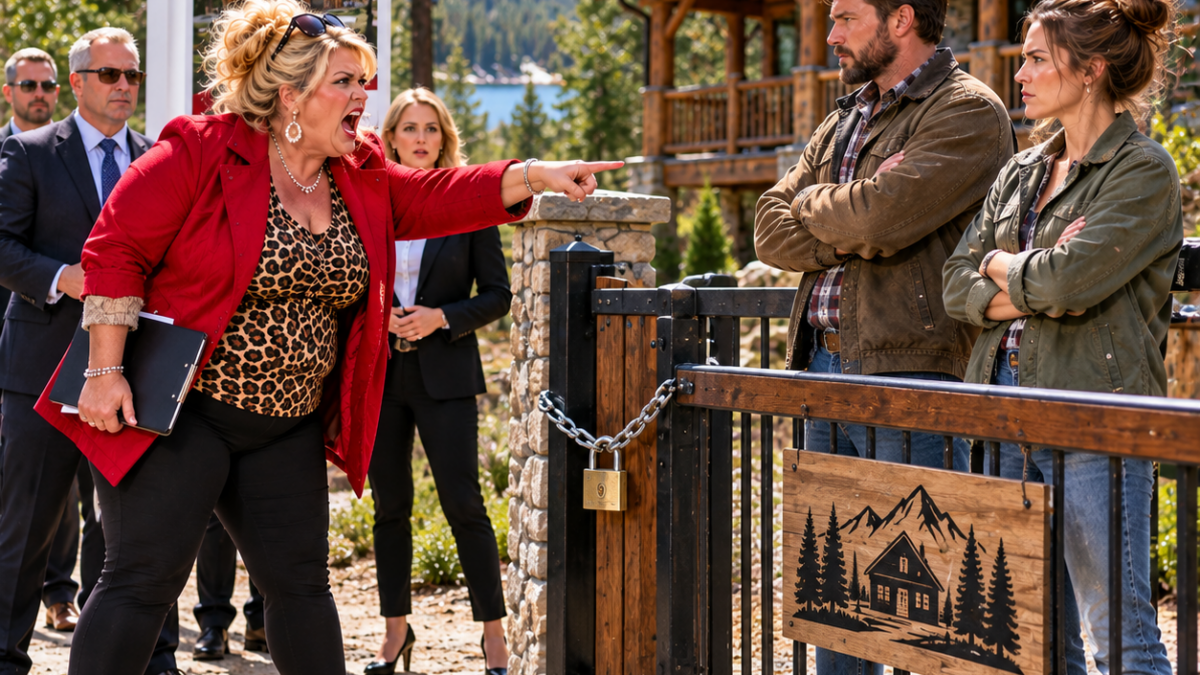
PART 2
That afternoon, I took Grandpa’s deed to the county clerk’s office.
The building sat behind the old courthouse in a basement that smelled like dust, toner, stale coffee, and forty years of paperwork no normal person would voluntarily read.
I had worked construction long enough to respect records.
A structure can look perfect from the street and still have a foundation problem hiding beneath it.
Property disputes are the same way.
The loud argument is usually aboveground.
The real problem is buried in paper.
Beverly Collins, the clerk working the property counter, knew my grandfather’s name before I finished introducing myself.
“Fletcher?”
She adjusted her glasses.
“Fletcher Fletcher?”
I nodded.
“My grandfather.”
She smiled.
“He used to come in here every time somebody changed a road sign.”
“That sounds like him.”
“He didn’t trust maps printed after 1990.”
“That also sounds like him.”
I placed the brochure on the counter.
Her smile disappeared.
“What is this?”
“The HOA invited a realtor to tour my property.”
Beverly read the page.
Then the second.
“Do they own it?”
“No.”
“Do they have an option?”
“No.”
“Listing agreement?”
“No.”
“Lien?”
“No.”
“Judgment?”
“No.”
She looked at me.
“Then why is somebody marketing it?”
“That’s what I’m trying to figure out.”
She disappeared into the record room.
Twenty minutes later, she returned carrying a file box.
My grandfather’s original 1981 deed.
Survey.
Title history.
An old subdivision plat.
The paper was yellowed but clean.
Beverly unfolded the survey.
“Your grandfather was careful.”
She traced the northern boundary.
My eyes narrowed.
“What?”
“Your modern tax map appears to simplify this line.”
“So?”
“Look at the original monument references.”
I leaned closer.
The property line extended farther north than I had always assumed.
Almost fifty feet.
Enough to matter.
Enough that Willowbrook’s decorative stone mailbox cluster, installed years after Grandpa bought his land, appeared to sit partly inside our deeded boundary.
I laughed once.
Not because it was funny.
Because Veronica had spent six months accusing me of violating her imaginary territory while part of her proud HOA entrance infrastructure might actually sit on mine.
Beverly kept reading.
Then tapped a clause.
“Your grandfather had good counsel.”
I read the language twice.
It preserved lawful preexisting use rights and clarified that later private covenants would not automatically attach without a recorded agreement or voluntary conveyance.
It did not mean my family was above every municipal law forever.
It did mean Veronica couldn’t invent HOA authority after the fact and pretend we had agreed to it.
“Can I get certified copies?”
Beverly smiled.
“How many?”
“Enough to make somebody very uncomfortable.”
***
I drove back to the cabin and found Dolores Patterson waiting on the porch with oatmeal cookies.
Dolores was seventy-one, retired after thirty years as a high-school principal, and possessed the unusual combination of grandmother energy and interrogation-room instincts.
She handed me the cookies.
“You locked the gate.”
“Yes.”
“I like the sign.”
“Thank you.”
She lowered her voice.
“Veronica hates it.”
“Even better.”
Dolores looked toward the road.
“She offered me five hundred dollars.”
My smile disappeared.
“For what?”
“To photograph your property.”
“She already has photos.”
“She wanted more.”
Dolores reached into her purse and unfolded a paper.
Handwritten list.
Truck.
Boat.
Workshop.
Trash area.
Cabin occupancy.
Visitors.
Anything that might look like a violation.
“She asked me to note when you’re gone during the week.”
My jaw tightened.
“She wanted your schedule?”
Dolores nodded.
“She said she needed proof the property was abandoned.”
I stared toward the road.
That ridiculous certified letter about abandonment suddenly felt less ridiculous.
Not legally.
Strategically.
“They’re building a file.”
“I know.”
Dolores looked at me carefully.
“And you’re not the first.”
She handed me another list.
Morrison family.
Patterson cottage.
Hendricks.
Kowalski.
Several names.
“What is this?”
“People Veronica has targeted.”
I recognized half the families.
The Morrisons had sold the previous year.
Hendricks fought about their work truck.
Mrs. Patterson—no relation to Dolores—had somehow received violations over rose colors and garden ornaments.
Dolores opened a notebook.
Dates.
Photographs.
Copies of letters.
Screenshots.
Recordings.
I looked at her.
“What have you been doing?”
“Retirement.”
“This is retirement?”
She smiled.
“I spent thirty years dealing with teenage bullies and parents who thought yelling changed facts.”
She tapped the notebook.
“Veronica isn’t original.”
Then she gave me the first piece of information that truly changed how I saw our HOA president.
Her California law license had been suspended following problems involving client trust accounts.
She had significant personal debt.
Her mortgage was behind.
And several business relationships connected her to distressed-property investors.
I sat down.
“How do you know all this?”
“Public records.”
“You’re terrifying.”
“I was a principal.”
Fair.
Dolores continued.
“Garrett, I think Veronica needs money.”
“So she’s stealing houses?”
“I don’t know.”
She looked toward Grandpa’s workshop.
“But I think she needs people to sell.”
That was enough for me.
***
I called Tom Martinez.
Tom was a local property-rights attorney with a reputation for enjoying HOA litigation a little too much.
I told him about the fake listing.
The realtor tour.
The abandonment letter.
The original deed.
Dolores’s evidence.
He stopped me after the words realtor tour.
“Did you give anybody permission to enter?”
“No.”
“Did the realtor have a listing agreement?”
“No.”
“Did Veronica?”
“No.”
“Good.”
“How is any of this good?”
“Because stupid people become easier to stop when they document the stupidity.”
I brought everything to his office.
Tom spent two hours reading.
Then he looked at me.
“First, we’re sending a cease-and-desist to Veronica, the HOA, and the realtor.”
“Good.”
“Second, we’re notifying the brokerage that your property is not for sale.”
“Better.”
“Third, nobody enters again.”
“Already locked the gate.”
He smiled.
“Heard about the sign.”
“Small town.”
“Very.”
He tapped the deed.
“Fourth, we verify every historical instrument before making claims about that mailbox area. Don’t move it. Don’t touch it.”
“I wasn’t going to.”
“You absolutely were.”
“I considered it.”
“That’s why you pay me.”
Tom leaned back.
“Garrett, the most important thing now is restraint.”
“I hate when lawyers say that.”
“That’s because clients prefer revenge.”
“I prefer results.”
“Good. Results come from letting Veronica overreach while we keep the record clean.”
I didn’t realize how prophetic that would be.
***
Two weeks later, a county code truck pulled into my driveway.
Harold Wesler stepped out.
I knew him by reputation.
Longtime county inspector.
Not corrupt.
Not fearless either.
Behind him came Veronica in her white BMW.
That immediately told me this wasn’t a routine inspection.
Harold carried a clipboard.
Veronica carried confidence.
“Mr. Fletcher,” Harold began, “we’ve received complaints about an unpermitted structure.”
He looked toward Grandpa’s workshop.
My chest tightened.
“What kind?”
“Possible code deficiencies.”
Veronica stepped forward.
“The workshop either needs extensive modernization or demolition.”
Harold glanced at her.
She continued anyway.
“Preliminary estimate is twenty-five thousand dollars.”
I looked at Harold.
“Did the county calculate that?”
He looked uncomfortable.
“No.”
“Did you?”
“No.”
I turned to Veronica.
“Then why are you quoting a number during a county inspection?”
Her mouth tightened.
“Because the HOA has obtained professional estimates.”
“The HOA that doesn’t govern my property?”
“Your resistance doesn’t change safety obligations.”
I pulled out my phone.
“Harold, I’m recording.”
“That’s fine.”
“Can you identify the code sections you’re inspecting?”
He named several.
I listened.
Some dealt with modern electrical protection.
Some structural requirements.
Some setback rules.
Most would not necessarily apply retroactively to a permitted 1983 accessory building unless substantial alterations or specific safety conditions triggered them.
I knew enough construction to recognize that.
But I didn’t argue every point.
I asked for the permit history.
Harold frowned.
“Our digital system shows no original permit.”
“Because records before the migration are incomplete.”
Veronica smiled.
“No permit means illegal structure.”
“No,” I said. “Missing digital record means missing digital record.”
Her smile vanished.
I called three retired contractors that afternoon.
The third was Jimmy Kowalski.
Seventy-four.
Retired.
Still answered his phone by saying, “Speak.”
“Jimmy, Garrett Fletcher.”
Pause.
“Fletcher cabin?”
“Yes.”
“Your grandfather still correcting everybody from heaven?”
“Probably.”
I explained.
Jimmy laughed so hard I had to pull the phone away.
“That workshop?”
“Yes.”
“Your granddad made me pour one corner twice because the footing was half an inch off.”
“Do you have paperwork?”
“I keep everything.”
Of course he did.
Two hours later, Jimmy arrived with a dusty project folder.
Original permit.
Inspection card.
Final approval.
Concrete inspection.
Framing signoff.
Electrical approval.
Every document Veronica claimed didn’t exist.
Harold withdrew the concern after reviewing the records and current conditions.
Then he called me privately.
“Garrett.”
“Yeah?”
“I shouldn’t say this.”
“That usually means you’re about to say something important.”
He sighed.
“Mrs. Ashworth has been pressuring county offices to scrutinize certain properties.”
“Mine?”
“Yours and others.”
“Why?”
“She frames it as community safety.”
“And you believe her?”
“I believed complaints deserved inspection.”
“Fair.”
He paused.
“But this isn’t normal anymore.”
I waited.
“She has hosted campaign events for some local officials. Donated. Built relationships.”
“Is she asking for favors?”
“I’m saying file formal complaints if you believe you’re being targeted.”
“You’ll testify?”
Another pause.
“Yes.”
That mattered.
***
The next morning, my security cameras caught Veronica at 12:47 a.m.
Black jacket.
Hat.
Gloves.
A bag full of decorative flowerpots.
She slipped through the tree line near the northern boundary and placed the pots carefully along the edge of my yard.
Then she measured.
Photographed.
Moved one pot.
Measured again.
When I watched the footage, I realized what she was trying to do.
Create visual “evidence” that items on my property extended into HOA common space.
Except the old survey showed she was standing roughly fifteen feet inside my parcel.
I forwarded the footage to Tom.
He called immediately.
“Please tell me she’s not planting objects on your property while arguing you encroached.”
“She is.”
There was a pause.
Then Tom started laughing.
“I shouldn’t enjoy this.”
“Yet you do.”
“Deeply.”
He became serious.
“Do not confront her.”
“I know.”
“We forward this to law enforcement as potential trespass and evidence fabrication.”
“Done.”
“You’re learning.”
“Don’t sound so surprised.”
***
Then came the lawsuit.
VERONICA ASHWORTH v. GARRETT FLETCHER.
The HOA claimed my property caused two million dollars in collective neighborhood devaluation.
Apparently my workshop, boat, work truck, and general refusal to obey Veronica’s aesthetic preferences had become a macroeconomic crisis.
They sought injunctions.
Fines.
Legal fees.
Restrictions on access.
One request would have effectively prevented me from using portions of my own property while title questions were litigated.
I called Tom.
His first words:
“Oh, she finally did it.”
“Did what?”
“Opened discovery.”
I looked at the complaint.
“You sound happy.”
“She’s suing you based on HOA authority.”
“Yes.”
“So we get to ask her to prove the HOA authority.”
That afternoon, Tom’s paralegal started checking incorporation records.
By evening, his tone had changed from amused to stunned.
“Garrett.”
“What?”
“The association has a problem.”
“How big?”
“Possibly existential.”
The original Willowbrook homeowners-association corporate filing had been rejected years earlier for deficiencies.
Missing signatures.
Incomplete supporting documents.
No properly completed correction in the record Tom located.
The neighborhood had functioning covenants affecting many newer parcels through other recorded instruments, so it wasn’t accurate to say nobody had obligations.
But the entity Veronica had been using to collect money, issue certain penalties, and sign enforcement documents appeared to have serious defects in its legal status and governance authority.
Tom began separating what might still be enforceable through recorded covenants from what Veronica had simply invented.
The result was ugly.
Several “emergency standards” she issued had no valid adoption record.
Several penalties lacked authority.
Some collections had been routed through accounts tied to an entity whose status was highly questionable.
That wasn’t petty overreach anymore.
That was the doorway into fraud.
***
Rick—one of my construction crew foremen—helped uncover the next layer.
His cousin worked as a licensed private investigator.
I gave them nothing confidential.
Only public leads Tom approved.
What came back was bad.
Veronica owed roughly $180,000 across credit cards, personal loans, and business obligations.
Her mortgage was in default.
Meanwhile, Lakeshore Properties had been purchasing distressed properties near Willowbrook.
Three in the past year.
All through related shell entities.
The Morrison cabin that sold after months of HOA pressure?
Lakeshore.
A lakefront parcel owned by an elderly widower?
Lakeshore.
A foreclosure near the marina?
Lakeshore.
Rick sat in my workshop.
“They call their strategy community optimization.”
“That sounds disgusting.”
“Corporate language always does.”
He continued.
“They acquire enough contiguous property, then redevelop.”
“For what?”
“Luxury resort concept.”
My stomach tightened.
“How much?”
“If they control the shoreline they’re targeting? Projected value could be north of fifteen million.”
“And my land?”
“Central access.”
There it was.
The realtor tour suddenly made sense.
They weren’t pretending my property was for sale because Veronica was eccentric.
They were testing buyer interest.
Measuring.
Planning.
Maybe trying to create momentum.
If enough people believed the property would eventually transfer, pressure on me would increase.
Tom later found a fifty-thousand-dollar payment from Lakeshore to Veronica described as a community liaison consulting fee.
Date:
Two days before she ramped up actions against my property and two other holdouts.
I stared at the transfer.
“That’s our motive.”
Tom held up a hand.
“That’s evidence of a payment. Motive is an inference.”
“You lawyers ruin everything.”
“That’s why you hire us.”
“What do you think it means?”
He looked at me.
“I think investigators will find it interesting.”
***
The HOA financial records made it worse.
Residents had paid approximately $430,000 in dues, fines, assessments, and related charges over a three-year period within the accounts Tom was reviewing.
The official balance and documented legitimate expenses did not explain where much of the money went.
Payments moved into consulting entities.
Vendor companies.
Personal expenses.
Some funds appeared to reach Veronica directly.
Spa bills.
Vacation rentals.
Luxury car expenses.
Credit-card payments.
One elderly resident, Ed Kowalski, had borrowed against his home to pay what he believed were mandatory fines.
Mrs. Patterson suffered anxiety attacks after months of threats involving her garden.
The Hendricks family paid repeated vehicle penalties.
The Morrisons finally sold.
When Tom showed me the records, anger stopped being personal.
“This isn’t about my cabin anymore.”
“No.”
“It’s everybody.”
“Yes.”
He leaned forward.
“That’s why we stop thinking like defendants and start thinking like victims building a collective record.”
The word victims bothered me.
I didn’t feel like one.
Then I thought about McKenzie.
About Dolores.
About Ed.
About families paying money they didn’t owe because a woman with polished stationery frightened them.
Fine.
Victims.
But not helpless ones.
***
Tom’s office became headquarters.
Not because we were playing soldiers.
Because evidence required organization.
Criminal referral.
Civil recovery.
Title protection.
Community outreach.
Separate tracks.
The district attorney’s office began reviewing financial records.
Federal investigators became interested because funds had moved electronically across state lines and Lakeshore operated in multiple jurisdictions.
Tom warned everybody:
“Do not start calling this racketeering at the grocery store.”
Dolores raised her hand.
“What may we call it?”
“A suspected coordinated fraud scheme.”
She frowned.
“Less satisfying.”
“More accurate.”
She wrote it down anyway.
I loved that woman.
***
Dolores opened her filing cabinet.
Three years of letters.
Photographs.
Meeting notices.
Threats.
Receipts.
Forty-seven families.
Not every one had experienced the same thing.
Some paid questionable fines.
Some endured pressure.
Some simply watched.
But the pattern showed Veronica using isolation as a tool.
She approached households separately.
Made each family believe their problem was unique.
Then discouraged neighbors from discussing finances.
Once people began comparing paperwork, her authority weakened almost overnight.
Ed Kowalski looked at another resident’s violation notice and said:
“That’s exactly what she sent me.”
Mrs. Patterson showed a payment demand.
Same language.
Hendricks produced emails.
Same threats.
People looked at each other as if waking from the same bad dream.
“How did we never talk about this?” someone asked.
Dolores answered:
“Because shame keeps people quiet.”
That became the core of our strategy.
Not humiliation.
Connection.
***
The VFW hall became our safest meeting place.
My grandfather had been a member until he died.
Roy Patterson, one of the few men still alive who had served with him in Korea, listened while I explained the cabin fight.
He was eighty-eight.
Thin.
Cane.
Voice like gravel.
When I finished, he asked one question.
“What do you need?”
“Witnesses. People willing to document public events. Help keeping older residents from being isolated.”
Roy nodded.
“Done.”
Twenty-three veterans volunteered.
We did not create armed patrols.
No vigilante nonsense.
They helped drive elderly residents to meetings.
Photographed public notices.
Sat with people during interviews.
Kept logs.
Made coffee.
Real support is usually less dramatic than people imagine.
One retired Marine spent three hours helping Ed organize bank statements.
Another fixed Mrs. Patterson’s broken porch step.
That did more to weaken Veronica’s fear campaign than any angry confrontation could have.
People who feel supported stop making desperate decisions.
***
McKenzie gave us the idea for the veterans memorial garden.
She was sketching at the kitchen table while Tom and I argued over survey lines.
“Why are you fighting over the mailbox land?”
“Because it’s ours.”
“That doesn’t answer my question.”
I stared at her.
Teenagers are dangerous when they inherit their mother’s logic.
She turned the drawing.
A garden.
Native flowers.
Granite memorial stones.
Small walking path.
Grandpa Fletcher’s name.
Other local veterans.
“You keep saying Grandpa cared about community.”
“He did.”
“So use the disputed strip for something everybody can support.”
Tom looked at me.
I looked at him.
“She’s smarter than you.”
He nodded.
“Obviously.”
The garden couldn’t simply become “community property” because legal title still mattered.
But we could dedicate an easement or voluntary use arrangement after the boundary was settled.
The symbolism mattered.
Veronica wanted every inch of land to become leverage.
McKenzie wanted the same dirt to become memory.
I knew which future Grandpa would choose.
***
Our legal filings hit first.
Tom sought emergency orders preserving HOA assets.
The court froze certain disputed accounts pending investigation.
Veronica responded by announcing that the HOA was “voluntarily restructuring.”
Tom translated.
“She wants access to whatever money remains.”
The freeze blocked large transfers.
That was when her behavior changed.
No more polished legal pressure.
She started lashing out.
Anonymous flyers appeared at grocery stores.
DANGEROUS NEIGHBOR ALERT.
My photograph.
Claims of criminal history.
Drug activity.
Threatening behavior.
All false.
Someone flooded my construction business with fake one-star reviews.
Customers received messages saying I stole tools.
A fake social-media account posted a picture of my workshop with “METH LAB?” written across it.
The first few made me furious.
Then Rick called.
“Boss.”
“What?”
“We just booked two new jobs.”
“How?”
“People saw the fake reviews, clicked your page, then read the real reviews.”
I laughed.
“That’s ridiculous.”
“Internet’s weird.”
Still, the smear campaign hurt.
Reputation matters when you work with your hands and rely on referrals.
But again, Veronica’s mistake was escalation.
The lies became so extreme that reasonable people stopped believing any of them.
***
Then she tried to buy witnesses.
Dolores recorded the conversation lawfully under our state’s rules after consulting Tom.
Veronica sat at Dolores’s kitchen table and offered three thousand dollars for a signed statement saying I harassed elderly residents and made threatening calls.
Dolores played confused.
“What calls?”
“You know the type.”
“No, I don’t.”
“Garrett is unstable.”
“He fixed my porch last year.”
“That’s irrelevant.”
“What did he say?”
Veronica hesitated.
“People have heard things.”
“Who?”
Another hesitation.
Finally:
“Dolores, you’re focusing on details.”
That sentence almost summarized her entire operation.
Details were Veronica’s enemy.
Documents.
Dates.
Authority.
Signatures.
Actual ownership.
She wanted people to accept conclusions without checking the foundation.
Dolores asked:
“And the three thousand?”
“A consulting payment.”
“For lying?”
Veronica stood.
“I didn’t say that.”
The recording was devastating.
Even worse for Veronica, she made similar offers to several others.
People compared notes.
The frightened community she had isolated was now coordinating.
Her old strategy had become impossible.
***
At 2:47 Friday morning, my cameras alerted.
I opened the feed.
Dark clothes.
Baseball cap.
Person moving near the workshop.
Then the face turned toward an infrared camera.
Veronica.
I sat upright.
She carried spray paint.
Red letters appeared across Grandpa’s workshop.
FORECLOSED.
Then she smashed two windows.
I called 911 before she finished.
She scattered small objects near the entrance.
When deputies arrived, they found drug paraphernalia placed near the property.
The cameras showed her placing it.
One item carried fingerprints later tied to her.
She was arrested before sunrise.
Standing beside a patrol car in handcuffs, Veronica looked at me.
I stayed behind the gate.
The same gate I’d locked after she invited strangers to tour my home.
“You did this,” she said.
I shook my head.
“You came here.”
Her face twisted.
“You think you’re going to win?”
“This isn’t a game.”
“It is to you.”
“No.”
I looked toward the workshop.
“This is my grandfather’s home.”
The deputy guided her into the car.
For the first time, the street was completely quiet.
No BMW.
No clipboard.
No realtor.
Just sunrise.
I thought the nightmare was over.
It wasn’t.
***
Veronica posted bail.
Within twelve hours, a crisis-management company began working for her.
Blackstone Crisis Management.
Professional robocalls.
Fake accounts.
Polished graphics.
The lies became cleaner.
More sophisticated.
They claimed I was conspiring to seize community assets.
That Tom was engineering a legal takeover.
That Dolores manipulated elderly residents.
That investigators were politically motivated.
Then they went after McKenzie.
That changed me.
The school called.
An anonymous report claimed our home environment was unsafe.
Drugs.
Weapons.
Neglect.
Emotional instability.
Complete fiction.
McKenzie walked through my door holding a letter and crying.
Not dramatic crying.
Humiliated crying.
The kind a sixteen-year-old tries to hide.
“Dad, why are they doing this?”
I didn’t know what to say.
Because adults wanted money?
Because one woman’s panic had become somebody else’s business model?
Because lies are cheap?
Elena—my ex-wife—came over within twenty minutes.
Our divorce had not been friendly.
But nothing unites divorced parents faster than someone targeting their child.
She looked at the report.
Then at me.
“Tell me who did this.”
“I don’t know yet.”
Her eyes narrowed.
“Find out.”
That was the closest we’d been to agreement in years.
The child-services review closed quickly after interviews, school records, and a home visit.
McKenzie was a high-performing student.
No neglect.
No dangerous conditions.
No basis for intervention.
The report was flagged as potentially malicious.
But “case closed” does not erase the moment your daughter asks whether strangers believe her father is dangerous.
That night I sat on the porch.
McKenzie came outside.
“I’m sorry.”
I looked at her.
“For what?”
“All this happened because of the cabin.”
“No.”
“If Grandpa hadn’t left it—”
“Stop.”
She looked at me.
“This happened because people made choices.”
I pointed toward the house.
“The cabin didn’t do anything.”
She nodded.
I continued.
“And you didn’t either.”
She leaned against me.
For fifteen minutes we listened to loons.
No strategy.
No evidence.
Just father and daughter.
I needed that.
Maybe more than she did.
***
Tom’s forensic accountant found the offshore money.
Community Solutions LLC.
Caribbean account.
Roughly $380,000 moved through a series of smaller transfers and related entities.
Investigators were already reviewing suspicious activity reports.
Veronica’s world narrowed.
Blackstone terminated its engagement.
Her remaining allies disappeared.
Lakeshore tried distancing itself.
That became difficult once bank records showed the fifty-thousand-dollar “community liaison” payment and other communications.
Then Veronica called Tom.
She wanted a deal.
Return half the missing money.
Reduced exposure.
Confidential settlement.
Limited public disclosure.
Tom listened.
Then told her attorney:
“No.”
I asked him later whether he had authority to reject a criminal plea.
He rolled his eyes.
“Of course not. Criminal charging is prosecutors’ business. I rejected the private civil settlement terms.”
“Good distinction.”
“You’re learning.”
“What happens now?”
“Town hall.”
The district attorney had agreed to address residents regarding the investigation while avoiding prejudicing the case.
Federal agents would attend.
Financial findings that could legally be disclosed would be presented.
Victims would speak.
Veronica still had counsel.
Still had rights.
Still had the presumption of innocence on unresolved criminal charges.
I reminded myself of that.
Because if I expected the law to protect me when Veronica abused authority, I had to respect the same process when she was accused.
Justice cannot become selective just because the defendant hurt you.
***
Saturday morning, cars filled the Willowbrook Community Center parking lot.
I arrived with McKenzie.
She wore Grandpa Fletcher’s old VFW pin on her jacket.
“Where did you get that?”
“Roy.”
“Of course.”
Dolores sat in front.
Ed Kowalski beside her with his walker.
Mrs. Patterson brought her oxygen tank.
Hendricks wore his work clothes deliberately, truck keys hanging from his belt like a political statement.
Reporters lined the back wall.
Veronica entered with attorney Marcus Webb.
She looked exhausted.
No white power suit.
Dark navy.
Minimal makeup.
For the first time, she looked human.
That almost made the next hour harder.
Tom stood.
“We’re not here to conduct a criminal trial.”
Good opening.
“We’re here because residents deserve transparent information about the financial and governance failures affecting this community.”
Slide one.
HOA collections.
Approximately $430,000 over the examined period.
Slide two.
Documented legitimate expenses.
Slide three.
Unexplained or disputed transfers.
Gasps.
Slide four.
Payments connected to Veronica.
Credit cards.
Personal expenses.
Consulting transfers.
Slide five.
Lakeshore.
Fifty-thousand-dollar payment.
Slide six.
Property targeting.
My cabin.
The Morrison cottage.
Two other lakefront parcels.
Slide seven.
Association legal defects and unapproved standards.
Veronica’s attorney stood.
“We object to characterizing disputed governance matters as fraud.”
Tom nodded.
“Then I will characterize them as disputed governance matters currently under investigation.”
That mattered.
He wasn’t performing.
He was building credibility.
Then came the video.
Veronica entering my property at 2:47 a.m.
Spray paint.
Broken windows.
Objects placed near the entrance.
The room erupted.
The district attorney stood.
“Please remain calm.”
People shouted anyway.
Ed Kowalski slowly rose.
The room quieted for him.
“This woman made me borrow against my house.”
His voice shook.
“My wife died ten years ago. That home is everything I have.”
He looked at Veronica.
“You told me my flagpole violated community standards.”
A few people murmured.
“You told me my shed needed twenty thousand dollars of work.”
He gripped the walker.
“I paid because I was afraid.”
Veronica looked away.
Ed continued.
“I thought everyone else was doing fine.”
He looked around the room.
“I didn’t know she was doing it to all of us.”
Mrs. Patterson stood next.
Then Hendricks.
Then another.
Then another.
Not a mob.
Testimony.
Stories.
Isolation collapsing in real time.
***
District Attorney Sarah Butler finally approached the microphone.
“There are active criminal investigations involving allegations of theft, fraud, money laundering, conspiracy, and other offenses.”
The room went silent.
“Those allegations will be resolved through the court system, not this meeting.”
She looked toward Veronica.
“Mrs. Ashworth has constitutional rights and is represented by counsel.”
Then toward us.
“Victims also have rights.”
FBI Special Agent Rebecca Torres explained that federal investigators were examining interstate financial transfers, the role of related companies, and potential recovery of misappropriated funds.
No dramatic arrest at the podium.
Veronica was already facing state charges from the vandalism case and other matters.
The serious financial case would proceed carefully.
That disappointed television.
It reassured me.
The law was finally moving without Veronica controlling the script.
Then Roy Patterson stood.
He held a folded flag.
My grandfather’s name was stitched on the presentation case.
I froze.
Roy looked at McKenzie.
“Come here, sweetheart.”
She walked forward.
He handed her the flag.
“This flew over the state capitol in honor of your great-grandfather and the veterans from this county.”
McKenzie started crying.
So did I.
Roy looked at me.
“Your granddad didn’t buy that cabin because it was valuable.”
I nodded.
“He bought it because he needed peace.”
Another nod.
“Don’t let this fight turn his peace into nothing but anger.”
That sentence broke me more than any courtroom result ever would.
For months, I had been saying I was protecting Grandpa’s legacy.
But every conversation about the cabin had become Veronica.
Every weekend became evidence.
Every room became strategy.
Roy reminded me that winning meant eventually giving the property back to our family emotionally.
Not just legally.
***
The financial prosecutions took months.
Lakeshore executives were investigated.
Additional schemes surfaced in other counties.
Some allegations did not survive verification.
Others became stronger.
Veronica ultimately entered pleas and was convicted on multiple charges connected to fraud, money laundering, misuse of community funds, and related conduct.
The federal sentence totaled five years.
Other state consequences ran alongside parts of the case.
Restitution orders were substantial.
Asset recovery helped return much of the money residents had lost.
Not every penny appeared magically.
Real recovery is messy.
Some funds came from seized accounts.
Some from property sales.
Some through court-ordered restitution over time.
Residents received different amounts based on documented loss.
Ed paid down the emergency loan he’d taken against his home.
Mrs. Patterson received compensation tied to invalid collections.
Hendricks got money back.
The Morrison family received a civil settlement related to the pressure surrounding their sale, though nothing could restore the year they lost.
The point wasn’t a perfect financial reset.
The point was that Veronica no longer controlled the ledger.
***
Lakeshore Properties became the bigger story.
Federal investigators found similar relationships with distressed acquisitions in multiple jurisdictions.
Executives faced charges arising from schemes that went beyond Willowbrook.
I was one witness among many.
That mattered to me.
Our neighborhood hadn’t discovered a nationwide criminal empire alone.
We had discovered our piece.
Other communities supplied theirs.
Investigators assembled the full picture.
Jake Morrison—the reporter who covered the parallel municipal-abuse stories in the region—called it “fraud by fragmentation.”
Every victim saw one ugly event.
Only when the events were combined did the model become visible.
That phrase stayed with me.
Fraud by fragmentation.
Maybe bullying works the same way.
Every person believes they are uniquely failing.
Then they talk.
Suddenly shame belongs to the bully instead.
***
The HOA itself faced a vote.
Some residents wanted to abolish everything.
Others wanted to preserve shared maintenance functions.
The legal structure was complicated because recorded covenants still existed for some properties even though Veronica had operated portions of governance improperly.
Tom explained it for almost an hour.
Nobody understood.
He tried again.
Still bad.
Finally Dolores stood.
“So what can we actually choose?”
That was the right question.
After months of legal cleanup, residents transitioned away from Veronica’s centralized enforcement culture into a far more limited neighborhood association model for voluntary social projects, while lawful shared-property obligations were handled through transparent agreements and professional administration where necessary.
No mystery fines.
No secret standards.
No midnight flowerpot operations.
Budgets published.
Vendor bids disclosed.
Conflict-of-interest rules.
Independent audits.
Meetings people actually attended.
Boring.
Wonderful.
***
Then came the property line.
The original survey was confirmed.
Willowbrook’s mailbox cluster encroached onto my parcel.
Veronica would have weaponized that.
I didn’t.
The association offered to move it.
I looked at McKenzie’s memorial-garden drawing.
“Don’t.”
Tom stared at me.
“What?”
“Leave it.”
“You sure?”
“Give me a legal easement agreement.”
His expression changed.
“You want the garden.”
“Yes.”
We created a small permanent access arrangement that allowed the mailbox area and adjoining strip to serve the neighborhood while confirming my underlying title.
Then the veterans memorial garden went in.
Native flowers.
Stone path.
Benches.
Granite markers.
Fletcher’s name among dozens.
At the center was a short inscription from something Grandpa had told me:
THIS IS OUR FOREVER HOME.
NOBODY CAN TAKE WHAT YOU BUILD WITH YOUR OWN SWEAT.
I worried it sounded too possessive for a community garden.
Roy disagreed.
“He didn’t mean walls.”
I looked at him.
“What did he mean?”
“Life.”
Maybe.
Grandpa never explained himself much.
***
The dedication happened on Veterans Day.
Cold morning.
Apple cider.
Coffee.
Donuts.
Three generations of veterans.
Families.
Former Veronica supporters.
People who had once avoided eye contact with me.
McKenzie placed flowers at Grandpa’s stone.
I stood behind her.
For months, I had imagined my satisfying ending as Veronica losing.
Prison.
Money.
Licenses.
Status.
But standing in that garden, I realized losing wasn’t the same as repair.
This was repair.
Ed sitting with kids on a bench.
Mrs. Patterson explaining rose varieties to a young couple.
Hendricks parking his work truck in full view without anybody measuring the driveway.
Dolores ordering everyone around because apparently retirement never cured principal behavior.
My cabin behind us.
Still standing.
Grandpa’s workshop still standing.
No realtor measuring it.
No brochure calling it a teardown.
That was victory.
***
McKenzie changed too.
Before all this, she thought construction was boring and property law was something adults invented to ruin weekends.
Then she watched documents save our cabin.
She helped organize the memorial design.
She sat through community meetings.
She saw adults lie.
She saw others admit mistakes.
Her college essay was about the difference between owning property and belonging somewhere.
She let me read it.
I cried.
Denied crying.
She took a picture.
Blackmail material.
She eventually chose pre-law.
“Because of me?”
“No.”
“Grandpa?”
“No.”
“Veronica?”
She smiled.
“Partly.”
I groaned.
“Don’t build your career around hating one woman.”
“I won’t.”
She became serious.
“I want people to understand paperwork before it destroys their lives.”
That sounded better.
***
My relationship with her mother improved too.
Not magically.
Divorce doesn’t reverse itself because an HOA president commits fraud.
We still disagreed.
We still had history.
But during the crisis, Elena—my ex-wife—and I stopped using McKenzie as a messenger.
We spoke directly.
Coordinated.
Showed up.
After the worst part ended, she told me:
“I always wondered whether that cabin mattered more to you than everything else.”
That hurt.
“Did you decide?”
She looked toward McKenzie.
“I think it mattered because of everything else.”
I nodded.
That was fair.
The cabin had sometimes been my escape.
Maybe too much.
After Veronica tried to take it, I learned escaping isn’t the same as protecting peace.
Peace requires showing up.
***
My construction business survived the fake reviews.
Better than survived.
People hired us because the public records made the smear campaign obvious.
But I refused to turn the company into a political brand.
No “anti-HOA contractor” shirts.
Rick suggested them.
I said no.
He printed one anyway.
I made him wear it under his jacket.
Our work spoke for itself.
We renovated historic homes.
Built decks.
Restored barns.
And yes, repaired old workshops.
Every time I touched rough timber, I thought about Grandpa.
He built slowly.
Measured twice.
Hated shortcuts.
Maybe that’s why his cabin survived Veronica.
It was built physically strong.
And legally documented.
***
One year after the realtor incident, another realtor arrived.
This one stopped outside the gate.
Called me.
“Mr. Fletcher?”
“Yes.”
“I have clients interested in property nearby. Your parcel came up in historical listings. I wanted to confirm it’s not available.”
I smiled.
“Not for sale.”
“Understood.”
She thanked me.
Left.
No drama.
I stood beside the gate.
The sign was weathered now.
PROPERTY NOT FOR SALE.
PRIVATE PROPERTY.
I considered taking it down.
Then McKenzie drove up.
“Leaving that forever?”
“Maybe.”
“Looks angry.”
“It has personality.”
She got out.
Read it.
Then pulled a marker from her car.
“What are you doing?”
She flipped the bottom panel.
On the back, she wrote:
WELCOME FRIENDS. CALL FIRST.
I laughed.
“That seems contradictory.”
“No.”
She locked the marker.
“Boundaries and hospitality can coexist.”
Pre-law students are unbearable.
But she was right.
Eventually I replaced the old sign with a smaller one.
PRIVATE PROPERTY.
PLEASE CALL BEFORE ENTERING.
Nothing about realtors.
Nothing about Veronica.
Healing changes signage too.
***
Dolores remained our unofficial historian.
She created binders documenting the entire scandal.
One copy went to an attorney training program.
One to the local library’s historical archive after redactions.
One stayed in her house.
“Why three?”
“Fire.”
I frowned.
“What?”
“Always keep copies in separate places.”
She had learned that from managing schools.
I stopped questioning her.
At the second anniversary of Veronica’s arrest, Dolores invited me for coffee.
“You seem calmer.”
“Insult?”
“Observation.”
“I am.”
“You used to drive past Veronica’s old house every day.”
I stared.
“How do you know that?”
“I have windows.”
Of course.
“I stopped.”
“I noticed.”
Her expression softened.
“Good.”
The woman who bought Veronica’s house was a pediatric nurse with two dogs.
She had nothing to do with the scandal.
For months, I subconsciously treated the building like it still belonged to my enemy.
Then I realized that was unfair.
A house isn’t guilty.
Neither are new neighbors.
So I stopped looking.
That was another kind of boundary.
***
Veronica’s old realtor friend faced professional consequences for marketing and showing property without proper authority.
The brokerage settled claims and strengthened internal verification procedures.
The realtor later sent me a written apology.
I read it.
She said Veronica had represented that the HOA was pursuing an authorized acquisition and that formal owner approval was imminent.
She should have verified.
She didn’t.
I believed the apology.
Not because it excused her.
Because she named the failure accurately.
Verification.
Everybody in this story who got manipulated had skipped some version of that step.
Residents assumed fines were legal.
Officials assumed complaints were honest.
The realtor assumed Veronica had authority.
I assumed my forty-acre—well, two-acre—deed map was simple.
Veronica’s power existed inside assumptions.
Documentation killed it.
***
The original glossy sales brochure sits in a drawer.
I almost threw it away after the trial.
McKenzie stopped me.
“Keep it.”
“Why?”
“Because someday it’ll be funny.”
I looked at the page.
PRIME DEVELOPMENT OPPORTUNITY.
TEARDOWN POTENTIAL.
I wasn’t laughing.
Years later, I understand what she meant.
Not funny like a joke.
Funny like something once powerful becoming absurd.
The brochure that made my hands shake now looks ridiculous.
Grandpa’s workshop still stands.
The deck still faces the lake.
The yoga studio never happened.
And nobody tours the property unless I invite them.
Power shrinks when fear does.
***
One summer, Ed Kowalski came over.
He was slower.
Health worse.
But smiling.
“I paid off the loan.”
“What loan?”
“The one I took because of the fines.”
I remembered.
He handed me a copy of the satisfaction document.
“Why are you showing me?”
“Because I want someone else to see it.”
I looked at him.
“That woman had me convinced I’d die owing money because my shed offended her.”
He laughed softly.
“Now the shed will outlive me.”
We walked to his property.
The shed leaned slightly.
I frowned.
“Actually, structurally, we should fix this.”
He stared.
“Don’t you start.”
I laughed.
We repaired it the following Saturday.
Free labor.
Neighbors brought food.
That became a pattern.
The community that once used enforcement letters to force conformity started using volunteer work to solve actual problems.
Someone needed a ramp.
We built it.
Storm damaged a roof.
People tarped it.
Mrs. Patterson needed help winterizing.
Done.
Turns out community standards can mean:
Don’t let your eighty-year-old neighbor climb a ladder alone.
I prefer those standards.
***
Tom Martinez became insufferable after the case.
Speaking engagements.
Property-rights seminars.
Radio interviews.
He called one afternoon.
“Garrett, I need you on a panel.”
“No.”
“Why?”
“Because panels are where people go to die slowly under fluorescent lights.”
“It matters.”
“What topic?”
“HOA governance and property rights.”
“No.”
“McKenzie already agreed.”
I stared at the phone.
“My daughter?”
“She says you need to get better at public speaking.”
Traitors everywhere.
I went.
The audience asked whether people should refuse every HOA fine.
I said no.
That surprised them.
“Some fines are legitimate.”
A man looked disappointed.
“Then what should homeowners do?”
“Read the governing documents.”
Groans.
“Verify whether the restriction applies to your property.”
More groans.
“Ask for the vote or rule that created it.”
Someone raised a hand.
“What if the board refuses?”
“Document the request. Get legal advice if the stakes justify it.”
“What about revenge?”
I laughed.
“Revenge is expensive.”
Then I said something I had learned the hard way:
“The goal is not to beat your neighbors. The goal is to stop unlawful behavior without destroying the place you still have to live afterward.”
The room quieted.
That became the useful part.
***
The biggest misconception about our case was the idea that I destroyed Veronica.
I didn’t.
Her own choices did.
I locked a gate.
Posted a sign.
Got certified records.
Installed cameras.
Called a lawyer.
Talked to neighbors.
That’s not destruction.
That’s defense.
Veronica chose fake authority.
Financial misconduct.
Trespassing.
Witness bribery.
Evidence planting.
Retaliatory pressure.
Each step increased the consequences.
People sometimes imagine justice as a trap clever heroes set for villains.
More often, justice is a record.
A line of choices nobody can erase once enough independent evidence confirms them.
***
Years after the sentencing, I received a letter from Veronica.
Prison mail.
I almost threw it away.
McKenzie said:
“Your choice.”
I opened it.
Veronica wrote three pages.
Some excuses.
Some regret.
Some anger.
Then one sentence caught me.
I thought if I could make Willowbrook valuable enough, everything I had done would be justified.
I read it twice.
There it was.
The entire problem.
Value.
She measured everything by what it could become financially.
Grandpa’s workshop wasn’t memory.
It was underused square footage.
My shoreline wasn’t peace.
It was development frontage.
Neighbors weren’t people.
They were cooperative or obstructive property owners.
Even her own authority became an asset she could monetize.
I wrote one reply.
Short.
I hope someday you understand that a community’s value is not the same thing as the resale price of its houses.
I never heard back.
That was fine.
***
The memorial garden grew wild around the edges.
Veronica would have hated it.
Native coneflowers.
Black-eyed Susans.
Tall grass.
Bees.
Children.
Granite markers warmed by sunlight.
Every Veterans Day, Roy visited until his health no longer allowed it.
One year, he sat beside Grandpa’s stone.
“You did good, kid.”
I laughed.
“I’m fifty.”
“Still a kid.”
He tapped the marker.
“Fletcher would’ve yelled at you.”
“For what?”
“Lawyers.”
“Probably.”
“Then he’d brag about you.”
I looked toward McKenzie helping children plant flags.
“About her.”
Roy nodded.
“More.”
Fair.
***
When Roy died, his family asked if we would place a memorial stone beside Grandpa’s.
Of course.
At the dedication, veterans stood in the same strip of land that had once caused a property-line fight.
I remembered Beverly showing me the old survey.
How excited I’d been that the mailbox might be on my land.
Back then, ownership felt like ammunition.
Now that same strip belonged to me legally but served something larger by agreement.
That felt stronger.
Not surrender.
Choice.
The difference between coercion and community is consent.
Veronica never understood that.
She believed if an outcome was beneficial in her mind, she had the right to force people into it.
But good things imposed without consent can still become abuse.
That lesson followed me everywhere.
***
McKenzie graduated college.
Law school came next.
At her graduation dinner, she handed me an envelope.
Inside was a photograph.
Grandpa and me staining the original deck.
I was maybe eleven.
He wore a sleeveless shirt.
Thin arms.
Old war scar visible.
On the back, she’d written:
NOBODY CAN TAKE WHAT YOU BUILD WITH YOUR OWN SWEAT.
I looked at her.
“Where’d you find this?”
“Mom.”
My eyes burned.
She smiled.
“Don’t cry.”
“I’m not.”
“Sure.”
I looked toward the cabin through the restaurant window in my mind, even though we were miles away.
Grandpa had been wrong in one literal sense.
People can take things.
Fraud.
Fire.
Foreclosure.
War.
Time.
Nothing physical is guaranteed.
But maybe he meant something else.
When you build a life honestly, people can damage pieces of it.
They cannot automatically own what those pieces mean.
That part remains yours unless you surrender it.
***
The cabin changed over the years.
New roof.
Repaired deck.
Modern wiring.
Grandpa would complain about half of it.
The workshop remained almost exactly the same.
Jimmy Kowalski died three years after the case.
Before he passed, he visited once.
Ran his hand along the foundation.
“Still off by half an inch?”
I asked.
He glared.
“Your grandfather was wrong.”
I laughed.
“He made you redo it.”
“He enjoyed suffering.”
Maybe.
Jimmy had preserved the permit file that saved the workshop.
After his funeral, his daughter gave me the original construction photographs.
I framed one.
Grandpa standing beside Jimmy.
Both young.
Both holding hammers.
That picture hangs in the workshop now.
Not the lawsuit.
Not Veronica’s mugshot.
Not the newspaper headline.
Builders deserve the wall.
Not destroyers.
***
That became my rule.
I stopped decorating my life with evidence of people who hurt us.
For a while, I had kept everything visible.
The Realtor brochure.
The cease-and-desist.
A copy of Veronica’s arrest report.
The fake violation notice.
It felt like proof.
Then one morning I realized Veronica was still taking up wall space in Grandpa’s cabin.
I boxed it all.
Legal archive.
Safe storage.
Not erased.
Just removed from daily life.
McKenzie replaced the empty wall with photographs.
Family.
Lake.
Grandpa.
Dolores.
Roy.
Memorial garden.
People who built.
That’s how the cabin finally became peaceful again.
***
The first Saturday after I removed the evidence wall, I woke early.
Made coffee in Grandpa’s old percolator.
Walked onto the deck.
Loons called across the lake.
Mist sat above the water.
No BMW.
No measuring tape.
No realtor.
No strangers discussing demolition.
I put my hand on the old railing.
Rough wood.
The same rail Grandpa and I stained decades earlier.
For months, every time I touched it, I remembered Veronica.
That morning, I remembered Grandpa.
That’s when I knew we’d won.
Not when she was sentenced.
Not when money was recovered.
Not when Lakeshore executives were indicted.
When my grandfather returned to the center of the memory.
When Veronica became secondary.
That was peace.
***
I still lock the gate.
People sometimes ask whether that’s because I no longer trust the neighborhood.
No.
I trust most of them more than ever.
I lock it because boundaries are healthy.
Friends call.
Neighbors know the code when helping with maintenance.
Emergency services have lawful access arrangements.
Nobody gets a master key just because they hold a volunteer title.
The sign changed.
It now reads:
FLETCHER CABIN — PRIVATE PROPERTY — FRIENDS WELCOME, PLEASE CALL AHEAD.
Underneath, McKenzie convinced me to add a tiny metal plaque.
NOT FOR SALE.
That part stayed.
***
Once a year, usually around the anniversary of that first unauthorized realtor tour, Dolores sends me the original photo.
Three strangers on the deck.
Realtor pointing.
Veronica near the driveway.
Her message always says:
REMEMBER WHEN SHE THOUGHT THIS WAS GOING TO WORK?
I respond:
GO TO BED, DOLORES.
She replies:
I’M RETIRED. I DON’T HAVE TO.
Some people become family because they share blood.
Others become family because they hand you oatmeal cookies and a three-year harassment dossier at exactly the right moment.
***
The final money recovery took years.
That’s another detail short versions skip.
Restitution is rarely a giant check falling from the sky.
Some residents received direct distributions.
Some claims were resolved civilly.
Some losses couldn’t be fully quantified.
Some emotional harm couldn’t be priced.
Mrs. Patterson once told me:
“I got the money back.”
Then she looked at her garden.
“But I lost two years being afraid to plant roses.”
What do you do with that?
You plant more roses.
That spring, neighbors helped her install an entire row.
Every color.
Red.
Yellow.
Pink.
White.
Purple.
Veronica once called them visually excessive.
Mrs. Patterson planted twice as many.
That was revenge I could support.
***
Hendricks kept the work truck.
Eventually bought another.
Bigger.
I accused him of choosing it just to annoy the ghost of the old HOA.
He admitted nothing.
Ed’s shed still leans.
Safely now.
Dolores still records meetings even when nothing happens.
Tom still bills too much.
McKenzie still corrects me when I call every property document a deed.
Willowbrook still has arguments.
Real ones.
Noise.
Road maintenance.
Dogs.
Trees.
Lake access.
Humans don’t become perfect because a corrupt president leaves.
We simply learned how to disagree without turning power into punishment.
That may be the real achievement.
***
People love asking what sign I posted after Veronica advertised the cabin.
They expect something clever.
Maybe:
NOT FOR SALE — HOA PRESIDENT IS A FRAUD.
Or:
TRESPASSERS WILL MEET MY LAWYER.
No.
The first sign was boring.
PRIVATE PROPERTY — NO TRESPASSING — PROPERTY NOT FOR SALE.
That boring sign mattered because it stated three facts.
Ownership.
Boundary.
Intent.
Veronica’s entire scheme depended on blurring all three.
Who owns this?
Who controls access?
Does Garrett intend to sell?
I answered before she could.
Sometimes the strongest response isn’t dramatic.
It’s clarity.
***
If I could talk to Grandpa now, I’d ask whether I handled it right.
He would probably complain that I hired too many lawyers.
He distrusted anybody whose shoes were too clean.
Then he’d inspect the repaired deck.
Run his fingers along the railing.
Check the workshop.
Ask whether McKenzie still fishes.
I’d tell him she does.
Not often.
But when life gets loud, she still comes to the lake.
That would matter most to him.
Because the property was never valuable because it was lakefront.
It was valuable because people could breathe there.
That is what Veronica almost misunderstood out of existence.
***
I eventually found the realtor’s first valuation notes through civil discovery.
One sentence stopped me.
“Existing cabin likely has sentimental value to owner; pressure strategy may be required.”
I sat with those words for a long time.
Sentimental value.
Pressure strategy.
Somebody had reduced my memories to an obstacle in a business plan.
Grandpa’s hands.
McKenzie’s refuge.
My weekends.
Our lake.
Obstacle.
That anger returned.
Then I noticed something else.
The notes were years old enough now to feel foreign.
The “pressure strategy” failed.
The cabin survived.
The project collapsed.
Lakeshore paid enormously for what its executives had done elsewhere.
Veronica went to prison.
The people described as obstacles kept living.
The spreadsheet lost.
The humans won.
I closed the file.
Put it away.
***
The last major public event connected to the case was the opening of a county homeowner-assistance clinic.
Not an anti-HOA office.
A neutral place where property owners could get help understanding deeds, covenants, fines, liens, and dispute procedures.
Tom helped establish it.
Dolores volunteered.
I spoke at the opening.
Only because McKenzie threatened to introduce me herself if I refused.
I stood at the microphone.
Looked at a room full of residents.
Some lived in HOAs they loved.
Some hated theirs.
Some didn’t have one.
I said:
“The most dangerous sentence in a property dispute is, ‘Everybody knows that’s the rule.’”
People laughed.
I continued.
“Ask where the rule is written.”
“Ask whether it applies to your parcel.”
“Ask who adopted it.”
“Ask whether the person demanding money has authority to demand it.”
Then I added:
“And if somebody tells you your home is already for sale when you never agreed to sell it…”
The room laughed louder.
“Lock the gate.”
That line became the headline.
Of course it did.
***
But the second half was more important.
“Then call a lawyer before you do anything stupid.”
Tom applauded hardest.
***
This story began with a realtor standing on my grandfather’s deck as if his cabin belonged to somebody else.
I still remember Dolores’s photograph.
The angle.
The woman pointing toward the workshop.
The buyers measuring.
The feeling that a piece of my family had been taken while I was at work.
For a few hours, Veronica controlled the story.
In her version, I was a difficult holdout.
The cabin was obsolete.
The workshop was ugly.
The land was underused.
Development was inevitable.
Selling was rational.
Resistance was selfish.
Then I locked the gate.
Posted the sign.
Opened Grandpa’s deed.
Talked to Beverly.
Listened to Dolores.
Found Jimmy’s permits.
Called Tom.
And discovered something Veronica never expected.
The strongest thing about old property isn’t always the land.
It’s the history people bothered to preserve.
Deeds.
Permits.
Surveys.
Receipts.
Photographs.
Witnesses.
Memories.
Community.
She had polished brochures.
We had records.
***
Veronica Ashworth thought she could create reality by printing it.
A violation notice.
An abandonment warning.
A sales brochure.
A lawsuit.
A flyer.
A fake witness statement.
A forged narrative repeated often enough to make frightened people surrender.
For a while, it worked.
People paid.
People sold.
People stayed silent.
Then everyone started reading each other’s papers.
That was the beginning of the end.
Because lies are strongest when they live alone.
Put them beside another lie.
Then another.
Then a bank statement.
Then a security video.
Then a deed.
Then a witness.
Soon they’re not stories anymore.
They’re evidence.
***
Years later, I was staining the deck again.
Same smell of pine.
Same sticky hands.
McKenzie sat on the railing reviewing law-school notes.
“You missed a spot.”
I looked at her.
“You’re holding a book.”
“Yes.”
“I’m holding the brush.”
“Also yes.”
“You could help.”
“I am supervising.”
“Future HOA president.”
She threw a rag at me.
I laughed.
Then I stopped.
The lake was turning gold.
Loons somewhere beyond the trees.
The workshop stood behind us.
Grandpa’s memorial garden visible through the pines.
I thought about that first photograph.
Strangers walking here like the place was already gone.
They had been so certain.
That certainty was what made them careless.
They thought regular people would be overwhelmed by documents, money, connections, and threats.
Sometimes we are.
Sometimes life is too busy.
Lawyers too expensive.
Rules too confusing.
Fear too heavy.
That’s why communities matter.
No one should have to fight everything alone.
I didn’t win because I was smarter than Veronica.
I won because people stopped letting her isolate us.
Dolores shared records.
Jimmy saved permits.
Harold told the truth.
Neighbors compared fines.
Tom understood the law.
Investigators followed money.
Veterans showed up.
McKenzie reminded me what the land was actually for.
Every person held one piece.
Together, the pieces became stronger than Veronica’s entire machine.
***
The original gate lock eventually rusted.
I replaced it.
This time nobody called.
Nobody demanded a master key.
Nobody sent a realtor.
I removed the old chain.
Held it in my hand.
Heavy.
Scratched.
The first thing I had bought after seeing those strangers on the deck.
I almost threw it away.
Then I hung it in the workshop.
Not as a trophy.
A reminder.
Boundaries sometimes need hardware.
But more often, they need people willing to defend them calmly.
***
If you ask me what the most satisfying moment was, I won’t say Veronica’s sentencing.
I won’t say watching Lakeshore collapse.
I won’t say seeing residents get money back.
I won’t even say the day the fake violation letters stopped.
It was a Saturday morning years later.
I was making coffee.
McKenzie had come home from law school.
She opened the refrigerator.
“Dad.”
“What?”
“We’re out of eggs.”
“Impossible.”
She looked toward the coop.
“Your chickens are freeloaders.”
“They are retired.”
“You have retired chickens?”
“Respect your elders.”
She rolled her eyes.
I grabbed the coffee.
Walked onto the porch.
She followed.
We sat in Grandpa’s old chairs.
No case files.
No cameras open on my phone.
No discussions about Veronica.
For almost an hour, we talked about nothing important.
School.
Work.
Her boyfriend.
Fishing.
Breakfast.
Then I realized something.
That was the life we had been fighting to preserve.
Not a dramatic court victory.
Not a headline.
An ordinary Saturday where nobody was trying to take anything.
***
I looked at the memorial garden.
At the mailbox cluster legally resting under an easement everyone understood.
At the workshop Veronica called obsolete.
At the cabin her realtor called a teardown.
Then I looked at the little sign beside the gate.
NOT FOR SALE.
Still true.
Maybe one day McKenzie will want to sell.
Maybe her children won’t care about the lake.
That will be their choice.
Property isn’t meaningful because it can never change hands.
It is meaningful because the owner gets to decide.
That’s what Veronica tried to steal before she ever tried to steal the land.
Choice.
And that’s what we took back.
***
My grandfather once told me:
“Nobody can take what you build with your own sweat.”
Life taught me the sentence needed one addition.
People can try.
They can threaten.
They can lie.
They can use money, paperwork, titles, connections, fear, and even the appearance of legal authority.
They can stand on your deck and talk about demolition as if you’re already gone.
But if the law is on your side, if the documents are real, if good people stop staying silent, and if you keep your anger from doing something stupid before the truth has time to work—
sometimes you get to stand on that same deck years later and watch the sunset from a place they already counted as theirs.
That’s what I did.
Coffee in my hand.
Grandpa’s railing beneath my palm.
McKenzie beside me.
The cabin still standing.
And every time I see that little NOT FOR SALE sign at the gate, I remember the day Veronica Ashworth sent a realtor onto my property without asking.
She thought she was showing buyers their future.
She was actually giving me the first photograph in the case that exposed hers.
**THE END.**








