PART 2: HOA Karen’s Son Gave Me 60 Seconds to Leave My Own Dock—Then He Saw the Sheriff’s Badge on My Chest
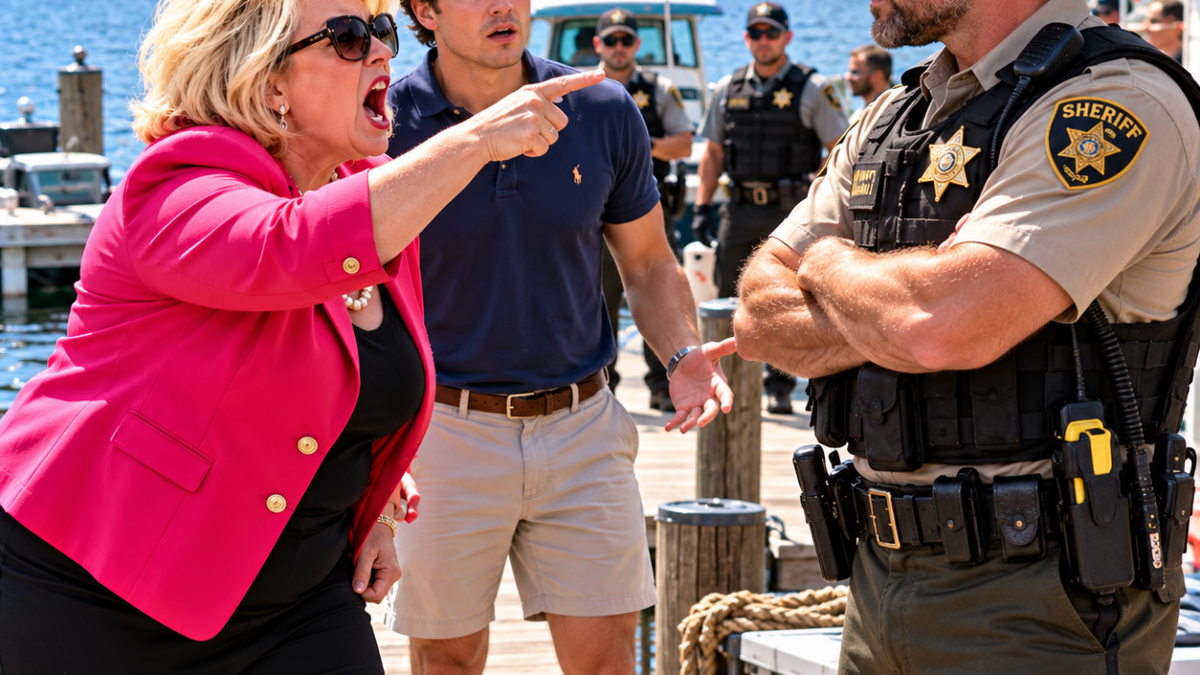
PART 2
The lake went so quiet I could hear water tapping the dock posts.
Preston looked at my badge like it had appeared out of thin air.
His eyes moved from my chest to my face, then back to the badge again, as if some part of him hoped the words would rearrange themselves into something less terrifying.
They did not.
COUNTY SHERIFF.
Caleb Mercer.
Right there in front of him.
The man he had just ordered off the dock.
The man he had threatened with jail.
The man whose property his guards were damaging while his mother watched from a golf cart.
One of the guards lowered the bolt cutters slightly.
The other whispered, “Oh, hell.”
Vanessa recovered faster than her son.
I gave her that.
Her face changed first to shock, then calculation, then something close to offense, as if I had tricked her by not announcing my position before she trespassed.
She stepped down from the golf cart and smoothed the front of her blouse.
“Sheriff Mercer,” she said, trying to make my title sound like an inconvenience. “This is obviously a misunderstanding.”
Preston still had not spoken.
I looked at the cut chain lying on the dock.
Then at the laminated Silver Pines paper in his hand.
Then at the guards.
“No,” I said. “A misunderstanding is when somebody gets the wrong address. This is something else.”
Vanessa’s jaw tightened.
“You cannot use your office to intimidate members of this community.”
“I agree.”
That made her blink.
I reached to the radio clipped at my belt.
“That’s why I’m not handling this personally.”
Preston found his voice.
“What does that mean?”
“It means I’m the property owner. I’m also the county sheriff. That creates a conflict. So I’m calling an independent supervisor to respond.”
Vanessa’s expression brightened a fraction.
She thought she saw a way out.
A civil dispute.
A conflict of interest.
A sheriff who had to step back.
She thought procedure would protect her from the reality sitting right in front of us.
I pressed the radio button.
“Dispatch, this is Sheriff Mercer. I need Deputy Supervisor Barrett and a second unit at my residence on Lake Briar. Possible trespass, property damage, disputed access claim. Be advised, I am the property owner and will not be acting as the responding officer.”
A brief pause.
Then dispatch answered, “Copy, Sheriff. Sending Supervisor Barrett and one additional unit.”
I lowered the radio.
Preston swallowed.
Vanessa folded her arms.
“This is still a civil matter,” she said.
“That depends on what Deputy Barrett finds.”
“You know this is improper.”
“What’s improper?”
“You involving your own department.”
“I’m not involving my own department to help me win an argument. I’m requesting an independent response because your son is standing on my dock with two guards who just cut my chain.”
One guard looked at the chain like it had become poisonous.
Vanessa pointed at the laminated paper.
“We have documentation.”
“Then show it to Barrett when he arrives.”
“I can show it to you.”
“No.”
Her eyes narrowed.
“No?”
“I’m not investigating this.”
That bothered her more than if I had shouted.
People like Vanessa know how to fight anger.
They know how to twist outrage into aggression, aggression into instability, instability into a story where they become the reasonable party.
Calm procedure left her with nothing to grab.
So I stood beside my own boathouse in full uniform, hands relaxed, voice steady, and let the evidence sit where it was.
The severed chain.
The bolt cutters.
The laminated paper.
The trespass.
The dock.
The mother.
The son.
The guards.
Everything visible.
Everything preserved.
Preston took a step back.
“Mom,” he muttered.
Vanessa shot him a look so sharp it cut him silent.
The wait for Barrett felt longer than it was.
In reality, he arrived in under an hour.
Deputy Supervisor Nolan Barrett had worked under me for nine years. He was careful, patient, and stubborn in the way good lawmen have to be stubborn. He did not rush his reports, did not bend his words to please anyone, and had never once mistaken my title for an instruction to stop thinking.
That was why I trusted him.
His cruiser rolled down my gravel drive with a second county unit behind him.
He stepped out, adjusted his hat, and took in the scene.
The guards.
The broken chain.
Vanessa’s golf cart.
Preston’s pale face.
Me standing away from everyone with my hands visible and my mouth shut.
Barrett walked toward me first.
“Sheriff.”
“Nolan,” I said. “For this response, I’m the complainant and property owner only.”
He nodded.
“Understood.”
“I’ll stay back unless you need a statement.”
“I’ll take one after I speak to them.”
That was all.
No wink.
No special treatment.
No show of loyalty.
Just procedure.
Vanessa watched the exchange closely, searching for favoritism she could later weaponize.
She did not find any.
Barrett turned to her.
“Ma’am, I’m Deputy Supervisor Nolan Barrett. Who is making the claim that this dock belongs to Silver Pines?”
Vanessa stepped forward with the laminated paper.
“The association has a legal easement over this shoreline.”
“May I see the document?”
She handed it to him like she was giving him a winning card.
Barrett read silently.
Preston regained enough confidence to say, “It’s all there.”
Barrett ignored him.
He read the first page.
Then the second.
Then looked at the top corner.
“Do you have a recorded deed or easement filed with the county clerk?”
Vanessa pointed.
“The reference number is there.”
Barrett looked at the number.
Then at me.
I said nothing.
He radioed dispatch.
“County records, this is Barrett. I need confirmation on an easement reference number.”
He read the number aloud.
Vanessa stood with her arms crossed, calm returning to her face.
Preston straightened slightly.
The guards began pretending they had merely been standing there.
I looked out over the lake.
The heron had moved farther into the reeds.
Dispatch came back a few minutes later.
“Barrett, records advises no easement found under that reference number. Number appears unrelated to Lake Briar shoreline parcel. No recorded access right located for Silver Pines HOA on Mercer property.”
The air changed.
Vanessa’s face flickered.
Only once.
Then she rebuilt it.
“There must be a clerical issue,” she said. “The association’s records manager provided that copy.”
Barrett looked at the paper again.
“This description doesn’t match Sheriff Mercer’s parcel.”
Preston snapped, “It was transferred from the old owner.”
I turned my head slowly.
“What old owner?”
He looked at me with the desperate confidence of a man who did not realize the floor had already opened under him.
“Your uncle. He sold the access years ago.”
“My uncle died before Silver Pines was incorporated.”
Preston’s mouth opened.
Closed.
Vanessa said sharply, “Preston.”
Too late.
Barrett wrote something down.
I said, “Nolan, the guards cut that chain after being told they were on private property.”
Barrett turned to the guards.
“Who instructed you to cut the chain?”
The bigger guard stared at Vanessa.
She stared back.
He swallowed.
“Mrs. Whitmore told us the association had taken over dock management.”
Barrett pointed to the bolt cutters.
“Set those down.”
Both guards obeyed immediately.
Preston looked furious.
Vanessa looked worse.
Not because she was embarrassed.
Because she could feel control leaving her.
Barrett spoke calmly.
“Everyone who is not legally authorized to be on this property needs to leave now. That includes you, Mr. Whitmore, Mrs. Whitmore, and both security personnel. This document does not establish any current legal right to occupy or alter this dock.”
Vanessa’s mouth tightened.
“This is far from over.”
“I’m documenting the incident.”
“You do that.”
She turned toward her golf cart, then looked back at me.
Her eyes had gone cold.
“You’ll regret making an enemy of Silver Pines.”
I said nothing.
It was not my job, in that moment, to answer threats.
It was my job to let Deputy Barrett hear them.
He did.
He wrote that down too.
Before they left, Barrett collected photographs, recorded the guards’ statements, documented the cut chain, photographed the laminated paper, and gathered the bolt cutters as potential evidence.
I gave my statement like any other complainant.
Short.
Specific.
No emotion where facts belonged.
After they left, I stood on the dock alone and picked up the severed chain.
My father had installed the original boat lift when I was sixteen.
He had made me hold the wrench while he tightened the bolts.
“Anything near water will test you,” he had said. “Wood swells. Metal rusts. Men argue. You keep your side clean.”
That phrase came back to me as the golf cart disappeared up the hill.
Keep your side clean.
I intended to.
That night, I called Graham Pollard.
Graham was a real estate attorney who had handled lakefront, riparian-rights, and boundary disputes for nearly thirty years. He had the kind of voice that made bad news sound organized.
I sent him the letter Silver Pines had mailed me, the fake-looking easement paper, my deed, my certified survey, Barrett’s preliminary incident number, and photographs from my own security cameras.
He called me back after ten.
“Caleb,” he said, “this is not a simple dock dispute.”
“I didn’t think it was.”
“It’s bigger.”
I sat at my kitchen table and looked through the window toward the dark water.
“How much bigger?”
“Silver Pines is marketing a waterfront initiative.”
I closed my eyes.
“Using my dock.”
“Your dock, your shoreline, your boathouse, and your lake frontage.”
He paused.
“They have promotional materials describing a private community marina, kayak rentals, an event deck, and guaranteed lake access for a new phase of home sales.”
I opened my eyes.
“How many lots?”
“Thirty-eight.”
The house went quiet around me.
Graham continued.
“They appear to be collecting deposits based partly on represented lake access.”
“Access they don’t have.”
“Correct.”
I thought of Vanessa in the golf cart, calm as could be, watching those guards cut my chain.
She had not been improvising.
She had been staging ownership.
That was worse.
Graham said, “I need to pull more records, but from what I see tonight, Vanessa may be trying to create a paper trail and pattern of use. Letters. Signage. Visits. Photographs. Claims. If she can make it look like Silver Pines has historically treated the dock as shared access, she may believe it strengthens her position in a later fight.”
“She knows it isn’t hers.”
“I can’t prove what she knows yet.”
“I can.”
“Caleb.”
I heard the warning in his voice.
“I know,” I said. “Keep my side clean.”
“Exactly.”
The next few weeks proved Graham right.
Silver Pines did not back off.
They sent invoices.
The first one demanded $1,400 for obstruction of community access, unauthorized dock modification, removal of association signage, and administrative processing.
I stared at the bill long enough to wonder whether laughing would count as an official response.
I had never belonged to Silver Pines.
Never signed its covenants.
Never paid dues.
Never attended a meeting.
The idea that Vanessa could fine me for unauthorized modification of my own dock would have been hilarious if it had not been part of a bigger fraud.
Graham sent a cease-and-desist letter.
It demanded that Silver Pines stop entering my land, stop marketing my dock, stop claiming access, preserve all related documents, and retract any representation that the HOA controlled my shoreline.
Vanessa responded by installing a large sign near the property boundary.
SILVER PINES WATERFRONT ACCESS
She placed it just close enough to my line that anyone driving by would think it marked the entrance to my dock.
I did not remove it.
I photographed it.
Date.
Time.
Location.
Then I sent everything to Graham.
He called me the next morning.
“She’s still building the record.”
“I figured.”
“She wants visible markers. If she can get residents accustomed to seeing that sign, seeing Preston near the dock, seeing people walk down there, she can later argue community reliance.”
“She picked the wrong shoreline.”
“She may have picked several.”
That proved true three days later, when Lydia Marlow knocked on my door.
She lived north of me on a narrow bend of Lake Briar.
Quiet woman.
Widowed.
Owned a strip of waterfront her parents had bought in the seventies.
She stood on my porch with a thick folder pressed against her chest and fear in her eyes.
“Sheriff Mercer?”
“Caleb is fine.”
She looked over her shoulder before stepping inside.
“I think Vanessa did this to me too.”
We sat at the kitchen table.
Lydia opened the folder.
Three years earlier, Vanessa had pressured her over a narrow footpath near the lake.
At first, Silver Pines requested occasional access for maintenance surveys.
Then occasional became seasonal.
Seasonal became scheduled.
Scheduled became expected.
Expected became claimed.
By the time Lydia realized what had happened, the HOA was describing that footpath as a historic community access corridor.
She had signed a limited-use agreement just to make the pressure stop.
“I was alone,” she said, staring at her hands. “My husband had just died. I didn’t have money for lawyers. Vanessa kept saying the association would bury me in legal fees.”
I felt my jaw tighten.
Lydia slid a printed email across the table.
It was from Vanessa.
One line had been highlighted.
Once residents establish regular access, removing them becomes legally complicated.
I read it twice.
Then again.
There it was.
Not an accident.
Not confusion.
Strategy.
Vanessa had written down the playbook in her own words.
Graham almost went silent when I sent him the email.
Then he said, “This changes the pattern.”
“How?”
“It shows intent to manufacture reliance through repeated access.”
“That’s what she’s doing with my dock.”
“Yes.”
“And the new lots?”
“Likely dependent on the same strategy.”
I looked out at the lake.
“You think she’s done this to others?”
“I think we should assume she has.”
Preston kept circling.
He stopped walking onto my dock in daylight after seeing my badge, but he did not disappear.
He parked along the road and filmed my shoreline from the shoulder.
He brought prospective residents close to the boundary and pointed toward my boathouse like a tour guide showing off a feature home.
Once, from my kitchen window, I watched him stand near the sign and tell a young couple something while gesturing toward my dock.
The woman looked delighted.
The man took pictures.
They believed him.
That was the part that made me angrier than Preston’s threats.
Silver Pines was not only trying to take from me.
They were selling lies to people who thought they were buying a dream.
Lake access.
Kayak mornings.
Sunset events.
A private marina.
All built on a dock my father had constructed board by board before Preston was born.
Then Preston made his next mistake.
Late one evening, I came home from a county meeting and noticed one of my shoreline cameras was angled slightly wrong.
Most people would not have seen it.
I did.
I checked the footage.
At 11:37 p.m., a Silver Pines pickup rolled down near the boundary with its headlights off.
Preston got out with two other men.
They carried folding chairs, a rolled sign, rope, a combination lockbox, and a toolbox.
They walked straight onto my dock.
One man unrolled a sign that said RESIDENTS ONLY.
Another tied fresh rope along the side rail.
Preston unlocked my boathouse door with a key I had never made and installed a lockbox with a Silver Pines logo.
Then he stood back and took pictures.
The second camera, hidden farther down the shoreline, captured his face clearly.
So did the third.
I did not touch a thing.
Not the sign.
Not the rope.
Not the lockbox.
Not the chairs.
At sunrise, I called Barrett.
He arrived with another deputy.
This time, nobody could pretend the line was blurry.
The footage showed criminal trespass after dark.
Tampering with a locked structure.
Attempted control over private property.
Theft or attempted interference, depending on what prosecutors decided about the lock.
Barrett watched the footage in my kitchen.
When it ended, he exhaled slowly.
“Sheriff—Caleb—this needs to go to the prosecutor.”
“I agree.”
“And not through you.”
“I agree.”
“You’ll need to stay completely hands-off.”
“I already am.”
He looked at me.
“I know. I’m saying it because this is going to get ugly.”
“It already is.”
“No,” Barrett said. “This is just the part before ugly.”
He was right.
Preston stormed into the sheriff’s office two days later.
I was in my office reviewing budget reports when the front desk called.
“Sheriff, Preston Whitmore is in the lobby demanding to see you.”
“Is he armed?”
“No.”
“Is he threatening anyone?”
“Not directly.”
“Put him in Interview Two. Door open. Camera on. Deputy present.”
Preston did not understand the trap he was building around himself.
He entered the interview room red-faced and furious.
I sat across from him with Deputy Miles standing near the open door.
A camera blinked in the corner.
“You think you can use that badge to intimidate my family?” Preston snapped.
“No.”
“You’re trying to destroy my mother.”
“No.”
“You’re using the department to steal community property.”
“Preston, this conversation is being recorded.”
“I don’t care.”
“You should.”
He leaned across the table.
“My mother owns half that shoreline now.”
I folded my hands.
“Based on what?”
“The paperwork Darla prepared.”
The room became very still.
Deputy Miles glanced at me.
I did not move.
“Darla King?” I asked.
Preston’s face changed.
Just slightly.
Too late.
“She’s the records manager,” he said, trying to recover. “She handles documents.”
“What documents?”
“You know what documents.”
“I want you to say it.”
He stood.
“This is harassment.”
“You came here.”
“You’ll regret this.”
“Preston.”
He stopped at the door.
“You came into a recorded interview room and mentioned Darla’s paperwork in connection with your mother’s shoreline claim. That matters.”
His face drained.
Then he left without another word.
Darla King became the loose thread.
She had worked for Silver Pines for years.
Records manager.
Office administrator.
The woman who knew where the old files were stored, who printed board packets, who prepared notices, who sent newsletters, who maintained digital archives.
Graham subpoenaed metadata through the civil case.
The prosecutor’s independent fraud unit began its own review.
The results were devastating.
The supposed historic easement had not been created decades earlier.
It had been created weeks before the first letter arrived in my mailbox.
The file origin traced back to Darla’s office computer.
But the access logs showed late-night edits under Preston’s credentials.
The county stamp embedded on the fake document did not match official formatting, but it was close enough to fool an ordinary person at a glance.
Then Darla panicked.
Vanessa tried to blame her first.
At an emergency HOA meeting, Vanessa told the board the records manager had mistakenly pulled old documents and misunderstood their significance.
She spoke calmly.
Elegantly.
She made Darla sound careless, not criminal.
Darla understood what was happening.
The next morning, she contacted Graham.
They met with her attorney present.
Everything was documented.
Darla admitted Vanessa had instructed her to modify an old legal description for “negotiation purposes.”
Vanessa had said it would never be recorded.
Never used as proof.
Just part of an internal working draft.
Darla claimed she resisted, then caved under pressure.
The draft later reappeared with a county-style stamp she said she never added.
Only two people had unsupervised access to that computer after hours.
Darla.
And Preston.
Darla also produced the email that turned the case from ugly to explosive.
Vanessa had written:
Lake access must be established before the new lot closings.
There it was again.
Access first.
Sales second.
Truth somewhere far behind both.
Darla handed over a flash drive.
Drafts.
Emails.
Internal memos.
Marketing documents.
Versions of the fake legal description.
Notes from meetings where Vanessa discussed “stabilizing the access narrative” before buyers questioned the marina timeline.
When Graham called me after reviewing it, his voice was grim.
“Caleb, this is no longer just civil.”
“I know.”
“The fraud unit will take it from here.”
“Good.”
“And you need to remain completely outside the investigative chain.”
“I know that too.”
That was harder than people might think.
I had spent nineteen years solving other people’s problems.
Now, on my own land, watching my father’s dock become the centerpiece of a fraud scheme, I had to stand still while others carried the case forward.
But standing still was not weakness.
It was discipline.
Vanessa mistook it for weakness.
That was her last great mistake.
She announced a Silver Pines Waterfront Opening Weekend.
The email went out on a Thursday.
Residents were invited to celebrate the community’s new lakefront access area with refreshments, kayak demonstrations, family photos, and a preview of the future event deck.
My dock was in the brochure.
My boathouse was in the background.
My shoreline was cropped to hide my house.
Graham filed for an emergency injunction immediately.
The earliest hearing was scheduled for Monday.
Vanessa set the opening for Saturday.
She knew exactly what she was doing.
If dozens of residents walked down to my dock, took pictures, launched kayaks, and treated the area as community property, she would get the visual record she wanted.
Families enjoying the waterfront.
Children on the dock.
Silver Pines signs near the lake.
Social media posts.
Witnesses.
Reliance.
History manufactured in one morning.
That Saturday, I woke to engines.
Golf carts.
A line of them.
From my kitchen window, I watched the procession roll down the road toward my shoreline.
Vanessa led from the front in a white golf cart with Silver Pines flags clipped to the roof.
Preston rode behind her.
Two hired security guards followed in a utility cart.
Residents filled the rest—families, retirees, children with life jackets, people carrying folding chairs and coolers.
Most of them looked excited.
That hurt more than I expected.
Because they were not villains.
They were people who had been lied to.
I walked outside with two documents in my hand.
My deed.
My certified survey.
I placed copies at the property line in clear plastic sleeves weighted with stones.
Then I stood back.
Vanessa saw them and waved dismissively.
“Obsolete,” she announced to the crowd.
A few residents looked uncertain.
Preston jumped out of his cart.
He had learned nothing.
“Today,” he said loudly, “Silver Pines finally opens what should have been available to residents all along.”
I remained silent.
He pointed toward me.
“And before anyone gets confused, Sheriff Mercer is not acting as sheriff today. This is personal.”
I nodded.
“That is correct.”
He blinked.
“I’m glad we agree.”
“It’s exactly why I’m not the one handling it.”
He frowned.
“What does that mean?”
Sirens did not announce the arrival.
No drama.
No screaming tires.
Just several county vehicles turning calmly down the road, followed by Deputy Supervisor Barrett stepping out with a folded court order in his hand.
Vanessa’s smile tightened.
Graham had not waited for Monday.
After reviewing the updated filing, the judge had issued emergency temporary relief that morning.
Barrett walked straight to Vanessa.
“Mrs. Whitmore, you are being served with a court order prohibiting Silver Pines HOA, its agents, representatives, employees, guests, or members from entering the Mercer property or using the dock, boathouse, shoreline, or any related access pending litigation.”
He handed her the order.
Vanessa read it.
Her face hardened with rage.
“This is outrageous.”
“It is signed,” Barrett said.
“This is an abuse of office.”
“It was issued by a judge.”
Preston grabbed the paper from her hand.
I knew what was coming a second before he did it.
He tore the order in half.
A silence fell so fast even the children stopped moving.
Barrett looked at the ripped paper on the ground.
Then at Preston.
“Mr. Whitmore, I am advising you clearly. Interfering with a lawful court order is a criminal offense. Crossing that property line after notice will result in enforcement.”
Preston’s face was red.
His hands were shaking.
He had built his entire personality around believing his mother’s influence made consequences optional.
Now consequences were standing in front of him wearing a county uniform and speaking calmly.
He looked at me.
“You think you win because you called your own people?”
I said, “I didn’t call them.”
Barrett said, “I’m the responding officer.”
Preston stepped across the property line.
Not by accident.
Not a toe over the edge.
He walked straight toward the dock.
Barrett moved immediately.
“Stop.”
Preston did not.
Barrett reached him in six steps.
“Mr. Whitmore, you are being detained.”
Preston jerked away.
Vanessa screamed, “Don’t touch my son!”
Barrett controlled Preston’s wrists with practiced calm.
No show.
No roughness.
No anger.
Just procedure.
Preston shouted, “He’s making you do this!”
Barrett said, “No, sir. You violated a court order after being warned.”
He cuffed him.
Right there in front of the crowd that had arrived expecting a waterfront celebration.
Vanessa spun toward the residents.
“Do you see this? He’s having my son arrested!”
I stepped forward then, not toward Preston, but toward the crowd.
“My name is Caleb Mercer. I own this property. Deputy Barrett is not arresting Preston because of who I am. He is detaining him because Preston violated a signed court order after being warned in front of witnesses.”
No one spoke.
I looked at the residents—at the children in life jackets, the retirees holding lawn chairs, the young couples who had likely put down deposits on new homes because they thought this dock belonged to them.
“I’m sorry you were told this shoreline belonged to your community. It does not.”
Vanessa shouted, “Liar!”
I did not answer her.
Graham arrived moments later, carrying a folder and walking with the grim focus of a man who had waited all morning for facts to catch up with arrogance.
He stood near the property line and addressed the residents.
“Anyone who has been told Silver Pines owns or controls this dock should request written proof from the association. As of this morning, a court order says otherwise.”
Murmurs spread through the crowd.
One woman near the back asked, “But the sales office said the marina was included.”
Another man said, “We paid a premium for lake access.”
Vanessa’s face went pale.
That was the moment her own residents began to understand the shape of the lie.
Before the morning ended, Barrett received another call.
Investigators from the independent fraud unit had executed a search warrant at the Silver Pines HOA office.
They found marketing contracts.
Buyer deposit records.
Internal board emails.
Multiple versions of the fabricated easement.
Instructions for sales staff.
And one email from Vanessa directing that the lake access be described as “existing,” never “proposed,” regardless of documentation.
That email would become the nail through the center of her defense.
By Monday, Silver Pines was no longer discussing a dock dispute.
It was discussing fraud exposure.
Buyer reliance.
Possible restitution.
Unauthorized legal spending.
Fabricated documents.
Criminal trespass.
Property damage.
And the collapse of a waterfront initiative built on land the HOA never owned.
Preston’s situation got worse as investigators examined the office computer.
Security footage showed him after hours at the scanner.
Metadata showed his login accessing the fake easement file.
A flash drive hidden in the office contained a digital template resembling the county recorder’s stamp.
At first, Preston said he had only printed materials for his mother.
Then Vanessa began distancing herself from him.
Preston did what weak men often do when the person protecting them steps away.
He turned on her.
Within days, mother and son had separate attorneys and separate stories.
Vanessa claimed Preston had gone too far.
Preston claimed Vanessa directed every step.
Darla confirmed enough of both to make the pattern clear.
The civil case moved alongside the criminal investigation.
Graham filed for quiet title, damages, reimbursement of legal fees, a permanent injunction, and compensation for the damage to my dock and boathouse.
He also demanded correction of every public-facing statement, brochure, webpage, sales packet, and HOA record implying Silver Pines had lake access through my property.
The court’s preliminary ruling was blunt.
No valid easement existed.
No Silver Pines ownership interest existed.
No community dock existed.
No legal basis supported the HOA’s claims.
A permanent injunction later barred the association from advertising, entering, marking, using, or claiming access to my shoreline.
The HOA was ordered to repair the physical damage and contribute significantly to my legal costs.
But money was never the main thing.
I refused every offer to sell an easement.
The new board tried once.
Politely.
They said residents had been promised lake access, buyers were angry, and a negotiated easement might reduce everyone’s losses.
I listened.
Then I said no.
Not angrily.
Not to punish innocent homeowners.
But because I had built my life on that shoreline specifically because it was quiet.
I did not want strangers walking past my kitchen window carrying kayaks.
I did not want weddings on my dock.
I did not want a community event deck where my father used to sit with a fishing rod and a thermos.
Some things are not for sale simply because someone else already promised them.
That was a lesson Silver Pines learned too late.
The fallout spread.
Lydia Marlow recovered full control over her footpath after the old agreement was reexamined.
Two other shoreline owners came forward with similar stories.
Families who had bought into the new phase demanded answers.
The HOA suspended Vanessa, then removed her.
The board audited years of expenses.
Residents discovered that dues had funded fake signs, aggressive marketing, questionable legal preparation, and pressure campaigns against private landowners.
Vanessa’s title disappeared first.
Then her influence.
Then her defenders.
Preston faced consequences of his own. Not the exaggerated ruin some people online later invented, but real ones. Charges tied to trespass, destruction of property, violating the order, and involvement with the fabricated documents where prosecutors could prove his role. The worst punishment for him, I suspect, was simpler than any court sentence.
For the first time in his life, saying “my mother said so” did not open a door.
Months passed before the lake felt quiet again.
I replaced the chain.
Repaired the boathouse lock.
Pulled down the unauthorized rope.
Removed the chairs.
Sanded the marks left by Preston’s lockbox.
And one cool morning in early fall, I knelt at the end of the dock replacing a warped board.
That was how my father had always dealt with trouble.
Fix what’s broken.
Do it right.
Don’t make a speech while the work still needs doing.
I had just driven the last screw into the new plank when a sedan stopped near the property line.
I looked up.
Vanessa stepped out.
No golf cart.
No security.
No son.
No folder.
No sunglasses.
No title.
Just Vanessa Whitmore standing at the boundary she had spent months pretending did not exist.
For a long moment, neither of us spoke.
Then she said, almost quietly, “You could have sold it to us from the beginning.”
I looked down at the board.
Picked up another screw.
Set it in place.
“You could have asked.”
She said nothing.
The lake moved gently beneath the dock.
I drove the screw in.
The sound echoed across the water.
Vanessa stood there like she wanted to argue, but the old weapons were gone.
No board resolution.
No fake easement.
No Preston.
No residents behind her.
No marketing brochure.
No audience.
Just a woman at the edge of land she did not own, facing the man she had tried to erase from his own shoreline.
Finally, she turned and walked back to her car.
I watched her taillights disappear through the trees.
A few minutes later, Barrett pulled up in his cruiser.
He stepped out and looked at the small sign I had installed near the path.
PRIVATE PROPERTY
NO COMMUNITY ACCESS
INVITED GUESTS ONLY
He smiled faintly.
“Think Preston understands that one?”
I looked out over the lake.
“It cost him enough. I’d hope so.”
Barrett leaned against the railing.
“Quiet again.”
“Mostly.”
“You ever wish you’d just sold them access and avoided all this?”
I thought about that.
The legal bills.
The threats.
The cameras.
The fake papers.
The residents misled.
The court orders.
Preston being cuffed on my lawn.
Vanessa standing at the boundary with nothing left to say.
Then I thought of my father building the dock board by board, long before Silver Pines existed. I thought of him teaching me that property was not about greed. It was about stewardship. Responsibility. Knowing what was yours so you could protect it without taking what belonged to someone else.
“No,” I said. “If I’d sold after they tried to take it, I would’ve taught them the tactic worked.”
Barrett nodded.
The lake shimmered in the afternoon light.
Somewhere across the water, a boat engine hummed.
On my dock, the new board sat clean and straight among the weathered ones.
That felt right.
Vanessa lost because she believed authority could replace ownership.
Preston lost because he believed his mother’s name could replace law.
Silver Pines lost because it tried to sell a dream built on another man’s dock.
And I kept my shoreline not because I was sheriff, but because the deed was clear, the truth was patient, and for once, the person they tried to bully had enough evidence to make the whole lie collapse in public.
In the end, Preston did get exactly what he threatened to call.
The sheriff came.
He just didn’t come for me.
[EXPANDED ENDING — 4000 WORDS]
For a long time after Vanessa Whitmore drove away from my property line, I stayed kneeling on the dock with the drill in my hand, staring at the screw I had just set into the new plank.
The lake was quiet again.
That should have felt like victory.
For months, all I had wanted was for the noise to stop. No more letters from Silver Pines. No more fake easements. No more Preston standing on my dock with that arrogant smirk. No more residents being marched toward my shoreline because they had been sold a dream built on someone else’s land. No more security guards with bolt cutters pretending they were enforcing the law.
Just lake water.
Boards under my knees.
Pine trees moving softly in the wind.
The faint smell of sawdust and old cedar from the boathouse.
But peace does not always arrive clean. Sometimes it comes dragging everything behind it—the threats, the court hearings, the signatures, the fraud files, the faces of people who found out too late that someone they trusted had lied to them.
I set the drill down and ran my palm over the board.
My father would have checked the grain first. He would have squinted at the screw heads, tapped the plank with his boot, and told me it would hold if the lake didn’t get mean over winter.
He had built that dock before Silver Pines existed. Before Vanessa Whitmore had a title. Before Preston was born. Before glossy brochures turned every quiet patch of water into a selling point.
To my father, a dock was not an amenity.
It was work.
Posts. Bolts. Weather. Maintenance. Responsibility.
He never would have understood how a homeowners association could look across a property line, see something another man had built, and decide it belonged in a marketing package.
Or maybe he would have understood too well.
He used to say greed always learned the language of progress.
A few minutes after Vanessa’s sedan disappeared, Deputy Supervisor Nolan Barrett pulled his cruiser onto the shoulder near the top of the path.
He stepped out slowly, the way men do when they are not responding to trouble but still know trouble has recently passed through.
He had been there for most of it.
The first confrontation after Preston cut my boat-lift chain.
The court order Preston tore in half.
The morning residents arrived in golf carts expecting a “community waterfront opening.”
The moment Preston crossed the property line after being warned.
The arrest.
The fraud investigators.
The search of the Silver Pines office.
Barrett had seen the whole lie collapse one legal step at a time.
He walked down toward the dock and stopped near the small sign I had installed by the path.
PRIVATE PROPERTY
NO COMMUNITY ACCESS
INVITED GUESTS ONLY
He read it and smiled faintly.
“Clear enough.”
I stayed on one knee, setting another screw.
“That was the idea.”
“You think Preston finally understands it?”
I drove the screw into the wood before answering.
“It cost him enough. I’d hope so.”
Barrett came down onto the dock and leaned one shoulder against the railing. He looked out over Lake Briar, where the afternoon sun was breaking into long strips across the water.
“Vanessa came by?”
I nodded.
“Alone?”
“First time I’ve seen her without an audience.”
“What did she want?”
I picked up another screw from the coffee can beside me.
“To tell me I could have sold it to them and saved everyone trouble.”
Barrett let out a dry breath.
“That sounds like her.”
“She still thinks the damage came from my refusal.”
“Not from the fraud.”
“Not from the trespass.”
“Not from using her son like a crowbar.”
I glanced up.
“She used everyone like a crowbar.”
Barrett did not argue.
That was the truth of it.
Preston was not innocent. He had cut locks, stepped onto private property, accessed fabricated records after hours, and torn a court order in front of witnesses. But he was also a product of a woman who had taught him that confidence could substitute for permission.
Vanessa had trained her son the same way she trained her board, her staff, and half the residents of Silver Pines.
Say it like it is already true.
Repeat it until people are tired.
Print it on letterhead.
Add a logo.
Make disagreement feel unreasonable.
Then move fast enough that by the time anyone asks for proof, the lie has people standing on it.
That was how my dock became a “shared recreational pier.”
That was how my boathouse appeared in brochures for homes I had nothing to do with.
That was how a private shoreline turned into a “waterfront initiative.”
And that was how ordinary families paid deposits on houses believing they were buying access to a lake they had no legal right to reach through my land.
I set another screw.
The drill whined across the water.
Barrett watched me for a while.
“You ever regret not telling Preston who you were right away?”
I stopped.
That question had followed me for months, though most people asked it differently.
Why didn’t you just show the badge immediately?
Why let him keep talking?
Why let the guards cut the chain?
Why not shut it down in ten seconds?
I rested the drill on my thigh.
“I was at home.”
Barrett nodded, but I continued because that answer was not enough.
“I spent nineteen years making sure the badge didn’t become a weapon in my own driveway. People already think sheriffs can do whatever they want. They think power bends toward itself. I wasn’t going to prove them right on my dock.”
“You didn’t.”
“I know. But I had to be careful from the first second.”
I looked toward the boathouse.
“When Preston threatened to call the sheriff, I could have embarrassed him right there. Maybe he deserved it. But if I had handled everything myself, Vanessa would’ve turned the whole case into a story about me abusing office over a personal property dispute.”
“She tried anyway.”
“She did. But she couldn’t make it stick because every step went through somebody else.”
Barrett smiled slightly.
“You mean me.”
“I mean the process.”
“That’s less flattering.”
“It’s more important.”
He accepted that with a nod.
The badge had mattered in the beginning only because it showed Preston how reckless he had been. But it could not be the reason I won. If the case depended on who I was instead of what the deed said, then Vanessa would have been right about power after all.
I did not keep my dock because I was sheriff.
I kept it because it was mine.
Recorded. Surveyed. inherited. Maintained. Protected by law.
The same law that would have protected it if I had been a mailman, a mechanic, a retired teacher, or a widower with no badge at all.
That distinction mattered to me more than any headline.
It mattered because of Lydia Marlow.
After the permanent injunction came down, Lydia stood on my porch with tears in her eyes, holding a copy of the court’s order like it had been written for her personally.
In a way, it had.
Three years earlier, Vanessa had pressured her into allowing “limited maintenance access” across a narrow lakeside footpath. That phrase had sounded harmless at the time. Lydia had been newly widowed, exhausted, and afraid of spending money she did not have on lawyers she did not know.
So she signed.
Just to make the pressure stop.
That was what she told me.
“I told myself it was just a path,” she said. “Just a few people. Just occasional access.”
But occasional became routine.
Routine became expected.
Expected became claimed.
By the time Lydia realized Silver Pines was treating her kindness as legal surrender, she felt too small to fight.
Vanessa had counted on that.
After my case exposed the pattern, Graham Pollard helped Lydia reopen the old agreement. The emails from Vanessa, the repeated access strategy, the fraud investigation, and the fabricated shoreline claims gave Lydia enough leverage to challenge what she had once thought was permanent.
She got her path back.
Not dramatically.
No arrests.
No cameras.
No crowd.
Just a corrected agreement, a recorded notice, and a new lock on a small gate at the edge of her land.
But when she told me, her hands shook.
“I slept through the night for the first time in years,” she said.
That stayed with me longer than Preston’s arrest.
Because property disputes are rarely only about land.
They are about sleep.
Privacy.
Dignity.
The ability to wake up without wondering who will walk through your yard because someone with more money and louder lawyers decided your peace was negotiable.
After Lydia came Wade Prater.
He had surveyed half the county before retiring and had a memory for boundary lines that made old maps seem alive. Vanessa had tried to dismiss him as an old man obsessed with pins in the dirt.
But Wade’s records were precise.
He had kept copies of every map, every letter, every notice from Silver Pines, every marked-up plat Vanessa’s office had sent him, and every correction he had mailed back.
When investigators compared Wade’s documents with Darla King’s files from the HOA office, the pattern became impossible to deny.
Vanessa had not merely exaggerated.
She had targeted access points.
She had identified weak owners.
She had created official-looking documents where no official rights existed.
And she had used the language of community improvement to hide a campaign of private pressure.
Wade visited my dock one morning after his own boundary was formally reaffirmed.
He was sixty-one, stiff-backed, with sunburned hands and a rolled survey under one arm.
He stood at the end of the pier and stared across the lake.
“People think lines on paper are abstract,” he said.
“They are until someone crosses one.”
He nodded.
“A line is a promise. That’s what they forget. It tells your neighbor where your peace begins.”
I had never heard it said better.
Silver Pines forgot that.
Or rather, Vanessa taught them to forget it when forgetting became profitable.
The new board spent months trying to untangle what she had done. I did not envy them. They inherited angry buyers, furious residents, legal exposure, withdrawn marketing materials, cancelled waterfront events, and a development phase that had been priced around an amenity they never owned.
Some residents blamed Vanessa from the start.
Others needed time.
A few never forgave me.
That surprised some people, but it did not surprise me.
When people buy a beautiful lie, the person who reveals the truth often feels like the thief.
One man approached me outside the courthouse after a civil hearing.
He was in his mid-thirties, dressed in work clothes, with tired eyes and a folder tucked under his arm.
“You’re Mercer?”
“Yes.”
“My wife and I put a deposit on one of the new lots.”
I waited.
He looked angry, but not certain where to aim it.
“They told us lake access was included.”
“I know.”
“We stretched for that deposit.”
“I’m sorry.”
He laughed once, bitterly.
“That doesn’t help.”
“No, it doesn’t.”
“My kids picked out kayaks.”
I had no answer for that.
Because he was right to be angry.
His family had been promised something. They had imagined weekends, birthdays, mornings on the water. They had built memories in advance, and now those memories had nowhere to live.
But I had not taken those memories from him.
Vanessa had sold them.
Still, anger does not always care where it properly belongs.
He looked toward the courthouse doors.
“You really couldn’t just let people use it?”
I met his eyes.
“How many people?”
He did not answer.
“Residents? Guests? Buyers? Event renters? Kayak customers? Maintenance crews? Wedding parties? Real estate tours?”
His expression shifted.
“That’s not what I meant.”
“It’s what Vanessa meant.”
He looked away.
I softened my voice.
“I’m sorry your family was lied to. I truly am. But the solution to that lie can’t be forcing me to live with strangers crossing my property forever.”
He stood there a moment longer.
Then his shoulders dropped.
“My wife said the same thing.”
“She sounds wise.”
That almost made him smile.
Almost.
He left without shaking my hand.
I understood.
Not every ending gives everyone what they want.
Sometimes justice only decides who should not have to pay for someone else’s lie.
Silver Pines eventually settled many of the buyer claims. Some deposits were refunded. Some homes were repriced. Some buyers walked away. Others stayed because they liked the neighborhood even without the lake access.
The “Waterfront Initiative” vanished from the website.
The brochures disappeared.
The sales office stopped saying “private marina.”
A commercial marina on the south side of Lake Briar later negotiated a legitimate arrangement with the new board, giving residents discounted memberships at a facility Silver Pines did not have to steal, invent, or misrepresent.
Funny how simple things become when people start by asking the actual owner.
Darla King resigned before the investigation concluded.
I saw her once afterward at the county clerk’s office. She looked older than she had during the hearings, like the months had pulled something out of her face.
She approached me near the records counter.
“Sheriff Mercer.”
“Darla.”
“I owe you an apology.”
I waited.
She held a folder against her chest the way Lydia had, but Darla’s fear was different. Lydia had feared being powerless. Darla feared being responsible.
“I should have said no earlier,” she said.
“Yes.”
The bluntness made her flinch.
I did not soften it.
She had helped create documents that nearly cost me my shoreline. She had kept copies, and those copies later mattered, but keeping evidence is not the same as stopping harm.
“I told myself it was just drafts,” she said. “Marketing language. Pressure tactics. The kind of thing every development office does.”
“That’s how lines get crossed.”
She nodded.
“I know that now.”
“No,” I said. “You knew it then. That’s why you saved copies.”
Her eyes filled.
For a second, I regretted saying it so sharply.
Then I remembered Preston on my dock.
The bolt cutters.
The fake easement.
The families who paid deposits.
Lydia’s footpath.
Wade’s boundary.
Darla’s fear mattered.
But so did what fear had allowed.
She wiped her cheek.
“I’m cooperating fully.”
“I know.”
“I just wanted you to hear it from me.”
“I hear it.”
She waited, maybe hoping for forgiveness.
I could not give her that in the moment.
Not because I wanted to punish her forever, but because forgiveness offered too quickly can become another way of cleaning up a mess before everyone has learned from it.
So I said, “Do better next time someone asks you to make a lie look official.”
She nodded.
“I will.”
I believe she meant it.
Preston’s consequences unfolded differently.
He had spent twenty-nine years being Vanessa’s son before he was anything else. That does something to a person. It teaches him rooms will open, mistakes will disappear, and other people’s objections are just noise to push through.
Court was probably the first room in his life where his last name made things worse instead of better.
He took a negotiated outcome on several charges tied to trespass, destruction of property, and violation of the court order. The document-related allegations were more complicated. Prosecutors could prove he accessed files after hours and handled materials connected to the fabricated easement, but Vanessa’s fingerprints were deeper on the planning.
That did not make Preston innocent.
It made him exactly what he had always been: the willing hand of someone else’s arrogance.
At his hearing, he looked smaller.
No Silver Pines polo.
No sunglasses.
No smirk.
He stood beside his attorney and answered the judge in a voice I barely recognized.
“Yes, Your Honor.”
“No, Your Honor.”
“I understand, Your Honor.”
I sat in the back row, not in uniform, because I was there as the property owner whose dock he had tried to take.
At one point, he glanced back and saw me.
For a second, I thought I saw hatred.
Then I realized it was humiliation.
That can look similar from a distance.
Afterward, in the hallway, he stopped near me.
His attorney touched his arm as if warning him not to speak.
Preston ignored him.
“My mother told me it was legal.”
I looked at him.
“You had bolt cutters in your hand.”
His face flushed.
“I didn’t know the easement was fake then.”
“You knew I told you to leave.”
He swallowed.
“You were just some guy on a dock.”
“That’s the part you need to think about.”
He frowned.
“It shouldn’t have mattered who I was.”
For once, he said nothing.
Maybe the lesson had finally reached him.
Maybe not.
Some people learn only the shape of consequences, not the meaning behind them.
But he turned and walked away without another threat.
That was progress.
Vanessa fought longer.
She had built her identity around control, and people like that do not surrender simply because facts defeat them.
They appeal.
They explain.
They reframe.
They blame subordinates, sons, lawyers, clerks, market pressure, misunderstood emails, old assumptions, bad advice, and community expectations.
In Vanessa’s version, she had been protecting property values.
In Vanessa’s version, the forged documents were “drafting errors.”
The marketing materials were “premature.”
The trespasses were “assertions of disputed rights.”
Preston’s behavior was “unfortunate overenthusiasm.”
Darla’s work was “administrative confusion.”
My resistance was “personal animus hidden behind public office.”
But courtrooms have one advantage over HOA meetings.
Eventually, someone asks for proof.
Not tone.
Not confidence.
Not a laminated resolution.
Proof.
The proof did not favor Vanessa.
The fabricated easement metadata.
The altered legal descriptions.
The buyer instructions.
The email about describing access as existing.
The message to Darla about establishing access before closings.
The prior pattern with Lydia and others.
The security footage of Preston at my boathouse.
The body-camera footage from the day Barrett served the injunction.
The shredded court order.
The board expenses Vanessa approved without proper votes.
The story was not perfect in every detail. Real cases never are. But the shape was clear enough.
Vanessa tried to take what was not hers because what was not hers made her project more valuable.
The court’s permanent injunction made the practical result plain.
Silver Pines could not advertise my dock.
Could not enter my shoreline.
Could not place signs near my boundary implying access.
Could not bring residents to my property.
Could not use photographs of my boathouse, pier, or lake frontage in marketing.
Could not revive the “historic community access” claim under another name.
The board also had to pay for repairs.
The damaged chain.
The boathouse lock.
The dock hardware.
The camera Preston had tilted.
The legal fees were more complicated, but the court awarded enough to make clear that I should never have had to spend my own money proving the obvious.
Then came the final meeting with the new Silver Pines board.
They requested it politely through Graham.
Not Vanessa’s kind of polite, which was really pressure wearing perfume.
Actual polite.
A simple request for discussion.
We met in Graham’s office, not at my house.
The new board president was a retired school principal named Helen Carver. She brought two board members, an attorney, and a folder of corrected documents.
She began by saying, “Mr. Mercer, Silver Pines owes you an apology.”
I said, “Yes, it does.”
No one argued.
That helped.
Helen continued.
“The prior leadership misrepresented property rights to residents, buyers, and neighboring owners. The association is correcting those records.”
She slid a letter across the table.
It was a formal written acknowledgment that Silver Pines had no ownership, easement, license, or access right over my dock, boathouse, shoreline, or lake frontage.
Clear language.
No hedging.
No “without admitting.”
No “alleged.”
I read it twice.
Then I signed the receipt acknowledging I had received it.
Helen looked tired.
“We are also attempting to repair the damage done to residents who relied on those representations.”
“I hope you do.”
“We have one request.”
I already knew what it was.
She looked embarrassed to ask.
“Would you consider selling a limited, paid easement for seasonal pedestrian access? Strictly controlled. No events. No marina. No commercial use.”
Graham looked at me but did not speak.
He had told me the request might come.
I looked at Helen.
“No.”
She nodded slowly, as if she had expected that.
“I understand.”
“I don’t think you do,” I said, not harshly.
She waited.
“If I sell access now, after everything Vanessa did, then everyone watching learns the same lesson.”
“What lesson?”
“That if you trespass, lie, pressure, market, and fight long enough, eventually the owner will sell just to make the conflict end.”
Helen looked down.
“I hadn’t thought of it that way.”
“I have thought of little else.”
That ended the request.
To her credit, she did not ask again.
Silver Pines eventually found another solution at the commercial marina. It cost them money, but the paperwork was real. The owner negotiated willingly. The agreement was recorded properly. No one cut chains. No one forged easements. No one sent a son with a laminated paper and a countdown.
Amazing what adulthood can accomplish.
By the time autumn settled over Lake Briar, the whole northern shore felt different.
Not changed exactly.
Corrected.
The fake sign was gone.
The unauthorized rope was gone.
The lockbox was gone.
The path was quiet.
Lydia’s gate stayed closed unless she opened it.
Wade’s boundary markers were repainted.
Silver Pines residents stopped wandering near my property line, and when they passed in boats, most waved with the awkward politeness of people who know more than they want to say.
I waved back when I felt like it.
Not always.
I am honest enough to admit that.
One Saturday morning, I found a small envelope tucked under the windshield wiper of my truck while it was parked near the feed store.
No return address.
Inside was a note written in neat block letters.
Sheriff Mercer,
We were one of the families who put a deposit down because of the promised lake access. At first, we were angry at you. It felt like you had taken away something our children had been excited about. After the meetings and the documents came out, we understood that you were not the one who lied to us.
I am sorry for believing you were the problem.
We got our deposit back. We bought a smaller house outside Silver Pines. It does not have lake access. But it is honest.
Thank you for standing your ground.
There was no signature.
I read that note three times sitting in my truck.
Then I folded it and put it in the glove box.
I kept it there for months.
Not because I needed praise.
Because sometimes a man needs proof that truth eventually reaches someone.
The final time I saw Vanessa was the day she came to the dock.
The day she said I could have sold it and spared everyone trouble.
People later asked me why I did not say more.
Why I did not tell her she ruined herself.
Why I did not remind her of the fraud investigation, the removed presidency, the restitution claims, the humiliation of watching her son cuffed at the edge of the property she tried to steal.
But standing there with a drill in my hand and sawdust on my jeans, I realized something.
Vanessa did not come for truth.
She came for one last version of control.
If she could make the whole thing about my refusal to sell, then she did not have to face what she had actually done.
So I gave her the only answer that mattered.
“You could have asked.”
That was the whole case in four words.
She could have asked to buy an easement.
Asked to lease access.
Asked whether I would consider limited use.
Asked whether there was any arrangement I might accept.
Asked like a neighbor.
Asked like a person who understood that ownership does not vanish because someone else has plans.
Instead, she claimed.
Threatened.
Fabricated.
Marketed.
Trespassed.
And sent her son to count down sixty seconds on a dock my father built.
After she left, I finished replacing the warped board.
Barrett arrived.
We talked.
He joked about Preston finally understanding the sign.
Then he left too, and the lake returned to itself.
I walked to the end of the dock near sunset.
The new plank looked pale among the old ones.
That happens with repairs.
At first, the fixed place stands out.
Too clean.
Too fresh.
Too obvious.
Then weather comes.
Rain, sun, cold mornings, muddy boots, fish scales, spilled coffee, lake spray.
Over time, the new board becomes part of the dock.
It does not erase the break.
It proves the break was handled.
I stood there until the sky went purple over Lake Briar.
A fishing boat crossed far out near the channel.
A breeze moved through the reeds.
The heron returned to the shallows.
For the first time in months, I did not think about Vanessa when I looked at the water.
I thought about my father.
About him handing me a hammer.
About the summer he built the dock.
About the way he believed a man should know the difference between holding firm and holding a grudge.
I did not hate Vanessa.
I did not need to.
Her own choices had done more to her than my hatred ever could.
I did not hate Preston either.
But I hoped every time he saw a dock, a property sign, or a court order, he remembered that morning.
I hoped he remembered the feeling of standing in front of a crowd, realizing his mother’s name could not protect him from a boundary line.
I hoped he remembered that the sheriff he threatened to call did arrive.
Just not for the man he wanted removed.
The final court papers came weeks later.
Filed.
Stamped.
Recorded.
Permanent injunction entered.
Title confirmed.
Claims barred.
Damages resolved.
Costs awarded.
Marketing corrected.
It was all very official and dry, as justice often looks on paper.
No dramatic music.
No final speech.
Just signatures and dates and legal descriptions.
But when I placed those papers in the same cedar locker where my uniform hung, I felt the circle close.
At the top was my badge.
Below it, the deed.
Beside it, my father’s old dock plans folded into a yellow envelope.
Three different kinds of authority.
The badge said what the county trusted me to do.
The deed said what the law recognized as mine.
The old plans said what my father had built before any of the rest became necessary.
Of the three, the plans meant the most.
That night, I took my coffee down to the dock.
The boards creaked under my boots.
The repaired section held firm.
Across the water, lights from Silver Pines glittered between the trees.
For months, those lights had felt like eyes watching my shoreline.
Now they were only lights.
Homes.
Families.
People trying to move past a lie they had not all chosen but had all been forced to live through.
I sat at the end of the dock and listened to the lake.
The world had become ordinary again.
That was the victory.
Not Preston’s arrest.
Not Vanessa’s fall.
Not the court order.
Ordinary.
The right to sit on my own dock without defending its existence.
The right to unlock my own boathouse without finding someone else’s lockbox on the door.
The right to watch the sunrise without wondering what new document Vanessa had invented overnight.
People think peace is fragile because it is quiet.
But sometimes quiet is the strongest thing left standing.
Vanessa had come with titles, meetings, logos, signs, fake documents, security guards, marketing teams, and a son foolish enough to threaten jail on private land.
All I had, at the beginning, was an old dock, a clear deed, patience, and the discipline not to let anger do Vanessa’s work for her.
It was enough.
Because the truth does not need to be loud when it is properly recorded.
And the final truth was simple.
Silver Pines never owned my dock.
Preston never had authority to stand on it.
Vanessa never had the right to sell it.
And I never needed to become less calm than the lie.
In the end, Preston got exactly what he asked for.
He threatened to call the sheriff.
The sheriff came.
But by the time it was over, the only person removed from my dock in handcuffs was him.
[END]








