PART 2: HOA Karen’s Son Cut the Chains on My Private Dock and Threatened to Arrest Me—Then He Saw My County Sheriff’s Badge
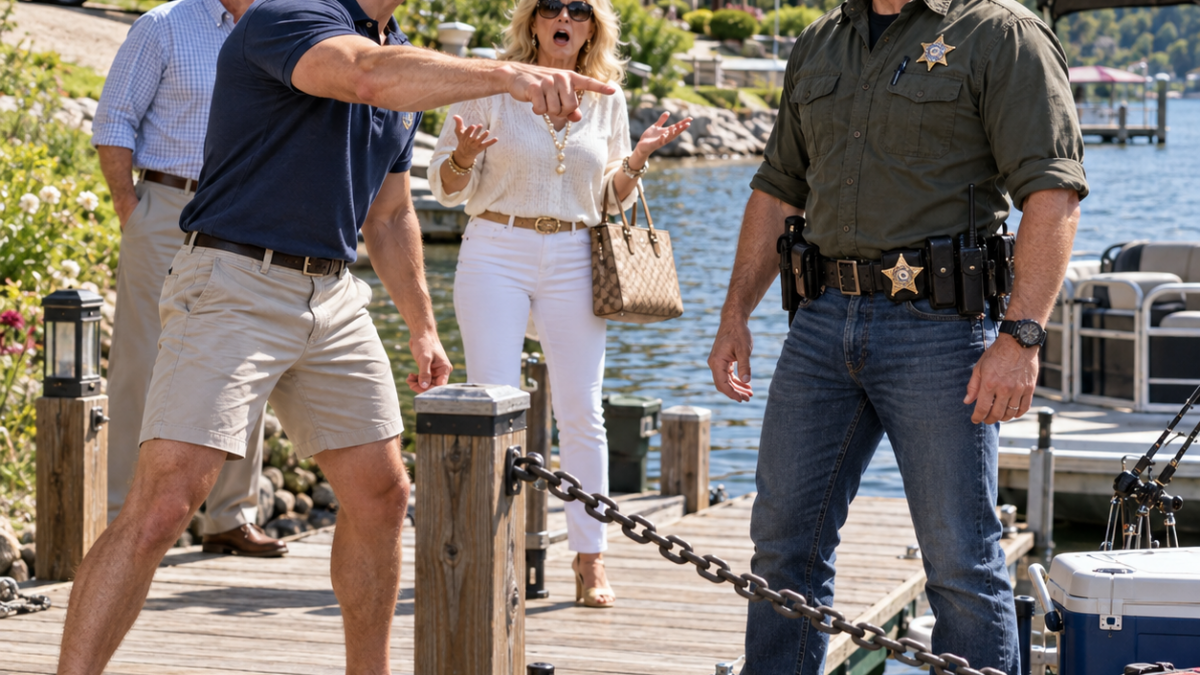
PART 2
His bolt cutters stopped moving.
I noticed.
Preston didn’t.
He was too busy enjoying himself.
“See?” he said. “Even my mother knows how this works.”
I looked at the countdown.
Forty-one seconds.
I could have identified myself immediately.
I could have reached for the phone in my pocket, called dispatch, and ended his little performance.
But I wanted to give him every opportunity to stop what he was doing.
Not because I was afraid.
Because I knew something Preston didn’t.
And I knew exactly how easily the presence of a sheriff could turn a legitimate property complaint into allegations of intimidation or abuse of authority.
I kept my voice level.
“Preston, this property isn’t part of Silver Pines. The dock isn’t community property. You have no permission to be here. I’m asking you to stop cutting my equipment and leave.”
He folded his arms.
“Thirty seconds.”
The younger guard looked uneasy.
“Mr. Whitmore, maybe we should verify—”
Preston snapped his head toward him.
“Do your job.”
The guard fell silent.
Vanessa watched from the hill.
The timer continued.
Twenty-two seconds.
I looked at Preston.
“Last chance to handle this reasonably.”
He smiled.
“That’s what I’m telling you.”
I nodded.
Then I turned and walked toward the boathouse.
Behind me, Preston burst out laughing.
“See, Mom? That’s all it takes.”
I heard Vanessa answer, “Some people only understand consequences.”
I stepped inside the boathouse and closed the door.
Then I opened the narrow locker beside the workbench.
My county sheriff’s uniform hung neatly inside.
I almost never wore it at home.
For nineteen years, I’d made a deliberate effort to keep my public office separate from my private life.
At work, I was Sheriff Caleb Mercer.
At home, I was just Caleb.
A man who fixed his own roof, repaired his own dock, and liked drinking coffee beside a quiet lake.
Most residents of Silver Pines knew me only as the fellow who lived on the northern shoreline.
I didn’t use a marked patrol vehicle for personal errands.
I didn’t introduce myself by title at neighborhood gatherings.
And I certainly didn’t use my badge to win arguments with neighbors.
But Preston had made one thing perfectly clear.
He wanted the sheriff involved.
So I decided it was time he understood who he had spent the morning threatening.
I removed my old gardening jacket.
Put on my uniform shirt.
Fastened my duty belt.
And checked the badge above my left pocket.
COUNTY SHERIFF.
CALEB MERCER.
Then I opened the door.
Preston was standing near the boat lift, smiling at his mother.
His back was partly turned.
The younger security guard saw me first.
His expression changed instantly.
He straightened.
“Sir—”
Preston turned.
“What’s your problem?”
Then he saw me.
His smile disappeared.
His eyes moved from my uniform to the badge and finally to my face.
He blinked.
Once.
Twice.
“No way.”
I stepped onto the dock.
“Now,” I said quietly, “would you like to start this conversation again?”
Nobody answered.
The bolt cutters hung motionless in the younger guard’s hands.
Vanessa rose halfway out of the golf cart.
Preston stared at my badge as though it might somehow vanish if he looked long enough.
I didn’t raise my voice.
I didn’t make a threat.
I simply looked at the broken chains lying near my feet.
Then at the men responsible.
“First, put those tools down.”
The younger guard immediately complied.
The older one followed.
Preston looked from one guard to the other.
“Don’t listen to him. He’s trying to intimidate us.”
I met his eyes.
“No, Preston. I’m trying to prevent anybody from making this situation worse.”
He swallowed.
“You’re really the sheriff?”
“Yes.”
He looked toward his mother.
For the first time, she didn’t seem to have an answer ready.
Then Preston recovered enough to say something astonishing.
“Well, you can’t arrest us just because you’re the sheriff.”
“That’s correct.”
He blinked.
Clearly, he hadn’t expected me to agree.
I continued.
“And because this involves my personal property, I won’t be conducting the investigation myself.”
Vanessa’s shoulders relaxed slightly.
I could almost see her calculating.
If I couldn’t personally investigate, maybe she could still frame this as an ordinary civil dispute.
Maybe she could still make the broken chains disappear into an argument over paperwork.
She leaned forward.
“Then I suggest we all behave professionally and allow the proper authorities to determine the association’s rights.”
I looked at her.
“That’s exactly what we’re going to do.”
Then I took out my radio.
“Dispatch, this is Sheriff Mercer. I need an independent field supervisor sent to my residence at Lake Briar. Possible trespass, property damage, and disputed documents. I’m the property owner and will not be the investigating officer.”
The dispatcher acknowledged the request.
Preston stared at the radio.
Then back at me.
His expression had changed from smug confidence to open disbelief.
“You actually called them?”
I looked at him.
“You said you wanted the sheriff’s department involved.”
He opened his mouth.
Nothing came out.
I looked toward the broken chain.
“Now we’re going to make sure everything is handled properly.”
What none of us knew yet was that the paperwork Vanessa had brought that morning contained a detail connecting it to something much older than this dock.
And when I recognized it, I understood that my property might be only one piece of a much larger operation.
Lake Briar was one of the few places in the county that still felt untouched by the growth happening around it.
The southern shore had become increasingly developed.
Luxury homes climbed the hills.
Private roads wound between manicured lawns.
Property advertisements promised peaceful waterfront living, even when the houses were several streets away from the actual water.
But the northern shoreline remained different.
There were wooded parcels, older family properties, and a handful of cabins built long before developers discovered how much money they could make selling a lake view.
My eleven acres sat along that northern bank.
The original property records established more than four hundred feet of shoreline and the associated private access rights.
Those rights had been documented for decades.
The dock stood entirely within my property and its authorized waterfront area.
There was no public pathway across my lawn.
No recorded easement granting Silver Pines access.
No deed transferring the dock to an association.
And no agreement allowing residents of the gated development to use my boathouse.
Silver Pines itself didn’t even touch the lake.
That was the detail Vanessa had spent months trying to hide.
The neighborhood’s northern boundary stopped short of the water.
Between its property and the shoreline lay privately owned land.
Including mine.
When Silver Pines was first developed, that arrangement wasn’t a problem.
The neighborhood was marketed as a peaceful community near Lake Briar.
Not on Lake Briar.
Near it.
Residents enjoyed the trees, walking trails, and large homes.
Some bought boats and used the public ramp several miles away.
Others visited commercial marinas.
Everything worked well enough.
Then Vanessa Whitmore decided proximity wasn’t valuable enough.
She wanted direct waterfront access.
More specifically, she wanted a marina.
The proposal was introduced under an elegant name.
The Silver Pines Waterfront Initiative.
The marketing materials showed a private marina, a lakeside event pavilion, kayak rentals, and a landscaped path leading directly to the water.
Residents were told the project would increase property values.
Prospective buyers were shown renderings of families relaxing on wooden docks, children carrying kayaks, and boats moored against a picturesque shoreline.
It looked beautiful.
There was just one problem.
The dock in those photographs was mine.
The shoreline was mine.
And Vanessa had never asked permission to use either.
When I first learned about the project, I assumed there had been some misunderstanding.
That was before the letters started.
The first envelope arrived on a Tuesday.
It was addressed formally to Caleb Mercer, property owner.
The letter claimed that I was improperly occupying a “shared recreational pier” and demanded that I remove my private equipment within ten days.
I remember reading those words at my kitchen table.
Shared recreational pier.
My father would have laughed so hard he’d spilled his coffee.
He’d built the dock before Silver Pines existed.
He’d bought the lumber himself.
Driven the pilings.
Fastened the boards.
Installed the original boat cleats.
I still had photographs showing him standing on the unfinished structure.
Yet here was an HOA claiming the dock was shared property.
The notice cited an alleged historic waterfront access right.
It warned that failure to comply could result in further enforcement action.
I read it twice.
Then opened my property file.
I made copies of the recorded deed and certified survey.
I wrote a short response explaining that the dock was private, the association held no rights over it, and no one from Silver Pines had permission to enter without my consent.
I mailed the response using a method that gave me proof of delivery.
Then I went back to work.
I genuinely believed that would end the matter.
The paperwork was clear.
A reasonable person would have checked the records, recognized the mistake, and apologized.
But Vanessa wasn’t interested in checking anything.
She sent her son.
The first time Preston appeared, I found him walking along my shoreline with a tape measure.
He was photographing the boathouse and measuring the path leading to the dock.
I approached him.
“Can I help you?”
He barely looked up.
“Just conducting a site assessment.”
“On whose authority?”
“Silver Pines.”
“Silver Pines doesn’t own this land.”
He smiled.
“That’s what we’re sorting out.”
“Then sort it out from your own side of the property line.”
His expression hardened.
“Mom said you’re difficult.”
I looked at him.
“Your mother doesn’t know me.”
“She knows you keep refusing to cooperate.”
“Cooperate with what?”
“The waterfront project.”
I pointed toward the boundary.
“Your project isn’t my responsibility.”
He slipped the tape measure into his pocket.
“You should think bigger, Mr. Mercer.”
I almost laughed.
“How big?”
“Community improvements. Property values. Tourism opportunities. The future of this lake.”
I looked at the water.
Then back at him.
“The future of this lake doesn’t require you standing in my yard.”
He stared at me for a moment.
Then walked away.
I assumed he’d learned the boundary.
Instead, he returned with curious residents.
One afternoon, I found Preston showing three couples the view from the shoreline.
He was pointing toward my dock while explaining where the future marina would operate.
I approached the group.
“Excuse me.”
One woman smiled.
“Oh, hello. Are you the caretaker?”
That stopped me.
“The caretaker?”
Preston interrupted.
“He’s the current property occupant.”
I looked at him.
“Current?”
He smiled.
“We’re discussing the development plans.”
I turned toward the couples.
“This is private property. The dock isn’t owned or controlled by Silver Pines.”
They looked confused.
One man frowned.
“But the association said this would be our marina.”
“I’m afraid you’ve been given incorrect information.”
Preston laughed.
“That’s his interpretation.”
I looked directly at him.
“No, Preston. It’s what the recorded deed says.”
The visitors began exchanging uncomfortable glances.
I wasn’t angry with them.
They’d apparently been told the association was arranging legitimate lake access.
It was reasonable for them to believe a neighborhood representative giving a tour was authorized to be there.
I told them they were welcome to enjoy the public access areas around Lake Briar, but my property wasn’t part of the development.
They apologized and left.
Preston remained.
When the others were out of earshot, his expression changed.
“You embarrassed me.”
“You brought people onto private land and called me an occupant.”
He stepped closer.
“My mother has been running Silver Pines for years.”
“Good for her.”
“She knows how these property issues work.”
“Then she knows she needs an easement or an owner’s permission.”
He pointed toward the dock.
“That thing won’t stay yours forever.”
I looked at him.
“Then somebody had better come up with a valid legal reason why.”
He gave me a thin smile.
“You’ll see.”
I watched him walk away.
Something in his tone bothered me.
Not because I thought he could legally seize the dock.
But because he sounded absolutely convinced that the outcome had already been decided.
Vanessa Whitmore had spent years building her reputation inside Silver Pines.
She was fifty-two, articulate, and extraordinarily skilled at making disagreement sound like incompetence.
Residents told me she ran meetings with military precision.
Budgets were presented in polished folders.
Rules were enforced strictly.
Complaints were answered with formal letters that sounded as though they’d been written by a law firm.
Some residents admired her.
Others were afraid of crossing her.
Most simply wanted the neighborhood maintained and their property values protected.
Vanessa understood that.
She knew people didn’t want to spend their evenings reviewing complicated HOA documents.
They wanted somebody else to handle the details.
So she became that somebody.
Over time, her opinions began sounding like policies.
Her preferences became enforcement priorities.
And her interpretation of association authority was rarely challenged.
Her son took that lesson and made it worse.
Preston didn’t hold an elected board position.
He wasn’t a licensed surveyor.
He wasn’t a county official.
And as far as I could determine, he had no professional role giving him control over waterfront property.
Yet he drove an SUV with a Silver Pines decal and behaved as though his mother’s presidency made him deputy ruler of the neighborhood.
He supervised contractors.
Directed security guards.
Confronted residents.
And delivered warnings with the swagger of somebody who believed his last name would protect him from anything.
The first few times he came to my property, I kept the conversations short.
I documented his visits.
Saved my camera recordings.
Noted the dates.
And avoided arguments.
I had spent nineteen years in law enforcement.
I knew how quickly a property dispute could become something uglier when people let anger make their decisions.
I also knew the danger of appearing to use public authority in a personal disagreement.
That was why I’d kept my occupation private whenever possible.
At home, I wanted to be a landowner.
Not an elected official.
But Preston mistook that restraint for weakness.
And Vanessa apparently did, too.
Her next letter was more aggressive.
It declared that Silver Pines possessed historic recreational access to the shoreline.
It claimed my dock had served community purposes for years.
And it warned that the association would take steps to “restore unrestricted resident use.”
Restore.
That word bothered me.
Nothing had ever been restricted because no such access had ever been granted.
You couldn’t restore a right that never existed.
I sent another written objection.
This time I asked Vanessa to identify the exact recorded instrument creating the alleged easement.
She didn’t provide one.
Instead, Preston arrived on that Saturday morning with two security guards, a laminated resolution, and bolt cutters.
Which brought us back to the dock.
And the moment he discovered that the quiet man he’d threatened to have arrested was the county sheriff.
Nolan Barrett arrived forty-three minutes after I requested an independent response.
He brought Deputy Marcus Hale, who was assigned to document the scene, and the dispatch supervisor had already been informed that I was personally involved.
Barrett was one of the most experienced supervisors in the department.
He was also the kind of man who could walk into a heated argument and make everybody lower their voices without raising his own.
I trusted him.
More importantly, I trusted him to tell me when I was wrong.
He parked near my driveway and approached the dock carrying a notebook.
I met him halfway up the path.
“Morning, Sheriff.”
“Morning, Nolan.”
He glanced toward the broken chains.
“That’s the property damage?”
“Yes.”
“Anybody injured?”
“No.”
“Any physical confrontation?”
“No.”
He nodded.
“Then let’s keep it that way.”
I handed him the documents I’d already prepared.
My deed.
The certified survey.
The earlier HOA notices.
And the written objections I’d sent to Vanessa.
Barrett reviewed them briefly.
Then he looked at me.
“You’re the complainant. I need you to stay out of the investigation.”
“I understand.”
“No questioning witnesses. No directing evidence collection. No decisions about charges.”
“Agreed.”
He looked toward Preston.
“Good. Because that young man looks like he’s waiting for somebody to give him an argument.”
I almost smiled.
“He’s had plenty of opportunities already.”
Barrett walked toward the dock.
I remained beside the boathouse.
Preston had recovered some of his confidence.
He stood with his hands on his hips while Vanessa held a thicker folder than the laminated paper he’d used earlier.
Barrett introduced himself.
“Deputy Supervisor Nolan Barrett. I’m responding to a complaint involving possible trespass and property damage.”
Vanessa stepped forward.
“Excellent. I’m Vanessa Whitmore, president of the Silver Pines Homeowners Association.”
Barrett nodded.
“Ma’am.”
She smiled.
“We’re glad someone is finally here to clarify the situation.”
Preston crossed his arms.
“My mother’s been trying to resolve this for weeks.”
Barrett looked at him.
“Then I’ll need you to explain what happened this morning.”
Preston pointed toward me.
“He refused to vacate community property.”
Barrett looked toward the dock.
“What makes you believe it’s community property?”
“The association has waterfront rights.”
“What recorded document establishes those rights?”
Vanessa stepped between them.
“I have that information.”
She opened her folder.
This time, she produced a document considerably more elaborate than Preston’s laminated resolution.
It contained a formal legal description.
A lot number.
A purported county recording reference.
A dated signature.
And what appeared to be an official recording stamp.
Barrett examined it.
From several feet away, I could see why Vanessa thought it would work.
It looked legitimate.
The layout resembled ordinary property records.
The language was formal.
The stamp was positioned exactly where someone unfamiliar with deed recording might expect it to be.
But as Barrett read, I noticed something.
The lot number.
It was wrong.
Not a simple transposed digit.
It referenced a different property.
I recognized it because I’d spent years reviewing old land records connected to our shoreline.
I didn’t interrupt.
Barrett had the document.
He would verify it.
He asked Vanessa, “Where did you obtain this?”
“Our association’s historical records.”
“Was it recorded with the county?”
“Of course.”
He studied the reference number.
“Who provided the certified copy?”
“Our records department.”
Barrett nodded.
Then he stepped aside and contacted county records.
Vanessa looked pleased.
Preston leaned against the boathouse railing.
“You’ll see,” he muttered toward me.
I didn’t answer.
Several minutes passed.
The guards stood quietly beside the damaged boat lift.
Marcus photographed the chains and the bolt cutters.
Barrett remained on the phone.
Then his expression changed.
“Would you confirm the recording reference one more time?”
He listened.
“Thank you.”
He ended the call.
Then turned toward Vanessa.
“Ma’am, the county has no record of this easement.”
Her smile faltered.
“That’s impossible.”
“The recording number doesn’t correspond to a valid instrument granting your association access to this property.”
“There must be an indexing mistake.”
“The legal description also doesn’t match Mr. Mercer’s parcel.”
Vanessa looked down at the document.
For the first time, she seemed genuinely uncertain.
Only briefly.
Then she recovered.
“Perhaps our administrative staff provided an earlier draft.”
Barrett kept his voice neutral.
“Then I suggest obtaining the correct recorded instrument before making further claims.”
Preston straightened.
“My mother knows what she’s doing.”
Barrett turned toward him.
“Mr. Whitmore, who instructed the security guards to cut these chains?”
Preston looked at Vanessa.
She answered.
“The association authorized the removal of unauthorized equipment.”
“Did the property owner consent?”
“We maintain that the association possesses the relevant access rights.”
“That’s not what I asked.”
Vanessa’s expression hardened.
Barrett repeated the question.
“Did Mr. Mercer give permission for the chains to be cut?”
“No,” she admitted.
“And did you personally direct these men to remove them?”
She hesitated.
Then said, “Yes, as part of our waterfront management responsibilities.”
The younger guard lowered his head.
Barrett turned toward him.
“Sir, were you instructed to cut those chains?”
The guard swallowed.
“Yes.”
“By whom?”
He glanced at Vanessa.
“Mrs. Whitmore.”
“And did you understand the dock belonged to Mr. Mercer?”
“We were told it was association property.”
Barrett made a note.
The second guard confirmed the instructions.
I watched from the path.
I wasn’t pleased to see the younger men caught in the middle.
They had made their own decision to cut equipment without verifying the claimed authority, and that mattered.
But they had also been given instructions by people who represented themselves as being in charge.
Vanessa had built an entire strategy around that kind of misplaced trust.
Barrett documented the statements.
Then instructed the visitors to leave my property while the ownership and potential offenses were reviewed.
Preston immediately objected.
“You can’t just throw us out!”
Barrett looked at him.
“You’re on property whose owner has expressly denied permission, and you haven’t produced a valid legal basis to remain.”
“My mother says—”
“Your mother’s position has been documented.”
Preston’s face reddened.
He glanced toward me.
“He’s using his job to get what he wants.”
I stayed where I was.
Barrett answered calmly.
“Sheriff Mercer isn’t conducting this investigation.”
Preston pointed at my uniform.
“Then why’s he wearing that?”
Barrett looked toward me, then back at Preston.
“His occupation doesn’t establish the property boundary. The recorded documents do.”
Vanessa moved toward her golf cart.
“This is far from over.”
I didn’t answer.
She turned back before climbing in.
“That dock will belong to Silver Pines before the end of the month.”
Barrett wrote down the statement.
Preston looked toward his mother.
Then toward me.
He seemed desperate to recover some of the authority he’d displayed earlier.
“You’ll regret making this personal.”
I met his eyes.
“Preston, it became personal when you cut my father’s chains.”
For a moment, he had no response.
Then he followed his mother toward the golf cart.
The security guards collected their tools under Barrett’s direction.
The damaged chains were documented as evidence.
The camera footage was preserved.
And the shoreline finally became quiet again.
But before Barrett left, I asked whether I could show him something.
Not as the sheriff.
As the property owner who had noticed a troubling detail.
I pointed toward the reference number on Vanessa’s disputed easement.
“Nolan, that number looks familiar.”
He examined it.
“From where?”
“An old property-document investigation.”
“Which one?”
I gave him the approximate year and the county file series I remembered.
It had involved altered land descriptions and questionable recording references.
I didn’t claim the two cases were connected.
I couldn’t know that.
But the resemblance was unusual enough to deserve verification.
Barrett made a note.
“I’ll pass it along for review.”
That evening, I changed out of my uniform and hung it back inside the boathouse locker.
Then I returned to the dock.
The broken chains were gone for evidence processing.
The lift stood unsecured.
A few fresh scratches marked the wood near the mounting bracket.
I sat on the edge and looked across the lake.
My father’s dock had survived storms, ice, and decades of weather.
Now it was being threatened by people with laminated paperwork and the belief that confidence could replace ownership.
I called Graham Pollard that night.
Graham had practiced real estate law for nearly thirty years.
He knew waterfront boundaries, easements, private access disputes, and development agreements.
More importantly, he wasn’t easily impressed by HOA threats.
When I explained what happened, he was quiet for several seconds.
Then he said, “Caleb, I want every document they’ve sent you.”
“I’ve got copies.”
“And the survey.”
“Certified.”
“And the dock’s construction records, if you still have them.”
“I have photographs and old receipts.”
“Good.”
I heard him opening a notebook.
“Because I suspect they’re doing more than trying to use your dock.”
I looked toward the water.
“What do you mean?”
He paused.
“I want to know what they’ve already promised other people.”
Graham found the answer the following afternoon.
He called while I was repairing a loose step near the back porch.
“Caleb, are you somewhere you can look at your email?”
“Yeah.”
“I’ve sent you something.”
I opened the message.
Attached was a Silver Pines marketing brochure.
The cover showed a beautiful lakeside setting, a polished wooden dock, kayaks, and a rendering of a small marina pavilion.
Across the top were the words:
SILVER PINES WATERFRONT LIVING.
I enlarged the image.
My breath caught.
That was my shoreline.
The trees.
The angle of the dock.
The curve of the bank.
Even the old wooden boathouse roof was visible behind the digitally added landscaping.
Someone had taken a photograph of my property and incorporated it into the development’s promotional material.
I stared at the screen.
“Graham, that’s my dock.”
“I know.”
“They’re advertising my dock.”
“Yes.”
I scrolled.
The brochure promised residents access to a private marina, community recreation facilities, and water activities.
It described the waterfront as an established amenity serving the new expansion phase.
I felt my face grow hot.
“They don’t own any of this.”
“That’s the problem.”
“Have they actually sold homes using this brochure?”
Graham hesitated.
“That’s what I’m looking into.”
He called me again that evening.
The situation was worse than we’d imagined.
Silver Pines was preparing thirty-eight additional residential lots.
Those homes were being marketed at a premium because of the promised lake access.
The projected community marina wasn’t a decorative feature.
It was a central selling point.
Buyers were being told they would have direct access to the water.
Some contracts included language describing waterfront amenities as part of the development’s appeal.
Deposits had already been collected.
And the entire arrangement depended on Silver Pines obtaining rights it didn’t have.
I sat silently while Graham explained.
Then I asked, “Why didn’t Vanessa just offer to buy the shoreline?”
“Maybe because a direct purchase would expose the fact that the access wasn’t secured before they started selling.”
“She could have asked.”
“She could have.”
“She never did.”
Graham sighed.
“Some people don’t want to negotiate when they’ve already promised investors and buyers that a deal is settled.”
I looked toward the kitchen window.
Beyond the trees, the dock was barely visible.
“So she invented an easement.”
“That’s one possibility the evidence points toward.”
“And now she’s trying to make people believe it existed all along.”
“Exactly.”
Graham explained what concerned him most.
Vanessa appeared to be creating a history of claimed access.
Letters.
Site visits.
Photographs.
Contractor measurements.
Security operations.
Signs.
Repeated statements that the dock was community property.
Each step made the claim look less sudden.
If the matter eventually reached court, she might attempt to present years of supposed association use rather than admitting the project had never possessed legitimate waterfront rights.
That didn’t mean such a claim would succeed.
But it could complicate the dispute, increase legal expenses, and make some owners more willing to settle simply to avoid prolonged litigation.
I thought about Preston walking along my shoreline with his tape measure.
The couples he brought to see the dock.
The photographs.
The first letter calling my father’s dock a shared recreational pier.
It all fit.
“They weren’t simply trespassing,” I said.
“They were creating a record.”
“That’s what it looks like.”
I felt a chill.
For weeks, I’d assumed Vanessa was acting out of arrogance.
Now I understood she might be acting with a plan.
And that made her more dangerous.
The first invoice arrived four days later.
Fourteen hundred dollars.
I stood in my kitchen reading it.
The charges were listed in separate categories.
Community access obstruction.
Unauthorized modification of shared waterfront infrastructure.
Improper removal of association signage.
Administrative enforcement fees.
I had to read the third charge twice.
Improper removal of association signage.
I hadn’t removed a single Silver Pines sign.
Because they didn’t belong on my property in the first place.
I called Graham.
He listened while I read the charges aloud.
Then he sighed.
“They’re attempting to treat you as though you’re subject to their covenants.”
“I’m not.”
“I know.”
“They know.”
“That may be exactly why they keep sending formal notices.”
He explained that the letters could serve a second purpose.
If I ignored them, Vanessa might later claim I had failed to challenge the association’s authority.
If I spent all my time answering them, she could increase my legal expenses and frustration.
Either way, she hoped to gain something.
Graham prepared a formal demand requiring Silver Pines to stop claiming ownership, cease entering my property, withdraw the unsupported charges, and remove misleading marketing statements.
The letter cited my recorded deed and survey.
It demanded identification of any genuine easement the HOA believed existed.
It warned that further unauthorized access would be documented and addressed through appropriate legal channels.
Vanessa’s response arrived four days later.
Not as a letter.
As a sign.
A large professionally printed sign appeared beside the boundary near the access path.
SILVER PINES WATERFRONT ACCESS.
The colors matched the development’s branding.
The sign was positioned just outside the surveyed line, but angled toward the road so that anyone approaching would assume it marked the entrance to a community waterfront facility.
I stood looking at it for several minutes.
Vanessa was careful.
She’d apparently been advised not to place the sign directly on my land.
So she put it close enough to create the same impression.
I photographed it.
Sent the images to Graham.
Then measured the location against the certified survey.
I didn’t touch it.
That seemed to infuriate Preston.
The following afternoon, he parked outside the boundary and recorded me walking toward the dock.
He held his phone up openly.
I stopped a safe distance away.
“Afternoon, Preston.”
He said nothing.
“Anything I can help you with?”
He kept filming.
I nodded.
“Have a good day.”
Then I continued walking.
I could almost feel his frustration.
He wanted a confrontation.
Something he could post online.
Something he could show his mother.
Something that would make me look unreasonable.
But I wasn’t going to hand him one.
By then, I’d spent nearly two decades responding to genuine emergencies.
I had seen what happened when frightened or angry people acted before thinking.
I wasn’t going to let an HOA president and her son turn my home into a stage for their own benefit.
Still, I was beginning to understand that patience alone wouldn’t resolve the matter.
We needed to discover how far the scheme extended.
The first person who helped us do that wasn’t an investigator.
It was another waterfront property owner.
Her name was Lydia Marr.
Lydia arrived at my door on a rainy Thursday afternoon carrying a thick folder.
She was in her early sixties, with silver hair pulled into a loose braid and the tired expression of someone who had spent far too much time fighting problems she never created.
“Are you Caleb Mercer?”
“Yes, ma’am.”
“My name is Lydia Marr. I own property north of here.”
I recognized the name.
Her family had held a narrow lakeside parcel for years.
“Of course. Come in.”
She stepped inside and looked toward the window overlooking the lake.
“I heard about the dock.”
I sighed.
“Seems everybody has.”
She gave me a sad smile.
“I thought you might need to know something.”
I offered coffee.
She accepted.
We sat at my kitchen table, and she opened her folder.
Three years earlier, Vanessa had approached Lydia about a narrow walking path crossing the edge of her property.
Silver Pines wanted residents to use it for occasional access to a scenic overlook near the water.
Lydia initially refused.
Then came the letters.
Official-looking notices.
Claims about historic access.
Warnings that blocking the path might violate established community rights.
She showed me copies.
The language was remarkably similar to the letters I’d received.
I felt my stomach tighten.
“What happened?”
Lydia looked down at her hands.
“My husband had just passed away.”
I waited.
“I was trying to manage the property alone. There were medical bills, estate paperwork, repairs to the house.”
Her voice became quieter.
“I couldn’t afford a long legal fight.”
“So you agreed?”
“To limited access. A narrow path. Occasional use.”
She opened another document.
“I made it clear that I was giving permission as a courtesy, not transferring ownership.”
I read the agreement.
It was carefully worded, but I could see how a determined association might attempt to stretch its meaning.
“What happened afterward?”
“First, they started sending residents through on weekends.”
She swallowed.
“Then every afternoon.”
She looked toward the window.
“Then they put up a sign.”
I felt anger rise.
“Calling it a community trail?”
She nodded.
“Exactly.”
The association began treating the narrow path as a permanent amenity.
When Lydia objected, Vanessa reminded her that residents had been using it for years.
Vanessa claimed removing the access would disrupt established community expectations.
The permission Lydia had granted to avoid conflict became the basis for a broader claim.
I shook my head.
“That’s the same thing she’s trying with my dock.”
“I know.”
Lydia reached into the folder and removed an old email.
“I saved this because something about it bothered me.”
She handed it over.
The message was from Vanessa.
It discussed waterfront access negotiations and included one particularly revealing sentence.
Once residents establish regular use, removing that access becomes legally complicated.
I read it twice.
Then looked at Lydia.
“She wrote this?”
“Yes.”
“Three years ago?”
She nodded.
“That’s why I came.”
I felt something settle heavily inside me.
Vanessa hadn’t stumbled into this strategy while trying to build her marina.
She’d been thinking about access claims for years.
She understood how repeated use could create confusion.
She understood how owners could become exhausted.
And she understood that a courteous concession might later be described as something far more permanent.
Lydia watched my face.
“I wish I’d fought harder.”
I shook my head.
“You were dealing with your husband’s death.”
“That’s no excuse.”
“It’s not an excuse. It’s what happened.”
She looked down.
“I just wanted them to stop.”
I understood that more than she realized.
Because that was exactly what Vanessa seemed to be counting on.
Not that owners would suddenly believe her false claims.
But that they would eventually become too tired to resist.
I placed the email beside the other documents.
“Would you be willing to speak with my attorney?”
Lydia looked at me.
“Yes.”
“He’s examining the history of these access claims.”
She nodded.
“I have more records at home.”
“Keep the originals safe.”
“I will.”
When she stood to leave, she paused at the doorway.
“Caleb?”
“Yes?”
“Don’t give her the dock.”
I looked toward the water.
“I’m not planning to.”
She gave me a faint smile.
“Good.”
After she left, I called Graham.
I told him about Lydia.
Then read him Vanessa’s email.
He was quiet for a moment.
“That changes the context considerably.”
“How?”
“It supports the possibility of a deliberate pattern.”
I looked toward the folder on my table.
“How many other people?”
“We need to find out.”
The next incident happened after dark.
I had returned from a long day at the sheriff’s office and was preparing dinner when I noticed something wrong with the boathouse camera.
The live image showed the dock at an unusual angle.
Only a few degrees off.
But enough that the outer corner of the boathouse was no longer visible.
I knew the camera hadn’t moved by itself.
I opened the recordings.
At 10:17 the previous night, a Silver Pines pickup had approached the shoreline access path.
Preston climbed out.
Two other men followed.
They carried folding chairs, a box of hardware, a coil of rope, and a rectangular sign.
I sat forward.
The three walked onto my dock.
One unfolded two chairs near the end.
Another replaced a mooring rope.
Preston attached a sign to the railing.
RESIDENTS ONLY.
I stared at the screen.
Then I watched him remove a small device from the box.
A combination lockbox bearing the Silver Pines logo.
He attached it near the boathouse door.
Another man worked on the existing lock.
A few minutes later, Preston tested a new key.
The door closed.
He locked it.
Then tried the handle.
Satisfied, he stepped backward and looked around the dock.
He seemed to be admiring the work.
I felt my pulse quicken.
He’d entered after dark.
Altered my security camera.
Installed equipment.
And changed access to my boathouse.
But Preston made one mistake.
He apparently didn’t know about the second camera.
After a theft from a neighboring property several years earlier, I’d installed another camera farther down the shoreline, concealed among the trees.
It covered the approach, the side of the boathouse, and the outer edge of the dock.
I switched to that recording.
Everything was there.
The arrival.
The equipment.
Preston directing the others.
The alteration to the first camera.
The installation of the new lock.
The three men leaving.
Every movement.
Every timestamp.
I sat back in my chair.
For several seconds, I couldn’t speak.
Then I called Barrett.
“Sorry to bother you this late.”
“What’s wrong?”
“Preston Whitmore came back.”
“Where?”
“My dock.”
“When?”
“Last night.”
“What happened?”
“He brought two men, installed association equipment, changed the boathouse lock, and moved my camera.”
There was a pause.
“Do you have footage?”
“All of it.”
Barrett sighed.
“Don’t touch anything.”
“I won’t.”
“I’ll arrange for it to be documented.”
I ended the call.
Then I sat at the table staring at the screen.
It was one thing for Preston to stand on my dock in daylight and wave a fake resolution around.
It was another to return after dark and physically take control of the boathouse.
He was no longer merely repeating his mother’s claims.
He was acting on them.
And I suspected he had no idea how much evidence he’d left behind.
Barrett came the following morning.
He reviewed the camera footage with another officer and documented the altered locks, installed furniture, signage, and damage.
I stayed out of the evidence collection.
That had become a personal rule.
Whatever my professional title, I was the complainant in this dispute.
I wanted every finding to stand independently of me.
Barrett watched Preston on the recording.
Then looked at the newly installed lock.
“He’s getting bold.”
“He’s been bold from the beginning.”
“This is different.”
I nodded.
“I know.”
He examined the second camera angle again.
“Did he know this one existed?”
“Apparently not.”
“Good coverage.”
“Wish I didn’t need it.”
Barrett looked toward the dock.
“So do I.”
The evidence was referred for prosecutorial review.
Graham prepared additional legal filings.
The incident strengthened our request for court protection against further unauthorized access.
But Preston learned that we’d discovered his nighttime visit before any final charging decision had been made.
And instead of speaking to an attorney or staying away from my property, he came to my office.
Not my house.
The sheriff’s office.
He arrived just before noon.
The front desk deputy called upstairs.
“Sheriff, Preston Whitmore is in the lobby demanding to see you.”
I closed the report I was reviewing.
“Is he causing a disturbance?”
“He’s loud. Not violent.”
“Tell him I’ll meet him in an interview room.”
There was a pause.
“Sir?”
“One with video recording. And have another supervisor present.”
“Understood.”
I wasn’t going to discuss the case privately.
Preston had already accused me of abusing my office.
I intended to make sure there was no opportunity for anyone to misrepresent the conversation.
When I entered the room, he was pacing.
His face was red.
The moment he saw me, he started talking.
“You need to call off your people.”
I remained near the door.
“What people?”
“The deputies investigating me.”
“That investigation isn’t under my direction.”
He laughed bitterly.
“That’s convenient.”
I gestured toward a chair.
“You can sit if you’d like.”
He didn’t.
“My mother owns half that shoreline.”
I kept my voice steady.
“On what basis are you making that claim?”
“The association has the paperwork.”
“What paperwork?”
“The easement.”
“The document the county couldn’t verify?”
His jaw tightened.
“That was a filing issue.”
“Then the association should provide a valid recorded instrument.”
He stepped closer to the table.
“You don’t understand how development works.”
I looked at him.
“Then explain it.”
He seemed surprised by the invitation.
For a moment, he searched for words.
Then he said, “The county can’t just ignore documents because you don’t like them.”
“Agreed.”
He nodded, thinking he’d won something.
“So the association’s paperwork matters.”
“Authentic records matter.”
He scoffed.
“Darla prepared the paperwork herself.”
The room went quiet.
I looked at him.
“Darla?”
He blinked.
Then looked toward the recording camera.
I kept my expression neutral.
“Who is Darla?”
Preston shifted his weight.
“Darla King. The records manager.”
I nodded.
“Did she prepare the easement you brought to my property?”
He hesitated.
“I didn’t say that.”
“You said she prepared the paperwork.”
“She handles documents for the association.”
“All right.”
Preston stared at me.
For the first time since entering, he seemed to realize he’d volunteered information nobody had asked him to provide.
I didn’t question him further about it.
The independent investigators could follow that lead.
He looked toward the door.
“This conversation is over.”
I nodded.
“You’re free to leave.”
He stood there for a second.
Then walked out without another word.
Afterward, I informed Barrett and the prosecutor’s office about the conversation and preserved the recording through the appropriate process.
The name mattered.
Darla King.
Until then, we’d been looking at documents that seemed to appear whenever Vanessa needed them.
Now we had a person connected to their preparation.
And that lead would become one of the most important discoveries in the entire case.
Darla King had worked in the Silver Pines administrative office for nearly twelve years.
She wasn’t a board member.
She didn’t own a development company.
And she wasn’t someone residents recognized from glossy brochures or annual meetings.
Her job was records.
Meeting minutes.
Property documents.
Contractor correspondence.
Association notices.
The kind of paperwork most people never thought about until something went wrong.
Graham obtained the available electronic file histories connected to the documents Vanessa had presented.
The results were troubling.
The supposed historic easement had not originated decades earlier.
The electronic version used by the association had been created only weeks before the first violation letter arrived at my house.
Its author information pointed to Darla’s office account.
Other related files carried the same origin.
The dates made no sense if the documents were genuine historical records.
An easement supposedly recorded years before Silver Pines expanded shouldn’t have originated as a new word-processing file immediately before the association began demanding control of my dock.
Graham called me after reviewing the metadata.
“Caleb, that easement is even less credible than we thought.”
“What did you find?”
“The document history.”
He explained the creation dates.
The revisions.
The account information.
And the inconsistencies between the purported historical instrument and the actual county records.
I listened quietly.
Then asked, “Does that prove Darla forged it?”
“No.”
I waited.
“It proves the association’s electronic document is not what Vanessa claims it is. We still need to establish who made the alterations, who added the false recording information, and who directed the document’s use.”
I thought about Preston’s visit to my office.
“He said Darla prepared the paperwork.”
“That may be significant.”
“Could Vanessa have ordered her to do it?”
“Possibly.”
Graham paused.
“But don’t confuse a plausible explanation with proof.”
That was something he repeated often.
And I respected him for it.
The case already involved a sheriff’s private property.
I couldn’t afford to let assumptions replace evidence.
Not when Vanessa was clearly preparing to accuse me of using my badge to settle a personal score.
Within days, the fraud investigators requested a review of the records process.
Vanessa responded by blaming administrative confusion.
She told board members that old documents had been transferred incorrectly.
She suggested Darla had misfiled historical material.
At one meeting, she described the problem as a routine clerical error.
That explanation might have worked if the only issue were an incorrect date.
But it didn’t explain the nonexistent recording number.
It didn’t explain the wrong property description.
It didn’t explain the misleading marina advertisements.
And it certainly didn’t explain Preston cutting chains and replacing locks on a dock the association had never legally owned.
Darla heard what Vanessa was saying.
And for the first time, she began to understand that she might be left holding responsibility for the entire scheme.
Graham called me one evening with unexpected news.
“Darla King wants to talk.”
I was sitting at my kitchen table reviewing a maintenance estimate for the damaged boathouse door.
I put the estimate aside.
“About what?”
“The documents.”
“Is she cooperating?”
“She says she has records that explain how the false easement was created.”
I leaned forward.
“What kind of records?”
“Drafts. Internal correspondence. Instructions.”
I was silent for a moment.
Then asked, “Why now?”
Graham sighed.
“Because Vanessa appears to be blaming her.”
The meeting was arranged through counsel, with the relevant investigators informed so the material could be handled properly.
I did not attend the initial interview.
I didn’t want Darla to feel pressured by the fact that I was the county sheriff.
Graham later explained what she’d disclosed.
According to Darla, Vanessa had personally instructed her to retrieve an old waterfront legal description from the association’s archives.
At first, the request seemed routine.
Development projects often required reference maps and historical property descriptions.
But Vanessa then directed her to alter the description.
The revised language extended a proposed access corridor toward my dock.
Darla said she questioned the change.
Vanessa told her it was only a preliminary negotiating document.
Something for internal planning.
Nothing that would be formally recorded.
Darla claimed she reluctantly prepared the draft.
Then the document disappeared from her immediate control.
When it resurfaced, it carried a county recording stamp.
A stamp Darla insisted she had never added.
The description had been presented as though it established an existing right.
Graham asked who else could access the office computer used to prepare the document.
Darla identified Preston.
He regularly visited after business hours to help with what Vanessa described as marketing materials.
He used the scanner.
Printed documents.
Accessed shared project folders.
And occasionally worked alone.
That information didn’t prove Preston had created the false stamp.
But it provided investigators with a clear lead.
Darla also produced an email from Vanessa.
The wording was simple.
Lake access needs to be established before the new lots close.
I read the email when Graham showed me the verified copy.
Then I looked at him.
“She knew she didn’t have the access.”
“That’s a reasonable inference, especially when considered with the other evidence.”
“And she was already advertising it.”
“Yes.”
I felt anger tighten my chest.
Thirty-eight lots.
Buyers paying premiums for waterfront amenities.
Families planning to use a marina that couldn’t legally exist on the land being advertised.
Vanessa had created a financial commitment and was trying to force reality to match it afterward.
If she could make my dock appear to be community property, she could protect the expansion.
If she couldn’t, the promises made to buyers could unravel.
I looked at Graham.
“How many people put deposits down?”
“The investigators are still establishing the complete amount.”
“And Vanessa kept taking deposits?”
“According to the available records, sales activity continued while the access issue remained unresolved.”
I shook my head.
That was the part I couldn’t understand.
A reasonable person, discovering that a proposed marina depended on land they didn’t own, would correct the plans.
Offer a purchase.
Negotiate an easement.
Find another location.
Or stop advertising the amenity.
Vanessa had done none of those things.
She’d doubled down.
Darla’s records showed why.
The marina wasn’t merely an attractive feature.
It was a promise tied to money already collected.
And Vanessa was desperate to keep that promise without admitting she had no right to make it.
I met Darla briefly several days later, after the relevant statements had been documented.
She looked exhausted.
There were dark circles under her eyes, and her hands trembled slightly as she held a paper cup of water.
I remained careful not to question her about evidence.
I only wanted to hear what she wished to say personally.
She looked at me.
“Mr. Mercer, I owe you an apology.”
I nodded.
She swallowed.
“I prepared that draft.”
I said nothing.
“I knew the description was being changed. Vanessa told me it was a negotiating document.”
Her voice became unsteady.
“I should have refused.”
I looked at her for a long moment.
“Did you know she was going to claim my dock belonged to the association?”
“Not at first.”
“And later?”
She lowered her eyes.
“Later, I knew the claim was wrong.”
That answer mattered.
Not because it excused her.
It didn’t.
But because she was finally acknowledging what had happened.
She continued.
“I kept telling myself it was aggressive marketing. That maybe the attorneys would fix the legal language before anything was finalized.”
I thought about the first letter.
The laminated resolution.
The broken chains.
The unauthorized boathouse lock.
“Then Preston showed up at my dock with bolt cutters,” I said.
She nodded.
“That’s when I realized how far this had gone.”
She looked toward the table.
“I saved copies of the emails because I was afraid somebody would eventually blame me.”
“Vanessa?”
She nodded.
“She started saying I’d misunderstood instructions.”
I leaned back.
“Did you?”
Darla shook her head.
“No.”
For several seconds, the room was quiet.
Then she said, “I helped create something I knew wasn’t right. I can’t undo that.”
I studied her.
“No, you can’t.”
Her eyes filled with tears.
“But you can tell the truth,” I added.
She nodded slowly.
“That’s what I’m trying to do.”
I didn’t offer forgiveness on behalf of everyone affected.
That wasn’t mine to give.
But I appreciated that she’d stopped helping Vanessa hide the truth.
Before leaving, Darla said she’d preserved the original drafts, emails, memoranda, and records in her possession.
Those materials would be provided through the appropriate investigative process.
Her decision would prove critical.
Because the case no longer depended on two competing explanations of a shoreline boundary.
Investigators now had a potential documentary trail showing how a legitimate historical description had been transformed into a false access claim.
And the person who prepared the initial draft was willing to explain how it happened.
The county prosecutor reviewed the expanding evidence and referred the fraud aspects of the case to an independent investigative unit.
That decision mattered to me.
I was the elected sheriff.
My department’s personnel had responded to the original trespass complaint.
But the underlying property belonged to me.
I wanted no suggestion that evidence had been collected or charges pursued simply because I held public office.
The independent unit assumed responsibility for examining the suspected document fraud and related conduct.
The prosecutor’s office handled charging decisions.
Barrett continued dealing with operational matters only under appropriate independent oversight.
I formally removed myself from every investigative decision concerning my property.
Vanessa tried to use that separation against me.
At a Silver Pines board meeting, she reportedly told residents that even the sheriff couldn’t prove the association had done anything wrong.
She described the investigation as politically motivated.
She suggested the county was trying to bully a homeowners association.
And she insisted the waterfront initiative would proceed.
I found that last claim astonishing.
The deed was clear.
The easement was unsupported.
The document history contradicted her story.
The access restrictions were being challenged.
And the criminal investigation was expanding.
Yet Vanessa kept promising residents that the marina would open.
Then she announced a grand opening weekend.
Not at some alternative property.
Not at a public launch.
At my dock.
The announcement appeared in an association email.
SATURDAY WATERFRONT CELEBRATION.
Residents were invited to enjoy the community pier, view the future marina improvements, and celebrate the opening of the Silver Pines waterfront.
My dock appeared in the photograph.
Again.
I stared at the email.
Then called Graham.
“She’s doing it anyway.”
“I’ve seen it.”
“After everything?”
“Yes.”
“Can we stop it?”
“We’re filing for immediate injunctive relief.”
He explained that the earliest ordinary hearing date available was Monday.
The celebration was scheduled for Saturday.
That left two days.
I looked toward the lake.
“She knows the timing.”
“I suspect she does.”
“She wants residents physically using the dock before the court rules.”
“That’s consistent with the pattern we’ve documented.”
I felt my patience wearing thin.
“Then what do we do?”
Graham’s voice remained steady.
“We pursue emergency relief, preserve the notices, and let the court decide what protection is appropriate.”
I hated the uncertainty.
But I understood why it mattered.
If I physically confronted a crowd of residents, Vanessa could claim I’d abused my office or intimidated innocent people.
If I allowed the gathering without objection, she might later try to characterize the event as another example of established community use.
We needed a clean legal response.
Not an angry confrontation.
Graham filed the necessary emergency papers.
The supporting materials included the deed, survey, photographs, prior notices, documentation of the property damage, and the planned event announcement.
I signed the required statements.
Then waited.
Friday evening came.
No final order.
I checked my phone repeatedly.
Graham called shortly before nine.
“The emergency request is being reviewed.”
“By whom?”
“The appropriate duty judge.”
“Will we know before tomorrow?”
“I can’t promise.”
I looked outside.
The water was dark.
The dock lights reflected faintly across the surface.
I thought about Preston standing there with his phone timer.
Sixty seconds.
He’d believed the threat of law enforcement would make me surrender.
Now his mother was planning to bring dozens of people onto my property and dare the legal system to respond quickly enough.
I turned off the kitchen light.
Went to bed.
And spent most of the night awake.
I heard the engines just after seven on Saturday morning.
At first, I thought a delivery truck had taken the wrong road.
Then I heard voices.
Laughter.
The high electric whine of several golf carts moving in a line.
I went to the front window.
A procession was approaching from the Silver Pines side.
Golf carts.
Small utility vehicles.
Residents carrying coolers and folding chairs.
A few people had kayaks strapped to racks.
Others carried towels.
Vanessa led them in her white golf cart.
Preston rode near the front, directing people toward the shoreline access point.
Two security guards were setting up a temporary barricade near my property boundary.
I stood there watching.
There must have been dozens of people.
Families.
Retirees.
Couples.
Several children carrying life jackets.
And almost all of them looked happy.
That was what struck me.
They weren’t arriving like trespassers.
They were arriving like guests who’d been promised a celebration.
They genuinely believed the association had secured waterfront access.
I felt no anger toward them.
Most probably had no idea the dock was private.
Some had bought homes based on the advertised marina.
Others had attended meetings where Vanessa confidently described the waterfront as an established community amenity.
They’d trusted her.
Now she was leading them onto land she had no right to use.
I called Graham.
He answered immediately.
“I know,” he said before I could speak.
“She’s here.”
“The emergency filing is still being handled.”
“There are families coming down the road.”
“Don’t confront them physically.”
“I’m not going to.”
“Preserve video.”
“Already recording.”
He paused.
“Caleb, whatever happens, let the independent officers handle enforcement.”
“I understand.”
I ended the call.
Then I gathered the certified survey and a copy of my recorded deed.
I walked to the property boundary.
I placed the documents in a clear protective sleeve on a small stand beside the path.
Then I stepped back.
Vanessa approached with Preston.
She wore a bright white jacket and sunglasses.
A camera operator from the development’s marketing team followed.
“Good morning, Caleb.”
I looked at her.
“Vanessa.”
She glanced at the documents.
“Still waving that old paperwork around?”
“It’s the recorded deed and certified survey.”
She made a dismissive gesture.
“Those records don’t reflect the association’s historic access rights.”
“They reflect who owns the land.”
Preston stepped forward.
“Today’s not about you, Sheriff.”
I met his eyes.
“Then why are you bringing people onto my property?”
He smiled toward the crowd.
“Because the waterfront is opening.”
I looked past him.
A young couple stood near the path holding two small kayaks.
The woman seemed confused.
“Excuse me,” she asked. “Is there a problem?”
I turned toward her.
“I’m afraid there is. This shoreline and dock are private property. The association doesn’t have permission to bring residents here.”
Her husband frowned.
“But we were told the marina was included with our homes.”
I nodded.
“I understand that’s what you were told.”
Vanessa interrupted.
“Don’t listen to him. This is a longstanding access arrangement.”
I looked at her.
“Then show them the recorded easement.”
Her expression hardened.
“We’ve been through this.”
“Yes. We have.”
Preston raised his voice.
“Everyone, please continue toward the waterfront.”
Several residents hesitated.
Others began moving forward.
I stepped aside rather than physically block them.
Then I said clearly, “For the record, I do not consent to entry onto my land. The ownership is disputed only by the association’s unsupported claim, and the matter is before the court.”
Vanessa laughed.
“Listen to him. He thinks his badge makes him king of the lake.”
I looked at her.
“My badge doesn’t give me any special property rights.”
Preston seized on the statement.
“Exactly! Today you’re not the sheriff. You’re just a guy refusing to cooperate.”
I nodded.
“That’s correct.”
He blinked.
Again, he hadn’t expected agreement.
I continued.
“Which is precisely why I’m not the person handling enforcement.”
Vanessa looked toward the road.
For the first time, I saw uncertainty cross her face.
A few minutes later, several county vehicles approached.
They weren’t responding to an order from me.
Graham had obtained emergency judicial relief that morning, and the appropriate officers had been assigned to serve and enforce it.
A duty judge had reviewed the sworn materials and signed a temporary order prohibiting the association and its representatives from entering or occupying my property while the dispute remained under judicial review.
Barrett arrived with the enforcement team.
He stepped out carrying the certified order.
The crowd grew quiet.
Vanessa straightened.
“What’s this?”
Barrett approached.
“Mrs. Whitmore, I’m serving a court order concerning the Mercer property.”
Her expression changed.
“What order?”
He handed her the document.
She read it.
Slowly.
Her lips tightened.
“This is absurd.”
Barrett remained calm.
“The order prohibits entry onto Mr. Mercer’s property by the association and its representatives while the court addresses the underlying claims.”
Vanessa looked toward me.
“You arranged this.”
I didn’t answer.
Barrett continued.
“The event cannot proceed on the private property identified in the order.”
Preston moved closer.
“You’re shutting down an entire community event?”
“The court has issued an order.”
“My mother is the HOA president.”
“That doesn’t override the order.”
Preston snatched the paper from Barrett’s hand.
For a moment, I thought he was simply going to read it himself.
Instead, he tore the copy in half.
The sound was sharp.
Several people gasped.
The pieces fell onto the grass.
I stared at him.
He had just destroyed the paper copy of a court order in front of dozens of witnesses.
Barrett didn’t move.
He looked at Preston.
“Mr. Whitmore, the order remains effective whether you tear that copy or not.”
Preston’s face was red.
“You think I’m scared of a piece of paper?”
Barrett’s voice stayed level.
“I’m instructing you not to enter the restricted property.”
Preston pointed toward my dock.
“That pier belongs to the community.”
“The court has directed that the association stay off this property pending further proceedings.”
Preston stepped closer.
“You’re taking his side because he’s your boss.”
Barrett shook his head.
“I’m enforcing the order.”
“Then stop me.”
The words hung in the morning air.
I felt a terrible sense of familiarity.
The same arrogance.
The same demand.
The same assumption that an official warning was meaningful only if Preston decided to respect it.
Barrett gave him another clear instruction.
“Do not cross the property line.”
Preston looked toward his mother.
Vanessa stood motionless.
I couldn’t tell whether she intended to stop him.
She didn’t.
Preston turned.
Then deliberately stepped across the marked boundary.
He walked toward my dock.
One step.
Then another.
Barrett followed.
“Mr. Whitmore, stop.”
Preston kept moving.
Barrett repeated the instruction.
Preston glanced back.
“Make me.”
Barrett moved forward and detained him.
It happened quickly.
There was no struggle worth describing.
No dramatic chase.
No physical confrontation between Preston and me.
Barrett took control of the situation and advised him of the relevant basis for the detention and arrest.
Preston protested loudly.
He claimed he was merely using community property.
He accused the officers of favoritism.
He insisted the order was invalid.
But none of that changed what the witnesses had seen.
He’d been served notice of a court restriction.
He’d been expressly warned not to enter.
And he’d crossed the boundary anyway.
Vanessa screamed from the path.
“Caleb! You’re arresting my son because you’re angry with me!”
I looked at her.
For the first time that morning, I raised my voice enough for the crowd to hear clearly.
“Vanessa, I haven’t arrested anybody.”
She stared.
I pointed toward Barrett.
“The responding officer is enforcing a court order. I’m the property owner, and I haven’t directed this investigation.”
Several residents turned toward her.
Preston was led back toward the vehicles.
The younger children watched silently.
A man near the front of the crowd looked at the survey on my stand.
Then at Vanessa.
“Did we actually have permission to use this dock?”
She didn’t answer.
He asked again.
“Vanessa, did the association ever buy access?”
Her jaw tightened.
“This is a complicated legal matter.”
The man looked toward the court order.
“That sounds like no.”
The crowd began murmuring.
One woman said she’d paid extra for a lot because of the marina.
Another said her sales documents described lake access as an existing amenity.
A third asked why the association had advertised a grand opening if the rights were still disputed.
Vanessa tried to regain control.
“Please, everyone, remain calm. This is an unfortunate misunderstanding.”
But the words no longer worked.
For the first time, the people she’d brought to witness her victory were beginning to understand that the entire event had been built on a promise she might never have had the right to make.
I looked toward the dock.
It was quiet.
No champagne.
No ribbon cutting.
No kayaks entering the water.
Only the same weathered boards my father had installed decades earlier.
And beyond them, Lake Briar shining in the morning light.
The opening event collapsed before noon.
Residents returned to their golf carts.
Some were angry.
Others were stunned.
Several approached Barrett and asked where they could obtain copies of the court order.
He directed them to the appropriate public records process.
A few apologized to me personally.
I told them they hadn’t known what was happening.
Most seemed relieved to hear that.
But one older man shook his head.
“We should have asked more questions.”
I looked at him.
“Maybe.”
He glanced toward the abandoned event decorations.
“Vanessa made everything sound settled.”
“That’s been the problem from the beginning.”
He nodded slowly.
Then walked away.
As the last carts departed, Barrett received a call.
He listened carefully.
Then turned toward me.
“The fraud unit has executed a separate search warrant at the Silver Pines office.”
I looked at him.
“Today?”
“Yes.”
“Did they find anything?”
He hesitated.
“The initial report says they’ve recovered records relevant to the waterfront investigation.”
I didn’t ask for details he wasn’t authorized to share.
Those would come through the proper channels.
But later, when the evidence was reviewed and disclosed through the case, I learned just how significant that search had been.
Investigators found marketing contracts.
Buyer deposit records.
Internal correspondence.
Multiple versions of the disputed legal description.
Instructions given to sales personnel.
And electronic files associated with the false easement.
One email stood out.
Vanessa had instructed staff not to describe the waterfront access as proposed.
She wanted it described as existing.
Regardless of whether the supporting legal documents established that right.
That distinction mattered enormously.
Proposed access told buyers something might be available in the future.
Existing access told them they were purchasing homes with an amenity already secured.
Vanessa apparently understood the difference.
And deliberately chose the more misleading description.
Investigators also recovered a small storage device containing a digital image closely resembling the county’s official recording stamp.
The files required technical analysis before anyone could establish how they had been used.
But the discovery was serious.
The same disputed easement had circulated with a stamp that county records could not authenticate.
Now investigators had found an electronic template resembling that stamp inside the association’s offices.
Darla cooperated.
She provided her preserved correspondence and work computer records.
The electronic history revealed that Preston had accessed the disputed easement file after normal office hours.
More than once.
Security footage from the association office showed him working at the scanner late in the evening.
Preston initially claimed he’d only been helping print marketing materials.
Vanessa claimed she’d relied on administrative staff to handle the records.
Then, as the investigation continued, their explanations began turning against each other.
Vanessa suggested her son might have made unauthorized changes.
Preston insisted his mother had directed the waterfront project.
For months, they had presented a united front.
She supplied the authority.
He supplied the intimidation.
Now each seemed increasingly interested in proving the other person had been responsible.
I didn’t take pleasure in watching a mother and son turn on each other.
But I couldn’t pretend to be surprised.
Their loyalty had been built around control.
And when that control disappeared, the relationship was no longer strong enough to protect either of them from the consequences.
Graham filed a civil action seeking formal confirmation of my property rights.
We requested protection against further unauthorized entry.
Removal of misleading claims.
Compensation for the damage to the dock and boathouse.
Recovery of appropriate legal costs.
And a permanent injunction preventing Silver Pines from representing my property as community waterfront access.
I reviewed every filing carefully.
The case wasn’t about whether residents deserved a nice place to enjoy the lake.
I had no objection to families kayaking, fishing, or spending time outdoors.
It was about where those activities could legally occur.
Silver Pines had alternatives.
Public facilities.
Commercial marinas.
Potentially other locations where access could be negotiated honestly.
What it didn’t have was a right to turn my backyard into a community recreation area without my consent.
Graham understood that.
He also understood that the court needed more than emotional arguments.
We had the deed.
The survey.
The historical photographs of the dock.
The evidence of property damage.
The false easement.
The document metadata.
The marketing materials.
The prior objections.
And the recordings of repeated attempts to assert authority the association didn’t possess.
The civil proceedings moved forward while the independent fraud investigation continued.
Preston appeared in court with his own attorney.
The confident young man who’d once counted down sixty seconds on my dock looked considerably different in the courtroom.
He no longer wore sunglasses.
He no longer laughed.
And he didn’t have his mother standing behind him issuing instructions.
He had to answer questions about his own conduct.
Why had he entered private property after being told to leave?
Why had security guards cut chains?
Why had he returned after dark to change the boathouse lock?
Why had he ignored explicit warnings about the court order?
And what role had he played in handling the disputed documents?
His attorney challenged some evidence and offered explanations where appropriate.
That was his right.
The court considered the actual record.
Not Preston’s last name.
Not Vanessa’s position.
Not my office.
The evidence.
The civil court’s preliminary findings confirmed that no valid easement granting Silver Pines access to my dock had been established.
A permanent injunction ultimately prohibited the association from entering or advertising my private waterfront as its own.
It also restricted future use of misleading signage and unauthorized access claims.
The physical property damage and legal expenses were addressed through the civil resolution.
I remember the day Graham called with the final order.
I was standing in the boathouse examining a replacement lock.
“Caleb,” he said, “the injunction has been entered.”
I sat down on a wooden bench.
“Permanent?”
“Yes.”
I closed my eyes.
For a moment, I didn’t speak.
Graham continued.
“The association cannot advertise or use your dock as community waterfront access.”
I took a slow breath.
“Good.”
“And the property rights are clearly established.”
“That’s what I wanted.”
He paused.
“How do you feel?”
I looked through the open boathouse door.
The lake was perfectly still.
“Tired.”
He laughed quietly.
“That’s understandable.”
I looked at the damaged railing near the entrance.
“But relieved.”
The financial consequences inside Silver Pines were severe.
The waterfront initiative had consumed tens of thousands of dollars in association funds.
Survey consultants.
Marketing companies.
Security contractors.
Document preparation.
Legal services.
Signs.
Event planning.
And expenses connected to access claims the association had never established.
Some payments lacked valid board approval.
Others were supported by vague descriptions.
The new financial review uncovered transactions that board members said they had never knowingly authorized.
Residents demanded answers.
The emergency association meeting was crowded.
I didn’t attend to accuse anyone.
Graham represented my interests where necessary.
But Lydia went.
And she finally told the community what had happened to her.
She described the narrow path she’d allowed people to use after her husband’s death.
How a small courtesy became regular access.
How regular access became a sign.
How a sign became an HOA claim.
And how Vanessa had used the residents’ expectations as pressure against the person who actually owned the land.
Lydia’s voice trembled.
But she continued.
“I wasn’t trying to stop anybody from enjoying the lake.”
She looked around the room.
“I just wanted people to respect what belonged to my family.”
Several residents nodded.
Then she read Vanessa’s old email about establishing regular use.
The room became silent.
Another waterfront owner stood.
He described similar notices.
Then another.
A woman said the association had tried to claim a narrow passage beside her garden.
An older couple described pressure to grant access across their shoreline.
Each story was different.
But the pattern was becoming difficult to ignore.
Vanessa had spent years identifying parcels with strategic value.
She approached owners with official-looking claims.
Applied pressure.
And attempted to turn temporary cooperation or repeated unauthorized use into something resembling permanent rights.
Most owners didn’t want to fight.
Some compromised.
Others paid attorneys.
A few simply gave in.
The method had worked often enough that Vanessa apparently grew more confident.
Then she reached my dock.
And her son decided a pair of bolt cutters would accomplish what the paperwork hadn’t.
One homeowner stood during the meeting and asked a question that cut through the entire debate.
“Did our dues pay for them to advertise a dock we never owned?”
Nobody answered immediately.
Then another resident asked whether the board had approved the waterfront spending.
A third demanded to know why buyer deposits had been accepted while access rights remained unresolved.
The room erupted into arguments.
Some defended the expansion’s original goals.
Others demanded immediate accountability.
Several residents said they had trusted Vanessa because she always presented herself as the person who understood the legal requirements.
Now they were discovering that confidence and legality weren’t the same thing.
The board voted to suspend her from the presidency pending formal removal procedures.
The final removal followed.
For the first time in years, Vanessa no longer controlled the agenda.
She no longer occupied the seat at the head of the table.
She no longer decided which records would be discussed.
And she could no longer silence inconvenient questions by describing them as administrative misunderstandings.
The association had to face what had happened.
Not merely because its president had been accused of misconduct.
But because its own money and reputation had been used to support the disputed project.
The new leadership attempted to repair the damage.
The first step was ending the false advertising.
Every brochure showing my dock as the Silver Pines marina was withdrawn.
The development’s online listings were corrected.
Any remaining properties were marketed without the promised private waterfront access.
Buyers affected by the representations were directed through the appropriate contractual and legal processes.
The association reviewed deposit obligations and potential refund claims.
That was not simple.
Some residents had already made major financial decisions based on the marina.
Others had paid premiums for homes they believed came with private lake access.
There were difficult conversations.
Legal expenses.
Financial reviews.
And growing anger toward the people responsible for the misleading promises.
I sympathized with the buyers.
But I couldn’t fix the problem by giving away my shoreline.
One afternoon, the new HOA president asked to meet with Graham and me.
He was a reserved man named Thomas Ellery.
Unlike Vanessa, he arrived without security guards, laminated resolutions, or threats.
He brought the association’s attorney and a folder of proposed terms.
We met at Graham’s office.
Thomas looked embarrassed.
“Sheriff Mercer, I want to begin by apologizing for what happened.”
I nodded.
“Thank you.”
He continued.
“The new board recognizes that your property was improperly represented in our waterfront materials.”
“Good.”
“We’ve taken steps to correct that.”
“I appreciate it.”
He glanced toward Graham.
“There’s one remaining issue we’d like to discuss.”
I already suspected what it was.
Thomas opened the folder.
The association wanted to purchase a formal waterfront easement.
A limited route.
Defined hours.
Insurance provisions.
Maintenance responsibilities.
Compensation.
The proposal was more professional than anything Vanessa had ever presented.
It acknowledged that no right currently existed.
And it offered to negotiate one voluntarily.
I read the first page.
Then looked up.
“No.”
Thomas hesitated.
“Would you at least review the compensation?”
“I appreciate the offer, but no.”
He looked disappointed.
“Some residents have already invested heavily based on the expected waterfront amenities.”
“I understand.”
“We’re trying to find a way to preserve part of the project.”
I nodded.
“And I hope you do.”
He leaned forward.
“But not through your land.”
“Correct.”
He was quiet for a moment.
I explained why.
“My home is on that shoreline. My family built that dock. I live there because I want privacy.”
I looked toward the window.
“I don’t want dozens of people walking across my yard every day. I don’t want a commercial dock operation beside my house. And I don’t want to turn the place my father built into an amenity for a development I never joined.”
Thomas listened.
I continued.
“This isn’t punishment. I’d give you the same answer if Vanessa had never been involved.”
He nodded slowly.
“I understand.”
And for once, an HOA representative actually seemed to mean it.
The discussion ended respectfully.
Several months later, Silver Pines reached an agreement with an existing commercial marina on a different part of Lake Briar.
Residents could arrange access there under legitimate contractual terms.
The solution wasn’t identical to Vanessa’s grand waterfront initiative.
It lacked the exclusive private dock she’d advertised.
But it didn’t require taking property from somebody else.
That alone made it a better plan.
Lydia’s situation improved as well.
The investigation into the earlier access claims gave her attorney grounds to reexamine the documents associated with her property.
The disputed use of her narrow path was addressed through a separate process.
Ultimately, she regained control over the access arrangement that had grown far beyond the limited permission she’d originally intended.
She called me the day the final paperwork was completed.
“Caleb?”
“Lydia.”
“I wanted to tell you something.”
“What’s that?”
“The path is mine again.”
I sat down.
I knew what those words meant to her.
Not just legally.
Emotionally.
For years, she’d watched people cross her land while telling herself that fighting would be too exhausting.
Now the records reflected her rights.
“That’s wonderful,” I said.
She laughed softly.
“I went down there this morning.”
“How’d it look?”
“Exactly the same.”
I smiled.
“Funny how that works.”
She was quiet for a moment.
“Except this time I knew I could decide who used it.”
I nodded.
“That’s a big difference.”
“It is.”
Then her voice softened.
“Thank you for not giving up.”
I looked out toward the lake.
“You helped more than you know.”
She’d provided the first clear evidence that Vanessa’s actions weren’t isolated.
Without her old email, we might never have understood how deliberate the strategy had become.
And without her willingness to speak publicly, other property owners might have remained silent.
The case had started with my dock.
But it had become something much larger.
Two families who had sold shoreline property years earlier contacted Graham to ask whether their transactions should be reviewed.
He couldn’t promise the outcome.
Too much depended on the documents, dates, and circumstances of each transfer.
But he helped them identify their options.
Other owners came forward.
Some simply wanted clarification.
Others believed they’d been misled.
A few had already accepted arrangements they regretted.
I listened to their stories when they chose to share them.
And I found myself thinking about how easily a person could surrender something important simply because fighting felt harder than agreeing.
That wasn’t weakness.
It was exhaustion.
Vanessa had understood that.
And she’d used it.
Preston’s legal problems continued.
The separate review of his conduct examined the damage to my dock, the unauthorized boathouse entry, the deliberate violation of the court order, and the evidence connected to the fabricated documents.
He had legal representation.
He had the opportunity to challenge allegations.
And he faced consequences based on the conduct that could actually be proven.
That mattered to me.
I didn’t want him punished for being Vanessa’s son.
I wanted him held responsible for what he personally did.
Those were different things.
Preston had spent years acting as though his mother’s title gave him authority over anyone who disagreed with her.
He’d threatened people.
Directed guards.
Entered private property.
Changed locks.
And ignored a court order in front of witnesses.
None of those actions became acceptable simply because Vanessa told him the property belonged to Silver Pines.
He was twenty-nine.
Old enough to understand that a laminated HOA resolution wasn’t a deed.
Old enough to recognize that cutting somebody else’s chains required legitimate authority.
And old enough to stop when a court order told him to stay off private land.
I heard that during one of the proceedings, he appeared shaken when questioned about the documents and his after-hours activities in the association office.
He apparently expected his mother’s position to explain everything.
But the questions weren’t about her title.
They were about his decisions.
Why had he accessed the disputed files?
Why had he entered the boathouse?
Why had he cut the locks?
Why had he returned at night?
Why had he crossed the boundary after being expressly ordered not to?
Those questions had no comfortable answers.
I didn’t attend every hearing.
I didn’t need to.
The case was being handled by people whose responsibility was to apply the law fairly.
I had removed myself from the investigation for a reason.
And I intended to honor that decision through the end.
Vanessa, meanwhile, faced the continuing fraud investigation and civil claims arising from the misleading waterfront representations.
The evidence against the overall scheme included internal correspondence, electronic file histories, marketing contracts, disputed legal documents, and testimony from people involved in preparing them.
Whether each criminal allegation would ultimately result in conviction was a matter for the courts.
But her practical power inside Silver Pines had already collapsed.
Her presidency was gone.
The association had repudiated the false access claims.
The waterfront project had been withdrawn in its original form.
And residents who once trusted her completely were demanding answers.
The woman who’d built her identity around controlling the neighborhood no longer controlled the story being told about her.
I spent the following months repairing the dock.
Some of the work was necessary because of the damage Preston’s guards had caused.
The boat-lift chains had to be replaced.
The locking hardware needed attention.
The boathouse door required repairs.
Several railing brackets had been loosened during the unauthorized installation of association equipment.
I replaced the damaged boards carefully.
Not because the dock was particularly valuable in commercial terms.
But because I knew exactly what it meant to me.
One afternoon, while working near the outer end, I found an old nail embedded beside a piling.
Its head was worn almost flat.
It had been there for decades.
I remembered my father showing me how to drive nails at a slight angle so the boards would hold better.
I could still hear his voice.
“Don’t rush it, Caleb. Wood remembers when you hurry.”
He’d been talking about splitting boards.
But the advice seemed appropriate for nearly everything that had happened.
Vanessa had rushed.
She’d promised access before securing it.
Advertised a marina before obtaining rights.
Collected deposits before the legal foundation was established.
And sent her son to enforce a claim that couldn’t survive a records check.
Every shortcut made the next one more necessary.
By the time Preston stood on my dock with bolt cutters, the entire project was balanced on a story that had to remain believable.
Then someone checked the documents.
And the story collapsed.
I drove the replacement nail into the board.
The hammer rang against the wood.
The lake was quiet.
For the first time in months, no security vehicles were parked near my property.
No association sign pointed toward the dock.
No unfamiliar people walked down the shoreline carrying clipboards.
My cameras recorded birds, deer, and the occasional passing boat.
Exactly what they were supposed to record.
The ordinary peace I’d almost forgotten returned gradually.
Not all at once.
At first, I still looked toward the access road whenever I heard an engine.
I still checked the mailbox with a little more caution than necessary.
I still reviewed the cameras before going to bed.
But over time, those habits faded.
The property became home again.
Not an evidence scene.
Not a disputed amenity.
Not the subject of an HOA marketing campaign.
Just home.
The final civil resolution required Silver Pines to address the documented damage and a substantial portion of the legal expenses associated with the property dispute.
The association also implemented measures to prevent future marketing or access claims involving my land.
The permanent injunction remained in force.
The false signage was removed.
The waterfront brochures were withdrawn.
And the development’s remaining listings no longer promised use of my dock.
I installed a small sign near the shoreline entrance.
PRIVATE PROPERTY.
ACCESS BY OWNER’S PERMISSION ONLY.
Nothing more.
I didn’t mention Vanessa.
Didn’t mention Preston.
Didn’t mention my title.
There was no need.
The sign expressed a basic rule that should have been respected from the beginning.
People could visit when invited.
They couldn’t simply decide my land belonged to them.
One morning, Barrett stopped by while I was replacing a warped plank.
He was off duty and had brought two cups of coffee.
I set down the hammer.
“You’re getting in the habit of showing up when there’s work to do.”
He grinned.
“Funny how I always arrive during the coffee break.”
I took one cup.
He looked toward the new sign.
“Looks good.”
“Simple enough.”
“Think Preston understands it now?”
I shook my head.
“Cost him a lot to learn.”
Barrett chuckled.
Then his expression became more thoughtful.
“You handled that first morning well.”
I looked at him.
“Did I?”
“You didn’t make it about the badge.”
I stared toward the water.
“I was angry.”
“I know.”
“More than I probably showed.”
He nodded.
“I know that, too.”
I took a sip of coffee.
“For about ten seconds, I wanted to put that kid in handcuffs myself.”
Barrett smiled faintly.
“But you didn’t.”
“No.”
“That’s the important part.”
I looked at him.
“If I’d done that, Vanessa would have spent the next six months arguing that the sheriff used his office to settle a personal dispute.”
“Probably.”
“And every piece of evidence would have been overshadowed by the question of whether I had a conflict.”
Barrett nodded.
“Instead, the records did the work.”
I looked toward the dock.
“Funny thing is, Preston was right about one thing.”
“What’s that?”
“Being sheriff didn’t give me any special right to keep my own property.”
Barrett tilted his head.
“No. Your deed did.”
I smiled.
“Exactly.”
We stood quietly for a while.
Then he finished his coffee and headed back toward his vehicle.
I returned to the plank.
The hammer felt comfortable in my hand.
The boards were warm in the afternoon sun.
And I realized I was finally working without that constant knot of anger in my chest.
The last time Vanessa came to my property, she arrived alone.
It was several months after the court’s permanent order.
I was kneeling near the outer end of the dock, replacing the final warped board.
The lake was calm.
A light breeze moved through the pines.
I heard a vehicle stop on the public access road beyond my boundary.
Then footsteps.
I looked up.
Vanessa stood just outside the property line.
No golf cart.
No security guards.
No laminated paperwork.
No association president’s badge clipped to her jacket.
She wore a plain coat and held her hands together in front of her.
For a moment, we simply looked at each other.
Then she spoke.
“Caleb.”
“Vanessa.”
She glanced toward the dock.
“You’ve repaired it.”
“Almost finished.”
Her eyes moved across the water.
I waited.
Finally, she said, “This whole thing could have been avoided.”
I looked down at the board beneath my hand.
“Yes.”
She seemed encouraged by my agreement.
“You could have sold us access from the beginning.”
I stopped working.
There it was.
After the forged documents.
After the false marketing.
After the property damage.
After the investigation.
After her removal from the association.
She still seemed to believe the problem had been my refusal.
Not her conduct.
I looked at her.
“You could have asked.”
She blinked.
“What?”
“You could have asked, Vanessa.”
She remained silent.
I continued.
“You could have come here like a neighbor. Explained what the association wanted. Offered to buy an easement. Accepted my answer.”
Her jaw tightened slightly.
“We had financial commitments.”
“Those weren’t mine.”
“People bought homes expecting lake access.”
“Because your association promised it before securing the rights.”
She looked away.
For a moment, I wondered whether she would finally acknowledge that.
But when she spoke again, her voice was defensive.
“You have no idea how difficult managing a community can be.”
I set the hammer down.
“Maybe not.”
She looked back at me.
“But I know it doesn’t give you the right to take somebody else’s property.”
Her face hardened.
“I never intended for things to go this far.”
I thought about the broken chains.
The fake easement.
The nighttime entry.
The boathouse lock.
The residents arriving for a celebration on land they had been told belonged to them.
I didn’t know what Vanessa had originally intended.
Perhaps she’d expected me to surrender after the first letter.
Perhaps she imagined a small concession would become a permanent arrangement.
Perhaps she had convinced herself the success of the expansion justified whatever methods were necessary.
But I wasn’t interested in debating her intentions.
I was interested in the choices she’d actually made.
I looked toward the boundary.
“You’re standing where you belong, Vanessa.”
She followed my gaze.
Just outside the line.
Not on the dock.
Not in my yard.
Not claiming authority over anything.
For a long moment, she said nothing.
Then she turned.
Walked back toward her car.
And drove away.
I watched the vehicle disappear around the bend.
There was no satisfaction in seeing her leave.
At least, not the kind I’d imagined when this first began.
I didn’t feel victorious because Vanessa had lost her position.
I didn’t feel powerful because Preston had been arrested.
I didn’t even feel particularly pleased that the marina project had collapsed.
What I felt was relief.
Relief that the dock was still mine.
Relief that the shoreline was quiet.
Relief that I no longer had to prove the same simple fact to people who refused to accept it.
I picked up the hammer.
Finished securing the plank.
Then stood and walked slowly toward the end of the dock.
The sun was beginning to set behind the trees.
Lake Briar stretched out before me, peaceful and indifferent to everything that had happened along its shore.
A fishing boat moved in the distance.
A heron stood motionless near the reeds.
The wooden boards creaked beneath my boots.
I remembered the summer my father built the dock.
How he’d stand at the end after we finished working, staring across the water as though he could see something I couldn’t.
Once, when I asked what he was looking at, he smiled.
“Nothing special.”
I remember feeling disappointed.
Then he added, “That’s the special part.”
I didn’t understand him then.
I did now.
For nineteen years, I’d served as county sheriff.
I’d dealt with criminals, emergencies, tragedies, and disputes that changed families forever.
At the end of those days, this place was where I came to remember who I was outside the uniform.
Not Sheriff Mercer.
Not an elected official.
Not a man with authority over anyone.
Just Caleb.
A son who still missed his father.
A homeowner who liked quiet mornings.
A man who wanted to repair his boat, drink coffee by the lake, and live without strangers demanding what belonged to him.
Vanessa had mistaken that ordinary life for weakness.
Preston had mistaken my refusal to threaten him for fear.
They believed influence was the same as authority.
And authority was the same as ownership.
They were wrong on both counts.
My badge had surprised Preston that first morning.
But the badge hadn’t established the boundary.
It hadn’t created my deed.
It hadn’t built the dock.
And it hadn’t given me the right to exclude trespassers.
Those rights existed before I became sheriff.
They would exist after I retired.
The badge mattered because it reminded Preston that the man he’d been threatening understood the legal process far better than he realized.
But what truly ended the scheme was something less dramatic.
A deed.
A survey.
Authentic records.
Witnesses willing to tell the truth.
And an independent investigation that followed the evidence instead of somebody’s title.
I thought about Lydia.
About the narrow path she’d finally regained control over.
About the homeowners who’d discovered their dues had funded misleading marketing.
About the families who were reviewing old agreements they’d signed under pressure.
The impact had reached farther than I expected.
And I was glad those people had been heard.
But I also knew the most important lesson was painfully simple.
A person doesn’t acquire another person’s property by announcing that it belongs to the community.
A board resolution doesn’t replace a deed.
A fabricated easement doesn’t become genuine because it’s printed on official letterhead.
And a son doesn’t inherit legal authority simply because his mother runs an HOA.
I stood at the end of the dock until the sun touched the far shore.
Then I turned toward the house.
The new sign stood near the entrance.
Private property.
Access by permission only.
I smiled to myself.
Preston Whitmore had once stood in that exact spot and given me sixty seconds to disappear.
He’d threatened to call the sheriff.
He’d promised I’d spend the night in jail.
He’d laughed when I walked into the boathouse.
And when I returned wearing my uniform, his confidence had disappeared before he could finish another threat.
But that wasn’t the ending of the story.
The real ending came months later.
When Vanessa no longer controlled Silver Pines.
When her false claims were removed.
When Preston faced the consequences of his own decisions.
When the residents learned the marina they’d been promised had never legally belonged to them.
And when my father’s dock returned to being exactly what it had always been.
A private place beside a quiet lake.
I reached the house and looked back one final time.
The water reflected the last orange light of evening.
The dock stood straight.
The boathouse door was locked with hardware I had installed myself.
No security guards waited along the shoreline.
No golf carts approached.
No one was counting down sixty seconds.
For the first time in months, everything was still.
I thought about Preston’s threat and shook my head.
He had wanted to call the sheriff because he believed a badge would force the rightful owner to surrender.
Instead, he discovered something his mother had spent years refusing to understand.
A title can give someone responsibility, but it cannot give them ownership of land that belongs to somebody else.
I went inside, poured myself another cup of coffee, and left the porch light on.
My dock was still there.
My father’s boards were still beneath my feet.
And Lake Briar was finally quiet again.
Preston had demanded that the sheriff come settle the matter.
In the end, he got exactly what he asked for.








