PART 2: HOA Karen Used My Driveway Like Her Private Parking Spot—So I Installed a Boom Barrier and Lowered It for Good
PART 2
### Chapter One: Before the Boom
Before Karen moved in, Maple Lane was boring in the best possible way.
I do not mean boring as an insult. Boring can be beautiful. Boring means trash day happens without drama. Boring means your neighbors wave but do not audit your mulch. Boring means your driveway belongs to you because society has collectively agreed that stealing someone’s access to their own garage is not a lifestyle choice.
Susan and I bought our house because it was quiet.
It sat near the curve of a cul-de-sac, with a short lawn in front, a wide concrete driveway, and a garage I was irrationally proud of because it was the first garage I had ever owned that did not require stacking bicycles, Christmas decorations, paint cans, and old tax records in the shape of a landslide.
Kevin Jr. was seven when we moved in.
Back then, he rode his scooter in circles until his knees were covered in bandages and his confidence was enormous. The neighbors were friendly enough. Mrs. Gable across the street walked every morning in matching tracksuits. Stan next door grilled too often and always offered me something burnt. Bob and Karen’s house was empty then, owned by a traveling nurse who was home about four days a month and never bothered anyone.
Life had rhythm.
Work. School. Soccer practice. Grocery runs. Yard work. Saturday pancakes. Sunday laundry. The kind of rhythm you do not appreciate until someone starts parking directly across it.
Karen and Bob bought the house three years after we did.
Bob seemed harmless from the beginning. Quiet. Slightly hunched. Always carrying something his wife had instructed him to carry. He worked in insurance, I think, though I never saw evidence of enthusiasm for anything except escaping to mow the lawn alone.
Karen was different.
Karen arrived like a weather system.
Within two weeks, she had introduced herself to every resident, joined the HOA social committee, criticized the color of Stan’s shutters, and referred to our cul-de-sac as “the heart of the neighborhood,” which immediately made me suspicious because normal people do not speak in brochure language while holding a casserole.
At first, her parking habits seemed accidental.
Street parking was limited. Maple Lane narrowed slightly near the curve, and when visitors came, things got tight. Sometimes people briefly blocked an apron while unloading groceries or dropping something off. It happened. Nobody loved it, but nobody declared war over thirty seconds of inconvenience.
Then Karen started treating my driveway like it came with her mortgage.
The first time, she was unloading groceries.
“Oh, Michael,” she said when I asked her to move. “I’m so sorry. I’ll just be a second.”
Again, my name is Greg.
She was not a second.
She was eight minutes.
Still, I let it go.
The second time, she was bringing in plants.
The third time, she was waiting for Mildred from Garden Club.
The fourth time, she said Bob needed room to back out.
The fifth time, she said she had only parked there because the sun was hitting her windshield too directly in front of her own house.
That was when Susan told me, gently, “You need to talk to her before you explode.”
So I did.
I waited until one Saturday afternoon when no one was rushing, no car was trapped, and my blood pressure was within survivable limits. I found Karen trimming a hydrangea with a seriousness usually reserved for surgery.
“Karen, can we talk for a minute?”
She smiled brightly.
“Of course, Michael.”
“Greg.”
“Yes, right. Greg.”
“I need you to stop blocking my driveway.”
Her eyebrows rose, as if I had introduced a new concept.
“Oh, am I doing that often?”
“Yes.”
“Well, I certainly never mean to inconvenience anyone.”
“I understand, but it is inconvenient. I leave early for work most mornings, and sometimes I need to get Kevin to practice.”
She waved one hand.
“Of course. Family schedules. So hectic these days.”
“So you’ll stop?”
“Absolutely.”
She did not stop.
If anything, the conversation appeared to establish that she could block my driveway and then act surprised later.
Karen had a talent for turning direct requests into atmospheric suggestions. To her, “please stop blocking my driveway” apparently meant “please continue doing this, but apologize theatrically when discovered.”
The pattern became absurd.
I would open the garage door and there she would be.
Beige Camry.
Silver SUV.
Sometimes angled.
Sometimes straight across.
Sometimes close enough to the sidewalk that pedestrians had to step around.
And every time, she had a reason.
Coffee.
Groceries.
Phone call.
Garden Club.
Mildred.
Bob.
Forgot.
Just a minute.
Didn’t realize.
The words changed, but the result did not.
My driveway was blocked.
My day was held hostage.
And Karen looked at me like I was unreasonable for wanting to leave my own home.
### Chapter Two: Polite Failure
I tried polite notes.
The first one said:
Karen, please don’t block my driveway. I need access for work and family schedules. Thanks, Greg.
I left it tucked under her windshield wiper.
That afternoon, I saw it crumpled in her recycling bin.
The second note was firmer.
Karen, this driveway is private property. Do not park here or block access.
That one produced a conversation over the hedge.
“Michael,” she called, while I was edging the lawn.
I turned off the trimmer.
“Greg.”
“I found your note a little hostile.”
“I found your car a little blocking.”
Her smile tightened.
“Well, there is no need to be rude.”
“Karen, I am asking you not to park across my driveway.”
“You know, while we’re discussing property appearance, your lawn edging could use some attention near the mailbox.”
I stared at her.
That was Karen’s gift.
She could enter a conversation about her wrongdoing and exit through someone else’s grass.
The notes failed.
So I bought cones.
Bright orange traffic cones.
Four of them.
They were not subtle. They looked ridiculous, but I did not care. I placed them at the bottom of the driveway like a small plastic army defending the border.
For two days, it worked.
On the third morning, I opened the garage door and saw the cones neatly stacked on my lawn.
Karen’s Camry sat where they had been.
The audacity was almost artistic.
I stood in the driveway holding my coffee, staring at the scene like a man discovering a crime committed by a raccoon with a law degree.
Susan came out behind me.
“Oh no.”
“She moved the cones.”
“I see that.”
“She physically moved the cones.”
“Yes.”
“To park there.”
“Yes.”
I looked at her.
“That feels like an important detail.”
Susan took my coffee from my hand.
“You are not allowed to speak to her until you use indoor words.”
I called the police instead.
Not 911. I was annoyed, not insane. I called the non-emergency line and explained that a neighbor repeatedly blocked my driveway. An officer arrived forty minutes later, by which point Karen had moved the car after I pounded on her door and listened to three minutes of “Oh dear, I must have forgotten.”
The officer was sympathetic but tired.
“Sir, if the vehicle is blocking your driveway and we see it blocking your driveway, we can address it. But if she moves it when asked, it becomes difficult. It’s a neighbor dispute unless she refuses an officer’s instruction.”
“So she can keep doing this?”
“I’m not saying that.”
“But practically?”
He sighed.
“Practically, document everything.”
I almost laughed.
Document everything is what officials say when they cannot or will not fix the problem.
So I documented.
Photos.
Dates.
Times.
Notes.
Texts to Susan.
Screenshots of missed calls.
Security camera clips.
Karen blocking my driveway became the most thoroughly archived nuisance in Maple Lane history.
Then I tried a tow company.
The dispatcher listened, sighed, and said, “Private driveway, neighbor’s car, no posted tow-away signs, possible liability if she claims damage. We don’t want it.”
“You tow cars all day.”
“Cars from lots with contracts and posted signs.”
“So what am I supposed to do?”
“Talk to your neighbor.”
I looked at Karen’s Camry through the window.
“My neighbor is the problem.”
“Sorry, buddy.”
The HOA was my next stop.
That was a mistake, but sometimes you need to exhaust all reasonable options before doing something completely unreasonable.
I emailed photos.
I attended a meeting.
I explained that my neighbor was repeatedly blocking my driveway, creating access issues, work delays, and family stress.
Mr. Abernathy, the HOA president at the time, listened with the expression of a man who had survived too many disputes over fence stain. The board nodded gravely. Karen, who had recently joined the landscaping committee and sat in the audience, looked offended that I had mentioned her by name.
A week later, the HOA sent both of us a letter.
Dear Residents,
The Association encourages all homeowners to promote neighborly harmony and remain mindful of property lines, driveway access, and shared community spaces. Open communication is the best path to resolving misunderstandings.
It was useless enough to be framed.
They would not intervene because the parking occurred on or near private driveways, not common areas.
Unless Karen leaked oil on my driveway.
Then they could fine her.
I considered pouring oil under her car and decided prison orange was not my color.
### Chapter Three: The Game
The final straw was Kevin’s championship soccer game.
People without kids may not understand how large a child’s sporting event can feel inside a family. It is not because youth soccer is objectively important to the rotation of the earth. It is because your kid believes it is. That makes it sacred enough.
Kevin was twelve.
He played goalie, which meant he had chosen the one position designed to turn every mistake into a public tragedy. I respected that. He had spent the season diving into mud, blocking shots with his ribs, and pretending not to care when the ball slipped past him even though I could see his face from the sideline.
The city finals were on a Saturday morning across town.
Kickoff at nine.
Warm-ups at eight-thirty.
Coach wanted players there by eight-fifteen.
We planned to leave at eight sharp.
Kevin packed his gear the night before. Cleats by the door. Orange goalie gloves in his bag. Water bottle filled. Jersey laid across a chair like a uniform before battle.
He barely slept.
Neither did I, because being a parent means absorbing someone else’s excitement and anxiety until your own nervous system files a complaint.
At 7:55, I was ready.
At 8:00, I opened the garage door.
Bob’s SUV sat across my driveway.
Not just blocking my car.
Blocking half the sidewalk.
At an angle so stupid it looked intentional even before I knew it was.
For a few seconds, I simply stared.
There are moments when rage is loud.
This was not one.
This was cold.
Quiet.
Final.
I walked to Karen’s door and rang the bell.
Nothing.
I rang again.
Nothing.
I knocked.
Hard.
I could hear a television inside.
I called her phone.
No answer.
Kevin came outside, dragging his gear bag.
“Dad?”
I turned.
He looked from me to the SUV, and his face changed.
Kids recognize adult problems faster than adults want them to.
“We’re going, right?”
“Yes.”
“How?”
“I’m working on it.”
I called the non-emergency police line. They said they would dispatch someone when available, but Saturday morning was busy.
8:10.
8:15.
Kevin paced in the driveway, kicking imaginary balls, glancing at his watch.
8:20.
Coach texted Susan.
Everything okay?
Susan replied, Running late. Neighbor issue.
That phrase was doing heavy lifting.
8:30.
Warm-ups started without him.
8:40.
Karen’s garage door opened.
She emerged in tennis clothes, racket in hand, cheerful as a sunrise nobody asked for.
“Oh, Michael,” she called. “Heading out?”
I stood very still.
“Karen, your husband’s SUV is blocking my driveway.”
She glanced at it like she had never seen the vehicle before.
“Oh, Bob needed the SUV this morning, and I had to park the Camry in the driveway, so we put it there for a minute.”
“It has been there for at least forty minutes.”
“Well, I’m sure Bob is coming.”
“He should have come forty minutes ago.”
She smiled.
“You know, youth sports schedules are so intense these days.”
Then she got into her Camry, which had been safely parked in her own driveway the entire time, and drove away.
Bob came out two minutes later, looking embarrassed but saying nothing. He moved the SUV.
We got to the field just before halftime.
Kevin’s team was already down two goals.
He played the second half like his heart was trying to make up for the minutes he missed. He made two great saves. One was spectacular. Parents clapped. His coach patted his shoulder.
They still lost.
After the game, Kevin sat in the back seat staring out the window.
I looked at him in the rearview mirror.
“You played great.”
He shrugged.
“If I’d been there at the start, maybe it would’ve been different.”
Maybe it would.
Maybe it would not.
That was not the point.
The point was that Karen had taken something from him that she had no right to take.
When we got home, Bob’s SUV was gone.
Karen’s Camry was parked neatly in front of her own house.
The world looked normal.
I was not.
That night, after Kevin went to bed, I sat at the kitchen table with my laptop open.
Susan sat across from me.
“Greg,” she said carefully, “what are you doing?”
“Research.”
“That word worries me when you say it like that.”
I turned the laptop toward her.
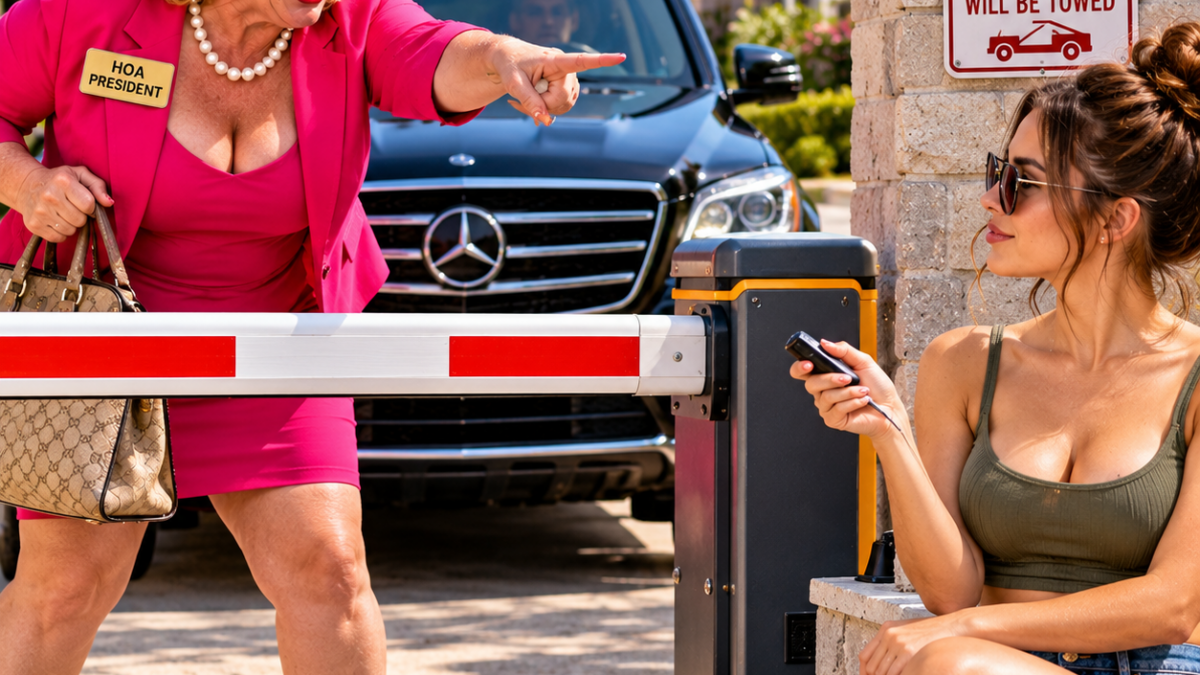
On the screen was a commercial-grade automatic boom barrier.
White arm.
Red stripes.
Operator cabinet.
Remote control.
Safety sensors.
Susan stared.
Then she looked at me.
“You cannot be serious.”
“I have never been more serious.”
### Chapter Four: The Idea Drops Like a Gate Arm
The idea came to me at a hospital parking garage.
Routine checkup. Nothing serious, unless you counted my blood pressure, which had likely joined a witness protection program because of Karen.
I paid at the machine, drove toward the exit, and watched the striped boom arm rise smoothly in front of me.
Then, after I passed, it lowered behind me.
Clunk.
Secure.
Final.
No argument.
No note.
No fake confusion.
Access granted.
Access denied.
I sat at the exit for half a second too long, staring in the rearview mirror at the barrier.
The driver behind me honked.
I drove away with the kind of smile that concerns spouses and lawyers.
That evening, I entered a world I never expected to explore: residential access control systems.
It turns out, if humanity can automate a thing, someone will sell you a version of it online for either too much money or suspiciously not enough. There were manual parking posts, collapsible bollards, swing gates, sliding gates, chain barriers, keypad entry systems, and boom arms.
Manual options were cheaper.
They were also useless for my purposes.
I knew Karen. If I had to get out and raise or lower something by hand, she would time her intrusions around inconvenience. The solution needed to work every time, even when I was running late, even in the rain, even before coffee.
Automatic was the answer.
Remote entry.
Vehicle detection loop.
Photo-eye safety sensors.
Obstruction reversal.
Dedicated power.
A professional installation.
I did not want a dangerous contraption. I wanted a legitimate access control system that happened to be deployed against a woman with the spatial ethics of a raccoon.
Susan read over my shoulder.
“Greg, this is what office parks use.”
“Yes.”
“We live in a cul-de-sac.”
“Yes.”
“You want to turn our driveway into a parking garage?”
“No. I want to turn it back into my driveway.”
She leaned against the counter.
“How much?”
I hesitated.
Her eyes narrowed.
“How much, Greg?”
I showed her the rough estimates.
She stared.
Then she closed her eyes.
“That is a vacation.”
“It is a vacation from Karen.”
“That is not how budgeting works.”
“It is how emotional survival works.”
Susan sighed.
Hard.
The kind of sigh that had chapters.
“Will it be legal?”
“I’m checking.”
“Will the HOA lose its mind?”
“Almost certainly.”
“Will it stop Karen?”
“Yes.”
She looked at the screen again.
“Promise me it won’t be bright orange.”
“Absolutely.”
I meant it at the time.
The standard arm was red and white.
Different problem.
I spent the next night reviewing city ordinances.
Setbacks.
Sidewalk clearance.
Right-of-way obstruction.
Electrical permits.
Driveway modifications.
No specific ban on residential boom barriers.
Then the HOA bylaws.
I read every miserable page.
Fence restrictions.
Shed restrictions.
Mailbox color.
Exterior lighting.
Driveway surface.
Basketball hoops.
Trash bins.
Flag brackets.
Holiday decorations.
Nothing about automatic boom barriers.
Not one word.
That was rare and beautiful.
An unregulated frontier.
A legal gap wide enough to lower a twelve-foot arm through.
Finding an installer was harder.
The first company laughed.
The second asked if I meant a gate.
The third said they did estates, not “regular driveways.”
Then I found Secure Entry Systems.
They mostly handled commercial lots, warehouses, loading zones, and a few high-end residential gates. Their dispatcher connected me to Gary.
“Secure Entry, this is Gary.”
“Hi, Gary. Greg Miller. I need a quote on a boom barrier installation.”
“Sure thing. Commercial property, parking structure, loading dock?”
“Residential driveway.”
There was a pause.
“Your house driveway?”
“Yes.”
Another pause.
“Okay.”
“I have a persistent issue with unauthorized parking blocking my access. I’ve tried direct conversation, written notices, cones, police, HOA. Nothing worked. I need a physical deterrent.”
Gary was quiet long enough that I thought I had lost him.
Then he chuckled.
“Neighbor?”
“You have no idea.”
“Actually, I think I do. We do private gates for people with long driveways. A boom arm is unusual, but not impossible. You want manual or automatic?”
“Automatic.”
“Remote?”
“Yes.”
“Safety loops, photo eyes, obstruction sensing?”
“All of it.”
“Power trench from the house?”
“Yes.”
“Concrete base?”
“Yes.”
“Basic or heavy-duty?”
I looked out the window at Karen’s Camry parked suspiciously near my apron.
“Heavy-duty.”
Gary laughed.
“Something that says access denied with authority?”
“Exactly.”
“Mr. Miller, I think this is going to be fun.”
### Chapter Five: Installation Day
Installation day felt like D-Day if D-Day had involved trenching, conduit, and a confused Amazon driver asking whether we were building a toll booth.
Gary arrived at 7:30 a.m. with two crew members, a Secure Entry Systems truck, and the relaxed confidence of a man who had installed enough barriers to know that every barrier has a story.
“Morning, Greg,” he said, stepping out with a clipboard.
“Morning.”
He looked toward Karen’s house.
“Problem neighbor?”
I followed his gaze.
Her blinds twitched so violently they practically waved.
“That’s the one.”
Gary smiled.
“Let’s lower the boom.”
First came measurements.
Then marking.
Then trenching from my garage panel toward the driveway entrance. The crew cut a neat line, laid conduit, pulled wiring, and set everything properly. One worker dug out a square for the concrete pad that would hold the operator cabinet just inside my property line.
Everything was permitted.
Everything was inside the boundary.
Everything was professional.
That mattered.
I did not want Karen to beat me because I got sloppy.
Neighbors noticed immediately.
Mrs. Gable paused mid-power walk with her hands on her hips.
“Greg,” she called, “are you installing a railroad crossing?”
“Private driveway access control.”
She looked at Gary’s crew.
Then at me.
Then at Karen’s house.
“About time.”
Young Timmy from down the street rode his bike back and forth asking if we were building a secret car wash.
Stan wandered over with coffee.
“You finally snapped?”
“Yes.”
“Healthy.”
“Thank you.”
Then the concrete truck arrived.
That was when Karen came outside.
She marched across her lawn in a lavender tracksuit, phone in hand, recording.
“What is all this?”
“Good morning, Karen.”
“What are you installing?”
“Access control.”
“For what?”
“My driveway.”
She glanced at Gary.
“Is this approved?”
Gary looked at me.
I said, “By me, yes.”
Karen narrowed her eyes.
“You cannot just construct commercial infrastructure in a residential community.”
“It is not in the street. It is not blocking the sidewalk. It is on my property.”
“It is ugly.”
“It is not finished.”
“It will still be ugly.”
Gary coughed into his fist, probably to hide a laugh.
Karen pointed her phone at the concrete pad.
“I am documenting this.”
“Good. Make sure you get the property line.”
She did not like that.
By late afternoon, the system was standing.
White operator cabinet.
Long aluminum arm.
Red and white reflective stripes.
Photo-eye sensors on small posts.
Driveway loops cut cleanly into the pavement.
Remote controls programmed.
Gary demonstrated.
“One click raises it. One click lowers it. Exit loop opens automatically when you drive out. Ten-second delay, then down. Photo eyes reverse if the beam is broken. Obstruction sensing reverses on contact. The arm is balanced and light enough not to damage a car under normal conditions, but I still recommend no one test that theory with enthusiasm.”
He pressed the remote.
The arm rose smoothly.
He pressed it again.
It lowered with a soft mechanical whir and stopped perfectly horizontal across the driveway.
My driveway.
Protected.
I cannot fully explain the joy I felt.
Some men dream of boats.
Some of motorcycles.
Some of custom kitchens or home theaters.
At that moment, my dream was a red-and-white aluminum arm preventing one beige Camry from ruining my life.
Gary handed me two remotes.
“There you go. One residential boom barrier.”
I stared at it.
“It’s beautiful.”
“It’s ridiculous.”
“Both can be true.”
He laughed, packed up, and left.
I spent the next hour testing it.
Up.
Down.
Up.
Down.
I walked through the photo beam. It reversed.
I placed a cardboard box under the arm. It stopped and lifted.
I backed out with the exit loop. It opened.
Ten seconds later, it lowered behind me.
Susan came outside, arms folded.
“You look happier than you did on our anniversary trip.”
“That is not fair.”
“You are testing it again.”
“It needs calibration.”
“It has gone up and down fifteen times.”
“Sixteen.”
She looked at the barrier.
“I admit, it does make a statement.”
“Yes.”
“I just wish the statement weren’t ‘Welcome to Municipal Parking Lot C.’”
That was fair.
But function came first.
Aesthetic diplomacy could wait.
### Chapter Six: Karen Meets the Arm
At 5:32 p.m., Karen’s beige Camry rounded the corner.
I was coincidentally weeding a flower bed near the driveway.
I say coincidentally because legally, it sounds better.
Karen slowed as usual, flicked her turn signal, and began turning into my driveway like muscle memory had overridden any awareness of physical reality.
Then she stopped.
The barrier stood across the entrance.
Silent.
Horizontal.
Glorious.
Her head jerked forward.
She leaned toward the windshield.
She stared.
Then she honked.
One sharp beep.
The arm did nothing.
She inched forward, as if maybe proximity would persuade it.
It did not.
She backed up.
Pulled forward again.
Still blocked.
She honked longer.
I pulled one weed with great focus.
Karen killed the engine and stormed out of the car.
“Michael!”
I looked up.
“Greg.”
“What is the meaning of this?”
I glanced at the barrier.
“Access control system.”
“It is blocking the driveway.”
“My driveway.”
“You can’t just put that there.”
“I did.”
“I need to park.”
I stood slowly.
“Where?”
She gestured wildly.
“Here.”
“In my driveway?”
“When Mildred comes, the street gets crowded.”
“That sounds like a planning issue.”
“It’s my usual spot.”
There it was.
The confession.
My usual spot.
I smiled.
“Karen, my private driveway was never your usual spot. It was my driveway. You were trespassing with tires.”
Her face flushed.
“That is a commercial parking arm.”
“Yes.”
“This is a residential neighborhood.”
“Also yes.”
“It is hideous.”
“Effective things often are.”
“I am reporting this.”
“Of course.”
“It is dangerous.”
“It has multiple safety sensors.”
“It almost hit my car.”
“It was stationary when you arrived.”
She opened her mouth, closed it, then pointed at me.
“You did this to target me.”
“I did this to stop unauthorized parking.”
“That means me.”
“If the shoe fits, please park it elsewhere.”
She made a sound somewhere between a gasp and a kettle boiling.
Then she got back in her Camry, reversed too sharply, nearly clipped her own mailbox, corrected, and drove away.
I pressed the remote.
The arm rose.
I pressed it again.
It lowered.
Peace settled over me like warm sunlight.
That night, for the first time in months, I slept without wondering whether my morning would begin with Karen’s bumper.
### Chapter Seven: Fallout
The HOA letter arrived the next morning.
Certified.
Of course.
Violation Notice: Unapproved Driveway Obstruction Modification.
Violation Notice: Non-Conforming Commercial Equipment.
Violation Notice: Significant Aesthetic Deviation from Community Standards.
The letter demanded immediate removal within seven days or daily fines would begin.
I placed it in a folder labeled Boom War.
Around lunchtime, the police arrived.
Same officers as before.
They looked tired from the curb.
I opened the barrier for them.
The senior officer walked up the driveway, glanced back at the arm, and sighed.
“Mr. Miller.”
“Officer.”
“We need to discuss the gate arm.”
“My access control system.”
“Right. That.”
“Karen called?”
“She called 911.”
“Of course she did.”
“She claims the barrier is illegal, obstructs public access, and almost struck her car.”
I laughed once.
The officer looked like he wished I had not, but also understood.
“It does not obstruct public access,” I said. “It is fully inside my property line and does not cross the sidewalk.”
“We can see that.”
“It did not almost hit her car. It was already down.”
“She says it moved.”
“It was not activated.”
“Do you have cameras?”
I pointed.
“Yes.”
That changed his expression.
I pulled up the footage.
Karen turning.
Stopping.
Honking.
Inching forward.
No movement from the barrier.
The officer watched it twice.
Then he rubbed his forehead.
“Okay.”
“Will you be citing her for false reporting?”
He gave me a look.
“Let’s not make my day worse.”
The other officer walked around the barrier.
“Honestly, sir, from a city enforcement standpoint, we don’t see an ordinance issue. If the HOA has a problem, that’s civil.”
Civil matter.
That phrase again.
But this time, it worked in my favor.
The senior officer lowered his voice.
“Between us, I understand why you did it. But this is like waving a red flag in front of a very angry bull.”
“I’ve been trapped in my own garage by that bull.”
“I know. Just keep everything documented. And please, for all our sakes, do not escalate beyond mechanical arms.”
“Understood.”
They left.
The barrier stayed.
Karen watched from her window.
I gave a little wave.
She disappeared behind the blinds.
### Chapter Eight: The Hearing
The HOA scheduled an emergency hearing.
Subject: Egregious Installation of Non-Compliant Commercial Access Barrier and Associated Aesthetic Violations at 112 Maple Lane.
Egregious.
I appreciated the drama.
Before the meeting, I consulted a lawyer friend named Stan—not grill Stan from next door, different Stan—who specialized in real estate disputes and accepted payment in beer and the chance to mock suburban governance.
He reviewed the bylaws, the violation notices, photos of the barrier, and my documentation of Karen’s parking.
“This is fascinating,” he said.
“That usually means expensive.”
“Maybe. They don’t have a specific rule against boom barriers. That helps you. They’ll rely on aesthetics, unapproved structural modification, and nuisance language. You rely on property rights, city compliance, documented necessity, and their prior refusal to help.”
“Can they force removal?”
“They can try.”
“Will they win?”
He took a sip.
“Depends how much everyone wants to pay lawyers to decide whether a parking garage arm can live in suburbia.”
“That is the saddest sentence I’ve ever heard.”
“Welcome to property law.”
He helped me draft a formal response denying the violation and requesting all evidence, bylaw citations, and appeal rights.
Then came the hearing.
The clubhouse fluorescent lights buzzed overhead like insects. The HOA board sat at a long table. Mr. Abernathy presided, looking exhausted before the meeting started. The ARC chair, Mrs. Whitcomb, wore an expression of permanent vinegar. The HOA attorney, Mr. Felton, had slick hair and the kind of smooth voice that makes you check your wallet.
Karen sat in the front row with a folder thick enough to qualify as luggage.
Susan sat beside me.
“You okay?” she whispered.
“No.”
“Good. Don’t get cocky.”
Mr. Felton presented first.
Slideshow.
Of course.
Before photos of my driveway.
After photos of the barrier.
Close-ups of the red and white stripes.
A dramatic angle from Karen’s lawn making it look like I had installed a border checkpoint.
He used phrases like commercial intrusion, visual disharmony, incompatible character, and declining neighborhood aesthetic.
Then he read anonymous neighbor statements.
“The barrier makes Maple Lane feel like a warehouse district.”
“The red stripes are jarring.”
“It lowers the tone of the community.”
I wrote that one down because I knew I would need it later.
Then it was my turn.
I stood with a folder of my own.
No slideshow.
Just facts.
“For more than a year, my driveway was repeatedly blocked by my neighbor’s vehicles. I was late for work, delayed for appointments, and my family’s access to our own home was controlled by another resident’s parking habits.”
Karen shifted.
I continued.
“I attempted direct conversation. I left written notes. I placed cones. The cones were moved. I called police. I contacted tow companies. I contacted this HOA. The HOA informed me it could not intervene in parking disputes on private driveways.”
I held up photos.
Dates.
Times.
Karen’s Camry.
Bob’s SUV.
Kevin standing beside his soccer bag.
“That incident caused my son to miss the first half of a championship game he had worked all season to play. That is when I decided I would not allow this to continue.”
The room quieted.
Even Mrs. Whitcomb looked less vinegar for a moment.
“The barrier is professionally installed. It is inside my property line. It does not obstruct the sidewalk or street. It meets city requirements. It has safety loops, photo-eye sensors, and obstruction reversal. It is not explicitly prohibited by any HOA bylaw.”
Karen shot up.
“He is targeting me!”
I turned.
“Karen, you parked in my driveway so often you called it your usual spot.”
Gasps.
She went red.
“I never said that.”
“I have video.”
She sat down.
Mr. Felton cleared his throat.
“Whether or not there was a prior dispute, Mr. Miller, the issue here is the unapproved structure.”
“The issue is access to my home.”
Mrs. Whitcomb said, “It lowers the tone of the neighborhood.”
I looked at her.
“Being trapped in your own garage lowers the tone more.”
Someone in the back coughed in a way that sounded suspiciously like a laugh.
The debate dragged for an hour.
They threatened fines.
I cited lack of explicit prohibition.
They cited aesthetics.
I cited documented nuisance.
They cited approval procedures.
I cited their refusal to address the underlying problem.
In the end, they did not order immediate removal.
They voted to impose daily fines pending further legal review.
That was bureaucratic language for: We are angry, but not completely sure we can win.
I could live with that.
The barrier stayed.
### Chapter Nine: Life Behind the Boom
Living with the barrier was absurd.
I will not pretend otherwise.
The pizza delivery guy called three times from the street because he thought he had reached a gated facility. The Amazon driver left packages beside the operator cabinet until I put up a sign saying PLEASE WALK AROUND THE ARM, IT WILL NOT BITE.
Stan from next door asked if I planned to charge admission.
Kevin loved it.
“Can I have a remote?”
“No.”
“What if there’s an emergency?”
“In what emergency does a twelve-year-old need to operate a driveway barrier?”
“What if zombies come?”
“Then we have larger problems.”
Susan adjusted slowly.
At first, she hated the look of it. Then she began enjoying not being blocked in. By week two, she clicked the remote with the calm authority of a queen entering a fortress.
Karen adapted badly.
Unable to park in my driveway, she began parking on the street directly in front of it. Technically legal, though clearly obnoxious. Sometimes she positioned her Camry just close enough to make my turn tight but not impossible.
I documented that too.
The HOA sent fine notices.
Fifty dollars a day.
Then seventy-five.
Then threats of legal action.
I paid none of them.
My lawyer friend advised me not to ignore the letters entirely, so I responded periodically, disputing the fines, restating my position, and asking them to identify the specific bylaw prohibiting access-control barriers.
They never did.
Instead, they kept using words like aesthetic.
Aesthetic is what people say when they cannot find law but still want control.
For three months, the boom barrier stood guard.
It became part of Maple Lane’s identity.
Kids called it The Arm.
Mrs. Gable called it The Karen Stopper.
Stan offered to paint flames on it.
I declined.
Even Bob, Karen’s husband, seemed secretly relieved.
Once, I saw him trying to leave while Karen’s Camry was badly positioned near their own driveway. He looked toward my boom barrier, then at his wife’s car, then at me.
Our eyes met.
He gave the smallest, saddest shrug.
I almost felt sorry for him.
Almost.
### Chapter Ten: Bob Breaks Ranks
The stalemate ended because of Bob.
Not the HOA.
Not Karen.
Not Mr. Felton.
Bob.
One Saturday morning, I was mowing the lawn when he approached like a man walking toward a confession booth he hoped was closed.
“Greg?”
I turned off the mower.
“Bob.”
“Got a second?”
“Sure.”
He looked at the barrier.
Then at his shoes.
“About the arm.”
“Yes?”
“I know Karen has been… difficult.”
I waited.
There are understatements, and then there are men trying to remain married.
Bob cleared his throat.
“But honestly, it’s kind of working.”
I raised an eyebrow.
“Working?”
“She hasn’t blocked your driveway.”
“That was the goal.”
“She also hasn’t gotten a parking ticket since she stopped trying to improvise parking near your place. And, frankly, it’s nice knowing she can’t leave our SUV in strange places when I need it.”
I stared at him.
“Bob, are you saying my ridiculous driveway arm improved your marriage?”
He looked horrified.
“No. I mean. Not exactly.”
“That sounded like exactly.”
He sighed.
“I’m saying maybe there’s a way to calm everyone down.”
“I’m listening.”
“I talked to Abernathy. The board is worried about legal costs. Karen wants them to sue, but Felton apparently told them it’s not a guaranteed win.”
“Good.”
“The biggest complaint is how it looks.”
“The biggest complaint is that Karen can’t park there.”
“Yes, but officially it’s how it looks.”
I waited.
“What if you painted the arm?”
I looked at the red and white stripes.
“To what?”
“Something neutral. HOA-approved. Beige, taupe, maybe the trim color.”
“You want me to camouflage my parking garage arm as lawn décor?”
“I want the HOA to have a graceful exit.”
That was unexpectedly perceptive.
Bob continued.
“If you repaint it and agree not to add signs or lights or whatever, maybe they drop the fines and recognize it as an access device.”
I studied him.
“Karen know you’re here?”
“No.”
“Does Karen know you’re suggesting peace?”
“Absolutely not.”
I almost laughed.
The red and white stripes had been satisfying. They announced victory every time Karen saw them. But the point was never the stripes.
The point was access.
If painting the arm some ridiculous approved neutral color kept the barrier in place and ended the fines, that was not surrender.
That was consolidation.
“I’ll consider it,” I said.
Bob nodded, visibly relieved.
“Thank you.”
“Bob?”
He stopped.
“You should park in your own driveway too.”
He winced.
“Working on it.”
### Chapter Eleven: Taupe Tranquility
Negotiation through lawyers over a driveway barrier may sound absurd.
It was.
But absurdity had become normal on Maple Lane.
The final agreement took two weeks.
I would repaint the boom arm and visible operator cabinet accents in an HOA-approved neutral color: Taupe Tranquility.
That was the actual name.
Taupe Tranquility.
Whoever named paint colors has never met tranquility and should apologize to taupe.
In exchange, the HOA would rescind all fines related to the barrier, drop pending enforcement actions, and recognize the system as a grandfathered resident-installed access control device, subject to routine maintenance and continued safety compliance.
In plain English:
I kept the barrier.
They stopped sending fake bills.
Karen lost.
Gary from Secure Entry Systems returned with his crew to repaint the arm.
When I told him the color name, he stared.
“Taupe Tranquility?”
“Yes.”
“Sounds like a retirement community for sad furniture.”
“Just paint it.”
The bright red and white stripes disappeared under two coats of HOA-approved neutrality. The barrier became less dramatic, less industrial, and somehow funnier. It now looked like a very serious piece of beige lawn art with authority issues.
Susan liked it better.
“I still think it’s ridiculous,” she said.
“But?”
“But the taupe helps.”
Karen did not like it.
I saw her watching from her porch while Gary tested the arm.
Up.
Down.
Up.
Down.
Still blocking.
Still legal.
Still mine.
The color changed nothing important.
That evening, I clicked the remote before leaving for Kevin’s practice. The arm rose smoothly. I backed out. It lowered behind me after ten seconds.
Karen was down the street, parked legally at the curb.
She looked away when I passed.
I gave her a small wave.
Not because I am mature.
Because I am not.
### Chapter Twelve: Access Granted
Life after the settlement became almost peaceful.
Almost.
Karen still lived next door. She still complained occasionally. She still found reasons to be offended by recycling bins, edging, and the suspicious height of Stan’s ornamental grasses.
But she never blocked my driveway again.
Not once.
The boom barrier became background.
Visitors learned the system. Delivery drivers adapted. Kevin eventually stopped begging for a remote. Susan stopped calling it “your midlife crisis gate” and started calling it “the arm.”
Mrs. Gable brought it up at neighborhood gatherings like local folklore.
“Ask Greg about the time he installed a toll booth to defeat Karen.”
“I did not install a toll booth.”
“You should have charged her.”
Stan still wanted flames painted on it.
I still refused.
As for the HOA, they left it alone.
Once in a while, I received a notice about my recycling bin being visible too early or my mailbox numbers needing cleaning, but never again about the barrier.
The system worked.
Every morning, I walked into the garage without dread.
I started my car.
Pressed the remote.
Watched Taupe Tranquility rise with quiet mechanical dignity.
Backed out freely.
Drove away on my own schedule.
No pounding on Karen’s door.
No late presentations.
No missed appointments.
No son standing in the driveway with gloves in his hand and disappointment on his face.
That was worth every dollar.
One Saturday, months later, Kevin had another tournament.
Not a championship this time, but important to him.
We loaded the car at 7:30.
He tossed his gear bag into the trunk and glanced toward Karen’s house.
“Think she’ll block us?”
I pressed the remote.
The boom arm rose.
“No.”
He grinned.
“That thing is kind of awesome.”
“Yes, it is.”
Susan rolled her eyes, but she was smiling.
We arrived early.
Kevin warmed up with his team.
He played the whole game.
They won.
Afterward, he ran over sweaty, muddy, and happy.
“Did you see that save?”
“I saw it.”
“The diving one?”
“Especially the diving one.”
He hugged me, which at twelve was becoming less common and therefore more valuable.
On the drive home, I realized something.
The barrier had never really been about cars.
It was about control.
Not controlling Karen.
Controlling my own home again.
Karen had turned my driveway into a place of uncertainty. Every morning, I wondered whether I would be able to leave. Every schedule depended on her mood, her convenience, her forgetfulness, her entitlement.
The boom barrier restored one simple thing.
Certainty.
### Epilogue: Lowering the Boom
People ask if installing a commercial-grade boom barrier on a suburban driveway was overkill.
Yes.
Of course it was.
It was wildly excessive.
It was expensive, dramatic, inconvenient, legally stressful, visually ridiculous, and for three months my house looked like the entrance to a municipal parking garage.
But let me ask this.
How many times should a person have to ask for access to his own driveway?
How many mornings should begin with a neighbor’s car blocking your garage?
How many notes, calls, complaints, and polite conversations should fail before you stop hoping courtesy will work on someone who sees courtesy as weakness?
Karen thought my driveway was available because I had tolerated her long enough.
That was my mistake.
Not the barrier.
The tolerance.
For too long, I tried to make her understand.
Then I realized understanding was not required.
Only prevention.
The HOA tried to punish me for solving the problem they refused to address. Karen tried to play victim after making my family late, stressed, trapped, and embarrassed. The board tried to hide behind aesthetics because they had no specific rule, no practical solution, and no desire to admit one resident had been terrorizing another one parking incident at a time.
In the end, the arm stayed.
Karen moved her car.
The fines disappeared.
The neighborhood survived.
Property values did not collapse because my driveway gained a taupe access-control barrier. Birds still sang. Lawns still grew. Children still rode bikes. The sun continued rising over Maple Lane despite one mechanical arm lowering at the end of my driveway.
Now, every morning, I click the remote.
The arm rises.
I back out.
The arm lowers behind me.
Access granted.
Access protected.
Sometimes I see Karen parked down the street, exactly where she should have parked from the beginning. Sometimes she pretends not to see me. Sometimes I wave anyway.
Not because we are friends.
Because my driveway is mine again.
And if there is one lesson I learned from all of this, it is simple.
Some people respect boundaries when you explain them.
Some people respect boundaries when the law explains them.
And some people only respect boundaries when a twelve-foot boom barrier lowers directly in front of their beige Camry.
**THE END**








