“PAY ME $150 OR STAY OFF MY LAKE!” HOA Karen Locked Me Out of My Own Waterfront and Built an 80-Foot Luxury Dock on My Land—Then the Court Sent a Crane to Remove Her $137,860 Monument to Arrogance
“PAY ME $150 OR STAY OFF MY LAKE!” HOA Karen Locked Me Out of My Own Waterfront and Built an 80-Foot Luxury Dock on My Land—Then the Court Sent a Crane to Remove Her $137,860 Monument to Arrogance
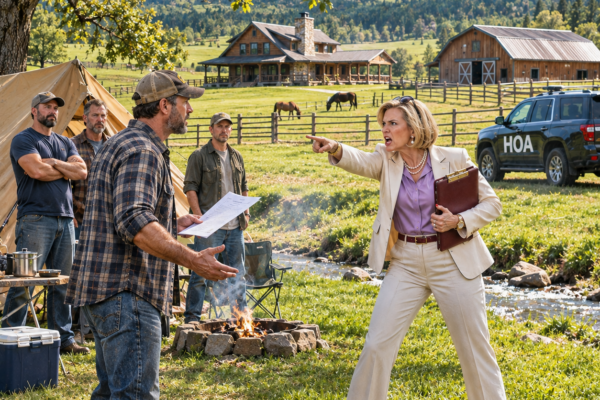
“THIS WATERFRONT BELONGS TO THE COMMUNITY NOW, AND IF YOU WANT TO USE IT, YOU’LL PAY LIKE EVERYBODY ELSE!” HOA president Patricia Bellamy declared after building an eighty-foot dock across the private shoreline where my father’s ashes had been scattered.
She installed a locked gate, charged residents $150 a year for access, fined me for standing on my own property, and even attached a brass plaque bearing her name to the dock she had built without my permission.
But Patricia had made one extraordinarily expensive mistake: I spent my professional life interpreting property boundaries, and when a marine demolition crew arrived with a court order, she was about to discover exactly how much eighty feet of stolen waterfront could cost her association.
The first thing I noticed that Saturday morning was a laminated sign attached to my grandfather’s old cedar post.
HARBOR POINT COMMUNITY WATERFRONT.
AUTHORIZED RESIDENTS ONLY.
ANNUAL DOCK ACCESS: $150.
I stared at it.
Then I looked at the new wooden gate blocking the path to Lake Brindle.
Beyond the gate stood an eighty-foot floating dock equipped with white bumpers, aluminum cleats, solar-powered lights, and a polished brass plaque.
THE PATRICIA W. BELLAMY COMMUNITY PIER.
I read the name twice.
Somebody had built a dock on my land and named it after herself.
Beside the gate was a stainless-steel donation box encouraging visitors to preserve our shared lake heritage.
“Our shared heritage?”
I looked toward the gravel landing where my father had taught me to fish.
“Dad, you’re not going to believe this.”
Two hours later, a pearl-white Lexus SUV entered my driveway.
Patricia Winnifred Bellamy, sixty-one years old and president of Harbor Point Estates, emerged wearing a coral floral blazer, oversized sunglasses, and a silver whistle around her neck.
Naturally, she was carrying a clipboard.
“Mr. Mercer! I assume you’ve seen our beautiful waterfront improvement project.”
“I have.”
She smiled.
“Wonderful.”
“Especially the part where you built it on my property.”
Her smile disappeared.
“Actually, Daniel, the shoreline has been designated for community use.”
“By whom?”
“The board.”
“Your board?”
“Obviously.”
I took a sip of coffee.
“Then perhaps your board can show me the deed transferring my land to your association.”
Patricia opened her clipboard.
“Section Eight of our bylaws authorizes recreational improvements for the collective benefit of residents.”
“Your bylaws govern your members. I’m not a member.”
“You live adjacent to our community.”
“So does the county landfill.”
Her face tightened.
“That is an inappropriate comparison!”
“I agree. The landfill asks permission before expanding.”
She informed me that her committee had approved a $68,400 construction budget.
I asked whether anybody had obtained my permission.
She replied that the architectural review committee had authorized everything.
“Patricia, your architectural committee can’t authorize construction on somebody else’s land.”
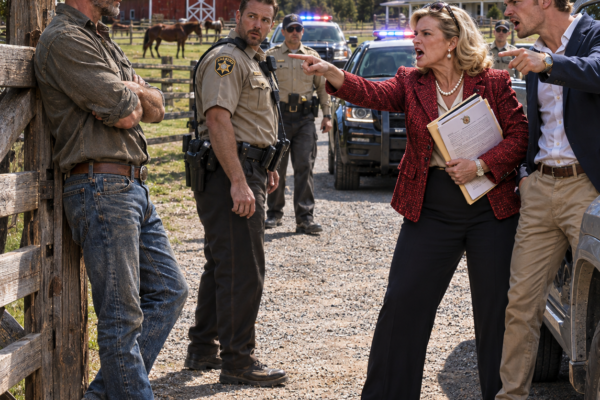
“RESISTANCE TO COMMUNITY IMPROVEMENTS WILL HAVE LEGAL CONSEQUENCES!”
“Then show me your property boundary.”
She couldn’t.
Instead, she climbed into her Lexus and drove away.
On Monday, I received a $250 fine for photographing the dock.
On Tuesday, another $400 fine for maintaining an unauthorized boat launch on the gravel landing my father had used since 1986.
On Wednesday, Patricia posted a photograph of my house on Facebook, telling residents that I was attempting to steal their recreational waterfront.
By Friday, three additional signs had appeared on my land.
Then came the following Saturday.
I walked down the familiar path carrying two folding chairs and discovered something that made me stop dead.
Two padlocks secured the new gate.
The keys had been distributed exclusively to residents who paid Patricia’s waterfront membership fee.
I couldn’t reach my father’s fishing spot.
I couldn’t reach the shoreline where my daughter had caught her first bluegill.
I couldn’t even stand beside the water where I had scattered a portion of my father’s ashes.
I called Patricia.
“Remove these locks.”
Her response was almost cheerful.
“You’ll need to purchase an annual access membership, Daniel.”
“That’s my land.”
“Not for recreational purposes anymore.”
I closed my eyes.
For six seconds, I considered buying the largest pair of bolt cutters in town.
Then I remembered something my father had taught me.
Never destroy the evidence that proves somebody else is wrong.
I took photographs of both padlocks.
Then I called a marine surveyor named Margaret Russo.
She listened to my explanation, examined the photographs I sent her, and asked three questions.
Had I sold the shoreline?
No.
Had I granted an easement?
No.
Was I a member of Harbor Point Estates?
Absolutely not.
She began laughing.
“Daniel, most HOAs argue over fences. Yours appears to have annexed a lake.”
Then her voice became serious.
“Don’t touch that dock. By the time we’re finished, Patricia is going to wish she’d spent twenty dollars checking your deed before spending sixty-eight thousand dollars building her little kingdom.”
PART2
Maggie’s office occupied a low brick building near Bellwater Municipal Airport. A faded wooden sign above the entrance read Russo Marine Survey and Engineering, and the parking lot contained three work trucks that looked as though they had spent considerably more time on construction sites than inside car washes.
I arrived Monday morning carrying a box of documents.
Maggie was fifty-eight, stood approximately five feet four inches tall, and wore steel-toed boots that looked capable of surviving an argument with a bulldozer. Her gray hair was pulled into a ponytail, and she was eating a meatball sandwich over an engineering drawing when I entered.
A drop of sauce landed beside a proposed seawall.
She examined it.
“That project’s already over budget. What’s another little problem?”
I laughed and placed the box on her desk.
“I’ve brought you a substantially bigger one.”
She moved the sandwich aside.
Inside the box were my recorded deed, the original subdivision plat, a survey prepared in 1998, an old shoreline access agreement involving the previous owner of the neighboring parcel, forty-three photographs, and copies of every notice Patricia had sent.
Maggie examined the documents in silence for several minutes.
Then she picked up a photograph showing the gate.
“Where’s your original access?”
“Right underneath that expensive obstruction.”
“And the dock connects to those posts?”
“Yes.”
She studied another photograph.
“Did anybody approach you about buying the land?”
“Not since 1998.”
“Who approached you then?”
“The developer who built Harbor Point.”
“What happened?”
“My father declined.”
Maggie nodded.
“Have you got the correspondence?”
I reached inside the box and retrieved an envelope that had become soft around the edges.
My father’s handwriting was visible on the back of the original offer letter.
Already got a lake. Don’t need your money.
Maggie read it and smiled.
“I think I would’ve liked your father.”
“Everybody did, unless they were trying to buy something he didn’t want to sell.”
She placed the letter beside the survey.
“Let’s see what we’ve got.”
For the next hour, we compared recorded documents with the available photographs and maps. I worked as a survey technician for a regional civil engineering firm, so I was familiar with the process. However, because this dispute concerned my own property, I wanted an independent professional establishing the relevant boundaries.
Maggie understood why.
“You could probably put together a decent preliminary analysis yourself,” she said, “but if this ends up in court, you want a certified survey prepared by somebody who doesn’t have a personal interest in the result.”
“Exactly.”
She examined the subdivision plat.
Then she pointed toward the shoreline.
“Daniel, you understand that owning waterfront property doesn’t necessarily mean you own the entire lake.”
“Of course.”
“Good. Because Patricia appears confused about that distinction.”
She explained the waterfront rules applicable in our fictional state of North Alder. Owners of qualifying shoreline properties possessed certain riparian rights associated with their land, including reasonable access to the water, subject to navigation rights, environmental restrictions, and permitting requirements.
Those rights weren’t unlimited.
They didn’t give me ownership over every gallon of water in Lake Brindle, nor did they authorize me to dismantle an encroaching structure without following the appropriate legal procedures.
But they were significant.
Patricia’s association had apparently constructed a substantial recreational facility across private land, interfered with my established shoreline access, and attempted to collect fees from people using the resulting installation.
Maggie tapped the recorded map.
“The HOA’s common property appears to end here. That’s approximately ninety-four feet east of your house.”
I nodded.
She moved her finger toward the dock photographs.
“Unless our field survey reveals something substantially different from these records, this gate is on your parcel. The walkway is on your parcel. Those shore connection posts are on your parcel.”
“And the dock?”
“Extends into the lake from a connection the HOA doesn’t appear entitled to use.”
She leaned back.
“Whoever approved this project should’ve verified the boundaries before construction.”
I smiled.
“I’ve been trying to explain that.”
“Apparently, nobody listened.”
“No.”
Maggie picked up the photograph of Patricia’s brass plaque.
“Well, Daniel, somebody’s about to receive a very expensive geography lesson.”
I returned home that afternoon and stood on my porch overlooking Lake Brindle.
My house wasn’t particularly impressive. It was a modest two-bedroom cedar cottage on 1.83 acres, with old kitchen cabinets, a crooked porch, and a bathroom door that became stubborn whenever the summer humidity increased.
The porch steps squeaked in a familiar pattern.
The gravel driveway occasionally developed potholes.
Raccoons had discovered several creative ways to interfere with my trash cans.
And I loved every inch of the place.
Eleven years earlier, after my father, Thomas Mercer, passed away, I purchased the property and made it my permanent home. Dad had spent twenty-seven summers fishing along its 142 feet of natural shoreline.
He wasn’t a particularly successful fisherman.
Once, I watched him spend nearly three hours trying to recover what he insisted was an enormous fish.
It turned out to be a submerged grocery bag.
He brought it to the surface, stared at it, and said, “Well, at least I caught something useful.”
I was sixteen at the time.
I laughed until my stomach hurt.
My daughter, Emily, caught her first bluegill from that same landing when she was little. Dad had helped her hold the fishing pole, and when the fish finally appeared, he celebrated as though she’d won an international championship.
“Look at that, Daniel! The girl’s already a better fisherman than her father!”
He never let me forget it.
After his death, I obtained the appropriate permission to scatter a small portion of his ashes beside the water.
It was a quiet morning.
Emily stood beside me.
Neither of us spoke much.
There were certain feelings that didn’t require conversation.
I remembered that morning as I looked toward Patricia’s padlocked gate.
To somebody unfamiliar with our family, the landing was an ordinary strip of gravel.
Twelve feet wide.
Nothing extravagant.
No expensive paving.
No decorative landscaping.
But it was the one place where I could sit with a cup of coffee and almost hear my father’s voice.
Now somebody who had never known him was charging strangers admission.
I understood why people became angry enough during property disputes to make terrible decisions.
I understood the temptation to remove the obstruction myself.
But I also knew that if I allowed my anger to dictate what happened next, Patricia could turn the resulting confrontation into another accusation.
She would be delighted to tell residents that the unreasonable neighbor had destroyed their property.
She would photograph the damage.
She would call the police.
She would write letters describing herself as a victim.
I wasn’t going to give her that opportunity.
I went inside, opened a new folder, and wrote the date on the first page.
For the moment, Patricia could keep her padlocks.
I intended to establish exactly why she had no right to put them there.
Maggie’s survey crew arrived the following Tuesday at eight-thirty in the morning.
Their white work truck carried survey poles, a robotic total station, metal detectors, and the equipment necessary to locate and verify the original boundary monuments.
Maggie stepped out wearing a fluorescent safety vest and carrying a cup of coffee.
“Morning, Daniel.”
“Morning.”
She looked toward the lake.
“Still there?”
“Unfortunately.”
“Good. Saves us having to investigate a disappearance.”
Her crew began working.
I remained nearby, available to answer questions, but careful not to interfere with their measurements.
By nine-fifteen, they had recovered two of the original iron monuments.
The third took a little longer.
It had become obscured beneath vegetation and accumulated leaf litter, but its location corresponded with the historic records.
Maggie examined it, then looked toward the subdivision.
“There we go.”
I smiled.
“Always satisfying, isn’t it?”
“Finding a monument somebody thought had disappeared?”
“Exactly.”
She nodded.
“It’s even more satisfying when somebody spent sixty-eight thousand dollars pretending it didn’t exist.”
By late morning, the crew had established the relevant boundaries and mapped the new structures.
The measurements were extraordinarily clear.
Patricia’s gate stood 31.6 feet inside my property.
The main access walkway crossed 47.2 feet of my land.
The dock’s landward connection was secured to posts installed along my shoreline.
The floating structure extended eighty feet into the lake from that connection.
Maggie was documenting the final portion of the site when a white golf cart appeared near the road.
It had tan seats, Harbor Point lettering, and an amber warning light mounted on the roof.
Patricia was driving.
I watched her approach with an expression suggesting she had discovered an unauthorized international border crossing.
She parked, grabbed her clipboard, and marched toward Maggie.
“EXCUSE ME! WHAT IS HAPPENING HERE?”
Maggie didn’t look up.
“Survey.”
“Who authorized it?”
“The owner.”
Patricia glanced toward me.
“The association has authority over waterfront development.”
Maggie straightened.
“Are you the landowner?”
“I’m the president of the association.”
“Those are different things.”
Patricia pointed at the survey equipment.
“This activity requires board approval.”
Maggie gestured toward a marked boundary location.
“Not on this property.”
Patricia flipped through her papers.
“Section Eleven, Paragraph Two-A, establishes the board’s authority to oversee improvements affecting community enjoyment.”
Maggie looked at her.
“That section cannot move a property line.”
“It’s a community planning issue!”
“No, ma’am. It’s a geometry issue.”
One of Maggie’s crew members turned away.
I suspected he was trying not to laugh.
Patricia noticed the fluorescent markings.
“You can’t put those there!”
Maggie looked down at them.
“They’re identifying the boundary.”
“According to whom?”
“The recorded documents, recovered monuments, and measured evidence.”
Patricia stood silently for a moment.
Then she hurried back toward her golf cart.
When she returned, she was carrying a rolled architectural drawing.
“I HAVE PROOF!”
She unfolded the document across the hood of the survey truck.
The title looked impressive.
HARBOR POINT SHORELINE MASTER PLAN.
There were benches, landscaped areas, decorative lighting, a proposed kayak rack, and a beautifully illustrated dock.
Maggie studied it.
“Who prepared this?”
“Our planning committee.”
“Is it a recorded survey?”
“It’s an official association document.”
“That’s not what I asked.”
Patricia’s face reddened.
“You’re being deliberately difficult.”
Maggie pointed toward a small note printed beneath the drawing.
“Read that.”
Patricia looked down.
She didn’t speak.
I leaned closer.
The note read:
Boundary locations approximate. Field verification required.
Maggie looked directly at Patricia.
“Did you obtain that verification?”
Patricia gathered the edge of the paper.
“Our committee considered the available information sufficient.”
“That’s a no, then.”
“You don’t understand the planning process!”
Maggie smiled.
“Lady, the earth has been this shape since before your committee met.”
This time, one of the crew members actually laughed.
Patricia rolled up the drawing.
“I intend to report this activity.”
“To whom?” Maggie asked.
“The appropriate authorities!”
“Please do.”
Patricia returned to her golf cart.
Before leaving, she turned toward me.
“Daniel, you’ll regret making this difficult.”
I looked at the boundary markings.
“Patricia, it was already difficult when you put forty-seven feet of walkway across my land.”
She drove away.
Maggie watched the golf cart disappear.
Then she looked at me.
“Did you get a picture of that drawing?”
“Several.”
“Especially the note about verification?”
“Absolutely.”
She nodded.
“Good. We’re going to need a bigger folder.”
By Friday, the folder contained 117 pages.
Maggie’s signed survey established the locations of the encroaching improvements. Her review of the available property documents identified no recorded dock easement, shoreline transfer, or other agreement authorizing Harbor Point to occupy my parcel.
However, there was something on the original subdivision plat that helped explain how the association’s planning committee might have convinced itself that the project was possible.
A narrow stormwater drainage strip.
It was located near the lake, but it ended before reaching my property boundary.
Somebody apparently interpreted the strip as a waterfront access corridor, then assumed that because it pointed in the general direction of the lake, the association possessed the right to build all the way to the water.
Maggie showed me the relevant notation.
“Stormwater drainage,” she said.
I nodded.
“Not recreational access.”
“Exactly. And it doesn’t cross your property.”
She looked at the dock photographs again.
“Even if their committee misunderstood the designation initially, a proper boundary review would’ve caught the problem.”
I considered Patricia’s behavior during the survey.
“She knew the drawing required verification.”
“Apparently.”
“And she approved construction anyway.”
Maggie shrugged.
“That’s a question somebody may eventually want to ask her.”
Neither of us knew how publicly that question would eventually be answered.
Our next visit was to the Bellwater County Land Records Office.
The assistant recorder, Elaine Foster, had silver hair, purple glasses, and the calm demeanor of a woman who had spent decades examining documents prepared by people considerably more confident than competent.
She recognized me when I approached the counter.
“Daniel Mercer. What have you lost this time?”
“About eighty feet of peace and quiet.”
She laughed.
“Explain.”
I did.
By the time I reached the part about the commemorative plaque, Elaine had removed her glasses.
“She named it after herself?”
“Yes.”
“Before checking who owned the shoreline?”
“Apparently.”
Elaine shook her head.
“That’s ambitious.”
She retrieved the original records and the relevant subsequent documents.
We reviewed the subdivision plat, amendments, recorded interests, and historical property descriptions.
Elaine was careful to explain that the land records office didn’t adjudicate private disputes or independently determine every legal right affecting a property.
But nothing in the documents we identified established that Harbor Point possessed the shoreline interest Patricia claimed.
“The paperwork doesn’t give them what they think it gives them,” Elaine said.
I smiled.
“Can I frame that?”
“You can order a certified copy for twelve dollars.”
“I’ll take three.”
She laughed.
“You planning to wallpaper the house?”
“Depends how many more letters Patricia sends.”
As Elaine prepared the documents, I examined the old developer’s offer to my father again.
In 1998, the developer had recognized that acquiring access to the lake required negotiating with the owner.
Nearly three decades later, the association’s president appeared to believe that negotiating was unnecessary.
Perhaps Patricia thought that because several dozen people wanted something, the person who already owned it no longer deserved a choice.
But that wasn’t the world my father had understood.
Dad had been generous.
He had allowed neighbors to fish from the landing with permission.
He had helped people launch small boats when circumstances were appropriate.
He had never installed a ticket booth or demanded money from an elderly man hoping to spend an afternoon near the water.
His willingness to share hadn’t transformed the shoreline into common property.
And it certainly hadn’t authorized somebody to lock his son out.
I thanked Elaine, collected the certified documents, and went to see the attorney Maggie had recommended.
Charles Whitcomb specialized in waterfront property disputes.
He wore brown suspenders, spoke slowly, and possessed a habit of cleaning his glasses whenever somebody presented him with a particularly questionable legal argument.
After reviewing Patricia’s first letter, he cleaned them.
After reading her description of the dock as community property, he cleaned them again.
Finally, he looked at me.
“Mr. Mercer, based on what you’ve provided, there appears to be a strong basis for seeking relief concerning trespass, interference with your shoreline access, and removal of the unauthorized improvements.”
“Excellent.”
“However, we need to address this through the proper procedures.”
“Can I remove the gate?”
“Not without considering the circumstances and obtaining appropriate authorization.”
“Can I tow the dock to Patricia’s driveway?”
“No.”
“Can I send her a photograph of a towboat?”
He stared at me.
I smiled.
“I’m joking, Charles.”
“I sincerely hope so.”
He returned to the documents.
I liked him.
He didn’t promise that everything would happen immediately. He didn’t pretend waterfront law was simple. He explained the possible complications, including the distinction between the ownership of land and rights relating to the use of adjoining water.
Then he identified the essential issue in my case.
“Whatever rights other people may possess to navigate or use the lake, they haven’t demonstrated the right to cross your private parcel, construct improvements there, or prevent you from reaching the shoreline.”
I nodded.
“And the dock permit?”
“That needs a separate review.”
He closed the folder.
“Let’s find out what they actually submitted.”
The North Alder Department of Inland Waters assigned a permitting specialist named Dr. Rebecca Shaw to examine the matter.
Rebecca possessed the patient, precise manner of somebody accustomed to separating environmental concerns from the dramatic explanations people offered when their projects came under scrutiny.
Charles supplied the relevant information through the appropriate channels.
Rebecca reviewed the available application materials and compared them with the certified survey.
The result was disturbing.
Harbor Point had submitted a simplified recreational dock application representing that the structure connected to the association’s own common property.
The application map showed the shoreline connection in a location that did not correspond with the actual installation.
The distinction wasn’t a minor drafting error.
It concerned whether the applicant possessed the property rights necessary to construct and maintain the facility where it stood.
Rebecca explained that the installation lacked valid authorization for its actual location and shoreline connection.
The department opened a compliance review.
When Charles informed me, I looked toward the water.
“So the architectural committee wasn’t the appropriate authority after all?”
He sighed.
“No, Daniel.”
“I’m shocked.”
“I doubt that.”
I laughed.
Then he became serious.
“We need to give the association a clear opportunity to resolve this voluntarily.”
He explained that an appropriate settlement could avoid unnecessary legal costs, protect the shoreline, and allow the association to recover its usable dock components.
I agreed immediately.
I didn’t need Patricia to lose her house.
I didn’t need the association to become bankrupt.
I didn’t want my neighbors to be financially punished simply because their president had made an extraordinarily bad decision.
I wanted my gate removed.
I wanted my access restored.
And I wanted the dock taken away through a process that didn’t damage the lake my family had enjoyed for decades.
On September 18, Charles sent the formal demand.
It included the relevant findings and requested that Harbor Point agree within fourteen days to remove the encroaching structures through an approved professional process, restore the disturbed shoreline, and reimburse reasonable documented costs.
There was no extravagant financial demand.
No attempt to confiscate the association’s property.
No demand that Patricia stand in the clubhouse and apologize to a photograph of my father.
Just a practical way to correct what had happened.
Five days later, her response arrived.
The board rejects your attempt to privatize community water resources.
I read the sentence twice.
Then I called Charles.
“Apparently, I’ve privatized the lake.”
“So I’ve been informed.”
“Did I miss a meeting?”
“Daniel.”
“Sorry.”
He continued.
“She’s accusing us of weaponizing technical land interpretations.”
I laughed.
“That’s an interesting description of reading a deed.”
“Agreed.”
Her letter went on to reject our proposed arrangements.
Then it announced that Harbor Point would proceed with an official dedication ceremony for the dock on October 12.
There would be refreshments, a ribbon cutting, a celebration of community achievement, and a keynote address delivered by Patricia herself.
The title of her speech was Access Belongs to Everyone.
I stared at the flyer.
At the bottom, beneath a photograph of the dock, residents were reminded that annual access memberships remained available for $150.
Apparently, access belonged to everyone who paid Patricia.
I forwarded the flyer to Charles.
He called three minutes later.
“Please tell me you’re not planning something dramatic at this ceremony.”
“I’m planning to attend as a landowner.”
“Quietly?”
“Define quietly.”
There was a long pause.
Then Charles said, “Let the paperwork do the talking.”
I looked at the photograph of the brass plaque.
“Understood.”
He sighed.
“Thank you.”
Patricia was going to hold a dedication ceremony on land she had been formally notified she didn’t own.
I wondered what she expected to accomplish.
Perhaps she believed that if enough people applauded the dock, it would become impossible for anybody to remove it.
Perhaps she thought that a ribbon, a plaque, and several trays of refreshments could establish a kind of ownership stronger than recorded property rights.
Whatever her reasoning, she was about to discover that popularity and legality were considerably different things.
Meanwhile, the residents began learning more about the waterfront project.
Not everybody was happy.
Some had paid the $150 access fee believing the association had purchased a new recreational property.
Others had contributed to additional waterfront assessments without fully understanding what the money was being used for.
Harold Benson, the seventy-eight-year-old gentleman who had fished along my shoreline for years, was particularly irritated.
Patricia’s contractors had thrown his folding chair away during construction.
It had been an old chair, but Harold loved it. He had developed arthritis, and the chair was one of the few he could comfortably use during a long afternoon beside the lake.
When he told me what happened, I bought him a new one with substantial armrests and cup holders.
He initially refused it.
“Daniel, you didn’t throw my chair away.”
“I know.”
“Then you shouldn’t have to replace it.”
“Consider it a fishing investment.”
He studied the new chair.
“It’s got two cup holders.”
“That’s advanced technology, Harold.”
He laughed.
Then he became quiet.
“Your dad used to let me sit down there whenever I wanted.”
“I remember.”
“He never asked me for a dime.”
“That’s because you never caught anything worth charging admission to see.”
Harold laughed so hard he began coughing.
“Smart mouth. Just like Thomas.”
I smiled.
Then he looked toward the locked gate.
“I miss the old landing.”
“So do I.”
He told me that Patricia had denied his request for reimbursement for the original chair, claiming he couldn’t provide photographs establishing that the construction crew had thrown it into a dumpster.
“Who thinks to photograph their own chair before somebody throws it away?” Harold asked.
“Nobody.”
“Exactly.”
He shook his head.
“That woman once measured the bow on my Christmas wreath. Said it was an inch too wide.”
I looked at him.
“Seriously?”
“Christmas morning, Daniel.”
I laughed despite myself.
“That’s dedication.”
“That’s something. I don’t know if I’d call it dedication.”
Harold had lived long enough to understand the difference between somebody enforcing a reasonable rule and somebody simply enjoying the power to interfere.
He wasn’t particularly interested in confrontation.
He wanted to fish.
He wanted to sit comfortably.
And he wanted to stop receiving envelopes from people who apparently believed holiday decorations required engineering tolerances.
Now Patricia had given him another reason to attend her association meetings.
He was determined to understand what happened to the shoreline he had enjoyed for years.
And his presence at the October 3 meeting proved particularly useful.
Thirty-two homeowners attended that evening, along with Harold.
Patricia introduced a proposed board resolution bearing the designation 24-17.
The resolution authorized the association to defend its waterfront installation regardless of boundary objections raised by neighboring private landowners.
It also authorized up to $35,000 in legal defense expenditures.
Harold later told me that several residents became visibly uncomfortable when they heard the amount.
Thirty-five thousand dollars.
On top of the $68,400 construction budget.
One homeowner raised his hand.
“Patricia, before we spend more money, can we confirm whether the dock is actually on association property?”
She responded that the project had been developed for the benefit of the entire community.
The homeowner asked again.
“Do we own the land where it’s connected?”
Patricia appeared irritated.
“The exact ownership line is irrelevant because community benefit takes precedence.”
The association secretary entered that statement into the official meeting minutes.
Harold obtained a copy.
The following morning, he brought it to my house.
He had written a little note on the front.
Thought you might enjoy this.
I read the relevant passage.
Then I looked at him.
“She actually said that?”
“Word for word.”
“After receiving the certified survey?”
He nodded.
“People started asking questions. She told them the matter was being handled by the board.”
I looked at the document again.
Previously, there had been room to argue that the planning committee had made a genuine mistake.
Perhaps somebody misunderstood the drainage strip.
Perhaps the contractor trusted the drawing.
Perhaps Patricia didn’t appreciate the difference between a recreational dock application and a grant of property rights.
But now she had received the survey.
She had been told what the recorded documents established.
She had been offered a practical way to remove and relocate the facility.
And rather than correct the mistake, she had chosen to declare that my ownership was irrelevant.
Charles examined the minutes when I sent them to him.
He called shortly afterward.
“Daniel, I think we’re past the point where further informal demands are likely to resolve this.”
I looked toward the lake.
“I agree.”
“We’ll proceed with the appropriate court application.”
“Good.”
He paused.
“And please continue doing absolutely nothing to the dock yourself.”
I laughed.
“Charles, you make me sound like a dangerous man.”
“I’ve heard you discuss towboats.”
“Fair enough.”
The October 12 dedication went ahead.
Patricia had invited the neighborhood to celebrate what she described as a historic achievement for Harbor Point.
A folding table held refreshments.
Decorative ribbons were attached near the entrance.
Someone had arranged chairs facing the waterfront.
The brass plaque had been polished until it shone in the autumn sunlight.
I stood on an unobstructed portion of my property, far enough away to avoid interfering with the gathering.
Charles had made his expectations perfectly clear.
No confrontation.
No attempts to interrupt.
No touching the structures.
I intended to follow his advice.
Patricia approached the microphone wearing an elegant blazer and an expression suggesting she expected the governor to arrive at any moment.
She thanked the planning committee.
She praised the contractor.
She described the importance of creating recreational opportunities for families.
Then she discussed the unfortunate resistance the project had encountered.
“Some people,” she announced, “are unwilling to recognize that beautiful natural resources should benefit more than a privileged few.”
Several guests looked toward my house.
I stood quietly.
“Harbor Point will not allow selfish interests to undermine our collective vision.”
I thought about Harold’s old fishing chair.
I thought about the children my father had helped cast their first fishing lines.
I thought about the residents who had been welcome on the landing long before Patricia decided they needed memberships.
And I wondered whether anybody at the celebration recognized the absurdity of a woman preaching universal access from behind a gate that required a paid membership.
When the ribbon was cut, people applauded.
Patricia smiled for photographs beside her plaque.
A few residents came down to inspect the dock.
Then I noticed Michael and Jenna Parker, a young couple who lived inside the subdivision.
They were standing near the gate, studying the signs.
Michael glanced toward me.
I nodded politely.
He nodded back.
Jenna looked uncertain.
Perhaps they had heard the things Patricia had been saying about me.
Perhaps they believed I was an unpleasant man who wanted to prevent children from enjoying the lake.
I didn’t approach them.
They would have their own opportunity to discover the truth.
For now, I watched Patricia celebrate a facility whose future was already being examined by the court and the waterway department.
Then I went inside.
There was nothing I could accomplish by arguing with her in front of a table full of cupcakes.
I had something considerably more useful waiting on my kitchen desk.
A complete set of the recorded property documents.
And an attorney who finally had enough evidence to ask a judge to restore my access.
Charles filed suit in Bellwater County Circuit Court.
The requested relief included a declaration of the relevant property rights, an injunction against continued occupation, removal of the unauthorized improvements, restoration of the affected land, and recovery of applicable documented costs.
The Department of Inland Waters continued its separate enforcement proceeding.
Because my established access remained obstructed and the agency had identified concerns involving the dock’s actual location, the court scheduled an expedited hearing.
I received the notice at work.
For several minutes, I sat at my desk looking at it.
During an ordinary week, I spent my time interpreting descriptions, examining historical survey records, and assisting engineers with questions concerning boundaries.
Sometimes the differences we investigated were only a few inches.
Other times, they involved substantial pieces of land.
The work had taught me that accuracy mattered because people built their lives around the rights recorded in those documents.
A misplaced line wasn’t simply a mistake on paper.
It could become a fence in the wrong location.
A building constructed without sufficient setbacks.
A road crossing land its users had no right to occupy.
Or, apparently, an eighty-foot dock bearing the name of a woman who thought community benefit could make private ownership disappear.
I had never expected my professional knowledge to become necessary for protecting my own home.
But I was grateful I understood enough to recognize what Patricia was doing.
Somebody else might have looked at her clipboard, the completed construction, and the association’s expensive attorney and concluded that fighting would be too difficult.
They might have accepted the gate.
Paid the annual fee.
Or stopped using their own shoreline altogether.
I couldn’t help wondering how many disputes ended that way.
Not because the people making demands were right.
Because the people receiving them were exhausted.
That thought remained with me on the morning of the hearing.
Judge Eleanor Marsh was a small, composed woman with the expression of somebody who had listened to more foolish arguments than she intended to tolerate that morning.
Patricia arrived wearing a pale yellow suit with pearl buttons.
Her clipboard accompanied her.
I wondered whether she believed the document holder was considered an essential form of identification in court.
Charles instructed me to remain quiet unless asked to speak.
I nodded.
The association’s attorney began by explaining the importance of recreational access to the community.
He described the project’s popularity, the resources invested in it, and the considerable inconvenience that would result from its removal.
Judge Marsh listened.
Then Charles presented our documents.
The recorded deed.
The certified survey.
The photographs of the gate and walkway.
The locations of the shoreline connection posts.
The absence of a recorded easement benefiting Harbor Point.
He also presented the demand letter and the association’s refusal to consider the proposed removal arrangements.
Finally, he introduced Resolution 24-17.
Patricia watched the documents being presented with increasing discomfort.
When Charles reached the board’s statement that exact ownership was irrelevant because community benefit took precedence, Judge Marsh looked up.
She examined the minutes.
Then she turned toward the association’s attorney.
“Does your client possess any recorded property interest permitting the installation of these improvements on Mr. Mercer’s parcel?”
The attorney hesitated.
“No, Your Honor.”
“Does the association have written permission from Mr. Mercer?”
“No, Your Honor.”
“Has any other lawful basis for occupying his property been established?”
The attorney attempted to return to the recreational importance of the dock.
Judge Marsh interrupted him.
“Counsel, recreational usefulness is not the same as legal authority.”
I looked down at the table.
Charles remained perfectly composed.
Patricia whispered something urgently to her attorney.
Then she raised her hand.
Judge Marsh stared at her.
“Mrs. Bellamy, this is not a board meeting.”
Patricia slowly lowered her hand.
For the first time since our initial conversation, she was in a room where her title didn’t give her control over who spoke or what conclusions were reached.
She couldn’t threaten the judge with an architectural violation.
She couldn’t impose a fine on Charles for presenting evidence.
She couldn’t declare the court’s interpretation of her property rights irrelevant because it interfered with community enjoyment.
And she certainly couldn’t dismiss the proceedings by announcing that her committee had already approved everything.
The court issued an injunction prohibiting the association’s continued occupation of my property and directed that the unauthorized structures be removed through a controlled process coordinated with the waterway agency.
The requirements were specific.
An approved removal plan.
Qualified contractors.
Appropriate environmental safeguards.
Restoration of the disturbed shoreline.
Patricia’s association had thirty days to comply.
Outside the courtroom, I shook Charles’s hand.
“Thank you.”
He nodded.
“We’re not finished.”
“I know.”
He glanced toward Patricia, who was speaking angrily to her attorney.
“Let’s see whether they comply voluntarily.”
I looked at her clipboard.
“Wouldn’t that be something?”
Charles sighed.
“Daniel.”
I smiled.
“I’ll behave.”
Patricia used twenty-nine of those thirty days arguing.
The association sent further correspondence describing the financial loss removal would create.
It questioned aspects of the survey.
It emphasized the number of people who had paid for access.
It continued discussing the project’s supposed importance to the community.
What it didn’t do was arrange the required work.
On the final day, Charles received another letter.
According to Patricia, the community pier had become an indispensable neighborhood institution.
Removing it would cause significant disruption.
It had acquired historical and social importance.
I read the relevant portion of the letter at my kitchen table.
Then I looked toward the photograph of my father.
He had fished from that shoreline for twenty-seven summers.
Patricia’s dock had been there for a matter of months.
And she was already claiming historical significance.
I called Charles.
“An indispensable institution?”
“That’s their position.”
“Do institutions normally come with a commemorative plaque named after somebody who’s still sitting on the board?”
He didn’t laugh.
But I could hear a smile in his voice.
“The compliance process is moving forward.”
Because the association had failed to arrange the work despite repeated opportunities, the court approved an agency-supervised removal process, with documented expenses assessed against Harbor Point under the applicable order.
November 19 became the compliance date.
The arrangements were made with qualified professionals.
The relevant environmental and site protections were reviewed.
The waterway department coordinated its participation.
And for the first time since discovering the laminated membership sign, I had a definite date when the obstruction would begin disappearing.
I called Emily that evening.
“Dad, is it finally happening?”
“November nineteenth.”
“Are they really taking the whole dock out?”
“Every foot of it.”
She laughed with relief.
“Grandpa would be so pleased.”
I looked toward the landing.
“Your grandpa would’ve complained about the trucks blocking his view.”
Emily laughed harder.
“That’s probably true.”
Then she became quiet.
“I can’t believe someone thought they could do that to you.”
I sighed.
“Neither can I.”
“Are you okay?”
I looked toward the photograph of Dad.
“Ask me when I can take my coffee down there again.”
She smiled.
“I’ll come sit with you.”
“Bring a fishing pole.”
“Are you going to teach me?”
“Your grandpa already taught you.”
She laughed.
“Then I guess you’d better practice.”
After hanging up, I stood beside the window for a while.
The dock lights were glowing across the lake.
Soon, they would be gone.
I didn’t want Patricia’s expensive creation destroyed unnecessarily. Its usable components could be recovered and possibly sold or installed somewhere appropriate.
But I wanted them removed from my land.
Every post.
Every sign.
Every obstruction.
I wanted my father’s landing back.
And on the morning of November 19, the people capable of making that happen finally arrived.
At seven-oh-two, I was standing on my porch holding a cup of coffee that had once again become disappointingly cold.
Two flatbed trucks turned onto Willow Bank Lane.
A marine service vehicle followed, along with a compact crane, a workboat trailer, and a pickup carrying several workers in orange safety vests.
The lead contractor climbed out of his vehicle.
He was a broad-shouldered man with a tremendous gray mustache, a slight limp, and the unmistakable scent of peppermint gum.
“Daniel Mercer?”
“That’s me.”
“Anthony DeLuca. Everybody calls me Tony.”
We shook hands.
He looked toward the dock.
Then he looked at the gate.
“Well, we’ve got eighty feet of bad decisions to relocate.”
I laughed.
“That’s one way of describing it.”
“Who built this?”
“The homeowners association.”
“With your permission?”
“No.”
He nodded slowly.
“Expensive way to find out where the yard ends.”
Tony’s crew had reviewed the approved removal plan. The dock consisted of ten modular floating sections, each eight feet long, connected to one another and secured in position.
The workers established their designated work area and installed the required protective measures. They prepared the recovery equipment, reviewed the safety arrangements, and began the professional dismantling process.
Maggie was scheduled to observe the relevant boundary locations.
Dr. Rebecca Shaw was present for the waterway department.
Charles would arrive shortly afterward.
Everything had been arranged through the appropriate procedures.
I stood near my porch, watching the crew prepare.
For months, Patricia had acted as though her association was the only organization capable of making decisions about my waterfront.
Now several organizations with actual authority or professional qualifications were involved.
And not one of them had asked Patricia’s architectural committee for permission.
At seven-forty-one, I heard a vehicle approaching rapidly.
A white Lexus SUV stopped near my driveway.
Patricia stepped out before her door had properly settled, wearing navy trousers, a cream jacket, and a turquoise scarf that fluttered behind her.
Her clipboard was tucked under her arm.
“WHAT IS THE MEANING OF THIS?”
Tony looked toward her.
“Morning.”
“WHO AUTHORIZED THESE VEHICLES?”
“The court.”
“WHICH COURT?”
Tony removed his work gloves.
“The one with the judge.”
One of his crew members looked down, visibly amused.
Patricia marched toward the marked work area.
Tony raised a hand.
“Ma’am, stay behind the safety line, please.”
“This is community infrastructure!”
“Then the community can watch from over there.”
She turned toward me.
“Daniel, you cannot seriously intend to destroy our dock!”
“I’m not destroying anything.”
She pointed at the equipment.
“What do you call that?”
“A professional removal operation authorized by the court.”
“This is VANDALISM!”
“No, Patricia. Vandalism would be somebody building something on land they didn’t own and refusing to remove it.”
She stared at me.
“That pier cost this community sixty-eight thousand dollars!”
“I know.”
“We held a dedication ceremony!”
“I heard the speech.”
She gestured toward the plaque.
“You have absolutely no respect for community investment!”
I looked toward the dock.
Then I looked directly at her.
“Patricia, you invested in something you didn’t own.”
For several seconds, she couldn’t produce another argument.
Then she pulled out her phone.
“I’m calling the police!”
Tony looked toward me.
“Were they notified?”
“Yes.”
He nodded.
“Good.”
Patricia began speaking into her phone.
She told the dispatcher that contractors were destroying valuable community property.
She insisted that an unlawful demolition was in progress.
She demanded immediate assistance.
I watched the crew continue preparing for the scheduled work.
There was no need for me to become involved in her telephone conversation.
The relevant documents were available.
The work had been authorized.
And when Officer Raymond Collins arrived, Patricia would finally have an opportunity to learn whether the police considered her clipboard more powerful than a court order.
Officer Collins arrived at eight-oh-three.
Ray was forty-six, tall, heavily mustached, and possessed the patient expression of a man who had spent his professional life explaining that something wasn’t necessarily illegal merely because somebody disliked it.
He stepped out of his patrol car.
He looked at the trucks.
He looked at the floating dock.
Then he looked at Patricia.
“Morning, Mrs. Bellamy.”
“OFFICER! THANK GOODNESS!”
She rushed toward him.
“These people are stealing community property!”
Ray looked toward Tony.
“Who’s responsible for the work?”
“I am.”
“Have you got your paperwork?”
Tony handed him the relevant court order and approved work authorization.
Ray reviewed them carefully.
Patricia continued speaking.
“I am the president of Harbor Point Estates, and I am formally requesting that you stop this unauthorized demolition!”
Ray finished reading.
Then he handed the documents back to Tony.
“This removal is authorized.”
Patricia stared.
“That’s impossible.”
“Apparently not.”
“The board has not approved it!”
“The court has.”
She opened her clipboard so sharply that a loose sheet floated onto the grass.
“SECTION SIX, PARAGRAPH NINE-B, SPECIFICALLY PROTECTS COMMUNITY AMENITIES FROM UNAUTHORIZED INTERFERENCE!”
Ray looked at the document she was holding.
Then he looked at her.
“Ma’am, your HOA bylaws don’t override a court order.”
She pointed toward Tony.
“He’s trespassing!”
Ray turned toward me.
“Mr. Mercer, is this your property?”
“Yes.”
“Have you authorized these contractors to perform the work?”
“Yes.”
He returned his attention to Patricia.
“Then they aren’t trespassing.”
She began protesting again.
Ray raised a hand.
“Mrs. Bellamy, you can’t call the police to make somebody else’s land become yours.”
I looked toward Tony.
He was chewing his gum with remarkable concentration.
Maggie, standing several feet away, suddenly became very interested in the survey markers.
Dr. Shaw remained professionally composed.
I decided that looking toward the lake was probably the best way to avoid laughing directly in Patricia’s face.
Ray returned to his vehicle to document the circumstances.
Patricia stood beside her Lexus, holding a clipboard full of rules that had just been defeated by several pages of actual legal authority.
At eight-twenty-six, Tony’s crew separated the first floating section.
The eight-foot platform moved away from the remaining structure under the controlled removal arrangements.
Patricia gasped.
“STOP THAT IMMEDIATELY!”
Nobody stopped.
The workers continued following the approved plan.
She pulled out her phone and began recording.
“Residents of Harbor Point, you are witnessing the deliberate destruction of a valuable community asset by an individual who refuses to recognize the needs of others!”
Tony glanced toward the camera.
“Morning, internet.”
Several workers laughed.
Patricia spun around.
“THIS IS NOT FUNNY!”
Tony shrugged.
“Ma’am, you’re recording yourself arguing with a court order. I’m just here to take apart a dock.”
She lowered the phone.
For months, she had successfully created the impression that the dispute was between a generous community and an unreasonable private landowner.
Now anybody watching her video could see the court-authorized contractors, the safety measures, and the police officer who had already reviewed the documents.
The evidence wasn’t cooperating with her story.
And the dock was getting shorter.
By nine-twelve, three sections had been removed.
By nine-forty-eight, five were gone.
Patricia called her attorney.
Then she attempted to contact county officials.
At one point, I heard her requesting an urgent conversation with someone named Senator Bradshaw.
Apparently, the senator wasn’t available to intervene in the dismantling of an unauthorized floating dock.
Several Harbor Point residents began arriving.
Some had received Patricia’s messages.
Others had noticed the trucks.
A few looked angry when they first approached, apparently believing they were witnessing somebody maliciously destroying facilities their association had purchased.
But once they learned that a court order authorized the operation, their expressions began changing.
They asked questions.
Real questions.
Where had the dock been built?
What did the survey show?
Why hadn’t the association relocated it voluntarily?
And who was going to pay for removing it?
Patricia attempted to answer several people at once.
Then Harold Benson arrived in his old green pickup.
He parked, opened the passenger door, and carefully removed the folding fishing chair I had bought him.
He carried it toward my driveway and unfolded it.
Patricia spotted him.
“HAROLD! THANK GOODNESS!”
He looked up.
“Morning, Patricia.”
“Tell these people how important this facility is to our neighborhood!”
Harold settled into his chair.
He adjusted his hat.
Then he looked at her.
“Patricia, you threw my chair away.”
She blinked.
“That was a construction necessity.”
Harold nodded toward the workers.
“Well, this looks like a deconstruction necessity.”
I had to turn around.
Maggie began laughing.
Tony covered his mouth.
And Patricia stood there looking genuinely astonished that a seventy-eight-year-old man in a folding chair could undermine her authority without even standing up.
Harold reached into his bag and produced a thermos.
“Coffee, Daniel?”
“Please.”
He poured me a cup.
It was actually hot.
That alone improved my morning considerably.
At ten-seventeen, the sixth section was removed.
By then, the gathering had grown.
The residents remained behind the safety boundary.
Most simply watched.
There was nothing dangerous or chaotic about the operation. Qualified professionals were carrying out approved work, recovering the components so they could be transported away.
The expensive pier was gradually becoming a collection of rectangular modules on trailers.
The spectacle was particularly impressive when viewed beside the association’s promotional photographs.
Patricia had advertised a permanent community achievement.
Tony was demonstrating that permanence had been somewhat exaggerated.
Michael and Jenna Parker approached while I was drinking Harold’s coffee.
Michael looked uncomfortable.
“Daniel, could we talk for a minute?”
“Of course.”
He glanced toward the boundary markers.
“We honestly thought Harbor Point bought the land.”
I nodded.
“A lot of people apparently did.”
“Patricia told us you were trying to take the waterfront away from the community.”
“I’ve owned the property for eleven years.”
Jenna looked toward the remaining dock sections.
“We paid three hundred dollars in waterfront assessments.”
“Were you given documentation explaining what those assessments covered?”
“She said it was for shoreline preservation.”
I glanced toward the brass plaque.
“Apparently, she was particularly concerned about preserving her name.”
Michael laughed.
Jenna smiled briefly, then became serious.
“I’m sorry. We believed her.”
I appreciated the apology.
More than I expected.
I had spent months looking toward Harbor Point and wondering what the people living there thought about me.
Some had apparently believed I hated children.
Others thought I wanted to acquire public waterfront land for myself.
Still others seemed convinced that I was simply being difficult because I disliked the association.
None of those things were true.
I looked toward Harold.
“See that gentleman?”
Michael nodded.
“Harold’s been fishing here for years. My father welcomed him. So have I.”
Jenna looked at him.
“Without charging anything?”
“Of course.”
She shook her head.
“I wish we’d known.”
I pointed toward the gravel landing.
“I don’t have a problem with neighbors enjoying the lake. I have a problem with somebody deciding that being welcome means they’re entitled to take ownership.”
Michael nodded.
“That makes sense.”
“It’s all I’ve been trying to explain.”
Patricia had created an artificial conflict between private ownership and community friendship.
She had convinced some residents that respecting my boundary meant denying them the opportunity to enjoy their neighborhood.
But that wasn’t true.
People could request permission.
They could make voluntary arrangements.
They could identify and develop facilities on land their association actually controlled.
They could build something together without beginning by taking something from somebody else.
I hoped Michael and Jenna understood that.
Judging from their expressions, I believed they did.
At ten-forty-two, Patricia made one final attempt to stop the operation.
She marched toward the landward walkway, waving her clipboard above her head.
Tony called out immediately.
“Ma’am, remain outside the work area.”
She continued until Officer Collins addressed her.
“Mrs. Bellamy, stay behind the marked boundary.”
She stopped.
Then she turned toward the residents.
“I HAVE PERSONALLY OVERSEEN THIS PROJECT FROM ITS INCEPTION, AND I REFUSE TO STAND BY WHILE AN OUTSIDER DESTROYS OUR WATERFRONT!”
The word outsider produced several confused expressions.
My property predated Harbor Point by thirty-eight years.
My father had been fishing there long before Patricia’s community existed.
I had been living there for eleven years.
If anybody was going to establish the chronology of who belonged near that shoreline, Patricia wasn’t going to enjoy the result.
She pointed toward the documents accompanying the contractor’s equipment.
“Our plans were approved by the board!”
Charles Whitcomb stepped forward.
“Mrs. Bellamy, are you referring to the plans associated with the original dock application?”
“Yes!”
“The plans representing that the connection point was located on HOA common property?”
“Of course.”
Charles adjusted his glasses.
“And you personally approved those plans?”
Patricia stood straighter.
“I signed every one of them.”
“Including the location?”
“ESPECIALLY THE LOCATION!”
Charles nodded.
“Thank you.”
He turned toward Dr. Shaw.
“Did you hear that?”
“I did.”
Patricia looked between them.
“What?”
Rebecca spoke calmly.
“Mrs. Bellamy, our compliance review includes the ownership representation made in the application. We have established that the actual connection point was not on association property.”
Patricia tightened her grip on the clipboard.
“Our planning committee assured me another survey wasn’t necessary.”
Charles looked at her.
“The drawing contained a field verification requirement.”
“I know what it contained!”
Several residents became quiet.
Charles waited a moment.
Then he asked, “Why did you approve construction before completing that verification?”
Patricia glanced toward the gathering.
She looked at the remaining dock sections.
Then she looked at me.
And she made the most expensive admission of her entire presidency.
“BECAUSE IF WE’D WAITED FOR ANOTHER SURVEY, MERCER WOULD HAVE HAD TIME TO OBJECT!”
The shoreline became silent.
Even Tony stopped chewing his peppermint gum.
Michael stared at Patricia.
Jenna covered her mouth.
Harold lowered his thermos.
Charles stood perfectly still.
Then he spoke.
“I see.”
Patricia’s expression changed.
She had apparently become so accustomed to defending her authority that she hadn’t recognized what she was admitting.
The problem wasn’t simply that she had failed to check the boundary.
She had deliberately approved the work before giving the property owner an opportunity to object.
The project had proceeded because verification and consultation could have prevented it from happening.
She looked toward Dr. Shaw.
“I mean—we were operating under a good-faith planning assumption.”
Rebecca made a note.
Patricia turned toward the residents.
“You’re misunderstanding what I said!”
Nobody answered.
She moved backward, apparently trying to regain some physical distance from the consequences of her own words.
Her heel caught the strap of her enormous handbag.
The bag tipped over.
Two highlighters fell onto the ground.
Then a tape measure.
A whistle.
Several parking permits.
A packet of peppermint candies.
And a small rubber stamp bearing the word APPROVED.
The stamp rolled down the gentle slope toward the wet leaves near the work area.
Patricia started after it.
Then stopped at the safety boundary.
Tony looked down at the little stamp.
He looked at Patricia.
“Ma’am, I think your approval’s gone missing.”
Harold made a terrible coughing sound.
Then he burst into laughter.
Several residents joined him.
I couldn’t help laughing, too.
It wasn’t the loss of a rubber stamp that made the moment so extraordinary.
It was the sudden realization that for years, an entire neighborhood had treated Patricia’s approval as something enormously powerful.
Now the physical object representing that authority was lying upside down in a patch of wet leaves.
And the court-authorized workers didn’t need it.
Patricia collected her belongings.
She left the stamp where it had fallen.
For the rest of the morning, she remained near her Lexus, making occasional telephone calls and watching the monument bearing her name become progressively smaller.
Nobody asked her permission to continue.
By eleven-thirty-one, nine of the ten floating sections had been removed.
Only the final eight-foot section and the landward connection remained.
The crew paused for a scheduled safety inspection. Dr. Shaw examined the shoreline protection measures, while Maggie confirmed that the relevant boundary locations remained undisturbed.
I sat beside Harold.
He poured me another cup of coffee.
“Doing all right?”
I nodded.
“Better than I have in months.”
He looked toward the remaining section.
“Your father would’ve liked seeing this.”
I smiled.
“Dad would’ve complained about the trucks blocking his fishing spot.”
Harold chuckled.
“He’d have charged them five dollars for parking.”
“Probably.”
We sat quietly for a little while.
The clouds were beginning to separate, and sunlight moved across Lake Brindle.
Without most of the dock obstructing the view, I could see the familiar ripples near the bank.
I remembered Dad sitting on the gravel in his old red jacket, holding his fishing pole in one hand and a cup of coffee in the other.
Sometimes we spent entire mornings together without catching anything.
It never seemed to bother him.
He used to say that anybody who measured the success of a fishing trip exclusively by the number of fish caught was probably missing the point.
I understood him better now than I had as a teenager.
The lake was never about the fish.
It was about having somewhere to sit beside somebody you loved.
Tony’s voice interrupted my thoughts.
“Daniel! Ready for the last piece?”
I stood.
“Absolutely.”
At twelve-oh-four, the final floating section was recovered and placed onto its transport supports.
The crew subsequently removed the unauthorized walkway and shoreline connections in accordance with the approved plan.
And just like that, the Patricia W. Bellamy Community Pier ceased to exist.
All eighty feet of it.
Its components sat neatly arranged on the transport trailers, looking considerably less impressive than they had beneath the architectural drawings and promotional photographs.
Tony walked toward me.
“That’s your dock problem handled.”
“What about the restoration?”
“Two more days for the remaining grading, stabilization, and native plantings. Then the required inspections.”
I shook his hand.
“Thank you, Tony.”
He nodded toward Patricia’s Lexus.
“Some folks buy a boat because they enjoy the lake. Others build an eighty-foot monument to being wrong.”
I laughed.
“If I ever need another marine contractor, you’re getting the call.”
“Hopefully, next time you’re asking me to put something in.”
By two-sixteen, the trucks were departing.
Patricia had already left.
There was no final speech.
No announcement that her association would take the matter to the Supreme Court.
No threat to fine the contractors for interfering with neighborhood standards.
Just a pearl-white Lexus disappearing down Willow Bank Lane.
I stood overlooking the water.
My access was no longer obstructed by the dock.
The remaining restoration would repair the physical damage.
I felt enormous relief.
However, while my problems were finally approaching a resolution, the residents of Harbor Point were about to discover that the removal of the dock hadn’t eliminated the financial obligations associated with it.
Patricia’s monument was gone.
The bills weren’t.
At the December membership meeting, eighty-seven homeowners filled the Harbor Point clubhouse.
Several carried calculators.
Others brought copies of financial disclosures and correspondence.
Harold arrived carrying his thermos and looking considerably happier than anybody attending a financial accountability meeting had a reasonable right to look.
Susan Caldwell, the temporary treasurer, had prepared a comprehensive financial summary.
When the figures appeared on the projection screen, the room became unusually quiet.
The original construction expenditure was $68,400.
The association had subsequently authorized up to $35,000 in legal defense spending.
Additional professional services, compliance expenses, removal costs, and shoreline restoration obligations had accumulated.
The final accounting placed the overall cost of the waterfront project at $137,860.
That figure didn’t include the original $150 access payments residents were now demanding back.
A man near the front removed his glasses.
“Is that number correct?”
Susan nodded.
“Those are the documented project expenses.”
“One hundred thirty-seven thousand eight hundred sixty dollars?”
“Yes.”
Another homeowner stood.
“What exactly do we have to show for it?”
Nobody answered immediately.
Eventually, somebody near the back muttered, “A pile of used dock sections.”
Several residents laughed bitterly.
Patricia sat at the front wearing a carefully coordinated outfit and holding her familiar clipboard.
When she addressed the room, she attempted to return to the language that had protected her throughout her presidency.
“The board acted in the best interests of the neighborhood.”
Michael Parker raised his hand.
“Did you know the boundary survey hadn’t been completed?”
Patricia adjusted her papers.
“The planning process was complicated.”
“Did you approve construction anyway?”
“We relied on the available information.”
Jenna stood.
“Did the original developer ever tell you the association owned Daniel’s shoreline?”
Patricia looked toward the other board members.
Nobody volunteered an answer.
Jenna continued.
“We paid assessments because we believed the property belonged to Harbor Point. If you didn’t know who owned it, why did you collect money from us?”
Patricia became defensive.
“The project was intended to benefit everyone!”
A woman near the back answered, “Then why didn’t you ask the man who owned the land?”
Applause followed.
Patricia banged her hand against the table.
“PLEASE! THERE IS A PROCEDURE FOR ASKING QUESTIONS!”
Susan looked toward her.
“Perhaps we should allow the members to finish.”
Patricia stared.
For years, she had controlled the order of discussion.
She had decided which complaints deserved attention, which objections could be dismissed, and which residents needed additional reminders about the association’s rules.
Now homeowners were asking specific questions involving substantial amounts of their own money.
And the other directors were no longer rushing to protect her.
The financial summary remained projected behind her.
$137,860.
It was difficult to distract a room full of people from a number that large.
Especially when the investment it represented had been removed and transported away.
Harold stood near the back of the clubhouse.
He raised one hand.
“Madam President?”
Patricia looked almost relieved.
Harold was generally quiet.
Perhaps she thought he would offer a less challenging subject.
“Yes, Harold?”
“I’ve got one question.”
“Go ahead.”
“Can I have the money back for the fishing chair your contractors threw away?”
A few people began laughing.
Patricia looked uncomfortable.
“Harold, we’ve already addressed your reimbursement request.”
“That’s right. You denied it.”
“There wasn’t sufficient documentation.”
Harold nodded.
“Forty-nine dollars and ninety-five cents. That’s what it cost.”
Patricia shuffled through her papers.
“You failed to provide photographic proof establishing that the chair was disposed of during construction.”
Harold smiled.
“Funny thing is, now you’ve got about a hundred witnesses who saw where things end up when you put them somewhere they don’t belong.”
The room erupted in applause.
Harold later insisted that it lasted twenty-three seconds.
I believed him.
He looked like a man who had enjoyed every one of them.
The association proceeded with the properly noticed vote concerning Patricia’s removal from the board.
Eighty-seven votes were cast.
Seventy-nine supported removal.
Eight opposed it.
Patricia lost the position she had spent years treating as a personal entitlement.
Her resignation became effective that evening.
Two other directors stepped down the following week.
I heard the results from Harold, who called me shortly after returning home.
“Seventy-nine to eight!”
I laughed.
“Sounds fairly decisive.”
“Should’ve been eighty-seven to nothing.”
“Harold.”
“I’m just saying.”
I smiled.
“How’s the new chair?”
“Wonderful.”
“Good.”
He paused.
“Daniel, you know what the best thing about tonight was?”
“What?”
“Nobody was afraid to ask a question.”
I looked toward the restored shoreline.
“I think that’s going to make your neighborhood a lot nicer.”
He agreed.
And over the following months, it did.
An independent review identified serious failures involving boundary verification, contractor oversight, and the procedures used to authorize the waterfront project.
The new leadership began arranging repayment of the access fees.
The financial obligations associated with the failed installation were addressed through the association’s budget and a repayment agreement.
Nobody could simply erase the $137,860 loss.
However, usable dock components were eventually sold through a documented surplus sale to help offset the expenses.
The association also adopted requirements for independent title, boundary, and permit reviews before major construction projects could proceed.
It was a sensible response to an extraordinarily expensive mistake.
Harbor Point had learned that approving something at a board meeting was only one part of a construction project.
There were property rights to establish.
Professional requirements to satisfy.
Permits to obtain.
And sometimes, a private landowner whose permission was necessary.
Those considerations had been ignored because Patricia believed getting what she wanted was more important than checking whether she was entitled to it.
The new board intended to prevent another person from making the same decision with residents’ money.
Meanwhile, life around the subdivision began changing.
Children rode their bicycles after dinner.
Harold installed a blue bird feeder without submitting a landscaping application.
Michael and Jenna painted their front door a cheerful yellow.
Apparently, property values survived.
One afternoon, a homeowner named Denise Walker appeared on my porch carrying a homemade apple pie.
“Daniel, I wanted to apologize.”
I invited her to sit.
“You don’t owe me anything.”
She shook her head.
“We believed everything Patricia told us.”
I smiled.
“She was pretty convincing.”
Denise laughed.
“She once convinced the board that a ceramic frog in somebody’s garden was an unauthorized religious monument.”
I stared at her.
“A frog?”
“It had a crown.”
I considered that.
“Separation of church and amphibian?”
Denise laughed so hard she nearly dropped the pie.
We went inside and had coffee.
For the first time, I began meeting some of my neighbors as ordinary people instead of residents participating in a dispute that shouldn’t have existed.
That was another thing Patricia had taken from us.
The chance to know each other without suspicion.
Fortunately, unlike the money she’d spent on her dock, that was something we could recover without a court proceeding.
The restoration work on my shoreline was completed that November.
The unauthorized connection posts were gone.
The disturbed ground had been stabilized.
The gravel landing was repaired.
Native plants had been installed where necessary, and the temporary protective measures were removed after the final inspections.
There was no brass plaque at the water’s edge.
No donation box.
No membership fee schedule.
Just the little landing my family had enjoyed for decades.
A few weeks later, Harold came over carrying two fishing rods.
He stopped at the beginning of the path.
“Mind if I use the landing?”
I laughed.
“Harold, you’ve been fishing here longer than I’ve owned the place.”
“Still polite to ask.”
“Go ahead.”
He carried his equipment down to the shoreline, unfolded his new chair, and spent nearly four hours beside the water.
He caught one bluegill approximately the size of a business card.
He was delighted.
When he returned to the house, he announced that he considered the afternoon extremely successful.
I laughed.
“My dad would’ve agreed.”
Harold smiled.
“Thomas understood fishing.”
“He couldn’t catch anything.”
“That’s not the same thing.”
He was right.
And watching him return to his familiar routine reminded me how much effort had been necessary to restore something so simple.
An elderly man sitting beside a lake.
A fishing pole.
A folding chair.
An afternoon without somebody demanding payment or permission from a committee that didn’t own the land.
The following spring, Susan Caldwell asked whether she could visit.
By then, she had become the new president of Harbor Point.
She arrived in an ordinary sedan wearing jeans, a green sweater, and sneakers with grass stains across the toes.
There was no golf cart.
No flashing light.
No ceremonial whistle.
Most importantly, there was no clipboard.
I considered that an excellent beginning.
We stood on my porch overlooking the lake.
Susan handed me a small folder.
It contained the association’s updated waterfront policy, including written acknowledgment that Harbor Point claimed no ownership or access right over my parcel.
The new board was also examining possible recreational alternatives on land the association actually controlled, subject to the necessary professional reviews and approvals.
“I wish we’d handled this differently,” Susan said.
“So do I.”
She looked toward the water.
“We’ve been discussing a small neighborhood fishing event. Nothing permanent. If you ever wanted to consider a voluntary arrangement, we’d appreciate the opportunity to talk.”
I looked at her.
“On my landing?”
“Only with your permission, of course. And only if we can agree on appropriate conditions.”
I thought about my father.
About the children he had helped learn to fish.
About Harold.
About Michael and Jenna, who had apologized after discovering how the dock came to occupy my property.
I had no intention of surrendering ownership or creating another permanent obligation.
But I also didn’t want Patricia’s misconduct to convince me that generosity was a mistake.
“I might be open to something small,” I said. “Clear boundaries, my permission, and absolutely no construction.”
Susan smiled.
“Entirely reasonable.”
“And no annual membership fee.”
She laughed.
“Definitely not.”
“And please don’t name anything after yourself.”
She laughed harder.
“I think we’ve learned our lesson about that.”
We shook hands.
As she prepared to leave, she turned back toward me.
“Anything else you’d like the new board to know?”
I considered the question.
“Just try to keep things reasonable.”
Susan nodded.
“That was pretty much my entire campaign.”
Then she drove away.
Nobody received a violation notice.
Nobody threatened legal action.
Nobody demanded that the court recognize a new form of property ownership based on community enthusiasm.
It was the most successful conversation I’d ever had with an HOA president.
As for Patricia Bellamy, she eventually resigned from the association entirely and moved away the following summer.
The last I heard, she had purchased a condominium downtown.
The building reportedly had an indoor swimming pool and a professional property management company.
I wish the residents all the best.
Particularly the pool manager.
That poor soul may have no idea what awaits the first time somebody leaves a towel on the wrong chair.
The brass plaque from Patricia’s dock was returned to the association along with the other recovered materials.
Nobody expressed much enthusiasm about displaying it.
The usable dock components were sold to offset some of the financial damage.
I didn’t purchase any.
I didn’t want a dock.
I hadn’t wanted one before Patricia arrived, and I certainly didn’t want one afterward.
There was, however, something from the dispute I decided to keep.
A certified copy of the original survey.
I framed it in my home office.
Beneath it, I placed a copy of my father’s response to the developer’s offer from 1998.
Already got a lake. Don’t need your money.
I sometimes sit at my desk looking at those two documents.
One is the formal work of a professional surveyor.
The other consists of eleven words written by a man who simply wanted to spend his remaining years fishing in peace.
Together, they represent the same principle.
He understood what belonged to him.
He understood that somebody else’s desire for it didn’t create an obligation to surrender it.
And he understood that a man could be generous with his neighbors without giving away the right to decide what happened to his own home.
Nearly three decades later, I still consider his little handwritten response the best waterfront policy anybody in Bellwater ever produced.
These days, I take my coffee down to the gravel landing on Sunday mornings.
Sometimes Harold joins me.
Sometimes Emily comes over, and we spend an hour or two pretending we’re better fishermen than we actually are.
One morning, she brought the old photograph of herself holding her first bluegill.
Dad was standing behind her.
He was wearing his red jacket and smiling broadly.
“Remember this?” she asked.
I studied the picture.
“Every minute.”
She sat beside me.
“I’m glad you got this place back.”
I looked across Lake Brindle.
“So am I.”
For several minutes, neither of us spoke.
There were birds moving along the shoreline.
The water was catching the morning light.
Harold was adjusting his fishing line farther down the bank.
Everything was ordinary.
And after what we had experienced, ordinary felt wonderful.
Nobody charged admission.
Nobody scanned a membership card.
Nobody required us to submit a recreational access application.
Nobody had installed another gate.
The lake remained open to its lawful uses, and my little piece of shoreline remained mine.
There was one minor exception to the absence of self-appointed waterfront authorities.
Harold recently caught a three-pound bass and declared that the entire northern end of Lake Brindle should officially be renamed Harold’s Fishing Kingdom.
I told him we’d need to check the deed.
He promised to bring a clipboard.
Emily nearly fell out of her chair laughing.
I looked at the water and thought about my father.
He would have enjoyed that conversation.
He would have enjoyed seeing Harold happy.
He would have loved sitting beside his granddaughter while she insisted that she was still the better fisherman.
And he would have understood why I spent months defending this place.
It had never been about winning an argument with Patricia Bellamy.
It was about preserving the memories she had tried to turn into a commercial amenity.
It was about protecting the difference between sharing something and having it taken away.
And it was about reminding an entire neighborhood that authority without lawful boundaries is nothing more than expensive arrogance.
Patricia believed an eighty-foot dock would become her permanent legacy.
Instead, she lost her presidency by a vote of seventy-nine to eight, left the neighborhood, and saddled the association with a $137,860 lesson in property ownership.
Her plaque disappeared.
Her gate disappeared.
Her membership fees disappeared.
But my father’s landing remained.
And every Sunday morning, when I carry my coffee down that familiar gravel path, I’m reminded that some things are worth defending because no amount of money could ever replace what they mean.
Patricia Bellamy thought her HOA presidency gave her the right to steal my shoreline and build an eighty-foot monument to herself—but the only thing she ultimately had a legal right to do with that dock was stand behind the safety line and wave goodbye as the court-authorized crew loaded it onto a trailer.