PART 2: HOA Karen Tried to Have Me Arrested as a Squatter—Then the Mayor Exposed Who Really Owned the 4,800 Acres Surrounding Her Entire Community
PART 2
A few hundred acres near the creek had eventually been sold to a developer.
That sale created Silvercrest.
But the surrounding mountains, timberland, pasture, ridgelines, and access roads were never part of the transaction.
They remained Mercer property.
Over the years, the land was managed through a family trust.
A longtime manager handled leases, timber inspections, taxes, and conservation work.
I had built my life elsewhere, returning periodically but leaving the daily administration in experienced hands.
When the trust’s manager retired, I assumed direct control.
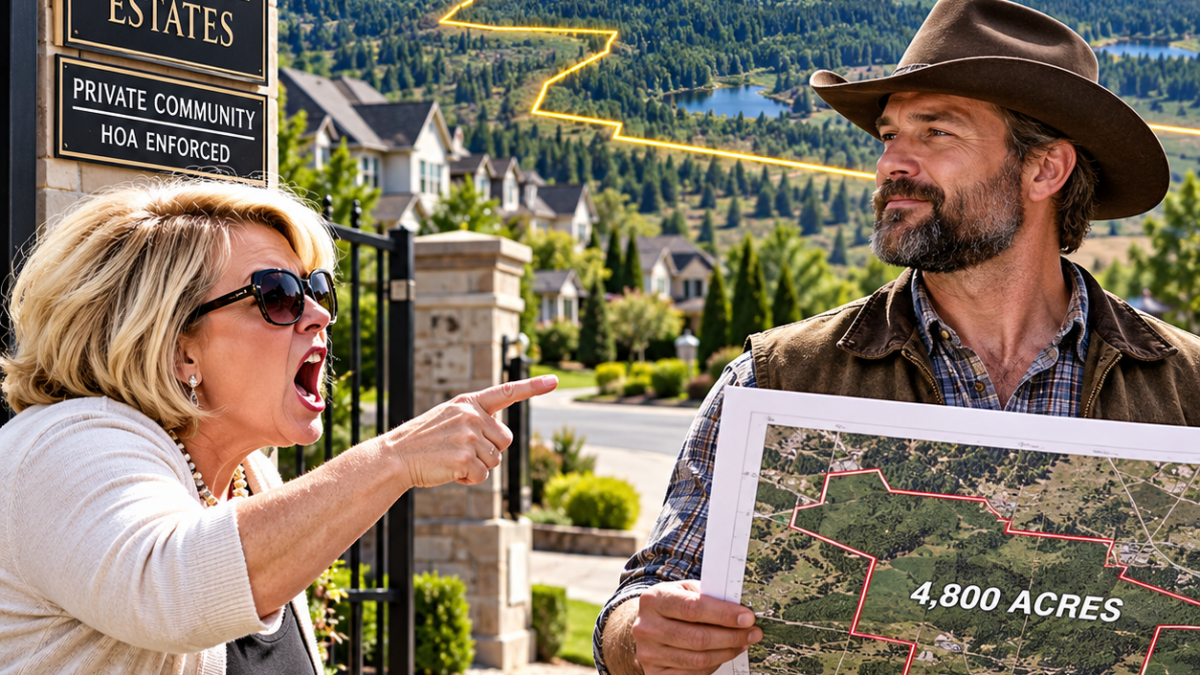
The remaining land under my ownership totaled 4,800 acres.
All properly documented.
All recorded.
All still ours.
Silvercrest occupied a relatively small pocket near the creek, surrounded on nearly every side by my family’s property.
Its residents could see our forests from their bedroom windows.
They could watch sunsets over our ridges.
And, as I was about to discover, their HOA had spent years pretending those forests and ridges belonged to them.
The morning Blair confronted me, I was conducting a preliminary inspection before hiring a professional surveyor.
I wanted to compare old boundary markers against the most recent county records.
That was all.
Instead, I found myself being treated like a criminal on land I legally owned.
The security officer eventually contacted the sheriff’s dispatch office.
But after explaining that the dispute concerned an uncertain property boundary and involved no violence, damage, or immediate threat, he was told the parties should document the issue and pursue the appropriate civil channels.
Blair was furious.
“This man is refusing to leave!”
The officer looked at me.
“Sir, are you threatening anyone?”
“No.”
“Blocking traffic?”
“No.”
“Damaging property?”
“No.”
He turned back toward Blair.
“Ma’am, unless we establish who owns this road, there’s not much more I can do.”
Blair glared at him.
Then at me.
“This isn’t over.”
“I didn’t think it was.”
She climbed into her SUV and slammed the door.
Before driving away, she rolled down the window.
“You’ve made a very serious mistake.”
I met her eyes.
“So has somebody.”
Her SUV accelerated down the road, kicking gravel against the weeds.
The younger security officer remained for a moment.
He glanced at the weathered stone marker.
Then at my truck.
“Sir,” he said quietly, “is this really your property?”
I nodded.
“Yes.”
He swallowed.
“All of it?”
I looked toward the ridgeline.
“More than you probably think.”
He didn’t ask another question.
After the security vehicles disappeared, I walked over to the nearest HOA sign.
It had been installed recently.
Fresh concrete surrounded the post.
The lettering was bright.
Someone had taken considerable trouble to announce ownership of land that wasn’t theirs.
I photographed the sign, recorded its location, and made a note in my field book.
Then I drove home.
By the time I reached my kitchen, I had made two decisions.
First, I wasn’t going to let Blair intimidate me.
Second, I wasn’t going to make a single accusation until I knew exactly what Silvercrest had been doing.
I called Nolan Briggs that afternoon.
Nolan was an independent licensed surveyor with a reputation for being painfully precise.
He was also the kind of man who could look at a boundary map for thirty seconds and spot discrepancies that other people missed for thirty years.
He answered on the third ring.
“Briggs Surveying.”
“Nolan, it’s Graham Mercer.”
“Well, there’s a name I haven’t heard in a while. How’s the ranch?”
“Apparently, part of it belongs to a homeowners association now.”
There was a pause.
“What?”
“That’s what they tell me.”
“Did you sell something?”
“No.”
“Did the trust grant an easement?”
“Not that I’ve found.”
Another pause.
Then Nolan said, “Graham, I think you need a survey.”
“I think I need a very thorough one.”
He came out two days later.
Nolan started with the county plat maps, the original Mercer deeds, and three historical surveys.
Then he brought his crew to the property.
For the next week, they worked their way through the timberland, marking corners, verifying monuments, checking recorded distances, and comparing the land on the ground with the legal descriptions.
I accompanied them whenever possible.
The first surprise came near a hiking trail.
We found a neatly maintained gravel path winding through the pines.
Wooden directional signs stood at intersections.
There were benches, trash receptacles, and small landscaping stones.
A polished sign read:
SILVERCREST NATURE TRAIL.
RESIDENT ACCESS ONLY.
Nolan stopped beside it.
He checked the coordinates on his equipment.
Then he looked at me.
“Graham, this is well outside their boundary.”
“How far?”
“Far enough that nobody should have confused it with association property.”
We followed the trail.
It passed through a grove of hardwoods, crossed a small stream, and climbed toward a scenic overlook.
Along the way, we encountered another sign thanking Silvercrest residents for supporting conservation through their annual HOA assessments.
I stared at it.
“They’re collecting money for this?”
“Looks that way.”
Nolan checked his map.
“And they’re doing it on your land.”
At first, I assumed the trail was an isolated problem.
Maybe someone had misunderstood an old informal access arrangement.
Maybe the original developer had promised amenities without completing the paperwork.
Maybe a former manager had granted limited permission that never made it into the records I had reviewed.
Those explanations weren’t impossible.
But the next discoveries made them increasingly difficult to believe.
Two days later, Nolan called me to a paved parking area behind the Silvercrest clubhouse.
“This is going to interest you.”
I drove over.
The parking lot was nearly full.
A group of residents was entering the clubhouse, carrying gym bags and coffee cups.
A landscaping truck idled near a row of ornamental trees.
Nolan stood beside a survey stake.
“See that line?”
I followed his gesture.
He had marked the recorded HOA boundary.
It ran across a narrow strip of landscaping and stopped well short of the rear parking area.
Most of the additional parking extended onto my land.
“Are you certain?”
He gave me a dry look.
“That’s why you hired me.”
I walked slowly along the painted parking spaces.
Families had probably parked there for years.
Visitors had used it during community events.
Maintenance crews had cleared snow from it.
And nobody had bothered to secure the underlying land rights.
Not far from the clubhouse, Nolan found an equipment storage yard hidden behind trees.
There were metal sheds, pallets of landscaping supplies, irrigation equipment, and a large pile of gravel.
The entire yard stood beyond Silvercrest’s legitimate property line.
Then came the reservoir.
It was a landscaped irrigation pond that supplied water for the community’s lawns and decorative planting areas.
The HOA described it as a private lake.
Its glossy brochures featured photographs of the water reflecting the surrounding mountains.
Nolan studied the records.
“The pond is almost entirely on Mercer land.”
I stood at the water’s edge, listening to a pump run beneath a small utility building.
Across the valley, sprinklers moved in slow arcs over carefully manicured lawns.
That water was being drawn from a reservoir located on property the HOA didn’t own.
“How long has this been here?” I asked.
Nolan examined the age of the visible equipment.
“Hard to say without construction records. But it isn’t new.”
The following day, we drove to the western maintenance road.
It extended more than two miles through the forest.
The HOA had graded it, widened sections, installed drainage culverts, and placed security signs at the entrances.
Nolan confirmed that the road crossed my land for nearly its entire length.
By the end of the week, we had identified three maintained recreational trails, the auxiliary parking lot, the maintenance road, the equipment yard, the reservoir, a picnic area, and a scenic overlook.
Every one of those facilities occupied some portion of Mercer property.
Some were entirely on it.
Others crossed the boundary.
All were being operated as though the HOA owned or controlled them.
I stood beside Nolan’s truck while he reviewed the preliminary findings.
“How bad is it?”
He removed his glasses.
“Graham, this isn’t somebody putting a shed three feet across a property line.”
“I gathered that.”
“They’ve built and maintained a substantial part of their community infrastructure on land they don’t own.”
I looked toward Silvercrest.
“And they’ve been charging people for it.”
Nolan nodded.
“That’s the part I’d want your lawyer to examine.”
I spent the next several evenings reviewing every public Silvercrest document I could find.
Old newsletters.
Community maps.
Promotional brochures.
Archived meeting minutes.
Budget summaries.
The more I read, the more disturbing the situation became.
One newsletter celebrated the grand opening of the scenic overlook.
There was Blair Whitcomb, smiling beside a ribbon-cutting ceremony, thanking homeowners for their generous contributions.
The article praised her leadership in expanding Silvercrest’s recreational amenities.
The overlook stood on my ridge.
Another newsletter announced improvements to the western trail system.
Residents were told that annual conservation assessments helped preserve the community’s privately controlled natural spaces.
Again, those trails crossed my property.
A third announcement celebrated the expansion of clubhouse parking.
A photograph showed the freshly paved area with a headline about better access for residents.
That parking lot occupied Mercer land.
There was even a brochure advertising Silvercrest as offering one of the largest privately maintained natural recreation areas in the county.
I sat at my kitchen table with the glossy pages spread in front of me.
My father had spent his life protecting those woods.
He’d refused several lucrative timber offers because he didn’t want the upper ridges stripped bare.
He’d repaired eroded streambanks, maintained old grazing areas, and kept certain sections untouched.
And here was a woman posing beside a scenic overlook on his land, taking credit for preserving it.
What bothered me most wasn’t that residents enjoyed the trails.
My father would probably have enjoyed seeing children explore those woods.
What bothered me was the deception.
Silvercrest had been promoting land it didn’t own.
Collecting maintenance fees connected to that land.
And threatening the actual owner with arrest for walking across it.
I called Laurel Prescott.
Laurel was the real estate attorney who had handled the transfer of the family trust property into my direct control.
She knew the Mercer records better than anyone.
“I need you to look into Silvercrest,” I told her.
“What happened?”
I explained Blair’s confrontation and Nolan’s preliminary findings.
By the time I finished, Laurel had stopped interrupting.
“Graham, don’t confront them again until we have the complete title history.”
“That serious?”
“Potentially.”
She paused.
“Send me everything Nolan has.”
I did.
Then we prepared a formal letter.
It was professional.
Measured.
Not threatening.
We asked Silvercrest to provide copies of any recorded deed, easement, lease, license, or written agreement authorizing the association’s use of Mercer land.
We identified the trails, parking lot, reservoir, maintenance road, and other improvements.
We requested that the HOA preserve all relevant documents and refrain from further construction while ownership was being verified.
I expected one of two responses.
Either Silvercrest would produce paperwork we hadn’t seen, or someone would call to arrange a meeting.
Blair chose a third option.
She sent me a legal-looking ultimatum.
The document arrived four days later.
At the top, in bold capital letters, it read:
NOTICE OF UNAUTHORIZED OCCUPATION.
It accused me of unlawfully entering Silvercrest conservation property.
It ordered me to remove my vehicle, stop all surveying activity, and refrain from returning.
I was given seventy-two hours to comply.
Failure to do so, the notice warned, would result in legal action and possible law-enforcement intervention.
I read it twice.
Then I called Laurel.
“Have you seen this?”
“I just received a copy.”
“What do you think?”
“I think somebody has become very comfortable making claims nobody asks them to prove.”
I glanced at the letter.
“She gave me seventy-two hours to leave my own land.”
“I noticed.”
“What happens next?”
“Now we get every recorded document connected to the original development.”
“And then?”
Laurel’s voice became very calm.
“Then we find out whether Mrs. Whitcomb is mistaken, reckless, or something worse.”
The title investigation took most of a week.
Laurel retrieved the original sale documents from the Mercer family to the Silvercrest developer.
She reviewed subdivision plats, recorded restrictions, later amendments, utility easements, and property transfers.
She examined the declarations governing the HOA.
She checked whether the family trust had ever entered a long-term access agreement.
Nothing authorized the broad use Silvercrest claimed.
There was no deed transferring any portion of the 4,800 acres to the HOA.
No recorded easement covering the recreational trail network.
No lease for the reservoir.
No legal agreement authorizing the maintenance road.
No document giving Silvercrest ownership of the scenic overlook.
What Laurel discovered next changed the entire dispute.
She came to my house carrying three thick folders.
Her expression told me this wasn’t going to be an ordinary meeting.
“Graham, sit down.”
I pulled out a chair.
She spread two maps across the table.
The first was the official recorded subdivision plat.
Silvercrest appeared as a compact development near the creek.
Its roads and residential lots were clearly marked.
The surrounding property belonged to Mercer.
The second map was from an HOA newsletter.
At first glance, it looked similar.
Then I noticed the boundary.
Silvercrest’s claimed conservation area extended across enormous sections of my timberland.
The recreational trails, reservoir, and scenic overlook were all shaded as association-controlled amenities.
“That can’t be right,” I said.
“It isn’t.”
Laurel placed another document beside it.
A board meeting record.
Blair Whitcomb’s signature appeared beneath a resolution approving the continued use of the HOA’s expanded amenity map.
Then came another resolution.
And another.
The same misleading boundary representation had been repeated over several years.
“She’s been approving these maps?”
“Yes.”
“Do you think she knew they were wrong?”
“We can’t establish her state of mind from a signature alone,” Laurel said. “But we can establish that the board repeatedly adopted maps inconsistent with the recorded plat.”
I looked at the documents.
“And people bought houses based on these?”
“That’s one of the questions we need answered.”
Laurel turned to a glossy marketing brochure.
The language promised permanent association-controlled open space.
A private scenic overlook.
Exclusive nature trails.
Community conservation lands.
All represented as valuable neighborhood amenities.
“People make major financial decisions based on representations like these,” Laurel said. “If those promises were inaccurate, this could become more than a boundary dispute.”
I rubbed my forehead.
“How much more?”
“That depends on what the board knew, what purchasers were told, and whether anyone intentionally concealed material information.”
She tapped the first map.
“But one thing is certain. Silvercrest doesn’t own the land these maps claim it controls.”
I sat back.
For a long moment, I said nothing.
Then I looked out the kitchen window toward the hills.
My father had spent years worrying that some developer would someday persuade the family to sell the rest of the ranch.
He’d never imagined a development might simply start treating the land as its own.
Laurel gathered the papers.
“Graham, I need you to understand something.”
“What?”
“She’s already accused you of trespassing. She’s already threatened legal action. And now we have evidence the association has been operating beyond its property boundaries for years.”
I nodded.
“Meaning?”
“Meaning you must be very careful about every step you take.”
I looked at Blair’s seventy-two-hour notice.
“What would you do?”
“I would let the records speak.”
Blair didn’t wait for the records.
She called an emergency HOA meeting.
By then, rumors were spreading through Silvercrest.
Some residents had noticed survey crews along the trails.
Others had seen me photographing signs.
A few had learned that a neighboring landowner was questioning the association’s property boundaries.
Blair moved quickly to control the story.
She stood at the front of a crowded clubhouse and announced that a wealthy land speculator was attempting to seize community property.
That land speculator was me.
According to accounts later given to Laurel, Blair described me as an outsider who wanted to disrupt the peaceful lifestyle residents had paid for.
She claimed I was challenging their trails, lake, parking, and conservation spaces.
She told the crowd the HOA was prepared to defend its assets.
Not once did she explain that the original recorded boundary placed those amenities outside the subdivision.
Instead, she presented the dispute as an attack.
“Silvercrest will not be bullied,” she declared.
The room applauded.
Some residents began asking questions.
An older man wanted to know whether the HOA held deeds to the trails.
Blair replied that the association had maintained those areas for years.
A woman asked whether the promised private lake was legally owned by Silvercrest.
Blair said the question was being handled by counsel.
Another homeowner asked to see the official subdivision map.
Blair told him that bringing more paperwork into the discussion would only create confusion.
Then she announced increased security patrols.
Within days, additional signs appeared along the trails.
Security cameras were repositioned to capture activity near the disputed boundaries.
Every time I visited my own land, someone from Silvercrest seemed to be watching.
I found it almost unbelievable.
A neighborhood association was photographing a landowner whenever he walked through his own forest.
But Blair wasn’t finished.
She ordered a physical barrier across the old gravel access road.
That order went to Wesley Dorr.
Wesley had managed Silvercrest’s facilities for nearly thirty years.
He knew its water systems, roads, landscaping, and maintenance equipment better than almost anyone.
He also knew construction work required proper authorization.
When Blair instructed him to install a gate across the disputed road, he asked for the recorded property documentation.
She handed him the HOA’s internal boundary map.
Wesley examined it.
There was no county recording information establishing ownership.
No licensed surveyor’s certification supporting the expanded line.
No supporting easement.
He refused to proceed.
Blair was furious.
“You work for this association,” she reminded him.
“Yes, ma’am.”
“Then do your job.”
“My job is to maintain the facilities legally.”
“I’m authorizing the gate.”
“With respect, Mrs. Whitcomb, I need more than your authorization before I build a barrier on disputed land.”
She accused him of disloyalty.
He documented the exchange and declined the assignment.
I didn’t know about that conversation immediately.
I learned about it later.
But it would become one of the most important moments in the entire dispute.
Because Wesley was the first person inside Silvercrest who had formally refused to treat Blair’s word as proof of ownership.
Nolan finished his survey several days later.
He arrived at my house in the early evening.
His truck was coated with dust.
He carried a large rolled map and a report thick enough to stop a door.
“I’ve completed the boundary work,” he said.
I cleared the kitchen table.
He unrolled the map.
The actual Silvercrest subdivision appeared in the center.
Around it stretched the surrounding Mercer tract.
Four thousand eight hundred acres.
Every relevant boundary was documented.
Every confirmed monument was identified.
Every disputed amenity was marked.
The auxiliary clubhouse parking lot extended well beyond the recorded line.
The reservoir was almost completely inside my property.
The maintenance road ran through Mercer timberland for miles.
The trail network crossed numerous sections.
The scenic overlook stood entirely on my ridge.
And the equipment yard was nowhere near land the HOA owned.
Nolan pointed to the area behind the clubhouse.
“This is almost entirely an encroachment.”
Then the reservoir.
“Same problem.”
Then the maintenance road.
“Even worse.”
He traced the recreational trails.
“These are scattered across multiple sections of your property.”
I stared at the map.
“How did they get away with this?”
He shrugged.
“Sometimes people make assumptions. Sometimes they inherit bad maps. Sometimes nobody wants to question something that’s already been built.”
“And sometimes?”
He met my eyes.
“Sometimes someone decides nobody will challenge them.”
I looked down at the stamped survey.
“Could these findings be wrong?”
“Any survey can be challenged,” Nolan replied. “But I’ve cross-checked this against three historical surveys, the recorded deeds, and the physical monuments. I’m comfortable defending my work.”
He leaned back.
“The big question isn’t where the boundary is anymore.”
“What is it?”
“How the association operated so far beyond it for so long.”
I stood and walked to the window.
Beyond the pasture, the lights of Silvercrest were beginning to glow.
Families were cooking dinner.
Children were riding bicycles.
Somebody was probably walking a dog along a trail that crossed my land.
None of those people had personally threatened me.
Most likely, none of them knew about the property problem.
They had bought homes in a community that promised scenic views and outdoor amenities.
They paid their assessments.
They trusted the HOA to handle the legal details.
My fight wasn’t with them.
And I didn’t want it to become one.
I turned back toward Nolan.
“I’m not closing anything yet.”
He nodded.
“Probably wise.”
“Laurel wants the paperwork complete before we take action.”
“She’s right.”
I looked at the survey again.
“What happens when Blair sees this?”
Nolan rolled up the map.
“If she’s sensible, she’ll call a lawyer and start negotiating.”
I thought about the security vehicles.
The trespassing accusations.
The seventy-two-hour notice.
The order to install a gate.
“What if she’s not sensible?”
Nolan gave me a long look.
“Then I suspect this is going to get considerably more expensive for her association.”
Silvercrest had been planning a major clubhouse expansion.
The proposed project included more recreational facilities, improved landscaping, expanded parking, and additional outdoor gathering areas.
Blair considered it the crown jewel of her presidency.
She had promoted the project for months.
Now she wanted municipal approval.
A planning meeting was scheduled with Mayor Elliot Vaughn and the city’s relevant staff.
Laurel reviewed the proposal.
Several planned improvements extended beyond the legitimate HOA boundary.
She advised me to attend.
Not to argue.
Not to create a spectacle.
Simply to present the documented property records through the proper process.
We filed our objection and supporting survey in advance.
On the morning of the meeting, I put on clean jeans, a pressed button-down shirt, and the same work boots I’d worn when Blair called me a squatter.
I drove the old pickup into town.
The meeting room was already crowded.
Residents filled most of the chairs.
Several board members sat near the front.
Blair wore a tailored navy blazer and sat with a thick binder arranged before her.
When I entered, she noticed me immediately.
Her expression changed.
She leaned toward another board member and whispered something.
I ignored her and took a seat near the back.
Laurel sat beside me.
“You ready?” she asked.
“As I’ll ever be.”
“Remember, let them ask the questions.”
I nodded.
The meeting began.
City staff reviewed the clubhouse expansion proposal.
Maps appeared on a screen.
Budget figures were discussed.
A planner described proposed landscaping improvements.
Then Blair stood.
“Before we proceed,” she announced, “I need to address a serious interference issue.”
Mayor Vaughn looked up.
“What issue?”
Blair turned and pointed directly toward the back of the room.
“That man.”
Every head turned.
I remained seated.
“He has been trespassing on association conservation property,” she continued. “He’s harassed our security staff, disrupted maintenance operations, and attempted to intimidate our board.”
Laurel’s pen stopped moving.
Blair raised her voice.
“Now he’s trying to obstruct improvements that our residents have funded and approved.”
Mayor Vaughn studied me.
Then he looked back at Blair.
“Mrs. Whitcomb, are you referring to Mr. Mercer?”
“Yes. Graham Mercer.”
The mayor opened the file in front of him.
“And you’re alleging that Mr. Mercer is trespassing on land owned by Silvercrest?”
“Exactly.”
“Have you verified the boundaries in your proposal against the official county parcel records?”
Blair waved the question away.
“Mayor Vaughn, Silvercrest has managed those areas for years.”
“That wasn’t my question.”
She hesitated.
“Our internal maps clearly identify the association’s conservation property.”
“Are those maps consistent with the recorded subdivision plat?”
“They reflect the property we’ve maintained.”
The mayor leaned back.
“Mrs. Whitcomb, maintenance and ownership are different legal concepts.”
Blair stiffened.
“Surely you don’t expect a community to abandon property it has maintained for decades because of one man’s sudden objections.”
The mayor turned toward his assistant.
“Please bring the county reference map.”
Blair frowned.
“Is that really necessary?”
“Yes.”
The assistant returned with a large rolled map.
The mayor cleared the center of the conference table.
He spread the map across it.
Several city employees stepped closer.
The map showed Silvercrest.
Its recorded residential lots.
Its streets.
Its clubhouse.
And around it, stretching across the hills, forests, ridges, and meadows, one enormous parcel.
The mayor placed his finger beside the parcel number.
“Mrs. Whitcomb, would you come here?”
She approached reluctantly.
He pointed to Silvercrest.
“This is your community’s recorded boundary.”
“Yes.”
Then he traced the much larger surrounding tract.
“And this is the adjoining property.”
Blair stared.
The mayor looked at the audience.
“The current ownership record identifies Graham Mercer as the owner of this surrounding tract.”
He paused.
“The area is approximately 4,800 acres.”
Someone near the front whispered, “What?”
The mayor continued.
“Mr. Mercer owns the land surrounding Silvercrest on nearly every side.”
The room became completely silent.
Blair looked from the map to the mayor.
“That can’t be correct.”
Laurel spoke for the first time.
“It is correct, Mayor Vaughn. We have submitted the complete recorded title history and a licensed boundary survey.”
The mayor nodded.
“I’ve reviewed those documents.”
Blair’s face reddened.
“But our association has always controlled those trails.”
The mayor looked directly at her.
“Mrs. Whitcomb, your association’s maintenance of an area does not establish that it owns the underlying land.”
She opened her mouth.
He raised one hand.
“And according to the survey before us, several of your proposed improvements would extend onto Mr. Mercer’s property.”
The room erupted in whispers.
One resident stood.
“Are you saying the trails aren’t ours?”
The mayor answered carefully.
“I’m saying the recorded property documents do not establish HOA ownership of those areas.”
Another resident asked, “What about the lake?”
Laurel replied, “The irrigation reservoir is located almost entirely within the Mercer parcel.”
A woman near the wall gasped.
Blair turned toward me.
“This is absurd! He’s trying to take our community!”
I stood slowly.
Every face shifted toward me.
“Mrs. Whitcomb,” I said, “I haven’t asked for one square foot of Silvercrest property.”
She glared.
“I’ve asked you to stop claiming mine.”
For several seconds, nobody spoke.
Then the mayor pointed to the subdivision on the map.
“Mr. Mercer isn’t surrounded by your community, Mrs. Whitcomb.”
He traced the surrounding property line.
“Your community is surrounded by his land.”
Blair stared at the map.
Her mouth opened.
Then closed.
For the first time since I’d met her, she had no immediate answer.
A few residents raised their phones to photograph the map.
Others looked toward the HOA board.
One man shook his head slowly.
Blair demanded a recess.
The mayor granted it.
But before anyone left, he instructed the clerk to record the ownership discrepancy and suspend further consideration of the disputed portions of the project pending proper documentation.
Blair’s clubhouse expansion had just collided with 4,800 acres of reality.
And everybody in the room had witnessed it.
I expected the map confrontation to force negotiations.
Instead, Blair tried to minimize what had happened.
Within days, a Silvercrest notice described the meeting as a routine technical disagreement over historical boundaries.
It assured residents that the board remained confident in its position.
Blair claimed lawyers would resolve the matter privately.
But the residents had seen the map.
And several had photographed it.
Questions began spreading faster than Blair could answer.
Why had their HOA maps shown land outside the subdivision?
Why were maintenance fees collected for amenities the association didn’t own?
Why had Blair threatened the neighboring landowner?
And why had she never produced a deed?
The first real break came from an unexpected person.
Monica Hale.
She was Silvercrest’s treasurer.
I had seen her at the municipal meeting, sitting quietly behind Blair.
Several days later, Laurel called.
“Graham, Monica Hale wants to meet.”
“What does she want?”
“She says she has financial records we should examine.”
I frowned.
“Why would the HOA treasurer come to us?”
“She says she’s been asking questions internally for years.”
We agreed to meet at Laurel’s office.
Monica arrived carrying a large binder and a canvas bag filled with documents.
She looked exhausted.
Not frightened exactly.
More like someone who had spent a long time holding together a problem she could no longer ignore.
She sat across from us.
“I don’t know where to begin.”
Laurel offered her water.
“Begin with what you know.”
Monica opened the binder.
“These are the association’s assessment records for nearly ten years.”
She slid a spreadsheet toward us.
There were ordinary categories.
Landscaping.
Security.
Road maintenance.
Insurance.
Then came the special assessments.
Trail preservation.
Conservation maintenance.
Private lake upkeep.
Scenic overlook improvements.
Western parking expansion.
Monica turned several pages.
“Every one of those categories connects to land shown on your survey.”
I examined the figures.
The total over the years was substantial.
“These were all charged to residents?”
“Yes.”
“Did the board believe the association owned those areas?”
Monica looked down.
“That’s what we were told.”
“By whom?”
She hesitated.
Then she answered.
“Blair.”
Laurel leaned forward.
“Did anyone question the underlying property rights?”
“I did.”
“When?”
“Several times.”
Monica opened another section.
“Whenever I asked about the legal status of the trails or reservoir, Blair said the matter had already been reviewed by counsel.”
“Did you ever see a legal opinion?”
“No.”
“An easement?”
“No.”
“A lease?”
“No.”
Monica’s voice tightened.
“But she made it sound like I was creating unnecessary problems.”
I sat quietly.
I’d seen that behavior before.
People who controlled an organization sometimes learned how to make ordinary questions feel like acts of disloyalty.
Eventually, everyone stopped asking.
Monica opened another folder.
“And there’s something else.”
She removed a copy of a letter.
It had been sent years earlier by a surveying company hired for a trail expansion.
The company warned the board that the proposed improvements appeared to cross land outside the recorded Silvercrest subdivision.
It recommended a formal title and boundary review before construction continued.
The letter had been received by the association.
Acknowledged.
Filed.
And ignored.
I read it twice.
“This was sent before the overlook was expanded?”
“Yes.”
“And before some of these assessments?”
“Yes.”
I looked at Laurel.
She didn’t smile.
She simply wrote a note.
Monica’s hands were trembling slightly.
“I didn’t know about this letter when it arrived. I found it in an old project file while reviewing expenses.”
“Why bring it to us?” I asked.
She met my eyes.
“Because people in Silvercrest worked hard for the money they paid.”
Her voice cracked.
“Some are retired. Some are raising children. Some stretched their finances because they were promised this beautiful community with private trails and protected open space.”
She swallowed.
“And if the board was charging them for things we never legally controlled, they deserve to know.”
I looked at her for a moment.
“Monica, I don’t want those families punished.”
She nodded.
“I know.”
“I want the land rights corrected. I want the false signs removed. And I want the association to stop claiming property it doesn’t own.”
She wiped at one eye.
“Then we’re asking for the same thing.”
The financial records changed the conversation.
Until then, Blair had successfully framed the dispute as a fight between a stubborn landowner and a neighborhood.
Now residents were beginning to understand that their own money was involved.
Many had paid years of special assessments.
Some had paid substantial one-time contributions for the overlook and trail expansions.
Others had purchased homes partly because the developer’s marketing materials promised permanent recreational access.
Those promises mattered.
I understood that better than Blair seemed to.
One afternoon, I drove to the clubhouse to meet Laurel.
A small group of residents approached my truck.
At first, I braced myself.
I expected accusations.
Instead, an older woman spoke.
“Mr. Mercer?”
“Yes, ma’am.”
“My name is Evelyn Carter. My husband and I have lived here for eleven years.”
I nodded.
“Nice to meet you.”
She looked uncomfortable.
“Can I ask you something?”
“Of course.”
“Are you going to make us leave?”
The question surprised me.
“Leave where?”
“Our homes.”
I stared at her.
“Why would I do that?”
She exchanged a glance with another resident.
“We heard you might claim the entire neighborhood because your family owned the land before it was developed.”
I felt a flash of anger.
Not at her.
At the person who had allowed that fear to spread.
“Mrs. Carter, the land under your house was legally sold to the developer decades ago. Your home is your home. I’m not challenging that.”
Her shoulders relaxed slightly.
“But the trails?”
“That’s different. The trails cross land that was never sold.”
A younger man stepped forward.
“We paid for those trails.”
“I understand.”
“So what happens to them?”
“That depends on whether your board is willing to negotiate a legal agreement.”
He frowned.
“Blair says you’re demanding ownership of our community assets.”
I shook my head.
“I’m demanding recognition of property I already own.”
There was a long silence.
Then Mrs. Carter asked, “Would you let people keep using the trails if the association made things right?”
I looked toward the trees.
“I haven’t ruled that out.”
Her eyes filled.
“My husband walks those trails every evening. It’s one of the few things that helps him keep moving after his surgery.”
I softened my voice.
“Then I hope your board chooses a solution that lets him continue.”
Another woman spoke.
“We didn’t know.”
“I believe you.”
“We really didn’t.”
I nodded.
“That’s why I’m not angry with you.”
I turned to the group.
“Listen to me carefully. I’m not trying to hurt Silvercrest residents. I don’t want anyone forced from a home. I don’t want your children losing a safe place to play. And I don’t want elderly people losing access to paths they’ve used for years.”
The younger man folded his arms.
“Then who are you fighting?”
I looked directly at him.
“Whoever decided my family’s land could become association property without asking us.”
The group fell silent.
Mrs. Carter finally extended her hand.
“Thank you for explaining.”
I shook it.
As they walked away, I realized something important.
Blair had been depending on fear.
But fear weakened when people started asking direct questions and receiving direct answers.
The next confrontation occurred during a follow-up meeting with city officials.
Blair arrived with a document she claimed would settle the entire dispute.
It was an old photocopied agreement.
She placed it dramatically on the table.
“Here is the proof you’ve all been demanding.”
Laurel leaned forward.
“What is it?”
“A historical access agreement between the original Mercer landholder and the Silvercrest developer.”
Blair smiled triumphantly.
“It grants permanent access and use rights to our association.”
For the first time in weeks, I felt genuine concern.
If an earlier owner had granted enforceable rights that our title review missed, the situation could become considerably more complicated.
Laurel understood that immediately.
“May I examine it?”
Blair slid the document across the table.
“By all means.”
Laurel put on her reading glasses.
She studied the first page.
Then the legal description.
Then the signature block.
Her expression remained neutral.
“Mrs. Whitcomb, where did you obtain this?”
“From historical association files.”
“Do you have the original?”
“This is a certified copy.”
“Certified by whom?”
Blair hesitated.
“The association’s records office.”
Laurel looked up.
“An internal association copy isn’t the same as a certified county recording.”
Blair’s smile faded.
“The agreement is valid.”
“We’ll need to verify that.”
Blair folded her arms.
“Are you suggesting it’s fake?”
“I’m suggesting we verify its authenticity before anyone relies on it.”
Then Laurel asked a question that made Blair visibly uncomfortable.
“Mrs. Whitcomb, do you know when the manager whose signature appears here stopped working for the Mercer trust?”
Blair glanced down.
“I don’t see why that matters.”
“It may matter considerably.”
Laurel slid the document toward me.
The supposed agreement bore the signature of a former trust manager.
I recognized the name.
But the date was wrong.
The manager had retired years before the document supposedly had been executed.
Laurel continued.
“The legal description also doesn’t match the recorded parcel configuration.”
Blair straightened.
“These are old documents. Of course the descriptions are different.”
“Sometimes historical descriptions differ,” Laurel agreed. “That’s why we verify them.”
I remained quiet.
I wanted to accuse Blair of producing a fabricated document.
But Laurel had warned me against making allegations we couldn’t yet prove.
A suspicious photocopy wasn’t enough by itself.
We needed the records.
And we needed facts nobody could explain away.
Over the following week, Laurel requested a search of the county’s official recording system.
There was no matching recorded agreement under the number Blair supplied.
The county couldn’t identify a corresponding original.
Meanwhile, Nolan reviewed historical aerial photographs.
He compared the route described in the document with imagery from the year it supposedly had been signed.
The photographs showed uninterrupted forest.
The road identified in Blair’s agreement didn’t exist at that time.
It had been built years later.
Nolan called me with the result.
“Graham, I think you’ll want to see this.”
He placed two aerial photographs side by side.
The older image showed dense timber.
The newer image showed the maintenance road.
The dates were clear.
“Her agreement specifically describes this road?”
“Yes.”
“And it supposedly predates the road?”
“By years.”
I looked at the photographs.
“Could it have referred to a proposed route?”
“That’s something a court would have to evaluate in context,” Nolan said. “But the document describes an existing access road, not a future corridor.”
Laurel reviewed the findings.
Together, the inconsistencies were severe.
Wrong or unmatched legal description.
No verified recording.
A signature associated with someone no longer managing the trust.
And a road that apparently didn’t exist on the claimed execution date.
We submitted the findings to the appropriate county offices and asked that the unverified document not be accepted as proof of a recorded easement.
The county confirmed it had no matching record and declined to treat the photocopy as establishing the claimed property rights.
When Blair learned the document had failed verification, she accused everyone involved of bias.
But the facts were no longer confined to a private argument.
They were documented.
And the city’s planning office suspended the pending disputed expansion approvals.
Blair had finally lost something she’d spent years depending on.
The ability to make a claim and expect everyone to accept it.
The next several weeks were difficult for everyone involved.
Silvercrest residents were divided.
Some believed Blair had made an honest mistake.
Others believed she had knowingly misrepresented the boundaries.
A few insisted the HOA should simply continue using the land because the trails and reservoir had existed for years.
Laurel warned me that the association might still attempt to assert legal rights based on historical use.
Those arguments would need to be addressed properly.
But no recorded document had been produced granting the sweeping ownership Blair claimed.
And every new survey finding strengthened our position.
We decided to offer a solution before escalating further.
Laurel drafted a formal proposal.
The HOA could negotiate paid, legally documented access to selected trails and the irrigation reservoir.
In exchange, the association would need to acknowledge the true boundaries and address the years of unauthorized use.
The requirements were straightforward.
All signs falsely identifying Mercer land as HOA property had to come down.
The trespassing notice against me had to be rescinded.
Residents had to receive accurate boundary information.
The association needed a transparent accounting of the fees collected for disputed amenities.
The cost of the independent survey needed to be addressed.
And future marketing materials could no longer describe Mercer property as land owned by Silvercrest.
We also required any continuing access rights to be clearly defined, properly approved, and recorded.
I considered the proposal fair.
It protected my land.
It protected the residents.
And it gave the association a way to correct its mistakes without destroying valued amenities.
Blair rejected it.
Every major condition.
Her response accused me of attempting to exploit the community.
She claimed the proposed payments were unnecessary.
She refused to remove the signs.
She would not acknowledge that the HOA’s maps were wrong.
And she insisted my trespassing notice should remain in effect.
Laurel read the response aloud in her office.
When she finished, neither of us spoke.
Finally, she placed the papers on her desk.
“Well,” she said, “that answers one question.”
“Which one?”
“Whether she intends to cooperate voluntarily.”
I looked at the letter.
“What are our options?”
“We can seek negotiated relief, pursue civil remedies, and take lawful steps to control nonessential access where the property rights are established.”
I thought about Mrs. Carter and her husband.
The children on bicycles.
The families who’d trusted the association.
“I won’t cut off anything essential to their safety.”
Laurel nodded.
“That’s important.”
“No blocking emergency routes. No interfering with utilities. No making life dangerous.”
“Agreed.”
“But I can’t keep letting Blair operate recreational facilities on my land as though she owns them.”
Laurel studied me.
“Then we’ll proceed carefully. Proper notices. Accurate boundaries. No retaliation.”
I looked out her office window.
“That’s exactly what I want.”
The first closures were quiet.
There were no bulldozers.
No shouting matches.
No security confrontations.
After legal review and appropriate notice, access was restricted to selected recreational areas where Silvercrest had failed to establish any right of use.
The scenic overlook was closed.
Sections of the trail network crossing Mercer property were marked and temporarily taken out of service.
The portion of the auxiliary parking area extending onto my land could no longer be used for association events.
We left genuinely essential access and utility arrangements undisturbed while their legal status and continuity were addressed.
I instructed everyone working for me to treat residents respectfully.
No insulting signs.
No unnecessary destruction.
No confrontation with families.
At the overlook, we installed a simple notice identifying the land as private property with no current public-access agreement.
We left the benches, railings, and platform undamaged.
I hoped an eventual agreement would allow people to enjoy the view again.
But the immediate impact on Silvercrest was enormous.
Weekend visitors arrived at the clubhouse and found fewer parking spaces available.
Residents accustomed to walking the entire trail loop discovered that only the portions within the actual subdivision remained open.
The scenic overlook, once featured in nearly every community brochure, was inaccessible.
Children who had ridden bicycles through the woods for years now had to turn around at a clearly marked boundary.
The difference between Blair’s maps and the county’s records was no longer an abstract legal issue.
It was visible.
It affected daily life.
And residents began asking questions Blair couldn’t avoid.
One evening, Monica called Laurel.
“The homeowners are organizing a special meeting.”
“About the dispute?”
“About the dispute, the assessments, and the board’s handling of everything.”
“When?”
“Next Thursday.”
Laurel looked toward me.
“Graham, would you be willing to attend?”
I thought for a moment.
“Yes.”
“Even if it gets ugly?”
I remembered Blair’s finger pointed at my windshield.
Her threat to have security drag me away.
The seventy-two-hour notice.
The misleading maps.
The failed historical agreement.
Then I remembered Mrs. Carter’s worried face when she asked whether she’d lose her home.
“Yes,” I repeated.
“It’s time the residents heard everything.”
The clubhouse was packed that Thursday.
Cars lined the street.
Residents stood shoulder to shoulder along the walls.
Every folding chair was occupied.
Some people looked angry.
Others looked frightened.
Many carried copies of HOA statements, assessment records, and property maps.
Blair sat at the front.
She wore a gray blazer and maintained the same rigid posture I’d seen at the municipal meeting.
But something was different.
She wasn’t surrounded by enthusiastic supporters.
Several board members sat apart from her.
Monica occupied a chair near the center of the table.
Wesley stood near the side wall.
Laurel and I sat quietly near the back.
Nolan had brought enlarged survey maps.
The meeting began with the acting secretary reviewing the special meeting notice and confirming the applicable procedures.
Then Blair stood.
“This community is under attack,” she announced.
A few people nodded.
Others groaned.
“A neighboring landowner has decided to use technical boundary discrepancies to deprive Silvercrest families of amenities they have enjoyed for decades.”
A man in the second row raised his hand.
“Technical discrepancies? My wife and I paid a special assessment for that overlook.”
Blair kept talking.
“These amenities were developed, maintained, and improved with your money.”
“On whose land?” someone called.
Blair ignored the question.
“And now Mr. Mercer wants to hold our entire neighborhood hostage.”
That was when Monica stood.
“Blair, I’d like to address the financial records.”
Blair turned.
“We’ve already discussed those.”
“Not publicly.”
“This isn’t the appropriate forum.”
Monica looked around the packed room.
“These are the people who paid the assessments. I can’t think of a more appropriate forum.”
A murmur of approval spread through the audience.
Blair sat down.
Monica opened her binder.
She began with the trail maintenance assessments.
She explained the amounts collected.
The budgets approved.
The expenses assigned.
Then she moved to the scenic overlook.
The reservoir.
The western parking expansion.
One category at a time, she showed residents how money had been collected for facilities located outside the recorded association boundary.
There were gasps.
Angry whispers.
A woman in the front row began shaking her head.
Monica continued.
“For years, I asked whether the association possessed documentation establishing its rights to these properties.”
She turned toward Blair.
“I was repeatedly told that legal counsel had resolved the issue.”
Blair interrupted.
“That was my understanding.”
Monica held up the old survey company’s warning letter.
“Then why was this document ignored?”
The room went silent.
Monica read the relevant portions.
The warning that construction appeared to extend beyond the subdivision.
The recommendation for a formal boundary review.
The acknowledgment showing the correspondence had reached the association.
Blair’s face reddened.
“That document was preliminary.”
Monica looked at her.
“Then why didn’t we commission the follow-up survey?”
Blair said nothing.
Monica’s voice remained steady.
“We continued spending homeowners’ money. We continued collecting assessments. And we continued advertising these areas as association-controlled property.”
She placed the letter on the table.
“I can no longer defend those decisions without the documentation to support them.”
The room erupted.
Residents spoke over one another.
Some demanded refunds.
Others asked how the board could have missed the warning.
One man wanted to know whether the HOA’s insurance would cover the consequences.
The acting secretary struggled to restore order.
Then Wesley stood.
“I need to say something.”
The room quieted.
He faced the residents.
“Mrs. Whitcomb instructed me to install a physical barrier across the gravel road Mr. Mercer uses to access his property.”
Several people turned toward Blair.
Wesley continued.
“I asked for documentation showing that Silvercrest owned or controlled the road.”
He lifted a sheet of paper.
“I was given an internal map that didn’t match the county records.”
Blair interrupted.
“That was an approved association map!”
Wesley nodded.
“Yes, ma’am. But it wasn’t proof of ownership.”
He looked toward the residents.
“I refused to build the barrier without proper authorization. I documented that decision at the time.”
A woman near the wall whispered, “She tried to lock him out?”
Another answered, “Of his own property.”
Blair raised her voice.
“This is being distorted!”
Wesley remained calm.
“I’m describing exactly what happened.”
Then Nolan stepped forward.
He unrolled the completed survey.
The map stretched across two tables.
He explained the recorded boundary.
The physical monuments.
The historical surveys.
The locations of the trails, parking, reservoir, maintenance road, and overlook.
He didn’t use complicated language.
He explained the findings in terms everyone could understand.
“This line,” he said, pointing to the subdivision boundary, “defines the land included in Silvercrest’s recorded plat.”
He moved his finger outward.
“These improvements extend onto the adjoining Mercer parcel.”
One resident raised his hand.
“How much of the surrounding land does Mr. Mercer own?”
Nolan answered.
“Approximately 4,800 acres.”
The man stared.
“All around us?”
“On nearly every side.”
Someone near the back gave a disbelieving laugh.
Another person muttered, “She called him a squatter.”
I heard it.
So did Blair.
Her face tightened.
Laurel then presented the title history.
She explained that the family had sold a limited portion of land to the developer.
She showed the recorded documents.
She confirmed that no subsequent deed had transferred the surrounding 4,800 acres to Silvercrest.
She discussed the absence of a verified agreement covering the contested amenities.
And she explained the problems with the photocopied historical access document Blair had submitted.
She was careful.
Precise.
She didn’t call anyone a criminal.
She didn’t speculate about motivations.
She simply explained what the records did and did not establish.
When she finished, the room was utterly quiet.
Blair stood again.
“This is ridiculous!”
Her voice echoed against the clubhouse ceiling.
“You’re all letting a wealthy landowner destroy everything we’ve built over a technicality!”
Several residents looked away.
She pointed at me.
“He has thousands of acres! Thousands! And he’s fighting us over trails and a parking lot!”
I remained seated.
“He could let us use those areas without losing anything!”
A man near the front answered before I could.
“He offered us an agreement, Blair.”
She spun toward him.
“An outrageous agreement!”
“He asked us to acknowledge the boundaries!”
Blair’s voice rose.
“He wants to humiliate this association!”
That was when I stood.
I hadn’t planned a speech.
I had prepared notes, but looking around the room, I knew exactly what needed to be said.
“Mrs. Whitcomb.”
She turned.
I walked toward the front.
The room fell silent.
“Several months ago, I drove my pickup onto a gravel road my family has maintained for generations.”
Blair folded her arms.
“You’ve told this story before.”
I continued.
“You arrived with security vehicles. You called me a squatter. You threatened to have me arrested.”
A few residents shifted in their chairs.
“You never asked who I was. You never asked whether I had a deed. You never asked why I was there.”
I pointed toward the survey.
“You assumed the land belonged to your association because you wanted it to.”
Blair opened her mouth.
I raised one hand.
“Please let me finish.”
She stopped.
“My grandfather helped mark those boundaries. My father ran cattle across those hills. I grew up walking those trails before Silvercrest existed.”
I looked around the room.
“I have never claimed your homes. I have never challenged ownership of your residential lots. I have never demanded that a family leave this community.”
Mrs. Carter sat near the second row.
She nodded slowly.
I continued.
“But your association built facilities on land my family never sold.”
I pointed toward the financial records.
“Then it collected money from you for those facilities.”
I faced Blair again.
“And when I asked for documentation, your president ordered me to leave.”
Blair’s jaw tightened.
I felt the anger I’d restrained for months rising.
But I kept my voice level.
“You say I’m holding Silvercrest hostage.”
I paused.
“I offered a lawful way to keep using the reservoir and selected trails. I asked for accurate maps, honest accounting, and recognition of the actual boundary.”
Several people murmured agreement.
“Your president rejected those conditions.”
I turned toward the residents.
“The inconvenience you’re experiencing now isn’t something I wanted. It’s the result of an arrangement your leadership refused to put on a legal foundation.”
A man in the back called out.
“Why not just let it go?”
I looked at him.
“Because it isn’t only about a hiking trail.”
He waited.
“Imagine someone built a parking lot behind your house without permission, charged other people to use it, and then threatened to have you arrested when you stepped outside.”
He looked down.
“Would you call that a technicality?”
No answer.
I faced the room.
“I don’t want revenge. I don’t want your money for something you never agreed to. And I don’t want families punished for trusting their HOA.”
I glanced at Blair.
“But I will not surrender my family’s land simply because someone became comfortable pretending it belonged to her.”
The room was silent.
Then Mrs. Carter stood.
“Mr. Mercer?”
“Yes, ma’am.”
“If we get new leadership, would you still negotiate with us?”
I met her eyes.
“Yes.”
“Fairly?”
“Yes.”
Her voice trembled.
“Because some of us really love those trails.”
I nodded.
“I know.”
Then I said something I meant with every part of me.
“I’d rather see your grandchildren walking those trails under a proper agreement than spend another year arguing over them.”
Someone began clapping.
It wasn’t loud at first.
A few people.
Then more.
Blair stood frozen at the table.
She had spent months describing me as an enemy of the community.
But the people sitting in front of her were beginning to understand that the fight had never required them to choose between their homes and my property rights.
They needed honest leadership.
And a legal agreement.
Not another threat.
The removal process began that evening.
Residents demanded that the board address Blair’s conduct and the mishandling of the disputed property.
The meeting officials reviewed the association’s governing procedures.
The homeowners then used the authorized process to bring forward a motion to remove Blair from her position.
The vote was decisive.
Blair Whitcomb was removed as president of the Silvercrest Homeowners Association.
She didn’t accept the result gracefully.
She accused residents of being manipulated.
She called Monica disloyal.
She blamed Wesley for undermining her authority.
She insisted Nolan’s maps were misleading.
And she accused Laurel of orchestrating a campaign against her.
But no speech could change the recorded boundary.
No accusation could create a missing deed.
No amount of anger could make her photocopied agreement appear in the county’s official records.
By the end of the meeting, she had lost the office she’d used to intimidate me.
She gathered her folders.
For a moment, she looked directly at me.
“You’re pleased with yourself, aren’t you?”
I shook my head.
“Not particularly.”
“You’ve destroyed my reputation.”
I looked at the documents scattered across the table.
“Blair, I didn’t sign those maps.”
She went still.
“I didn’t approve those assessments.”
Her mouth tightened.
“I didn’t ignore the warning letter.”
She looked away.
“And I didn’t order security to remove a landowner from his own property.”
She snatched up her bag.
“You think you’re better than everyone.”
“No.”
I stepped aside to let her pass.
“I just think ownership should mean something.”
She left without answering.
Removing Blair didn’t solve every problem.
The residents still needed access to amenities they’d come to rely on.
The HOA still faced questions about its historical assessments.
The reservoir required a long-term operating agreement.
The parking area needed redesign.
The misleading marketing materials had to be corrected.
And the association needed a new leadership team willing to negotiate.
Fortunately, that happened quickly.
The new board contacted Laurel and requested a formal meeting.
Monica attended as treasurer.
Wesley provided technical information about the maintenance systems.
Several residents participated as representatives of the community.
I brought Nolan and Laurel.
For the first time since the dispute began, nobody opened the meeting by threatening anyone else.
The new board president spoke first.
“Mr. Mercer, we want to acknowledge that this situation should have been addressed years ago.”
I nodded.
“Thank you.”
“We also want to apologize for the way you were treated.”
I thought of that morning on the gravel road.
The flashing security lights.
Blair’s accusations.
The humiliation she’d tried to create.
“I appreciate that.”
The president continued.
“Our goal is to find a lawful arrangement that protects your property and restores appropriate amenities for residents.”
“That has been my goal from the beginning.”
Laurel laid out the proposed terms.
The discussion lasted several hours.
There were difficult questions.
How much should the association pay for continued access?
Which trails would remain open?
Who would maintain them?
Who would carry liability insurance?
What protections would apply to the reservoir?
What would happen if future development plans conflicted with the agreement?
How would boundary markers be maintained?
And how could the HOA assure residents that its future maps accurately reflected recorded property rights?
We didn’t settle everything that day.
But there was a difference between those negotiations and every conversation I’d had with Blair.
The new leadership asked questions.
They listened to answers.
They provided documents when requested.
And when someone identified a problem, they worked toward a solution instead of pretending the problem didn’t exist.
Eventually, we reached an agreement.
Silvercrest would receive defined access rights to selected recreational trails and the irrigation reservoir through properly documented arrangements.
The association would pay an agreed annual amount.
It would carry appropriate insurance and accept specified maintenance responsibilities.
Any future improvements on Mercer land would require written permission.
The agreement would be recorded in the appropriate county records.
The auxiliary parking lot would be reduced and redesigned so that the remaining facility sat within Silvercrest’s lawful property boundary.
The equipment storage yard would be relocated.
Structures outside the HOA boundary without authorization would be removed or addressed through specific agreements.
The misleading signs would be replaced.
The association would distribute accurate property maps to residents.
And its future advertising would clearly distinguish HOA-owned amenities from facilities used under access agreements.
The new board also agreed to address the cost of the survey and commission an independent review of the disputed assessments.
I didn’t demand that every resident receive a particular refund.
That was something the HOA and its members needed to resolve based on the accounting and applicable obligations.
But I insisted that the financial review be transparent.
People deserved to know where their money had gone.
And what they’d actually paid for.
The day the new agreement was signed, Laurel placed the final documents in front of me.
I looked at my signature line.
For a moment, I thought about my father.
He had always resisted unnecessary development.
He believed the land should remain productive, healthy, and protected.
But he’d also been a generous man.
Neighbors used our old roads with permission.
Local families sometimes crossed the property during hunting season.
Children from nearby farms had fished the creek.
He wasn’t opposed to sharing.
He was opposed to being taken advantage of.
I picked up the pen.
“You think Dad would have approved?” I asked Laurel.
She smiled slightly.
“I didn’t know your father as well as you did.”
I looked down.
“But I suspect he’d appreciate the fact that you’re protecting the land without making enemies of everyone living next door.”
I signed.
The new board president signed next.
Monica looked relieved.
Wesley let out a quiet breath.
And for the first time in months, I felt like we’d made genuine progress.
The following weeks brought practical changes.
Crews removed the old signs that falsely identified Mercer land as HOA property.
New signs appeared at the agreed access points.
They explained that the surrounding land was privately owned and that designated trails were available through an authorized agreement.
The overlook reopened after the necessary inspections and access arrangements were completed.
Mrs. Carter’s husband returned to his evening walks.
Children began riding the permitted trail sections again.
The irrigation reservoir continued operating under a documented arrangement.
The parking project was redesigned.
And the old equipment yard was finally cleared from the timberland.
I walked through the forest one afternoon and noticed how different everything felt.
Not because the trees had changed.
They hadn’t.
The same pines stood along the ridge.
The same creek ran through the lower valley.
The same wind moved across the grass.
What had changed was the relationship between the people living there and the land beneath their feet.
For years, the association had operated on assumptions.
Now those assumptions had been replaced by recorded agreements.
I no longer had to wonder whether someone would call security when I inspected a fence.
Residents no longer had to wonder whether their favorite trail might disappear because of an unresolved ownership dispute.
And the new board had learned something its former president never seemed to understand.
Authority is easier to maintain when it’s supported by evidence.
Blair’s troubles didn’t end with her removal.
An independent financial review began examining the disputed assessments.
A homeowners’ committee requested records about the trail expansion, reservoir maintenance, parking improvements, and scenic overlook.
Questions were raised about what had been represented to residents and when the board became aware of the boundary discrepancies.
Some homeowners argued that a portion of their past payments should be refunded.
Others wanted the association to focus on stabilizing its finances and restoring essential services.
Those were difficult decisions.
The new board worked through them with legal and accounting assistance.
I stayed out of the internal governance process.
I had no interest in controlling Silvercrest.
I didn’t want a seat on its board.
I didn’t want to decide who should serve as president.
And I didn’t want the association’s residents to confuse my property rights with authority over their homes.
I wanted my land respected.
That was all.
As for Blair, the documents she had signed remained part of the record.
So did her responses to earlier boundary questions.
So did the ignored survey warning.
So did the order Wesley had refused to carry out.
Whether her decisions would ultimately produce additional personal legal consequences was a matter for the appropriate parties to determine.
I never made punishment my objective.
But I wasn’t going to conceal the evidence to spare her embarrassment.
There was a difference.
One afternoon, several months after the agreement, Wesley stopped by while I was repairing a section of old fencing.
He climbed out of his truck carrying two cups of coffee.
“Thought you might want one.”
I accepted it.
“Appreciate it.”
We leaned against the tailgate and watched clouds gathering over the western ridge.
“Things are calmer now,” he said.
“That’s what I hear.”
“The new board actually asks for documentation before approving projects.”
I smiled.
“Revolutionary idea.”
He laughed.
Then he became serious.
“You know, I’ve worked around HOAs for most of my adult life. I’ve seen arguments over fences, parking spaces, paint colors, and landscaping.”
“I can imagine.”
“But this one was different.”
“How?”
He looked toward Silvercrest.
“Blair didn’t just think she was right. She thought being in charge made her right.”
I considered that.
He continued.
“Every time somebody questioned her, she treated the question as an attack.”
“Sounds familiar.”
“And after enough years, people stopped asking.”
I nodded.
“Until somebody finally checked.”
Wesley raised his coffee.
“Exactly.”
We stood quietly for a while.
Then he pointed toward the old boundary marker.
“That stone’s been there a long time, hasn’t it?”
“My grandfather helped place it.”
Wesley shook his head.
“All those years, the answer was sitting right there.”
I looked at the weathered rock.
“Most answers are easy to miss if nobody wants to look.”
With the dispute resolved, I finally had time to focus on the property itself.
I restored sections of the old ranch road.
It had once connected the upper pasture to a livestock crossing near the creek.
Decades of rain had washed out portions of it.
Saplings had grown through the center.
Several old culverts needed replacement.
I hired a small local crew.
We worked carefully, preserving the surrounding trees wherever possible.
I wasn’t interested in creating another paved road through the woods.
I wanted to recover a piece of the ranch’s history.
On some mornings, I walked the route alone before the crew arrived.
I could still remember my father riding ahead of me on an old bay horse, checking fences after storms.
He’d stop occasionally and point things out.
A deer trail.
A damaged water crossing.
A place where the hillside needed erosion control.
I hadn’t appreciated those lessons when I was young.
Now they seemed more valuable than almost anything else he’d left me.
I also began planning a conservation area near the creek.
The land supported wildlife, mature trees, and a fragile stream corridor.
Preserving it permanently had been something I’d considered for years.
The Silvercrest dispute made me more determined.
Not because I hated development.
But because the conflict had reminded me how quickly land could become nothing more than a colored shape on somebody’s promotional map.
To me, those 4,800 acres were not a marketing opportunity.
They were history.
Responsibility.
A connection between generations.
And a promise I intended to honor.
I also explored leasing limited grazing rights to a neighboring cattle operation.
The lower pastures had been underused for years.
With proper management, they could support livestock without compromising the surrounding forest.
It felt good to think about ordinary land management again.
Fences.
Water.
Pastures.
Timber.
Not lawyers, threats, and HOA notices.
One Saturday afternoon, I was working along the restored road when a family approached on one of the authorized trails.
A father.
A mother.
Two young children.
The little boy stopped when he saw me.
“Are you Mr. Mercer?”
I smiled.
“I am.”
“My mom says you own the mountain.”
His mother looked embarrassed.
“I’m sorry. He’s been asking questions about the signs.”
I laughed.
“It’s all right.”
The boy pointed uphill.
“Do you really own all those trees?”
“A lot of them.”
His eyes widened.
“Even the big ones?”
“Even the big ones.”
He thought for a moment.
“Can you build a castle?”
His father laughed.
I crouched slightly.
“I suppose somebody could build all kinds of things on land they own, if the laws allowed it.”
“Are you going to?”
“No.”
“Why not?”
I looked toward the towering pines.
“Because I think the trees are better.”
The boy considered that answer.
Then he nodded.
“Yeah. They’re pretty cool.”
His mother smiled.
“Thank you for letting us use the trail again.”
I stood.
“I’m glad the agreement worked out.”
They continued toward the overlook.
I watched them disappear between the trees.
For the first time since Blair had blocked my truck, I felt that the whole ordeal had ended where it should have.
Not with a destroyed community.
Not with families forced to choose sides.
But with the truth established and a fair arrangement in place.
Several weeks later, I drove down the same gravel road where everything had started.
The morning was clear.
Sunlight cut through the pines.
The air smelled of damp soil and fresh grass.
My truck rolled slowly past the old stone marker.
I remembered Blair standing there in her expensive shoes.
The security vehicles.
The flashing lights.
Her finger pointed at my windshield.
Her voice demanding that I leave.
I pulled over at almost the exact spot where she’d first confronted me.
The old Silvercrest signs were gone.
No more warnings claiming the entire forest belonged to the HOA.
No more invented association boundaries.
In their place stood a simple new marker.
MERCER PRESERVE.
PRIVATE PROPERTY.
4,800 ACRES.
There were also clearly designated signs directing residents to the trails covered by the new access agreement.
I climbed out of the truck and stood beside the marker.
The wood was freshly stained.
The lettering was plain.
Nothing elaborate.
Nothing threatening.
Just the truth.
I ran my hand across the top of the sign.
Then I walked a few steps toward the old stone boundary marker.
It was still there.
Weathered.
Scarred by decades of storms.
Almost hidden beneath the grass.
I brushed dirt from its surface.
For a moment, I could almost hear my father telling me to check the fence before dark.
A car slowed behind my truck.
I turned.
Mayor Elliot Vaughn pulled onto the shoulder.
He lowered his window.
“Morning, Graham.”
“Morning, Mayor.”
He glanced at the new sign.
“Well, that’s certainly clearer than the old arrangement.”
I smiled.
“Thought I’d make it simple.”
He got out and walked over.
For a moment, we both looked toward Silvercrest.
The roofs were barely visible through the trees.
Beyond them rose the wooded ridges.
My ridges.
He shook his head.
“You know, it’s pretty difficult to call you a squatter now.”
I laughed.
“I’d hope so.”
He looked at the marker.
“Quite a fight over a property line.”
I shook my head.
“It wasn’t really about the line.”
“No?”
“It was about somebody believing she could move it just by saying it belonged somewhere else.”
The mayor nodded.
Then he asked, “What are you going to do with the rest of the property?”
I looked west.
The hills stretched into the distance.
The old pastures lay golden beneath the sun.
The pine forests climbed toward the ridge.
A hawk circled high above the creek.
“Most of it stays exactly the way it is.”
“Conservation?”
“Some. Managed grazing in the lower pastures. Restoring the old ranch road. Maybe a few other projects over time.”
He smiled.
“Your father would probably like that.”
I nodded.
“I think he would.”
The mayor turned toward his car.
Before leaving, he stopped.
“Graham, I have to ask you something.”
“What’s that?”
“When Blair first threatened to have you arrested, why didn’t you just show her the deed?”
I thought about it.
The answer wasn’t quite as simple as pride.
At first, I’d been curious whether she would listen to a basic question.
Then I’d realized how much she had already claimed.
And once the survey began revealing the true extent of the encroachments, I knew a single argument on a gravel road wouldn’t solve anything.
“She wasn’t interested in seeing it,” I said.
The mayor nodded slowly.
“No, I suppose she wasn’t.”
“And I wanted the whole record examined. Not just one piece of paper waved in her face.”
He looked toward the forest.
“Worked out in the end.”
“Yes.”
He started toward his car.
Then I added, “Mayor?”
He turned.
“The funny thing is, I never needed Blair to believe I owned this land.”
He waited.
I pointed toward the old boundary stone.
“My grandfather knew. My father knew. The county records knew.”
I looked down the gravel road.
“All I needed was for somebody to finally read the deed.”
He smiled.
“Seems like a reasonable request.”
Then he climbed into his car and drove away.
I stayed a little longer.
The road was quiet.
No security SUVs.
No flashing lights.
No angry woman ordering me off my own land.
Only the sound of wind moving through the trees.
Eventually, I climbed back into my truck.
I started the engine and drove toward the upper pasture.
As I passed the boundary marker, I looked at it one last time.
For years, Blair Whitcomb had treated those forests, trails, and hills as extensions of her authority.
She had convinced residents that everything beyond their backyards belonged to Silvercrest.
She had signed maps that expanded the association’s claimed territory.
Approved assessments tied to land the HOA didn’t own.
Ignored warnings.
Threatened me with arrest.
And tried to use a questionable historical document to justify years of unauthorized control.
In the end, she lost her presidency.
The association corrected its maps.
The residents gained access through legitimate agreements.
And my family’s property remained exactly where it had always been.
Four thousand eight hundred acres.
Not one of them created by a lawyer’s argument.
Not one of them transferred by an HOA newsletter.
Not one of them surrendered because a woman with a title and two security vehicles thought her authority extended beyond the law.
As I drove higher into the mountains, I remembered something else my father used to tell me.
“Son, you don’t have to shout when the truth is written down.”
For most of my life, I’d thought he meant that honest people could rely on their word.
After Silvercrest, I understood something deeper.
The truth still needed people willing to protect it.
People willing to ask uncomfortable questions.
People willing to check old records instead of accepting convenient stories.
And sometimes, people willing to stand quietly on a gravel road while someone threatened to arrest them for owning what was already theirs.
Blair had called me a squatter because she looked at my rusty pickup, muddy boots, and faded jacket and decided I didn’t belong.
She never imagined the man she was trying to throw out owned nearly every ridge she could see from her clubhouse windows.
But that was never the most important part of the story.
The important part was that the land didn’t become mine when the mayor unfolded his map.
It didn’t become mine when the residents voted Blair out.
And it didn’t become mine when the new signs went up.
It had been mine all along.
The only thing that changed was that Silvercrest finally had to acknowledge it.
And after all the threats, all the false claims, and all the years of pretending that a homeowners association could own whatever its president pointed at, the final truth was almost embarrassingly simple:
Blair Whitcomb had spent years calling my land her community’s property. I needed only one accurate survey and the recorded deed to show everyone whose property it had always been.








