PART 2: HOA Karen Tried to Foreclose on My “Abandoned” House—She Thought I Was a Broke Veteran Until My Badge Came Out
PART 2
I sat at the dining room table until almost midnight.
The foreclosure packet remained open in front of me.
Karen had expected those pages to frighten me.
Instead, every page answered another question.
The management company handling the action used the same commercial mailing address that appeared on paperwork for Broadleaf Residential Holdings—the investment LLC connected to Karen’s husband.
Broadleaf had purchased three houses inside Oakmont Estates during the previous two years.
All three homeowners had accumulated unusually aggressive HOA fines before selling.
All three sales had closed below comparable market value.
And all three houses had been renovated and resold within months for substantially more.
Coincidence was still technically possible.
But investigators don’t build cases on what feels wrong.
We build them on patterns that can survive somebody else trying to tear them apart.
I pulled the three property files toward me.
First was the Givens house.
Arthur and May Givens, both in their seventies.
They had lived in Oakmont for seventeen years.
Their trouble started after Arthur developed Parkinson’s and their lawn maintenance became irregular.
The HOA cited weeds.
Then edging.
Then paint fading on a rear fence almost nobody could see.
Then a loose mailbox post.
The fines multiplied.
Broadleaf offered cash.
They sold.
Second was Theresa Bowman.
Widowed.
Sixty-eight.
Her violations started after she refused to replace a roof Karen claimed looked “weathered,” even though county records showed no code violation.
Fines followed.
Then attorney fees.
Then a lien notice.
Broadleaf appeared.
She sold.
Third was Leon Price.
A retired postal worker.
His offense was a workbench visible through an open garage door.
That became storage violations.
Then vehicle violations.
Then landscaping penalties.
Same ending.
Broadleaf bought.
I leaned back and looked at the ceiling.
Three residents.
Three pressure campaigns.
Three distressed sales.
One buyer.
I had suspected the pattern for weeks.
Karen’s foreclosure notice finally connected the enforcement mechanism directly to the acquisition pipeline.
I photographed every page.
Scanned the packet.
Uploaded the files to our secure case system.
Then I called Director Evans again.
She answered on the fourth ring.
“You know what time it is?”
“You’re awake.”
“That doesn’t mean I’m happy.”
“I have the management-company address.”
That woke her up.
“Talk.”
I gave her the connection.
There was silence while she typed.
Then she said, “Do not confront anyone.”
“I know.”
“Do not let the residents confront anyone either.”
“They don’t know who I am.”
“Keep it that way.”
I looked toward the front window.
Karen’s house sat dark two doors down.
“Evans.”
“Yes?”
“If they’ve done this three times, there are probably more.”
“I know.”
“And if the older residents sold because they believed foreclosure was inevitable—”
“I know, Mark.”
Her voice softened slightly.
“That’s why you’re there.”
I closed the first file.
“I’m not letting them take this house.”
Evans almost laughed.
“Considering the United States government currently owns it through an operational entity, I’m fairly confident Karen Thompson is going to encounter resistance.”
“It isn’t this house I’m worried about.”
That silenced her.
Finally she said, “Find the victims. Let the documents tell us what happened.”
Then she hung up.
The next morning, I became the man Karen expected me to be.
Defeated.
I drove my old F-150 to a hardware store and bought one gallon of discount exterior paint.
Not enough to repaint the house.
Just enough to look like I was trying.
Then I spent three hours scraping one section of the front door while making sure Karen could see me from her kitchen window.
Around eleven, her golf cart rolled slowly past.
She didn’t stop.
She simply looked.
I hunched my shoulders.
Kept scraping.
Let her believe the foreclosure notice had broken me.
Inside, every camera was running.
That afternoon I wrote my response to the board.
I intentionally made it sound like something a frightened homeowner would produce after spending hours searching online.
I cited the procedural defects.
Asked for meeting minutes.
Requested an itemized list of violations.
Asked for copies of every prior warning.
And requested mediation.
Nothing aggressive.
Nothing sophisticated enough to expose my actual resources.
Just stubborn enough to irritate Karen.
I hand-delivered it to the HOA mailbox.
As I walked away, a curtain moved inside Karen’s front room.
Good.
Three days later, she answered.
Not by mail.
She came personally.
I was in the back room when the camera alert sounded.
Front porch.
Karen Thompson.
I changed my posture before walking toward the door.
Shoulders lower.
Pace slower.
Face tired.
By the time I reached the hallway, the envelope had already been shoved through the mail slot.
I opened the door.
Karen was halfway down the walkway.
“Karen?”
She stopped.
Turned.
“That’s President Thompson when we’re discussing association business.”
“Right.”
I held up the envelope.
“Is this about mediation?”
She smiled.
“You’ll find the board’s decision inside.”
“Couldn’t you just tell me?”
“No.”
“Please.”
That word mattered.
People reveal themselves when they believe you need something from them.
Karen walked back toward me.
“The board has denied mediation.”
“Why?”
“Because mediation is appropriate when there is a legitimate dispute.”
“And this isn’t?”
“No.”
She looked at the crooked shutter.
“This is chronic disregard for community standards.”
“I’ve been trying.”
“Trying is not compliance.”
“My pension—”
“Everyone has financial responsibilities, Mr. Serrano.”
She lowered her voice.
“You chose to buy in Oakmont Estates.”
Actually, my agency had.
But I nodded.
“I know.”
“Then perhaps you should start thinking realistically about whether remaining here is financially responsible.”
There it was again.
Sell.
Leave.
Disappear.
I made myself look worried.
“What happens if I can’t pay everything?”
Karen studied me.
A predator checking whether the animal was limping.
“There are always options.”
“What options?”
“Some buyers specialize in properties that need work.”
My pulse barely changed.
“Like investors?”
“Yes.”
“Do you know any?”
Karen paused.
Not long.
Less than a second.
But cameras don’t forget half-seconds.
“I may know people who could make the process easier.”
I swallowed.
“You mean buy the house?”
“Possibly.”
“For how much?”
“That would depend on condition.”
I looked back at my peeling door.
She followed my gaze.
“Obviously, it would not command full market value.”
“Could you give me a name?”
“Not yet.”
“Why not?”
“Let’s see whether you can cure the violations first.”
Then she smiled.
“I’d hate for you to make a decision while emotional.”
She walked away.
I waited until she was inside her house.
Then I closed the door.
Straightened.
Walked to the surveillance monitor.
Replayed the conversation.
Once.
Twice.
A third time.
Then I called Evans.
“She offered access to a buyer.”
“Directly?”
“Not by name.”
“Still good.”
“She’s grooming the sale.”
“Maybe.”
“Evans.”
“Maybe,” she repeated. “Your job is evidence, not conclusions.”
I hated when she was right.
I opened Karen’s envelope.
Her letter denied every procedural challenge.
The meeting minutes, she claimed, contained “confidential board deliberations” and would not be provided.
My mediation request was denied.
And attached behind that letter was a new charge.
$2,000.
EMERGENCY AESTHETIC REMEDIATION ASSESSMENT.
Due within fourteen days.
Failure to pay could result in collection activity and additional legal remedies.
No itemization.
No description of work.
No vendor estimate.
Nothing.
I laughed once.
Not because it was funny.
Because Karen was accelerating exactly the way the previous files suggested she would.
Then I noticed the signature.
Karen Thompson, President.
Approved by Oakmont Estates Board of Directors.
I checked the last published meeting minutes.
No assessment vote.
No discussion.
No emergency expenditure.
I checked the board calendar.
No special meeting.
Either Karen had convened something off-record…
Or she had simply invented board authorization.
Both possibilities were useful.
But paper alone wasn’t enough.
I needed the woman who had first noticed the numbers.
Eleanor Vance.
I had known her name since the investigation began.
She was seventy-four, widowed, and had worked as a forensic accountant for nearly four decades.
The first anonymous letters sent to the attorney general had been written on stationery patterned with tiny blue flowers.
We had never officially confirmed she was the writer.
But everything pointed to her.
I couldn’t approach her as an agent.
So I bought cookies.
Bad ones.
Plastic tray.
Grocery-store bakery.
The kind a man living alone might grab because he didn’t know what respectable neighbors brought when visiting.
Eleanor was pruning roses when I walked up her driveway.
She saw me before I spoke.
Her expression changed.
Not fear exactly.
Caution.
People in Oakmont had learned that an unexpected conversation could become an HOA complaint.
“Mrs. Vance?”
“Yes?”
“I’m Mark Serrano.”
“I know.”
That surprised me.
She pointed toward my street with her pruning shears.
“The house Karen hates.”
“That’s becoming my claim to fame.”
“You also have clover.”
“I’ve been informed.”
Her mouth twitched.
Almost a smile.
I held out the cookies.
“I was hoping I could ask you something.”
She looked at them.
“Those look terrible.”
“They probably are.”
That earned the smile.
She gestured toward a bench beneath an oak tree.
“Sit.”
I sat.
She remained standing for a moment, studying me.
Then she lowered herself carefully onto the other end.
“What do you want to know?”
I pulled out the foreclosure notice.
Eleanor read the first page.
Her face hardened.
“She’s doing it again.”
I kept my expression neutral.
“Again?”
She looked at me.
“You really don’t know?”
“Know what?”
For the next hour, Eleanor told me Oakmont’s history.
Not the clean version printed on the HOA website.
The human version.
Before Karen became president, the board had been annoying in ordinary ways.
Arguments over pool hours.
Debates about landscaping budgets.
Occasional disputes about fences.
Then Karen was elected.
At first people liked her.
She was energetic.
Organized.
Always volunteering.
She promised stronger enforcement and better property values.
Within a year, the tone changed.
Friendly reminders became formal notices.
Formal notices became fines.
Fines accumulated administrative fees.
Administrative fees became legal threats.
People stopped speaking at meetings.
“They learned,” Eleanor said.
“What?”
“That if you embarrassed her publicly, she found something wrong with your house by Friday.”
She stood and walked inside.
When she returned, she carried two binders.
The first contained violation notices.
The second contained invoices and financial reports.
Tabs.
Dates.
Cross-references.
Handwritten notes.
My respect for her immediately doubled.
“I was an accountant,” she said.
“I gathered that.”
“How?”
“You alphabetized the fines by violation category.”
She shrugged.
“Old habits.”
She opened to landscaping.
Prestige Patio and Lawn.
Karen’s brother-in-law.
Invoices climbed every year.
Not gradually.
Aggressively.
A $17,000 annual contract became $26,000.
Then $39,000.
Then special projects.
Tree maintenance.
Irrigation.
Mulch.
Storm cleanup.
Yet Eleanor had photographs showing common areas deteriorating.
Dead sprinkler zones.
Untouched trees.
Broken lighting.
Bare planting beds.
“Look here,” she said.
She pointed to a $12,800 invoice for irrigation replacement.
“The invoice says south entrance.”
She flipped to a photograph.
“The south entrance hasn’t had irrigation since 2018.”
“How do you know?”
“My husband installed the original system.”
Her voice softened slightly.
“He was on the landscape committee.”
I looked at her.
“When did he die?”
“Four years ago.”
“I’m sorry.”
She nodded.
“Karen became president eleven months later.”
Another page.
Oakmont Management Solutions.
Five thousand dollars monthly.
“Consulting.”
“What do they consult on?”
“Nobody knows.”
“Who owns it?”
“A young man named Tyler Thompson.”
Karen’s nephew.
I already knew.
But Mark Serrano did not.
“Related to Karen?”
Eleanor gave me a dry look.
“You catch on quickly.”
Then she showed me the roof letters.
Her own file.
Karen had demanded that Eleanor replace a thirty-year-old roof with tiles from an “approved supplier.”
The approved supplier had family ties to Karen.
When Eleanor refused, violations appeared.
Trim color.
Birdbath height.
Rose variety.
Mailbox oxidation.
“I paid some,” she said.
“Why?”
“Because when your husband dies after forty-nine years of marriage, you discover there are days when you will pay seventy-five dollars simply because you don’t have the strength to argue.”
That sentence landed harder than any financial record.
I had investigated fraud before.
Numbers can make you angry.
Victims make you understand the cost.
“How much have they taken from you?”
“Directly? Maybe four thousand.”
“And indirectly?”
She looked toward her roses.
“Sleep.”
I said nothing.
“Peace.”
She closed the binder.
“The feeling that this is my home.”
That was why I was there.
Not because a landscaping invoice was inflated.
Because people like Eleanor had begun feeling like guests inside houses they had paid for.
I showed her my $2,000 assessment.
She shook her head.
“That’s her pattern.”
“What happens next?”
“She’ll add attorney fees.”
“Then?”
“Lien.”
“And after that?”
“She’ll make sure somebody tells you there’s an investor willing to buy.”
“Who?”
“Broadleaf something.”
I kept my face still.
“Have they approached you?”
“Twice.”
“Do you have the letters?”
Eleanor looked at me differently.
“Why are you asking so many questions?”
Because I’m a federal investigator and those letters might help prove a predatory acquisition scheme.
Instead I said, “Because Karen picked the wrong broke veteran.”
Eleanor studied me.
Then she laughed.
Not loudly.
But genuinely.
“I hoped you might say something like that.”
She brought me the letters.
Broadleaf Residential Holdings.
Cash offer.
Quick closing.
Property purchased as-is.
The first offer came eleven days after an HOA lien warning.
The second came after Karen threatened legal escalation.
“How did they know you might sell?”
Eleanor asked.
I looked at the letters.
“That’s a very good question.”
Her eyes sharpened.
“You think Karen gave them information.”
“I think we should prove whatever we say.”
That answer pleased her.
“You really were Army?”
“Yes.”
That part of my cover story required no acting.
“How long?”
“Long enough to learn that the loudest person in the room usually isn’t the one you should be watching.”
She smiled.
“What are you planning?”
“Collect everything.”
“And then?”
“Find the other people.”
“Then?”
“We make Karen follow her own rules.”
Eleanor leaned back.
“You know she’ll retaliate.”
“Yes.”
“You don’t seem worried.”
“I’ve had worse supervisors.”
She laughed again.
When I left, she kept the store-bought cookies.
I carried photographs of the Broadleaf letters inside my jacket.
That evening, I uploaded them.
The metadata on one letter led our analysts to a printing vendor.
The printing vendor had billed another Karen-connected company.
Not proof by itself.
But another strand.
The next morning, Karen retaliated.
A yellow violation sticker appeared on my truck.
COMMERCIAL VEHICLE PROHIBITED.
My Ford F-150 had no company logo.
No commercial plates.
No equipment rack.
Nothing distinguishing it from half a dozen trucks within three blocks.
Fine: $250.
Two days later, another notice.
UNACCEPTABLE GROUND COVER.
The clover beside my driveway apparently threatened civilization.
Fine: $500.
I stood in the yard holding the paper while Karen drove past.
She slowed.
I looked defeated.
She smiled.
Excellent.
Every fine went into the case.
Every date.
Every photograph.
Every delivery method.
The pattern became almost comedic.
Monday: shutter.
Wednesday: lawn height.
Friday: trash can visible for forty-seven minutes after collection.
The following Tuesday: “exterior storage.”
The storage was a garden hose.
Then came another assessment.
Then attorney fees.
Within two weeks, Karen had transformed less than $200 worth of cosmetic issues into more than $4,000 in claimed debt.
Which was exactly the kind of escalation our earlier victims described.
I installed visible cameras.
Not the covert ones.
Big ones.
Obvious.
One over the garage.
One facing the driveway.
One on the porch.
If Karen asked, I could truthfully say I feared vandalism.
What I really wanted was behavioral data.
Would scrutiny make her cautious?
No.
It made her furious.
One afternoon, she rolled up in her golf cart while I pulled weeds.
“Mr. Serrano.”
I looked up.
“Karen.”
Her jaw tightened.
“President Thompson.”
“I’m pulling weeds, not attending a board meeting.”
She stared at me.
Then toward the cameras.
“Those may violate community architectural standards.”
“Security cameras?”
“Exterior modifications require review.”
“I’ll submit paperwork.”
“They may still be denied.”
“Then send me the rule.”
“You have quite an attitude for someone facing foreclosure.”
I gave her a tired smile.
“I’ve had a rough month.”
Her expression softened.
Not from compassion.
From satisfaction.
“I warned you.”
“I know.”
“The board is concerned you don’t have the resources to maintain the property.”
“I’m doing what I can.”
“Your disability income only stretches so far, I imagine.”
There it was.
The line she had wanted.
I lowered my head.
“Yeah.”
She leaned back in her seat.
“Sometimes the responsible decision is to move somewhere better suited to your circumstances.”
“Where?”
“There are smaller homes outside the association.”
“I don’t really want to move.”
“Want and reality aren’t always the same thing.”
I looked at her.
“What happens if the HOA forecloses?”
Karen shrugged.
“The property would eventually be sold.”
“To who?”
“Whoever qualifies.”
“Could Broadleaf buy it?”
The change in her face was tiny.
But there.
“Broadleaf?”
“They sent me something.”
I lied.
Not technically much of a lie.
Broadleaf letters existed.
Just not to me.
Karen recovered.
“Many investors send unsolicited offers.”
“Do you know them?”
“No.”
Too fast.
“Okay.”
She turned the golf cart.
Then stopped.
“Mr. Serrano?”
“Yes?”
“If an investor contacts you, I strongly suggest you take the offer seriously.”
“Why?”
“Because thirty days passes quickly.”
Then she drove away.
I waited until she turned the corner.
The camera had everything.
That night, Director Evans listened to the recording twice.
“She lied,” I said.
“She denied knowing Broadleaf.”
“Her husband is connected to it.”
“I know.”
“She told me to take their offer.”
“I heard her.”
“This is getting ridiculous.”
Evans leaned back on the video call.
“No. It is becoming useful.”
I hated how calm she sounded.
“Mark, remember something.”
“What?”
“You already know she’s corrupt.”
“Pretty sure.”
“You already know people were hurt.”
“Yes.”
“That creates danger.”
“For whom?”
“For the case.”
I knew exactly what she meant.
Once you stop investigating a suspect and start hating them, you can make every ambiguous fact fit the story you want.
Evans had trained me out of that years ago.
“Stay curious,” she said.
“I am.”
“No, you’re angry.”
I looked away.
She continued.
“Anger is fine. Certainty is dangerous.”
I nodded.
“Understood.”
“Good. Now find the others.”
Eleanor did that for me.
Two nights later, four people gathered in her living room.
Eleanor.
Daniel and Amy Miller.
Minh Chen.
And me.
The Millers were in their early thirties with two children under seven.
Karen had fined them over a swing set.
The original letter claimed the blue plastic roof was not on the approved color palette.
They repainted it.
Karen then claimed the dimensions violated sightline standards.
They moved it.
Then she claimed children playing after seven constituted recurring noise.
“I thought we were losing our minds,” Amy said.
Daniel stared at his hands.
“You start wondering if maybe you really are the bad neighbor.”
“How much?” I asked.
“Fines?”
“Yes.”
“Just over three thousand.”
Eleanor looked disgusted.
“And attorney fees,” Daniel added.
Minh Chen’s story was different.
He owned an electrical repair business.
His van was his livelihood.
Oakmont’s rules prohibited commercial vehicles overnight, but allowed service vehicles during reasonable working hours.
Karen began citing his van at noon.
Then at three.
Then while he stopped home for lunch.
“She told me to rent off-site parking,” he said.
“How far away?”
“Three miles.”
“So every time you get an emergency service call—”
“I drive three miles in my personal car, switch vehicles, then go.”
“That’s insane,” Daniel said.
Minh nodded.
“She says rules are rules.”
I placed my violation notices on Eleanor’s coffee table.
Truck.
Clover.
Shutter.
Lawn.
Garden hose.
Assessment.
Foreclosure.
Amy stared at the stack.
“She did all that in a month?”
“Most of it.”
Eleanor opened her binders.
Then Daniel added his letters.
Minh added photographs and citations.
For the first time, the residents saw the whole pattern laid out physically.
Different people.
Same phrasing.
Same escalation.
Same threats.
I watched fear become something else.
Not courage yet.
Recognition.
That comes first.
“She’s doing this deliberately,” Amy whispered.
Eleanor nodded.
“To all of us.”
Minh looked at me.
“What do we do?”
“Stop fighting alone.”
“How?”
“We use the rules.”
Daniel laughed bitterly.
“Her rules?”
“No.”
I picked up the HOA bylaws.
“Our rules.”
That distinction mattered.
Karen had spent years training residents to think the board owned the association.
It didn’t.
The homeowners did.
Boards only borrow authority from governing documents and membership votes.
I couldn’t stand up and say that as an agent.
But I could help them discover it as residents.
Our first target was information.
State law and Oakmont’s own documents gave homeowners access to categories of association records.
Eleanor submitted requests.
So did Daniel.
So did Minh.
Different dates.
Different subject areas.
Vendor contracts.
Meeting minutes.
Budget approvals.
Enforcement policy.
Conflict disclosures.
Karen resisted.
Then delayed.
Then claimed copying costs.
Then suddenly produced a cardboard box of documents so disorganized it looked deliberately useless.
That was another mistake.
She assumed disorganization would exhaust them.
Instead she had handed a retired forensic accountant several thousand pages and a reason to stay up late.
Eleanor called me at 10:47 one night.
“You awake?”
“Yes.”
“You’d better come over.”
Her dining table was covered with documents.
She wore reading glasses low on her nose.
Three mugs of coffee sat beside her.
“You drink all those?”
“Focus.”
She handed me a vendor contract.
Prestige Patio and Lawn.
Automatic ten-percent annual increase.
No service-based adjustment.
No competitive rebidding.
Signed by Karen.
I scanned the approval section.
“Where’s the board authorization?”
“Exactly.”
Next document.
Oakmont Management Solutions.
Monthly consulting fee: $5,000.
No detailed scope.
No performance metrics.
No competitive bid.
Classified under legal and administrative expenses.
Eleanor pushed another page toward me.
“Who owns it?”
I pretended to read.
“Tyler Thompson.”
“Karen’s nephew.”
“You checked?”
“Public corporate filing.”
She tapped the paper.
“Twenty-four years old.”
“What kind of consulting?”
“His social media says he customizes vape devices and streams video games.”
I tried not to smile.
“People contain multitudes.”
“Mark.”
“Sorry.”
Then came the website invoice.
Fifteen thousand dollars.
Community website redesign.
We opened the Oakmont website.
Copyright date five years old.
Broken calendar.
Pool rules from two summers earlier.
No redesign.
Eleanor sat back.
“I told you.”
“Not yet.”
Her eyes flashed.
“Mark, please don’t tell me this isn’t fraud.”
“I’m telling you we should prove it.”
“You sound like a lawyer.”
“Worse. Army.”
That calmed her.
Then we found Broadleaf.
The name appeared in a file Karen probably had not intended residents to see.
A “property disposition consultation” attached to an old lien file.
Broadleaf Residential Holdings.
Registered agent: Robert Thompson.
Karen’s husband.
Eleanor went completely still.
“Oh my God.”
I said nothing.
She looked at me.
“You knew.”
Danger.
I let a beat pass.
“Knew what?”
“You weren’t surprised.”
“I’ve been looking into Broadleaf.”
“How?”
“Public records.”
Technically true.
She stared at me longer than I liked.
Then she returned to the page.
“These monsters.”
Her voice shook.
“They make people desperate and then buy their homes.”
“We don’t know every sale was coerced.”
“I know what happened to Theresa Bowman.”
“Tell me.”
Eleanor did.
Theresa had been widowed.
Karen cited her roof.
Then her fence.
Then drainage.
Then legal fees.
Broadleaf offered cash.
Theresa moved to live with her daughter.
“She cried the day she left,” Eleanor said. “She thought she had failed.”
That sentence stayed with me.
Not lost money.
Failed.
Karen’s system didn’t merely take property.
It convinced victims that the loss was their fault.
I went home after midnight and stared at the photograph of Theresa Bowman from her property file.
A gray-haired woman standing beside a moving truck.
I had spent years looking at numbers move through accounts.
That night, they stopped being numbers.
The next phase came from the residents, not me.
Eleanor wanted an audit.
Daniel wanted Karen removed.
Minh wanted his van left alone.
Amy wanted her children to play in their backyard without worrying that laughter had a dollar value.
We studied the bylaws.
Twenty-five percent of homeowners could force consideration of a removal petition.
The annual meeting was three weeks away.
Perfect.
We drafted the petition narrowly.
No accusations of crimes.
No words like racketeering.
No claims we could not publicly prove.
It cited governance failures.
Undisclosed family vendor relationships.
Inconsistent enforcement.
Failure to produce records.
Questionable expenditures.
Improper meeting procedures.
And requested two actions.
Remove the current board.
Order an independent forensic audit.
“Why not put Broadleaf in?” Daniel asked.
“Because the petition isn’t a criminal complaint.”
“But people should know.”
“They will.”
“When?”
“When we have a venue where Karen can’t claim we’re spreading rumors.”
Eleanor watched me.
“You’ve done this before.”
“Done what?”
“Built a case.”
I smiled.
“I was an engineer. We like structure.”
She didn’t look convinced.
We needed signatures.
Twenty-five percent.
Eleanor wanted fifty.
“Why?”
“Because I’m old enough to know that people become brave in kitchens and cautious in public.”
She was right.
We went door to door.
I stayed mostly in the background.
That was essential.
Karen already saw me as a target.
If I became the visible organizer, she might focus everything on me.
Eleanor was harder to dismiss.
Seventy-four.
Widowed.
Forty years in accounting.
Perfect yard.
Perfect payment history.
She was Karen’s nightmare.
A credible victim.
At the first house, the homeowner barely let us finish.
“Where do I sign?”
At the second, a woman shut the door.
At the third, an older man whispered that he agreed but feared retaliation.
Eleanor answered gently.
“That fear is the reason this petition exists.”
He signed.
By evening we had eleven percent.
The second day, eighteen.
Then Karen discovered us.
I knew because a new violation notice appeared at 7:04 the next morning.
LAWN BLADE HEIGHT.
I measured.
Three and three-quarter inches.
The HOA standard allowed up to four.
I photographed the ruler.
Logged the violation.
Went inside.
At nine, Eleanor called.
“They cited my roses.”
“What?”
“Unapproved variety.”
“Are you serious?”
“I have grown these same roses for sixteen years.”
“What does the letter say?”
“That a complaint was received.”
“Save it.”
“I’m framing it.”
By noon, Daniel received a new warning about his children.
Minh’s van was photographed three times.
Karen wasn’t subtle anymore.
That helped.
Residents who had been afraid watched retaliation happen in real time.
Signature count rose.
Twenty-two percent.
Twenty-eight.
Thirty-three.
At thirty-seven, people began calling us.
At forty, we stopped.
Enough to force the issue.
Enough to prove Karen’s claim of “a handful of complainers” was false.
We filed the petition with proof of delivery.
Karen did not acknowledge it.
Instead, every homeowner received an email.
A SMALL GROUP OF DISGRUNTLED RESIDENTS IS ATTEMPTING TO DISRUPT THE STABILITY OF OAKMONT ESTATES.
The message blamed misinformation.
Personal grudges.
People who “did not understand association governance.”
And residents who wanted “special exemptions.”
Then Karen made it personal.
She referred to “one chronically noncompliant homeowner with a documented history of refusing standards.”
Me.
No name.
But everyone knew.
Amy called furious.
“Can we respond?”
“No.”
“Why?”
“Because she wants a fight.”
“She’s lying.”
“Then let her keep talking.”
That was harder for everyone than collecting signatures.
Silence feels like weakness when somebody publicly attacks you.
But Karen was showing the neighborhood exactly why the petition existed.
Three days later, she escalated again.
The sound of children in Daniel and Amy’s backyard was officially classified as “repeated nuisance activity.”
That pushed another six homeowners toward us.
Karen fined Minh because his work van remained in his driveway for fourteen minutes while he ate lunch.
Two more signatures.
Then she sent me a final foreclosure demand.
Five days until “further legal action.”
I called Evans.
“We’re getting close.”
“Yes.”
“The annual meeting is next week.”
“I know.”
“Task force ready?”
“Do not ask operational questions over this line.”
“That means yes.”
“It means stop asking.”
I smiled.
Then she added, “The U.S. Attorney’s office reviewed the file.”
My smile vanished.
“And?”
“They want cleaner proof on property targeting.”
“What kind?”
“Intent.”
“We have the pattern.”
“Pattern isn’t intent.”
“We have her suggesting investors.”
“Better.”
“What do they want?”
“Something showing they selected properties deliberately.”
I looked toward Karen’s house.
“That may be inside her office.”
“Which you are not entering.”
“I know.”
“Mark.”
“I know.”
The meeting would have to do the rest.
We spent the next week preparing.
Not a mob.
Not a shouting match.
Procedure.
Eleanor would introduce the petition.
Karen would almost certainly rule her out of order.
Minh would raise the bylaw provision allowing new business from members.
Amy would make a formal motion.
Daniel would second.
Residents would vote to add it to the agenda.
Then Eleanor would present the evidence.
“What if Karen shuts off the microphone?” Amy asked.
“Keep speaking.”
“What if she adjourns?”
“She can attempt it.”
“What if security removes us?”
“Do not resist.”
“What if she calls police?”
“Excellent.”
They stared at me.
“Excellent?”
“Because then there’s an independent record of what happened.”
Eleanor smiled.
“You really are strange.”
The morning of the annual meeting, a process server delivered my civil notice to Karen.
Not a criminal complaint.
Not a badge.
Not the truth.
Just a demand that foreclosure activity stop and notice that I would pursue legal remedies personally against responsible board members if they continued.
The server reached Karen’s porch at 4:07 p.m.
The meeting started at six.
Our exterior camera captured the entire delivery.
Karen opened the door.
Took the papers.
Read the first page.
Her posture changed.
She tried handing them back.
The server calmly placed them at her feet.
“You’ve been served.”
Then he left.
Karen stared down at the pages.
She looked toward my house.
I moved away from the window before she could see me.
Two hours later, the Oakmont community center was overflowing.
Normally twenty residents attended.
That night, more than a hundred came.
Folding chairs filled the aisles.
People stood along the walls.
I entered alone.
Faded shirt.
Old jeans.
Work boots.
Mark Serrano, broke veteran.
Karen sat at the front table.
My legal notice lay beside her gavel.
When she saw me, hatred flashed across her face.
Good.
Emotion makes careless people careless faster.
Eleanor sat three rows ahead.
Minh was near the aisle.
Amy and Daniel separated themselves.
Everything looked casual.
Nothing was.
Karen called the meeting to order.
Her voice was tight.
She rushed through approval of minutes.
Pool report.
Landscaping report.
Architectural committee.
Then the treasurer stood.
“Total operating expenses—”
“Question.”
Karen slammed the gavel.
“Questions will be taken later.”
A man near the back called out, “How much did Prestige Patio get?”
Murmurs spread.
Karen glared.
“That information is available in association records.”
Eleanor quietly said, “Some of them.”
People laughed.
Karen heard.
“Mrs. Vance, do you have something to say?”
Eleanor looked up.
“Not until new business.”
Karen’s face hardened.
I almost admired Eleanor.
Almost.
The meeting dragged another twenty minutes.
Karen clearly hoped people would leave.
Nobody did.
Finally she reached the agenda’s end.
“We have no properly submitted new business, so I will entertain a motion to adjourn.”
Eleanor stood.
“Point of order.”
The room changed instantly.
Karen’s fingers tightened around the gavel.
“Sit down.”
“Article Four, Section Two allows members in good standing to introduce motions during new business.”
“You are not recognized.”
Eleanor did not raise her voice.
“I have a petition signed by forty percent of Oakmont homeowners.”
Gasps.
Then whispers.
Karen’s face flushed.
“That petition was not submitted thirty days before the meeting.”
Minh stood.
“Point of order.”
Karen turned on him.
“You are not recognized either.”
Minh’s hands trembled.
But his voice did not.
“The thirty-day requirement applies to board-sponsored agenda additions. Member motions from the floor are governed separately.”
Karen stared.
Minh continued.
“I am requesting the chair follow the association’s adopted procedure.”
Karen’s two board allies looked down at their papers.
Nobody helped her.
“Sit down, Mr. Chen.”
Amy stood from the rear.
“I move that the membership add the petition to new business for immediate consideration.”
Daniel stood.
“Second.”
Then other voices.
“Second.”
“I second.”
“So do I.”
Karen slammed the gavel.
“Order!”
Eleanor held up the petition.
“A motion has been properly made and seconded.”
Karen’s face became blotchy.
“You people do not understand what you are doing.”
A woman beside me whispered, “We understand exactly.”
Karen had no graceful exit.
She called the vote.
“All in favor?”
The room thundered.
“Aye!”
Karen waited.
“All opposed?”
A handful of voices.
The motion passed.
For the first time in five years, Karen Thompson had been forced to put something on an agenda she did not control.
Eleanor walked to the front.
Karen refused to hand her the microphone.
Eleanor had brought her own.
She switched it on.
Feedback squealed briefly.
Then her voice filled the room.
“My name is Eleanor Vance. I have lived in Oakmont Estates for twenty-one years.”
Karen crossed her arms.
Eleanor continued.
“I served on the finance committee before Mrs. Thompson became president. I worked forty years as an accountant. I am presenting this petition because I believe our association has failed in three basic duties: transparent finances, consistent enforcement, and accountable governance.”
No insults.
No shouting.
Facts.
She projected copies of the landscaping contract.
Prestige Patio and Lawn.
Karen’s brother-in-law.
Annual increases.
No documented competitive process.
Then Oakmont Management Solutions.
Karen’s nephew.
Sixty thousand dollars annually.
Undefined consulting.
Then the website invoice.
Fifteen thousand dollars.
No visible redesign.
People began murmuring.
Karen stood.
“These documents are being deliberately misrepresented.”
Eleanor turned toward her.
“Then an independent audit should clear everything up.”
That line destroyed Karen’s position more effectively than an accusation.
If the books were clean, why fear an audit?
Karen sat.
Eleanor displayed enforcement letters.
Not names.
Patterns.
Swing set.
Work van.
Roof.
Roses.
Truck.
Clover.
Garden hose.
Noise.
Then foreclosure.
Mine.
Karen interrupted again.
“Mr. Serrano’s property has been chronically neglected since the day he moved in.”
Eleanor looked at me.
“So you did initiate foreclosure?”
Karen realized too late.
“The board acted within its authority.”
“Did the board vote?”
“Yes.”
“Date?”
“That information is confidential.”
A wave of laughter moved through the room.
Eleanor didn’t smile.
“Board votes involving property enforcement are reflected in official minutes.”
Karen pounded the gavel.
“This is not a trial.”
“No,” Eleanor said. “It’s a membership meeting.”
Applause erupted.
Karen pointed at her.
“You have made your presentation.”
“I have one more matter.”
Eleanor projected Broadleaf Residential Holdings.
The room became quiet.
“This company purchased at least three properties from residents after aggressive HOA enforcement.”
Karen’s face changed.
Not much.
But I saw it.
So did the camera Sarah—one of our task-force technicians posing as a resident’s guest—had positioned legally at the back of the room.
Eleanor continued.
“The registered agent connected to this company is Robert Thompson.”
Karen stood.
“That is my husband’s private business and has absolutely nothing to do with this association.”
There.
She confirmed the connection herself.
Eleanor nodded.
“Then an audit and independent review can determine whether association information or enforcement activity was used to benefit that private business.”
Karen’s composure cracked.
“How dare you?”
Eleanor looked at her.
“My home was threatened.”
“You violated standards.”
“For roses?”
“You repeatedly refused compliance.”
“For the roses I have grown since before you moved here?”
“Sit down!”
“I’m standing.”
People laughed again.
Karen turned on the room.
“You think this is funny?”
Silence.
Her voice rose.
“You think maintaining property values is funny? You think rules are optional because one bitter old woman and one deadbeat veteran don’t like them?”
The room went completely still.
Eleanor flinched.
Not because she was afraid.
Because cruelty still hurts even when you expect it.
I stood.
First time that night.
“Enough.”
Karen looked at me.
Every head turned.
I walked into the aisle.
“Do not speak to her that way.”
Karen laughed.
“And here he is.”
I kept my voice level.
“The man you’re trying to foreclose on.”
“Yes.”
She lifted my legal notice.
“The man threatening the association with frivolous litigation because he refuses basic maintenance.”
I looked at Eleanor.
Then back at Karen.
“This petition calls for a vote.”
“You don’t dictate procedure.”
“No.”
I pointed toward the homeowners.
“They do.”
Karen’s hand tightened around the papers.
“This is my meeting.”
“No.”
Her face twisted.
“My association.”
“No.”
She struck the table.
“I have spent five years building this community!”
A man shouted, “With our money!”
Another voice: “Where’s the audit?”
Another: “Answer about Broadleaf!”
Another: “Why did you fine my mother?”
Karen lost control.
Not all at once.
First she yelled over the crowd.
Then she blamed Eleanor.
Then Minh.
Then the Millers.
Then me.
“You,” she said, pointing.
“You moved here and started this.”
I almost smiled.
“I moved here six months ago.”
“Exactly!”
“Your problems are older than six months.”
“You’re poisoning these people!”
“They’re homeowners.”
“You’re a nobody!”
That line hung in the air.
Exactly what she believed.
Not just about me.
About all of them.
Eleanor.
Minh.
Amy.
Daniel.
Theresa.
Arthur Givens.
Anyone without Karen’s title was nobody.
The room heard it.
Karen heard herself.
Too late.
Amy stood.
“I move for an immediate vote on the removal petition.”
Daniel seconded.
Karen shouted, “No.”
Eleanor calmly said, “A motion is on the floor.”
“No!”
Karen swept the water pitcher from the table.
It hit the floor.
Plastic, thankfully.
Water spread over the tile.
The room fell silent.
Karen was breathing hard.
“This meeting is adjourned.”
She grabbed her purse.
I spoke.
“A motion to adjourn requires proper procedure.”
She turned toward me.
“I don’t care.”
There it was.
The entire case in three words.
Not the federal case.
The community case.
Rules mattered only when Karen could use them against somebody else.
She stormed out.
One board member followed.
The other remained seated, staring at the table.
Eleanor looked at the homeowners.
“What now?”
An elderly man from the second row stood.
“We vote.”
So they did.
Not because I ordered it.
Not because Eleanor forced them.
Because after years of fear, the community finally understood that Karen’s authority existed only as long as they continued lending it to her.
The recall passed overwhelmingly.
An interim board was appointed.
Eleanor became president.
She protested.
Everyone ignored her.
Minh joined as a member-at-large.
A CPA named Patricia Gomez became treasurer.
Their first resolution requested an independent forensic audit.
The second suspended disputed enforcement actions pending review.
The third prohibited destruction or seizure of homeowner property without documented legal authority and due process.
Then somebody asked about my foreclosure.
Eleanor looked at me.
“Mr. Serrano?”
“Yes?”
“Would you like the interim board to suspend this action?”
I considered the question.
Part of the undercover operation still depended on preserving evidence.
But Karen’s removal had changed the environment.
“I think that would be reasonable.”
The room laughed.
Eleanor smiled.
“Motion?”
Twenty hands went up.
For the first time since moving into Oakmont, I let myself enjoy a small piece of the victory.
Not Karen losing.
The residents standing.
Those were different things.
Afterward, people hugged Eleanor.
They shook Minh’s hand.
Amy cried.
Daniel lifted their daughter onto his shoulders.
I stayed near the wall.
Eleanor eventually found me.
“You knew exactly what she would do.”
“I guessed.”
“You’re a terrible liar.”
That worried me.
“What?”
“You guessed too accurately.”
“I read the bylaws.”
“So did I.”
She studied me.
Then smiled.
“Whatever you’re hiding, I hope it’s good.”
Before I could answer, she walked away.
I barely slept.
At 2:18 a.m., Evans called.
“We have enough.”
I sat up.
“For what?”
“Search warrants have been approved.”
“And arrest warrants?”
“Some.”
“Karen?”
“Yes.”
“Robert?”
“Yes.”
“The board members?”
“Not all.”
“What changed?”
“Her statements at the meeting helped. Broadleaf link is now public and corroborated. We also got records back from the financial institutions.”
I stood.
“What records?”
“Transfers.”
My heartbeat quickened.
“From HOA funds?”
“Through vendors into accounts controlled by Karen and Robert.”
“How much?”
“We’re still totaling.”
I looked toward the dark street.
“When?”
“Nine.”
“Today?”
“Yes.”
“She’ll know something is wrong after last night.”
“We’ve accounted for that.”
“Evans.”
“What?”
“Can I do the reveal?”
Silence.
Then: “You’re enjoying this.”
“Professionally.”
“Absolutely not.”
“Come on.”
“You may identify yourself if operationally appropriate.”
“That’s almost permission.”
“That is the maximum happiness you’re receiving from me.”
At eight-thirty, I dressed differently.
For six months, Mark Serrano had worn faded jeans, discount work shirts, old boots, and an expression that suggested the world had already taken most of the fight out of him.
That morning I put on a charcoal suit.
White shirt.
Conservative tie.
Service weapon secured.
Credentials in my inside pocket.
I looked in the mirror.
For the first time in months, I recognized myself.
Not because of the suit.
The posture.
Undercover work lives in your muscles.
You carry the character home.
You start moving like him.
Speaking like him.
Sometimes even thinking like him.
I stood straight.
The tired, defeated veteran disappeared.
Special Agent Mark Serrano came back.
At 8:57, two unmarked vehicles turned onto Chestnut Drive.
A third stopped near the HOA office.
Economic-crimes investigators.
Federal task-force personnel.
A prosecutor.
Search teams positioned nearby.
Curtains began moving.
Oakmont loved a spectacle even when it pretended otherwise.
I walked toward Karen’s house.
Two investigators joined me.
One carried the warrant packet.
We reached the porch.
Before I knocked, the door opened.
Karen had seen us approaching.
She wore a bathrobe.
Her eyes were swollen.
Hair uncombed.
She looked at the investigators.
Then at me.
Confusion.
Annoyance.
Recognition.
Then something much deeper.
Fear.
“Serrano?”
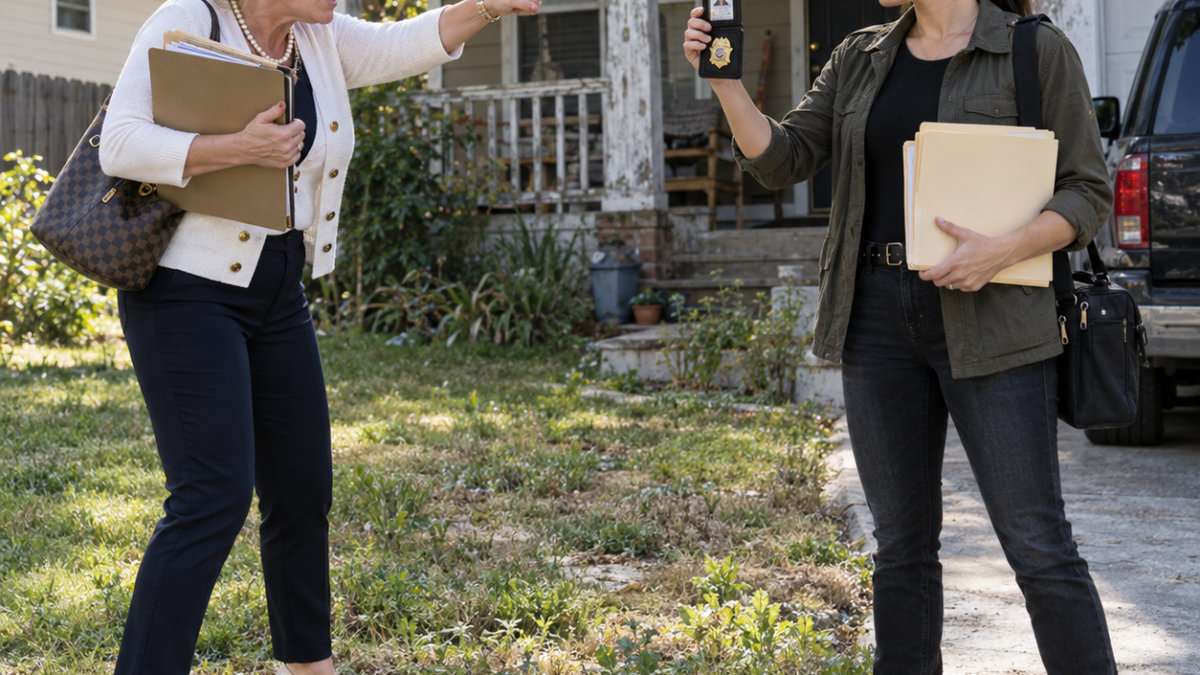
I removed my credentials.
Opened them.
“Special Agent Mark Serrano.”
Karen stopped breathing for what felt like several seconds.
Her eyes moved from my photograph to the badge.
Back to me.
“No.”
“Yes.”
“What is this?”
The investigator beside me stepped forward.
“Karen Thompson?”
She didn’t answer.
“Ma’am, are you Karen Thompson?”
“Yes.”
“We have a warrant to search these premises.”
Karen looked at me.
Then behind us.
Neighbors were beginning to gather on sidewalks.
“You’re police?”
“Federal investigator.”
“You said you were retired Army.”
“I am.”
“You said you were disabled.”
“I never told you my medical status.”
“You lied to me.”
“I was working undercover.”
Her mouth opened.
Closed.
Then opened again.
“My house?”
“The property on Chestnut was acquired for investigative use.”
She gripped the doorframe.
“No.”
“You tried to foreclose on an operational property while it was being used to document the activity we were investigating.”
“You set me up.”
“No.”
Her eyes filled with rage.
“You let the lawn grow!”
“Yes.”
“You broke that shutter!”
“We made the property cosmetically unattractive.”
“You—”
She looked past me toward my house.
“The truck.”
“Mine.”
“The disability pension?”
“I never showed you a pension statement.”
“You made me believe—”
“I allowed you to believe I was vulnerable.”
Her face went pale.
I lowered my voice.
“That was the point.”
Robert Thompson appeared behind her.
“What the hell is happening?”
An investigator looked at the warrant.
“Robert Thompson?”
“Who are you?”
“Sir, we need you to step outside.”
Robert looked at Karen.
Then at me.
He recognized me.
“You’re the loser from down the street.”
I held up the badge.
“Not exactly.”
He stopped.
The prosecutor stepped forward.
The next few minutes moved according to procedure.
Names confirmed.
Warrants presented.
Rights explained.
Karen began demanding an attorney.
Good.
Robert tried insisting Broadleaf was legitimate.
Nobody asked him about Broadleaf.
Also good.
People confess information when they are desperate to explain themselves.
When the cuffs appeared, Karen finally understood the scale of what was happening.
“This is because of the HOA meeting?”
“No.”
“Eleanor did this?”
“No.”
“That old woman has been harassing me for years.”
“Eleanor kept records.”
“She stole confidential documents.”
“No.”
“You don’t know what she did!”
I looked at her.
“I know more about Oakmont Estates than anyone who has ever lived here.”
That silenced her.
The investigators cuffed Robert.
Karen stared at me.
“All those times you were standing in your yard…”
“Yes.”
“The cameras.”
“Yes.”
“The foreclosure.”
“Yes.”
“You wanted me to do it.”
That was the first thing she said that morning that deserved a careful answer.
“No.”
She frowned.
“We suspected you might.”
“That’s the same thing.”
“No, Karen.”
I kept my voice quiet.
“You always had the option to follow the rules.”
Her face collapsed slightly.
Not tears.
Recognition.
Every step that had brought her to that porch had required a choice.
Inflate the contract.
Or don’t.
Fine the homeowner.
Or don’t.
Share information with a connected buyer.
Or don’t.
Threaten foreclosure.
Or don’t.
There had never been a moment when I forced her hand.
We simply created a homeowner she believed would be easy to exploit.
She did everything else herself.
As investigators led her toward the car, neighbors gathered.
Nobody cheered.
I was glad.
This wasn’t entertainment.
Families had lost homes.
Retirement money had disappeared.
People had spent years afraid of letters arriving in their mailboxes.
Eleanor stood across the street in a pale blue robe.
She stared at my suit.
Then at the badge still in my hand.
Her mouth opened.
I walked toward her after Karen was placed in the vehicle.
“You.”
I nodded.
“You lied to me.”
“Yes.”
“You’re not a broke veteran.”
“Definitely a veteran.”
“But not broke.”
“That depends on how you define federal salary.”
She stared.
Then slapped my arm.
Harder than I expected.
“Ow.”
“I gave you cookies.”
“I brought the first cookies.”
“Terrible cookies.”
“Agreed.”
Her eyes filled.
The humor disappeared.
“Was it you?”
“What?”
“The letters.”
“No.”
She looked frightened.
“How did you find me?”
“We followed the evidence.”
“My letters mattered?”
“More than you know.”
She covered her mouth.
I lowered my voice.
“Eleanor, you started this.”
“No.”
“You noticed what everyone else had been trained not to notice.”
“I only wrote what I saw.”
“That’s exactly how cases begin.”
Her shoulders trembled.
“For years she made me feel crazy.”
“You weren’t.”
“She told people I was senile.”
“I know.”
“She said I was bitter because Harold died.”
I didn’t know that part.
Anger rose.
Then Evans’s voice lived in my head.
Evidence.
Not hatred.
I said, “Your records were better than some professional audit files I’ve seen.”
Eleanor laughed through tears.
“That is the nicest thing anyone has said to me in years.”
Search teams spent most of the day inside Karen’s house and the HOA office.
Computers.
Phones.
External drives.
Bank records.
Property files.
Vendor contracts.
Boxes.
One discovery changed the case completely.
Inside Karen’s home office, investigators found a folder labeled ACQUISITION OPPORTUNITIES.
The title alone was ugly.
The contents were worse.
Addresses.
Estimated equity.
Age of owners.
Known family circumstances.
Mortgage status.
Compliance history.
Notes.
Givens property:
ELDERLY. HEALTH ISSUES. PRESSURE VIA MAINTENANCE.
Bowman:
WIDOW. ROOF. LIMITED CASH.
Price:
STUBBORN BUT LOW LIQUIDITY. ESCALATE LEGAL.
Then my address.
SERRANO.
VET. FIXED INCOME. NO FAMILY OBSERVED. EASY TARGET.
I stared at those words.
Easy target.
That was the intent prosecutors had wanted.
Not an inference.
Not a theory.
Karen had written it.
Beside several properties were numbers estimating acquisition price and resale value.
Broadleaf wasn’t merely buying distressed properties.
The evidence indicated they were identifying desirable homes, using HOA pressure to increase distress, then positioning an affiliated buyer to capitalize.
The investigation expanded.
Former residents were contacted.
Theresa Bowman cried when an investigator told her why they were calling.
Arthur Givens had died six months earlier.
His wife May lived with her daughter in Arizona.
When she learned the government was reviewing the sale, she reportedly said only:
“I knew something wasn’t right.”
That sentence hurt more than anger would have.
Victims often know.
They just can’t prove it.
The forensic audit ordered by Eleanor’s interim board began at the same time.
For once, law enforcement and residents were working from opposite ends of the same problem.
We examined crime.
They examined governance.
The numbers converged.
Nearly half a million dollars in questionable or diverted HOA spending over five years.
Payments to Prestige Patio and Lawn.
Payments to Oakmont Management Solutions.
Duplicate charges.
Phantom projects.
Personal expenses disguised through vendors.
Renovation materials that never appeared on community property.
Credit card charges unrelated to HOA business.
Vehicle expenses.
Travel.
Home-improvement purchases.
The worst part was how ordinary the theft looked.
No suitcase full of cash.
No secret vault.
Just invoices.
Checks.
Retainers.
Reimbursements.
Ten thousand here.
Five thousand there.
A thousand small decisions nobody questioned because Karen made questioning painful.
People imagine corruption announces itself dramatically.
Most of the time it hides inside boredom.
That was Karen’s real protection.
She counted on nobody wanting to read page forty-seven of a financial packet.
She had not counted on Eleanor Vance.
The state placed the association under temporary independent administration while the criminal case developed and a new permanent board was elected.
First action:
All pending foreclosures initiated under Karen’s administration were frozen for review.
Second:
Disputed liens were examined.
Third:
Connected-vendor contracts were terminated.
Fourth:
Residents received detailed explanations of every step.
That last one mattered almost as much as the money.
Transparency sounds boring until you’ve lived without it.
Then it feels like oxygen.
For weeks I remained in the operation house.
My cover was blown, so the peeling door no longer served a purpose.
One Saturday morning, I started scraping it properly.
Eleanor walked over carrying lemonade.
“You’re finally fixing that disgrace?”
“I’ve been shamed.”
“About time.”
She watched me paint.
“Wrong shade.”
I froze.
She waited.
Then burst out laughing.
I pointed the brush at her.
“That wasn’t funny.”
“It was extremely funny.”
“You’re enjoying power already.”
“I learned from the best.”
“That worries me.”
She sat on the porch step.
For a few minutes we said nothing.
Then she asked, “Will Karen go to prison?”
“Possibly.”
“That means you don’t know.”
“Correct.”
“Do you think she deserves to?”
I looked at the paintbrush.
“As an investigator, I don’t decide that.”
“I’m not asking the investigator.”
I sat beside her.
“I think people deserve consequences proportionate to what they did.”
“Lawyer answer.”
“Agent answer.”
She nodded.
“I wanted revenge for a while.”
“I know.”
“How?”
“You kept the roof letter in a plastic sleeve.”
She frowned.
“What does that prove?”
“Nothing. But you glared at it every time you opened the binder.”
She laughed softly.
Then her expression changed.
“After Harold died, I thought the worst thing that could happen to me had already happened.”
I listened.
“Then Karen started sending those letters.”
She looked across the street.
“People would say, ‘It’s only an HOA fine.’ But when you’re alone, every certified envelope feels enormous.”
Her hands tightened around the lemonade glass.
“I stopped inviting friends because I worried their cars would cause trouble. I stopped putting things in the yard Harold loved. I replaced a bird feeder because Karen said it was too tall.”
“Why didn’t you move?”
“Because Harold planted those roses.”
I followed her gaze.
Her garden was visible at the end of the street.
Red.
Pink.
Yellow.
A living memory.
“She almost made me leave the last place I still felt close to him.”
I didn’t have an answer.
So I didn’t manufacture one.
After a while she said, “That’s what I want the new board to understand.”
“What?”
“A violation isn’t just paper.”
I nodded.
“It lands in someone’s life.”
“Yes.”
We finished the lemonade.
Then I painted the door.
The criminal case moved faster than many white-collar cases because the evidence was unusually complete.
Financial records.
Surveillance.
Property documents.
Vendor connections.
Broadleaf acquisitions.
Karen’s notes.
Electronic messages recovered from devices.
Cooperating witnesses.
Bank transfers.
Even her public behavior helped establish the enforcement culture residents described.
Karen’s attorney challenged portions of the case.
That was his job.
Robert’s attorney tried distancing him from HOA operations.
The financial records made that difficult.
Two former board members obtained separate counsel.
One cooperated quickly.
The other waited until prosecutors confronted him with signatures approving payments to Karen-connected vendors.
Then he cooperated too.
Nobody remained loyal once loyalty carried personal consequences.
That didn’t surprise me.
Systems built on fear do not produce real loyalty.
Only temporary obedience.
Karen held out the longest.
Through counsel, she initially insisted every vendor arrangement benefited the association.
Every enforcement action was legitimate.
Every property sale was voluntary.
Every transfer had innocent explanations.
Then discovery began.
Her own acquisition notes surfaced.
Broadleaf communications.
Payments.
Internal messages.
The story became harder to maintain.
Eventually, plea negotiations began.
I was not present when Karen entered her final plea.
I watched from the rear of the courtroom.
Not because I needed revenge.
Because cases should end where investigators can see what their work became.
Karen looked different.
No floral dresses.
No oversized sunglasses.
No gavel.
No golf cart.
Gray suit.
Hair pulled back.
Attorney beside her.
The prosecutor described the scheme.
Money diverted.
Conflicts concealed.
Residents targeted.
Properties acquired.
Restitution.
Mail and wire communications.
Karen stood quietly.
When the judge asked whether she understood the agreement, she said yes.
When asked whether anyone had forced her to plead, she said no.
That mattered to me.
No undercover agent forced her.
No resident forced her.
No prosecutor forced her.
Choices.
Again.
Always choices.
Karen ultimately received a five-year federal sentence under the negotiated disposition reflected in the case.
Robert and the other participants received lesser sentences and financial penalties based on their roles and cooperation.
Restitution orders reached into the hundreds of thousands.
Assets were pursued.
Connected contracts were voided.
Improper liens were released.
Former residents received notices that their cases were being reviewed for potential recovery.
Money never repairs everything.
It did not give May Givens the final year she might have spent peacefully with her husband in their house.
It did not return Theresa Bowman’s home.
It did not erase years of fear from Eleanor.
But consequences mattered.
Acknowledgment mattered.
For the first time, official documents said what the residents had been trying to say for years.
Something had been done to them.
They had not imagined it.
They had not failed.
They had been targeted.
Oakmont’s permanent board election happened three months later.
The community center was packed again.
This time there was no screaming.
No gavel slamming.
No security.
No fear.
Eleanor stood at the podium.
She had resisted running for president.
Then almost everyone nominated her.
“Apparently,” she told me, “retirement was too peaceful.”
Her platform was the most Eleanor thing imaginable.
Monthly financial statements.
Competitive bidding.
Conflict disclosures.
Open minutes.
Independent annual review.
Clear fine schedules.
Mandatory appeal rights.
No surprise assessments without documented votes.
And what she called the “Human Being Rule.”
That wasn’t its official name.
But everybody called it that.
Before severe enforcement action, the board had to offer direct communication and a reasonable opportunity to resolve the problem.
Especially where age, illness, disability, bereavement, or temporary hardship might be involved.
Not exemption from reasonable rules.
Basic humanity.
Minh joined the board.
So did Patricia.
Daniel volunteered on the recreation committee.
Amy took over events.
Her children’s blue swing set stayed exactly where it was.
At the first permanent board meeting, Minh parked his work van in the lot.
Nobody photographed it.
He took a picture himself and sent it to me.
I saved it.
The landscaping contract went out for competitive bids.
Prestige Patio and Lawn didn’t submit one.
Oakmont Management Solutions disappeared almost immediately after prosecutors became involved.
The community website received an actual redesign.
For less than one-third of what Karen’s board had supposedly paid.
And Eleanor’s roses?
The new landscaping standards specifically allowed existing mature gardens unless they created an objective safety problem.
At the meeting where that passed, Eleanor looked at me.
“Do you think that’s too self-serving?”
“Yes.”
Her face fell.
I continued.
“You should add a clause requiring every resident to maintain at least twelve rose bushes.”
She kicked my shoe under the table.
The neighborhood laughed.
Months earlier, nobody laughed in HOA meetings.
That might have been the biggest improvement of all.
My operation officially ended shortly after sentencing.
The house on Chestnut Drive would be sold.
Not through Broadleaf.
Through an ordinary open-market process.
I packed the surveillance equipment first.
Cameras.
Recorders.
Encrypted storage.
Monitors.
Then the staged furniture.
The rooms slowly became what Karen had always believed they were.
Empty.
On my final afternoon, I found the original foreclosure notice at the bottom of a file box.
YOUR PROPERTY IS A BLIGHT ON THIS COMMUNITY.
Thirty days to vacate.
I stood in the kitchen holding it.
For six months, Karen had believed that paper represented power.
It didn’t.
It represented evidence.
There was a knock.
Eleanor.
Of course.
She held a covered plate.
“If those are grocery-store cookies, I’m calling the authorities.”
“They’re homemade.”
“Then I’ll allow entry.”
She came inside.
Looked around.
“So this was all government equipment?”
“Most of it.”
“The ugly couch?”
“Government issue.”
“You’re joking.”
“Yes.”
She placed the cookies on the counter.
“What happens to the house?”
“Sold.”
“To who?”
“Whoever buys it.”
“Can the HOA reject them?”
I gave her a look.
She laughed.
“Kidding.”
We walked outside.
The front door was painted now.
The shutter straight.
Lawn cut.
No clover.
Karen would have approved.
That annoyed me slightly.
Eleanor noticed.
“You should leave one weed.”
“For historical accuracy?”
“For character.”
I looked down.
A tiny dandelion grew beside the walkway.
I left it.
We sat on the porch.
Same porch where Karen had handed me the foreclosure notice.
“Did you know from the beginning she’d come after this house?” Eleanor asked.
“We thought she might.”
“Why?”
“Property profile.”
“Large lot?”
“Yes.”
“Cosmetically weak?”
“Yes.”
“Owner apparently vulnerable?”
“Yes.”
She looked down the street.
“So you made yourself look like prey.”
“That’s one way to say it.”
“Did that bother you?”
I thought.
“More than I expected.”
“Why?”
“Because people treated me differently.”
“Karen?”
“Not just Karen.”
Some neighbors had avoided me initially.
Others gave polite smiles but never approached.
The man with the neglected property.
The old truck.
The veteran who seemed like he might be struggling.
Then, once people discovered the badge, some treated me like an entirely different human being.
Same face.
Same history.
Different perceived status.
“That was useful too,” I said.
“For the investigation?”
“For me.”
Eleanor waited.
“It reminded me how easy it is to respect people after learning they have power.”
She nodded slowly.
“And how much more important it is before.”
“Exactly.”
She reached for a cookie.
“So what’s next?”
“Another case.”
“Another HOA?”
“I hope not.”
“Scared?”
“Deeply.”
She smiled.
Then became serious.
“Will you ever tell people about this?”
“Parts eventually become public.”
“That’s not what I mean.”
“What do you mean?”
“Will you remember us?”
I looked at her.
“Eleanor, you kept five years of invoices in alphabetical order.”
“Chronological within category.”
“Exactly. You’re impossible to forget.”
Her eyes filled again.
She looked away.
We sat quietly.
Kids rode bicycles past.
Minh’s van turned onto the street.
He waved.
Daniel’s daughter ran through a sprinkler in the front yard.
Too loud by Karen’s old standards.
Nobody cared.
Oakmont did not look dramatically different.
Same houses.
Same sidewalks.
Same entrance sign.
Same sad petunias planted years earlier by Prestige Patio.
But the atmosphere had changed.
People stood in driveways talking.
Garage doors stayed open.
Children’s toys remained visible.
Residents stopped scanning the street whenever a golf cart approached.
Fear leaves physical habits behind.
It takes time for the body to understand the threat is gone.
Eleanor suddenly said, “I’m replacing those petunias.”
“Presidential abuse of authority.”
“I’m putting it to a vote.”
“What with?”
“Native flowers.”
“Financially responsible?”
“Three bids.”
“Conflict disclosure?”
“My niece hates gardening.”
“Acceptable.”
She laughed.
I checked my watch.
I needed to leave.
Eleanor stood with me.
At the walkway, she hugged me.
That surprised me.
I hugged her back.
“Thank you,” she whispered.
“You did most of it.”
“That’s not true.”
“Yes, it is.”
She stepped back.
“You were the federal agent.”
“You were the woman who noticed.”
“You had surveillance.”
“You had receipts.”
“You had subpoenas.”
“You had forty years of accounting experience and spite.”
She laughed through tears.
“Spite is underrated.”
“I’m putting that in the report.”
I picked up my final box.
Eleanor walked back toward her house.
Halfway down the sidewalk, she turned.
“Mark?”
“Yeah?”
“I’m glad the house wasn’t really abandoned.”
I looked at the porch.
“So am I.”
Then she went home.
I loaded the box into my truck.
The same old F-150 Karen had cited as a commercial vehicle.
I kept it after the operation.
Partly because it ran well.
Partly because I enjoyed the irony.
As I pulled away, I stopped at the Oakmont entrance.
The sign still read:
WELCOME TO OAKMONT ESTATES
A COMMUNITY OF EXCELLENCE
For years, Karen had thought excellence meant uniformity.
Perfect lawns.
Approved colors.
Quiet compliance.
No dissent.
No inconvenient questions.
But communities are not excellent because every mailbox matches.
They become worth living in when the powerful are accountable to the people around them.
When an elderly widow can ask where her money went without being punished.
When a tradesman can earn a living without being harassed.
When children can play.
When rules solve problems instead of creating victims.
When a resident who receives a frightening letter knows the board will hear him before threatening his home.
And when people understand that silence is not the same thing as peace.
I drove through the gate.
In my mirror, Oakmont grew smaller.
A month later, Eleanor sent me a photograph.
The sad petunias were gone.
In their place were native flowers.
Purple.
Yellow.
White.
Below them, the entrance sign had been cleaned.
Her message read:
THREE BIDS. UNANIMOUS VOTE. EVERYTHING DOCUMENTED. HAPPY NOW?
I replied:
NEED RECEIPTS.
Thirty seconds later, she sent photographs of every invoice.
Of course she did.
I laughed alone in my office.
Then another message appeared.
One more thing.
A photograph loaded.
The old operation house.
Sold.
In front stood a young couple with two children and a golden retriever.
A SOLD sign leaned against the mailbox.
The little girl was holding a piece of chalk.
On the driveway behind her, she had drawn an enormous blue sun.
Eleanor’s message beneath the photograph said:
New family moved into your “abandoned property.” The children are already violating at least twelve of Karen’s imaginary rules.
I stared at the image longer than I expected.
That house had been a tool.
A surveillance platform.
Bait.
Evidence.
For me, it had never really been home.
But now someone was going to build a life there.
Birthdays.
Arguments.
Christmas mornings.
Homework at the kitchen table.
Dogs scratching the floor.
Maybe a teenager learning to drive.
Ordinary things.
The exact things corruption had stolen from other families.
I typed:
Tell them the crooked shutter was historically significant.
Eleanor replied:
I told them the federal government finally fixed it.
Fair.
Years later, when people asked about the Oakmont case, they usually wanted to hear about the morning Karen saw my badge.
That was the dramatic part.
The moment the woman who had spent years frightening everyone else finally understood she had targeted the wrong house.
But that was never my favorite part.
My favorite part happened before the badge.
Before the warrants.
Before anyone knew who I was.
It was Eleanor standing in that crowded community center with a microphone in her hand.
Her voice shaking at first.
Karen ordering her to sit down.
And Eleanor staying on her feet.
That was the real turning point.
Because government investigations can punish corruption.
Courts can impose sentences.
Auditors can recover money.
But none of those things can permanently protect a community if residents surrender their voices again the moment officials leave.
Oakmont saved itself when ordinary people stopped waiting for somebody more powerful to rescue them.
An elderly accountant kept records.
A young family signed a petition.
An electrician learned the bylaws.
Neighbors showed up.
People who had spent years whispering finally spoke where Karen could hear them.
My badge came later.
And maybe that was fitting.
Karen’s greatest mistake was never foreclosing on federal property.
It wasn’t even underestimating an undercover agent.
Her greatest mistake was believing everyone she targeted was weak simply because they were quiet.
She mistook Eleanor’s grief for helplessness.
Minh’s politeness for submission.
Amy and Daniel’s financial pressure for surrender.
My silence for fear.
And an entire neighborhood’s patience for permission.
She was wrong about all of us.
The last time I spoke to Eleanor about the case, she told me something I wrote down afterward.
“Karen spent years teaching us to be afraid of getting letters from the HOA,” she said. “You know what changed everything?”
“What?”
“We finally sent one back.”
That was Eleanor.
Simple.
Precise.
True.
Karen had arrived on my porch carrying a foreclosure notice like a weapon.
She believed she was giving a powerless man thirty days to disappear.
Instead, she delivered the document that helped connect her harassment operation to the property scheme investigators had been trying to prove.
She thought she was closing a trap around me.
She never realized she was standing inside one.
And when that thirty-day clock finally expired, I wasn’t the person leaving Oakmont in disgrace.
She was.
Not because I destroyed her.
Not because the residents took revenge.
Because eventually the paperwork she had used to frighten everyone else told the truth about her.
Every fine.
Every invoice.
Every transfer.
Every threatening letter.
Every targeted address.
Every signature.
Every lie.
All of it remained after her authority was gone.
That is the dangerous thing about people who believe power makes them untouchable.
They stop imagining anyone will ever examine the record.
Karen Thompson built her little kingdom out of paper.
In the end, paper was exactly what brought it down.
And the “abandoned” house she thought would become her easiest conquest became the one address she should have left alone.