PART 2: HOA Karen Towed My Trailer With My $250,000 Champion Bull Inside—Then the State Brand Inspector Arrived With the Evidence That Destroyed Her
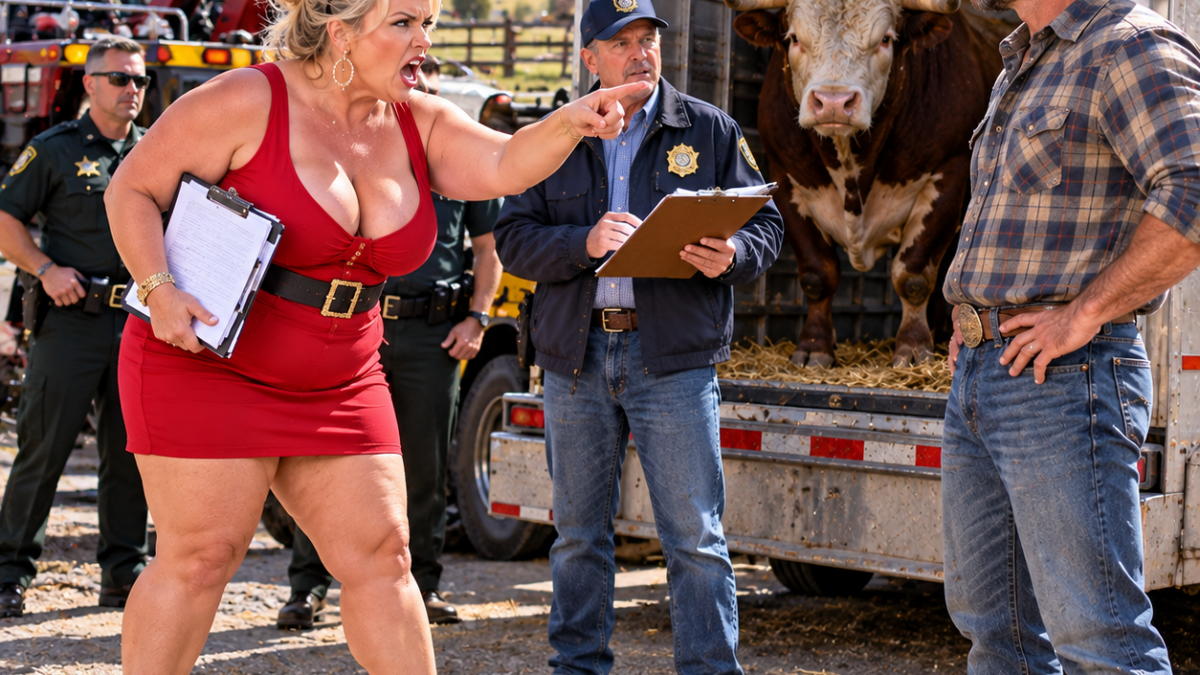
PART 2
“No,” I said. “Absolutely not. Atlas isn’t for sale, and I haven’t authorized anybody to move him except my daughter and me.”
There was a brief silence on the other end of the phone. I could hear papers moving and another person speaking somewhere behind Inspector Bennett.
“Mr. Sterling, I need you to remain calm. We have a situation involving a livestock trailer that was presented for transfer through a commercial holding yard about thirty miles east of your property. The paperwork lists a Hereford bull as part of an abandoned-property disposal.”
My stomach dropped.
“Abandoned-property disposal?”
“Yes, sir.”
“Inspector, my daughter loaded that bull into our trailer less than two hours ago. We’re supposed to be leaving for a breeding evaluation. There’s nothing abandoned about him.”
“I understand. That’s why I’m calling. The identification information provided doesn’t match a lawful transfer from the registered owner. Your ranch brand appears in our records, and the documents raised concerns.”
Grace was standing close enough to hear every word. Her face had gone pale, and she pressed both hands against her mouth.
“Where is he?” I demanded. “Please tell me where my bull is.”
“We’re establishing his exact location. I need your registration certificate, ownership documents, recent photographs, and any veterinary records you can provide.”
“I have everything.”
“Good. A sheriff’s deputy is being assigned to the case. Do not go to the holding yard alone.”
That last sentence frightened me more than anything else she had said.
I had spent twenty-two years in the Marine Corps. I’d seen people injured because somebody made a careless decision and others hurt because somebody made a deliberately cruel one. I knew how to function under pressure. I knew how to listen when every instinct in my body was screaming at me to move.
But Atlas wasn’t a truck, a tractor, or a piece of construction equipment.
He was a living animal.
He could panic.
He could injure himself against a trailer partition.
He could become dangerously overheated if somebody left him standing inside an enclosed trailer in the afternoon sun.
And nobody at that holding yard knew him.
Nobody knew that he disliked sudden movements around his head or that his left hind leg sometimes stiffened after a long journey. Nobody knew that when he got nervous, he responded best to Grace’s voice.
I looked at my daughter.
She was shaking.
“Dad,” she whispered, “what if they try to unload him?”
I put my arm around her shoulders.
“We’re going to find him.”
“What if he gets hurt?”
I wanted to tell her nothing bad would happen. I wanted to promise we’d have Atlas home before lunch, standing in his familiar pen with a clean bucket of water and a pile of hay.
But I’d spent too many years learning that a promise means nothing unless you can keep it.
So I told her the only thing I knew was true.
“We’re not going to stop until he’s home.”
The first sheriff’s cruiser arrived forty minutes later.
Deputy Ryan Mercer stepped out carrying a notebook and a radio. He was a broad-shouldered man in his early thirties, with the patient expression of somebody accustomed to sorting legitimate emergencies from neighbor disputes that had gotten out of hand.
He approached me beside the empty trailer pad.
“Mr. Sterling?”
“Jack Sterling.”
He shook my hand.
“Dispatch says there’s a dispute involving a trailer removed by your homeowners association.”
“There is. But the bigger problem is that a live animal was inside.”
He looked toward the deep tire marks running across my gravel driveway.
“Walk me through what happened.”
I took him to the spot where the trailer had stood.
We had placed it there the previous evening, close to the barn and safely within our marked property boundaries. It was a thirty-two-foot aluminum livestock trailer with a reinforced floor, padded partitions, and a ventilation system specifically designed for transporting valuable breeding animals.
I showed him photographs taken that morning, including one Grace had snapped while I was fastening Atlas’s halter.
The time stamp was visible.
5:47 a.m.
Then I showed him another photograph taken at 6:26.
The trailer was gone.
Deputy Mercer studied both images.
“Who owns the trailer?”
“I do. It’s registered to Sterling Heritage Cattle.”
“And the bull?”
“Also mine. Registered ownership, identification records, and insurance documentation are in the house.”
“What is the animal worth?”
I hesitated.
“Approximately two hundred fifty thousand dollars.”
He looked up.
“Did you say two hundred fifty thousand?”
“Yes.”
He examined my face, apparently trying to determine whether I’d misunderstood his question.
I hadn’t.
I handed him Atlas’s appraisal.
The document identified him as a nationally recognized champion Hereford breeding bull, with a valuation supported by his pedigree, championship results, and contracted breeding interests.
Deputy Mercer studied the paperwork.
Then he looked toward the empty pad again.
“Why would an HOA tow a trailer with a bull that valuable inside?”
I gave a humorless laugh.
“That’s what I’d like to know.”
He took my statement.
I explained the violation notices, Karen’s repeated demands, the forty-eight-hour ultimatum, and her phone call that morning.
I had saved her messages.
I had photographs showing the trailer parked entirely within my property lines.
I had copies of the county agricultural-use approvals.
And I had something else Karen apparently hadn’t considered.
A security camera mounted above my barn door.
Deputy Mercer followed me into the house.
Grace brought up the recording on our computer.
At 6:08 a.m., a flatbed recovery truck entered our driveway.
Karen Miller’s white SUV followed.
Two men got out of the truck.
One inspected the trailer tongue while the other walked around the rear doors.
Karen stood near the gate, holding her familiar leather binder.
At 6:12, one of the men approached the trailer.
He appeared to hear something.
He leaned toward a ventilation opening.
Then stepped back.
The video had no clear audio from that distance, but the image showed him gesturing toward the trailer while speaking to Karen.
She waved her hand dismissively.
Moments later, the men began preparing the trailer for towing.
Deputy Mercer leaned closer to the screen.
“Stop it there.”
Grace paused the recording.
He pointed toward the rear ventilation panel.
“Was the bull inside at that moment?”
“Yes,” I said.
“And the workers knew?”
“I can’t tell you exactly what they knew. But that man looked directly inside.”
The deputy nodded.
“That’s something we’ll need to establish.”
We continued watching.
At 6:19, the truck pulled away with my trailer.
Karen stayed behind long enough to photograph the empty parking area.
Then she drove off.
Deputy Mercer sat back.
For a moment, nobody spoke.
Finally, he said, “Mr. Sterling, this is no longer something I’d describe as a routine HOA disagreement.”
I looked at him.
“It’s been more than that for months.”
Inspector Nora Bennett arrived shortly after nine.
She stepped out of a state vehicle wearing jeans, work boots, and a dark jacket bearing her agency identification.
She was in her forties, with sun-weathered skin and an expression that suggested she had spent much of her career dealing with people who believed livestock laws were optional.
She carried a tablet and a thick folder.
“Jack Sterling?”
“Yes, ma’am.”
“I’m Nora Bennett.”
I shook her hand.
“Please tell me you’ve found Atlas.”
“We’ve located the trailer. We’re working with the sheriff’s office to secure the animal and verify what happened.”
“Where?”
“Red Mesa Agricultural Salvage and Impound, outside Millstone.”
I knew the place.
It wasn’t a legitimate livestock facility in the way I understood the term. It was a sprawling commercial yard that stored abandoned farm machinery, damaged trailers, and vehicles seized under private towing contracts.
I had driven past it once.
The fences were rusty.
The ground was uneven.
There were heaps of metal parts visible from the highway.
It was no place for a quarter-million-dollar breeding animal.
Nora seemed to read my thoughts.
“We’ve requested that nobody move or unload the bull until we arrive and assess the situation.”
Grace stepped forward.
“Is he okay?”
Nora’s expression softened.
“We haven’t had a veterinary examination yet, sweetheart. But we know where the trailer is, and we’re going to get qualified people there.”
Grace swallowed.
“His name is Atlas.”
Nora nodded.
“Then we’re going to find Atlas.”
She asked to see the identification records.
I brought out the folder my father had kept in a fireproof cabinet.
Inside were Atlas’s registration certificate, breeding records, photographs, and documents showing our family’s registered ranch brand.
There was also a record of his ear tattoo and electronic identification.
Nora compared the information to the report she’d received from the holding yard.
Then she frowned.
“Mr. Sterling, there’s something you need to see.”
She turned her tablet toward me.
A scanned document appeared on the screen.
At the top were the words WILLOW CREEK ESTATES HOMEOWNERS ASSOCIATION.
Below that was a description of my trailer.
At the bottom, someone had written:
One abandoned agricultural transport trailer, contents included. Disposal authorized by association president.
The signature was unmistakable.
Karen Miller.
I stared at it.
Then at Nora.
“Contents included?”
She nodded grimly.
“That language is one reason this was flagged.”
I felt something tighten in my chest.
“She’s trying to sell my bull.”
“We’re investigating an attempted transfer and the circumstances surrounding it.”
I looked at Grace.
Tears were streaming down her face.
She had spent three years raising Atlas, training him, preparing him for shows, and caring for him through illnesses and injuries.
Now a woman who had never spent an afternoon in a cattle barn had signed a document treating him like unwanted garbage.
I turned back toward Nora.
“Inspector, whatever paperwork you need, I’ll provide it. Whatever statement you need, I’ll sign it. But I need to get him home.”
She looked at me steadily.
“Then let’s do this properly.”
Before leaving, Nora asked whether we had a livestock veterinarian available.
I called Dr. Emily Shaw.
Emily had been our family veterinarian for nearly ten years. She knew Atlas from the morning he was born, and she knew my daughter well enough to recognize her voice before she finished saying hello.
When I explained what happened, Emily didn’t waste time expressing outrage.
She asked practical questions.
How long had Atlas been inside the trailer?
What was the outside temperature?
Had we loaded water?
Was the ventilation system operating?
Had he shown signs of agitation before the trailer disappeared?
I answered as carefully as I could.
Then she said, “Jack, I’m bringing my mobile equipment and meeting you at the yard. We need to assess him before anybody attempts another transport.”
“Thank you.”
“Don’t thank me yet. Just make sure nobody tries to unload him without proper handling arrangements.”
Grace stood beside me listening.
After the call ended, she spoke quietly.
“Dad, I should’ve stayed with him.”
I turned toward her.
“No.”
“If I’d stayed outside, they wouldn’t have taken him.”
“Grace.”
She looked down.
I placed both hands on her shoulders.
“You went into the house to get the registration folder. You were doing exactly what I asked.”
“But—”
“The person responsible for this is the person who ordered a trailer removed without permission or regard for what was inside.”
She began crying again.
I pulled her into my arms.
For a moment, she was nine years old, standing beside me after her mother died, asking questions I had no answers for.
I had promised myself then that I would never allow grief to make me disappear from my daughter’s life.
And yet, standing in that kitchen, I felt just as helpless as I had eight years earlier.
I held her tighter.
“We’re going to bring him home.”
The drive to Millstone took forty-seven minutes.
Deputy Mercer went ahead with another sheriff’s vehicle.
Nora followed in her state truck.
I drove behind them with Grace beside me.
Emily was coming separately.
We traveled through open country, past cattle pastures, hay fields, and long stretches of highway bordered by cottonwood trees.
Normally, I loved that drive.
It reminded me why I’d returned to Colorado after leaving the Marines.
But that morning, I barely noticed the landscape.
I kept imagining Atlas inside that trailer.
He was an enormous animal, but he had always been unusually patient.
When Grace was little, she’d sit outside his pen reading her schoolbooks aloud while he chewed hay.
Sometimes he’d approach the fence and lower his great white face toward her.
She called it his listening face.
My father had laughed the first time he saw it.
“That bull’s going to be smarter than half the men I’ve worked with.”
Grace had grinned.
“He already is, Grandpa.”
Dad had loved Atlas.
Not merely because of his value.
He had spent thirty years selecting breeding lines, studying pedigrees, and working toward the combination of temperament, structural soundness, and performance that Atlas represented.
When Atlas won his first major championship, Dad had stood beside him wearing his old brown felt hat.
I remembered the photograph.
Grace holding the lead rope.
Dad resting one hand against Atlas’s shoulder.
All three of them smiling, at least in the human way.
Six months later, my father was gone.
A heart attack took him while he was repairing a fence.
No warning.
No dramatic goodbye.
Just an ordinary morning that ended with our family changed forever.
Grace hadn’t cried at the funeral until she saw Dad’s empty chair in the barn.
Then she collapsed against me.
Atlas had been standing quietly in his pen, watching us.
Afterward, Grace spent hours with him.
She said being near him made Grandpa feel less far away.
That was why I understood her terror.
The bull was worth a quarter of a million dollars on paper.
But losing him would mean losing something no insurance company could replace.
Red Mesa Agricultural Salvage and Impound sat behind an eight-foot chain-link fence.
Old tractors, damaged trailers, and heaps of scrap metal filled the yard.
A weathered sign hung beside the entrance.
Beyond it, I could see our aluminum livestock trailer parked between a broken grain truck and a stack of rusted fencing panels.
My heart slammed against my ribs.
“There!”
Grace leaned forward.
“Dad, that’s our trailer!”
I pulled into the designated parking area behind the deputy’s vehicle.
Nora was already speaking with a heavyset man wearing a stained ball cap.
He looked angry.
Then he noticed the sheriff’s vehicles and became considerably less confident.
Deputy Mercer approached us.
“Mr. Sterling, stay here for a moment.”
I nodded, though every part of me wanted to run toward the trailer.
Grace grabbed my arm.
“Dad, I can hear him.”
At first, I heard only distant machinery.
Then came a deep, muffled bellow.
Atlas.
My knees nearly gave out.
He was alive.
I closed my eyes for half a second.
Then opened them.
The yard owner began arguing with Nora.
“I bought that trailer fair and square!”
Nora remained calm.
“From whom?”
“The HOA lady.”
“Did she provide evidence that she owned it?”
He gestured toward the paperwork.
“She signed the disposal form.”
“And did she provide ownership documents for the livestock inside?”
He hesitated.
“Well, she said everything was included.”
Nora looked at him.
“You cannot establish lawful ownership of registered cattle by writing ‘contents included’ on a form for abandoned equipment.”
The man’s face darkened.
“I didn’t know it was worth anything.”
“Value isn’t the deciding factor,” she replied. “Ownership is.”
Deputy Mercer stepped forward.
“Sir, we’re investigating the circumstances under which this property was removed and transferred. We need access to the trailer and the associated records.”
The man looked from one official to another.
Then he unlocked the gate.
I will never forget what I saw when we reached Atlas.
The trailer was parked in direct sunlight.
Its side vents were open, but the air inside was warm and stale.
Atlas stood near the forward partition, breathing faster than normal.
His white face was streaked with dust.
He had rubbed one side of his muzzle against the interior wall, leaving a raw-looking patch beneath his halter.
He wasn’t collapsed.
He wasn’t bleeding heavily.
But he was frightened.
And he was thirsty.
Grace stopped beside me.
“Oh, Atlas.”
Her voice broke.
The bull lifted his head.
Then he made a low sound deep in his chest.
Grace started crying.
“That’s my boy.”
Dr. Shaw arrived moments later.
She asked everyone to give the trailer space while she assessed the animal’s condition and made arrangements for safe handling.
I stood beside the door, hands shaking.
Emily checked his breathing, temperature, hydration, and mobility.
She examined the rubbed area on his muzzle.
Then she looked at me.
“He’s stressed, Jack. The heat and transport were not good for him. But at this point, I’m not seeing evidence of a catastrophic injury.”
I swallowed.
“Can we take him home?”
“After we get him cooled down appropriately and confirm he’s stable for transport.”
Grace looked toward Atlas.
“Can I talk to him?”
Emily nodded.
“From a safe position. Keep your voice calm.”
Grace moved beside the trailer.
“Hey, handsome.”
Atlas turned his head.
“It’s me, big guy.”
He gave another quiet bellow.
She smiled through tears.
“I’m right here. We’re going home.”
I had seen my daughter win ribbons in crowded livestock arenas.
I’d watched her work confidently beside animals ten times her weight.
But nothing in those moments compared to seeing her standing outside that trailer, speaking softly to the animal she’d raised from birth.
She wasn’t thinking about awards.
Or money.
Or what Karen had done.
She just wanted her friend safe.
I looked away before she could see me crying.
The next hour passed slowly.
Emily supervised Atlas’s immediate care.
Nora examined the identification marks and compared them against the registration and ownership records.
The sheriff’s deputies photographed the trailer, the gate, the towing equipment, and the documents held by the yard.
The owner, Sal Martino, became increasingly cooperative as he realized the seriousness of the situation.
He provided a handwritten receipt.
It showed a payment of five hundred dollars to Karen Miller for the supposed disposal of one agricultural trailer and its contents.
Five hundred dollars.
I stared at that amount.
Karen had accepted five hundred dollars for property containing a living animal valued at a quarter of a million.
The trailer itself was worth tens of thousands.
But money wasn’t the first thing I thought about.
I thought about Atlas standing inside that metal box while strangers debated whether he belonged to them.
I thought about what might have happened if the yard had tried to unload him with untrained workers.
A frightened bull can injure people and himself in seconds.
We were fortunate the situation hadn’t become a tragedy.
Nora placed the bill of sale into an evidence folder.
“This document is going to need a closer examination.”
Deputy Mercer nodded.
“Along with the HOA’s authorization records.”
Sal looked increasingly nervous.
“I didn’t know she wasn’t the owner.”
The deputy studied him.
“Then we’ll need to establish what you knew, what you were told, and what you did after discovering livestock was inside.”
Sal removed his cap.
For the first time, he looked genuinely frightened.
We brought Atlas home that afternoon using a different, properly prepared livestock trailer.
Emily recommended rest, careful monitoring, and a follow-up examination before returning to our planned breeding schedule.
Grace sat beside me in the truck during the entire drive.
She barely spoke.
Every few minutes, she checked the transport-monitoring display and asked whether Atlas was okay.
When we reached our property, she climbed out before I’d fully finished parking.
The unloading was handled slowly and carefully.
Atlas stepped down the ramp, paused, and looked around.
Then he walked toward the familiar barn.
Grace watched him enter his pen.
Only after he lowered his head toward his water did she finally let out a long, trembling breath.
“He’s home.”
I put my arm around her.
“He’s home.”
She turned and buried her face against my chest.
I held her while she cried.
Not the frantic tears of the morning.
These were different.
The kind that come when fear finally begins to loosen its grip.
I looked over her shoulder toward the barn.
Atlas stood quietly in the shade.
For that moment, the championship ribbons, breeding contracts, and quarter-million-dollar valuation meant absolutely nothing.
All that mattered was the sound of him breathing.
That evening, I called Karen Miller.
She answered immediately.
“Well, Mr. Sterling, have you finally decided to pay your fines?”
I stood on my porch overlooking the barn.
“Atlas is home.”
There was a pause.
“Good for you.”
“Karen, do you understand what you did?”
“I enforced community standards.”
“You authorized the removal of my trailer with a live animal inside.”
“I didn’t know there was an animal in it.”
“The security footage shows your contractor checking the ventilation opening.”
“Then take it up with the contractor.”
“You signed a document transferring the trailer and its contents.”
Her voice sharpened.
“That was standard abandoned-property paperwork.”
“On equipment that was parked on my land and had been loaded less than an hour earlier?”
She became defensive.
“You’ve been violating the covenants for months.”
“Karen, you accepted five hundred dollars for property you didn’t own.”
Silence.
Then she said, “That money was for the community beautification fund.”
I looked at the barn.
My daughter was sitting beside Atlas’s pen.
“Listen carefully. I’ve provided the sheriff’s office and the state brand inspector with the documentation. From now on, any communication about this goes through my attorney.”
She laughed bitterly.
“Are you threatening me?”
“No.”
I paused.
“I’m giving you notice that this is no longer something you get to settle with a violation letter.”
I ended the call.
Then I sat down.
For several minutes, I stared at the mountains.
The anger was still there.
But underneath it was something colder.
A determination I hadn’t felt since leaving the Marines.
Karen had nearly cost us a living animal entrusted to our care.
She was going to face the consequences of that decision.
And I was going to make sure the people who had enabled her understood exactly what had happened.
The next morning, I contacted our livestock insurer.
The claims representative listened carefully as I explained the unauthorized transport, potential injuries, and veterinary treatment.
Then I sent her the registration documents, appraisal, photographs, and preliminary veterinary report.
Her reaction was immediate.
“Mr. Sterling, given the animal’s insured value and the circumstances, we’ll need a complete investigation.”
“I expected that.”
“We may also need an independent veterinary assessment and documentation of any effect on the bull’s future breeding performance.”
I understood.
Atlas’s value wasn’t merely what someone might pay for him at an auction.
His breeding record and future contracts were part of the calculation.
If the incident affected his health or reproductive soundness, the financial consequences could be substantial.
That afternoon, a representative from the insurer called again.
“Mr. Sterling, we’ve also been informed that the trailer was transferred under a document signed by the HOA president.”
“Yes.”
“Did you authorize any such transaction?”
“No.”
“Then we’ll need copies of all related records.”
I sent everything.
The insurance investigation was another layer Karen hadn’t anticipated.
She’d assumed she could order a tow, collect a small fee, and declare victory.
Instead, her actions had drawn attention from law enforcement, livestock regulators, insurance investigators, and attorneys.
But I wasn’t celebrating yet.
Atlas still needed to recover.
And the emotional damage to Grace wasn’t going to disappear because we’d brought him home.
Three nights after the incident, I found Grace sitting in the barn.
It was almost midnight.
A single light glowed above Atlas’s pen.
He was lying quietly on clean bedding.
Grace sat on an overturned bucket, holding her grandfather’s old leather work gloves.
I stepped inside.
“Sweetheart?”
She looked up.
“Couldn’t sleep.”
I sat beside her.
For a while, we listened to the sounds of the barn.
The movement of cattle.
The quiet hum of the ventilation fans.
The occasional rustle of straw.
Finally, Grace spoke.
“Dad, do you remember when Grandpa said Atlas would be the one?”
I smiled faintly.
“He said that about a lot of calves.”
“Not like this.”
I looked toward the bull.
She was right.
Dad had recognized something special in Atlas from the beginning.
He’d spent years searching for the right bloodline combination, and when the calf arrived, he acted as though he’d been handed a winning lottery ticket.
Grace ran her fingers over the worn gloves.
“He promised he’d take me to the national show when Atlas was ready.”
I swallowed.
“I remember.”
“And then he died.”
I nodded.
She stared at the floor.
“When they took Atlas, I thought I was losing Grandpa all over again.”
The words struck me harder than I expected.
I reached for her hand.
“Grace, your grandfather isn’t inside that bull.”
“I know.”
“He’s in everything he taught you.”
She looked at me.
“The way you handle cattle. The way you treat people. The way you refuse to give up when something matters.”
Her eyes filled.
“Atlas is part of his legacy. But so are you.”
She leaned against my shoulder.
We sat there until the clock passed one.
And for the first time since the towing, I understood exactly what Karen had stolen from my daughter that morning.
Not just a few hours of peace.
Her sense that the things she loved were safe.
That was something I intended to help her rebuild.
The HOA’s public response came the following afternoon.
Karen posted a statement on the neighborhood’s private online group.
It described me as a hostile property owner who had refused to comply with reasonable standards.
It claimed the association had lawfully removed an abandoned commercial trailer and that I was now attempting to intimidate the board through exaggerated allegations.
The statement didn’t mention Atlas by name.
It didn’t mention his value.
It didn’t mention the brand inspector.
And it certainly didn’t mention the five-hundred-dollar bill of sale.
Instead, Karen wrote that the HOA would not be bullied by individuals who believed agricultural operations placed them above community rules.
The comments initially supported her.
Several newer residents thanked her for protecting property values.
One person wrote that farm equipment didn’t belong in a residential development.
Another suggested I should move farther into the country.
Then David Garcia asked a question.
David lived two doors down from my property. He worked in information technology and had always struck me as a thoughtful man who preferred repairing his son’s bicycle to attending neighborhood arguments.
His comment was simple.
Was there a live animal inside the trailer when it was removed?
Karen deleted it.
Then another neighbor asked whether the board had approved the towing.
That comment disappeared too.
Within an hour, several residents had been blocked from posting.
David took screenshots before the messages vanished.
That evening, he knocked on my door.
He wasn’t alone.
Beside him stood an elderly gentleman with a cane and a weathered straw hat.
“Mr. Sterling?” David asked.
“Jack. Please.”
He nodded.
“I’m David Garcia, and this is Robert Henderson.”
I invited them inside.
Robert moved slowly, but there was nothing uncertain about his expression.
“I heard what happened to your bull,” he said.
“Thank you.”
“Is he all right?”
“Recovering.”
The old man nodded.
“Good.”
Then he looked me directly in the eye.
“Because that woman has been getting away with hurting people for far too long.”
Robert Henderson had lived in Willow Creek Estates for seventeen years.
He was a retired botanist.
His wife, Margaret, had died five years earlier.
Before she passed, the two of them had cultivated a rose garden beside their porch.
Fifty-three varieties.
Some common.
Some rare.
Several grown from cuttings Margaret had brought home from gardens they’d visited during their travels.
Robert described the garden quietly.
Not like a hobby.
Like a place filled with memories.
“Margaret loved yellow roses,” he said. “Especially the pale ones. She said they made the whole garden look like morning sunshine.”
Two years earlier, Karen had declared that certain flower colors violated the association’s approved landscaping palette.
Robert had argued.
He’d shown her the original landscaping approval.
She insisted the standards had changed.
When he refused to remove the roses, the HOA assessed fines.
Eventually, contractors entered his property and tore out much of the bed.
He showed me photographs.
Before.
After.
The difference was devastating.
An entire section of carefully cultivated roses had become bare dirt.
“I couldn’t afford a lawyer,” Robert admitted. “I’m on a fixed income. I paid what I had to pay and tried to move on.”
His voice trembled.
“But Margaret planted those flowers.”
I looked at the photographs.
For the first time, I understood that Karen’s cruelty didn’t begin with my trailer.
She had been treating other people’s memories as disposable for years.
David told me his own story.
His son, Daniel, had received a portable basketball hoop for his birthday.
The boy practiced every evening after school.
One day, the family forgot to move the hoop behind the fence before the HOA’s designated storage time.
Karen imposed a five-hundred-dollar fine.
David paid it to avoid a prolonged dispute.
But the resentment remained.
“She made my son feel like he’d done something shameful,” David said.
He looked toward the window.
“It’s a basketball hoop, Jack. He’s twelve.”
I shook my head.
“What do you want from me?”
David placed a laptop on the table.
“We want to help.”
For years, David had been collecting copies of violation emails sent by neighbors who asked him for technical assistance.
Some wanted help opening attachments.
Others wanted to know whether a message looked legitimate.
Over time, he’d accumulated dozens of notices.
When he began reviewing them, a pattern emerged.
Karen frequently relied on vague language.
Community harmony.
Visual compatibility.
Property-value preservation.
Conduct detrimental to neighborhood appearance.
The same phrases appeared again and again.
Robert had his own collection.
Photographs.
Receipts.
Letters.
Names of neighbors who had experienced similar treatment.
Together, they represented years of grievances that had never been examined as a whole.
I listened carefully.
Then I told them about the sheriff’s investigation, the brand inspection records, and the signed transfer document.
David stared at me.
“She sold your trailer?”
“She signed a document transferring it for five hundred dollars.”
“With the bull inside?”
“Yes.”
He leaned back in his chair.
“That’s unbelievable.”
Robert’s face tightened.
“It’s exactly what she did to my roses. She decided she didn’t like something, and suddenly she thought she had the right to destroy it.”
I looked at both men.
“I’m willing to fight for my property. But I don’t want this turning into a neighborhood war.”
David nodded.
“Neither do we.”
He opened his laptop.
“We want the rules to mean something again.”
I considered that.
Then I offered to help organize the records.
Not rumors.
Not accusations based on gossip.
Documents.
Dates.
Payments.
Photographs.
Statements from people willing to speak.
If the board had been abusing its authority, the evidence would show it.
And if Karen had acted alone, the other board members deserved to know before her decisions exposed the entire association to serious liability.
My attorney was named Claire Donovan.
She specialized in property disputes and commercial litigation, and she had the kind of calm, exacting manner I appreciated.
When she first reviewed the case, she didn’t make promises about spectacular courtroom victories.
She asked questions.
Who owned the trailer?
Where had it been parked?
What did the HOA covenants actually say?
Had a violation notice been issued?
Was the towing authorized by a board vote?
Who signed the disposal agreement?
What did the towing company know about the animal?
How had the holding yard obtained possession?
Then she requested every document we had.
By the following afternoon, my kitchen table looked like a military planning station.
The land deed.
County permits.
HOA covenants.
Livestock registration.
Insurance appraisal.
Veterinary reports.
Security footage.
Tow-yard records.
State brand inspection documents.
Claire studied the files.
Then she looked at me.
“Jack, there are several serious issues here.”
I nodded.
“Go on.”
“First, whether the association had any authority to enter your property and remove the trailer.”
“Second?”
“Whether the required notice and enforcement procedures were followed.”
She turned another page.
“Third, the transfer of property that the HOA did not own, including registered livestock.”
“And the bull’s value?”
“That affects potential damages, but the absence of authority would matter even if Atlas were worth a thousand dollars.”
I appreciated that answer.
Karen had acted as though the worth of my property depended on her opinion of its appearance.
Claire understood that ownership wasn’t determined by somebody else’s taste.
She continued.
“We also need to examine potential responsibility among the HOA, its president, the towing company, and the receiving yard.”
I leaned forward.
“What happens next?”
“We preserve the evidence. We demand records. We coordinate with the criminal investigation without interfering. And we make sure the association understands the legal exposure created by this incident.”
She paused.
“Jack, I want you to promise me something.”
“What?”
“Don’t threaten Karen. Don’t confront the towing company. Don’t make public accusations beyond what the evidence supports.”
I nodded.
“Understood.”
She closed the folder.
“Good. Because right now, the documents are doing more damage to her position than any angry speech you could make.”
Claire’s first formal notice went to every member of the HOA board.
It described the unauthorized removal of the trailer, the livestock transfer paperwork, the reported payment, and the resulting losses and risks.
It demanded preservation of board communications, contractor instructions, financial records, and any documents used to justify the towing.
It also requested confirmation of the board’s authorization.
The letter was professional.
Measured.
Direct.
No insults.
No dramatic threats.
But when I finished reading it, I understood exactly why Claire had chosen that approach.
Every sentence was supported by evidence.
Every request demanded an answer.
And the central question was devastatingly simple.
Who had authorized Karen Miller to take property belonging to someone else?
Three days later, the HOA treasurer called me.
His name was Frank Wallace.
He sounded terrified.
“Mr. Sterling?”
“Speaking.”
“This is Frank. I’m the treasurer of Willow Creek Estates.”
“I know who you are.”
He swallowed.
“I received your attorney’s letter.”
“I assumed you would.”
“Is the value of that bull really two hundred fifty thousand dollars?”
“Yes. The appraisal and insurance records document it.”
There was a long silence.
Then Frank whispered, “Oh, my God.”
I waited.
“Karen told us she was removing an abandoned farm trailer.”
“It wasn’t abandoned.”
“She said the contractor would dispose of it as scrap.”
“That’s not what happened.”
Frank’s breathing grew uneven.
“She never mentioned livestock.”
I looked toward the barn.
“That doesn’t surprise me.”
He lowered his voice.
“Mr. Sterling, she never brought the towing decision to the board.”
That got my attention.
“What?”
“There was no vote. No emergency authorization. Nothing in the minutes.”
I remained silent.
Frank continued.
“She told us afterward that she’d handled a nuisance violation under her executive powers.”
I looked at Claire’s letter on the table.
“Frank, you need to tell your attorney exactly what you just told me.”
He hesitated.
“Am I going to lose my house over this?”
The fear in his voice startled me.
He wasn’t asking about Karen.
He was asking whether her actions could ruin the people she’d claimed to represent.
I thought about Grace.
Atlas.
Robert’s roses.
David’s son.
Then I said, “Frank, my goal is to recover our losses and make sure this never happens again. But your board needs to stop protecting decisions it didn’t authorize.”
He was quiet for a moment.
Then he said, “I’m calling an emergency meeting.”
The board meeting took place at Susan Parker’s house.
I wasn’t invited.
David heard the details from two neighbors who attended as observers during the open portion.
Frank demanded the towing contract.
Karen refused to provide it.
Another board member, Brenda Lewis, asked whether there had been a lawful notice and opportunity to correct the alleged violation.
Karen insisted she’d acted under emergency authority.
Frank asked what the emergency was.
She reportedly answered, “The trailer was destroying our neighborhood’s appearance.”
Brenda stared at her.
“A livestock trailer parked on its owner’s property is an emergency?”
Karen accused her of being disloyal.
Todd Harrison, the board’s real estate adviser, asked whether the association had insurance covering the incident.
Karen said everything was under control.
Then Frank produced Claire’s letter.
He read the financial exposure section aloud.
The veterinary costs.
The trailer recovery and repair costs.
Potential economic losses.
The animal’s documented valuation.
And the possibility of substantial legal expenses.
The room went silent.
Susan began crying.
Todd demanded to see the bill of sale.
Karen claimed she’d misplaced it.
Frank told her the sheriff’s office already had a copy.
That was when the meeting reportedly turned into a shouting match.
Karen accused the board of betraying her.
Frank accused her of acting without authorization.
Brenda demanded that all enforcement activity against my property stop immediately.
Todd threatened to resign unless the association obtained independent counsel.
By the end of the night, the four other board members had voted to suspend Karen’s executive authority pending an investigation.
She was furious.
But for the first time in six years, the board had refused to follow her lead.
Meanwhile, the sheriff’s investigation continued.
Deputy Mercer obtained the towing company’s dispatch records and interviewed the driver.
The driver admitted that he’d heard movement inside the trailer.
He said he had asked Karen whether animals were present.
According to his statement, she insisted the trailer was abandoned and that any contents were covered by the association’s disposal authority.
The company owner initially characterized the incident as a misunderstanding.
That explanation became difficult to maintain when investigators reviewed the security footage.
The driver had inspected the ventilation opening.
He had apparently recognized that something was inside.
And he had proceeded without contacting the registered owner or a livestock professional.
The holding-yard owner provided another statement.
Sal Martino admitted that Karen had signed the disposal document and accepted five hundred dollars.
He also acknowledged that his employees had considered transferring the trailer and its contents through a commercial sale process.
The brand inspector’s intervention prevented that from proceeding.
Claire explained the significance.
“Jack, the evidence isn’t just that the trailer was moved. It’s that someone tried to exercise ownership rights over property they had no apparent right to sell.”
I looked at her.
“And Atlas?”
“The registration and identification records are particularly important. They establish who owned him and help show why the attempted transfer was improper.”
I nodded.
The more I learned, the angrier I became.
Not because Karen had been foolish enough to mistake a valuable bull for ordinary livestock.
Because she had been willing to dispose of a living animal without finding out who cared for him.
Atlas recovered slowly.
Emily returned several times to examine him.
The abrasion on his muzzle healed.
His hydration returned to normal.
His appetite improved.
But he remained unusually sensitive to unfamiliar vehicles for a while.
When a truck came down the driveway, he’d sometimes lift his head sharply and move toward the back of his pen.
Grace noticed every change.
She spent hours working with him at a pace Emily considered appropriate.
She didn’t force him into another trailer.
She didn’t rush his training.
She simply rebuilt his confidence through familiar routines.
Quiet handling.
Regular feeding.
Short, calm sessions.
And a great deal of patience.
One evening, I found her standing beside the fence.
Atlas was resting a few feet away.
She had her grandfather’s old hat tucked under one arm.
“Dad?”
“Yeah?”
“Do you think he’ll ever be comfortable showing again?”
I looked at the bull.
“I think we need to let Emily answer the medical part.”
Grace nodded.
“And the rest?”
I smiled gently.
“The rest, we’ll figure out together.”
She looked toward the barn.
“Grandpa would’ve been so mad.”
I laughed softly.
“He would’ve been furious.”
“Do you think he would’ve yelled at Karen?”
I thought about my father.
He was a stubborn man.
Proud.
Occasionally difficult.
But he believed animals deserved respect and that anger never justified carelessness.
“No,” I said finally. “I think he’d have brought Atlas home first.”
Grace smiled.
“And then?”
“Then he’d have made sure everybody responsible answered for what happened.”
She rested her head against my shoulder.
“Sounds like Grandpa.”
The insurance adjuster visited the following week.
She inspected the trailer and reviewed the veterinary reports.
The trailer had sustained damage during the unauthorized towing and subsequent handling.
The rear gate mechanism was bent.
One of the interior partitions had been improperly secured.
There were fresh marks along the frame.
Atlas had suffered documented stress and minor injuries, though Emily remained cautiously optimistic about his recovery.
The adjuster was thorough.
She photographed everything.
Compared records.
Asked questions.
Then she looked at me.
“Mr. Sterling, I can understand why you’re upset.”
I folded my arms.
“I’m more upset about what could’ve happened.”
She nodded.
“That is understandable.”
I looked toward Atlas.
“People see the appraisal and think two hundred fifty thousand dollars is the whole story.”
“It isn’t?”
“No.”
I paused.
“My father spent thirty years building that breeding program. Grace spent three years raising this animal. There are parts of that investment you can’t put on an insurance form.”
The adjuster lowered her clipboard.
“I understand.”
For a moment, neither of us spoke.
Then she said, “We’ll document the losses that can be evaluated. And the veterinary findings will guide any assessment of lasting injury.”
That was all I could reasonably ask.
Karen’s supporters began disappearing.
At first, several residents continued insisting she had acted for the good of the neighborhood.
Then the towing footage became known to the board.
The bill of sale surfaced.
The brand inspection documents were reviewed.
The five-hundred-dollar payment raised questions about where the money had gone.
People who had defended Karen suddenly became quieter.
Some apologized privately.
Others avoided eye contact.
I didn’t chase anyone for an admission.
I had too much work to do.
The ranch still needed attention.
Cattle still needed feeding.
Fences still needed repairing.
And my daughter deserved to finish her schoolwork without spending every evening reading angry neighborhood messages.
But David and Robert kept gathering records.
By the end of the month, they had documented dozens of questionable enforcement actions.
Some were merely petty.
Others had caused real financial harm.
One family had paid more than two thousand dollars in landscaping fines.
Another had been threatened over a work truck needed for the father’s job.
An elderly widow had received repeated warnings about a fence her late husband had built decades earlier.
Robert’s destroyed rose garden was only one example.
I looked at the growing collection of records.
What struck me wasn’t how powerful Karen had become.
It was how many people had stopped believing they could say no.
Claire prepared a second letter.
This one addressed the broader governance concerns.
She explained that our immediate case involved the trailer and livestock, but the documented pattern of arbitrary enforcement warranted review by the association’s new leadership.
Frank agreed.
The board retained independent counsel.
A special committee was established to examine the covenants, enforcement procedures, financial records, and previous property-removal decisions.
David joined the committee.
Robert agreed to advise it.
Several longtime residents volunteered to review notices and help identify cases requiring reconsideration.
The process wasn’t glamorous.
There were no dramatic confrontations.
Just hours of reading documents.
Comparing records.
Asking questions.
Finding contradictions.
But I had spent more than two decades in logistics.
I knew that serious problems were often solved by people willing to do unexciting work carefully.
Karen had built her authority on confusion.
We were dismantling it with clarity.
Then came the arrest.
It happened on a Friday afternoon.
I was in the barn checking Atlas when David called.
“Jack, you need to know what’s happening.”
“What is it?”
“The sheriff’s office is at Karen’s house.”
I stopped moving.
“Why?”
“I don’t have all the details. But there are two cruisers.”
I walked outside.
From the end of our driveway, I could see several neighbors standing on their porches.
A sheriff’s vehicle was parked near Karen’s large beige house.
Another was positioned behind it.
I didn’t walk over.
I didn’t take my phone out to record.
I simply stood beside the fence and watched from a distance.
A few minutes later, Deputy Mercer emerged from the front entrance with Karen.
Her hands were secured behind her back.
She was speaking rapidly.
Even from where I stood, I could hear the anger in her voice.
“This is ridiculous! I was acting as HOA president!”
Deputy Mercer remained professional.
He guided her toward the cruiser.
Karen turned toward the gathered neighbors.
“Call the board! Call my attorney!”
Nobody moved.
Then she saw me.
For a moment, her expression changed from outrage to something much smaller.
Fear.
She called out across the street.
“Sterling! You did this!”
I didn’t answer.
She had signed the document.
She had ordered the towing.
She had accepted payment for property she didn’t own.
The investigation had followed the evidence.
I hadn’t put handcuffs on her.
I hadn’t invented the charges.
And I wasn’t going to turn her arrest into entertainment.
The cruiser door closed.
A few neighbors began applauding.
Others simply watched in silence.
Robert Henderson stood on his porch holding his old gardening hat.
He looked toward me.
Then he tipped it once.
I nodded back.
The cruiser drove away.
I stood there for another minute.
Then I returned to the barn.
Atlas was waiting for his evening feed.
The criminal case moved through the legal system over the following months.
The charges included offenses connected to the unauthorized taking and attempted transfer of property, with the specific counts evaluated according to the evidence and applicable law.
The towing company and holding yard faced separate investigations and civil claims.
Karen retained defense counsel.
For a while, she insisted the incident had been an innocent misunderstanding.
But the records were difficult to explain.
The security footage.
The signed disposal document.
The payment.
The testimony about the animal inside the trailer.
The absence of a proper ownership transfer.
And the association’s own records showing she had not received board authorization.
Eventually, Karen entered a negotiated plea resolving the criminal charges.
The court imposed a custodial sentence, restitution obligations, and other conditions arising from the case.
The legal proceedings weren’t as fast or theatrical as people expected.
There were hearings.
Continuances.
Arguments about responsibility.
Disputes over damages.
But the important thing was that the evidence was examined and consequences followed.
For years, Karen had acted as though the rules were whatever she decided they were.
Now she was facing a system she couldn’t rewrite with a clipboard.
The civil negotiations were complicated.
Our attorney worked with the HOA’s independent counsel, the towing company, the holding yard, and the relevant insurers.
The livestock insurer addressed the covered losses according to the policy and medical findings.
The trailer repairs were documented.
Veterinary expenses were submitted.
Additional claims involving economic losses and unauthorized property handling were negotiated.
The association faced substantial potential liability, but Claire understood something I had insisted on from the beginning.
I didn’t want innocent neighbors financially ruined because they’d happened to live in a community Karen controlled.
I wanted accountability.
Not collective punishment.
Frank Wallace approached me after one meeting.
He looked exhausted.
“Jack, I don’t know how to thank you.”
“For what?”
“For not trying to destroy the association.”
I looked at him.
“Frank, the HOA didn’t raise Atlas.”
He smiled weakly.
“No.”
“But most of the people living here didn’t take him either.”
His eyes filled.
“We were afraid we’d lose everything.”
I put a hand on his shoulder.
“Then make sure nobody like Karen gets unchecked authority again.”
He nodded.
“I intend to.”
The final settlements addressed the documented losses without requiring the devastating special assessment residents had feared.
The HOA also adopted reforms to its governance procedures.
It wasn’t a perfect outcome.
Nothing could erase what had happened.
But it was fair enough that we could begin moving forward.
The neighborhood reforms took most of the following winter.
David and Robert helped lead the covenant review committee.
They held open meetings.
Invited feedback.
Published proposed changes.
And gave homeowners time to understand what they were voting on.
The resulting rules were considerably simpler.
The association retained reasonable standards for safety, maintenance, and shared facilities.
But vague language allowing arbitrary enforcement was removed or narrowed.
Homeowners received proper notice and an opportunity to respond before penalties were considered.
Major enforcement actions required documented authorization.
Property removal couldn’t be treated as a casual administrative decision.
Financial records became more transparent.
And board officers were required to disclose potential conflicts of interest.
Robert’s favorite change concerned landscaping.
The association abandoned its rigid flower-color restrictions.
I laughed when he told me.
“Going to plant yellow roses again?”
He smiled.
“As many as I can afford.”
I offered to help.
He shook his head.
“You’ve already done enough, Jack.”
I looked at him.
“Robert, my father taught me how to dig a proper garden bed when I was twelve. I think I can still manage a shovel.”
He laughed.
Then his eyes grew wet.
“Margaret would have liked you.”
That meant more than he knew.
In early spring, Grace received some news.
Emily had completed Atlas’s follow-up examinations and was satisfied with his recovery.
His injuries had healed.
His behavior had improved.
And his breeding evaluation results were reassuring.
There were no findings requiring us to retire him from the program.
When Emily delivered the news, Grace covered her face with both hands.
Then she began laughing and crying at the same time.
“Really?”
Emily smiled.
“Really. We’ll keep monitoring him, but he’s doing well.”
Grace threw her arms around me.
“Dad!”
I held her tightly.
For months, she’d carried the fear that the towing incident might have permanently changed Atlas’s future.
Now she could finally begin planning again.
A week later, we loaded him into the repaired trailer for a short supervised training trip.
Grace checked every latch twice.
I inspected the tires.
Emily confirmed the travel plan.
We took our time.
When Atlas stepped into the trailer calmly, Grace smiled.
“That’s my boy.”
I closed the gate.
Then I looked toward the empty section of driveway where Karen’s tow truck had once stood.
The memories were still there.
But they no longer controlled us.
Our first major cattle event after the incident took place that summer.
It wasn’t the biggest show in the country.
It wasn’t even the most profitable.
But for Grace and me, it mattered more than any championship we’d ever attended.
We arrived early.
Atlas traveled well.
He settled into his temporary stall.
Grace spent the morning grooming him, brushing his coat until it shone under the arena lights.
I watched her work.
She had her grandfather’s concentration.
His patient hands.
His habit of checking every detail twice.
When she stepped into the show ring, I stood behind the railing.
Atlas moved beside her.
Calm.
Powerful.
Confident.
The judge examined him carefully.
The other competitors were excellent animals.
I wasn’t thinking about winning.
I was thinking about the morning we’d found our driveway empty.
Grace’s scream.
The phone call.
The trailer sitting in a salvage yard.
And the terrible possibility that we’d never get this moment back.
When the judge announced the results, Grace looked stunned.
Atlas had taken the top honor in his division.
She turned toward me.
For a moment, she couldn’t speak.
Then she smiled.
The same smile she’d worn when she was seven and had shown her grandfather the first calf she’d helped feed.
I felt tears in my eyes.
Grace walked out of the ring and handed me the ribbon.
“This one’s for Grandpa.”
I looked at Atlas.
Then at my daughter.
“Yes, sweetheart.”
I swallowed.
“It is.”
We placed the ribbon inside my father’s old wooden cabinet.
Beside it were photographs from previous shows.
Registration certificates.
Awards.
And the handwritten note he’d left me.
Take care of him, son. He’s everything we worked for.
I stood looking at the note one evening.
Grace came into the room.
“Dad, do you think Grandpa would be proud?”
I smiled.
“Of Atlas?”
She nodded.
“Of course.”
She hesitated.
“And me?”
I turned toward her.
“Grace, he was proud of you long before Atlas won anything.”
Her eyes filled.
I continued.
“He watched you get up before sunrise to feed calves. He watched you work through bad weather. He watched you lose and get back in the ring anyway.”
I placed my hand on the cabinet.
“He didn’t love you because you won championships.”
She looked down.
“He loved you because you cared enough to do the work.”
She leaned against me.
For a while, we stood quietly.
Then she whispered, “I miss him.”
“Me too.”
The new HOA board eventually invited me to attend a community meeting.
I almost declined.
The thought of sitting in that clubhouse again brought back months of anger.
But David insisted.
“Jack, you need to see what you’ve helped change.”
I arrived on a Thursday evening.
The room was full.
Frank stood at the front.
Robert sat beside him with a small bouquet of pale yellow roses.
David had prepared a simple presentation reviewing the new governance procedures.
No threatening photographs.
No theatrical accusations.
No binders filled with neighbors’ mistakes.
Just a straightforward discussion about how the community could operate fairly.
Frank spoke first.
“For too long, this association confused enforcement with leadership.”
He looked around.
“We allowed one person to make decisions without meaningful oversight. And when those decisions hurt people, too many of us stayed silent.”
The room was quiet.
He continued.
“We cannot undo everything that happened. But we can make sure the next generation of residents inherits a better system.”
Several people nodded.
Then Robert stood.
He held up one of the roses.
“My wife planted the first yellow rose in our garden seventeen years ago.”
His voice trembled.
“Two years back, the association had those plants removed. Most of you know what happened.”
He paused.
“This spring, some of my neighbors helped me put the garden back.”
He looked toward me.
“Jack dug the first bed.”
People turned.
I felt uncomfortable.
Robert smiled.
“He also reminded me that sometimes a community isn’t defined by the person who hurts you. It’s defined by the people who show up afterward with shovels.”
The room broke into applause.
I looked down at my hands.
For once, I didn’t know what to say.
After the meeting, David and Robert came to my ranch.
They brought a bottle of bourbon and three glasses.
We sat on the tailgate of my truck watching the sunset.
The barn stood behind us.
Atlas was grazing in his fenced pasture.
David raised his glass.
“To the end of Karen Miller’s reign.”
Robert shook his head.
“No.”
David looked at him.
“What?”
Robert lifted his own glass.
“To getting our neighborhood back.”
I smiled.
“That sounds better.”
We drank.
For a while, nobody spoke.
The evening air smelled of hay and pine.
A breeze moved across the pasture.
Atlas lifted his head, looked toward us, then returned to grazing.
David laughed.
“Hard to believe that animal nearly brought down an entire HOA.”
I shook my head.
“He didn’t do anything.”
David nodded.
“True.”
I looked toward the barn.
“Karen did that herself.”
The following year, Grace graduated from college with a degree in animal science.
She had already been accepted into a graduate program focused on livestock genetics and reproductive management.
I sat in the audience wearing my best suit.
When her name was called, I stood and applauded until my hands hurt.
She crossed the stage with the confident stride she’d developed leading cattle around show rings since childhood.
After the ceremony, she found me near the entrance.
“Dad!”
I hugged her.
“You did it.”
She laughed.
“We did it.”
I shook my head.
“No, sweetheart. You earned this.”
She held up her diploma.
“Grandpa would’ve cried.”
I smiled.
“He absolutely would have.”
Then she reached into her bag and handed me a small envelope.
Inside was a photograph.
It showed her standing beside Atlas after the championship she’d won the summer following the towing.
On the back, she’d written:
Three generations. One promise. We kept him safe.
I stared at the words.
My throat tightened.
Grace watched me.
“Dad, I know the whole thing was terrible. But I learned something watching you handle it.”
I looked up.
“What?”
“You never let them make you cruel.”
I couldn’t speak.
She continued.
“You were angry. I know how angry you were. But you still cared about the neighbors. You still wanted things done fairly.”
Tears blurred my vision.
“I was just trying to do what Grandpa would’ve done.”
Grace smiled.
“Then I guess it worked.”
The ranch grew over the next few years.
Not dramatically.
I wasn’t interested in becoming a corporate cattle operation.
I wanted a place where the work meant something.
Grace helped improve the breeding records and animal-care practices.
We upgraded the barn.
Expanded the pasture fencing.
And began offering educational visits for local agricultural students.
We also established a small scholarship in my father’s memory.
The Walter Sterling Agricultural Heritage Award supported young people interested in livestock science and responsible animal husbandry.
The first recipient was a seventeen-year-old boy named Ethan Morales.
His family couldn’t afford registered cattle.
But he’d spent years helping on neighboring farms and hoped to study agricultural engineering.
At the presentation ceremony, Ethan approached me with his parents.
His father shook my hand.
“Mr. Sterling, this means more than you know.”
I looked at the boy.
“What do you want to build someday?”
He smiled.
“A ranch where everything works the way it’s supposed to.”
I laughed.
“That’s a good dream.”
He glanced toward Atlas.
“Is that really the bull from the story?”
I nodded.
“It is.”
“Can I see him?”
“Of course.”
We walked toward the pasture.
Atlas stood beneath an old cottonwood tree.
Ethan stared at him.
“He’s huge.”
“Seventeen hundred pounds of very expensive stubbornness.”
The boy laughed.
Then he grew serious.
“Is it true somebody tried to sell him for five hundred dollars?”
I looked at the bull.
“Yes.”
Ethan shook his head.
“That’s crazy.”
I smiled faintly.
“It was.”
He looked toward the barn.
“What happened to the woman?”
“She faced the legal consequences of what she did.”
“Were you happy?”
I thought about the question.
Then I answered carefully.
“I was relieved.”
He frowned.
“Isn’t that the same thing?”
“No, son.”
I looked toward Grace, who was checking a water trough.
“Happiness was bringing Atlas home. Happiness was watching my daughter finish school. Happiness was seeing my neighbors get their lives back.”
I paused.
“The court case was about accountability.”
Ethan nodded slowly.
I hoped he understood.
One October morning, I received a letter from Robert Henderson.
He lived only a few houses away, so the envelope surprised me.
Inside was a photograph of his garden.
The roses had grown tall.
Yellow blossoms filled the space beside his porch.
In the center stood a small wooden plaque bearing Margaret’s name.
The note was written in Robert’s careful handwriting.
Jack, Margaret always said the best gardens grow where people care enough to keep planting, even after a bad season. Thank you for helping me plant again.
I sat at my kitchen table holding the photograph.
Then I walked outside.
The morning sunlight was spreading across the pasture.
Grace was already in the barn.
Atlas stood near the fence.
I looked around at the place we’d fought so hard to protect.
The five acres I’d bought for my family’s future.
The barns and fences.
The house.
The cattle.
And the neighborhood that had finally begun treating us like people who belonged.
Karen had looked at my property and seen an eyesore.
She’d looked at Atlas and seen unwanted farm equipment.
She’d looked at the trailer and decided she could remove it because she didn’t like the way it looked.
But none of those things had ever been hers to take.
And her greatest mistake wasn’t failing to recognize a quarter-million-dollar champion.
It was believing that something became worthless simply because she didn’t understand its value.
The final chapter of Karen Miller’s story reached me through a public court record.
The criminal proceedings had concluded.
The financial obligations arising from the case remained significant.
Her position on the HOA board was gone permanently under the association’s new governance arrangements.
The property-removal practices she’d used had been replaced by procedures requiring clear authorization and documented notice.
I didn’t follow her private life.
I didn’t need to.
For a long time, I’d imagined how satisfying it would be to watch her lose everything she thought made her important.
Then I discovered that satisfaction was much quieter than I’d expected.
It wasn’t the moment the sheriff’s cruiser left her driveway.
It wasn’t the moment the board removed her authority.
It wasn’t even the courtroom outcome.
It was a Tuesday morning nearly two years later, when Grace walked into the kitchen holding a cup of coffee and announced that Atlas had produced another promising group of calves.
I smiled.
“Good news?”
“The best.”
She placed a folder on the table.
Inside were registration records, photographs, and breeding notes.
The same kind of documents my father had spent decades collecting.
Grace sat across from me.
“Dad, I’ve been thinking about expanding the heritage breeding program.”
I looked at her.
“Tell me.”
She began explaining her ideas.
Selection goals.
Animal health.
Genetic diversity.
Long-term planning.
I listened while she talked.
Her eyes were bright.
Her voice full of excitement.
And suddenly, I could see my father sitting in that same chair, listening to me describe plans I’d made when I was her age.
The years seemed to fold together.
Grandfather.
Father.
Daughter.
A family business carried forward through patience and care.
I looked toward the window.
Atlas was standing in the pasture beneath the morning sun.
And I realized we hadn’t simply recovered an expensive animal.
We had protected the next chapter of our family’s story.
That evening, I walked into the barn alone.
The air smelled of clean hay, cedar shavings, and the familiar warmth of cattle.
Atlas stood quietly in his pen.
He was older now.
Still broad-shouldered.
Still imposing.
Still carrying that unmistakable white face and steady gaze.
I leaned against the fence.
“Well, old boy.”
He lifted his head.
“You caused quite a fuss, didn’t you?”
He blinked.
I laughed softly.
“Don’t worry. None of it was your fault.”
I reached into my jacket and pulled out the note my father had left inside the registration folder.
The paper was worn along the edges.
I’d read it so many times that I knew every word.
Take care of him, son. He’s everything we worked for.
For years, I’d interpreted that sentence as a responsibility to protect the breeding program.
The money.
The records.
The genetics.
The work Dad had invested.
But standing in the barn, I finally understood that he’d meant something larger.
Take care of what you’ve been given.
Not because it is expensive.
Not because somebody else wants it.
But because years of love and sacrifice may be hidden inside things that strangers dismiss without a second thought.
My father had understood that.
Grace understood it.
And now, after everything we’d endured, I understood it too.
The next morning, I stood outside with a fresh cup of coffee.
The sun was rising above the eastern pasture.
The restored livestock trailer sat beside the barn, its aluminum sides reflecting the pale morning light.
I remembered the empty gravel pad.
The tow marks.
Grace screaming.
Karen laughing into the phone.
For a long time, those memories had returned whenever I saw the trailer.
But not anymore.
Now I saw something else.
I saw the day Atlas came home.
I saw Grace standing beside his pen, crying with relief.
I saw a brand inspector who took her responsibility seriously.
A deputy who followed the evidence.
A veterinarian who treated a valuable animal as a living creature rather than a financial asset.
And neighbors who finally found the courage to challenge a system that had made them afraid.
I looked toward Robert’s house.
His yellow roses were visible even from the road.
David’s son was shooting baskets in the driveway.
Frank was walking his dog past the community entrance.
Ordinary things.
Beautiful things.
The kind of things people stop noticing until somebody threatens to take them away.
Grace came out of the barn.
“Morning, Dad.”
“Morning, sweetheart.”
She stood beside me.
We watched Atlas move slowly across the pasture.
After a while, she said, “You know what I think Grandpa would’ve said about all this?”
I smiled.
“What?”
She lowered her voice, imitating my father.
“Jack, next time somebody tries to steal a quarter-million-dollar bull, make sure they know how to read a brand before they bring the tow truck.”
I burst out laughing.
Grace laughed too.
For several seconds, neither of us could stop.
Then she rested her head against my shoulder.
“I miss him.”
I put my arm around her.
“Me too.”
We stood there quietly.
The morning breeze moved through the grass.
Atlas lowered his head to graze.
The trailer waited beside the barn, ready for another journey.
And I knew that whatever came next, we’d face it together.
Karen Miller had ordered my trailer removed because she believed being HOA president gave her the right to decide what belonged in our neighborhood.
She saw an old livestock trailer.
I saw the vehicle that carried my family’s future.
She saw an unwanted farm animal.
My daughter saw the bull she’d raised with her grandfather.
She saw five hundred dollars in easy money.
The insurance documents said two hundred fifty thousand.
And when the state brand inspector asked for lawful proof of ownership, everything Karen had tried to hide began unraveling.
Her authority disappeared.
Her decisions were investigated.
The people she’d intimidated found their voices.
And the community she claimed to protect finally learned how to protect itself.
But the greatest victory wasn’t hers to lose.
It was ours to keep.
The day we brought Atlas home, I made my daughter a promise.
Nobody would ever again make us feel that our family’s hard work, our memories, or the things we loved were disposable simply because they didn’t fit somebody else’s idea of perfection.
We kept that promise.
Not by frightening our neighbors.
Not by threatening innocent people.
And not by becoming as cruel as the woman who had hurt us.
We kept it by documenting the truth, standing together, and refusing to surrender what belonged to us.
I took one final sip of coffee.
Grace headed toward the barn to begin the morning feeding.
Atlas followed her movement with his great white face.
And just before she disappeared through the doorway, she turned and called back to me.
“Dad, Grandpa would be proud of us.”
I looked at my father’s old ranch sign hanging above the gate.
STERLING HERITAGE CATTLE.
Three generations.
Thirty years of breeding.
One unforgettable fight.
And a champion bull that was finally where he belonged.
I smiled.
“Yes, sweetheart.”
My voice caught.
“I think he would.”
Karen thought she’d taken away a nuisance trailer. Instead, she nearly destroyed a family’s living legacy—and the brand inspector made sure the truth followed that trailer all the way back to the woman who signed it away.
The $250,000 champion was still ours.
The ranch was still standing.
The neighborhood had found its courage.
And my daughter’s future was brighter than it had been before the nightmare began.
That was the kind of justice my father would have wanted.
Not just seeing someone held accountable for what she’d done.
But seeing everything she tried to destroy grow stronger after she was gone.
THE END








