PART 2: HOA Karen Sued Me Over My Rooster’s Crowing—She Had No Idea My Flock Was Part of a Registered Rare-Breed Conservation Program
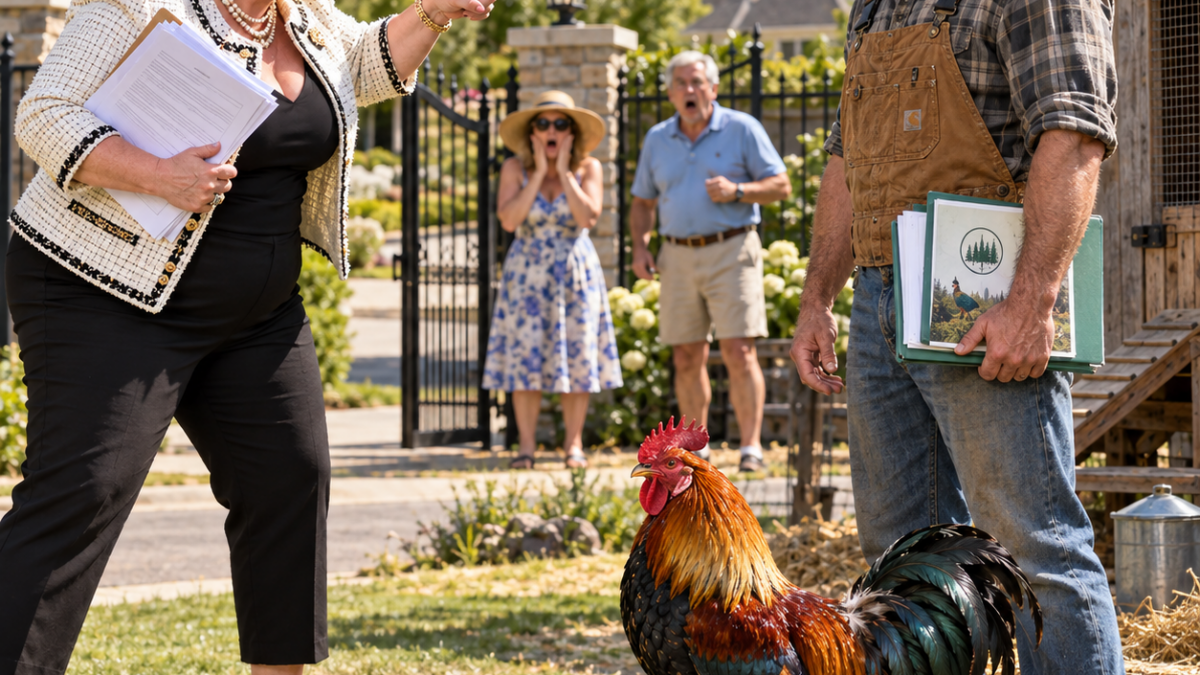
The HOA president showed up before sunrise, pointed at my rooster like he was a wanted criminal, and told me she was going to have my entire flock seized for disturbing her “respectable community.”
She thought she was threatening an old retired soldier with a few noisy backyard chickens, but those birds were part of a registered conservation breeding program on land that had been legally agricultural long before her subdivision existed.
What Karen didn’t understand was that the moment she stopped threatening me with fines and decided to drag me into court, she opened a door that would expose far more than the sound of one rooster at dawn.
My name is Marcus Hayes.
I spent twenty-five years in the Army and retired as a sergeant major, which means I had already survived more shouting, paperwork, inflated egos, and bad decisions from people with temporary authority than most men should experience in one lifetime.
That was why I bought five acres outside town.
Peace.
Green pasture.
A farmhouse.
Enough room to breathe.
I bought the land twenty years before Oakridge Estates existed, back when the property beside mine was still open field.
My parcel was zoned agricultural.
Always had been.
After retirement, I turned part of it into Hayes Heritage Hatchery.
Not a factory farm.
Not some noisy commercial operation.
A conservation project.
My main flock included American Crevecoeurs, a critically endangered heritage poultry breed, along with Marsh Daisy chickens whose bloodlines I tracked with more precision than some units tracked equipment.
Every bird mattered.
Breeding pairs were documented.
Lineage recorded.
Eggs logged.
Health monitored.
This wasn’t a hobby I stumbled into because I wanted fresh breakfast.
It was preservation.
Living genetics.
A tiny piece of agricultural history that could disappear forever if people stopped maintaining healthy breeding populations.
General Patton was the loudest member of that history.
Black feathers.
Wild crest.
Broad chest.
A rooster with the attitude of a battalion commander who believed sunrise required his personal authorization.
At 5:12 one humid morning, Patton crowed from his usual stump.
Seconds later, Karen Miller appeared at the edge of my property.
Bright pink tracksuit.
Arms folded.
Face already furious.
“Your noise chickens are a public nuisance, Mr. Hayes, and I am having them seized.”
I took another sip of coffee.
Karen waited for me to react.
I didn’t.
Years in the Army taught me that silence is incredibly uncomfortable to people who expect obedience.
“Did you hear me?” she demanded.
“I heard you.”
“Harold in Unit 7B says those animals wake him at four in the morning.”
“Patton doesn’t crow at four.”
“That is irrelevant.”
“No, Karen. The time seems fairly relevant in a noise complaint.”
Her face tightened.
“This is Oakridge Estates. It is a residential community, not a barnyard.”
I pointed toward her shoes.
“You’re standing at the edge of my property. Please step back onto the common side.”
“I am the HOA president.”
“That doesn’t change my property line.”
Her eyes widened.
I continued calmly.
“My land is agriculturally zoned. The use predates Oakridge Estates. My poultry operation is protected under long-standing agricultural provisions, and the flock is part of a registered rare-breed conservation program.”
She laughed.
Actually laughed.
“They’re chickens.”
“They are chickens.”
“Then stop making them sound like endangered pandas.”
“American Crevecoeurs are considered critically endangered as a heritage breed.”
“I don’t care what you call them.”
“That’s becoming obvious.”
She pulled a folded notice from her clipboard.
“You will receive this formally today. Remove the roosters within seven days or fines begin at one hundred dollars per day.”
“And if I don’t?”
“We will pursue removal.”
“You intend to come onto my farm and seize registered breeding animals?”
“If necessary.”
I looked toward General Patton.
He hopped onto his stump.
Spread his wings.
Then crowed so loudly Karen physically flinched.
I almost admired his timing.
She pointed at him.
“That one goes first.”
Something inside me became very still.
I had spent years in dangerous places learning the difference between a threat and somebody bluffing.
Karen wasn’t bluffing.
She truly believed the HOA gave her power over my land.
That made this more serious.
I went inside.
Pulled my deed.
County zoning documents.
Right-to-farm paperwork.
Conservation certifications.
Then I opened the Oakridge covenants.
Article Two.
Section Four.
There it was.
Any property incorporated near association jurisdiction with verified pre-existing continuous agricultural use remained exempt from covenants restricting that use.
I read it twice.
Then I smiled.
Karen wanted a fight over rooster noise.
She had just chosen to fight it using a rulebook that already said she was wrong.
And if she insisted on taking me to court, I was going to make sure the judge read every single page she had ignored.
PART 2
Sarah found me at my desk an hour later.
My wife had been married to a sergeant major long enough to recognize danger by office supplies.
The deed lay open.
County survey beside it.
Livestock Conservancy paperwork stacked to the right.
HOA covenants centered directly in front of me.
Three highlighters.
Yellow.
Blue.
Red.
Sarah leaned against the doorframe.
“Oh no.”
I looked up.
“What?”
“You have three colors.”
“That means organization.”
“That means somebody is about to regret something.”
She brought me fresh coffee.
“Karen?”
“Karen.”
“Roosters?”
“Roosters.”
“Patton?”
“Specifically Patton.”
Sarah looked through the window toward the pasture.
General Patton was scratching dirt like nothing in the world had changed.
“She picked the loudest one.”
“He considers that recognition.”
Sarah smiled.
Then noticed the highlighted covenant.
“What did you find?”
I tapped Article Two, Section Four.
She read it.
Then read it again.
“Pre-existing agricultural use is exempt.”
“Yes.”
“She has a copy of this?”
“She should.”
Sarah laughed once.
Not because anything was funny.
Because sometimes absurdity produces that reaction.
“She won’t care.”
“I know.”
“She’s going to say her interpretation is different.”
“Probably.”
“She’ll keep fining us.”
“Yes.”
Sarah watched me.
“And you’re enjoying this.”
“No.”
“Marcus.”
“A little.”
“Don’t.”
Her expression became serious.
“We finally have peace here.”
That stopped me.
Sarah had paid for that peace too.
Deployments.
Long absences.
Phone calls from places I couldn’t name.
The strange adjustments every time I came home.
After twenty-five years, this farm was supposed to be the chapter where nobody needed anything from us except animals at feeding time.
“I know.”
“Then don’t let Karen become the new war.”
“I’m not looking for one.”
“You never were.”
She kissed my forehead.
“But they keep finding you.”
Two days later, the official violation arrived.
A teenager delivered it in an HOA golf cart.
He looked embarrassed.
“Mr. Hayes?”
“That’s me.”
“I was told to hand this to you.”
“Thank you.”
He started backing away.
“You can relax, son. I’m not going to shoot the messenger.”
“I know.”
He paused.
“Mrs. Miller said you might be hostile.”
I stared.
“I offered her coffee.”
He looked even more uncomfortable.
Then he drove away.
The notice said:
IMMEDIATE CESSATION OF NUISANCE LIVESTOCK ACTIVITY
Seven days.
Then $100 per day.
Removal required.
Signed:
Karen Miller, President.
I placed it on the desk.
Then drafted my response.
No insults.
No accusations.
No drama.
I wrote like I was responding to a colonel who had issued an order without reading the regulation.
I quoted Article Two, Section Four verbatim.
Attached the original county zoning permit.
Attached the agricultural-use documentation.
Attached state right-to-farm language relevant to established agricultural activity.
Then I attached documentation from the Livestock Conservancy describing the conservation significance of the breeding program.
I wrote:
My flock is maintained as part of an established heritage-breed conservation program. The agricultural use of this parcel predates Oakridge Estates and is expressly recognized by the association’s own governing documents as an exempt pre-existing use.
Then:
The violation is disputed in full. I will not be removing the birds. Any attempt to seize, remove, harm, or interfere with them will be treated as unauthorized interference with my property and agricultural operation.
Signed.
Dated.
Certified mail.
Return receipt.
Another copy to Karen personally.
Sarah watched me seal the envelopes.
“Why her house?”
“So she can never say she didn’t see it.”
“Marcus Hayes.”
“Yes?”
“You are terrifying when you’re polite.”
“Thank you.”
“That wasn’t necessarily praise.”
The receipt came back signed.
Karen had it.
The fine started anyway.
Seven days.
$700.
The invoice arrived on pink paper.
Failure to comply.
Sarah placed it beside my cereal bowl.
“Good morning.”
I looked at the amount.
“Predictable.”
“You’re not mad?”
“I’m documenting.”
“That is your version of mad.”
Fair.
I wrote another letter.
NOTICE OF DISPUTE AND INTENT TO SEEK LEGAL REMEDIES
Again:
Grandfather clause.
Agricultural zoning.
Conservation status.
Right-to-farm protections.
Certified receipt showing prior notice.
Demand to rescind.
Demand to cease harassment.
I sent it.
Another week.
$1,400.
Attached was a handwritten note.
Pink stationery.
Karen’s handwriting.
Laws don’t apply only to you, Mr. Hayes. We’ll see about that in court.
I stared at it for several seconds.
Sarah read over my shoulder.
“She wrote that?”
“Yes.”
“She thinks this helps her?”
“She thinks she’s intimidating me.”
“What are you going to do?”
I peeled the note carefully from the invoice.
Placed it inside a plastic evidence sleeve.
Then labeled the folder:
KAREN
Sarah laughed.
“That’s ominous.”
“It’s filing.”
“It’s revenge filing.”
“No such thing.”
“Sure.”
The fines climbed.
Two thousand.
Three thousand.
Every time, same response.
Dispute.
Certified mail.
Receipt.
File.
I did not yell.
Did not post on social media.
Did not put up a sign insulting Karen.
Did not retaliate.
That was the part that frustrated her most.
Bullies understand anger.
Anger gives them leverage.
Calm leaves them alone with the record.
But letters alone were not enough.
Karen’s power came from something deeper.
Isolation.
People believed she represented everybody.
So I started walking.
Every evening.
Through Oakridge.
Friendly.
No campaign speech.
No secret revolution.
Just conversations.
David was first.
Young father.
Portable basketball hoop.
He and his son were shooting free throws.
I stopped outside the driveway.
“Nice shot.”
The boy missed.
David laughed.
“He’s got my genetics.”
I introduced myself.
Recognition appeared immediately.
“The rooster guy.”
“That’s apparently my legal name now.”
He smiled.
After a few minutes, I nodded toward the hoop.
“You move that every night?”
David’s face changed.
“HOA.”
“What rule?”
“Must be stored out of sight after eight.”
“That thing weighs what?”
“Hundred fifty pounds with water in the base.”
“You drain it?”
“No. My back just hates me.”
“Why comply?”
“Karen.”
One word again.
Complete explanation.
“She fined us three times.”
“How much?”
“Not huge.”
“That’s not what I asked.”
David sighed.
“Enough to scare my wife.”
Then:
“She said repeated violations could lead to liens.”
There it was.
I told him my land was agricultural.
Grandfathered.
Registered conservation program.
David stared.
“That’s not what Karen said at the meeting.”
“What did she say?”
“That you were ignoring rules everybody else has to follow.”
“Did she mention the exemption clause?”
“No.”
“The zoning?”
“No.”
“Conservation?”
“No.”
He shook his head.
“Why would she leave that out?”
“Because facts complicate a simple story.”
I kept walking.
The Abernathys came next.
George and Eleanor.
Garden gnomes.
Beautiful front garden.
George had practiced corporate law before retiring.
Eleanor had practiced the older and more frightening profession of telling George when he was wrong.
She loved the gnomes.
Karen didn’t.
Three fines.
“Unapproved lawn ornaments.”
George adjusted his glasses.
“She is, legally speaking, ridiculous.”
“Strong opinion.”
“I spent forty years dealing with executives who thought confidence and authority were the same thing.”
“I spent twenty-five years dealing with sergeants and officers who sometimes believed similar things.”
We understood each other instantly.
I explained my case.
Every document.
Every certified letter.
The pink note.
George leaned back.
“You kept everything?”
“Yes.”
“Receipts?”
“Yes.”
“Original envelopes?”
“Yes.”
“Copies of bylaws as they existed when the development incorporated around you?”
“Yes.”
His smile grew.
“Sergeant major?”
“Retired.”
“That explains it.”
“What?”
“Paperwork as a weapon.”
I liked George immediately.
He reviewed the covenants.
Article Two, Section Four.
Then enforcement sections.
Then board procedure.
He spent more than an hour.
At the end, he said:
“You’re right.”
“I know.”
“Never say that to a retired lawyer.”
“Sorry.”
“Your problem isn’t the law.”
“What is?”
“Karen.”
“I had noticed.”
“She won’t retreat because you show her rules.”
“Why?”
“Because the dispute has become personal.”
George pointed toward my farm.
“Your roosters are not the threat.”
“What is?”
“You are.”
“To her?”
“You told her no.”
That simple.
The next two weeks changed everything.
David introduced me to neighbors.
George introduced me to more.
Christmas lights.
Vegetable garden.
Trash bins.
Mailbox.
Holiday wreath.
A small oil stain.
A decorative bird feeder.
Karen’s favorites seemed exempt.
Karen’s critics received letters.
The pattern became clearer.
One Saturday, Sarah and I invited several families to the farm.
Nothing formal.
Iced tea.
Cookies.
Tables in the yard.
People met General Patton.
He behaved terribly.
Crowed through half the conversations.
David’s son adored him.
“He’s huge!”
Patton puffed up.
“He heard you,” I said.
George and Eleanor came.
Three other families.
Nobody gave speeches.
We talked.
For the first time, people compared experiences.
George eventually leaned back.
“What we are describing is not merely strict enforcement.”
Everyone quieted.
“It is selective enforcement, retaliation, and potentially breach of fiduciary duty.”
David frowned.
“In English?”
George smiled.
“Karen is using the rules as weapons.”
That everybody understood.
He continued:
“And Marcus’s case is worse. She has actual notice that the HOA’s own documents exempt his agricultural use. She’s continuing fines anyway.”
Sarah said:
“She knows about the conservation registration.”
“Yes.”
George nodded.
“If she keeps going, she increases the HOA’s exposure.”
One neighbor asked:
“So what do we do?”
George looked at me.
I shook my head.
“This isn’t my rebellion.”
Eleanor snorted.
“Too late.”
People laughed.
Then George said:
“Document everything.”
That became our first rule.
No rumors.
No anonymous accusations.
No exaggeration.
Letters.
Photos.
Dates.
Receipts.
Appeals.
Responses.
Karen had used bureaucracy against frightened homeowners for years.
Now homeowners learned the same language.
A month later, the thick envelope arrived.
Downtown law firm.
Sarah handed it to me.
“This feels different.”
“It is.”
I opened it.
Summons.
OAKRIDGE ESTATES HOMEOWNERS ASSOCIATION, INC. v. MARCUS HAYES
Public nuisance.
Removal of flock.
Accumulated fines exceeding $5,000.
Attorney fees.
Injunctive relief.
I read the first page.
Then second.
Then the complaint.
Sarah watched me.
“You’re smiling.”
“Barely.”
“Why are you smiling?”
“Because she filed.”
“That’s good?”
“No.”
I looked at the stack.
“But now she has to prove things.”
Karen’s world operated on letters nobody challenged.
Court was different.
Statements needed evidence.
Authority needed documents.
Money needed authorization.
Witnesses could be questioned.
Records could be requested.
I called George.
“She did it.”
Pause.
Then:
“Bring everything.”
An hour later, I sat in his study.
Dark shelves.
Old law books.
My Karen folder on the desk.
George read the complaint.
Twenty minutes.
Occasional grunt.
Then:
“Sloppy.”
“What specifically?”
“Noise allegations with no objective measurements.”
He flipped pages.
“Property-value claims with no appraisal evidence.”
Another page.
“Hearsay.”
He picked up Karen’s affidavit.
“She says your roosters crow continuously throughout the night.”
“They don’t.”
“Can you prove that?”
“My security cameras record audio.”
George smiled.
“Of course they do.”
He reviewed Article Two.
“There’s your shield.”
Then another section.
He stopped.
Read again.
“Oh.”
“What?”
He rotated the binder.
ARTICLE FIVE — BOARD AUTHORITY
Any legal action initiated in the association’s name required majority approval of the full board at a duly recorded meeting.
Associated legal expenditures had to be budgeted or specially approved.
George looked at me.
“Do you know about a vote?”
“No.”
“Meeting notice?”
“No.”
“Minutes?”
“No.”
He leaned back.
“I will bet my pension she did not get approval.”
“Meaning?”
“If she filed this lawsuit on her own and used HOA funds to do it, the chicken case may become the least interesting part of this.”
He reached for his phone.
“Who are you calling?”
“My old firm.”
“George—”
“You need active litigation counsel.”
“I know.”
“I have somebody.”
“Expensive?”
“First meeting will be free.”
“That answer worries me.”
“Jessica Riley.”
“Relation?”
“To you? No.”
“Good.”
“Runs litigation at Miller & Vance.”
“Good?”
George smiled.
“Terrifying.”
Two days later, Sarah and I were in a downtown conference room.
Jessica Riley sat across from us.
Early forties.
No wasted words.
My file covered the table.
She read for almost an hour.
Then looked up.
“Mr. Hayes.”
“Marcus.”
“Marcus, most clients bring me a story.”
She tapped the binders.
“You brought me evidence.”
“Habit.”
“Useful habit.”
She held up the pink note.
“This is particularly unwise.”
“Karen’s?”
“Yes.”
Then the covenants.
“This exemption clause is strong.”
The lawsuit.
“Their nuisance evidence is weak.”
Board rules.
“And this is interesting.”
She looked at George.
“No authorization?”
“That’s what we need to discover.”
Jessica smiled.
Not pleasantly.
“We’ll defend the nuisance claim.”
Then looked at me.
“But we will also counterclaim if the facts support it.”
“For what?”
“Potential malicious prosecution-style theories depending on state law and procedural posture, breach of governing duties, harassment, misuse of association funds, and any fraud or self-dealing discovery reveals.”
Sarah said:
“You think there’s more?”
Jessica looked at Karen’s handwritten note.
“People who behave like this rarely become reckless in only one category.”
That sentence proved prophetic.
Discovery began.
Bank statements.
Invoices.
Emails.
Meeting minutes.
Fine history.
Board communications.
Five years.
Karen’s lawyer objected.
Too broad.
Burdensome.
Harassing.
Jessica argued the HOA had sued first and placed its governance, finances, authorization, and enforcement conduct directly at issue.
The judge granted substantial discovery.
The boxes arrived three weeks later.
Mess.
Receipts.
Statements.
Minutes.
Invoices.
Unsorted papers.
Classic document dump.
Jessica had paralegals.
I had retirement.
Bad combination for Karen.
Sarah joined too.
She loved numbers.
Within days, we found the first problem.
Prestige Lawn Care.
Huge monthly payments.
Far beyond what common-area landscaping appeared to justify.
Entrance.
Park.
Road verges.
Nothing close to invoice totals.
Sarah found the key receipt.
Prestige service.
Karen Miller’s residential address.
Extensive landscaping.
Water feature.
Flower beds.
Same odd amount appearing in an HOA payment.
We checked another month.
Then another.
Then another.
My stomach turned.
“This can’t be this obvious.”
Jessica leaned over.
“It can.”
“Forty thousand?”
“More depending on period.”
Sarah found catering.
Board-meeting expenses matching Karen’s daughter’s graduation-party date.
Then a roofing contractor.
Payment from HOA.
Description:
Community clubhouse roof repair.
The clubhouse roof was nearly new.
Contractor?
Karen’s brother-in-law.
Then emails.
That was where the mask fell off.
Karen had apparently assumed deleted emails vanished.
They didn’t.
One chain mentioned me.
We need to do something about the Hayes man. His arrogance is unbearable.
Another:
I don’t care what his zoning says. This is Oakridge, not a farm commune. Keep the fines going. He’ll break eventually.
I read that sentence twice.
“He’ll break eventually.”
Sarah touched my arm.
“You okay?”
“Yes.”
I wasn’t.
Not because of me.
Because I thought of every person who had folded because that was exactly the strategy.
Wear them down.
Make resistance more expensive than surrender.
Then came the lawsuit email.
Board member Frank had written:
Are we sure legal action is wise? Don’t we need a board vote?
Karen replied:
Your job is to vote yes when I tell you to. I have already retained counsel. This is happening. Do not question my authority again.
Jessica printed the email.
Set it in the center of the table.
“There.”
George exhaled.
“There’s what?”
“The lawsuit authorization problem.”
She continued.
“Potential breach of fiduciary duty.”
Then looked at the financial records.
“And depending on what we establish about personal expenses, potentially fraud.”
I felt no triumph.
Just anger.
The roosters had been an excuse.
Karen had been using the association like private property.
The countersuit followed.
Carefully framed.
No fantasy.
No theatrical million-dollar numbers.
The allegations matched evidence.
Misuse of HOA funds.
Unauthorized litigation.
Targeted enforcement.
Harassment.
Personal liability where the facts supported it.
Karen and two active allies named personally.
HOA separately for governance failures.
When the process server delivered Karen’s papers, she was standing beside a Prestige landscaping crew at her own house.
The irony wrote itself.
The report said her face went white.
That evening, Frank called me.
His voice shook.
“Marcus.”
“Yes.”
“I’ve been sued.”
“You were named.”
“My wife is terrified.”
“I’m sorry she’s scared.”
“What do I do?”
“Get counsel.”
“I didn’t want any of this.”
“You were on the board.”
“I questioned Karen.”
“You also let her continue.”
Silence.
“I was afraid of her.”
“So was everybody.”
“What do I do?”
“Tell the truth.”
“I could lose everything.”
“Then tell the truth faster.”
Harsh.
Maybe.
But weakness in private leadership can hurt hundreds of people.
Frank eventually cooperated.
His emails helped prove Karen had bypassed board procedure.
The association fractured.
Then the story reached local media.
David’s nephew Leo ran a community news site.
He asked to interview me.
Jessica gave me strict boundaries.
No confidential discovery details.
No unproven accusations.
No trial-by-media exaggeration.
I agreed.
Leo came to the farm.
Met Patton.
The rooster crowed directly into his microphone.
Perfect.
I explained heritage breeds.
Conservation.
Agricultural zoning.
The HOA lawsuit.
George explained fiduciary duty in plain English.
David explained the basketball-hoop fines.
Other residents told their stories.
Leo went to Karen.
Door slammed.
“No comment.”
His article spread through town.
Then television picked it up.
The evening news showed my farm.
Neat fencing.
Clean pens.
Rare birds.
My service photograph.
Then Karen’s expensive landscaping.
They explained the lawsuit and countersuit as allegations, not settled fact.
That distinction mattered.
Public support swung hard.
Too hard sometimes.
I saw comments calling for violence.
I hated that.
I told Leo:
“Remove threats.”
He agreed.
I didn’t want a mob.
I wanted accountability.
Court was enough.
Karen’s deposition arrived weeks later.
Jessica prepared like a surgeon.
“Marcus, she will try to provoke you.”
“I know.”
“Do not react.”
“I know.”
“Do not shake your head.”
“I know.”
“Do not mutter.”
“I know.”
“Do not make faces.”
“I’m not twelve.”
George said:
“Debatable.”
Sarah smiled.
Deposition day.
Karen arrived in navy blue.
Her lawyer looked exhausted before they began.
Court reporter ready.
Jessica started simple.
Name.
Address.
Role.
Years as president.
Then:
“Mrs. Miller, you referred to Mr. Hayes’s animals as ‘noise chickens.’ Correct?”
Karen scoffed.
“That’s what they are.”
“What does that term mean?”
“Chickens that make unreasonable noise.”
“Unreasonable according to whom?”
“The community.”
“Any county citation?”
“No.”
“Formal noise measurement?”
“No.”
“Decibel testing?”
“We don’t need a machine to know a rooster is loud.”
Jessica nodded.
“Any independent acoustic expert?”
“No.”
“Any investigation into agricultural zoning before suit?”
Karen’s expression changed.
“That zoning is outdated.”
“Is that a legal opinion?”
“It’s common sense.”
“Did counsel advise you that HOA covenants superseded agricultural zoning?”
Karen looked toward her lawyer.
He looked down.
Jessica slid Article Two, Section Four across.
“Read the highlighted language.”
Karen refused.
Jessica read it.
Pre-existing agricultural use.
Exempt.
Then:
“Were you aware of this language before imposing fines?”
“It’s being misinterpreted.”
“By whom?”
“Mr. Hayes.”
“Anyone else?”
Silence.
Jessica introduced the conservation documentation.
“Did you receive this letter before continuing fines?”
“Yes.”
“So you knew the birds were part of a registered heritage-breed breeding program?”
“They’re still chickens.”
Nobody spoke.
Jessica moved on.
Board authorization.
Email chain.
Frank’s warning.
Then Karen’s response.
Your job is to vote yes when I tell you to.
Jessica asked:
“Did you write this?”
“I don’t remember.”
“Is that your email?”
“Yes.”
“Did you write it?”
“I may have.”
“Did the board vote before counsel was retained?”
Karen’s lawyer shifted.
Karen said:
“I had executive authority.”
“Show us where.”
No answer.
Jessica did not celebrate.
Just marked the exhibit.
Then finances.
Prestige Lawn Care.
Invoices.
Karen’s home.
HOA checks.
“Explain.”
“Bookkeeping error.”
“Repeated monthly?”
“Yes.”
“Three years?”
Silence.
“More than forty thousand dollars?”
“I intended to repay it.”
“Did you?”
No.
Catering.
Graduation party.
Roof payment.
Brother-in-law.
Each document narrowed her options.
Karen’s anger cracked.
Then self-pity arrived.
“I did everything for this community.”
Jessica waited.
“Nobody appreciated me.”
Silence.
“I was at every meeting. Every emergency. Every complaint.”
Jessica asked calmly:
“Did that entitle you to use association money for personal expenses?”
Karen began crying.
“No.”
That was the first direct answer all afternoon.
Deposition ended.
I stood.
No speech.
No victory line.
Just left with Sarah.
In the elevator, she exhaled.
“I almost feel sorry for her.”
“I do.”
Sarah looked surprised.
“That was quick.”
“I said almost.”
The deposition changed the insurance equation.
The HOA’s carrier reviewed the sworn testimony.
The financial records.
Authorization problems.
Countersuit.
Within days, settlement talks began.
The insurance lawyer spoke professionally.
The association wanted the nuisance case dismissed with prejudice.
My legal costs covered.
Compensation for harassment and associated damages.
Governance reform.
Karen removed.
Her active allies removed.
Most importantly, the carrier took the position that deliberate fraud and intentional misconduct would not receive the same protection as ordinary board mistakes.
Karen could no longer hide completely behind the HOA.
Jessica looked at me.
“This is the point where people get greedy.”
“I’m not interested.”
“What do you want?”
“My farm left alone.”
“Done.”
“My legal costs.”
“Done.”
“Fines eliminated.”
“Done.”
“Public correction.”
“Reasonable.”
“Board reform.”
“Likely.”
“And the money taken from residents gets recovered.”
Jessica leaned back.
“That will require separate recovery mechanisms.”
“Then pursue them.”
“We will.”
I thought about Patton.
“Anything else?”
Sarah answered.
“No more fear.”
That became the real settlement.
The nuisance suit was withdrawn permanently.
My fines disappeared.
The conservation flock remained.
The HOA acknowledged my agricultural exemption.
Karen and her two allies lost their positions.
An independent forensic audit began.
Oakridge called an emergency homeowner meeting.
Standing room only.
Karen sat at the board table.
No pink tracksuit.
No smugness.
Frank read the motion.
His voice shook.
“Immediate removal of Karen Miller from the board for gross misconduct and breach of fiduciary duty.”
Seconded.
Hands rose.
Nearly everyone.
Karen sat frozen.
Then stood.
“You cannot do this.”
Someone shouted:
“You stole from us.”
Another:
“You bullied us.”
Another:
“You lied.”
The room exploded.
George stood.
“Enough.”
Everyone quieted.
He looked at Karen.
“You were given authority to serve this community.”
Then:
“You used it to control it.”
Karen’s face twisted.
“I built this place.”
“No.”
George looked around.
“They did.”
That line broke something.
Not in Karen.
In the residents.
They realized he was right.
The HOA had never belonged to the president.
It belonged to the homeowners.
Karen grabbed her purse.
Walked out through a room of people she once controlled.
No one stopped her.
Her allies resigned the next day.
George became interim president.
His first act:
Audit.
Second:
Public apology.
Third:
Suspend and review disputed fines.
David’s hoop fine vanished.
The Abernathys’ gnome fines vanished.
Garden.
Wreath.
Mailbox.
Vegetable patch.
Reviewed.
Some legitimate violations remained.
Others disappeared.
That distinction mattered.
We weren’t burning the rulebook.
We were forcing it to serve people instead of ego.
Karen’s personal civil settlement came later.
She had to repay misused association funds.
Interest.
A meaningful portion of my legal costs and damages.
Her finances took a serious hit.
Months later, FOR SALE appeared in front of her house.
Prestige landscaping immaculate.
Koi pond perfect.
Flowers aligned.
The new family bought it.
First thing they did?
Removed half the decorative landscaping and put in open lawn for their kids.
Sarah showed me.
“Karen would faint.”
“Not our problem.”
“Growth.”
The farm returned to quiet.
No certified letters.
No threats.
No lawsuit.
Just work.
I expanded the conservation program.
Added rare Silver Appleyard ducks.
Sarah accused me of building a small endangered-breed army.
“Sheep next?”
“No.”
“Goats?”
“Absolutely not.”
“Marcus.”
“No goats.”
I lasted eight months.
We got two goats.
Not endangered.
Just manipulative.
General Patton grew older.
Still crowed.
Still acted like sunrise depended on him.
Neighbors stopped complaining.
Not because his voice changed.
Because the context did.
Families visited.
Children learned about heritage breeds.
I started hosting occasional educational mornings.
Nothing huge.
Small groups.
Explain why genetic diversity matters.
Why old breeds disappear.
Why agricultural history is part of culture.
David’s son loved Patton.
Eleanor Abernathy loved the Marsh Daisy hens.
George pretended not to like the ducks.
The ducks disagreed.
Oakridge became a different community.
Board meetings drew people.
Finances published.
Large expenditures reviewed.
Family/vendor relationships disclosed.
Legal action required actual vote.
Enforcement appeals heard by multiple people.
No one president controlling everything.
Term limits added.
George served one term.
Refused a second.
“Why?”
He pointed at Karen’s old chair.
“Furniture shouldn’t fit anybody too comfortably.”
Good answer.
One morning years later, I stood on the same porch where this had started.
Coffee.
Sunrise.
Sarah beside me.
General Patton climbed onto his stump.
He was slower now.
Gray around the edges of his crest.
Still proud.
He drew in a breath.
Crowed.
Long.
Rolling.
Across pasture.
Across Oakridge.
Nobody appeared in a pink tracksuit.
No threat.
No notice.
No fine.
A child two houses over yelled:
“Morning, Patton!”
I laughed.
Sarah leaned against me.
“You know he thinks they answer to him.”
“They might.”
“You thought this whole thing was going to be about protecting chickens.”
“It was.”
“No.”
I looked at her.
“What was it about?”
She nodded toward Oakridge.
“People learning they weren’t alone.”
Maybe.
That was the strange thing.
Karen sued me because of noise.
But the loudest thing her lawsuit uncovered wasn’t a rooster.
It was everyone she had kept quiet.
The basketball dad.
The retired lawyer.
The garden-gnome couple.
The woman with Christmas lights.
The family with the vegetable patch.
Frank, who had been afraid to challenge her even from inside the board.
One by one, they spoke.
And once people compare fear, fear shrinks.
Karen’s power depended on each person believing:
This is only happening to me.
I must have done something wrong.
Fighting will cost too much.
Better comply.
That system died the day we sat at folding tables in my backyard and realized everybody had the same envelope somewhere in a drawer.
That was the real turning point.
Not court.
Not the countersuit.
Not the deposition.
Not the insurance company.
Connection.
I still keep the Karen file.
Thick.
Certified receipts.
Invoices.
Pink note.
Summons.
Emails.
Deposition excerpts.
Settlement.
Sarah asked once why I keep it.
“History.”
“You keep chicken history?”
“Operational lessons.”
“You’re retired.”
“Lessons survive retirement.”
One day my grandson might ask why Grandpa has a file named Karen.
I will probably tell him.
But I won’t tell it like a revenge story.
I’ll tell him about boundaries.
Authority.
Evidence.
And patience.
I’ll tell him that General Patton’s crow wasn’t protected because Patton was special.
It was protected because the farm existed under lawful agricultural use and because those birds represented legitimate conservation work.
I’ll tell him that Karen had some real authority.
HOA presidents do.
That was precisely why her abuse mattered.
Abuse is not somebody having zero power.
It is somebody using legitimate power outside its limits.
She could enforce valid covenants.
She could not erase agricultural zoning because she disliked livestock.
She could not ignore an express grandfather clause.
She could not invent a board vote.
She could not treat association money like her checking account.
She could not keep escalating simply because someone told her no.
That was the lesson.
Power has edges.
People who respect those edges can serve for years.
People who erase them eventually meet something harder than their own certainty.
Paper.
Evidence.
Neighbors.
Courts.
Truth.
The Livestock Conservancy sent me a letter after everything ended.
Nothing dramatic.
They were glad the breeding program could continue.
I framed it.
Not because it was legal evidence anymore.
Because the flock mattered.
American Crevecoeurs are strange, beautiful birds.
Black feathers.
Crests.
History going back centuries.
Their numbers became dangerously low because industrial agriculture rewards different traits.
Keeping them alive requires people willing to maintain breeding lines even when the work is inconvenient.
That became symbolic to me.
Preservation is stubbornness with purpose.
Karen saw noise.
I saw continuity.
She saw inconvenience.
I saw responsibility.
She saw chickens.
They were chickens.
But they were also living evidence that not everything old should disappear simply because a newer system finds it untidy.
The farm itself was like that.
Five green acres surrounded by identical houses.
Agriculture before development.
History before covenants.
Karen wanted the world smooth.
Uniform.
Predictable.
A rooster refuses all three.
Maybe that was why Patton drove her crazy.
He announced every dawn without permission.
No committee.
No vote.
No pink letter.
Just instinct.
Life.
A few months before Patton died, he stopped crowing as often.
Age.
I noticed immediately.
So did Sarah.
One morning, silence.
I went outside.
Found him near his stump.
Still alive.
Just tired.
I carried him gently to the barn.
People who have never cared for animals assume livestock are interchangeable.
They aren’t.
Not when you know them.
Not when you’ve watched a line for years.
Not when one bird becomes the accidental flag bearer for a fight you never wanted.
Patton died that winter.
Natural.
Old.
I buried him beneath an oak at the edge of the pasture.
David came.
George.
Eleanor.
A few children.
Sarah stood beside me.
No grand ceremony.
David’s son placed a small wooden marker.
GENERAL PATTON
HE WON THE NOISE WAR
I laughed so hard I cried.
The marker is still there.
A younger Crevecoeur rooster eventually claimed the stump.
Different voice.
Different temperament.
Same sunrise.
The first morning he crowed, Sarah looked at me.
“What are you going to name him?”
“Nothing military.”
She waited.
“Eisenhower.”
“You are impossible.”
“Patton needed strategic depth.”
She walked away.
I heard her laughing.
Karen’s story ended before Patton’s did.
I heard indirectly she moved several towns away.
Somebody told me she joined a condo board.
I hope that part was a joke.
I never verified it.
Didn’t care.
That is another difference between anger and healing.
At the beginning, I wanted Karen to understand.
Understand the law.
Understand the birds.
Understand what she had done.
Eventually, I no longer needed her understanding.
The court understood enough.
The HOA understood.
Neighbors understood.
The conservation program remained.
That was sufficient.
People sometimes ask whether I regret countersuing so hard.
No.
But I also don’t celebrate the damage to her life.
Those are not contradictions.
Consequences were necessary.
Fraud needed repayment.
Misuse of funds needed exposure.
Harassment needed to stop.
But suffering itself was never my objective.
The objective was freedom to live lawfully on my land without one woman weaponizing an institution.
Once that happened, the mission was complete.
Sergeant majors understand mission completion.
You don’t keep firing because ammunition remains.
Oakridge eventually held its first heritage day.
That was George’s idea.
Residents set up tables.
Local history.
Gardening.
Crafts.
Kids.
Someone persuaded me to display a few Crevecoeurs.
I resisted.
Sarah volunteered me.
Marriage.
General Patton was still alive then.
He sat in a secure exhibition pen glaring at everybody.
Children loved him.
A reporter from the town paper asked me:
“Is this the rooster from the lawsuit?”
“Yes.”
“Does he know he’s famous?”
“He assumes everything is about him.”
The reporter laughed.
“What did the whole case teach you?”
I thought.
Then said:
“That rules and community are not the same thing.”
She waited.
“Good rules help people live together.”
“And bad rules?”
“Sometimes the rule isn’t bad.”
I looked toward the Oakridge clubhouse.
“Sometimes the person holding it forgets why it exists.”
The article quoted that.
George framed it in the clubhouse.
I told him to take it down.
He didn’t.
The HOA had a sense of humor again.
That was progress.
Years passed.
My five acres remained green.
Oakridge grew older around me.
Children became teenagers.
Parents became grandparents.
Eleanor’s gnomes multiplied.
David’s basketball hoop eventually rusted.
His son outgrew it.
He refused to throw it away.
“Historical structure,” he told George.
George threatened him with a $75 fine.
Both men laughed for five minutes.
That was healthy power.
Able to joke about itself.
Karen never could.
She treated authority as identity.
The new board treated it as temporary work.
One summer, drought hit hard.
My agricultural water needs became a concern.
Instead of sending me a demand, the board president called.
“Marcus, can we coordinate?”
Simple sentence.
Different world.
We did.
I adjusted watering schedules.
They adjusted common-area irrigation.
Everybody survived.
No war.
No lawsuit.
No pink stationery.
Authority plus respect.
That was all Karen had needed from the beginning.
The lawsuit file grew dusty.
The farm did not.
Silver Appleyards joined.
Rare ducks.
Beautiful.
Loud in different ways.
Sarah looked at me the day they arrived.
“Do they quack before sunrise?”
“Possibly.”
“Any HOA protection?”
“Don’t start.”
She laughed.
A year later, our conservation work received recognition from a regional agricultural society.
Small plaque.
Nothing life-changing.
I put it in the barn.
Sarah moved it into the house.
“You should be proud.”
“I am.”
“You hide everything.”
“Military habit.”
“Retired.”
“Apparently.”
The real pride was simpler.
Hatching healthy chicks.
Maintaining genetic lines.
Passing breeding stock to responsible keepers.
Knowing a rare breed existed in slightly better numbers because our little farm kept going.
Karen almost ended that over one complaint.
That still astonishes me.
One person’s ignorance paired with authority can do disproportionate damage.
That is why process matters.
She should have investigated.
Checked zoning.
Read the grandfather clause.
Asked the county.
Reviewed the conservation paperwork.
Measured actual noise.
Used mediation.
Anything.
Instead:
Threat.
Fine.
Escalate.
Sue.
Then discovery.
That last step changed her life.
The lawsuit she believed would destroy me opened her records.
That is the irony I appreciate most.
Karen wanted a courtroom because she thought courts were bigger clipboards.
They aren’t.
Courts ask:
Show me.
Show authorization.
Show evidence.
Show numbers.
Show votes.
Show damages.
Show the rule.
Show why it applies.
She had spent years winning because residents rarely forced her to show anything.
Once she had to, her authority collapsed.
That is the quiet power of evidence.
I never screamed at her.
Never threatened her.
Never harmed her property.
Never targeted her family.
Never used General Patton as a weapon.
I wrote letters.
Kept receipts.
Read covenants.
Protected records.
Talked to neighbors.
Hired counsel.
Waited.
Boring.
Extremely effective.
Sarah once asked:
“If Karen had dropped the first fine when she saw the exemption, what would have happened?”
“Nothing.”
“Really?”
“Yes.”
“No audit?”
“No.”
“No lawsuit?”
“No.”
“No discovery?”
“No.”
“No landscaping fraud exposed?”
“Probably not then.”
She shook her head.
“So her entire downfall happened because she wouldn’t admit she was wrong about one rooster.”
I looked toward Patton.
He crowed.
“Apparently.”
Sarah smiled.
“That bird has impeccable timing.”
The farmhouse porch looks almost the same today as it did when Karen first appeared.
Painted railing.
Old oak.
Coffee table.
Pasture beyond.
Oakridge houses in the distance.
The line between my land and the development is still there.
Invisible unless you know where to look.
Boundaries are like that.
Property boundaries.
Legal boundaries.
Ethical boundaries.
People get into trouble when they treat invisible lines as nonexistent.
Karen crossed too many.
Now the HOA actually keeps a boundary map in its governing binder.
George insisted.
Next to Article Two, Section Four.
Someone—probably David—added a sticky note years ago:
ASK MARCUS BEFORE SUING FARMERS.
I pretend to hate it.
I don’t.
One cool morning, I walked toward Patton’s old stump.
Eisenhower stood there.
Sun just breaking over the houses.
Mist along the grass.
He stretched his neck.
Crowed.
The sound rolled across my five acres.
Into Oakridge.
No complaints.
A porch light came on.
Somebody waved.
I waved back.
That was when the whole story finally felt finished.
Not when Karen lost her board seat.
Not when the insurance company settled.
Not when she sold her house.
Not when the countersuit ended.
That morning.
Because a rooster crowed.
And nothing happened.
No letter.
No threat.
No fear.
Just morning.
People underestimate how precious ordinary mornings become after someone turns them into a battlefield.
Coffee tastes different when nobody is threatening your home.
Birdsong sounds different when no one has labeled it a nuisance.
A pasture feels larger when you know the boundary is respected.
Peace is not dramatic.
That is why people overlook it.
But after twenty-five years in uniform, I knew exactly what it was worth.
Karen sued me over rooster noise because she thought she was defending the neighborhood from one stubborn farmer.
She never understood that my flock was protected conservation livestock on grandfathered agricultural land.
She never understood that her lawsuit required scrutiny of her own authority.
And she absolutely never understood that the frightened residents she had kept separate for years would become witnesses the moment somebody gave them a place to speak.
She brought bylaws.
I brought the bylaws too.
She brought fines.
I brought receipts.
She brought a lawsuit.
We brought discovery.
And discovery brought the truth.
In the end, General Patton never had to win anything.
He just kept being what he was.
A rooster.
A rare one.
A loud one.
A living piece of agricultural history standing on land where he had every lawful right to be.
Karen was the one who had to change.
When she refused, the system changed without her.
That is why I still smile when a Crevecoeur rooster crows across the pasture before breakfast.
To some people, it’s noise.
To me, it sounds like something much bigger.
It sounds like a boundary holding.
It sounds like history surviving.
It sounds like a neighborhood that finally learned the difference between rules and control.
And after everything Karen tried to take away, it sounds exactly like home.
HOA Karen Sued Me Over My Rooster’s Crowing—She Had No Idea My Flock Was Part of a Registered Rare-Breed Conservation Program
[FACEBOOK CAPTION — 700–800 WORDS]
The HOA president showed up before sunrise, pointed at my rooster like he was a wanted criminal, and told me she was going to have my entire flock seized for disturbing her “respectable community.”
She thought she was threatening an old retired soldier with a few noisy backyard chickens, but those birds were part of a registered conservation breeding program on land that had been legally agricultural long before her subdivision existed.
What Karen didn’t understand was that the moment she stopped threatening me with fines and decided to drag me into court, she opened a door that would expose far more than the sound of one rooster at dawn.
My name is Marcus Hayes.
I spent twenty-five years in the Army and retired as a sergeant major, which means I had already survived more shouting, paperwork, inflated egos, and bad decisions from people with temporary authority than most men should experience in one lifetime.
That was why I bought five acres outside town.
Peace.
Green pasture.
A farmhouse.
Enough room to breathe.
I bought the land twenty years before Oakridge Estates existed, back when the property beside mine was still open field.
My parcel was zoned agricultural.
Always had been.
After retirement, I turned part of it into Hayes Heritage Hatchery.
Not a factory farm.
Not some noisy commercial operation.
A conservation project.
My main flock included American Crevecoeurs, a critically endangered heritage poultry breed, along with Marsh Daisy chickens whose bloodlines I tracked with more precision than some units tracked equipment.
Every bird mattered.
Breeding pairs were documented.
Lineage recorded.
Eggs logged.
Health monitored.
This wasn’t a hobby I stumbled into because I wanted fresh breakfast.
It was preservation.
Living genetics.
A tiny piece of agricultural history that could disappear forever if people stopped maintaining healthy breeding populations.
General Patton was the loudest member of that history.
Black feathers.
Wild crest.
Broad chest.
A rooster with the attitude of a battalion commander who believed sunrise required his personal authorization.
At 5:12 one humid morning, Patton crowed from his usual stump.
Seconds later, Karen Miller appeared at the edge of my property.
Bright pink tracksuit.
Arms folded.
Face already furious.
“Your noise chickens are a public nuisance, Mr. Hayes, and I am having them seized.”
I took another sip of coffee.
Karen waited for me to react.
I didn’t.
Years in the Army taught me that silence is incredibly uncomfortable to people who expect obedience.
“Did you hear me?” she demanded.
“I heard you.”
“Harold in Unit 7B says those animals wake him at four in the morning.”
“Patton doesn’t crow at four.”
“That is irrelevant.”
“No, Karen. The time seems fairly relevant in a noise complaint.”
Her face tightened.
“This is Oakridge Estates. It is a residential community, not a barnyard.”
I pointed toward her shoes.
“You’re standing at the edge of my property. Please step back onto the common side.”
“I am the HOA president.”
“That doesn’t change my property line.”
Her eyes widened.
I continued calmly.
“My land is agriculturally zoned. The use predates Oakridge Estates. My poultry operation is protected under long-standing agricultural provisions, and the flock is part of a registered rare-breed conservation program.”
She laughed.
Actually laughed.
“They’re chickens.”
“They are chickens.”
“Then stop making them sound like endangered pandas.”
“American Crevecoeurs are considered critically endangered as a heritage breed.”
“I don’t care what you call them.”
“That’s becoming obvious.”
She pulled a folded notice from her clipboard.
“You will receive this formally today. Remove the roosters within seven days or fines begin at one hundred dollars per day.”
“And if I don’t?”
“We will pursue removal.”
“You intend to come onto my farm and seize registered breeding animals?”
“If necessary.”
I looked toward General Patton.
He hopped onto his stump.
Spread his wings.
Then crowed so loudly Karen physically flinched.
I almost admired his timing.
She pointed at him.
“That one goes first.”
Something inside me became very still.
I had spent years in dangerous places learning the difference between a threat and somebody bluffing.
Karen wasn’t bluffing.
She truly believed the HOA gave her power over my land.
That made this more serious.
I went inside.
Pulled my deed.
County zoning documents.
Right-to-farm paperwork.
Conservation certifications.
Then I opened the Oakridge covenants.
Article Two.
Section Four.
There it was.
Any property incorporated near association jurisdiction with verified pre-existing continuous agricultural use remained exempt from covenants restricting that use.
I read it twice.
Then I smiled.
Karen wanted a fight over rooster noise.
She had just chosen to fight it using a rulebook that already said she was wrong.
And if she insisted on taking me to court, I was going to make sure the judge read every single page she had ignored.
[END OF FACEBOOK CAPTION]
[FIRST COMMENT / FULL STORY CONTINUATION]
Sarah found me at my desk an hour later.
My wife had been married to a sergeant major long enough to recognize danger by office supplies.
The deed lay open.
County survey beside it.
Livestock Conservancy paperwork stacked to the right.
HOA covenants centered directly in front of me.
Three highlighters.
Yellow.
Blue.
Red.
Sarah leaned against the doorframe.
“Oh no.”
I looked up.
“What?”
“You have three colors.”
“That means organization.”
“That means somebody is about to regret something.”
She brought me fresh coffee.
“Karen?”
“Karen.”
“Roosters?”
“Roosters.”
“Patton?”
“Specifically Patton.”
Sarah looked through the window toward the pasture.
General Patton was scratching dirt like nothing in the world had changed.
“She picked the loudest one.”
“He considers that recognition.”
Sarah smiled.
Then noticed the highlighted covenant.
“What did you find?”
I tapped Article Two, Section Four.
She read it.
Then read it again.
“Pre-existing agricultural use is exempt.”
“Yes.”
“She has a copy of this?”
“She should.”
Sarah laughed once.
Not because anything was funny.
Because sometimes absurdity produces that reaction.
“She won’t care.”
“I know.”
“She’s going to say her interpretation is different.”
“Probably.”
“She’ll keep fining us.”
“Yes.”
Sarah watched me.
“And you’re enjoying this.”
“No.”
“Marcus.”
“A little.”
“Don’t.”
Her expression became serious.
“We finally have peace here.”
That stopped me.
Sarah had paid for that peace too.
Deployments.
Long absences.
Phone calls from places I couldn’t name.
The strange adjustments every time I came home.
After twenty-five years, this farm was supposed to be the chapter where nobody needed anything from us except animals at feeding time.
“I know.”
“Then don’t let Karen become the new war.”
“I’m not looking for one.”
“You never were.”
She kissed my forehead.
“But they keep finding you.”
Two days later, the official violation arrived.
A teenager delivered it in an HOA golf cart.
He looked embarrassed.
“Mr. Hayes?”
“That’s me.”
“I was told to hand this to you.”
“Thank you.”
He started backing away.
“You can relax, son. I’m not going to shoot the messenger.”
“I know.”
He paused.
“Mrs. Miller said you might be hostile.”
I stared.
“I offered her coffee.”
He looked even more uncomfortable.
Then he drove away.
The notice said:
IMMEDIATE CESSATION OF NUISANCE LIVESTOCK ACTIVITY
Seven days.
Then $100 per day.
Removal required.
Signed:
Karen Miller, President.
I placed it on the desk.
Then drafted my response.
No insults.
No accusations.
No drama.
I wrote like I was responding to a colonel who had issued an order without reading the regulation.
I quoted Article Two, Section Four verbatim.
Attached the original county zoning permit.
Attached the agricultural-use documentation.
Attached state right-to-farm language relevant to established agricultural activity.
Then I attached documentation from the Livestock Conservancy describing the conservation significance of the breeding program.
I wrote:
My flock is maintained as part of an established heritage-breed conservation program. The agricultural use of this parcel predates Oakridge Estates and is expressly recognized by the association’s own governing documents as an exempt pre-existing use.
Then:
The violation is disputed in full. I will not be removing the birds. Any attempt to seize, remove, harm, or interfere with them will be treated as unauthorized interference with my property and agricultural operation.
Signed.
Dated.
Certified mail.
Return receipt.
Another copy to Karen personally.
Sarah watched me seal the envelopes.
“Why her house?”
“So she can never say she didn’t see it.”
“Marcus Hayes.”
“Yes?”
“You are terrifying when you’re polite.”
“Thank you.”
“That wasn’t necessarily praise.”
The receipt came back signed.
Karen had it.
The fine started anyway.
Seven days.
$700.
The invoice arrived on pink paper.
Failure to comply.
Sarah placed it beside my cereal bowl.
“Good morning.”
I looked at the amount.
“Predictable.”
“You’re not mad?”
“I’m documenting.”
“That is your version of mad.”
Fair.
I wrote another letter.
NOTICE OF DISPUTE AND INTENT TO SEEK LEGAL REMEDIES
Again:
Grandfather clause.
Agricultural zoning.
Conservation status.
Right-to-farm protections.
Certified receipt showing prior notice.
Demand to rescind.
Demand to cease harassment.
I sent it.
Another week.
$1,400.
Attached was a handwritten note.
Pink stationery.
Karen’s handwriting.
Laws don’t apply only to you, Mr. Hayes. We’ll see about that in court.
I stared at it for several seconds.
Sarah read over my shoulder.
“She wrote that?”
“Yes.”
“She thinks this helps her?”
“She thinks she’s intimidating me.”
“What are you going to do?”
I peeled the note carefully from the invoice.
Placed it inside a plastic evidence sleeve.
Then labeled the folder:
KAREN
Sarah laughed.
“That’s ominous.”
“It’s filing.”
“It’s revenge filing.”
“No such thing.”
“Sure.”
The fines climbed.
Two thousand.
Three thousand.
Every time, same response.
Dispute.
Certified mail.
Receipt.
File.
I did not yell.
Did not post on social media.
Did not put up a sign insulting Karen.
Did not retaliate.
That was the part that frustrated her most.
Bullies understand anger.
Anger gives them leverage.
Calm leaves them alone with the record.
But letters alone were not enough.
Karen’s power came from something deeper.
Isolation.
People believed she represented everybody.
So I started walking.
Every evening.
Through Oakridge.
Friendly.
No campaign speech.
No secret revolution.
Just conversations.
David was first.
Young father.
Portable basketball hoop.
He and his son were shooting free throws.
I stopped outside the driveway.
“Nice shot.”
The boy missed.
David laughed.
“He’s got my genetics.”
I introduced myself.
Recognition appeared immediately.
“The rooster guy.”
“That’s apparently my legal name now.”
He smiled.
After a few minutes, I nodded toward the hoop.
“You move that every night?”
David’s face changed.
“HOA.”
“What rule?”
“Must be stored out of sight after eight.”
“That thing weighs what?”
“Hundred fifty pounds with water in the base.”
“You drain it?”
“No. My back just hates me.”
“Why comply?”
“Karen.”
One word again.
Complete explanation.
“She fined us three times.”
“How much?”
“Not huge.”
“That’s not what I asked.”
David sighed.
“Enough to scare my wife.”
Then:
“She said repeated violations could lead to liens.”
There it was.
I told him my land was agricultural.
Grandfathered.
Registered conservation program.
David stared.
“That’s not what Karen said at the meeting.”
“What did she say?”
“That you were ignoring rules everybody else has to follow.”
“Did she mention the exemption clause?”
“No.”
“The zoning?”
“No.”
“Conservation?”
“No.”
He shook his head.
“Why would she leave that out?”
“Because facts complicate a simple story.”
I kept walking.
The Abernathys came next.
George and Eleanor.
Garden gnomes.
Beautiful front garden.
George had practiced corporate law before retiring.
Eleanor had practiced the older and more frightening profession of telling George when he was wrong.
She loved the gnomes.
Karen didn’t.
Three fines.
“Unapproved lawn ornaments.”
George adjusted his glasses.
“She is, legally speaking, ridiculous.”
“Strong opinion.”
“I spent forty years dealing with executives who thought confidence and authority were the same thing.”
“I spent twenty-five years dealing with sergeants and officers who sometimes believed similar things.”
We understood each other instantly.
I explained my case.
Every document.
Every certified letter.
The pink note.
George leaned back.
“You kept everything?”
“Yes.”
“Receipts?”
“Yes.”
“Original envelopes?”
“Yes.”
“Copies of bylaws as they existed when the development incorporated around you?”
“Yes.”
His smile grew.
“Sergeant major?”
“Retired.”
“That explains it.”
“What?”
“Paperwork as a weapon.”
I liked George immediately.
He reviewed the covenants.
Article Two, Section Four.
Then enforcement sections.
Then board procedure.
He spent more than an hour.
At the end, he said:
“You’re right.”
“I know.”
“Never say that to a retired lawyer.”
“Sorry.”
“Your problem isn’t the law.”
“What is?”
“Karen.”
“I had noticed.”
“She won’t retreat because you show her rules.”
“Why?”
“Because the dispute has become personal.”
George pointed toward my farm.
“Your roosters are not the threat.”
“What is?”
“You are.”
“To her?”
“You told her no.”
That simple.
The next two weeks changed everything.
David introduced me to neighbors.
George introduced me to more.
Christmas lights.
Vegetable garden.
Trash bins.
Mailbox.
Holiday wreath.
A small oil stain.
A decorative bird feeder.
Karen’s favorites seemed exempt.
Karen’s critics received letters.
The pattern became clearer.
One Saturday, Sarah and I invited several families to the farm.
Nothing formal.
Iced tea.
Cookies.
Tables in the yard.
People met General Patton.
He behaved terribly.
Crowed through half the conversations.
David’s son adored him.
“He’s huge!”
Patton puffed up.
“He heard you,” I said.
George and Eleanor came.
Three other families.
Nobody gave speeches.
We talked.
For the first time, people compared experiences.
George eventually leaned back.
“What we are describing is not merely strict enforcement.”
Everyone quieted.
“It is selective enforcement, retaliation, and potentially breach of fiduciary duty.”
David frowned.
“In English?”
George smiled.
“Karen is using the rules as weapons.”
That everybody understood.
He continued:
“And Marcus’s case is worse. She has actual notice that the HOA’s own documents exempt his agricultural use. She’s continuing fines anyway.”
Sarah said:
“She knows about the conservation registration.”
“Yes.”
George nodded.
“If she keeps going, she increases the HOA’s exposure.”
One neighbor asked:
“So what do we do?”
George looked at me.
I shook my head.
“This isn’t my rebellion.”
Eleanor snorted.
“Too late.”
People laughed.
Then George said:
“Document everything.”
That became our first rule.
No rumors.
No anonymous accusations.
No exaggeration.
Letters.
Photos.
Dates.
Receipts.
Appeals.
Responses.
Karen had used bureaucracy against frightened homeowners for years.
Now homeowners learned the same language.
A month later, the thick envelope arrived.
Downtown law firm.
Sarah handed it to me.
“This feels different.”
“It is.”
I opened it.
Summons.
OAKRIDGE ESTATES HOMEOWNERS ASSOCIATION, INC. v. MARCUS HAYES
Public nuisance.
Removal of flock.
Accumulated fines exceeding $5,000.
Attorney fees.
Injunctive relief.
I read the first page.
Then second.
Then the complaint.
Sarah watched me.
“You’re smiling.”
“Barely.”
“Why are you smiling?”
“Because she filed.”
“That’s good?”
“No.”
I looked at the stack.
“But now she has to prove things.”
Karen’s world operated on letters nobody challenged.
Court was different.
Statements needed evidence.
Authority needed documents.
Money needed authorization.
Witnesses could be questioned.
Records could be requested.
I called George.
“She did it.”
Pause.
Then:
“Bring everything.”
An hour later, I sat in his study.
Dark shelves.
Old law books.
My Karen folder on the desk.
George read the complaint.
Twenty minutes.
Occasional grunt.
Then:
“Sloppy.”
“What specifically?”
“Noise allegations with no objective measurements.”
He flipped pages.
“Property-value claims with no appraisal evidence.”
Another page.
“Hearsay.”
He picked up Karen’s affidavit.
“She says your roosters crow continuously throughout the night.”
“They don’t.”
“Can you prove that?”
“My security cameras record audio.”
George smiled.
“Of course they do.”
He reviewed Article Two.
“There’s your shield.”
Then another section.
He stopped.
Read again.
“Oh.”
“What?”
He rotated the binder.
ARTICLE FIVE — BOARD AUTHORITY
Any legal action initiated in the association’s name required majority approval of the full board at a duly recorded meeting.
Associated legal expenditures had to be budgeted or specially approved.
George looked at me.
“Do you know about a vote?”
“No.”
“Meeting notice?”
“No.”
“Minutes?”
“No.”
He leaned back.
“I will bet my pension she did not get approval.”
“Meaning?”
“If she filed this lawsuit on her own and used HOA funds to do it, the chicken case may become the least interesting part of this.”
He reached for his phone.
“Who are you calling?”
“My old firm.”
“George—”
“You need active litigation counsel.”
“I know.”
“I have somebody.”
“Expensive?”
“First meeting will be free.”
“That answer worries me.”
“Jessica Riley.”
“Relation?”
“To you? No.”
“Good.”
“Runs litigation at Miller & Vance.”
“Good?”
George smiled.
“Terrifying.”
Two days later, Sarah and I were in a downtown conference room.
Jessica Riley sat across from us.
Early forties.
No wasted words.
My file covered the table.
She read for almost an hour.
Then looked up.
“Mr. Hayes.”
“Marcus.”
“Marcus, most clients bring me a story.”
She tapped the binders.
“You brought me evidence.”
“Habit.”
“Useful habit.”
She held up the pink note.
“This is particularly unwise.”
“Karen’s?”
“Yes.”
Then the covenants.
“This exemption clause is strong.”
The lawsuit.
“Their nuisance evidence is weak.”
Board rules.
“And this is interesting.”
She looked at George.
“No authorization?”
“That’s what we need to discover.”
Jessica smiled.
Not pleasantly.
“We’ll defend the nuisance claim.”
Then looked at me.
“But we will also counterclaim if the facts support it.”
“For what?”
“Potential malicious prosecution-style theories depending on state law and procedural posture, breach of governing duties, harassment, misuse of association funds, and any fraud or self-dealing discovery reveals.”
Sarah said:
“You think there’s more?”
Jessica looked at Karen’s handwritten note.
“People who behave like this rarely become reckless in only one category.”
That sentence proved prophetic.
Discovery began.
Bank statements.
Invoices.
Emails.
Meeting minutes.
Fine history.
Board communications.
Five years.
Karen’s lawyer objected.
Too broad.
Burdensome.
Harassing.
Jessica argued the HOA had sued first and placed its governance, finances, authorization, and enforcement conduct directly at issue.
The judge granted substantial discovery.
The boxes arrived three weeks later.
Mess.
Receipts.
Statements.
Minutes.
Invoices.
Unsorted papers.
Classic document dump.
Jessica had paralegals.
I had retirement.
Bad combination for Karen.
Sarah joined too.
She loved numbers.
Within days, we found the first problem.
Prestige Lawn Care.
Huge monthly payments.
Far beyond what common-area landscaping appeared to justify.
Entrance.
Park.
Road verges.
Nothing close to invoice totals.
Sarah found the key receipt.
Prestige service.
Karen Miller’s residential address.
Extensive landscaping.
Water feature.
Flower beds.
Same odd amount appearing in an HOA payment.
We checked another month.
Then another.
Then another.
My stomach turned.
“This can’t be this obvious.”
Jessica leaned over.
“It can.”
“Forty thousand?”
“More depending on period.”
Sarah found catering.
Board-meeting expenses matching Karen’s daughter’s graduation-party date.
Then a roofing contractor.
Payment from HOA.
Description:
Community clubhouse roof repair.
The clubhouse roof was nearly new.
Contractor?
Karen’s brother-in-law.
Then emails.
That was where the mask fell off.
Karen had apparently assumed deleted emails vanished.
They didn’t.
One chain mentioned me.
We need to do something about the Hayes man. His arrogance is unbearable.
Another:
I don’t care what his zoning says. This is Oakridge, not a farm commune. Keep the fines going. He’ll break eventually.
I read that sentence twice.
“He’ll break eventually.”
Sarah touched my arm.
“You okay?”
“Yes.”
I wasn’t.
Not because of me.
Because I thought of every person who had folded because that was exactly the strategy.
Wear them down.
Make resistance more expensive than surrender.
Then came the lawsuit email.
Board member Frank had written:
Are we sure legal action is wise? Don’t we need a board vote?
Karen replied:
Your job is to vote yes when I tell you to. I have already retained counsel. This is happening. Do not question my authority again.
Jessica printed the email.
Set it in the center of the table.
“There.”
George exhaled.
“There’s what?”
“The lawsuit authorization problem.”
She continued.
“Potential breach of fiduciary duty.”
Then looked at the financial records.
“And depending on what we establish about personal expenses, potentially fraud.”
I felt no triumph.
Just anger.
The roosters had been an excuse.
Karen had been using the association like private property.
The countersuit followed.
Carefully framed.
No fantasy.
No theatrical million-dollar numbers.
The allegations matched evidence.
Misuse of HOA funds.
Unauthorized litigation.
Targeted enforcement.
Harassment.
Personal liability where the facts supported it.
Karen and two active allies named personally.
HOA separately for governance failures.
When the process server delivered Karen’s papers, she was standing beside a Prestige landscaping crew at her own house.
The irony wrote itself.
The report said her face went white.
That evening, Frank called me.
His voice shook.
“Marcus.”
“Yes.”
“I’ve been sued.”
“You were named.”
“My wife is terrified.”
“I’m sorry she’s scared.”
“What do I do?”
“Get counsel.”
“I didn’t want any of this.”
“You were on the board.”
“I questioned Karen.”
“You also let her continue.”
Silence.
“I was afraid of her.”
“So was everybody.”
“What do I do?”
“Tell the truth.”
“I could lose everything.”
“Then tell the truth faster.”
Harsh.
Maybe.
But weakness in private leadership can hurt hundreds of people.
Frank eventually cooperated.
His emails helped prove Karen had bypassed board procedure.
The association fractured.
Then the story reached local media.
David’s nephew Leo ran a community news site.
He asked to interview me.
Jessica gave me strict boundaries.
No confidential discovery details.
No unproven accusations.
No trial-by-media exaggeration.
I agreed.
Leo came to the farm.
Met Patton.
The rooster crowed directly into his microphone.
Perfect.
I explained heritage breeds.
Conservation.
Agricultural zoning.
The HOA lawsuit.
George explained fiduciary duty in plain English.
David explained the basketball-hoop fines.
Other residents told their stories.
Leo went to Karen.
Door slammed.
“No comment.”
His article spread through town.
Then television picked it up.
The evening news showed my farm.
Neat fencing.
Clean pens.
Rare birds.
My service photograph.
Then Karen’s expensive landscaping.
They explained the lawsuit and countersuit as allegations, not settled fact.
That distinction mattered.
Public support swung hard.
Too hard sometimes.
I saw comments calling for violence.
I hated that.
I told Leo:
“Remove threats.”
He agreed.
I didn’t want a mob.
I wanted accountability.
Court was enough.
Karen’s deposition arrived weeks later.
Jessica prepared like a surgeon.
“Marcus, she will try to provoke you.”
“I know.”
“Do not react.”
“I know.”
“Do not shake your head.”
“I know.”
“Do not mutter.”
“I know.”
“Do not make faces.”
“I’m not twelve.”
George said:
“Debatable.”
Sarah smiled.
Deposition day.
Karen arrived in navy blue.
Her lawyer looked exhausted before they began.
Court reporter ready.
Jessica started simple.
Name.
Address.
Role.
Years as president.
Then:
“Mrs. Miller, you referred to Mr. Hayes’s animals as ‘noise chickens.’ Correct?”
Karen scoffed.
“That’s what they are.”
“What does that term mean?”
“Chickens that make unreasonable noise.”
“Unreasonable according to whom?”
“The community.”
“Any county citation?”
“No.”
“Formal noise measurement?”
“No.”
“Decibel testing?”
“We don’t need a machine to know a rooster is loud.”
Jessica nodded.
“Any independent acoustic expert?”
“No.”
“Any investigation into agricultural zoning before suit?”
Karen’s expression changed.
“That zoning is outdated.”
“Is that a legal opinion?”
“It’s common sense.”
“Did counsel advise you that HOA covenants superseded agricultural zoning?”
Karen looked toward her lawyer.
He looked down.
Jessica slid Article Two, Section Four across.
“Read the highlighted language.”
Karen refused.
Jessica read it.
Pre-existing agricultural use.
Exempt.
Then:
“Were you aware of this language before imposing fines?”
“It’s being misinterpreted.”
“By whom?”
“Mr. Hayes.”
“Anyone else?”
Silence.
Jessica introduced the conservation documentation.
“Did you receive this letter before continuing fines?”
“Yes.”
“So you knew the birds were part of a registered heritage-breed breeding program?”
“They’re still chickens.”
Nobody spoke.
Jessica moved on.
Board authorization.
Email chain.
Frank’s warning.
Then Karen’s response.
Your job is to vote yes when I tell you to.
Jessica asked:
“Did you write this?”
“I don’t remember.”
“Is that your email?”
“Yes.”
“Did you write it?”
“I may have.”
“Did the board vote before counsel was retained?”
Karen’s lawyer shifted.
Karen said:
“I had executive authority.”
“Show us where.”
No answer.
Jessica did not celebrate.
Just marked the exhibit.
Then finances.
Prestige Lawn Care.
Invoices.
Karen’s home.
HOA checks.
“Explain.”
“Bookkeeping error.”
“Repeated monthly?”
“Yes.”
“Three years?”
Silence.
“More than forty thousand dollars?”
“I intended to repay it.”
“Did you?”
No.
Catering.
Graduation party.
Roof payment.
Brother-in-law.
Each document narrowed her options.
Karen’s anger cracked.
Then self-pity arrived.
“I did everything for this community.”
Jessica waited.
“Nobody appreciated me.”
Silence.
“I was at every meeting. Every emergency. Every complaint.”
Jessica asked calmly:
“Did that entitle you to use association money for personal expenses?”
Karen began crying.
“No.”
That was the first direct answer all afternoon.
Deposition ended.
I stood.
No speech.
No victory line.
Just left with Sarah.
In the elevator, she exhaled.
“I almost feel sorry for her.”
“I do.”
Sarah looked surprised.
“That was quick.”
“I said almost.”
The deposition changed the insurance equation.
The HOA’s carrier reviewed the sworn testimony.
The financial records.
Authorization problems.
Countersuit.
Within days, settlement talks began.
The insurance lawyer spoke professionally.
The association wanted the nuisance case dismissed with prejudice.
My legal costs covered.
Compensation for harassment and associated damages.
Governance reform.
Karen removed.
Her active allies removed.
Most importantly, the carrier took the position that deliberate fraud and intentional misconduct would not receive the same protection as ordinary board mistakes.
Karen could no longer hide completely behind the HOA.
Jessica looked at me.
“This is the point where people get greedy.”
“I’m not interested.”
“What do you want?”
“My farm left alone.”
“Done.”
“My legal costs.”
“Done.”
“Fines eliminated.”
“Done.”
“Public correction.”
“Reasonable.”
“Board reform.”
“Likely.”
“And the money taken from residents gets recovered.”
Jessica leaned back.
“That will require separate recovery mechanisms.”
“Then pursue them.”
“We will.”
I thought about Patton.
“Anything else?”
Sarah answered.
“No more fear.”
That became the real settlement.
The nuisance suit was withdrawn permanently.
My fines disappeared.
The conservation flock remained.
The HOA acknowledged my agricultural exemption.
Karen and her two allies lost their positions.
An independent forensic audit began.
Oakridge called an emergency homeowner meeting.
Standing room only.
Karen sat at the board table.
No pink tracksuit.
No smugness.
Frank read the motion.
His voice shook.
“Immediate removal of Karen Miller from the board for gross misconduct and breach of fiduciary duty.”
Seconded.
Hands rose.
Nearly everyone.
Karen sat frozen.
Then stood.
“You cannot do this.”
Someone shouted:
“You stole from us.”
Another:
“You bullied us.”
Another:
“You lied.”
The room exploded.
George stood.
“Enough.”
Everyone quieted.
He looked at Karen.
“You were given authority to serve this community.”
Then:
“You used it to control it.”
Karen’s face twisted.
“I built this place.”
“No.”
George looked around.
“They did.”
That line broke something.
Not in Karen.
In the residents.
They realized he was right.
The HOA had never belonged to the president.
It belonged to the homeowners.
Karen grabbed her purse.
Walked out through a room of people she once controlled.
No one stopped her.
Her allies resigned the next day.
George became interim president.
His first act:
Audit.
Second:
Public apology.
Third:
Suspend and review disputed fines.
David’s hoop fine vanished.
The Abernathys’ gnome fines vanished.
Garden.
Wreath.
Mailbox.
Vegetable patch.
Reviewed.
Some legitimate violations remained.
Others disappeared.
That distinction mattered.
We weren’t burning the rulebook.
We were forcing it to serve people instead of ego.
Karen’s personal civil settlement came later.
She had to repay misused association funds.
Interest.
A meaningful portion of my legal costs and damages.
Her finances took a serious hit.
Months later, FOR SALE appeared in front of her house.
Prestige landscaping immaculate.
Koi pond perfect.
Flowers aligned.
The new family bought it.
First thing they did?
Removed half the decorative landscaping and put in open lawn for their kids.
Sarah showed me.
“Karen would faint.”
“Not our problem.”
“Growth.”
The farm returned to quiet.
No certified letters.
No threats.
No lawsuit.
Just work.
I expanded the conservation program.
Added rare Silver Appleyard ducks.
Sarah accused me of building a small endangered-breed army.
“Sheep next?”
“No.”
“Goats?”
“Absolutely not.”
“Marcus.”
“No goats.”
I lasted eight months.
We got two goats.
Not endangered.
Just manipulative.
General Patton grew older.
Still crowed.
Still acted like sunrise depended on him.
Neighbors stopped complaining.
Not because his voice changed.
Because the context did.
Families visited.
Children learned about heritage breeds.
I started hosting occasional educational mornings.
Nothing huge.
Small groups.
Explain why genetic diversity matters.
Why old breeds disappear.
Why agricultural history is part of culture.
David’s son loved Patton.
Eleanor Abernathy loved the Marsh Daisy hens.
George pretended not to like the ducks.
The ducks disagreed.
Oakridge became a different community.
Board meetings drew people.
Finances published.
Large expenditures reviewed.
Family/vendor relationships disclosed.
Legal action required actual vote.
Enforcement appeals heard by multiple people.
No one president controlling everything.
Term limits added.
George served one term.
Refused a second.
“Why?”
He pointed at Karen’s old chair.
“Furniture shouldn’t fit anybody too comfortably.”
Good answer.
One morning years later, I stood on the same porch where this had started.
Coffee.
Sunrise.
Sarah beside me.
General Patton climbed onto his stump.
He was slower now.
Gray around the edges of his crest.
Still proud.
He drew in a breath.
Crowed.
Long.
Rolling.
Across pasture.
Across Oakridge.
Nobody appeared in a pink tracksuit.
No threat.
No notice.
No fine.
A child two houses over yelled:
“Morning, Patton!”
I laughed.
Sarah leaned against me.
“You know he thinks they answer to him.”
“They might.”
“You thought this whole thing was going to be about protecting chickens.”
“It was.”
“No.”
I looked at her.
“What was it about?”
She nodded toward Oakridge.
“People learning they weren’t alone.”
Maybe.
That was the strange thing.
Karen sued me because of noise.
But the loudest thing her lawsuit uncovered wasn’t a rooster.
It was everyone she had kept quiet.
The basketball dad.
The retired lawyer.
The garden-gnome couple.
The woman with Christmas lights.
The family with the vegetable patch.
Frank, who had been afraid to challenge her even from inside the board.
One by one, they spoke.
And once people compare fear, fear shrinks.
Karen’s power depended on each person believing:
This is only happening to me.
I must have done something wrong.
Fighting will cost too much.
Better comply.
That system died the day we sat at folding tables in my backyard and realized everybody had the same envelope somewhere in a drawer.
That was the real turning point.
Not court.
Not the countersuit.
Not the deposition.
Not the insurance company.
Connection.
I still keep the Karen file.
Thick.
Certified receipts.
Invoices.
Pink note.
Summons.
Emails.
Deposition excerpts.
Settlement.
Sarah asked once why I keep it.
“History.”
“You keep chicken history?”
“Operational lessons.”
“You’re retired.”
“Lessons survive retirement.”
One day my grandson might ask why Grandpa has a file named Karen.
I will probably tell him.
But I won’t tell it like a revenge story.
I’ll tell him about boundaries.
Authority.
Evidence.
And patience.
I’ll tell him that General Patton’s crow wasn’t protected because Patton was special.
It was protected because the farm existed under lawful agricultural use and because those birds represented legitimate conservation work.
I’ll tell him that Karen had some real authority.
HOA presidents do.
That was precisely why her abuse mattered.
Abuse is not somebody having zero power.
It is somebody using legitimate power outside its limits.
She could enforce valid covenants.
She could not erase agricultural zoning because she disliked livestock.
She could not ignore an express grandfather clause.
She could not invent a board vote.
She could not treat association money like her checking account.
She could not keep escalating simply because someone told her no.
That was the lesson.
Power has edges.
People who respect those edges can serve for years.
People who erase them eventually meet something harder than their own certainty.
Paper.
Evidence.
Neighbors.
Courts.
Truth.
The Livestock Conservancy sent me a letter after everything ended.
Nothing dramatic.
They were glad the breeding program could continue.
I framed it.
Not because it was legal evidence anymore.
Because the flock mattered.
American Crevecoeurs are strange, beautiful birds.
Black feathers.
Crests.
History going back centuries.
Their numbers became dangerously low because industrial agriculture rewards different traits.
Keeping them alive requires people willing to maintain breeding lines even when the work is inconvenient.
That became symbolic to me.
Preservation is stubbornness with purpose.
Karen saw noise.
I saw continuity.
She saw inconvenience.
I saw responsibility.
She saw chickens.
They were chickens.
But they were also living evidence that not everything old should disappear simply because a newer system finds it untidy.
The farm itself was like that.
Five green acres surrounded by identical houses.
Agriculture before development.
History before covenants.
Karen wanted the world smooth.
Uniform.
Predictable.
A rooster refuses all three.
Maybe that was why Patton drove her crazy.
He announced every dawn without permission.
No committee.
No vote.
No pink letter.
Just instinct.
Life.
A few months before Patton died, he stopped crowing as often.
Age.
I noticed immediately.
So did Sarah.
One morning, silence.
I went outside.
Found him near his stump.
Still alive.
Just tired.
I carried him gently to the barn.
People who have never cared for animals assume livestock are interchangeable.
They aren’t.
Not when you know them.
Not when you’ve watched a line for years.
Not when one bird becomes the accidental flag bearer for a fight you never wanted.
Patton died that winter.
Natural.
Old.
I buried him beneath an oak at the edge of the pasture.
David came.
George.
Eleanor.
A few children.
Sarah stood beside me.
No grand ceremony.
David’s son placed a small wooden marker.
GENERAL PATTON
HE WON THE NOISE WAR
I laughed so hard I cried.
The marker is still there.
A younger Crevecoeur rooster eventually claimed the stump.
Different voice.
Different temperament.
Same sunrise.
The first morning he crowed, Sarah looked at me.
“What are you going to name him?”
“Nothing military.”
She waited.
“Eisenhower.”
“You are impossible.”
“Patton needed strategic depth.”
She walked away.
I heard her laughing.
Karen’s story ended before Patton’s did.
I heard indirectly she moved several towns away.
Somebody told me she joined a condo board.
I hope that part was a joke.
I never verified it.
Didn’t care.
That is another difference between anger and healing.
At the beginning, I wanted Karen to understand.
Understand the law.
Understand the birds.
Understand what she had done.
Eventually, I no longer needed her understanding.
The court understood enough.
The HOA understood.
Neighbors understood.
The conservation program remained.
That was sufficient.
People sometimes ask whether I regret countersuing so hard.
No.
But I also don’t celebrate the damage to her life.
Those are not contradictions.
Consequences were necessary.
Fraud needed repayment.
Misuse of funds needed exposure.
Harassment needed to stop.
But suffering itself was never my objective.
The objective was freedom to live lawfully on my land without one woman weaponizing an institution.
Once that happened, the mission was complete.
Sergeant majors understand mission completion.
You don’t keep firing because ammunition remains.
Oakridge eventually held its first heritage day.
That was George’s idea.
Residents set up tables.
Local history.
Gardening.
Crafts.
Kids.
Someone persuaded me to display a few Crevecoeurs.
I resisted.
Sarah volunteered me.
Marriage.
General Patton was still alive then.
He sat in a secure exhibition pen glaring at everybody.
Children loved him.
A reporter from the town paper asked me:
“Is this the rooster from the lawsuit?”
“Yes.”
“Does he know he’s famous?”
“He assumes everything is about him.”
The reporter laughed.
“What did the whole case teach you?”
I thought.
Then said:
“That rules and community are not the same thing.”
She waited.
“Good rules help people live together.”
“And bad rules?”
“Sometimes the rule isn’t bad.”
I looked toward the Oakridge clubhouse.
“Sometimes the person holding it forgets why it exists.”
The article quoted that.
George framed it in the clubhouse.
I told him to take it down.
He didn’t.
The HOA had a sense of humor again.
That was progress.
Years passed.
My five acres remained green.
Oakridge grew older around me.
Children became teenagers.
Parents became grandparents.
Eleanor’s gnomes multiplied.
David’s basketball hoop eventually rusted.
His son outgrew it.
He refused to throw it away.
“Historical structure,” he told George.
George threatened him with a $75 fine.
Both men laughed for five minutes.
That was healthy power.
Able to joke about itself.
Karen never could.
She treated authority as identity.
The new board treated it as temporary work.
One summer, drought hit hard.
My agricultural water needs became a concern.
Instead of sending me a demand, the board president called.
“Marcus, can we coordinate?”
Simple sentence.
Different world.
We did.
I adjusted watering schedules.
They adjusted common-area irrigation.
Everybody survived.
No war.
No lawsuit.
No pink stationery.
Authority plus respect.
That was all Karen had needed from the beginning.
The lawsuit file grew dusty.
The farm did not.
Silver Appleyards joined.
Rare ducks.
Beautiful.
Loud in different ways.
Sarah looked at me the day they arrived.
“Do they quack before sunrise?”
“Possibly.”
“Any HOA protection?”
“Don’t start.”
She laughed.
A year later, our conservation work received recognition from a regional agricultural society.
Small plaque.
Nothing life-changing.
I put it in the barn.
Sarah moved it into the house.
“You should be proud.”
“I am.”
“You hide everything.”
“Military habit.”
“Retired.”
“Apparently.”
The real pride was simpler.
Hatching healthy chicks.
Maintaining genetic lines.
Passing breeding stock to responsible keepers.
Knowing a rare breed existed in slightly better numbers because our little farm kept going.
Karen almost ended that over one complaint.
That still astonishes me.
One person’s ignorance paired with authority can do disproportionate damage.
That is why process matters.
She should have investigated.
Checked zoning.
Read the grandfather clause.
Asked the county.
Reviewed the conservation paperwork.
Measured actual noise.
Used mediation.
Anything.
Instead:
Threat.
Fine.
Escalate.
Sue.
Then discovery.
That last step changed her life.
The lawsuit she believed would destroy me opened her records.
That is the irony I appreciate most.
Karen wanted a courtroom because she thought courts were bigger clipboards.
They aren’t.
Courts ask:
Show me.
Show authorization.
Show evidence.
Show numbers.
Show votes.
Show damages.
Show the rule.
Show why it applies.
She had spent years winning because residents rarely forced her to show anything.
Once she had to, her authority collapsed.
That is the quiet power of evidence.
I never screamed at her.
Never threatened her.
Never harmed her property.
Never targeted her family.
Never used General Patton as a weapon.
I wrote letters.
Kept receipts.
Read covenants.
Protected records.
Talked to neighbors.
Hired counsel.
Waited.
Boring.
Extremely effective.
Sarah once asked:
“If Karen had dropped the first fine when she saw the exemption, what would have happened?”
“Nothing.”
“Really?”
“Yes.”
“No audit?”
“No.”
“No lawsuit?”
“No.”
“No discovery?”
“No.”
“No landscaping fraud exposed?”
“Probably not then.”
She shook her head.
“So her entire downfall happened because she wouldn’t admit she was wrong about one rooster.”
I looked toward Patton.
He crowed.
“Apparently.”
Sarah smiled.
“That bird has impeccable timing.”
The farmhouse porch looks almost the same today as it did when Karen first appeared.
Painted railing.
Old oak.
Coffee table.
Pasture beyond.
Oakridge houses in the distance.
The line between my land and the development is still there.
Invisible unless you know where to look.
Boundaries are like that.
Property boundaries.
Legal boundaries.
Ethical boundaries.
People get into trouble when they treat invisible lines as nonexistent.
Karen crossed too many.
Now the HOA actually keeps a boundary map in its governing binder.
George insisted.
Next to Article Two, Section Four.
Someone—probably David—added a sticky note years ago:
ASK MARCUS BEFORE SUING FARMERS.
I pretend to hate it.
I don’t.
One cool morning, I walked toward Patton’s old stump.
Eisenhower stood there.
Sun just breaking over the houses.
Mist along the grass.
He stretched his neck.
Crowed.
The sound rolled across my five acres.
Into Oakridge.
No complaints.
A porch light came on.
Somebody waved.
I waved back.
That was when the whole story finally felt finished.
Not when Karen lost her board seat.
Not when the insurance company settled.
Not when she sold her house.
Not when the countersuit ended.
That morning.
Because a rooster crowed.
And nothing happened.
No letter.
No threat.
No fear.
Just morning.
People underestimate how precious ordinary mornings become after someone turns them into a battlefield.
Coffee tastes different when nobody is threatening your home.
Birdsong sounds different when no one has labeled it a nuisance.
A pasture feels larger when you know the boundary is respected.
Peace is not dramatic.
That is why people overlook it.
But after twenty-five years in uniform, I knew exactly what it was worth.
Karen sued me over rooster noise because she thought she was defending the neighborhood from one stubborn farmer.
She never understood that my flock was protected conservation livestock on grandfathered agricultural land.
She never understood that her lawsuit required scrutiny of her own authority.
And she absolutely never understood that the frightened residents she had kept separate for years would become witnesses the moment somebody gave them a place to speak.
She brought bylaws.
I brought the bylaws too.
She brought fines.
I brought receipts.
She brought a lawsuit.
We brought discovery.
And discovery brought the truth.
In the end, General Patton never had to win anything.
He just kept being what he was.
A rooster.
A rare one.
A loud one.
A living piece of agricultural history standing on land where he had every lawful right to be.
Karen was the one who had to change.
When she refused, the system changed without her.
That is why I still smile when a Crevecoeur rooster crows across the pasture before breakfast.
To some people, it’s noise.
To me, it sounds like something much bigger.
It sounds like a boundary holding.
It sounds like history surviving.
It sounds like a neighborhood that finally learned the difference between rules and control.
And after everything Karen tried to take away, it sounds exactly like home.








