PART 2: HOA Karen Stormed My Family’s 150-Year-Old Ranch—Then Froze When I Told Her I Was the Governor
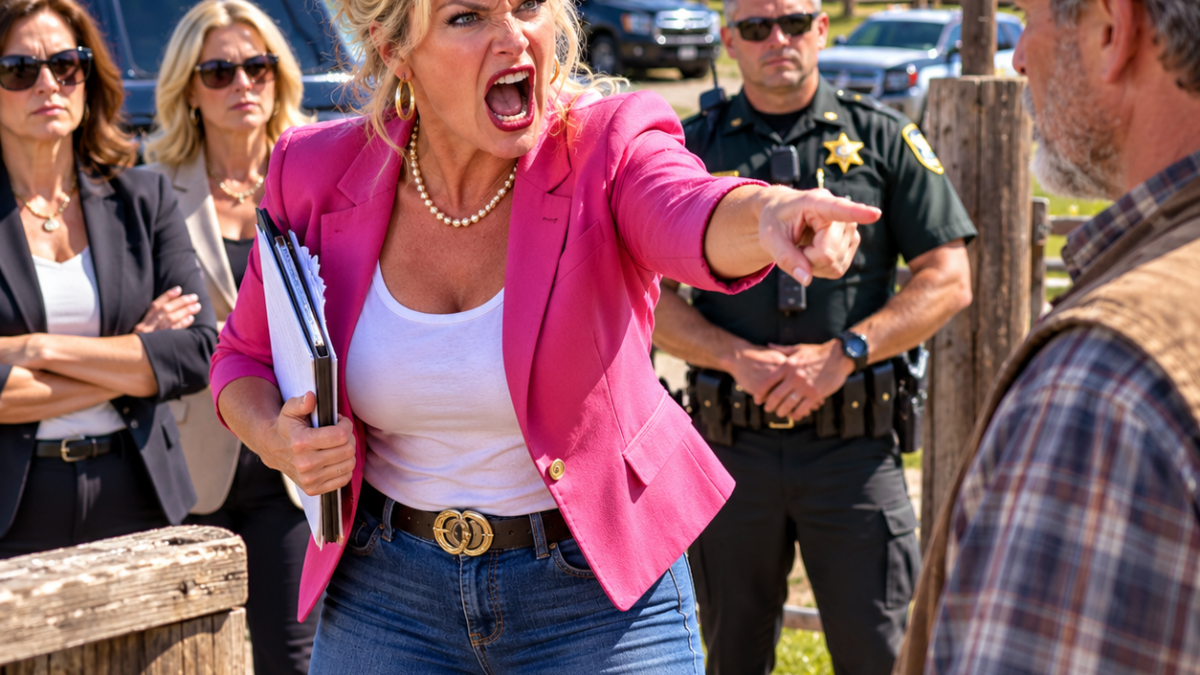
PART 2
The next morning, I sat at Uncle Walter’s kitchen table with three things in front of me.
A pot of black coffee.
The original Jennings Ranch survey from 1873.
And my phone.
The map was fragile enough that I handled it by the edges.
One hundred fifty years of family ownership was traced in fading ink.
Creek.
North pasture.
South pasture.
Old wagon road.
Timber ridge.
Cattle pond.
No subdivision.
No HOA.
No “community-adjacent” designation.
Nothing even remotely resembling Angela Faircroft’s invented jurisdiction.
I called Attorney General Marcus Hale.
Marcus and I had known each other since college.
Back then he had been the kind of student who corrected professors.
Now he was the kind of attorney general who corrected government agencies.
He answered with, “Please tell me you aren’t calling to move the budget meeting.”
“I have an HOA trying to annex my ranch.”
Silence.
Then laughter.
Not polite laughter.
He actually had to move the phone away.
“You’re serious?”
“Unfortunately.”
“The ranch?”
“Walter’s place.”
“The one from the nineteenth century?”
“Same one.”
“And some HOA thinks it owns jurisdiction?”
“They voted.”
He started laughing again.
“I’m glad this is entertaining.”
“I’ve had a difficult week.”
“Angela Faircroft.”
The laughter stopped.
“You know the name?”
“I know of her.”
That caught my attention.
“How?”
“Oak Hollow has been lobbying county zoning for expanded development designations.”
“So she really has been trying this.”
“She has filed several petitions.”
“Approved?”
“Not that I know.”
“She claims ownership of adjacent wooded parcels lets her annex mine.”
“It doesn’t.”
“I figured.”
Marcus became quieter.
“You want me to send somebody from the state land registry?”
“Not yet.”
“Trevor.”
“I want to know what she thinks she can get away with.”
“That sentence has historically caused you problems.”
“She mentioned inspection.”
“Do not invite confrontation.”
“I’m not.”
“You are governor.”
“I’m also the landowner.”
“That dual role makes everything complicated.”
“I know.”
“Then document, don’t provoke.”
“I already have cameras.”
He sighed.
“Of course you do.”
The ranch had security cameras long before I inherited it.
Walter installed them after cattle thieves hit farms two counties over.
Old man may have disliked smartphones, but he loved motion sensors.
I upgraded the system after moving in.
Fence posts.
Barn corners.
Driveway.
Ridge line.
All legal.
All recorded.
I hung up with Marcus and stepped onto the porch.
Morning mist still clung to the pasture.
Two barn cats were stretched across the railing, soaking up the first sunlight.
For maybe thirty seconds, everything felt peaceful.
Then a white SUV appeared on the gravel road.
Angela.
This time she brought reinforcements.
Two men climbed out wearing matching khaki pants and polo shirts bearing the Oak Hollow logo.
One carried a measuring wheel.
The other carried a hard black case.
I walked down the steps.
Angela smiled.
It was the kind of smile people use right before handing you a bill.
“Good morning, Governor.”
“Angela.”
“We’re here for the scheduled topographical and environmental assessment.”
“No assessment was scheduled.”
“Our charter provides access.”
“Your charter doesn’t govern this property.”
She handed one of the men a sheet of paper.
“Article sixteen.”
“I don’t care if it’s article one thousand.”
The man with the measuring wheel stepped onto my driveway.
I held up a hand.
“Stop.”
He froze.
“Sir?”
“You have no permission to survey this property.”
Angela’s tone sharpened.
“He’s a certified contractor.”
“That changes nothing.”
The second man opened the black case.
Inside was a drone.
He began unfolding the arms.
I pointed to it.
“Put that away.”
Angela scoffed.
“We’re conducting aerial boundary documentation.”
“Not over this ranch.”
“You don’t own the air.”
“No, but I do own the property you’re using as your launch point.”
She rolled her eyes.
I gestured toward the hill behind the pasture.
“See that ridge?”
The drone operator looked.
“There’s a buried fiber line under it connected to a state wildlife monitoring facility.”
He stopped assembling the drone.
Angela didn’t.
“So?”
“Sensitive state infrastructure. Restricted monitoring equipment. If your drone crosses into that protected zone while recording, you may create a much larger problem than an HOA citation.”
The contractor slowly folded one arm of the drone back.
Angela snapped, “He’s bluffing.”
The contractor looked at her.
Then at me.
“Ma’am, I’m not flying near government infrastructure without authorization.”
“There’s nothing sensitive here.”
I smiled slightly.
“You’re standing six hundred yards from a state-owned wildlife data station.”
The measuring-wheel man took one step backward.
Angela glared at both of them.
“I hired you to perform an assessment.”
The drone operator closed the case.
“And I’m telling you I need authorization.”
“You have authorization.”
“From the property owner?”
He looked at me.
“No.”
“Then we’re done.”
He carried the case toward the SUV.
The other contractor followed.
Angela stayed.
Her face had gone pale with anger.
“You enjoy this.”
“Enjoy what?”
“Using your position to intimidate ordinary citizens.”
I stepped closer, keeping several feet between us.
“You were warned yesterday that this ranch isn’t in your HOA.”
“Our legal counsel disagrees.”
“Then your legal counsel can contact mine.”
“You think your title makes you untouchable.”
“No.”
I pointed toward one of Walter’s cameras.
“That’s why everything happening here is recorded.”
Her eyes moved toward the camera.
She hadn’t noticed it.
“Video and audio,” I added.
The smallest twitch crossed her face.
Then she turned.
As the SUV disappeared down the gravel road, I went inside and replayed the footage.
Clear image.
Clear audio.
Angela asserting inspection authority.
Her contractors stepping onto private property.
The drone being prepared.
Her refusal to leave immediately after being told.
I saved copies in three places.
That afternoon, I drove into town.
There was someone I wanted to talk to before Oak Hollow figured out its next move.
Darla Benton had worked at the county records office for twenty-seven years.
She knew land history the way some people knew baseball statistics.
Her desk was buried beneath folders, paper clips, a half-knitted scarf, and a coffee mug that read:
**I CAN’T FIX STUPID, BUT I CAN FILE IT.**
“Governor.”
“Darla.”
“You here officially?”
“No.”
“Good. Official people make me nervous.”
I sat across from her.
“Tell me about Oak Hollow.”
She stared at me.
“What did Angela do?”
“That obvious?”
“She has a particular effect.”
I explained the attempted annexation.
Darla leaned back.
“That woman has lost her mind.”
“Has she tried this before?”
“Not like that.”
“Like what?”
“She has been pushing zoning petitions for two years.”
Darla opened a drawer.
“Wanted a designation called ‘community-adjacent rural enhancement zone.’”
“That real?”
“No.”
“Thought so.”
“She kept rewriting it until it sounded official.”
She handed me a thick file.
Inside were petitions.
Maps.
Letters.
Requests for zoning consideration.
Oak Hollow wanted authority over properties surrounding the subdivision.
Not ownership exactly.
Influence.
Design review.
Vegetation restrictions.
Access rights.
“Why?” I asked.
“Expansion.”
“Development?”
“Eventually.”
Darla tapped one map.
“See these parcels?”
A ring of small rural properties surrounded Oak Hollow’s eastern side.
“She wants them?”
“She wants control of them.”
“Same thing if you pressure owners long enough.”
Darla looked at me.
“Exactly.”
“How much support does she have?”
“More than she should.”
“County board?”
“Some members.”
“Why?”
She removed her glasses.
“Beautification grants.”
“Meaning?”
“Oak Hollow community foundation makes donations to projects favored by certain districts.”
“You think those are bribes?”
“I think I file records.”
“Darla.”
She looked at me.
“I think you should ask why one zoning board member’s brother got a landscaping contract three weeks after voting for an Oak Hollow variance.”
That was enough.
I asked for public copies of every petition.
The stack barely fit in my briefcase.
As I reached my truck, my chief of staff called.
“You sitting down?”
“No.”
“Angela Faircroft filed an ethics complaint against you.”
I stopped.
“For what?”
“Threatening a private citizen during a personal land dispute.”
I laughed.
“You’re kidding.”
“She says you used your office to intimidate her and interfere with lawful community operations.”
“Did she mention trespassing?”
“No.”
“The drone?”
“No.”
“Survey contractors?”
“No.”
“She does say you threatened federal prosecution.”
“I warned a contractor about restricted infrastructure.”
“I’ve seen the footage.”
“Then why are we talking?”
“Because ethics complaints create paper even when they’re ridiculous.”
“Respond with the complete video.”
“Already happening.”
I hung up.
When I reached the ranch at dusk, something was waiting on the porch.
A manila envelope.
No mailing label.
No name.
No note.
I opened it inside.
Photographs slid onto the kitchen table.
My house.
My truck.
Me walking from the barn.
Me feeding cattle.
Me standing near the creek.
Some were close.
Others were shot from the ridge with a long lens.
I checked security footage.
Nobody approached from the driveway.
Then I checked the camera blind spots.
Whoever delivered the envelope knew them.
That was when the story changed.
Angela’s annoyance was one thing.
Professional surveillance was another.
I walked the perimeter that night carrying a flashlight.
Nothing.
Only cattle moving softly in the darkness.
At sunrise, Deputy Luis Ramirez arrived.
Luis was a former Army intelligence specialist who had worked cybercrime in Dallas before deciding rural law enforcement sounded quieter.
He examined the photographs.
“These aren’t phone pictures.”
“I figured.”
“Long lens.”
“How long?”
“Enough to shoot across the ridge.”
He studied one image.
“Whoever took these knew where to stand.”
“HOA?”
“Maybe.”
I handed him the security footage from Angela’s attempted inspection.
He watched silently.
“They were told to leave?”
“Yes.”
“They returned after yesterday’s warning?”
“Yes.”
“Then you have a criminal trespass argument.”
“What about the photos?”
“We start a case file.”
“Good.”
“You want me to question Angela?”
“Not yet.”
His eyebrows rose.
“Governor, when somebody photographs you from concealment and hand-delivers the evidence, that’s not ordinary HOA drama.”
“I know.”
“Then why wait?”
“Because I think she wants me focused on the ranch.”
“While?”
“Something else is happening.”
Luis looked toward Oak Hollow in the distance.
“What?”
“I intend to find out.”
That answer came faster than I expected.
Two days later, a woman named Evelyn Greaves called my office.
She refused to speak to staff.
She would only talk to me.
Her voice trembled.
“Governor Jennings?”
“Yes.”
“I heard about Oak Hollow.”
“What about it?”
“They did it to me.”
I sat straighter.
“Did what?”
“They took my house.”
Her property had once sat between two parcels Oak Hollow wanted for expansion.
Small farmhouse.
Three acres.
Red front door.
Her husband had died five years earlier.
She lived alone.
Then violation notices started arriving.
Not HOA violations exactly.
“Community hazard warnings.”
Tree maintenance.
Drainage.
Supposed structural problems.
Then came a condemnation notice.
“They said the county declared the house unsafe.”
“Who delivered it?”
“Two men.”
“County employees?”
“They said they were.”
“Uniforms?”
“Polo shirts.”
My stomach tightened.
“What happened?”
“They told me I had thirty days to leave.”
“Did you contact the county?”
“I tried.”
“What did they say?”
“Nobody could find my case.”
“So why did you leave?”
There was silence.
“They said if I fought, I’d be responsible for demolition costs and legal fees.”
“How much?”
“More than I had.”
“Where’s the property now?”
“Oak Hollow owns it.”
I closed my eyes.
“Evelyn, do you still have the paperwork?”
“Every page.”
“Meet me at the county courthouse tomorrow.”
She arrived carrying a battered leather folder.
Inside were photographs.
Before.
A neat farmhouse with ivy across the porch.
After.
Rubble.
The condemnation notice bore Oak Hollow letterhead.
No county seal.
No county case number.
Signed by someone listed as:
**David Kern, Compliance Director**
I searched state employment records.
No David Kern.
County records.
Nothing.
Oak Hollow staff.
Nothing.
“He didn’t exist,” I said.
Evelyn’s hands tightened.
“I lost my home because of a man who didn’t exist?”
“We don’t know yet.”
She looked at me.
“You know.”
I did.
I just wasn’t ready to say it until investigators could prove it.
“Did Oak Hollow pay you?”
“They bought the lot after demolition.”
“How much?”
She showed me.
Less than half market value.
“Did you have a lawyer?”
“No.”
“Family?”
“My sister.”
“Anyone else knew?”
“People knew I moved.”
“No one knew why?”
Her eyes filled.
“Who listens to a sixty-eight-year-old widow arguing with an HOA?”
I didn’t have an answer.
That afternoon, I called Ramirez.
“Pull every Oak Hollow-related property acquisition from the last two years.”
“How many?”
“All.”
“What am I looking for?”
“Condemnations. Foreclosures. Demolitions. Forced sales.”
“You think Evelyn isn’t alone?”
“I think she’s the first person who finally found somebody willing to listen.”
That night, another man came to the ranch.
James Lorn.
Former city planner.
He arrived at nine carrying a sealed envelope.
“I was on the county zoning advisory board.”
“Was?”
“Angela got me removed.”
“Why?”
“I opposed boundary expansion.”
He sat on Walter’s porch.
His hands shook.
“She pressured three board members to support Oak Hollow’s petitions.”
“How?”
“Campaign donations. Contracts. Community grants.”
“Illegal?”
“Some. Maybe all.”
“What happened when you complained?”
“They accused me of conflict of interest.”
“For what?”
“Supposedly owning part of a landscaping company.”
“Do you?”
“I’ve never owned a lawnmower.”
He handed me the envelope.
Emails.
Budget records.
Internal memos.
One document stood out.
**BEAUTIFICATION PROJECT — PHASE 4**
Another:
**PRIVATE COMMUNITY ENFORCEMENT SERVICES**
The vendor was a Nevada corporation.
No local address.
No employee names.
I looked at James.
“The men with Angela.”
“Probably.”
“They’re not security?”
“They call themselves compliance contractors.”
“What do they actually do?”
“Knock on doors.”
“And?”
“Pressure people.”
“How?”
“Threats. Photos. Notices. Repeated inspections.”
“How many families?”
“I know five who sold below market.”
“Why?”
“They couldn’t take it anymore.”
That night, sleep didn’t come.
This wasn’t about my ranch.
My ranch was simply where Angela finally met somebody with enough resources to resist.
The next morning Ramirez called.
“Seventeen property transfers.”
I stood at the fence.
“Seventeen?”
“In two years.”
“How many condemnations?”
“Nine.”
“County inspection records?”
“None.”
“Demolition permits?”
“Some paperwork, but not legitimate county-originated condemnations.”
“Who did the demolition?”
“Subcontractors through a Nevada shell company.”
“The same company paying Angela’s enforcers?”
“Looks connected.”
I felt my anger turn cold.
“Send everything to Marcus Hale.”
“Already packaged.”
“Mark urgent.”
“Done.”
I drove straight to the capital.
Marcus met me in his office.
I placed Evelyn’s folder on his desk.
Then James’s emails.
Then Ramirez’s property list.
Then surveillance photos.
Then Angela’s private security requisition.
Marcus stopped joking.
“This is racketeering territory.”
“You’re sure?”
“If the pattern proves coordinated acquisition through threats, fraudulent notices, shell companies, and corrupted government processes? Yes.”
“Money laundering?”
“If funds moved through the shells.”
“Extortion?”
“Potentially.”
“What do you need?”
“Evidence that ties Angela personally to the conduct.”
“Her signatures are everywhere.”
“I want more.”
“How much more?”
“Enough that no defense lawyer can call this overzealous prosecution by a governor with a personal land dispute.”
That was the problem.
I was both victim and governor.
Every action would be scrutinized.
If I pushed too hard, Angela could claim political retaliation.
If I stepped away entirely, more people could be hurt.
So I made one decision.
From that point forward, I would not direct the criminal investigation.
Marcus’s office would.
State police would.
The U.S. Attorney could join if appropriate.
I would provide evidence only as a property owner and witness.
Marcus agreed.
“Good.”
“Doesn’t mean I’m going quiet.”
“I didn’t expect miracles.”
Three days later, Evelyn called me.
Her voice was different.
Not frightened anymore.
Furious.
“There’s a black SUV outside my sister’s house.”
“You recognize it?”
“No plates I can see.”
“Stay inside.”
“It followed me yesterday.”
“Where?”
“Grocery store.”
“Did you call police?”
“Yes.”
“Good.”
“Trevor, they’re watching me because I talked.”
I looked out toward the ranch gate.
“Pack a bag.”
“What?”
“Come here.”
“The ranch?”
“I have state police coordinating security because of the surveillance against me. You’ll be safer.”
“I don’t want to create trouble.”
“You’re already in trouble.”
She arrived before sunset.
I gave her Walter’s old guest room.
She stood in the doorway.
“Does this lock?”
“From inside.”
She checked anyway.
That broke something in me.
A woman had lost her home, been ignored by officials, and now she was afraid to sleep unless she could lock herself behind a door.
Angela called that beautification.
I called it cruelty.
That night, Ramirez came with two investigators.
We spread documents across Walter’s dining table.
“What we still need,” one investigator said, “is direct evidence connecting the enforcement contractors to unlawful activity.”
I looked toward the window.
“What if they come back?”
Ramirez frowned.
“You expect them to?”
“They photographed me.”
“True.”
“They watched Evelyn.”
“True.”
“They tried to survey my land twice.”
“True.”
“So give them something they think they want.”
Nobody answered.
I explained.
We placed a utility trailer near the eastern ridge.
Visible from the road.
A truck beside it.
Inside the windshield:
**SURVEY EQUIPMENT DROP SITE**
Fake invoice.
Fake delivery manifest.
Nothing sensitive.
Nothing illegal.
But enough to tempt someone desperate to know what evidence we were collecting.
Then we waited.
First night.
Nothing.
Second night.
1:31 a.m.
My phone vibrated.
**EAST RIDGE MOTION ALERT.**
Two figures appeared on thermal camera.
Dark clothes.
No headlights.
They crossed the fence line.
One carried a crowbar.
The other carried a black equipment bag.
I recognized the shape.
Drone case.
State troopers were positioned beyond the trees.
The two men reached the trailer.
One began working the lock.
Then floodlights came on.
“STATE POLICE! HANDS WHERE WE CAN SEE THEM!”
Everything happened in seconds.
One man dropped the crowbar.
The other tried to run.
He made it twelve yards.
Troopers had both cuffed before I stepped onto the porch.
Angela’s contractors.
The same men who had attempted to map my ranch.
Their backgrounds made things worse.
One had prior breaking-and-entering charges.
The other had worked for a private property reclamation company in Arizona shut down over illegal eviction practices.
Morning news picked up the arrests.
Angela responded with a statement:
**Oak Hollow HOA condemns the unauthorized actions of independent contractors who operated outside the scope of their duties.**
Marcus called me.
“She just made a mistake.”
“How?”
“Calling them independent.”
“Why?”
“Financial records show they were paid through the Nevada shell company.”
“And?”
“James has internal requests signed by Angela authorizing those payments.”
The chain was forming.
Then Evelyn identified one of them.
“He gave me the condemnation notice.”
That was enough for warrants.
State investigators raided Angela’s house.
They seized laptops.
Phones.
External drives.
Bank records.
Printed property maps.
On one computer, they found photographs of rural homes surrounding Oak Hollow.
Some had red Xs over them.
One folder was titled:
**RECLAIM TARGETS — Q3**
Evelyn’s former home was inside.
So was mine.
My ranch had a note.
**HIGH VALUE — RESISTANT OWNER**
I read that line twice.
Resistant owner.
As though property rights were a behavioral defect.
Then investigators found a spreadsheet.
Potential acquisitions.
Estimated owner vulnerability.
Age.
Debt.
Property value.
Legal representation.
One column was labeled:
**PRESSURE INDEX**
Elderly widows rated high.
Families behind on medical bills rated high.
Absentee owners rated high.
People with attorneys rated low.
My name was at the bottom.
Beside it:
**POLITICAL COMPLICATION — ALTERNATIVE STRATEGY REQUIRED**
That was why they had photographed me.
Not because Angela lost her temper.
Because after I refused to obey, I became a target.
Angela was arrested the following morning.
Not on my ranch.
Not at the capitol.
Outside the Oak Hollow Community Center.
Appropriate, I thought.
She had turned that building into the headquarters of her private little empire.
Now state police waited outside it.
Video later showed her coming down the steps.
Perfect hair.
Dark glasses.
Expensive coat.
Two investigators approached.
At first, she looked annoyed.
Then one displayed the warrant.
Her face changed.
She tried to turn back toward the building.
An investigator stopped her.
Within seconds her hands were behind her back.
Conspiracy.
Fraud.
Racketeering-related charges.
Unlawful surveillance.
Additional property offenses still under review.
More charges would come.
The Oak Hollow board started collapsing before Angela reached booking.
The vice president resigned after emails showed he had purchased two properties acquired after questionable condemnations.
Both for far below assessed value.
The treasurer disappeared.
Authorities later learned he had boarded an international flight.
Accounts were frozen.
Property transfers flagged.
The county halted every Oak Hollow expansion request.
Reporters descended.
I held a press conference outside the county courthouse.
My communications director begged me to use the governor’s podium.
I refused.
No state seal.
No flags.
No official backdrop.
Just me standing beside Evelyn, James, and several affected landowners.
A reporter shouted, “Governor Jennings, is this personal revenge against the HOA president who challenged your ranch?”
I looked directly at the camera.
“This stopped being about my ranch the moment I learned other families had lost their homes.”
Another reporter called, “Did your office target Oak Hollow?”
“No.”
“Did you personally direct Angela Faircroft’s arrest?”
“No.”
“Then what is your role?”
“Witness.”
I paused.
“Landowner.”
Then I looked at Evelyn.
“And neighbor.”
Cameras clicked.
“This case isn’t about lawn color, barn roofs, or one argument between an HOA president and a rancher.”
I held up one of Evelyn’s fake condemnation letters.
“This is about power being used as a weapon against people who didn’t have enough money to fight back.”
The crowd went quiet.
“They counted on people being isolated.”
I lowered the letter.
“They counted wrong.”
The county zoning board reversed every pending Oak Hollow expansion designation.
Previously altered rural classifications were reopened for review.
Properties acquired through questionable processes were frozen pending investigation.
Then came the court order.
Oak Hollow HOA was placed under receivership.
Its enforcement authority was suspended.
Weeks later, the association would be dissolved.
For the first time since Walter died, the ranch became quiet.
No SUVs.
No drones.
No people measuring gravel.
No threatening letters.
One evening Evelyn joined me on the porch.
She wore a light shawl around her shoulders.
We watched cattle moving across the field.
“Thank you,” she said.
I didn’t answer immediately.
There are moments when saying “you’re welcome” feels wrong.
As if justice is some favor.
Finally I said, “You should never have needed me.”
She looked toward the pasture.
“But I did.”
That was true.
And it bothered me.
The week after Angela’s arrest, people began coming to the ranch.
Not reporters.
Victims.
Curtis Bell arrived first.
Former county appraiser.
He sat in Walter’s rocking chair with his hat in his hands.
“I flagged Oak Hollow acquisitions.”
“When?”
“Almost two years ago.”
“What did you find?”
“Property values.”
“What about them?”
“Homes acquired after condemnations were valued far below comparable properties.”
“Did you report it?”
“Yes.”
“What happened?”
“I was transferred.”
“Who ordered it?”
He named a zoning consultant.
Investigators checked.
No professional credentials.
Multiple shell companies.
Post office boxes.
Payments from developers.
Then a mother arrived with her teenage son.
His arm was in a sling.
She didn’t sit.
“They cut our water.”
“Who?”
“Oak Hollow.”
“Why?”
“They said we owed dues.”
“Did you?”
“No.”
She held up receipts.
“I paid.”
“How long was the water off?”
“Three days.”
Her son had tried to reopen the exterior service connection.
He slipped.
Broke his arm.
Oak Hollow sent them another violation for tampering with community utilities.
She handed me a USB drive.
“I recorded the calls.”
I listened that night.
An Oak Hollow representative threatening additional fines.
Another warning that their voting privileges could be suspended.
A third saying utility restoration required an “administrative compliance fee.”
I sent everything to Marcus’s task force.
Additional fraud counts followed.
But the most devastating evidence came from Angela herself.
Ramirez arrived one evening carrying a sealed evidence summary.
“You’re going to want to sit down.”
“What now?”
“Her computer had audio archives.”
“Of what?”
“Everything.”
Angela had recorded board meetings.
Calls.
Private negotiations.
Backroom conversations.
Apparently she didn’t trust her partners.
That paranoia preserved the entire conspiracy.
One recording featured Angela speaking with a man identified only as “D.”
Her voice was unmistakable.
“We push the next three lots into acquisition.”
The man asked, “What if owners refuse?”
“Maintenance liens. Health notices. Let penalties accumulate.”
“County?”
“They won’t see anything.”
“How?”
“I’ve got the inspector handled.”
Then the line that changed the scope again.
“Once we control the properties, transfer through the new LLC. Strip the record. Resell.”
The man’s voice:
“And returns?”
Angela laughed.
“You get your return. I get control.”
Investigators identified “D.”
Douglas Rennert.
Out-of-state developer.
He had funneled nearly two million dollars into entities connected to Oak Hollow expansion.
He was arrested in Phoenix while stepping off a plane.
Suddenly Oak Hollow wasn’t a rogue HOA.
It was part of a property acquisition machine.
Targets were pressured.
Some fined.
Some falsely condemned.
Some denied services.
Some threatened with liens.
Then shell entities bought property cheaply.
Developers consolidated parcels.
Profits moved through layered companies.
Angela received money and control.
Board allies received opportunities.
Corrupt officials received payments.
Residents received intimidation.
More than twenty indictments followed across the network.
The public reaction was enormous.
People from other counties started sending complaints about their HOAs.
Most were ordinary disputes.
Some weren’t.
One elderly man claimed his association had fined him thousands after refusing to sell an access strip.
A widow said her HOA threatened foreclosure over disputed landscaping assessments.
A disabled veteran described being denied driveway modifications until attorneys intervened.
The case had exposed something larger than Oak Hollow.
Not that all HOAs were criminal.
They weren’t.
But any system granting private organizations coercive power over homes required transparency.
And transparency had been exactly what Angela avoided.
The trial began months later.
I attended only when subpoenaed.
I refused to use the governor’s entrance.
I walked through the same courthouse doors as everyone else.
Reporters lined the steps.
Inside, every seat was filled.
Evelyn testified first.
She wore the same faded denim jacket she had worn when she first met me.
The prosecutor showed the jury a picture of her farmhouse.
Red door.
Ivy.
Flower boxes.
“Was this your home?”
“Yes.”
“For how long?”
“Thirty-one years.”
“What happened?”
“They told me it was condemned.”
“Who?”
“Oak Hollow representatives.”
“Did the county condemn your property?”
“No.”
“Did you know that at the time?”
“No.”
“Why did you leave?”
Her voice caught.
“Because they made me believe fighting would ruin me.”
The prosecutor displayed the fake notice.
“Did you receive this?”
“Yes.”
“Did anyone explain that the listed compliance director did not exist?”
“No.”
“What did you think when you learned the truth?”
Evelyn looked toward Angela.
Not angry.
Not dramatic.
Just tired.
“They made me feel stupid for loving my own home.”
Nobody moved.
“They said keeping it was selfish. Ugly. Bad for property values.”
Her eyes filled.
“So eventually I started believing maybe they were right.”
That testimony hurt more than any financial spreadsheet.
Because that was Angela’s real weapon.
Not fines.
Shame.
Convince people they deserved what was happening.
James testified.
He described zoning pressure.
Curtis described manipulated valuations.
The mother with the injured son played recorded threats.
Ramirez explained surveillance evidence.
State investigators showed shell-company transfers.
Then audio recordings filled the courtroom.
Angela’s own voice.
“Maintenance liens.”
“Health hazards.”
“Inspector on payroll.”
“Strip the record clean.”
When that recording played, Angela flinched.
Only once.
But everybody saw it.
My testimony came later.
The prosecutor asked about the first encounter.
“Did Ms. Faircroft tell you your ranch had been annexed?”
“Yes.”
“Was it?”
“No.”
“Did she have any lawful authority to inspect your land?”
“No.”
“Did you identify yourself as governor?”
“Yes.”
“Why?”
“Because she assumed I was an uninformed landowner she could intimidate.”
“Did you threaten her with your office?”
“No.”
“What did you tell her?”
“That she was trespassing.”
The defense attorney stood.
“Governor Jennings, you’re one of the most powerful individuals in this state, correct?”
“Legally, my office has significant responsibilities.”
“Power.”
“Responsibility.”
“Would Ms. Faircroft have reason to fear retaliation after learning your identity?”
“Anyone breaking the law should fear legal consequences.”
He smiled.
“So yes?”
“No.”
His smile faded.
“Then explain.”
“She should not fear me.”
I looked toward the jury.
“She should fear evidence.”
The courtroom went still.
The defense attorney changed subjects.
He suggested my administration used state resources against a private political opponent.
I answered every question.
Who opened investigations?
Independent prosecutors.
Who issued warrants?
Judges.
Who arrested defendants?
Law enforcement acting on warrants.
Who presented charges?
Prosecutors.
Had I ordered any of those acts?
No.
Then he made a mistake.
“Governor, isn’t it true that this entire prosecution began because Ms. Faircroft offended you personally?”
I looked at Evelyn.
Then the family behind her.
Then James.
Curtis.
Dozens of victims.
“No.”
I faced the attorney.
“It began because she thought offending people was the same thing as owning them.”
The judge told the jury to disregard rhetorical commentary.
But the words were already there.
The trial lasted weeks.
The jury deliberated less than six hours.
When they returned, the courtroom filled again.
Angela stood.
One count.
Guilty.
Second.
Guilty.
Third.
Guilty.
Again.
Again.
Again.
Conspiracy.
Fraud.
Racketeering-related offenses.
Unlawful surveillance.
Extortion-related counts.
Property offenses.
Guilty.
Evelyn closed her eyes.
Curtis bowed his head.
The mother with the injured son covered her mouth.
I felt no joy.
Only release.
Angela stared straight ahead.
She didn’t cry.
She didn’t apologize.
She didn’t turn around.
Sentencing came later.
Years.
Restitution.
Asset forfeiture.
Civil judgments.
Other defendants received their own outcomes.
Some pleaded guilty.
Some cooperated.
Some fought.
Douglas Rennert eventually entered a deal in exchange for information about other property schemes.
Several officials resigned.
One zoning inspector pleaded guilty to taking payments.
The former Oak Hollow vice president faced charges tied to property acquisitions.
The treasurer was eventually located abroad and returned through legal proceedings.
It took time.
Justice usually does.
While courts worked, we worked on something else.
Prevention.
I asked for a legislative review of HOA authority statewide.
That became controversial immediately.
Some groups accused me of trying to destroy homeowners associations.
I wasn’t.
Plenty of communities used HOAs responsibly.
The problem wasn’t existence.
The problem was unchecked power.
We proposed mandatory financial audits above certain revenue thresholds.
Transparent vendor ownership disclosures.
Limits on compounding fines.
Clear notice and appeal rights.
Restrictions on utility interference.
Stronger protections against retaliatory liens.
Criminal penalties for falsified enforcement documents.
Most importantly, no HOA could annex private property without explicit written consent from every affected landowner.
The bill attracted unusual allies.
Conservatives who cared about property rights.
Progressives concerned about predatory housing practices.
Rural lawmakers angry over expansion.
Suburban legislators flooded with constituent complaints.
The final vote passed with overwhelming support.
When I signed the bill, reporters asked whether Angela Faircroft inspired it.
“No.”
I looked toward Evelyn, who had been invited to stand beside the signing table.
“People like Evelyn inspired it.”
She smiled.
That mattered more than headlines.
Back at Oak Hollow, the old HOA was gone.
Court-supervised administrators unwound its accounts.
Legitimate shared assets transferred to a voluntary neighborhood cooperative.
Road maintenance continued.
Common drainage continued.
The pool stayed open.
The world did not end because nobody was measuring mailbox color.
Residents voted on expenses.
Every financial statement was visible.
No private compliance army.
No hidden acquisition fund.
No property-target spreadsheet.
Some people moved anyway.
One elderly couple told me they were exhausted.
I met them while they loaded potted plants into a van.
“We’re leaving,” the husband said.
“You sure?”
“Yes.”
“Anything I can do?”
He shook his head.
“My wife wakes up every time a white SUV parks outside.”
I understood.
Justice doesn’t erase fear immediately.
Sometimes victory comes too late for people to want to stay on the battlefield.
I helped load their plants.
They thanked me.
Then they drove away.
That stayed with me.
I had become used to stories with satisfying outcomes.
Arrest.
Verdict.
Law signed.
Land returned.
But real damage doesn’t disappear because the newspaper runs a victory headline.
Evelyn never got thirty-one lost years back.
Her farmhouse had been demolished.
The family with the injured son still had medical bills.
Residents had spent years afraid.
Walter had died believing an HOA might someday come for his ranch.
That last part hurt.
One evening I went through his desk.
I found letters.
Receipts.
Handwritten cattle records.
Then an envelope marked:
**OAK HOLLOW**
Inside were three notices.
First:
**AESTHETIC CONCERN — PERIMETER FENCING**
Second:
**LIVESTOCK VISIBILITY REVIEW**
Third:
**FUTURE COMMUNITY INTEGRATION NOTICE**
Walter had written across the bottom in red pencil:
**NOT THEIR LAND.**
I laughed.
Then cried.
It surprised me.
I sat alone in his office holding that stupid paper while tears hit the desk.
Walter had been eighty-two.
Widowed.
Stubborn.
Sick.
Oak Hollow sent him notices anyway.
He never told me.
Maybe he didn’t want help.
Maybe he thought it was nonsense.
Maybe he knew I was busy governing.
Maybe he believed he could handle it until he couldn’t.
I wished I had called more.
Political life makes everything feel urgent.
Budgets.
Schools.
Storm response.
Press conferences.
Appointments.
Bills.
There is always something demanding attention.
Then one day the person you meant to call is gone.
That regret became part of the ranch.
I couldn’t change it.
I could only decide what I did next.
Evelyn eventually received restitution through combined civil recovery and compensation programs.
It wasn’t enough to rebuild the exact house she lost.
Nothing could.
But we helped her purchase a small cottage outside town.
Red front door.
She chose that herself.
The first day I visited, ivy had already been planted near the porch.
“You’re recreating it.”
“No.”
She smiled.
“Starting again.”
Inside, she hung one photograph of the original farmhouse.
Not dozens.
One.
“I don’t want the old house to become the only home I ever had.”
That sentence stayed with me.
Oak Hollow was doing the same.
Starting again.
Not pretending nothing happened.
Not living forever inside it.
James returned to planning work as a consultant.
Curtis retired completely.
Ramirez complained that his quiet rural assignment had become the biggest investigation of his career.
Marcus framed the first absurd Oak Hollow annexation map and hung it behind his desk.
Underneath he wrote:
**NO, YOU CANNOT JUST VOTE TO OWN THINGS.**
I told him it wasn’t professional.
He said neither was my face when Angela first mentioned annexation.
The ranch slowly became home to me again.
At first every white SUV made me look toward the gate.
Every drone sound made me stop.
Every unfamiliar car made me check cameras.
Then months passed.
Nothing.
The trail cameras returned to recording deer.
Coyotes.
Raccoons.
One particularly stupid turkey that attacked its own reflection.
I repaired Walter’s barn roof.
Not because Angela complained.
Because it actually leaked.
That distinction made the work satisfying.
I replaced rotten boards on the fence.
Repainted the porch.
Restored the old cattle chute.
I kept Walter’s tools exactly where he’d left them.
One evening Ramirez came by carrying a wooden sign.
“You make this?”
“No.”
“Curtis.”
Burned into the wood:
**THIS LAND STANDS FREE**
I stared at it.
“Dramatic.”
“You’re governor.”
“Fair.”
We hung it on the porch beam.
The next summer, I hosted a cookout.
No campaign signs.
No reporters.
No state staff except Marcus, who claimed free barbecue fell under attorney general emergency jurisdiction.
Evelyn came.
James.
Curtis.
Ramirez.
Oak Hollow families.
Kids ran through the meadow.
Someone brought a guitar.
Someone else brought too much potato salad.
For the first time, people from Oak Hollow stepped onto the ranch because they were invited.
That mattered.
Evelyn stood beside the split-rail fence.
“This is the one?”
“What?”
“The famous fence Angela hated.”
“Part of it.”
She touched the weathered wood.
“How old?”
“Sections are newer. Original line dates back generations.”
“She really thought she could regulate this?”
“She thought she could regulate everything.”
Evelyn smiled.
“Not anymore.”
At sunset, I stood on the porch.
Maybe sixty people scattered across the yard.
Laughter.
Children.
Neighbors.
A year earlier, this place had been under surveillance.
Now Ramirez was losing badly at horseshoes to a fourteen-year-old.
That felt like justice too.
Later, after everyone left, I walked the fence line alone.
Stars over the ridge.
No drones.
No flashlights.
No contractors.
The grass moved softly.
I stopped where Angela first stood with her clipboard.
I could still picture her.
“You can’t park there.”
Funny.
She entered my life believing authority came from saying something confidently enough.
That was her entire system.
Fake compliance director?
Say he exists.
Illegal condemnation?
Print it on official-looking paper.
Stolen property?
Call it acquisition.
Intimidation?
Call it enforcement.
Bribes?
Call them beautification grants.
Private muscle?
Call them compliance contractors.
Annexation?
Call it community enhancement.
The words were camouflage.
Strip them away and the truth was ugly.
People were being robbed.
That was why language mattered so much in the trial.
Evelyn didn’t “transition out.”
She was forced from her home.
Residents didn’t “voluntarily sell after compliance proceedings.”
They were pressured.
Angela didn’t “expand community influence.”
She targeted land.
And Walter’s ranch wasn’t “community-adjacent.”
It was ours.
One hundred fifty years.
The following fall, I received an invitation from Oak Hollow’s new neighborhood cooperative.
Annual meeting.
I almost threw it away.
Then I saw a handwritten note.
**No fines. We promise. —Evelyn**
I went.
The former HOA clubhouse looked completely different.
The president’s raised table was gone.
Everyone sat at the same level.
Financial statements were projected on a screen.
Actual numbers.
Vendor bids.
Insurance costs.
Pool maintenance.
Road repairs.
A woman asked why landscaping spending had increased twelve percent.
Someone answered.
No one threatened her.
A man challenged a contractor quote.
They agreed to seek another estimate.
Democracy turned out to be boring.
Beautifully boring.
At the end, the chairwoman asked if I wanted to speak.
“No.”
People laughed.
“You’re governor.”
“Exactly why you’ve heard enough speeches.”
Evelyn stood.
“He came all this way.”
I shook my head.
“I came to watch.”
“Watch what?”
I looked around.
“This.”
People waited.
“You disagreeing without being afraid.”
Nobody joked after that.
The chairwoman nodded.
“Fair.”
When I returned home, Walter’s porch light was on.
I had installed an automatic timer.
He hated wasting electricity.
I left it anyway.
Some rebellions are small.
A year after Angela’s conviction, one final investigation report arrived.
Hundreds of pages.
Property transfers.
Payment trails.
Shell companies.
Internal messages.
The report concluded that Oak Hollow’s expansion strategy had targeted seventeen properties.
Nine involved fraudulent or unsupported condemnation processes.
Five owners sold under documented coercive pressure.
Three fought successfully before Angela’s network could complete acquisition.
The Jennings Ranch was intended to become the largest future target.
Why?
A private memo answered.
Our eastern acreage connected Oak Hollow to a proposed resort corridor.
If acquired, developers could have built upscale homes, trails, and a commercial lodge stretching toward the wildlife ridge.
Projected value:
More than forty million dollars.
I stared at that number.
Forty million.
Suddenly Angela’s obsession made sense.
The fence wasn’t ugly.
The cattle weren’t a nuisance.
My barn roof wasn’t offending anyone.
She wanted the land.
Everything else was theater.
Walter had written:
**NOT THEIR LAND.**
Three words.
More truthful than hundreds of pages of their planning documents.
I placed the report in his desk.
Then I locked the drawer.
I didn’t want to live inside evidence forever.
Two years passed.
Then three.
My term as governor moved forward.
Other controversies replaced Oak Hollow.
That’s politics.
Yesterday’s scandal becomes tomorrow’s footnote.
But the law we passed remained.
HOA audits improved.
State complaints decreased in several categories.
Not disappeared.
Human beings remain capable of creating conflict anywhere two driveways meet.
But people had clearer protections.
And associations had clearer limits.
One afternoon Marcus called.
“Guess what?”
“No.”
“You’ll like this.”
“That sentence worries me.”
“First annual statewide HOA compliance report.”
“I have meetings.”
“Complaints involving unlawful annexation?”
“How many?”
“Zero.”
I smiled.
“Good.”
“Apparently your ranch scared everybody.”
“It wasn’t my ranch.”
“I know.”
“It was evidence.”
“You’re becoming insufferably philosophical.”
“Occupational hazard.”
I hung up.
That evening I sat in Walter’s chair.
The porch overlooked the pasture.
Cattle moved lazily in fading sunlight.
The sign above me read:
**THIS LAND STANDS FREE**
I thought about Angela.
Not often anymore.
That’s important.
For a while she occupied too much space in my head.
Anger does that.
It gives the person who hurt you a room in your mind and lets them live there rent-free.
Eventually I evicted her.
Not through forgiveness exactly.
Through irrelevance.
She wasn’t the story.
Walter was.
Evelyn was.
The families were.
The people who testified despite fear were.
The officials who eventually did their jobs were.
The neighbors who rebuilt trust were.
Even Oak Hollow itself was more than Angela.
One corrupt president had convinced everyone her authority and the community were the same thing.
They weren’t.
Communities survive bad leaders.
Sometimes they become stronger after discovering they can.
That realization changed how I governed too.
Power belongs to institutions temporarily.
Never permanently to the person sitting in the chair.
Governors leave.
HOA presidents leave.
Judges retire.
Sheriffs lose elections.
Landowners die.
What matters is whether the rules still protect the next person after you’re gone.
Walter understood that better than I did.
The ranch outlived him.
It will outlive me.
Before my final year in office, I updated my will.
Jennings Ranch would never be sold for subdivision development.
Future heirs could farm it.
Ranch it.
Conserve it.
Live there.
Lease agricultural portions.
But no private association would control it.
No residential annexation without unanimous family consent.
No hidden easements.
Everything recorded.
Everything surveyed.
Everything clear.
My lawyer looked at the restrictions.
“You’re serious.”
“Very.”
“You know future generations may hate you.”
“Family tradition.”
I also created a conservation easement over the wildlife ridge.
That protected the state monitoring corridor and kept the most sensitive acreage undeveloped.
Angela once tried using community rules to claim power over the ranch.
In the end, her attack pushed me to protect it better than Walter ever could.
Irony has a strange sense of humor.
On the fourth anniversary of Walter’s death, I walked to the family cemetery at the north edge.
His stone was simple.
**WALTER JENNINGS**
**1940–2026**
Nothing underneath.
No quote.
He would have hated one.
I stood there with my hat in my hands.
“You missed a lot.”
Wind through dry grass.
“Oak Hollow’s still there.”
Nothing.
“Angela isn’t.”
I smiled.
“Thought you’d enjoy that.”
Still nothing.
Then I told him about Evelyn’s new house.
The law.
The ranch protections.
The cookouts.
The sign.
I didn’t know whether dead men hear.
But living men sometimes need to speak.
Before leaving, I put one thing beside the stone.
Not flowers.
A copy of the old 1873 survey.
Not the original.
Walter would have killed me.
Just a laminated reproduction.
One hundred fifty years of boundary.
Still exactly where it belonged.
As I walked back toward the ranch house, I passed the old split-rail fence.
Angela had called it noncompliant.
She was right.
It didn’t comply with Oak Hollow.
It complied with something older.
History.
Work.
Memory.
Ownership.
Family.
That was enough.
Years later, people still occasionally asked me the same question.
“What was the moment Angela realized she had picked the wrong man?”
Most expected me to say the moment I told her I was governor.
That wasn’t it.
Her hands trembled slightly, yes.
Her confidence cracked.
But she kept fighting.
Being governor didn’t defeat her.
Evidence did.
Evelyn’s photographs.
James’s emails.
Curtis’s valuations.
The mother’s recordings.
Ramirez’s investigation.
The contractors caught trespassing.
Angela’s own audio files.
Bank records.
Shell companies.
Victims willing to testify.
The law worked because people fed it truth.
My title only meant reporters paid attention sooner.
So whenever someone tells the story as:
**HOA Karen picked a fight with the governor and lost,**
I correct them.
She picked fights with widows.
Families.
Retirees.
Ranchers.
Public employees.
Anyone she thought was weaker than her system.
She lost because those people finally stopped standing alone.
That’s the version worth remembering.
One warm October evening, Evelyn came to the ranch.
She carried a pie.
“Apple?”
“Peach.”
“Better.”
We sat on the porch.
She looked toward the pasture.
“You ever think about selling?”
“No.”
“Even for forty million?”
“No.”
“Liar.”
I laughed.
“Okay. Briefly.”
“What stopped you?”
I thought about Walter.
The fence.
The fake annexation map.
The photos left on my porch.
The families.
Then the cookout.
“Forty million buys a lot.”
“It does.”
“But not another one of these.”
She nodded.
For a while we watched the sunset.
Then she said, “I used to hate Oak Hollow.”
“Used to?”
“I hated the place, not just Angela.”
“What changed?”
“The people apologized.”
“All of them?”
“Enough.”
She took a sip of coffee.
“And the new neighbors don’t know me as the woman who lost her house.”
“What do they know you as?”
“The woman who brings too much cobbler.”
“That’s a better legacy.”
She smiled.
“Much.”
Before leaving she stopped beneath the wooden sign.
**THIS LAND STANDS FREE.**
“Curtis did good.”
“He did.”
“You know what’s funny?”
“What?”
“Angela wanted your ranch because she thought owning more land meant more power.”
I looked at the pasture.
“And?”
“You kept it because you finally learned power wasn’t the point.”
She drove away.
I stood there thinking about that sentence.
Maybe she was right.
Angela wanted ownership because ownership meant control.
Walter kept ownership because the ranch was home.
I inherited it thinking those were the same thing.
They weren’t.
A home isn’t valuable because you can control who stands on it.
It’s valuable because you know where you stand.
The next spring, we replaced another stretch of fence.
Bryce from Oak Hollow came to help.
I told him he didn’t have to.
He said he wanted to see whether governors knew how to work.
I handed him a post driver.
Four hours later he stopped making jokes.
At lunch, he looked across the field.
“This really been in your family one hundred fifty years?”
“About that.”
“Long time.”
“Yeah.”
“My family never kept anything that long.”
“Sometimes that’s healthier.”
He laughed.
Then became serious.
“I nearly sold my house when everything broke.”
“Why didn’t you?”
“My daughter.”
“What’d she say?”
“She said if all the decent people leave, only the bad ones get to decide what the place becomes.”
I drove a nail into the rail.
“Smart kid.”
“Gets it from her mother.”
We finished the fence before dark.
The new wood stood beside weathered sections.
Different colors.
Different ages.
Same line.
That image became how I thought about the whole story.
Walter’s generation.
Mine.
Evelyn’s.
Bryce’s daughter.
Different pieces.
Same boundary.
Same principle.
You don’t get to take what belongs to someone else because you have more money, more lawyers, more votes, or a louder voice.
Angela never understood boundaries.
Not property boundaries.
Not ethical boundaries.
Not legal ones.
She kept crossing lines until she crossed one that finally had consequences.
The governor part makes a good title.
I admit that.
A woman storms a ranch.
Threatens a dusty guy in a cowboy hat.
Then discovers he’s the governor.
Funny.
Satisfying.
But the real story began long before she reached my porch.
It began when she looked at people like Evelyn and decided they were easy.
It began when board members stopped asking questions.
When officials accepted favors.
When fake paperwork became convenient.
When residents decided fighting wasn’t worth the trouble.
When everybody assumed somebody else would speak.
Corruption rarely arrives announcing itself.
It grows inside silence.
That is why the moment I remember most isn’t Angela’s arrest.
It isn’t the guilty verdict.
It isn’t signing the reform bill.
It’s Evelyn sitting across from me in that old courthouse holding photographs of her demolished home and saying:
“You’re the first person I’ve told who didn’t hang up.”
That sentence changed me.
A governor spends his life being spoken to.
People want things.
Funding.
Appointments.
Help.
Attention.
Votes.
But hearing isn’t the same as listening.
Walter taught me land.
Evelyn taught me power.
Power matters most when you use it for someone who doesn’t have any.
That was the lesson Angela accidentally left behind.
Near the end of my term, a reporter came to the ranch for a long-form profile.
She wanted the dramatic tour.
The driveway confrontation spot.
The fence cameras.
The ridge where contractors were arrested.
Walter’s survey.
I showed her everything.
Then she asked, “Where did Angela stand when you told her you were governor?”
I pointed.
“Right there.”
She smiled.
“What did her face look like?”
“Like someone had just realized the man she thought she could bully had security detail.”
The reporter laughed.
“Was that satisfying?”
“For about thirty seconds.”
“What was more satisfying?”
I looked across the ranch.
“The quiet.”
She waited.
“No drones.”
I pointed toward the barn.
“No strangers measuring things.”
Toward the gate.
“No fake notices.”
Toward the fence.
“No one telling an old family what belongs to them.”
She lowered her notebook.
“So peace?”
“Peace with records.”
She laughed again.
I didn’t.
Because that was exactly what I meant.
Peace without records can be temporary.
Walter’s ranch had survived one hundred fifty years partly through memory and family knowledge.
That wasn’t enough anymore.
So we had surveys.
Recorded protections.
Legal boundaries.
Conservation documents.
Clear succession.
Trust is good.
Paper matters too.
One of Walter’s old sayings came back to me:
“Good fences don’t make good neighbors. Honest neighbors make fences unnecessary.”
He usually said it while repairing a fence.
That contradiction was pure Walter.
I kept the fences anyway.
By the time I left office, Oak Hollow had become an ordinary neighborhood.
That may be the greatest compliment I can give it.
Ordinary.
No national news.
No raids.
No courtroom crowds.
No governors arguing with HOA presidents.
Just residents complaining about potholes.
Teenagers leaving bikes in driveways.
Parents taking children to the pool.
Neighbors decorating too early for Christmas.
Normal life.
The voluntary cooperative had three rules posted inside the community center.
1. Shared expenses must be transparent.
2. No neighbor has authority over another person’s private property without lawfully recorded agreement.
3. If you think something is illegal, call an attorney before printing a scary letter.
Rule three was apparently Bryce’s idea.
I approved.
Not officially.
I had no jurisdiction.
And that was the point.
The final time I saw Angela was at a restitution hearing years later.
She looked older.
So did I.
Her hair was gray at the roots.
No sunglasses.
No clipboard.
No entourage.
The judge reviewed remaining victim claims.
Evelyn was there.
When court adjourned, Angela passed within a few feet of us.
She stopped.
For one second I thought she might apologize.
Instead she looked at me.
“Are you happy?”
The question surprised me.
“About what?”
“This.”
She gestured vaguely.
Her case.
Her sentence.
The collapsed HOA.
Everything.
I thought before answering.
“No.”
She blinked.
“You destroyed my life.”
“No.”
I kept my voice quiet.
“You built your life on other people’s fear.”
Her jaw tightened.
“And you used your office to make an example of me.”
“No.”
I glanced toward Evelyn.
“You made examples of people who couldn’t fight back.”
Angela looked at her.
Evelyn didn’t flinch.
I continued.
“The courts dealt with you.”
Angela’s eyes returned to mine.
“So you don’t feel anything?”
“I feel relieved.”
“That I’m in prison?”
“That you’re irrelevant to the ranch.”
That hurt her more than anger would have.
I could see it.
Control had always been oxygen to Angela.
Being forgotten was the one thing she couldn’t tolerate.
A bailiff called her forward.
She turned away.
That was the last conversation we ever had.
I never needed another.
Back home, I took off my jacket and walked the pasture.
The sun was setting.
The cattle were near the creek.
A barn cat followed me halfway before losing interest.
I reached the fence.
Ran my hand over the weathered rail.
One hundred fifty years.
Governors come and go.
HOA presidents come and go.
Developers.
Lawyers.
Boards.
Inspectors.
All temporary.
The land remained.
That night, I sat on the porch with Walter’s original survey beside me.
The paper had darkened with age.
Ink faded.
But the lines were still clear.
I thought about everything Angela tried to erase.
Evelyn’s home.
Walter’s ownership.
Families’ rights.
County records.
Truth itself.
She believed paperwork belonged to whoever controlled the printer.
She was wrong.
Real records survived.
People remembered.
Witnesses spoke.
And eventually, truth became heavier than her lies.
I looked up at the wooden sign Curtis made.
**THIS LAND STANDS FREE.**
At first I had thought the words referred to Oak Hollow.
Free from HOA control.
Later I thought they referred to Angela.
Free from intimidation.
Now I understood them differently.
Land isn’t free because nobody has rules.
Land is free when the rules protect the rightful owner as much as they protect the powerful person trying to take it.
That was what we had restored.
Not lawlessness.
Law.
Real law.
Equal law.
Angela accused me that first morning of believing rules didn’t apply to me because I was governor.
She was wrong about that too.
The entire reason she lost was because the same rules applied to both of us.
I couldn’t arrest her because I disliked her.
She couldn’t annex my ranch because she wanted it.
I couldn’t seize Oak Hollow.
She couldn’t seize Evelyn’s home.
Rules had to mean something beyond who was standing closest to power.
Years later, when people retell the story, they still get excited about that moment.
Angela:
“You’ll be fined.”
Me:
“I’m the governor.”
They love it.
Maybe I do too.
Just a little.
But if you asked me for the ending, I’d tell you something less dramatic.
I’d tell you about a porch.
An old rocking chair.
A repaired barn roof.
Cattle moving through golden grass.
Evelyn bringing peach cobbler.
Bryce complaining about fence work.
Ramirez pretending rural policing had finally become boring again.
I’d tell you about Walter’s red pencil words:
**NOT THEIR LAND.**
And I’d tell you that he was right.
They never owned it.
Not Angela.
Not Oak Hollow.
Not the developers.
Not the men with drones.
Not the officials taking money.
They only borrowed control for a while because enough people were frightened into silence.
Then the silence ended.
The truth came out.
The land stayed.
And every evening when the sun drops behind the ridge, the old ranch settles into the same quiet my family has known for generations.
No white SUVs.
No measuring wheels.
No surveillance lenses.
No fake condemnations.
No polished woman marching toward me with a clipboard and telling me where I am allowed to stand.
Just home.
Walter’s home.
My home.
And someday, someone else’s responsibility.
Before I went inside that night, I stopped at the porch beam and touched the wooden sign.
The ranch had survived droughts.
Wars.
Recessions.
Family deaths.
Storms.
And one extremely determined HOA president.
It would survive me too.
That thought didn’t make me sad.
It made everything feel correctly proportioned.
I had never truly owned one hundred fifty years of history.
I was only holding it for a while.
Angela wanted the ranch because she thought owning land meant power.
Walter protected it because he understood owning land meant duty.
It took me a long time to learn the difference.
Now I knew.
So if my children or their children ever stand on that porch and some future Angela comes marching up the gravel road carrying official-looking paperwork and claiming somebody voted away what belongs to them, they’ll know what to do.
Check the deed.
Check the law.
Turn on the cameras.
Call the right people.
And above all, don’t surrender simply because the person threatening you sounds confident.
Confidence isn’t authority.
A letterhead isn’t law.
A board vote isn’t ownership.
And power built on frightened people eventually collapses when those people realize they can stand together.
Angela learned that in a courtroom.
Oak Hollow learned it in public.
I learned it on a ranch my family nearly lost without even knowing someone was trying to take it.
And Walter?
Walter knew it all along.
That old man didn’t need to be governor.
He only needed three words written in red pencil.
**Not their land.**
He was right.
It never was.
And as long as the Jennings family remembers what happened here, it never will be.








