PART 2: HOA Karen Smashed My Trash Can 57 Times—So I Replaced It With One Her $60,000 SUV Couldn’t Bully
PART 2
When Dale said it, I honestly thought he was joking.
We were standing near the contractor counter at Home Depot, both of us holding bad coffee in paper cups while the fluorescent lights buzzed above us like they had unpaid debts.
Dale had known me for years. We’d worked on enough job sites together that he could tell when I was angry before I said a word.
He was one of those men with hands like old leather, a laugh that sounded like gravel in a bucket, and the calm confidence of somebody who had spent two decades turning wet gray sludge into driveways, patios, foundations, and things that did not move unless a machine asked politely.
“Nobody said a trash can had to be plastic,” he repeated.
I stared at him.
“Dale, are you suggesting I make a trash can out of concrete?”
“I’m suggesting you check the rules.”
“I checked the rules.”
“And?”
I took a slow sip of coffee.
“No material requirement. Only size, lid, placement, and collection-day visibility.”
Dale grinned.
“Well, there you go.”
I looked down at the list of replacement bins I had already bought in less than two months. Plastic can after plastic can. Every one crushed, cracked, split open, or left with tire marks across the side like Brenda Whitmore had decided my driveway was her personal demolition course.
“She’ll complain,” I said.
“She already complains.”
“She’ll say it’s unsafe.”
“Then make it safe.”
“She’ll say I’m provoking her.”
Dale shrugged.
“Marcus, if someone keeps driving into a thing that is sitting legally at the curb, maybe the problem isn’t the thing.”
That was the first time I smiled about the whole situation.
Not because I wanted revenge in the messy, reckless way people talk about revenge online. I didn’t want Brenda hurt. I didn’t want a fight in the street. I didn’t want my kids watching their father turn into the kind of man who solved problems with anger instead of proof.
I wanted her to stop.
And if she refused to stop, I wanted the consequences to belong to the person causing the damage.
That night, after dinner, I went into the garage.
Emma followed first, pretending she needed something from the storage shelf.
Then Tyler wandered in with a bike chain in his hand, pretending he had not been listening from the hallway.
“What are you building?” he asked.
“A trash can.”
He looked at the cracked plastic bin leaning against the wall.
“We already have a dead-trash-can cemetery.”
“Not that kind.”
Emma crossed her arms.
“Dad, please tell me this isn’t illegal.”
That stopped me.
Because Emma had already been carrying too much of this.
She had become careful in ways a sixteen-year-old should not have to be careful. She checked the window before leaving for school. She asked whether Brenda would be at the bus stop. She had started saying things like, “Maybe we should just move,” as if moving houses were as easy as changing shoes.
I set down the bag of concrete mix.
“Come here, both of you.”
They came closer.
“I’m not building a trap,” I said. “I’m not building anything that jumps out, scratches tires, blocks traffic, or hurts anyone. I’m making a stronger container that still follows the city code. It will sit where the city requires it to sit. If nobody drives into it, nothing happens.”
Tyler’s eyes brightened.
“But if someone does drive into it?”
“Then physics explains itself.”
Emma tried not to smile.
Tyler didn’t even try.
“That is the most dad revenge ever.”
“It’s not revenge,” I said, though even I heard how unconvincing that sounded.
Emma raised one eyebrow.
“Dad.”
“Fine,” I admitted. “It’s extremely documented self-defense for a garbage container.”
The three of us spent Friday evening in the garage.
I used a standard plastic outer shell so it would look like every other trash can on the block. Inside, Dale had helped me design a reinforced base: sixty pounds of concrete mix, steel rebar arranged for stability, and drainage holes preserved so nobody could claim it collected water or created a sanitation problem.
It still opened normally. It still held trash. It still fit the city’s size requirement.
The difference was that it no longer folded like a paper cup when a pearl-white Escalade kissed it at fifteen miles an hour.
Classic rock played from my dusty radio.
Tyler mixed concrete with the intense focus of a kid making a science fair volcano that could pass a building inspection.
Emma took photos, partly for evidence and partly because she said one day she would need proof that her father built “the world’s pettiest monument to municipal compliance.”
The smell of wet concrete filled the garage.
It took me back to childhood.
My father had poured the basement floor in the house where I grew up. He was a quiet man, not big on speeches, but he believed in building things properly the first time. I remembered him letting me press my palm into the damp corner of the slab before it hardened.
“Concrete remembers,” he told me.
At the time, I thought he meant the handprint.
Now, standing in my garage with my own kids beside me, I understood something else.
Some things are meant to become solid after people have stepped on them too long.
By Monday morning, the can was ready.
I rolled it to the curb at 5:55 a.m., exactly where the city required it.
The sky was still dark. The streetlights glowed against damp pavement. Somewhere down the block, a sprinkler clicked on even though it was November and nobody’s lawn needed anything but rest.
I returned to the kitchen and poured coffee.
Emma and Tyler appeared behind me in their pajamas.
“You two should be getting ready for school,” I said.
Tyler whispered, “History is happening.”
Emma had her phone ready.
At 6:15, the familiar low growl of Brenda’s Escalade rolled around the corner.
My stomach tightened despite everything.
Because there is something strange about waiting for someone to do wrong. You almost hope they won’t. You almost hope the sight of the same trash can in the same legal place will be enough for them to make the better choice.
Brenda slowed.
Her headlights washed across our driveway.
For a second, the Escalade drifted wide, as if she might pass normally.
Then it turned.
Not sharply.
Not accidentally.
Deliberately.
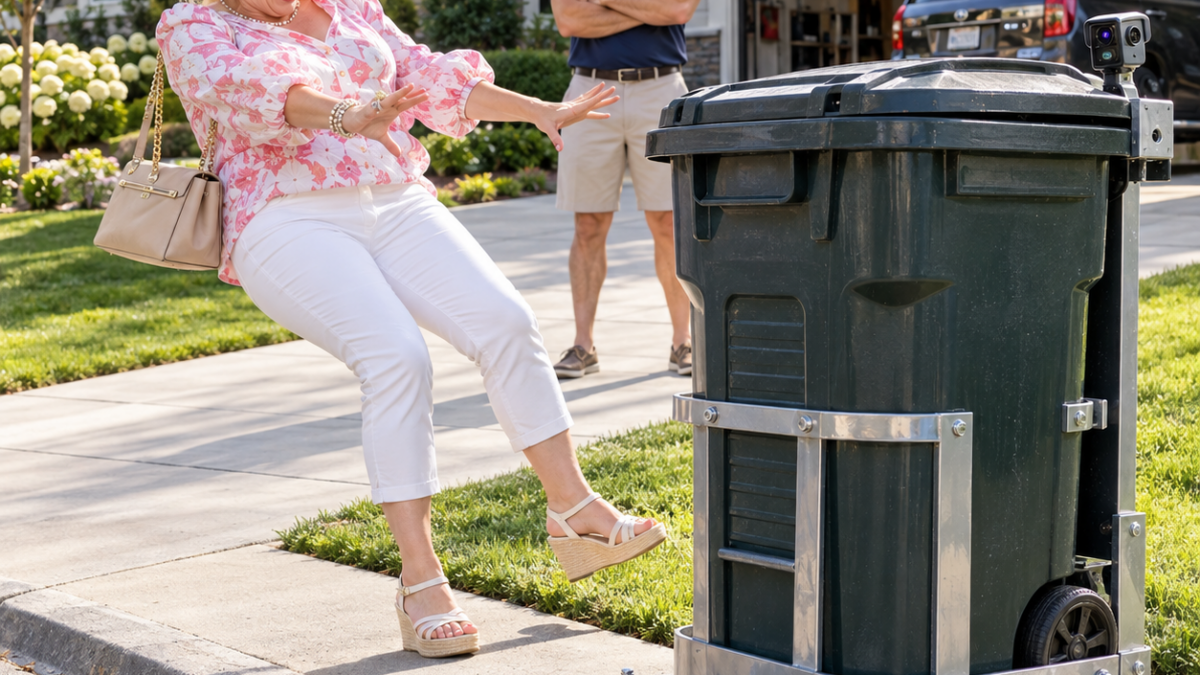
The front corner of that enormous SUV struck the trash can.
Only this time, there was no crack of plastic.
There was a deep, solid, beautiful thunk.
The Escalade jolted.
The running board bent inward.
The can stayed where it was.
Not perfectly. It shifted maybe half an inch.
But compared to the destruction Brenda expected, it might as well have been a mailbox planted in bedrock.
Inside the kitchen, Tyler slapped both hands over his mouth.
Emma whispered, “Oh my gosh.”
Brenda sat frozen behind the wheel.
Thirty full seconds passed.
Then, unbelievably, she backed up and tried again from a slightly different angle.
Thunk.
This time, the sound included metal scraping concrete.
Her bumper flexed.
The can remained upright.
My coffee cup was warm between my hands.
I did not laugh.
I wanted to.
I almost did.
But something about Brenda’s face through the windshield stopped me.
She looked less like a bully enjoying herself and more like a person discovering that the world had quietly changed rules on her.
Rules she had been breaking all along.
Finally, she drove away.
Her running board hung crooked.
A trim piece dragged for a moment before snapping loose and landing on the asphalt.
The garbage truck arrived twenty minutes later and picked up the trash as usual.
The driver looked at the can, looked at the mark on the street, looked at me standing in the driveway, and gave a slow nod.
“Sturdy model,” he said.
“You could say that.”
He laughed and drove on.
That should have been the end.
A reasonable person would have learned.
Brenda was not a reasonable person.
### The woman who kept hitting the same lesson
For the next week, she tested it.
Every morning.
Sometimes gently.
Sometimes harder.
Once from a ridiculous angle that required her to nearly climb the curb.
Each collision left new scars on the Escalade and little more than a scuff on my reinforced trash can.
By Friday, her front bumper looked like it had lost an argument with a loading dock. One headlight housing rattled. The running board sagged. There was a pale streak of scraped paint along the passenger side that made her pristine luxury SUV look embarrassed to be seen in public.
The neighborhood noticed.
Mrs. Olivia began standing behind her curtains at 6:10 with a mug of tea.
Jim Torres, the maintenance guy, started scheduling his morning walk so he passed my house just in time.
Kids at the bus stop whispered about “the indestructible trash can.”
Tyler came home from school beaming.
“Dad, everyone knows. They’re calling it the concrete can.”
Emma dropped her backpack on a chair.
“They’re also calling us the trash-can family.”
I winced.
“I’m sorry.”
She shrugged, but her face was softer than it had been in weeks.
“Honestly? It’s better than being the family Brenda keeps bullying.”
That sentence stayed with me.
Because it meant my kids had felt it.
Not just the inconvenience. Not just the embarrassment.
The bullying.
That night, I sat at my desk and reviewed every video clip.
Fifty-seven incidents by then.
Fifty-seven.
The number sounded absurd even to me.
The first few were broken plastic. The later ones were Brenda damaging her own vehicle because she could not accept that something she wanted to destroy had become stronger than her.
I saved each clip with date, time, weather, and visible damage.
Electricians learn documentation the hard way. If a client says you did something wrong, the inspection report saves you. If a builder blames the wiring, the photos behind the drywall save you. If a breaker trips three times in the same circuit, the log tells you what guesswork can’t.
I documented like my house depended on it.
Because in a way, it did.
Brenda’s next move came by certified letter.
This one accused me of installing an “unauthorized concrete structure” on HOA-adjacent property.
I read it standing at my kitchen counter.
Then I read it again.
Then I called Amanda Sterling, a property rights attorney I had consulted after the first violation notice.
Amanda was calm in a way I deeply envied.
She listened, asked for photos, reviewed the HOA rules and city ordinance, and called me back the next morning.
“Marcus,” she said, “it is a trash container.”
“That’s what I thought.”
“It is not a structure.”
“Also what I thought.”
“It is on collection day, within the city placement zone?”
“Yes.”
“Does it block traffic?”
“No.”
“Does it extend beyond the allowed distance?”
“No.”
“Does it contain spikes, blades, traps, electrical components, or anything designed to injure a person?”
“No.”
“Then they’re going to have a difficult time arguing that a legal trash container becomes illegal because someone keeps driving into it.”
I sat back in my chair.
“So what do I do?”
“Respond politely. Attach the ordinance. Attach the photos. Deny private property inspection unless they identify a legitimate emergency or obtain proper legal authority. And Marcus?”
“Yes?”
“Do not threaten Brenda. Do not mock Brenda. Do not post the videos online.”
“I haven’t.”
“Good. Let her create the record. You just preserve it.”
I did exactly that.
Brenda did not.
She began investigating the can like it was a national security threat.
Mrs. Olivia called one night, whispering as if Brenda could hear through phone lines.
“Marcus, she is in your driveway.”
I opened the camera app.
There was Brenda in dark pants and a jacket, crouched near the trash can with a flashlight and what looked like a bathroom scale.
She tried to tilt the can.
It did not cooperate.
Then she looked toward the street, clearly frightened by the possibility of being seen doing the exact sort of trespassing she would have fined someone else for imagining.
The next day, she cornered Jim at the hardware store and asked whether he had seen me buying concrete.
Then she questioned Dale at the contractor desk.
Then she filed a complaint with the city about an unauthorized concrete installation.
The building inspector who came out was named Pete.
He looked tired before he even reached the porch.
“Mr. Holloway?”
“That’s me.”
“Got a complaint about an unpermitted concrete structure.”
I pointed to the trash can.
He looked at it.
Then looked back at me.
“That?”
“That.”
He walked around it once.
Lifted the lid.
Looked inside.
Tapped the side with his pen.
“It holds garbage?”
“Yes.”
“City size limit?”
“Yes.”
“Placed only on collection day?”
“Yes.”
He wrote something on his clipboard.
“No violation.”
I almost smiled.
Pete lowered his voice.
“I’ve inspected illegal garage conversions with less paperwork than this trash can apparently has.”
“I’m starting to think it’s famous.”
He sighed.
“Please don’t let it become my whole week.”
Unfortunately for Pete, Brenda had already made it her whole life.
### What Brenda was really protecting
The first hint came from Patricia Lopez.
Patricia was the only HOA board member who still seemed to remember that board members were supposed to serve residents rather than rule them. She was quiet at meetings, but when she spoke, people listened because she did not waste words.
After a neighborhood coffee event at the community center, she pulled me aside near the refreshment table.
“Marcus, I need to tell you something.”
Her voice was low.
I looked around.
Brenda stood across the room, laughing too loudly with Gerald Thornfield.
“What is it?”
“Brenda is pushing for expanded enforcement authority.”
“That doesn’t surprise me.”
“Inspections. Material restrictions. Contractor approval. Fines for unapproved exterior modifications.”
I folded my arms.
“So the trash can has inspired legislation.”
Patricia did not smile.
“It’s more than that. She’s also pushing maintenance contracts. Same company keeps appearing in the proposals. Whitmore Construction.”
The name hit me strangely.
“Whitmore?”
“She says there’s no relation that matters because her late husband’s family is large and the company is professionally managed. But she gets defensive whenever anyone asks.”
“Did she disclose any financial interest?”
Patricia looked at me.
“No.”
That night, after the kids went to bed, I sat at my desk and opened the state business registration database.
At first, I thought I must be wrong.
Then I found it.
Whitmore Construction LLC.
Formed six months earlier.
Registered agent: Richard Whitmore.
Forty percent ownership: Brenda Whitmore.
I leaned closer to the screen.
Richard was Brenda’s husband. Not late husband. Current husband.
That was another lie.
She presented herself around the neighborhood as a widow because it made her seem sympathetic and untouchable. In reality, Richard lived part-time at their lake condo and appeared in business records as president of the very company receiving HOA maintenance contracts.
I searched HOA meeting minutes.
Seven contracts in four months.
Landscape edging.
Sidewalk patching.
Community center touch-ups.
Playground maintenance.
Drainage repairs.
Small jobs, mostly. The kind nobody questions because the amounts are low enough to sound routine but high enough to add up.
Twenty-three thousand four hundred dollars.
Every contract had been approved with Brenda voting.
Every competing bid had been beaten by fifty to a hundred dollars.
Not thousands.
Not dramatic discounts.
Just enough to win.
That pattern bothered me more than if they had underbid by half.
It looked informed.
It looked like someone knew the competing numbers.
I reviewed the monthly financial statements available through the HOA portal.
Then I requested older records.
Then I called Amanda.
Her voice changed when I explained what I had found.
“Send everything.”
“I already did.”
“You have meeting minutes showing her votes?”
“Yes.”
“Ownership records?”
“Yes.”
“Contract awards?”
“Yes.”
“Any disclosure forms?”
“Not that I’ve found.”
She was quiet for a moment.
“Marcus, this is no longer just a harassment issue.”
“I know.”
“If a board member failed to disclose a direct financial interest in vendor contracts, that may violate fiduciary duties, nonprofit law, and potentially fraud statutes depending on what else is found.”
I looked toward the kitchen, where Emma was laughing at something Tyler showed her on his phone.
“When I first asked about the maintenance budget,” I said slowly, “Brenda started targeting me twelve days later.”
“That may not be coincidence.”
“No. I don’t think it is.”
Suddenly, the trash can war looked different.
Brenda had not simply hated my curb placement.
She had hated that I asked questions.
She had hated that I read documents.
She had hated that I was the kind of neighbor who did not get embarrassed into silence.
The concrete can had become the symbol, but the real fight was buried in the books.
And Brenda had been slamming her SUV into a trash can while standing on top of a paper trail that could ruin her.
### The garage war room
I invited the people I trusted most to my garage the next evening.
Mrs. Olivia arrived first with jasmine tea and a folder of handwritten notes. Her husband had passed years earlier, and she lived alone, but there was a quiet strength in her that reminded me of old houses that survive every storm because their foundations were built right.
Jim Torres came straight from work in his maintenance uniform.
Dale brought donuts because, in his words, “every good conspiracy needs donuts.”
Patricia arrived last, carrying HOA financial papers in a canvas tote and looking like she had not slept well in a week.
I had cleared the workbench and taped a timeline to the wall.
On it were dates:
September 3: I questioned maintenance costs at board meeting.
September 15: First direct conversation with Brenda about trash can.
September 19: First certified violation letter.
October: selective enforcement notices.
November: concrete can installed.
Then the contracts.
Whitmore Construction formed.
First bid.
Second bid.
Third bid.
Seven approvals.
Seven payments.
Seven votes by Brenda.
Patricia stood in front of the timeline with one hand over her mouth.
“I knew it felt wrong,” she whispered. “I didn’t know it was this blatant.”
Dale examined the vehicle damage photos pinned beside the timeline.
“That Escalade is going to need serious work,” he said. “Running board, bumper, maybe alignment if she hit hard enough.”
Jim shook his head.
“All over a trash can.”
“No,” Mrs. Olivia said softly.
Everyone turned toward her.
She looked at the evidence board.
“This is not about trash can. This is about a woman who thinks everything belongs to her.”
Nobody argued.
We spent three hours organizing.
Patricia would request a formal audit through the board process.
Mrs. Olivia would quietly talk to neighbors who had been targeted by Brenda.
Jim would document any maintenance-related pressure or suspicious work orders.
Dale would review the construction contracts for pricing and scope.
I would continue preserving video evidence and coordinate with Amanda.
The goal was not chaos.
It was accountability.
Amanda’s advice was clear: move carefully, do not make unsupported accusations, and let the documents lead.
So we did.
Over the next week, I knocked on doors.
I expected people to be annoyed.
Instead, people were relieved.
Mrs. Rodriguez on Maple Street told me Brenda fined her because her garbage can was out fifteen minutes too early.
A widower named Mr. Patterson had received three notices about rose bushes his wife planted before she died.
The Johnsons had been cited for children’s sidewalk chalk.
Another single father had been warned because his work van was “visually inconsistent,” even though Gerald’s brother parked a boat in his driveway all summer.
Patterns emerged quickly.
Single parents.
Elderly residents.
New homeowners.
Minority families.
People least likely to fight.
I built a spreadsheet.
Sixty-seven violation notices in one year.
Forty-nine went to residents who fit one of those vulnerable categories.
Only eighteen went to long-term homeowners or board-connected families.
When I showed Amanda, she leaned back in her chair.
“This is exactly the kind of pattern that gets attention,” she said.
“From who?”
“Civil rights attorneys. State regulators. Sometimes fair housing investigators, depending on the facts.”
I thought about Brenda’s parking lot comment.
People like you.
I had recorded it.
At the time, it stung.
Now, in context, it mattered.
Meanwhile, the concrete can kept doing its quiet work.
Brenda hit it less often after the first week, but not never. Her obsession would not let her stop. Some mornings she only slowed and glared at it. Other mornings, she clipped it just hard enough to leave another mark on the Escalade.
The neighborhood began treating it like a weather report.
“Brenda tapped it today.”
“Full hit this morning.”
“New crack in her bumper.”
“Running board still hanging.”
I hated how much the kids enjoyed it.
I also understood.
For weeks, they had felt powerless.
Now the bully looked foolish.
That mattered to teenagers more than any legal theory.
But Brenda’s embarrassment made her dangerous.
And desperate people do reckless things.
### The tracker
The first vandalism happened on a Saturday night.
At 2:13 a.m., the driveway motion sensor lit up.
A dark figure in a hood approached the trash can and sprayed orange paint across it.
MOVE.
The letters were uneven, hurried, and honestly not very impressive.
By the time I woke and checked the camera, the person was gone.
But the video captured a pearl-white Escalade parked three houses down with its lights off.
I filed a police report.
The officer was polite but noncommittal.
“It’s spray paint on a trash can,” he said.
“It’s part of a pattern.”
“I understand.”
He did not sound like he understood.
Then came the utility complaint.
Someone reported suspicious excavation around my property that might endanger underground gas lines. A utility inspector spent two hours confirming that I had not dug anything anywhere.
Then fake negative reviews appeared on my electrical business page.
Then anonymous complaints were filed with the city about my lawn, my porch light, my work truck, and my allegedly improper garage storage.
Every complaint took time.
Every complaint created stress.
Every complaint reminded Emma and Tyler that Brenda could still reach into our lives whenever she wanted.
Then Tyler found the tracker.
It was Friday evening.
He was in the driveway working on his bike chain while I sorted invoices in the garage.
“Dad?”
His voice sounded strange.
I stepped out.
He was crouched near my work truck, pointing under the rear frame.
“What is that?”
I knelt.
A small black device was attached with a magnet.
Blinking light.
Hard plastic casing.
Not factory.
Not mine.
My mouth went dry.
“Go inside,” I said.
“Dad—”
“Inside, Tyler. Now.”
He stood, face pale, and backed away.
Emma came to the door.
“What happened?”
“Both of you inside.”
I photographed the tracker from every angle.
Then I called the police.
This time, Officer Derek Martinez came.
He was in his late thirties, serious, not easily impressed, and unlike the first officer, he listened before deciding what kind of problem he had walked into.
He examined the tracker without touching it.
“You didn’t place this?”
“No.”
“Any reason someone would be monitoring your vehicle?”
I gave him the short version.
The trash cans.
The videos.
The HOA fines.
The Whitmore Construction records.
The harassment complaints.
The vandalism.
By the time I finished, Officer Martinez’s expression had changed.
“Mr. Holloway,” he said, “this is no longer a neighborhood disagreement.”
“That’s what I’ve been trying to explain.”
He nodded.
“I’m going to take a formal report. Do not remove the device until we process it. Send me copies of the videos and documentation you have. All of it.”
“All of it is a lot.”
“I prefer a lot.”
For the first time, law enforcement seemed to understand the shape of the thing.
Not a single incident.
A campaign.
That night, Emma sat beside me at the kitchen table after Tyler went to bed.
She was quiet for a long time.
Then she said, “I hate her.”
I closed my laptop.
“Emma.”
“I know I’m not supposed to say that.”
“You’re allowed to feel what you feel.”
“She put something on your truck. What if Tyler hadn’t found it? What if she follows you? What if she makes Mom’s lawyer think you’re unstable and we can’t stay here?”
That last part cut deep.
My custody situation had been fragile since the divorce. Not because I was a bad father, but because divorce turns ordinary life into paperwork. Every dispute, every address, every school issue, every “home environment” note becomes part of a file.
Brenda’s harassment was not just annoying.
It threatened the stability I had promised my kids.
I reached across the table and took Emma’s hand.
“Listen to me. We are handling this the right way.”
“She doesn’t.”
“No. She doesn’t. That’s why she’s going to lose.”
Emma looked at me.
“You really believe that?”
“I do.”
I had to believe it.
Because my daughter needed my confidence more than my anger.
### Insurance fraud
Brenda’s Escalade damage finally became too expensive for denial.
Instead of admitting she had been repeatedly striking a stationary trash can, she filed an insurance claim for road hazard damage.
That was a mistake.
An investigator from State Farm called me two days later.
His name was Martin Price, and he spoke with the careful politeness of someone trained to let silence make people nervous.
“Mr. Holloway, we’re reviewing a claim involving damage to Mrs. Whitmore’s vehicle near your property. She indicated there may have been a hazardous object improperly placed in the roadway.”
“I can provide video.”
There was a pause.
“You have video?”
“Fifty-seven incidents.”
Another pause.
“Fifty-seven?”
“Yes.”
I sent him the file.
Not all at once. The evidence folder was too large. I organized it by date.
Collision attempts.
Street view.
Trash placement.
City ordinance.
Survey.
Inspection report.
Witness statements.
He called back the next day.
His voice was no longer neutral.
“Mr. Holloway, these videos show deliberate contact with a stationary object on multiple occasions.”
“Yes.”
“This was not a road hazard.”
“No.”
“This may involve intentional damage and misrepresentation.”
“I assumed you’d notice.”
He exhaled.
“We are referring the claim for further review.”
When I told Amanda, she said, “Good. Insurance investigators have tools HOA boards don’t.”
“What happens now?”
“Potential denial of claim. Possible referral for fraud investigation if they determine false statements were made.”
“And Brenda?”
“Brenda is creating more evidence than we could ever request.”
That became the theme of the next two weeks.
Brenda filed an emergency restraining order against me, claiming I had threatened her near the mailbox.
My cameras showed I had been at a job site across town at the time.
She submitted a voicemail she claimed I left.
Audio analysis showed it had been cut together from public comments I made at an HOA meeting.
She included witness statements from people whose addresses did not exist.
Judge Patricia Williams dismissed the petition without a hearing and warned Brenda about submitting false evidence.
That should have frightened her into silence.
Instead, it pushed her toward the public meltdown everyone would remember.
### The phone call from Richard Whitmore
Richard Whitmore called me the afternoon before the big board meeting.
I did not recognize the number, so I let it go to voicemail.
Then I listened.
“Mr. Holloway, this is Richard Whitmore. Brenda’s husband. I need to speak with you. Please.”
His voice sounded hollow.
Tired.
I called Amanda first.
She told me I could listen but not negotiate without counsel.
Then I called him back on speaker, with the call recorded after notifying him.
Richard answered immediately.
“Marcus?”
“Mr. Whitmore.”
“Please. Richard is fine.”
“What can I do for you?”
He laughed once, without humor.
“I was hoping to ask you that.”
I said nothing.
He continued.
“She’s spent eight thousand dollars on lawyers, repairs, surveillance, and God knows what else. Our insurance claim is being investigated. Whitmore Construction is losing work. Gerald won’t return my calls. I need to know what it takes to make this go away.”
I looked out the window.
The concrete trash can sat near the garage like a ridiculous gray witness.
“Your wife stalked my family, vandalized my property, submitted false complaints, put a tracker on my truck, and may have used HOA money to benefit your company.”
Richard breathed shakily.
“I didn’t know about the tracker.”
“But you knew about the contracts.”
Silence.
“Richard?”
“I knew Brenda helped us get the bids.”
“That’s not what I asked.”
Another silence.
Then he said, “I knew she didn’t disclose everything.”
There it was.
Not the full truth.
But enough.
“This isn’t going away with an apology and a check,” I said.
“She’s not well.”
I closed my eyes.
That sentence made me angry in a way I did not expect.
“Richard, maybe that’s true. Maybe she needs help. But needing help doesn’t give her permission to hurt people.”
“She’s going to lose everything.”
“She should have thought about that before she tried taking peace from everyone else.”
He whispered, “Is there any way to settle?”
“Talk to Amanda.”
“Marcus—”
“No. Talk to Amanda. And Richard?”
“Yes?”
“If Brenda destroys records, threatens witnesses, or tries another fake report before tomorrow night, there won’t be anything left to settle.”
I ended the call.
I did not feel powerful.
I felt exhausted.
Justice sounds clean when people tell stories afterward. In the middle of it, justice feels like paperwork, stress, sleepless nights, and children asking questions they should never have to ask.
But the next evening, everything came to a head.
### The meeting Pinewood never forgot
The community center was designed for forty people.
One hundred eighteen showed up.
Then more stood in the hallway.
Then Channel 7 arrived.
Then Metro Weekly.
Then Channel 12.
By six o’clock, cars lined both sides of Maple Street.
People carried folders, phones, lawn chairs, and the kind of nervous energy that makes ordinary rooms feel like courtrooms.
I wheeled the concrete trash can in through the side entrance.
Dale helped me.
“Subtle,” he muttered.
“Never claimed to be.”
We placed it beside the podium.
A few people laughed when they saw it.
Others clapped.
Brenda arrived ten minutes late wearing black instead of her usual navy blazer. Her face was powdered too heavily, and her hands trembled as she took her seat beside Gerald Thornfield and attorney Harold Masterson.
Gerald looked like a man who had aged five years in one weekend.
Patricia sat at the board table with her own folder, calm but pale.
Officer Martinez stood near the back wall.
He said he was there because of the ongoing report involving the tracker and related complaints. The insurance investigator had also referred information to the proper authorities.
Brenda kept looking at the door.
As if calculating whether she could leave before the room turned on her.
Gerald called the meeting to order.
His voice cracked.
“We are here to address recent community concerns, misinformation, and disruptions affecting Pinewood Gardens.”
Mrs. Olivia stood immediately.
Her careful English carried through the room.
“Before you call us misinformation, maybe you explain why Mrs. Whitmore put tracker on Marcus’s truck.”
A low murmur swept the room.
Gerald banged his gavel.
“Public comment will proceed in order.”
“Good,” Mrs. Olivia said, sitting down. “I am first.”
I almost smiled.
Harold Masterson gave an opening statement about neighborly misunderstandings, inflammatory accusations, and the importance of not rushing to judgment.
He spoke for seven minutes.
Nobody looked convinced.
Then Patricia stood.
“As a sitting board member, I move that this meeting allow presentation of documentation related to enforcement practices and financial conflicts.”
Gerald blinked.
“Patricia, this is not—”
“I move,” she repeated.
Another board member, who had barely spoken all year, seconded.
The vote passed.
Gerald looked like he had swallowed a battery.
Then I stood.
The room quieted.
I carried my presentation boards to the front and placed my folder on the table beside the concrete can.
“This is not about a trash can,” I began.
A few people laughed softly.
I looked around at the faces in the room. Neighbors who had avoided eye contact for months now leaned forward. Emma and Tyler sat in the second row beside Mrs. Olivia. I had not wanted them there, but Emma insisted.
“If people are going to talk about our family,” she said, “we should hear the truth, too.”
So there they were.
Watching.
Learning.
I took a breath.
“This is about what happens when one person believes rules apply only to the people she wants to control.”
I walked through the timeline.
The city ordinance.
The first collision.
The repeated destruction.
The violation letter.
The board meeting.
The parking lot recording.
The concrete can.
Then I played the videos.
Not all fifty-seven.
Twelve minutes of selected clips, each labeled by date and time.
The room reacted first with disbelief, then laughter, then anger.
There was Brenda, striking the original trash cans.
There she was after the concrete can, hitting it again and again, damaging her own SUV.
There she was at midnight trying to inspect it with a flashlight.
There was the spray paint vandalism.
There was the Escalade parked nearby.
There was the tracker found under my truck.
By the time the video ended, Brenda had stopped looking at the screen.
Then I changed slides.
Whitmore Construction LLC.
Ownership records.
Board minutes.
Contract awards.
Seven votes.
Seven payments.
No disclosure.
Twenty-three thousand four hundred dollars in contracts connected directly to Brenda’s family business.
Gasps moved through the room.
Mrs. Rodriguez stood.
“Our dues paid her company?”
I nodded.
“That is what the records show.”
Brenda shot to her feet.
“This is harassment!”
Her voice cracked through the room.
“This man has been targeting me for months! He is unstable, angry, and trying to destroy community standards because he refuses to follow basic rules!”
I turned toward her.
“Brenda, I followed the city ordinance.”
“You weaponized a trash can!”
People laughed, but it was not friendly laughter.
I waited.
She pointed at me.
“People like you come in here and poison decent neighborhoods!”
The room changed.
Not loudly.
Quietly.
The way a room changes when everyone hears something ugly and understands it at the same time.
Mrs. Olivia lowered her eyes.
Emma stiffened.
Tyler’s jaw clenched.
I felt heat rise in my chest, but I kept my voice steady.
“People like me?”
Brenda realized too late what she had said.
“I mean disruptive people.”
“No,” I said. “You said what you meant.”
Channel 7’s camera was pointed directly at her.
Harold Masterson leaned toward Brenda and whispered urgently, but she pulled away.
“I protected this neighborhood!” she shouted. “I kept standards high! I kept property values from falling because some people don’t understand what belongs here!”
Mrs. Rodriguez stood and shouted something in Spanish.
Dale muttered, “There it is.”
Then Patricia stood.
Her voice was calm, and because it was calm, it cut through the chaos.
“I move for the immediate suspension of Brenda Whitmore from all HOA duties pending independent audit and investigation.”
Gerald’s face drained.
“You can’t—”
“I can,” Patricia said. “And I do.”
The second came from the quiet board member at the end of the table.
“All in favor?” Patricia asked.
The vote was four to zero.
Brenda was the only one who did not vote.
Because Officer Martinez had stepped forward.
“Mrs. Whitmore,” he said, “I need to speak with you regarding an active investigation involving unauthorized tracking, suspected insurance fraud, and harassment.”
The room went silent.
Brenda stared at him.
“You can’t be serious.”
“I am.”
Harold Masterson stood.
“My client will not make any statement without counsel.”
“That is her right,” Officer Martinez said.
Then he looked at Brenda.
“But she is being served tonight with notice related to the investigation, and depending on review of the warrant materials, further action may follow.”
It was not the dramatic handcuff moment people expected from television.
Not yet.
But it was worse for Brenda in some ways.
Because everyone saw it.
Everyone saw the woman who had spent years writing violation letters now being formally confronted by the consequences of her own record.
Then Mrs. Olivia walked to the front.
She placed a stack of witness statements beside my folder.
“My name is Olivia Tran,” she said. “I saw her hit his trash can many times. I saw her go into his driveway at night. I did not speak before because I was afraid.”
Her hands trembled.
But her voice did not.
“I am not afraid now.”
That broke something open.
One by one, neighbors stood.
Mrs. Rodriguez described being fined over trash placement fifteen minutes early.
Mr. Patterson described being threatened over rose bushes planted by his late wife.
The Johnsons described sidewalk chalk notices.
A young couple described being warned not to question maintenance costs if they wanted their fence approved.
Jim Torres described suspicious work orders connected to Whitmore Construction.
Dale explained the pricing discrepancies.
Patricia described Brenda pushing contracts without disclosure.
By the time the last person spoke, the room no longer belonged to Brenda, Gerald, or any board.
It belonged to the residents.
And they were done being quiet.
### The collapse
The next forty-eight hours moved fast.
Brenda resigned Tuesday morning with a two-line letter blaming a hostile environment and personal attacks.
By Wednesday, the insurance company denied her claim and referred the matter for further review.
By Thursday, the district attorney’s office filed charges related to insurance fraud and unauthorized tracking.
Additional harassment charges followed after police reviewed the wider pattern.
Whitmore Construction’s contractor certification was suspended pending investigation.
The HOA board voted unanimously to hire an independent CPA firm.
Gerald Thornfield resigned before the audit even began.
His letter was longer than Brenda’s but somehow said less.
The audit was brutal.
Patterson and Associates reviewed contracts, bids, payments, disclosures, meeting minutes, bank statements, and maintenance records.
The final report identified forty-seven thousand dollars in overcharges, questionable contracts, unsupported expenses, and improper payments connected to Whitmore Construction or Brenda’s influence.
Forty-seven thousand dollars.
All while she fined people over mailboxes, garbage cans, rose bushes, and chalk.
Every homeowner received a refund.
Three hundred seventy dollars by Christmas.
For some families, it was a nice surprise.
For others, it paid bills.
Mrs. Olivia cried when hers arrived.
Not because the amount was life-changing.
Because it meant someone had finally admitted the money should not have been taken that way.
Richard Whitmore called me once more.
“The civil settlement check is being sent through your attorney,” he said.
His voice was empty.
“Twelve thousand five hundred, as agreed.”
I did not gloat.
There are moments when victory feels too tired for celebration.
“Thank you for confirming.”
“Brenda is moving to Florida to stay with her sister.”
I said nothing.
He added, “She says you ruined her life.”
I looked toward the living room, where Emma and Tyler were decorating the Christmas tree.
“No, Richard,” I said. “She kept hitting the same thing and called it someone else’s fault.”
He had no answer.
I wished him well.
I meant it more than I expected.
Brenda eventually accepted a plea arrangement on the insurance-related charge and received probation, fines, restitution, and community service. The unauthorized tracking matter brought additional penalties, and the civil settlement closed our direct claims.
It was not the movie version of justice.
No judge slammed a gavel and sent her away forever.
But real life rarely works like that.
Real justice often looks like money returned, licenses reviewed, authority removed, court records filed, apologies never given, and a neighborhood learning how to protect itself next time.
That was enough.
Mostly.
### The new Pinewood
Patricia Lopez became HOA president in the special election.
She ran unopposed, not because people feared her, but because people trusted her.
At her first official meeting, she placed three documents on the table.
A conflict-of-interest policy.
A transparent bidding policy.
A homeowner appeal procedure.
Then she looked around the room and said, “If a rule cannot be explained plainly, enforced fairly, and reviewed openly, it does not belong in this community.”
People applauded.
I watched Emma listening from the back row.
Tyler was beside her, whispering something that made her elbow him in the ribs.
They were smiling.
That mattered more to me than any refund.
The first community project under the new board was playground renovation.
Funded with recovered money.
The old equipment had been fading for years while Brenda’s contracts somehow kept getting paid for repairs nobody could identify.
Now families gathered to vote on designs.
Kids made suggestions.
Tyler argued passionately for a climbing wall.
Emma, to my surprise, suggested a shaded reading bench for kids who did not like running around.
The board approved both.
On installation day, half the neighborhood showed up.
Dale helped with concrete footings.
Jim supervised safety checks.
Mrs. Olivia brought spring rolls and tea.
Mrs. Rodriguez brought cookies.
Patricia brought a clipboard, then made a joke about using it only for good.
I watched neighbors who had once barely spoken work side by side.
That was when the anger finally began to leave me.
Not all at once.
But enough.
Because anger is useful when it gets people moving.
It becomes poison if you build a home for it.
I did not want Brenda living in my head rent-free after she had already cost us months of peace.
The concrete trash can became a neighborhood legend.
At first, I kept using it.
Then, after Patricia suggested we retire it “before it develops its own fan club,” we moved it to the community center lobby.
Dale mounted it on a low platform.
Tyler made a sign.
PROPERTY RIGHTS PROTECTED HERE.
Emma said it was too dramatic.
Then she secretly took photos of it for her college application essay.
Channel 7 ran an investigative story about the Pinewood Gardens dispute, focusing on HOA overreach, conflict-of-interest failures, and the importance of documentation. The video clips spread online. Not because people loved trash cans, though apparently many did, but because everyone understands the feeling of being bullied by someone with a little authority and too much free time.
Other neighborhoods contacted us.
A single mother in Dayton dealing with selective fines.
A retired couple in Toledo facing contractor kickbacks.
A teacher near Cincinnati whose HOA was trying to ban solar panels despite state protections.
Patricia began hosting quarterly homeowner-rights workshops.
Amanda spoke at the first one.
Mrs. Olivia sat in the front row and asked the sharpest questions.
Tyler started a small video channel explaining HOA disputes in plain language, though I made him promise not to use anyone’s name without permission.
Emma wrote her college essay about evidence, power, and what a trash can taught her about civic responsibility.
She got into three journalism programs.
The day the acceptance letter arrived, she ran into the garage and hugged me so hard I nearly dropped my drill.
“You know this is partly because of the concrete can,” she said.
“I’m not sure admissions officers are ready for that sentence.”
She laughed.
“Dad, you accidentally became interesting.”
That may have been the most teenager compliment I had ever received.
### Custody
The part I rarely talk about is how close I came to losing more than money.
During the worst months, my ex-wife’s attorney raised concerns about neighborhood conflict and home stability. I understood why. From the outside, it looked like chaos: police reports, HOA disputes, cameras, legal letters, vandalism, online arguments, board meetings.
A custody evaluator asked Emma and Tyler how they felt living with me.
I hated that.
Not because I feared their answers, but because children should not have to explain adult harassment to strangers with clipboards.
Emma told the evaluator, “My dad doesn’t start fights. He finishes problems.”
Tyler said, “He could have yelled or done something stupid, but he used laws and cameras and concrete.”
Apparently, that answer made it into the report.
The judge later noted that the children had witnessed their father respond to harassment through lawful documentation, community support, and nonviolent problem-solving.
That line meant more to me than the settlement check.
Because my greatest fear had never really been Brenda.
It was failing my kids.
Divorce had already shaken their sense of home.
I had promised them stability.
Then Pinewood Gardens became a battleground over a trash can.
But somewhere in the mess, Emma and Tyler learned something I could not have taught with a lecture.
They learned that standing up for yourself does not require becoming cruel.
They learned that rules matter most when powerful people are forced to follow them.
They learned that evidence beats volume.
And they learned that sometimes the ridiculous fight is not ridiculous at all if it reveals a serious truth underneath.
### Mrs. Olivia’s letter
The first spring after Brenda left, Mrs. Olivia gave me a letter.
She came over on a Sunday afternoon while I was fixing the porch light.
She held an envelope in both hands.
“For you,” she said.
I climbed down from the ladder.
“You could’ve just told me whatever it is.”
She shook her head.
“Some things better written.”
Inside was a note in careful handwriting.
She wrote about coming to America with her husband decades earlier.
About buying their first home.
About how, after he died, she became afraid of official-looking letters because English legal words still made her nervous when she was tired.
She wrote that Brenda had once threatened her over garden edging and hinted that unpaid fines could affect her title.
She wrote that she paid because she did not know who would believe her.
Then she wrote:
*When you stood up, I remembered I am also allowed to stand.*
I read that sentence three times.
My throat tightened.
Mrs. Olivia looked embarrassed.
“I know my English is not perfect.”
“It’s perfect,” I said.
She smiled.
Then she looked toward the street.
“You know, I used to hate Tuesday mornings.”
I followed her gaze.
The curb was empty.
No broken plastic.
No Escalade.
No dread.
“Me too,” I said.
She nodded.
“Now Tuesday is just garbage day.”
That was the quietest victory of all.
### Brenda’s last message
Nearly a year after the board meeting, I received an envelope with no return address.
Inside was a handwritten note from Brenda.
The handwriting was sharp and slanted.
Marcus,
I hope you are satisfied. You turned an entire neighborhood against me over a trash can. I spent years trying to preserve standards while people like you undermined everything that made Pinewood Gardens desirable. Maybe I made mistakes, but you destroyed my reputation, my friendships, and my home.
I read it once.
Then again.
There was no apology.
No mention of the tracker.
No mention of the false claim.
No mention of Whitmore Construction.
No mention of Emma or Tyler or Mrs. Olivia or any of the people she had frightened.
Just blame wrapped in self-pity.
At the bottom, she wrote:
You won.
I sat with that line for a while.
Then I took out a pen and wrote a reply I never sent.
Brenda,
I did not win when your life fell apart.
I won when my kids stopped being afraid to open the curtains.
I won when Mrs. Olivia stopped whispering.
I won when the board started showing the books.
I won when neighbors learned each other’s names.
You did not lose because of a trash can.
You lost because you kept mistaking fear for respect.
I folded the unsent letter and put it in my desk drawer.
Sometimes writing the answer is enough.
### The festival
Pinewood Gardens held its first Concrete Can Day the following September.
I voted against the name.
Everyone ignored me.
There were bounce houses, barbecue, a dunk tank, homeowner-rights workshops, and a children’s bike parade that Tyler helped organize.
The concrete trash can sat near the community center entrance like a ridiculous war memorial.
Someone put flowers in it.
Then someone else put balloons.
By noon, people were taking photos beside it.
I stood under a tent helping Patricia hand out copies of the new transparency policy.
Emma walked by with a camera around her neck, taking photos for the community newsletter.
Tyler was explaining to a group of younger kids that concrete had compressive strength but poor tensile strength unless reinforced, which was possibly the most Tyler thing he had ever done.
Mrs. Olivia sat in the shade drinking tea with Mrs. Rodriguez.
Jim and Dale argued over barbecue sauce.
Amanda gave a short talk titled “Know Your Documents Before Someone Weaponizes Them.”
People laughed at the title.
But they stayed to listen.
That afternoon, Patricia asked me to say a few words.
I didn’t want to.
Public speaking and electrical panels have one thing in common: both can go badly if you touch the wrong point under pressure.
But Emma nudged me.
“Come on, Dad. You’re accidentally inspiring.”
So I stood near the concrete can and looked at the crowd.
One year earlier, many of these people had watched from behind curtains while Brenda terrorized one household at a time.
Now they stood together in daylight.
“I’m not going to give a long speech,” I said.
Tyler shouted, “Thank you!”
Everyone laughed.
I pointed at the concrete can.
“This thing is funny now. I get that. It’s a ridiculous object. It’s a trash can that somehow became a local celebrity.”
More laughter.
“But the truth is, I built it because I was tired. I was tired of replacing what someone else kept destroying. I was tired of my kids feeling embarrassed. I was tired of being told the problem was my refusal to move instead of someone else’s decision to hit what belonged to me.”
The crowd grew quiet.
“I thought I was dealing with one angry neighbor. Then I learned a lot of you had your own version of the same story. Different letters. Different fines. Different threats. Same fear.”
I looked toward Mrs. Olivia.
“She reminded me that courage doesn’t always look loud. Sometimes it’s a signed witness statement from someone whose hands are shaking.”
Mrs. Olivia wiped her eyes.
I looked back at the crowd.
“Pinewood changed because people stopped handling unfairness alone. That’s the real lesson. Not concrete. Not cameras. Not viral videos. People.”
I placed my hand on the can.
“This thing didn’t save our neighborhood. It just refused to break long enough for us to notice what else was broken.”
For a moment, nobody spoke.
Then Patricia started clapping.
Soon everyone joined.
Emma took a photo right then.
It later hung in the community center hallway.
In the picture, I’m standing beside a concrete trash can, looking uncomfortable while half the neighborhood applauds.
Tyler says it captures my natural awkwardness.
Emma says it captures the moment Pinewood finally became ours.
I think both are true.
### What I tell people now
People still contact me about HOA problems.
They expect a trick.
A magic sentence.
A loophole.
A concrete solution, literally or otherwise.
I always tell them the same thing.
Read your documents.
Know your city ordinances.
Document everything.
Stay calm.
Find allies.
Do not threaten.
Do not exaggerate.
Do not assume someone has authority just because their letterhead looks expensive.
And never let a bully convince you that being tired means you are wrong.
Brenda’s real weapon was not her Escalade.
It was exhaustion.
She counted on people giving up because fighting back required reading bylaws after work, saving receipts, attending meetings, writing statements, calling attorneys, and looking like a troublemaker before the truth came out.
That is how petty tyrants survive.
They make honesty inconvenient.
They make fairness expensive.
They make silence feel easier than dignity.
But silence has a cost, too.
Martha paid it in another neighborhood.
Mrs. Olivia almost paid it here.
My kids nearly paid it with their sense of safety.
I was not willing to keep paying.
So yes, I installed a trash can Brenda did not see coming.
But the concrete was never the strongest thing we built.
The strongest thing was the network of neighbors who learned to ask questions out loud.
The strongest thing was a board that now publishes every contract.
The strongest thing was my daughter realizing journalism could expose what power tries to hide.
The strongest thing was my son learning that creativity and patience can beat cruelty.
The strongest thing was Tuesday morning becoming just garbage day again.
### The last Tuesday
A year after Brenda moved away, I woke early on a Tuesday.
Old habits.
The house was quiet.
Emma was away visiting a college campus.
Tyler was asleep, probably dreaming about bicycles, engines, or whatever fourteen-year-old boys store in their heads when they finally run out of snacks.
I made coffee and stepped outside.
The air was cool.
The curb was empty except for my ordinary city-issued trash bin.
Plastic.
Lightweight.
Completely normal.
The concrete can lived at the community center now.
The street was still.
No Escalade.
No engine growl.
No crack of plastic.
No watching from behind curtains.
Mrs. Olivia came out a few minutes later with her tea.
She lifted her mug.
I lifted mine.
Neither of us said anything.
The garbage truck arrived at 6:34.
The driver picked up the bin, emptied it, set it back down, and drove away.
That was it.
The most ordinary thing in the world.
And somehow, after everything, it felt like peace.
I stood there for a while, looking at the quiet curb.
Then Tyler opened the front door, hair sticking up in every direction.
“Dad, why are you staring at the trash can?”
I smiled.
“No reason.”
He squinted at me.
“You’re being weird.”
“Probably.”
He stepped onto the porch.
“Do you miss the concrete one?”
I looked down the street, where morning light was beginning to touch the roofs of Pinewood Gardens.
“No,” I said. “I think it did its job.”
Tyler nodded thoughtfully.
Then he said, “Still would’ve made an awesome college fund if we charged admission.”
I laughed.
A real laugh.
The kind that comes from somewhere clean.
“Go get ready for school.”
He turned back inside.
I stayed on the porch a moment longer.
The neighborhood was waking up.
Garage doors opened.
Dogs barked.
A kid’s backpack dragged across a driveway.
Somewhere, someone’s sprinkler clicked on too early, and nobody ran outside with a ruler.
That was when I understood the real ending.
Brenda had tried to make Pinewood Gardens smaller.
Smaller rules.
Smaller people.
Smaller courage.
She wanted everyone worried about a fine, a letter, a board vote, a mailbox color, a trash can.
But the fight she started made the neighborhood bigger.
Bigger conversations.
Bigger accountability.
Bigger trust.
Bigger courage.
And in the end, the woman who kept knocking over my trash can did not just destroy her own SUV.
She destroyed the fear that had kept everyone else standing alone.
I picked up my coffee and went back inside to make breakfast for my son.
Because Tuesday was just Tuesday again.
And that was the best victory of all.
**[THE END]**








