PART 2: HOA Karen Ruled Our Neighborhood for 15 Years—Then My Lawyer Discovered Her HOA Never Legally Existed
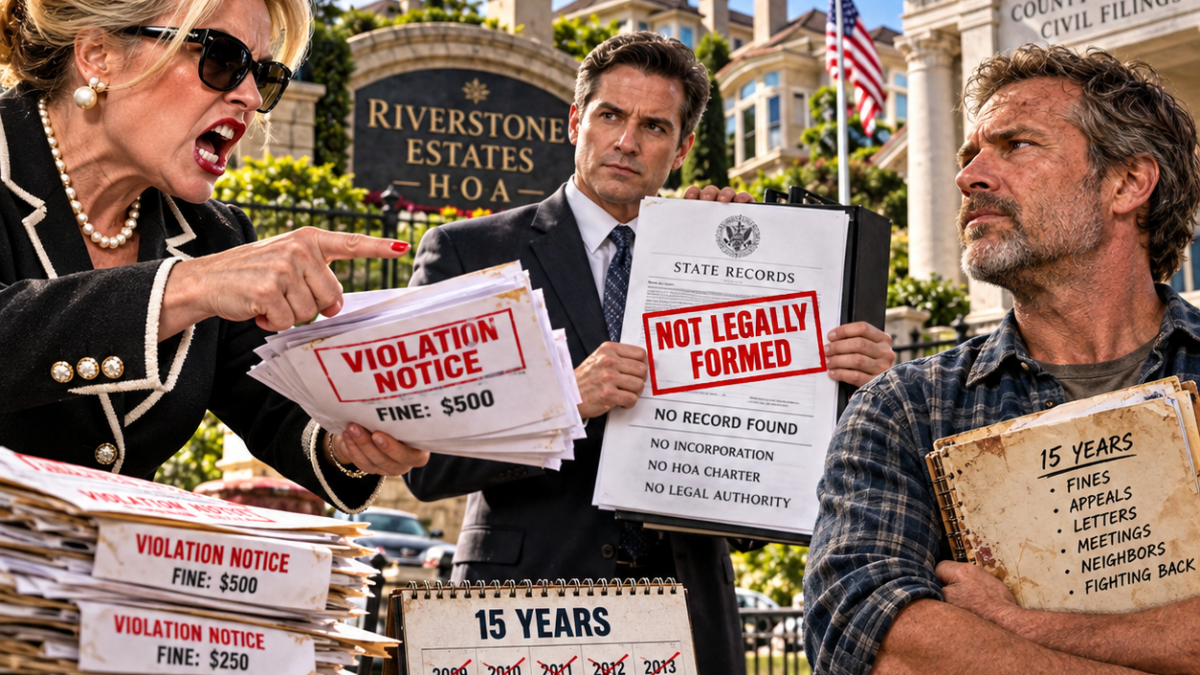
PART 2
The pole went up the next morning.
I did not raise Danny’s flag yet.
That was deliberate.
I wanted the concrete fully cured, the hardware checked, the halyard tested, the footing inspected, and the lighting circuit completed correctly before the first piece of fabric touched the line. That was partly respect and partly habit. The Army had drilled something into me that civilian life never managed to remove: if you are going to do a thing, especially a thing that matters, do it right the first time.
Sarah stood beside me while I checked the level.
“You know she can see this from her kitchen.”
“I know.”
“You enjoying that?”
“No.”
She waited.
“Maybe a little.”
She laughed.
For several minutes, we were ourselves again.
Then the next notice arrived.
It had been tucked beneath the windshield wiper of my truck.
FLAGPOLE — CONTINUING NONCOMPLIANCE.
Fine:
$50.
Next morning:
$50.
Then another.
Then another.
Each notice went into a manila folder on my workbench.
At first I considered them absurd souvenirs.
That changed quickly.
The flagpole was only the beginning.
My workshop became an “unapproved accessory structure.”
The workshop had existed when I bought the house.
That apparently did not matter.
The gravel drive leading to it was deemed inconsistent with neighborhood appearance standards.
My 1967 Kaiser M715—the truck I had spent a year stripping down, rebuilding, cleaning, priming, and restoring—was labeled an abandoned derelict vehicle despite being inside my property and actively under restoration.
Then came the front door.
Sarah had painted it Patriot Blue.
She chose the color before we moved in.
Not neon.
Not fluorescent.
Just a rich navy blue that looked beautiful against the brick.
Karen’s letter informed us Patriot Blue was not on the approved Oak Meadows palette.
Acceptable colors:
Desert Tan.
Forest Brown.
Stone Gray.
Sarah read the letter while standing in our kitchen.
She looked toward the door.
Then at me.
“What is wrong with blue?”
“Apparently civilization ends at navy.”
She laughed.
But not as easily as before.
I saw concern beginning to replace amusement.
That evening, I finally dug through our closing documents.
The Oak Meadows covenants were buried among disclosures, title documents, plats, tax papers, insurance forms, inspection records, and pages of signatures.
I sat at the kitchen table and read every word.
Architectural controls.
Exterior structures.
Vehicle rules.
Landscaping.
Trash bins.
Paint colors.
Holiday decorations.
Signage.
A hundred different opportunities for somebody to tell somebody else how to live.
Some rules were understandable.
Nobody wants a neighbor turning the front yard into a landfill.
But the language bothered me.
Reasonable aesthetic standards.
Compatible appearance.
Appropriate condition.
Community harmony.
Terms that sounded harmless until you realized one person could decide what each meant.
And Karen Brewster had spent fifteen years becoming that person.
According to neighbors, she had served as president for as long as most residents could remember.
She chaired the Architectural Review Committee too.
People joked that Oak Meadows did not have a board.
It had Karen and witnesses.
The jokes stopped being funny when Sarah opened another envelope.
A lien notice.
Five thousand dollars.
Cumulative unresolved violations.
Sarah sat at the kitchen table while I read.
She looked pale.
“Can they actually take the house?”
“No.”
I answered too quickly.
She heard it.
“Jack.”
“I’m going to find out exactly what they can do.”
“You said these were just fines.”
“They were.”
“And now?”
“Now she’s escalating.”
Sarah stared through the window toward Karen’s property.
“She’s not just a busybody, is she?”
“No.”
The word came out harder than I intended.
I sat beside her.
Took her hand.
“No. She isn’t.”
Sarah had seen me angry.
She had seen me scared.
She had lived with the version of me that returned from deployment and sometimes woke at two in the morning convinced for half a second that I was still somewhere else.
She knew the difference between emotional anger and the other state.
The cold one.
The planning state.
She squeezed my hand.
“What are you thinking?”
“Three phases.”
She closed her eyes.
“Oh, Lord.”
“Phase one, information.”
“Of course.”
“Phase two, people.”
“Meaning?”
“I’m not the only one she’s doing this to.”
“You don’t know that.”
“I’m going to.”
“And phase three?”
“I don’t know yet.”
Sarah looked at me for several seconds.
“Promise me something.”
“What?”
“No stupid macho stuff.”
“I’m too old.”
“I’m serious.”
“So am I.”
“No confronting her in the street. No breaking anything. No threats.”
“Agreed.”
“Legal.”
“Completely.”
She nodded.
“Then destroy her.”
I stared.
Sarah smiled.
“Legally.”
“That’s my wife.”
The next morning I bought supplies.
Digital camera.
Audio recorder where lawful.
External hard drive.
Fireproof document box.
Cloud account.
Three-ring binders.
Dividers.
Spreadsheet software I already owned but had never imagined using to catalog lawn violations.
I created columns.
DATE.
TIME.
SOURCE.
ALLEGED VIOLATION.
BYLAW CITED.
FINE.
RESPONSE.
EVIDENCE.
I photographed every notice before moving it.
Scanned everything.
Recorded the dates Karen’s golf cart appeared at the edge of my property.
She began parking there almost daily.
Sometimes she held binoculars.
That was not paranoia.
She literally used binoculars.
One afternoon, I walked from my workshop toward the house and saw her sitting forty yards away staring through them.
I stopped.
She lowered them.
We looked at each other.
Then she raised them again.
I nearly laughed.
Instead I photographed her.
Evidence.
The notices became increasingly ridiculous.
Improper grass-height variance.
Two hundred dollars.
The grass beneath several oak trees was allegedly taller than grass in the open section.
I measured.
Quarter inch difference.
Vegetable garden containing “non-native and aesthetically disruptive flora.”
One hundred fifty dollars.
Sarah’s heirloom tomatoes.
Then the M715.
Hazardous-material risk.
One thousand dollars.
The “hazard” was a drip pan I had put beneath the engine specifically to prevent oil from reaching the ground.
I stared at that notice for a long time.
This was not enforcement.
It was punishment.
And punishment is most effective when the target thinks nobody else understands.
So I started walking.
Not with petitions.
Not yet.
Just conversations.
Mr. Henderson lived two streets over.
Eighty-two.
Widower.
Immaculate house.
Perfect lawn.
The kind of homeowner Karen should theoretically have loved.
I found him behind the house trimming roses.
“Mr. Henderson?”
He turned slowly.
“Yes?”
“I’m Jack Miller.”
His eyes moved toward my direction.
“The flagpole.”
“That’s me.”
He set down his shears.
“What did she fine you?”
The question was so immediate I knew.
“You too?”
His shoulders dropped.
He pointed toward a stone birdbath.
“My Eleanor loved that.”
Bluebirds splashed in shallow water.
“She passed seven years ago.”
“I’m sorry.”
“Thank you.”
He touched the edge.
“Karen decided it was an unapproved lawn ornament.”
I thought he was joking.
He wasn’t.
“Fine?”
“Two hundred fifty initially.”
“Initially?”
“I appealed.”
“What happened?”
“More fees.”
He sat on the garden bench.
“I fought for months.”
“How much total?”
“A little over a thousand.”
“For a birdbath?”
“For refusing to remove it.”
“Then?”
“She filed a lien.”
His voice softened.
“I’m eighty-two years old, Jack. This house is all I own. My pension isn’t large. I couldn’t risk it.”
“So you paid.”
“Yes.”
His eyes watered.
“I felt like I betrayed Eleanor.”
That landed harder than my own fines.
Karen had turned a piece of stone into a loyalty test between a widower and his dead wife.
“Do you have the records?”
Mr. Henderson looked at me.
“Every one.”
He went inside.
Returned carrying an old ledger and envelopes.
Meticulous.
Dates.
Check numbers.
Notices.
The kind of records people keep when they feel nobody will ever believe them.
He handed them over.
“You’re fighting her.”
“I am.”
“Can you win?”
“Yes.”
I had no basis yet for that confidence.
But he needed it.
Maybe I did too.
“Then copy everything.”
I spent hours scanning.
Birdbath.
Driveway crack.
Flag at half-staff too long after Memorial Day.
Christmas wreath considered excessive.
He had been punished repeatedly because Karen learned he would eventually pay.
Mr. Henderson introduced me to others.
Young couple with a newborn.
Fined because a stroller sat on the porch for an hour.
Single mother named Maria.
Two weeks late on dues after losing her job.
Threatened with foreclosure.
Family with a basketball hoop.
Children’s play labeled a nuisance after one complaint.
Some residents refused to speak.
Fear.
Others gave documents but asked me not to use their names.
I respected that.
Three provided written statements.
A pattern emerged.
Karen targeted people least able or least willing to fight.
Elderly.
New homeowners.
Single parents.
Families under stress.
She also ignored violations committed by allies.
That became my next research line.
If rules were truly about community standards, enforcement should be reasonably consistent.
It was not.
Karen’s hedges exceeded the height she had used to fine another resident.
Her satellite dish violated her own preferred placement.
A large generator behind her home lacked approval records I could find.
Her nephew’s landscaping truck regularly sat visible for days, while she fined another man for parking a work van overnight.
A deep crack ran across Karen’s own driveway.
Mr. Henderson had been fined for one barely wide enough for a coin.
I created another folder.
SELECTIVE ENFORCEMENT.
Sarah found me labeling it.
“You’re enjoying this too much.”
“I am not.”
“You made tabs.”
“Tabs are neutral.”
“You color-coded them.”
“Operational efficiency.”
“You were definitely like this in the Army.”
“Worse.”
“I believe that.”
The financial information bothered me even more.
Oak Meadows supposedly collected over a hundred thousand dollars annually in dues and fines.
Yet roads deteriorated.
Pool closed for repairs two summers.
Playground equipment rusted.
Landscaping basic.
Budget reports consisted of broad categories.
Administrative expenses.
Community upkeep.
Professional services.
One company appeared repeatedly.
Brewster’s Best Lawns.
Owner?
Karen’s brother-in-law.
The contract price looked high.
Very high.
I could not prove theft.
Not yet.
But I could prove conflict.
Then I noticed another company buried under consulting.
Different name.
No obvious connection.
I set it aside.
Something was missing.
The case was strong emotionally.
Strong politically.
But legally, we needed more than suspicion.
Then Karen made the mistake people like her eventually make.
She attacked someone who already knew where the bodies were.
Carol Winters was one of the Architectural Review Committee members.
Quiet woman.
Late fifties.
Always stood slightly behind Karen at meetings.
I assumed loyalist.
I was wrong.
Carol contacted me through the email address I had created for residents.
Subject:
PLEASE DO NOT TELL HER.
The message was six paragraphs of panic.
Her teenage son had saved for years to buy a used pickup.
Nothing commercial.
Normal truck.
Karen declared it a commercial vehicle after the boy parked it in their driveway.
Carol protested.
Karen told her committee loyalty required setting an example.
Something broke.
Carol asked to meet outside Oak Meadows.
Coffee shop in the next town.
She arrived early.
Sat facing the door.
Hands shaking.
“Did anyone follow you?”
“No.”
“How do you know?”
“I know.”
She slid a USB drive across the table.
“What is it?”
“Everything I saved.”
“From?”
“The board.”
My pulse changed.
“What kind of everything?”
“The real minutes.”
I stared.
“What do you mean real?”
She swallowed.
“Karen edits them.”
The world narrowed.
“Explain.”
“We vote at meetings.”
“Yes.”
“Sometimes we disagree.”
“Yes.”
“But when minutes go out, they say unanimous.”
I leaned forward.
“Do you have the original drafts?”
“Yes.”
“Emails?”
“Yes.”
“Financials?”
Her eyes filled with tears.
“I should have stopped this years ago.”
“Carol.”
“I was scared.”
“We’ll deal with blame later.”
She nodded.
“There are bank reports too.”
“How did you get them?”
“I was committee secretary before Karen removed me from finance access.”
“Are they legitimate records?”
“Yes.”
“Anything altered by you?”
“No.”
“Do you still have originals or source emails?”
“Yes.”
“Good.”
“Is this enough?”
I looked at the USB.
“I don’t know.”
It was.
At home, I created a forensic copy before opening files.
Old habits.
Then I began reading.
Public minutes:
Motion approved unanimously.
Carol’s saved draft:
Karen — yes.
Carol — no.
Bob — no.
Public minutes:
Committee unanimously supports assessment.
Actual email chain:
Carol objected.
Bob questioned legality.
Karen wrote:
As president I am exercising veto authority.
No such veto appeared in the bylaws.
Then finances.
Consulting payments.
Thousands.
Repeated.
Entity name:
BWB Community Advisory Services.
I searched state corporate records.
Registered manager shared Karen’s maiden surname.
Further documents linked reimbursements directly to expenses with no obvious HOA purpose.
Groceries.
Luxury goods.
Spa.
Designer purchases.
The evidence needed professional review.
But it was no longer merely strange.
It was alarming.
I called Sarah into the office.
She looked at the screen.
“What is that?”
“Money.”
“Ours?”
“Neighborhood.”
“Karen?”
“Looks like.”
She sat.
“How much?”
“I don’t know yet.”
“Jack.”
“I need a lawyer.”
Our little resistance met in my workshop two nights later.
Mr. Henderson.
Maria.
The Wilsons.
Carol did not attend.
Too afraid.
Several others.
I projected the records onto the wall.
First:
Fines.
Then selective enforcement.
Then real versus published minutes.
People started murmuring.
Then financial transfers.
The room became silent.
Maria’s hands trembled.
“She threatened to take my house.”
Nobody spoke.
“I was two weeks late after losing my job. Two weeks.”
Mr. Henderson whispered:
“She took a thousand dollars from me.”
That word took mattered.
For years, each had believed they were individually failing.
Too late.
Too colorful.
Too sentimental.
Too poor.
Too difficult.
Now they saw the same hand.
When I finished, Mr. Wilson asked:
“What do we do?”
“We organize.”
“She controls the lawyer.”
“We get our own.”
“Money?”
“I’ll start.”
I put one thousand dollars into a legal fund.
Not because I was wealthy.
Because somebody had to move first.
Maria contributed twenty.
She apologized.
I pushed it back.
“No.”
Her face fell.
“No apology.”
I took the twenty.
“This matters as much as mine.”
By the end of the night, we had over two thousand dollars pledged.
More importantly, we had names.
Statements.
Commitment.
I had researched attorneys.
One kept appearing.
David Sterling.
Property litigation.
Association disputes.
Former Marine.
Aggressive reputation.
I sent him an email with a brief summary.
He called the next day.
“You have documents?”
“A lot.”
“Everybody says that.”
“I have spreadsheets.”
Pause.
“Come in.”
Dave’s office occupied the fifteenth floor of a city tower.
Glass.
Steel.
Nothing sentimental.
Dave himself looked like he could have been carved from a tire.
Shaved head.
Compact build.
Direct stare.
Mr. Henderson came with me.
Dave did not waste time.
“Mr. Miller, ninety-nine percent of HOA calls I receive are people furious because they can’t paint a garage door purple.”
“Mine is blue.”
He stared.
I smiled.
“Show me.”
I connected laptop.
Thirty minutes became ninety.
He said nothing for most of it.
When I displayed public and original minutes side by side, he leaned forward.
When I showed corporate connections, closer.
When Mr. Henderson described the lien threat, Dave’s jaw tightened.
Finally:
“Son of a bitch.”
Mr. Henderson flinched.
Dave stood.
“This isn’t an HOA dispute.”
“What is it?”
“Potential fraud wrapped in landscaping rules.”
He paced.
“These minutes alone are a problem.”
He pointed.
“These financial transfers need forensic review.”
Another point.
“Selective enforcement, questionable liens, possible conflicts, altered records.”
He looked at me.
“You built this?”
“Yes.”
“What did you do in the Army?”
“Logistics.”
“That explains everything.”
“Will you take it?”
Dave smiled.
“Oh, I’ll take it.”
Mr. Henderson looked like he might cry.
“What happens now?” he asked.
Dave’s expression softened slightly.
“Now somebody else gets scared.”
Our first legal move was records.
Not press.
Not police.
Records.
Dave sent formal demands and began the appropriate civil process to obtain board communications, banking information, contracts, invoices, meeting records, and electronic communications.
The HOA’s law firm responded dismissively.
Overbroad.
Burdensome.
Fishing expedition.
They produced redacted summaries.
Nothing meaningful.
Dave loved it.
“This is good.”
I stared.
“How?”
“They’re refusing.”
“That seems bad.”
“For them.”
He prepared a motion to compel.
“The difference between your requests and mine?”
“What?”
“A judge can make mine expensive to ignore.”
The legal machinery began moving.
Then Dave gave me another assignment.
“Go back to the beginning.”
“What beginning?”
“Oak Meadows.”
“We have five years of records.”
“No. I want inception.”
He leaned forward.
“Every structure rests on something.”
“I know.”
“What is the legal foundation of this association?”
“The covenants.”
“Maybe.”
He held up a finger.
“Pull original subdivision deeds.”
Another.
“Developer filings.”
Another.
“Articles of incorporation.”
Another.
“State registration.”
“Why?”
“Because I want to know exactly what entity has been collecting money from my clients.”
Simple question.
Nobody had asked it.
Not me.
Not Henderson.
Not Maria.
Apparently not Karen’s victims over fifteen years.
The next morning I went to county records.
Original plat.
Early 1980s.
Developer deed restrictions.
Recorded covenants.
Oak Meadows name.
Lots.
Common areas.
I searched association filings.
Nothing.
Variation:
Oak Meadows Homeowners Association.
Nothing.
Oak Meadows HOA.
Nothing.
Oak Meadows Property Owners Association.
Nothing.
Oak Meadows Community Association.
Nothing.
I asked the clerk.
Older woman.
Gray hair.
Patient eyes.
She searched local records.
Then state corporate index.
Nothing.
“Could it be dissolved?”
“Dissolved entities still usually leave a record.”
“Developer’s corporation?”
We searched.
Developer existed.
Other companies existed.
Brewster’s Best Lawns existed.
Then I recognized Karen’s maiden-name company.
Also existed.
Oak Meadows HOA?
Nothing.
The clerk turned the screen toward me.
NO RESULTS FOUND.
I felt cold.
“Check again.”
She did.
“What if it was never nonprofit?”
Search.
Nothing.
“Different punctuation?”
Search.
Nothing.
She finally said:
“Mr. Miller, I can’t find evidence in these systems of a corporation by that name ever being registered.”
I stared.
Not excitement.
Disbelief.
“This organization has bank accounts.”
“That may be.”
“It files liens.”
“I’m only telling you what our corporate search shows.”
“It collects dues.”
“I understand.”
“Can I get certified documentation of the search?”
“Yes.”
I also contacted the relevant state office for confirmation.
Dave wanted everything official.
When the certified response came back, the central fact of our fictional source’s legal theory was there:
No identified incorporation for Oak Meadows Homeowners Association in the searched state records.
I called Dave from my truck.
“You sitting down?”
“No.”
“Sit.”
“I’m a Marine.”
“Fine. Fall dramatically if necessary.”
“What?”
“I can’t find the HOA.”
Pause.
“What does that mean?”
“No corporation.”
Another pause.
“Jack.”
“County search and state response.”
“Send them.”
I did.
Two minutes.
Five.
Then Dave called.
His voice sounded different.
“What exactly did Karen’s documents call the organization?”
“Oak Meadows Homeowners Association.”
“Every lien?”
“Yes.”
“Banking?”
“Yes.”
“Letters?”
“Yes.”
“Contracts?”
“Yes.”
“And no corporate entity under that name appears in these certified searches.”
“Correct.”
“Holy hell.”
That was the moment.
Not victory.
A door opening.
Dave slowed himself.
“Listen carefully. We are not going to make public claims until I’ve reviewed the deed structure, declarations, possible unincorporated-association status, trustee arrangements, and every other way somebody might argue authority exists.”
That was why I hired him.
The source story treated non-incorporation as instantly fatal.
Dave, in my rewrite, did what a good lawyer should do.
He verified.
For the next week, he chased every possibility.
Developer rights.
Assignment.
Successor entity.
Unincorporated association theory.
Trustee authority.
Recorded declaration enforcement.
Management-company powers.
He brought in another lawyer for association law.
Then called me.
“The situation is as bad as you thought.”
“How bad?”
“The entity Karen represents has serious foundational defects.”
“Meaning?”
“Meaning the authority they have been asserting is not supported the way they have represented it, and several collection and lien actions are potentially catastrophic for them.”
“Can we use it?”
Dave laughed.
“We’re going to use everything.”
He explained that the legal issue was more nuanced than one missing certificate.
But politically?
Devastating.
Karen had spent fifteen years telling residents:
The HOA says.
The board has authority.
The association can lien you.
The corporation requires.
Now she would have to explain what, exactly, the association legally was and where its claimed powers came from.
Meanwhile, Dave’s motion to compel advanced.
Karen continued acting as if nothing changed.
Fines accumulated.
Flagpole remained empty.
Sarah hated that.
“When are you going to fly Danny’s flag?”
“Meeting day.”
“You planned that?”
“Yes.”
“Dramatic.”
“Dave’s influence.”
The annual meeting was three weeks away.
Dave developed the strategy.
Class claims prepared.
Evidence package for prosecutors.
Civil filings timed near the meeting.
Karen would not know about the foundational issue until she publicly committed herself.
“I want her on record,” Dave said.
“She’s been on record for fifteen years.”
“I want her asserting authority after being given a direct opportunity to identify its source.”
“What if she produces something?”
“Then we evaluate it.”
“And if she can’t?”
“Everyone watches.”
The morning of the meeting, I woke before sunrise.
Sarah joined me on the porch.
Two coffee cups.
Flag still folded.
She looked at the pole.
“Today?”
“Yes.”
We finished coffee.
Then I went to the workshop.
The display case sat on a shelf above my desk.
I opened it.
Danny’s flag had remained folded for six years.
I touched the fabric.
Memory does not always arrive as pictures.
Sometimes sensation.
Dust.
Heat.
Radio chatter.
Danny laughing at something stupid.
Danny complaining about coffee.
Danny telling me one day he wanted a yard large enough for a flagpole.
I had told him he could barely keep a barracks room clean.
He said:
“That’s why the yard will be my wife’s problem.”
He never married.
Never owned the yard.
I carried the flag outside.
Sarah stood quietly.
I attached it.
Then began raising.
Red.
White.
Blue.
The fabric caught the morning wind.
Opened.
For the first time, Danny’s flag flew above my home.
Sarah cried.
I did too.
Not much.
Enough.
“He’d like it,” she whispered.
“He’d complain the pole wasn’t taller.”
She laughed through tears.
That gave me the strength I needed.
The Oak Meadows annual meeting began at seven.
By six-thirty, parking overflowed.
Residents had heard.
Something was happening.
Nobody knew exactly what.
Our group had spread one message:
Attend.
That was enough.
Karen sat at the front in a purple pantsuit.
Carol beside her.
Pale.
Bob on the other side.
Confused.
Karen interpreted the crowd as admiration.
Of course.
She opened with a speech.
Property values.
Community integrity.
Rules.
Standards.
Volunteers.
Sacrifice.
She referred vaguely to “certain residents who misunderstand collective responsibility.”
Everyone knew she meant me.
I sat third row.
Mr. Henderson on one side.
Dave on the other.
Dave wore a dark suit.
No papers visible.
He looked like somebody waiting for dessert.
Eventually:
“Any questions?”
Her tone said:
Don’t.
I stood.
“I have one.”
Karen looked almost pleased.
“Mr. Miller.”
“For the last three months, I’ve received thirty-two violation notices totaling more than seventeen thousand dollars.”
Murmurs.
“I’ve also been notified of a lien.”
More murmurs.
“My question is simple.”
I looked directly at her.
“Under what specific legal authority does the Oak Meadows Homeowners Association collect these fines and encumber property?”
Karen blinked.
Then smiled.
“Our authority comes from the covenants every homeowner accepted.”
“I understand the covenants.”
“Apparently you don’t.”
Some of her supporters laughed.
I continued.
“I’m asking about the association.”
Her expression changed slightly.
“What about it?”
“Where are the incorporation documents?”
Silence.
Karen stared.
“The what?”
“Articles establishing the association entity.”
“This is ridiculous.”
“Can homeowners inspect them?”
“Our authority is not subject to your amateur legal theories.”
“I’m not offering a theory.”
I kept my voice calm.
“I’m asking for a document.”
Karen’s cheeks reddened.
“We have governed Oak Meadows for more than twenty years.”
“That wasn’t my question.”
“You are out of order.”
“Do the articles exist?”
She slammed her palm on the table.
“Our authority is absolute under the covenants.”
There.
Dave stood.
Not quickly.
Slowly.
Every head turned.
Karen frowned.
“And who exactly are you?”
“David Sterling.”
He held up a business card.
“Attorney.”
The room shifted instantly.
Karen’s face tightened.
“I represent Mr. Miller and multiple other residents.”
Dave walked toward the aisle.
“His question is not ridiculous.”
He removed two certified documents from his jacket.
“It is one of the most important questions anyone in Oak Meadows has asked in years.”
Karen pointed.
“This is a homeowners meeting. Attorneys do not have the floor.”
A resident shouted:
“Let him speak!”
Another:
“I want to hear this.”
More voices.
Karen struck the gavel.
Dave waited.
Silence eventually returned.
Then:
“We have conducted a review of county and state records.”
He held up the first document.
“This certified search did not identify a corporation registered under the name Oak Meadows Homeowners Association.”
Gasps.
Karen laughed.
Sharp.
Nervous.
“That proves nothing.”
Dave nodded.
“You’re right.”
That surprised her.
“Incorporation alone is not the only possible source of association authority.”
He held up another document.
“That is why we also reviewed the governing documents, historical filings, property records, purported assignments, lien instruments, and the way this organization has represented itself to homeowners.”
He looked directly at her.
“And we found serious legal defects.”
The room became silent.
Karen stood.
“This is nonsense.”
Dave continued.
“For years, residents were told Oak Meadows HOA was a duly constituted entity possessing powers that included fines, collection actions, and liens.”
“It does.”
“Then identify the legal entity.”
“I am looking at it.”
“No.”
Dave’s voice hardened.
“You are looking at three individuals sitting behind a table.”
That sentence landed.
Residents murmured.
Karen raised the gavel.
“Security—”
There was no security.
Never had been.
Just Karen saying the word.
Dave smiled faintly.
“Before anybody leaves, I also need to inform residents that a civil action has been filed this morning challenging numerous assessments and lien practices.”
The room erupted.
Karen’s face went white.
Dave raised his voice.
“And relevant financial records have been provided to law enforcement for independent review.”
That stopped everyone.
Carol closed her eyes.
Bob whispered:
“What?”
Karen turned toward him.
“You knew about this.”
“No, I didn’t.”
“You signed—”
Carol suddenly stood.
“No.”
Karen stared.
Carol’s hands shook violently.
“No more.”
“Sit down, Carol.”
“No.”
It was the first time any of us heard Carol speak against her publicly.
She faced the residents.
“I gave them records.”
Chaos.
Karen shouted:
“What did you do?”
Carol began crying.
“I gave them the original minutes.”
Karen’s face transformed.
Not anger.
Fear.
“Carol.”
“The ones before you changed them.”
People stood.
“What does she mean?”
“Changed?”
“You altered minutes?”
Karen pounded the gavel.
Carol kept talking.
“And the financial statements.”
Karen stopped.
Everyone stopped.
Carol looked at her.
“I should have done it years ago.”
Then the clubhouse doors opened.
Two investigators in suits entered with a sheriff’s deputy.
Nobody cheered.
This was not entertainment anymore.
The female investigator approached the board table.
“Karen Brewster?”
Karen remained standing.
“Yes.”
“We have a warrant authorizing seizure of specified financial and electronic records related to an ongoing investigation.”
The deputy placed a copy on the table.
Karen looked at it.
Then at Dave.
Then at me.
“You did this.”
I shook my head.
“No.”
My voice was quiet.
“You did.”
For fifteen years, Karen had used official-looking paper to terrify people.
Now she held one piece of paper she could not intimidate.
Her hand trembled.
The investigators instructed the board not to destroy or alter records.
They asked Karen, Carol, and Bob to remain available for interviews.
Nobody was dramatically handcuffed in front of cheering neighbors.
Reality was colder.
Questions.
Documents.
Phones.
Computers.
Banking records.
The slow machinery Karen had spent years pretending to be.
Her reign effectively ended that night.
But the legal aftermath took months.
That mattered because revenge stories like to skip the difficult middle.
Investigations are not magic.
People must prove things.
Records must authenticate.
Money must be traced.
Liens analyzed individually.
Bank accounts reconciled.
Minutes compared.
Witnesses interviewed.
Dave’s team worked through years of payments.
Prosecutors did the same.
An independent forensic accountant joined.
The numbers told a story.
Brewster’s Best Lawns had received inflated payments.
The contractor was Karen’s brother-in-law.
Some services were legitimate.
Some charges were not easily supported.
The consulting company linked to Karen’s maiden name received repeated transfers.
Personal expenses had been reimbursed through categories that did not match their nature.
Designer goods.
Groceries.
Spa expenses.
Travel.
Other purchases.
The total exposure became substantial.
The altered minutes were particularly ugly.
Actual board disagreements disappeared from public records.
Karen’s supposed “presidential veto” had no foundation in the bylaws as used.
Bob admitted he barely read what he signed.
Carol cooperated.
Her testimony became critical.
Residents came forward.
Mr. Henderson.
Maria.
The Wilsons.
Others who had been silent.
One by one.
The same people who once whispered:
I don’t want trouble.
Now sat across from investigators and told the truth.
That may have been the part I found most moving.
Not Karen falling.
People standing.
Mr. Henderson called me after his interview.
“Jack?”
“Yes, sir?”
“I told them everything.”
“I knew you would.”
“My hands shook.”
“That doesn’t matter.”
“I forgot dates.”
“They have your ledger.”
He became quiet.
Then:
“Eleanor would’ve been proud, right?”
I swallowed.
“Yes.”
“She hated bullies.”
“Then absolutely.”
The civil case expanded.
Not in the cartoonish way people later repeated.
A judge did not simply declare every neighborhood rule in history nonexistent because one corporate filing was missing.
Dave and association-law specialists worked through the actual recorded restrictions, the defective entity structure, collection authority, liens, contracts, and representations made to homeowners.
The conclusion remained devastating for Karen’s regime.
Numerous fines and lien actions were invalid or unsupported.
Funds had been collected under representations that did not match the association’s actual legal footing.
Financial misconduct compounded everything.
A receiver was eventually appointed over remaining disputed association assets during the unwind.
Claims were processed.
Documentation mattered.
Residents who could show payments tied to improper fines began receiving refunds.
The first check I cared about belonged to Mr. Henderson.
$1,742.50.
Refunds.
Interest.
Adjustments.
Whatever accounting formula produced the exact number did not matter to him.
He called me before opening it.
“Come over.”
I found him behind his house.
Same bench.
Same birdbath.
Bluebird splashing.
He held the check.
“Look.”
I looked.
He was smiling.
Not triumphant.
Peaceful.
“I’m going to buy something stupid.”
“Good.”
“Eleanor never let me.”
“Even better.”
He laughed.
Then his eyes filled.
“She would’ve liked you.”
That hit me harder than any courtroom order.
I sat beside him.
For a while we watched birds.
No Karen.
No HOA.
No lawyers.
Just water and wings.
Maria received refunds too.
She had spent months feeling ashamed because she could not keep up after losing work.
When money came back, she called her parents first.
“I paid them what I borrowed.”
“What are you doing with the rest?”
“Saving.”
Pause.
“Mostly.”
“What does mostly mean?”
“My daughter wants to go to San Antonio.”
“Go.”
“I should save.”
“Maria.”
“I know.”
She went.
Sent Sarah pictures.
The Wilsons got money returned.
Other former residents filed claims.
Some had moved years earlier.
Not everyone recovered everything.
Records were incomplete.
People lost receipts.
Some payments could not be reconstructed.
Justice rarely restores every dollar.
But for the first time, the system was moving in the opposite direction.
Money away from abuse.
Back toward residents.
Karen’s criminal case took longer.
The source story ultimately gives her probation, restitution, and a permanent prohibition on serving in positions of trust.
I kept that core outcome.
She entered a plea related to fraud and theft conduct established through the investigation.
Five years’ probation.
Restitution exceeding two hundred thousand dollars when all relevant obligations were calculated.
Restrictions on future fiduciary roles.
Her brother-in-law faced consequences connected with the contracting scheme.
Bob avoided the worst criminal consequences but lost every shred of credibility.
Carol cooperated sufficiently that prosecutors treated her differently.
People argued about whether Karen deserved prison.
Some wanted years behind bars.
I discovered I did not.
Sarah asked me why.
“I don’t know.”
“You spent months calling her the enemy.”
“She was.”
“And now?”
“She lost.”
“That isn’t an answer.”
I thought.
“I wanted her stopped.”
“Not destroyed?”
“At first?”
“Yes.”
I admitted it.
“At first, maybe both.”
“And now?”
I looked toward the flagpole.
“Stopped is enough.”
Sarah leaned against me.
“That’s probably healthy.”
“Don’t spread it around.”
The lien against our house was removed.
That day I printed the release.
Not because I distrust electronic records.
Because some papers deserve touching.
Sarah stood in the kitchen while I read it.
“Gone?”
“Gone.”
She closed her eyes.
Then cried.
Not dramatically.
Months of fear leaking out.
I put my arms around her.
“I’m sorry.”
“For what?”
“I said I knew they couldn’t take the house.”
“You were protecting me.”
“I wasn’t certain.”
“I knew.”
I pulled back.
“You knew?”
“Jack, I’m married to you.”
Fair.
“What scared you most?” I asked.
She looked around our kitchen.
“Losing this because somebody else wanted power.”
That was it.
Not money.
Home.
The same thing Karen never understood.
For her, a house seemed to be an item on a controlled landscape.
For us, it was recovery.
Sarah’s garden.
My workshop.
Coffee.
Quiet.
Danny’s flag.
Our place.
The old Oak Meadows board dissolved in disgrace.
Then the neighborhood faced a difficult question.
What now?
People had become so angry at the very idea of an HOA that some wanted nothing.
No association.
No dues.
No common maintenance.
No rules.
Dave warned against overcorrection.
“There are still common areas.”
Park.
Entrance landscaping.
Certain shared obligations.
“So what?” a resident asked.
“So someone has to maintain them.”
“We can hire people individually.”
“Two hundred households coordinating lawn mowing?”
People laughed.
Dave continued.
“The problem was not neighbors organizing.”
He pointed toward the empty chair where Karen used to sit.
“The problem was opacity, concentrated authority, defective structure, and fear.”
Eventually residents formed a new voluntary neighborhood organization for genuinely shared purposes.
Simple charter.
Transparent bank account.
Low dues.
Budget online.
No architectural police.
No fines for doors.
No liens over birdbaths.
No secret enforcement committee.
Leaders elected regularly.
Term limits.
Independent treasurer.
Meeting minutes published without Karen-style editing.
Someone nominated me for president.
“No.”
Immediate.
Laughter.
Mr. Henderson said:
“You didn’t even think.”
“I have spent enough of my life in meetings.”
Maria shouted:
“You like meetings.”
“I like mission briefings. Different.”
Sarah whispered:
“He hates both.”
Correct.
I agreed to serve on an advisory committee for the first six months.
That was enough.
The front doors of Oak Meadows changed.
Blue.
Red.
Yellow.
Green.
Nothing catastrophic happened.
Property values did not collapse because people possessed colors.
One family installed a basketball hoop.
Children played.
Noise lasted until dinner.
Civilization survived.
Maria planted flowers outside her house.
Whatever she wanted.
Mr. Henderson’s birdbath remained.
The pool finally reopened after residents discovered how much money had previously disappeared into vague spending.
Playground repaired.
Potholes fixed.
For the first time, dues visibly returned to the community.
That changed people’s relationship with paying them.
Nobody loves dues.
But people tolerate a hundred dollars better when they can see the repaired fence rather than Karen’s spa receipt.
The flagpole, meanwhile, still stood empty.
The morning after the old regime finally lost control, Sarah asked:
“Why isn’t Danny’s flag up?”
I looked at her.
“I already raised it for the meeting.”
“You took it down afterward.”
“Protocol.”
“What are you waiting for?”
I realized I didn’t know.
Maybe part of me still treated it like evidence.
A symbol of defiance.
Something tied to Karen.
That felt wrong.
Danny had nothing to do with Karen.
His flag deserved better than becoming a trophy in an HOA fight.
So that evening I carried it outside.
No reporters.
No neighbors.
No dramatic audience.
Sarah held the halyard.
We raised it.
Then turned on the soft ground light I had planned from the beginning.
The fabric moved against the sunset.
Sarah asked:
“What are you thinking?”
“Danny.”
“Anything else?”
“No.”
And that was when the flag became his again.
Not mine.
Not Karen’s.
His.
Months later, local news discovered the story.
PHANTOM HOA SCANDAL.
That became the phrase.
Reporters parked on the street.
Legal commentators argued on television about incorporation, covenants, unincorporated associations, defective liens, homeowner rights, state statutes, and every legal nuance imaginable.
Most explanations were more complicated than the headline.
Some were wrong.
One reporter asked me:
“How did it feel discovering the HOA never existed?”
I corrected her.
“We discovered the organization did not have the legal status and authority it had represented to us.”
She looked disappointed.
“That’s less dramatic.”
“It’s more accurate.”
“Can I use ‘phantom HOA’?”
“You’re going to anyway.”
She smiled.
Probably.
Another reporter asked:
“Did you fight Karen for fifteen years?”
“No.”
“But she was president fifteen years.”
“Yes.”
“So the headline—”
“Is wrong.”
She laughed.
I didn’t.
That is why I would change the original story title.
I did not spend fifteen years fighting fines.
Karen spent fifteen years accumulating power.
I simply happened to arrive when her system was rotten enough to fall.
The difference matters.
I was not some superhuman man who endured fifteen years of war.
I endured months.
Mr. Henderson endured years.
Maria endured years.
Carol lived with guilt for years.
Other families moved.
The real story belonged to all of them.
Karen’s longest-lasting weapon had been isolation.
Every victim thought:
It’s only me.
I’m probably wrong.
Maybe I misunderstood.
Maybe my birdbath really is against the rules.
Maybe I should pay.
Maybe I should repaint.
Maybe I should stay quiet.
The moment those stories entered the same room, Karen’s power began dying.
Not when the lawyer arrived.
Before.
In my workshop.
Seven people.
Coffee.
Overturned buckets.
Fear.
Then recognition.
That is how community resistance starts.
Not with courage.
With comparison.
After reporters left, life became quiet.
The good kind.
I finished the M715.
Olive drab.
Engine rebuilt.
Electrical restored.
Seats repaired.
The first time I drove it out of the workshop, Sarah stood with her hands on her hips.
“You’re not going on the highway in that.”
“Why?”
“It looks like it invaded somewhere.”
“It has turn signals.”
“Barely.”
“Legal.”
“That has never reassured me about you.”
Mr. Henderson came outside when he heard the engine.
I drove past his house.
He saluted.
I returned it.
Maria’s children loved the truck.
Every kid did.
Karen had called it derelict.
Now it appeared in a Veterans Day parade.
I parked beneath Danny’s flag afterward.
For the first time, pieces of my life felt connected rather than divided into before deployment and after.
That mattered more than I expected.
The workshop had started as therapy.
During the Karen fight, it became headquarters.
Afterward, I deliberately turned it back into a workshop.
Files moved into cabinets.
Projector came down.
Meeting chairs returned.
Tools reclaimed wall space.
The giant spreadsheet remained on one computer.
I considered deleting it.
Sarah stopped me.
“Keep it.”
“Why?”
“Because someday you’ll convince yourself this wasn’t as bad as it was.”
She knew me.
I archived it.
Not displayed.
There is a difference between preserving history and living inside it.
Carol visited one afternoon.
First time since investigations.
She looked nervous standing at our door.
“Can I come in?”
“Of course.”
Sarah made coffee.
Carol sat at the kitchen table.
Same table where our battle plan began.
“I owe you an apology.”
“You helped us.”
“Eventually.”
“You were afraid.”
“That doesn’t excuse it.”
“No.”
She looked surprised by the bluntness.
I continued.
“But you still changed sides when it cost you something.”
Tears appeared.
“My son thinks I’m brave.”
“Maybe you are.”
“I let her do things for years.”
“Yes.”
“I signed minutes.”
“Some.”
“I stayed quiet.”
“Yes.”
She looked down.
“I don’t know how to forgive myself.”
Sarah answered before I did.
“Then do useful things.”
Carol looked up.
Sarah shrugged.
“Guilt is only useful if it changes what you do next.”
I married above my rank.
Carol eventually volunteered to help the new association maintain accurate records.
Not president.
Not chair.
Records.
Every meeting.
Every vote.
If somebody voted no, minutes said no.
If abstained, abstained.
No unanimous fairy tales.
She became obsessive.
Good.
Her son kept the truck.
Nobody called it commercial.
Bob moved away.
He sent no apology.
That was fine.
Not every loose end ties neatly.
Karen’s house went up for sale after her case resolved.
I saw the sign during a walk.
No feeling.
That surprised me.
For months I imagined seeing her leave would feel like victory.
Instead it looked like real estate.
Truck arrived weeks later.
Karen supervised movers.
Sarah and I watched from our porch because pretending not to would have been ridiculous.
Karen looked toward us once.
No gesture.
Neither did I.
Then she left.
That was the last time I saw her.
People asked whether I wished I had said something.
What?
“You should have read the bylaws?”
Too small.
“You lost?”
Obvious.
“Danny’s flag still flies?”
She could see it.
Silence was enough.
The new owners painted Karen’s front door blue.
Not Patriot Blue.
Lighter.
Still funny.
Sarah took a photograph.
Sent it to me while I was in the workshop.
No caption.
I laughed.
The most satisfying endings often arrive accidentally.
Years passed.
Mr. Henderson slowed down.
His garden became harder.
Residents began helping.
Not because a rule required it.
Because they liked him.
Teenagers mowed.
Maria watered roses when he visited doctors.
I repaired a loose board on his back fence.
One evening we sat beside Eleanor’s birdbath.
He was eighty-seven.
“Jack?”
“Yes?”
“I’m leaving this place to my daughter.”
“Good.”
“I put something in the will.”
“That sounds ominous.”
“The birdbath.”
I looked at him.
“What about it?”
“If she doesn’t want it, it goes to you.”
I laughed.
“I do not want responsibility for the most litigated birdbath in Texas.”
He grinned.
“You’re getting it.”
“You’re not dying.”
“Eventually.”
“Unacceptable.”
He died the following winter.
Peacefully.
His daughter kept the house for a year.
Then sold.
She did not want the birdbath.
Of course.
So one Saturday she brought it to us.
Sarah chose a spot near the flagpole.
“Seriously?”
“Yes.”
“We’re turning the yard into an HOA museum.”
“No.”
She placed it.
Bluebirds discovered it three days later.
I sat on the porch watching.
Thought about Eleanor.
Henderson.
All the people I never would have known if Karen had left me alone.
I would not call that gratitude.
But adversity rearranges communities.
Some connections survive the cause.
Maria eventually remarried.
The Wilsons had another child.
Their stroller lived on the porch whenever they wanted.
The new voluntary association organized block parties.
Garage sales.
Veterans Day breakfast.
Food drives.
Nothing compulsory.
People still argued.
Humans remain humans.
One fight over park landscaping lasted three meetings.
I attended the first.
Never again.
Sarah said:
“So much for peaceful democracy.”
“This is what freedom looks like.”
“Hydrangea arguments?”
“Apparently.”
Better than fear.
The flag became a neighborhood landmark.
Children asked whose it was.
I usually gave short answer.
“A friend.”
When older kids asked, I told more.
Danny.
Afghanistan.
Promise.
One teenager said:
“So the HOA tried to stop a dead soldier’s flag?”
I corrected him.
“They tried to stop the pole.”
“That’s basically the same.”
“No.”
“Why defend them?”
“I’m not.”
“Then why care?”
“Because details matter.”
That became something I said often.
Details matter.
Karen thrived where details blurred.
Rule says something about structures.
Therefore I control every structure.
Budget says administrative.
Therefore nobody asks what administration means.
Minutes say unanimous.
Therefore disagreement vanishes.
HOA letterhead says official.
Therefore nobody asks what entity sits behind the logo.
Details are where false power breaks.
That is what Dave Sterling understood.
He remained our lawyer for years.
Not because we needed constant litigation.
Because after one institutional disaster, people like written answers.
He eventually became almost friendly.
Almost.
He charged too much to be fully lovable.
At dinner one evening, he said:
“You know, the missing incorporation wasn’t actually the most important evidence.”
I looked up.
“You built the whole meeting around it.”
“Politically important.”
“Legally?”
“The financial misconduct was cleaner.”
“Then why the corporate issue?”
“Because people understood it instantly.”
He pointed with his fork.
“Karen’s power relied on mystique.”
“Mystique?”
“Letterhead. Title. ‘The association.’ ‘The board.’ ‘Our attorneys.’”
He made quotation marks.
“Once homeowners realized the structure was not what they had been told, they stopped assuming every other claim was true.”
“So it broke the spell.”
“Exactly.”
I liked that explanation.
The legal case required complexity.
The community needed one understandable question:
What exactly have we been obeying?
That question liberated them.
But it also taught us caution.
Years later, someone proposed creating a formally incorporated nonprofit for community events.
Half the neighborhood panicked.
“Another HOA!”
“No.”
“Same thing!”
“No.”
I spoke at that meeting reluctantly.
“An organization is not automatically abusive because it is organized.”
People stared.
“Karen’s problem wasn’t paperwork.”
I paused.
“Well, some of it was paperwork.”
Laughter.
“The problem was power without transparency.”
We incorporated the voluntary neighborhood group properly.
Filed everything.
Limited mission.
No property liens.
No architectural enforcement.
Independent audit.
Public budget.
It was almost comically careful.
Dave reviewed the documents.
“This is the most trauma-informed neighborhood association I’ve ever seen.”
“Send bill.”
“I will.”
“Unfortunately.”
Oak Meadows became nicer after rules loosened.
Not uglier.
That surprised some people.
Homes became more individual.
One yellow door.
One red.
Porch swings.
Flags.
Gardens.
Children’s toys.
Most residents still maintained property because they cared where they lived.
The apocalypse of nonconformity never came.
That taught me another lesson.
Good communities rely more on norms and relationships than constant punishment.
Most people do not need a $200 fine to mow eventually.
They need a neighbor saying:
“You okay?”
Sometimes tall grass means laziness.
Sometimes it means chemotherapy.
Karen never asked.
One summer, Maria’s grass grew knee-high.
Old Karen would have sent a violation.
New Oak Meadows sent three people.
Her mother had been hospitalized.
We mowed.
That simple difference described everything.
One system sees violation.
Another sees person.
I do not romanticize all HOAs as evil now.
That would be intellectually lazy.
Some communities have legitimate shared property and need governance.
But any organization can drift if people surrender attention.
Government.
Corporation.
Church.
Club.
HOA.
Military unit.
Power does not become safer because scale is small.
In fact, small power can become strange because nobody thinks it is important enough to monitor.
Karen was not governor.
Mayor.
General.
CEO of a major company.
She was HOA president.
That sounded trivial.
Until you were Mr. Henderson facing a lien over Eleanor’s birdbath.
Scale feels different from the receiving end.
Our story became locally famous for a while.
Then another scandal replaced it.
Good.
I preferred anonymity.
The plaque at the entrance changed too.
OLD:
OAK MEADOWS
A COVENANT COMMUNITY
EST. 1983
New:
OAK MEADOWS
WELCOME HOME
No legal fiction.
No threat.
Just welcome.
Sarah liked it.
I pretended not to care.
One day she caught me photographing it.
“For records?”
“Historical documentation.”
“You’re sentimental.”
“Operational awareness.”
“You cried raising Danny’s flag.”
“Dust.”
“There was no dust.”
“Texas.”
She kissed me.
Retirement softened me against my will.
The M715 became my favorite weekend project even after it was finished because old vehicles are never finished.
There is always a seal.
Gauge.
Wire.
Leak.
One Saturday Lucas, a neighbor’s teenage son, came over.
“Can I help?”
“You know engines?”
“No.”
“Perfect.”
I taught him.
Months later he asked about Army life.
Then Danny.
Then flag.
I told him more than I usually did.
At the end he asked:
“Were you scared fighting Karen?”
Unexpected question.
“Yes.”
He looked surprised.
“But you knew she was wrong.”
“That doesn’t eliminate fear.”
“You had a lawyer.”
“Eventually.”
“You were Army.”
“So?”
“I figured soldiers don’t get scared.”
I set down the wrench.
“Anyone who tells you that is selling something.”
He absorbed that.
“What did you do when you were scared?”
“Made a plan.”
That was probably the most honest summary.
Courage is sometimes just organization applied to fear.
Karen was powerful partly because residents felt fear without structure.
Once we added records, meetings, counsel, numbers, fear became action.
Years later, Lucas joined the Air Force.
Not my fault.
His mother blamed me.
He sent me a photograph from basic training.
I mailed back:
READ EVERYTHING BEFORE YOU SIGN IT.
He replied with words Sarah told me I shouldn’t repeat.
Good kid.
The flagpole needed repainting eventually.
I lowered the flag.
Cleaned steel.
Checked footing.
Replaced light.
A neighbor joked:
“Did you submit architectural approval?”
I stared.
He ran.
Neighborhood humor.
The original $750 notice stayed in my archive.
Once, at a barbecue, someone suggested framing it.
“No.”
“Why?”
“It doesn’t deserve wall space.”
“What does?”
I pointed inside.
Photographs.
Family.
Danny.
Sarah.
People you love should occupy walls.
People who hurt you can live in filing cabinets.
That became one of my rules.
Henderson’s birdbath lived outside.
Different.
It was love before it was conflict.
I refused to let Karen redefine it.
Same with flag.
Same with house.
That was the deeper work after legal victory.
Reclaiming meaning.
For months:
Flagpole = Karen.
Mail = Karen.
Golf cart sound = Karen.
Blue door = Karen.
Over time:
Flagpole = Danny.
Mail = bills and birthday cards.
Golf carts = annoying transportation.
Blue door = Sarah’s choice.
Healing means ordinary objects lose the antagonist’s name.
Our door stayed Patriot Blue until the paint faded.
Then Sarah asked:
“Same color?”
“Of course.”
She painted it again.
No application.
No notice.
No anxiety.
The first brush stroke made her grin.
“You know this is technically rebellion.”
“No.”
“Why?”
“There’s nobody to rebel against.”
She considered.
“That’s better.”
Exactly.
Freedom is not permanent rebellion.
It is eventually not needing rebellion.
Oak Meadows reached that point.
The lawsuit ended.
Receiver finished work.
Accounts settled.
New group formed.
Investigations closed.
Karen faded into story.
News crews disappeared.
Life became grocery lists and irrigation leaks.
Perfect.
When I turned sixty-five, Sarah organized a surprise gathering.
Workshop.
Neighbors.
Food.
Danny’s flag overhead.
Dave Sterling came.
Expensive bourbon.
Of course.
He handed me a folder.
I groaned.
“If this is legal work on my birthday—”
“Open.”
Inside was a copy of the old state corporate search.
NO RESULTS.
Below it, he had written:
BEST QUESTION YOU NEVER THOUGHT TO ASK.
I laughed.
“You told me to search.”
“Still counts.”
Then another page.
The properly filed incorporation certificate for the new voluntary neighborhood association.
Oak Meadows Community Cooperative.
Transparent.
Limited authority.
Real entity.
Dave had circled the filing number.
“See?”
“What?”
“We learned.”
That mattered.
The story’s ending was not:
No associations ever again.
It was:
Do it correctly.
Build systems worthy of trust.
Abolishing structure is easy.
Building better structure is harder.
Oak Meadows chose harder.
Years passed.
Sarah and I aged.
Garden grew less ambitious.
Then more ambitious because retirement apparently convinces people to plant things they do not want to weed.
Tomatoes always remained.
“Aesthetically disruptive,” I told her.
She threw one at me.
Missed.
Waste.
The workshop accumulated too many projects.
M715.
Old generator.
Motorcycle I swore I would restore.
Danny’s old field radio someone gave me.
Nothing useful.
All meaningful.
I understood Henderson more as I aged.
Objects hold people.
Not literally.
But memory attaches.
Birdbath.
Flag.
Truck.
You cannot judge that with an aesthetic guideline.
That was Karen’s deepest failure.
She saw objects.
Residents saw stories.
To her:
Blue door.
Violation.
To Sarah:
Home.
To her:
Birdbath.
Unapproved ornament.
To Henderson:
Eleanor.
To her:
Flagpole.
Structure.
To me:
Danny.
When governance refuses context, people become paperwork.
That is how cruelty can feel administrative rather than cruel.
Nobody has to shout.
Just issue notice.
Late fee.
Lien.
Foreclosure threat.
Clean fonts.
Gold seal.
The source story calls Karen a tyrant.
Maybe she was.
But tyranny often arrives wearing procedure.
That is why procedure itself must be legitimate.
Years after everything, a young couple bought Henderson’s old house.
They kept the roses.
Removed one tree.
Added solar panels.
I helped move the birdbath before closing because it had come to me.
The husband saw it at my house later.
“Was that from our backyard?”
“Yes.”
“Why?”
“Long story.”
He laughed.
“HOA?”
“Very long story.”
They joined the new community association.
Paid dues.
Read budget.
Asked questions.
That is how institutional memory works.
Not everyone must know every scandal.
They just need habits that make repetition less likely.
Transparency became normal.
Nobody celebrated monthly bank statements.
They were simply there.
That may be Oak Meadows’ greatest achievement.
Boring information.
Public.
Karen depended on mystery.
Healthy governance depends on visibility.
At seventy, I finally admitted I could not do everything myself.
Hired help for property.
Sold a few unfinished vehicle projects.
Kept M715.
Obviously.
Sarah asked whether we should move somewhere smaller.
I looked at five acres.
Flag.
Workshop.
Garden.
“No.”
She expected that.
“We can hire help.”
“We did.”
“You fired him.”
“He put metric bolts on an American truck.”
“Jack.”
“Standards.”
She laughed.
We stayed.
One evening we sat on porch.
Flag moving gently.
Birdbath below.
Blue door behind.
M715 visible.
Sarah put her head on my shoulder.
“It is quiet.”
That line echoed our first months.
Before Karen.
Then after.
Quiet means different things depending on what came before.
Before conflict, quiet is simply absence of sound.
After conflict, quiet can feel earned.
No golf cart slowing.
No violation tucked under windshield.
No certified envelope creating dread.
No phone call from lawyer.
No neighbor whispering.
Just cicadas.
Wind.
Flag rope tapping softly.
Sarah asked:
“Would you do anything differently?”
I thought.
“Find Dave sooner.”
“Anything else?”
“Talk to Henderson sooner.”
“Anything else?”
“Maybe don’t call it Operation Deconstruct Karen.”
She laughed.
“You named it that?”
“You knew.”
“I thought you were joking.”
“No.”
“Embarrassing.”
“Agreed.”
Then she became serious.
“Would you have moved?”
“At the worst point?”
“Yes.”
I looked across property.
“No.”
“Even if we lost?”
“We wouldn’t.”
“That isn’t what I asked.”
Fair.
“If fighting meant losing everything?”
I took time.
“I don’t know.”
She nodded.
“Good answer.”
Older age makes certainty less attractive.
When younger, I believed standing ground was always honorable.
Experience taught me sometimes retreat protects what matters.
But in this case?
We had evidence.
Allies.
Process.
A home worth defending.
Standing made sense.
Not because pride demanded it.
Because surrender would have rewarded abuse and left everyone else alone under Karen.
That was the point where personal fight became community responsibility.
I never asked for that role.
People rarely do.
The old media articles still circulate occasionally.
Someone sends one.
Headline:
TEXAS NEIGHBORHOOD DISCOVERS HOA LEGAL MESS AFTER VETERAN CHALLENGE.
Another:
PHANTOM HOA FINES RESIDENTS FOR YEARS.
Another exaggerates everything.
I stopped correcting strangers online.
Life is short.
But whenever someone says:
“One lawyer discovered the HOA never existed and instantly erased twenty years of fines,”
I correct friends.
“Not instantly.”
Nothing meaningful happened instantly.
The clerk search took hours.
Dave verification took days.
Case months.
Refunds longer.
Community rebuilding years.
Instant justice is satisfying fiction.
Real justice is administrative.
Forms.
Hearings.
Deadlines.
Receipts.
That is less cinematic.
Also more durable.
The source story ends with Danny’s flag and peace.
That is where mine belongs too.
But before that, one final event matters.
Danny’s parents visited.
They lived several states away.
Age made travel difficult.
They had never seen our house.
Never seen pole.
When they finally came, I did not tell them the Karen story first.
I walked them outside.
His mother stopped when she saw the flag.
Hands covered mouth.
His father stood beside her.
We said nothing.
Flag moved in evening air.
Then his mother asked:
“That’s his?”
“Yes.”
“The one from…”
“Yes.”
She walked closer.
Touched the pole.
“You kept it all this time.”
“Of course.”
Tears.
Mine too.
His father asked:
“Does it fly every day?”
“When weather permits.”
He nodded.
“Danny would like that.”
Same thing Sarah had said years before.
His mother eventually noticed the light.
“Beautiful.”
I laughed.
“What?”
“Nothing.”
“How was this funny?”
I shook my head.
“Long story.”
I told them later.
Not every detail.
Enough.
Danny’s father became angry.
“She tried to make you take it down?”
“Yes.”
“Why?”
“Rules.”
He stared at flag.
Then said:
“Danny hated stupid rules.”
True.
His mother laughed.
That memory felt like the final restoration of the flag’s meaning.
Not defiance.
Not HOA victory.
Danny.
As they left the next morning, his mother hugged me.
“Thank you for keeping him here.”
That sentence almost broke me.
I had spent months thinking I was defending my property.
Maybe part of me was defending grief.
The place where grief had finally found a form.
Pole.
Flag.
Promise.
Karen could never understand that because she never asked.
She saw structure.
Not story.
That is why good leadership begins with curiosity before enforcement.
Sometimes the weird object has a reason.
Sometimes tall grass has a reason.
Sometimes a stroller is on a porch because parents are exhausted.
Sometimes dues are late because someone lost a job.
Rules can still exist.
But humanity should arrive before punishment whenever possible.
Oak Meadows learned that.
So did I.
A few years after Danny’s parents visited, the new association asked permission to hold a Veterans Day ceremony near our property.
Not mandatory.
Small.
I agreed.
Residents gathered around the flagpole.
No speeches from me.
A local high school student played taps.
That was enough.
Afterward, Mr. Henderson’s daughter attended and placed a small flower near the birdbath.
Maria brought her children.
Carol stood near the back.
Dave Sterling showed up wearing a Marine tie despite claiming he hated ceremonies.
We looked like an unlikely unit.
Different ages.
Backgrounds.
Politics probably.
What united us was not hatred of Karen anymore.
That would have been pathetic.
What united us was memory of what happens when neighbors stop treating each other as people.
Karen’s name was not spoken once.
That felt right.
At sunset, Sarah and I lowered the flag.
Folded it properly.
Carried it inside.
I looked back toward Oak Meadows.
Doors of every color.
Work trucks.
Basketball hoop.
Gardens.
Ordinary imperfections.
Alive.
Fifteen years Karen had tried to make the neighborhood obey one idea of order.
Then one question broke the illusion.
What exactly gives you this authority?
The question mattered beyond Oak Meadows.
Power should be able to answer.
Where did it come from?
What are its limits?
Who reviews it?
Where does the money go?
How can a decision be appealed?
If those questions create rage rather than answers, pay attention.
I learned that overseas.
Learned it again at home.
People occasionally ask whether Karen’s biggest mistake was targeting a veteran.
No.
That flatters me too much.
Her biggest mistake was targeting people separately for so long that she began believing separate meant powerless.
Then we compared notes.
Any one of us could have lost.
Henderson alone?
Paid.
Maria alone?
Borrowed money.
Carol alone?
Stayed quiet.
Me alone?
Spent years and savings litigating.
Together?
Different equation.
Evidence multiplied.
Money pooled.
Courage spread.
That is why Karen’s system broke.
Not because I was tougher.
Because isolation ended.
The lawyer mattered.
The clerk mattered.
The certified searches mattered.
The investigation mattered.
But first came neighbors sitting on overturned buckets in a workshop saying:
Me too.
That was the beginning of the end.
One day, long after the legal files were closed, I removed the label from my original binder.
It read:
OPERATION DECONSTRUCT KAREN.
I shook my head.
Young sixty-year-old me had been dramatic.
I replaced it.
OAK MEADOWS — HISTORICAL RECORDS.
Sarah saw.
“Growth.”
“Archival accuracy.”
“Growth.”
“Fine.”
I put the binder in a cabinet.
The flag notice remained inside.
$750.
Preemptive light nuisance.
I smiled.
Then closed the drawer.
Outside, Danny’s flag moved above the yard.
The light below waited for darkness.
Our Patriot Blue door glowed in the evening sun.
M715 rested in the driveway.
Tomatoes grew wherever Sarah wanted.
Birds splashed in Eleanor’s old birdbath.
Nothing dramatic.
Everything meaningful.
Karen had wanted conformity.
What remained was community.
She had wanted fear.
What remained was trust.
She had wanted every resident to believe the HOA was an unquestionable force above them.
What remained was a small voluntary association whose bank statements anybody could download.
That transformation was bigger than revenge.
Revenge would have ended with Karen afraid.
Justice ended with everyone else unafraid.
There is a difference.
And that is why, when people ask me what it felt like watching investigators walk into that annual meeting and seeing Karen’s face finally lose all its confidence, I tell them the truth.
It felt good for about ten seconds.
Then I looked at Mr. Henderson.
At Maria.
At Carol.
At Sarah.
And realized the real work was only starting.
Stopping a bad system is easier than building a good one.
Oak Meadows did both.
That is why we won.
Not because Karen lost.
Because after she was gone, we did not create another Karen.
We created rules that could be read.
Budgets that could be seen.
Leaders who could be replaced.
Meetings where no vote magically became unanimous.
Neighbors who knew one another’s names.
A place where an old widower could keep his wife’s birdbath.
A place where a family could leave a stroller on the porch without fearing a lien.
A place where blue was just a color.
A place where a flagpole could be a promise instead of a violation.
Late one evening, Sarah brought two glasses of iced tea outside.
We sat beneath the porch fan.
Sun had nearly disappeared.
The soft light at the base of the pole came on automatically.
Danny’s flag remained visible against the darkening Texas sky.
Sarah watched it.
“You ever think about the first day?”
“Karen?”
“Yeah.”
“Sometimes.”
“She really fined us before the light existed.”
“Proactive enforcement.”
Sarah laughed.
“Seven hundred fifty dollars.”
“Plus fifty a day.”
“How much did it reach?”
“Enough.”
She rested her head on my shoulder.
“Worth it?”
I knew what she meant.
Not money.
Stress.
Fear.
Months of fighting.
I looked at the flag.
Then blue door.
Workshop.
Birdbath.
Lights of our neighbors beyond the trees.
“Yes.”
She nodded.
“Me too.”
The flag shifted as a warm breeze moved through the oaks.
For a long time neither of us spoke.
I had spent years after the service searching for quiet.
At first, I thought quiet meant no conflict.
No orders.
No explosions.
No radios.
No danger.
I was wrong.
Real quiet is deeper.
It is knowing your home is safe.
Knowing the rules around you are real and visible.
Knowing your neighbors will speak when something is wrong.
Knowing power has limits.
Knowing a promise made to a dead friend can remain just that—a promise—without somebody converting it into a fine.
Karen ruled Oak Meadows for fifteen years because everyone believed somebody else had checked.
Somebody must have checked the authority.
Somebody must have checked the books.
Somebody must have checked the liens.
Somebody must have checked the minutes.
Nobody had.
Then Dave asked me to check the foundation.
And there, under two decades of gold-lettered notices, threats, meetings, fines, and fear, we found the question Karen could never answer cleanly.
What exactly are you?
Once people began asking that question, they started asking all the others too.
Where did our money go?
Who approved this?
Why was that vote changed?
Why did one family get fined while Karen did the same thing?
Why did we accept this?
Questions did what anger alone never could.
They turned subjects back into homeowners.
Back into neighbors.
Back into people.
That was Karen’s real defeat.
Not probation.
Not restitution.
Not losing her house.
Not the headlines.
Her real defeat was that the community learned to ask questions after she spent fifteen years teaching them not to.
That habit outlived her.
I hope it always will.
The next morning I woke before Sarah.
Made coffee.
Went outside.
Dawn was just beginning.
Danny’s flag hung almost still.
A faint breeze lifted one corner.
The neighborhood beyond my property remained quiet.
No golf cart.
No clipboard.
No notice.
I took a drink.
Listened to birds beginning in the trees.
Then the breeze strengthened and the flag opened fully.
Red.
White.
Blue.
Exactly where I had promised it would fly.
I thought of Danny.
Mr. Henderson.
Eleanor.
Maria.
Carol.
Dave.
Sarah.
All the people who had been made to feel small by paper.
And all the paper that ultimately made the truth impossible to hide.
Karen once told me the association could put a lien on my home because she believed her authority was absolute.
Years later, I understood the most important lesson of the entire fight.
No legitimate authority is absolute.
Not an HOA board.
Not its president.
Not a lawyer.
Not a veteran with a righteous cause.
Power that cannot be questioned eventually becomes something else.
That is why records matter.
Appeals matter.
Votes matter.
Limits matter.
Neighbors matter.
And sometimes, when everybody around you has spent fifteen years assuming a kingdom must be real because the queen keeps wearing a crown, the most devastating thing you can do is walk into the records office and ask the clerk one very simple question.
“Can you show me where this kingdom was ever legally created?”
In our case, the answer changed everything.
Karen had spent years weaponizing paperwork.
In the end, paperwork was the one weapon she could not survive.
Danny’s flag kept flying.
Sarah kept her blue door.
The tomatoes kept growing.
The birdbath kept attracting bluebirds.
And Oak Meadows finally became what Karen had always claimed she was protecting.
A community.
Not a kingdom.
A community.
And for the first time since I came home from the service, the quiet around me didn’t feel empty.
It felt like peace.








