PART 2: HOA Karen Ordered My Lake Cabin’s Water Shut Off—Then Learned Her Entire $800,000 Neighborhood Depended on My Pipeline
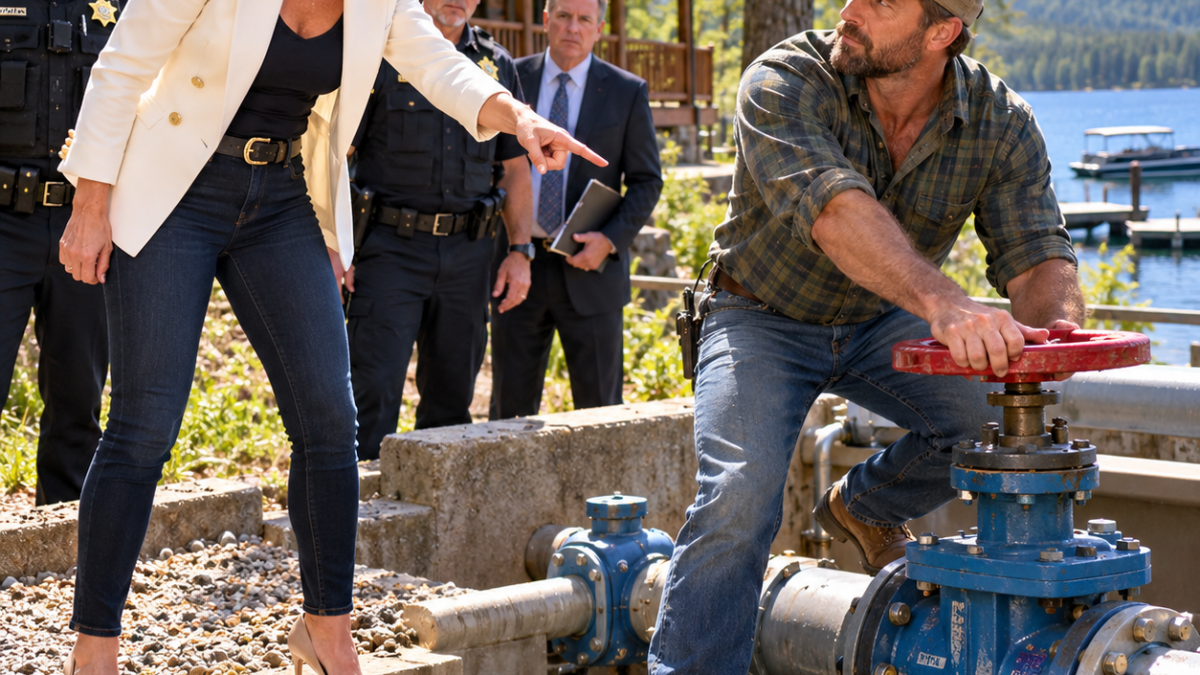
The sound of a power saw cutting into the waterline outside my cabin was the first thing I heard that Tuesday morning. By the time I reached the driveway, two contractors were standing beside an exposed pipe while the HOA president watched with a smile that made my blood run cold. I thought I’d already seen the worst of her cruelty, but what happened next would force me to confront a secret buried beneath this neighborhood for decades.
“Cut it right there!” Veronica Brightwell shouted, pointing toward the pipe running beneath my gravel driveway. “He was warned. He’s had thirty days to comply, and I’m not wasting another minute on that filthy cabin.”
I was standing barefoot on my porch, holding a coffee mug that had belonged to my late wife, Martha.
“Turn that saw off!” I yelled.
The younger contractor stopped immediately. The older man hesitated, glanced at Veronica, then released the trigger.
Veronica turned toward me with a satisfied smile.
“Good morning, Mr. Thornfield. I see you’ve finally decided to participate in community water conservation.”
“Conservation?” I stepped off the porch. “You’re cutting a pressurized waterline twenty feet from my front door!”
“Your continued violations have left us no alternative.”
She held up a laminated notice.
“Your property has exceeded the HOA’s permitted water usage. Effective immediately, your service is subject to termination until all outstanding fines are paid.”
“How much?”
“Five thousand dollars. Plus administrative costs.”
I stared at her.
“I’m seventy-one years old, Veronica. I live alone. My monthly water usage is lower than almost every household around this lake.”
“Then you should have no difficulty explaining yourself at the next board hearing.”
Behind her, a man in an expensive gray suit raised his phone and started recording.
I recognized him as one of her board members.
He was smiling.
That was the moment something inside me hardened.
My name is Garrett Thornfield. I spent forty years designing, maintaining, and repairing municipal water systems throughout Clearbrook County. I knew more about the pipes beneath Whisper Lake Estates than most residents knew about the rooms inside their own houses.
But Veronica never bothered to ask what I did for a living.
To her, I was just another stubborn old man living in a weathered cabin that didn’t match the expensive homes surrounding the lake.
Martha and I had discovered that cabin during our thirty-seventh wedding anniversary trip. She’d fallen in love with its cedar siding, the little fishing dock, and the loons calling across the water at sunrise.
“This is where we should grow old,” she’d whispered.
We never got that chance.
Cancer took her two years later.
I scattered her ashes from that dock on a quiet September morning, promising that the place she loved would remain our home.
For three years, I kept that promise.
Then Veronica decided my cabin was ruining her neighborhood.
She’d controlled the Whisper Lake Estates HOA for eight years, surrounded by board members who rarely challenged her. Her house was worth nearly eight hundred thousand dollars, her lawn looked professionally painted, and she treated community guidelines like laws handed down from heaven.
My cabin had been built in 1963, long before the HOA existed.
That didn’t stop her.
First came complaints about my cedar siding. Then my vegetable garden. Then the bird feeders Martha had hung outside our kitchen window.
Finally, she accused me of excessive groundwater consumption.
At a board meeting, she announced a new two-hundred-gallon usage restriction for older properties and looked directly at me.
Two weeks later, I received a five-thousand-dollar fine and a threat to disconnect my water unless I installed monitoring equipment.
I challenged the order in writing.
I produced water records.
I requested the association’s legal authority.
She ignored everything.
Instead, she sent contractors to my wellhouse, spread rumors that I was stealing groundwater, and told neighbors my property threatened their drinking water.
And now she was standing in my driveway, ordering men to cut a pipe.
“Veronica,” I said quietly, “do you understand what happens when somebody cuts into an active waterline without verifying the system?”
She folded her arms.
“I understand that your refusal to cooperate ends today.”
I looked at the contractors.
“Who authorized the excavation?”
“The association,” the older man replied.
“Did you contact the county utility authority?”
He glanced at Veronica.
She interrupted.
“Mr. Thornfield, I’m an attorney. I understand legal authority perfectly well.”
I stared at the exposed pipe, recognizing the old fitting beneath its insulation.
Something about its location bothered me.
I had seen that installation before.
Decades earlier.
Long before Veronica’s house existed.
“Put your tools down,” I told the workers. “Nobody touches that line until the county confirms what it serves.”
Veronica stepped closer.
“You don’t give orders here.”
I didn’t answer.
Instead, I walked into the cabin, opened the bottom drawer of my desk, and pulled out an old leather folder containing the original property surveys.
The first drawing was dated 1963.
And when I unfolded it, I saw a handwritten notation beside the very pipe Veronica had ordered her contractors to cut.
My heart began pounding.
Because suddenly, I wasn’t looking at an ordinary water-service connection.
I was looking at something I remembered helping to design.
PART 2
I stood in my kitchen with the old survey spread across the table, listening to the distant voices of Veronica’s contractors outside.
The drawing was almost sixty years old. Its edges had yellowed, and the blue engineering lines had faded where the paper had been folded. But I recognized the symbols immediately. I had spent most of my adult life reading documents exactly like this, tracing pipes beneath streets, identifying pressure-control stations, and figuring out why water stopped flowing to homes miles away from the actual problem.
Near the southern edge of my property, a thick blue line crossed the boundary and continued toward the eastern shore.
Beside it were the words PRIMARY DISTRIBUTION CORRIDOR.
I followed the line with my finger.
It ran beneath my driveway, crossed the narrow strip of woodland behind my cabin, and continued toward what eventually became Whisper Lake Estates.
Forty-seven houses.
Every one of them connected to the same distribution network.
I remembered that section of pipe because I had supervised an upgrade there in the late 1980s. The original development had been a collection of fishing cabins, barely more than seasonal shelters. When luxury homes began appearing along the shoreline, the county had needed to expand the water system without disturbing the lake’s protected wetlands.
The most practical route had been through the property where I now lived.
At the time, I had been a relatively young engineer.
I remembered standing in the mud with a survey crew, discussing how the new pressure-control equipment would connect to the existing distribution main.
But there was something about the old agreement I couldn’t quite remember.
I turned another page.
There it was.
A recorded infrastructure easement.
Dated April 1963.
The agreement contained provisions for access, maintenance, inspection, and protection of the water corridor. Certain responsibilities had been retained by the owner of the original cabin parcel, while authorized utility operators held separate rights necessary to supply the surrounding properties.
I studied the document.
If the rights had survived later transfers, my property played a much more important role in the neighborhood’s water system than Veronica understood.
But even more troubling was what her contractors had been preparing to cut.
The pipe in my driveway wasn’t necessarily an isolated service connection.
It might have been part of the main distribution system.
And if that was true, her attempt to punish me could endanger the water service of the very people she claimed to protect.
I folded the survey and reached for my phone.
I still had Janet Rodriguez’s number memorized.
We’d worked together for fifteen years before I retired.
She answered on the second ring.
“Garrett? This is a surprise.”
“Janet, I need you to listen carefully.”
My tone must have registered immediately.
“What happened?”
“I’ve got two contractors standing in my driveway with a saw, and the HOA president is ordering them to disconnect what she thinks is my waterline.”
There was a pause.
“Did they verify the isolation point?”
“No.”
“Did they contact our office?”
“Not according to the men.”
“What size is the pipe?”
I told her what I could see.
Another pause.
Then Janet’s voice became sharply professional.
“Garrett, nobody touches anything until we get somebody out there. I’m sending a crew.”
I looked toward the window.
Veronica was pacing beside her BMW.
“Janet, bring the old Whisper Lake distribution records.”
“Why?”
“Because I think she’s standing over the supply main.”
I returned to the driveway carrying the survey folder.
Veronica was already impatient.
“Well?” she demanded. “Have you decided to cooperate?”
“I’ve contacted the county water authority.”
Her smile disappeared.
“That wasn’t necessary.”
“It was absolutely necessary.”
The older contractor approached me.
He was a heavyset man with a weathered face and a name patch reading RICK.
“Sir, we’re working under instructions from the property management company.”
“Did they tell you what that pipe serves?”
He hesitated.
“They said it was your private supply line.”
“Did anyone give you a utility map?”
“No, sir.”
“Then you were about to cut a pipe without knowing whether it serves one cabin or forty-seven homes.”
Rick turned toward the exposed fitting.
The younger worker stepped away from it.
Veronica laughed dismissively.
“More scare tactics. This is exactly why the board has been forced to intervene.”
I looked at her.
“Veronica, you are not a licensed water-system operator.”
“I’m a lawyer.”
“Then you should understand why you don’t authorize destructive work on infrastructure without verifying ownership, jurisdiction, and safety.”
Her cheeks flushed.
“You have no idea what kind of trouble you’re creating.”
I glanced at the inactive saw.
“At least I’m trying to prevent the kind that comes with a damaged water main.”
She moved closer.
“You think your retirement from the county gives you special privileges?”
“No.”
I held up the survey.
“But it does mean I can recognize a distribution corridor when I see one.”
For the first time that morning, she looked uncertain.
Only briefly.
Then she pointed toward the workers.
“Finish the job.”
Neither man moved.
Rick folded his arms.
“Ma’am, I’m not touching another inch until the utility people arrive.”
Veronica stared at him.
“You’re under contract.”
“Not to flood a neighborhood.”
The younger contractor quietly put his tools back in the truck.
I watched Veronica’s expression change.
Anger.
Disbelief.
Then something close to panic.
She had arrived expecting an easy victory over an old widower.
Instead, two contractors had refused her orders, and county officials were on their way.
But I knew Veronica.
She wasn’t finished.
Not even close.
The county trucks arrived twenty-three minutes later.
Janet stepped out of the lead vehicle wearing a navy utility jacket and carrying a rolled set of infrastructure maps.
Her hair had gone mostly gray since we’d last worked together, but her expression was exactly as I remembered.
Focused.
Impatient with nonsense.
And completely uninterested in being impressed by expensive clothing.
She looked at the excavation.
Then at the saw.
Then at Veronica.
“Who’s responsible for this work?”
Veronica stepped forward.
“I am. Veronica Brightwell, president of the Whisper Lake Estates Homeowners Association.”
Janet nodded.
“And who authorized excavation near this water infrastructure?”
“The HOA board.”
“Did you obtain clearance from the utility authority?”
Veronica straightened.
“Our association has broad enforcement powers under its governing documents.”
Janet looked at the exposed pipe.
“That wasn’t my question.”
A silence fell across the driveway.
Veronica’s smile tightened.
“We were disconnecting an individual property for violations.”
“On whose authority?”
“Our covenants.”
Janet turned toward Rick.
“Have you cut into the pipe?”
“No, ma’am.”
“Good. Nobody touches it until our crew identifies the line and inspects the exposed section.”
Veronica started to protest.
Janet raised one hand.
“Mrs. Brightwell, a homeowners association doesn’t become a public utility merely because its president decides a resident deserves punishment.”
I nearly smiled.
Janet turned toward me.
“Garrett, show me what you found.”
I unfolded the old survey on the hood of her truck.
She studied it for several seconds.
Then she called one of her technicians over.
“Get me the current distribution map for this sector.”
He retrieved a tablet.
They compared the maps.
I watched Janet trace the old blue line.
Her forehead tightened.
“Well,” she said quietly.
“What?”
She glanced at Veronica.
“Your HOA president was about to make a very expensive mistake.”
Veronica crossed her arms.
“That’s an outrageous allegation.”
Janet ignored her.
She pointed to the drawing.
“This is the original corridor carrying the main distribution supply toward Whisper Lake Estates. The county needs to verify the current configuration before anybody works here.”
She looked at the technicians.
“Secure the excavation and arrange a full condition assessment.”
Then she turned toward Veronica.
“Whatever disagreement you have with Mr. Thornfield, you will not interfere with this infrastructure.”
Veronica’s voice rose.
“You can’t just overrule the association!”
Janet looked directly at her.
“Watch me enforce the utility’s safety requirements.”
By lunchtime, the contractors were gone.
Veronica left shortly afterward, slamming her car door so hard that I heard it from my porch.
Janet stayed.
We sat at my kitchen table with the old records spread between us.
She took a sip of coffee.
“Garrett, how long have you owned this place?”
“Three years.”
“And you never reviewed the utility easement?”
“I bought it to retire, Janet. Not to return to work.”
She smiled faintly.
“Well, work seems to have found you.”
I rubbed my forehead.
“Tell me exactly what we have.”
She turned the survey toward me.
“The main crosses your property. That’s clear. The current distribution system serves the entire Whisper Lake development through this corridor.”
“And the easement?”
“The recorded documents give the original parcel owner certain access and protective rights related to the infrastructure. The county and its authorized operators retain their own rights and responsibilities.”
I nodded.
“So I can’t just turn off the neighborhood’s water because I’m angry.”
She gave me a hard look.
“Garrett, if I thought you were considering that, I’d take your coffee away.”
I laughed.
“Don’t worry.”
She softened.
“The important thing is that Veronica can’t authorize random work on this corridor. And you have grounds to insist that anyone entering your property comply with the recorded agreement and applicable utility procedures.”
I looked at the faded document.
“She threatened to cut off my water.”
“I know.”
“And she didn’t even understand what she was touching.”
“No.”
Janet placed her cup down.
“There’s something else you need to know.”
Her expression had changed.
She opened a separate folder.
“Veronica has been filing complaints with our office for years.”
I stared at her.
“Against me?”
“Not just you.”
She turned a page.
“Several residents. Different accusations, similar pattern.”
“Water misuse?”
“Unauthorized wells. Alleged contamination. False emergency reports. Claims about utility theft.”
I felt my jaw tighten.
“Has the county done anything?”
“We investigate complaints. Some allegations were unsubstantiated. Others were referred for follow-up where necessary. We’re compiling a record of repeated misuse of the complaint process.”
I leaned back.
“So I’m not the first.”
Janet shook her head.
“Not even close.”
That evening, Hazel Murphy came over.
Hazel was seventy-eight and had lived beside Whisper Lake since the 1970s. She walked with a cane, baked pies that should have been illegal, and possessed an extraordinary ability to know everything happening within five miles of her porch.
She carried a covered dish.
“Chicken casserole,” she announced. “You look like a man who’s forgotten to eat.”
I took it gratefully.
“Come in.”
She settled into Martha’s old chair beside the fireplace.
“Well?”
“Well, what?”
“Did the woman finally get herself arrested?”
“Not today.”
Hazel sighed.
“Pity.”
I laughed despite myself.
Then I told her what Janet had discovered.
Hazel listened carefully.
When I finished, she set down her coffee.
“Garrett, you need to understand something about Veronica.”
“I’m beginning to.”
“No, honey. You’re only seeing what she’s doing to you. I’ve watched her do it to other people for eight years.”
She looked toward the window.
“Remember the Kowalskis?”
“I’ve heard the name.”
“Frank and his wife, Anna. Sweet people. Their cabin was down the shore, where the Hendersons live now.”
“What happened?”
Hazel’s face hardened.
“Veronica decided their place looked too ordinary for the neighborhood. Started with landscaping complaints. Then vehicle violations. Then allegations about their well.”
I listened without interrupting.
“They fought for almost a year. Frank was recovering from surgery, and Anna was exhausted from caring for him. Eventually, they sold.”
“Did Veronica buy the property?”
“No. But a developer she knew purchased it.”
Hazel looked at me.
“I’ve always wondered whether that was a coincidence.”
I felt something cold settle in my stomach.
“Do you have proof?”
“No. And I’m not going to pretend I do.”
She leaned forward.
“But I know what it looks like when someone is trying to wear another person down.”
I stared toward the darkening lake.
Suddenly, Veronica’s obsession with my cabin seemed less random.
The water fines.
The inspections.
The threats.
The attempt to disconnect my service.
It was the same pattern Hazel had described.
The difference was that I had spent forty years learning how infrastructure, government records, and technical regulations worked.
Veronica had assumed she was dealing with an old man who would eventually surrender.
She had no idea how much documentation I could assemble.
The following morning, I drove to the county courthouse.
I requested the recorded deeds, subdivision filings, easement documents, and original HOA declaration.
Then I went through my own purchase records.
My cabin had been built in 1963.
Whisper Lake Estates had been established in 1987.
That twenty-four-year difference mattered, although it didn’t settle every legal question by itself.
Whether HOA covenants applied to my property depended on the recorded chain of title, valid restrictions, and whether the parcel had ever been lawfully subjected to the association’s authority.
I wasn’t going to assume that age alone made me exempt.
I contacted a property attorney named Daniel Mercer.
He reviewed the documents and agreed to represent me.
At our first meeting, he spread the records across his desk.
“Mr. Thornfield, the association has several serious problems with its position.”
“Such as?”
“First, the documents we’ve reviewed don’t establish that your original cabin parcel is subject to the water-use restriction Veronica cited.”
I leaned forward.
“Second?”
“The HOA’s attempt to disconnect your water appears to exceed its claimed authority, particularly because it involved infrastructure operated under separate utility arrangements.”
“And third?”
Daniel tapped the recorded easement.
“Your property is burdened by, and benefits from, a complicated set of infrastructure rights. This corridor is essential to the development. The HOA cannot simply ignore the rights of the landowner or the utility.”
I stared at the map.
“Can we stop her?”
“We can seek appropriate court relief and demand that the association cease unauthorized interference. We’ll also ask for preservation of the records concerning the decision to send those contractors.”
I nodded.
“Do it.”
Daniel studied me.
“May I ask something personal?”
“Sure.”
“Why are you so determined to stay in that particular cabin? There are beautiful houses all around that lake.”
I looked at the photograph of Martha I’d placed beside my notebook.
“Because my wife loved it.”
His expression softened.
“Understood.”
“No,” I said quietly. “I don’t think anyone understands until they’ve lost the person they planned to grow old with.”
He waited.
“We found that cabin together. She picked the kitchen curtains. She chose the little table on the porch. She planted the flowers beside the steps.”
My throat tightened.
“When she died, I scattered her ashes from our dock. Every morning I sit there, it’s the closest thing I have to another cup of coffee with her.”
Daniel lowered his eyes.
Then he closed the folder.
“Mr. Thornfield, we’ll make sure your rights are fully and carefully presented.”
Veronica responded to our first legal notice with another certified letter.
This one accused me of attempting to intimidate the HOA through my former employment with the county.
It claimed I was exploiting technical information to avoid compliance.
She also demanded that I stop contacting county officials about association matters.
I laughed when I read that.
Then I forwarded it to Daniel.
His response was brief.
Preserve it. Do not engage directly.
A week later, Veronica announced an emergency community meeting.
The stated subject was protecting the neighborhood’s water supply.
Hazel called me that afternoon.
“Garrett, she’s telling people you’re threatening to shut off the whole neighborhood.”
I closed my eyes.
“That’s exactly what I’m trying to prevent.”
“She’s saying you found some old paperwork and now you’re holding everyone’s water hostage.”
I stared at the phone.
“And people believe her?”
“Some do. Most don’t know what to believe.”
I understood their fear.
Water isn’t a decorative amenity.
It isn’t like arguing over mailbox colors or boat sizes.
Families need clean running water for drinking, cooking, bathing, and sanitation.
Elderly people rely on it.
Parents rely on it.
Medical facilities and emergency services depend on properly maintained utility systems.
If someone convinced residents that one man could arbitrarily shut off the supply, they had every reason to be worried.
Veronica had taken the truth—that the main line crossed my property—and twisted it into a threat I had never made.
That was when I decided to attend the meeting.
Not to defend myself emotionally.
To explain the system.
With facts.
The community center was packed.
Veronica stood at the front beside a projector showing photographs of my cabin.
A large headline read WATER SECURITY CRISIS.
I almost turned around.
Instead, I took a seat near the back.
She was midway through her presentation.
“Certain individuals,” she declared, “are attempting to manipulate outdated easement documents to threaten the safe water supply of our community.”
People murmured anxiously.
A young mother raised her hand.
“Are you saying our water might be shut off?”
Veronica nodded gravely.
“That is a possibility we’re taking very seriously.”
I stood.
“No, it isn’t.”
Every head turned.
Veronica’s smile froze.
“Mr. Thornfield, this is a scheduled board presentation.”
“And you’re telling people something that isn’t true.”
She straightened.
“You’ll have an opportunity to speak at the appropriate time.”
I looked around the room.
“Folks, I’ve spent forty years working on water systems. I promise you that nobody has the right to arbitrarily shut off your water because they’re angry about an HOA dispute.”
A man near the front raised his hand.
“Then what’s this business about the pipeline on your property?”
I walked toward the projector.
“Would you like me to explain it?”
Veronica stepped in front of me.
“You’re not on the agenda.”
Hazel stood.
“Then put him on it.”
Several people nodded.
A woman near the aisle said, “I’d like to hear what he has to say.”
Another resident added, “He’s the one who actually worked for the water department.”
Veronica looked around.
For the first time that evening, she realized the room wasn’t entirely hers.
Reluctantly, she moved aside.
I connected my laptop.
On the screen appeared the county’s historical water distribution map.
“This,” I began, “is the original supply corridor serving Whisper Lake Estates.”
I highlighted the line running through my property.
“The main crosses my land. That creates important access and maintenance obligations for me and the utility. It does not give me the right to deprive forty-seven families of water whenever I feel like it.”
A few people visibly relaxed.
“Likewise, the HOA does not have the authority to send contractors into that corridor and cut what it assumes is someone’s personal supply.”
I displayed the photograph of the excavation.
“This is what happened at my cabin.”
A low murmur spread through the room.
I continued.
“The workers were preparing to cut into an active waterline without confirming the system configuration. County utility personnel intervened before the line was damaged.”
A man in the second row stood.
“That could have affected us?”
“It could have caused serious problems. The county prevented the work from proceeding and is conducting the necessary review.”
Veronica interrupted.
“He’s exaggerating!”
I turned toward her.
“Then let Janet Rodriguez explain what her department found.”
Janet stood near the rear doors.
She hadn’t arrived with me, and I was grateful she was there.
She approached the front.
“Good evening. I’m Janet Rodriguez with the Clearbrook County Water Authority.”
The room fell silent.
“We inspected the excavation at Mr. Thornfield’s property. Our preliminary findings confirm that the affected area includes critical distribution infrastructure. Unauthorized work there presents a safety and service risk.”
She looked toward Veronica.
“The association was not authorized to perform the proposed disconnection.”
Someone gasped.
Veronica’s face tightened.
Janet continued.
“We have secured the site and are reviewing the infrastructure corridor. Residents should direct any service concerns to the utility, not to unqualified contractors or private enforcement personnel.”
I stepped away from the microphone.
The facts could speak for themselves.
That should have ended the matter.
Instead, Frank Kowalski stood.
I recognized him from Hazel’s description.
He was a broad-shouldered man in his late seventies with white hair and a deliberate way of speaking.
“My name is Frank Kowalski,” he said.
Veronica’s expression changed.
“Frank, this isn’t the appropriate time—”
“You said the same thing three years ago.”
The room went quiet.
Frank held up a folder.
“My wife and I lived here for twenty-six years. We paid our bills. We maintained our property. We never bothered anybody.”
His voice shook slightly.
“Then you started sending us violation notices. Our truck was too old. Our porch needed paint. Our garden was supposedly against community standards.”
He looked directly at Veronica.
“When Anna became ill, you threatened more fines because I didn’t have the strength to keep everything perfect.”
I watched his hands.
They were trembling.
“We sold our home because we couldn’t take it anymore.”
Veronica crossed her arms.
“Mr. Kowalski, the board enforced legitimate property standards.”
Frank shook his head.
“You made my wife cry in the home where we’d raised our children.”
Nobody moved.
He swallowed.
“She died eleven months after we left.”
The silence became unbearable.
Frank looked toward me.
“I don’t want another family to go through what we did.”
Then he sat down.
Hazel reached across the aisle and took his hand.
A woman in the back rose.
“She did something similar to my parents.”
Another man spoke.
“She fined me for parking my work van.”
Then Carlos Ramirez, a disabled veteran, stood beside his service dog.
“She tried to restrict my dog from shared spaces, even after I provided documentation of my disability-related needs.”
The room erupted.
People began speaking over one another.
Years of resentment poured out.
Veronica struck the table with her palm.
“Enough!”
The room quieted slightly.
She looked furious.
“This is a premium lakefront community. We have standards. Some people simply refuse to live up to them.”
The words hung in the air.
Then Hazel said, quietly but clearly, “Some people can’t afford an eight-hundred-thousand-dollar house, Veronica. That doesn’t mean they don’t deserve a home.”
A few people applauded.
Then more.
Veronica looked around the room as though she were seeing her neighbors for the first time.
Not as names on violation notices.
Not as properties to regulate.
As people who were no longer afraid to disagree with her.
The next morning, the local newspaper published a story about the meeting.
For once, Veronica didn’t control the entire narrative.
The article included a statement from Janet explaining the utility’s findings and quoted several residents who described their experiences with HOA enforcement.
It also reported that my attorney was challenging the association’s water-related fines.
I was making breakfast when Hazel called.
“Have you seen it?”
“I have.”
“She’s going to be furious.”
“Probably.”
“You sound awfully calm.”
I looked at Martha’s photograph beside the kitchen window.
“Hazel, I’ve spent three months being angry. I’m running out of energy for it.”
She was quiet.
Then she said, “You remind me of your wife sometimes.”
I smiled sadly.
“Martha would’ve laughed at that.”
“She would’ve told you to eat your breakfast.”
I looked down at the untouched eggs.
“You’re probably right.”
Veronica’s retaliation came quickly.
She hired Blackstone and Associates, a law firm known for representing property associations in enforcement disputes.
Her attorneys claimed that my refusal to comply with HOA water restrictions posed an environmental risk and requested court intervention.
The complaint alleged excessive groundwater use and potential septic contamination.
Daniel called me as soon as the papers arrived.
“Garrett, this is getting expensive for them.”
“What are they asking for?”
“Restrictions on your water use, inspection rights, and relief concerning the alleged contamination.”
“Is there evidence?”
“That’s what we’re going to require them to establish.”
We arranged certified environmental testing and asked that the relevant health authorities review the findings.
The inspections took nearly two weeks.
I watched technicians collect samples from my well, soil, and septic system.
They examined the equipment.
Reviewed maintenance records.
Checked the drainage patterns.
I had installed and maintained water systems for forty years, but I wasn’t arrogant enough to assume my own property was perfect.
If there was a problem, I wanted to know.
The results showed no contamination attributable to my cabin and no violation supporting the HOA’s allegations.
My septic system was functioning properly.
My measured water use was consistent with a small, single-occupant household.
Daniel forwarded the results to the opposing attorneys.
Then he called me.
“They have a problem.”
“How big?”
“Large enough that they should seriously reconsider this case.”
I sat down.
“Good.”
There was a pause.
“Garrett, there’s more.”
The environmental review had also identified a concern with runoff and wastewater management near Veronica’s property.
It wasn’t the catastrophe some neighbors later imagined, but it warranted further investigation and corrective action.
The authorities notified the appropriate parties.
I didn’t celebrate.
Environmental problems aren’t funny just because they affect someone you dislike.
Pollution doesn’t recognize property lines.
If Veronica’s property was creating a problem, I wanted it fixed.
For the lake.
For everyone.
Even for her.
That evening, I sat on the dock holding Martha’s old coffee mug.
The sun was setting behind the western ridge.
I remembered the first morning we’d seen the cabin.
We’d been married thirty-seven years.
Martha had stepped onto the porch, looked across the lake, and smiled in a way I hadn’t seen in months.
At the time, her treatment had already exhausted her.
We both knew the future was uncertain.
But for one afternoon, standing beside that quiet water, we’d allowed ourselves to imagine growing old together.
She’d pointed to the little dock.
“That’s where I’ll sit and drink coffee.”
I had laughed.
“Every morning?”
“Every morning.”
“Even when it rains?”
“Especially when it rains.”
I looked down at her mug.
She had never been able to spend a full year there.
Cancer took her before we could make the move.
After her death, I’d almost sold the cabin.
It hurt too much to imagine living inside a dream we’d never completed.
But one morning, I drove up alone.
I opened the windows.
Swept the floor.
Made coffee.
And sat on the dock.
The loons were calling.
Mist floated over the water.
For a moment, I could almost hear her beside me.
That was when I decided to stay.
Not because I couldn’t move on.
But because I wanted to carry something beautiful forward.
And now Veronica was telling the entire town that grief had made me unstable.
She had even suggested Martha would be ashamed of me.
I stared at the sunset.
For the first time in months, I felt tears slipping down my cheeks.
Not because of the fines.
Not because of the lawsuit.
Because someone had taken the most painful loss of my life and tried to turn it into a weapon.
I sat there until the stars appeared.
Then I made a decision.
I would fight Veronica with everything the law and the evidence allowed.
But I would never threaten innocent families with the water supply they depended on.
That was the difference between us.
And I intended to make sure the entire neighborhood understood it.
The decisive discovery came at two in the morning.
I had spread the infrastructure records across my kitchen table, comparing the original easement with the county’s current distribution diagrams.
The more I studied them, the more clearly I remembered the system’s history.
The first cabin owner, Bill Hrix, had been a civil engineer.
He helped establish the original water corridor in 1963, negotiating access agreements when the shoreline still consisted mostly of woodland and fishing cabins.
When the larger neighborhood was developed, the existing corridor became essential to the expanded supply network.
The route was upgraded and modernized, but its legal history remained.
And certain recorded rights concerning entry, maintenance coordination, and protection of the infrastructure corridor continued with the land.
Veronica had spent months threatening me with disconnection without understanding that the system serving her own house crossed property she couldn’t simply commandeer.
I found an old letter from the utility department that confirmed the basic arrangement.
The county and the authorized operator remained responsible for water service.
But any proposed work affecting the corridor required compliance with the recorded access arrangements and applicable safety procedures.
That was the leverage I needed.
Not the power to punish forty-seven households.
The power to demand lawful treatment of the property and infrastructure everyone relied upon.
I placed the letter beside the survey.
Then I made three phone calls the following morning.
The first was to Daniel Mercer.
The second was to Janet Rodriguez.
The third was to Hazel.
And by noon, we had the beginning of a plan.
Daniel insisted on caution.
“Garrett, I know you’re angry.”
“I’m beyond angry.”
“That’s exactly why I’m telling you this. Your property rights are strong enough that you don’t need theatrics.”
I leaned back in my chair.
“Veronica has been putting on theatrics for three months.”
“And now she expects you to respond emotionally. Don’t give her that.”
Janet agreed.
She proposed a formal infrastructure assessment, not because we wanted to frighten anyone but because the attempted excavation had raised legitimate questions about the condition and protection of the corridor.
Any testing that could affect service would be conducted under utility control, with appropriate public notice, safeguards, and contingency planning.
Nobody would lose water simply to prove a point.
I made that condition clear.
Janet nodded.
“That’s how responsible operators work.”
Daniel prepared notices demanding that the HOA cease unauthorized utility interference, withdraw unsupported fines, and preserve records concerning the attempted disconnection.
He also drafted a request for the association’s financial records relating to legal expenses and contractor payments.
Meanwhile, Hazel quietly contacted residents who had experienced similar treatment.
Frank Kowalski agreed to provide a written account of his family’s experience.
Carlos gathered the correspondence concerning his service dog.
The Hendersons supplied copies of their vegetable garden fines.
Others came forward.
Not everyone had a strong legal claim.
Some simply wanted to be heard.
But together, their experiences showed the neighborhood what Veronica’s leadership had become.
Fear disguised as standards.
Punishment disguised as conservation.
And authority exercised without meaningful accountability.
Veronica heard that I was considering moving.
That rumor was deliberate.
Hazel had mentioned to a few neighbors that I seemed tired of fighting.
Frank had told an acquaintance at the marina that I’d been asking about property values.
Technically, both statements were true.
I was tired.
And I had requested an appraisal as part of my legal preparations.
But Veronica interpreted the information exactly as we’d anticipated.
She thought I was surrendering.
Within days, she announced a special HOA meeting to formalize what she called the successful resolution of the Thornfield water compliance matter.
The announcement claimed that my property would finally be brought into full compliance with association standards.
It even implied that I’d agreed to leave if the necessary improvements proved too expensive.
I hadn’t agreed to any such thing.
Daniel preserved the notice.
Janet prepared a factual statement concerning the utility corridor.
And I made sure my presentation included the original 1963 survey, the current distribution map, the inspection findings, and the recorded easement documents.
Veronica invited local journalists.
A county commissioner.
Several utility representatives.
Even a television crew.
She wanted everyone to watch her victory.
I wanted everyone to understand the truth.
Thursday evening arrived cold and clear.
I wore the same brown jacket I’d worn for most of my working life.
Nothing expensive.
Nothing impressive.
Just an old engineer attending a neighborhood meeting.
The community center was crowded.
Veronica stood at the front in a navy suit and pearl necklace, surrounded by board members who looked increasingly nervous.
A large screen displayed the words COMMUNITY WATER COMPLIANCE RESOLUTION.
I took a seat beside Hazel.
She leaned toward me.
“You look like you’re going to a funeral.”
“Whose?”
“Hopefully her HOA career.”
I almost laughed.
Then the meeting began.
Veronica tapped the microphone.
“Tonight marks an important victory for responsible community management.”
She smiled toward the cameras.
“For months, our association has worked tirelessly to address serious water-use violations involving one noncompliant property.”
Her eyes found mine.
“Mr. Thornfield has finally recognized the importance of bringing his property into alignment with community standards.”
I remained seated.
She continued.
“Our decisive enforcement actions have demonstrated that no resident, regardless of age, background, or former government employment, is above the rules.”
A few supporters applauded.
Veronica raised her chin.
“And as a final demonstration of the board’s commitment to compliance, we have arranged for a certified technician to explain the disconnection procedures available when residents refuse to cooperate.”
A man carrying a large tool case stood near the side door.
I recognized him as one of her property-management employees.
My stomach tightened.
Veronica had learned nothing from the morning in my driveway.
She was still treating water service as a punishment she could order.
I slowly stood.
“Before we go any further, Veronica, I have one question.”
Her smile widened.
“Of course, Mr. Thornfield.”
“Has anyone here actually verified who owns the land beneath the pipeline you’re threatening to interfere with?”
The room quieted.
She looked irritated.
“We’ve already addressed your outdated easement claims.”
“No,” I said.
“You’ve dismissed them.”
I placed my briefcase on the table.
Then I opened it.
Inside were the documents that had taken weeks to organize.
The original 1963 easement.
The recorded property surveys.
The current county distribution maps.
The inspection findings.
The environmental reports.
And Daniel’s legal analysis.
Veronica folded her arms.
“More paperwork, Garrett?”
I looked toward the county officials.
“Not just paperwork.”
I unfolded the largest map.
“This is the main water distribution corridor serving Whisper Lake Estates.”
People leaned forward.
I pointed to the line crossing my property.
“Every one of the forty-seven residential properties in this development receives water through the network connected to this corridor.”
A murmur moved through the room.
I continued.
“The original legal arrangements predate the formation of this HOA. The association did not create the system, does not own the land beneath this critical section, and cannot authorize unauthorized excavation or disconnection simply because it dislikes a homeowner.”
Veronica shook her head.
“That’s absurd.”
I turned toward Janet.
“Would you explain the utility’s findings?”
Janet rose.
The room became silent.
She introduced herself and summarized the inspection.
“The county water authority has confirmed that the distribution corridor crosses Mr. Thornfield’s property under recorded utility arrangements. The attempted work ordered by the association was not authorized by our office.”
She paused.
“Interference with critical water infrastructure can create significant safety and service risks. Decisions about isolation, maintenance, and repair must be made by authorized personnel under applicable procedures.”
Veronica opened her mouth.
Janet continued.
“These requirements are not optional HOA preferences.”
The reporter’s camera began flashing.
Derek, Veronica’s husband, sat in the front row with his hands clasped tightly.
The technician quietly put down his tool case.
I looked at Veronica.
“You tried to cut off my water without understanding the system. And the pipe your contractors were preparing to damage was connected to the infrastructure serving your own neighborhood.”
Her face went pale.
“You’re saying you can shut off everybody’s water?”
“No,” I said firmly.
“I’m saying nobody gets to use essential utilities as a weapon.”
I let that sentence settle.
“Not you. Not me. Nobody.”
For a moment, the room was completely still.
Then Frank Kowalski stood.
“She’s done this for years.”
Veronica turned sharply.
“Sit down, Frank.”
He didn’t.
He held up the folder he’d brought.
“My wife and I lived here before half these houses were built. We worked hard. We paid our bills. We helped our neighbors.”
His voice trembled.
“Then Veronica decided our property didn’t belong in her luxury community.”
He described the violation notices.
The threats.
The mounting costs.
The constant worry.
He spoke about Anna becoming ill and how exhausting the dispute had been during her treatment.
Then he said something that silenced the room.
“My wife spent the last year of her life worrying about whether we’d lose our home.”
Hazel began crying.
Frank looked directly at Veronica.
“We finally sold because we couldn’t take any more.”
His hands shook.
“I thought leaving would give Anna some peace.”
Nobody spoke.
“She died before she could enjoy the new place.”
I felt the air leave my chest.
Frank took a breath.
“I don’t care what your house is worth, Veronica. You had no right to make ours feel like a prison.”
He sat down.
The room remained silent.
Then Carlos Ramirez stood beside his service dog.
He described the restrictions Veronica had attempted to impose.
The Hendersons followed.
Then a young couple with two children.
Then an elderly widow who said she’d been afraid to challenge a fine because she couldn’t afford legal representation.
One by one, the stories emerged.
Different families.
Different complaints.
The same feeling.
Fear.
I looked at Veronica.
For the first time since meeting her, I saw what eight years of unchecked authority had created.
Not a community.
A collection of people who had learned to keep their heads down.
And the worst part was that many of them had started believing they deserved it.
Veronica slammed her hand against the table.
“This is a coordinated attack!”
Nobody answered.
She pointed at me.
“This man has manipulated all of you! He’s a bitter old widower who’s never recovered from his wife’s death!”
My chest tightened.
The room went still.
Veronica kept going.
“His grief has obviously affected his judgment. He’s turned a routine compliance issue into a personal vendetta!”
I felt my hands curl into fists.
Then I remembered Martha.
Not the hospital room.
Not the machines.
Not the final terrible weeks.
I remembered her standing on our dock with the wind in her hair, laughing because I’d dropped a fishing pole into the water.
I unclenched my hands.
Slowly.
I stepped toward the microphone.
“Veronica.”
She stared at me.
“You can criticize my cabin.”
No one moved.
“You can complain about my garden. You can disagree with my attorney. You can challenge the interpretation of a deed.”
I paused.
“But you don’t get to use my wife’s death to explain away facts you don’t like.”
Her mouth opened.
I continued.
“Martha was the kindest person I ever knew. She spent thirty-seven years reminding me that the measure of a person isn’t how much money they have or how impressive their house looks.”
My voice caught.
“She loved that little cabin. The peeling paint. The crooked porch steps. The birds that woke us before sunrise.”
I looked around the room.
“She didn’t care whether the neighbors drove expensive cars. She cared whether they’d stop to help someone whose car wouldn’t start.”
Hazel covered her face.
I turned back toward Veronica.
“My wife died believing people were mostly good. I’ve spent the last three months trying not to let you convince me she was wrong.”
A long silence followed.
Then Betty Henderson stood.
“She wasn’t wrong, Garrett.”
Phil Morgan rose beside her.
“Not even close.”
Another resident stood.
Then another.
Within moments, nearly the entire room was on its feet.
They weren’t shouting.
They weren’t threatening Veronica.
They were simply refusing to remain silent.
And somehow that was more powerful than anything I’d prepared.
County Sheriff Mike Davidson had been standing near the entrance.
He stepped forward as the meeting grew louder.
“Everyone, please remain calm.”
The room quieted.
He looked toward Veronica.
“Mrs. Brightwell, there are several ongoing matters involving complaints and reports submitted to county agencies. Those will be evaluated through the proper process.”
Veronica crossed her arms.
“Are you threatening me?”
“No, ma’am. I’m explaining that official investigations are not controlled by HOA meetings.”
He turned toward the audience.
“If anyone has relevant documentation concerning threats, property damage, or suspected offenses, they may provide it to the appropriate investigators.”
Then he looked at the technician.
“Nobody is disconnecting a residential water supply here tonight.”
The technician nodded quickly.
Veronica looked around.
Her attorney was staring at the documents.
Several board members had moved away from her table.
Even Derek seemed unable to look her in the eye.
She had arranged the meeting to showcase her authority.
Instead, she had invited witnesses to the collapse of it.
I stepped back from the microphone.
My work was finished.
The board called an emergency closed session that night.
By the next afternoon, Veronica had submitted her resignation as HOA president.
The association’s legal counsel began reviewing the pending litigation.
Daniel received a call from Blackstone and Associates indicating that the HOA wanted to discuss dismissing its claims and resolving the dispute.
The association ultimately withdrew the unsupported water fines.
It agreed not to interfere with my service without lawful authority.
The parties established a formal process for addressing future utility work near the recorded corridor.
And the board authorized an independent review of the enforcement actions taken during Veronica’s presidency.
That review uncovered procedural problems.
Some fines had been assessed without sufficient notice.
Others had been based on interpretations of covenants that the board could not adequately support.
Certain enforcement actions appeared inconsistent across comparable properties.
Residents who’d paid questionable penalties were offered a review and, where appropriate, refunds or credits.
The board also referred relevant financial and complaint records for further examination.
I wasn’t interested in inventing crimes or celebrating allegations that hadn’t been proven.
If Veronica had broken the law, the proper authorities could decide what consequences followed.
What mattered to me was that she could no longer use an official-looking letter to make frightened neighbors surrender money or property without scrutiny.
The new board election took place three weeks later.
Frank Kowalski returned to the neighborhood for the vote.
He had no intention of moving back.
His memories of Anna were too closely tied to what had happened.
But he agreed to serve as an adviser during the transition.
The residents elected a new president, Thomas Ellison, a retired school principal with the patience of a saint and the firm voice of a man who had spent forty years telling teenagers to stop throwing things.
His first words after accepting the position were simple.
“This association exists to serve the homeowners. The homeowners do not exist to serve the association.”
People applauded.
The new board began reviewing its rules.
It created clearer notice requirements.
Established a fair hearing process.
Required documented legal authority before threatening liens or utility-related enforcement.
Set stricter standards for conflicts of interest.
And introduced a neighbor-first approach to resolving ordinary disagreements.
The changes didn’t eliminate every argument.
People still disagreed about landscaping.
Parking.
Dock repairs.
Fence colors.
But disagreement no longer meant automatic punishment.
For the first time in years, residents felt comfortable speaking at meetings.
And that was worth more than any judgment Veronica might have suffered.
The most important work happened after the cameras disappeared.
Janet and I completed a comprehensive review of the water infrastructure serving Whisper Lake Estates.
The attempted excavation had exposed weaknesses in the corridor’s documentation and protection procedures.
We identified sections where access arrangements needed clarification and where older equipment would benefit from modernization.
The county and authorized utility operator developed a phased maintenance plan.
The HOA contributed where appropriate under its responsibilities and agreements.
Property owners were informed about the work.
Nobody was asked to surrender rights or rely on one person’s promises.
Everything was documented.
I volunteered my engineering knowledge.
Dave Morgan from the hardware store helped coordinate materials.
Phil worked with local contractors.
Janet supervised the utility-side technical requirements.
We replaced aging components, improved monitoring, and made the maintenance access points easier to identify.
The upgrades reduced waste and improved operational efficiency.
More importantly, they reduced the risk that a future dispute would endanger basic services.
When the final system assessment was complete, Janet came to my cabin.
She handed me a copy of the report.
“Looks good, Garrett.”
I studied it.
“Not bad for an old man with a rusty cabin.”
She smiled.
“Not bad at all.”
Then she looked toward Martha’s photograph on the mantel.
“She’d be proud of you.”
I swallowed.
“I hope so.”
Janet put a hand on my shoulder.
“She would.”
Spring came slowly that year.
The snow melted along the shoreline.
The first flowers appeared beside my porch.
The bird feeders Martha had hung were still there, repaired and freshly painted.
Hazel stopped by one Saturday carrying a basket of muffins.
She found me replacing a loose railing board.
“You know,” she said, “Veronica would have written you a fine for that.”
“For repairing my porch?”
“For using the wrong shade of stain.”
I laughed.
She sat in Martha’s old chair.
“You seem happier.”
“I am.”
“Good.”
She watched me work for a while.
Then she said, “Garrett, I’ve been thinking about your wife.”
I set down the hammer.
“What’s on your mind?”
“Martha loved this lake. And you’ve spent years making sure the water stays clean and the people have what they need.”
I nodded.
“She would’ve liked that.”
Hazel smiled.
“Then why don’t we do something in her memory?”
I looked at her.
“What kind of something?”
“A scholarship.”
I stopped.
“Go on.”
“You know more about water engineering than anyone around here. Why not help a young person learn what you learned?”
I thought about Martha.
She had always believed education was the best investment a community could make.
When I complained about paying for another evening course early in my career, she’d reminded me that knowledge was one of the few things nobody could take away from you.
She’d worked extra shifts at the hospital while I finished my certifications.
She’d sat beside me while I studied hydraulics.
She’d celebrated every promotion as though she’d earned it herself.
In many ways, she had.
I looked at Hazel.
“Let’s do it.”
The Martha Thornfield Lake Conservation Scholarship began with a modest fund.
I contributed the first money.
Several neighbors added donations.
Janet contacted local educators.
Dave organized a fundraiser at his hardware store.
Frank returned for the dedication.
Within months, we had enough support to assist three local students pursuing environmental engineering and water-resource management.
At the first scholarship ceremony, I stood beside a photograph of Martha.
The community center was filled with families.
Children who had never known her listened while I explained who she had been.
Not a celebrity.
Not a politician.
Not somebody who’d owned a mansion.
Just a woman who believed that kindness mattered.
And that the water we all depended on deserved protection.
One of the scholarship recipients was a seventeen-year-old girl named Emily Carter.
Her father worked nights maintaining county roads.
Her mother cleaned rooms at a nearby hotel.
Emily wanted to study environmental engineering because a water contamination problem in her grandparents’ town had shown her how quickly ordinary families could suffer when basic infrastructure failed.
She approached me after the ceremony.
“Mr. Thornfield?”
“Yes?”
“Thank you for believing in me.”
I smiled.
“You earned this.”
She shook her head.
“My parents couldn’t have afforded the extra program costs.”
I looked toward Martha’s photograph.
“Then I’m glad we could help.”
Emily hesitated.
“Do you think your wife would’ve liked me?”
My throat tightened.
I looked at the young woman standing in front of me.
Her determined expression.
Her nervous hands.
Her obvious excitement about what she might accomplish.
I smiled.
“Emily, Martha would’ve already invited you over for dinner.”
The girl laughed.
Then she hugged me.
I stood there for a moment, surprised.
And then I hugged her back.
Summer brought another change.
The neighborhood organized its first annual Lake Community Day.
Not an HOA enforcement event.
Not a meeting about violations.
A celebration.
Families brought food.
Children played games along the shore.
Volunteers cleaned the walking paths.
Neighbors repaired docks and shared tools.
Frank returned with his family.
Carlos brought his service dog.
The Hendersons contributed vegetables from the same garden Veronica had once threatened to fine them for.
Hazel made three apple pies and complained that nobody appreciated how difficult it was to bake in July.
I spent the morning showing children how a water distribution system works.
We used simple demonstration models.
Small tanks.
Clear tubing.
Hand-operated pumps.
I explained how water pressure keeps homes supplied and why engineers design systems with safety controls and maintenance procedures.
One little boy raised his hand.
“Mr. Thornfield, is it true you can turn off everybody’s water?”
The adults nearby went quiet.
I knelt beside him.
“No, son. Not just because I feel like it.”
He looked confused.
“But my dad said the pipes go through your land.”
“That’s true.”
“Then why can’t you?”
I thought for a moment.
“Because having a right involving something important doesn’t mean you get to hurt people with it.”
He frowned.
“Even mean people?”
I smiled.
“Especially when you’re angry at mean people.”
He thought about that.
Then he pointed toward the demonstration pump.
“Can I try it?”
“Absolutely.”
He began turning the handle.
Water moved through the clear tubing.
His eyes widened.
I watched him laugh.
And I thought about how close Veronica had come to making something so ordinary—clean running water—into a tool for controlling people’s lives.
Now the same subject was bringing families together.
That felt like justice.
Veronica moved away later that year.
Her husband accepted a job in another state, and their lakefront house was listed for sale.
I heard rumors about her new neighborhood.
Some said she had become quieter.
Others said she’d simply stopped volunteering for community boards.
I didn’t investigate.
Whatever lessons she had learned were hers to carry.
A few days before she left, however, she came to my cabin.
It was late afternoon.
The sky was turning gray, and rain clouds gathered over the mountains.
I was on the porch repairing a bird feeder when her white BMW pulled into my driveway.
I watched her step out.
For once, she wasn’t carrying a clipboard.
She walked toward the porch slowly.
“Garrett.”
“Veronica.”
She looked at the cabin.
At the weathered siding.
The flowers beside the steps.
The old rocking chair.
Then she looked at me.
“I suppose you’re happy.”
I set down the screwdriver.
“About what?”
“Everything. The board. The lawsuit. The newspaper stories.”
I considered my answer.
“I’m happy I can live in my home without being threatened.”
She looked away.
“You ruined my reputation.”
I shook my head.
“Veronica, I didn’t make you send contractors to cut a waterline.”
Her jaw tightened.
“I was enforcing standards.”
“You didn’t verify your authority.”
“I was trying to protect the neighborhood.”
“Then why did so many neighbors feel frightened of you?”
She didn’t answer.
The wind moved through the trees.
A loon called from the lake.
I leaned against the porch railing.
“Can I tell you something?”
She crossed her arms.
“Apparently you’re going to.”
“When Martha died, I didn’t know what to do with myself.”
Her expression changed slightly.
“I spent forty years solving problems. Broken pumps. Pressure failures. Infrastructure emergencies. There was always something I could fix.”
I looked toward the water.
“But I couldn’t fix what happened to her.”
Veronica remained silent.
“I bought this cabin because she loved it. Every morning I sit on that dock, I remember the life we planned together.”
My voice grew quieter.
“When you threatened to take it away, you weren’t just threatening an old building.”
She looked down.
“You were threatening the one place where I still felt close to her.”
For the first time, Veronica didn’t interrupt.
I continued.
“You can disagree with people. You can care about property values. You can believe your neighborhood should be maintained properly.”
I paused.
“But when you use rules to humiliate people, you stop protecting a community and start destroying it.”
She stared at the porch steps.
A long silence followed.
Then she spoke.
“I never wanted things to get this far.”
I nodded slowly.
“Then you should’ve stopped long before they did.”
Her eyes filled.
I couldn’t tell whether it was regret, embarrassment, or anger.
Perhaps all three.
Finally, she said, “I’m sorry about your wife.”
It wasn’t an apology for everything she’d done.
I wasn’t going to pretend it was.
But it was the first humane thing she’d said to me in months.
“Thank you,” I replied.
She turned and walked toward her car.
Before opening the door, she looked back.
“Are you ever going to forgive me?”
I thought about that.
Forgiveness isn’t a switch.
It isn’t something you owe another person because they finally sound sorry.
And it doesn’t erase consequences.
“I hope someday I won’t think about what happened every time I look at this driveway,” I said.
She nodded faintly.
Then she drove away.
I never saw her again.
The first autumn after the dispute felt different.
The air turned crisp.
Leaves gathered along the shoreline.
The lake reflected deep reds and golds as the trees changed color.
One morning, I stood on the dock with two cups of coffee.
It was an old habit.
For years after Martha died, I had continued making two cups without thinking.
Sometimes I’d catch myself halfway through pouring the second and feel the loss all over again.
That morning, I deliberately made two.
I placed one beside her favorite chair.
Then I sat down.
The wooden boards creaked beneath me.
Across the lake, Hazel’s curtains opened.
Frank’s old friends were fishing near the eastern bank.
Children waited for the school bus at the entrance road.
Water flowed quietly through the buried pipeline beneath my property.
Clean.
Reliable.
Unremarkable.
Exactly as essential infrastructure should be.
I thought about the first morning Veronica ordered her contractors to cut the line.
The saw.
The exposed pipe.
The expensive suit.
Her confidence that an official-looking notice made her actions lawful.
And I thought about what had happened afterward.
The hidden records.
The old easement.
The public meeting.
The neighbors who finally spoke.
The improvements that made the system safer.
The scholarship in Martha’s name.
It would have been easy to call that revenge.
But revenge usually ends with somebody losing.
This had ended with forty-seven families gaining something.
Security.
A voice.
A neighborhood where people could disagree without fearing that essential services would be turned against them.
And I had gained something too.
Not just a legal victory.
A reason to believe I still had something useful to give.
On the anniversary of Martha’s death, I invited a few neighbors to the cabin.
Nothing elaborate.
Coffee.
Sandwiches.
A few photographs.
Hazel came early to help.
Frank drove up with a bouquet of flowers.
Carlos brought his service dog, who immediately found the warmest patch of sunlight on the porch.
Emily Carter, now preparing for her first semester of environmental engineering studies, brought a handwritten card.
Inside, she’d written about the scholarship and how it had changed her plans.
I read it twice.
Then I placed it beside Martha’s photograph.
After everyone left, I walked down to the dock alone.
The sky was pink and gold.
I carried the same small box that had held Martha’s ashes two years earlier.
It was empty now.
But I had kept it.
I sat on the edge of the dock and spoke quietly.
“Well, sweetheart, you wouldn’t believe the year I’ve had.”
I laughed softly.
“Remember how you told me retirement would be peaceful?”
A breeze stirred the lake.
“Turns out I had one more big engineering problem to solve.”
I looked toward the houses.
“Made some friends, too.”
My throat tightened.
“Hazel reminds me of your mother. Frank’s a good man. And there’s a young woman going to college because of the scholarship we started in your name.”
I paused.
“I think you’d like her.”
The loons called from the far bank.
I closed my eyes.
For a moment, I could almost hear Martha laughing.
I remembered her standing beside me on our anniversary trip.
“This is where we should grow old.”
We hadn’t grown old together.
But maybe, in some small way, I was keeping the promise for both of us.
The following spring, the HOA installed a new sign at the community entrance.
Not one listing endless restrictions.
Not one warning people about violations.
It was a simple wooden sign surrounded by flowers.
WELCOME TO WHISPER LAKE ESTATES.
Beneath it, in smaller lettering, were the words:
A COMMUNITY BUILT ON RESPECT, RESPONSIBILITY, AND NEIGHBORLY CARE.
Thomas Ellison asked me to attend the dedication.
I almost declined.
I’d never enjoyed ceremonies.
But Hazel insisted.
“You started something important,” she told me.
“No,” I replied. “Veronica started it.”
Hazel shook her head.
“She started a fight. You helped us find a better way to live.”
I couldn’t argue with that.
At the dedication, Thomas spoke briefly about the new board’s commitment to fairness.
Frank talked about the importance of hearing neighbors before judging them.
Carlos thanked the residents who had supported changes to the community’s accessibility policies.
Then Thomas invited me to say a few words.
I stepped forward.
The morning sun warmed my face.
Behind the crowd, the lake glittered through the trees.
“I’ve spent most of my life around water,” I began.
“Not the beautiful part you see from a dock. I’m talking about pipes buried under roads, pumps inside concrete buildings, pressure gauges, maintenance records, and problems nobody notices until something stops working.”
A few people laughed.
“But water systems taught me something about communities.”
I paused.
“Every house depends on connections most people never see. One line feeds another. One valve affects several homes. One neglected problem can become everybody’s emergency.”
I looked around.
“People aren’t so different.”
Hazel smiled.
“What happens to one family eventually affects the others. When someone is bullied into silence, the whole neighborhood loses something. When we protect a neighbor who’s struggling, we make the entire community stronger.”
I glanced toward Martha’s photograph on the small memorial table.
“My wife used to say that kindness is a choice, but so is cruelty.”
My voice softened.
“I think she was right.”
The crowd grew quiet.
“We can’t control every disagreement. We can’t prevent every mistake. But we can decide whether our rules make people feel safer or more afraid.”
I looked toward the new sign.
“And I hope this place never forgets the difference.”
For a moment, nobody spoke.
Then applause rose through the crowd.
I stepped away from the microphone.
Hazel hugged me.
Frank shook my hand.
Thomas smiled.
And somehow, the lake cabin that Veronica had once called an embarrassment had become a symbol of everything our neighborhood wanted to preserve.
Years later, people would still talk about that morning when the HOA president tried to shut off my water.
They’d tell the story with laughter.
The contractors.
The saw.
The old survey.
The moment Veronica learned that the pipeline serving her luxury neighborhood crossed the property of the man she’d been trying to drive out.
Some versions grew more dramatic with every telling.
A few neighbors insisted I’d threatened to turn off the entire development.
I always corrected them.
“I never threatened to shut off anybody’s water.”
That mattered to me.
Because the truth was more satisfying.
Veronica had assumed that control meant the ability to punish.
She believed power belonged to whoever could issue the most intimidating letter, gather the largest group of supporters, or threaten the greatest financial consequences.
But real responsibility doesn’t work that way.
The waterline beneath my property served forty-seven homes.
Forty-seven families.
Children who needed baths before school.
Elderly residents who needed safe drinking water.
Parents preparing dinner.
People caring for sick spouses.
People recovering from surgery.
People whose daily lives depended on infrastructure they rarely had reason to think about.
I could never have justified using their needs to settle a personal score.
Instead, we protected that system.
We improved it.
We made sure nobody could manipulate it through ignorance or intimidation again.
And in doing so, we protected something more valuable than a pipeline.
We protected the idea that people deserve dignity in their own homes.
One quiet morning, I sat on my dock with a mug of coffee and watched the sunrise spread across Whisper Lake.
My cabin still had weathered cedar siding.
The porch steps still creaked.
Martha’s bird feeders still hung beside the kitchen window.
The house wasn’t worth eight hundred thousand dollars.
It never would be.
But I wouldn’t have traded it for Veronica’s mansion if she’d offered me the keys herself.
The value of my home had never been measured by the size of its rooms or the perfection of its landscaping.
It lived in the memories held within its walls.
The kitchen where Martha had made pancakes.
The porch where she’d watched storms roll over the mountains.
The dock where we’d dreamed about a future we didn’t get to share.
And now, the driveway where an angry HOA president had unknowingly exposed a truth that changed an entire neighborhood.
I took a sip of coffee.
The water moved gently against the dock.
Somewhere beneath my property, the main supply line carried clean water toward dozens of homes.
I smiled.
Veronica Brightwell had tried to cut off my water because she believed I was powerless.
She had no idea how deeply her own neighborhood depended on the land beneath my feet.
But the greatest lesson wasn’t that I had the knowledge and legal rights to stop her.
It was that I could have used my position to make everyone afraid.
And I chose not to.
I thought of Martha.
Her smile.
Her patience.
Her quiet insistence that every person deserved kindness, especially when life had already been cruel enough.
Then I looked across the lake at the homes waking up around me.
Forty-seven families.
One interconnected water system.
And a community that had finally learned to look after one another.
For the first time since Martha died, I no longer felt as though I were simply preserving the life we’d planned.
I was building something new with the love she’d left behind.
I lifted my mug toward the sunrise.
“We did it, sweetheart.”
A loon called from the far shore.
The morning breeze brushed against my face.
And I sat there listening to the sound of a neighborhood beginning another ordinary day.
Water flowing.
Children laughing.
Neighbors greeting one another.
No threats.
No intimidation.
No fear.
Just the life Martha and I had always wanted.
Veronica tried to teach me that whoever controlled the water controlled the neighborhood. Instead, I helped prove that the person worthy of protecting a community is the one who refuses to use its most basic needs against its people.
And that was a victory no HOA president could ever take away from me.
THE END








