PART 2: HOA Karen Ordered My Grandpa’s Rusty Gas Pump Hauled to Scrap—Then Learned It Was a Rare $45,000 Collector Piece
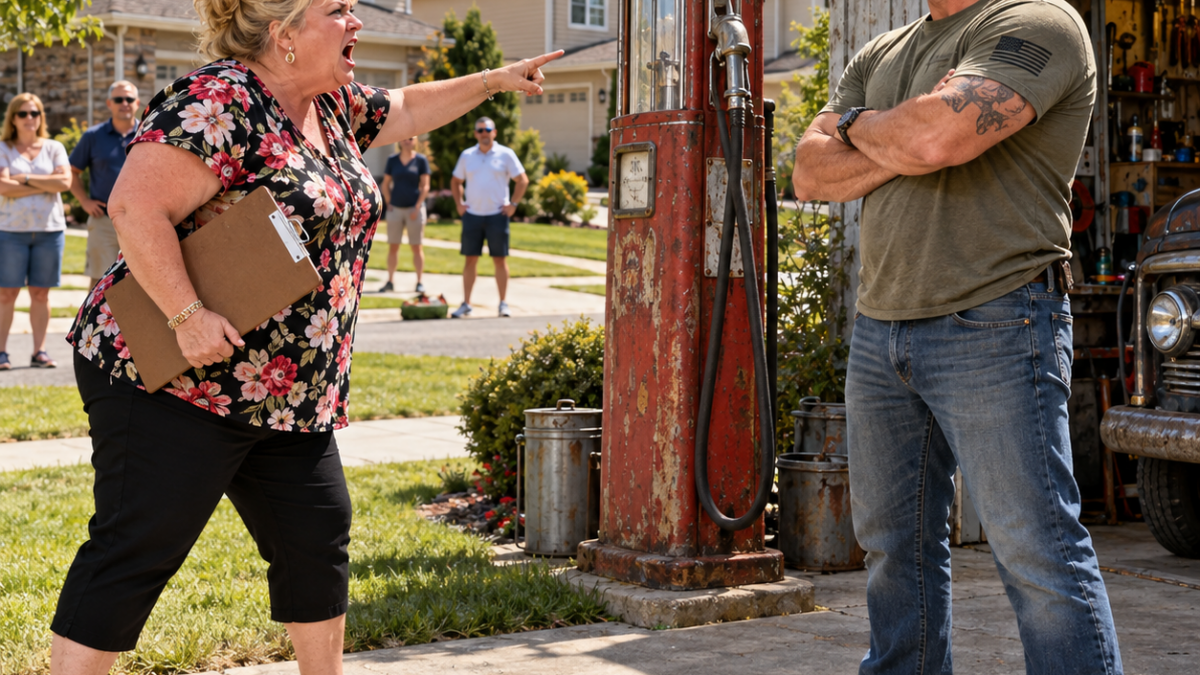
PART 2
The answer started with a brass plate I almost missed.
I was kneeling beside the pump with a flashlight and a soft cloth when I noticed a rectangle beneath the grime near the base.
I had seen it hundreds of times as a boy.
Never read it.
Back then the pump was simply Grandpa’s pump.
Children rarely understand that ordinary things become historical if they survive long enough.
I cleaned the plate slowly.
Letters emerged.
WAYNE COMPANY.
FORT WAYNE, INDIANA.
MODEL 60.
I sat back on my heels.
“Okay, Grandpa.”
For the first time since Karen’s visit, I smiled.
“Let’s see what you left me.”
I spent the rest of the afternoon learning a word I had never heard before.
Petroliana.
Collectors use it for old gas-station memorabilia.
Pumps.
Signs.
Oil bottles.
Globes.
Advertising.
The kind of objects most people once threw away without thinking.
The Wayne Model 60 appeared everywhere I searched.
Tall.
Art Deco styling.
Beautiful clock-face mechanism.
Restored examples looked nothing like the rust-covered machine sitting beside my driveway.
Bright reds.
Blues.
Yellows.
Chrome fittings.
Illuminated glass globes.
Some sold for several thousand dollars.
A few much more.
That got my attention.
But internet auction results were not enough.
Karen had a clipboard.
I wanted an expert.
A document.
A number nobody could dismiss as something I had found in a collector forum at midnight.
That search led me to Arthur Vance.
Dallas.
Nearly forty years dealing in antique service-station equipment.
His name appeared repeatedly in restoration groups and auction catalogs.
People described him as brilliant, irritable, expensive, and usually right.
Perfect.
I sent photographs.
Front.
Rear.
Side panels.
Mechanism.
Base plate.
No mention of Karen.
No HOA drama.
Just:
I inherited this from my grandfather and would like a certified appraisal for insurance and estate purposes.
Arthur replied two days later.
Looks promising. Appears unusually complete. On-site appraisal: $500.
I answered immediately.
When can you come?
Tuesday morning, a dusty Ford pickup pulled into my driveway.
Arthur climbed out without ceremony.
Late sixties.
White hair.
Work shirt.
Jeans.
He looked at me once.
Then walked straight past me toward the pump.
“Morning,” I said.
He grunted.
Apparently conversation was optional.
For nearly an hour, he examined Grandpa’s pump like a surgeon.
He opened inspection panels.
Used a small mirror to examine internal assemblies.
Tapped steel with his knuckles.
Scraped a tiny section of paint from an inconspicuous rear corner.
Photographed tags.
Checked fasteners.
Looked at the computing mechanism.
I sat on my porch and let him work.
Eventually he stood.
Wiped his hands.
“Well.”
That was all.
I walked over.
“That good or bad?”
“Depends whether you planned to throw it away.”
I laughed once.
“No.”
“Good.”
He pointed at the body.
“Genuine Wayne 60. Nineteen thirty-two.”
“Certain?”
“Very.”
“Anything special?”
Arthur gave me the kind of look experts reserve for people who don’t yet understand what they own.
“You know most of these got gutted?”
“For scrap?”
“Mechanisms removed. Panels swapped. Parts scavenged. Globes broken. Pumps like this lived hard lives.”
He opened the side panel.
“Yours still has the important internals.”
“Seized.”
“Doesn’t matter as much as complete.”
Then he pointed toward a small circular tag riveted to the body.
“You see that?”
“I noticed it yesterday.”
“First-thousand production marker.”
I stared.
“What does that mean?”
“Exactly what it sounds like.”
He smiled slightly.
“One of the first thousand Model 60s off the line.”
I felt something shift.
Not greed.
Recognition.
Grandpa had known this machine longer than he had known me.
“What’s it worth?”
Arthur looked over the pump again.
“As-is, to a knowledgeable collector willing to restore it? Fifteen to twenty.”
“Thousand?”
He looked offended.
“No, Jack, fifteen dollars.”
I laughed.
“Sorry.”
“But.”
There it was.
“But?”
“This tag matters.”
He checked his notes.
“Rarity. Original internals. Provenance if you can document it. Early production.”
He clicked his pen closed.
“For insurance appraisal, I’m comfortable at forty-five thousand.”
I thought I had misheard him.
“How much?”
“Forty-five.”
I stared at Grandpa’s rusted pump.
“Forty-five thousand dollars?”
“Yes.”
“My grandfather bought this thing used.”
“Your grandfather had good taste.”
“He probably paid almost nothing for it.”
“Most valuable antiques were once ordinary equipment.”
Arthur looked toward my house.
“You’ve got history on it?”
“Photographs. Maybe service records. Newspaper clippings.”
“Find everything.”
He handed me his card.
“The more provenance you establish, the stronger the value.”
I was still staring at the pump.
Karen had threatened to haul a $45,000 antique to a scrapyard.
Arthur noticed my expression.
“What?”
I told him.
Not every detail.
Enough.
His eyebrows went up.
“HOA called that junk?”
“Rusty piece of trash.”
He looked offended on behalf of machinery.
“That woman needs glasses.”
“She threatened to remove it.”
Arthur turned serious.
“Without permission?”
“That’s what she said.”
“Do you have it in writing?”
“Some.”
“Get everything in writing.”
Military man meets collector.
Same instinct.
Documentation.
“Would you testify if this became a legal dispute?”
Arthur grinned.
“Against somebody trying to scrap a first-run Wayne 60?”
He handed me his clipboard.
“Son, I might do that for free.”
The certified appraisal arrived the next morning.
Official letterhead.
Photographs.
Technical description.
Condition.
Production details.
Rarity.
Replacement and collector value.
At the bottom:
APPRAISED VALUE: $45,000
I printed three copies.
Then five.
Then one more because my Air Force career had destroyed any ability I once had to trust a single copy of anything.
The appraisal changed the fight.
But not in the way people assume.
I wasn’t suddenly happy because Grandpa’s pump was worth money.
I had no intention of selling it.
What changed was risk.
Before the appraisal, Karen could frame this as a dispute over ugly yard decor.
Now she had been formally warned that the thing she threatened to remove and discard was a documented high-value antique.
If she still touched it after receiving that information, ignorance would become much harder to claim.
That mattered.
I called Ben Carter.
Ben had been JAG during our Air Force years.
He left the service before I did, went into property and contract litigation, and developed the personality of a man who enjoyed reading legal threats over breakfast.
“Jack Riley.”
“Ben.”
“You owe me money.”
“For?”
“You disappeared after retirement.”
“I moved.”
“You have telephones in retirement.”
“I liked the silence.”
“So why ruin it by calling a lawyer?”
“HOA.”
He whistled.
“The suburban insurgency.”
I laughed.
“Something like that.”
“What did you do? Wrong-colored mulch?”
“Gas pump.”
Pause.
“Explain.”
I did.
Grandpa.
1932 Wayne Model 60.
Seventy-plus years on the property.
HOA fine.
Four-day removal threat.
Lien.
Scrapyard.
Forty-five-thousand-dollar appraisal.
When I finished, silence.
Then Ben said:
“Say the number again.”
“Forty-five thousand.”
“Certified?”
“Yes.”
“Qualified appraiser?”
“Yes.”
“Written threat to remove?”
“The first deadline was verbal. Violation notices and follow-up correspondence establish removal demand.”
“Any authorization for them to enter the property?”
“No.”
“Do the covenants permit self-help removal?”
“Not clearly.”
Ben exhaled.
“Jack.”
“Yeah?”
“This woman is trying to turn a garden-club dispute into actual litigation.”
“I know.”
“I love her.”
“You haven’t met her.”
“I love defendants who write.”
He asked for everything.
I sent:
Covenants.
Karen’s notices.
My certified letter.
Return receipt.
HOA response.
Photographs showing the pump’s historic location.
Arthur’s appraisal.
Inheritance records.
Old photographs.
Ben called the next afternoon.
“You have several useful arguments.”
“I assumed.”
“Don’t get cocky.”
“I’m listening.”
“First, procedure. Their own rules appear to provide thirty days to cure or appeal.”
“Correct.”
“Karen’s four-day threat was nonsense.”
“Yes.”
“Second, this pump long predates the HOA.”
“By decades.”
“That helps historical-status and waiver-style arguments. Not automatic victory, but helpful.”
“Okay.”
“Third, they have apparently tolerated it for years.”
“Yes.”
“Fourth, their language is vague.”
“Yes.”
“Fifth.”
His tone sharpened.
“Forty-five thousand dollars.”
I smiled.
“There it is.”
“That number changes behavior.”
“What do you recommend?”
“We notify every board member.”
“Not only Karen?”
“Especially not only Karen.”
“Why?”
“Because right now Karen thinks she is the HOA.”
“Accurate.”
“I want the other directors to understand that if they authorize somebody to seize or destroy a documented $45,000 antique, this stops being one woman’s tantrum.”
“You want them scared.”
“I want them informed.”
“That sounded lawyerly.”
“I charge for adjectives.”
He drafted the letter.
Three pages.
No insults.
No threats beyond lawful remedies.
History.
Procedure.
Longstanding presence.
Appraisal.
Potential liability for unauthorized removal or damage.
Demand:
Rescind fines.
Recognize the pump’s historical status.
Confirm no removal action will occur.
Reimburse improper charges.
Respond within fifteen business days.
The attachment was Arthur’s appraisal.
The number sat there like a grenade with the pin still safely in place.
$45,000
Ben added one sentence I particularly liked:
Any person or entity authorizing or participating in unauthorized removal, destruction, or disposal after receipt of this notice will do so with actual knowledge of the asset’s documented value.
I read that twice.
“Poetry.”
“Pay your invoice.”
I sent the letter to the full board.
Email.
Certified copies.
Management address.
Karen.
Every director.
I imagined five people opening the same envelope.
I hoped four of them would have better instincts than Karen.
The neighborhood, meanwhile, had started talking.
It began with David Garcia.
He lived beside me with his wife Maria and their two boys.
Their portable basketball hoop appeared and disappeared from the driveway with military regularity.
Saturday morning, I caught him mowing.
Brought him water.
We introduced ourselves properly.
After ten minutes, I asked:
“What’s with the basketball hoop?”
His face changed.
“Karen.”
One word.
Complete explanation.
“What rule?”
“She says if it stays out overnight it becomes a permanent recreational structure.”
“It has wheels.”
“I pointed that out.”
“And?”
“She said mobility doesn’t change visual impact.”
I laughed.
David didn’t.
“Three fines.”
“How much?”
“Couple hundred.”
“Why keep moving it?”
“My wife got nervous when Karen mentioned a lien.”
There it was again.
The nuclear word.
Home.
People can laugh at a hundred-dollar fine.
Mention a lien and suddenly the threat moves from annoyance to shelter.
I told David about the pump.
When I explained Karen wanted it removed, he stared toward my driveway.
“That thing has been there forever.”
“Since before Oakmont Meadows.”
“My father remembers the old station.”
“Really?”
“Yeah.”
I made a mental note.
Provenance.
Witnesses.
Then David said:
“You fighting her?”
“Yes.”
“That’s dangerous.”
“Why?”
“She targets people.”
“Examples?”
“Mailbox down the street.”
“What happened?”
“Wrong black.”
I stared.
“Wrong black?”
“Apparently black has varieties.”
Air Force paint specifications had taught me that, technically, he was correct.
Still absurd in context.
David looked toward Karen’s side of the subdivision.
“If you cross her, she finds something else.”
“That’s why everybody complies?”
“Pretty much.”
“What if everybody stopped doing that at once?”
He laughed.
“Nobody wants to be first.”
“I already am.”
That made him think.
The next neighbor was Eleanor Gable.
Mrs. Gable had known Grandpa.
That mattered immediately.
She was seventy-something, small, sharp, and surrounded by roses in colors Karen apparently considered acts of sedition.
“You’re Thomas’s grandson.”
“Yes, ma’am.”
“You have his eyes.”
People always said that.
I never knew whether they meant shape or sadness.
She looked toward the pump.
“Karen after it?”
“How’d you know?”
“She hates anything with personality.”
I laughed.
Mrs. Gable snipped a rose.
“Your grandfather fueled my husband’s truck at that pump.”
I froze.
“You remember?”
“Of course.”
“When?”
“Late sixties. Seventies. Every week.”
“Would you put that in writing?”
Her eyes narrowed.
“Why?”
“Because Karen says it’s unapproved junk.”
Mrs. Gable straightened.
“Junk?”
“She used stronger language.”
“That woman.”
I told her about the appraisal.
She almost dropped the shears.
“Forty-five thousand?”
“Yes.”
She looked at the pump.
Then at me.
“Thomas would laugh himself sick.”
“Probably.”
“He never threw anything away.”
“That part I inherited.”
Mrs. Gable walked closer.
Placed a hand against the old steel.
Then quietly:
“Don’t you let them take this.”
“I won’t.”
Her eyes filled slightly.
“That station was here before everything.”
She gestured toward the subdivision.
“Before the pool. Before the clubhouse. Before those ridiculous stone entrance signs.”
I smiled.
“Historical fixture?”
“History, period.”
That evening, I created a private neighborhood group.
No dramatic name originally.
Just:
Oakmont Residents
Mrs. Gable’s son demanded something stronger.
David suggested:
Oakmont Neighborhood Alliance
It stuck.
Seven members by morning.
Fifteen by the end of the week.
The stories came quickly.
Garden hose left on grass.
Fine.
Political sign displayed inside a window.
Warning.
Oil spot.
Power wash demand.
Welcome mat with text.
“Unapproved signage.”
Driveway basketball hoop.
Mailbox finish.
Flowers.
Outdoor chair cushions.
One resident had been warned that a holiday wreath was too large.
It would have been funny if people weren’t so afraid.
That was the part outsiders never understand about petty administrative abuse.
No single incident seems large.
That is what makes the system durable.
Nobody hires a lawyer over a welcome mat.
Nobody wants a lawsuit about roses.
Nobody wants to spend a Saturday reading forty-seven pages of covenants because somebody dislikes a garden hose.
So people pay.
Comply.
Grumble privately.
Karen learned the lesson.
Small pressure works.
Then she brought small-pressure tactics to the wrong object.
Grandpa’s pump.
And eventually, the wrong group of people.
Our alliance did not begin as rebellion.
It began as comparison.
David posted his letters.
Mark Peterson—the mailbox guy, no relation to Karen—posted his.
Mrs. Gable’s son uploaded photographs of flower notices.
Someone asked:
“Did she threaten liens with everyone?”
Almost every response:
“Yes.
Or some variation.
That pattern bothered Ben.
“Jack.”
“Yeah?”
“How often is she mentioning liens?”
“Frequently.”
“Actual recorded liens?”
“Unknown.”
“Get records.”
The board minutes I had requested finally arrived.
Incomplete.
Three meeting packets missing.
Fine schedules inconsistent.
Karen’s committee reports vague.
Some enforcement actions had no recorded board authorization.
Not proof of conspiracy.
Evidence of governance failure.
Ben saw leverage.
“Your board is asleep.”
“George seems nervous.”
“Good.”
“How is that good?”
“Nervous people call lawyers.”
Karen, unfortunately, did not call a lawyer soon enough.
A week after receiving Ben’s letter, bright pink flyers appeared across Oakmont Meadows.
SPECIAL COMMUNITY MEETING
PROTECT OUR PROPERTY VALUES
The flyer identified my lot.
My address.
Described Grandpa’s pump as:
A LARGE RUSTED INDUSTRIAL SCRAP STRUCTURE
Agenda:
Community action.
Forcible removal.
Lien authorization.
Ben read the flyer and started laughing.
“You attract interesting opponents.”
“She named my address.”
“I see that.”
“She ignored our letter.”
“She didn’t ignore it.”
“What?”
“She responded emotionally.”
“Meaning?”
“She wants a public vote to spread ownership of her decision.”
I sat back.
“That actually makes sense.”
“If homeowners vote to remove it, she thinks she becomes safer.”
“Does she?”
“No.”
“Good.”
“But the meeting gives us opportunity.”
I knew.
So did the alliance.
The group chat erupted.
David:
She put your address on the flyer.
Mark:
She wants a show.
Mrs. Gable’s son:
Mom says she’s coming and wearing the red hat Dad hated because this is apparently war.
I laughed.
Ben gave me one instruction repeatedly.
“Calm.”
“I’m calm.”
“Military calm and actual calm are different.”
“I know.”
“Do not insult Karen.”
“I won’t.”
“Do not call her corrupt unless you can prove corruption.”
“I won’t.”
“Do not threaten criminal charges.”
“I won’t.”
“Do not gloat about the appraisal.”
“I may enjoy it internally.”
“Allowed.”
“And the others?”
“Let them tell their stories.”
“So the meeting becomes about pattern.”
“Exactly.”
“What if Karen tries to shut them down?”
“She probably will.”
“Then?”
“Let her.”
Meeting night arrived.
More than one hundred people packed the clubhouse.
Standing room.
Heat from too many bodies.
Cheap coffee.
Fluorescent lights.
Karen sat at the center of the board table wearing a bright red blazer.
Power color.
On the wall behind her:
Projector screen.
When she saw me, she smiled.
Not friendly.
Predatory.
She thought the room belonged to her.
I sat near the back with one manila folder.
No attorney.
No stack of binders.
Ben had been very clear.
“You walking in with me makes it look like litigation night.”
“It is litigation night.”
“No.”
“It might become litigation night.”
“Exactly.”
Karen banged the gavel.
“Thank you all for coming.”
False warmth.
Then:
“We are here because community standards matter.”
There it was.
Standards.
Investment.
Property values.
Precedent.
Slippery slope.
She talked for ten minutes before mentioning me directly.
Then the slideshow began.
Photo of Grandpa’s pump.
Zoomed.
Harsh angle.
Rust emphasized.
Large red text:
UNAPPROVED STRUCTURE
Karen gestured toward it.
“This industrial blight has remained on Lot Seven despite repeated lawful requests.”
She changed slides.
Picture of a manicured yard.
Birdbath.
Flowers.
Perfect lawn.
“This is what Oakmont Meadows represents.”
Next slide.
Pump.
“This is what one resident believes he is entitled to impose on everyone else.”
A few people murmured.
Some nodded.
Not everybody knew the history.
Karen continued.
She described me as defiant.
Uncooperative.
Dismissive.
Said fines now exceeded $800.
Never mentioned the appraisal.
Never mentioned Ben’s letter.
Never mentioned the four-day deadline violated their own written thirty-day procedure.
Then she reached the end.
“I am asking this board to authorize immediate removal of the structure and a lien against the property for all associated costs.”
Smattering of applause.
Karen sat.
George, one of the directors, looked uncomfortable.
He adjusted the microphone.
“Mr. Riley, would you like to respond?”
I stood.
Walked forward.
No rush.
Military ceremonies teach you one thing useful in public conflict:
Never move faster than the person yelling.
It makes them look like the unstable one.
“Good evening.”
The room settled.
“My name is Jack Riley.”
I looked around.
“I live at 121 Oakmont Drive.”
I paused.
“I recently retired after twenty-two years in the United States Air Force. The property you’ve been discussing belonged to my grandfather, Thomas Riley.”
Several older residents reacted to the name.
Good.
“He built the house around 1950. Before that, he operated a service station on the property.”
I opened the folder.
“The gas pump shown in Mrs. Miller’s presentation was installed during that service-station era.”
I held up an old photograph.
Grandpa standing beside it.
“You are looking at the same pump.”
Murmurs.
Karen interrupted.
“Historical sentiment does not override covenants.”
I nodded.
“I agree sentiment alone does not settle a legal dispute.”
That disarmed her slightly.
“So let’s talk procedure.”
I held up the bylaws.
“Section Twelve gives homeowners thirty days from initial written notification to cure or appeal.”
I looked at Karen.
“Mrs. Miller gave me four.”
George turned toward her.
She snapped:
“That was a courtesy deadline before further action.”
“Then why did you threaten removal Friday?”
“I was explaining consequences.”
I nodded.
“Next.”
I held up my certified letter.
“I formally disputed the violation and requested clarification.”
Then the HOA response.
“The response did not address the historical status argument.”
Karen shifted.
I continued.
“Then my attorney sent the board another letter.”
That got the board members’ attention.
George looked at the man beside him.
I held up the certified-mail receipt.
“The letter was received.”
Karen said:
“This is not a courtroom.”
“No.”
I looked at the residents.
“It’s your association.”
Then I took out Arthur’s appraisal.
“This is the part Mrs. Miller omitted.”
The room went quiet.
“She repeatedly described Grandpa’s pump as scrap.”
I turned the document toward the audience.
“A certified antique-petroleum-equipment specialist inspected it.”
I let the pause work.
“He identified it as an authentic 1932 Wayne Model 60.”
A man in the third row whispered:
“No way.”
I continued.
“Mechanically complete.”
Another pause.
“Early-production example.”
Then:
“Appraised current value: forty-five thousand dollars.”
The reaction was physical.
Gasps.
People leaning forward.
Karen’s face changed.
She knew the number already.
But she had hoped nobody else would.
I looked at her.
“So when Mrs. Miller says she wants the HOA to authorize removal and disposal of scrap, she is asking you to authorize removal of a documented $45,000 antique that has stood on this property since decades before this association existed.”
I set the appraisal on the table.
“I intend to restore it.”
Silence.
“It is not for sale.”
I stepped back.
“And I believe some neighbors would like to speak.”
Karen hit the gavel.
“This meeting concerns Lot Seven.”
Mrs. Gable stood.
Tiny.
Steady.
“Then Lot Seven concerns me.”
Karen stared.
“Eleanor—”
“I knew Thomas Riley.”
The room quieted again.
Mrs. Gable walked into the aisle.
“My husband bought fuel at that pump.”
Her voice trembled, not from fear.
Age.
“I have lived here fifty-two years.”
She looked toward Karen.
“That pump is older than your presidency, older than this clubhouse, older than most homes here.”
Karen said:
“That doesn’t exempt it.”
Mrs. Gable ignored her.
“You send me notices about yellow roses.”
A few people laughed.
“I planted those roses with my husband.”
No laughter now.
“He has been dead nine years.”
Her eyes glistened.
“You see an unauthorized plant.”
She pressed one hand to her chest.
“I see him.”
Karen’s expression hardened.
“Rules cannot be based on emotion.”
Mrs. Gable nodded.
“Neither should they be based on your personal taste.”
Murmurs.
Then louder.
Mrs. Gable pointed at Karen.
“You are not a queen.”
Silence.
“This is a neighborhood.”
She sat.
Mark Peterson stood next.
He hated attention.
You could tell by the way he held his hands.
“My mailbox was black.”
A few people laughed.
He looked embarrassed.
“The covenants say black or dark bronze.”
He swallowed.
“Mrs. Miller fined me because it was the wrong black.”
Louder laughter.
Karen interrupted.
“It was an unapproved finish.”
Mark turned toward her.
“That phrase is not in the covenant.”
That mattered.
He described sanding and repainting a brand-new mailbox while his daughter was in college and money was tight.
“It wasn’t the hundred dollars.”
His voice shook.
“It was knowing you could threaten my house until I obeyed.”
He sat quickly.
David Garcia stood.
Basketball hoop.
Wheels.
Three fines.
His boys stopped leaving it outside.
Then someone else stood without planning.
A woman.
“Welcome mat.”
Karen groaned.
The woman continued.
“It said WELCOME HOME.”
Laughter.
“You classified it as an unauthorized sign.”
Another resident:
“She made me remove garden edging.”
Another:
“I got a notice over a hose.”
Another:
“She threatened legal action because my son works on his car in our closed garage.”
The room erupted.
Not violence.
Release.
Years of separate irritation suddenly becoming one shared pattern.
Karen pounded the gavel.
“Order!”
Nobody stopped.
“ORDER!”
Another homeowner stood.
Another story.
George stared at the crowd.
Then at Karen.
The other directors looked sick.
I did not speak.
I didn’t need to.
This was no longer my case.
That was the point.
Karen tried to regain control.
“This meeting is about the pump!”
A man shouted:
“No, it’s about you!”
The room roared.
George finally stood.
Both hands up.
“Please!”
Gradually noise dropped.
He turned toward Karen.
“Did you receive Mr. Riley’s attorney letter?”
She stiffened.
“The board address received correspondence.”
“Did you distribute it to us?”
“I summarized it.”
George stared.
“Did you distribute it?”
“No.”
The room reacted.
He looked at the appraisal.
“You knew the pump was valued at forty-five thousand dollars before this meeting?”
Karen’s jaw tightened.
“An appraisal does not override community standards.”
“That wasn’t my question.”
“Yes.”
George sat back.
Then stood again.
“You asked us tonight to authorize forcible removal without giving us the legal letter?”
“I am president. I manage enforcement.”
“You asked us to assume personal liability.”
Karen’s face reddened.
“That is ridiculous.”
George looked toward me.
“Mr. Riley, did your attorney warn board members individually?”
“Yes.”
I handed him a copy.
He read one paragraph.
Then another.
His face changed.
Karen snapped:
“This is intimidation.”
George looked at her.
“No.”
His voice had changed.
“It’s notice.”
He turned toward the other directors.
“We are done.”
“What?”
“This meeting is adjourned.”
“I set the agenda.”
George stared at her.
“Sit down, Karen.”
The room went completely silent.
I don’t think anyone had ever publicly told Karen Miller to sit down.
She remained standing.
George continued.
“You threatened destruction of a $45,000 asset without full board review, after violating our own stated appeal timeline, and then withheld legal correspondence from directors.”
Karen’s hands shook.
“You are undermining me.”
“No.”
George looked around.
“We undermined ourselves by allowing one person to control enforcement.”
That was the institutional turning point.
He faced the residents.
“On behalf of the board, I apologize.”
Gasps.
“We will conduct an emergency review tomorrow.”
Karen shouted:
“You cannot do this!”
George did not look at her.
“We will also suspend any action regarding Mr. Riley’s property until counsel reviews the matter.”
Applause began.
Not huge.
Then louder.
Karen stared at the room as though everyone had betrayed her simultaneously.
People clustered after adjournment.
Several shook my hand.
A woman cried.
“I thought I was the only one.”
That sentence hit harder than the applause.
That was how Karen had maintained control.
Isolation.
Everyone believed their fine was private.
Their humiliation personal.
Their fear embarrassing.
Comparison broke it.
David came over.
“You started something.”
“No.”
“Yes.”
I looked toward Mrs. Gable.
“She did.”
Mrs. Gable heard me.
“Damn right.”
Then Karen approached.
People moved aside.
Her face was blotchy.
“You’re pleased with yourself.”
“No.”
“You turned them against me.”
I shook my head.
“No, Karen.”
She moved closer.
“You think you’re clever.”
“You called my grandfather’s pump trash.”
“It is ugly.”
“That was never the real issue.”
“What is?”
“You thought nobody would compare notes.”
She stared.
“You ruined this community.”
“No.”
I kept my voice low.
“You just needed someone to hold up a mirror.”
She left.
The clubhouse door slammed behind her.
That was the last time Karen controlled a public meeting.
The emergency board session happened the next evening.
I wasn’t there.
Neither were most residents.
Closed session.
Counsel.
Directors.
Karen.
According to George, their attorney spent the first twenty minutes explaining why Karen’s plan to remove the pump was legally reckless.
He reviewed the appraisal.
The historical presence.
The procedural violation.
Her failure to circulate counsel correspondence.
The threat to impose a lien.
Potential claims.
Then he asked the simplest question.
“Why are you doing this?”
Karen said:
“Because rules mean nothing if we don’t enforce them.”
The lawyer supposedly answered:
“Rules also mean nothing if you don’t follow your own.”
That line circulated for months.
By midnight, Karen had two choices.
Resign voluntarily.
Or face a formal board process for removal.
She raged.
Threatened.
Accused George of betrayal.
Accused other directors of cowardice.
Insisted the community would collapse without her.
Nobody changed sides.
The next afternoon, George called me.
“Jack.”
“George.”
“I owe you an apology.”
“You personally?”
“Yes.”
“Why?”
“Because I signed things.”
He sounded exhausted.
“I let Karen handle enforcement because I didn’t want to deal with angry homeowners.”
“That’s honest.”
“It’s also cowardly.”
“Maybe.”
“No, it is.”
He paused.
“Karen resigned.”
I sat down.
“Effective?”
“Immediately.”
“Board too?”
“Yes.”
Silence.
Then George continued.
“We voted unanimously regarding your property.”
I waited.
“All fines rescinded.”
Good.
“Your account is clear.”
Good.
“The pump is formally recognized as a historical pre-existing feature.”
Very good.
“No future architectural enforcement regarding its continued presence, assuming restoration doesn’t create safety issues.”
“Reasonable.”
“We will issue written apology.”
“Fine.”
“And we will reimburse appraisal and documented legal consultation costs.”
I leaned back.
That surprised me.
“Thank you.”
George wasn’t finished.
“We’re freezing all active enforcement actions initiated under Karen for review.”
I sat up.
“All?”
“Last twelve months to start.”
“What about Mrs. Gable?”
“Included.”
“Garcias?”
“Yes.”
“Mark?”
“Yes.”
I smiled.
“That matters more.”
“I figured you’d say that.”
Then George asked:
“Would you join a bylaw-review committee?”
I laughed.
“I just retired.”
“We need people who read things.”
“That is a low bar.”
“Apparently not.”
I agreed.
Temporarily.
Three months maximum.
George negotiated me to six.
Lawyers would have admired him.
The apology arrived on HOA letterhead.
Direct.
No passive voice hiding accountability.
The association acknowledged improper handling of the dispute.
Confirmed rescission.
Confirmed historical exemption.
Expressed regret.
I read it beside Grandpa’s pump.
Then folded it.
Put it in the binder.
For years, military life taught me that a mission ends with documentation.
This one did too.
Karen listed her house shortly after.
People expected me to celebrate.
I didn’t.
I saw her once near the mailbox.
No clipboard.
No red blazer.
Just a woman getting mail.
We looked at each other.
She looked away first.
There is a difference between accountability and humiliation.
Once she lost the authority to harm people, I didn’t need anything else from her.
She moved later that summer.
I never learned where.
Never searched.
The pump restoration began the following weekend.
I pulled tools into the driveway.
Panels.
Screws.
Penetrating oil.
Wire brushes.
Photographs.
Labels.
Air Force logistics habits are useful in restoration.
Every fastener bagged.
Every part numbered.
Every step photographed.
David Garcia appeared carrying beer.
“Need help?”
“You know gas pumps?”
“No.”
“Mechanical restoration?”
“No.”
“Paint?”
“No.”
“Then why are you here?”
“Beer.”
“Excellent qualification.”
He stayed.
Then Mark showed up.
Accountant.
Surprisingly meticulous.
He became parts inventory.
Mrs. Gable sent sandwiches through her son.
By late afternoon, six neighbors stood around Grandpa’s pump.
We removed the side panels.
Revealed the old mechanism.
Grease hardened like stone.
Rust.
Dust.
History.
David found a stamped number inside.
“Jack.”
“What?”
“Look.”
We photographed it.
Sent it to Arthur.
His reply:
Matches early production. Don’t lose that plate.
“No pressure,” Mark said.
The restoration became a neighborhood ritual.
Every Saturday.
Wire brushes.
Music.
Cold drinks.
Stories.
People who had lived fifty feet apart for ten years finally learned each other’s first names.
That was the strangest result of everything Karen had done.
Her control had isolated people.
The fight connected them.
Older residents came by with stories about Grandpa’s station.
One man remembered buying his first tank of gas there in 1974.
A woman remembered Grandpa changing a flat tire for her mother during a thunderstorm and refusing payment.
Another brought a faded photograph.
There it was.
Grandpa.
Pump behind him.
Texaco star globe intact.
I held that photograph longer than I should have.
The man said:
“Keep it.”
“I can scan it.”
“No.”
He pushed it toward me.
“It belongs with the pump.”
We found traces of the original red under later paint.
Arthur had been right.
I ordered historically appropriate finish.
Chrome pieces went out for restoration.
A reproduction glass globe arrived in a crate packed like museum glass.
When I opened it, David whistled.
“Forty-five-thousand-dollar junk.”
“Careful.”
“Sorry.”
“Seventy-five if we do this right.”
He laughed.
We didn’t know how prophetic that joke was.
The bylaw committee met Wednesday nights.
That part was less fun.
George.
Carol.
Three residents.
Me.
Ben joined once by video.
We focused on ambiguity.
Define fines.
Define appeals.
Require written votes.
Limit unilateral authority.
Create review for larger penalties.
Require notice before liens.
Provide hardship procedures.
Historical-feature provision.
Mrs. Gable demanded that clause.
“If it was here before Karen, it stays.”
We refined her legal drafting.
But the spirit survived.
The fine review produced refunds.
Some violations had been legitimate.
That mattered.
We did not erase everything because Karen had abused authority.
A fence encroachment still needed correction.
A dangerous dead tree still needed removal.
A genuine drainage problem still needed repair.
Fairness is not the absence of rules.
It is rules applied consistently for real reasons.
Others were ridiculous.
Mark’s mailbox fine:
Refunded.
Garcia hoop:
Refunded.
Mrs. Gable’s yellow-rose penalties:
Refunded.
Welcome mat:
Refunded.
Flower-border bricks:
Refunded.
A widow received money back for a late trash-can fine issued while she was hospitalized.
She cried.
George cried too.
The board meetings changed after that.
People came.
That was key.
Karen had flourished partly because nobody attended.
Same fifteen people.
Same directors.
Same assumptions.
The first election after reform had triple the turnout.
George ran for president reluctantly.
Won.
His first words:
“I did not want this job.”
Everyone applauded.
I leaned toward David.
“That may be why he deserves it.”
The restoration took months.
Not because we worked slowly.
Because we cared.
Every old bolt invited a decision.
Original or replacement.
Preserve patina or refinish.
How faithful to period.
How operational should the display become.
I decided the pump would never dispense fuel.
That part of its life was over.
But I wanted the face illuminated.
Wanted the chrome bright.
Wanted the Texaco star glowing in evening light like it did in photographs with Grandpa.
We stripped the body.
Primed.
Sanded.
Painted.
Red.
Real red.
Not HOA beige.
Three coats.
Then clear.
Chrome returned.
The nozzle polished beautifully.
New hose.
Face restored.
Numbers cleaned.
When we installed the globe, everybody went quiet.
It transformed the silhouette instantly.
David whispered:
“Okay.”
“What?”
“I understand now.”
“Understand what?”
“Why you fought.”
I looked at the pump.
“I wasn’t fighting for how it looked.”
“I know.”
“That’s the point.”
The completion ceremony was informal.
Barbecue.
Folding chairs.
Kids running around.
Mrs. Gable wearing a dress with enormous yellow roses purely out of principle.
George came.
Carol.
Mark.
Garcias.
Neighbors I barely knew before Karen’s ultimatum.
As sunset approached, I stood beside the pump.
Grandpa’s photograph was in my pocket.
I hadn’t planned a speech.
Everyone looked at me anyway.
So I tried.
“My grandfather kept this pump working for about forty years.”
My voice caught earlier than I wanted.
“He pumped gas, fixed tires, gave advice nobody asked for.”
Laughter.
“He knew some of your parents.”
Mrs. Gable nodded.
“Some of your grandparents.”
I looked around.
“When Karen called this thing junk, I thought the fight was about my family.”
I placed a hand against the red steel.
“It turns out it was about all of us.”
Silence.
“We had spent years living near each other without actually knowing one another.”
David looked at Mark.
Mrs. Gable smiled.
“The pump brought people here when Grandpa ran the station.”
I swallowed.
“I guess it did it one more time.”
Then I plugged in the cord.
The globe flickered.
Dim.
Then warm light filled the Texaco star.
The crowd cheered.
I looked up.
For one strange second, I was eight years old.
Grandpa behind me.
His grease-stained hands.
“Hold the nozzle straight, Jack.”
“I am.”
“You’re spilling imaginary gasoline.”
“How?”
“Talent.”
That memory hit so hard I had to turn away.
Mrs. Gable saw.
She hugged me.
“You did good.”
“Everybody did.”
“Thomas would be proud.”
That one nearly finished me.
The restored pump remained beside the driveway.
Not hidden.
Not apologized for.
Beautiful.
Months later, Arthur emailed.
Saw photographs. Excellent restoration.
Then:
I have a museum client interested.
I called him.
“How interested?”
“American roadside exhibit.”
“Okay.”
“They know provenance.”
“And?”
“They’d likely offer around seventy-five.”
I stopped.
“Seventy-five thousand?”
“Potentially.”
I laughed.
“What?”
“Nothing.”
“Jack, that’s serious.”
“I know.”
“You should at least consider it.”
“I will.”
I did.
For almost ten minutes.
Seventy-five thousand dollars was not abstract.
Travel.
Investment.
New truck.
Savings.
Lily—my niece, not daughter—had college ahead eventually.
Many practical uses.
I walked outside.
Evening.
The pump glowed.
A couple from down the street walked past with a stroller.
The husband pointed.
“Telling her the story?”
His wife laughed.
“She’s six months old.”
“Start early.”
They waved.
I looked at the pump.
Grandpa’s pump.
Arthur’s $75,000 museum centerpiece.
Karen’s trash.
The neighborhood’s rallying point.
Then I went inside.
Replied.
Thank you. I’m honored, but it isn’t for sale.
Arthur answered:
Figured.
The value became almost funny afterward.
People joked about protective glass.
Security guards.
A velvet rope.
David once put a cardboard sign beside it:
PLEASE DO NOT LEAN ON THE $75,000 TRASH
I made him remove it.
Mrs. Gable wanted it back.
George suggested listing the pump as an official historical feature in the association records.
That passed unanimously.
Eventually the local historical society contacted me.
We researched Grandpa’s station.
Found business-license records.
Old advertisements.
A 1954 newspaper photograph.
A city directory listing:
RILEY SERVICE — GAS, TIRES, REPAIRS
The historical society installed a small tasteful plaque near the driveway.
Not HOA plaque.
Historical marker.
It explained the service station.
Grandpa.
The Wayne Model 60.
The neighborhood kids started calling our house “the gas station house.”
Fine by me.
One Saturday, a boy asked:
“Does it still work?”
“Depends what you mean.”
“Can it put gas in a car?”
“No.”
“Then it doesn’t work.”
His father apologized.
I laughed.
“He’s technically correct.”
The boy looked at the glowing globe.
“What does it do?”
I considered.
“It tells stories.”
He stared at me like adults were exhausting.
Fair.
Years passed.
Oakmont Meadows became less afraid of individuality.
Not lawless.
Just human.
Some mailboxes differed.
Basketball hoops appeared.
Flowers ignored strict palettes.
Property values did not collapse.
Nobody’s home turned into a junkyard because Mrs. Gable grew yellow roses.
The apocalypse failed to arrive.
George eventually stepped down.
Carol became president.
Then David served one term.
Nobody wanted lifetime rule.
We wrote term limits.
Good systems assume good people can become too comfortable with authority.
That lesson had been expensive enough.
I served exactly six months on the bylaw committee.
At six months and one day, George asked me to stay.
“No.”
“One more quarter.”
“No.”
“You’re good at this.”
“That is not a reason to punish me.”
“Vice president?”
I looked at him.
He raised his hands.
“Had to try.”
Retirement deserved some protection too.
Karen’s old house sold.
A teacher and her husband moved in.
Nice people.
They never knew her personally.
Once, the teacher asked me why everyone laughed when she said she was thinking of joining the HOA board.
Long story.
We gave her the short version.
She served eventually.
Did well.
That mattered.
The point of reform is not to make leadership shameful.
It is to make abusive leadership difficult.
One afternoon, years later, a storm rolled through.
Wind stronger than expected.
Branches came down.
Power flickered.
I stepped outside after it passed.
The pump stood.
Red paint wet.
Globe intact.
Mrs. Gable’s yellow roses bent nearly flat but survived.
David’s basketball hoop had blown onto its side.
He came outside.
Saw me.
“HOA violation.”
“Absolutely.”
“Wind approved?”
“Submit form in triplicate.”
He laughed.
That kind of joke would once have carried fear.
Now it was only a joke.
Normal.
That may be the most satisfying ending of all.
Not Karen leaving.
Not the apology.
Not the $45,000 appraisal.
Not the $75,000 museum offer.
Normal.
Normal neighbors.
Normal rules.
Normal disagreements.
Nobody terrified of mail.
Nobody hiding children’s toys.
Nobody thinking a lien threat would arrive because flowers bloomed the wrong color.
The pump aged into the neighborhood.
It stopped being defiance.
Became landscape.
History.
One evening, I found Grandpa’s old ledger in a box I had not opened since moving.
Customers.
Parts.
Fuel orders.
Receipts.
His handwriting.
Small and precise.
Near the back, an entry:
Wayne pump — bought used — $125
I laughed so loudly the neighbor’s dog barked.
One hundred twenty-five dollars.
Arthur came by later that year.
I showed him.
He smiled.
“Good investment.”
“Only took seventy years.”
He walked around the restored pump.
Touched the paint.
“Still sure?”
“About?”
“Selling.”
“Yes.”
“Museum would love it.”
“So does the neighborhood.”
“Museums have climate control.”
“Neighborhood has Mrs. Gable.”
Arthur considered.
“Fair.”
He photographed the restoration for an article in a collector magazine.
The piece eventually ran with a short history.
Grandpa would have loved that.
Or pretended not to.
He was not sentimental in public.
Neither am I.
According to everybody who knows me.
Ben, unfortunately, keeps evidence otherwise.
He once sent me a framed copy of Karen’s first violation notice.
Underneath, he added:
APPRAISED VALUE OF THIS LEGAL ADVICE: $45,000
I sent it back.
He returned it.
It now hangs in my garage because friendship is sometimes coercion.
When people hear the story, they usually focus on the money.
Karen thought it was junk.
Actually worth forty-five thousand.
Then seventy-five after restoration.
Great twist.
But money was never the part that made her wrong.
If the pump had been worth fifty dollars, her abuse of process would still have been abuse.
The appraisal mattered because it forced other board members to pay attention.
Forty-five thousand dollars translated sentiment into a language liability understands.
But value is not only market price.
Mrs. Gable’s roses might be worth twenty dollars at a nursery.
To her, they were her husband.
David’s portable basketball hoop was not rare.
To his sons, it was afternoons with their father.
Mark’s mailbox was ordinary.
His dignity wasn’t.
Grandpa’s pump happened to possess both kinds of value.
Market.
Memory.
Karen could see neither.
That was her real failure.
She thought governing meant classifying things.
Approved.
Unapproved.
Pretty.
Ugly.
Compliant.
Violation.
She stopped asking what those things meant to the people living behind the doors.
Good rules need human context.
Otherwise bureaucracy becomes a machine for converting life into paperwork.
I spent twenty-two years in military logistics.
I love paperwork more than most sane people.
But paperwork is supposed to support a mission.
Not become the mission.
Karen forgot that.
Oakmont Meadows remembered.
A young couple moved into the neighborhood last year.
First home.
Nervous.
They came to me because somebody told them I “beat the HOA.”
I corrected them.
“No.”
“That’s what everybody says.”
“HOA still exists.”
“But you beat Karen.”
“She resigned.”
“Because of you.”
“Because people stopped letting her act alone.”
The husband glanced toward the pump.
“That really worth seventy-five grand?”
“Maybe.”
“You leave it outside?”
“It weighs four hundred pounds.”
“Still.”
I smiled.
“You planning something?”
“No, sir.”
“Good answer.”
His wife laughed.
Then asked something better.
“Is the HOA okay now?”
I looked toward the street.
Kids.
Dogs.
David older, still yelling about basketball.
Mrs. Gable’s son visiting her garden.
Carol walking toward the clubhouse carrying meeting papers.
“Yes.”
I meant it.
“That is what matters.”
Not perfect.
Never perfect.
People still argued.
A fence dispute lasted three months.
Somebody wanted chickens.
The pool budget created a near civil war.
Normal.
Democracy is often boring conflict without fear.
We achieved that.
Mrs. Gable eventually passed away.
That part is hard to write.
She was ninety-one.
Her son called me.
“She went peacefully.”
I sat beside the pump after we hung up.
Yellow roses bloomed next door.
For the first time since Karen left, I cried over something connected to that fight.
At the funeral, her son handed me her gardening shears.
“She wanted you to have these.”
“Why?”
“She said you were the only man she knew stubborn enough to keep yellow roses alive.”
I laughed through tears.
I keep them hanging in the garage.
Her house sold.
New owners asked about the roses.
I told them.
They kept them.
Of course they did.
The historical-preservation clause now protects mature plantings tied to documented property history when reasonably safe.
Mrs. Gable got that into the rules before leaving us.
Another victory.
Grandpa would have liked her.
Maybe they’re arguing about flowers somewhere.
I like imagining that.
Some summers, I polish the pump.
Not too much.
Arthur says over-restoration can erase character.
I understand that better now.
Rust told one story.
New paint tells another.
You don’t have to erase every scar to honor something.
Same with communities.
Oakmont’s old board minutes still exist.
Karen’s name remains.
Fine records.
Apologies.
Refunds.
We didn’t burn those documents.
We archived them.
Institutions need memory too.
Forget why safeguards exist and somebody eventually asks:
Why do we need this rule?
Then removes it.
Then the cycle restarts.
So new board members receive training.
Conflict.
Appeals.
Limits.
Lien procedure.
Documentation.
Not exciting.
Necessary.
Every time somebody complains about the bureaucracy, George says:
“Would you like Karen back?”
Training attendance improves instantly.
One autumn afternoon, I was sitting on the porch when a restored 1950 Ford pulled up.
Driver got out.
Late seventies.
He walked toward the pump.
Stopped several feet away.
“Riley station?”
“Used to be.”
“You Thomas’s grandson?”
I stood.
“Yes.”
The man smiled.
“I thought so.”
He walked around the pump.
“My dad used to stop here.”
“When?”
“Fifties.”
He looked at the globe.
“Tom fixed our radiator once.”
I listened.
“He stayed open two hours late so we could get home.”
That was Grandpa.
“Wouldn’t take extra money.”
Also Grandpa.
The man touched the steel lightly.
“Glad you kept it.”
“Me too.”
He drove away.
I sat down.
That interaction lasted maybe five minutes.
Worth more than seventy-five thousand dollars.
No museum could have given me that.
The pump belonged where the stories happened.
Years have softened my anger at Karen.
Not erased judgment.
What she did was wrong.
Threatening destruction.
Ignoring procedure.
Using lien language to terrify residents.
Turning taste into authority.
But anger requires maintenance.
I got tired of maintaining it.
The pump had become beautiful.
The neighborhood had healed.
Karen was gone.
There was nothing left for anger to protect.
That is closure.
Not forgetting.
Not excusing.
Simply no longer paying emotional rent to someone who moved out years ago.
Sometimes I wonder what Karen would think if she drove past now.
See the red paint.
Chrome.
Glowing globe.
Historical marker.
Would she recognize value?
Would she remain angry because the object survived her?
No idea.
Doesn’t matter.
The pump does not need her approval anymore.
Neither do I.
The last photograph in my restoration album was taken by David.
Sunset.
Pump illuminated.
I’m standing beside it.
One hand on the steel.
Behind me, neighbors at the barbecue.
Kids.
String lights.
Mrs. Gable alive, sitting under a canopy in her yellow-rose dress.
George holding a paper plate.
Mark laughing.
People who once barely spoke.
On the back, David wrote:
The $45,000 piece of trash that fixed the neighborhood.
I complained.
Then framed it.
Because he wasn’t entirely wrong.
Karen saw junk.
Arthur saw a rare Wayne 60.
Collectors saw money.
Grandpa saw a machine that helped him support his family.
I see all of it now.
But the pump’s greatest value arrived after Karen threatened to destroy it.
It gave frightened neighbors a reason to stop whispering.
A reason to compare letters.
A reason to stand up in one room and realize nobody was alone.
It reminded a board that authority is borrowed.
It helped turn a subdivision back into a neighborhood.
You cannot put that in an appraisal.
Arthur once tried.
I told him his valuation was low.
He didn’t laugh.
Collectors take numbers seriously.
The pump still stands beside my driveway.
Some evenings, I turn on the globe before sunset.
Red star glowing.
Cars slow occasionally.
Children point.
People wave.
The house Grandpa built remains behind it.
Yellow roses next door.
Basketball bouncing somewhere down the street.
The neighborhood is imperfect.
Good.
Perfection was Karen’s obsession.
Life needs room to be uneven.
Grandpa understood that.
A station is supposed to serve whoever pulls in.
New car.
Old truck.
Dirty tires.
Perfect paint.
Doesn’t matter.
You help them get where they’re going.
Maybe that is what the pump does now.
Not gasoline.
Perspective.
It reminds us that things existed before us.
People will come after us.
Authority is temporary.
Memory lasts longer.
Community lasts only if people choose it.
And sometimes the object one person calls an eyesore becomes the very thing everybody gathers around.
Karen threatened to haul my grandfather’s gas pump to the scrapyard because she saw no value in anything she could not control.
She believed the clipboard made her powerful.
She believed the lien threat would make me surrender.
She believed the board would follow her.
She believed the neighborhood would stay quiet.
She was wrong four times.
The certified appraisal proved the pump had value.
The bylaws proved her deadline was wrong.
The neighbors proved her intimidation was not isolated.
And the board finally proved its president was not the association.
That was how she lost.
Not because I screamed louder.
I didn’t.
Not because I threatened her.
I didn’t need to.
Not because I was a veteran and somehow automatically tougher.
Twenty-two years in uniform mostly taught me the opposite.
Discipline beats drama.
Preparation beats anger.
Documents beat bluster.
And good people standing together beat one loud person standing alone.
The museum’s $75,000 offer still exists in my email archive.
Every few years Arthur jokes that I should reconsider.
My answer remains the same.
The pump isn’t for sale.
It already has the only job worth more than the offer.
Every evening when that glass globe lights, it reminds me of Grandpa.
And every neighbor who passes it remembers the night Oakmont Meadows stopped being afraid.
Karen wanted the pump removed because she thought it was lowering the value of the neighborhood.
In the end, it became the most valuable thing in it.
Not because of what a collector would pay.
Because it taught us what a community was supposed to be.








