PART 2: HOA Karen Ordered Me to Remove Grandpa’s Boat—Then Discovered I Owned the Lake Beneath Her $50 Million Marina
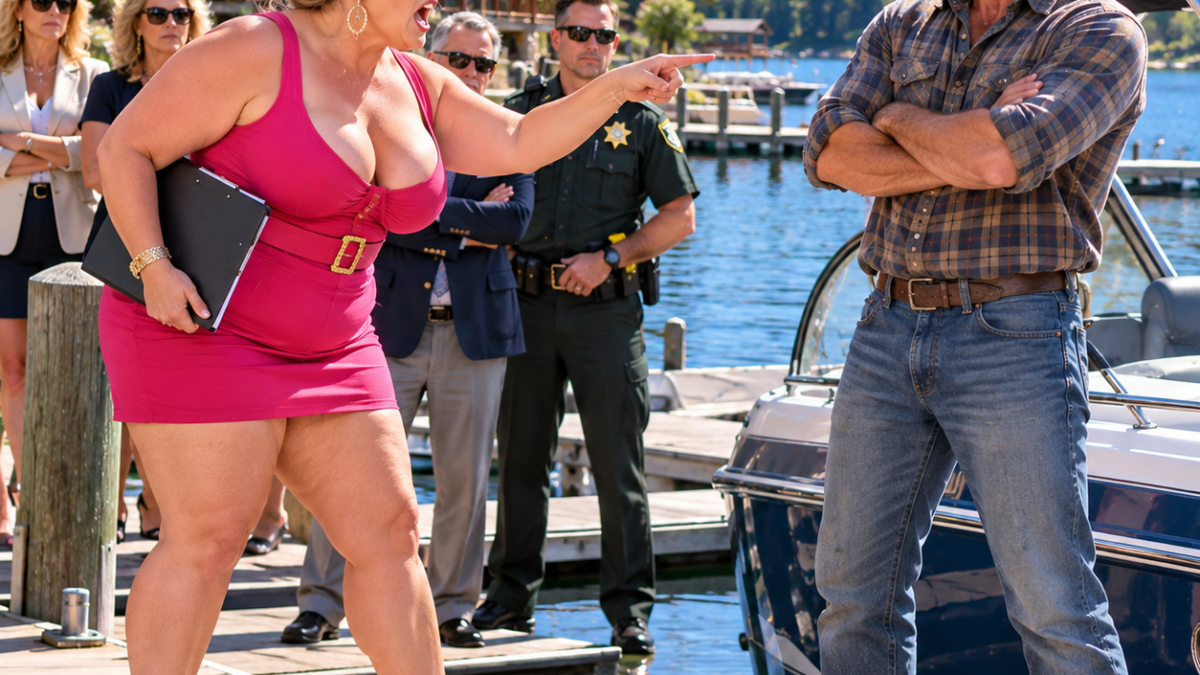
PART 2
The deed was dated November 18, 1982.
I remember that date because it was two days after my grandfather’s sixty-first birthday. He had celebrated with a cheap chocolate cake, a fishing trip, and a photograph of me holding a trout almost too large for my ten-year-old arms.
I’d seen that photograph a hundred times.
I’d never seen the deed.
The county clerk placed the document inside a protective sleeve and turned it toward me.
“Is this the property you’re researching?”
I stared at the legal description.
Part of it referred to the cabin parcel I already knew about. But another section described an entirely separate tract, including submerged land beneath the southern portion of Lake Meridian.
I read the description once.
Then again.
Then a third time.
“Ma’am,” I asked, “is this a deed to the lakebed?”
She adjusted her glasses.
“It’s a recorded conveyance of the property described there. You’ll need a title professional to determine the current legal interests.”
I nodded, but my mind was already racing.
My grandfather had bought what everybody called worthless swamp for eight thousand dollars.
But this document suggested he’d purchased something far larger than the cabin lot I’d inherited.
I remembered him telling me that people sometimes overlook the value of land because they’re too busy admiring the buildings sitting on it.
At the time, I thought he was talking about real estate.
Maybe he meant something else.
I spent the next four hours examining the original surveys, subdivision maps, and recorded transfers.
By late afternoon, I had discovered something that made Karen Brightwater’s threats look very different.
Lake Meridian wasn’t legally as simple as the neighborhood brochures suggested.
The northern basin and southern basin were described separately in older records, even though modern maps often treated them as one continuous lake.
An underwater ridge divided the two basins.
My grandfather’s original purchase appeared to include the lakebed beneath the southern section, along with certain access rights that had been preserved through later property transfers.
And the proposed location of Karen’s new marina?
It was almost entirely within that southern basin.
I sat in my truck outside the courthouse, staring through the windshield.
For months, Karen had accused me of using community property without permission.
She had threatened fines.
Sent security patrols.
Tried to remove my grandfather’s boat.
And now I had reason to believe the property she wanted to control wasn’t hers or the HOA’s in the first place.
I reached for my phone.
There was only one person I wanted to call.
Rebecca Martinez.
She was an attorney I’d met through a veterans’ legal assistance program after a previous property dispute.
Rebecca had spent fifteen years handling complex land and water-rights matters.
When she answered, I skipped the pleasantries.
“Rebecca, I think my grandfather owned a lake.”
There was a pause.
Then she said, “Marcus, you’re going to have to explain that sentence very carefully.”
Rebecca drove up from Denver two days later.
She arrived in a dark blue SUV carrying two leather folders, a laptop, and the unmistakable expression of someone who had already found several questions that needed answers.
I met her on the porch.
She looked toward the lake.
“Beautiful place.”
“My grandfather thought so.”
She smiled.
“Let’s see what he left you.”
We spent the morning going through the documents.
The original deed.
The subdivision records.
The survey maps.
My grandfather’s estate papers.
The current county parcel information.
Rebecca explained that ownership of submerged land, water rights, access rights, and recreational privileges could involve different legal questions.
That distinction mattered.
I couldn’t simply point to an old deed and declare that every drop of water was exclusively mine.
But the title documents were substantial.
By noon, Rebecca had called a surveyor and requested additional records from the county.
By three, she was studying a boundary map that showed the southern basin outlined in red.
Finally, she looked at me.
“Marcus, your grandfather made an extraordinary purchase.”
I leaned forward.
“How extraordinary?”
“Based on what we’ve reviewed, he acquired ownership of the southern lakebed parcel and retained important access interests. Your inheritance appears to include those rights.”
I looked toward the window.
The lake glittered beneath the afternoon sun.
“And the HOA?”
“Hasn’t shown any deed establishing ownership of this portion.”
I felt my pulse quicken.
“What about Karen’s marina?”
Rebecca turned the survey toward me.
“If these boundaries are confirmed, she can’t build what she’s proposing without addressing your property rights and the other applicable approvals.”
I sat silently.
For three months, Karen had acted as though I was standing in the way of progress because I refused to move an old boat.
Now I understood something.
My grandfather’s boat wasn’t merely an inconvenience.
It represented a property history Karen wanted everyone to forget.
That evening, I walked down to the dock.
Persistence rocked gently against the cedar planks.
Her white paint had faded over the years. The chrome around the windows needed polishing. A small crack had appeared in the varnish beside the stern.
To Karen, she was an eyesore.
To me, she was the smell of summer mornings and the sound of my grandfather laughing whenever I tangled a fishing line.
I ran my hand along the railing.
“Looks like you left me more than I knew, Grandpa.”
The wind moved across the water.
For a moment, I remembered him standing at the helm, squinting into the sunlight.
He used to say that a boat could teach a person two things.
How to move forward.
And when to hold steady.
I thought about Karen.
Her threats.
Her smug smile.
The way she spoke to longtime residents as though their families were obstacles to be removed.
Then I thought about my grandfather.
He had spent most of his life helping neighbors.
He repaired docks for people who couldn’t afford contractors.
He carried groceries across the lake when winter storms blocked the road.
He taught children to fish even when their parents couldn’t pay him a cent.
The lake had been his life’s work.
I wasn’t going to let someone turn it into a private playground for wealthy investors without a fight.
Karen’s next move arrived Monday morning.
A security boat appeared near my dock.
Two men in matching polo shirts circled slowly, taking photographs.
I watched them from the porch.
After twenty minutes, I walked down and called out.
“Can I help you gentlemen?”
The driver lifted a camera.
“Routine waterfront compliance patrol.”
“Authorized by whom?”
“Lake Meridian HOA.”
I nodded.
“Do you have written permission to patrol this part of the lake?”
He frowned.
“It’s community water.”
“That’s what I’ve been told.”
I took a photograph of their boat.
The younger man glanced toward his partner.
“Are you threatening us?”
“No. I’m documenting who’s operating near my dock.”
The driver started the engine and pulled away.
I watched the wake strike the old cedar supports.
Then I returned to the cabin and emailed the photographs to Rebecca.
Her reply arrived an hour later.
Keep documenting. Do not confront them physically. We’re verifying the boundaries and access instruments.
I followed her advice.
Every patrol went into a log.
Every notice was photographed.
Every threat was preserved.
Karen had spent months counting on intimidation.
I was going to respond with evidence.
The following Thursday, Karen held another HOA board meeting.
This time, she unveiled a new proposal.
The Lake Meridian Waterfront Enhancement Initiative.
The name sounded harmless.
The details were anything but.
Under the proposal, all boats older than twenty years would require expensive inspections and restoration to meet newly established aesthetic standards.
Owners would pay an annual watercraft assessment of two thousand dollars.
Additional fees would fund security patrols and marina planning.
Karen presented polished illustrations of luxury docks, landscaped shoreline paths, and a private yacht club.
At the center of the presentation was a rendering of a large marina complex.
I recognized the location immediately.
The southern basin.
My grandfather’s property.
I sat in the back row while Karen explained how the project would increase property values and attract affluent buyers.
Then she displayed an image of my boat.
The photograph had been taken from an angle that emphasized every faded patch of paint.
“Unfortunately,” she said, “certain older vessels are incompatible with the community’s future.”
Several people turned toward me.
I raised my hand.
“May I ask a question?”
Karen sighed.
“Mr. Wendell, we’ve already discussed your violations.”
“I’m asking about the marina.”
She folded her arms.
“Go ahead.”
“Who owns the land beneath the proposed docks?”
Her expression changed.
“The lake belongs to the community.”
“According to which recorded deed?”
A murmur moved through the room.
Karen’s smile tightened.
“We have decades of shared use.”
“That wasn’t my question.”
She glanced toward her attorney.
He leaned close and whispered something.
Then Karen turned back toward me.
“Ownership is being addressed by our development consultants.”
I nodded.
“So the board is asking residents to approve expensive fees for a marina before confirming whether it owns the property required to build it?”
Her face reddened.
“Mr. Wendell, your hostility is precisely why the board has concerns about your behavior.”
I looked around the room.
Several residents were studying the projected marina plan with renewed interest.
I didn’t press further.
I had asked the question I wanted everyone to remember.
Outside, Deputy Jim Torino caught up with me.
Jim’s family had lived near the lake almost as long as mine.
We’d grown up together.
He was a good man who had become a sheriff’s deputy after years working construction.
“Marcus,” he said quietly.
“Jim.”
“You need to be careful.”
I looked at him.
“About what?”
“Karen’s getting desperate.”
I leaned against my truck.
“Why?”
He hesitated.
“She’s got investors involved. Big money.”
I waited.
“Her real estate company has been buying options on lakefront properties.”
That got my attention.
“How many?”
“I don’t know the exact number. More than a few.”
“Why didn’t anyone tell me?”
“Some folks signed confidentiality agreements. Others don’t understand what they signed.”
I stared toward the community center.
Through the windows, I could see Karen laughing with a group of newer residents.
“Jim, do you think she’s trying to force the old families out?”
He looked uncomfortable.
“I think you need to let your attorney follow the money.”
That night, I called Rebecca.
She listened carefully.
Then she said, “I’ll look into the development interests.”
Three days later, I learned the name Mountain Vista Properties.
Karen Brightwater wasn’t simply a real estate agent.
She owned a development company.
And that company was connected to a proposed fifty-million-dollar luxury resort and marina project.
The plans included high-end condominiums, a private yacht club, expanded dock facilities, and exclusive recreational access.
Rebecca had obtained corporate records and public planning documents that showed Karen’s company was pursuing the project with a group of Denver investors.
The development depended on acquiring additional shoreline properties.
Including several owned by the original families.
I studied the acquisition map.
The Hendersons.
The Torinos.
Ezra Blackstone.
My cabin.
All positioned around the proposed marina and access route.
Rebecca pointed to one of the documents.
“These appear to be contingent purchase agreements. The development depends on assembling enough property and securing the necessary approvals.”
I looked at her.
“So the harassment wasn’t just about my boat.”
“That’s one possible explanation for her actions. We need evidence of intent before making that accusation publicly.”
I nodded.
But the pattern was becoming difficult to ignore.
The violations against longtime residents.
The pressure to modernize or sell.
The sudden security patrols.
The proposed marina.
The relentless campaign against my grandfather’s boat.
Karen didn’t simply want the lake to look different.
She wanted to transform the entire community into a profitable resort.
And the people who had spent decades living there were standing in her way.
Ezra Blackstone came over the following evening.
Ezra was seventy-eight, a retired schoolteacher with silver hair and the patient expression of someone who had spent forty years explaining basic arithmetic to children who insisted they already knew everything.
He carried an envelope.
“Marcus, I think you should see this.”
Inside was a written offer from Mountain Vista Properties.
Two hundred thousand dollars.
For Ezra’s modest cabin.
I stared at the number.
“That’s considerably more than the county’s assessed value.”
He nodded.
“Exactly.”
“Why not accept?”
Ezra looked toward the lake.
“My wife and I bought that cabin when our children were little. She’s gone now. My boys live out of state. But every room in that house holds a memory.”
His voice softened.
“I don’t want to sell because somebody’s making me afraid to stay.”
I handed back the offer.
“Did Karen contact you personally?”
“She did.”
“What did she say?”
“That the neighborhood was changing and older homeowners would eventually struggle to meet the new standards.”
I felt my jaw tighten.
Ezra continued.
“She suggested selling now would save me years of trouble.”
He looked directly at me.
“I taught children for forty years, Marcus. I know a bully when I see one.”
I nodded.
“So do I.”
He leaned forward.
“Your grandfather helped build this community. Don’t let them erase what those families created.”
I looked toward Persistence.
“I won’t.”
Over the next several weeks, Rebecca assembled a legal team.
A surveyor completed a detailed boundary review.
An environmental specialist examined the proposed marina location.
A property attorney researched the easement documents.
And several original families agreed to share their correspondence with Karen and Mountain Vista Properties.
The evidence was extensive.
Some notices appeared to rely on covenants whose applicability to certain original parcels was disputed.
Some fees had been proposed without the approval procedures required by the governing documents.
Several residents reported pressure to sell after receiving repeated violations.
Rebecca advised us to remain cautious about public accusations until the records could be verified.
I agreed.
But Karen didn’t show the same restraint.
She began circulating rumors that I was mentally unstable.
That my Navy service had left me dangerous.
That I was threatening community safety.
She even filed a complaint accusing me of intimidating board members by questioning the HOA’s authority.
I had spent twenty-two years in the Navy.
I had worked through emergencies that required calm judgment and precise engineering decisions.
Now a real estate developer was trying to portray me as a threat because I wouldn’t move my grandfather’s boat.
It hurt more than I wanted to admit.
Not because I thought people who knew me would believe her.
But because I understood how easily fear could turn neighbors against one another.
The harassment soon became more personal.
Someone damaged my mailbox.
Then it happened again.
One morning, I found the words GET OUT painted across the wooden post beside my driveway.
I photographed everything.
Jim took a report.
No suspect was immediately identified.
A week later, I discovered something wrong with the boat’s fuel system.
The mechanic found foreign material in the tank and recommended cleaning the system before starting the engine.
The repairs cost more than a thousand dollars.
I stood beside the boat while the mechanic explained the damage.
“Any idea who did it?” he asked.
I shook my head.
“Not enough evidence.”
He nodded.
“That’s the right answer.”
But inside, I was furious.
Persistence was more than machinery.
It was my grandfather’s hands on the steering wheel.
His laughter.
His patience.
His way of reminding a young boy that not everything important had to be new.
Someone had tried to damage a part of my family history because I refused to surrender it.
That night, I sat alone on the dock.
The lake was quiet.
The mountains stood dark against the sky.
I remembered my grandfather telling me never to confuse anger with strength.
For the first time in months, I understood how difficult that lesson could be.
Then came the anonymous complaint to the VA.
A concerned caller claimed I was behaving irrationally and might pose a danger to myself or others.
I received a professional wellness check.
The people who visited treated me respectfully.
I explained the neighborhood dispute and provided context.
They listened.
Still, when they left, I felt humiliated.
Karen’s campaign had reached into an area of my life that should never have been used as a weapon.
I called Rebecca.
She listened without interrupting.
Then she said, “Marcus, we’re going to address this carefully. But I need you to promise me something.”
“What?”
“Don’t confront Karen.”
I looked toward the lake.
“Rebecca, I’m tired.”
“I know.”
“She won’t stop.”
“Then let the evidence stop her.”
I closed my eyes.
For a moment, I heard my grandfather’s voice.
Hold steady.
I took a breath.
“All right.”
The next breakthrough came from an old access-road easement.
Rebecca had been reviewing the property records when she noticed a reference to a perpetual access arrangement across land associated with my grandfather’s purchase.
The route connected the county road to the southern shoreline.
Decades earlier, it had been used for maintenance and limited property access.
Now Karen’s development plans showed heavy construction traffic traveling along essentially the same corridor.
Rebecca called me.
“Marcus, do you have the old road easement papers?”
“I think so.”
“Find them.”
I searched the cabin that evening.
They were inside my grandfather’s wooden file cabinet beneath a stack of old fishing licenses.
The original agreement identified the parcels involved and described specific access rights and limitations.
Rebecca reviewed it with the surveyor.
When she called back, her voice was controlled but unmistakably excited.
“This could materially affect the marina project.”
“How?”
“The developer appears to assume it can use the route for commercial construction and resort access. The recorded easement may not authorize that use.”
I looked toward the map.
“So she needs my permission?”
“She may need additional rights from you and other parties. We’ll verify the details before drawing a final conclusion.”
I smiled.
For months, Karen had acted like my grandfather’s property was an inconvenience.
Now the project’s own plans suggested that his old land rights stood directly in its path.
There was more.
In 1984, my grandfather had signed a conservation agreement intended to protect parts of the southern lake habitat.
The documents referenced important aquatic species and restrictions on certain forms of development.
Rebecca arranged for a qualified conservation attorney to examine the agreement.
The conclusion was significant.
Any marina proposal would have to account for the existing recorded restrictions, property ownership, water-law requirements, and relevant environmental approvals.
Karen couldn’t simply vote those obligations away at an HOA meeting.
My grandfather had protected the place long before anyone thought a private yacht club might be profitable.
I walked out to the dock that evening and looked at the southern basin.
I remembered fishing there with him when I was twelve.
We’d spent hours waiting for trout.
He’d told me that some places were valuable precisely because people hadn’t ruined them yet.
I hadn’t understood.
Now I did.
Karen’s attorney called two days later.
He offered five hundred thousand dollars for my cabin and associated property interests.
The offer was contingent on a quick closing and a confidentiality agreement.
I listened carefully.
Then I asked him to send everything in writing.
When the documents arrived, Rebecca reviewed them.
She advised against accepting without a full evaluation of the property and development implications.
I agreed.
But the offer revealed something important.
Karen’s investors were willing to pay far more than she’d suggested my property was worth.
For months, she’d called the cabin an eyesore and my boat a nuisance.
Now her company wanted to pay half a million dollars to make them disappear.
I declined the offer.
Karen responded with another public statement about protecting community standards.
The contradiction was becoming impossible to hide.
Ezra helped organize a coalition of original families.
Seven households joined.
Some had been there since the 1980s.
Others had inherited properties from parents or grandparents.
All were tired of being treated as obstacles to somebody else’s financial ambitions.
We met at Ezra’s cabin one Sunday afternoon.
The table was covered with deeds, notices, photographs, and correspondence.
One family described repeated landscaping fines.
Another shared threatening letters about an allegedly unauthorized dock.
A third had been told its property would become difficult to insure unless expensive upgrades were completed.
We compared dates.
Some enforcement efforts closely followed development inquiries or purchase offers.
Rebecca warned us that timing alone didn’t prove an unlawful scheme.
But it justified further investigation.
Frankly, that was enough for me.
I wanted the truth.
Not rumors.
Not revenge fantasies.
The truth.
The environmental evidence became increasingly troubling.
During routine monitoring, a specialist identified petroleum residue in a portion of the southern basin.
The source wasn’t immediately clear.
I provided maintenance records for Persistence and allowed the boat to be inspected.
The results didn’t support the accusation that my vessel was responsible.
Then my newly installed security cameras captured something disturbing.
Three people approached the shoreline late at night.
They carried containers.
They moved toward the water.
The footage showed material being poured near the dock.
I watched it twice.
Then I called Jim Torino.
He came over before sunrise.
We reviewed the recording together.
His expression darkened.
“Marcus, don’t touch anything.”
I nodded.
“I haven’t.”
He secured the area and contacted the appropriate environmental authorities.
Investigators collected samples.
The camera footage was preserved.
I gave them everything I had.
Within days, the incident became a formal investigation.
I won’t pretend I felt calm.
Someone had intentionally contaminated water my grandfather had spent decades protecting.
The same water Karen claimed she wanted to improve.
I looked at the dark stain near the shoreline and felt a kind of anger I’d rarely experienced.
Not because the contamination threatened my legal case.
Because somebody had treated the lake like a disposable prop in a personal war.
The environmental investigation widened.
Additional records were requested.
Security patrol activities were examined.
Investigators reviewed the timing of complaints, development plans, and suspicious incidents.
Rebecca advised me to let the process proceed without public speculation.
Meanwhile, a Denver newspaper reporter contacted me.
She was investigating potential conflicts between HOA enforcement and private development interests.
I agreed to an interview.
We sat on my porch.
She asked about my grandfather.
The boat.
The lake.
The property records.
The harassment.
Then she asked a question I hadn’t expected.
“Mr. Wendell, what would you do if a developer offered you enough money to retire anywhere in the country?”
I looked toward the water.
“I already retired where I wanted to be.”
She smiled.
“So the money isn’t tempting?”
“Money can replace a house.”
I paused.
“It can’t replace the mornings I spent fishing with my grandfather.”
The reporter lowered her pen.
I continued.
“He bought this place when nobody wanted it. He built that dock with his hands. He protected the shoreline because he thought somebody should.”
I looked at Persistence.
“If I sell it to people who want to destroy what he loved, what exactly have I gained?”
The reporter didn’t answer.
She didn’t need to.
Her first article appeared the following week.
It examined the proposed marina, the land records, and the concerns raised by longtime residents.
It reported that Karen Brightwater owned Mountain Vista Properties and that her development interests overlapped with decisions she had influenced as HOA president.
The article included a statement from Karen denying wrongdoing.
It also quoted Rebecca explaining that recorded property rights and conservation restrictions could significantly affect the project.
The response was immediate.
Residents who had never attended an HOA meeting began asking questions.
Why had the board proposed expensive marina assessments before confirming land ownership?
Why had so many original families received enforcement notices?
Why were development negotiations being conducted without broader disclosure?
And why had the HOA president’s private company been involved in acquiring properties around the proposed resort?
Karen issued another statement.
She called the reporting misleading.
She accused critics of opposing progress.
She insisted the marina would bring prosperity.
But the conversation had changed.
People were no longer debating whether my grandfather’s boat looked old.
They were asking who stood to profit from removing it.
A former employee of Mountain Vista Properties eventually contacted Rebecca.
Her name was Sarah Collins.
She had worked as an administrative assistant and had retained records she believed were relevant to the investigation.
Rebecca arranged for her information to be handled through proper legal channels.
Sarah described internal discussions about acquiring older shoreline properties, managing negative publicity, and coordinating with HOA contacts.
Some records raised serious questions about the separation between Karen’s public role and her private business interests.
Others related to the campaign against my property.
Investigators and attorneys reviewed the materials.
I didn’t meet Sarah immediately.
When we finally spoke, she looked frightened.
“I should have said something earlier,” she told me.
I studied her.
“Why didn’t you?”
“She was my boss. I needed the job.”
I nodded.
“I understand.”
“She told us the original families were holding the development back.”
I looked toward the lake.
“That’s one way to describe people refusing to sell their homes.”
Sarah’s eyes filled.
“I knew it was wrong.”
I didn’t offer easy absolution.
I simply thanked her for coming forward.
Sometimes doing the right thing begins long after we wish it had.
Karen’s investors began distancing themselves from the project.
Some requested independent legal reviews.
Others suspended financing while the property and environmental questions remained unresolved.
The proposed resort suddenly faced problems no amount of advertising could solve.
Uncertain property access.
Disputed HOA authority.
Environmental restrictions.
Potential conflicts of interest.
And mounting public scrutiny.
The development that Karen had presented as inevitable was no longer moving forward.
Then Jim called.
“Marcus, we need to talk.”
His voice was serious.
I asked him to come over.
He arrived with two cups of coffee and sat at the kitchen table.
“There’s an investigation involving an alleged attempt to influence a law-enforcement action against you.”
I stared at him.
“What?”
“I can’t give you every detail. But I want you to know the matter is being handled.”
My mouth went dry.
“Did Karen try to have me arrested?”
Jim was careful.
“The investigation concerns an attempt to obtain a false report and improper official action. The evidence will determine what charges, if any, are appropriate.”
I sat silently.
For months, I’d been told that my research made me dangerous.
That my refusal to move my boat was threatening.
That my military background should make neighbors afraid.
Now investigators were examining whether someone had tried to weaponize law enforcement against me.
I looked at Jim.
“Thank you for telling me.”
He nodded.
“Keep doing what you’ve been doing. Document everything. Let the system work.”
Karen scheduled one final emergency HOA meeting for Labor Day weekend.
The agenda announced a vote concerning waterfront safety, marina security, and the removal of noncompliant vessels.
My boat was clearly the intended target.
Rebecca wanted to challenge the meeting’s legal authority before it occurred.
But we also recognized an opportunity to present the verified facts to the community.
We prepared carefully.
The title records.
The surveys.
The conservation agreement.
The access-road documents.
The development disclosures.
The environmental findings that could lawfully be shared.
Every major claim was supported by a document.
I wasn’t interested in another shouting match.
I wanted Karen’s neighbors to see exactly what had been hidden beneath months of threats.
The morning of the meeting, I walked down to the dock.
Persistence sat quietly beside the cedar planks.
I placed my hand against her weathered hull.
“Grandpa, I hope I get this right.”
The water lapped against the shore.
I thought about the boy I’d been when Clifford first let me hold the wheel.
He’d trusted me with the boat long before I trusted myself.
Now, forty years later, I felt as though he’d entrusted me with the lake.
And I intended to be worthy of it.
The community center was packed.
Residents lined the walls.
Several reporters had arrived.
County officials sat near the front.
Karen stood behind the board table wearing a dark suit and an expression of carefully rehearsed confidence.
She began with a speech about responsible development.
Property values.
Safety.
The future.
Then she displayed a photograph of Persistence.
“Unfortunately,” she announced, “one resident continues to obstruct the modernization of our waterfront.”
I stood.
“Karen, before you discuss removing my boat, I think everyone deserves to see the ownership records.”
She sighed dramatically.
“Mr. Wendell, we’ve heard your claims before.”
“Not these documents.”
Rebecca rose beside me.
“Madam President, we have recorded title documents, professional survey findings, and relevant conservation instruments that directly concern the proposed marina.”
Karen looked toward her attorney.
He said nothing.
Rebecca connected her laptop to the projector.
The first image appeared.
My grandfather’s original 1982 deed.
I stepped forward.
“Forty-three years ago, Clifford Wendell paid eight thousand dollars for property most people considered worthless.”
I paused.
“He built a cabin. He built a dock. And he bought something the later developers never bothered to understand.”
Rebecca displayed the survey.
The southern basin glowed red on the screen.
“The records establish that my grandfather acquired the lakebed parcel beneath Lake Meridian South. Those interests passed through his estate to me.”
People leaned forward.
Karen’s expression changed.
I continued.
“The HOA has repeatedly described this area as community property. But it hasn’t produced a recorded deed showing that it owns the submerged land where the marina is proposed.”
A murmur moved through the room.
Rebecca brought up the modern survey.
The proposed marina footprint appeared over the lakebed boundary.
Several people gasped.
I pointed toward the screen.
“Your development plan places major facilities on property you don’t own.”
Karen stood abruptly.
“That’s impossible!”
Rebecca answered.
“The ownership records have been reviewed by qualified professionals. If the developer disputes the boundaries, there is a legal process for resolving them. What the HOA cannot do is simply assume title because it wants to build a marina.”
Karen stared at the screen.
I watched the realization spread across her face.
For months, she’d treated my grandfather’s boat as an obstacle that could be removed by fines and intimidation.
Now the entire room could see why its location mattered.
Rebecca advanced to the next document.
The access-road easement.
“This recorded agreement also affects the route proposed for construction and resort traffic,” she explained. “The developer has not established that its intended commercial use is authorized.”
Then came the conservation restrictions.
The environmental review.
The ownership disclosures linking Karen to Mountain Vista Properties.
Each document removed another piece of the story she’d been telling the neighborhood.
A resident raised his hand.
“Karen, why didn’t the board tell us you owned the company developing the marina?”
She swallowed.
“My business interests were publicly available.”
“That isn’t what he asked,” Ezra said from the second row.
Another homeowner stood.
“Were the boat restrictions designed to help your development?”
Karen’s voice rose.
“Absolutely not!”
I looked at her.
“Then why did you propose rules that would force older boats off the water while planning a private yacht club?”
She didn’t answer.
A woman near the aisle held up a copy of the proposed assessment.
“Why were we being asked to pay thousands of dollars for improvements to property the HOA hasn’t shown it owns?”
The questions multiplied.
Karen tried to regain control.
But the room had changed.
Her audience was no longer waiting for instructions.
They wanted answers.
Then Rebecca addressed the harassment.
She explained the disputed covenant authority, the attempted assessments, and the documented incidents involving my property.
She emphasized that criminal allegations belonged to investigators and courts, not a neighborhood vote.
I appreciated that.
For months, Karen had accused me without evidence.
I wasn’t going to do the same.
But the established facts were devastating enough.
The security patrols.
The repeated notices.
The public allegations.
The attempts to impose costly restrictions.
The undisclosed development interests.
And the failure to verify ownership before proposing a fifty-million-dollar resort.
Karen stood behind the table, gripping the edge so tightly her knuckles turned pale.
Finally, she pointed at me.
“You’ve ruined everything!”
I looked at her.
“No, Karen.”
My voice was quiet.
“You tried to build a future by making other people surrender theirs.”
She shook her head violently.
“You don’t understand what this project could have brought to the community!”
“Maybe it could have brought money.”
I looked around the room.
“But some of these families already had something money couldn’t replace.”
Ezra stood slowly.
“My wife and I raised our children here.”
The Hendersons nodded.
Jim’s mother wiped her eyes.
I continued.
“My grandfather built his cabin before there was an HOA. He spent his life helping the people around this lake.”
I held up an old photograph.
Clifford standing beside Persistence, one hand resting on my shoulder.
“He never owned a mansion. He never had a fifty-million-dollar development plan.”
My throat tightened.
“But he understood something important.”
I looked at Karen.
“A neighborhood isn’t valuable because every house looks expensive. It’s valuable because the people living there know they belong.”
The room went silent.
Then Ezra began applauding.
Others joined him.
Within seconds, nearly everyone was standing.
Karen’s face collapsed.
For the first time, she had no speech prepared.
The meeting’s scheduled vote was suspended.
The HOA board agreed to review the development proposal and the association’s authority before taking further action.
Several board members called for an independent investigation of the project’s financial and governance arrangements.
Karen attempted to continue the proceedings.
But she no longer had the support required to control the room.
As residents began leaving, Jim Torino approached the front with another officer.
He asked Karen to step aside.
The conversation was brief.
I couldn’t hear every word.
But I saw her expression change.
Then Jim placed her under arrest in connection with the alleged bribery attempt involving law-enforcement action against me.
The room fell silent.
Karen looked directly at me.
“This is your fault!”
I stood motionless.
Her voice cracked.
“You could have moved that stupid boat!”
I looked toward the projected photograph of Persistence.
Then back at her.
“You could have left my grandfather’s property alone.”
Jim escorted her from the room.
I didn’t cheer.
I didn’t clap.
I didn’t smile for the cameras.
I simply watched the woman who had spent months trying to frighten me finally face a process she couldn’t control with an HOA vote.
The legal aftermath took months.
Mountain Vista Properties lost investor support as the development’s property, environmental, and financial problems became public.
The marina proposal was abandoned.
Karen’s role in the company’s activities received additional scrutiny.
The environmental investigation resulted in charges and negotiated resolutions involving the parties responsible for the contamination incident.
The attempted bribery case proceeded separately.
Karen eventually entered a plea agreement resolving several charges arising from the investigation.
Her professional licensing issues were handled through the appropriate regulatory process.
The financial consequences were substantial.
Mountain Vista Properties collapsed under the weight of failed development commitments, litigation, and investor claims.
The HOA’s new leadership withdrew the disputed boat-related enforcement actions and began reviewing its governance procedures.
My own civil claims were resolved through a negotiated settlement that included compensation for documented losses and legal expenses.
I didn’t receive the satisfaction of watching every allegation become a criminal conviction.
That’s not how real legal proceedings work.
But I received something more important.
My property rights were recognized.
My grandfather’s boat remained where it belonged.
And the plan to transform the southern basin into a private luxury marina was finished.
The neighborhood changed after Karen left.
Not overnight.
Trust doesn’t return simply because one person loses power.
It takes time.
People who had spent years avoiding HOA meetings began attending again.
The board revised its enforcement procedures.
Financial decisions became more transparent.
Homeowners received clearer notice before major votes.
And the association began working with qualified professionals rather than relying on the president’s personal interpretations.
Ezra helped organize a committee representing the original families.
Newer residents joined too.
That mattered.
The problem had never been that some people owned expensive homes.
The problem was believing expensive homes gave their owners more right to dignity than everyone else.
Once people began talking openly, they discovered they had far more in common than Karen had allowed them to believe.
They wanted safe docks.
Clean water.
Fair rules.
Respectful neighbors.
And a place where children could grow up without watching adults threaten one another over property values.
I spent much of the following year working with Rebecca and environmental specialists to establish a long-term stewardship plan for Lake Meridian South.
We documented the lakebed ownership and existing access rights.
We worked with conservation partners to protect the sensitive habitat.
And we developed a framework allowing lawful community recreation without surrendering control to commercial development interests.
I wanted families to keep fishing.
Swimming where permitted.
Enjoying the shoreline.
Watching the sunset.
My grandfather had never treated the lake as something that existed solely for his pleasure.
I wasn’t going to start.
We named the conservation initiative the Clifford Wendell Memorial Wildlife Preserve.
The dedication took place on a beautiful Saturday morning.
Neighbors gathered near the old dock.
Ezra brought photographs from the 1980s.
Jim attended with his family.
The Hendersons brought homemade food.
Children ran along the shore.
And Persistence floated beside the dock, freshly restored.
I’d spent months repairing the damage to her engine and hull.
The old white paint had been renewed.
The mahogany fittings gleamed.
The brass lettering on her stern had been carefully polished.
PERSISTENCE.
I ran my hand across the name.
For years, I’d thought it was simply my grandfather’s description of the kind of boat he wanted.
Now I understood it was also the way he lived.
He never gave up on things worth saving.
At the dedication, Ezra asked me to speak.
I stood beside a photograph of my grandfather.
For a moment, I couldn’t find the words.
Then I looked toward the lake.
“When Clifford Wendell bought this property in 1982, people thought he was wasting eight thousand dollars.”
A few neighbors laughed.
“He didn’t see worthless swamp. He saw a place where families could fish, children could swim, and people could spend quiet mornings watching the mountains.”
I paused.
“He built that dock with his hands. He repaired boats for neighbors. And when somebody needed help, he showed up.”
My voice tightened.
“He taught me that ownership means responsibility.”
I looked around.
“For months, people fought over who had the right to control this water. But my grandfather’s greatest gift wasn’t the lakebed or the access agreements.”
I swallowed.
“It was showing me that the best way to protect something beautiful is to make sure it remains beautiful for people who come after you.”
The crowd was silent.
Then Jim began applauding.
Others joined.
I looked toward Persistence.
The sunlight shimmered across her restored hull.
And I knew my grandfather would have been proud.
The first annual conservation festival took place the following summer.
It began as a small neighborhood gathering.
Then local schools asked to participate.
Environmental organizations offered educational programs.
Veterans groups helped organize fishing lessons.
Families came from surrounding towns.
Children learned about aquatic habitats, water quality, and the history of the lake.
Students helped monitor shoreline conditions.
Volunteers removed litter and repaired trails.
The local businesses appreciated the visitors.
But the best part had nothing to do with money.
It was watching children experience the same wonder I’d felt when my grandfather first took me fishing.
One little boy stood beside Persistence for nearly ten minutes, staring at her polished windows.
Finally, he asked, “Mister, is this the boat everybody fought about?”
I smiled.
“It is.”
“Why?”
I thought about how to answer.
“Some people thought it didn’t belong here.”
He frowned.
“But it’s beautiful.”
I laughed softly.
“Thank you.”
He pointed toward the lake.
“Did your grandpa really own all that water?”
“He owned important property rights connected to the southern lake. And now I’m responsible for taking care of them.”
The boy thought for a moment.
“Does that mean you can tell everybody to leave?”
I looked at the families gathered along the shoreline.
“No.”
“Why not?”
“Because being able to exclude people in some circumstances doesn’t mean it’s the right thing to do.”
He considered that.
Then grinned.
“Can I go fishing?”
I smiled.
“Absolutely.”
One quiet evening after the festival, I sat alone on the dock.
The crowds had gone home.
The cleanup crews had finished.
The water was calm.
I opened the old tackle box that had belonged to my grandfather.
Inside were faded lures, spare hooks, an old pocketknife, and a photograph I’d forgotten.
Clifford stood beside the original cabin in 1983.
The dock was unfinished.
The ground was muddy.
There were no luxury houses in the background.
Just pine trees.
Water.
And a man smiling because he’d found somewhere he wanted to stay.
On the back, he’d written a single sentence.
Someday Marcus will understand why I chose this place.
I stared at those words for a long time.
Then I laughed through tears.
“You were right, Grandpa.”
I looked across the water.
The northern shoreline glowed beneath the setting sun.
Families were preparing dinner.
Children were calling to one another.
A fishing boat moved slowly toward the far bank.
The community hadn’t become perfect.
No community ever does.
But it had become something better.
A place where people were learning to respect what they hadn’t built themselves.
A place where wealth didn’t automatically translate into authority.
And a place where the history of the original families was finally understood as something worth preserving.
A year after Karen’s arrest, I received a letter from a veteran in Montana.
He had read about the Lake Meridian dispute.
His neighborhood association was challenging equipment he’d installed on his property, and he wanted to know how I’d handled the legal process.
I wrote back.
I told him to preserve every notice.
Read the recorded documents.
Verify the association’s actual authority.
Consult qualified professionals.
And never let anger convince him to make threats he couldn’t take back.
I didn’t promise him victory.
I didn’t pretend every HOA dispute hid a valuable property secret.
I simply shared what I’d learned.
Over time, I found myself helping more people understand property records and basic conservation issues.
It wasn’t the retirement I’d planned.
But it was meaningful.
And it gave me a way to honor my grandfather’s life beyond restoring his boat.
The last time I took Persistence across the southern basin that season, the water was nearly perfectly still.
I stood at the helm, one hand resting on the old wooden wheel.
The engine hummed beneath me.
The mountains reflected across the lake.
I remembered Karen arriving at dawn with bolt cutters.
Her threat of five hundred dollars in daily fines.
The board members marching toward my dock.
The confidence with which she’d treated my grandfather’s property as an inconvenience she could remove.
Then I remembered the courthouse.
The old deed.
The survey.
The discovery that changed everything.
And the night the community finally learned what was behind the proposed marina.
Karen had tried to force me to move a boat.
Instead, she exposed a development scheme that threatened the future of the entire southern shoreline.
Her plans collapsed.
The disputed enforcement actions ended.
The lake’s legal history came to light.
And the families who’d nearly been pushed aside regained their voice.
But the greatest satisfaction wasn’t seeing Karen arrested.
It was knowing that my grandfather’s work would survive another generation.
I eased the throttle back.
Persistence slowed near the northern cove.
I turned toward the place where Clifford had taught me to fish.
For a moment, I could almost see him standing beside me.
His old fishing hat.
His weathered hands.
That patient smile.
“See, Marcus?” he’d say. “Sometimes the most valuable things are the ones everybody else overlooks.”
I smiled.
“You got that right, Grandpa.”
The boat rocked gently.
I looked toward the shoreline.
Then I turned for home.
That evening, I tied Persistence to the same dock where my grandfather had first taught me to secure a line.
The cedar boards creaked beneath my boots.
The cabin windows glowed warmly.
Somewhere in the distance, children were laughing.
I stood beside the boat, looking at the name painted on her stern.
PERSISTENCE.
For forty years, she’d carried my family’s memories across Lake Meridian.
She’d survived storms.
Broken parts.
Long winters.
And one determined HOA president who believed anything old should disappear if it interfered with her plans.
But she was still here.
So was the cabin.
So was the lake.
And so were the families who had refused to surrender their homes.
I thought about what Karen had said the morning she threatened to remove the boat.
“This neighborhood has changed, Marcus.”
She’d been right about one thing.
The neighborhood had changed.
But not in the way she wanted.
It had become a place where people understood that progress didn’t require erasing the past.
Where rules needed lawful authority.
Where developers couldn’t substitute intimidation for consent.
And where ordinary families could stand together against people who thought everything had a price.
I sat on the dock as the last sunlight disappeared behind the mountains.
My grandfather had paid eight thousand dollars for land nobody wanted.
Decades later, its recorded rights had helped stop a fifty-million-dollar development scheme.
But the real value of his purchase could never be written on a deed.
It was the childhoods spent fishing.
The friendships built along the shoreline.
The memories carried from one generation to the next.
And the quiet assurance that some places were worth protecting simply because they were loved.
Karen Brightwater tried to take my grandfather’s boat because she believed money and HOA authority could erase our family’s history. Instead, she discovered that the lake she wanted to sell had already been entrusted to someone who would never let her destroy it.
I took one last look at Persistence.
Then I walked up the path toward the cabin.
For the first time since the trouble began, I wasn’t thinking about lawyers, fines, or property boundaries.
I was thinking about tomorrow morning.
Coffee on the porch.
Sunrise over the water.
And maybe a fishing trip in the boat my grandfather had taught me to love.
Some victories don’t need a cheering crowd.
Sometimes they sound like a boat rope tightening gently against a cedar post, a loon calling across still water, and an old family promise finally fulfilled.
THE END








