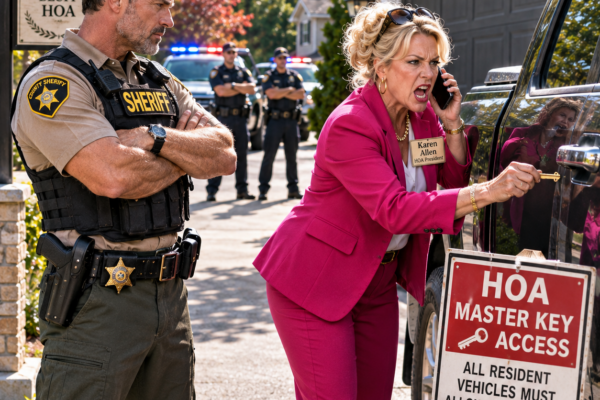
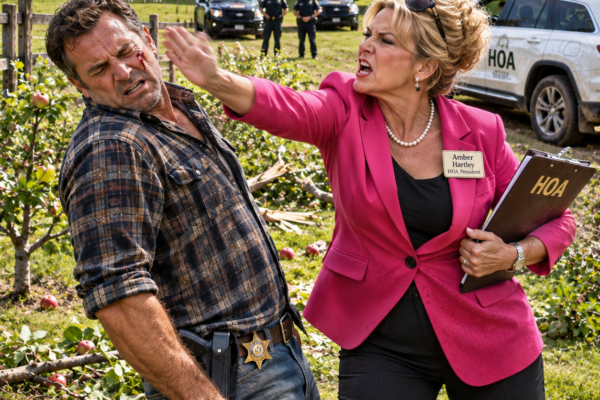
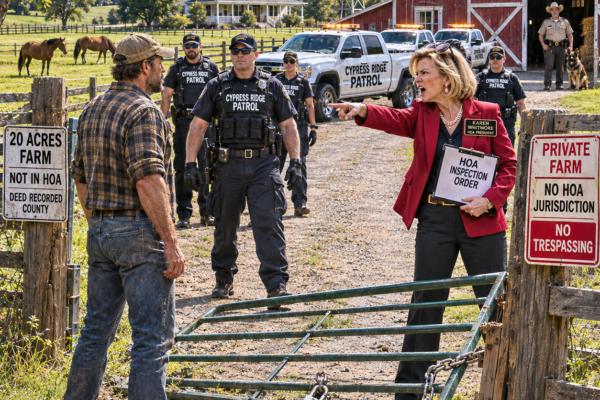
PART 2: HOA President Planted Cocaine in My Car to Get Me Arrested—She Had No Idea Who She Was Framing
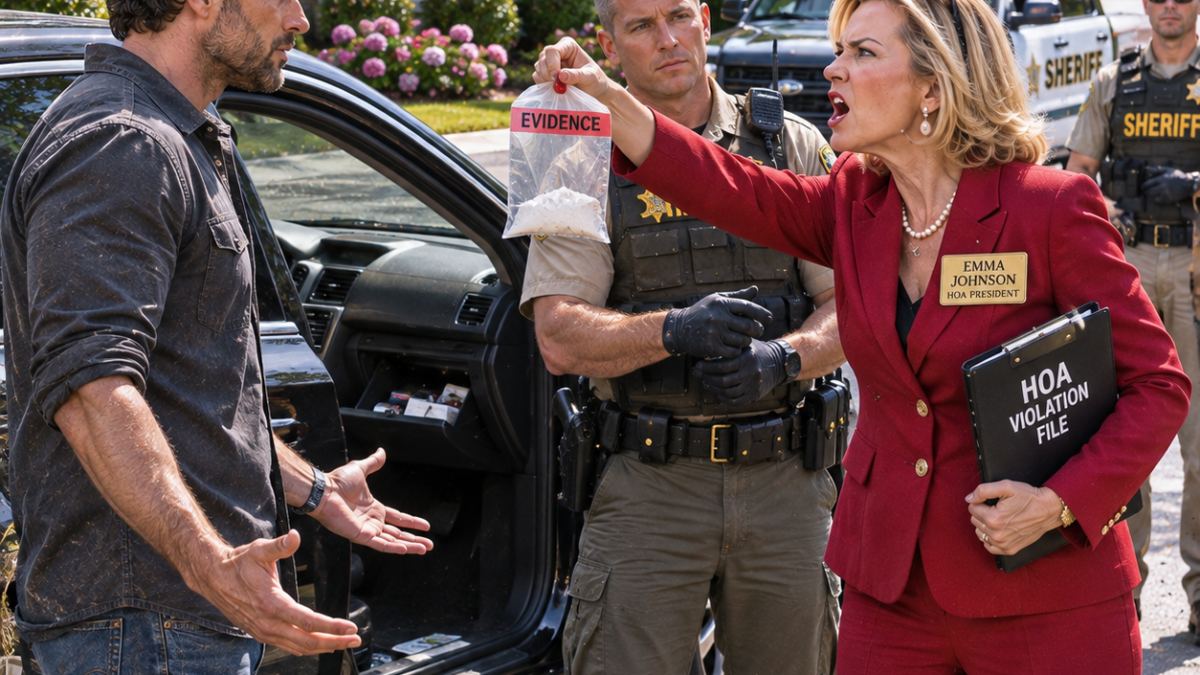
Blue-and-red lights washed across the white fences of Mapleton Oaks while I stood beside my black sedan with my hands visible, listening to HOA president Emma Johnson tell a sheriff’s deputy that the bag of cocaine in her palm had come from my glove compartment.
She had spent fifty-seven days measuring my grass, photographing my trash cans, inventing fines, and trying to make me submit to her board, but framing me for a felony was the first time she had crossed from petty control into a crime that could destroy my career, my freedom, and the peace I had moved there to rebuild.
What Emma could not see beneath the flashing patrol lights was the tiny marking along the edge of that evidence bag, and the instant I recognized it, I understood that she had just connected herself to something far more dangerous than a neighborhood feud.
My name is Robert Miller, and I had been living in Mapleton Oaks for exactly fifty-seven days when Emma tried to have me arrested.
From the outside, Mapleton Oaks looked almost painfully perfect. White fences, trimmed hedges, matching stone mailboxes. It was the kind of neighborhood real-estate brochures described as “quiet, secure, and community focused.”
I had moved there for one reason that had nothing to do with prestige.
My mother had undergone major hip surgery, and her physical therapy clinic was less than fifteen minutes away. I wanted to be close enough to drive her to appointments.
Emma learned my name before most of my neighbors did.
Within my first week, I received a warning because my trash bin remained visible from the street for forty-three minutes after the approved pickup window.
The next letter said my lawn exceeded community height standards by half an inch.
Then came a parking notice because my sedan had spent one evening in the section she called the “visitor zone.”
I knew most of her demands stretched the bylaws, but I kept my responses polite.
Emma interpreted politeness as weakness.
That afternoon, I was returning from my mother’s physical therapy appointment when two HOA volunteers stepped into the road near the security gate.
One wore an orange vest.
The other held a clipboard.
Emma stood behind them in a red blazer and pearl earrings.
She raised one hand.
“Mr. Miller. Stop the vehicle.”
I lowered my window.
“Problem?”
“We’ve received complaints about a suspicious odor coming from your car.”
I almost smiled.
“What kind of odor?”
“Possibly narcotics.”
One volunteer shifted uncomfortably.
Emma continued.
“Mapleton Oaks takes community drug safety very seriously.”
“Does it?”
“Step out of the vehicle.”
“Under what authority?”
Her mouth tightened.
“HOA emergency safety policy.”
“That doesn’t authorize you to search my car.”
“You can cooperate voluntarily, or we can contact law enforcement.”
The younger volunteer looked at her.
“Emma, maybe we should just call them.”
She cut him off.
“We are conducting the preliminary inspection.”
I could have ended the encounter right there.
Instead, I stepped out.
“Go ahead.”
I left the driver’s door open and stood near the front fender while the volunteers awkwardly checked the trunk.
My phone was recording from my jacket pocket.
Emma moved toward the passenger side.
She pretended to study the interior.
But I wasn’t watching her directly.
I was watching her reflection in the side mirror.
Her right hand slipped into her purse.
When it came out, she was holding a folded white napkin.
She leaned through the passenger door.
A second later, the napkin was gone.
Then Emma gasped.
“Oh my God.”
The younger volunteer turned.
“What?”
Emma reached into my car and lifted a small clear plastic bag filled with white powder.
“There.”
Her voice rose so the neighbors gathering nearby could hear.
“I knew he was hiding something.”
The young volunteer stared at the bag.
“Wait. Where did that—”
“Call the sheriff,” Emma snapped.
She raised the bag like a trophy.
“This is cocaine.”
Five minutes later, Deputy Raymond Jackson pulled up.
He greeted Emma by first name.
That was the first detail I didn’t like.
The second came when he took the bag from her without asking who had touched it, where exactly it had been found, or whether anyone had recorded the search.
He looked at the powder, then at me.
“That’s a serious amount, sir.”
Emma folded her arms.
“I told you.”
Jackson reached toward the cuffs on his belt.
I looked once more at the bag in his hand.
Along the sealed edge was a tiny inventory marking most civilians would never notice.
I knew exactly where I had seen that code before.
And I knew the cocaine in Emma Johnson’s hand had never belonged anywhere near my car.
PART 2
Jackson’s fingers closed around the handcuffs.
“Turn around for me, sir.”
I didn’t move.
Emma smiled.
Not broadly.
She was too careful for that.
But the corners of her mouth lifted just enough to tell me this was the moment she had been waiting for.
Neighbors stood at the ends of their driveways with phones raised.
The younger HOA volunteer looked sick.
He kept staring at the bag.
I looked at Jackson.
“Deputy, before you put those on me, I suggest you set that evidence bag down.”
His expression hardened.
“I suggest you follow instructions.”
“Set it down.”
“You don’t dictate procedure here.”
“Actually, in this particular situation, I’m going to insist.”
Emma laughed.
“Listen to him. He still thinks he’s in charge.”
I reached slowly inside my jacket.
Jackson’s hand shifted toward his sidearm.
“Hands where I can see them.”
“Relax.”
I pulled out my credentials.
Opened them.
Held them toward the flashing patrol lights.
The gold shield caught the red-and-blue reflection.
Jackson’s face changed first.
Then the volunteer’s.
Then Emma’s.
“Robert Miller,” I said. “Drug Enforcement Administration.”
Jackson stared at the credentials.
I watched his eyes read the title twice.
Director.
The color disappeared from his face.
Emma’s mouth opened.
Nothing came out.
I turned the badge slightly toward her.
“You wanted to know what I was hiding, Mrs. Johnson.”
Her hand went to her throat.
“No.”
The word was barely audible.
Jackson looked from me to the evidence bag.
Then back.
I said, “That packaging carries a federal evidence inventory format.”
His fingers loosened.
The bag almost slipped from his hand.
“Deputy, put it on the hood and don’t touch it again.”
He obeyed.
Emma took one step backward.
Then another.
“No.”
Her breathing quickened.
“This is some kind of trick.”
I looked at her.
“Which part?”
“You’re not DEA.”
I held the credentials out farther.
“Would you like to verify them?”
She stared.
Then her knees buckled.
The young volunteer caught one arm.
Jackson caught the other.
Emma sank onto the pavement.
Someone across the street whispered, “Oh my God.”
I didn’t celebrate.
A person fainting doesn’t become funny because they tried to frame you.
I called for medical assistance.
Then I took out my phone and sent one coded message.
**Move. Secure scene.**
Two unmarked SUVs had been waiting less than a mile away.
That was the part Emma could not possibly have known.
I had not moved into Mapleton Oaks because the neighborhood happened to be close to my mother’s physical therapy clinic.
That part was true.
It just wasn’t the whole truth.
Six communities across three counties had surfaced during an internal DEA review involving narcotics that should have been destroyed after federal seizures.
Small quantities kept reappearing.
Not on cartel traffickers.
Not in known drug houses.
In suburban traffic stops.
HOA disputes.
Property inspections.
Anonymous-tip searches.
The pattern was strange enough that analysts initially dismissed it as coincidence.
Then forfeiture records started lining up.
People arrested after “community safety complaints” were losing homes, vehicles, and cash.
Some of those assets passed through the same brokers.
Some of the same neighborhood management companies.
Mapleton Oaks had appeared repeatedly.
I had volunteered to go in quietly.
I used my real name because the assignment was not a deep-cover criminal infiltration. I was simply another homeowner whose federal position was not publicized to the HOA.
Emma did the rest.
My agents arrived.
Agent Daniel Cole stepped from the first SUV.
Maria Ortega, our forensic specialist, came from the second.
Cole saw Emma sitting on the curb with paramedics.
Then Jackson.
Then the bag.
His expression tightened.
“Sir?”
“Secure it.”
He put on gloves.
Photographed the bag exactly where it lay.
Ortega began documenting the vehicle.
I pointed toward the gatehouse.
“Preserve every camera feed from the last twenty-four hours.”
Jackson finally found his voice.
“Director Miller, I didn’t know.”
“I’m sure you didn’t.”
He swallowed.
“I was responding to a complaint.”
“That’s why we document what happened.”
Emma lifted her head.
Her face was pale.
“I made a mistake.”
I looked at her.
“That’s what you’re going with?”
She tried to stand.
The paramedic stopped her.
Emma ignored him.
“I found the bag.”
The younger HOA volunteer spoke.
“No.”
Every face turned toward him.
He looked terrified.
Emma stared at him.
“Trevor.”
He swallowed.
“I didn’t see it there.”
“You were looking in the trunk.”
“I saw your hand.”
Emma’s face changed.
“Be very careful.”
Trevor looked at me.
Then at my agents.
“She had something wrapped in a napkin.”
Emma tried to stand again.
“You’re confused.”
“I’m not.”
“You were behind the car.”
“I saw you in the mirror.”
So had I.
I said quietly, “Trevor, don’t discuss this further in front of everyone. Agent Cole will take your statement.”
Emma glared at him.
The paramedic checked her blood pressure.
Jackson took one slow step away from the evidence bag.
I noticed.
So did Cole.
The bag was sealed and logged.
No one was arrested at the gate that evening.
That surprised the neighbors.
Probably Emma too.
She expected handcuffs.
Maybe she expected me to enjoy them.
I didn’t.
I wanted the network.
Emma was useful to me frightened and talking.
Less useful if she immediately lawyered up and shut down.
Before the ambulance left, she looked at me through the open rear doors.
Her voice was low.
“You’re destroying this community.”
I almost laughed.
“You planted cocaine in my car.”
“I was protecting people.”
“From me?”
“From people who don’t belong here.”
The paramedic closed the door.
That sentence stayed with me.
The ambulance pulled away.
Jackson remained beside his patrol car.
I approached him.
“Deputy.”
“Yes, sir.”
“Who called you?”
“Dispatch.”
“Who requested you specifically?”
He hesitated.
“I don’t know that anyone did.”
“We’ll check.”
His jaw tightened.
“Am I under investigation?”
“Should you be?”
“No.”
“Then you have nothing to worry about.”
He looked at me.
For half a second, the nervous deputy disappeared.
Something colder surfaced.
Then it was gone.
“Of course.”
That night, I barely slept.
Not because Emma had planted drugs in my car.
I had expected someone eventually to try something reckless.
What bothered me was the bag.
At 6:40 the next morning, Ortega called.
“Sir.”
“Tell me.”
“The powder is cocaine.”
“Expected.”
“The inventory markings are real.”
I sat up.
“Batch?”
“Federal seizure batch from 2019.”
That changed everything.
“Location?”
“Originally held in a regional evidence facility before scheduled destruction.”
“Chain-of-custody discrepancy?”
“Yes.”
“How much?”
“We’re still working backward.”
“Who had access?”
“More people than I like.”
I got out of bed.
My kitchen window faced the quietest street I had ever lived on.
Sprinklers clicked.
A jogger passed.
Two kids waited for a school bus.
Nothing looked criminal.
That was why the place worked.
Cole arrived an hour later carrying financial records.
He spread them across my kitchen table.
“Mapleton Oaks has issued sixty-seven major ‘maintenance and safety penalties’ in eighteen months.”
“How major?”
“Five thousand and up.”
I frowned.
“For HOA violations?”
“Officially.”
“Where does the money go?”
“Not where residents think.”
He pointed at a company name.
**MAPLE DEVELOPMENT GROUP.**
“Shell?”
“Looks like it.”
“Owner?”
“Registered through a law office.”
“Which law office?”
“Whitmore & Crane.”
I recognized the name from HOA correspondence.
“Their association counsel.”
“Indirectly.”
Cole turned another page.
“The law firm has family ties to someone in the county prosecutor’s office.”
“Wonderful.”
“And we found something else.”
He slid a forfeiture list toward me.
Homes.
Cars.
Cash.
All seized after arrests involving narcotics.
Several addresses were inside HOA-managed communities connected to the same property management firm.
I leaned back.
“This wasn’t about dues.”
“No.”
“Fines create pressure.”
“And arrests create assets.”
He nodded.
Before we could go further, somebody knocked.
I checked the camera.
Emma.
Oversized sunglasses.
Cream jacket.
Folder.
I told Cole to stay in the back room.
Then opened the door.
“Morning.”
Emma forced a smile.
“Mr. Miller.”
“Director works too.”
Her mouth tightened.
“I came to clear up yesterday.”
“That should be interesting.”
“It was a terrible misunderstanding.”
“You accidentally placed cocaine in my car?”
“I did not place anything.”
“You were recorded.”
Her eyes flickered.
“By whom?”
“Interesting question.”
She looked past me into the house.
“Are you alone?”
“Why?”
“I thought we could speak privately.”
“We are.”
Emma lowered her voice.
“Whatever you think you saw, this can be handled without turning Mapleton Oaks into a circus.”
“I’m not the one who called the sheriff.”
“I was concerned.”
“You planted federal evidence in my car.”
“You keep saying planted.”
“Would ‘introduced’ make you feel better?”
Her jaw tightened.
“You don’t understand what you’re doing.”
“Then explain it.”
“People here have invested their lives in this neighborhood.”
“So?”
“Property values collapse when federal agencies start crawling through a community.”
“Cocaine in cars tends to hurt the brochure too.”
“This isn’t funny.”
“I agree.”
She stepped closer.
“For fifty-seven days you’ve ignored community expectations.”
“I followed the bylaws.”
“You challenge everything.”
“When it’s wrong.”
“You make people uncomfortable.”
“Who?”
“Residents.”
“Names.”
She paused.
That was the problem with vague authority.
It weakens when you ask for nouns.
Emma exhaled.
“I’m offering you a chance to keep this quiet.”
“What do I get?”
Her expression changed.
She had not expected negotiation.
“Peace.”
I leaned against the doorframe.
“And what do you get?”
“A normal community.”
“No federal review?”
“No unnecessary escalation.”
“That sounds remarkably specific.”
“Mr. Miller—”
“Did you know where the cocaine came from?”
She froze.
Not dramatically.
Just enough.
I saw it.
“I don’t know what you mean.”
“The bag.”
“No.”
“Who gave it to you?”
“Nobody.”
“Then where did you get it?”
“I found it.”
“In my car.”
“Yes.”
“After carrying it from your purse.”
“That’s a lie.”
“Then you’ll enjoy the video.”
The mask finally cracked.
“Be careful.”
“Is that a threat?”
“It’s advice.”
“I’ve had better.”
She turned and walked down the driveway.
Halfway to the sidewalk, she stopped.
Without turning around, she said:
“You think a badge makes you untouchable.”
I answered:
“No.”
She looked over her shoulder.
“It makes you arrogant.”
I shook my head.
“The people who planted narcotics in an innocent person’s car might know something about arrogance.”
She left.
Cole came into the hallway.
“She’s scared.”
“Yes.”
“Want to pick her up?”
“Not yet.”
He looked disappointed.
“She almost framed you for a felony.”
“I know.”
“You’re taking this better than I am.”
“No, I’m not.”
I closed the door harder than necessary.
The truth was, I was furious.
But anger was expensive in my line of work.
It made people move before evidence was ready.
I had spent twenty-six years learning to let other people underestimate silence.
Two hours later, Ortega met us at a café outside Mapleton Oaks.
She placed an encrypted tablet on the table.
“We recovered HOA communications from preserved cloud backups.”
“Without touching anything live?”
“Warrant and provider return.”
“Good.”
Cole leaned closer.
Ortega opened a group thread.
**CLEAN STREETS PROJECT.**
Names appeared.
Emma Johnson.
Deputy Raymond Jackson.
HOA treasurer Karen Bell.
Attorney Paul Whitmore.
Two security contractors.
Several unidentified accounts.
The messages were not subtle.
**Yellow house is noncompliant.**
**Target resists payment.**
**Seed approved.**
**Deputy available Thursday.**
**Case closes after pickup.**
I stared.
“Seed?”
Ortega scrolled.
There were photos.
Small evidence bags.
Vehicle descriptions.
Addresses.
One message read:
**Seed drop successful. Jackson will handle stop.**
Cole swore under his breath.
“So yesterday wasn’t improvisation.”
“No.”
I asked, “How many targets?”
“Still counting.”
“What’s the earliest message?”
“Fourteen months ago in this thread.”
“That means there were probably earlier channels.”
Ortega nodded.
“There’s more.”
She showed me gatehouse footage from the evening Emma planted the cocaine.
At 5:42 p.m., Jackson’s patrol vehicle stopped near the side entrance.
Emma approached.
She leaned into his passenger window.
His hand extended.
A folded white napkin changed hands.
At 5:51, I arrived.
Cole leaned back.
“That’s enough for Jackson.”
“Enough for a lot.”
“Bring him in.”
“Soon.”
“Why not now?”
“Because if we arrest him this morning, everybody upstream destroys records this afternoon.”
Cole knew I was right.
He didn’t have to like it.
Neither did I.
That evening, a black SUV with no visible plate sat at the end of Sycamore Drive.
It disappeared when I approached.
An hour later, my landline rang.
A distorted voice said:
“Back off.”
I said nothing.
“This is bigger than your neighborhood.”
Still nothing.
“You want your mother safe?”
Every muscle in my body tightened.
The line went dead.
That was the first moment the case became personal in a different way.
My mother.
Not my badge.
Not my career.
Her.
I called her.
She answered on the fourth ring.
“Robert?”
“Everything okay?”
“Why wouldn’t it be?”
“You locked your doors?”
She laughed.
“I’m seventy-four, not helpless.”
“Mom.”
The tone changed her.
“What happened?”
“Nothing yet.”
“Robert.”
“I need you to stay with Aunt Susan for a few days.”
“No.”
I closed my eyes.
“Please.”
“Is this work?”
“Yes.”
“Are you in danger?”
“I don’t know.”
“Then you’re not telling me enough.”
“I can’t.”
Silence.
Then she said:
“I hate your job sometimes.”
“I know.”
“When do I leave?”
“Tonight.”
That was my mother.
Argument first.
Cooperation second.
I arranged protection discreetly.
Then sat alone in my kitchen staring at the empty chair where she usually complained about my coffee.
That threat changed my patience into something harder.
I still wasn’t going to rush.
But now I wanted every person involved.
At 11:14 p.m., an email arrived from an unknown account.
Attached was a photograph of my car outside the café.
A red X had been drawn across the windshield.
**YOU’RE NEXT.**
I forwarded it to Cole.
He called immediately.
“Safe house.”
“No.”
“Sir.”
“If I disappear from the neighborhood now, Emma knows exactly how scared we are.”
“She already knows who you are.”
“She doesn’t know what we know.”
“Your mother was threatened.”
“She’s protected.”
“And you?”
“I’m surrounded by agents.”
“You’re surrounded by hydrangeas.”
“Some are armed.”
He sighed.
“Eventually you’re going to make me old.”
“You’re already old.”
“I’m forty-one.”
“Exactly.”
The next evening, I went to the HOA meeting.
The room went silent when I entered.
Emma sat at the center table.
Her left wrist was bandaged from the fall at the gate.
Karen Bell sat beside her.
Paul Whitmore, the HOA attorney, sat on the other side.
Emma smiled.
“Mr. Miller.”
“Director Miller.”
A few heads turned.
Apparently not everyone knew.
Emma’s smile weakened.
“We weren’t expecting you.”
“I pay dues.”
“That doesn’t mean—”
“I’d like to hear what they’re funding.”
A gray-haired board member near the end shifted in his chair.
Emma tapped her gavel.
“We’re discussing recent community-safety concerns.”
“Perfect.”
I sat in the front row.
Emma tried to continue.
I waited until she mentioned maintaining a drug-free environment.
Then I said:
“Does planting cocaine in residents’ cars fall under that program?”
The room exploded.
“What?”
“Planting what?”
“Emma?”
She slammed the gavel.
“Mr. Miller, that accusation is defamatory.”
I stood.
“No.”
I placed one photograph on the table.
Still frame.
Her hand inside my passenger compartment.
Another.
Jackson’s patrol vehicle at the side gate.
Another.
Napkin passing through the window.
Emma stared.
Karen Bell whispered:
“Oh God.”
Emma turned on her.
“Quiet.”
The gray-haired man stood.
“Emma, what is this?”
“Manipulated imagery.”
I said:
“The original footage is preserved with the provider.”
Emma glared at me.
“You’re abusing federal power in a private dispute.”
“Federal evidence was planted in my vehicle.”
“That is your allegation.”
“It’s a lab-confirmed federal seizure batch.”
The room went silent.
Paul Whitmore stopped writing.
Emma’s face changed.
Only slightly.
But I saw the fear.
I continued.
“Every relevant financial record, security record, email, message, property action, and vendor payment associated with this board is now subject to federal preservation orders.”
Karen Bell pushed her chair backward.
Emma snapped:
“Sit down.”
Karen stared at her.
“I didn’t sign up for this.”
“You signed everything.”
“That’s not true.”
Paul interrupted.
“Everybody stop talking.”
Emma turned.
“You work for us.”
“I’m advising you to stop making statements.”
She slammed her palm on the table.
“This is my meeting.”
Paul looked at her.
“No. It’s an association meeting, and right now you need counsel.”
That was the first time I saw Emma realize people around her might stop obeying.
I gathered my folder.
At the door, she called:
“Robert.”
I looked back.
Her voice was barely above a whisper.
“You have no idea how deep this goes.”
I answered:
“You’re right.”
Then I left.
By dawn, somebody was inside the HOA office destroying records.
We knew because the cloud backup system kept recording every deletion.
Karen Bell’s login.
Emma’s administrative account.
Compressed archives sent to encrypted storage.
Documents renamed.
Invoices altered.
Ortega watched the metadata populate on her screen.
“Do they know we preserved originals?”
“No.”
“Let them keep working.”
Cole smiled.
“You enjoy this too much.”
“No.”
“You absolutely do.”
“I enjoy timestamps.”
At nine, I visited Henry Webb.
He was seventy-one and had lived in Mapleton Oaks almost from the beginning.
He opened his door three inches.
“You the federal guy?”
“Apparently.”
“You here about Emma?”
“Yes.”
“Come in.”
His dining table was covered in HOA notices.
Fine after fine.
Driveway crack.
Shutter paint.
Noise.
Unauthorized guest parking.
Tree trimming.
Mailbox discoloration.
Total claimed balance:
$17,240.
I stared.
“Have you challenged these?”
“For years.”
“What happens?”
“They add fees.”
“Attorney?”
“Can’t afford one.”
He handed me the newest notice.
At the bottom:
**Failure to satisfy delinquent assessments may result in community forfeiture proceedings.**
“Have they taken anyone’s home?”
Henry’s expression changed.
“The Thompsons.”
“Jamal and Nicole?”
“You know them?”
“I know the case.”
He sat.
“Nice couple. New baby. Missed payments after Nicole lost her job.”
“What happened?”
“HOA said drugs were found in Jamal’s truck.”
I knew.
Same federal evidence batch.
Henry looked at me.
“They arrested both of them.”
“Nicole too?”
“Child was in the house.”
I had not known that.
“They lost the property?”
“Within months.”
“Who bought it?”
“Investor.”
“Name?”
Henry searched through papers.
“Southgate Residential.”
I photographed the document.
“Henry.”
“Yes?”
“Do not pay another dollar until you speak with counsel.”
His eyes widened.
“Am I in trouble?”
“No.”
“Then what is this?”
I looked at the pile of fines.
“I think somebody turned your HOA into a collection machine.”
He laughed without humor.
“I told everybody that.”
“I know.”
“No one listened.”
“I’m listening now.”
Ortega met me later near the community pool.
She already knew about Southgate.
“Every seized property goes through one of three brokers.”
“Related?”
“All connect to Stonebrook Management Group.”
“The property manager.”
“Yes.”
“And the fines?”
She showed me the flow.
HOA fine.
Maple Development Group.
EJ Holdings.
Then transfers to Jackson.
Thirty percent on several payments.
“EJ?”
“Emma Johnson.”
I stared at the pool.
Children were swimming twenty yards away.
Parents sat under umbrellas.
Behind a clubhouse wall, people had built a system that ruined families while everybody argued about lawn standards.
“What about Jamal and Nicole Thompson?”
“Convictions pending appeal.”
“Get their defense counsel everything we can legally disclose.”
“Already started.”
“Property?”
“Sold.”
“Can we freeze the chain?”
“We can notify prosecutors and seek holds on any related transfers.”
“Do it.”
That night, my team monitored another board meeting under court-authorized access to preserved systems.
A spreadsheet appeared on the projector.
Names.
Addresses.
Colors.
Green.
Yellow.
Red.
My name was red.
Beside it:
**NEW TARGET — CODE 9 IF REQUIRED.**
Cole looked at me.
“Code nine?”
Ortega searched the recovered chats.
Then turned the screen.
**CODE 9 — EVIDENCE PLACEMENT WITH LAW-ENFORCEMENT COORDINATION.**
Nobody spoke.
Emma’s voice came through the meeting audio.
“The DEA is examining us. Destroy anything that connects community enforcement to Jackson.”
Paul Whitmore said:
“Emma, stop. That would be obstruction.”
“It’s survival.”
Karen Bell whispered:
“What about Miller?”
Emma answered:
“We turn him into the problem.”
“How?”
“He’s harassing a civilian board. We file suit. We say he threatened us. We go public.”
Paul said:
“I’m not signing that.”
Emma’s tone hardened.
“You already know too much.”
The room in our surveillance van went still.
Cole looked at me.
“That sounded like a threat.”
“It was.”
Emma continued.
“People believe me. They always have.”
I closed the laptop.
“We have enough for preservation and warrants.”
Cole nodded.
“Finally.”
“Not arrests yet.”
He stared.
“You enjoy torturing me.”
“I’m building a case.”
“That is what people say when they enjoy torturing me.”
At midnight, my motion sensors triggered.
Two men moved along my driveway.
Dark hoodies.
Gloves.
One carried a pry bar.
The other a red plastic gasoline container.
I did not go outside.
I wasn’t interested in proving courage.
I called the surveillance team already positioned nearby.
My exterior cameras captured everything.
One man poured gasoline along the front tire of my sedan.
The other spray-painted:
**STOP DIGGING.**
Then four federal agents moved in.
“Hands!”
Both men froze.
The gas container hit the pavement.
They were arrested without a shot fired.
One was a Mapleton Oaks contract security guard.
The other had worked patrol events for Emma.
By three in the morning, both had attorneys.
By ten, one was cooperating.
Emma had offered them $2,000 each.
“Scare him.”
“Destroy the car.”
“Make it look random.”
She had told them I was a hostile journalist.
Not DEA.
Cole handed me the written statement.
“That’s attempted arson plus obstruction.”
“Yes.”
“Can I arrest her now?”
“Get the financial warrant first.”
He dropped his head onto my kitchen table.
“I hate you.”
At eleven thirty, a court order unsealed records from EJ Holdings.
The money trail was worse than we expected.
Jackson had co-signed one account.
Two days before the drug-planting incident, $50,000 moved into Emma’s personal account under the description:
**Community Risk Consulting.**
I stared at it.
“What did she consult on?”
Cole shrugged.
“Apparently framing you.”
At one, another surprise arrived.
Emma had filed a civil complaint against me.
Slander.
Harassment.
Abuse of authority.
Property damage.
I laughed.
For the first time in three days, genuinely laughed.
Cole looked over.
“What?”
“She sued me.”
“Already?”
“Apparently.”
“That woman has stamina.”
I met Emma at the HOA office with counsel present.
I did not threaten her.
I did not offer immunity I had no authority to promise.
I laid out facts.
Gate footage.
Group messages.
The target list.
Bank transfers.
Arson statements.
Property records.
Emma sat behind her desk staring at each page.
Finally she said:
“Those guards are lying.”
“Why?”
“To save themselves.”
“Jackson?”
“Same.”
“Your bank account?”
“Community consulting.”
“Fifty thousand dollars?”
“I worked.”
“For whom?”
Silence.
I placed the Thompson file on top.
“Jamal and Nicole Thompson.”
Her eyes flickered.
“You remember them.”
“I remember every homeowner.”
“Their narcotics came from the same evidence batch as mine.”
Emma looked away.
“You fined them eleven thousand dollars before their arrest.”
“They were delinquent.”
“Their house was sold after forfeiture.”
“Not my decision.”
“The buyer connects to Stonebrook.”
“I don’t control buyers.”
“The closing notary handled six other properties from drug cases tied to your HOA network.”
Her hands began to shake.
Then I said:
“Two men say you paid them to burn my car.”
She looked up.
“That’s ridiculous.”
“They described the payment location.”
“No.”
“They described the cash envelope.”
“No.”
“One photographed the messages.”
Emma closed her eyes.
For a long time, only the clock ticked.
Then she whispered:
“You think this started with me?”
Cole and I exchanged a glance.
I said:
“Tell me.”
Emma laughed once.
It sounded exhausted.
“You really think I invented this?”
“Who did?”
She rubbed both hands over her face.
“People above Jackson.”
“Names.”
“No.”
“Emma.”
“You’ll get me killed.”
“People already threatened my mother.”
That shook her.
“What?”
“You heard me.”
She stared.
“I never authorized that.”
“I didn’t say you did.”
Her breathing changed.
The arrogance drained out.
For the first time, I saw somebody who understood she might be expendable.
She whispered:
“Jackson told us the program was protected.”
“What program?”
“Community safety partnerships.”
“Who is us?”
“HOA presidents. Management companies. Certain lawyers.”
“What were you told?”
“That federal forfeiture programs could help remove problem properties.”
“By planting drugs?”
She looked at the table.
“Not at first.”
“When did that begin?”
“I don’t know.”
“You used the term ‘seed.’”
She flinched.
“Who taught you that?”
“Jackson.”
“Who taught him?”
“I don’t know.”
“Stonebrook?”
Her eyes moved.
That was enough.
I leaned closer.
“If you’re a pawn, Emma, you need to understand something.”
She looked at me.
“Pawns are the first pieces sacrificed.”
Her hand reached for the pen.
Then stopped.
“I want a lawyer.”
“Good decision.”
We left.
Jackson came in voluntarily at first.
He arrived smiling.
“Director.”
“Deputy.”
“You wanted to talk.”
“About community partnerships.”
He chuckled.
“Emma loves those.”
“I know.”
I slid the transfer record across the table.
His smile disappeared.
“Fifty thousand dollars.”
He said nothing.
“Your signature.”
“Loan.”
“To Emma?”
“Yes.”
“For what?”
“Personal.”
“Then why did the money originate from EJ Holdings?”
Silence.
I added the gatehouse still.
Napkin.
His patrol car.
Emma.
Then the laboratory batch record.
Jackson’s face turned red.
“You can’t prove I knew what was in that packet.”
“Maybe not with the picture.”
He relaxed slightly.
Then I placed the Clean Streets messages down.
His face changed again.
**Seed ready.**
**Jackson confirms pickup.**
**Target will be stopped if planting succeeds.**
He stared.
Cole said:
“You were saying?”
Jackson stood.
“I want counsel.”
I nodded.
“Interview is over.”
He stopped at the door.
Then turned.
“They’ll kill me.”
It came out so quietly I almost missed it.
“Who?”
He looked at me.
“You think Emma runs anything?”
“Sit down.”
“I want a deal.”
“That comes through prosecutors.”
“I can give you names.”
“Then start with one.”
He closed the door.
Sat.
“Stonebrook.”
“Who there?”
“Regional director named Martin Vale.”
“Above him?”
“Fairmont Consulting.”
I had heard the company name before.
Federal subcontractor.
Evidence-storage security.
My stomach tightened.
Jackson continued.
“Fairmont controls the inventory systems.”
“What inventory?”
He looked at me like I was slow.
“Yours.”
DEA evidence.
That changed the case overnight.
Within forty-eight hours, coordinated warrants hit Emma’s home, the HOA office, Jackson’s residence, a storage unit, and several financial entities.
I remained at the command post.
This was no longer personal enough for me to pretend I should lead every door entry myself.
Cole called from Emma’s garage.
“Sir.”
“What?”
“We found a concealed safe.”
“Contents?”
“Evidence bags.”
My chair stopped moving.
“How many?”
“Dozens.”
“Narcotics?”
“Yes.”
“Inventory markings?”
“Federal.”
I closed my eyes.
Emma had not merely received one planted bag.
She had been storing a supply.
Cocaine.
Heroin.
Fentanyl.
All sealed in bags carrying numbers tied to previously seized federal evidence.
Emma was arrested that evening.
This time she did not faint.
She walked from the house in handcuffs.
Neighbors watched silently.
She saw me near the command vehicle.
We looked at each other.
No anger left.
Just exhaustion.
She said:
“I told you it was bigger.”
“You did.”
“They’ll come for you.”
“They already have.”
She nodded.
Then agents put her in the car.
Mapleton Oaks became a federal crime scene by sunrise.
News vans blocked the entrance.
Yellow tape crossed the HOA office.
Residents emerged from homes looking less like curious neighbors and more like people waking after a natural disaster.
Henry Webb walked to my driveway.
“Is it true?”
“What part?”
“All of it.”
I nodded.
His eyes filled.
“The Thompsons?”
“We’re working on their case.”
“Can they get their home back?”
“I don’t know yet.”
He looked toward Emma’s house.
“I hated her.”
I said nothing.
“Now I just feel stupid.”
“Why?”
“I paid.”
“Most people did.”
“I kept paying because I thought if I fought harder, they’d come after me.”
“That was the point.”
Henry looked at me.
“You were never afraid?”
“Yes.”
He laughed.
“Didn’t look like it.”
“You didn’t see me at two in the morning after someone threatened my mother.”
That surprised him.
“I’m sorry.”
“So am I.”
Mapleton Oaks was only one branch.
Stonebrook Management handled twelve HOAs across four states.
All showed the same pattern.
Unusually high penalties.
Aggressive “safety enforcement.”
Property seizures.
Contractors paid through overlapping shell companies.
Ortega drew the network on a wall.
Mapleton Oaks at the bottom.
Stonebrook above it.
Fairmont Consulting above Stonebrook.
Then federal contracts.
I stared at Fairmont’s name.
“They protect evidence facilities.”
“Yes.”
“So they knew exactly where seizure inventory sat.”
“And when it was scheduled for destruction.”
“Which means shortages could be hidden.”
Ortega nodded.
A fraction diverted before destruction.
Inventory logs manipulated.
Narcotics moved through local intermediaries.
Planted during targeted enforcement.
Arrests.
Forfeitures.
Properties resold.
Money washed through fines, renovations, consulting fees, and management contracts.
It was monstrous because each individual piece looked bureaucratic.
No one needed a cartel warehouse.
They needed forms.
Signatures.
A frightened homeowner.
A deputy willing to lie.
A board president willing to call theft “community protection.”
Federal prosecutor Laura Gaines reviewed the evidence.
“You have racketeering exposure.”
“Against Stonebrook?”
“Potentially more.”
“How much more?”
She looked at Fairmont.
“Interstate conspiracy.”
“DOJ?”
“Not yet.”
I pointed at their federal subcontract.
“They had government access.”
“Government access is not government participation.”
I knew she was right.
I hated that she was right.
Laura continued.
“You need evidence connecting decision-makers, not just contractors.”
“That’s coming.”
“Robert.”
“What?”
“Be careful.”
“I am.”
“You moved into a target HOA yourself.”
“That was controlled.”
“Someone shot a threat at your mother.”
“That wasn’t.”
“Exactly.”
Three days later, a young woman named Rachel Pearce came to my door.
Twenty-six.
Former Fairmont systems analyst.
Hands shaking so badly she spilled coffee when I gave her a cup.
“I saw the news.”
“What do you know?”
“Everything.”
People who say that usually don’t.
Rachel did.
She had worked on Fairmont’s evidence-management software.
At first she believed the system was designed to flag discrepancies.
Then she found hidden routing functions.
Drugs marked for destruction could be diverted into “overflow retention.”
Transfers disappeared from the standard audit interface.
Only administrators saw them.
“Who had administrative access?”
“Fairmont executives.”
“Federal personnel?”
She hesitated.
“Yes.”
“Names?”
“I only know one.”
She slid a printed authorization across the table.
**Harold Westfield.**
I stared.
For a moment, the room disappeared.
Harold Westfield had recruited me into federal service.
He had mentored me.
He had attended my father’s funeral.
When I became a director, he called and said:
**Never let your title become more important than the law.**
Rachel watched my face.
“You know him.”
“Yes.”
“Is that bad?”
I looked at the signature again.
“It might be.”
Westfield had served as a senior DEA administrator before moving into a Justice Department oversight role.
He understood evidence systems better than almost anyone.
If his authorization was legitimate, we had a problem deeper than Fairmont.
If it was forged, someone wanted us to believe we did.
“Authenticate everything.”
Rachel nodded.
“We already started.”
“Not we.”
She looked confused.
“You are now a witness.”
Her face went pale.
“That means protection?”
“Yes.”
“Do I need it?”
“Probably.”
She whispered:
“I was hoping you’d say no.”
“So was I.”
The Fairmont warrant produced encrypted ledgers.
Contracts.
Internal presentation files.
A program name appeared repeatedly.
**PROJECT WHITEHALL.**
At first, it looked like an internal audit initiative.
Then Ortega found an implementation deck.
**Private property associations.**
**Regional enforcement partnerships.**
**Asset-cycle optimization.**
**Civil forfeiture integration.**
Corporate language designed to make crime sound like efficiency.
One slide described narcotics as:
**forfeiture-exempt supply inventory.**
I read it twice.
Cole stood behind me.
“They turned stolen drugs into a business model.”
“Yes.”
At the bottom of the authorization page sat Harold Westfield’s digital signature.
Below it sat mine.
I stopped breathing.
“Why is my name there?”
Ortega zoomed in.
**Operational Oversight — Director Robert Miller.**
I had never seen the document.
Rachel leaned toward the screen.
“That’s why.”
“Why what?”
“Your credentials were cloned.”
She opened authentication logs.
A Fairmont maintenance session months earlier had captured my digital certificate during a system upgrade.
Someone had used my identity to approve transfers.
Cole cursed.
“They were setting you up.”
Before Mapleton Oaks.
Before Emma.
Before I ever volunteered.
My name had already been woven into Whitehall.
The realization made me physically cold.
The bag in my car had not simply been bad luck.
If Emma’s frame had succeeded, investigators would eventually have found federal narcotics tied to systems bearing my authorization.
A DEA director caught with cocaine from his own agency’s evidence chain.
Perfect scapegoat.
I called my mother that night.
She was staying with Susan.
“How are you?”
“Bored.”
“Good.”
“That’s not good.”
“It is today.”
She heard something in my voice.
“Robert.”
“Yeah?”
“Is this worse than you told me?”
I sat on the edge of my bed.
“Yes.”
“How much worse?”
“I can’t tell you.”
She sighed.
“You’ve been saying that since you were twenty-eight.”
“I know.”
“You remember what your father used to say?”
“Several things I’m trying to forget.”
“When you’re scared, tell the truth about being scared.”
I looked at the dark window.
“I’m scared.”
There was silence.
Then:
“Good.”
I almost laughed.
“Good?”
“Means you’re not stupid.”
That helped more than she knew.
The next morning, my power failed.
Then the alarm.
A window shattered.
I dropped behind cover as three rounds struck the front of the house from across the street.
No return fire.
No heroic chase.
By the time protective teams arrived, the shooter was gone.
One bullet lodged in a kitchen cabinet.
Another hit the wall above my couch.
The third shattered a lamp.
Cole stared at the damage.
“You’re moving.”
I didn’t argue.
Not this time.
My mother was relocated again.
Rachel entered full witness protection.
We moved the core investigation into secure federal space.
Harold Westfield called me that evening.
First time in almost a year.
“Robert.”
“Harold.”
“I heard about your house.”
“News travels.”
“You okay?”
“Yes.”
“I’m glad.”
He sounded exactly like the man I remembered.
That was the worst part.
“Whitehall,” I said.
Silence.
Then:
“You need to be careful with partial information.”
My jaw tightened.
“You recognize the name.”
“Of course.”
“What is it?”
“Internal modernization initiative.”
“Designed to divert narcotics?”
“No.”
“Your signature is on the documents.”
“So is yours.”
I closed my eyes.
He knew.
“Mine was forged.”
“Then perhaps mine was too.”
“Was it?”
A pause.
“Robert, this conversation shouldn’t happen on the phone.”
“Then answer one question.”
“What?”
“Did you authorize Fairmont to access destroyed-evidence inventories?”
He did not answer.
That was the moment I knew.
Not proof.
But knowledge.
“Harold.”
His voice changed.
“Walk away.”
I stood.
“Excuse me?”
“You have your HOA case.”
“This is not an HOA case anymore.”
“Make it one.”
“People were framed.”
“People are framed every day by bad actors. Prosecute the bad actors.”
“Whitehall created the actors.”
“You don’t know what Whitehall was built to do.”
“Then tell me.”
Another pause.
“You’re thinking like an investigator.”
“That’s my job.”
“No. Your job now is leadership.”
I laughed without humor.
“You taught me those were supposed to be the same thing.”
The call ended.
I went to Senator Evelyn Ross, chair of an oversight committee with jurisdiction touching federal forfeiture programs.
I did not leak.
I did not hold a press conference.
I brought evidence through counsel and inspector-general channels.
Ross reviewed the first package for twenty minutes.
Then removed her glasses.
“How many agencies?”
“We don’t know.”
“How many states?”
“At least four.”
“How many innocent defendants?”
“We don’t know.”
“How much money?”
“We don’t know.”
She looked at me.
“That is an alarming amount of not knowing.”
“Yes.”
“Westfield?”
“Evidence points toward his office.”
“And you?”
“My credentials were cloned.”
“Can you prove that?”
“Three independent forensic reviews.”
She leaned back.
“We’ll hold a closed hearing.”
“When?”
“Friday.”
“Too slow.”
“That is four days.”
“Evidence is already disappearing.”
Her eyes sharpened.
“Then bring me proof of destruction.”
We did.
Deletion logs.
Accounts closed.
Assets shifting offshore.
Fairmont servers being wiped under something called:
**ECHO PHASE.**
The closed hearing lasted hours.
I laid out Mapleton Oaks first.
Emma.
Jackson.
The planted bag.
The homeowners.
The forfeitures.
Then Stonebrook.
Fairmont.
Whitehall.
Finally the forged authorization carrying my name.
Across the table sat agency officials.
Justice Department counsel.
Inspector-general representatives.
Harold Westfield.
He looked older.
Not frightened.
Not yet.
Senator Ross asked:
“Mr. Westfield, did you authorize Project Whitehall?”
He smiled.
“Whitehall was an internal compliance review.”
“Did it permit narcotics evidence to be diverted?”
“Absolutely not.”
“Did you sign this authorization?”
He studied it.
“Digital signatures can be manipulated.”
I said:
“Mine was.”
He looked at me.
Ross asked:
“And yours?”
“I can’t authenticate that copy.”
Rachel’s forensic affidavit was entered.
Then access logs.
Then Fairmont internal correspondence.
Westfield stayed calm.
“This could reflect rogue contractor behavior.”
Ross said:
“Then I assume you support full forensic review.”
He hesitated.
It lasted perhaps one second.
But everybody saw it.
“If you expose internal methods publicly, you compromise prosecutions.”
Ross leaned forward.
“We are not discussing methods. We are discussing whether federal evidence was stolen and used to frame civilians.”
Westfield’s jaw tightened.
“You could destroy careers.”
Ross answered:
“If the evidence is accurate, those careers are not my first concern.”
For the first time, Harold looked at me not as his former protégé.
As an enemy.
That hurt more than I expected.
After the hearing, I walked through Washington in light rain.
Cole caught up.
“You okay?”
“No.”
“Good.”
I looked at him.
“My mother said the same thing.”
“Smart woman.”
“I hate both of you.”
The closed hearing triggered internal action.
Westfield was placed on leave.
Fairmont contracts suspended.
Stonebrook accounts frozen.
Then Acting Deputy Attorney General Caldwell announced an “integrity review.”
Forty-eight hours later, Ortega found evidence Caldwell’s office was authorizing rapid account closures and data deletions linked to Whitehall.
Not cleanup.
Erasure.
We had a second problem.
I met investigative editor Maya Lang at the Sentinel through attorneys.
I did not hand her active classified files.
I gave her independently releasable evidence already cleared through lawful channels and arranged secure dead-man preservation through counsel.
“If something happens,” I told her, “you know where the public records are.”
She studied me.
“You expect something.”
“I expect people who have already planted narcotics and fired at my house to remain consistent.”
Rachel helped decrypt one final Fairmont archive.
The file contained a video.
Harold Westfield.
Two corporate executives.
Three years earlier.
The recording quality was poor but clear.
Westfield said:
“We’re not stealing. We’re reallocating seized assets.”
One executive asked:
“And distribution?”
“Community partnerships.”
“Risk?”
Westfield smiled.
“If necessary, responsibility stops at operational oversight.”
The executive asked:
“Miller?”
Westfield nodded.
My stomach turned.
There it was.
Not interpretation.
Not metadata.
My name.
Spoken.
My mentor had chosen me years earlier as the eventual shield.
Cole watched the video twice.
Then said:
“You know what bothers me most?”
“What?”
“He probably still thinks he had a reason.”
I knew.
That bothered me too.
The archive was immediately duplicated into protected evidence systems and delivered to oversight investigators.
That night, the secure facility alarms went off.
Vehicles approached the perimeter using credentials that appeared legitimate.
The credentials belonged to a Justice Department security team.
They were not authorized to be there.
No Hollywood gunfight followed.
The facility locked down.
Federal protective teams surrounded the arriving vehicles.
Four men were detained.
One carried an order signed by Caldwell’s office directing them to “secure sensitive evidence.”
The order was outside proper authority.
That was enough.
Caldwell’s office had just reached for the evidence with both hands.
By morning, Senator Ross moved the matter into public session.
The country learned the name Whitehall.
Not every detail.
Enough.
Enough to force preservation.
Enough that no single office could bury it quietly.
Harold denied everything.
Called the video manipulated.
Forensic specialists authenticated it publicly through technical reports.
He claimed rogue subordinates.
Subordinates produced emails.
He claimed the program was legal.
Lawyers produced statutes and policies showing otherwise.
He claimed he never intended false arrests.
Jackson’s testimony connected instructions downward.
Emma’s cooperation filled in the HOA level.
Stonebrook executives filled the middle.
The structure became visible.
Not one mastermind.
A chain.
Each person telling themselves they only handled one piece.
Emma only managed homeowners.
Jackson only handled “problem properties.”
Stonebrook only handled money.
Fairmont only handled systems.
Westfield only “optimized” forfeiture.
Nobody wanted responsibility for the whole machine.
That was how the machine survived.
Then Rachel disappeared.
For forty-three minutes.
It felt like forty-three hours.
She was scheduled to transfer between secure locations.
Her vehicle never arrived.
Her phone stopped moving near Constitution Avenue.
A parking-garage camera showed two men approaching her.
One displayed credentials.
They placed her in a government sedan.
No struggle.
That meant she believed them at first.
Cole put the still image on-screen.
“Caldwell’s security deputy.”
We did not charge into a warehouse alone.
We obtained an emergency warrant.
FBI tactical teams traced the government vehicle to a forfeiture storage facility near the river.
I went to the command post.
Not through the door.
I had learned something about responsibility.
Directors who play cowboy eventually create funerals.
The team entered at 8:17 p.m.
Seven minutes later:
“Witness located.”
I closed my eyes.
Alive.
Caldwell’s security deputy was arrested.
Two contractors surrendered.
Rachel had been restrained in an office while they demanded access credentials to a Geneva financial archive.
She still had the final encryption key in her head.
When she emerged wrapped in a blanket, I met her at the ambulance.
“You okay?”
“No.”
“Apparently that is the correct answer lately.”
She laughed once, then cried.
I held her shoulders.
“I’m sorry.”
“For what?”
“For pulling you into this.”
She wiped her face.
“I came to you.”
“I know.”
“They would have found me eventually.”
“Probably.”
She looked at me.
“Did they get the archive?”
“No.”
“Good.”
Then she sat down and let the paramedics work.
The Geneva archive broke the financial case open.
Transfers.
Offshore accounts.
Kickbacks.
Consulting contracts.
Payments to officials.
Harold Westfield had controlled an account receiving proceeds for almost eighteen years.
Caldwell’s security office had received disguised payments through subcontractors.
Stonebrook executives had profited from property resales.
Several county officials across multiple states were implicated.
Not every name proved criminal.
That mattered.
We were careful.
We had learned what happened when systems decided accusation was enough.
The final public hearing was not dramatic because somebody shouted.
It was dramatic because nobody could explain the documents anymore.
Senator Ross placed a transaction ledger on the screen.
“Mr. Westfield, this account received $4.8 million over eleven years.”
Westfield said:
“I had no knowledge of that account.”
Then prosecutors produced his authenticated access records.
He changed his answer.
“It was used for operational purposes.”
Ross asked:
“What operations?”
Silence.
Another ledger.
Property sales.
Another.
Fairmont payments.
Another.
Jackson’s transfers.
Then the Whitehall video.
Harold watched himself on-screen saying my name.
The room became completely silent.
Ross asked:
“Director Miller, did you authorize Project Whitehall?”
“No.”
“Did you authorize narcotics diversion?”
“No.”
“Did you authorize your credentials to be used?”
“No.”
“Were you ever informed your name had been attached to these records?”
“No.”
She turned to Harold.
“Mr. Westfield?”
He looked down.
That was the moment power shifted.
Not when I flashed my badge at Emma.
Not when Jackson confessed.
Not when agents opened Emma’s safe.
Here.
A man who had spent years controlling paperwork finally confronted paperwork he could not control.
Westfield invoked his rights.
That was his right.
I respected it.
The investigation moved forward without another word from him.
The legal aftermath took years.
Emma pleaded guilty to conspiracy-related offenses, obstruction, evidence tampering, and financial crimes.
Her cooperation reduced her sentence, but it did not erase it.
She admitted planting the cocaine.
Admitted participating in false HOA enforcement.
Admitted using seized-property pressure to force residents out.
In court, she apologized to Jamal and Nicole Thompson.
Nicole did not forgive her.
She didn’t have to.
Deputy Raymond Jackson pleaded guilty under a cooperation agreement.
He lost his badge, pension eligibility tied to misconduct findings, and freedom for a substantial period.
Paul Whitmore was charged on financial and obstruction-related evidence, though some counts were later narrowed.
Karen Bell cooperated early and avoided the harshest outcome, but she was permanently removed from association management.
Stonebrook executives went to trial.
Fairmont lost its federal contracts and collapsed under criminal and civil cases.
Caldwell’s security deputy was convicted for the unlawful seizure and attempted destruction of evidence.
Harold Westfield was indicted on conspiracy, fraud, obstruction, and financial charges.
His case took the longest.
He fought everything.
Appealed everything.
Blamed contractors.
Subordinates.
Technology.
Politics.
Eventually a jury heard the recordings, followed the money, and convicted him on the central conspiracy counts.
I attended sentencing.
He looked at me once.
Only once.
Afterward, outside the courthouse, reporters shouted questions.
I ignored them.
Cole walked beside me.
“What are you thinking?”
“That he taught me to do this job.”
“Still?”
“Yes.”
“That weird?”
“Very.”
“He also tried to frame you.”
“Also true.”
Cole shoved his hands into his coat pockets.
“People are complicated.”
“I liked you better when you only complained.”
“I can complain.”
“Please.”
“My feet hurt.”
“Better.”
The homeowners took longer to repair.
That was the part headlines stopped covering.
Jamal and Nicole Thompson had their drug convictions vacated after prosecutors acknowledged corrupted evidence.
Their original house could not simply be handed back because it had passed through subsequent transactions involving people who had not known the history.
Instead, a victim-compensation settlement, forfeiture restitution, and civil recovery helped them buy another home.
I met them once.
Nicole held my hand across a conference table.
“They called us addicts.”
“I know.”
“My daughter asked why police took her father.”
I didn’t know what to say.
Jamal did.
“Tell him what we decided.”
Nicole looked at him.
Then at me.
“We’re not teaching her to hate police.”
That surprised me.
“After everything?”
Jamal nodded.
“One bad system used people wearing badges.”
He looked directly at me.
“You wore one too.”
I understood.
Henry Webb’s $17,000 in fines vanished during the restructuring.
He framed the cancellation notice.
I told him that was ridiculous.
He said:
“So was seventeen thousand dollars for a cracked driveway.”
Fair.
Mapleton Oaks entered court-supervised financial reorganization.
The old board dissolved.
Residents voted on whether to keep an HOA at all.
They did.
Barely.
But the new bylaws changed dramatically.
Open records.
Independent audits.
No private “patrol” searches.
No fabricated emergency powers.
Strict limits on fines.
Neutral appeals.
No board member could direct law enforcement activity.
Henry joined the financial committee.
I asked why.
He said:
“Spite.”
Then smiled.
“Responsible spite.”
My mother returned home after the major arrests.
The first morning I drove her to physical therapy again, she stared at the patched bullet hole near my kitchen.
“You’re repainting.”
“Yes.”
“That color is awful.”
“It’s the same color.”
“Exactly.”
She was walking with a cane then.
Three months later, no cane.
We drove through Mapleton Oaks after her final therapy appointment.
At the gate, she looked toward the spot where Emma had held up the cocaine.
“That’s where it happened?”
“Yes.”
“You never told me she fainted.”
“It seemed unnecessary.”
My mother laughed.
“You left out the best part.”
“She thought I was going to prison.”
“And then?”
“I showed my credentials.”
She shook her head.
“I would have liked to see her face.”
“You’re terrible.”
“I raised you.”
“Unfortunately.”
She reached over and squeezed my hand.
Then her smile faded.
“You almost died.”
The bullet holes.
The kidnapping.
The threats.
I knew what she meant.
“Yeah.”
“Was it worth it?”
I drove another hundred yards before answering.
“I don’t know.”
She nodded.
That was why I loved her.
She didn’t need heroic answers.
At my driveway, she said:
“Stop the car.”
“Why?”
“Stop.”
I did.
She opened the door.
“Mom?”
She stepped out.
No cane.
Then walked from the curb toward my front porch.
Slowly.
Carefully.
But alone.
I followed ten feet behind.
Halfway there, she looked over her shoulder.
“Don’t hover.”
“You fell last month.”
“I tripped.”
“Same gravity.”
“Robert.”
I held up both hands.
“Fine.”
She made it to the porch.
Turned.
Smiled.
For two years, that image stayed with me more than any courtroom victory.
My mother standing on her own feet.
No flashing lights.
No federal agents.
No cameras.
Just a woman walking to her son’s front door.
That was what I had moved to Mapleton Oaks for in the first place.
Eventually, I sold the black sedan.
Not because of the drugs.
Because my mother complained the passenger seat was too low.
I bought an SUV.
Cole saw it.
“You became suburban.”
“Get out.”
“Leather seats?”
“Out.”
“Cup holders?”
“I will revoke your parking privileges.”
“HOA behavior.”
I almost threw my coffee at him.
The old sedan went through federal evidence processing before release.
When I cleaned it out, I found one HOA warning beneath the passenger seat.
**IMPROPER VEHICLE PLACEMENT — $75.**
Emma had issued it during my second week.
I stood in the garage holding that ridiculous piece of paper.
For nearly two years, the case had reached from one neighborhood gate to federal contracting offices, courtrooms, offshore accounts, Senate hearings, and families whose lives had been broken by forged evidence.
And it had begun, for me, with a woman who believed she could control where I parked.
I kept the notice.
Not because it mattered legally.
Because it reminded me how corruption often looks before anybody calls it corruption.
Small.
Petty.
Annoying.
A fine nobody wants to fight.
A rule nobody questions.
A person saying, “That’s just how things work here.”
Then another line gets crossed.
And another.
Until one day somebody is standing beside your car holding drugs that were never yours and acting offended when you ask where they came from.
Years later, I drove through Mapleton Oaks after visiting my mother.
The neighborhood still looked beautiful.
White fences.
Oak trees.
Trimmed hedges.
Children riding bikes.
The HOA office had been renovated.
No security patrol signs.
No “Clean Streets” program.
Henry was outside arguing with a landscaper about a sprinkler.
I rolled down my window.
“You become Emma?”
He looked horrified.
“Take that back.”
I laughed.
He walked over.
“Your grass is too tall.”
“Careful.”
“I know federal people.”
“So do I.”
He leaned on the window.
“You hear about Nicole?”
“No.”
“Teacher again.”
I smiled.
“Good.”
“Jamal started a small contracting business.”
“Better.”
Henry nodded toward the old Emma house.
“New family.”
“Probably healthier.”
“They planted roses.”
I looked.
Red roses lined the walkway.
“Nice.”
“Emma hated red flowers.”
“Then definitely healthier.”
He grew serious.
“You ever hear from her?”
“No.”
That wasn’t completely true.
One letter had arrived through her attorney.
Not to apologize to me.
To ask that a statement be forwarded to the residents.
She admitted what she had done.
No excuses.
No claims that I had ruined her.
She wrote:
**I spent years believing order made people safe, and eventually I became willing to hurt people to protect the image of order.**
I did not know whether prison had changed her.
I did not know whether guilt lasted after sentencing.
I only knew the sentence sounded honest.
The new board read the letter privately and chose not to circulate it widely.
They wanted the neighborhood to move forward.
I agreed.
Some stories do not need permanent villains at the entrance gate.
Henry tapped my door.
“You coming to the cookout Saturday?”
“No.”
“Your mother already said yes.”
I stared at him.
“You called my mother?”
“She likes us.”
“She barely knows you.”
“She likes us more than you.”
Probably true.
Saturday afternoon, I went.
I stood near the community pool where Ortega once showed me the money trail.
Kids splashed in the water.
Someone burned hamburgers.
Henry argued about music.
Nicole Thompson came with Jamal and their daughter.
My mother sat under an umbrella telling embarrassing stories about me to anyone who would listen.
Cole appeared carrying a pie.
I looked at him.
“Why are you here?”
“Your mother invited me.”
“This is getting out of control.”
He pointed toward the pool.
“Community.”
“Don’t say that word.”
He laughed.
For a while, I forgot what Mapleton Oaks had been.
That mattered.
A neighborhood should not spend forever defined by the worst person who controlled it.
Neither should an agency.
Neither should a country.
Whitehall led to major reforms in evidence destruction, digital access controls, forfeiture review, conflict auditing, and contractor oversight.
None were perfect.
No policy ends human greed.
But systems could be made harder to abuse.
Independent logging.
Separate authorizations.
Mandatory external review for certain forfeitures.
Better defense access to chain-of-custody records.
More transparency around property seizures.
I testified about those changes more times than I wanted.
At one hearing, a senator asked me:
“Director Miller, what ultimately exposed Whitehall?”
He probably expected me to say advanced forensics.
Financial intelligence.
Interagency cooperation.
I answered:
“An HOA president planted cocaine in my car.”
Half the room laughed.
I didn’t.
“Seriously?”
“Yes, Senator.”
“How?”
“Because she was so confident nobody would question her authority that she committed the entire act in front of cameras.”
I paused.
“Whitehall survived because every layer assumed the next layer would remain quiet.”
“What broke it?”
“Someone finally looked at the bag.”
That was the truth.
The scandal had been enormous.
The clue was tiny.
An inventory code along a plastic seam.
The final time I testified, I left the Capitol and called my mother.
She answered:
“Done?”
“Done.”
“Really done?”
“For today.”
“That means no.”
“Correct.”
“Dinner Sunday.”
“I’ll be there.”
“You said that last week.”
“I was working.”
“You are always working.”
“I’m retiring eventually.”
“You’re old enough.”
I smiled.
“Love you too.”
“Bring dessert.”
The line went dead.
I stood on the steps for a minute.
Harold Westfield once told me justice died when people who saw the light looked away.
He had later become one of those people.
For a long time, that contradiction bothered me.
Eventually I understood something uncomfortable.
Good advice does not guarantee a good person forever.
Bad people can say true things.
Good people can become compromised.
Titles do not preserve character.
Neither do badges.
Character has to be chosen repeatedly.
That was the lesson Mapleton Oaks left me with.
Not that HOA presidents are corrupt.
Most are not.
Not that police are corrupt.
Most of the men and women I worked beside hated what Jackson had done more than anyone.
Not that federal agencies are evil because Westfield abused one.
The real danger was simpler.
Any system becomes vulnerable the moment the people inside it decide their purpose makes them exempt from limits.
Emma believed community safety justified planting drugs.
Jackson believed “problem residents” deserved shortcuts.
Stonebrook believed profitable outcomes excused fraudulent property transfers.
Fairmont believed stolen evidence was inventory.
Westfield believed a program mattered more than the people destroyed by it.
And for a while, every one of them called what they were doing something noble.
Safety.
Efficiency.
Order.
Enforcement.
Oversight.
That was what frightened me.
Not monsters.
People who learned to rename harm until they could live with it.
On the second anniversary of the night Emma planted the cocaine, I came home from my mother’s house around sunset.
No patrol cars.
No HOA volunteers.
No neighbors filming.
I parked the SUV in my driveway.
Technically, about twelve inches past the old “approved parking alignment” Emma used to complain about.
I noticed.
Then laughed.
My mother had sent leftovers home with me.
I carried the bag toward the porch.
Halfway there, a little girl rode past on a bicycle.
She waved.
“Hi, Mr. Miller.”
“Hey.”
Behind her, Henry shouted from his yard:
“Your car is crooked!”
I turned.
“Fine me.”
He cupped his hands around his mouth.
“Seventy-five dollars!”
“Send it to my lawyer.”
He laughed.
I went inside.
The house was quiet.
The repaired window reflected orange sunset across the living room.
On my desk sat two things.
My DEA credentials.
And Emma’s old $75 parking notice.
One represented authority.
The other represented somebody pretending to have more authority than she did.
For years I thought the difference between them was the badge.
It wasn’t.
The difference was the boundary.
Real authority has boundaries.
A warrant has boundaries.
A law has boundaries.
A badge has boundaries.
The moment someone decides those boundaries are inconvenient, the badge becomes nothing more than metal.
I picked up my credentials.
Put them in the drawer.
Then I picked up Emma’s warning.
For a second, I considered throwing it away.
Instead I slid it beneath the badge.
Not as a trophy.
As a reminder.
The next morning, I drove my mother to breakfast.
She climbed into the SUV without help.
“You’re late.”
“Three minutes.”
“Late.”
“You sound like an HOA president.”
She gave me a look.
“Don’t insult me.”
I laughed.
We pulled away from Mapleton Oaks.
At the entrance, morning sunlight touched the same white fence that had glowed red and blue two years earlier.
No one stopped us.
No one searched the car.
No one raised a bag of powder.
No deputy reached for cuffs.
My mother looked out the window.
“Pretty neighborhood.”
“Yeah.”
“You staying?”
I thought about it.
The fear.
The gunshots.
The hearings.
The friends.
Henry.
Nicole and Jamal rebuilding their lives.
Children who now knew the community pool only as a place to swim.
My mother walking to my porch without a cane.
“Yes.”
She nodded.
“Good.”
“Why?”
“Because you finally found a house close to my doctor.”
I laughed so hard I nearly missed the turn.
After everything, that was still what mattered to her.
Not Whitehall.
Not headlines.
Not senators.
Not the badge.
A son living close enough to drive his mother to appointments.
I reached over and squeezed her hand.
Then we kept driving.
Behind us, Mapleton Oaks disappeared through the trees.
The place where a woman had tried to destroy me with one small bag of cocaine had become something neither of us expected.
Not a battlefield.
Not evidence.
Home.
[END OF STORY]