PART 2: HOA Karen Trespassed on My Farm, Slapped Me, Then Called 911—She Had No Idea I Was the County Sheriff
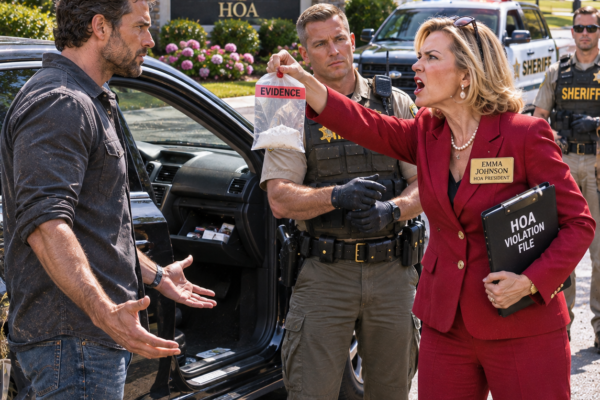
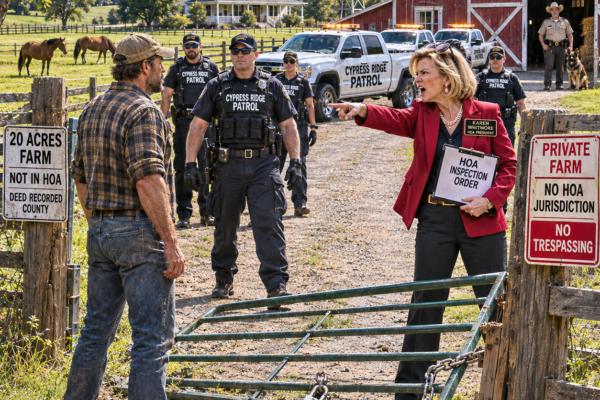
The morning Amber Hartley drove her white SUV past three NO TRESPASSING signs, tore across my north pasture, and announced that my farm would become overflow parking for an HOA trail survey, I thought the worst thing I would have to deal with was another suburban board member who confused a clipboard with a deed. When I told her to turn around, she slapped me hard enough to split the inside of my cheek, crushed a row of young apple trees while leaving, and called 911 screaming that a “violent farmer” had attacked her and was trying to keep her from “public community land.” I could have ended her performance with one sentence the moment the patrol cars arrived, but something about the confidence in her lie told me I needed to hear exactly how far she was willing to take it before she learned who she had chosen to accuse.
My name is Daniel Miller, and my family has worked the same stretch of Rockford County farmland for more than twenty years.
The farm sits beside Heritage Oaks, a subdivision built three years ago where an old hay field used to be. Most of the people there are decent. They wave when I haul feed. They bring their kids to my farm stand in October. They understand that country living comes with tractors, livestock, dust, and the occasional smell no scented candle can defeat.
The HOA board had a harder time accepting that.
Almost from the day Heritage Oaks opened, I received letters proposing “community partnerships.” First they wanted an easement along my eastern fence for a walking trail. Then a picnic area. Then access to an “underused” corner of my orchard.
Every request received the same answer.
No.
My farm was not part of Heritage Oaks. No covenants bound it. No easement gave their residents access. I had no interest in turning working pasture into an amenity for a subdivision.
Amber Hartley seemed personally offended by that.
I had met her once before at my farm stand when she demanded a “community discount” on eggs because, according to her, Heritage Oaks increased my customer base.
I told her the hens had not approved a discount.
She did not appreciate the joke.
That morning, I was repairing storm damage along the north fence when I heard tires grinding over gravel far too fast.
Amber’s SUV blasted past the farm stand, ignored the private-property signs, crossed through an open equipment gate, and stopped so close to me that gravel struck my boots.
She climbed out carrying a coffee and wearing oversized sunglasses.
“You need to move.”
I stared at her.
“Excuse me?”
“My committee is surveying future recreation space. I’m parking back there.”
She pointed toward my pasture.
“No, you’re not.”
Her head tilted.
“I’m the HOA president.”
“And this isn’t HOA property.”
“We’re all part of the same community.”
“Community isn’t ownership.”
Her mouth tightened.
“The board has already discussed a walking trail through this section.”
“Then your board discussed land it doesn’t own.”
I pointed toward her SUV.
“Turn around and leave.”
She laughed.
Then walked past me toward the pasture gate.
I stepped in front of her.
“Amber. Stop. You’re trespassing.”
She stared at me for one long second.
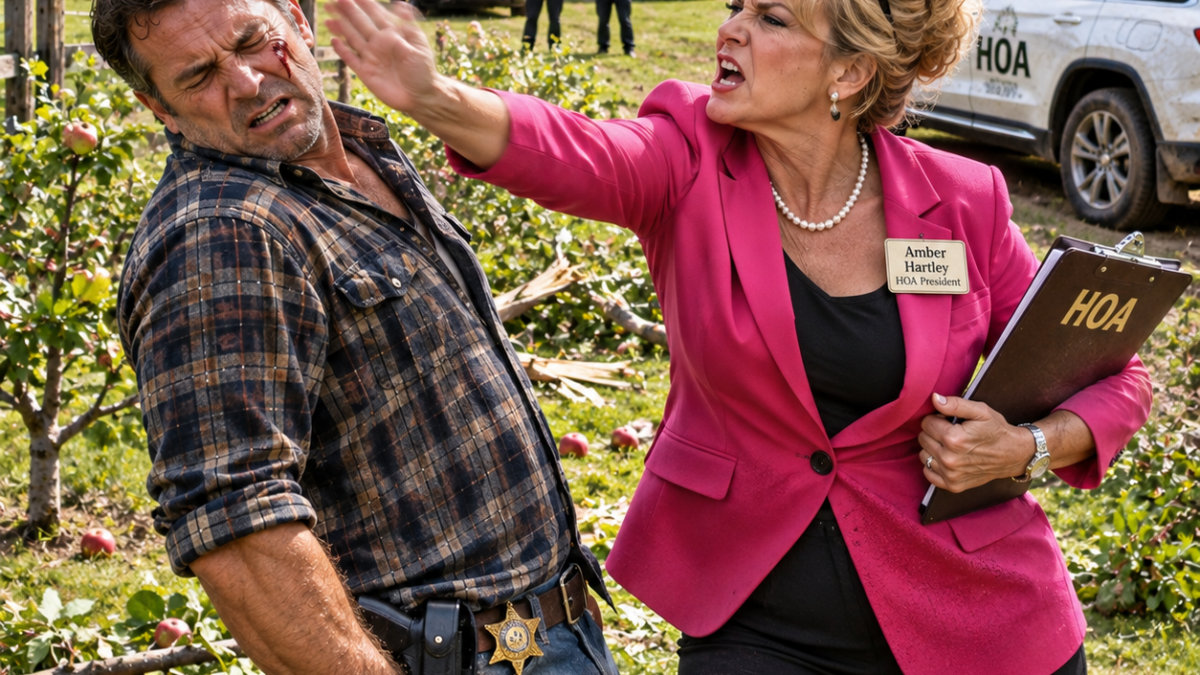
Then her hand flashed across my face.
The crack echoed off the equipment shed.
“You do not tell me what I can do,” she snapped.
I tasted blood.
For a moment, every instinct in me wanted to react.
Instead, I took one step backward.
“Leave the property.”
Her face changed when she realized I was not going to give her the confrontation she wanted.
She rushed back to the SUV, spun the tires, and cut across the pasture instead of returning along the gravel lane.
Three young apple trees disappeared beneath her tires.
The bumper caught the deer fence and bent a steel post sideways.
Then she lifted her phone.
“Help!” she screamed loud enough for me to hear through the open window. “I’m being attacked by a violent farmer. Send the police!”
I stood beside the broken fence with my cheek burning and watched her race toward the front drive.
A few minutes later my radio crackled from inside the tool shed.
“Sheriff,” Deputy Garcia said, sounding confused, “we’ve got a 911 assault call at your farm.”
I picked up the radio.
“White SUV?”
A pause.
“Yes, sir.”
I looked toward the dust hanging over my orchard.
“Send Newman and Riley. Tell them I’m coming up front.”
Garcia lowered his voice.
“Should I tell the caller who owns the farm?”
I wiped the blood from my lip.
“No.”
Ahead of me, I could already hear Amber shouting at the deputies.
I started walking.
“Let her finish the story first.”
PART 2
By the time I reached the front drive, Amber had upgraded me from violent farmer to attempted murderer.
Deputies Newman and Riley stood beside her SUV while she paced between them, waving both hands hard enough to shake the bracelets on her wrists.
“He grabbed me around the throat,” she said. “I could barely breathe.”
Newman saw me approaching over her shoulder.
His expression didn’t change, but his eyes did.
He knew immediately that we were in dangerous territory.
Not because Amber was right.
Because I was the sheriff, I was the alleged attacker, and anything my deputies did from that moment forward could be accused of favoritism if we handled it carelessly.
Riley had the same realization.
Good deputies think about those things before somebody’s attorney forces them to.
Amber pointed toward my farmhouse.
“He chased me. He threatened me. He said nobody would believe me because he’s been around here longer.”
Then she spotted me.
“There!”
She jabbed a finger in my direction.
“That’s him.”
I stopped several yards away.
Newman raised a hand.
“Sir, stay there a moment.”
I did.
Amber practically vibrated with satisfaction.
“See? Finally somebody is controlling him.”
Newman looked at me.
“Name, sir?”
There was a tiny pause.
He was doing it right.
“Daniel Miller.”
Amber cut in.
“Don’t let him charm you. He is dangerous.”
Newman continued.
“Mr. Miller, I’m Deputy Newman with the Rockford County Sheriff’s Office.”
“I know.”
Amber frowned.
Newman ignored her.
“We’re investigating a reported assault. Keep your hands visible and don’t approach Ms. Hartley.”
“Understood.”
Amber’s expression turned triumphant.
She folded her arms and looked at me like she’d finally put the hired help back in its place.
Newman asked:
“Ms. Hartley, you said he grabbed your throat?”
“Yes.”
“With one hand or two?”
“Both.”
“Where?”
She touched the front of her neck.
“Here.”
Riley stepped slightly closer.
“I don’t see visible marks.”
“My skin doesn’t bruise easily.”
“Okay.”
Newman wrote it down.
“You said he chased you?”
“Across the field.”
“What happened before that?”
“I was conducting official HOA business.”
“What business?”
“Land assessment.”
“On this property?”
“Yes.”
Newman looked toward the three signs at the entrance.
PRIVATE PROPERTY.
NO TRESPASSING.
FARM OPERATIONS—AUTHORIZED VEHICLES ONLY.
“Did you have permission from the owner?”
“The HOA has community access.”
“That wasn’t my question.”
Amber’s lips tightened.
“The board has authority over the surrounding area.”
“Do you have an easement?”
She blinked.
“A what?”
“A recorded easement giving Heritage Oaks access to this property.”
“We don’t need one. The farm affects our subdivision.”
Newman glanced at Riley.
Riley’s body camera was recording every word.
I said nothing.
That was harder than it sounds.
When someone lies about you while you’re standing six feet away, every part of you wants to interrupt.
Correct.
Defend.
Expose.
But I’d spent twenty-three years in law enforcement learning that people reveal more when you don’t rescue them from their own story.
Newman continued.
“You also told dispatch Mr. Miller stole your purse.”
Amber hesitated.
“He grabbed for it.”
“Where is it?”
She looked toward the SUV.
“I left it in the car.”
Riley walked to the passenger side.
There was a handbag sitting on the seat.
Undisturbed.
Newman wrote again.
“And you reported that he threatened your dog.”
Amber’s face changed.
Just slightly.
“I was upset.”
“Do you have a dog with you?”
“No.”
“At home?”
“No.”
Riley looked down.
I knew that look.
He was trying very hard not to react.
Newman closed his notebook.
“Ms. Hartley, what exactly did Mr. Miller say to you?”
“He told me to leave.”
“Anything else?”
“He said I was trespassing.”
“Did he threaten physical harm?”
“He was intimidating.”
“Words?”
“He said, ‘Leave the property.’”
“Anything beyond that?”
She huffed.
“You’re missing the point.”
Newman turned toward me.
“Mr. Miller, I need your version.”
Amber threw up her hands.
“Why are you even listening to him?”
Before I could answer, a cruiser rolled up behind us.
Chief Deputy Luis Garcia stepped out.
Amber barely looked at him.
Garcia had been my second-in-command for seven years.
He came toward Newman first, not me.
Newman spoke quietly.
“Chief, we have an alleged assault, property dispute, possible false report, and—”
Garcia looked at my cheek.
“You bleeding?”
“Inside of my lip.”
Amber snapped:
“He attacked me.”
Garcia nodded.
“Understood.”
Then he turned to me.
“Sheriff, because you’re a party to this incident, I’m taking command of the scene.”
“Agreed.”
Amber froze.
Her head moved slowly toward him.
“What did you just call him?”
Nobody answered immediately.
She looked at Newman.
Then Riley.
Then me.
“Sheriff?”
Garcia’s expression stayed flat.
“Sheriff Daniel Miller.”
Amber laughed.
Not because anything was funny.
It was the short, involuntary laugh people make when reality arrives in a shape their brain refuses to accept.
“No.”
Garcia said nothing.
Amber looked at me.
“You’re a sheriff?”
“The sheriff.”
“Of what?”
I almost admired the question.
“Rockford County.”
Her face drained.
Then filled again with color.
“No.”
She backed against the hood of her SUV.
“No, that’s ridiculous. You’re dressed like a farmer.”
“I am a farmer.”
“You can’t be both.”
“Apparently I can.”
“This is a setup.”
“No.”
“You knew I was calling police.”
“You announced it loudly enough for the goats to know.”
Riley looked away.
Amber pointed at the deputies.
“Arrest him anyway.”
Nobody moved.
“He assaulted me!”
Garcia stepped between us.
“Ms. Hartley, Sheriff Miller will not make decisions in this investigation.”
She stared.
“What?”
“I’m taking over. He is the complaining witness.”
“But he’s your boss.”
“Yes.”
“Then you can’t investigate this.”
“That’s a fair concern.”
Garcia looked at me.
“Sheriff?”
“Request an outside investigator from Pine County for the assault allegation and any charge involving me personally. Our deputies can preserve the scene and document the property damage.”
Garcia nodded.
“Already called.”
Amber’s confidence faltered again.
I had deliberately surrendered control over the part of the case where I was the victim.
That wasn’t weakness.
That was how authority was supposed to work.
Amber couldn’t understand that yet.
She lived in a world where power was valuable only if you used all of it.
Garcia looked at her SUV.
“Ms. Hartley, did you drive across the pasture?”
“I was escaping.”
“From what?”
“Him.”
“After he allegedly grabbed you?”
“Yes.”
“Did you strike the trees?”
“I don’t know.”
“Fence?”
“It was already broken.”
I spoke for the first time.
“It wasn’t.”
Garcia turned.
“Sheriff, let us take your statement separately.”
“Understood.”
I walked twenty yards away with Riley.
Amber immediately started talking louder behind me.
“He’s intimidating everybody. You don’t understand what kind of influence he has.”
Riley pulled out a notebook.
“Start from the beginning.”
I did.
The SUV.
The parking demand.
Trail survey.
The argument.
The slap.
The drive through the trees.
The 911 call.
No adjectives.
No speech about HOA tyranny.
Facts.
When I finished, Riley asked:
“Did you touch her at any point?”
“No.”
“Block her vehicle?”
“No.”
“Threaten arrest?”
“No.”
“Display a badge?”
“No.”
“Identify yourself as sheriff?”
“No.”
“Why not?”
“Wasn’t relevant until she called law enforcement.”
Riley nodded.
Then looked toward the equipment shed.
“You still have cameras covering the farm stand?”
“Yes.”
“North lane?”
“Two.”
“Pasture gate?”
“One wildlife camera points roughly that direction.”
His eyebrows lifted.
“Audio?”
“Farm stand camera does.”
“Good.”
I corrected him.
“Potentially useful.”
Old habit.
Evidence isn’t good because it helps you.
It’s good if it’s accurate.
We pulled the footage.
The first camera showed Amber’s SUV passing two PRIVATE PROPERTY signs without slowing.
The second captured her stopping near me.
No clear audio.
The farm stand microphone did better than expected because sound carried through the open lane.
Her voice was faint but recognizable.
**I’m the HOA president.**
Then:
**This area will be perfect.**
Then me:
**You’re trespassing.**
A few seconds later came a sharp sound.
The slap itself was partly blocked by her body, but my head moved sideways immediately.
Then her voice:
**Don’t you dare tell me what to do.**
The pasture camera caught the SUV running over the apple saplings.
The fence bent when her bumper clipped the lower rail.
Garcia watched silently.
Amber’s attorney would later argue about angles, context, and audio quality.
That’s what attorneys do.
But the footage changed the atmosphere immediately.
Pine County Investigator Sarah Whitmore arrived forty minutes later.
She was a sergeant I’d worked with on multi-jurisdiction cases but not someone who reported to me.
Perfect.
Garcia briefed her.
Whitmore interviewed Amber away from all of us.
Then me.
Then Newman and Riley.
Then Hank Delaney, who hadn’t witnessed the slap but had seen Amber’s SUV tearing across the field from his adjoining property.
She inspected the tire tracks.
Photographed the trees.
Looked at the bent fence.
Listened to 911 audio.
That audio was worse for Amber than the cameras.
Her first words to dispatch were:
“He’s attacking me right now.”
At that exact timestamp, the farm camera showed me standing more than eighty feet away while Amber was inside her SUV.
She then claimed I’d taken her purse.
The purse was visible on her passenger seat.
She claimed I’d threatened to kill her dog.
She had no dog.
Whitmore finished shortly after noon.
She walked toward Garcia.
Then toward Amber.
“Ms. Hartley, based on the statements, recordings, video, physical evidence, and your own 911 call, I’m placing you under arrest.”
Amber stared at me.
“You did this.”
I shook my head.
“No.”
“You told her to arrest me.”
Whitmore stepped closer.
“He didn’t.”
“This is political retaliation.”
“I don’t work for him.”
Amber’s eyes widened.
“You people are unbelievable.”
Whitmore said:
“Turn around, please.”
“For what?”
“Criminal trespass, criminal mischief related to property damage, suspected false reporting, and misdemeanor assault. The prosecutor will decide final charges.”
Amber’s mouth opened.
“Assault?”
She looked at me.
“I barely touched him.”
That sentence went straight onto Whitmore’s report.
Sometimes people confess because silence feels unbearable.
The handcuffs clicked.
Amber gasped.
“This is humiliating.”
I said nothing.
There are moments when a clever line feels tempting.
This wasn’t one of them.
Whitmore put her in the Pine County cruiser so none of my deputies had to transport her.
As the car left my driveway, I felt no victory.
Mostly exhaustion.
Then I looked toward the orchard.
Three young apple trees lay broken in the dirt.
That hurt more than the slap.
They weren’t ordinary nursery trees.
They were grafts from an old Winesap my father had planted the year I bought the farm.
Dad died eight years earlier.
The original tree was declining from age and a lightning scar, so I’d spent several seasons grafting healthy cuttings onto young rootstock.
Five survived.
Amber had crushed three.
I knelt beside the closest one.
The trunk had split low.
No saving it.
Garcia came over.
“I didn’t know those were from your dad’s tree.”
“Yeah.”
“I’m sorry.”
I touched one broken branch.
“She didn’t know either.”
Garcia looked toward the road where the cruiser had disappeared.
“Does that matter?”
“For the damage?”
“No.”
“For how angry I should let myself get?”
I stood.
“Maybe.”
I had to remember that.
Intent mattered in criminal law.
But it mattered in life too.
Amber hadn’t targeted my father’s trees because they belonged to him.
She had destroyed them because she didn’t care enough to know what she was driving over.
Somehow that was its own kind of insult.
Hank Delaney rolled up in his battered Ford fifteen minutes later.
He leaned out his window.
“Heard a woman yelling like somebody put a raccoon in a church piano.”
“Accurate.”
He looked at my cheek.
“What happened?”
“HOA president slapped me, ran over Dad’s grafts, hit the fence, then called 911 on me.”
Hank stared.
“She called the cops on you?”
“Yes.”
“Did she know?”
“No.”
His face slowly transformed.
Then he laughed so hard he had to put the truck in park.
I waited.
He wiped his eyes.
“Oh, Lord.”
“You done?”
“No.”
He laughed again.
“She called the sheriff’s office on the sheriff.”
“Yes.”
“On his own farm.”
“Yes.”
“Because he wouldn’t let her park there.”
“Finished?”
“Probably not.”
I walked toward the fence.
Hank got out, still chuckling.
Then he saw the trees.
The laughter stopped.
“Those the Miller grafts?”
“Three of them.”
His face hardened.
“Damn.”
Hank had known my father.
They’d served in the Army around the same time, though different units, and spent thirty years arguing about tractors.
He knelt beside the broken trees.
“Any chance?”
“This one’s gone. That one’s gone. Third might push something above the graft, but I doubt it.”
“You got scion wood left?”
“Some.”
“Then we make more.”
Simple.
That’s how farm people talk about grief.
Not because they feel less.
Because something always needs doing.
We spent the afternoon repairing the fence.
I took myself off duty for the remainder of the day.
Garcia became acting sheriff for anything related to Amber’s case.
Before leaving, he told me:
“The HOA has called twice.”
“Already?”
“Vice chair says arresting their president is interfering with community governance.”
“Who?”
“Howard Brantley.”
I knew the name from the letters.
“Tell him he can talk to Whitmore or the special prosecutor once one is assigned.”
“He wants to talk to you.”
“No.”
Garcia nodded.
“Good answer.”
I drove the final staple into the fence post harder than necessary.
Hank noticed.
“Careful.”
“I’m fine.”
“No, you ain’t.”
I looked at him.
He pointed toward the orchard.
“That’s what you’re mad about.”
“Yes.”
“Then be mad.”
“Helpful.”
“I’m seventy-four. I don’t have enough years left for subtle advice.”
I laughed despite myself.
He picked up another staple.
“Your daddy would’ve been furious.”
“I know.”
“He also would’ve told you to graft another tree.”
“I know.”
“Annoying man.”
“Very.”
We worked until sunset.
That night I sat in the kitchen with an ice pack against my cheek and all the old HOA letters spread across the table.
I hadn’t looked at them in months.
The earliest ones were almost friendly.
**Heritage Oaks Community Partnership Opportunity.**
They proposed an easement along the eastern pasture.
I declined.
Next:
**Shared Recreational Corridor Proposal.**
Declined.
Then:
**Community Greenway Concept.**
Declined.
The language changed over time.
“Partnership” became “access discussion.”
“Request” became “community need.”
The most recent letter, six months old, bothered me now.
It included a rough concept drawing.
A dotted green trail ran directly through my north pasture.
Not beside it.
Through it.
At the bottom:
**Phase II access subject to final coordination.**
Final coordination with whom?
Certainly not me.
I called Garcia.
“You still at the office?”
“Unfortunately.”
“I found something.”
I explained.
“Send it to Whitmore.”
“I will.”
“Daniel.”
“What?”
“You are not investigating this.”
“I know.”
“You sound like you’re investigating this.”
“I am sitting at my kitchen table.”
“With documents arranged chronologically.”
I looked down.
He knew me too well.
“Fine.”
“Scan them. Send them. Then stop.”
“Yes, Chief.”
“That’s acting sheriff to you.”
I hung up.
The next morning, the Heritage Oaks Facebook page had exploded.
I didn’t have an account, but one of my dispatchers sent Garcia screenshots, and Garcia forwarded only what the investigator considered relevant.
Amber’s supporters claimed she had been “arrested by a hostile sheriff in a land dispute.”
Some claimed I had used deputies to settle a personal argument.
Howard Brantley posted:
**President Hartley was engaged in authorized HOA planning activity when an unfortunate misunderstanding occurred with an adjacent property owner. We are reviewing the sheriff’s conduct.**
Adjacent property owner.
Not sheriff.
Interesting choice.
Garcia called.
“Do not respond.”
“I wasn’t going to.”
“I know you.”
“Apparently everybody says that now.”
“The county attorney wants a special prosecutor from Pine County because you’re a victim and elected sheriff.”
“Good.”
“And state professional standards may review our response.”
“Also good.”
“You mean that?”
“Yes.”
He paused.
“I figured.”
An outside review was exactly what I wanted.
If my office had done anything wrong, I needed to know.
If we hadn’t, Amber couldn’t later claim I had hidden behind my badge.
By noon, Pine County Prosecutor Ellen Price accepted the case.
She called me personally.
“Sheriff Miller.”
“Daniel is fine.”
“Daniel, from this point forward I want no communication with Ms. Hartley, her attorney, or Heritage Oaks about the criminal case.”
“Agreed.”
“You’re a witness.”
“I know.”
“You won’t review investigative reports unless disclosed through the ordinary process.”
“Understood.”
“You won’t direct your deputies’ testimony.”
“Obviously.”
“I have to say it.”
“Then say it.”
She paused.
“You’re taking this better than most law enforcement victims do.”
“I’m trying not to become Exhibit A for the defense.”
That made her laugh.
“Good. We’ll get along.”
Amber was released after processing and an initial appearance.
No dramatic overnight jail sentence.
No instant guilty plea.
She was given conditions.
Stay off my property.
No direct contact with me.
Return for court.
Her attorney issued a statement saying she had been “confused about the precise limits of community access” and had “reacted emotionally after feeling physically threatened.”
That phrase bothered me.
Physically threatened.
The videos showed I never touched her.
But attorneys are allowed to advocate.
I reminded myself of that often over the next several months.
The first real surprise came from inside Heritage Oaks.
A woman named Linda Carver called my personal number.
I didn’t recognize it.
“This is Daniel.”
“Sheriff Miller?”
“Yes.”
“My name is Linda Carver. I live in Heritage Oaks.”
“All right.”
“I need to talk to somebody about Amber.”
“About the criminal case?”
“About the trail.”
That changed things.
“I can’t investigate it.”
“I know. Chief Garcia gave me Sergeant Whitmore’s number. I already called her.”
“Good.”
“But I thought you should know what your neighbors were told.”
I waited.
Linda continued.
“Amber told us the county had agreed your farm would eventually be incorporated into a regional greenway.”
I stood up from my kitchen chair.
“She said what?”
“She said negotiations were basically complete.”
“When?”
“At the annual meeting last fall.”
I remembered the letter from six months earlier.
“Was that recorded?”
“Our meetings are.”
“Preserve it. Give it to Whitmore.”
“I did.”
She hesitated.
“Sheriff?”
“Yes?”
“I’m sorry.”
“For what?”
“I voted for the trail plan.”
“You thought I agreed?”
“Yes.”
“Then you didn’t do anything to me.”
“We should’ve checked.”
“That would have helped.”
She gave a tired little laugh.
“Yes.”
Over the following week, more residents came forward.
Not because I asked them to.
Because once Amber’s arrest became public, people started comparing what they had been told.
Heritage Oaks had approved a preliminary recreation plan.
A walking loop.
A small picnic area.
A scenic overlook.
The plan assumed access through roughly eleven acres of my north pasture.
The board minutes did not say they owned the land.
They used phrases like:
**anticipated community access**
and
**future corridor coordination**
and
**pending integration**
Corporate language has a strange ability to make theft sound like scheduling.
Howard Brantley had been present at every meeting.
So had Amber.
One board member, Melissa Grant, had asked whether I had signed an easement.
According to the minutes, Amber replied:
**Mr. Miller’s objections are informal and are being addressed at the county level.**
That was false.
There had been no county-level negotiation.
None.
The most interesting document appeared two days later.
A contractor estimate.
**Heritage Oaks Phase II Trail Clearing.**
It included gravel installation, brush removal, benches, and signage.
Location:
**Miller North Meadow Connector.**
My name was literally in the project title.
The estimate was dated three months before Amber drove onto my land.
Attached was an email from Amber:
**We expect to resolve the owner issue. Please price as though access is secured.**
That didn’t prove she intended to commit a crime.
It proved she knew there was an owner issue.
Meaning her claim that she believed the land was already community property became harder to sustain.
Whitmore forwarded the documents to the prosecutor.
I learned about them only when they became part of discovery.
Meanwhile, Heritage Oaks went into civil war.
Howard publicly defended Amber.
Melissa demanded an independent legal review.
Three homeowners wanted her removed immediately.
Others claimed everyone was overreacting.
One elderly man wrote a letter to the local newspaper saying:
**We hired an HOA to mow entrances and manage drainage, not annex neighboring farms.**
I liked him without knowing him.
Then the state review began.
Two investigators from the state law-enforcement standards unit came to my office.
I gave them my radio logs.
Dispatch records.
Body-camera access.
Farm footage.
My own written statement.
They interviewed Newman.
Riley.
Garcia.
Whitmore.
I didn’t ask anyone how it was going.
That was torture.
Sheriffs are terrible at not knowing things.
Three weeks later, the preliminary finding came back.
No evidence that I directed my deputies to arrest Amber.
No evidence I used my office to influence the charging decision.
The report specifically noted that Garcia assumed scene command and Pine County independently handled the arrest decision.
I read that paragraph twice.
Not because I doubted my choices.
Because reputation matters when you wear a badge.
One bad decision can stain twenty years of good ones.
I framed nothing.
I put the report in a drawer.
Then went outside and pruned apple trees.
The two surviving Miller grafts had new growth.
The third crushed one was finished.
I cut the dead trunk back and stood holding a piece of wood that had once been part of my father’s tree.
Memories are strange things.
Dad never cared about fancy apples.
He planted that old Winesap because a nursery had marked it down.
He’d probably have laughed at me turning its descendants into sacred objects.
But losing people changes what ordinary things become.
I saved a small section of the broken trunk.
Hank found me in the shed sanding it smooth.
“What are you making?”
“Don’t know.”
“Then you’re doing a bad job.”
“Go home.”
He picked up the piece.
“Knife handle?”
“Maybe.”
“Your dad would approve.”
“Dad carried the same pocketknife for forty years.”
“Exactly. He’d tell you to quit being sentimental and make something useful.”
I smiled.
“Knife handle it is.”
The criminal case reached a preliminary hearing six weeks after the incident.
I wore a suit.
Not uniform.
That mattered to me.
I wasn’t there as sheriff.
I was there as Daniel Miller, property owner and complaining witness.
Amber arrived with a private attorney named Charles Weller.
Her pink blazer was gone.
She wore navy.
Howard and several Heritage Oaks board members sat behind her.
Melissa sat on the opposite side of the courtroom.
That told me a lot.
Prosecutor Price called Whitmore first.
Then Riley.
Then me.
Price asked:
“What were you doing when Ms. Hartley arrived?”
“Repairing a fence.”
“Did you authorize Heritage Oaks to enter your north pasture?”
“No.”
“Any recorded easement?”
“No.”
“Any verbal permission?”
“No.”
“Did you identify yourself as sheriff before the physical altercation?”
“No.”
“Why not?”
“It wasn’t relevant. I was a property owner asking someone to leave.”
“Did you touch Ms. Hartley?”
“No.”
“Threaten her?”
“No.”
“Block her SUV?”
“No.”
She played the farm audio.
My voice:
**You’re trespassing.**
Then the slap.
Amber:
**Don’t you dare tell me what to do.**
Price paused the recording.
“What happened after that?”
“I told her to leave.”
“What did she do?”
“Drove across the pasture, damaged trees and fencing, and called 911.”
Weller stood for cross-examination.
“Sheriff Miller, you are the highest-ranking law-enforcement officer in Rockford County.”
“Elected sheriff, yes.”
“Your deputies work for you.”
“They work for the county under my administration.”
“You can discipline them.”
“Yes.”
“Promote them.”
“Within policy and law, yes.”
“So when you stood in your driveway claiming my client assaulted you, your deputies knew their boss expected a result.”
“I made no such expectation known.”
“Did you need to?”
Price objected.
“Sustained.”
Weller changed direction.
“You were angry.”
“Yes.”
That surprised him.
“You admit that?”
“Of course.”
“My client struck you.”
“Yes.”
“And you were angry.”
“Yes.”
“You wanted her punished.”
“I wanted the incident documented and handled lawfully.”
“That’s not what I asked.”
I thought.
“Part of me wanted consequences.”
There was a slight shift in the courtroom.
Weller smiled.
“Thank you.”
Then I continued.
“Which is why I removed myself from deciding what those consequences should be.”
His smile faded.
He looked down.
“You instructed your chief deputy to call an outside agency.”
“Yes.”
“You selected Sergeant Whitmore.”
“No.”
“Who did?”
“Chief Garcia contacted Pine County duty command. They assigned her.”
“You knew her.”
“Yes.”
“You’ve worked cases together.”
“Yes.”
“So she was hardly independent.”
“Law-enforcement agencies in neighboring counties routinely work together. I didn’t request her by name.”
Weller moved on.
“Did you tell Ms. Hartley she was trespassing?”
“Yes.”
“Did you stand in her path?”
“I stepped between her and a pasture gate.”
“So you blocked her.”
“From walking farther onto private land after I told her to leave.”
“Could she have perceived that as threatening?”
“She can testify to what she perceived.”
Smart answer.
Price had drilled that into me.
Don’t read other people’s minds.
Weller showed a photograph of the pasture.
“You call this active farmland?”
“Yes.”
“It’s grass.”
“Pasture is often grass.”
A few people smiled.
He tried again.
“No crops are visible.”
“Livestock rotate through that field.”
“On the morning in question?”
“Not in that section.”
“So the area was empty.”
“No.”
“What occupied it?”
I looked at him.
“My land.”
Silence.
He moved on.
The judge found sufficient evidence for the case to proceed.
No dramatic conviction.
No gavel of doom.
Just another court date.
Outside, Howard Brantley approached me.
“Sheriff.”
“Mr. Brantley.”
“You’re destroying Heritage Oaks.”
“I haven’t done anything to Heritage Oaks.”
“Our president is facing criminal charges.”
“Because of what happened on my farm.”
“You could drop this.”
“No.”
“It’s a minor neighbor dispute.”
I stared at him.
“She struck me, damaged property, and made a false emergency report.”
“She was under stress.”
“So am I sometimes.”
“She made a mistake.”
“Then the court can decide what that mistake requires.”
Howard stepped closer.
“People make accommodations for neighbors.”
“Do they?”
“Yes.”
“Good.”
I nodded toward Heritage Oaks.
“Then accommodate my property line.”
His face tightened.
“You know we’re trying to build something good.”
“A trail.”
“A community.”
“Build it on land you own.”
He walked away.
Melissa Grant had heard everything.
She approached after Howard left.
“I’m sorry.”
“You don’t owe me his apology.”
“I owe you mine.”
She handed me a folder.
“What is this?”
“Board emails.”
I didn’t take it.
“If these are relevant to the criminal case, give them to Sergeant Whitmore or the prosecutor.”
“I already made copies for them.”
“Then why give me one?”
“Because some of them are about you.”
I still didn’t take it.
“I’ll see them through discovery if I’m entitled.”
Melissa looked at me for a moment.
Then smiled faintly.
“You really are making this difficult for people who want to call you corrupt.”
“Occupational habit.”
She left with the folder.
That afternoon Price called.
“Thank you.”
“For?”
“Not taking the emails.”
“Were you testing me?”
“No.”
“You sound disappointed.”
“I would’ve yelled at you.”
“I know.”
The emails deepened the HOA problem.
Amber had repeatedly pushed for access to my farm.
Howard encouraged her.
Not criminally, at least not based on what I saw later.
But recklessly.
One message from Howard read:
**Eventually Miller will realize holding out hurts his relationship with 146 voting households.**
Amber replied:
**Pressure works when politeness doesn’t.**
Another:
**Once people are using the trail, he’ll never have the nerve to shut it down.**
That one stayed with me.
Not because it proved the criminal charges.
Because it explained the strategy.
Create a fact on the ground.
Let residents start using it.
Then make me the villain if I tried to stop them.
Amber hadn’t arrived at my farm simply looking for parking.
She was trying to begin the process of treating my land as though permission had already been granted.
The SUV was only the first tire track.
The HOA board hired independent counsel.
That lawyer gave them advice they should have gotten before designing a trail through someone else’s property.
My farm was outside Heritage Oaks.
The HOA possessed no authority over it.
No easement.
No access rights.
No pending annexation.
No “one-mile jurisdiction.”
That last phrase apparently came from something Howard had heard at a planning seminar and misunderstood so completely it became neighborhood mythology.
At the next board meeting, more than a hundred homeowners showed up.
I didn’t.
Hank went.
I asked why.
“Entertainment.”
He returned with a printed agenda and enough satisfaction to power a small city.
“What happened?”
“Howard got yelled at for two hours.”
“Anything useful?”
“Melissa moved to suspend all trail planning involving your property.”
“And?”
“Passed.”
“Good.”
“Then a lady named Janine asked why the HOA spent twelve thousand dollars on preliminary design work for land it didn’t own.”
I stopped.
“Twelve thousand?”
Hank grinned.
“Didn’t know that?”
“No.”
“Howard did.”
Heritage Oaks residents were paying the price for their board’s assumptions.
That shifted the entire fight.
It was no longer Amber versus me.
It was homeowners asking why their dues had funded a fantasy.
The board scheduled a recall vote.
Amber’s attorney urged her not to speak publicly.
She ignored him.
She posted a twelve-minute video from her living room.
I watched only because Price sent it to me as potential evidence.
Amber said I had “weaponized my office.”
She claimed farm boundaries were “historically disputed.”
They weren’t.
She said Heritage Oaks had always understood the north meadow to be “shared rural greenspace.”
It hadn’t.
Then she said:
“Sheriff Miller is using technical ownership claims to deny hundreds of families access to land that enhances our quality of life.”
Technical ownership claims.
I paused the video.
My deed was now a technicality.
I closed the laptop.
That phrase made something in me go very still.
My father used to say the quickest way to recognize a thief was when he started explaining why ownership was unfair.
Amber didn’t think of herself as a thief.
That was the problem.
She thought wanting something for the community made taking it noble.
The recall vote happened the following week.
Amber lost by almost the same percentage she’d once bragged elected her.
Howard lost his vice-chair seat too.
Melissa became interim president.
Her first public statement was four sentences.
**Heritage Oaks recognizes that its authority ends at the boundaries established in its governing documents and recorded property records. The association has no ownership interest or access right in the Miller farm. All plans involving that property are canceled. The board apologizes to Mr. Miller and to homeowners whose dues were spent pursuing unauthorized concepts. We will review safeguards to prevent this from happening again.**
I printed that one.
Not as a trophy.
As evidence that an HOA statement could fit on one page when nobody was trying to hide anything.
Amber’s criminal case continued.
So did my property claim.
The apple trees weren’t worth a fortune on paper.
That frustrated me.
Courts value things in dollars.
Sentimental value is harder.
A horticultural appraiser calculated replacement costs, years of lost growth, fence repair, soil restoration, and labor.
The number mattered.
But not as much as the fact that the three trees came from Dad’s original Winesap.
A prosecutor can’t put a price on that.
Neither could I.
Hank and I grafted six new rootstocks in late winter.
He held a branch while I cut the scion.
“Your hands shaking.”
“Cold.”
“Liar.”
I looked at him.
He nodded toward the original tree.
“You worried these won’t take?”
“Yes.”
“Some won’t.”
“Helpful again.”
“That’s farming.”
We grafted all six.
Then waited.
The first bud broke in April.
I stood in the orchard staring at a piece of green smaller than my thumbnail.
Hank came up behind me.
“See?”
“One.”
“That’s enough to start.”
It was.
Around that same time, Amber’s attorney approached Price about a plea.
I learned only after the terms were substantially negotiated.
The proposed resolution required Amber to plead guilty to misdemeanor assault, criminal trespass, criminal mischief, and false reporting.
Full restitution.
Probation.
Community service.
Conflict-management counseling.
No contact with me beyond legal processes.
And because some of her conduct arose from abusing an HOA role, the parties proposed a probation condition prohibiting her from serving as an HOA officer or enforcement representative for two years.
Price called.
“You’re entitled to give input.”
“Not control.”
“Correct.”
“What are you asking?”
“Whether you oppose the plea.”
I sat on the porch.
The new grafts were visible across the yard.
“Does she admit the false report?”
“Yes.”
“Property damage?”
“Yes.”
“Assault?”
“Yes.”
“Restitution?”
“Yes.”
“Then no.”
“You don’t want jail?”
“What would jail accomplish here?”
Price was quiet.
“Some victims want it.”
“I wanted it the morning she killed Dad’s trees.”
“And now?”
“I want the record to say what happened.”
“It will.”
“I want the HOA-role condition.”
“We have it.”
“And I want her nowhere near the farm.”
“Also covered.”
“Then I’m fine with the plea.”
Price asked:
“You forgive her?”
“No.”
“Good distinction.”
The plea hearing was three months after the incident.
Judge Miriam Hargreaves presided.
She had a reputation for asking short questions nobody wanted to answer.
Amber stood beside Weller.
No pink blazer.
No sunglasses.
She looked tired.
Judge Hargreaves reviewed each count carefully.
“Ms. Hartley, did you knowingly enter property belonging to Mr. Miller after being told you did not have permission?”
Amber swallowed.
“Yes.”
“Did you strike him?”
“Yes.”
“Did you drive your vehicle across the property and cause damage?”
“Yes.”
“Did you report to 911 that Mr. Miller was attacking you at a time when the evidence shows he was not?”
A long pause.
Weller leaned toward her.
Amber whispered:
“Yes.”
The judge looked over her glasses.
“Louder.”
“Yes, Your Honor.”
“Why?”
Amber’s face tightened.
“I was angry.”
“That’s an emotion.”
“Yes.”
“I asked why you falsely reported an active assault.”
Amber looked toward me.
Then away.
“I wanted the officers to make him leave.”
“His own property.”
“Yes.”
The courtroom went silent.
Judge Hargreaves continued.
“Why did you believe you had a right to be there?”
Amber breathed in.
“The HOA wanted a trail.”
“Again, not my question.”
Amber closed her eyes briefly.
“Because I thought what we wanted mattered more.”
There it was.
No speech.
No grand confession.
One sentence.
Honest enough to hurt.
Judge Hargreaves leaned back.
“You were elected to administer a private association. You were not elected mayor, county commissioner, police chief, land-use authority, or monarch.”
A few people shifted.
Hargreaves didn’t smile.
“Private governance becomes dangerous when people confuse contractual authority with general government power.”
She looked at Amber.
“You crossed that line physically, legally, and apparently psychologically.”
Amber’s eyes watered.
“I understand.”
“I hope you do.”
Price described the plea agreement.
Weller described Amber’s lack of prior criminal convictions, cooperation after the initial incident, loss of her HOA position, and willingness to pay restitution.
Then the judge asked whether I wanted to speak.
I stood.
“My name is Daniel Miller.”
Not sheriff.
Daniel Miller.
“Amber damaged my fence and trees. Those can be repaired.”
I paused.
“She also made a false emergency call that sent armed deputies into a situation based on information she knew was false.”
Amber looked down.
“That matters beyond me.”
I glanced toward Newman and Riley sitting in the back.
“They had to arrive not knowing whether the person they were about to confront was violent. False reports don’t just endanger the person being accused. They put officers in bad positions too.”
I looked at the judge.
“I don’t want Ms. Hartley’s life destroyed.”
Amber’s head lifted.
“I want her to understand that authority has edges. My badge has edges. Her HOA office had edges. My property has edges. Ignoring them is what brought us here.”
I sat.
Hargreaves imposed the negotiated sentence with some modifications.
Probation.
Full restitution.
A substantial fine on the false-report count.
Community service.
Conflict-management and decision-making counseling.
No contact.
Two years barred by probation conditions from serving in an HOA enforcement or leadership position.
The judge also warned her:
“If you violate these conditions, the court has options less comfortable than community service.”
Amber nodded.
Afterward, the hallway filled with Heritage Oaks residents.
I tried to leave quietly.
Amber called my name.
“Sheriff.”
I stopped.
Weller was beside her.
So was Price.
Safe.
Appropriate.
Amber held something small.
A gold-colored pin.
HERITAGE OAKS PRESIDENT.
The same kind I’d found near my porch after the incident.
“I had two,” she said.
I waited.
“I used to wear this to every meeting.”
“Okay.”
She looked embarrassed.
“I thought it meant something bigger than it did.”
I said:
“It meant what it was supposed to mean.”
“What?”
“That your neighbors trusted you to handle certain things.”
She stared at the pin.
“I ruined that.”
“Yes.”
She looked surprised by my answer.
I wasn’t going to comfort her out of responsibility.
Then she said:
“I’m sorry about the trees.”
That caught me.
Not the slap.
Not the arrest.
The trees.
“How did you know?”
“Melissa told me what they were.”
I looked away.
“My father planted the original.”
“I know.”
Silence.
“I can’t replace that.”
“No.”
“I can pay restitution.”
“Yes.”
“It doesn’t feel like enough.”
“It isn’t.”
Her eyes filled.
Again, I didn’t rescue her.
Some guilt is supposed to be uncomfortable.
Finally I said:
“But you can stop making more damage.”
She nodded.
Then handed the pin to Weller instead of me.
Good.
I didn’t want it.
I drove home.
The goats didn’t care about justice.
They cared that I was late with feed.
The tractor wouldn’t start because a battery terminal had corroded.
One irrigation valve was leaking.
Real life welcomed me back immediately.
I was grateful.
That evening I walked to the orchard.
Five of the six new grafts were showing buds.
Better odds than Hank predicted.
I called him.
“Five.”
“Told you.”
“You said some wouldn’t make it.”
“One didn’t.”
“That isn’t the same thing.”
“At my age I don’t have to be precise.”
I laughed.
Then sat beneath Dad’s original tree.
The bark was rough against my back.
For the first time since Amber’s SUV crossed the pasture, I felt the incident shrinking to its proper size.
Not forgotten.
Not meaningless.
Just no longer larger than everything else.
The next chapter surprised me.
Heritage Oaks asked for a meeting.
Melissa came with four board members and the association’s attorney.
We met at my farm stand.
No conference room.
No polished table.
Wood benches and the smell of straw.
Melissa began.
“We’re not asking for land.”
“Good start.”
Howard wasn’t there.
Also a good start.
She unfolded a county map.
“We’re redesigning the trail entirely within Heritage Oaks.”
I looked.
The proposed loop stayed on their side of the property line.
“Looks reasonable.”
“We have one issue.”
I raised an eyebrow.
“Parking.”
I laughed.
Melissa did too.
“Yeah. We know.”
“What about it?”
“Our current visitor lot is too small. We originally assumed people could use the shoulder near your farm stand.”
“Why?”
She looked embarrassed.
“Amber.”
“Of course.”
“We’ve arranged weekend overflow parking with Pine Grove Church instead.”
“Three quarters of a mile away.”
“We’ll run a shuttle for events.”
I nodded.
“Sounds like a solution.”
One board member, a man named Yusuf Patel, said:
“We wanted you to know before construction begins. Survey flags will be near your eastern fence, but not on your property.”
“Thank you.”
“Would you mind walking the line with our surveyor once?”
Their attorney looked nervous.
I smiled.
“That’s a request.”
“Yes.”
“Then yes.”
It was such a small exchange.
But it mattered.
Permission had entered the vocabulary.
The next month, I walked the boundary with their surveyor.
Melissa came too.
Amber did not.
The new trail curved away from my pasture and into a wooded common area Heritage Oaks actually owned.
At one point the surveyor drove a stake beside my fence.
Melissa asked:
“That’s definitely our side?”
He checked.
“Yes.”
She looked at me.
“Good?”
“Good.”
That was how it should have happened from the beginning.
Ask.
Verify.
Respect the answer.
The trail opened in October.
Heritage Oaks invited me.
I almost declined.
Hank said:
“You’re going.”
“Why?”
“Free pie.”
“You don’t even live there.”
“Neither do you.”
Fair.
We went.
Kids rode bicycles.
Families walked dogs.
Nobody crossed my fence.
A small sign at the trail’s western edge read:
**PRIVATE WORKING FARM BEYOND THIS POINT — PLEASE RESPECT PROPERTY BOUNDARY**
I didn’t request it.
Melissa added it.
Hank stood reading it.
“Think Amber would’ve liked that?”
“No.”
“Then I love it.”
“Behave.”
He took two pieces of pie.
Amber’s absence was obvious without anyone mentioning her.
Some residents apologized.
Others avoided me.
A few had defended her until the end and clearly still believed I’d overreacted.
That was fine.
Justice does not require unanimous applause.
Six months later, restitution arrived.
Part of it covered the fence.
Part covered the trees and labor.
I used the tree money for something different.
I bought twenty young apple rootstocks.
More than I needed.
Hank saw them stacked beside the shed.
“What are you doing?”
“Expanding.”
“Your orchard?”
“Maybe.”
We grafted half with Dad’s Winesap.
The rest with varieties I’d been developing.
Then I called Melissa.
“I’ve got ten extra trees if Heritage Oaks wants them.”
Silence.
“Are you serious?”
“Yes.”
“For the trail?”
“If you have space.”
“Why?”
I looked at the little trees.
“Because I’d rather your residents learn where apples come from than keep believing farms are unused grass.”
She laughed.
Then became quiet.
“I’d like that.”
The HOA bought protective cages.
I didn’t donate those.
I’m generous, not stupid.
A group of Heritage Oaks kids came to help plant.
I showed them how to spread roots.
How deep to dig.
Why you don’t bury the graft union.
One little boy asked:
“Why do you cut one tree and put it on another tree?”
“Because the top gives you the fruit you want and the roots give you strength.”
He considered that.
“So it’s two trees?”
“Sort of.”
“Does it hurt?”
Good question.
“For a while.”
“Then?”
“If it takes, they heal together.”
Hank looked at me.
I knew what he was thinking.
“Don’t say it.”
“I didn’t.”
“You were going to turn that into a life lesson.”
“I’m old. That’s my job.”
The Heritage Oaks orchard strip became unexpectedly popular.
No trail entered my farm.
No shared garden.
No easement.
Just ten trees planted on their land because we agreed to it.
That difference mattered more than the trees themselves.
Amber completed community service through a county-approved conservation program.
I knew because Price mentioned her compliance during a routine probation update.
I didn’t ask where.
Then one Saturday nearly a year after the arrest, I saw her.
I was delivering produce to the county food pantry.
Amber was in the rear lot wearing work gloves and loading boxes.
No blazer.
No pin.
No sunglasses.
She saw me.
Stopped.
For a second, both of us considered pretending we hadn’t.
Then she approached.
“Sheriff.”
“Amber.”
She held her hands together.
“I won’t keep you.”
“Okay.”
“I wanted you to know I finished the conflict course.”
I didn’t know what to say.
“Congratulations?”
She almost smiled.
“Fair.”
She looked toward my truck.
“Apples?”
“Mostly.”
“From the trees?”
“Some.”
Her expression changed.
“Did the grafts survive?”
“Five of six new ones.”
“I’m glad.”
I believed her.
That surprised me.
Amber looked down.
“Community service put me with the county conservation crew.”
“Good.”
“They made me remove invasive brush on public land.”
I waited.
She laughed softly.
“Actual public land.”
I smiled despite myself.
“Useful distinction.”
“Yes.”
She took a breath.
“I thought about that every day.”
“What?”
“How many times I used the word community like it meant ownership.”
I leaned against the truck.
“Why did you?”
She considered the question seriously.
“Because people listened to me.”
Not greed.
Not insanity.
Not some movie-villain answer.
People listened.
She continued.
“I became president because nobody else wanted it. The first year, everyone thanked me for fixing things. Parking. Trash cans. A contractor dispute.”
She looked toward the food pantry doors.
“Then somebody complained about a fence, so I handled it. Then another person wanted a dog restricted, so I handled that. Every time I pushed, people let me.”
Her mouth tightened.
“Eventually I stopped noticing the difference between being asked to solve a problem and having the right to decide everything.”
That matched what residents had told me.
“What about my farm?”
“I knew you said no.”
Important.
No excuse.
“I told myself you were being selfish.”
I said nothing.
“I thought one landowner shouldn’t be able to block something hundreds of people wanted.”
“But?”
“But it was yours.”
She looked at me.
“It didn’t matter whether I thought your decision was selfish.”
That was the lesson.
Not that my decision had been noble.
Not that every landowner is automatically reasonable.
That consent doesn’t disappear because a committee dislikes the answer.
Amber continued.
“The morning I came there, I thought if I drove in and started the survey, you’d give up.”
I remembered Howard’s email.
Once people are using the trail, he’ll never have the nerve to shut it down.
“So it was deliberate.”
“Yes.”
“Parking wasn’t the real reason.”
“No.”
“What was?”
“To establish access.”
The words still made me angry.
Even a year later.
Amber saw it.
“I know.”
“You were trying to create a situation where I’d look unreasonable for stopping you.”
“Yes.”
“And when I didn’t cooperate?”
“I got angry.”
“You slapped me.”
“Yes.”
“Then lied to 911.”
Her face tightened.
“Yes.”
“Why?”
“I panicked.”
“That isn’t enough.”
“I know.”
She swallowed.
“I wanted to be the victim before you could tell anyone what I’d done.”
That was probably the most honest thing she ever said to me.
I looked at her.
“Thank you.”
She seemed confused.
“For what?”
“For saying that without turning it into my fault.”
Amber nodded.
Then stepped away.
“I should get back.”
“Amber.”
She stopped.
“You’re doing better?”
She thought.
“I’m quieter.”
That was not the answer I expected.
“What does that mean?”
“I ask more questions before I decide I’m right.”
“Sounds exhausting.”
She laughed.
“It is.”
Then went back inside.
I loaded the empty produce crates into my truck and drove home.
I didn’t forgive her that day.
Forgiveness wasn’t a switch.
But something loosened.
Maybe because accountability is easier to believe when it costs the person saying it something.
Two years passed.
My term as sheriff neared its end.
I had been doing the job long enough.
Twenty-three years in law enforcement.
Twelve as sheriff.
I wanted mornings where my radio didn’t decide whether breakfast got cold.
Garcia ran for the office.
I endorsed him only after making him promise never to call me before seven unless somebody was actively on fire.
He won.
On my last day, the staff held a retirement gathering.
Hank came wearing a bolo tie he’d apparently owned since the Nixon administration.
Melissa came from Heritage Oaks.
Even Judge Hargreaves stopped by long enough to tell me retirement would “reduce the county’s sarcasm problem by at least twenty percent.”
Garcia gave me a framed photograph.
Not of the sheriff’s office.
My farm.
Taken from the county road at sunset.
Under it, a small brass plate:
**AUTHORITY ENDS SOMEWHERE. CHARACTER SHOULD NOT.**
I stared at him.
“That’s painfully sentimental.”
“I had help.”
“Hank?”
“Judge Hargreaves.”
“Of course.”
I took my badge off at five that afternoon.
That was strange.
For years, I’d carried it even while fixing fences, buying feed, standing in line for coffee.
The weight disappeared from my belt.
I felt lighter.
Also older.
The next morning, I woke before sunrise anyway.
Habit.
I walked to the orchard.
Dad’s old Winesap was still hanging on.
Barely.
The trunk was hollow in one section.
One major limb had died.
But around it stood the new trees.
Five from the first grafting.
Then twelve more that survived from the later batch.
Young.
Straight.
Healthy.
The three Amber destroyed were gone.
Yet there were more descendants of the original tree now than there had ever been before the incident.
Hank arrived carrying coffee.
“You retired one day and already look useless.”
“Morning to you too.”
He handed me a cup.
We stood watching the sunrise.
After a while he asked:
“You ever think about that woman?”
“Amber?”
“No, Dolly Parton.”
I ignored him.
“Sometimes.”
“Still mad?”
“Sometimes.”
“Good.”
“Why good?”
“Means you’re not dead.”
We walked toward the fence.
On the Heritage Oaks side, the trail was already busy.
Joggers.
A woman with a stroller.
An older couple.
Everyone stayed where they belonged.
Near the boundary stood the apple trees we’d planted together.
Several had started producing.
A little girl reached toward one.
Her father stopped her.
“Those aren’t ours. Ask at the harvest day.”
I heard him from across the fence.
Simple sentence.
Those aren’t ours.
Ask.
I smiled.
Hank caught it.
“What?”
“Nothing.”
“Liar.”
A month later, Heritage Oaks held its first community apple day.
They invited me to explain grafting.
I brought cider.
Hank brought unsolicited opinions.
Melissa had finished her term as HOA president and refused to run again.
Yusuf Patel had taken over.
His first speech lasted ninety seconds.
A miracle.
Afterward, he walked me toward the western boundary.
“We’re replacing the trail sign.”
“Why?”
“Weather damage.”
The old sign had faded.
PRIVATE WORKING FARM BEYOND THIS POINT.
He showed me the replacement.
Same wording.
Then another smaller line underneath:
**ACCESS BY OWNER PERMISSION ONLY**
“Too much?” he asked.
“No.”
“Good.”
He pointed toward the road.
“We also expanded our event parking.”
“On whose land?”
He grinned.
“Land we purchased.”
“Look at you.”
“We’re learning.”
The new lot sat entirely inside Heritage Oaks.
Forty-two spaces.
Striped.
Drainage approved.
No SUV needed to cross my gate.
The irony wasn’t lost on anyone.
During the harvest event, I noticed a woman standing near the apple trees.
Amber.
For a second, my chest tightened out of old habit.
Then I saw she wasn’t wearing anything that marked authority.
She was holding a paper cup of cider.
Yusuf spoke to her.
They laughed.
Then Amber noticed me.
She did not walk over immediately.
She waited.
That mattered too.
Later, when I was alone near the fence, she approached.
“Daniel.”
Not sheriff.
“Amber.”
She looked toward the orchard on my side.
“Your dad’s tree still alive?”
“Technically.”
“Stubborn.”
“Family trait.”
She smiled.
Then pointed toward one Heritage Oaks apple tree.
“I helped prune that one last winter.”
“You?”
“Conservation crew teaches things.”
“I’m terrified.”
“It survived.”
“Low standard.”
She laughed.
A comfortable laugh.
Not friendship.
Not exactly.
But no poison in it.
She grew serious.
“My probation ended last month.”
“I heard.”
“I can technically serve on the board again.”
I raised an eyebrow.
“Planning a comeback?”
“No.”
Immediate.
Firm.
We both laughed.
Then she said:
“I don’t think I ever want a title again.”
“That seems extreme.”
“Maybe.”
“You can hold responsibility without becoming what you were.”
She looked at me.
“You really believe that?”
“I carried a badge for twenty-three years.”
“Fair point.”
She stared at the trees.
“I used to think leadership meant being the person nobody could say no to.”
“What do you think now?”
“That it’s being the person who can hear no without turning it into war.”
I nodded.
“That’s better.”
A group of children ran toward us.
One stopped at the boundary fence.
“Mr. Miller!”
“What?”
“Can we go see the goats?”
I looked at Yusuf.
He shrugged.
“Not an HOA activity.”
Good answer.
I opened the pedestrian gate.
“Stay with me. Don’t touch electric fencing. Don’t chase anything.”
Six children poured through.
Then one turned toward Amber.
“Are you coming?”
Amber froze.
The little boy clearly had no idea who she was.
She looked at me.
A question.
Permission.
I held the gate open.
“Sure.”
She stepped through.
The difference between that moment and the morning she drove her SUV into my pasture was so simple it almost hurt.
She asked.
I said yes.
That was all it had ever needed to be.
We walked toward the goat pen.
The children laughed when Hank’s oldest goat tried to eat Amber’s jacket.
I said:
“He’s enforcing a dress code.”
Amber stared at me.
Then laughed harder than I expected.
Later, after everyone left, I closed the gate.
Sunset stretched across the farm.
The new apple trees cast thin shadows over the grass.
I walked to the shed and opened the drawer where I kept Dad’s pocketknife.
The original handle had cracked years ago.
I’d replaced one side with wood from the graft Amber’s SUV destroyed.
The grain wasn’t fancy.
A little uneven.
But smooth now from use.
I slipped it into my pocket and walked the northern fence.
I stopped at the spot where her SUV had first come through.
The old bent post was gone.
New steel.
Straight.
The PRIVATE PROPERTY sign remained.
I had replaced it once because the reflective coating faded.
Not bigger.
Not angrier.
No threats.
Just clear.
Beyond it, Heritage Oaks lights came on one by one.
Families were heading home from the trail.
On my side, the goats settled near the barn.
The orchard moved in the evening wind.
For a long time, I thought the best part of the story was Amber calling 911 on a farmer and discovering she’d accused the county sheriff.
People loved that part when they heard it.
The reveal.
The look on her face.
The handcuffs.
It made a good story.
But retirement gave me enough distance to realize that wasn’t the part that mattered.
If I’d used my badge to humiliate her, we’d simply have been two people fighting over who had more power.
The badge mattered because I didn’t use it until I had to identify myself.
Then I stepped away from my own case.
Garcia took command.
Whitmore made the arrest.
Price prosecuted it.
Hargreaves imposed the sentence.
Amber faced consequences because evidence survived scrutiny—not because the sheriff was angry.
That difference became more important to me with every passing year.
Authority means nothing if it has no boundaries.
Neither does ownership.
Neither does leadership.
The gate in front of me was closed.
But not locked.
It didn’t need to be.
People finally understood that closed meant ask first.
I heard footsteps behind me.
Hank.
“Dinner.”
“I didn’t invite you.”
“Your refrigerator has food.”
“That’s not the same thing.”
“At my age it is.”
We started toward the farmhouse.
Halfway there, I looked back.
On the far side of the fence stood one of the Heritage Oaks apple trees.
Young branches.
Green leaves.
Fruit beginning to redden.
For a moment I saw the three crushed saplings as they’d been that morning, flattened in the dirt.
Then the image passed.
Land has a way of refusing to stay trapped in one bad day.
You replant.
You repair.
You wait.
Some things grow back exactly as they were.
Most don’t.
Sometimes they grow into something you never would have planted if nothing had been broken.
I reached the porch.
Hank opened my refrigerator without permission.
“Boundaries,” I called.
“Community access,” he shouted back.
I laughed so hard I had to lean against the doorframe.
Then I went inside.
Outside, the farm settled into darkness.
No sirens.
No board letters.
No SUV racing through the pasture.
Just a straight fence, a closed gate, and young apple trees growing on both sides of a property line everyone finally knew how to respect.
[END OF STORY]