PART 2: HOA Karen Parked 3 Unmarked Trucks in My Garage Without Permission—So Dad Locked Them In and Called the SheriffHOA Karen Parked 3 Unmarked Trucks in My Garage Without Permission—So Dad Locked Them In and Called the Sheriff
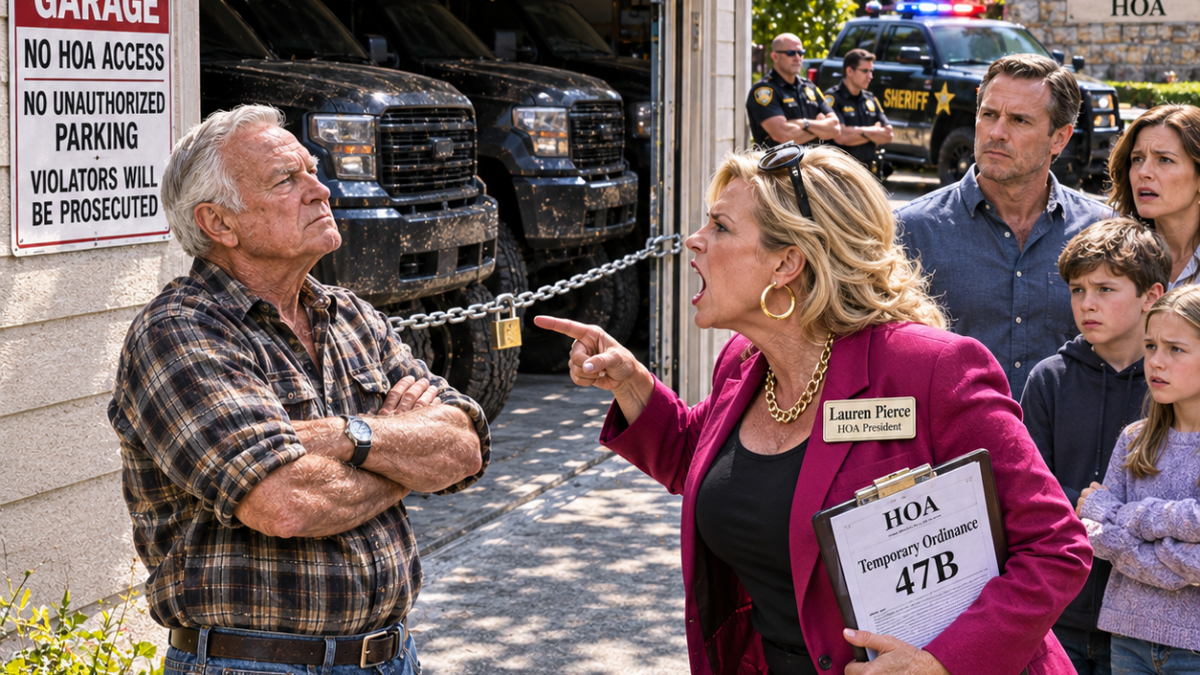
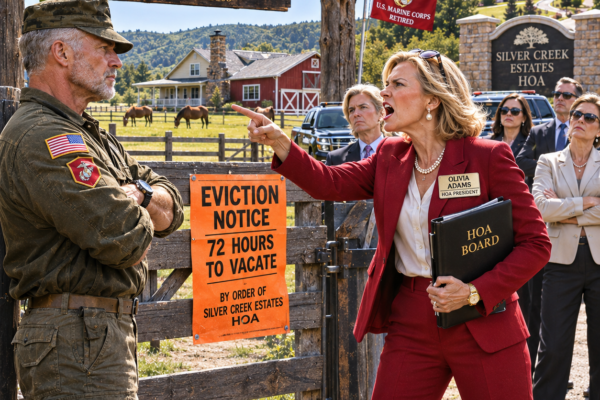
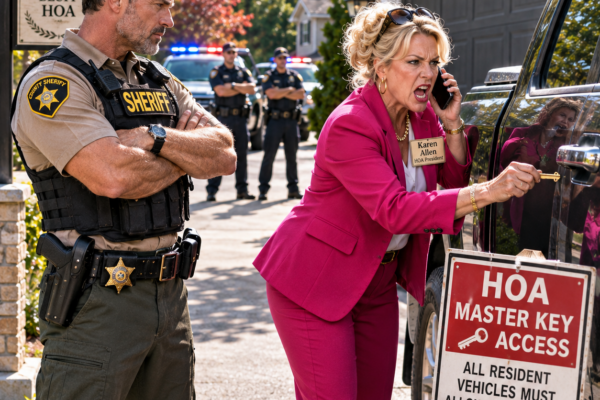
The bang that shook our cul-de-sac came from my own garage door, and when I ran outside I found my seventy-two-year-old father, Hank, standing in front of it with both arms folded while three enormous unmarked trucks sat locked inside the garage Lauren Pierce had just commandeered in the name of the HOA. Lauren was already marching up my driveway in a magenta blazer, waving a sheet labeled “Temporary Ordinance 47B” and demanding that Dad hand over the locks before she called the sheriff on us for interfering with “community equipment.” What none of us understood yet was why an HOA needed three unmarked trucks at all—or why, once the sheriff started asking the right questions, Lauren became more frightened of those vehicles being opened than she was of losing the entire neighborhood.
My name is Ethan Cole. I was forty-five, an IT consultant, father of two, and until that week I believed the worst thing an HOA could do was fine you for leaving a trash bin visible too long.
Cedar Ridge Meadows had been peaceful when my wife, Rachel, and I bought our house. Kids rode bikes around the fountain. Neighbors borrowed tools. People argued about lawns and forgot about it by dinner.
Then Lauren became HOA president.
At first, her rules were annoying rather than alarming.
Mailbox colors. Trash-can hours. Holiday-decoration limits. One month she warned me because our hydrangeas were “visually dominant.”
Dad moved in with us the same year after a hip replacement made living alone inconvenient, and he disliked Lauren from the first conversation.
Hank had spent most of his adult life repairing Army vehicles. He believed authority mattered only when the person using it understood its limits.
Lauren believed authority expanded whenever nobody stopped her.
The warning arrived in a bakery box.
Six blueberry muffins sat beneath a folded note.
Dad squeezed one and frowned.
“Could patch drywall with this.”
I read the note aloud.
“Friendly reminder: trash bins remained visible nine minutes beyond the permitted window.”
Dad snorted.
Then I reached the second paragraph.
“Per Temporary Ordinance 47B, the HOA will be using your garage this week for equipment overflow.”
Dad stopped chewing.
“Read that again.”
I did.
He looked toward the attached garage.
“No.”
“Maybe the clubhouse storage is being repaired.”
“Doesn’t matter. Tell her no.”
I should have.
Instead, work got busy. The note slid beneath a stack of mail.
The next morning, engines woke me before seven.
Three heavy trucks rolled into the cul-de-sac.
They were dark gray, nearly identical, with tinted windows and no HOA markings.
Lauren’s white Lexus followed.
I went outside barefoot.
“Lauren, what is this?”
She smiled.
“Equipment overflow. Just like the notice said.”
“I never agreed.”
“Temporary Ordinance 47B gives the association emergency storage authority.”
“Since when?”
“Since necessary.”
One driver walked toward my keypad.
Before I could stop him, he entered my garage code.
The door rose.
My stomach dropped.
“How do you know that code?”
Lauren answered too quickly.
“Association records.”
“My garage code is not an HOA record.”
The men drove all three trucks inside.
Dad appeared behind me in sweatpants and an old Army T-shirt.
“Who gave you permission?”
Lauren lifted her chin.
“The board.”
“Show me the vote.”
“I don’t need to debate policy with residents.”
Dad turned to me.
“Ethan. Get the locks.”
“Dad—”
“Now.”
I should have stopped him.
Instead, I brought him the heavy padlocks we used for the shed.
Dad secured the manual release and added an exterior chain through the garage hardware.
Lauren stared at him.
“You cannot detain HOA property.”
Dad pulled out his phone.
“No. But I can secure my son’s private garage until somebody with actual authority explains why three trucks were put inside it without consent.”
Lauren’s face went crimson.
“I’m calling the sheriff.”
Dad smiled.
“Already doing it.”
Twenty minutes later, Sheriff Doug Ramsey stepped out of his cruiser, looked at the locked garage, looked at Lauren, and asked one question.
“Who owns the house?”
“I do,” I said.
He turned to Lauren.
“Do you have written permission from Mr. Cole to store those vehicles here?”
Lauren answered immediately.
“We have Ordinance 47B.”
Doug held out his hand.
“Let me see it.”
She gave him the paper.
He read the first page.
Then the second.
His expression changed.
“Ms. Pierce,” he said quietly, “this document doesn’t say what you just claimed it says.”
Lauren stopped breathing for half a second.
And that was the first moment I realized the trucks might not be the strangest thing sitting inside my garage.
PART 2
Doug read the paper again.
Not quickly.
That was one of the things I liked about him.
Sheriff Doug Ramsey never rushed when somebody wanted him to.
Lauren shifted beside him.
“Well?”
He looked up.
“This appears to authorize temporary use of HOA-owned common areas during maintenance emergencies.”
“Exactly.”
“My garage is not an HOA-owned common area,” I said.
Lauren snapped toward me.
“No one asked you.”
Doug folded the paper.
“I did.”
Her lips tightened.
He pointed at the garage.
“Mr. Cole owns the structure?”
“Yes,” I said.
“Any deeded easement allowing the association to use it?”
“No.”
“Written agreement?”
“No.”
“Rental agreement?”
“No.”
“Emergency declaration from the county?”
“No.”
Lauren threw up both hands.
“Why are you treating this like a property-law seminar? We needed storage.”
Doug looked at her.
“Because needing something doesn’t make it yours.”
Dad grunted approvingly.
Lauren ignored him.
“This association has always had broad emergency powers.”
“Maybe over association property.”
“Cedar Ridge Meadows is a planned community.”
“So?”
She seemed genuinely offended by the question.
“So residents agree to cooperate.”
I stepped forward.
“Cooperate isn’t the same as surrendering my garage.”
Lauren raised her clipboard.
“You received written notice.”
“I received muffins.”
“Which contained written notice.”
Dad said:
“Dry muffins.”
Doug glanced at him.
“Hank.”
“Relevant.”
“No.”
Dad folded his arms.
Doug returned his attention to Lauren.
“Who owns the trucks?”
“The HOA.”
“All three?”
“Yes.”
“Registration?”
“I don’t carry vehicle registrations in my purse.”
“Who drove them?”
“Contractors.”
“Which company?”
“Association contractors.”
“Name?”
Lauren hesitated.
Dad noticed too.
His expression changed.
“So you don’t know.”
“Of course I know.”
“What company?”
She looked at me.
Then Doug.
“Cedar Compliance Services.”
Doug wrote it down.
“Phone number?”
“I don’t have it memorized.”
“What are the trucks carrying?”
“Equipment.”
“What kind?”
“HOA equipment.”
Doug lowered his pen.
“What kind?”
Lauren’s voice hardened.
“Compliance equipment.”
Dad laughed once.
No humor in it.
“What in God’s name is compliance equipment?”
“That information is confidential.”
Now Doug’s expression changed.
Not dramatic.
Just attentive.
The same way a mechanic starts listening differently when an engine develops a sound it shouldn’t have.
He turned to me.
“Did you authorize anyone to enter the garage?”
“No.”
“Did you give the drivers the access code?”
“No.”
“Anyone in your household?”
I looked at Dad.
He shook his head.
Rachel was at work.
Our daughter, Emma, was sixteen.
Our son, Noah, thirteen.
Neither knew the keypad code beyond their own temporary numbers, and the code the driver entered wasn’t one of theirs.
“No.”
Doug nodded.
“Then we have two separate issues.”
Lauren immediately said:
“No, we don’t.”
“Yes, ma’am. We do.”
He held up one finger.
“Unauthorized use of private property.”
Second finger.
“And the question of how somebody obtained a residential access code.”
Lauren clutched her clipboard tighter.
“The HOA maintains emergency information.”
“Did Ethan give you that code?”
“I don’t remember.”
I did.
“I never did.”
Doug nodded.
“Then we document it.”
Lauren’s composure began slipping.
“We have a meeting tonight. Those trucks are required.”
“For what?”
She stared at him.
“I told you. Compliance.”
Doug looked toward the garage.
“Does the HOA need access to the trucks right now?”
“Yes.”
“Then the vehicle owners or authorized representatives can come here with identification, registrations, and proof they have a lawful right to remove them.”
Lauren’s eyes widened.
“You’re letting him hold them hostage?”
“No.”
Doug pointed at my locked garage.
“I’m preventing this dispute from turning into five more disputes.”
Dad said:
“Best thing anybody’s said all morning.”
Lauren stepped toward the chain.
“Then I’m opening it.”
Dad moved in front of her.
Not threateningly.
Just enough.
Doug lifted one hand.
“Everybody stop.”
The authority in his voice changed the entire driveway.
Dad stepped back.
Lauren stopped.
Doug looked at me.
“Ethan, keep the garage secured until we confirm ownership and arrange a documented removal.”
“Fine.”
He looked at Dad.
“No additional locks.”
Dad seemed disappointed.
Then Lauren.
“Do not enter the Cole property without permission.”
She looked stunned.
“I live across the street.”
“You can live on the moon. Their driveway is still theirs.”
Her face reddened.
“This community is going to hear about this.”
Doug nodded.
“That’s your right.”
Then he added:
“Just make sure what you tell them is true.”
That landed.
Lauren walked away stiffly, heels striking the pavement harder with every step.
The two truck drivers had disappeared during the argument.
I hadn’t noticed until then.
Their absence bothered Doug.
“Where’d they go?”
I looked around.
“No idea.”
He called the number Lauren eventually provided.
Disconnected.
He searched the company name through his in-car system.
No local business license appeared under Cedar Compliance Services.
That still didn’t prove anything.
Could have been an out-of-county contractor.
Trade name.
Bad records.
But the questions were multiplying.
Doug took photographs.
Garage.
Trucks through the windows.
Paper notice.
Padlocks.
Keypad.
Then he asked me to reset the access codes.
I did it before breakfast.
When Rachel came home from her hospital shift around nine, she found a sheriff’s cruiser in the driveway, three trucks trapped in the garage, Dad drinking coffee beside the door like a guard at Fort Knox, and me changing passwords on my phone.
She stopped halfway up the walk.
“No.”
That was her entire greeting.
I walked toward her.
“Morning.”
“No.”
“You want context?”
“No. I want a new family.”
Dad lifted his cup.
“Too late.”
Rachel stared at the garage.
“What’s in there?”
“Three HOA trucks.”
“Why?”
“Lauren.”
She closed her eyes.
“Of course.”
I explained.
When I reached the part about the drivers using our garage code, she opened her eyes.
“How did they know it?”
“We don’t know.”
“That code is private.”
“I know.”
“Ethan.”
“I know.”
The jokes left the morning.
That was the moment the intrusion stopped feeling absurd.
Somebody had information about our house.
Not just our address.
Not just when the trash cans came out.
Our garage access.
A code that could have opened the door attached to the house where my children slept.
Rachel looked toward Dad.
“You changed everything?”
“Ethan did.”
“Alarm?”
“Reset.”
“Interior door?”
“Locked.”
She nodded.
Then looked at me.
“This isn’t about trucks anymore.”
“No.”
It wasn’t.
By noon, Doug returned with a deputy and an investigator named Carla Ruiz.
The registered owners of the trucks had been identified.
Not the HOA.
All three were titled to separate limited-liability companies.
Those companies shared a mailing address.
A commercial mailbox twenty miles away.
Lauren’s name didn’t appear on the registrations.
Neither did Cedar Ridge Meadows.
Ruiz asked:
“Did Ms. Pierce tell you these were HOA-owned?”
“Yes.”
Dad said:
“Repeatedly.”
Ruiz looked toward the garage.
“Have you opened any of them?”
“No.”
“Good.”
Dad shifted.
I knew exactly what he was thinking.
Ruiz looked at him.
“Mr. Cole?”
“Hank.”
“Hank, don’t open them.”
“I wasn’t going to.”
She stared.
He sighed.
“I was thinking about it.”
“Don’t.”
“Fine.”
The trucks were eventually removed that afternoon—but not released to Lauren.
Two tow operators arranged through the sheriff’s office transported them to a secure lot while ownership and the circumstances of their placement were reviewed.
Lauren stood on her lawn filming the entire process.
At one point she shouted:
“This is unlawful seizure of HOA assets!”
Ruiz ignored her.
The trucks disappeared around the corner.
Dad watched them go.
“Feels wrong.”
“What?”
“Letting mysterious trucks leave without knowing what’s inside.”
Rachel pointed at him.
“That sentence is why you’re not in charge.”
Dad looked offended.
“I served this country.”
“And we’re grateful.”
“Doesn’t sound grateful.”
She kissed his cheek.
“Go eat something.”
He did.
Lauren called an emergency HOA meeting that evening.
Of course she did.
The email subject line read:
**URGENT ASSOCIATION CRISIS — COLE HOUSEHOLD DETENTION OF COMMUNITY ASSETS**
Rachel read it over my shoulder.
“Detention?”
“She likes dramatic nouns.”
Dad entered carrying a sandwich.
“What time?”
“You’re not going.”
“Six?”
“Dad.”
“I’m seventy-two. You can’t ground me.”
Rachel said:
“I can hide your keys.”
Dad looked at her.
“You wouldn’t.”
She smiled.
He decided to ride with us.
The Cedar Ridge clubhouse was packed.
Nobody in that neighborhood had ever seen three industrial trucks removed by the sheriff from a resident’s garage.
Even people who normally treated HOA meetings as punishment showed up.
Lauren stood behind the podium.
Navy pantsuit now.
Magenta apparently had been retired after the morning’s defeat.
Behind her sat four board members.
Julia Reyes, the association secretary, was not there.
I noticed because Julia had always been the one taking minutes.
Lauren started.
“Today, the association was subjected to an unprecedented act of hostility.”
Dad whispered:
“Here we go.”
I nudged him.
Lauren continued.
“Certain residents unlawfully obstructed approved association operations, resulting in the seizure of critical compliance vehicles.”
A man named Gary raised his hand.
“What are compliance vehicles?”
Lauren ignored him.
“Until this matter is corrected, neighborhood safety is at risk.”
Another voice:
“Safety from what?”
“Please hold questions.”
Dad raised his hand.
She glared.
“No.”
He lowered it.
Then stood anyway.
“Ordinance 47B.”
The room shifted.
Lauren’s jaw tightened.
“What about it?”
“Read the whole thing.”
“I don’t need to.”
“I do.”
“I’m chairing this meeting.”
Dad pulled a laminated copy from his jacket.
I stared.
“Where did you get that?”
“County library.”
“When?”
“Lunch.”
Of course.
He looked around the room.
“Ordinance 47B was proposed in 2012 during clubhouse repairs.”
Lauren interrupted.
“It grants emergency storage.”
Dad raised the paper.
“It granted the board temporary use of HOA-owned utility rooms and common-area storage during declared maintenance emergencies.”
People began murmuring.
“It says nothing about resident garages.”
Lauren snapped:
“Policies evolve.”
Dad continued.
“Also says it expired after ninety days.”
Silence.
Then somebody laughed.
Lauren struck the podium with her palm.
“Enough.”
One board member leaned toward her.
“Lauren, did counsel review the ordinance before today?”
She didn’t answer.
“Lauren?”
“We didn’t have time.”
The board member’s expression changed.
“You told us legal approved it.”
“I said legal principles supported it.”
“That isn’t what you told me.”
A crack.
Small.
But visible.
Lauren straightened.
“The point is that the Cole residence obstructed community operations.”
I stood.
My legs felt strangely heavy.
I hated speaking in rooms full of neighbors.
IT work suited me partly because computers rarely formed committees.
“Can I ask something?”
Lauren stared.
“I suppose.”
“Who owned the trucks?”
“The association.”
“Sheriff Ramsey says the registrations show three LLCs.”
A murmur spread.
Lauren’s expression didn’t move.
“Leased assets.”
“Can you show the leases?”
“Confidential.”
“Who is Cedar Compliance Services?”
“Vendor.”
“State registration?”
“Not relevant.”
“How did they get my garage code?”
That shut down the room.
Rachel sat beside Dad.
Her fingers tightened around mine.
Lauren said:
“Emergency information is maintained for safety.”
“By whom?”
“The association.”
“I never provided my garage code.”
Her eyes shifted.
Only once.
Toward the empty secretary’s chair.
Julia’s chair.
I noticed.
Then Lauren said:
“Perhaps your wife did.”
Rachel stood.
“No.”
One word.
Flat.
Medical-professional voice.
The one she used when somebody tried lying about medication history.
“I did not.”
Lauren’s gaze moved.
“Then one of your children.”
Rachel took a step toward the aisle.
“Do not bring my children into your explanation for why strangers could open my house.”
The room went silent.
Lauren tried to recover.
“No one entered your house.”
“They entered my garage using a private code.”
“It was association business.”
Rachel’s voice dropped lower.
“That door connects to my kitchen.”
Lauren said nothing.
The meeting ended without a resolution.
The board voted to suspend any further “equipment operations” until counsel reviewed the issue.
Lauren called the vote unnecessary.
Three directors voted for it anyway.
Dad smiled all the way home.
I didn’t.
I kept thinking about Julia’s empty chair.
The next morning I emailed her.
No response.
Then I called.
Voicemail.
By afternoon, Lauren sent another neighborhood email accusing us of undermining community security.
Doug called around five.
“Ethan.”
“What’s wrong?”
“Nothing immediate.”
The word immediate did all the work.
“What did you find?”
“Can’t tell you much yet.”
“Doug.”
“The truck owners agreed to a voluntary inspection in connection with the property-access complaint.”
My chest tightened.
“And?”
“There’s equipment inside that raises questions.”
“What kind of questions?”
“Questions I don’t answer over the phone.”
“Doug.”
“Come to the office tomorrow. Bring Rachel if you want.”
I told Dad.
He said:
“I knew it.”
“You know nothing.”
“I know mysterious trucks aren’t filled with pool noodles.”
The next morning Rachel and I sat across from Ruiz in a small conference room at the sheriff’s office.
Doug came in carrying coffee.
Ruiz opened a folder.
“Some of what I’m about to tell you isn’t for public distribution.”
“Understood.”
She placed photographs on the table.
The inside of the middle truck looked like a mobile electronics workshop.
Monitors.
Receivers.
Storage cases.
Camera hardware.
Networking equipment.
Nothing automatically criminal.
I used similar technology in legitimate IT deployments.
Then Ruiz showed the labels.
House numbers.
Street names.
Resident names.
**MENDOZA — FENCE**
**HARPER — NOISE**
**NGUYEN — PARKING**
Then:
**COLE — PRIORITY**
Rachel’s hand went cold in mine.
Ruiz continued.
“We found data-storage media. We’re seeking appropriate legal process before examining protected contents.”
I nodded.
Good.
No shortcuts.
Doug pointed at another photograph.
A box of small cameras.
Some disguised as landscaping objects.
Decorative rocks.
Birdhouse components.
An irrigation fitting with a pinhole lens.
Rachel whispered:
“No.”
Ruiz said:
“We don’t know where each device was deployed.”
I stared at the photograph.
“The HOA knew about this?”
“We don’t know.”
“Lauren?”
“We don’t know.”
“Then why was she hiding the trucks in my garage?”
Ruiz closed the folder.
“That is one of the questions.”
Dad was waiting at home when we returned.
He took one look at Rachel’s face and didn’t make a joke.
That worried me more than anything.
We sat around the kitchen table.
I explained only what Ruiz said we could discuss within the family.
Dad looked at the counter.
Then at the windows.
“Son.”
“Yeah?”
“Check the house.”
I was already thinking it.
I spent the afternoon examining our network.
Router logs.
Connected devices.
Wi-Fi history.
Smart-home accounts.
Nothing obvious.
That should have reassured me.
It didn’t.
Then I checked the camera system.
One administrator login had occurred eight months earlier from an unfamiliar device.
At the time I’d assumed it was a mobile-app glitch.
Now I stared at the timestamp.
Rachel came behind me.
“What?”
I pointed.
“Unknown login.”
“Could that be Lauren?”
“I don’t know.”
“Could someone have accessed the cameras?”
“Possibly.”
She stepped away from the desk.
Our home security cameras covered the driveway, back patio, garage interior, and front entry.
Not bedrooms.
Nothing like that.
But the idea that someone might have watched any part of our private life was enough.
Rachel sat on the bed.
“I need you to tell me we’re safe.”
That hurt.
Because husbands want to say yes.
Fathers want to say yes.
IT consultants especially want to say yes after looking at logs.
But I didn’t know.
“I can tell you what I’ve changed.”
“That isn’t what I asked.”
“No.”
I sat beside her.
“I don’t know yet.”
She nodded.
Tears appeared.
Not dramatic.
Just one running down her cheek.
“I hate this.”
“So do I.”
“Our kids.”
“I know.”
“I don’t want Emma thinking somebody watched her come home from school.”
“I know.”
Rachel wiped her face.
“Fix what you can.”
That I could do.
I replaced network credentials.
Factory-reset the cameras.
Changed garage hardware.
Disabled remote codes temporarily.
Brought in a security contractor who had no relationship with Cedar Ridge.
We inspected the house exterior.
Nothing found.
Then the contractor stopped beside a decorative stone near our side garden.
“This yours?”
I looked.
“I don’t remember buying it.”
Dad came outside.
“What?”
The contractor picked it up.
The bottom had been cut cleanly.
Inside was a small weatherproof camera module.
Nobody spoke.
Rachel was standing behind me.
I heard her inhale.
Dad’s voice changed.
“All right.”
Not loud.
Worse.
“Dad.”
“No.”
“Don’t touch anything.”
He looked at me.
“You think I’m going across the street?”
“Yes.”
“I was thinking about it.”
“Don’t.”
He stared at Lauren’s house.
Then at the fake rock.
Finally:
“Call Doug.”
I did.
The camera became evidence.
Two more devices were found in common landscaping areas near other homes after law enforcement obtained consent from the property owners.
One pointed toward Gary’s driveway.
Another toward a side yard belonging to the Mendozas.
Cedar Ridge stopped being funny.
Nobody joked about the trucks anymore.
The board placed Lauren on administrative suspension pending legal review.
She responded by calling another meeting.
The board refused to recognize it.
She held it anyway.
Six people attended.
Three were there to tell her to resign.
Then Julia Reyes called me.
Not Lauren’s relative.
Different Reyes.
She had been Lauren’s administrative assistant for eighteen months.
Her voice shook.
“Mr. Cole?”
“Julia?”
“I need to talk.”
“About the garage code?”
Silence.
Then:
“Yes.”
We met at Sheriff Ramsey’s office.
Not my house.
Not a diner.
Somewhere documented.
Julia arrived with a lawyer.
That told me everything before she sat down.
Ruiz led the interview.
I was there only for part of it because some information concerned me directly.
Julia explained that Lauren maintained what she called a “compliance intelligence file.”
At first, it was ordinary HOA information.
Violation photographs.
Complaint records.
Parking notes.
Then Lauren began collecting more.
Schedules.
Visitor patterns.
Financial-pressure indicators gleaned from public filings.
Insurance information residents had submitted for HOA-related claims.
She purchased cameras using HOA money but described them as “landscape security equipment.”
Julia helped maintain files.
“Why?”
Ruiz asked.
Julia stared at her hands.
“At first I thought it was legitimate.”
“When did that change?”
“When she asked me to catalog who was easiest to pressure.”
Rachel squeezed my arm.
Ruiz said:
“Pressure how?”
“Fines. Embarrassment. Threats of liens. Social pressure.”
“And Mr. Cole?”
Julia looked at me.
“You were labeled resistant.”
Dad would have been proud.
I wasn’t.
“What does priority mean?”
“Lauren thought you influenced other homeowners.”
“I barely go to meetings.”
“That was part of it.”
“What?”
“You ignored her.”
That sentence landed strangely.
Julia continued.
“She could handle people who argued. She liked arguments. Arguments made her feel important.”
“And me?”
“You kept throwing notices away.”
“I saved them.”
Julia almost smiled.
“She didn’t know.”
Then the smile disappeared.
“She said if she could make an example of your house, other people would stop challenging her.”
“Why my garage?”
Julia looked toward Ruiz.
Then back at me.
“The clubhouse storage was never full.”
My stomach tightened.
“So why put the trucks there?”
“She wanted them off HOA property.”
“Why?”
“I think she knew an audit was coming.”
The room went quiet.
Ruiz asked:
“What audit?”
“Insurance and finance.”
Julia’s lawyer whispered something to her.
She nodded.
“Lauren had been charging surveillance-related expenses to categories like landscaping, safety equipment, and community research.”
“How much?”
“I don’t know exactly.”
“Why move the trucks?”
“Because an outside accountant was scheduled to inspect association assets.”
Rachel stared at me.
The garage hadn’t been convenient storage.
It had been concealment.
My house had been selected because Lauren believed she could force us to cooperate and then blame “temporary ordinance authority” if anyone questioned it.
Ruiz asked:
“How did she get Ethan’s garage code?”
Julia began crying.
“I gave it to her.”
Rachel went rigid.
I asked:
“How did you get it?”
“I didn’t steal it from your house.”
“That wasn’t my question.”
She wiped her face.
“Two years ago, the HOA used a contractor to install replacement keypad systems on several homes after a manufacturer recall.”
I remembered.
Our garage keypad had been replaced through a bulk neighborhood deal.
Not mandatory.
Just cheaper.
“The installer submitted setup sheets for billing.”
My stomach dropped.
“Codes were on those sheets?”
“Temporary ones. Some residents changed them.”
I hadn’t.
Julia nodded.
“Lauren kept copies.”
Rachel stood.
I thought she was leaving.
Instead, she walked to the wall and stared out the window.
“Two years.”
Julia whispered:
“I’m sorry.”
Rachel turned.
“Did you watch my family?”
“No.”
“Did Lauren?”
“I don’t know.”
“That’s not good enough.”
“I know.”
Rachel’s voice cracked.
“My daughter was fourteen when that system was installed.”
Julia cried harder.
I wanted to be angry at her.
Part of me was.
But I could see the fear.
The guilt.
The lawyer.
The fact that she had come voluntarily carrying records.
Ruiz asked:
“Why come forward now?”
Julia opened her bag.
She removed a flash drive.
“Because she told the board the trucks contained harmless maintenance equipment.”
She placed it on the table.
“They didn’t.”
“What is this?”
“Backups.”
Lauren’s emails.
Financial records.
Device inventories.
Vendor invoices.
Compliance files.
And correspondence with outside companies.
Ruiz did not plug it in.
Good investigator.
She bagged it.
Logged it.
Chain of custody.
Later, warrants were obtained.
The story that emerged was worse than surveillance for HOA fines.
Prosecutors alleged that Lauren had used resident data for financial gain.
Not every rumor proved true.
Some early accusations were nonsense.
No evidence supported wild claims that she’d sold live bedroom footage or secretly hacked bank accounts.
Reality was less sensational and, in a way, more disturbing.
She had collected behavioral and property data without proper authorization.
She had shared selected information with third parties.
One real-estate marketing consultant wanted indications of distressed homeowners who might sell.
An insurance intermediary had received photographs and incident patterns that could affect risk assessments.
A local political consultant had discussed using neighborhood demographic and behavioral information for voter targeting.
There were invoices.
Payments.
Emails.
Some transactions went through HOA accounts.
Others through entities tied to Lauren.
The trucks were owned by companies connected to the vendor network.
Cedar Compliance Services existed—but not the way Lauren described it.
It operated under a different legal name and subcontracted surveillance hardware.
The three trucks were mobile monitoring and equipment platforms.
Not HOA-owned.
Not ordinary maintenance.
And Lauren had parked them in my garage because she needed them temporarily out of sight.
Sheriff Ramsey called me after warrants were served.
“We’re bringing in state investigators.”
“Why state?”
“Financial side.”
“Federal?”
“Maybe later.”
Dad was listening on speaker.
He mouthed:
**FBI?**
I shook my head.
Doug said:
“Hank there?”
“Yes.”
“Tell him not to start an operation.”
Dad shouted:
“Too late.”
Doug sighed.
“Ethan.”
“I’ve got him.”
“Do you?”
“No.”
The neighborhood meeting that followed was unlike anything Cedar Ridge had ever seen.
The board called it.
Not Lauren.
Their attorney attended.
Doug attended at the back but made clear he wasn’t there to adjudicate HOA politics.
Julia came with counsel.
Lauren arrived anyway.
That surprised me.
Rachel said:
“She thinks she can still talk her way out.”
Dad adjusted his jacket.
“Good.”
“Dad.”
“What?”
“No speeches.”
“Define speech.”
“More than thirty seconds.”
“Unconstitutional.”
We sat in the second row.
Lauren entered in navy.
No magenta.
No clipboard.
That was how I knew she was scared.
The acting vice president, Martin Shaw, opened the meeting.
“The purpose tonight is to address governance, financial controls, privacy practices, and the status of President Lauren Pierce.”
Lauren stood.
“Former acting president.”
Martin stared.
“What?”
“You don’t have authority to suspend me.”
“Our counsel advised—”
“Counsel doesn’t run this association.”
“No,” Martin said. “The board does.”
Applause.
Lauren spun.
“Do not encourage disorder.”
That brought laughter.
Not friendly laughter.
The kind that tells a person their spell has broken.
Martin continued.
“The board has received information indicating significant unauthorized expenditures.”
Lauren interrupted.
“False.”
“Please sit.”
“False.”
“Lauren.”
“You people don’t understand what it takes to keep a community like this stable.”
Dad whispered:
“Here comes the throne speech.”
Rachel elbowed him.
Martin displayed the old Ordinance 47B first.
He read the expiration date.
Then the actual language.
There was no authority to use private garages.
No vehicle-storage power.
No emergency annexation rights.
Lauren stared ahead.
Then Martin showed the financial records.
Surveillance-equipment purchases categorized as landscaping.
Vendor fees.
Consulting expenses.
Payments to Cedar Compliance-related companies.
Questions filled the room.
Gary stood.
“You had cameras on us?”
Lauren pointed at Martin.
“Security equipment existed for enforcement purposes.”
“Inside my yard?”
“Common-area visibility extends—”
“My backyard is not a common area.”
A woman named Rosa Mendoza stood.
“You photographed my daughter?”
Lauren shook her head quickly.
“No.”
Rosa held up a printed photograph investigators had authorized her to receive from her own complaint.
“My daughter was sitting on our patio.”
Lauren’s composure cracked.
“It wasn’t focused on her.”
“That doesn’t make it better.”
The room erupted.
Martin struck the table with his palm.
“Please.”
Nobody listened.
Then Julia stood.
Everything stopped.
Lauren looked at her.
Betrayal.
Not fear.
That was the emotion.
“Julia.”
Julia’s hands trembled.
“I’m sorry.”
Lauren’s voice softened.
Dangerously.
“You’re confused.”
“No.”
“You don’t understand the systems you maintained.”
“I maintained them.”
“You followed instructions.”
“Yes.”
“Then sit down before you say something that hurts you.”
Julia’s lawyer rose.
“That sounded like a threat.”
Lauren froze.
Julia looked at her former boss.
“I kept backups.”
Color left Lauren’s face.
Not all at once.
Slowly.
Julia continued.
“Emails. invoices. device lists. resident profiles. Communications with outside buyers.”
The room went silent enough to hear the air conditioning.
Lauren said:
“There were no buyers.”
Julia didn’t respond.
“You’re lying.”
Julia held Lauren’s gaze.
“No.”
“Why are you doing this?”
“Because you told me the Coles agreed to store the trucks.”
Lauren’s mouth tightened.
“You knew they didn’t.”
“I believed you.”
“That’s your problem.”
That was the sentence.
The one that killed whatever sympathy remained in the room.
Julia’s face changed.
Not weakness anymore.
“You told me their garage was association-controlled overflow.”
Lauren threw up her hands.
“It should have been.”
I heard Rachel inhale beside me.
Lauren heard herself too late.
Martin leaned toward the microphone.
“Should have been?”
Lauren looked around.
No escape.
She tried anyway.
“This community has become impossible to manage because everyone thinks private preference overrides collective welfare.”
Dad stood.
I grabbed his sleeve.
He looked at me.
“Thirty seconds.”
I released him.
He faced Lauren.
“You keep calling other people’s property a preference.”
She glared.
“And you keep interfering.”
Dad nodded.
“Yep.”
He pointed toward me.
“My son bought that house.”
Then toward Rosa.
“She bought hers.”
Gary.
“He bought his.”
Then the room.
“You didn’t build their lives. You didn’t earn their paychecks. You didn’t raise their kids. They elected you to keep the pool clean and hire somebody to mow grass.”
A few people laughed.
Dad didn’t.
“You turned being trusted with common property into permission to invade private lives.”
Lauren said:
“You’re oversimplifying.”
Dad shook his head.
“No, ma’am. You complicated something simple.”
He sat.
Thirty-two seconds.
I counted.
Martin called for a vote.
Removal of Lauren Pierce as HOA president.
Every eligible director voted yes.
Lauren’s own hand hovered for a moment.
Then dropped.
She looked around the room.
“You’ll regret this.”
Nobody answered.
She collected her purse.
No papers.
No applause when she left.
That was worse for her than booing.
The criminal investigation widened over the next several weeks.
State financial investigators joined.
Then federal agents because data and payments had crossed state lines.
The phrase “FBI investigation” spread through Cedar Ridge like gasoline.
Half the neighborhood suddenly remembered suspicious events from five years earlier.
Most meant nothing.
Doug repeatedly warned people:
“Report facts. Not theories.”
That became important.
One rumor claimed Lauren had hidden microphones inside every home.
False.
Another said she had hacked smart TVs.
No evidence.
Someone swore the community fountain contained facial-recognition cameras.
It did not.
Dad was disappointed by that one.
“Would’ve been impressive.”
“Stop.”
“I’m saying technically impressive.”
Investigators found enough real evidence.
They did not need fantasy.
One afternoon federal agents executed warrants on business locations and Lauren’s residence under judicial authorization.
I did not watch.
Dad wanted to.
Rachel hid his truck keys.
He accused her of authoritarianism.
She said:
“File a grievance.”
He muttered:
“Lauren would’ve understood me.”
Rachel threatened to change his Wi-Fi password.
He surrendered.
The agents recovered additional financial records.
Device inventories.
Resident files.
A whiteboard in Lauren’s converted garage labeled:
**PRIORITY COMPLIANCE**
My name appeared near the top.
So did Julia’s.
Rosa’s.
Gary’s.
Several people who had challenged fines.
The files contained notes.
Some petty.
Some invasive.
**Late arrival pattern.**
**Possible financial strain.**
**Frequent overnight guest.**
**Child home during school hours.**
**Potential divorce.**
**Mortgage filing—monitor.**
I read my own file only after prosecutors disclosed portions of it.
**Ethan Cole — resistant. IT background. Potential organizer.**
Another line:
**Garage viable for temporary equipment relocation. Low likelihood of immediate compliance, but family pressure may work.**
Family pressure.
I stared at those words.
Rachel sat across from me.
“What?”
I handed her the page.
Her face hardened.
“They were thinking about me.”
“Us.”
“The kids.”
“Maybe.”
“No.”
She tapped the sentence.
“Family pressure.”
She pushed the paper away.
“That woman didn’t just think she could use our garage. She thought she could use us against you.”
I didn’t answer.
Because that was exactly what it looked like.
For the first time, my anger stopped being nervous energy and became something heavier.
I wanted Lauren punished.
Not embarrassed.
Not voted out.
Punished.
That scared me a little.
Dad saw it.
We were in the garage replacing the scratched door hardware after the trucks had been gone for weeks.
He handed me a wrench.
“You’re thinking ugly thoughts.”
“I’m tightening a bolt.”
“You’re trying to murder that bolt.”
I stopped.
Dad leaned against the workbench.
“I know that face.”
“You were angry enough to chain trucks in my garage.”
“Yep.”
“You wanted to spray Lauren with sprinklers.”
“The sprinklers handled their own business.”
“Dad.”
He sighed.
“Anger’s useful for about five minutes.”
“Then what?”
“Then it starts charging rent.”
I looked at him.
“Where did you get that?”
“Probably your mother.”
Grandma had been dead twenty years.
Dad still borrowed her wisdom without credit.
I sat on a stool.
“She had files on the kids.”
“Notes.”
“Same thing.”
“No.”
I glared.
He didn’t flinch.
“Don’t give her crimes she didn’t commit because you’re mad about the ones she did.”
That stopped me.
He pointed toward the house.
“You teach those kids facts matter.”
“Yes.”
“Then facts matter when you hate somebody too.”
I hated when he was right.
“Still want her convicted.”
“Fine.”
“Still want her to lose everything she got from this.”
“Fine.”
“Still want—”
“Want justice.”
He picked up the wrench.
“That’s a cleaner word. Make sure you mean it.”
The federal case took time.
Months.
Not days.
Lauren hired lawyers.
Good ones.
They challenged search warrants.
Disputed interpretations.
Argued many cameras were installed for legitimate property-security purposes.
Contended data-sharing contracts involved anonymized market research rather than private resident information.
Some allegations weakened under scrutiny.
Others strengthened.
Julia’s testimony mattered.
So did accounting records.
One vendor executive agreed to cooperate.
That opened another layer.
According to prosecutors, Lauren had pressured vendors to classify surveillance equipment under misleading expense categories to avoid board questions.
She also routed certain consulting payments through a business account not disclosed to the board.
The association’s insurer started its own investigation.
Homeowners hired civil counsel.
Then came the lawsuits.
Lots of them.
Residents sued Lauren.
Some sued vendors.
The HOA sued for unauthorized expenditures.
Lauren countersued the HOA, alleging wrongful removal and defamation.
The serenity of Cedar Ridge Meadows became a courthouse calendar.
Dad kept track on a wall planner.
Rachel called it his “sports season.”
He disagreed.
“Sports have less paperwork.”
One civil hearing produced a moment I will never forget.
Lauren’s attorney argued that many residents had implicitly consented to enhanced monitoring through broadly worded security provisions in the HOA covenants.
The residents’ lawyer put the covenant on a screen.
It allowed cameras in common areas.
Entrance.
Pool.
Clubhouse.
Mail kiosk.
Then she displayed the map of surveillance-device locations recovered from Lauren’s records.
Side yards.
Private-facing angles.
My garden.
Gary’s rear driveway.
Rosa’s patio view.
The lawyer asked:
“Which of those areas is a common area?”
Lauren’s attorney said:
“The intent of the system—”
“Which areas?”
Silence.
The judge leaned forward.
“Counsel?”
“Several appear outside common property.”
“Several?”
The judge looked at the map.
“Most.”
Lauren sat at the defense table.
For once she didn’t look at anyone.
The court later issued restrictions preserving evidence and barring further unauthorized monitoring while civil claims proceeded.
The association’s insurer funded portions of settlements for some conduct and disputed others.
Vendor defendants entered separate negotiations.
It was complicated.
Real accountability usually is.
There was no single check labeled **KARMA**.
But money started flowing back.
Unauthorized fines were refunded.
Improper fees reversed.
Some residents received settlements.
The association recovered portions of vendor payments.
Lauren eventually sold her Cedar Ridge home during the litigation.
Not because a mob drove her out.
Because legal bills, loss of standing, and the collapse of her community position made staying miserable.
I saw the moving truck one Saturday.
Dad stood beside me at the window.
Neither of us celebrated.
“You expected to feel better?”
I asked.
“Little.”
“Me too.”
Lauren stepped outside carrying a box.
For a moment she looked toward our house.
I wondered if she’d come over.
She didn’t.
Maybe that was best.
The criminal case resolved almost eighteen months after the trucks entered my garage.
Federal prosecutors announced plea agreements involving several people and entities.
Not every defendant received the same treatment.
Some cooperated.
Some paid penalties.
Certain privacy-related allegations were handled civilly rather than criminally.
Lauren pleaded guilty to financial and data-related offenses prosecutors said they could prove from records and testimony, along with state-level counts connected to unauthorized surveillance practices.
I attended sentencing because I had been formally recognized as one of several affected residents.
So did Rachel.
Dad insisted.
Emma was seventeen by then.
She wanted to come.
We said no.
She was angry.
“You keep saying this happened to our family.”
“It did.”
“Then why can’t I hear the ending?”
Rachel looked at me.
That one was hard.
We eventually allowed both kids to attend a separate victim-impact proceeding that was less graphic and more controlled.
At Lauren’s sentencing, the courtroom was packed.
Not with cheering neighbors.
People were tired.
Julia sat with her attorney.
Rosa beside her husband.
Gary behind them.
Martin represented the association.
Lauren entered wearing a charcoal suit.
Her hair had grown longer.
No bright lipstick.
No clipboard.
She looked smaller than the woman who once commanded an entire meeting with one look.
Her lawyer spoke first.
No prior felony record.
Community involvement.
Years of volunteer service.
Stress.
Poor judgment.
A desire to maintain property values that evolved into serious boundary violations.
The prosecutor responded with financial records.
Concealment.
False classifications.
Resident profiling.
The intentional removal of the trucks from HOA property immediately before audit activity.
Then Julia testified.
Her voice was steadier than when she’d first met investigators.
“I admired her.”
Lauren looked up.
Julia continued.
“I thought she was strong.”
She swallowed.
“When people complained about her, she told me leadership always looks cruel to weak people.”
The courtroom stayed silent.
“I believed that for a while.”
Julia looked toward Lauren.
“Then she started asking me to record things that had nothing to do with covenants.”
“Personal schedules.”
“Money problems.”
“Family situations.”
“Who argued with whom.”
“Who might sell.”
“Who might be embarrassed.”
Julia’s hands shook.
“I should have left earlier.”
Lauren looked away.
The prosecutor asked:
“Why didn’t you?”
Julia answered:
“Because every small thing seemed explainable by the thing before it.”
That sentence stayed with me.
That’s how boundaries disappear.
Not always in one dramatic leap.
An extra photograph.
A saved password.
A private note.
A temporary truck.
A garage somebody assumes they can use.
Then suddenly you’re standing somewhere you never intended to go, explaining how every previous step seemed small.
When it was my turn, I didn’t bring the Ordinance 47B paper.
Didn’t bring the muffin box.
Didn’t tell the sprinkler story.
I talked about the garage code.
“My daughter was fourteen when that code was copied into records we didn’t know the association retained.”
Lauren stared ahead.
“My son was eleven.”
I paused.
“I understand there is no evidence that anyone entered the living area of our home.”
That distinction mattered.
“But for months, my wife checked the interior garage door twice before bed.”
Rachel lowered her eyes.
“My daughter stopped using the garage entrance when she came home from school.”
I swallowed.
“My father slept in a chair near the front window for two weeks and pretended it was because his hip hurt.”
Dad looked offended.
It was true.
“The greatest damage wasn’t the trucks.”
I looked toward Lauren.
“It was teaching a family that their ordinary routines might belong to somebody else.”
I sat.
Lauren was given prison time followed by supervised release, financial penalties, restitution obligations, and restrictions appropriate to the offenses.
The exact sentence mattered less to me than I expected.
What mattered was the judge’s explanation.
“Leadership does not transform curiosity into entitlement.”
He looked at Lauren.
“Nor does a private association transform neighbors into subjects.”
Her shoulders dropped.
Then something surprising happened.
Lauren asked to speak.
Her attorney looked nervous.
The judge allowed it.
She stood.
For several seconds, she said nothing.
Then:
“I thought I was protecting Cedar Ridge.”
Nobody moved.
She looked at Julia.
“Then protecting it became controlling it.”
She turned toward the residents.
“I knew more than everyone else because I made it my business to know more.”
Her voice weakened.
“And after a while, knowing things about people felt like being stronger than them.”
Rachel’s fingers tightened around mine.
Lauren looked toward me.
“I put the trucks in your garage because I thought you wouldn’t risk making trouble with your father and children in the house.”
There it was.
Family pressure.
The phrase from my file.
I felt Dad move behind me.
Lauren continued.
“I was wrong.”
I waited for a but.
None came.
“I am sorry.”
I did not nod.
Did not smile.
Did not offer forgiveness.
I just heard her.
That was enough for that day.
Outside the courthouse, reporters waited.
I declined.
Dad did not.
A microphone appeared near him.
“Mr. Cole, how do you feel?”
He looked horrified that anyone had asked.
“Hungry.”
Then walked away.
That clip was online before we reached the parking garage.
Rachel laughed until she cried.
Maybe because after eighteen months of fear, lawyers, subpoenas, meetings, and surveillance reports, Dad refusing to provide a dramatic quote felt like the first normal thing we’d experienced.
The HOA itself had already begun changing.
Martin became interim president.
He hated the job.
That made him perfect for it.
His first meeting lasted forty-two minutes.
Dad timed it.
“Record.”
Martin rewrote the association’s vendor policy.
Any contract above a modest threshold required multiple bids or written justification.
Technology purchases had to be itemized.
Security cameras could face only common property unless owners explicitly consented.
Board members lost individual access to resident security codes.
The HOA deleted all retained codes it had no legitimate reason to keep.
Data retention rules were created.
Independent financial review became annual.
Residents could inspect budgets without begging.
Complaint records focused on actual covenant issues rather than personal behavior.
Most importantly, the new board created something Lauren had never tolerated.
Appeals.
You could challenge a violation before paying.
Imagine that.
Gary immediately challenged an old fine for having “excessively whimsical yard décor.”
He won.
Then installed two flamingos.
Dad donated a third.
Rachel told them both they were children.
Dad replied:
“Free children.”
The trucks remained in law-enforcement custody for months before being returned or forfeited according to the different cases involving their owners.
My garage stayed empty during that time.
Not literally.
Dad filled half of it with tools within three weeks.
But emotionally empty.
Every time the door opened, I remembered those dark trucks rolling inside.
Rachel did too.
The first few months, she would stop if an unfamiliar vehicle slowed near the house.
Emma hated being alone after school.
Noah made jokes because thirteen-year-old boys sometimes use humor like armor.
One afternoon he pointed at a delivery van.
“Dad, HOA invasion.”
I smiled.
Then saw his face.
He was checking whether I was scared.
That hurt.
I crouched beside him.
“Hey.”
“What?”
“You know we’re okay, right?”
“Yeah.”
“Do you?”
He shrugged.
“Mostly.”
I sat beside him on the porch.
“We’re allowed to be mostly okay for a while.”
He looked at me.
“Grandpa isn’t.”
Dad was in the driveway installing a mechanical lock on a storage cabinet that contained extension cords.
“Grandpa was never okay.”
Noah laughed.
Good.
We got better slowly.
I stopped checking every network log before bed.
Rachel stopped testing the garage door twice.
Emma began parking inside when she got her license.
That was a bigger moment than she realized.
She drove in.
Turned off the car.
Looked at me.
“What?”
“Nothing.”
“You’re being weird.”
“First car in here since…”
She understood.
“Oh.”
For a second she looked like she might back out.
Then she opened the door.
“No.”
“What?”
“It’s our garage.”
She got out.
“I’m parking here.”
Rachel watched from the kitchen.
Later she hugged Emma for no obvious reason.
Emma complained.
Teenager normal.
Perfect.
Dad never really recovered from being called a neighborhood hero.
The residents had started treating him like folklore after the garage incident.
That became much worse once the truth emerged.
Someone printed a shirt:
**HANK LOCKED THE DOOR**
Dad wore it to HOA meetings.
I begged him not to.
He said:
“Historical preservation.”
One spring, Cedar Ridge held a block party.
Not an HOA event.
A neighborhood event.
Important distinction.
I handled the grill.
Rachel organized food.
Emma brought friends.
Noah ran around with kids who were finally old enough to think fathers were embarrassing and grandfathers were awesome.
Hank arrived wearing a sash Gary had made.
**NEIGHBORHOOD HERO**
I stared.
“No.”
He looked at Rachel.
“She approved.”
Rachel shook her head.
“He lies now.”
“War changes a man.”
“You haven’t been to war in forty years.”
“Memory counts.”
People laughed when he walked down the street.
Not at him.
With him.
For the first time, the jokes didn’t feel like denial.
They felt like healing.
Julia came.
That surprised me.
Several residents still blamed her.
Understandably.
She had helped Lauren.
But she had also provided the evidence that exposed the system.
Both truths existed.
She stood near the edge of the party, holding a plate but barely eating.
I walked over.
“Hey.”
“Hi.”
“You okay?”
She smiled faintly.
“Mostly.”
I remembered Noah.
“Mostly is allowed.”
She looked toward Rachel.
“Does she hate me?”
“No.”
“That’s not the same as liking me.”
“No.”
Julia nodded.
“I deserve that.”
I shook my head.
“Don’t turn accountability into permanent self-hatred.”
Her eyes filled.
“I gave Lauren your code.”
“Yes.”
“I know.”
“You also came forward.”
“Too late.”
“For some things.”
I didn’t soften it.
Then:
“But not too late for everything.”
She looked toward Emma laughing near the sidewalk.
“I’m glad your family is okay.”
“So am I.”
Julia eventually moved away.
Before leaving, she helped the HOA implement a privacy and record-retention policy with outside counsel.
Not as a board member.
Not as an officer.
As someone who knew exactly how bad systems get built.
That felt right.
A year after Lauren’s sentencing, Dad’s hip failed again.
This time there was no avoiding surgery.
He acted offended by biology.
“Cheap parts.”
The orthopedic surgeon said:
“Mr. Cole, the implant lasted twelve years.”
Dad pointed at me.
“My son keeps buying houses with stairs.”
“We have one staircase.”
“Hostile architecture.”
Surgery went well.
Recovery didn’t.
He hated needing help.
That surprised nobody.
He especially hated when I took his car keys temporarily because pain medication made driving unsafe.
“You’re abusing authority.”
“I learned from the HOA.”
“That isn’t funny.”
“It’s a little funny.”
He spent six weeks sleeping in our downstairs guest room.
One night I found him awake at two.
He was sitting by the window.
Same chair he’d used after the surveillance camera was discovered.
“You okay?”
“Hip.”
“Liar.”
He glanced at me.
“Don’t steal my lines.”
I sat across from him.
After a while, he said:
“You know what bothered me most about those trucks?”
“The trucks?”
“Not Lauren.”
“What?”
“I froze.”
I frowned.
“You locked three vehicles in a garage.”
“After.”
He looked toward the dark driveway.
“When those guys knew your code, I froze for a second.”
I remembered.
Dad had been speechless.
I thought it was anger.
“It scared you.”
“Yes.”
He hated admitting it.
I waited.
“I was supposed to be the guy who could handle things.”
“Dad.”
“I spent forty years fixing problems.”
“You locked the garage.”
“After they were already in.”
“They entered because I didn’t respond to the note.”
“That isn’t your fault.”
“Then it isn’t yours either.”
He looked at me.
That was the whole conversation.
Sometimes fathers and sons spend years giving each other advice they refuse to take themselves.
Dad nodded.
“Fair.”
He recovered.
Slower than he wanted.
By summer he was walking without the cane.
He celebrated by installing a new garage-door opener.
I inspected it.
“Normal?”
“Mostly.”
“What does mostly mean?”
He smiled.
“Don’t worry about it.”
I worried about it.
There was no military-grade locking system.
Just a quality residential opener with modern security.
Progress.
The HOA rebuilt itself too.
Not perfectly.
People still argued.
Gary wanted unlimited yard ornaments.
Martin wanted budgets submitted on time.
Rosa thought the pool closed too early.
Somebody complained about teenagers playing basketball after nine.
Normal conflict.
That was what we’d wanted.
Normal.
One evening at a board meeting, Martin announced he wouldn’t seek another term.
The room groaned.
He held up his hands.
“Absolutely not. I have done my service.”
Dad whispered:
“Coward.”
Martin heard him.
“Hank, you run.”
Dad went pale.
The entire room laughed.
“No.”
Martin smiled.
“Thought so.”
A younger resident named Dana Patel took over.
Her first meeting began with:
“I don’t care what color your mailbox is unless it’s on fire.”
Dad clapped.
Rachel looked at me.
“We’re staying here forever, aren’t we?”
“Probably.”
She smiled.
For a while, I thought that was the ending.
Lauren gone.
Neighborhood repaired.
Dad healthy.
Garage reclaimed.
Then a letter arrived.
Not from Lauren.
From her daughter.
I didn’t know she had one.
Her name was Rebecca Pierce.
She was thirty-one and lived two states away.
The letter began:
**Mr. Cole, you don’t know me, and I understand if you don’t want to hear from anyone with my last name.**
I almost stopped.
Rachel said:
“Read it.”
Rebecca wrote that she had been estranged from Lauren for years.
Control had not begun with the HOA.
It had existed at home.
Checking phones.
Reading journals.
Calling employers.
Using “concern” as justification for intrusion.
Rebecca said watching news coverage of the case made her feel two things she hated admitting.
Relief.
And grief.
Relief that people finally believed what Lauren could be like.
Grief that strangers had been hurt before consequences arrived.
She did not ask forgiveness.
She did not ask us to contact Lauren.
She ended with:
**I hope your garage feels like a garage again. That probably sounds stupid. It doesn’t to me.**
I folded the letter.
Rachel cried.
I didn’t at first.
Then I walked into the garage.
Emma’s little sedan was parked on one side.
Dad’s workbench on the other.
No trucks.
No evidence tags.
No police tape.
A box of Christmas decorations.
Two bicycles.
A leaf blower I kept forgetting to repair.
Normal clutter.
I sat on an old paint bucket.
Then I cried.
Dad found me.
He stopped in the doorway.
“Bad news?”
I handed him the letter.
He read slowly.
Then sat beside me.
“She knew.”
“Yeah.”
“Kids usually do.”
I looked at him.
“What does that mean?”
He shrugged.
“Parents think they hide the worst parts of themselves.”
He folded the letter.
“Kids live in the house.”
We sat there.
After a while Dad said:
“You should answer.”
“Why?”
“Because she didn’t ask you for anything.”
That was his logic.
It made sense.
I wrote Rebecca one paragraph.
**Your mother’s actions hurt my family, and I’m not going to pretend otherwise. But none of that belongs to you. The garage feels like a garage again. I hope whatever home you build for yourself feels like yours too.**
I mailed it.
No further correspondence came.
That was enough.
Two years passed.
Dad turned seventy-five.
We threw him a party in the driveway.
He complained about “public aging.”
Gary made a cake shaped like a padlock.
Martin gave him a framed copy of the expired Ordinance 47B.
Dad hung it in the garage.
Underneath he installed a small brass plaque:
**AUTHORITY EXPIRES. COMMON SENSE SHOULD NOT.**
Rachel rolled her eyes.
I loved it.
Lauren’s appeals eventually ended.
Civil settlements closed.
The federal case against the broader vendor network concluded with penalties, restitution, and convictions for some participants.
I stopped tracking every docket update.
That felt healthy.
Cedar Ridge received money back through a combination of settlements and insurance recoveries.
The board could have spent it on a fancy entrance sign.
Instead, residents voted to upgrade cybersecurity, legal compliance, and community-space security.
Dad opposed the cybersecurity line.
“Computers caused half this.”
I stared at him.
“Computers exposed half this.”
“Technicality.”
Then Dana proposed the final project.
A community privacy garden.
I hated the name.
So did Rachel.
It was basically trees and benches replacing the old surveillance-heavy landscaping near the clubhouse.
No hidden devices.
No cameras except at the building entrances, clearly marked.
Residents loved it.
At the dedication, Dana asked Dad to cut the ribbon.
He refused.
“I’m not an official.”
“That’s why we’re asking.”
He considered.
Then:
“Fine.”
He cut it.
No speech.
I was proud.
Then he leaned toward the microphone.
“One thing.”
I closed my eyes.
He said:
“If anybody parks three trucks in Ethan’s garage again, bring your own chains.”
The crowd exploded.
I laughed too.
Because by then the memory no longer owned us.
That was the strange gift time gave.
Events don’t disappear.
Their shape changes.
The truck incident had once been frightening.
Then infuriating.
Then evidence.
Then courtroom testimony.
Then family history.
Eventually, parts became funny again.
Not because Lauren’s conduct stopped being wrong.
Because we had survived long enough for laughter to return.
Dad died three years later.
Not dramatically.
Not because of Lauren.
His heart simply stopped one winter morning.
He was seventy-eight.
I found him in his recliner with a half-finished cup of coffee and a socket wrench catalog open on his lap.
For the first week after the funeral, the house filled with food.
Cedar Ridge people brought casseroles.
Soup.
Bread.
Gary brought twelve muffins.
I stared at the bakery box.
He immediately said:
“Too soon?”
I started laughing.
Then crying.
Gary cried too.
Rachel found us both in the kitchen surrounded by muffins and grief.
Dad’s funeral drew more neighbors than I expected.
Martin spoke.
So did Sheriff Ramsey, retired by then.
Doug said:
“Hank Cole understood something a lot of people with titles forget. Authority is borrowed. Character is owned.”
I wrote that down afterward.
Emma, now in college, spoke about Grandpa teaching her to change a tire.
Noah told the story of Dad setting sprinklers against raccoons.
He wisely omitted Lauren.
Then it was my turn.
I had prepared three pages.
I used none.
I looked at the room.
“My father was difficult.”
People laughed.
“He was stubborn.”
More laughter.
“He believed every problem could be fixed with tools, stronger hardware, or louder opinions.”
Rachel smiled through tears.
“But the thing I learned from him wasn’t how to lock a garage.”
I stopped.
“The morning those trucks arrived, Dad was angry because somebody crossed a boundary.”
I looked toward Doug.
“He could’ve made the whole thing about winning.”
“He didn’t.”
“That night, when we realized this was bigger than an HOA argument, he kept saying one thing.”
**Do it right.**
That wasn’t exactly how the original story unfolded.
Dad loved theatrics.
But when it mattered, he listened when professionals told him not to touch evidence.
He testified truthfully.
He accepted that courts moved slower than anger.
He gave Julia room to be both responsible and redeemable.
And he learned to stop watching the window.
I finished:
“Dad locked a door that day. But what he really taught me was that good boundaries don’t exist to shut everybody out.”
“They exist so the people who come in know they were invited.”
I sat.
After the funeral, I couldn’t enter his workshop for almost a month.
It was attached to the garage.
Every wrench exactly where he left it.
Coffee can full of bolts.
Army photograph.
The ridiculous **HANK LOCKED THE DOOR** shirt hanging from a hook.
Eventually Noah came home from college for a weekend.
He stood beside me.
“You going in?”
“I am in.”
“You know what I mean.”
I did.
We started cleaning.
Not erasing.
Organizing.
Dad would haunt me if we threw out usable hardware.
Behind a cabinet we found the old chains he had used on the garage door the morning Lauren parked the trucks.
Rusty now.
Heavy.
No evidentiary value.
Just metal.
Noah lifted one.
“Keep?”
I thought.
Then shook my head.
“No.”
“You sure?”
“Yeah.”
We took them to recycling.
I kept one padlock.
Not because I needed it.
Because grief is allowed one stupid object.
I mounted it beside the expired Ordinance 47B.
Under Dad’s plaque.
Years later, Cedar Ridge Meadows barely resembled the place Lauren had controlled.
Not physically.
The same houses.
Same fountain.
Same streets.
But people behaved differently.
Boards posted records openly.
Residents argued without whispering.
Nobody treated HOA leadership as royalty.
Dana finished her term and stepped away.
Another neighbor replaced her.
Then another.
Power rotated.
Exactly as it should.
The surveillance scandal became something new residents heard about in fragments.
“Wasn’t there some crazy president?”
“Yes.”
“Didn’t somebody lock trucks in a garage?”
“Yes.”
“Was that Hank?”
Definitely.
One Saturday, a young couple moved into Lauren’s old house.
They had two small children.
The husband came over.
“I’m Ben.”
“Ethan.”
He looked toward my garage.
“The realtor told us there’s some history around here.”
I laughed.
“That’s one way to say it.”
“Anything we should know?”
I considered.
Then:
“Your trash cans go in by seven.”
His face fell.
I let it hang.
Then smiled.
“Kidding.”
He laughed nervously.
“You’re terrible.”
“Learned from my father.”
His daughter rode a scooter into their driveway.
No fear.
No history.
Good.
The house deserved new memories.
So did the street.
That evening, I opened the garage.
Rachel’s car was gone because she was on shift.
Emma’s old sedan had been replaced by boxes she stored at our place.
Noah’s bicycle hung from the wall.
Dad’s workbench stayed.
I had considered removing it.
Never did.
On the corner sat a small wooden box.
Inside was the padlock.
Next to it, one surviving copy of Lauren’s muffin note.
**Per Temporary Ordinance 47B, the HOA will be using your garage this week for equipment storage. Much appreciated.**
I read it.
Then laughed.
The arrogance still amazed me.
But it no longer made my stomach tighten.
I put it back.
Closed the box.
And pressed the garage-door button.
The door began descending.
Halfway down, I stopped it.
For a second, I remembered that first bang.
Dad standing outside.
Three trucks trapped behind him.
Lauren coming up the driveway convinced that a printed rule could turn my property into hers.
Doug holding out his hand.
**Do you have permission?**
That had been the entire case in one question.
Permission.
Such a simple word.
Lauren had built an empire out of avoiding it.
Could she photograph this?
Could she monitor that?
Could she retain this code?
Could she store those trucks?
Could she use our data?
Every time asking would have risked hearing no.
So she stopped asking.
That was when leadership became control.
I pressed the button again.
The door continued down.
Then I heard Dad’s voice in my head.
Not literally.
Memory.
**Get me the locks, son.**
I smiled.
The door touched concrete.
No bang.
Just the soft click of the modern lock engaging.
Rachel pulled into the driveway a minute later.
She stepped out.
“You standing in the garage thinking about your dad again?”
“Yes.”
“Good thoughts?”
“Mostly.”
She came beside me.
“What were you thinking?”
“The trucks.”
“Seriously?”
“Not exactly.”
She waited.
I looked at the closed garage door.
“Dad locked them in because he thought he was protecting our house.”
“He was.”
“But that wasn’t what saved us.”
Rachel leaned against me.
“What did?”
I thought of Doug.
Ruiz.
Julia.
Martin.
Rosa.
Gary.
The board.
The judge.
The years afterward.
“Everybody finally deciding that boundaries mattered.”
Rachel smiled.
“Your father would hate that answer.”
“Too philosophical?”
“Not enough chains.”
I laughed.
We went inside.
The next morning, I opened the garage to sunlight.
No mysterious trucks.
No sheriff’s cruiser.
No angry HOA president.
Just tools, bicycles, boxes, and Dad’s old workbench.
On the wall above it hung the expired ordinance.
The brass plaque.
And one battered padlock.
I left them there.
Not because I wanted to remember Lauren.
Because I wanted to remember Hank.
The man who saw three trucks where they didn’t belong, locked the door, and then—when the situation became bigger than his anger—learned that the strongest thing he could do was let the truth out.
The garage door rose the rest of the way.
Kids rode bicycles past the house.
Ben across the street waved.
I waved back.
Cedar Ridge Meadows was loud, imperfect, occasionally ridiculous, and finally ordinary again.
That was enough.
More than enough.
I picked up my coffee, stepped into the morning, and left the garage open.
[END OF STORY]