PART 2: HOA KAREN HAD MY $300,000 RV TOWED FROM “HER” STREET—THEN THE COUNTY PLAT PROVED I OWNED HALF THE ROAD
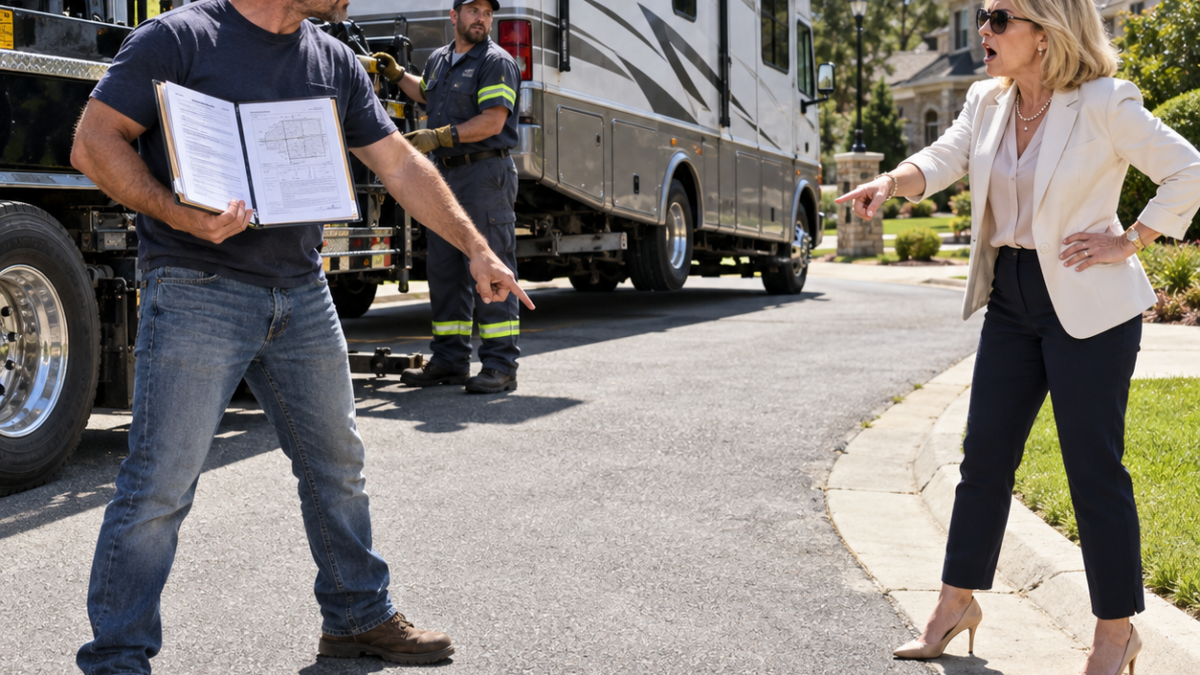
The HOA president stood beside my $300,000 motor home and smiled while a tow truck dragged away the last trip my late wife and I had promised each other we would take.
She told me I had no rights on “her” street, ordered the driver to ignore me, and warned that the impound fees would teach me to respect her authority.
I let her leave believing she had won, because there was one detail about that asphalt neither she nor her board had ever bothered to verify.
My name is Jack Callahan.
Thirty years in the Army Corps of Engineers taught me that when somebody starts shouting about boundaries, the smartest thing you can do is stop arguing and find the survey.
That morning, though, I wasn’t thinking like an engineer.
I was thinking about Sarah.
The RV was a forty-foot Class A motor home we had spent years talking about buying.
Grand Canyon.
Yellowstone.
The Pacific Coast Highway.
Sarah used to keep a folded road map in the kitchen drawer with little circles around places she wanted to see.
Then cancer rearranged our calendar.
Doctors told us we might have a year.
We got six months.
After she died, I almost canceled the RV order.
Then I found the map.
Across the top, in Sarah’s handwriting, were five words:
**Don’t you dare stop living.**
So I kept it.
That RV became my retirement plan and, in a strange way, my promise to her.
Which was why watching it bounce over the curb behind a tow truck felt less like losing a vehicle and more like somebody dragging a piece of my marriage away.
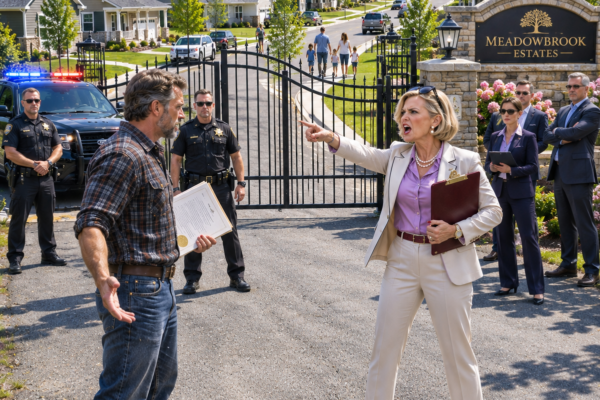
“Karen,” I called, walking barefoot down my driveway. “Stop the tow.”
She folded her arms.
Karen Peterson was president of the Oakwood Preserve Homeowners Association, the subdivision bordering my five-acre property.
She had been sending me violation notices for months.
RV visibility.
Mailbox color.
Landscaping.
Trash cans.
There was one small problem.
I wasn’t in Oakwood Preserve.
Never had been.
“My property is not subject to your HOA,” I said.
Karen pointed toward the road.
“Your property ends at the grass.”
“No, it doesn’t.”
“This street belongs to the association.”
“No, it doesn’t.”
Her smile disappeared.
“Mr. Callahan, I’ve been president of this community for six years.”
“Congratulations.”
“I know exactly what the HOA owns.”
Apparently, she didn’t.
Before building my house, I had paid for a full boundary survey.
My western property line didn’t stop at the curb.
According to the plat, it extended twelve feet into Oakwood Preserve Lane—to the centerline of the private road.
My RV wasn’t parked in the street anyway.
It sat on a reinforced pad entirely inside my parcel.
I explained that.
Karen didn’t care.
She turned to the driver.
“Take it.”
The tow truck lurched forward.
Fiberglass scraped against the curb.
I heard something crack near the rear fender.
My hands curled into fists.
Karen noticed.
For a second, she looked almost pleased.
“Perhaps next time,” she said, “you’ll be more considerate of your neighbors.”
Then she walked away.
I stood there until the tow truck disappeared.
After thirty years around military projects, I’d learned something about anger.
If you use it immediately, you usually waste it.
So I went inside.
I made another cup of coffee.
Then I walked into my office and unrolled the county survey across my desk.
Lot 17.
Five acres.
Oakwood Preserve Lane bordering the east side.
Property line extending directly to the middle of the asphalt.
I stared at it.
Then something bothered me.
If the HOA really owned the road, why did my deed extend into it?
I pulled up the county parcel information.
The road wasn’t listed as county property.
I searched the HOA parcel database.
Nothing obvious appeared there either.
By noon, I had my RV’s impound location.
By one o’clock, I had photographs of the scrape and cracked rear fender.
By two, I had paid $3,200 under written protest to get my own vehicle back.
And the next morning, when the county records office opened, I was waiting at the door.
The clerk eventually brought me boxes covering the original Oakwood Preserve development.
Plat maps.
Covenants.
Bankruptcy filings.
Common-area records.
Deeds.
For three days, I read every page.
Then I found the missing document.
Or, more accurately, I discovered it had never existed.
The bankrupt developer had created the HOA.
He had recorded the neighborhood restrictions.
But the deed transferring the private streets and several common areas to the HOA had never been completed.
I read that section twice.
Then a third time.
I pulled out my survey.
I pulled out the county plat.
I checked the ownership rules.
And suddenly I understood why Karen had been able to bully people for years.
Nobody had checked.
I leaned back in the archive chair and stared at the documents spread across the table.
Karen Peterson thought she had towed my RV from her street.
What she had actually done was order a private company onto my land to remove my $300,000 property.
And according to the records in front of me, half the street she had been standing on while she gave the order…
was mine.
PART 2
I didn’t celebrate.
Not yet.
One of the easiest mistakes people make when they discover they’re right is rushing out to tell the person who’s wrong.
I had spent three decades building bridges, drainage systems, access roads, and military infrastructure. I had watched contractors destroy good cases by talking too much before the paperwork was finished.
So I sat there in the basement of the county records building with a yellow legal pad and started making a list.
First: establish exactly who owned Oakwood Preserve Lane.
Second: establish exactly what authority, if any, the HOA had over parking and towing on that road.
Third: document the RV damage.
Fourth: document every dollar I had paid.
Fifth: find out whether Karen had done this to anybody else.
That last item changed everything.
At first, I was angry because she had touched something Sarah and I had dreamed about together.
By the end, I would realize the RV was only the door through which I entered a much bigger problem.
The county clerk, Martha Bell, had been watching me disappear beneath stacks of old development files for three days.
On the afternoon I found the missing deed, she rolled her chair toward the counter.
“You find what you were looking for?”
I tapped the folder.
“I found what isn’t here.”
She pushed her reading glasses higher on her nose.
“Sometimes that’s the more important discovery.”
“You remember this development?”
“Oakwood Preserve?”
“Yes.”
She laughed without humor.
“Everybody remembers Oakwood Preserve.”
“Why?”
“The developer went bankrupt halfway through phase two. There were subcontractor liens, half-finished drainage work, arguments about the entrance landscaping. Mess.”
“Was the road ever dedicated to the county?”
“No.”
“Transferred to the HOA?”
She frowned.
“If it was, there should be a deed.”
“There isn’t.”
Martha glanced at the documents.
“Then you’d better talk to a property lawyer before doing anything dramatic.”
“I don’t do dramatic.”
She looked at me over her glasses.
“You’re a retired colonel with six banker boxes around you.”
“Lieutenant colonel.”
“That correction proves my point.”
I smiled for the first time in three days.
On the drive home, I didn’t go directly to my house.
I stopped three houses inside Oakwood Preserve.
A retired Marine named Dave Jensen lived there.
Dave and I had met shortly after I built my place.
He had been standing on a ladder installing a twenty-foot flagpole in his front yard while Karen stood on the sidewalk holding a clipboard and telling him the HOA allowed only wall-mounted flags.
Dave looked down at her and said, “Ma’am, I survived Fallujah. I can probably survive your architectural committee.”
We’d been friends ever since.
When I pulled into his driveway, he was in the garage cleaning golf clubs.
He glanced at the binder under my arm.
“That looks unpleasant.”
“It is.”
“Tax audit?”
“Worse.”
“Prostate results?”
“HOA.”
He set down the club.
“Come in.”
I spread the papers across the hood of his truck.
“What did she do now?” he asked.
“She had my RV towed.”
Dave stopped moving.
“The one you bought for Sarah?”
“Yes.”
His face hardened.
“From your driveway?”
“From my RV pad.”
“That woman has finally lost her damn mind.”
“That’s not the interesting part.”
I showed him the survey.
Then the recorded plat.
Then the development files.
Then the missing transfer.
Dave read slowly.
Unlike Karen, he understood maps.
He traced one finger down the line.
“Your boundary goes to the middle of the road.”
“Yes.”
“And mine?”
“Most likely the same.”
He looked at me.
“Most likely?”
“I haven’t pulled your individual deed yet.”
“But the street isn’t HOA property.”
“Not from anything I’ve found.”
Dave stared down Oakwood Preserve Lane.
For six years, Karen had treated it like her personal parade route.
She regulated parking.
She prohibited commercial vehicles overnight.
She fined homeowners for leaving basketball hoops too near the curb.
She threatened teenagers for chalk drawings.
She once sent Dave a $500 violation because three cars had parked outside his house during his daughter’s birthday dinner.
“Son of a—”
“Gunny.”
He stopped.
“What?”
“Don’t scare the documents.”
He looked back at the file.
“She fined me for parking on a road she doesn’t own.”
“That appears to be what happened.”
“She threatened a lien.”
“Yes.”
“And my flagpole?”
“That may be different. Your lot is inside the HOA, so architectural restrictions could still apply depending on your covenants.”
He sighed.
“You always ruin the fun with accuracy.”
“It’s a character flaw.”
Then Dave’s face changed.
Not anger.
Recognition.
“Jack.”
“What?”
“You need to talk to Mrs. Gable.”
“Who?”
“House number fourteen. Widow. Little white place with the roses.”
“I’ve seen it.”
“You’ve seen the garden gnomes?”
“Yes.”
“Karen has been after her about them for two years.”
“Garden gnomes?”
“They were her husband’s.”
I looked at him.
Dave nodded.
“Ed Gable bought one everywhere they traveled. Cheap little things. Wisconsin. Arizona. Florida. One from some tourist trap in Branson. After he died, she put them around the roses because she said looking at them made the yard feel like he was still there.”
“What did Karen do?”
“Threatened fines.”
My grip tightened on the binder.
“How much?”
“Don’t know.”
We visited Mrs. Gable that evening.
She opened the door cautiously.
Dave smiled.
“Ma’am, I brought Jack Callahan.”
Her face softened.
“Oh. The gentleman with the big motor home.”
“Yes, ma’am.”
She looked embarrassed.
“I hope you don’t mind me saying so, but it’s beautiful.”
“Thank you.”
“My Ed always wanted one.”
That was how we ended up sitting at her kitchen table drinking coffee from china cups while she brought out a grocery bag full of HOA letters.
There were twenty-seven.
Some were ordinary.
Trim shrubs.
Pressure-wash driveway.
Replace a broken porch light.
Others were ridiculous.
Remove lawn ornament.
Unauthorized decorative item.
Excessive seasonal display.
Noncompliant garden accessories.
One letter threatened a continuing fine of fifty dollars per day if she didn’t remove the gnomes.
“How much have you paid?” I asked.
Her fingers tightened around the coffee cup.
“About eighteen hundred dollars.”
Dave swore quietly.
Mrs. Gable looked down.
“I know it sounds foolish.”
“No,” I said. “It doesn’t.”
“They kept saying they could put a lien on the house.”
“Did anyone explain the appeal process?”
“I tried going to a meeting.”
“What happened?”
“Karen said I was wasting everybody’s time.”
She smiled sadly.
“Ed handled things like that. After he died, I wasn’t very good at standing up for myself.”
Something about that sentence hit me harder than I expected.
After Sarah died, people praised me for being strong.
I hated that word.
Strong usually meant I had learned to do the things she used to do before anybody noticed I was struggling.
Cook for one.
Sleep on one side of a bed.
Remember trash day.
Answer invitations alone.
I looked through Mrs. Gable’s kitchen toward the back window.
Tiny painted gnomes stood among rose bushes.
A fisherman.
A firefighter.
One holding a suitcase.
A stupid little collection.
And probably priceless to her.
“What would Ed have said about Karen?” I asked.
Mrs. Gable smiled.
“He’d have been arrested.”
Dave laughed so hard he nearly spilled his coffee.
Before we left, I asked if I could copy the letters.
“What for?”
“I’m trying to understand how the association has been operating.”
“Are you going to sue them?”
“I don’t know yet.”
She touched the grocery bag.
“If it helps somebody else, take all of it.”
That was the night my problem stopped being about a tow bill.
Over the next week, Dave and I talked quietly to residents.
We didn’t announce a rebellion.
We didn’t post anything online.
We knocked on doors.
The Millers had a backyard playset Karen said was visible above their fence.
They had spent almost $2,000 modifying it twice.
A teacher named Rachel Boone had paid a fine because her sister’s car remained parked at the curb for two nights after a snowstorm.
A young couple, Marcus and Elena Ramirez, had been warned that their son’s basketball hoop was a “visual nuisance.”
Dave had a folder full of letters about his flagpole.
And almost everybody had paid something.
Not because they believed Karen was right.
Because lawyers were expensive.
Because liens sounded terrifying.
Because nobody wanted to be labeled the difficult neighbor.
Fear had become Karen’s enforcement mechanism.
My tow was simply the first time she had tried the same tactic on someone outside the association.
That distinction mattered.
I called Charles Albright.
Charlie had been Army JAG before becoming a real-estate attorney.
Dave had used him years earlier in a boundary dispute.
He listened to me for almost an hour without interrupting except to ask for document numbers.
When I finished, he was silent.
“Charlie?”
“I’m here.”
“Well?”
“You have two cases.”
“Explain.”
“First, your personal claim. Unauthorized entry onto your parcel, potentially wrongful tow, conversion, property damage, recovery of fees.”
“And the second?”
“The HOA governance mess.”
“They don’t own the roads.”
“Maybe.”
“Maybe?”
“You know better than that, Jack.”
I did.
Finding a missing deed wasn’t the same as obtaining a judicial declaration.
Records could be incomplete.
Rights could arise through other instruments.
Easements could exist.
Dedications could be implied.
Charlie continued.
“We verify everything. Title search. Deed chain. Development agreement. Road maintenance agreements. County acceptance records. State statutes.”
“Agreed.”
“Don’t paint anything. Don’t block anything. Don’t dig trenches.”
“I wasn’t planning trenches.”
“With engineers, I clarify.”
Two days later he called.
“You sitting down?”
“No.”
“Sit down.”
I sat at the kitchen table.
“The title company agrees with you.”
“Road?”
“Private. Never dedicated to the county. No recorded conveyance to the HOA. Adjacent parcels appear to hold fee ownership to centerline, subject to access easements benefiting the homeowners.”
“So I own half the road.”
“Fee interest in the underlying strip, yes.”
“Karen?”
“Has an easement right to pass over it. The HOA may have maintenance authority under the covenants, but that does not magically give them ownership, and it certainly doesn’t give them authority to tow a vehicle from your RV pad.”
I smiled.
“How bad is the tow?”
“Very.”
“Good.”
“No. Not good.”
“You know what I mean.”
“I do. I just enjoy disappointing you.”
“What next?”
“Professional resurvey. Then demand letter. Then, if necessary, injunction.”
I called Marcus Bell, a surveyor who had worked on several Corps projects before starting his own company.
He came out Tuesday morning with two technicians.
They set up instruments on Oakwood Preserve Lane.
Curtains started moving immediately.
Twenty minutes later, Karen appeared.
Of course she did.
She marched down the sidewalk wearing white slacks and a floral blouse, phone already in her hand.
“What is happening?”
Marcus looked through his instrument.
“Boundary survey.”
“Authorized by whom?”
“Property owner.”
“I am asking who authorized you to obstruct HOA property.”
Marcus looked at me.
I was sitting on my porch.
He understood instantly that he didn’t want this assignment to become a neighborhood reality show.
“Ma’am, we’re working within our survey authority. We won’t be long.”
Karen spotted me.
“Mr. Callahan!”
“Morning, Karen.”
“What are you doing?”
“Drinking coffee.”
“You hired these people.”
“Yes.”
“For what?”
“To determine where my property ends.”
“I already told you where it ends.”
“So did the county.”
She stepped off the sidewalk.
“Your little stunt is not going to change association boundaries.”
“Good.”
She blinked.
“Good?”
“I don’t want to change anything.”
I stood.
“I want the existing line marked.”
Marcus’s crew began installing temporary markers.
The first stake went into a preexisting joint near the center of the road.
Karen stared at it.
“What is that?”
“My boundary.”
“No.”
Marcus checked his measurements.
“Actually, ma’am, yes.”
She rounded on him.
“Who paid you?”
“Mr. Callahan.”
“So you’re working for him.”
“I’m a licensed surveyor.”
“That doesn’t answer my question.”
“It answers the important one.”
Dave was watching from his driveway.
I could see his shoulders shaking.
Marcus’s crew continued.
Stake.
Ten feet.
Stake.
Ten feet.
A bright line of pink ribbons ran down the road.
Karen followed them like a general watching enemy troops advance.
“You cannot mark our street.”
I handed her a copy of the preliminary title findings.
“It’s not your street.”
She slapped the paper away.
“I am not reading your propaganda.”
“That’s unfortunate.”
“Remove these stakes.”
“No.”
She pointed at me.
“You are intentionally disrupting this community.”
“You had my RV towed from my property.”
“You violated the rules.”
“I don’t belong to your HOA.”
“You benefit from the neighborhood.”
“What does that have to do with jurisdiction?”
“Everything!”
That single word told me more about Karen than all her letters.
To her, authority wasn’t created by law or documents.
It was created by proximity to her.
She believed because she supervised Oakwood Preserve, anything touching Oakwood Preserve belonged under her control.
When the survey crew finished, Marcus handed me a stamped report.
“Centerline ownership is consistent with the deed calls.”
Karen heard him.
Her face turned red.
“You are making a serious mistake.”
I looked at her.
“So did your tow company.”
She stormed away.
That afternoon Charlie sent the first formal demand.
It was professional.
No insults.
No threats beyond lawful remedies.
It identified the unauthorized tow.
The $3,200 impound charge.
The estimated RV repairs.
Survey costs.
Attorney expenses.
It demanded preservation of all HOA records regarding my property.
Most importantly, it notified the board that my parcel was not subject to HOA covenants and that no association agent had permission to enter my property for enforcement activity.
We sent copies to every board member.
Certified mail.
Return receipt.
Then we waited.
The board’s vice president, a quiet accountant named Paul Friedman, called Charlie two days later.
Apparently, he had never been told the RV had been towed from outside the HOA.
Another member, Linda Cho, hadn’t known either.
Karen had authorized it herself.
That was useful.
But it also made her dangerous.
The more isolated she became, the more personally she took the challenge.
At 2:17 the following morning, my security camera sent an alert.
I opened the app.
Karen was standing in the road.
She wore a pink tracksuit.
For a moment, I genuinely wondered if I was dreaming.
Then she bent down, grabbed one of the survey stakes, and pulled.
It didn’t move.
She braced one foot against the asphalt.
Pulled again.
The stake came free.
She threw it onto my grass.
I sat upright in bed.
“No way.”
She walked to the next one.
Pulled.
Threw.
Next.
Pulled.
Threw.
I watched in absolute disbelief as the president of Oakwood Preserve spent twenty minutes removing professionally placed boundary markers in the middle of the night.
Halfway through, she stopped and leaned against a mailbox.
Then she continued.
I saved the recording in three locations.
The next morning I called Marcus.
“Remember the woman from yesterday?”
“The angry one?”
“Yes.”
“That doesn’t narrow it down much.”
“Pink tracksuit.”
“Oh.”
“She removed every stake.”
Silence.
“Every one?”
“I have video.”
Marcus sighed.
“What do you want to do?”
“Reestablish the line.”
“Stakes again?”
“No.”
I had already spoken with Charlie.
We were careful.
The source story made the yellow line look like something I simply decided to paint, but in real life, property rights, easements, road markings, and traffic safety can intersect in complicated ways.
Charlie verified what could legally be done on the private road and how to avoid interfering with access rights.
Once he was satisfied, Marcus’s crew returned and applied a visible temporary boundary stripe at the surveyed centerline.
Bright yellow.
Straight.
Impossible to pretend wasn’t there.
Karen came outside halfway through.
She stopped.
I saw the moment she understood what the line meant.
It ran past my property for nearly five hundred feet.
Her association had access rights over the road.
But the dirt and pavement beneath half that width belonged to me.
I walked to the edge of my lawn.
Karen pointed at the stripe.
“Remove that.”
“No.”
“You’re vandalizing community property.”
“It isn’t community property.”
“You’re trying to humiliate me.”
That surprised me.
“Karen, this has never been about humiliating you.”
“Yes, it has.”
“You had my RV taken.”
“Because you refused to cooperate.”
“I refused to obey rules that don’t apply to me.”
“Everybody else manages.”
“Everybody else signed covenants.”
She stared at me.
“You think you’re special because you were in the Army?”
“No.”
“Because you’re an engineer?”
“No.”
“Then what makes you think you can challenge the association?”
I looked at the line.
“The deed.”
She walked away shaking.
That day Charlie sent a revised notice.
It demanded reimbursement.
It demanded repair costs.
It informed the HOA that I would enforce my property rights while respecting legitimate access easements.
It also included a secure link.
Night-vision footage.
Karen in the pink tracksuit.
Pulling survey markers.
One by one.
Paul Friedman called me personally that evening.
“I watched the video.”
“I assumed someone would.”
“Jack, I had no idea.”
“You’re on the board.”
“I know.”
“That’s why you should have had an idea.”
He was silent.
Then he said, “You’re right.”
That answer mattered.
People who are used to power almost never say it.
Karen did not.
She called an emergency board meeting.
Then canceled it when she discovered Paul and Linda intended to question her towing authority.
Instead, she posted a message on the neighborhood portal accusing me of conducting a “hostile campaign against Oakwood Preserve.”
The effect was the opposite of what she intended.
Residents started asking questions.
Why was the surveyor marking the middle of the road?
Why had an RV been towed from outside the HOA?
Why were attorney letters arriving?
Why was the president photographed removing survey markers at two in the morning?
Dave called me laughing.
“Her message board is on fire.”
“Stay off it.”
“I’m just reading.”
“Do not post.”
“You’re no fun.”
“We’re building a legal record, not campaigning.”
“We could do both.”
“No.”
“Yes, sir.”
He paused.
“Jack?”
“What?”
“Mrs. Gable wants to know whether the HOA can legally fine her for the gnomes.”
“That depends on the covenants.”
“She says you’re avoiding the important question.”
“I am.”
“She says Sarah would have liked her.”
I closed my eyes.
Dave didn’t say things like that casually.
“How does she know anything about Sarah?”
“I told her about the RV.”
I didn’t answer.
“You okay?”
“Yeah.”
But I wasn’t entirely.
That weekend I went into the motor home alone.
The tow damage had been temporarily sealed, but the long scratch remained.
Sarah’s map was still in the drawer beside the dinette.
I unfolded it.
There were her circles.
Yellowstone.
Yosemite.
Sedona.
Olympic National Park.
A little heart near the Pacific Coast Highway.
For months after she died, I had treated the RV like a museum.
Kept it spotless.
Checked the systems.
Started the engine.
Never traveled.
I told everybody I was waiting until the right time.
The truth was simpler.
Going without Sarah felt like admitting she was really gone.
I sat at the dinette and touched the words she had written.
Don’t you dare stop living.
“You’d be furious with me,” I said.
The motor home was silent.
“You’d also hate Karen.”
That made me laugh.
Then I folded the map carefully and put it back.
The neighborhood confrontation reached its first real climax at the monthly HOA meeting.
Normally twelve people attended.
That night, nearly seventy crowded into the clubhouse.
I wasn’t a member, so I had no voting rights.
But I had been invited by homeowners and Charlie attended as my attorney.
Dave sat beside Mrs. Gable.
The Millers came.
Rachel Boone came.
The Ramirezes came.
Paul and Linda sat at the board table.
Karen entered last.
She wore a navy suit.
No clipboard.
No smile.
She banged the gavel.
“This meeting is called to order.”
Immediately, somebody shouted, “Who owns the road?”
Karen ignored it.
“We have become aware of a coordinated misinformation campaign being conducted by an adjacent property owner.”
Dave muttered, “That’s you.”
“Thank you, Gunny.”
Karen continued.
“This individual has attempted to disrupt services, intimidate board members, interfere with contractors, and damage community cohesion.”
Charlie leaned toward me.
“Don’t react.”
“I know.”
“You’re smiling.”
“I can smile.”
“Not like that.”
Karen spent seven minutes describing me as if I were a hostile foreign power.
Then she made her mistake.
She said, “The HOA’s ownership of Oakwood Preserve Lane is beyond dispute.”
Charlie stood.
Karen stopped.
“Who are you?”
“Charles Albright. Counsel for Jack Callahan.”
“This is a members-only business meeting.”
Paul Friedman spoke.
“Homeowners invited him.”
Karen looked at him sharply.
Paul didn’t move.
Charlie held up a binder.
“Since my client’s actions have occupied the first ten minutes of your meeting, I believe basic fairness permits a response.”
The room murmured.
Karen looked around and realized she would lose the room if she refused.
“Five minutes.”
“I’ll try to be efficient.”
He connected his laptop to the clubhouse screen.
First slide.
The original Oakwood Preserve plat.
Second.
Developer deed history.
Third.
The roads.
Fourth.
My survey.
Charlie explained what we had found.
The developer created the HOA.
Recorded covenants.
But never completed the conveyance of the private road.
Fee ownership followed the adjoining parcels to the centerline, subject to access rights.
Hands started going up.
Karen interrupted.
“This is a gross oversimplification.”
Charlie nodded.
“That’s possible, which is why we commissioned a title examination.”
He displayed the title opinion.
“This confirms the recorded chain we have described.”
The room changed.
You could feel it.
People began looking at Karen differently.
Not yet with anger.
With doubt.
Doubt is much worse for someone whose power depends on certainty.
Then Charlie showed photographs of my RV.
The paved pad.
The property line.
The damage.
The tow invoice.
$3,200.
A homeowner called out, “The HOA charged an administrative fee?”
Charlie enlarged the invoice.
There it was.
HOA ADMINISTRATIVE RELEASE: $2,000.
Karen’s face went rigid.
Paul turned toward her.
“What is that?”
Karen whispered something.
“What?” Paul asked.
“It is standard enforcement reimbursement.”
Paul stared.
“I’ve never seen that fee.”
Another homeowner shouted, “Where does that money go?”
Karen struck the gavel.
“Order!”
Charlie lifted one hand.
“We have asked for accounting records relating to that charge.”
Then came the video.
2:17 a.m.
Black-and-white image.
Pink tracksuit.
Karen.
Pulling out the first marker.
Someone gasped.
The second marker.
Third.
Fourth.
Mrs. Gable whispered, “Oh, my.”
The footage accelerated.
Karen waddled down the road, removing stake after stake.
By the end, even people who hated me would have had difficulty defending it.
Charlie paused on a clear frame.
“Those markers were installed by a licensed surveyor to identify my client’s property boundary.”
Karen stood.
“That video was taken without my consent.”
A homeowner laughed.
“You were in the road!”
Karen slammed the gavel.
“This meeting will come to order!”
Nobody listened.
Voices came from everywhere.
“I paid $750 for street parking!”
“Do we even have authority to fine for that?”
“What about towing?”
“Where did the two thousand dollars go?”
“Why were you out there at two in the morning?”
Dave stood.
He didn’t shout.
That made everyone quieter.
“I have one question.”
Karen glared at him.
“What?”
“You’ve spent six years telling us to follow the rules.”
He pointed at the frozen image of her pulling out the stake.
“Which rule is that?”
Silence.
Mrs. Gable began clapping.
One person joined.
Then another.
Karen’s face turned white.
“Enough!”
She grabbed the microphone.
“You people have no idea what I have done to protect your property values.”
Rachel Boone stood.
“You threatened an eighty-two-year-old woman over garden gnomes.”
“They violated decorative standards.”
Mrs. Gable lifted her chin.
“My husband bought those.”
Karen froze.
Mrs. Gable continued.
“He bought one on every trip we took for thirty-eight years.”
Her voice shook.
“You made me feel ashamed of remembering my husband.”
Nobody moved.
“That,” she said quietly, “was cruel.”
Karen looked away.
It should have ended there.
A person with perspective would have resigned.
A person with even a little humility would have apologized.
Karen did neither.
She stared at me across the room.
“This man is manipulating all of you.”
I didn’t stand.
I didn’t answer.
That made her angrier.
“You think you’re winning, Mr. Callahan?”
Charlie whispered, “Don’t.”
I stayed seated.
Karen pointed at me.
“This community existed before you arrived.”
Dave said, “Actually, his parcel predates phase two.”
A few people laughed.
Karen snapped, “Shut up, Dave!”
That killed whatever authority she had left.
Paul Friedman stood.
“I move that the board suspend all nonessential enforcement activity until counsel reviews our authority and finances.”
Linda seconded immediately.
Karen looked at them.
“You can’t do that.”
“We’re directors,” Paul said.
“I am president.”
“One vote,” Linda replied.
A homeowners’ room that had feared Karen for years watched two of her own board members defy her.
The motion passed.
Karen gathered her papers.
She walked out without adjourning the meeting.
Charlie waited until the door slammed.
Then he looked at me.
“She’ll either get a lawyer or do something incredibly stupid.”
“Which do you think?”
He glanced toward the door.
“Stupid.”
Two mornings later, I was sanding maple in my workshop when I heard the diesel engine.
Heavy.
Low.
Then the warning beeper of a truck backing.
Beep.
Beep.
Beep.
I put down the sander.
Walked to the front window.
Another tow truck sat beside my RV.
For three seconds I simply stared.
Then I saw Karen.
She was standing near the curb pointing at the motor home.
The driver had already backed toward my pad.
I didn’t feel anger.
I felt disbelief.
After the survey.
After the title report.
After the demand letter.
After the board meeting.
After the video.
She was trying again.
I called Charlie.
“It’s happening.”
“What?”
“Second tow.”
There was a pause.
“You’re kidding.”
“No.”
“Call law enforcement. Now. Don’t touch anybody. Record everything.”
“Understood.”
My second call was emergency dispatch.
“My name is Jack Callahan. I’m at 125 Oakwood Preserve Lane. A tow company is currently attempting to remove my motor home from private property without authorization.”
“Is there a dispute over the vehicle?”
“No. I own it. I have the title.”
“Is anyone armed?”
“I am not. I don’t know about the driver.”
“Stay at a safe distance. Officers are being sent.”
My third call was Dave.
He answered on the first ring.
“Yeah?”
“She came back.”
“No.”
“Yes.”
“Tow truck?”
“Yes.”
“I’ll be there.”
“Dave.”
“What?”
“Calm.”
“I’m always calm.”
“Bring your phone, not your Marine Corps.”
He hung up.
I stepped outside recording.
The tow driver was large, maybe forty, ponytail down his back.
He was feeding a chain under the RV.
“Sir.”
He looked up.
“This vehicle is on private property.”
He glanced at Karen.
She yelled, “Ignore him.”
I kept my eyes on the driver.
“I am the registered owner. You do not have permission to move it.”
“HOA ordered the tow.”
“The HOA has no jurisdiction over this parcel.”
Karen marched toward me.
“You have been warned repeatedly.”
“Karen, get off my property.”
“I am standing on the association easement.”
“Then stay within the access area and stop directing someone to take my vehicle.”
The driver hesitated.
Karen pointed at the RV.
“Hook it!”
I raised my phone so the camera clearly captured her.
“Karen, you are being recorded instructing this man to remove a vehicle worth more than three hundred thousand dollars from land you have been formally notified you do not control.”
“Good.”
That word was a gift.
“Did you hear that?” I asked the driver.
He stopped.
Karen shouted, “You were hired to tow it!”
The driver looked miserable.
“I was told this was HOA common property.”
“It isn’t.”
“He’s lying!”
I held up the survey.
“I have the recorded documents.”
A police cruiser turned the corner.
Lights flashing.
The tow driver immediately stepped away from the chain.
Officer Michael Reyes got out.
He was tall, maybe mid-thirties.
He looked first at me.
Then Karen.
Then the RV.
Then the yellow centerline.
“Who’s the vehicle owner?”
“I am.”
“Who ordered the tow?”
“I did,” Karen said.
Reyes looked at her.
“Why?”
“HOA violation.”
He turned back to me.
“Are you in the HOA?”
“No.”
Karen interrupted.
“He uses our street.”
Reyes raised one hand.
“One at a time.”
Then Charlie arrived.
Of course he arrived in a black sedan that made him look far more expensive than he was.
He carried a briefcase.
Dave appeared from his driveway.
Then the Millers.
Rachel.
Three more neighbors.
Phones came out.
A local Channel 4 van pulled in behind Charlie.
I stared at Dave.
He shrugged.
“My buddy works assignment desk.”
“You called television?”
“You said bring my phone, not that I couldn’t call other phones.”
“You are impossible.”
Officer Reyes looked increasingly annoyed.
Charlie approached.
“Officer, Charles Albright, counsel for Mr. Callahan.”
He handed over the plat, survey, title report, demand notice, and proof the HOA had received it.
Reyes read.
Then he walked to the RV pad.
He examined the survey markers.
He looked at the stripe.
He walked back.
“Ma’am, this RV appears to be parked on Mr. Callahan’s private parcel.”
Karen shook her head violently.
“No. The HOA controls everything visible from Oakwood Preserve Lane.”
“Control isn’t the same as ownership.”
“You don’t understand our covenants.”
“Is his property subject to those covenants?”
“Yes.”
Charlie said, “No.”
Karen shouted, “Stay out of this!”
Reyes looked at Charlie.
“Documentation?”
Charlie handed him my deed.
“No declaration reference. No accession agreement. No HOA membership.”
Reyes looked at the tow driver.
“Do not move that vehicle.”
The driver nodded immediately.
Karen stepped between them.
“I authorized the tow.”
Reyes’s patience thinned.
“And I’m telling him not to move it.”
“You work for this community.”
“No, ma’am. I work for the city.”
“This is private property.”
“Exactly.”
For half a second I almost admired the neatness of that answer.
Then Charlie removed another document.
“Officer, there is one more issue.”
He handed Reyes a copy of a temporary restraining order we had obtained after escalating conduct and the second threatened enforcement action.
It prohibited Karen from entering specified portions of my property and from directing agents to remove or interfere with my personal property pending the hearing.
Reyes read it.
Then looked at Karen.
“Have you been served with this?”
“Yes, but—”
“When?”
“Yesterday.”
“You understand it orders you not to interfere with his property?”
“It was improperly obtained.”
“That is something your lawyer can address in court.”
“He is terrorizing us!”
I actually looked behind me.
At my house.
My workshop.
The RV.
Then back at Karen.
“I was sanding a bookshelf.”
Dave muttered, “Menacingly.”
I glared at him.
Officer Reyes walked toward Karen.
“Ma’am, I need you to step away from his property.”
“I am the HOA president.”
“That has nothing to do with my instruction.”
“I am not leaving.”
“Then I am going to ask one more time.”
The Channel 4 camera was rolling.
Neighbors were recording.
Karen saw every lens.
I think that humiliation pushed her over the edge.
She pointed at me.
“This is my neighborhood! He moved here and decided he could do whatever he wanted!”
I finally answered.
“I built on land I own.”
“You painted our road!”
“My property line.”
“You blocked our services!”
“I never blocked lawful access.”
“You turned everyone against me.”
“No, Karen.”
I looked toward Mrs. Gable, who had come slowly down the sidewalk.
“You did that yourself.”
Karen stared at the crowd.
Nobody defended her.
Not one person.
Officer Reyes said quietly, “Hands behind your back.”
She looked at him as if he had spoken another language.
“What?”
“You are being detained.”
“You can’t arrest me.”
“Turn around.”
“I have done nothing wrong.”
“You are violating a court order after documented notice, and we’ll sort out the remaining allegations through the proper process.”
She backed away.
Reyes took her arm.
Karen jerked it free.
The crowd gasped.
Reyes’s tone changed.
“Do not pull away from me.”
Then, finally, she stopped.
He placed the cuffs on.
Click.
Click.
I had imagined that moment.
I wish I could tell you it felt glorious.
It didn’t.
It felt sad.
Not for Karen.
For how unnecessary everything had been.
One apology after the first tow could have prevented all of it.
One phone call to a lawyer.
One board vote.
One sentence:
**We made a mistake.**
Instead, pride had carried her from a bad decision to a public arrest.
Mrs. Gable stood beside me.
“She looks frightened.”
“She probably is.”
“I thought I’d enjoy this more.”
“So did I.”
Mrs. Gable nodded.
“Maybe that’s good.”
I looked at her.
“Why?”
“Because if we enjoyed people being destroyed, we’d be more like her.”
I never forgot that.
The Channel 4 report aired that evening.
They interviewed Charlie.
Dave.
The Millers.
They asked me to appear.
I almost refused.
Then the reporter asked why the RV mattered.
I looked through the windshield toward Sarah’s empty passenger seat.
“Because my wife and I were supposed to travel in it.”
The reporter lowered her microphone slightly.
“Was she unable to?”
“She died before we could.”
“I’m sorry.”
I nodded.
“She left me a note telling me not to stop living.”
“So this wasn’t just a vehicle.”
“No.”
“What was it?”
I looked at the RV.
“A promise I hadn’t figured out how to keep yet.”
That part of the interview aired.
Not the angry legal sections.
Not the jokes.
That.
The next morning I had eleven voicemail messages from strangers.
Widowers.
Widows.
Veterans.
One man said he had kept his wife’s sewing room untouched for nine years and understood exactly what I meant.
I listened to that message twice.
The legal fallout moved more slowly than television.
Real life usually does.
Karen’s criminal charges were reviewed based on what officers, prosecutors, and the court believed the evidence supported.
The towing companies were pulled into civil claims.
The first company suddenly became eager to refund the $3,200.
Charlie declined the initial offer.
“They damaged the vehicle.”
“They’ll pay repairs.”
“They also entered private property.”
“They’ll pay legal fees.”
I smiled.
“Now you’re speaking my language.”
The HOA board held an emergency meeting forty-eight hours after the arrest.
Karen was suspended.
Paul Friedman became acting president.
Linda Cho became treasurer.
The third board member resigned.
Then came the audit.
That was ugly.
Karen hadn’t personally stolen millions.
The reality was smaller and somehow more believable.
Questionable administrative fees.
Enforcement surcharges.
Unapproved reimbursements.
Tow referral payments.
Consulting expenses.
Legal invoices nobody remembered approving.
Several fines had been imposed under interpretations of the covenants that association counsel later found indefensible.
Street-parking enforcement was especially problematic because ownership and maintenance authority had never been properly resolved.
Homeowners started demanding refunds.
Paul called me.
“Jack, we have a problem.”
“Only one?”
“Fair.”
“What do you need?”
“Charlie says we need to clarify title to the roads.”
“You do.”
“We want to pursue dedication to the county.”
“That could take time.”
“We know.”
“Surveys.”
“Yes.”
“Road standards.”
“Yes.”
“Possible upgrades.”
“Yes.”
“Storm drainage.”
Paul sighed.
“You are enjoying this.”
“A little.”
“Will you cooperate?”
That was the question.
I could have refused.
Legally, I had leverage.
A lot of it.
For weeks, Karen had treated ownership like a weapon.
I could have done the same.
Instead I thought about Mrs. Gable.
The Millers.
Kids riding bicycles.
Delivery drivers trying to figure out who controlled which twelve feet of pavement.
A neighborhood cannot function indefinitely as a property-law puzzle.
“I’ll cooperate,” I said.
Paul exhaled.
“Thank you.”
“On conditions.”
“Of course.”
“Full settlement of my tow claim.”
“Reasonable.”
“Correction of every HOA record claiming jurisdiction over my lot.”
“Done.”
“Written acknowledgment that my parcel is outside the association.”
“Yes.”
“Independent review of fines related to road use.”
He hesitated.
“That could be expensive.”
“So was my tow.”
“Fair.”
“And Karen does not participate.”
“She won’t.”
“Then I’ll cooperate.”
The next week, Charlie called.
“You’re getting soft.”
“No.”
“You could make them suffer.”
“What would that accomplish?”
“Satisfaction.”
“I’ve met satisfaction. Overrated.”
“You’ve changed.”
“Sarah used to say revenge was like setting your own porch on fire because you’re angry at your neighbor.”
Charlie paused.
“She actually said that?”
“No.”
“I thought it sounded too polished.”
“She would have told me to stop being an ass.”
“That I believe.”
The HOA accepted the settlement.
My RV repairs cost more than expected.
The rear body panel had cracked near a mounting point.
Paint had to be matched.
The tow company and association insurers eventually covered the repair, fees, surveys, and agreed legal costs.
But the check wasn’t what brought closure.
It was watching Paul stand in front of sixty homeowners and say:
“The association was wrong.”
No qualification.
No passive voice.
No “mistakes were made.”
He continued.
“We enforced authority we did not properly possess. We failed to supervise the president. Some homeowners paid fees they should not have been charged. We are going to correct that.”
Mrs. Gable raised her hand.
“What about my gnomes?”
The room laughed.
Paul smiled.
“Your gnomes are safe.”
She pointed at him.
“That’s going in the minutes.”
“It will.”
Dave stood.
“And my flagpole?”
Paul groaned.
“One crisis at a time, Gunny.”
For the first time, an HOA meeting sounded like neighbors instead of subjects appearing before a tribunal.
Karen resigned officially before the board could vote to remove her.
She sent a three-page letter blaming misinformation, hostile residents, legal technicalities, media harassment, and “outside agitation.”
She never apologized.
Not to me.
Not to Mrs. Gable.
Not to the board.
Maybe some people can’t survive admitting they were wrong because they have built their identity around always being right.
I stopped waiting for her apology.
That turned out to be its own kind of freedom.
The process of dedicating Oakwood Preserve Lane to the county took months.
Engineers inspected pavement width.
Drainage easements had to be corrected.
Title documents were cleaned up.
Surveyors returned so often Marcus joked he deserved a mailbox.
The homeowners approved an assessment to fund required improvements.
Nobody liked paying it.
But they understood what they were buying.
Clarity.
No more pretend ownership.
No more confusion about who could regulate traffic.
No future HOA president deciding where private authority began simply because nobody had checked.
The yellow boundary stripe remained during most of that process.
At first, I loved it.
Every time I saw it, I remembered the moment Karen discovered paperwork was stronger than volume.
But as weeks passed, the line began to bother me.
Kids avoided crossing it when they rode bikes.
Neighbors joked about “Jack’s side” and “HOA side.”
Delivery drivers slowed unnecessarily.
It had been useful as evidence.
Now it was becoming a scar.
One evening, I stood beside the RV while Dave walked over carrying two beers.
He handed me one.
“You’re staring at the road.”
“Observant.”
“You hate the line now.”
“I don’t hate it.”
“You look at it the way you look at overcooked steak.”
I drank.
“It served its purpose.”
“So remove it.”
“County dedication isn’t final.”
“Then wait.”
We stood quietly.
Dave looked at the RV.
“When are you leaving?”
“For what?”
“The trip.”
I said nothing.
He nodded.
“So that’s the real problem.”
“No.”
“You fought World War Three to get that thing back.”
“Property rights.”
“Sure.”
“And wrongful towing.”
“Absolutely.”
“And neighborhood governance.”
“Very important.”
“And none of that explains why it’s still parked here.”
I looked at him.
“You done?”
“No.”
He pointed at the RV.
“You keep saying it was Sarah’s dream.”
“It was ours.”
“Then why aren’t you doing it?”
“I will.”
“When?”
“Soon.”
“You’ve been retired almost a year.”
“Dave.”
“Jack.”
I hated when he copied my tone.
He sat on the curb.
“After Nancy died, I kept her car for four years.”
I had never heard this story.
“You did?”
“Old Subaru.”
“Terrible car.”
“Awful.”
“Transmission?”
“Three transmissions.”
“Why keep it?”
“Because her sunglasses were in the center console.”
I looked at him.
“I told myself I’d sell it when I was ready.”
“What happened?”
“One day my daughter needed money for college. I sold the Subaru.”
“Hard?”
“Worst Tuesday I’ve had outside combat.”
He took a drink.
“But keeping the car wasn’t keeping Nancy.”
I looked toward the RV window.
Dave continued.
“Using the things they left us doesn’t erase them, Jack.”
“I know.”
“Knowing and doing aren’t the same.”
A few days later, Mrs. Gable appeared carrying cookies.
She had developed an alarming habit of arriving whenever I was trying to avoid emotional conversations.
She climbed into the RV.
First time.
Looked around.
“Oh, Sarah would have loved this.”
“You never met Sarah.”
“No.”
“How do you know?”
“Women know.”
I had no defense against that.
She saw the map.
I had left it on the dinette.
She unfolded it.
“Oh.”
“What?”
“All these circles.”
“Places she wanted to go.”
Mrs. Gable read the note.
Don’t you dare stop living.
She looked at me.
“Your wife was bossy.”
I laughed.
“You have no idea.”
“Good.”
She refolded the map.
“Where’s first?”
“I haven’t decided.”
“That’s why you haven’t gone.”
“What?”
“You keep thinking there’s a perfect first trip.”
“There should be.”
“No.”
She placed the map in front of me.
“Pick one.”
“Mrs. Gable—”
“Pick.”
I scanned the circles.
Grand Canyon felt too big.
Yellowstone too complicated.
Pacific Coast too emotional.
Then I saw a small circle near Shenandoah.
Sarah loved fall leaves.
“Virginia.”
“Good.”
“I didn’t say I’m going.”
“You did now.”
Three weeks later, county dedication papers were signed.
Oakwood Preserve Lane officially became a public road.
Ownership questions were resolved through the conveyance process.
Maintenance shifted to the county.
Parking rules became ordinary municipal rules.
Karen’s little kingdom, at least as far as the street went, ceased to exist.
The following Saturday, I rented equipment to remove the yellow stripe.
Dave came outside first.
“You doing it?”
“Yes.”
“Need help?”
“No.”
He brought a chair.
Mrs. Gable brought cookies.
The Millers brought lemonade.
The Ramirez kids brought sidewalk chalk.
Within an hour, half the neighborhood was outside.
I ran the grinder slowly along the stripe.
Yellow disappeared beneath the machine.
Black asphalt emerged.
Dust rose.
The work was loud and hot.
About halfway down the block, I stopped for water.
Mrs. Gable sat beneath an umbrella.
“Looks better,” she said.
“It does.”
“Does that bother you?”
“What?”
“Removing the thing that proved you were right.”
I looked at the remaining stripe.
“No.”
“Good.”
“Why?”
“Because some people would have left it forever just to remind everybody they won.”
I knew exactly who she meant.
I started the machine again.
By late afternoon, the final yellow paint was gone.
Someone fired up a grill.
Music appeared.
Kids drew enormous flowers on the sidewalk.
Dave planted a folding table in the middle of his driveway.
Neighbors who had once avoided HOA meetings stood talking in small groups.
Nobody discussed covenants.
Nobody discussed title.
Nobody discussed Karen.
They talked about football.
School.
Weather.
A new Italian restaurant.
Normal things.
That was when I understood what we’d actually repaired.
Not the road.
Trust.
Karen had turned neighbor against neighbor by making everyone afraid that somebody might report them.
A car too long at the curb.
A child’s toy.
A garden ornament.
A flag.
Fear makes people stay inside.
That Saturday, everybody came out.
Near sunset, Mrs. Gable walked toward my RV carrying something small.
“What’s that?”
“A gift.”
She handed it to me.
A garden gnome.
About ten inches tall.
Little red hat.
Tiny suitcase.
I stared at it.
“You’re joking.”
“His name is Walter.”
“I am not putting a gnome outside my house.”
“Sarah would.”
“You still never met Sarah.”
“I know enough.”
Dave started laughing.
Mrs. Gable pointed to the RV dashboard.
“Take him with you.”
“Why?”
“He’s the traveler.”
I looked at the ridiculous little thing.
Then at her.
“Did Ed buy this one?”
“Yes.”
“Then you keep him.”
“I have thirty-two.”
“Thirty-two?”
“Karen never counted correctly.”
Dave nearly fell out of his chair.
I put Walter on the RV dashboard.
He’s still there.
The morning I finally left for Shenandoah, I woke before dawn.
The neighborhood was quiet.
I loaded clothes.
Food.
Tools I wouldn’t need but couldn’t emotionally leave behind.
Sarah’s map went beside the driver’s seat.
Walter sat on the dash.
At 6:15, I started the engine.
I almost shut it off.
My hand stayed on the key.
The passenger seat was empty.
That’s the cruel thing about grief.
You can spend months preparing for a moment and still be surprised when it arrives.
I looked toward Sarah’s side.
For years, whenever I drove, she controlled the music.
Badly.
She believed navigation instructions were merely suggestions.
She would say “turn here” approximately four seconds after the intersection.
I could hear her voice.
Not literally.
Memory.
“Go, Jack.”
I put the RV into gear.
As I reached the street, porch lights came on.
Dave stood in his driveway holding coffee.
He saluted.
Mrs. Gable waved from her porch in a robe.
The Millers’ children had made a sign.
GO SEE IT ALL, MR. JACK.
I had to stop.
I rolled down the window.
Dave shouted, “You’re blocking traffic!”
“It’s six in the morning.”
“Public road now!”
I laughed.
Then I drove.
The first mile hurt.
The next ten did too.
By mile fifty, the sun came up.
By mile one hundred, I turned on Sarah’s favorite playlist.
At Shenandoah, I parked at an overlook.
Orange and red leaves rolled across the mountains.
I took out the map.
Sarah had circled the area in blue ink.
I sat outside with coffee.
For the first time since she died, I didn’t think about what she had missed.
I thought about what she had given me.
Thirty-four years.
A daughter.
A home plan.
A terrible collection of recipes she never measured correctly.
A map.
A command.
Don’t you dare stop living.
“I made it,” I said.
Nobody answered.
I didn’t need anyone to.
Over the next year, I made six trips.
Grand Canyon.
Yellowstone.
Utah.
Olympic.
Pacific Coast Highway.
At every place Sarah had circled, I took a photograph.
Sometimes Walter the gnome appeared in it.
Mrs. Gable insisted.
I mailed her postcards.
Dave received none because he complained.
He still complained.
Back home, Oakwood Preserve changed too.
Paul didn’t run for permanent president.
He said eight months was enough HOA politics for one lifetime.
Dave somehow got elected.
I accused him of hypocrisy.
He said he was performing a containment operation.
His first meeting lasted twenty-two minutes.
His second lasted nineteen.
His third almost collapsed over mailbox paint.
Mrs. Gable attended every one.
Whenever Dave became too serious, she raised her hand and asked about gnome policy.
The answer remained:
No comment.
The HOA rewrote its enforcement procedures.
No fines without documented authority.
No towing without legal review.
No president acting alone.
Hearings required before major penalties.
Financial reports published quarterly.
Most importantly, people actually started attending meetings.
Karen eventually moved.
I heard she sold her house about a year after the arrest.
I did not watch.
I did not stand in the road.
I did not celebrate.
One afternoon I saw a moving truck leaving her driveway.
That was all.
Dave walked over.
“You gonna say anything?”
“No.”
“This is your chance for a dramatic final line.”
“Life isn’t television.”
“Could say, ‘Make sure the truck doesn’t cross my property.’”
I looked at him.
“That’s pretty good.”
“I know.”
We both laughed.
Then the truck disappeared around the corner.
Karen became somebody I used to know.
That was the best revenge available.
Not ruining her life.
Not thinking about her anymore.
Years later, people still ask about the story.
Usually someone introduces me as “the guy who owned the HOA street.”
That’s not technically accurate.
I owned the underlying fee interest to the centerline along my parcel before the county dedication.
If you say that at parties, people walk away.
So I stopped correcting them.
Mostly.
The RV is older now.
More miles.
A few stone chips.
Walter has faded from sunlight.
Sarah’s map is soft along the folds.
The note remains readable.
Sometimes I think about the morning Karen had the RV towed.
How close I came to doing exactly what she expected.
Shouting.
Threatening.
Making a scene.
If I had, maybe the story would have ended as a stupid feud.
Instead, I went inside.
Made coffee.
Opened a survey.
Checked the record.
That’s what finally beat her.
Not rage.
Not my military background.
Not the television crew.
Not even the arrest.
Facts.
The right fact, documented at the right time, can be remarkably patient.
Karen had spent years creating authority through repetition.
She said the street belonged to the HOA.
So people believed it.
She said she could fine them.
So people paid.
She said she could tow vehicles.
So tow companies came.
She said resistance would be expensive.
So nobody resisted.
Until one morning she towed something that mattered enough to me that I checked every assumption.
Her mistake wasn’t picking the wrong soldier.
I never liked that phrase.
It makes the story sound like I won because I was tougher than she was.
I didn’t.
Her mistake was picking a fight with someone willing to read the documents.
There’s a difference.
The most emotional moment came several years later.
I had returned from a long trip through Arizona.
My daughter, Megan, came over for dinner.
She stood inside the RV looking at the collection of photographs I’d mounted near the bedroom.
Sarah’s circles.
One photograph from each place.
Megan touched the Grand Canyon picture.
“Mom would have cried.”
“Your mother cried at dog food commercials.”
“She had range.”
I smiled.
Megan looked at the passenger seat.
“Do you still talk to her?”
The question caught me.
“Sometimes.”
“Me too.”
We sat at the dinette.
After a while, she noticed Walter.
“Why is there an ugly gnome on your dashboard?”
“Show some respect.”
“For what?”
“He is a decorated traveler.”
“Dad.”
“His name is Walter.”
“I’m calling a doctor.”
I told her the story.
Mrs. Gable.
Ed.
The gnomes.
Karen.
The block party.
Megan laughed until tears ran down her face.
Then she became quiet.
“You know what I like most?”
“What?”
“You actually went.”
I looked at the map.
“Took me long enough.”
“But you went.”
That night, after Megan left, I stood outside.
Oakwood Preserve Lane was quiet.
County streetlights.
No yellow stripe.
No survey stakes.
No tow truck.
Just pavement.
Mrs. Gable’s house had changed hands after she passed away peacefully at eighty-seven.
Her niece kept most of the gnomes.
Dave kept one.
So did I.
The Millers’ children grew up.
Their playset eventually came down because the kids no longer used it.
Not because an HOA ordered it removed.
Dave’s flagpole still stands.
The new board stopped caring about things that never needed to become battles.
And my RV still sits on the same reinforced pad when I’m home.
Visible from the street.
Perfectly legal.
Sometimes people slow down and look.
Maybe they’ve heard the story.
Maybe they just like motor homes.
I don’t know.
But every time I walk past the repaired fiberglass, I remember the scratch Karen’s tow truck left that morning.
The repair shop did excellent work.
You can barely see it.
I could have had the entire section replaced.
Instead, I asked them to preserve one tiny mark near the bottom.
Megan thinks that’s strange.
Maybe it is.
But the mark reminds me of something.
Not Karen.
Sarah.
Because without that tow, I might have spent another year telling myself I would travel someday.
The fight forced me to protect the RV.
Protecting it forced me to admit why it mattered.
And admitting why it mattered finally forced me to use it.
Karen tried to drag away a promise.
Instead, she pushed me into keeping it.
That’s the part she never knew.
And that’s the part that mattered most.
The money came back.
The legal bills were paid.
The HOA corrected its records.
The tow companies stopped taking Karen’s calls.
The road became public.
The yellow line disappeared.
The neighborhood healed.
And one autumn morning, years after Sarah wrote those five words across an old paper map, I drove that forty-foot motor home west with her handwriting beside me.
I crossed deserts.
Mountains.
Forests.
Coastlines.
I stood at places we’d once planned to see together and learned that carrying someone with you is not the same thing as refusing to move forward without them.
Eventually I understood what Sarah had been trying to tell me before I was ready to hear it.
Living after loss isn’t betrayal.
Joy isn’t forgetting.
Going forward doesn’t erase who traveled beside you before.
The last stop on Sarah’s original map was a small overlook on the Oregon coast.
I reached it just before sunset.
Wind came off the Pacific hard enough to shake the RV.
I walked to the edge of the overlook carrying the old map.
Below me, waves broke against black rocks.
The sky turned orange.
I found the final circle Sarah had drawn.
Beside it, in tiny handwriting I had somehow never noticed before, she’d written:
**Save this one for last.**
I sat on a bench.
For a while, I couldn’t breathe properly.
Then I laughed.
Of course she had planned the ending too.
I looked out at the water.
“We made it, Sar.”
The wind moved through the grass.
I folded the map.
Put it in my jacket.
Then I walked back toward the RV.
Walter waited on the dashboard.
I started the engine.
And for the first time since losing her, I wasn’t driving toward a place Sarah and I had planned.
I was driving somewhere new.
Somewhere that wasn’t circled on the map.
Somewhere I had chosen.
That was when I finally understood that the war with Karen had never really ended with an arrest, a settlement check, or a legal document.
It ended when I no longer needed the fight to give me a reason to keep moving.
The HOA president had once stood in front of my home and told me the street belonged to her.
She had been wrong about the road.
But more importantly, I had been wrong about something too.
For almost a year after Sarah died, I had acted as if my life still belonged to the past.
It didn’t.
The street became public.
The neighborhood belonged to its people again.
The RV belonged to me.
And my future, finally, did too.