PART 2: HOA Karen Fined Me $200 a Day for My Boat—Then Learned Every Drop of the Lake Was Mine
PART 2
I didn’t tell Emma what I thought the documents meant.
Not yet.
Twenty-five years in Army logistics had taught me a rule that followed me into retirement:
Never build a plan around a fact you haven’t verified.
The documents looked extraordinary.
That did not make my interpretation correct.
So I closed Theodore’s folder, slid it beneath a stack of tax records, and went upstairs.
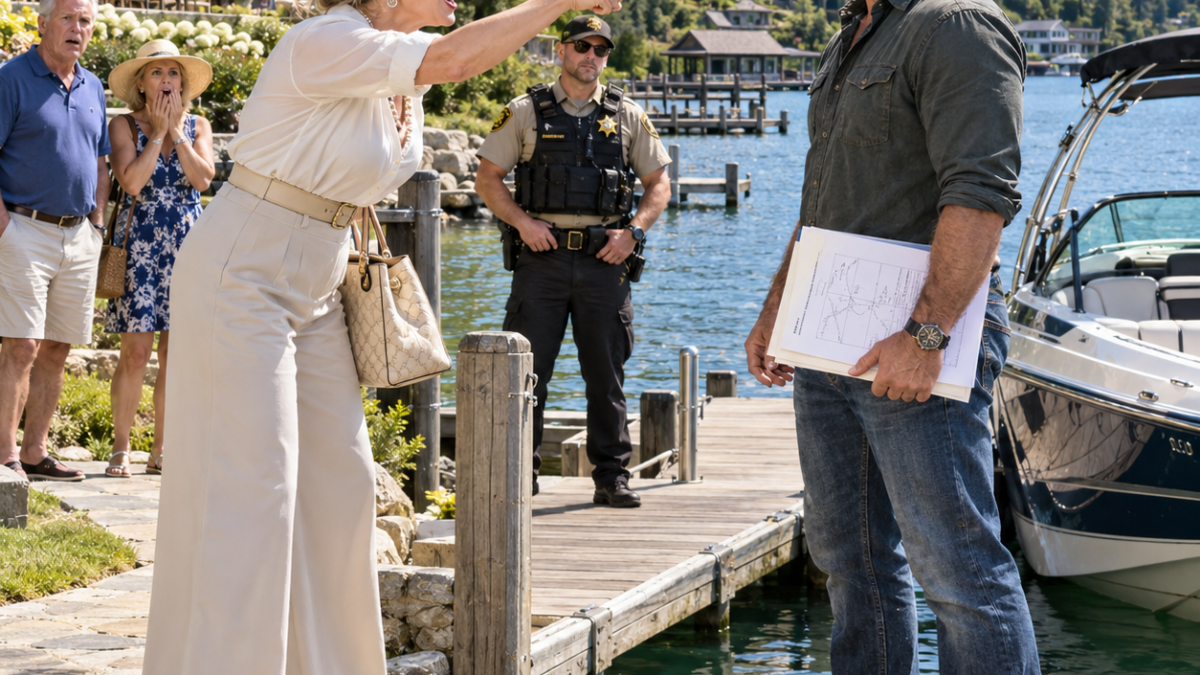
Karen was already on my dock.
Again.
Her attorney followed.
His name was Bradley Finch.
Mid-fifties.
Expensive raincoat.
Expensive shoes.
Expensive impatience.
He held a leather portfolio beneath one arm while Karen stood beside him wearing the expression of somebody arriving to collect a surrender.
Emma remained inside near the kitchen window.
I walked down.
“Evening.”
Karen smiled.
“Marcus, I’m glad you’re finally taking this seriously.”
“I didn’t realize rain made violations more serious.”
Bradley didn’t smile.
“Mr. Sterling, I’m counsel for the Willowbrook Lake Homeowners Association.”
I nodded.
“Congratulations.”
He handed me an envelope.
Thick paper.
Real letterhead this time.
**NOTICE OF INTENT TO PURSUE INJUNCTIVE RELIEF AND DAMAGES**
I read.
Immediate removal of my Chris-Craft.
Five thousand dollars in alleged damages.
Agreement never to dock a vessel longer than twenty feet without HOA approval.
Claims of diminished property values.
Navigation interference.
Noise nuisance.
I looked toward my boat.
Thirty feet of restored mahogany sat quietly beside the dock while rain ticked against the canvas cover.
“When was the last time you measured navigation clearance?”
Bradley frowned.
“Excuse me?”
“You’re alleging obstruction. What measurements support that?”
Karen interrupted.
“This isn’t a deposition.”
“No. It’s my dock.”
Bradley raised one hand.
“Mr. Sterling, you can litigate every detail if you choose. Litigation is expensive.”
There it was.
Not law.
Pressure.
I folded the letter.
“I’ll have counsel review it.”
Karen stepped closer.
“You don’t need another lawyer.”
“I always become suspicious when the opposing side tells me that.”
Emma laughed inside.
Karen heard her.
Her face tightened.
Then she leaned toward me.
“You could make this very simple.”
“So could you.”
“Remove the boat.”
“No.”
The word landed harder than a speech.
Karen stared at me.
“You think your military background scares people?”
“No.”
“You behave like you’re above everyone.”
“No.”
“You investigate people’s property.”
“Only when they investigate mine.”
Bradley looked at her.
“Karen.”
She ignored him.
“This lake belongs to the community.”
That sentence made every nerve in my body sharpen.
I glanced toward Theodore’s basement.
Then back at her.
“Does it?”
She laughed.
“Don’t be ridiculous.”
I didn’t answer.
Because I finally knew exactly what needed verifying first.
***
At seven-thirty the next morning, I called Jennifer Patel.
Betty Jaimes had recommended her.
Betty was seventy-three, a retired English teacher, and one of the few people in Willowbrook who had never seemed intimidated by Karen.
If Betty said someone was competent, I listened.
Jennifer answered on the fourth ring.
“Patel.”
“Ms. Patel, my name is Marcus Sterling. Betty Jaimes gave me your number.”
“That already makes me nervous.”
I smiled.
“I have an HOA dispute.”
“Of course you do.”
“And about forty years of old water-right documents.”
Silence.
“What kind of documents?”
“I think my uncle may have owned the lake.”
Another silence.
Longer.
“Mr. Sterling.”
“Yes?”
“Don’t summarize anything else over the phone.”
“Okay.”
“Scan the index pages. Send them securely. Then bring the originals to my office.”
“You think it’s serious?”
“I think people often misunderstand old property documents.”
“Fair.”
“And occasionally they don’t.”
***
Emma came downstairs while I was making coffee.
“Lawyer?”
“Yes.”
“Do we own the lake?”
“I don’t know.”
She stared.
“Dad.”
“I know what the papers seem to say.”
She pulled out a chair.
“And?”
“And we’re going to find out what they actually say.”
She groaned.
“You’re the least satisfying person to uncover a family secret with.”
“I kept you alive through adolescence.”
“Barely.”
“That was mostly your fault.”
She smiled.
Then she became serious.
“Why didn’t Uncle Theodore tell you?”
That question bothered me.
Theodore had been eccentric.
Private.
Never married.
No children.
He’d taken me fishing every summer when I was a kid.
He taught me knots.
Engines.
Weather.
Patience.
But he never once said:
By the way, Marcus, I own the lake.
“He liked secrets,” I said.
Emma looked toward the basement door.
“That’s one way to describe it.”
***
Jennifer called that afternoon.
Her voice had changed.
“Marcus.”
That was the first time she used my first name.
“Yes?”
“I’ve reviewed the copies.”
“And?”
“I want to bring in a water-rights attorney.”
My chest tightened.
“Meaning?”
“Meaning I’m not comfortable telling you these documents are meaningless.”
“That’s lawyer language for what?”
“That your uncle may have done something very unusual.”
***
The next twenty-four hours felt longer than some deployments.
Jennifer contacted David Kim.
David specialized in Colorado property and water law.
He was careful immediately.
“Ownership of a lake can mean different things.”
“I figured.”
“Lake bed ownership. Water rights. Access rights. Riparian rights. Navigation. Easements. Recorded licenses. Public rights. Historical use.”
“Understood.”
“You don’t necessarily get to say ‘I own the lake’ merely because a deed contains water language.”
“Also understood.”
He paused.
“But.”
I waited.
“These records are remarkable.”
That was the first moment I let myself feel something.
Not victory.
Possibility.
David continued.
“The original developer acquired the basin before subdivision.”
“Okay.”
“When Pinewood Development failed financially in the early 1960s, your uncle purchased interests that included the lake bed and separately transferred water and navigation rights.”
I sat down.
“Separately?”
“Yes.”
“He then bought additional parcels over sixteen years.”
“Why?”
“I can’t answer motive.”
“What does he end up with?”
“On the documents I’ve reviewed, Theodore consolidated ownership over the lake bed and broad private-use and navigation rights.”
My fingers tightened around the phone.
“All forty-seven acres?”
“Appears so.”
“What about the homeowners?”
“Most shoreline deeds stop at the surveyed high-water boundary.”
“And docks?”
“We need to investigate easements, licenses, and whether long-term use created any enforceable rights.”
“So Karen may have rights.”
“Potentially.”
“HOA?”
“That’s different.”
David paused.
“I have not seen a recorded conveyance giving the HOA regulatory authority over the lake itself.”
That sentence landed.
Hard.
“The HOA doesn’t own it.”
“Not from what I’ve seen.”
“My uncle did.”
“Yes.”
“And now?”
“Assuming probate transferred the interest as the estate records indicate…”
He paused.
“You.”
I stared through my kitchen window.
Mist lifted from the water.
The same water I’d watched every morning for eighteen months.
The lake Karen called community property.
The lake she’d threatened to sue me for using.
Mine.
At least in the recorded ownership sense David had just described.
“Marcus?”
“I’m here.”
“Do not do anything dramatic.”
I laughed once.
“You’ve spoken to Betty?”
“No.”
“Everybody keeps assuming I’m dramatic.”
“People who discover they may own forty-seven-acre lakes tend to become dramatic.”
“Fair.”
***
Emma arrived Friday afternoon carrying Thai food.
The moment she walked in, she looked at my face.
“Oh my God.”
“Language.”
“You own it.”
“We have strong documentation.”
She dropped the food on the counter.
“You own the lake.”
“Emma.”
She hugged me.
Unexpected.
Hard.
I stood there with my arms around my twenty-two-year-old daughter and realized something strange.
I hadn’t known how much I missed her.
Not phone calls.
Not text messages.
Her.
Since her mother and I divorced years earlier, Emma had become polite.
Independent.
Busy.
Our relationship wasn’t broken.
Just distant.
Theodore’s secret had somehow pulled her back into my kitchen.
She released me.
“Why do you look sad?”
“I’m not.”
“You are.”
I looked toward Theodore’s old chair.
“I wish he was here.”
That was the truth.
Emma sat beside me.
“What would he say?”
I smiled.
“He’d probably ask why it took me eighteen months to open the basement boxes.”
She laughed.
That sounded right.
***
Then Jennifer found another document.
Not ownership.
Conservation.
Theodore had spent years corresponding with biologists, lawyers, and environmental groups about protecting the lake from development.
He’d never finalized the conservation easement.
But his letters were clear.
He loved that water.
One letter from 1989 said:
**If people are allowed to enjoy something beautiful, they often assume enjoyment equals ownership. It does not. Ownership means responsibility.**
I read it twice.
Then a third time.
That one sentence changed the way I thought about the secret.
Theodore hadn’t hoarded a lake.
He’d protected it.
He allowed neighbors to swim.
Fish.
Keep docks.
Raise children beside the water.
He could have charged them.
Didn’t.
Could have excluded them.
Didn’t.
He simply kept legal ownership because he didn’t trust developers to protect the shoreline forever.
Karen thought ownership was authority.
Theodore thought ownership was responsibility.
That distinction mattered.
***
Karen didn’t know any of this.
And she kept escalating.
She convinced the HOA to file suit.
An actual lawsuit.
No more threat letters.
The complaint accused me of violating community standards.
Demanded five thousand dollars.
Requested an injunction requiring boat removal.
Claimed community rights in the lake based partly on decades of use.
That last point made David sit straighter.
“This is why we don’t gloat.”
“Could they win?”
“Adverse-use and prescriptive-right theories are fact-specific.”
“English.”
“They’ve used the lake a long time.”
“With Theodore’s permission.”
“That’s important.”
“Can we prove permission?”
David smiled.
“Theodore kept letters.”
Of course he did.
Dozens.
Homeowners thanking him for allowing dock repairs.
Requests to hold fishing tournaments.
Letters seeking permission for community swim events.
Even an HOA letter from 1997 thanking him for “continued private permission allowing member recreational use.”
I stared at it.
“The HOA knew.”
“A previous board did.”
“Karen doesn’t.”
“Apparently not.”
Jennifer leaned back.
“This document significantly weakens the claim that community use was hostile to Theodore’s ownership.”
I looked toward the lawsuit.
“Can we dismiss?”
“We respond.”
“No dramatic reveal?”
Jennifer smiled.
“Not yet.”
Lawyers are no fun.
***
Then somebody put sugar in my boat’s fuel system.
I discovered it because the engine ran rough during a test.
I shut it down.
Phil came over.
He opened the fuel system.
Smelled.
Then looked at me.
“That wasn’t there yesterday.”
The police came.
Detective Morrison photographed everything.
Collected samples.
I didn’t accuse Derek.
Phil’s camera showed a shadow near the dock at two in the morning.
Body size roughly similar.
Movement possibly familiar.
Not enough.
Sarah Rodriguez—my old JAG friend—was clear.
“Don’t name people without evidence.”
“I know.”
“You sound disappointed.”
“I am.”
She laughed.
“Good. Means retirement hasn’t ruined you.”
The sabotage changed something inside me.
Not because the boat mattered more than anything else.
Because whoever did it had crossed from paperwork into property damage.
Karen’s campaign was becoming unstable.
Then Channel 9 ran a segment portraying me as a difficult veteran intimidating a peaceful HOA.
Karen stood on her dock wearing white.
Behind her:
My lake.
“This shared community resource belongs to all of us,” she told the camera.
Emma paused the recording.
“Please tell me you’re saving that.”
“Already saved.”
She smiled.
“Military logistics really made you boring.”
“Boring wins.”
***
Karen went further.
She began telling people former soldiers could be unpredictable.
That my boat was some kind of compensation.
That I suffered adjustment issues.
One regional HOA page repeated her comments.
Three other association presidents publicly supported her.
Sarah Rodriguez read the screenshots.
Her face hardened.
“Don’t turn this into a discrimination claim casually.”
“I wasn’t.”
“Good.”
“But?”
“But stigmatizing veterans as inherently dangerous is ugly.”
“No argument.”
“If housing decisions or enforcement are being applied selectively because of perceived military status or disability, counsel can assess the legal implications.”
Jennifer nodded.
“We document. We don’t overclaim.”
That became our mantra.
Document.
Don’t overclaim.
Karen did enough damage without help from exaggeration.
***
Phil came by with another problem.
Derek planned a massive dock expansion.
Forty-foot yacht lift.
Floating dock.
Fifty feet into the water.
He had permit drawings.
They showed property coordinates.
David examined them.
Then laughed.
“What?”
“His plans extend over Marcus’s lake bed.”
“How far?”
“Substantially.”
Phil said:
“I told the contractor those boundaries looked wrong.”
David compared the permit.
“The upland lot line doesn’t give him ownership into the water.”
Jennifer looked at me.
“Do not interfere with construction yourself.”
“I know.”
“We’ll send formal notice.”
Derek received it the next morning.
Work stopped before it began.
Karen called me within thirty minutes.
I let voicemail take it.
The message lasted four minutes and contained very little language suitable for court.
We saved it anyway.
***
Then came the settlement offer.
Five thousand dollars.
Delivered by Cheryl Mason, one of Karen’s real-estate colleagues.
In exchange, I would dock the Chris-Craft elsewhere and sign a confidentiality agreement.
I read it.
Then looked at Cheryl.
“Do you know who owns the lake?”
She blinked.
“What?”
“Nothing.”
I handed it back.
“I decline.”
Her voice dropped.
“Karen said fighting city hall doesn’t end well.”
I looked at her.
“Karen isn’t city hall.”
“She has connections.”
“Then she should be especially careful not to imply she can use them against private citizens.”
Cheryl swallowed.
“I’ll tell her no.”
“Tell her exactly what happened.”
She left quickly.
***
The state environmental complaint arrived Monday.
Anonymous report of possible petroleum contamination.
An inspector named Dr. Sarah Jamison spent two hours testing the water and examining my fuel system.
She was professional.
No eye-rolling.
No assumptions.
When she finished:
“Your dock area is clean.”
“Any contamination?”
“Not from your operation.”
“Can I get that in writing?”
“You’ll receive a report.”
She packed her equipment.
Then paused.
“This is a remarkably healthy lake.”
That mattered more to me than Karen’s complaint.
“Theodore kept it that way.”
“Your uncle?”
“Yeah.”
She looked across the water.
“He did good work.”
I felt unexpectedly emotional.
“He did.”
***
We finally decided how to respond.
Not by closing the lake.
Not by removing everyone’s docks.
Not by banning boats.
Jennifer laid out the options.
“You could send notices reserving rights.”
David added:
“You could formalize current residential access.”
Sarah Rodriguez said:
“You could let Karen reveal the ownership situation during her own hearing.”
Emma grinned.
“Please pick that one.”
I looked at her.
“You’re enjoying this too much.”
“I’m twenty-two. Public humiliation is basically a recreational activity.”
I tried not to laugh.
Then David brought out the conservation-easement draft.
“Theodore never finished this.”
I read it.
Permanent protection against major development.
Water-quality standards.
Habitat preservation.
Defined community recreational access.
No commercial exploitation without approval.
“I can still own it?”
“Yes.”
“And neighbors keep reasonable access?”
“Yes.”
“Existing docks?”
“Subject to documented agreements and safety/environmental standards.”
“Future Karen?”
Jennifer smiled.
“Cannot pretend the HOA owns the water.”
I looked toward Theodore’s letter.
Ownership means responsibility.
“Do it.”
***
Karen scheduled her final disciplinary hearing like she was staging a trial.
Certified notice.
Stenographer.
Bradley Finch.
City Councilman Patrick Hayes.
County Commissioner Linda Rodriguez.
Local media.
She accused me of willful violations, harassment, and—my favorite—
**conduct unbecoming a community resident.**
Emma laughed for a full minute.
“Dad, you’re getting court-martialed by a realtor.”
“Very dignified.”
“Are you wearing a uniform?”
“No.”
“Why not?”
“Because I retired.”
“Coward.”
***
The meeting room held twenty people comfortably.
Forty-three came.
Betty’s network alone brought half the shoreline.
Phil brought contractors.
Emma had told former neighbors.
Blake Morrison from Channel 9 positioned his camera near the front.
Karen sat behind the board table.
Bradley beside her.
Derek looked like he’d slept badly.
I entered with Jennifer, David, and Sarah.
Karen smiled.
“Mr. Sterling. Thank you for finally appearing for accountability.”
I sat.
“Happy to help.”
She launched into her presentation.
Navigation.
Noise.
Property values.
Community harmony.
My alleged hostility.
Bradley stood.
“My client seeks removal of the offending vessel and permanent injunctive relief preventing violations of established rules governing shared water resources.”
Jennifer wrote one sentence on her legal pad and turned it toward me.
**SHE SAID IT AGAIN.**
Shared water resources.
I almost smiled.
Then Karen said:
“Mr. Sterling has behaved as though this lake belongs to him.”
Silence.
Emma covered her mouth.
That was too perfect.
Jennifer whispered:
“Now.”
I stood.
“Actually, Karen, that’s the first accurate thing you’ve said all evening.”
Her smile flickered.
“What?”
I walked toward the front.
“Before we discuss boat regulations, everybody should understand who owns the property being regulated.”
Bradley frowned.
“This hearing concerns HOA covenants.”
“Correct.”
Jennifer opened her briefcase.
David unfolded the survey.
I turned toward the room.
“The HOA has repeatedly described this forty-seven-acre lake as community property.”
Karen interrupted.
“Because it is.”
“No.”
Her face hardened.
I placed the first certified deed on the table.
“This lake is privately owned.”
Someone in the audience whispered.
Karen laughed.
“You own your cabin lot.”
“I inherited my cabin lot.”
I placed another deed.
“And the original lake-bed parcel.”
Another.
“Navigation rights.”
Another.
“Additional water interests Theodore acquired between 1962 and 1978.”
David stood.
“My name is David Kim. I am counsel specializing in property and water-rights matters.”
He pointed toward the map.
“The shoreline properties generally terminate at the surveyed boundary identified in their deeds. The lake-bed ownership and associated private-use rights were separately acquired by Theodore Sterling and transferred through his estate.”
Karen stared at the map.
Bradley had gone very still.
David continued carefully.
“Individual residents may have contractual, licensed, easement, or other legally cognizable access rights depending on their documents and historical use. But the HOA does not own this lake.”
That legal precision mattered.
I looked toward Karen.
“You’ve spent months threatening to remove my boat from water the association doesn’t own.”
Her lips parted.
Bradley leaned toward her.
She ignored him.
“This is impossible.”
Jennifer held up the 1997 letter.
“The association previously acknowledged Theodore Sterling’s private ownership and thanked him for allowing recreational access.”
Betty said loudly:
“I remember that.”
Every head turned.
She smiled.
“Theodore used to say people were welcome as long as they respected the lake.”
Karen looked toward her.
“You knew?”
“I knew Theodore owned something.”
Betty shrugged.
“He never bragged.”
That hurt Karen more than anything I could have said.
Theodore had possessed enormous leverage and never needed an audience.
Karen possessed a gavel and treated it like a crown.
***
Commissioner Rodriguez leaned forward.
“Mr. Sterling, what does this mean for existing residents?”
The whole room waited.
I knew Karen expected retaliation.
Maybe everyone did.
I looked at David.
Then Jennifer.
Then Emma.
Then the faces around the lake.
People who had swum there for decades.
Raised children there.
Fished there.
Buried spouses and sat on docks afterward.
Theodore had never wanted to take that away.
Neither did I.
“It means,” I said, “that the HOA cannot invent lake regulations it has no ownership authority to impose.”
Murmurs.
“But it does not mean I’m closing the water.”
People exhaled.
Karen stared.
I continued.
“My uncle allowed this community to enjoy the lake for decades because he believed stewardship mattered more than control.”
I held up the conservation documents.
“I intend to finish what he started.”
David displayed the proposed easement.
“We are finalizing permanent conservation protections and defined residential access rights.”
A man near the back said:
“So our docks stay?”
“Lawful existing docks will be reviewed and documented fairly.”
“Boats?”
“Reasonable recreational use continues.”
“Fishing?”
“Yes.”
Children swimming?
“Yes.”
Karen finally spoke.
“What about me?”
The room went silent.
I looked at her.
“What about you?”
“My dock.”
“Same rules as everyone else.”
Derek’s face changed.
He knew what was coming.
“And your planned forty-foot yacht lift,” I continued, “must remain within whatever rights your property actually has and comply with environmental and permitting requirements.”
Someone laughed.
Karen snapped:
“That’s retaliation!”
“No.”
I looked directly at her.
“Equal enforcement.”
The words landed.
They were hers.
Used against me for months.
Now they finally meant something.
***
Bradley asked for a recess.
Karen refused.
“I want this finished.”
Jennifer said:
“So do we.”
She placed the environmental inspection.
The dock inspection.
The lawsuit.
The HOA’s prior acknowledgment of Theodore’s ownership.
The repeated complaint records.
The social-media posts describing veterans as dangerous.
The documentary evidence showing Karen had been soliciting contractors to find violations.
Nobody needed a dramatic soundtrack.
The paperwork spoke.
Then Phil stood.
“Karen offered me money to find something wrong with Marcus’s dock.”
Karen turned.
“You liar.”
Phil held up his phone.
“I kept the voicemail.”
That was new even to me.
He played it.
Karen’s voice:
**Phil, I need something documented. Anything. There’s got to be a defect somewhere.**
The room shifted.
Then Mrs. Patterson stood.
Karen had pressured her too.
Then the Johnsons.
Then an elderly widower named Henderson.
Selective complaints.
Threats.
Repeated references to people who didn’t “fit” the neighborhood.
Karen sat slowly.
For the first time, she looked less angry than tired.
***
The HOA vice president, Harold Finch—not related to Bradley—cleared his throat.
“I move for a vote of no confidence.”
Three people seconded immediately.
Karen slammed her hand down.
“You can’t.”
Harold looked at Jennifer.
“Can we?”
Jennifer said:
“Follow your bylaws.”
They did.
Notice requirements had already been satisfied for board business at the scheduled session.
Members reviewed the procedure.
Karen protested every step.
This time people actually read the rules before voting.
She lost.
Overwhelmingly.
Effective immediately pending the formal transition required under the bylaws.
Betty looked at me.
I shook my head.
She smiled.
Karen stood.
“This community will regret this.”
No one answered.
She grabbed her purse.
Derek followed.
Bradley stayed behind.
I noticed that.
Lawyers know when a client has left the useful part of a meeting.
***
Outside, Blake Morrison approached me.
“Mr. Sterling, did you deliberately hide the ownership until tonight?”
“I verified it before discussing it publicly.”
“Could you really close the lake?”
“In some circumstances I could restrict access, but residents may also have rights that must be respected.”
He looked disappointed by the nuance.
“So the dramatic version—”
“Is less accurate.”
He smiled.
“What are you actually doing?”
“Protecting the lake permanently.”
That became the follow-up story.
Not:
VETERAN OWNS LAKE, HUMILIATES HOA.
Though the internet produced plenty of that.
The better story was:
PRIVATE LAKE OWNER CREATES CONSERVATION PLAN AFTER HOA DISPUTE.
Theodore would’ve preferred that.
***
Karen resigned completely the next morning.
Email.
Three paragraphs.
No apology.
Claimed the community had become hostile.
Claimed leadership was impossible when residents refused reasonable standards.
Her house went on the market less than a week later.
Betty ran for interim president.
Nobody else wanted the job.
She won.
Her campaign platform was one sentence:
**Let’s stop being ridiculous.**
The vote was nearly unanimous.
***
The lawsuit died soon afterward.
Bradley withdrew several claims once ownership records were fully incorporated into the case.
Remaining issues were resolved through counsel.
No million-dollar courtroom verdict.
No judge slamming a gavel and calling Karen evil.
Real legal disputes rarely end that cleanly.
But the injunction against my boat went nowhere.
The HOA acknowledged it had no independent ownership authority over the lake.
My boat remained.
Exactly where Theodore would’ve expected it.
***
The sabotage investigation lasted longer.
Police never charged Karen.
The video wasn’t clear enough.
No fingerprints produced a useful result.
Derek denied involvement.
I hated that uncertainty.
Part of me wanted a clean villain ending.
Evidence doesn’t care what stories want.
So we repaired the fuel system.
Documented the damage.
Moved on.
That became another lesson.
Justice does not require every unanswered question to become an accusation.
Sometimes you live with what you can prove.
***
Karen’s real-estate license complaint moved through the state process.
Some allegations were dismissed.
Others resulted in disciplinary findings related to disclosure and professional conduct.
She paid fines.
Completed additional training.
Her reputation suffered.
Derek abandoned his city-council run.
The unpermitted dock extension was corrected.
Their proposed yacht structure never happened.
They sold the property the following spring.
Not because I evicted them.
I didn’t.
They left because the lake community Karen had tried to rule no longer wanted to be ruled.
***
Before moving, Karen came to my dock one last time.
No stilettos.
Sneakers.
Jeans.
She stopped at the top.
“Can I come down?”
That question alone showed how much had changed.
“Yes.”
She walked slowly.
My Chris-Craft floated beside us.
Freshly polished mahogany.
She looked at it.
“I never thought it was ugly.”
I laughed.
“You called it a rust bucket.”
“I was angry.”
“You were angry before you knew me.”
She looked toward the water.
“I thought people liked communities because standards protected value.”
“Some standards do.”
“Then why was I wrong?”
“You weren’t wrong to want standards.”
I paused.
“You were wrong to think your preferences were ownership.”
She absorbed that.
Then:
“I built my business around selling Willowbrook.”
“I know.”
“I thought anything different made it harder.”
“Different isn’t the same as harmful.”
She nodded.
“I know that now.”
We stood quietly.
Then she looked at me.
“You could’ve closed everything.”
“The lake?”
“Yes.”
“I could’ve tried.”
“Why didn’t you?”
I looked across the water.
Phil’s grandchildren were fishing.
Betty sat on her dock reading.
A couple paddled slowly near the far shore.
Loons called from the northern cove.
“Because Theodore didn’t protect this so one person could use it as a weapon.”
Her eyes lowered.
“That what you think I did?”
“Yes.”
She nodded.
No argument.
Then she said:
“I’m sorry I contacted Emma.”
That one mattered.
“She didn’t deserve that.”
“No.”
“I was trying to pressure you.”
“I know.”
Karen looked at the boat.
“I became somebody I wouldn’t have liked.”
I didn’t tell her she wasn’t that person anymore.
That was hers to prove.
Instead:
“I hope your next place gives you a chance to do better.”
She looked at me.
“Do you forgive me?”
I thought.
“No.”
Her face tightened.
Then I continued.
“But I don’t need to hate you either.”
That surprised her.
She nodded once.
Then walked away.
That was the last conversation we ever had.
***
Betty’s presidency looked very different.
First meeting:
Forty-five minutes.
Financial report.
Dock maintenance.
Trash collection.
Fire mitigation.
No PowerPoint presentations about individual neighbors.
No photographs taken through windows.
No twenty-slide attack on a boat.
At the end, Betty asked:
“Any new business?”
Phil raised his hand.
“Marcus’s boat is too pretty and lowers the self-esteem of mine.”
Betty pointed toward the door.
“Meeting adjourned.”
I laughed harder than I had in months.
***
Then we finished Theodore’s conservation plan.
David negotiated the language carefully.
Permanent restrictions against major commercial development.
Water-quality protections.
Habitat safeguards.
Limitations on shoreline destruction.
Defined access licenses for existing residents.
Reasonable boating.
Swimming.
Fishing.
Dock rights subject to safety and environmental standards.
Future property buyers would receive disclosure documents before closing.
Nobody would ever again buy a lakefront house assuming they owned water they didn’t.
And no future lake owner could casually wake up angry and revoke everybody’s access without legal safeguards.
Jennifer looked at the final draft.
“You’re restricting your own power.”
“Yes.”
“Significantly.”
“Yes.”
“You trust future Sterlings that little?”
“I trust systems more.”
She smiled.
“Smart.”
Theodore’s lesson again.
Ownership means responsibility.
***
The state later recognized the lake under a conservation partnership.
Not a government takeover.
Not loss of private ownership.
A legal structure preserving its ecological character while recognizing established residential use.
Dr. Jamison helped with water-quality baseline work.
University students came to study the ecosystem.
No invasive species.
Healthy trout population.
Protected nesting areas.
Theodore had somehow preserved something extraordinary while almost nobody knew he owned it.
That felt exactly like him.
***
We created the Theodore Sterling Memorial Conservation Fund.
I seeded it with estate money and contributions from shoreline residents who wanted to participate voluntarily.
Emma insisted scholarships be part of it.
“For environmental law?”
“That’s oddly specific.”
“You would’ve lost without Jennifer and David.”
Fair.
So we funded students studying environmental science, conservation law, water resources, and land stewardship.
Emma helped review applications.
Our first recipient was a young woman from Pueblo studying watershed engineering.
When she stood at the scholarship ceremony and said:
“I grew up fishing with my dad, and I want my career to protect places where other families can have that,”
I had to look away.
Emma noticed.
“You crying?”
“No.”
“Dad.”
“Wind.”
“We’re indoors.”
“Air conditioning.”
She smiled.
***
Emma started visiting more.
Not because of Karen.
Not even because of the lake.
We repaired Theodore’s old rowboat together.
She learned to varnish wood.
Badly.
I told her so.
She accused me of becoming an old man.
Correct.
One evening we sat on the dock eating sandwiches.
She asked:
“Did you ever think about selling?”
“The lake?”
“Yeah.”
I looked around.
“What would somebody pay?”
“A lot.”
“How much is a lot?”
“Depending on development rights and restrictions, potentially millions.”
She whistled.
“And you just leave people swimming in it?”
I laughed.
“That sounds sinister when you say it like that.”
“You know what I mean.”
I looked toward the water.
“Theodore could’ve developed it.”
“Why didn’t he?”
“Because some things make more sense alive than monetized.”
She became quiet.
Then:
“You sound like him.”
That hit harder than she knew.
“Thank you.”
“Wasn’t necessarily a compliment.”
Too late.
***
The veterans fishing tournament began the following August.
I invited former service members from around Colorado.
Some came with families.
Some came alone.
Some barely spoke.
Some never stopped talking.
We raised money for veteran legal assistance and mental-health services.
No speeches about veterans being broken.
No Karen-style stereotypes.
Just people.
Fishing.
Eating burgers.
Telling terrible jokes.
One man named Robert sat on my dock long after sunset.
Vietnam veteran.
Seventy-six.
He looked toward the water.
“Quiet here.”
“That’s why I stayed.”
He nodded.
“Hard to find quiet.”
I knew what he meant.
Not sound.
The kind inside your head.
We sat without talking.
Sometimes that’s what community looks like too.
***
Channel 9’s Blake Morrison came back for the tournament.
He had been embarrassed by the first story that leaned too heavily on Karen’s narrative.
He said so on camera.
That impressed me.
“I should’ve checked ownership records before describing the lake as community property.”
I nodded.
“Yes.”
He laughed.
“Not going to make this easy?”
“No.”
“Fair.”
His follow-up won a regional journalism award.
He focused on Theodore.
Private conservation.
Community access.
How assumptions about ownership had shaped the conflict.
The story became less about Karen and more about responsibility.
That was better.
***
Law students started visiting.
David used the lake in lectures.
Not because the law was simple.
Because it wasn’t.
The students expected a satisfying rule:
Man owns lake.
HOA loses.
Instead, David made them examine deeds, easements, implied licenses, long-term use, water-rights doctrine, subdivision documents, conservation law, and equitable issues.
A student once asked me:
“Were you disappointed when you learned ownership wasn’t absolute?”
I smiled.
“No.”
“Why?”
“Absolute power usually causes the problem.”
He wrote that down.
I almost told him it wasn’t a legal doctrine.
Then decided it probably wouldn’t hurt.
***
Phil organized monthly shoreline cleanups.
The first drew twelve people.
The third drew fifty.
Children collected trash.
Neighbors inspected docks.
David gave short talks about erosion.
Betty brought cookies.
No one asked her to.
No one could stop her.
At sunset, we’d grill beside the water.
The lake felt more communal after everyone learned it was privately owned.
Strange.
Before, people treated access as entitlement.
Afterward, they treated it as trust.
That small shift changed everything.
***
One morning, Derek sent me an email from wherever they had moved.
Short.
Unexpected.
**Marcus, I owe you an apology for the dock plans. I knew the boundary paperwork was questionable and let Karen push it because I wanted the yacht lift. You were right to stop us.**
I read it twice.
No excuse.
No request.
Just admission.
I wrote back:
**Thank you for saying it. I hope things go well for you.**
That was enough.
***
Karen tried joining the HOA board in her next community.
Emma found out online.
Apparently local residents had read the news stories.
She lost.
Emma sent me a screenshot with seventeen laughing emojis.
I called her.
“Leave her alone.”
“Dad.”
“Seriously.”
“She tried to steal your lake.”
“She tried to assert rights she didn’t have.”
“That is the most dad way possible to say steal your lake.”
I laughed.
“People deserve opportunities to become better.”
“She can become better without being president.”
Fair.
I had no rebuttal.
***
Years passed.
The Chris-Craft became famous around the lake.
Not because it was expensive.
Because it started everything.
Kids called it Theodore.
I never corrected them.
Technically the boat already had a name:
**Quiet Water.**
I had painted it on the stern after restoration.
Theodore’s phrase.
He used to say:
“Anybody can see themselves clearly when the water is quiet.”
As a kid, I thought he meant fishing.
As an adult, I understood.
Chaos distorts.
Ego distorts.
Fear distorts.
Sometimes you need stillness before you can see what something really is.
Karen never gave herself stillness.
She reacted.
Escalated.
Controlled.
Every challenge became attack.
Every difference became threat.
Every rule became weapon.
Eventually she couldn’t see the lake.
Only authority.
***
I nearly made the opposite mistake.
Once I discovered ownership, revenge became intoxicating.
I imagined closing her dock.
Blocking Derek’s yacht.
Posting private-lake signs.
Making every person who had doubted me ask permission.
That fantasy lasted longer than I’m proud to admit.
Then I read Theodore’s conservation letter again.
Ownership means responsibility.
Not superiority.
That saved me from becoming the next person who thought a document made him king.
***
Betty eventually stepped down as HOA president.
She said:
“I’ve already raised two children and taught thirty-eight years. I refuse to spend my remaining life explaining trash-can rules to adults.”
Nobody blamed her.
The next president was Phil.
He lasted nine months.
Too many calls.
After him, a younger mother named Rachel took over.
Competent.
Transparent.
Boring.
Perfect.
The HOA and lake-owner association developed a cooperative agreement.
Separate authority.
Clear responsibilities.
HOA managed roads and common lands it actually controlled.
My conservation trust managed the lake.
Joint committees coordinated safety.
Nobody pretended one entity owned everything.
It worked because boundaries were finally understood.
Imagine that.
***
Emma graduated.
Then law school.
That surprised me.
“What happened to environmental policy?”
“Law is policy with sharper teeth.”
Jennifer laughed for five minutes when I told her.
Emma eventually focused on environmental and land-use work.
Blame Theodore.
At her law-school graduation, she wore his old tie pin.
Afterward, we sat on the hood of my truck.
She handed me a small envelope.
Inside was a copy of Theodore’s 1989 letter.
She’d framed one line:
**IF PEOPLE ARE ALLOWED TO ENJOY SOMETHING BEAUTIFUL, THEY OFTEN ASSUME ENJOYMENT EQUALS OWNERSHIP. IT DOES NOT. OWNERSHIP MEANS RESPONSIBILITY.**
“I want this in my office.”
I looked at her.
“He would’ve loved that.”
“So do I.”
That one broke me.
No pretending it was air conditioning this time.
I cried.
My daughter hugged me.
No embarrassment.
***
Five years after Karen first walked onto my dock, the state hosted a small ceremony recognizing the lake’s conservation designation.
Nothing glamorous.
A plaque.
Officials.
Students.
Neighbors.
Theodore’s photograph beside the water.
I stood at a microphone.
I hate microphones.
Emma sat in the front row.
Betty beside her.
Phil.
Jennifer.
David.
Sarah.
Dr. Jamison.
People who had turned one ugly HOA fight into something useful.
I looked across the lake.
“My uncle Theodore owned this water for decades.”
I paused.
“Almost nobody knew.”
A few smiles.
“He never treated that secrecy as permission to dominate his neighbors.”
I looked at the conservation plaque.
“He treated it as responsibility.”
Then:
“Karen Whitmore and I disagreed about almost everything.”
People laughed.
“But she accidentally forced me to learn what Theodore left behind.”
Silence.
“If she hadn’t challenged my boat, I might’ve gone another ten years without opening those basement boxes.”
Emma whispered loudly:
“Twenty.”
People laughed again.
Probably correct.
“So even bad conflict can reveal important things.”
I looked toward the shoreline.
“The question is what you do after the reveal.”
***
After the ceremony, Betty sat beside me on the dock.
She had slowed with age.
Still sharp.
Still impossible.
“Your boat is too big.”
I looked at her.
“Seriously?”
She smiled.
“Just checking whether you’re still sensitive.”
“Go home, Betty.”
“You don’t own my house.”
“No.”
“You do own the water under my dock.”
“Technically.”
She nodded.
“Good.”
Then she handed me a cookie.
We sat.
Loons called.
Nothing needed fixing.
***
That evening, Emma asked:
“Would you do anything differently?”
“About Karen?”
“All of it.”
I thought.
“I would’ve opened Theodore’s boxes earlier.”
“Obviously.”
“I would’ve spoken to neighbors sooner.”
“Why?”
“Because isolation made the harassment easier.”
She nodded.
“Anything else?”
I looked toward the boat.
“I would’ve worried less about winning.”
“That sounds fake.”
I laughed.
“Maybe.”
She waited.
“The first few months, I wanted to beat Karen.”
“And later?”
“I wanted the lake protected.”
Emma smiled.
“That’s probably growth.”
“Don’t sound so surprised.”
***
The lake is still mine today.
Legally, through Theodore’s estate and the structures we formalized afterward.
But saying “my lake” feels different now.
Possession isn’t the important part.
Responsibility is.
Every spring, environmental students test water quality.
Every summer, children learn to fish.
Every August, veterans gather.
Every fall, volunteers clean shoreline trash.
Residents maintain access through documented agreements instead of assumptions.
Future buyers know exactly what they are purchasing.
No hidden surprise.
No Karen can stand on someone else’s dock and pretend a title gives her unlimited power.
No future Marcus can inherit the lake and casually decide everyone else should suffer because he’s angry.
That’s the system I’m proudest of.
***
The Chris-Craft still sits at my dock.
Same boat Karen wanted removed.
Mahogany glows in the afternoon sun.
Engine runs smoother than it did in 1987.
On quiet mornings, I take it out alone.
Not fast.
Just enough to hear the hull cut through water.
Sometimes I pass Karen’s old house.
A younger family lives there now.
Two daughters.
One boy.
They swim constantly.
The father keeps a fishing boat tied to the dock.
Correct permit.
Recorded access agreement.
No problem.
The youngest girl waves every time I pass.
I wave back.
She doesn’t know the history.
Good.
Children shouldn’t inherit every adult conflict.
They should inherit the things adults fixed afterward.
***
One Sunday, the father called from his dock.
“Marcus!”
I slowed.
“Yeah?”
“My daughter wants to know if you’re king of the lake.”
I laughed.
“No!”
The little girl shouted:
“Mom said you own it!”
“Own isn’t king!”
She considered this.
“Can I still swim?”
“Yes!”
She jumped immediately.
Her father shook his head.
“Guess that’s approval.”
I smiled.
That moment said more about ownership than any deed.
***
Karen once believed community meant authority flowing downward.
President.
Board.
Residents.
Rules.
Punishment.
Theodore believed community worked differently.
People shared something precious.
The owner protected it.
Neighbors respected it.
Everyone benefited.
Neither model is perfect automatically.
But one begins with control.
The other begins with stewardship.
I know which one I want my daughter to inherit.
***
My favorite photograph of Theodore now hangs in the cabin.
He’s standing beside the lake in 1978.
Old flannel shirt.
Fishing rod.
Terrible hat.
Nothing about him looks wealthy.
Nothing suggests he had just completed the final purchase giving him control over nearly the entire lake.
On the back he’d written:
**THE BEST THINGS YOU OWN ARE THE THINGS YOU DON’T HAVE TO PROVE YOU OWN.**
That line makes me laugh every time.
Because Karen spent months demanding proof of authority she didn’t have.
Theodore spent forty years holding authority he rarely mentioned.
There’s a lesson in that.
***
People online still summarize the story differently.
They say:
**HOA Karen fined a veteran over his boat, then discovered he owned the entire lake.**
It’s catchy.
Mostly true.
But incomplete.
The reveal wasn’t the victory.
The reveal was temptation.
I suddenly had the power to humiliate everyone who had doubted me.
To restrict access.
To make neighbors feel what Karen had made me feel.
To take a place people loved and turn it into leverage.
That would’ve been revenge.
And it would’ve proved Karen right about one thing:
Give someone authority and eventually they’ll use it for themselves.
So I chose something else.
I protected the lake.
Protected reasonable community access.
Protected my own rights.
Protected future owners from confusion.
And protected future residents from having to depend on whether the person holding the deed was kind.
That was justice.
***
Sometimes Karen’s old cease-and-desist letter still turns up when I’m organizing files.
**REMOVE VESSEL BY FRIDAY.**
**$200 DAILY PENALTY.**
**POTENTIAL LIEN.**
I should throw it away.
I don’t.
It’s framed in my workshop beside Theodore’s original lake-acquisition map.
Underneath both I mounted a small brass plaque.
It reads:
**KNOW WHAT YOU OWN. KNOW WHAT YOU OWE. KNOW THE DIFFERENCE.**
Emma says that’s the most retired-Army thing she’s ever seen.
She’s probably right.
***
This morning, I carried coffee onto the dock before sunrise.
Same habit.
Mist sat low.
No wind.
The Chris-Craft barely moved against its lines.
Across the water, porch lights clicked on one by one.
Phil’s house.
Betty’s old place, now owned by her granddaughter.
The Whitmore property.
Families beginning ordinary mornings.
No emergency meetings.
No cease-and-desist letters.
No reporters.
Just life.
I sat in Theodore’s old chair near the dock shed.
For a moment, I imagined him beside me.
“You took long enough,” he’d probably say.
“I was busy.”
“You were stubborn.”
“Runs in the family.”
Then I’d tell him what happened.
Karen.
The boat.
Emma.
The conservation agreement.
Scholarships.
Veterans tournament.
Kids swimming.
He’d probably say nothing.
Theodore rarely praised anybody directly.
Then he’d look across the lake and ask:
“Water still clean?”
I’d say yes.
That would be enough.
***
Karen Whitmore walked onto my dock believing a title made her powerful.
She thought HOA president meant owner.
She thought a veteran living quietly in an old cabin would fold under enough fines.
She thought a restored wooden boat was something she could remove because it didn’t match her vision.
She never bothered to ask who owned the dock.
Who owned the water.
Or why my eccentric uncle had spent forty years buying pieces of a lake nobody else thought were valuable.
When the truth finally came out, I could have used it to destroy her.
Instead, I used it to destroy the assumption that power belongs to whoever shouts the loudest.
Karen left.
The boat stayed.
The lake stayed.
The neighbors stayed.
And Theodore’s greatest secret became his greatest gift.
Not forty-seven acres of water.
Not deeds.
Not navigation rights.
A lesson.
**Owning something doesn’t make you important. What you protect with that ownership does.**
Every evening the loons still call across Clearwater Lake.
Children still jump from docks.
Veterans still fish.
Families still paddle beneath the mountains.
My Chris-Craft still sits exactly where Karen said it wasn’t allowed to be.
And when someone asks whether it bothers me that so many people use “my” lake, I always look at the water and think of Theodore.
Then I give them the same answer.
“No.”
Because the lake belongs to me on paper.
**But the peace it creates was never supposed to belong to only one person.**
**THE END.**








