PART 2: HOA KAREN DUMPED SIX FEET OF SNOW ON MY PROPERTY—THEN SCREAMED WHEN I SENT IT BACK TO HER STREET
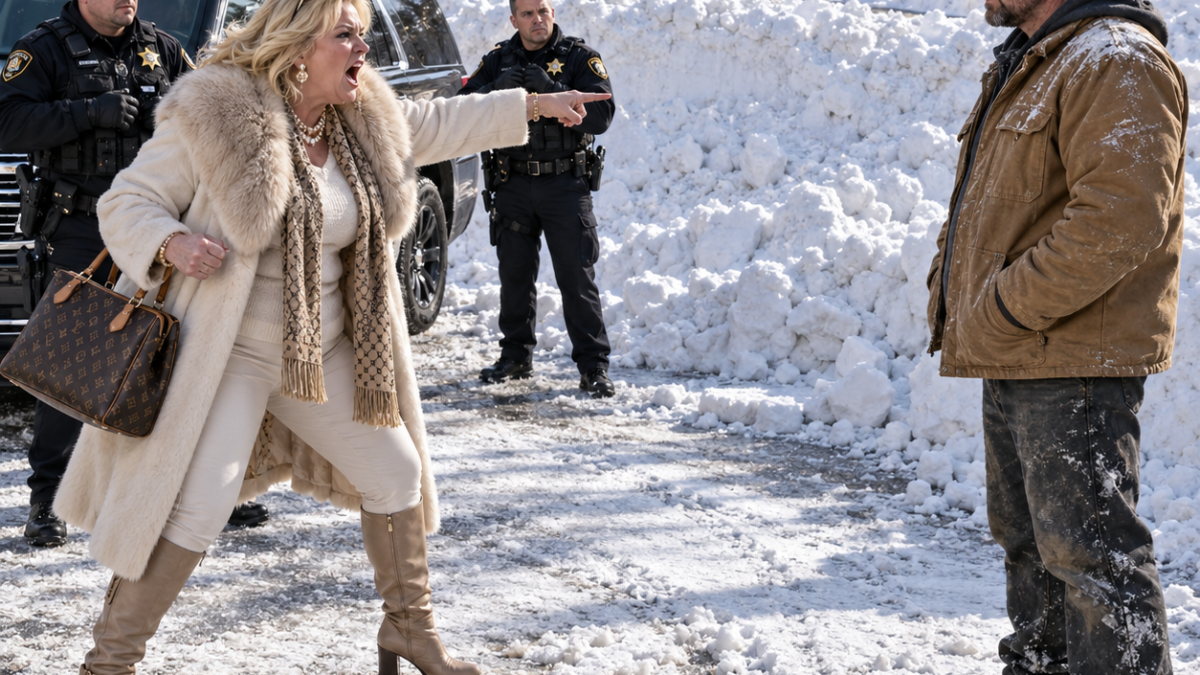
PART 2
The woman who stepped out of that silver Lexus was Brenda Kowalski.
Even through the grainy security footage, I recognized her immediately. The long camel-colored winter coat, the white scarf tucked beneath her chin, the deliberate way she walked as if every square foot of Pinerest Estates belonged to her.
Brenda had been president of our homeowners association for four years, and she had spent most of that time making sure everybody understood that she expected obedience.
She inspected lawns in summer, measured decorative fences in spring, and sent official-looking violation letters whenever someone’s trash container remained visible longer than she considered acceptable.
Her husband, Frank, handled what she liked to call neighborhood security.
Nobody had ever elected him.
Nobody had ever explained what his title meant.
But he wore a black vest with reflective lettering and drove his pickup around our streets as if he were the chief of police.
Now I was watching both of them standing in the darkness outside my home.
Frank had just deposited a mountain of snow across my property line.
Brenda stood near her Lexus, watching the result.
On the recording, Frank pointed toward my fence.
Brenda appeared to say something.
Then both of them looked toward my house.
I couldn’t hear their words. The camera was too far away, and the wind had been howling that night.
But I could see enough.
They hadn’t accidentally pushed snow beyond a boundary marker.
Frank had deliberately driven it there, and Brenda had been present while he did it.
I paused the video.
For a long moment, I sat perfectly still.
Then I looked through the kitchen window at the broken fence.
Emily’s fence.
And I felt an anger so sharp that I had to close my eyes before doing anything else.
***
I had learned a long time ago that anger could make intelligent people do stupid things.
I worked as an industrial equipment consultant, and before that I’d spent years supervising heavy machinery projects. A careless decision around machinery could cost someone a hand, a leg, or a life.
The same principle applied when dealing with people.
If I marched to Brenda’s house shouting accusations, she’d turn the entire situation into an argument about my behavior.
I knew her well enough to expect that.
So I did something else.
I downloaded the recording.
Then I saved copies to my computer, an external hard drive, and a private cloud folder.
I captured still images showing the truck’s position, the time stamps, Frank standing in my side yard, and Brenda’s Lexus waiting near the cul-de-sac entrance.
I photographed the fence again.
I measured the snow pile.
I pulled out the original property survey and marked the boundary.
By eight thirty that morning, I had enough material to establish exactly where the snow had been placed and who had placed it there.
At nine, I called the HOA office.
Brenda answered on the second ring.
“Pinerest Estates Homeowners Association. Brenda speaking.”
“Good morning, Brenda. This is Garrett Harrison.”
There was a brief pause.
“Oh. Garrett. What can I do for you?”
Her voice was bright and cheerful.
Too cheerful.
“I woke up this morning and discovered that someone pushed an enormous amount of snow onto my private property.”
“I’m sorry to hear that.”
“I have security footage showing Frank doing it.”
The silence lasted nearly five seconds.
Then she cleared her throat.
“Garrett, winter maintenance sometimes requires temporary accommodations.”
“Accommodations?”
“Snow has to go somewhere.”
“Not across my property line.”
“The area beside your house has been designated for seasonal snow storage.”
I looked at the survey spread across my kitchen table.
“By whom?”
“The association.”
“When?”
“Garrett, we don’t need to discuss every operational decision with individual homeowners.”
“That isn’t an HOA common area. It’s my land.”
“We have to maintain safe roads for everyone.”
“I agree. But Frank crossed the boundary five times, broke two fence boards, and blocked my sidewalk.”
Brenda sighed.
It was the kind of sigh an irritated teacher might give a child who kept asking questions.
“Everyone has to make sacrifices during winter.”
I looked through the window again.
“Are you telling me the HOA intends to leave six feet of snow on my property?”
“I’m telling you the snow is exactly where our maintenance team determined it needed to be.”
“Then I need that decision in writing.”
Her tone hardened.
“You’re welcome to submit a formal complaint if you feel so strongly about it.”
“Brenda—”
“Have a nice day, Garrett.”
The line went dead.
I stood in the kitchen with the phone still against my ear.
Then I slowly lowered it.
Outside, the snow mountain glittered in the morning sun.
The broken fence boards were barely visible beneath its weight.
I thought about Emily kneeling beside the lavender plants in that same part of the yard.
I thought about the hours we’d spent making our home beautiful.
And I thought about how casually Brenda had dismissed the damage.
I opened a new folder on my computer.
I named it PINEREST SNOW INCIDENT.
Then I began documenting everything.
***
The first email went out that afternoon.
I addressed it to Brenda and every listed HOA board member.
I attached photographs, the relevant portions of my survey, and still images from the security footage.
I described the incident factually.
The date.
The time.
The location.
The damage.
I requested removal of the snow and reimbursement for the broken fence.
I also asked for a copy of any board resolution authorizing my property to be used as a snow storage area.
An automated response confirmed receipt.
Then nothing happened.
The following morning, the pile remained.
The day after that, it was still there.
By the third day, the snow had compacted into a solid mass.
It blocked the sidewalk leading to my backyard and pressed against the wooden fence.
I couldn’t safely reach the small storage shed beyond it without climbing over icy debris.
When I looked out the kitchen window, I no longer saw Emily’s garden.
I saw a white wall.
I sent another email.
No answer.
I called the management company.
The receptionist told me the board would review my complaint.
I asked when.
She couldn’t say.
I asked whether the snow removal contractor had been notified.
She didn’t know.
I asked whether someone could inspect the damage.
She promised to pass along the message.
Another day passed.
Nothing.
***
On the fourth morning, I went outside with a shovel.
I wasn’t attempting to move the entire mountain.
That would have been impossible by hand.
I just wanted to reopen enough of the sidewalk to reach my backyard safely.
The snow was hard and heavy.
Each shovelful felt like lifting wet concrete.
After an hour, sweat soaked my shirt beneath my winter jacket.
After two hours, my shoulders were burning.
I stopped several times to catch my breath.
I was fifty-two years old, not twenty-five, and my back had already endured decades of physical work.
But I kept going.
By early afternoon, I’d cleared a narrow path.
It took nearly four hours.
When I finally leaned the shovel against the garage wall, my hands were shaking from exhaustion.
I went inside, swallowed two pain relievers, and sat at the kitchen table.
For a moment, I could almost hear Emily’s voice.
“Garrett Harrison, you’re going to hurt yourself trying to do everything alone.”
She used to say that whenever I refused help.
I smiled sadly.
Then I looked at the snow through the window.
I hadn’t felt that alone in a long time.
***
Frank Kowalski arrived the next afternoon.
I was in the garage organizing tools when I heard his pickup pull into my driveway.
He parked behind my car, blocking my exit.
Yellow hazard lights flashed on the roof.
He stepped out wearing his black security vest.
The reflective letters across the back read SECURITY.
He walked toward me with the slow confidence of a man who expected people to move aside.
“Garrett.”
“Frank.”
He stopped about six feet away.
“Been hearing you’ve got some complaints about winter maintenance.”
“I’ve submitted documentation to the board.”
He nodded as if I’d confirmed something.
“Well, let me explain something. You don’t get to interfere with community operations because you don’t like where the snow ends up.”
I set down the wrench in my hand.
“Frank, you pushed snow onto my land and broke my fence.”
He shrugged.
“That’s not how I remember it.”
“I have the video.”
His expression changed slightly.
“Videos can be misleading.”
“Not when they show your truck crossing my property line five times.”
Frank took a step closer.
“I’ve also heard you might be planning to move that snow.”
“It’s on my property. I intend to have it removed.”
“Not onto the roadway, you don’t.”
I looked at him.
“Why are you telling me that?”
“Because I’m the security patrol coordinator.”
“And what legal authority does that give you?”
His jaw tightened.
“Excuse me?”
“Where in the HOA bylaws is that position defined?”
He stared at me.
“I don’t need to explain my authority to you.”
“Then you won’t mind moving your truck so I can leave my driveway.”
He looked over his shoulder.
Then back at me.
“You’re making this harder than it needs to be.”
I didn’t answer.
Frank lowered his voice.
“People who don’t cooperate with community security sometimes find themselves dealing with other problems.”
I felt the hair rise along the back of my neck.
“What kind of problems?”
He smiled without warmth.
“Property issues. Compliance inspections. Things like that.”
I held his gaze.
“Are you threatening me?”
“I’m giving you friendly advice.”
“No, Frank. You’re standing in my driveway, blocking my vehicle, and suggesting I’ll be punished if I complain about damage you caused.”
His face reddened.
“You’d better watch yourself, Harrison.”
Then he turned, climbed into his truck, and drove away.
I stood in the garage until the sound of his engine disappeared.
Then I went inside and saved the camera footage of the encounter.
Another date.
Another time stamp.
Another entry in the growing record.
***
The monthly HOA meeting took place the following Thursday.
I hadn’t attended a board meeting in nearly three years.
Ordinarily, I avoided them.
The meetings were dominated by debates about mailbox designs, lawn maintenance, decorative lighting, and whatever new restriction Brenda had decided was necessary.
But this time I had a reason to go.
About twenty residents were seated inside the community clubhouse when I arrived.
Brenda sat at the front table with four other board members.
Frank stood near the rear wall, still wearing that black vest.
When Brenda saw me, her smile tightened.
I took a seat near the back.
The meeting began with routine business.
Budget updates.
Landscaping contracts.
Holiday decorations.
Brenda controlled the discussion effortlessly.
When residents asked questions, she answered with practiced confidence.
When somebody challenged a decision, she reminded them that board members volunteered their time.
It was a performance I’d seen before.
Then the agenda reached homeowner concerns.
I raised my hand.
Brenda looked toward me.
“Mr. Harrison.”
I stood.
“I’d like to discuss the snow that was placed on my property last week.”
She sighed.
“We’ve already addressed that matter.”
“No, you haven’t.”
Several residents turned.
I continued calmly.
“At 4:17 in the morning, Frank pushed approximately six feet of accumulated snow across my private property line, damaging my fence and blocking access to my backyard.”
Frank shifted against the wall.
“I have recordings showing the entire incident,” I continued. “I also have a survey confirming the boundary.”
Brenda raised a hand.
“Personal security recordings aren’t appropriate for discussion during an open board meeting.”
“Why not?”
“Because this is a community maintenance matter, not a personal grievance.”
I looked around the room.
“If the HOA damaged another homeowner’s property, wouldn’t that homeowner have the right to ask for repairs?”
Nobody answered.
Brenda smiled tightly.
“The board will take your concerns under advisement.”
“I’ve already submitted them in writing.”
“Then the matter is being handled.”
“When will the snow be removed?”
She looked toward the other board members.
“I propose that no additional action be taken regarding this routine maintenance complaint.”
Four hands rose.
One woman at the table kept hers down.
Brenda nodded.
“The motion passes.”
I stared at her.
“You’ve just voted not to address damage caused by your own snow removal operation?”
She struck the gavel.
“Mr. Harrison, your time has expired.”
I sat down.
My hands were shaking.
Not because I was afraid.
Because I’d just watched four people dismiss clear evidence without even agreeing to examine it.
***
After the meeting, I stayed near the exit while residents gathered their coats.
An older woman approached cautiously.
She had silver hair, a pale blue winter jacket, and nervous eyes.
“Mr. Harrison?”
“Garrett, please.”
“I’m Olivia Baker.”
I recognized her.
She lived three houses down in a small blue Cape Cod with white trim and bird feeders hanging beneath the front porch.
“I saw you speaking earlier,” she said.
“That was me.”
She glanced toward the clubhouse doors.
“Could I tell you something?”
“Of course.”
Olivia lowered her voice.
“Frank did something similar to me two winters ago.”
I stopped.
“What happened?”
“He pushed snow onto my front walkway. So much that I couldn’t open my front door properly.”
I stared at her.
“For how long?”
“Almost a week.”
“Did you complain?”
She nodded.
“That’s when things got worse.”
She looked down at her hands.
“The following month, I received three violation letters.”
“What kind?”
“My mailbox was supposedly two inches too close to the curb. My porch light was the wrong color. And my recycling bin had been visible too long.”
I felt my jaw tighten.
“Did you appeal?”
“I tried.”
“What happened?”
“Brenda said the rules applied equally to everyone.”
Olivia gave a sad little laugh.
“Then she told me I should be grateful the board was looking after property values.”
“Did you pay the fines?”
She nodded.
“I live on Social Security and a small pension. I couldn’t afford to hire a lawyer.”
Her eyes filled.
“And I was frightened.”
I looked at her.
“Of Frank?”
“Of both of them.”
We stood quietly.
Then she reached into her purse.
“I still have the letters.”
I looked up.
“All of them?”
“Every one.”
I handed her my phone number.
“Olivia, would you be willing to let me see them?”
She hesitated.
Then nodded.
“Maybe it’s time somebody did.”
***
When I returned home, I opened my laptop.
A new email waited in my inbox.
The subject line read:
NOTICE OF VIOLATION.
I clicked it.
The letter cited Section 4.7 of the community guidelines.
Improper outdoor storage.
Visual blight.
Accumulation of materials exceeding approved height restrictions.
Fine: $150.
I read the description again.
They were fining me for the six-foot snow pile Frank had deliberately pushed onto my property.
For several seconds, I couldn’t move.
Then I laughed.
Not because the situation was funny.
Because the absurdity was almost impossible to comprehend.
The HOA president’s husband had damaged my property.
The board had refused to repair it.
And now the association was demanding money from me because the damage hadn’t been removed.
I printed the notice.
Placed it beside the photographs.
And wrote the date on my timeline.
They had just created another piece of evidence.
***
Over the next weekend, I began researching the governing rules.
I studied the HOA bylaws.
The community covenants.
Relevant Minnesota statutes.
Municipal snow-management ordinances.
County records.
I wanted to understand the boundaries between association authority, private property rights, and public roadway maintenance.
One thing became increasingly obvious.
Frank’s title did not give him police powers.
An HOA could hire security personnel.
It could contract for patrol services.
It could impose lawful community rules through its established procedures.
But a man wearing a vest marked SECURITY was not automatically a law enforcement officer.
He couldn’t simply invent powers because his wife was president.
And he couldn’t use intimidation to resolve property disputes.
I contacted the sheriff’s office through its regular public information line and asked about the authority of private neighborhood security personnel.
The deputy who answered explained that private security roles did not confer the same authority as sworn law enforcement officers.
He also advised that any threats or trespassing concerns should be documented and reported through appropriate channels.
I thanked him.
Then I turned to the snow itself.
The law was more complicated than Brenda’s casual assertions.
Removing snow from private property was one issue.
Depositing snow onto a public roadway was another.
A homeowner couldn’t simply create a dangerous obstruction because someone else had wronged him.
I understood that.
And I wasn’t interested in hurting innocent neighbors.
But I was interested in forcing the association to acknowledge where its snow had come from, who was responsible for it, and why my property had been treated as disposable.
I kept researching.
Then I submitted a formal request for HOA records, including financial statements, governing documents, and contracts concerning snow removal and neighborhood security.
I wanted to know exactly what the residents were paying for.
***
Three days before Christmas, my son came home from college.
Tyler was nineteen, a computer science major at the state university, and he had inherited his mother’s ability to see patterns where everyone else saw confusion.
He also had her dark eyes and the same habit of tilting his head when something didn’t make sense.
I met him at the front door.
He dropped his backpack and hugged me.
“Hey, Dad.”
“Hey, kid.”
He stepped back, looked through the kitchen window, and frowned.
“What happened to the yard?”
I followed his gaze.
The snow mountain still stood beside the house.
“Long story.”
Tyler laughed.
“Did you start building a ski resort?”
“Not exactly.”
He looked more closely.
“Wait. Is that our fence?”
I nodded.
His expression changed.
“What happened?”
I told him.
All of it.
The plow.
Frank.
Brenda.
The HOA meeting.
The fines.
The threats.
By the time I finished, Tyler looked furious.
“They did that on purpose?”
“I have video.”
“Show me.”
I opened the security footage.
He watched silently.
Then replayed the portion showing Frank’s truck crossing the boundary.
“That’s not accidental.”
“No.”
He looked at the second vehicle.
“Is that Brenda?”
“Looks like it.”
Tyler stared at the screen.
Then looked at me.
“Dad, how long have they been doing this?”
I frowned.
“What do you mean?”
“You said you installed the cameras a few years ago.”
“Yes.”
“Do you still have the older recordings?”
I thought about the backup server in the basement.
“I should.”
Tyler stood.
“Then we need to check them.”
***
That evening, my son and I went downstairs.
The basement was colder than the rest of the house.
Emily’s old Christmas decorations were stacked against one wall.
A shelf held photo albums, spare cables, and boxes of household records.
Near the utility room sat the small backup server I’d installed three years earlier.
I rarely thought about it.
The cameras uploaded recent recordings to cloud storage, but the local system also retained archived footage that I periodically transferred to backup drives.
Tyler connected his laptop.
Within minutes, folders appeared on the screen.
Dates.
Camera numbers.
Recording segments.
Three winters of material.
Tyler looked at me.
“Well, Dad.”
“What?”
“This is going to take a while.”
I smiled.
“Good thing you’re home for break.”
He laughed.
Then we started watching.
***
We spent two evenings reviewing recordings.
Most of the footage showed nothing remarkable.
Snow falling.
Wind moving tree branches.
Animals crossing the yard.
Occasional snowplows clearing the common area.
But Tyler was patient.
He used the time stamps to locate major storms from previous winters.
Then he compared the camera angles.
Late on the second evening, he called me into the study.
“Dad.”
I looked up from the kitchen.
“Yeah?”
“Come here.”
He pointed toward the screen.
“This is from two winters ago.”
I watched Frank’s truck move through the common area.
Then the blade turned.
Snow crossed the boundary.
Not as much as this year.
A smaller pile.
But unmistakably the same action.
Tyler opened another clip.
The following winter.
Another storm.
Another series of passes.
Again, snow was pushed beyond the property line.
I stared at the screen.
“I remember that drift.”
Tyler looked at me.
“What did you think caused it?”
“I assumed it was just the way the snow accumulated near the cul-de-sac.”
He opened a third clip.
Different storm.
Same truck.
Same direction.
Same boundary crossing.
Tyler leaned back.
“Dad, this has been happening for three winters.”
I sat down slowly.
For three years, I’d looked at unusual piles of snow near my fence and assumed they were accidental.
I hadn’t complained much.
I hadn’t wanted a fight.
I had accepted the inconvenience.
And each winter, Frank had apparently pushed a little farther.
Until this year, when he’d buried the side yard beneath six feet of packed snow.
Tyler looked toward the window.
“They kept doing it because nobody stopped them.”
I couldn’t answer.
Because I knew he was right.
***
On Christmas Eve, I found an old email.
I’d been searching through previous messages to the HOA when I came across something from two Januaries earlier.
I had written to Brenda after noticing unusually heavy snow accumulation near my fence.
My message was polite.
I asked whether the plowing contractor could be more careful about the property line.
Brenda had replied personally.
She thanked me for bringing the issue to her attention and said the association would try to be more careful going forward.
I read the email twice.
Then called Tyler.
He came into the kitchen carrying a plate of leftover cookies.
“What?”
I showed him the message.
He read it.
Then looked at me.
“So she knew.”
“She knew I’d complained.”
“And promised they’d stop.”
“Yes.”
Tyler looked through the window.
“But they didn’t.”
“No.”
He set down the plate.
“Dad, that’s worse.”
I nodded.
It was.
Before, Brenda could have claimed confusion about the boundary.
She could have argued that the snow placement was accidental.
But the old email established that she had been warned years earlier.
She knew I objected.
She knew the location was disputed.
And the dumping had continued.
I added the email to the evidence folder.
Then I sat at the kitchen table for a long time.
***
Christmas Day was quieter than it used to be.
When Emily was alive, the house seemed to glow during December.
She decorated every room.
Hung stockings above the fireplace.
Played old Christmas songs while baking cookies.
Tyler used to wake us before sunrise, too excited to wait for presents.
After she died, the holidays became difficult.
I still put up a tree.
Still cooked the traditional breakfast.
Still hung her favorite ornament near the top.
But there was always an empty space at the table.
That Christmas, Tyler and I made pancakes.
We exchanged gifts.
He gave me a framed photograph of the three of us taken during a summer trip to Lake Superior.
In the picture, Emily stood between us with her arms around our shoulders.
She was laughing.
I stared at it.
Tyler watched me.
“You okay, Dad?”
I nodded.
“Yeah.”
Then my eyes filled.
He moved around the table and hugged me.
For a while, neither of us spoke.
When he stepped back, I placed the photograph beside the kitchen window.
Beyond it stood the snow mountain.
The broken fence.
The place where his mother had planted flowers.
Tyler followed my gaze.
“Dad?”
“Yeah?”
“We’re not letting them keep doing this.”
I looked at him.
His expression was serious.
Not angry in the reckless way I’d sometimes been at nineteen.
Determined.
I reached across the table.
“Your mother would tell us not to let anger make us stupid.”
He smiled faintly.
“She would.”
“And she’d also tell us not to let bullies take over our home.”
Tyler nodded.
“That sounds like Mom.”
I looked outside again.
Then I made a decision.
I was finished waiting for Brenda to decide whether my property mattered.
***
The day after Christmas, Brenda launched her next attack.
It began with an email sent to all 145 households in Pinerest Estates.
The subject line read:
IMPORTANT COMMUNITY SAFETY NOTICE.
The message warned residents about a homeowner who was refusing to cooperate with winter snow-management procedures.
It claimed this unnamed individual had created hazardous conditions.
It suggested that selfish behavior threatened neighborhood safety and could interfere with emergency services.
My name wasn’t mentioned.
It didn’t have to be.
Everyone knew who had been complaining about the snow pile at the end of the cul-de-sac.
Within hours, I noticed the change.
A neighbor who usually waved when I checked the mailbox walked past without looking at me.
Another closed his garage door when I approached.
Two residents stopped talking as I entered the clubhouse to collect a package.
I’d lived in Pinerest Estates for five years.
I’d helped people shovel driveways.
I’d assisted elderly neighbors with yard repairs.
I’d volunteered at community events.
I’d donated to fundraisers.
Yet one email from Brenda was enough to make people question my character.
I felt the isolation settle over me like another layer of snow.
***
On December 28, another violation notice arrived.
Failure to maintain property.
The HOA cited the broken fence boards.
Fine: $200.
I stared at the letter.
Frank’s snow pile had broken the boards.
Brenda had refused to repair them.
Now the association wanted to fine me because the fence remained damaged.
Two days later, another notice arrived.
Hazardous ice accumulation.
The walkway beside my house was partially obstructed by compacted snow and ice.
Fine: $250.
Combined with the original $150 notice, the HOA was demanding $600.
Every letter threatened additional action if I failed to pay.
One warned that unresolved amounts could lead to collection procedures and possible lien action if legally authorized.
I knew those threats weren’t automatically enforceable simply because Brenda printed them on official letterhead.
But I also knew how expensive it could become to challenge improper HOA penalties.
I read the three notices side by side.
Then I laid the photographs beside them.
A perfect sequence.
First, Frank created the condition.
Then Brenda refused to correct it.
Then the association fined me for the resulting damage.
I looked at Tyler.
He shook his head.
“They’re building a case against you.”
“Yes.”
“So what do we do?”
I closed the folder.
“We keep building a better one.”
***
On New Year’s Eve, a county code enforcement officer arrived.
His name was Daniel Mercer.
He was in his fifties, with gray hair and the tired expression of someone who hadn’t expected to spend the last day of the year inspecting a snow pile.
He parked near the curb and approached my front door carrying a clipboard.
“Mr. Harrison?”
“That’s me.”
“We received a complaint about improper snow storage and an alleged nuisance condition.”
I stepped aside.
“I’ve been expecting somebody.”
He looked toward the side yard.
“Well, that’s quite a pile.”
“It is.”
“Can you explain how it got there?”
I opened the evidence folder.
For the next twenty minutes, I showed him the property survey, photographs, time-stamped video, and HOA correspondence.
Mercer watched the footage carefully.
Then he walked around the pile.
He examined the plow marks.
Photographed the broken fence.
Checked the property boundary.
He asked whether I’d placed any of the snow there myself.
“No.”
“Do you have the original recordings?”
“Yes.”
“Keep them.”
He made notes.
Then he looked toward the cul-de-sac.
“This appears to involve mechanical placement of snow from outside your property.”
“That’s what I’ve been trying to tell the HOA.”
Mercer nodded.
“I’m not seeing grounds to cite you for creating this condition based on what you’ve shown me.”
I exhaled.
He continued.
“That doesn’t resolve the private dispute, but I’ll document my observations.”
“Thank you.”
He handed me his card.
“If additional problems develop, keep a record.”
“I intend to.”
He smiled faintly.
“Looks like you’re already doing that.”
Then he wished me a happy new year and drove away.
I stood in the driveway watching his vehicle disappear.
For the first time since the storm, someone outside the HOA had examined the evidence and acknowledged the obvious.
The snow hadn’t been put there by me.
That mattered.
***
Olivia Baker arrived that evening.
She carried a thick manila folder against her chest.
When I opened the door, she looked nervously over her shoulder.
“Olivia?”
“Garrett, may I come in?”
“Of course.”
I led her into the kitchen.
Tyler was upstairs talking to friends.
The house smelled of coffee and leftover cinnamon rolls.
Olivia sat at the table.
For a moment, she held the folder without opening it.
Then she said, “I’ve been thinking about what you said at the meeting.”
I waited.
“You told me I wasn’t alone.”
“I meant it.”
Her eyes filled.
She pushed the folder toward me.
“Then I want you to have these.”
Inside were years of correspondence.
Violation notices.
Emails.
Photographs.
Written complaints.
Records of fines she’d paid after Frank dumped snow across her walkway.
The documents were organized by date.
Every letter had been saved.
Every payment receipt was attached.
Olivia watched as I examined them.
“Why didn’t you show anyone before?” I asked gently.
She looked down.
“Because I was scared.”
I nodded.
She continued.
“My husband died seven years ago. I was still figuring out how to manage everything alone when Brenda became president.”
Her voice trembled.
“At first, she was kind. She brought cookies. Offered to help me understand the HOA rules.”
I listened.
“Then Frank blocked my walkway with snow, and I complained.”
She wiped her eyes.
“Suddenly, everything I did was wrong.”
I looked at the letters.
Small violations.
Petty fines.
Threatening reminders.
Nothing individually dramatic.
But together, they told a story of sustained pressure.
Olivia continued.
“The Henderson family had trouble too.”
I looked up.
“The family that moved away?”
She nodded.
“Frank dumped snow against their driveway one winter. When they complained, Brenda started sending notices.”
“What happened?”
“They sold their house.”
I felt my jaw tighten.
Olivia stared at the table.
“I watched them leave, Garrett. They had two little girls. The mother cried when the moving truck came.”
I didn’t speak.
“I told myself I couldn’t help them. I was afraid Brenda would come after me again.”
She lifted her eyes.
“But now she’s doing it to you.”
I reached across the table.
“Olivia—”
She shook her head.
“I’m tired of being afraid.”
Her voice grew steadier.
“If you’re willing to stand up to them, I want to help.”
I looked at the folder.
Then at her.
“Thank you.”
She smiled through tears.
“Don’t thank me yet. I should’ve done this two years ago.”
“No,” I said.
“You did it when you were ready.”
***
After Olivia left, I sat alone at the kitchen table.
Her documents lay beside mine.
Two separate households.
Two separate winters.
The same pattern.
Frank deposited snow where it didn’t belong.
Residents complained.
Brenda refused to help.
Then violation notices began arriving.
The similarity was too strong to ignore.
I looked toward the living room.
Emily’s photograph stood on the mantel.
She was smiling in the picture, her hair blowing across her face as we stood beside Lake Superior.
For five years, I’d tried to preserve the life we’d built.
The house.
The garden.
The blue door.
Sometimes, keeping those things unchanged was the only way I knew how to remain connected to her.
But now I was beginning to understand something.
Keeping a house wasn’t the same as protecting a home.
A home needed peace.
Safety.
The freedom to walk outside without wondering whether someone with a petty grudge would punish you for speaking.
Brenda and Frank had been taking those things from people for years.
And they’d counted on everybody remaining too afraid or exhausted to fight back.
I looked down at Olivia’s folder.
Then I thought about the Henderson family.
About their little girls.
About the mother crying beside the moving truck.
I felt something shift inside me.
This was no longer just about my fence.
***
Tyler came downstairs around eleven.
He found me sitting at the kitchen table.
“Still working?”
I nodded.
He saw Olivia’s folder.
“What’s that?”
I explained.
He listened without interrupting.
When I finished, he sat down.
“So they’ve done this to other people.”
“Yes.”
“And Brenda keeps getting away with it.”
“So far.”
Tyler looked through the window.
The snow mountain was still there.
“Dad, what’s the plan?”
I leaned back.
“I’ve been thinking about removing the snow myself with the plow.”
He frowned.
“All of it?”
“As much as I can safely remove.”
“Where would you put it?”
I hesitated.
That was the difficult part.
A public roadway ran alongside the cul-de-sac and connected our small cluster of homes to the rest of the development.
The HOA treated the area as its private winter-maintenance responsibility, but municipal records distinguished the public roadway from the association-owned common area.
I had been reviewing those boundaries carefully.
I was angry enough to want Brenda to experience the inconvenience she’d imposed on me.
But I also knew that creating a dangerous road obstruction could hurt innocent people.
An ambulance might need to pass.
A neighbor might have an emergency.
A driver could lose control on ice.
I wasn’t willing to risk someone’s safety to make a point.
I told Tyler that.
He nodded.
“Then we make sure nobody gets hurt.”
“Exactly.”
We discussed equipment, notification, and the need to keep access available.
I also knew that moving the snow onto a public roadway could create legal complications of its own.
Removing it from my land did not automatically give me permission to leave it wherever I pleased.
But I had reached the point where I was prepared to force the issue into the open, even if it meant accepting scrutiny of my own actions.
I contacted the appropriate non-emergency public services line, documented the snow-removal dispute, and requested municipal assistance.
Then I made arrangements to use my own plow.
Tyler watched me close the laptop.
“You’re really going to move it?”
I looked toward the side yard.
“Yes.”
He studied me.
“Mom would say this is stubborn.”
I smiled sadly.
“She’d be right.”
Then I looked at the photograph on the mantel.
“But she’d also tell me to finish what I started.”
***
On January 2, I began removing the snow.
It was still dark outside, and the temperature had fallen well below zero.
Tyler helped document the work.
I used the plow attachment on my pickup to break down the compacted pile, moving the snow away from my fence and reopening the side yard.
The work was slow.
The snow had hardened into thick, icy layers.
My first priority was to clear the damaged fence without causing further harm.
I worked carefully, checking the location and condition of the remaining boards.
As the pile shrank, I directed the displaced snow toward the roadway area that the HOA had repeatedly used for neighborhood snow management.
The result was exactly as dramatic as I’d expected.
A substantial mound of snow occupied part of the street near Brenda and Frank’s property, disrupting the normal vehicle route through the cul-de-sac.
I had kept emergency access in mind and avoided burying driveways, hydrants, or entrances, but I also knew that the roadway obstruction would require prompt professional clearance.
It wasn’t a solution I would recommend to anyone else.
Anger and heavy equipment are a dangerous combination, and even a carefully planned act of protest can create risks.
But after weeks of unanswered requests, fines, threats, and damage, I’d made my decision.
The snow was no longer crushing Emily’s garden.
And the HOA could no longer pretend it was invisible.
By the time I finished, my side yard was clear enough to expose the damaged fence.
For the first time in three weeks, I could see the ground beneath the pile.
Tyler stood beside me.
“Well.”
I looked at him.
“What?”
“Brenda’s definitely going to notice.”
I took off my gloves.
“That’s the idea.”
***
The morning light revealed everything.
From my kitchen window, I could see the mound near the roadway.
A few neighbors stepped outside and stared.
One man took photographs.
Another shook his head.
Then Brenda’s garage door opened.
Her silver Lexus rolled forward.
Stopped.
For a moment, nothing happened.
Then the driver’s door flew open.
Brenda stepped out wearing a bathrobe beneath her winter coat and thick boots.
Even through the closed windows, I could hear her shouting.
“FRANK!”
The garage door on the other side of their house opened.
Frank appeared, pulling on a jacket.
Brenda pointed toward the street.
Then toward my house.
Her arms moved wildly.
Frank stared at the snow.
His face changed.
I watched him reach for his phone.
Tyler stood beside me.
“She’s calling somebody.”
I nodded.
“Probably.”
He looked at me.
“Are you worried?”
“Yes.”
He seemed surprised.
I continued.
“We’ve got to be ready to explain exactly what happened, including our part in it.”
Tyler nodded.
I picked up the folder I’d prepared.
Then I put on my coat.
***
Deputy Willie Olsen arrived shortly afterward.
His cruiser pulled carefully alongside the snow.
The emergency lights flashed briefly before he switched them off.
Brenda met him in the street.
She was shouting before he had fully closed his car door.
I couldn’t hear every word, but I heard my name several times.
She pointed toward my house.
Frank stood beside her with his arms crossed.
I walked outside carrying the folder.
Tyler followed.
Deputy Olsen saw us approaching.
“Mr. Harrison?”
“That’s me.”
He looked toward the mound.
“Can you explain what’s going on?”
“Yes, Deputy.”
I handed him the folder.
Inside were the property survey, screenshots of Frank’s snow dumping, the original recordings’ time stamps, Brenda’s earlier acknowledgement of my complaint, photographs of the fence damage, and the code enforcement officer’s observations.
I explained how the HOA had deposited snow on my land.
I explained the unanswered requests for removal.
I explained the fines.
Then I described my own decision to move the snow and acknowledged that the material was now interfering with normal roadway use.
Olsen listened carefully.
He looked at the documents.
Then at the snow.
Then at Brenda.
“Mrs. Kowalski, did the association direct snow onto Mr. Harrison’s private property?”
Brenda stiffened.
“That was a designated maintenance area.”
“Do you have documentation establishing that designation?”
“The HOA has authority over snow management.”
“That doesn’t answer the question.”
Her cheeks reddened.
Frank stepped forward.
“I was doing my job.”
Olsen looked at him.
“What job?”
“Security and maintenance coordination.”
“Who authorized you to deposit snow on this parcel?”
Frank hesitated.
Brenda interrupted.
“This is ridiculous! The issue is that Garrett deliberately blocked our street!”
Olsen raised a hand.
“I understand that concern. We’ll address the roadway hazard. I’m asking about the original placement as well.”
He turned toward me.
“Mr. Harrison, removing snow from your property and depositing it onto a public roadway are separate matters. The public works department will need to assess and clear this obstruction, and there may be responsibility for the resulting costs.”
“I understand.”
Brenda looked triumphant.
“Then arrest him!”
Olsen turned toward her.
“Ma’am, I’m not making an arrest based solely on what you’ve described. We need to assess the facts and the applicable rules.”
“He endangered the entire neighborhood!”
“I’ve heard your concern.”
“He did this to punish me!”
Olsen looked toward the mound.
Then back at her.
“Mrs. Kowalski, your association also needs to explain why its snow-removal operation deposited material on a homeowner’s private land.”
Brenda froze.
For the first time that morning, she had no immediate answer.
***
Then she turned toward me.
Her expression was unlike anything I’d seen before.
The careful smile was gone.
The polished voice.
The calm authority.
All of it disappeared.
She stepped toward me, pointing a shaking finger.
“You think you’re clever, Garrett?”
I didn’t answer.
“You think you can embarrass me in front of my neighbors?”
“Brenda, I asked you to remove the snow.”
“You made a fatal mistake.”
Deputy Olsen moved closer.
“Ma’am, lower your voice.”
She ignored him.
“I will destroy you.”
The words rang across the freezing street.
Several neighbors stopped moving.
Brenda leaned forward.
“By the time I’m finished, you won’t be able to live in this neighborhood. I’ll make sure of it.”
Olsen stepped between us.
“Mrs. Kowalski.”
She looked at him.
“That sounded like a threat. Step back.”
Brenda’s mouth opened.
Nothing came out.
Olsen continued.
“You need to calm down and let this matter be handled appropriately.”
She stared at him.
Then at me.
For a moment, I thought she might start shouting again.
Instead, she turned sharply and walked toward her house.
Frank followed.
Tyler stood beside me with his phone lowered.
He had recorded the confrontation.
I looked at my son.
“Save that.”
He nodded.
“Already did.”
***
The street remained partially obstructed until municipal crews cleared the accumulated snow.
The city plow arrived approximately thirty-one hours after my initial service request.
A heavy orange truck moved through the neighborhood and removed the mound.
I watched from the porch.
The work took less than twenty minutes once the proper equipment arrived.
The operator cleared the roadway, checked the remaining snowbanks, and drove away.
I felt relief when the street was fully open again.
I’d made my point.
But I was also grateful that nobody had been injured and that the obstruction hadn’t interfered with an emergency.
I understood that my decision could have had consequences beyond the dispute with Brenda.
I wasn’t interested in pretending otherwise.
The difference between Brenda and me would have to be my willingness to acknowledge my own actions and accept legitimate scrutiny.
I could defend myself against improper dumping without claiming that every choice I’d made was beyond question.
***
Brenda wasn’t finished.
On January 3, another community-wide email appeared.
The subject line made Tyler stare at his phone in disbelief.
DOMESTIC TERRORISM IN OUR COMMUNITY.
Brenda accused me of deliberately endangering residents, holding the neighborhood hostage, and creating a pattern of antisocial behavior.
She claimed the incident threatened property values.
She demanded an emergency board meeting to consider additional penalties and possible legal action.
Tyler read the email aloud.
Then looked at me.
“Dad, she actually used the words domestic terrorism.”
I took the phone.
Read the message.
Then set it down.
“Yes.”
“Over snow?”
“Apparently.”
He shook his head.
“That’s insane.”
I looked at him.
“Don’t respond.”
He frowned.
“Why?”
“Because she’s trying to make the argument about our reactions instead of her conduct.”
Tyler sighed.
“But people are going to believe her.”
“Some will.”
“And you’re just going to let them?”
I thought about that.
“No.”
I opened my evidence folder.
“I’m going to give the right people the facts.”
***
The following morning, a certified letter arrived.
Frank had initiated a civil claim alleging that my actions had caused him emotional distress and other harm.
I read the document carefully.
Then placed it in the folder.
Tyler watched from across the table.
“Now he’s suing you?”
“Looks that way.”
“After what he did?”
“Yes.”
Tyler shook his head.
“What are you going to do?”
“Respond properly.”
I contacted an attorney for advice.
I wasn’t going to ignore legal paperwork simply because I believed the underlying allegations were weak.
The attorney reviewed the documents and explained the importance of meeting deadlines, preserving evidence, and avoiding unnecessary public statements.
That afternoon, I organized every record again.
The original snow dumping.
The property survey.
The photographs.
The fence damage.
The HOA votes.
The fines.
The code enforcement report.
Olivia’s documents.
The confrontation with Deputy Olsen.
And Brenda’s increasingly inflammatory emails.
By then, the file told a story far larger than one winter storm.
***
I also began examining the HOA’s financial arrangements.
The records I’d requested had not yet arrived.
That delay bothered me.
For several years, Brenda had insisted that residents trust the association’s security program.
Frank drove his truck around the neighborhood, wore his vest, and occasionally attended meetings as though he had official authority.
But I’d never seen a clear explanation of how the program was organized.
Who employed him?
Was he paid?
What company provided the service?
Was there a written contract?
Did the HOA carry appropriate insurance?
Had the board approved the arrangement?
I checked Minnesota’s public business registry.
At first, searches for names resembling “Pinerest Security Patrol” produced nothing useful.
I made notes.
Then expanded the search.
I didn’t yet know what I’d find.
But I was beginning to suspect that Frank’s security operation might explain why Brenda was so determined to silence complaints.
***
I wrote a detailed letter to Councilman Robert Jensen.
His office dealt with local housing and community concerns, and I wanted the documented complaints brought to the attention of officials who could make appropriate referrals.
I kept the letter factual.
I described the snow dumping and attached time-stamped footage.
I included the property survey.
The HOA’s refusal to act.
The violation notices.
The code enforcement observations.
The threatening statements.
Olivia’s documentation.
And the questions surrounding the security program.
I asked for review of the pattern and referral to any agency with appropriate jurisdiction.
Then I sent it.
I didn’t post the letter online.
I didn’t announce it to the neighborhood.
I wasn’t interested in winning an argument through public pressure before the evidence had been examined.
I wanted accountability.
And I wanted it to rest on facts.
***
Jensen responded the following afternoon.
His message surprised me.
His office had received several previous complaints concerning Pinerest Estates.
Three separate incidents over the preceding four years.
The complaints described similar concerns about selective enforcement, intimidation, and association leadership.
But earlier residents hadn’t provided enough documentation to support meaningful action.
My submission was different.
It included video, dated correspondence, property records, and independent observations.
Jensen explained that he would forward the information to the city attorney’s office and the appropriate state authorities for review.
He also asked whether I would be willing to provide a statement if investigators requested one.
I answered immediately.
Yes.
I would cooperate fully.
Then I called Olivia.
She answered after several rings.
“Garrett?”
“Hi, Olivia.”
“Everything okay?”
“I wanted you to know the complaint has been referred for official review.”
She was quiet.
Then she asked, “You mean somebody’s actually going to look at what Brenda’s been doing?”
“That’s what they’ve told me.”
Olivia began crying.
I waited.
Finally, she said, “I never thought anyone would listen.”
My throat tightened.
“Someone’s listening now.”
***
Two days later, an HOA board member appeared at my door.
She was a quiet woman in her forties.
I recognized her from the meeting as the only person who hadn’t voted to dismiss my snow complaint.
She held a large envelope.
“Mr. Harrison?”
“Yes.”
“I’m delivering the financial records you requested.”
I looked at the envelope.
“Thank you.”
She hesitated.
Then lowered her voice.
“I’m sorry this took so long.”
I studied her.
“Did Brenda ask you to bring these?”
She looked uncomfortable.
“The board received advice that the records should be provided.”
I nodded.
“Well, I appreciate it.”
She glanced toward the street.
Then back at me.
“I hope you’ll look at everything carefully.”
Before I could ask what she meant, she turned and walked away.
I watched her until she reached her car.
Then I went inside.
***
The envelope contained three years of financial reports.
Budgets.
Bank summaries.
Expense schedules.
Vendor payments.
I spread the documents across the kitchen table.
For hours, I worked through the figures.
Most expenses appeared ordinary.
Landscaping.
Snow removal.
Pool maintenance.
Insurance.
Administrative fees.
Then I reached a recurring monthly payment.
Community Security Services.
$2,400.
I checked the preceding month.
Same amount.
Then the month before that.
Again.
I followed the entries backward.
Thirty-six months.
Two thousand four hundred dollars each month.
I reached for my calculator.
$86,400.
I stared at the total.
The HOA had paid more than eighty-six thousand dollars over three years for something labeled community security services.
I searched the vendor name.
Pinerest Patrol LLC.
Then I opened the Secretary of State’s business registry.
This time, the company appeared.
The registered agent was Frank Kowalski.
The business address was connected to the Kowalski household.
I sat back.
There it was.
The man who had threatened me in my driveway.
The man who wore a security vest and claimed authority he couldn’t explain.
The man who had pushed snow onto my property for three winters.
He was receiving payments through a company connected directly to the HOA president’s family.
I looked at the total again.
Eighty-six thousand four hundred dollars.
Then I began searching the meeting minutes for authorization of the contract.
***
I found no recorded competitive bidding process.
No clear disclosure of the family relationship in the materials provided.
No documented approval explaining why Brenda’s husband’s company had been selected.
That absence didn’t automatically prove theft.
The records might have been incomplete.
An approval could have occurred outside the minutes I’d received.
And a company owned by a board member’s relative wasn’t necessarily prohibited from doing legitimate work.
But the conflict-of-interest questions were obvious.
Had Brenda disclosed the relationship?
Had she participated in approving payments?
Were the services actually performed?
Was the company properly insured and authorized for its work?
Why had residents never received a clear explanation of the arrangement?
I printed the relevant records.
Then called Tyler.
He came into the kitchen.
I showed him the documents.
He read them carefully.
Then looked up.
“Dad.”
“Yeah?”
“That’s a lot of money.”
“It is.”
“For Frank driving around in a vest?”
“We don’t know exactly what services the contract covers.”
Tyler stared at the company registration.
“But it’s his company.”
“Yes.”
“And Brenda runs the HOA.”
“Yes.”
He looked at me.
“That’s not good.”
I nodded.
“No. It isn’t.”
***
That evening, Tyler asked permission to prepare a short video for the neighborhood.
I hesitated.
I’d deliberately avoided making public accusations while the official review was developing.
But there was already a considerable amount of confusion.
Brenda had sent inflammatory emails.
Residents were repeating rumors.
Some believed I’d invented the entire snow dispute.
Others had never seen the original footage.
Tyler suggested a factual compilation using the existing recordings.
No dramatic music.
No insults.
No accusations beyond what the images and documents supported.
Just a chronological record.
Frank’s truck crossing the property line.
The snow pile.
The damage.
The HOA violation notices.
The later street obstruction.
Deputy Olsen’s response.
Brenda’s threatening statements.
I thought about the risks.
Then agreed, on one condition.
We would avoid publishing unrelated personal information or presenting unproven financial suspicions as established facts.
Tyler nodded.
“Fair.”
He spent the evening editing.
When he finished, I watched the video with him.
It was uncomfortable.
I saw myself standing in the driveway.
Angry.
Tired.
I saw Brenda shouting.
I saw Frank pushing snow.
I saw the broken fence.
And I saw how the dispute had escalated.
The footage didn’t make anyone look perfect.
Including me.
That was important.
We posted the factual video to the local community forum.
Then we stepped back.
***
Within forty-eight hours, more than two thousand people had viewed it.
Residents who’d never attended HOA meetings began asking questions.
Some wanted to know why Frank had been dumping snow on private property.
Others asked whether the association had paid for the security patrol.
A few questioned my decision to place snow on the roadway.
I understood those concerns.
I answered that the street had been cleared and that I was cooperating with any review of my actions.
I didn’t pretend the reversal had been risk-free.
But the original footage was undeniable.
Frank had crossed the boundary.
Again and again.
And Brenda had dismissed the damage before imposing fines for it.
The narrative she’d created began falling apart.
***
On January 8, Brenda knocked on my door.
I was in the kitchen reviewing the financial records when I heard the sound.
I assumed it was Olivia.
Instead, Brenda stood on the porch.
Alone.
No Frank.
No board members.
No polished smile.
She looked exhausted.
Her hair was neatly arranged, but her face was pale.
“Garrett.”
“Brenda.”
“Can we talk?”
I studied her.
For a moment, I considered refusing.
Then I stepped aside.
She entered the living room.
I didn’t offer coffee.
I didn’t invite her to sit.
I simply waited.
She looked around the room.
Her eyes settled briefly on Emily’s photograph.
Then she turned toward me.
“I know you’ve contacted outside officials.”
I didn’t answer.
“I know about the video.”
I waited.
“People are asking questions, Garrett. They’re making accusations.”
“Then answer the questions.”
She pressed her lips together.
“It’s not that simple.”
“Why?”
“Because people don’t understand everything involved in running this association.”
I looked at her.
“Then explain it.”
She stared at me.
For a moment, I thought she might actually try.
Instead, she sighed.
“I came here to make a reasonable proposal.”
I folded my arms.
“Go ahead.”
She took a breath.
“The board will withdraw your fines.”
I said nothing.
“Frank will discontinue the civil action.”
I waited.
“And I’ll step down as president at the next scheduled meeting.”
I looked at her.
“That’s your proposal?”
She nodded.
“In exchange, I want you to withdraw your complaints, stop cooperating with the outside investigation, and have the video removed.”
The room became very quiet.
I could hear the refrigerator running in the kitchen.
I looked toward Emily’s photograph.
Then back at Brenda.
“You’re asking me to stop telling the truth.”
She shook her head.
“I’m asking you to end an unnecessary conflict.”
“Will you refund Olivia Baker’s fines?”
Brenda blinked.
“What?”
“Will you compensate her for what happened two winters ago?”
She looked away.
“That’s unrelated.”
“Will you apologize to the Henderson family?”
Her expression tightened.
“Garrett—”
“Will you review the violations issued against every resident who complained about Frank?”
She didn’t answer.
I continued.
“Will you explain the payments to Pinerest Patrol LLC?”
Her face changed.
For the first time since entering my home, she looked genuinely frightened.
“What payments?”
I held her gaze.
“Eighty-six thousand four hundred dollars over three years.”
She swallowed.
“Those were legitimate services.”
“Then provide the approvals, contracts, insurance documentation, and conflict-of-interest disclosures.”
Brenda stared at me.
I could see her searching for an answer.
Then she lowered her voice.
“You don’t understand what you’re doing.”
I looked at her.
“I understand exactly what I’m doing.”
“You’ll destroy this community.”
“No, Brenda.”
I opened the front door.
“I’m trying to stop you from destroying it.”
For several seconds, she didn’t move.
Then she picked up her handbag.
Her expression hardened.
“You’ll regret refusing this.”
I stepped aside.
“Good night, Brenda.”
She walked past me.
I watched her descend the porch steps.
Then I closed the door.
***
The emergency HOA meeting was scheduled for January 12 at seven in the evening.
By then, the neighborhood had become almost unrecognizable.
People were talking in grocery stores.
At mailboxes.
On sidewalks.
Through text messages and email chains.
Some were furious with Brenda.
Others remained loyal.
Many were simply confused.
But the questions had become too serious to ignore.
The snow dumping was one issue.
The fines were another.
The security payments raised a completely different set of concerns.
And the board had to confront all of them.
I arrived fifteen minutes early.
The clubhouse parking lot was already crowded.
Inside, every folding chair was occupied.
People stood along the walls.
Eighty-three residents had come.
More than half the households in Pinerest Estates were represented.
I’d never seen such a turnout.
Brenda sat at the front table.
Her posture was rigid.
Frank stood near the back wall.
He wore the black security vest.
Even then.
Even after everything.
I found a seat beside Olivia.
She reached for my hand.
Her fingers trembled.
“You ready?” she whispered.
I looked toward the front table.
“As ready as I’ll ever be.”
***
Brenda called the meeting to order.
She didn’t mention the snow dumping.
She didn’t mention my fence.
She didn’t mention the security company.
Instead, she began with a prepared statement.
The first agenda item concerned disciplinary action against me.
She described my conduct as reckless.
Disruptive.
Dangerous.
She accused me of deliberately obstructing a roadway and creating unnecessary risk to residents.
She also claimed the video had damaged the association’s reputation.
I listened.
Some of her concerns about the roadway deserved examination.
But she presented them as though nothing had happened before I moved the snow.
As though the entire dispute had begun with my decision to return the pile to the street.
She proposed additional penalties and possible legal action.
Then she asked whether anyone wished to respond.
I raised my hand.
Brenda stared at me.
“Mr. Harrison.”
I stood.
“May I present the records that led to this dispute?”
Her jaw tightened.
“You may speak briefly.”
I walked toward the front.
I carried a folder.
Nothing more.
I wasn’t interested in shouting.
I’d already spent too many nights angry.
I wanted the residents to see the evidence.
***
I began with the original security footage.
The projector displayed the snowy cul-de-sac at 4:17 in the morning.
Frank’s truck appeared.
Three routine passes.
Then the deliberate turn toward my property.
The blade crossed the boundary.
Snow accumulated against the fence.
Again.
And again.
A low murmur spread through the room.
Someone whispered, “That’s his yard.”
Another resident said, “Look at the fence.”
I paused the video.
Then showed the survey.
“This is the property line,” I explained.
I pointed to the boundary.
“The snow was pushed across it.”
Brenda shifted in her chair.
I continued.
“After I reported the incident, the board refused to remove the snow or repair the damage.”
I displayed the emails.
Then the first violation notice.
$150 for excessive snow accumulation.
Several residents shook their heads.
I showed the second notice.
$200 for the broken fence.
Then the third.
$250 for the obstructed walkway.
A woman near the back spoke.
“Wait. They fined you for the damage Frank caused?”
I nodded.
“Those notices were issued after I’d already provided the footage.”
Brenda raised her hand.
“This is being presented without proper context.”
I looked at her.
“Then please explain the missing context.”
She said nothing.
I continued.
***
Next, I showed the email from two winters earlier.
The one in which Brenda had acknowledged my complaint about snow being pushed near the fence.
I read the relevant sentence aloud.
Then I displayed footage from the previous winters.
Smaller piles.
Repeated boundary crossings.
The same truck.
The same general location.
The room grew quieter.
People were beginning to understand that the current incident wasn’t isolated.
It had developed over time.
Then I showed the code enforcement officer’s report documenting his observations.
I explained that the officer had not found evidence that I had created the original snow pile.
I also acknowledged my own decision to move snow into the roadway.
“I understand that my response created a roadway issue that needed to be cleared,” I told the room. “I am not asking anyone to ignore that. The question is why the association repeatedly placed its snow on private property, refused to correct the damage, and then fined the homeowner for the resulting conditions.”
Several residents nodded.
I looked toward Brenda.
She stared at the table.
***
Then I opened the financial documents.
“I also requested records concerning the association’s security program.”
Frank shifted against the wall.
I placed the payment schedule on the projector.
“For thirty-six months, the HOA reported payments of $2,400 per month for community security services.”
I paused.
“That totals $86,400.”
A murmur spread through the room.
I continued.
“The listed vendor is Pinerest Patrol LLC.”
I displayed the public business registration.
“The registered agent is Frank Kowalski.”
People began whispering.
I looked toward the board.
“The documents provided to me do not include a clear record of competitive bidding, a documented conflict-of-interest disclosure, or the approvals explaining this arrangement.”
Brenda stood abruptly.
“Those payments are legitimate!”
I looked at her.
“Then the association should provide the supporting records.”
Frank pushed away from the wall.
“That’s my company!”
Several people turned.
He seemed to realize what he’d said.
I nodded.
“Yes, Frank. That’s what the registration shows.”
He pointed at me.
“You’re twisting this!”
I kept my voice steady.
“I’m showing the records.”
He looked toward Brenda.
Then back at me.
For the first time, I saw something beyond arrogance in his expression.
Fear.
***
I finished by explaining that the information had been referred to officials for independent review.
I didn’t claim Brenda had already been found guilty.
I didn’t claim Frank’s company had performed no legitimate services.
Those questions required a proper investigation.
But the association’s members had a right to see the records and demand answers.
I placed the final document on the table.
Then stepped back.
For several seconds, nobody spoke.
Then Olivia stood.
Her hands trembled.
I turned toward her.
She looked frightened.
But she remained standing.
“Two winters ago,” she began, “Frank pushed snow across my walkway.”
Her voice was barely audible.
Someone near the front said, “We can’t hear you.”
Olivia swallowed.
Then spoke louder.
“I complained to the board because I couldn’t safely use my front door.”
She looked at Brenda.
“The following month, I received violation notices for my mailbox, porch light, and recycling bin.”
Brenda shifted in her seat.
Olivia continued.
“I paid the fines.”
Her voice broke.
“I paid because I was afraid.”
The room was silent.
“I live alone. My husband is gone. I don’t have money for lawyers.”
She wiped her eyes.
“And I didn’t want trouble.”
I felt my throat tighten.
Olivia looked around the room.
“But I kept the letters. Every one.”
She raised the folder.
“And I am tired of being afraid of the people who are supposed to represent us.”
For a moment, nobody moved.
Then someone began clapping.
One person.
Then another.
Within seconds, much of the room joined.
Olivia sat down crying.
I reached for her hand.
She squeezed mine.
***
Another resident stood.
A middle-aged man near the side wall.
He explained that he’d questioned a landscaping contract two years earlier.
Within weeks, he received several violation notices.
Then a woman near the back spoke about assessment fees that never seemed to produce the promised improvements.
Another homeowner described being threatened with penalties after challenging a parking decision.
One by one, residents began sharing experiences they’d kept to themselves.
Some complaints were minor.
Others were serious.
Not every disagreement proved misconduct.
But together, the accounts showed how many people felt intimidated by Brenda’s administration.
The room had changed.
People weren’t whispering anymore.
They were speaking openly.
And Brenda could no longer control the conversation by striking a gavel.
***
Frank broke first.
He pushed away from the wall and strode toward the front.
“Enough!”
His voice echoed through the clubhouse.
People fell silent.
He pointed at me.
“This man is a liar!”
I remained standing beside the projector.
Frank continued.
“He’s been manipulating people with edited videos and half-truths!”
A woman near the front called out, “Then show us the full records!”
Frank ignored her.
He stepped closer.
“You think you’re going to ruin my life, Harrison?”
I didn’t answer.
His face reddened.
“I know where you live!”
Someone gasped.
Frank continued.
“And I know what kind of man you are!”
A calm voice interrupted.
“Frank.”
Deputy Willie Olsen had been observing near the exit as a private attendee. He stepped forward, identifying himself before addressing the disturbance.
Frank turned.
Olsen raised one hand.
“Stop.”
Frank stared at him.
“You just made a statement that could reasonably be understood as a threat,” Olsen said. “You need to step back.”
The room was silent.
Frank’s mouth opened.
Then closed.
For a moment, I thought he might argue.
Instead, he looked toward Brenda.
She wouldn’t meet his eyes.
He turned sharply and walked out.
The door slammed hard enough to rattle the windows.
Nobody spoke for several seconds.
Then an older man near the back said quietly, “That’s the man we’ve been paying to keep us safe?”
No one answered.
***
The meeting continued.
Board members who had previously defended Brenda now looked deeply uncomfortable.
Residents demanded formal action.
The association’s governing procedures were reviewed, and properly presented motions were brought to a vote under the emergency meeting rules.
The first concerned Brenda’s removal from the presidency.
Seventy-one voted in favor.
Four opposed.
Eight abstained.
The motion passed.
Brenda sat very still.
Her hands rested on the table.
Her face had lost its color.
Then came a motion suspending the security patrol program pending independent review.
Seventy-nine voted yes.
None opposed.
Four abstained.
The program was suspended.
Finally, residents voted to rescind the recent violation notices issued against me.
Seventy-three supported the motion.
Two opposed.
Eight abstained.
The fines were withdrawn.
Six hundred dollars in penalties that never should have been assessed were gone.
But I barely thought about the money.
I was watching Brenda.
For four years, she’d sat at the front of that room, telling people what they were allowed to do.
She’d controlled agendas.
Dismissed complaints.
Threatened fines.
Presented herself as the unquestioned authority over Pinerest Estates.
Now she sat motionless while the homeowners used the association’s own procedures to remove her.
When the voting ended, she gathered her papers.
Slowly.
Carefully.
She stood.
For a moment, she looked toward me.
I thought she might say something.
An apology.
A threat.
A final accusation.
But she said nothing.
She walked toward the exit.
Passed my row.
And left.
The door closed softly behind her.
Somehow, that quiet sound felt louder than Frank’s slam.
***
The room remained crowded for nearly another hour.
Residents approached me with questions.
Some wanted copies of the documents.
Others asked what would happen to the security program.
Several wondered whether the association could recover money if the payments had been improper.
I answered what I could.
For anything requiring official findings, I urged them to wait for the independent review.
Olivia stood beside me.
At one point, she reached around my shoulders and hugged me.
Her face was wet with tears.
“Thank you,” she whispered.
I shook my head.
“Olivia, you stood up in front of everyone.”
She looked at me.
“I couldn’t have done it without knowing somebody would stand beside me.”
My throat tightened.
I hugged her back.
For a moment, I thought about Emily.
She would have liked Olivia.
She would have invited her over for coffee.
Probably sent her home with a plate of cookies and instructions to stop apologizing for things she hadn’t done.
I smiled through the ache in my chest.
***
When the clubhouse finally emptied, I stayed behind.
The folding chairs stood in crooked rows.
A few papers lay scattered across the front table.
The room smelled of stale coffee and wet winter coats.
I looked toward the chair where Brenda had sat.
For years, she’d used that position to frighten people into silence.
Now it was empty.
My phone buzzed.
A message from Tyler.
“Dad, the state office called. They want to interview us tomorrow.”
I read it twice.
Then slipped the phone into my pocket.
Outside, the January wind moved across the parking lot.
Somewhere in the distance, I heard a snowplow scraping pavement.
The meeting was over.
But the consequences were only beginning.
***
The official review continued over the following weeks.
Investigators examined the association’s financial records.
They reviewed the payments to Pinerest Patrol LLC.
They interviewed board members.
They examined the available contracts and records of authorization.
They also reviewed the snow dumping, the threats, and the pattern of complaints from residents.
I provided my security footage.
Tyler supplied the organized timeline.
Olivia submitted her correspondence.
Other homeowners came forward with documents of their own.
For the first time, the allegations were being examined outside Brenda’s control.
She couldn’t decide which evidence the investigators were allowed to see.
She couldn’t adjourn the interview when questions became uncomfortable.
And she couldn’t dismiss residents’ complaints with a four-to-one board vote.
The records had become larger than her authority.
***
The investigation also forced me to confront my own choices.
Investigators asked about my decision to move snow toward the roadway.
I explained what I’d done.
I provided the footage.
I described the public-services notifications.
I acknowledged that even though the snow had originated on my property through unauthorized dumping, placing it where it disrupted normal traffic had created an additional issue.
The reviewers examined those circumstances separately.
That mattered.
I wasn’t asking anyone to excuse my conduct simply because I believed Brenda had mistreated me.
I wanted the same standard applied to everyone.
The core allegations against the HOA involved years of deliberate dumping, retaliation, and potentially improper financial arrangements.
Those facts deserved examination regardless of whether my response had been wise.
***
Six weeks after the emergency board meeting, the investigation reached its first major conclusion.
Frank faced criminal charges relating to the snow dumping and threatening conduct.
The allegations concerned a pattern extending across multiple winters, not just the final incident.
He ultimately entered no-contest pleas to the charges.
The court imposed twelve months of probation.
Two hundred hours of community service.
And protective conditions restricting contact with me, Olivia, and several other residents involved in the complaints.
When I learned the outcome, I sat quietly for a long time.
I’d imagined Frank being forced to answer for what he’d done.
But I didn’t feel triumphant.
I thought about Olivia standing in her doorway, unable to get past the snow.
I thought about the Henderson family leaving the neighborhood.
I thought about my own broken fence.
And I felt relief.
Frank could no longer use his invented position to intimidate residents.
His threats had consequences.
And the pattern of behavior that had continued for years had finally been interrupted.
***
The financial findings created a separate problem for Brenda.
The review confirmed that Pinerest Patrol LLC had received $86,400 from the association over thirty-six months.
The payments had been made under arrangements that lacked the necessary documented oversight and conflict-of-interest safeguards.
The association pursued civil action against Brenda concerning breach of fiduciary duty and recovery of the funds.
She chose not to contest the civil claim through a full trial.
A settlement required restitution over three years and a formal acknowledgement of the misconduct associated with the arrangements.
Additional restrictions on her future association leadership were established through the applicable proceedings.
The security company was dissolved.
Frank stopped wearing the vest.
The patrol truck disappeared from neighborhood rounds.
Brenda resigned from community organizations she’d once controlled.
For years, the couple had acted as though Pinerest Estates belonged to them.
Now their authority was gone.
Not because I had shouted louder.
Not because I’d threatened them.
But because their decisions had finally been examined.
***
I occasionally saw Frank afterward.
Once at the grocery store.
Another time near the community mailboxes.
He no longer wore his security vest.
No flashing lights.
No exaggerated swagger.
When he noticed me, he looked away.
I didn’t approach him.
I didn’t need to.
The protective conditions made distance important, and I had no desire for another confrontation.
I felt no satisfaction in watching him become uncomfortable.
What mattered was that he no longer had a position he could use to frighten Olivia or anyone else.
***
Brenda and Frank eventually began discussing whether to sell their house.
Olivia heard about it through a neighbor.
She mentioned it one afternoon while we were checking the damaged fence.
“Do you hope they leave?” she asked.
I thought about the question.
Part of me wanted the neighborhood to be free of them.
But another part understood that their physical presence wasn’t the most important issue anymore.
Their authority had been removed.
The financial arrangements had been challenged.
The victims had been heard.
The association was changing.
“I hope they stop hurting people,” I answered.
Olivia nodded.
“That’s a good answer.”
I smiled.
“It’s the best one I’ve got.”
***
The new board took office in February.
The election drew the largest turnout in Pinerest Estates history.
Residents who hadn’t attended a meeting in years showed up.
People asked questions.
Read the proposals.
Compared candidates.
For the first time, association leadership felt like something the community actually participated in rather than something Brenda simply controlled.
Olivia Baker accepted the position of treasurer.
When she told me, I nearly dropped my coffee.
“You?”
She laughed.
“Don’t sound so surprised.”
“I’m not surprised. I’m impressed.”
Olivia smiled nervously.
“I’ve spent years keeping every receipt because I was afraid somebody would accuse me of something.”
She looked down at her folder.
“Maybe it’s time I used that habit for something useful.”
I laughed.
“You’re going to be excellent.”
She shook her head.
“I’ll be careful.”
I looked at her.
“That’s exactly why you’ll be excellent.”
***
The first major policy change concerned snow management.
The board adopted a written plan identifying approved snow storage areas.
Property boundaries were documented.
Contractors were required to follow designated routes.
Private land could not be used for storage without proper authorization and the owner’s consent.
Residents received clear procedures for reporting damage or improper dumping.
Complaints would be reviewed by people who weren’t personally involved in the incident.
It was simple.
Obvious.
The sort of policy that should have existed years earlier.
The second reform concerned neighborhood security.
The board eliminated Frank’s self-appointed patrol position and replaced the old arrangement with a properly reviewed contract for licensed private security services, subject to applicable legal and insurance requirements.
Residents could examine the contract.
The costs were disclosed.
Conflicts of interest had to be identified.
No individual could invent authority simply by putting on a vest.
For the first time, the association had meaningful boundaries around what its representatives could do.
***
The new board also reviewed previous violations.
Some were valid.
Some were questionable.
Others showed clear patterns of selective enforcement.
Olivia’s old fines were reconsidered.
Residents who had received retaliatory notices were encouraged to submit documentation.
The board couldn’t undo every wrong.
It couldn’t bring back every family who had moved away.
It couldn’t erase the fear people had experienced.
But it could stop repeating the same mistakes.
And it could acknowledge them.
That mattered more than I expected.
***
My compensation arrived in March.
The HOA approved a settlement totaling $2,300 to address the improper fines, the fence damage, and agreed compensation associated with the dispute.
I didn’t become rich.
I didn’t recover every hour I’d spent researching documents.
I didn’t get back the nights I’d lain awake wondering whether Brenda would find another way to punish me.
But the settlement addressed the damage.
And it came with something I valued more.
A formal apology.
The letter was signed by all five members of the new board.
It acknowledged that I’d been subjected to improper treatment and selective enforcement.
It recognized the association’s failure to respond appropriately to documented property damage.
And it committed to procedures intended to prevent similar abuses.
I read the letter twice.
Then I sat at the kitchen table.
For a long moment, I looked at the signature lines.
Five people.
Five board members.
All acknowledging that what had happened was wrong.
I thought about Brenda hanging up the phone when I’d first complained.
Her laughter.
Her dismissal.
The fines.
The threats.
The loneliness.
Then I looked at the apology again.
And I cried.
Quietly.
The way I sometimes cried when I missed Emily too much to speak.
***
Tyler came into the kitchen and found me sitting there.
He looked at the letter.
“Dad?”
I wiped my face.
“I’m okay.”
He sat beside me.
“Is that from the HOA?”
I nodded.
He read it.
Then looked at me.
“Finally.”
I laughed softly.
“Yeah.”
He put his arm around my shoulders.
For a while, neither of us spoke.
Then he said something that nearly broke me.
“Mom would be proud of you.”
I closed my eyes.
“I hope so.”
Tyler shook his head.
“She would.”
I looked at him.
He smiled.
“She always said you were the most stubborn man she’d ever met.”
I laughed through my tears.
“She did.”
“And she said that’s why she loved you.”
I looked down at the letter.
For months, I’d felt as though I were fighting to protect what Emily had left behind.
Her garden.
Her fence.
Our home.
But now I understood that the most important thing I’d preserved wasn’t made of wood or paint.
It was the life she’d believed we deserved.
A life where we could feel safe.
Where our neighbors could be trusted.
Where kindness mattered more than titles.
I hugged my son.
And held on.
***
Spring arrived slowly.
Minnesota doesn’t surrender winter easily.
Snow lingered along the fence lines.
Ice remained in shaded corners.
For weeks, the ground stayed hard and brown.
Then one afternoon in late March, I stepped onto the back porch and noticed something.
The last patch of ice had melted from the side yard.
The mountain was gone.
The ground beneath it looked damaged.
Grass flattened.
Soil exposed.
A few broken branches scattered near the fence.
But the space was open again.
I stood there for a long time.
Then walked outside.
I knelt beside the area where Emily’s lavender had once grown.
The plants had suffered beneath the weight of the snow.
Some stems were broken.
Others were brown.
I touched one gently.
For a moment, I wondered whether anything would survive.
Then I noticed a tiny green shoot pushing through the soil.
I smiled.
***
Olivia visited later that afternoon.
She carried a small potted plant.
“Garrett?”
I looked up from the garden.
“Hey, Olivia.”
She walked carefully across the damp grass.
“I brought you something.”
I looked at the pot.
A winter-blooming plant, hardy enough to survive cold weather.
“It’s beautiful.”
She smiled.
“I thought you might want to put it where that awful snow pile stood.”
I looked toward the damaged fence.
Olivia’s expression softened.
“You told me your wife loved this garden.”
I nodded.
“She did.”
“Then I thought something should grow here again.”
I felt my throat tighten.
Olivia handed me the plant.
“So we remember.”
I looked at her.
“Remember what?”
She smiled gently.
“That even after a hard winter, something can still bloom.”
For a moment, I couldn’t speak.
Then I hugged her.
“Thank you.”
***
That evening, Tyler and I repaired the last damaged fence boards.
We worked side by side.
He held the wood steady while I fastened the replacement sections.
At one point, he laughed.
“What?”
He looked at the old boards.
“Remember when Mom made us repaint this entire fence because she thought the first color looked too gray?”
I smiled.
“She said it made the garden look sad.”
Tyler laughed.
“She made us start over.”
“Every single board.”
We worked quietly for a while.
Then Tyler looked toward the house.
“She’d like how it looks now.”
I followed his gaze.
The blue door.
The repaired fence.
The garden beginning to wake beneath the spring sunlight.
“Yeah,” I said.
“She would.”
***
I planted Olivia’s gift that evening.
The soil was damp and soft.
I dug a small hole near the place where the snow mountain had stood.
Set the plant carefully inside.
Pressed the earth around its roots.
Then stepped back.
For months, that corner of my yard had represented everything Brenda and Frank had done.
The disrespect.
The intimidation.
The fines.
The threats.
The attempt to make me feel powerless inside my own home.
Now it held something new.
A small living plant.
A gift from a neighbor who had once been too frightened to speak.
I stood there until the sun began to set.
Then I looked toward Emily’s old garden.
For the first time that winter, I felt peace.
***
The following Saturday, I took the apology letter into the garage.
I framed it in a simple wooden frame and hung it near the shelves where I kept my tools.
Tyler watched.
“You’re really framing an HOA letter?”
I smiled.
“Yep.”
He laughed.
“That’s the least exciting decoration I’ve ever seen.”
I stepped back.
“It isn’t decoration.”
“What is it?”
I looked at the letter.
“A reminder.”
“Of Brenda?”
“No.”
“Then what?”
I thought about the security footage.
The broken fence.
Olivia’s trembling hands.
The packed clubhouse.
The moment residents finally began asking questions.
Then I looked at Tyler.
“A reminder that documentation lasts longer than denial.”
He grinned.
“That sounds like something you’d put on a T-shirt.”
I laughed.
“Don’t give me ideas.”
***
Life in Pinerest Estates slowly returned to normal.
Neighbors who had avoided me during Brenda’s email campaign began waving again.
Some apologized.
Others simply acted as though nothing had happened.
I didn’t force conversations.
I didn’t demand that everyone admit they’d been wrong.
People handle embarrassment differently.
A few residents still believed I’d overreacted by moving the snow onto the road.
I understood why.
That decision had created an inconvenience for innocent neighbors, and it could have created greater danger.
I didn’t pretend otherwise.
But the more important outcome was that the association’s underlying abuses had been documented and addressed.
The new board began communicating openly.
Financial reports were available.
Snow removal procedures were clear.
Residents knew where to submit complaints.
And nobody had to fear Frank Kowalski appearing in a black vest to threaten them over imaginary security rules.
It wasn’t a perfect neighborhood.
No neighborhood is.
But it was becoming a better one.
***
One afternoon, I saw Mr. Peterson near the mailboxes.
He was the neighbor who’d stopped waving after Brenda sent her first community-wide accusation.
He looked uncomfortable when he saw me.
“Garrett.”
“Afternoon.”
He shifted his weight.
“I’ve been meaning to talk to you.”
I waited.
He looked down at the envelopes in his hand.
“I believed some of the things Brenda said.”
I nodded.
“I figured.”
He sighed.
“I thought you were being difficult about the snow.”
“I was angry.”
“Yeah.”
He looked toward my house.
“But I didn’t know Frank had been dumping it there for years.”
I said nothing.
Peterson continued.
“And I didn’t know about the fines.”
He looked up.
“I’m sorry I treated you like you were the problem.”
For a moment, I remembered how lonely those December days had felt.
The neighbors looking away.
The conversations stopping.
The garage doors closing.
I could have told him every detail.
But he already understood enough to apologize.
“Thanks, Peterson.”
He nodded.
Then glanced toward my driveway.
“Fence looks good.”
I smiled.
“Appreciate it.”
He hesitated.
“Need any help with the yard this spring?”
I looked at him.
“Maybe.”
He smiled.
“Just let me know.”
Then he walked away.
It wasn’t a dramatic reconciliation.
But it mattered.
***
A few weeks later, Olivia invited Tyler and me to dinner.
She made pot roast, mashed potatoes, and enough vegetables to feed twice as many people as she’d invited.
We sat around her kitchen table.
Photographs of her late husband lined the shelves.
A pair of cardinals visited the bird feeder outside the window.
During dessert, Olivia looked at me.
“You know, Garrett, I almost didn’t go to that first meeting.”
I set down my fork.
“Why?”
She smiled sadly.
“I was afraid Brenda would recognize me.”
I nodded.
“I understand.”
“And after I spoke to you in the parking lot, I almost threw away the folder.”
“Really?”
She nodded.
“I kept thinking about what she’d do if she found out I was helping.”
Tyler looked at her.
“But you came anyway.”
Olivia smiled at him.
“Yes.”
She reached for her coffee.
“Because your father reminded me that I wasn’t helpless.”
I shook my head.
“Olivia, you had the documents. You had the courage.”
She looked at me.
“Not at first.”
I smiled.
“Neither did I.”
For a moment, we were quiet.
Then Tyler raised his glass.
“To stubborn neighbors.”
Olivia laughed.
I raised mine.
“To better ones.”
***
That night, after Tyler had gone upstairs, I sat alone in the living room.
Emily’s photograph stood on the mantel.
The house was quiet.
But it was a different kind of quiet from the silence I’d lived with after she died.
Back then, the silence had felt like absence.
Every room reminded me of something missing.
The empty chair.
The unused coffee mug.
The side of the bed nobody slept in.
I’d installed the security cameras partly because I wanted to feel less vulnerable living alone.
I never imagined those cameras would become the evidence that helped expose years of mistreatment.
I thought about the morning I discovered the snow pile.
The coffee spilling across the counter.
The cold air biting my face.
The broken boards sticking out of the snow.
I remembered how helpless I’d felt.
Then I looked toward the repaired fence outside.
The yard was open.
The garden was growing.
The house was still mine.
And perhaps most importantly, I didn’t feel alone anymore.
***
On the first warm evening of April, Tyler and I sat on the back porch.
The sunset turned the sky pink.
A light breeze moved through the yard.
Somewhere nearby, someone was grilling dinner.
Tyler leaned back in his chair.
“Dad?”
“Yeah?”
“Do you regret moving the snow?”
I considered the question carefully.
“I regret that the whole situation reached that point.”
He nodded.
“Would you do it again?”
I looked toward the cul-de-sac.
The street was clear.
Neighbors walked dogs along the sidewalk.
Children rode bicycles past the mailboxes.
“I’d handle the roadway part differently,” I admitted.
Tyler looked at me.
“Really?”
“Yes.”
I nodded toward the street.
“I was angry. I wanted Brenda to experience what she’d made me deal with. But other families lived on that road too.”
He was quiet.
I continued.
“I’m grateful nobody got hurt. Next time I’d push harder for proper removal through the authorities instead of creating another hazard.”
Tyler thought about that.
“But you don’t regret fighting back.”
I looked at him.
“No.”
He smiled.
“Good.”
I turned toward the garden.
“I don’t regret documenting what happened. I don’t regret asking questions. And I don’t regret refusing to accept that Brenda and Frank could do whatever they wanted because everyone else was afraid.”
Tyler nodded.
“Mom would’ve liked that answer.”
I smiled.
“I hope so.”
***
Sometimes, the most satisfying part of a long conflict isn’t the moment your opponent loses.
It isn’t a courtroom decision.
It isn’t a public vote.
It isn’t even a financial settlement.
Sometimes, it’s the first ordinary morning when you wake up and realize you’re no longer afraid of what someone might do next.
That morning came for me in April.
I woke early.
Made coffee.
Opened the kitchen curtains.
And looked toward the side yard.
No mountain of snow.
No broken fence.
No security truck.
No threatening notices waiting in my inbox.
Just a patch of green grass, a repaired wooden fence, and the small plant Olivia had given me.
I stood there smiling.
For the first time in months, the view through my kitchen window reminded me of Emily rather than Brenda.
That was when I knew the nightmare was finally over.
***
I carried my coffee outside.
The air smelled of damp soil and fresh grass.
I walked toward the garden.
Kneeling beside Olivia’s plant, I noticed several new leaves.
Small.
Bright green.
Growing steadily.
I thought about the enormous snow pile that had once occupied the same spot.
Six feet of frozen weight.
A deliberate act of cruelty.
A symbol of how little Brenda and Frank cared about anyone who refused to obey them.
For weeks, I’d thought the snow mountain represented their power.
They could put it there.
Ignore my complaints.
Fine me for it.
Turn the neighborhood against me.
And threaten me when I challenged them.
But in the end, that mountain had done something they never anticipated.
It had forced me to look more closely.
At their conduct.
At the association’s records.
At the stories other residents had been afraid to tell.
And when those stories were finally examined together, the system they’d used to intimidate people began to collapse.
***
I looked toward the blue front door.
Emily had painted it herself.
She’d stood on a ladder in old jeans, laughing because she’d accidentally gotten paint on her nose.
I’d teased her about choosing such a bright color.
She’d told me that a house should have something that made you smile when you came home.
For years after she died, I kept that door painted because it reminded me of her.
Now I understood that keeping it wasn’t just about preserving the past.
It was about protecting the future she’d wanted for us.
A future where Tyler could come home from college and feel safe.
Where Olivia could walk outside without fear.
Where neighbors could disagree without being threatened.
Where homeowners didn’t have to choose between their dignity and their peace.
I stood in the garden for a long time.
Then I whispered, “We did it, Em.”
The breeze moved through the trees.
And for a moment, I could almost imagine her standing beside me.
Smiling.
***
Brenda Kowalski had believed that running an HOA made her more important than the people who lived in it.
She had treated community rules like weapons.
She had allowed her husband to dress up as an authority figure and intimidate residents.
She had dismissed legitimate complaints, imposed retaliatory fines, and expected everyone to remain silent.
When I refused, she tried to make me the villain.
She called my conduct dangerous.
She accused me publicly.
She threatened my ability to live in my own neighborhood.
And when the evidence began turning against her, she came to my door offering to make everything disappear—as long as I stopped cooperating with the investigation.
But she had misunderstood something fundamental.
I wasn’t fighting because I wanted revenge against one woman.
I was fighting because people deserved to feel safe in their homes.
Because a widow shouldn’t have to fear financial punishment for complaining about a blocked walkway.
Because families shouldn’t be pressured into moving away when they question unfair treatment.
Because a homeowners association exists to serve its members, not intimidate them.
And because my wife’s garden was never Brenda’s dumping ground.
***
By summer, the garden had recovered.
Not completely.
Some of Emily’s original lavender hadn’t survived the winter.
The grass near the fence remained patchy.
A few plants needed replacing.
But the yard was beautiful again.
Olivia’s winter-blooming plant had taken root.
New flowers appeared.
Tyler helped me build a small wooden border around the restored garden.
We worked on it one Saturday morning.
When we finished, he stepped back and looked at the result.
“Mom would’ve loved this.”
I nodded.
“Yeah.”
He smiled.
“Except she’d probably tell us the border wasn’t straight.”
I laughed.
“She absolutely would.”
Tyler looked at the blue door.
Then at the garden.
For a moment, his expression became serious.
“Dad, I’m glad you didn’t give up.”
I looked at him.
“Me too.”
He put an arm around my shoulders.
We stood together beneath the summer sun.
For a while, neither of us spoke.
Then I looked toward the street.
The same cul-de-sac where Brenda had screamed at me.
The same neighborhood where Frank had threatened residents.
The same place where people had once looked away rather than risk becoming the next target.
Now children played outside.
Neighbors greeted one another.
And the HOA board held meetings where residents were allowed to ask questions without being humiliated.
The place wasn’t perfect.
But it was ours again.
***
That evening, I sat on the back porch with a glass of iced tea.
The sun was setting behind the trees.
Tyler was inside preparing to return to college.
A gentle breeze moved through Emily’s garden.
I thought about everything that had happened.
The storm.
The cameras.
The broken fence.
The fines.
The threats.
The snow blocking the street.
Deputy Olsen’s arrival.
Brenda’s furious accusations.
Olivia finding the courage to speak.
The financial records.
The crowded emergency meeting.
The votes.
The investigation.
The consequences.
And the final apology.
It had been an exhausting road.
There were moments when I wanted to quit.
Moments when the loneliness felt heavier than the snow.
Moments when I wondered whether defending my property was worth the emotional cost.
But I kept going.
Not because I was fearless.
Not because I was always right.
And certainly not because every decision I made was perfect.
I kept going because giving up would have meant accepting that Brenda and Frank had the right to decide whether I could live peacefully in my own home.
They didn’t.
They never did.
***
The most important lesson I carried from that winter wasn’t about snow removal.
It was about what happens when people with small amounts of authority are allowed to use it without accountability.
Brenda didn’t begin by controlling every aspect of the neighborhood.
She began with little things.
Violation notices.
Meeting procedures.
Parking restrictions.
Security patrols.
Then, year after year, people stopped questioning her.
They paid the fines.
Accepted the excuses.
Avoided confrontation.
Some even moved away.
And Brenda became increasingly confident that nobody would ever hold her responsible.
But when the truth finally came out, her authority disappeared quickly.
Not because the homeowners suddenly became angry.
Many had been angry for years.
It disappeared because the anger was finally supported by evidence.
Documents.
Recordings.
Financial statements.
Witnesses.
And people willing to stand together.
***
I looked toward the plant growing where the snow mountain had stood.
Olivia had chosen it because it could survive harsh winters.
Because it could bloom even after being buried beneath cold soil.
I smiled.
That seemed appropriate.
For months, Brenda had tried to bury me beneath fines, threats, and accusations.
She’d expected me to remain silent.
She’d expected me to clean up the mess she’d created and accept that her word mattered more than my rights.
But she’d made one terrible mistake.
She’d chosen a man who kept records.
And when those records exposed a pattern of mistreatment, other residents finally found the courage to speak.
In the end, I didn’t need to destroy Brenda Kowalski.
Her own decisions destroyed the authority she’d abused.
All I had to do was refuse to let the truth disappear beneath six feet of snow.
***
Tyler came onto the porch carrying his backpack.
“Ready, Dad?”
I looked up.
“Almost.”
He glanced toward the garden.
“Looks good.”
I nodded.
“Your mom would’ve been happy.”
Tyler smiled.
“She would’ve been proud of both of us.”
I stood and hugged him.
Then we walked toward the front door together.
Before going inside, I looked back one last time.
At the blue door.
The repaired fence.
The green grass.
The little plant growing where Brenda’s snow pile had once stood.
And I felt something I hadn’t felt in a long time.
Not anger.
Not the satisfaction of watching someone lose power.
Something quieter.
Something better.
Peace.
**Brenda Kowalski tried to bury my property under six feet of snow, then bury me under fines and threats when I complained.**
**She never imagined the same winter storm would expose years of intimidation and a security operation that had cost our neighborhood $86,400.**
**In the end, the snow melted, the money was ordered repaid, the fines disappeared, and the people she’d frightened finally got their voices back.**
But the part I’ll remember longest isn’t the crowded meeting or the day Brenda lost her position.
It’s the morning I stood beside Emily’s garden and saw new green leaves pushing through the soil where that enormous pile had been.
Because the woman who thought she could turn my home into a dumping ground had taught me something she never intended.
**You can pile snow over someone’s property. You can threaten their money, their reputation, and their peace. But you cannot bury the truth forever.**
And sometimes, after the coldest winter of your life, the most beautiful thing you can discover is that something you thought was gone forever has begun to grow again.
**THE END.**








