PART 2: HOA Karen Called the Cops When I Returned to My Family Ranch—Then Her Own Paperwork Started Falling Apart
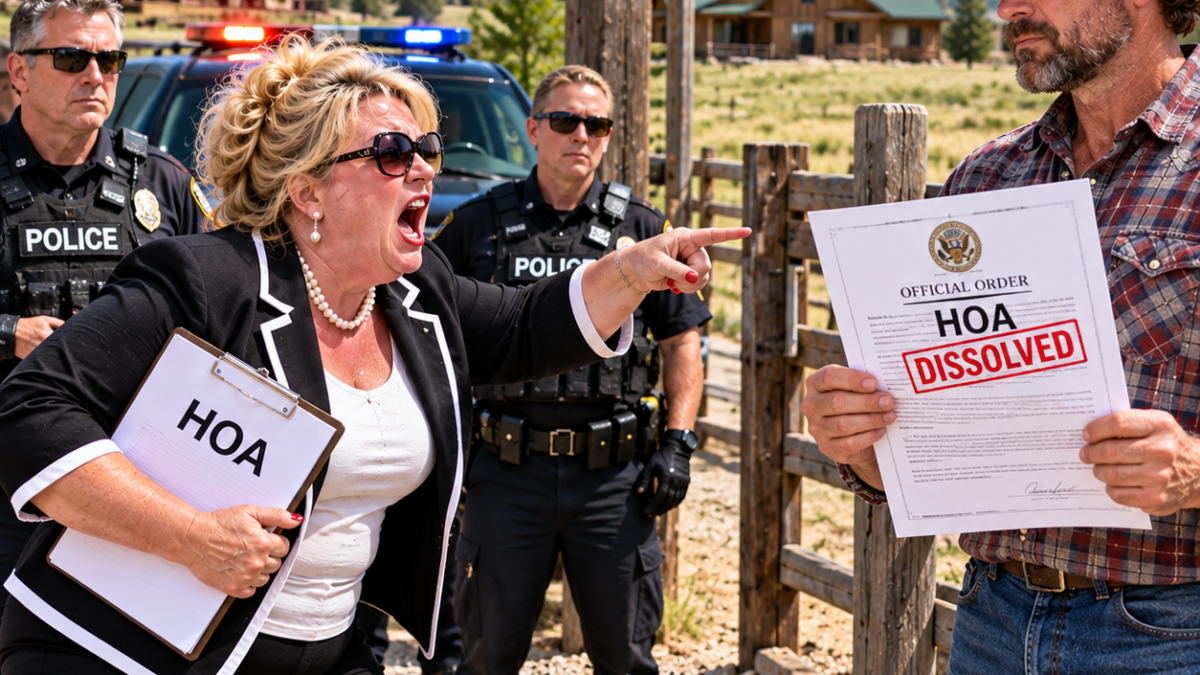
PART 2
Deputy Wright waited.
Janet recovered quickly.
She reached into the leather folder tucked beneath her arm and removed several pages.
“Pinewood Valley HOA has administrative authority over this parcel under the county’s abandoned-property procedures.”
Randy glanced at the papers.
“What procedures?”
“Section 47.3.”
His brow tightened.
“I don’t know that section.”
“That doesn’t mean it doesn’t exist.”
“I didn’t say it did.”
Janet’s smile hardened.
I stood beside my truck, too exhausted to enjoy the first crack in her confidence.
Randy handed me back my deed.
“Ms. Dawson, based on what you’ve shown me, I’m not arresting you for trespassing on a property where county tax records still identify you as owner.”
Janet stepped forward.
“That is not your determination to make.”
“Correct.”
His tone flattened.
“That’s why I’m not making a title determination. This is a civil property dispute unless someone gives me evidence of a crime.”
“I called because she cut—”
“I haven’t cut anything yet,” I said.
Randy looked at the shiny padlock.
Then at Janet.
“Who put that on?”
“The association.”
“Did the titled owner authorize it?”
Janet didn’t answer.
Randy sighed.
“Ms. Evans, I’d strongly recommend nobody change locks, remove property, or escalate this until the records are sorted out.”
“This ranch is under HOA management.”
“Then prove that through the appropriate channels.”
He turned to me.
“Recorder’s office opens Monday. Bring everything.”
“I will.”
“And maybe talk to a property lawyer.”
Janet’s eyes stayed on me while Randy returned to his cruiser.
Dust rolled across the road after he left.
For a few seconds, neither of us spoke.
Then Janet’s pleasant expression disappeared.
“You have no idea what you’re dealing with.”
“I’m starting to.”
“You think an old deed makes you untouchable?”
“It makes me the owner.”
“For now.”
The way she said it made my skin crawl.
She walked toward the white SUV parked beside my barn.
My barn.
My gate.
My pasture.
I watched her drive out through a side access lane I hadn’t even known she was using.
Then I took the bolt cutters from my truck.
One squeeze.
The padlock snapped.
I dropped it in the dirt.
***
The ranch house smelled closed up.
Dust.
Wood.
Old coffee.
I checked every room before allowing myself to sit.
Nothing obviously stolen.
Nothing vandalized.
But someone had been on the property.
The grass behind the barn was flattened where vehicles had parked.
Orange survey ribbons hung on fence posts.
A fresh set of tire tracks crossed the east pasture.
On the kitchen counter sat a plastic clipboard I didn’t recognize.
Empty.
Maybe forgotten.
Maybe left deliberately.
I called Deborah.
No answer.
Again.
Voicemail.
“Deb, I’m home. Please call me.”
Nothing.
I called Mom at the rehabilitation center.
My sister answered.
“How did the drive go?”
“Complicated.”
“Mom’s asking for you.”
“Put her on.”
Mom’s speech was still slow after the stroke.
“Home?”
“Yes.”
“Horses?”
“Fine.”
“Fence?”
“Mostly.”
I didn’t tell her some woman had called police on me at Grandpa’s gate.
Mom had enough to recover from.
“I’ll come back Wednesday.”
“No.”
“Mom—”
“Stay.”
Her word was weak but clear.
“Take care… ranch.”
I closed my eyes.
“Okay.”
That night I slept in my childhood bedroom.
Or tried to.
Every noise sounded unfamiliar.
Wind against the window.
A horse shifting in the paddock.
A truck somewhere on Miller Road.
At 2:13 a.m., headlights swept across the ceiling.
I sat up.
A vehicle slowed outside the gate.
Then continued.
I told myself I was being paranoid.
At 2:30, I was still awake.
So I started researching.
County Code Section 47.3.
Nothing obvious.
Texas abandoned-property law.
Nothing remotely matching Janet’s claim.
HOA annexation procedures.
More complicated.
But one basic principle kept repeating through the material I found: an HOA didn’t simply acquire somebody else’s deeded acreage because grass got tall while the owner was away.
There had to be valid recorded covenants, contractual authority, consent, or some lawful property mechanism.
My ranch predated Pinewood Valley subdivision by decades.
I had never signed anything.
Neither had my parents, as far as I knew.
At 4:10 a.m., I found Pinewood Valley’s website.
Professional logo.
Board page.
Janet Evans, president.
Mission statement.
Community standards.
Violation schedule.
Fifty-two “member properties.”
Dawson Ranch was listed as number fifty-three.
Status:
**ANNEXED—ADMINISTRATIVE HOLD**
My chest tightened.
They had added me to their own system.
That wasn’t the same as legal ownership.
But it told me this was organized.
I took screenshots.
***
The first violation notice arrived Monday.
Technically, it had already been waiting in my mailbox.
Heavy cream paper.
Embossed-looking logo.
**NOTICE OF ARCHITECTURAL NONCOMPLIANCE**
My barn violated community design standards.
Fine:
$500.
The barn had been standing since 1968.
Tuesday:
Unapproved livestock fencing.
$300.
Wednesday:
Commercial agricultural equipment visible from common roadway.
$250.
Thursday:
Exterior paint deterioration.
$400.
Friday:
Excessive vegetation.
Unauthorized equine use.
Unapproved mailbox.
Improper gate materials.
By the end of the week, Janet’s HOA claimed I owed $2,300.
I spread the notices across Dad’s kitchen table.
At first glance, they looked official.
At second glance, they looked like somebody trying too hard.
Different article numbers referenced the same rule.
Fine amounts didn’t match Pinewood’s online schedule.
One page cited Article 7.3.
Another called the same rule Section VII-C.
No recorded declaration number.
No document reference tying my ranch to any restrictive covenants.
Just Janet Evans’s signature.
I was still comparing them when a certified letter arrived from a Houston law firm.
It threatened a lien.
Possible collection action.
Potential “removal of unauthorized occupants.”
That phrase made me angry enough to call.
A young associate answered.
I gave my name.
There was a pause.
“Oh.”
“You know who I am?”
“We represent Pinewood Valley in certain matters.”
“Do you have a copy of whatever recorded covenant supposedly subjects Dawson Ranch to your client’s authority?”
Another pause.
“I’d need to review the file.”
“Please do.”
“Our client has represented that the parcel was lawfully incorporated.”
“Your client called the police on me while I held the deed.”
“I wasn’t present.”
“Correct. Which is why I’m asking for your legal basis.”
“We’ll respond in writing.”
“When?”
“I can’t give you a timeline.”
“Then please tell Janet to stop threatening liens until her lawyer can identify what gives her the power to issue one.”
He became noticeably colder.
“Ms. Dawson, I would advise you not to treat this casually.”
“I’m not.”
I ended the call.
Ten minutes later, Janet emailed me.
**Continued hostile communication with HOA counsel may result in additional administrative penalties.**
I saved that too.
***
The recorder’s office occupied a squat brick building that looked like nothing important had happened there since 1979.
I took a number.
Waited forty-five minutes.
A clerk named Denise Ortega called me forward.
Mid-thirties.
Wire-rim glasses.
Focused expression.
I explained the situation.
She listened without interrupting.
Then I said:
“Janet claims County Code Section 47.3 allows abandoned agricultural land to be annexed into an HOA.”
Denise typed.
Paused.
Typed again.
“What was the wording?”
I showed her the sign photograph.
She searched longer.
Then looked up.
“I don’t find that provision.”
“You mean it doesn’t apply?”
“I mean I don’t find a county code matching this description.”
“So she invented it?”
Denise raised a hand.
“I can’t say that yet.”
Right.
Government employee.
Careful language.
“Can you search for an annexation filing involving Dawson Ranch?”
She did.
Nothing.
Then Pinewood Valley HOA.
Her frown deepened.
“Interesting.”
“What?”
“I see a business filing under that name in our local index.”
“HOA formation?”
“It’s categorized strangely.”
She clicked again.
“Formation date says March 15 two years ago.”
“Okay.”
“But our intake timestamp shows the packet entered this system in January of this year.”
“Meaning?”
“Could be migration. Could be correction. Could be late filing.”
“Could it be backdated?”
Denise looked at me.
“Possibly. I would need the original packet.”
“Can we get it?”
“I’ll request archives.”
I slid the violation notices through the slot.
“These valid?”
She skimmed them.
“I cannot give you legal advice.”
“Everybody says that right before giving me the most useful information.”
She almost smiled.
Then:
“I don’t see a recorded declaration reference here.”
“What does that mean?”
“If somebody claims a property is bound by recorded restrictions, usually they can identify the recording information.”
Janet’s notices couldn’t.
Denise copied my number.
“I’ll call when I find the formation file.”
I left with more confidence than I had entered with.
That lasted three hours.
***
The environmental complaint was taped to my front door.
Anonymous report.
Hazardous chemical storage.
Groundwater contamination.
Possible improper waste disposal.
Inspection Wednesday.
I stood on the porch holding it.
The timing was too clean.
Police failed.
Violation notices didn’t scare me.
Now environmental enforcement.
I called the number.
Inspector Frank Miller answered.
“Anonymous complaint?”
“Yes.”
“About a farm?”
“Yes.”
He sighed.
“We’re required to look.”
“Come.”
Wednesday morning, Frank inspected everything.
Barn.
Equipment shed.
Fuel storage.
Septic.
Creek bank.
Old tractor area.
He spent nearly two hours walking in ninety-degree heat.
Finally, he signed his report against the hood of his truck.
“No violations.”
“That’s it?”
“That’s it.”
“What about groundwater contamination?”
“No evidence.”
“Chemical dumping?”
“No.”
He handed me a copy.
“Your place is cleaner than half the farms I visit.”
“Can you tell me who filed the complaint?”
“No.”
He hesitated.
Then looked toward the road.
“I can tell you something else.”
“What?”
“We’ve had three similar anonymous complaints around this valley in six months.”
“All farms?”
“Rural properties adjacent to Pinewood.”
“Valid?”
“No.”
“Same caller?”
He met my eyes.
“I didn’t say that.”
“You almost did.”
Frank opened his truck door.
“I’ve said what I can.”
That was enough.
***
Deborah’s note appeared under my front door that evening.
No knock.
No phone call.
Just folded paper.
**Rachel,**
**I’m sorry I didn’t answer. Janet has been watching who talks to you. She threatened complaints against my property if I helped.**
**My name is listed as a founding member of Pinewood Valley HOA. I never signed their formation papers.**
**I think my signature was forged.**
**Meet me at Route 12 Diner tomorrow, 7:00 a.m. Come alone.**
**D.**
I read it three times.
The fear I had been carrying turned into something colder.
Forgery.
Not legal disagreement.
Not aggressive HOA interpretation.
Forgery.
My phone rang.
Denise.
“Ms. Dawson?”
“Yes.”
“I found the archived formation packet.”
Her voice sounded different.
Careful.
“There’s a problem.”
“What kind?”
“The stated founding date and the notary certification don’t line up.”
I sat down.
“How badly?”
“The document says March 15 two years ago.”
“And?”
“The notary stamp appears dated December 3 of the year before.”
“That’s impossible.”
“Yes.”
“Could the stamp just be wrong?”
“Possibly.”
“But?”
“I contacted the notary database to verify commission information.”
“And?”
“The seal information raises additional questions.”
“What questions?”
“I’d rather show you tomorrow.”
I looked at Deborah’s note.
“Denise, is this HOA real?”
Long silence.
Then:
“I think you need to come see the file.”
***
Deborah was already in the diner when I arrived.
Back booth.
Hands around a coffee mug.
She looked exhausted.
When I sat down, she said:
“I’m sorry.”
“You were scared.”
“I should’ve called.”
“What did Janet do?”
Deborah looked toward the door.
“Two months after you left, she came to my house.”
“With the HOA?”
“She said they were organizing one. Said everybody was joining. Shared road upkeep, security, property standards.”
“Did you sign?”
“No.”
“Nothing?”
“She had a petition.”
“What petition?”
“She said it was to show interest. I told her I wanted to read everything first.”
“You didn’t sign that either?”
“No.”
Deborah reached into her purse.
Photograph.
HOA founding petition.
**DEBORAH J. PHILLIPS**
Signature beside it.
Then a photocopy of her actual bank signature.
The differences were obvious once she pointed them out.
Different D.
Different P.
Different slant.
“I spent thirty years signing loan paperwork with my husband,” she said. “I know my own name.”
“How did you get this?”
“Recorder’s office last month.”
“Why didn’t you call me?”
“Janet found out.”
“How?”
“I don’t know.”
“What happened?”
“Next day I got three violation notices.”
“For?”
“Fence height. Shed paint. Unauthorized trailer.”
“Were they legitimate?”
“I paid.”
My stomach tightened.
“How much?”
“Eight hundred dollars.”
“Deb.”
“I’m on a fixed income.”
“So you paid someone who forged your signature?”
“I paid because I wanted her to leave me alone.”
There it was.
Janet’s real weapon.
Not law.
Exhaustion.
Deborah told me about three others.
People whose names appeared on the founding list despite denying they had joined.
Two had eventually sold.
The third was Harold Vance.
Retired notary.
Eighty-two.
“He’s been collecting evidence for years,” Deborah said.
“Why hasn’t anyone listened?”
“He’s old.”
“That doesn’t answer it.”
“In this county, sometimes it does.”
***
Harold Vance lived at the end of a dirt road beneath enormous pecan trees.
Sharp eyes.
White hair.
Voice like sandpaper.
When I introduced myself, he said:
“Janet trying to steal your ranch?”
“That obvious?”
“She likes land with tired owners.”
That sentence hit harder than it should have.
He invited me in.
His kitchen table disappeared beneath paperwork.
Formation documents.
Signature comparisons.
Violation notices.
County complaints.
Letters.
Returned certified mail.
Photographs.
Timelines.
“For three years?” I asked.
“Three years, two months.”
“Why?”
“Because I was a notary forty years.”
He pulled out a signature page.
“I know what bad signatures look like.”
He pointed to three.
“These are not the people named.”
“You know them?”
“Personally.”
“Could handwriting vary?”
“Of course.”
He tapped one.
“But people don’t suddenly reverse basic letter construction.”
He showed me samples.
Harold had documented three properties targeted before mine.
The Henderson family.
The Martinez family.
Another older owner named Susan Hale.
Each received escalating HOA violations.
Each disputed membership.
Each faced legal threats.
Henderson sold.
Martinez sold.
Hale moved to assisted living and transferred the property to her nephew.
“Who bought the first two?”
I asked.
Harold’s expression sharpened.
“Companies.”
“Connected to Janet?”
“Couldn’t prove it.”
“Names?”
He gave them to me.
I wrote them down.
“Why didn’t you sue?”
“With what money?”
Fair.
“Why didn’t county officials act?”
“My complaints disappeared.”
“Literally?”
“Twice they told me there was no record I had filed.”
“Did you keep copies?”
Harold smiled.
That was a stupid question to ask a retired notary.
He opened another folder.
Stamped receipts.
Dates.
Names.
Every complaint preserved.
“You have standing now,” he said.
“I know.”
“No. You have something better.”
“What?”
“She got greedy.”
“How?”
“Dawson Ranch is forty acres.”
“So?”
“Biggest parcel she’s tried.”
“Why does that matter?”
“Because people ignore an old widow losing two acres.”
His eyes held mine.
“They notice forty.”
I disliked the truth in that.
“Will you help?”
Harold leaned back.
“I’ve been waiting three years for someone to ask the right question.”
“What question?”
“How do we stop her?”
I waited.
“And?”
He smiled.
“By making her prove she exists.”
***
The online attack started before I got home.
A Pinewood Valley community post.
Photographs of my truck.
My horses.
My barn.
Caption:
**UNAUTHORIZED OCCUPATION CONTINUES**
I was described as a squatter.
A safety risk.
Someone making “aggressive legal threats.”
People commented.
Some I recognized.
Most I didn’t.
**Call the sheriff again.**
**Why is she allowed to keep animals there?**
**Protect our property values.**
One comment said:
**If police won’t remove her, residents should.**
That one I screenshotted separately.
I sat alone in my kitchen that night with Harold’s documents around me.
For the first time, I wondered whether fighting was worth it.
Not legally.
Personally.
Mom was still recovering.
My job had already given me unpaid leave beyond what I planned.
The ranch needed repairs.
I had spent savings on travel and medical expenses.
Janet’s genius was not that her documents were convincing.
It was that she understood pressure.
One complaint is annoying.
Seven notices, a lawyer, police, environmental inspectors, public humiliation, hostile neighbors, and family illness become a system.
A system makes surrender feel practical.
I picked up the phone.
Looked at a realtor’s number I had saved years earlier.
For thirty seconds, I considered calling.
Sell.
Take the money.
Leave.
Then I looked through the kitchen doorway.
Dad’s height marks were still carved into the trim.
Mine too.
Age eight.
Ten.
Thirteen.
The ranch wasn’t sacred because dirt is sacred.
It mattered because every room contained evidence that my family had existed.
Grandma’s ashes were scattered beyond the west meadow.
Dad built the barn.
Mom planted the pecan near the well.
I wasn’t going to let a woman with a printer convert that into an administrative opportunity.
I deleted the realtor number.
***
Denise let me into the recorder’s office before opening.
Back room.
Blinds closed.
Stack of documents.
“I’m taking a risk showing you internal working notes,” she said.
“I understand.”
“Nothing leaves this room except certified public copies.”
“Understood.”
She started with Pinewood’s formation document.
Claimed date:
March 15, two years earlier.
Notary stamp:
December 3, previous year.
“That’s impossible,” I said.
“Yes.”
“Wrong stamp?”
Denise placed another paper beside it.
Notary commission record.
“The notary whose name appears here reported this physical stamp stolen several years ago.”
I stared.
“Did she notarize the HOA packet?”
“She says no.”
That was much worse than a clerical error.
Then Denise opened the state business registry.
Pinewood Valley Homeowners Association.
No matching corporate registration under that exact entity.
She was careful explaining what that did and did not mean.
“An association’s legal authority depends on more than a business registration. The key issues are whether it was lawfully created, whether valid declarations or restrictive covenants were recorded, and whether the affected owners consented where required.”
“Does Dawson Ranch appear in any recorded Pinewood declaration?”
“No.”
“Ever?”
“I checked the chain you gave me.”
“Any annexation instrument?”
“No.”
“Any signed consent from me?”
“No.”
“My parents?”
“No.”
“Grandfather?”
“No.”
“So Janet has nothing.”
“For your ranch, I don’t see a recorded basis for HOA jurisdiction.”
I exhaled.
Then she showed me the signature pages.
Seventeen rows.
Left column:
HOA petition signatures.
Right:
verified signature samples from public filings.
Property deeds.
Recorded affidavits.
Voter documents where lawfully accessible.
Harold had already flagged some.
Denise independently checked more.
“How many?”
“Seventeen suspicious enough to refer for investigation.”
“Out of fifty-two?”
“Yes.”
“Deborah?”
“One.”
“Harold?”
“He isn’t listed as a founder.”
“Why?”
“He opposed Janet.”
Of course.
Denise slid another page toward me.
Board minutes.
Founding meeting.
Janet Evans appointed president “by unanimous consent.”
“Who attended?”
“That’s the problem.”
No attendance sheet.
No verifiable notice.
No independent election record.
“This organization may have never been validly created in the form it claims,” Denise said.
“May?”
“I am still not a judge.”
“Everybody keeps ruining my best moments with legal accuracy.”
She laughed.
Then turned serious.
“I already contacted Assistant County Attorney Linda Rivera.”
“Why?”
“Because some of these documents were filed with county offices.”
“Fraud?”
“Potentially.”
“Forgery?”
“Potentially.”
“Extortion?”
“Rachel.”
“I know. Potentially.”
Denise nodded.
“Linda wants to meet.”
***
Linda Rivera was in her forties, calm, methodical, and almost impossible to read.
At her office sat:
Me.
Denise.
Harold.
Deborah.
Forty-seven pages of documents.
Linda took nearly two hours.
She asked Deborah:
“Did you authorize anybody to sign for you?”
“No.”
“Did you sign any petition that could reasonably have been converted into this?”
“No.”
She asked Harold:
“Can you identify the basis for your forgery conclusions?”
He explained letter construction.
Known exemplars.
Sequence.
Pen lifts.
He did not claim forensic certainty.
That helped.
She asked me about the ranch.
“Any recorded deed restrictions adopting Pinewood covenants?”
“None we’ve found.”
“Any contract?”
“No.”
“Any dues paid?”
“No.”
“Any prior recognition of Pinewood authority?”
“No.”
“Any abandonment proceeding?”
“None.”
She finally set down her pen.
“There are several separate issues.”
I waited.
“First, Pinewood appears to lack a valid recorded basis to exercise mandatory HOA authority over Dawson Ranch.”
Good.
“Second, there are serious questions about whether the organization itself was properly constituted.”
Better.
“Third, we have multiple allegations of forged signatures and questionable government filings.”
Best.
“Fourth, if people were induced to pay money through false authority, there may be criminal and civil exposure.”
Deborah whispered:
“Can you shut them down?”
Linda looked at her.
“I can’t dissolve an organization by saying a sentence in my office.”
That was more realistic than the fantasy I wanted.
“But I can seek emergency judicial relief, refer criminal evidence, notify affected owners, and challenge the validity of these filings.”
“How long?” I asked.
“Depends how hard they fight.”
Harold muttered:
“Janet fights everything.”
Linda looked at him.
“I know.”
“You’ve dealt with her?”
“Complaints.”
“How many?”
“Enough.”
She closed the folder.
“Fortunately, Mrs. Evans scheduled an emergency Pinewood meeting Saturday.”
I had seen the notice.
Agenda:
**DAWSON RANCH TRESPASS CRISIS**
Linda almost smiled.
“She intends to publicly assert authority over your property.”
“Yes.”
“Good.”
I raised an eyebrow.
“Good?”
“She’s volunteering statements.”
Harold smiled.
I understood.
Janet believed the meeting would be my humiliation.
Instead, she was creating a room full of witnesses.
***
Preparation took three days.
Linda did not want theatrics.
That disappointed Harold.
“We should put all seventeen forged signatures on a poster.”
“No,” Linda said.
“Projector?”
“No.”
“Why do you hate visual aids?”
“I hate contaminating witnesses.”
Harold grumbled.
We built a sequence.
First:
Dawson deed and tax records.
Second:
No recorded Pinewood covenant burdening my ranch.
Third:
Fake Section 47.3 claim.
Fourth:
Formation-document date inconsistency.
Fifth:
Notary denial.
Sixth:
Signature testimony.
Seventh:
Prior victim pattern.
Deborah contacted property owners.
Of the seventeen questionable names Denise flagged, eleven were reachable.
Eight agreed to attend.
Two former residents sent notarized statements.
One refused entirely.
“Afraid?” I asked.
Deborah nodded.
Linda arranged for Deputy Wright and another deputy to be nearby, not inside unless requested.
She also arranged a court reporter.
“Why?” I asked.
“Because everybody remembers meetings differently once attorneys arrive.”
Saturday morning, Mom called.
Her speech was stronger.
“Big day?”
My sister had told her.
“You weren’t supposed to worry.”
“I’m mother.”
“Apparently strokes don’t cure that.”
She laughed.
Then:
“Your father… hated HOAs.”
“He hated everybody who told him what color a fence should be.”
“Same thing.”
I smiled.
“You okay?”
“Better.”
“Good.”
She paused.
“Don’t lose ranch.”
My throat tightened.
“I won’t.”
“Your grandpa would haunt you.”
“That’s exactly what I told myself.”
***
The community center parking lot was full by 1:40.
Janet had summoned everyone.
Forty-three people inside.
Banner on wall:
**PINEWOOD VALLEY HOA — BUILDING COMMUNITY TOGETHER**
Janet arrived last.
White sedan.
Reserved space marked:
**HOA PRESIDENT**
She wore a navy dress and pearls.
When she saw me:
“Ms. Dawson.”
“Janet.”
“I’m surprised you came.”
“You invited me.”
“I invited affected residents.”
“I’m apparently your favorite one.”
Her smile tightened.
“You’ll have an opportunity to speak after the board addresses your violations.”
Linda Rivera approached.
Janet looked at her.
“I don’t believe we’ve met.”
“Linda Rivera. County attorney’s office.”
That changed Janet’s face for maybe half a second.
Then the smile returned.
“How nice.”
“I’m here to observe.”
“Of course. We have nothing to hide.”
Harold whispered behind me:
“People should stop saying that.”
***
Janet called the meeting to order at exactly 2:00.
She spoke confidently.
Community safety.
Standards.
Property values.
Then me.
“An individual has unlawfully occupied property annexed into Pinewood jurisdiction.”
I stood.
“My family owns Dawson Ranch.”
Janet held up a hand.
“You will have your opportunity.”
The room murmured.
Linda raised her hand.
Janet hesitated.
“Yes?”
“Before you proceed with any vote affecting Ms. Dawson’s property, I need clarification regarding the legal authority of this organization.”
Janet sat straighter.
“This is an internal HOA matter.”
“You are asserting jurisdiction over real property.”
“We have recorded authority.”
“Please identify the instrument.”
Silence.
Janet reached through her folder.
“Our annexation resolution.”
“That’s an internal resolution. I’m asking for the recorded declaration, covenant, consent, or other property instrument binding Dawson Ranch.”
“We have administrative approval.”
“From whom?”
“The county.”
Linda’s voice remained calm.
“My office finds no county annexation order involving Dawson Ranch.”
The room shifted.
Janet’s smile disappeared.
“That is inaccurate.”
Linda continued.
“County Code Section 47.3, which your notices cite as an abandoned agricultural annexation provision, does not contain the authority you’ve represented.”
A man in the third row turned toward Janet.
“You told us the county approved it.”
“They did.”
“Where?”
Janet ignored him.
“This meeting is not a courtroom.”
Linda nodded.
“No. Which is why nobody here should pretend your internal paperwork substitutes for recorded property authority.”
Janet stood.
“If you’re here to harass us—”
“I’m here because documents filed in connection with this organization raise serious concerns.”
Linda opened the formation packet.
“Can you confirm Pinewood Valley claims it was formed March 15 two years ago?”
“Yes.”
“And that this is your filed founding packet?”
“Yes.”
“Then can you explain why the notary stamp predates the claimed execution by approximately fifteen months?”
The room went silent.
Janet stared at the page.
“That must be a clerical error.”
Linda placed another document on the table.
“The notary denies notarizing it.”
Janet’s face went pale.
“She may not remember.”
“Her stamp was reported stolen before this document was filed.”
No one moved.
That was the first real collapse.
Not shouting.
Silence.
A woman behind me whispered:
“Oh my God.”
Janet recovered.
“One defective notarization does not invalidate years of community governance.”
Linda nodded.
“Correct. Which is why we examined other issues.”
Deborah stood.
“My name is Deborah Phillips.”
Janet snapped:
“Sit down.”
Deborah froze.
Then I saw something change in her.
Months of fear became anger.
“No.”
She walked forward.
“Your formation petition says I’m a founding member.”
She held up the page.
“That signature is not mine.”
Janet laughed too quickly.
“You signed a community-interest petition.”
“No.”
“You may not remember.”
“I remember my handwriting.”
Deborah held up her real sample.
The differences were visible even from the second row.
Then Thomas Greene stood.
“My signature’s wrong too.”
Janet turned.
“Thomas—”
Another woman.
“Mine too.”
Then another.
One by one.
Eight people.
Each saying the same thing.
I never signed.
I never consented.
That isn’t my signature.
Two statements from former residents were read.
One said she had signed what Janet described as a neighborhood safety survey, then later discovered the signature page incorporated into a membership packet.
The mood in the room transformed.
People who had glared at me started staring at Janet.
Janet stood so fast her chair scraped backward.
“This is coordinated.”
Nobody answered.
“These people are working with Rachel Dawson to destroy an organization that has protected your property values for two years.”
Harold spoke from the back.
“Two years?”
Janet looked at him.
“According to your paperwork, you formed before your notary seal existed.”
A few nervous laughs.
Janet slammed her palm against the table.
“Enough.”
Linda waited.
Then:
“Mrs. Evans, did you personally collect signatures used for the formation petition?”
Janet’s jaw tightened.
“I coordinated the process.”
“Did you direct others to sign names without authorization?”
“No.”
“Did you ever reproduce a property owner’s signature yourself?”
“No.”
That was important.
The source story’s instant confession would have been satisfying.
Reality rarely offers one.
Janet did not confess.
She denied.
Completely.
Linda nodded.
“Then forensic review will determine that.”
Janet’s confidence flickered.
Linda continued.
“Until then, my office has sought emergency relief preventing Pinewood Valley from enforcing assessments, liens, penalties, or claimed property authority based on these disputed filings.”
Janet laughed.
“You can’t shut us down because a few residents changed their minds.”
Linda looked toward the door.
A young assistant stepped in carrying a folder.
“Actually, a judge signed the temporary order twenty-seven minutes ago.”
Nobody breathed.
Linda took the order.
“The court has temporarily enjoined Pinewood Valley and its officers from collecting assessments, recording liens, enforcing alleged covenants, or representing that Dawson Ranch is subject to its jurisdiction pending the validity proceeding.”
Janet stared.
The room erupted.
Questions.
Anger.
Someone shouted:
“Does that mean our fines are fake?”
Another:
“What about the $4,000 I paid?”
Janet tried to regain control.
“This is temporary.”
Linda agreed.
“Yes.”
That surprised Janet.
“It is temporary.”
Then Linda added:
“But the hearing record also confirms that no valid recorded instrument has been identified binding Dawson Ranch to Pinewood Valley. Ms. Dawson remains titled owner of her ranch.”
Every eye turned toward me.
Janet’s attempt to label me a squatter had just died in the meeting she called to remove me.
Deputy Wright appeared at the side door.
He didn’t handcuff Janet.
He didn’t need to.
“Mrs. Evans,” he said, “investigators will need to speak with you regarding suspected forged signatures and documents filed with county offices. You’re not under arrest at this moment. I recommend you get counsel.”
For the first time since I met her, Janet looked small.
Not physically.
Institutionally.
The authority surrounding her had vanished.
***
I should have felt triumphant.
Instead, I felt exhausted.
People surrounded me.
Apologies.
Questions.
Requests to see documents.
One woman touched my arm.
“I believed her.”
“I know.”
“I called you a squatter online.”
“I know.”
She looked ashamed.
“I’m sorry.”
I nodded.
That was all I had energy for.
Outside, Janet caught me near my truck.
“Rachel.”
I turned.
Her attorney hadn’t arrived yet.
She stood alone.
“You think you won.”
“I think I’m going home.”
“You destroyed something people needed.”
“You threatened to take my ranch.”
“I was trying to organize this valley.”
“With forged signatures?”
“You don’t know what it was like before.”
“No standards. No cooperation. People dumping junk. Roads falling apart. Nobody paid for anything unless someone forced them.”
“That doesn’t give you my land.”
“I never wanted your land.”
“You put a lock on it.”
“Because it had been abandoned.”
“My mother had a stroke.”
“I didn’t know that.”
“I told you at the gate.”
Janet looked away.
That mattered.
She remembered.
“I was following information I had.”
“You invented a county code.”
“I was given language.”
“By who?”
No answer.
“Who, Janet?”
She crossed her arms.
“You think all those people criticizing me are innocent? They loved having someone else enforce rules until enforcement reached them.”
There was probably truth in that.
Communities often love power when it points outward.
I stepped closer.
“Maybe.”
She looked surprised.
“But you still forged authority you didn’t have.”
“You don’t know that I forged anything.”
“Then investigators will sort it out.”
Her face hardened.
“Your family ranch will be surrounded by development someday.”
“Maybe.”
“You’ll wish someone had planned.”
“Maybe.”
She hated that I wouldn’t give her a dramatic argument.
I opened my truck door.
Then she said:
“Your grandfather would’ve understood.”
I turned back.
“Don’t use him.”
For the first time, anger cut through my exhaustion.
“You never met him. You never watched him pull calves at two in the morning or rebuild fence after storms. You never watched my dad work that ranch until his hands cracked open. You don’t get to borrow my family to justify taking control of what they built.”
Janet said nothing.
I drove home.
***
The temporary injunction became the beginning, not the end.
Pinewood Valley’s lawyers fought.
Hard.
They argued the association existed as a voluntary organization even if some paperwork was defective.
That certain owners had ratified membership through payment.
That forged signatures—if forged—could be isolated misconduct rather than fatal to the entire structure.
Those arguments weren’t ridiculous.
Some residents had voluntarily joined.
Some had paid dues for two years.
Some genuinely wanted a community association.
The legal issue became separating voluntary cooperation from mandatory power.
Dawson Ranch was easier.
No covenant.
No consent.
No annexation.
No recorded basis.
Janet’s claim over my property collapsed early.
The broader Pinewood structure took longer.
Forensic handwriting analysis confirmed multiple disputed signatures were not written by the named owners.
The notary issue worsened.
The original notary testified she never handled Pinewood’s formation documents and had reported the seal stolen.
Records investigators traced preparation files to a computer associated with Janet’s community-management business.
That didn’t automatically prove every signature came from her hand.
But it connected the packet to her operation.
Then money records surfaced.
Dues.
Fines.
“Administrative penalties.”
Thousands collected.
Some deposited into Pinewood accounts.
Some spent on legitimate community expenses.
Road grading.
Signs.
Meeting-room rentals.
Some went to Evans Community Management, a small company Janet and her husband Billy owned.
That made the case uglier.
Not because every payment was necessarily theft.
Because Janet had presented Pinewood as a properly authorized mandatory association while paying her own management company without transparent approval.
Harold called me the day those records became public.
“She paid herself.”
“Looks that way.”
“Can I say I told you so?”
“You’ve been saying that for three years.”
“I’m eighty-two. Efficiency matters.”
***
The criminal investigation moved slower than neighbors expected.
People kept asking:
“Why isn’t Janet in jail?”
Because real investigations aren’t television.
Documents need authentication.
Intent matters.
Forgery charges require proof about who made or used false writings and under what circumstances.
Fraud requires its own elements.
Janet retained counsel and stopped talking.
Smartest thing she did.
Deputy Wright told me quietly:
“She’s not helping herself, but she’s not making it easier either.”
“Meaning?”
“Meaning let investigators work.”
I did.
Mostly.
The community forum was another story.
For months it had called me a criminal.
Now it became a feeding frenzy against Janet.
People posted every old fine.
Every argument.
Every letter.
Some stories were legitimate.
Some were petty.
One man claimed Janet had deliberately poisoned his roses.
I knew that was nonsense.
I commented once:
**Please stick to documented facts.**
Within minutes, someone replied:
**Why are you defending her?**
I closed the website.
That taught me something uncomfortable.
Crowds don’t become wise when they change targets.
They only change direction.
***
Mom came home to Texas three months later.
She moved into the ranch temporarily because her house had stairs.
When my sister drove her up Miller Road, I stood at the gate.
No brass padlock.
No HOA sign.
Just Grandpa’s old chain.
Mom lowered the window.
“You look terrible.”
“Nice to see you too.”
She smiled crookedly, stroke still affecting one side of her face.
When she saw the barn, she started crying.
That surprised me.
Mom rarely cried.
I opened her door.
“What?”
“Thought… maybe lose it.”
“We didn’t.”
She touched the truck door.
“Your father would… be loud.”
“Dad was loud when the weather changed.”
She laughed.
I helped her inside.
For the first time since the whole fight began, the ranch felt like home instead of evidence.
***
Deborah’s restitution claim was one of the first resolved.
Her $800 came back through a civil settlement involving Pinewood-controlled funds.
She brought the check to my kitchen.
“I feel stupid.”
“Don’t.”
“I paid because she scared me.”
“That was the system.”
“I ignored you because she scared me.”
“That part hurt.”
Deborah looked down.
“I know.”
I let the silence sit.
Then:
“But you came back.”
She looked at me.
“What?”
“When it mattered. You came back.”
She started crying.
I poured coffee because neither of us knew what else to do.
Forgiveness wasn’t instant.
Trust came back slower.
But it came.
***
Harold became a minor local celebrity.
He hated it.
A newspaper called him “the retired notary who cracked the fake HOA.”
He called me furious.
“I did not crack anything.”
“You collected three years of evidence.”
“That’s called filing.”
“You should put that on a shirt.”
“Rachel.”
“Sorry.”
He eventually donated copies of his records to Linda Rivera’s office for training.
He told younger investigators:
“Documents are only boring until somebody lies in them.”
That sounded exactly like him.
***
Janet’s case resolved about a year later.
Not with the dramatic hundred-year sentence some neighbors wanted.
There were criminal counts tied to false filings and forged documents, plus separate civil claims.
Her lawyers negotiated.
She entered pleas on reduced charges involving false instruments and fraudulent representations.
She received probation, financial penalties, community-service requirements, and restitution obligations rather than a long jail sentence.
Billy was not treated as the mastermind people online wanted him to be.
Evidence showed he handled some finances but was not responsible for all of Janet’s actions.
Civil liability remained.
Evans Community Management shut down.
Janet could no longer realistically operate another neighborhood association.
The permanent civil judgment was more important to me than the criminal drama.
The court found that Pinewood Valley, as constituted and operated under the challenged formation documents, lacked authority to function as the mandatory property owners’ association Janet claimed.
Mandatory enforcement stopped.
Fines issued without lawful authority were voided or subject to reimbursement.
Recorded lien threats based solely on Pinewood’s defective authority were withdrawn.
Residents who still wanted a voluntary neighborhood organization could form one properly.
Some did.
Most didn’t.
That was the real dissolution.
Not a judge dramatically striking a gavel and saying:
**Your HOA is gone.**
It was paperwork undoing paperwork.
The same weapon Janet relied on, turned in the opposite direction.
***
The Henderson property bothered me most.
Harold had told me they sold cheap after months of pressure.
I contacted the family.
Their daughter, Megan, answered.
At first she didn’t want to talk.
Then I explained what happened.
Silence.
Finally:
“My parents thought they were losing their minds.”
“What do you mean?”
“Every week there was another violation.”
She described fines.
Driveway gravel.
Fence color.
Trailer storage.
Vegetation.
Then threats.
Eventually, an investor offered to buy.
Below market.
Her parents accepted because they were tired.
“Who was the buyer?” I asked.
She gave me the LLC name.
I passed it to Linda.
The company wasn’t directly owned by Janet.
But records connected it to a local investor who had done business with Billy.
Not enough for me to claim a conspiracy.
Enough for investigators to look.
The Martinez family had a similar story.
They sold too.
That made my own victory feel smaller.
I had gotten back in time.
They hadn’t.
No court could fully return the years of fear that pushed them away.
***
One afternoon, I saw Janet at a grocery store.
Frozen-food aisle.
No pearls.
No blazer.
Just jeans and a gray sweater.
She saw me.
For a second, both of us considered turning away.
Then she said:
“Rachel.”
“Janet.”
She looked tired.
“I heard your mother’s home.”
“Yes.”
“I’m glad.”
“Thank you.”
Awkward silence.
Then:
“Pinewood could have worked.”
“Maybe.”
She looked surprised.
“I mean that.”
“A voluntary road group? Shared maintenance? Sure.”
“People needed standards.”
“Some wanted standards.”
“Most did.”
“Then they could vote for them honestly.”
Her mouth tightened.
“You still make everything sound simple.”
“No.”
I shook my head.
“I think you made it simple. You decided if people didn’t agree with you, they were obstacles.”
Her eyes flashed.
“Have you ever tried getting fifty property owners to agree on anything?”
“No.”
“It’s impossible.”
“Then maybe fifty property owners weren’t supposed to be forced into one answer.”
She looked down at the frozen vegetables in her cart.
“I thought I was fixing things.”
“I believe you.”
That hurt her more than anger would have.
“You do?”
“I think you started by wanting order.”
“And then?”
“You started believing wanting order made your decisions more important than everyone else’s.”
She stared at me.
Then said quietly:
“You enjoyed destroying me.”
I thought about the gate.
The police.
The threats.
The online posts.
For a while, yes, I had wanted that.
But standing in a grocery aisle a year later, I didn’t.
“No.”
I said.
“I enjoyed getting my ranch back.”
Then I walked away.
***
The new voluntary road association had its first meeting in Harold’s barn.
Nine households joined.
Deborah became treasurer because nobody else wanted the job.
She hated me for suggesting her.
Rachel’s rule, written at the top of the bylaws:
**NO PROPERTY OWNER BECOMES A MEMBER WITHOUT A SEPARATE SIGNED CONSENT.**
Harold added:
**SIGNATURES SHALL BE WITNESSED.**
Everyone laughed.
He did not.
The group handled gravel.
Drainage.
Emergency contact lists.
That was all.
No fence colors.
No barn fines.
No invented annexations.
It functioned better because it tried to do less.
***
Mom improved slowly.
She walked with a cane.
Speech mostly returned.
One evening we sat on the porch watching the horses.
She asked:
“Why Janet want ranch?”
“I don’t know if she wanted the land itself.”
Mom raised an eyebrow.
“She locked gate.”
“Fair.”
I explained my best understanding.
Janet wanted control.
A continuous community boundary.
Standards.
Dues.
Authority.
Maybe long-term development value.
Maybe ego.
Probably several motives at once.
Mom listened.
Then:
“Grandpa hated people… with plans for his dirt.”
I laughed.
“That sounds right.”
She pointed toward the west meadow.
“Your grandmother… there.”
“I know.”
“Janet know?”
“No.”
“Wouldn’t matter.”
Probably not.
Mom rested her hand on mine.
“You did good.”
Those three words almost broke me.
For months, I had told myself I fought because of law.
Ownership.
Principle.
But part of me had always been the little girl afraid of disappointing the people whose names were carved into that house.
“Thanks, Mom.”
She smiled.
“Still need fix barn.”
Of course.
***
Two years after I came home to the padlock, I replaced the gate.
Not because Janet damaged it.
It was simply old.
The contractor asked if I wanted an automatic opener.
I said no.
Then changed my mind.
Mom enjoyed pressing buttons.
The new gate was black steel.
Simple.
No HOA logo.
No warning except:
**DAWSON RANCH — PRIVATE PROPERTY**
Before the contractor left, he handed me the old chain.
I almost threw it away.
Instead, I hung it on a nail inside the barn.
Beside it I hung the broken brass padlock Janet installed.
Not as a trophy.
As evidence of how absurd the whole thing had been.
A twenty-dollar lock had started a fight involving police, forged signatures, lawyers, county investigators, neighbors, and a fake power structure.
The padlock hadn’t protected anything.
It had only told me someone believed I wouldn’t come back.
They were wrong.
***
Deborah came over that evening carrying lemonade.
She noticed the padlock.
“You kept that?”
“Apparently I’m becoming Harold.”
“Terrifying.”
We sat outside.
The sun dropped over the pasture.
Kids from a neighboring property rode bicycles down Miller Road.
Normal.
No forum posts.
No violation notices.
No strangers photographing my horses.
Deborah said:
“You know what’s strange?”
“What?”
“Most people around here never wanted an HOA.”
“So why did they listen to Janet?”
“She sounded certain.”
That answer stayed with me.
Certainty.
Janet had documents.
Letterhead.
Rules.
A title.
A reserved parking space.
People often mistake confidence for authority because checking authority takes work.
Then Deborah asked:
“Would you ever move?”
I looked across the ranch.
“Maybe someday.”
She seemed surprised.
“After all this?”
“Fighting to keep something doesn’t mean I have to be buried with it.”
“Your grandmother was.”
“Different generation.”
I smiled.
“If I ever sell, it’ll be because I decide to.”
That was the entire point.
***
Later that year, I found one final document in Dad’s desk.
An old letter from Grandpa.
Not legal.
Not important.
Written to Dad sometime in the 1980s after an argument about whether to sell ten acres along the road.
Grandpa wrote:
**Land isn’t valuable because you keep it forever. It’s valuable because while it’s yours, nobody else gets to decide what you do with it.**
I read the sentence twice.
Then laughed.
After two years of fighting Janet, there was Grandpa explaining the entire case in one line.
I put the letter in the deed folder.
Original 1952 deed.
Title transfers.
Tax receipts.
Court order.
Janet’s fake violation notices.
Broken HOA sign photograph.
Grandpa’s letter.
All together.
Not because I expected another fight.
Because families forget.
Papers remember.
***
The next spring, we held Mom’s seventieth birthday at the ranch.
My sister came from New Mexico.
Cousins drove in.
Deborah brought a casserole.
Harold brought nothing and complained about the cake.
Deputy Wright stopped by off duty because Mom invited him.
At one point, I caught him looking at the gate.
“No padlock,” he said.
“I upgraded.”
“Less paperwork for me.”
“You’re welcome.”
He laughed.
Children ran through the grass.
Somebody opened the barn.
Music played from Dad’s old radio.
For years, the ranch had been a place where my family worked.
Then it became a hospital-adjacent burden.
Then evidence.
Then disputed property.
Now it was just home again.
That was the best ending I could imagine.
Near sunset, Mom asked me to walk with her to the west meadow.
Slowly.
Cane sinking into soft ground.
We stopped where Grandma’s ashes had been scattered years ago.
Mom looked toward the house.
“Your grandpa… proud.”
“You think?”
“He’d say gate too fancy.”
I laughed.
“He absolutely would.”
She squeezed my arm.
“No one took it.”
“No.”
We stood there until the light changed.
I thought about Janet at the gate the first day.
Calling police.
Certain I would disappear because her paperwork said I should.
I thought about Deborah hiding in fear.
Harold collecting documents nobody wanted.
Denise noticing dates that didn’t match.
Linda refusing to turn outrage into shortcuts.
Deputy Wright deciding not to arrest the easiest person.
None of us alone destroyed Janet’s power.
Her own records did most of the work.
All we had to do was make people read them carefully.
When Mom got tired, we walked back.
At the gate, I pressed the remote.
The steel panels opened slowly.
No homemade sign.
No laminated warning.
No organization claiming authority it never had.
Just the road my grandfather had used for seventy years.
Mom looked at me.
“Lock it tonight.”
“I will.”
She smiled.
Not because she was afraid someone would take the ranch.
Because now the lock meant what a lock was supposed to mean.
Someone inside had the right to close it.
I waited until the last car left.
Then I stood beside the gate with the evening settling over Dawson Ranch.
The old brass padlock still hung on the barn wall behind me.
Janet had once used it to tell me I didn’t belong on my own land.
Now it was nothing more than a broken piece of metal.
I pressed the remote.
The gate closed.
This time, from the inside.
[END OF STORY]
[TITLE]
**HOA Karen Called the Cops When I Returned to My Family Ranch—Then Her Own Paperwork Started Falling Apart**
[FACEBOOK OPENING — 700–800 WORDS]
I had driven four hundred miles straight from my mother’s hospital room when I reached the gate of the forty-acre ranch my family had owned since 1952 and found a brand-new brass padlock, a laminated sign declaring **HOA-MANAGED PROPERTY**, and a silver-haired woman already calling the police to report me for trespassing on my own land.
I was still wearing the same jeans I had slept in beside Mom’s hospital bed when that woman told dispatch I was an “unauthorized occupant,” then stood behind my grandfather’s gate smiling as the first patrol car came down Miller Road toward us.
What she didn’t know was that the deed in my glove compartment wasn’t the only document I had—and before that weekend was over, the paperwork she trusted more than seventy years of ownership was going to become the most dangerous thing in the room.
My name is Rachel Dawson.
Dawson Ranch had been in my family for three generations.
My grandfather bought the original acreage in 1952, cleared mesquite with borrowed equipment, dug the first stock pond himself, and built a two-room house that my father eventually expanded into the place where I grew up.
I had been gone four months.
Mom suffered a stroke while visiting my sister in New Mexico, and what was supposed to be a one-week emergency became months of rehabilitation, hospital transfers, insurance calls, and nights sleeping in plastic chairs.
My neighbor Deborah Phillips had promised to check the horses and keep an eye on the ranch.
Then she stopped answering my calls.
I blamed bad reception.
Until I came home.
The sign behind the locked gate read:
**PINEWOOD VALLEY HOMEOWNERS ASSOCIATION**
**HOA-MANAGED PROPERTY**
**UNAUTHORIZED ENTRY PROHIBITED**
A second notice claimed the ranch had been “reclassified” under something called **County Code Section 47.3—Abandoned Agricultural Land Annexation Provision**.
I read it twice.
I had never heard of that law.
Then a woman stepped around my barn.
Sixties.
Sharp silver bob.
Pressed linen blazer.
She walked toward me like she had been expecting my truck.
“Can I help you?”
“This is Dawson Ranch.”
“I’m aware.”
“I’m Rachel Dawson.”
Her smile barely moved.
“I’m Janet Evans, president of Pinewood Valley HOA.”
“You’re standing on my property.”
“I’m afraid that’s no longer accurate.”
I actually laughed.
Not because it was funny.
Because I was too tired to process the alternative.
Janet explained that the ranch had supposedly been declared abandoned after code violations, structural deterioration, and “failure to maintain agricultural use.”
“The county approved our annexation petition three months ago,” she said.
“I was gone caring for my mother.”
“That doesn’t change the administrative determination.”
“What administrative determination?”
“You’ll need to speak with our counsel.”
She reached for her phone.
“For now, you need to leave.”
I opened my truck door and pulled out the folder I always kept behind the seat.
Original deed.
Title transfers.
Current tax receipts.
Insurance.
Everything establishing an uninterrupted ownership chain from my grandfather to me.
Janet barely glanced at it.
Then she called 911.
“Yes, I need to report a trespasser on HOA-managed property.”
I stared at her.
She kept talking.
“There’s a woman here claiming she owns it.”
That was when I noticed Deborah across the neighboring fence.
She stood motionless near her porch.
Watching us.
Not waving.
Not coming closer.
Janet followed my eyes.
“Mrs. Phillips can confirm the property has been under HOA management for months.”
Deborah looked away.
Something was wrong.
Then the patrol car arrived.
Deputy Randy Wright stepped out, took one look at Janet, one look at me, and sighed like he already knew neither of us was going to make his afternoon easy.
Janet spoke first.
“This woman refuses to leave community property.”
Deputy Wright turned to me.
“Ma’am, do you have proof of ownership?”
I handed him the deed.
He read the first page.
Then the tax receipt.
Then the transfer record.
His expression slowly changed.
Janet noticed.
“Deputy, those documents are outdated.”
He looked up.
“These taxes were paid six months ago.”
“The HOA annexed the property afterward.”
“Through what authority?”
Janet opened her mouth.
And for the first time since I arrived, she hesitated.
[END OF FACEBOOK OPENING]
[FULL STORY CONTINUATION]
Deputy Wright waited.
Janet recovered quickly.
She reached into the leather folder tucked beneath her arm and removed several pages.
“Pinewood Valley HOA has administrative authority over this parcel under the county’s abandoned-property procedures.”
Randy glanced at the papers.
“What procedures?”
“Section 47.3.”
His brow tightened.
“I don’t know that section.”
“That doesn’t mean it doesn’t exist.”
“I didn’t say it did.”
Janet’s smile hardened.
I stood beside my truck, too exhausted to enjoy the first crack in her confidence.
Randy handed me back my deed.
“Ms. Dawson, based on what you’ve shown me, I’m not arresting you for trespassing on a property where county tax records still identify you as owner.”
Janet stepped forward.
“That is not your determination to make.”
“Correct.”
His tone flattened.
“That’s why I’m not making a title determination. This is a civil property dispute unless someone gives me evidence of a crime.”
“I called because she cut—”
“I haven’t cut anything yet,” I said.
Randy looked at the shiny padlock.
Then at Janet.
“Who put that on?”
“The association.”
“Did the titled owner authorize it?”
Janet didn’t answer.
Randy sighed.
“Ms. Evans, I’d strongly recommend nobody change locks, remove property, or escalate this until the records are sorted out.”
“This ranch is under HOA management.”
“Then prove that through the appropriate channels.”
He turned to me.
“Recorder’s office opens Monday. Bring everything.”
“I will.”
“And maybe talk to a property lawyer.”
Janet’s eyes stayed on me while Randy returned to his cruiser.
Dust rolled across the road after he left.
For a few seconds, neither of us spoke.
Then Janet’s pleasant expression disappeared.
“You have no idea what you’re dealing with.”
“I’m starting to.”
“You think an old deed makes you untouchable?”
“It makes me the owner.”
“For now.”
The way she said it made my skin crawl.
She walked toward the white SUV parked beside my barn.
My barn.
My gate.
My pasture.
I watched her drive out through a side access lane I hadn’t even known she was using.
Then I took the bolt cutters from my truck.
One squeeze.
The padlock snapped.
I dropped it in the dirt.
***
The ranch house smelled closed up.
Dust.
Wood.
Old coffee.
I checked every room before allowing myself to sit.
Nothing obviously stolen.
Nothing vandalized.
But someone had been on the property.
The grass behind the barn was flattened where vehicles had parked.
Orange survey ribbons hung on fence posts.
A fresh set of tire tracks crossed the east pasture.
On the kitchen counter sat a plastic clipboard I didn’t recognize.
Empty.
Maybe forgotten.
Maybe left deliberately.
I called Deborah.
No answer.
Again.
Voicemail.
“Deb, I’m home. Please call me.”
Nothing.
I called Mom at the rehabilitation center.
My sister answered.
“How did the drive go?”
“Complicated.”
“Mom’s asking for you.”
“Put her on.”
Mom’s speech was still slow after the stroke.
“Home?”
“Yes.”
“Horses?”
“Fine.”
“Fence?”
“Mostly.”
I didn’t tell her some woman had called police on me at Grandpa’s gate.
Mom had enough to recover from.
“I’ll come back Wednesday.”
“No.”
“Mom—”
“Stay.”
Her word was weak but clear.
“Take care… ranch.”
I closed my eyes.
“Okay.”
That night I slept in my childhood bedroom.
Or tried to.
Every noise sounded unfamiliar.
Wind against the window.
A horse shifting in the paddock.
A truck somewhere on Miller Road.
At 2:13 a.m., headlights swept across the ceiling.
I sat up.
A vehicle slowed outside the gate.
Then continued.
I told myself I was being paranoid.
At 2:30, I was still awake.
So I started researching.
County Code Section 47.3.
Nothing obvious.
Texas abandoned-property law.
Nothing remotely matching Janet’s claim.
HOA annexation procedures.
More complicated.
But one basic principle kept repeating through the material I found: an HOA didn’t simply acquire somebody else’s deeded acreage because grass got tall while the owner was away.
There had to be valid recorded covenants, contractual authority, consent, or some lawful property mechanism.
My ranch predated Pinewood Valley subdivision by decades.
I had never signed anything.
Neither had my parents, as far as I knew.
At 4:10 a.m., I found Pinewood Valley’s website.
Professional logo.
Board page.
Janet Evans, president.
Mission statement.
Community standards.
Violation schedule.
Fifty-two “member properties.”
Dawson Ranch was listed as number fifty-three.
Status:
**ANNEXED—ADMINISTRATIVE HOLD**
My chest tightened.
They had added me to their own system.
That wasn’t the same as legal ownership.
But it told me this was organized.
I took screenshots.
***
The first violation notice arrived Monday.
Technically, it had already been waiting in my mailbox.
Heavy cream paper.
Embossed-looking logo.
**NOTICE OF ARCHITECTURAL NONCOMPLIANCE**
My barn violated community design standards.
Fine:
$500.
The barn had been standing since 1968.
Tuesday:
Unapproved livestock fencing.
$300.
Wednesday:
Commercial agricultural equipment visible from common roadway.
$250.
Thursday:
Exterior paint deterioration.
$400.
Friday:
Excessive vegetation.
Unauthorized equine use.
Unapproved mailbox.
Improper gate materials.
By the end of the week, Janet’s HOA claimed I owed $2,300.
I spread the notices across Dad’s kitchen table.
At first glance, they looked official.
At second glance, they looked like somebody trying too hard.
Different article numbers referenced the same rule.
Fine amounts didn’t match Pinewood’s online schedule.
One page cited Article 7.3.
Another called the same rule Section VII-C.
No recorded declaration number.
No document reference tying my ranch to any restrictive covenants.
Just Janet Evans’s signature.
I was still comparing them when a certified letter arrived from a Houston law firm.
It threatened a lien.
Possible collection action.
Potential “removal of unauthorized occupants.”
That phrase made me angry enough to call.
A young associate answered.
I gave my name.
There was a pause.
“Oh.”
“You know who I am?”
“We represent Pinewood Valley in certain matters.”
“Do you have a copy of whatever recorded covenant supposedly subjects Dawson Ranch to your client’s authority?”
Another pause.
“I’d need to review the file.”
“Please do.”
“Our client has represented that the parcel was lawfully incorporated.”
“Your client called the police on me while I held the deed.”
“I wasn’t present.”
“Correct. Which is why I’m asking for your legal basis.”
“We’ll respond in writing.”
“When?”
“I can’t give you a timeline.”
“Then please tell Janet to stop threatening liens until her lawyer can identify what gives her the power to issue one.”
He became noticeably colder.
“Ms. Dawson, I would advise you not to treat this casually.”
“I’m not.”
I ended the call.
Ten minutes later, Janet emailed me.
**Continued hostile communication with HOA counsel may result in additional administrative penalties.**
I saved that too.
***
The recorder’s office occupied a squat brick building that looked like nothing important had happened there since 1979.
I took a number.
Waited forty-five minutes.
A clerk named Denise Ortega called me forward.
Mid-thirties.
Wire-rim glasses.
Focused expression.
I explained the situation.
She listened without interrupting.
Then I said:
“Janet claims County Code Section 47.3 allows abandoned agricultural land to be annexed into an HOA.”
Denise typed.
Paused.
Typed again.
“What was the wording?”
I showed her the sign photograph.
She searched longer.
Then looked up.
“I don’t find that provision.”
“You mean it doesn’t apply?”
“I mean I don’t find a county code matching this description.”
“So she invented it?”
Denise raised a hand.
“I can’t say that yet.”
Right.
Government employee.
Careful language.
“Can you search for an annexation filing involving Dawson Ranch?”
She did.
Nothing.
Then Pinewood Valley HOA.
Her frown deepened.
“Interesting.”
“What?”
“I see a business filing under that name in our local index.”
“HOA formation?”
“It’s categorized strangely.”
She clicked again.
“Formation date says March 15 two years ago.”
“Okay.”
“But our intake timestamp shows the packet entered this system in January of this year.”
“Meaning?”
“Could be migration. Could be correction. Could be late filing.”
“Could it be backdated?”
Denise looked at me.
“Possibly. I would need the original packet.”
“Can we get it?”
“I’ll request archives.”
I slid the violation notices through the slot.
“These valid?”
She skimmed them.
“I cannot give you legal advice.”
“Everybody says that right before giving me the most useful information.”
She almost smiled.
Then:
“I don’t see a recorded declaration reference here.”
“What does that mean?”
“If somebody claims a property is bound by recorded restrictions, usually they can identify the recording information.”
Janet’s notices couldn’t.
Denise copied my number.
“I’ll call when I find the formation file.”
I left with more confidence than I had entered with.
That lasted three hours.
***
The environmental complaint was taped to my front door.
Anonymous report.
Hazardous chemical storage.
Groundwater contamination.
Possible improper waste disposal.
Inspection Wednesday.
I stood on the porch holding it.
The timing was too clean.
Police failed.
Violation notices didn’t scare me.
Now environmental enforcement.
I called the number.
Inspector Frank Miller answered.
“Anonymous complaint?”
“Yes.”
“About a farm?”
“Yes.”
He sighed.
“We’re required to look.”
“Come.”
Wednesday morning, Frank inspected everything.
Barn.
Equipment shed.
Fuel storage.
Septic.
Creek bank.
Old tractor area.
He spent nearly two hours walking in ninety-degree heat.
Finally, he signed his report against the hood of his truck.
“No violations.”
“That’s it?”
“That’s it.”
“What about groundwater contamination?”
“No evidence.”
“Chemical dumping?”
“No.”
He handed me a copy.
“Your place is cleaner than half the farms I visit.”
“Can you tell me who filed the complaint?”
“No.”
He hesitated.
Then looked toward the road.
“I can tell you something else.”
“What?”
“We’ve had three similar anonymous complaints around this valley in six months.”
“All farms?”
“Rural properties adjacent to Pinewood.”
“Valid?”
“No.”
“Same caller?”
He met my eyes.
“I didn’t say that.”
“You almost did.”
Frank opened his truck door.
“I’ve said what I can.”
That was enough.
***
Deborah’s note appeared under my front door that evening.
No knock.
No phone call.
Just folded paper.
**Rachel,**
**I’m sorry I didn’t answer. Janet has been watching who talks to you. She threatened complaints against my property if I helped.**
**My name is listed as a founding member of Pinewood Valley HOA. I never signed their formation papers.**
**I think my signature was forged.**
**Meet me at Route 12 Diner tomorrow, 7:00 a.m. Come alone.**
**D.**
I read it three times.
The fear I had been carrying turned into something colder.
Forgery.
Not legal disagreement.
Not aggressive HOA interpretation.
Forgery.
My phone rang.
Denise.
“Ms. Dawson?”
“Yes.”
“I found the archived formation packet.”
Her voice sounded different.
Careful.
“There’s a problem.”
“What kind?”
“The stated founding date and the notary certification don’t line up.”
I sat down.
“How badly?”
“The document says March 15 two years ago.”
“And?”
“The notary stamp appears dated December 3 of the year before.”
“That’s impossible.”
“Yes.”
“Could the stamp just be wrong?”
“Possibly.”
“But?”
“I contacted the notary database to verify commission information.”
“And?”
“The seal information raises additional questions.”
“What questions?”
“I’d rather show you tomorrow.”
I looked at Deborah’s note.
“Denise, is this HOA real?”
Long silence.
Then:
“I think you need to come see the file.”
***
Deborah was already in the diner when I arrived.
Back booth.
Hands around a coffee mug.
She looked exhausted.
When I sat down, she said:
“I’m sorry.”
“You were scared.”
“I should’ve called.”
“What did Janet do?”
Deborah looked toward the door.
“Two months after you left, she came to my house.”
“With the HOA?”
“She said they were organizing one. Said everybody was joining. Shared road upkeep, security, property standards.”
“Did you sign?”
“No.”
“Nothing?”
“She had a petition.”
“What petition?”
“She said it was to show interest. I told her I wanted to read everything first.”
“You didn’t sign that either?”
“No.”
Deborah reached into her purse.
Photograph.
HOA founding petition.
**DEBORAH J. PHILLIPS**
Signature beside it.
Then a photocopy of her actual bank signature.
The differences were obvious once she pointed them out.
Different D.
Different P.
Different slant.
“I spent thirty years signing loan paperwork with my husband,” she said. “I know my own name.”
“How did you get this?”
“Recorder’s office last month.”
“Why didn’t you call me?”
“Janet found out.”
“How?”
“I don’t know.”
“What happened?”
“Next day I got three violation notices.”
“For?”
“Fence height. Shed paint. Unauthorized trailer.”
“Were they legitimate?”
“I paid.”
My stomach tightened.
“How much?”
“Eight hundred dollars.”
“Deb.”
“I’m on a fixed income.”
“So you paid someone who forged your signature?”
“I paid because I wanted her to leave me alone.”
There it was.
Janet’s real weapon.
Not law.
Exhaustion.
Deborah told me about three others.
People whose names appeared on the founding list despite denying they had joined.
Two had eventually sold.
The third was Harold Vance.
Retired notary.
Eighty-two.
“He’s been collecting evidence for years,” Deborah said.
“Why hasn’t anyone listened?”
“He’s old.”
“That doesn’t answer it.”
“In this county, sometimes it does.”
***
Harold Vance lived at the end of a dirt road beneath enormous pecan trees.
Sharp eyes.
White hair.
Voice like sandpaper.
When I introduced myself, he said:
“Janet trying to steal your ranch?”
“That obvious?”
“She likes land with tired owners.”
That sentence hit harder than it should have.
He invited me in.
His kitchen table disappeared beneath paperwork.
Formation documents.
Signature comparisons.
Violation notices.
County complaints.
Letters.
Returned certified mail.
Photographs.
Timelines.
“For three years?” I asked.
“Three years, two months.”
“Why?”
“Because I was a notary forty years.”
He pulled out a signature page.
“I know what bad signatures look like.”
He pointed to three.
“These are not the people named.”
“You know them?”
“Personally.”
“Could handwriting vary?”
“Of course.”
He tapped one.
“But people don’t suddenly reverse basic letter construction.”
He showed me samples.
Harold had documented three properties targeted before mine.
The Henderson family.
The Martinez family.
Another older owner named Susan Hale.
Each received escalating HOA violations.
Each disputed membership.
Each faced legal threats.
Henderson sold.
Martinez sold.
Hale moved to assisted living and transferred the property to her nephew.
“Who bought the first two?”
I asked.
Harold’s expression sharpened.
“Companies.”
“Connected to Janet?”
“Couldn’t prove it.”
“Names?”
He gave them to me.
I wrote them down.
“Why didn’t you sue?”
“With what money?”
Fair.
“Why didn’t county officials act?”
“My complaints disappeared.”
“Literally?”
“Twice they told me there was no record I had filed.”
“Did you keep copies?”
Harold smiled.
That was a stupid question to ask a retired notary.
He opened another folder.
Stamped receipts.
Dates.
Names.
Every complaint preserved.
“You have standing now,” he said.
“I know.”
“No. You have something better.”
“What?”
“She got greedy.”
“How?”
“Dawson Ranch is forty acres.”
“So?”
“Biggest parcel she’s tried.”
“Why does that matter?”
“Because people ignore an old widow losing two acres.”
His eyes held mine.
“They notice forty.”
I disliked the truth in that.
“Will you help?”
Harold leaned back.
“I’ve been waiting three years for someone to ask the right question.”
“What question?”
“How do we stop her?”
I waited.
“And?”
He smiled.
“By making her prove she exists.”
***
The online attack started before I got home.
A Pinewood Valley community post.
Photographs of my truck.
My horses.
My barn.
Caption:
**UNAUTHORIZED OCCUPATION CONTINUES**
I was described as a squatter.
A safety risk.
Someone making “aggressive legal threats.”
People commented.
Some I recognized.
Most I didn’t.
**Call the sheriff again.**
**Why is she allowed to keep animals there?**
**Protect our property values.**
One comment said:
**If police won’t remove her, residents should.**
That one I screenshotted separately.
I sat alone in my kitchen that night with Harold’s documents around me.
For the first time, I wondered whether fighting was worth it.
Not legally.
Personally.
Mom was still recovering.
My job had already given me unpaid leave beyond what I planned.
The ranch needed repairs.
I had spent savings on travel and medical expenses.
Janet’s genius was not that her documents were convincing.
It was that she understood pressure.
One complaint is annoying.
Seven notices, a lawyer, police, environmental inspectors, public humiliation, hostile neighbors, and family illness become a system.
A system makes surrender feel practical.
I picked up the phone.
Looked at a realtor’s number I had saved years earlier.
For thirty seconds, I considered calling.
Sell.
Take the money.
Leave.
Then I looked through the kitchen doorway.
Dad’s height marks were still carved into the trim.
Mine too.
Age eight.
Ten.
Thirteen.
The ranch wasn’t sacred because dirt is sacred.
It mattered because every room contained evidence that my family had existed.
Grandma’s ashes were scattered beyond the west meadow.
Dad built the barn.
Mom planted the pecan near the well.
I wasn’t going to let a woman with a printer convert that into an administrative opportunity.
I deleted the realtor number.
***
Denise let me into the recorder’s office before opening.
Back room.
Blinds closed.
Stack of documents.
“I’m taking a risk showing you internal working notes,” she said.
“I understand.”
“Nothing leaves this room except certified public copies.”
“Understood.”
She started with Pinewood’s formation document.
Claimed date:
March 15, two years earlier.
Notary stamp:
December 3, previous year.
“That’s impossible,” I said.
“Yes.”
“Wrong stamp?”
Denise placed another paper beside it.
Notary commission record.
“The notary whose name appears here reported this physical stamp stolen several years ago.”
I stared.
“Did she notarize the HOA packet?”
“She says no.”
That was much worse than a clerical error.
Then Denise opened the state business registry.
Pinewood Valley Homeowners Association.
No matching corporate registration under that exact entity.
She was careful explaining what that did and did not mean.
“An association’s legal authority depends on more than a business registration. The key issues are whether it was lawfully created, whether valid declarations or restrictive covenants were recorded, and whether the affected owners consented where required.”
“Does Dawson Ranch appear in any recorded Pinewood declaration?”
“No.”
“Ever?”
“I checked the chain you gave me.”
“Any annexation instrument?”
“No.”
“Any signed consent from me?”
“No.”
“My parents?”
“No.”
“Grandfather?”
“No.”
“So Janet has nothing.”
“For your ranch, I don’t see a recorded basis for HOA jurisdiction.”
I exhaled.
Then she showed me the signature pages.
Seventeen rows.
Left column:
HOA petition signatures.
Right:
verified signature samples from public filings.
Property deeds.
Recorded affidavits.
Voter documents where lawfully accessible.
Harold had already flagged some.
Denise independently checked more.
“How many?”
“Seventeen suspicious enough to refer for investigation.”
“Out of fifty-two?”
“Yes.”
“Deborah?”
“One.”
“Harold?”
“He isn’t listed as a founder.”
“Why?”
“He opposed Janet.”
Of course.
Denise slid another page toward me.
Board minutes.
Founding meeting.
Janet Evans appointed president “by unanimous consent.”
“Who attended?”
“That’s the problem.”
No attendance sheet.
No verifiable notice.
No independent election record.
“This organization may have never been validly created in the form it claims,” Denise said.
“May?”
“I am still not a judge.”
“Everybody keeps ruining my best moments with legal accuracy.”
She laughed.
Then turned serious.
“I already contacted Assistant County Attorney Linda Rivera.”
“Why?”
“Because some of these documents were filed with county offices.”
“Fraud?”
“Potentially.”
“Forgery?”
“Potentially.”
“Extortion?”
“Rachel.”
“I know. Potentially.”
Denise nodded.
“Linda wants to meet.”
***
Linda Rivera was in her forties, calm, methodical, and almost impossible to read.
At her office sat:
Me.
Denise.
Harold.
Deborah.
Forty-seven pages of documents.
Linda took nearly two hours.
She asked Deborah:
“Did you authorize anybody to sign for you?”
“No.”
“Did you sign any petition that could reasonably have been converted into this?”
“No.”
She asked Harold:
“Can you identify the basis for your forgery conclusions?”
He explained letter construction.
Known exemplars.
Sequence.
Pen lifts.
He did not claim forensic certainty.
That helped.
She asked me about the ranch.
“Any recorded deed restrictions adopting Pinewood covenants?”
“None we’ve found.”
“Any contract?”
“No.”
“Any dues paid?”
“No.”
“Any prior recognition of Pinewood authority?”
“No.”
“Any abandonment proceeding?”
“None.”
She finally set down her pen.
“There are several separate issues.”
I waited.
“First, Pinewood appears to lack a valid recorded basis to exercise mandatory HOA authority over Dawson Ranch.”
Good.
“Second, there are serious questions about whether the organization itself was properly constituted.”
Better.
“Third, we have multiple allegations of forged signatures and questionable government filings.”
Best.
“Fourth, if people were induced to pay money through false authority, there may be criminal and civil exposure.”
Deborah whispered:
“Can you shut them down?”
Linda looked at her.
“I can’t dissolve an organization by saying a sentence in my office.”
That was more realistic than the fantasy I wanted.
“But I can seek emergency judicial relief, refer criminal evidence, notify affected owners, and challenge the validity of these filings.”
“How long?” I asked.
“Depends how hard they fight.”
Harold muttered:
“Janet fights everything.”
Linda looked at him.
“I know.”
“You’ve dealt with her?”
“Complaints.”
“How many?”
“Enough.”
She closed the folder.
“Fortunately, Mrs. Evans scheduled an emergency Pinewood meeting Saturday.”
I had seen the notice.
Agenda:
**DAWSON RANCH TRESPASS CRISIS**
Linda almost smiled.
“She intends to publicly assert authority over your property.”
“Yes.”
“Good.”
I raised an eyebrow.
“Good?”
“She’s volunteering statements.”
Harold smiled.
I understood.
Janet believed the meeting would be my humiliation.
Instead, she was creating a room full of witnesses.
***
Preparation took three days.
Linda did not want theatrics.
That disappointed Harold.
“We should put all seventeen forged signatures on a poster.”
“No,” Linda said.
“Projector?”
“No.”
“Why do you hate visual aids?”
“I hate contaminating witnesses.”
Harold grumbled.
We built a sequence.
First:
Dawson deed and tax records.
Second:
No recorded Pinewood covenant burdening my ranch.
Third:
Fake Section 47.3 claim.
Fourth:
Formation-document date inconsistency.
Fifth:
Notary denial.
Sixth:
Signature testimony.
Seventh:
Prior victim pattern.
Deborah contacted property owners.
Of the seventeen questionable names Denise flagged, eleven were reachable.
Eight agreed to attend.
Two former residents sent notarized statements.
One refused entirely.
“Afraid?” I asked.
Deborah nodded.
Linda arranged for Deputy Wright and another deputy to be nearby, not inside unless requested.
She also arranged a court reporter.
“Why?” I asked.
“Because everybody remembers meetings differently once attorneys arrive.”
Saturday morning, Mom called.
Her speech was stronger.
“Big day?”
My sister had told her.
“You weren’t supposed to worry.”
“I’m mother.”
“Apparently strokes don’t cure that.”
She laughed.
Then:
“Your father… hated HOAs.”
“He hated everybody who told him what color a fence should be.”
“Same thing.”
I smiled.
“You okay?”
“Better.”
“Good.”
She paused.
“Don’t lose ranch.”
My throat tightened.
“I won’t.”
“Your grandpa would haunt you.”
“That’s exactly what I told myself.”
***
The community center parking lot was full by 1:40.
Janet had summoned everyone.
Forty-three people inside.
Banner on wall:
**PINEWOOD VALLEY HOA — BUILDING COMMUNITY TOGETHER**
Janet arrived last.
White sedan.
Reserved space marked:
**HOA PRESIDENT**
She wore a navy dress and pearls.
When she saw me:
“Ms. Dawson.”
“Janet.”
“I’m surprised you came.”
“You invited me.”
“I invited affected residents.”
“I’m apparently your favorite one.”
Her smile tightened.
“You’ll have an opportunity to speak after the board addresses your violations.”
Linda Rivera approached.
Janet looked at her.
“I don’t believe we’ve met.”
“Linda Rivera. County attorney’s office.”
That changed Janet’s face for maybe half a second.
Then the smile returned.
“How nice.”
“I’m here to observe.”
“Of course. We have nothing to hide.”
Harold whispered behind me:
“People should stop saying that.”
***
Janet called the meeting to order at exactly 2:00.
She spoke confidently.
Community safety.
Standards.
Property values.
Then me.
“An individual has unlawfully occupied property annexed into Pinewood jurisdiction.”
I stood.
“My family owns Dawson Ranch.”
Janet held up a hand.
“You will have your opportunity.”
The room murmured.
Linda raised her hand.
Janet hesitated.
“Yes?”
“Before you proceed with any vote affecting Ms. Dawson’s property, I need clarification regarding the legal authority of this organization.”
Janet sat straighter.
“This is an internal HOA matter.”
“You are asserting jurisdiction over real property.”
“We have recorded authority.”
“Please identify the instrument.”
Silence.
Janet reached through her folder.
“Our annexation resolution.”
“That’s an internal resolution. I’m asking for the recorded declaration, covenant, consent, or other property instrument binding Dawson Ranch.”
“We have administrative approval.”
“From whom?”
“The county.”
Linda’s voice remained calm.
“My office finds no county annexation order involving Dawson Ranch.”
The room shifted.
Janet’s smile disappeared.
“That is inaccurate.”
Linda continued.
“County Code Section 47.3, which your notices cite as an abandoned agricultural annexation provision, does not contain the authority you’ve represented.”
A man in the third row turned toward Janet.
“You told us the county approved it.”
“They did.”
“Where?”
Janet ignored him.
“This meeting is not a courtroom.”
Linda nodded.
“No. Which is why nobody here should pretend your internal paperwork substitutes for recorded property authority.”
Janet stood.
“If you’re here to harass us—”
“I’m here because documents filed in connection with this organization raise serious concerns.”
Linda opened the formation packet.
“Can you confirm Pinewood Valley claims it was formed March 15 two years ago?”
“Yes.”
“And that this is your filed founding packet?”
“Yes.”
“Then can you explain why the notary stamp predates the claimed execution by approximately fifteen months?”
The room went silent.
Janet stared at the page.
“That must be a clerical error.”
Linda placed another document on the table.
“The notary denies notarizing it.”
Janet’s face went pale.
“She may not remember.”
“Her stamp was reported stolen before this document was filed.”
No one moved.
That was the first real collapse.
Not shouting.
Silence.
A woman behind me whispered:
“Oh my God.”
Janet recovered.
“One defective notarization does not invalidate years of community governance.”
Linda nodded.
“Correct. Which is why we examined other issues.”
Deborah stood.
“My name is Deborah Phillips.”
Janet snapped:
“Sit down.”
Deborah froze.
Then I saw something change in her.
Months of fear became anger.
“No.”
She walked forward.
“Your formation petition says I’m a founding member.”
She held up the page.
“That signature is not mine.”
Janet laughed too quickly.
“You signed a community-interest petition.”
“No.”
“You may not remember.”
“I remember my handwriting.”
Deborah held up her real sample.
The differences were visible even from the second row.
Then Thomas Greene stood.
“My signature’s wrong too.”
Janet turned.
“Thomas—”
Another woman.
“Mine too.”
Then another.
One by one.
Eight people.
Each saying the same thing.
I never signed.
I never consented.
That isn’t my signature.
Two statements from former residents were read.
One said she had signed what Janet described as a neighborhood safety survey, then later discovered the signature page incorporated into a membership packet.
The mood in the room transformed.
People who had glared at me started staring at Janet.
Janet stood so fast her chair scraped backward.
“This is coordinated.”
Nobody answered.
“These people are working with Rachel Dawson to destroy an organization that has protected your property values for two years.”
Harold spoke from the back.
“Two years?”
Janet looked at him.
“According to your paperwork, you formed before your notary seal existed.”
A few nervous laughs.
Janet slammed her palm against the table.
“Enough.”
Linda waited.
Then:
“Mrs. Evans, did you personally collect signatures used for the formation petition?”
Janet’s jaw tightened.
“I coordinated the process.”
“Did you direct others to sign names without authorization?”
“No.”
“Did you ever reproduce a property owner’s signature yourself?”
“No.”
That was important.
The source story’s instant confession would have been satisfying.
Reality rarely offers one.
Janet did not confess.
She denied.
Completely.
Linda nodded.
“Then forensic review will determine that.”
Janet’s confidence flickered.
Linda continued.
“Until then, my office has sought emergency relief preventing Pinewood Valley from enforcing assessments, liens, penalties, or claimed property authority based on these disputed filings.”
Janet laughed.
“You can’t shut us down because a few residents changed their minds.”
Linda looked toward the door.
A young assistant stepped in carrying a folder.
“Actually, a judge signed the temporary order twenty-seven minutes ago.”
Nobody breathed.
Linda took the order.
“The court has temporarily enjoined Pinewood Valley and its officers from collecting assessments, recording liens, enforcing alleged covenants, or representing that Dawson Ranch is subject to its jurisdiction pending the validity proceeding.”
Janet stared.
The room erupted.
Questions.
Anger.
Someone shouted:
“Does that mean our fines are fake?”
Another:
“What about the $4,000 I paid?”
Janet tried to regain control.
“This is temporary.”
Linda agreed.
“Yes.”
That surprised Janet.
“It is temporary.”
Then Linda added:
“But the hearing record also confirms that no valid recorded instrument has been identified binding Dawson Ranch to Pinewood Valley. Ms. Dawson remains titled owner of her ranch.”
Every eye turned toward me.
Janet’s attempt to label me a squatter had just died in the meeting she called to remove me.
Deputy Wright appeared at the side door.
He didn’t handcuff Janet.
He didn’t need to.
“Mrs. Evans,” he said, “investigators will need to speak with you regarding suspected forged signatures and documents filed with county offices. You’re not under arrest at this moment. I recommend you get counsel.”
For the first time since I met her, Janet looked small.
Not physically.
Institutionally.
The authority surrounding her had vanished.
***
I should have felt triumphant.
Instead, I felt exhausted.
People surrounded me.
Apologies.
Questions.
Requests to see documents.
One woman touched my arm.
“I believed her.”
“I know.”
“I called you a squatter online.”
“I know.”
She looked ashamed.
“I’m sorry.”
I nodded.
That was all I had energy for.
Outside, Janet caught me near my truck.
“Rachel.”
I turned.
Her attorney hadn’t arrived yet.
She stood alone.
“You think you won.”
“I think I’m going home.”
“You destroyed something people needed.”
“You threatened to take my ranch.”
“I was trying to organize this valley.”
“With forged signatures?”
“You don’t know what it was like before.”
“No standards. No cooperation. People dumping junk. Roads falling apart. Nobody paid for anything unless someone forced them.”
“That doesn’t give you my land.”
“I never wanted your land.”
“You put a lock on it.”
“Because it had been abandoned.”
“My mother had a stroke.”
“I didn’t know that.”
“I told you at the gate.”
Janet looked away.
That mattered.
She remembered.
“I was following information I had.”
“You invented a county code.”
“I was given language.”
“By who?”
No answer.
“Who, Janet?”
She crossed her arms.
“You think all those people criticizing me are innocent? They loved having someone else enforce rules until enforcement reached them.”
There was probably truth in that.
Communities often love power when it points outward.
I stepped closer.
“Maybe.”
She looked surprised.
“But you still forged authority you didn’t have.”
“You don’t know that I forged anything.”
“Then investigators will sort it out.”
Her face hardened.
“Your family ranch will be surrounded by development someday.”
“Maybe.”
“You’ll wish someone had planned.”
“Maybe.”
She hated that I wouldn’t give her a dramatic argument.
I opened my truck door.
Then she said:
“Your grandfather would’ve understood.”
I turned back.
“Don’t use him.”
For the first time, anger cut through my exhaustion.
“You never met him. You never watched him pull calves at two in the morning or rebuild fence after storms. You never watched my dad work that ranch until his hands cracked open. You don’t get to borrow my family to justify taking control of what they built.”
Janet said nothing.
I drove home.
***
The temporary injunction became the beginning, not the end.
Pinewood Valley’s lawyers fought.
Hard.
They argued the association existed as a voluntary organization even if some paperwork was defective.
That certain owners had ratified membership through payment.
That forged signatures—if forged—could be isolated misconduct rather than fatal to the entire structure.
Those arguments weren’t ridiculous.
Some residents had voluntarily joined.
Some had paid dues for two years.
Some genuinely wanted a community association.
The legal issue became separating voluntary cooperation from mandatory power.
Dawson Ranch was easier.
No covenant.
No consent.
No annexation.
No recorded basis.
Janet’s claim over my property collapsed early.
The broader Pinewood structure took longer.
Forensic handwriting analysis confirmed multiple disputed signatures were not written by the named owners.
The notary issue worsened.
The original notary testified she never handled Pinewood’s formation documents and had reported the seal stolen.
Records investigators traced preparation files to a computer associated with Janet’s community-management business.
That didn’t automatically prove every signature came from her hand.
But it connected the packet to her operation.
Then money records surfaced.
Dues.
Fines.
“Administrative penalties.”
Thousands collected.
Some deposited into Pinewood accounts.
Some spent on legitimate community expenses.
Road grading.
Signs.
Meeting-room rentals.
Some went to Evans Community Management, a small company Janet and her husband Billy owned.
That made the case uglier.
Not because every payment was necessarily theft.
Because Janet had presented Pinewood as a properly authorized mandatory association while paying her own management company without transparent approval.
Harold called me the day those records became public.
“She paid herself.”
“Looks that way.”
“Can I say I told you so?”
“You’ve been saying that for three years.”
“I’m eighty-two. Efficiency matters.”
***
The criminal investigation moved slower than neighbors expected.
People kept asking:
“Why isn’t Janet in jail?”
Because real investigations aren’t television.
Documents need authentication.
Intent matters.
Forgery charges require proof about who made or used false writings and under what circumstances.
Fraud requires its own elements.
Janet retained counsel and stopped talking.
Smartest thing she did.
Deputy Wright told me quietly:
“She’s not helping herself, but she’s not making it easier either.”
“Meaning?”
“Meaning let investigators work.”
I did.
Mostly.
The community forum was another story.
For months it had called me a criminal.
Now it became a feeding frenzy against Janet.
People posted every old fine.
Every argument.
Every letter.
Some stories were legitimate.
Some were petty.
One man claimed Janet had deliberately poisoned his roses.
I knew that was nonsense.
I commented once:
**Please stick to documented facts.**
Within minutes, someone replied:
**Why are you defending her?**
I closed the website.
That taught me something uncomfortable.
Crowds don’t become wise when they change targets.
They only change direction.
***
Mom came home to Texas three months later.
She moved into the ranch temporarily because her house had stairs.
When my sister drove her up Miller Road, I stood at the gate.
No brass padlock.
No HOA sign.
Just Grandpa’s old chain.
Mom lowered the window.
“You look terrible.”
“Nice to see you too.”
She smiled crookedly, stroke still affecting one side of her face.
When she saw the barn, she started crying.
That surprised me.
Mom rarely cried.
I opened her door.
“What?”
“Thought… maybe lose it.”
“We didn’t.”
She touched the truck door.
“Your father would… be loud.”
“Dad was loud when the weather changed.”
She laughed.
I helped her inside.
For the first time since the whole fight began, the ranch felt like home instead of evidence.
***
Deborah’s restitution claim was one of the first resolved.
Her $800 came back through a civil settlement involving Pinewood-controlled funds.
She brought the check to my kitchen.
“I feel stupid.”
“Don’t.”
“I paid because she scared me.”
“That was the system.”
“I ignored you because she scared me.”
“That part hurt.”
Deborah looked down.
“I know.”
I let the silence sit.
Then:
“But you came back.”
She looked at me.
“What?”
“When it mattered. You came back.”
She started crying.
I poured coffee because neither of us knew what else to do.
Forgiveness wasn’t instant.
Trust came back slower.
But it came.
***
Harold became a minor local celebrity.
He hated it.
A newspaper called him “the retired notary who cracked the fake HOA.”
He called me furious.
“I did not crack anything.”
“You collected three years of evidence.”
“That’s called filing.”
“You should put that on a shirt.”
“Rachel.”
“Sorry.”
He eventually donated copies of his records to Linda Rivera’s office for training.
He told younger investigators:
“Documents are only boring until somebody lies in them.”
That sounded exactly like him.
***
Janet’s case resolved about a year later.
Not with the dramatic hundred-year sentence some neighbors wanted.
There were criminal counts tied to false filings and forged documents, plus separate civil claims.
Her lawyers negotiated.
She entered pleas on reduced charges involving false instruments and fraudulent representations.
She received probation, financial penalties, community-service requirements, and restitution obligations rather than a long jail sentence.
Billy was not treated as the mastermind people online wanted him to be.
Evidence showed he handled some finances but was not responsible for all of Janet’s actions.
Civil liability remained.
Evans Community Management shut down.
Janet could no longer realistically operate another neighborhood association.
The permanent civil judgment was more important to me than the criminal drama.
The court found that Pinewood Valley, as constituted and operated under the challenged formation documents, lacked authority to function as the mandatory property owners’ association Janet claimed.
Mandatory enforcement stopped.
Fines issued without lawful authority were voided or subject to reimbursement.
Recorded lien threats based solely on Pinewood’s defective authority were withdrawn.
Residents who still wanted a voluntary neighborhood organization could form one properly.
Some did.
Most didn’t.
That was the real dissolution.
Not a judge dramatically striking a gavel and saying:
**Your HOA is gone.**
It was paperwork undoing paperwork.
The same weapon Janet relied on, turned in the opposite direction.
***
The Henderson property bothered me most.
Harold had told me they sold cheap after months of pressure.
I contacted the family.
Their daughter, Megan, answered.
At first she didn’t want to talk.
Then I explained what happened.
Silence.
Finally:
“My parents thought they were losing their minds.”
“What do you mean?”
“Every week there was another violation.”
She described fines.
Driveway gravel.
Fence color.
Trailer storage.
Vegetation.
Then threats.
Eventually, an investor offered to buy.
Below market.
Her parents accepted because they were tired.
“Who was the buyer?” I asked.
She gave me the LLC name.
I passed it to Linda.
The company wasn’t directly owned by Janet.
But records connected it to a local investor who had done business with Billy.
Not enough for me to claim a conspiracy.
Enough for investigators to look.
The Martinez family had a similar story.
They sold too.
That made my own victory feel smaller.
I had gotten back in time.
They hadn’t.
No court could fully return the years of fear that pushed them away.
***
One afternoon, I saw Janet at a grocery store.
Frozen-food aisle.
No pearls.
No blazer.
Just jeans and a gray sweater.
She saw me.
For a second, both of us considered turning away.
Then she said:
“Rachel.”
“Janet.”
She looked tired.
“I heard your mother’s home.”
“Yes.”
“I’m glad.”
“Thank you.”
Awkward silence.
Then:
“Pinewood could have worked.”
“Maybe.”
She looked surprised.
“I mean that.”
“A voluntary road group? Shared maintenance? Sure.”
“People needed standards.”
“Some wanted standards.”
“Most did.”
“Then they could vote for them honestly.”
Her mouth tightened.
“You still make everything sound simple.”
“No.”
I shook my head.
“I think you made it simple. You decided if people didn’t agree with you, they were obstacles.”
Her eyes flashed.
“Have you ever tried getting fifty property owners to agree on anything?”
“No.”
“It’s impossible.”
“Then maybe fifty property owners weren’t supposed to be forced into one answer.”
She looked down at the frozen vegetables in her cart.
“I thought I was fixing things.”
“I believe you.”
That hurt her more than anger would have.
“You do?”
“I think you started by wanting order.”
“And then?”
“You started believing wanting order made your decisions more important than everyone else’s.”
She stared at me.
Then said quietly:
“You enjoyed destroying me.”
I thought about the gate.
The police.
The threats.
The online posts.
For a while, yes, I had wanted that.
But standing in a grocery aisle a year later, I didn’t.
“No.”
I said.
“I enjoyed getting my ranch back.”
Then I walked away.
***
The new voluntary road association had its first meeting in Harold’s barn.
Nine households joined.
Deborah became treasurer because nobody else wanted the job.
She hated me for suggesting her.
Rachel’s rule, written at the top of the bylaws:
**NO PROPERTY OWNER BECOMES A MEMBER WITHOUT A SEPARATE SIGNED CONSENT.**
Harold added:
**SIGNATURES SHALL BE WITNESSED.**
Everyone laughed.
He did not.
The group handled gravel.
Drainage.
Emergency contact lists.
That was all.
No fence colors.
No barn fines.
No invented annexations.
It functioned better because it tried to do less.
***
Mom improved slowly.
She walked with a cane.
Speech mostly returned.
One evening we sat on the porch watching the horses.
She asked:
“Why Janet want ranch?”
“I don’t know if she wanted the land itself.”
Mom raised an eyebrow.
“She locked gate.”
“Fair.”
I explained my best understanding.
Janet wanted control.
A continuous community boundary.
Standards.
Dues.
Authority.
Maybe long-term development value.
Maybe ego.
Probably several motives at once.
Mom listened.
Then:
“Grandpa hated people… with plans for his dirt.”
I laughed.
“That sounds right.”
She pointed toward the west meadow.
“Your grandmother… there.”
“I know.”
“Janet know?”
“No.”
“Wouldn’t matter.”
Probably not.
Mom rested her hand on mine.
“You did good.”
Those three words almost broke me.
For months, I had told myself I fought because of law.
Ownership.
Principle.
But part of me had always been the little girl afraid of disappointing the people whose names were carved into that house.
“Thanks, Mom.”
She smiled.
“Still need fix barn.”
Of course.
***
Two years after I came home to the padlock, I replaced the gate.
Not because Janet damaged it.
It was simply old.
The contractor asked if I wanted an automatic opener.
I said no.
Then changed my mind.
Mom enjoyed pressing buttons.
The new gate was black steel.
Simple.
No HOA logo.
No warning except:
**DAWSON RANCH — PRIVATE PROPERTY**
Before the contractor left, he handed me the old chain.
I almost threw it away.
Instead, I hung it on a nail inside the barn.
Beside it I hung the broken brass padlock Janet installed.
Not as a trophy.
As evidence of how absurd the whole thing had been.
A twenty-dollar lock had started a fight involving police, forged signatures, lawyers, county investigators, neighbors, and a fake power structure.
The padlock hadn’t protected anything.
It had only told me someone believed I wouldn’t come back.
They were wrong.
***
Deborah came over that evening carrying lemonade.
She noticed the padlock.
“You kept that?”
“Apparently I’m becoming Harold.”
“Terrifying.”
We sat outside.
The sun dropped over the pasture.
Kids from a neighboring property rode bicycles down Miller Road.
Normal.
No forum posts.
No violation notices.
No strangers photographing my horses.
Deborah said:
“You know what’s strange?”
“What?”
“Most people around here never wanted an HOA.”
“So why did they listen to Janet?”
“She sounded certain.”
That answer stayed with me.
Certainty.
Janet had documents.
Letterhead.
Rules.
A title.
A reserved parking space.
People often mistake confidence for authority because checking authority takes work.
Then Deborah asked:
“Would you ever move?”
I looked across the ranch.
“Maybe someday.”
She seemed surprised.
“After all this?”
“Fighting to keep something doesn’t mean I have to be buried with it.”
“Your grandmother was.”
“Different generation.”
I smiled.
“If I ever sell, it’ll be because I decide to.”
That was the entire point.
***
Later that year, I found one final document in Dad’s desk.
An old letter from Grandpa.
Not legal.
Not important.
Written to Dad sometime in the 1980s after an argument about whether to sell ten acres along the road.
Grandpa wrote:
**Land isn’t valuable because you keep it forever. It’s valuable because while it’s yours, nobody else gets to decide what you do with it.**
I read the sentence twice.
Then laughed.
After two years of fighting Janet, there was Grandpa explaining the entire case in one line.
I put the letter in the deed folder.
Original 1952 deed.
Title transfers.
Tax receipts.
Court order.
Janet’s fake violation notices.
Broken HOA sign photograph.
Grandpa’s letter.
All together.
Not because I expected another fight.
Because families forget.
Papers remember.
***
The next spring, we held Mom’s seventieth birthday at the ranch.
My sister came from New Mexico.
Cousins drove in.
Deborah brought a casserole.
Harold brought nothing and complained about the cake.
Deputy Wright stopped by off duty because Mom invited him.
At one point, I caught him looking at the gate.
“No padlock,” he said.
“I upgraded.”
“Less paperwork for me.”
“You’re welcome.”
He laughed.
Children ran through the grass.
Somebody opened the barn.
Music played from Dad’s old radio.
For years, the ranch had been a place where my family worked.
Then it became a hospital-adjacent burden.
Then evidence.
Then disputed property.
Now it was just home again.
That was the best ending I could imagine.
Near sunset, Mom asked me to walk with her to the west meadow.
Slowly.
Cane sinking into soft ground.
We stopped where Grandma’s ashes had been scattered years ago.
Mom looked toward the house.
“Your grandpa… proud.”
“You think?”
“He’d say gate too fancy.”
I laughed.
“He absolutely would.”
She squeezed my arm.
“No one took it.”
“No.”
We stood there until the light changed.
I thought about Janet at the gate the first day.
Calling police.
Certain I would disappear because her paperwork said I should.
I thought about Deborah hiding in fear.
Harold collecting documents nobody wanted.
Denise noticing dates that didn’t match.
Linda refusing to turn outrage into shortcuts.
Deputy Wright deciding not to arrest the easiest person.
None of us alone destroyed Janet’s power.
Her own records did most of the work.
All we had to do was make people read them carefully.
When Mom got tired, we walked back.
At the gate, I pressed the remote.
The steel panels opened slowly.
No homemade sign.
No laminated warning.
No organization claiming authority it never had.
Just the road my grandfather had used for seventy years.
Mom looked at me.
“Lock it tonight.”
“I will.”
She smiled.
Not because she was afraid someone would take the ranch.
Because now the lock meant what a lock was supposed to mean.
Someone inside had the right to close it.
I waited until the last car left.
Then I stood beside the gate with the evening settling over Dawson Ranch.
The old brass padlock still hung on the barn wall behind me.
Janet had once used it to tell me I didn’t belong on my own land.
Now it was nothing more than a broken piece of metal.
I pressed the remote.
The gate closed.
This time, from the inside.
[END OF STORY]








