PART 2: HOA Karen Called My $2,000 EV Charger “Public Property”—So I Let Her Walk Straight Into Her Own Trap
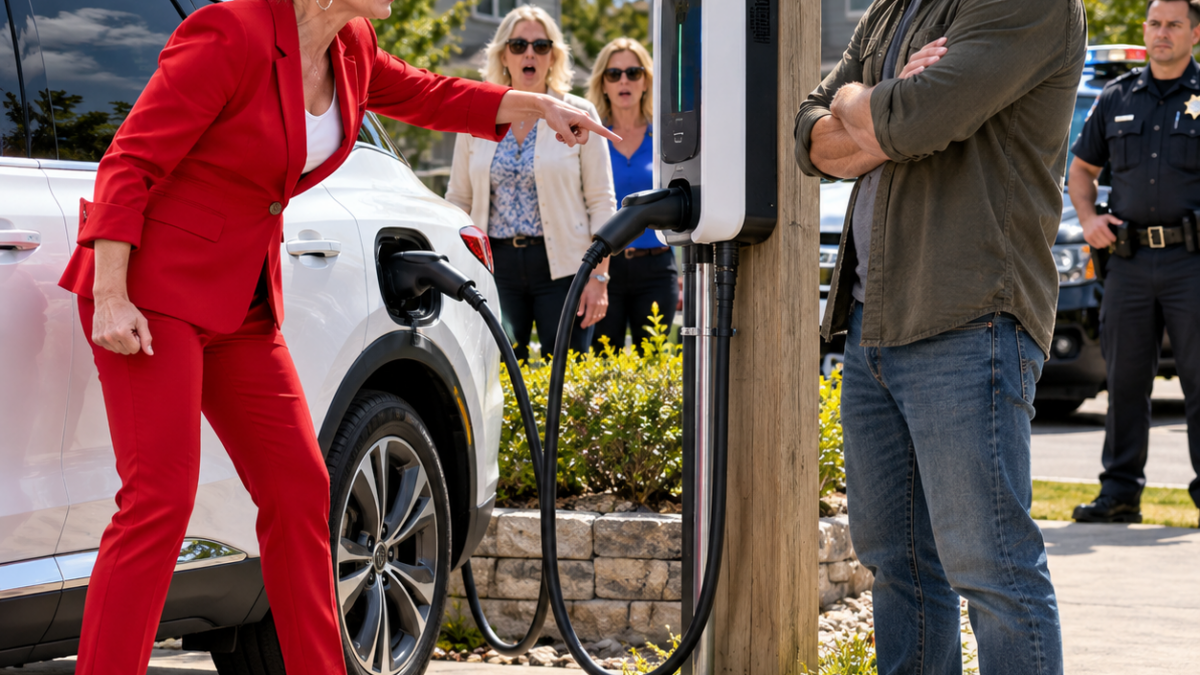
PART 2
I didn’t tear up the violation notice.
I didn’t march three doors down and wave it in Evelyn’s face.
I didn’t post an angry message in the community app.
I did what I had learned to do after years of working as a software engineer whenever something behaved in a way it shouldn’t.
I started debugging.
The HOA letter cited Article 7.4 of the Ridgewood Heights covenants, so I pulled up the full document and read the section carefully.
The language was straightforward. Exterior equipment visible from the street—satellite dishes, certain HVAC components, solar equipment and similar installations—could be subject to architectural review.
I read it again.
Then I walked into my garage.
My charger was mounted on the interior wall beside a storage cabinet.
When the garage door was closed, it was impossible to see.
When the garage door was open, someone standing on the sidewalk might glimpse a few inches of cable if they deliberately looked inside.
Calling it “exterior equipment” was absurd.
But something about the confidence of Evelyn’s notice bothered me.
She wasn’t guessing.
She expected me to be frightened by the letterhead, the case number, the deadline and the threat of $100-a-day fines.
She expected me to see an official-looking document and obey.
So I kept researching.
That was when I found the Arizona protections governing residential electric-vehicle charging equipment.
I read the relevant material twice, then a third time because I wanted to be certain.
Even where an HOA could impose reasonable standards, its authority over EV charging equipment was not unlimited.
My charger wasn’t sitting in a common parking lot.
It wasn’t attached to an HOA-owned wall.
It wasn’t drawing power from a community meter.
It was inside my garage, on my property, connected to an electrical panel I paid for.
The more I read, the less the violation notice looked like an aggressive interpretation of the rules.
It looked like retaliation.
I called Desert Community Services, the company that handled administrative work for Ridgewood Heights.
After ten minutes of recorded menus and hold music, a woman named Jennifer answered.
I gave her the violation number.
I explained where the charger was installed.
There was a long pause while she pulled up my file.
“Mr. Reyes?”
“Yes.”
“I’m looking at Article 7.4 now.”
“So am I.”
Another pause.
“You’re saying the charging equipment is inside your enclosed garage?”
“Correct.”
“Not mounted to the exterior?”
“No.”
“Not in the driveway?”
“No.”
“Not on a common wall?”
“No. Inside my garage.”
I heard a keyboard clicking.
Then Jennifer said carefully, “I can understand why you’re questioning the citation.”
“That’s a diplomatic way of putting it.”
She almost laughed, but stopped herself.
“I’m not authorized to invalidate a violation over the phone. You can formally appeal it before the board.”
“What happens while I’m appealing?”
“The deadline technically remains active unless the board suspends enforcement.”
“So I can be fined for refusing to remove equipment that the cited rule doesn’t cover?”
“I understand your concern.”
“That wasn’t exactly my question.”
Another pause.
“I would strongly recommend attending the next board meeting.”
I wrote down the date.
Then I asked, “Who submitted the violation?”
Jennifer hesitated.
The hesitation told me before she answered.
“The notice was authorized by Vice President Rogers.”
Of course it was.
“Thank you, Jennifer.”
When I hung up, I took a screenshot of the call log and saved it.
That folder on my laptop now contained the charging records, my two emails, screenshots of Evelyn’s community posts, the violation notice and my notes from the management company.
I named the folder RIDGEWOOD.
I almost named it EVELYN.
But I didn’t want this to become personal.
That distinction mattered to me.
I wasn’t trying to destroy a woman.
I was trying to stop a pattern.
Mark came over that evening.
He found me sitting at the kitchen table with the violation notice beside my laptop.
“What did she do?”
I slid the paper toward him.
He read it.
His expression changed almost immediately.
“Article 7.4.”
“You recognize it?”
He gave a humorless laugh.
“Oh, yeah.”
He sat down.
“She used that section against the Hendersons.”
“The family you told me about?”
“Same family.”
“What did a rule about exterior equipment have to do with their fence?”
“Nothing, originally.”
He pushed the notice back toward me.
“They had a fence along their backyard. Evelyn decided the color didn’t match the architectural standard. The Hendersons showed documentation that it had been approved before they bought the place. Suddenly the issue changed. Then she said it was visible from common property. They proved it wasn’t. Then there was another complaint about maintenance. Then another.”
“Until they left.”
Mark nodded.
“They had two kids. Nice people. Jason coached Little League.”
“Did nobody on the board stop her?”
“Most people don’t attend meetings unless their pool is closed.”
That sentence stayed with me.
Maybe that was how people like Evelyn accumulated power.
Not because everyone agreed with them.
Because everyone else was busy.
They had jobs.
Kids.
Mortgages.
Parents getting older.
Health problems.
Deadlines.
Normal lives.
They didn’t have forty hours to spend arguing about fence colors and mailbox specifications.
Evelyn did.
And she had mistaken everybody else’s exhaustion for permission.
“Why didn’t you ever fight her?” I asked.
Mark looked toward my window.
“I did once.”
“What happened?”
“She sent me three violations in a month.”
“For what?”
“One was my work trailer being visible from the street for twenty minutes while I unloaded tools. One was an oil spot on my driveway. One was weeds.”
“Were there weeds?”
He gave me a look.
“Alan, there are weeds in Arizona.”
Despite myself, I laughed.
Then his expression became serious.
“You know what I learned? She doesn’t need to be right. She just needs to make being right expensive.”
That was the most useful thing anyone said to me during the entire dispute.
Because it clarified the battlefield.
If I fought Evelyn complaint by complaint, she could manufacture complaints forever.
I needed something bigger than an argument over Article 7.4.
I needed a record so clear that defending her would become harder than stopping her.
Two days later, I ordered a security camera.
Not because I wanted to spy on Evelyn.
Because somebody had repeatedly entered my property after midnight.
I installed it beneath the garage eave.
The camera covered my driveway, the charger area and the sidewalk immediately in front of my home.
Nothing more.
No windows.
No neighboring backyards.
No private spaces.
I tested the night vision.
Then I walked to the edge of the driveway and watched myself appear on my phone.
Clear face.
Clear timestamp.
Clear view of anyone touching the charger.
The ChargePoint app already recorded every session.
Now I could pair electronic logs with video.
I also installed a smart control system that gave me remote authority over the charger.
I could shut off a session from my phone whenever I wanted.
But that wasn’t the feature that interested me most.
The important part was information.
Who.
When.
How long.
How much power.
No argument.
No “he said, she said.”
Just facts.
For nearly a week, nothing happened.
Every morning I checked the camera.
Nothing.
Every night I checked the charging history.
Nothing.
I started wondering whether Evelyn had finally understood.
Then another community post appeared.
“Ridgewood Heights has always been special because neighbors support neighbors,” she wrote. “Unfortunately, some people seem determined to treat our community like a collection of isolated properties instead of a shared neighborhood. We hope everyone remembers that generosity costs very little.”
I stared at the phrase.
Generosity costs very little.
Interesting thing to write when the generosity belonged to somebody else.
The comments arrived quickly.
“You tell ’em, Evelyn.”
“People move here and want all the benefits without being part of the community.”
“Some people just shouldn’t live in an HOA.”
That last comment bothered me more than it should have.
Not because the stranger knew anything about me.
Because he didn’t.
He had already decided who I was based on Evelyn’s version.
I had become “the selfish new guy.”
Not Alan Reyes.
Not the man who had saved for years before buying his first house.
Not the engineer who had moved to Arizona after spending most of his thirties in apartments where every parking space felt temporary.
Not the person who had paid for his charger so he wouldn’t have to spend evenings sitting at public stations.
Just a character in someone else’s story.
The selfish newcomer.
I typed a response.
Deleted it.
Typed another.
Deleted that too.
Finally, I closed the app.
Evidence beats emotion.
I kept repeating Mark’s warning.
She doesn’t need to be right.
She just needs to make being right expensive.
The next morning, the HOA management company emailed me a reminder.
My thirty-day compliance deadline was approaching.
Failure to remove the charger could result in daily fines.
I called Jennifer again.
“Has anyone reviewed my written objection?”
“I can see it in the file.”
“Has anyone responded?”
“Not yet.”
“Why?”
“I can’t speak for the board.”
“Can the fine be paused?”
“The board would need to authorize that.”
“Who controls the agenda?”
Another hesitation.
“The board officers.”
“Including Evelyn Rogers.”
“Yes.”
I thanked her.
Then I spent an hour researching HOA attorneys.
The first lawyer I found wanted a $3,500 retainer.
The second charged $425 an hour.
I could pay it.
That wasn’t the issue.
What made me angry was the idea that Evelyn could steal forty or fifty dollars of electricity, issue a baseless violation notice, and force me to spend thousands proving I had the right not to be bullied.
That was her advantage.
Not the rules.
The friction.
The cost.
The exhaustion.
She counted on normal people deciding peace was cheaper than justice.
For the first time, I understood why the Hendersons had moved.
I understood why Mark kept his head down.
And for one ugly evening, I considered doing the same thing.
I opened a real-estate website.
I looked at houses in Chandler.
Tempe.
Mesa.
Places without Ridgewood Heights in their description.
I imagined listing my house, packing the kitchen I had barely finished unpacking, paying another set of closing costs and telling myself it was worth it for peace.
Then I looked through the sliding door toward the garage.
A place I had worked for years to afford.
My house.
I closed the real-estate website.
“No.”
I said it aloud.
The room was empty, but it felt important to hear my own voice.
“No.”
I wasn’t leaving because someone else had decided boundaries were optional.
Four quiet nights passed.
On the fifth night, my phone buzzed at 11:47 p.m.
**Charging session started.**
I sat upright in bed.
For a second I thought I had forgotten to plug in.
Then I remembered I had.
My heart began pounding.
I opened the camera feed.
There she was.
Evelyn Rogers.
Pajama pants.
Light jacket.
Hair tied back.
Walking toward my garage.
She stopped near the sidewalk.
Looked left.
Looked right.
Then walked up my driveway.
That glance changed everything.
A confused person doesn’t check whether she’s being watched.
A person who believes something is a community amenity doesn’t approach it at midnight after scanning the street.
I watched Evelyn reach my vehicle.
She disconnected the charging cable with the efficiency of somebody who had practiced.
Then she connected it to an extension cable already lying along the edge of my driveway.
Already prepared.
Already stretched toward her house.
She didn’t hesitate.
Thirty seconds later, she was walking home.
I sat in bed staring at my screen.
My finger hovered over the button that would stop the session.
One tap.
That was all it would take.
Instead, I lowered my phone.
“Okay, Evelyn.”
My voice was barely above a whisper.
“Charge your car.”
I let it run.
Not because I was afraid.
Because for the first time, I had exactly what I needed.
The next morning, the session ended around six.
Fifty-two kilowatt-hours.
I downloaded the video.
Saved it on my laptop.
Copied it to cloud storage.
Copied it to an external drive.
Then I watched it again.
The time.
The face.
The glance.
The extension cord.
The deliberate disconnection of my vehicle.
There was no ambiguity.
I made coffee and opened a spreadsheet.
Seven unauthorized sessions.
Three hundred twelve kilowatt-hours.
Roughly forty-five dollars in electricity.
Financially, it was almost ridiculous.
People spend more than that on dinner.
But theft is strange that way.
Sometimes the dollar value has nothing to do with the violation.
If someone takes twenty dollars from your wallet, the deepest injury isn’t that you’re twenty dollars poorer.
It’s knowing someone believed they had the right to put their hand in your pocket.
By lunchtime, I had booked a consultation with Olivia Murphy, an attorney whose name kept appearing in discussions about HOA disputes.
Our video call was the next afternoon.
She had short dark hair, rectangular glasses and the expression of somebody who had learned not to react too quickly to outrageous stories because her clients probably told them all day.
I emailed the folder beforehand.
She opened with the violation notice.
Then my photographs.
Then the HOA documents.
Then the charging logs.
She asked questions as she worked.
“When did you first tell Mrs. Rogers to stop?”
I gave her the date.
“In writing?”
“Yes.”
“Did she acknowledge it?”
“No.”
“Did the charging continue afterward?”
“Yes.”
“How many times?”
“Three confirmed after the first written notice. More total.”
She nodded.
Then she opened the video.
She watched the entire clip without speaking.
When it ended, she replayed the part where Evelyn looked up and down the street.
Then Olivia leaned back.
“Well.”
That single word made me smile for the first time all day.
“Well what?”
“She has a problem.”
“How big?”
“That depends on what you want.”
She started with the violation notice.
Based on the materials I had provided, she believed the HOA had a weak basis for applying its exterior-equipment rule to a charger installed inside my garage.
She also pointed me back toward the state EV-charging protections I had found.
Then we discussed the unauthorized use.
“You explicitly withdrew permission.”
“I never gave permission.”
“That’s even better.”
“So what would you do?”
Olivia folded her hands.
“I’m not you.”
“Pretend you are.”
“No.”
I raised an eyebrow.
She smiled slightly.
“My job is to explain options, not turn clients into versions of me.”
“Fair.”
“You could send a demand letter. You could pursue reimbursement. Depending on how aggressively you wanted to proceed, you could also make a police report and let law enforcement determine whether the conduct meets criminal requirements. You can challenge the HOA violation formally. You can notify the management company and board that an officer may be using her position in retaliation against a homeowner.”
“All privately?”
“Yes.”
I shook my head.
“That’s not enough.”
Olivia studied me.
“What do you mean?”
“For six years, according to my neighbor, people have been getting targeted one at a time. If I handle this quietly, maybe my violation disappears. Maybe she pays forty-five dollars. Then next month she finds somebody else.”
“So what do you want?”
“I want to present everything at the meeting.”
“All of it?”
“The notice. The law. The logs. The email. The video.”
“In front of homeowners?”
“Yes.”
She was silent for several seconds.
“That carries risk.”
“I know.”
“If the board protects her, you may deepen the conflict.”
“I know.”
“If you embarrass her publicly, expect an emotional reaction.”
“I know.”
Olivia leaned toward the camera.
“Then understand one more thing. If you do this, don’t turn it into revenge.”
I frowned.
“She stole from me.”
“I know.”
“She tried to fine me for the charger she was stealing electricity from.”
“I know.”
“She smeared me to my neighbors.”
“I know that too.”
“Then why shouldn’t this be revenge?”
“Because revenge makes you sloppy.”
That shut me up.
Olivia continued.
“You have something better than anger. You have documentation. Don’t call her a thief. Show the charging logs. Don’t call her a liar. Show the violation notice next to the photographs. Don’t accuse her of retaliation as a conclusion. Show the timeline and let people reach it themselves.”
I nodded slowly.
“The more boring you are, the worse this becomes for her.”
I laughed.
“That might be the first time a lawyer has advised me to be boring.”
“It’s excellent legal strategy.”
We spent another forty minutes structuring the presentation.
Slide one: violation notice.
Slide two: photographs proving the charger’s location.
Slide three: applicable HOA language.
Slide four: state EV-charging protections.
Then pause.
Request dismissal.
Only after that did we move to the other issue.
Timeline.
Written notice.
Charging logs.
Video.
“Don’t play more than you need,” Olivia said.
“The clip is thirty seconds.”
“Perfect.”
“What if she interrupts?”
“Let the president handle it.”
“What if the president doesn’t?”
“Stay calm.”
“What if she says the video is illegal?”
“Tell them where the camera is mounted and what it records. Then stop arguing. If they want legal conclusions, let their counsel address them.”
“What if she walks out?”
“Let her.”
“What if everybody hates me afterward?”
Olivia looked at me for a moment.
“That one I can’t answer.”
Neither could I.
That was the part no spreadsheet could calculate.
I had been in Ridgewood Heights barely two months.
Evelyn had been there for years.
She knew families.
She knew who had grandchildren.
Who traveled.
Who volunteered.
Who needed roof approval.
Who wanted permission for a shed.
Power in neighborhoods doesn’t always look dramatic.
Sometimes it looks like remembering everybody’s name.
Sometimes it looks like being the person with the clipboard at every event.
Sometimes it looks like being useful long enough that people stop asking whether you should have that much influence.
The night before the meeting, I barely slept.
At 2:10 a.m., I considered canceling the presentation.
At 2:40, I opened the video again.
At 3:05, I read the comments under Evelyn’s latest neighborhood post.
One person had written:
“Some people should learn respect before buying into established communities.”
I closed the app.
At six the next evening, I showered, put on a blue button-down shirt and dark slacks, packed my laptop and drove to the Ridgewood Heights Community Center.
I was twenty minutes early.
The parking lot was already half full.
That surprised me.
Normally HOA meetings attracted the same handful of retirees, board regulars and homeowners with active complaints.
That night there were dozens.
Maybe Evelyn had encouraged attendance because she expected to make an example out of me.
If so, she had done me a favor.
Inside, metal folding chairs faced a long table.
The board sat beneath the Ridgewood Heights emblem.
President Robert Hendricks sat in the middle.
He looked to be in his early sixties, gray hair, tired eyes.
Linda Chen sat on his left.
Treasurer Marcus Bell sat beside her.
And on Robert’s right sat Evelyn.
Cream blouse.
Gold necklace.
Hair perfectly arranged.
She looked relaxed.
Almost cheerful.
When she saw me carrying my laptop, she smiled.
Not warmly.
The kind of smile someone gives when she thinks she already knows how your evening will end.
I sat halfway back.
Mark arrived five minutes later and chose a seat near the rear wall.
He gave me a small nod.
No thumbs-up.
No dramatic gesture.
Just a nod.
It helped more than he probably knew.
At seven, Robert called the meeting to order.
For forty minutes, Ridgewood Heights discussed everything except the reason my heart was pounding.
Pool resurfacing.
Landscaping bids.
Reserve funding.
A broken light near the south entrance.
Garage-sale weekend.
Then Robert looked down.
“Item seven. Violations and appeals.”
Evelyn shifted slightly in her chair.
Robert continued.
“We have an appeal from homeowner Alan Reyes regarding notice 2024-0147. Mr. Reyes?”
Every head seemed to turn at once.
I stood.
My legs felt heavier than usual.
I carried the laptop to the projector.
The HDMI connection failed.
For one awful second, the screen stayed blue.
Somebody coughed.
Evelyn leaned back.
I tried again.
Nothing.
My palms started sweating.
Then Mark called from the back.
“Use input two.”
A few people laughed.
I switched the projector.
My first slide appeared.
The violation notice filled the screen.
I heard someone behind me whisper, “That’s the charger guy.”
Good.
Let them know.
I turned toward the board.
“Thank you for allowing me to appeal. I’ll keep this factual.”
Evelyn crossed her arms.
I highlighted Article 7.4.
“The notice states that my EV charger is unauthorized exterior equipment visible from the street.”
Next slide.
A photograph of my garage with the door open.
Next.
The charger mounted inside.
Next.
The street view with the garage closed.
“You cannot see the unit from the street because it is installed inside my garage.”
Linda leaned forward.
Robert studied the image.
I continued.
“I also reviewed the Arizona protections applicable to residential EV charging equipment. Based on both those protections and the actual language in Article 7.4, I’m asking the board to rescind the notice.”
Robert looked toward the other members.
“That seems fairly clear.”
Linda nodded.
Marcus said, “I’d like management to confirm, but yes, I don’t see how we classify something inside a garage as exterior equipment.”
Evelyn’s chair moved.
“If I may.”
Robert glanced toward her.
“Briefly.”
She looked directly at me.
“Mr. Reyes is deliberately focusing on technical wording while ignoring the purpose of community standards.”
I said nothing.
“The concern has never been simply whether you can see three inches of a charger from the sidewalk. The concern is unapproved equipment and the precedent created when new residents decide rules are optional.”
I waited.
Olivia’s words came back.
Don’t interrupt.
Don’t argue.
Let her talk.
Evelyn continued.
“Ridgewood Heights has standards for a reason. Mr. Reyes has been resistant to those standards almost since the day he moved in.”
There it was.
Not the charger.
Me.
I looked at Robert.
“May I respond?”
He nodded.
“I don’t believe requesting that people not use electricity from my private meter qualifies as resistance to community standards.”
The room changed.
Not much.
Just enough.
A few heads turned toward Evelyn.
Her eyes sharpened.
She hadn’t expected me to bring that up yet.
I clicked to the next slide.
A table appeared.
Seven rows.
Dates.
Start times.
Stop times.
Energy consumed.
“I originally planned to limit tonight’s appeal to the violation notice. But because Mrs. Rogers has described this as a broader issue regarding my attitude toward the community, I think the board needs context.”
The room became quiet.
“These are charging sessions recorded by my ChargePoint system.”
I pointed to the first row.
“I did not initiate these sessions.”
Second row.
“Or these.”
Third.
“Or these.”
I moved down the list.
“Each happened late at night or early in the morning.”
Evelyn spoke immediately.
“This proves nothing.”
I looked at Robert.
He held up one hand.
“Evelyn, please allow Mr. Reyes to finish.”
That was the first crack.
Tiny.
But visible.
I continued.
“After discovering the first unauthorized sessions, I sent Mrs. Rogers an email explaining that the charger was privately owned, connected to my electrical meter, and not available for public use.”
I showed the email.
Date.
Time.
No emotional language.
No insults.
Just the request.
“I received no reply.”
Next slide.
“I then wrote the entire board requesting confirmation that privately owned charging equipment was not a community amenity.”
Robert looked uncomfortable.
Linda glanced down.
“I received no reply to that message either.”
The silence became heavier.
“Despite that, unauthorized charging continued.”
Evelyn leaned toward her microphone.
“This is ridiculous. Lots of people share resources in this neighborhood.”
Someone behind me muttered, “Not electricity.”
A few people chuckled nervously.
Evelyn’s face tightened.
I clicked again.
A still image filled the screen.
11:47 p.m.
My driveway.
A woman approaching.
Evelyn.
She froze.
The entire room seemed to freeze with her.
Then I pressed play.
Nobody moved.
Onscreen, Evelyn walked up my driveway.
She looked left.
She looked right.
She unplugged my vehicle.
She connected my charger to the extension cord leading toward her property.
Then she walked away.
Thirty seconds.
That was all.
Thirty seconds to destroy six weeks of narrative.
The video ended.
The final frame remained frozen behind the board.
Evelyn’s hand was on my cable.
Her face was turned partially toward the streetlight.
Perfectly recognizable.
Her chair slammed backward.
“You recorded me?”
Her voice cracked.
Nobody answered.
She looked at Robert.
“Did you know about this?”
Robert looked stunned.
“No.”
“This is illegal!”
I stayed where I was.
“The camera is mounted on my house and records my driveway.”
“You were spying on me!”
“It records people entering my property.”
“You set me up!”
That accusation landed differently than she intended.
A voice from somewhere behind me said, “How did he set you up by putting a camera on his own driveway?”
This time the laughter wasn’t nervous.
It was real.
Short.
Sharp.
Humiliating.
Evelyn turned toward the audience.
“You don’t understand. I thought the charging equipment was available to neighbors.”
I clicked backward.
My email reappeared.
The sentence asking her to stop was highlighted.
I didn’t say anything.
I didn’t have to.
People read it.
Evelyn did too.
Her face began turning red.
“That email was hostile.”
Someone near the front said, “It says please.”
Another ripple moved through the room.
Robert rubbed his forehead.
“Evelyn, did you use Mr. Reyes’s charger after receiving this email?”
She looked at him.
“I used what I believed was a shared resource.”
“After he told you it wasn’t?”
“He doesn’t get to decide community norms.”
“It’s attached to his electrical panel,” Marcus said.
It was the first time the treasurer had spoken in several minutes.
Evelyn turned on him.
“You know exactly what I mean.”
“No,” Marcus said. “I’m realizing I may not.”
That was the second crack.
And this one was bigger.
Evelyn’s voice rose.
“Do you people understand what happens when everyone starts acting this way? We become a neighborhood of locked doors and cameras and people keeping score over forty dollars.”
“Forty-five,” Mark called from the back.
I almost smiled.
Evelyn glared at him.
Robert tapped his microphone.
“Enough. Everyone.”
The room settled.
I moved to my final slide.
A timeline.
Unauthorized sessions.
Written notice to Evelyn.
Email to board.
More unauthorized sessions.
Community posts.
Violation notice.
More charging.
Video.
No adjectives.
No accusations.
Just dates.
“I’m not asking the board to decide whether Mrs. Rogers likes me,” I said. “I’m asking the board to rescind a violation that appears unsupported by the rule it cites. Separately, I’m asking the board to address whether an officer should use association authority against a homeowner after being told to stop taking electricity from that homeowner’s property.”
I closed the laptop.
“That’s all.”
Nobody spoke for several seconds.
Robert finally cleared his throat.
“I think the board needs a recess.”
Evelyn turned toward him.
“Robert—”
“Fifteen minutes.”
“I don’t think—”
“Fifteen minutes.”
The authority in his voice surprised everyone.
Especially Evelyn.
The board members stood.
Robert walked through the side door.
Linda followed.
Marcus followed.
Evelyn remained seated.
For the first time since I met her, she looked uncertain.
Then she grabbed a folder and disappeared through the door after them.
The moment it shut, the room exploded.
People whispered.
Turned in their chairs.
Pulled out phones.
Mark came toward me.
“You okay?”
“My hands are shaking.”
“They should be.”
“I think I’m going to throw up.”
“Try not to do it on the projector.”
I laughed.
It released something in my chest.
A woman I recognized from the mailbox approached.
The same woman who had stopped making eye contact after Evelyn’s first community post.
“I owe you an apology.”
“You don’t owe me anything.”
“Yes, I do.”
Her name, I learned, was Susan.
“When Evelyn posted that thing about new residents, I assumed you had done something.”
“I noticed.”
She looked embarrassed.
“I’m sorry.”
“Thank you.”
A man behind her stepped closer.
“I had no idea she was taking your power.”
“Most people didn’t.”
“She told us you refused to let somebody use the charger during an emergency.”
I stared at him.
“What emergency?”
He shrugged.
“She implied someone had been stranded.”
There it was.
A new layer.
Not just insinuation.
Evolution.
By the time Evelyn’s story traveled through the neighborhood, I hadn’t simply refused to let her charge her Tesla.
I had apparently abandoned a neighbor during a crisis.
“That never happened,” I said.
“I believe you now.”
Now.
It was an uncomfortable word.
But I appreciated the honesty.
Mark looked toward the closed boardroom door.
“You know what she’s doing in there.”
“What?”
“Explaining why none of this is technically her fault.”
He was probably right.
Fifteen minutes became twenty.
Then twenty-five.
People stayed.
Nobody left.
At twenty-eight minutes, the side door opened.
Robert emerged first.
His expression was grim.
Linda came next.
Then Marcus.
Evelyn came last.
Her face was pale.
She didn’t look at the audience.
She sat down.
Robert adjusted the microphone.
“The board has discussed the appeal and the additional information presented tonight.”
A chair squeaked somewhere behind me.
“First, violation notice 2024-0147 is rescinded effective immediately.”
I felt my shoulders drop.
I hadn’t realized how tense they were.
“There will be no fines associated with that notice, and the violation will be removed from Mr. Reyes’s homeowner record.”
A few people clapped.
Robert raised a hand.
“Please.”
The room quieted again.
“Second, after reviewing the circumstances surrounding the notice, including the information presented regarding unauthorized use of Mr. Reyes’s charging equipment, the board believes there is a serious conflict between the standards expected of association officers and the conduct documented tonight.”
Evelyn stared at the table.
Robert took a breath.
“Mrs. Rogers has tendered her resignation as vice president, effective immediately.”
The reaction was instantaneous.
Whispers.
Gasps.
A low whistle from the back.
Evelyn’s head snapped upward.
Robert continued before she could speak.
“The association will also distribute written clarification regarding privately owned EV charging equipment and will review our violation procedures with the management company so that individual officers cannot issue or advance enforcement actions without appropriate review.”
That part mattered almost as much as her resignation.
Maybe more.
Because removing one person doesn’t solve a system that lets the next person do exactly the same thing.
Robert looked toward me.
“Mr. Reyes, the board owes you an apology. Your questions should have been answered before this reached the stage it did.”
“Thank you.”
I meant it.
Then Evelyn stood.
“No.”
Robert closed his eyes.
“Evelyn.”
“No.”
She turned toward the room.
“I have spent six years serving this community.”
Nobody interrupted.
“Six years.”
Her voice became louder.
“I have attended meetings when the rest of you couldn’t be bothered. I have answered emails at midnight. I have dealt with contractors. I have walked this neighborhood in August checking landscaping because none of you wanted to do it.”
She pointed at the residents.
“Do you think standards enforce themselves?”
Nobody answered.
“You all loved having me handle problems when the problems weren’t yours.”
There was truth buried inside her anger.
That was the uncomfortable part.
Evelyn probably had spent hundreds of unpaid hours on HOA work.
She probably had solved real problems.
She probably had protected homeowners from legitimate nuisances and irresponsible contractors.
People are rarely villains in every room they enter.
Sometimes the same qualities that make someone useful—persistence, certainty, attention to detail—become dangerous when nobody tells them no.
Evelyn pointed at me.
“Then he moves here.”
Her hand trembled.
“Two months. He has lived here two months and suddenly I’m the criminal?”
I stayed quiet.
“He refused to participate in our community.”
Someone called, “He refused to pay for your Tesla.”
Laughter erupted.
Evelyn’s face twisted.
“This is exactly what I mean!”
She looked toward Robert.
“You’re going to let them turn this into a joke?”
Robert’s voice was tired.
“No one forced you to connect your car to his charger.”
“I thought—”
“He emailed you.”
“I know what he emailed!”
The room went still.
Evelyn realized too late what she had admitted.
Robert stared at her.
“You knew?”
“I knew what he claimed.”
“That it belonged to him?”
“He was being selfish.”
Robert leaned back slowly.
At that moment, whatever remaining possibility existed that Evelyn had genuinely misunderstood disappeared.
She hadn’t believed the charger was public.
She believed my ownership didn’t matter.
Those were very different things.
An older man in the first row stood.
His name was George Peterson.
His voice was rough with age.
“Six years ago you used my garden hose to fill your pool.”
Evelyn turned toward him.
“What?”
“You remember.”
“I have no idea what you’re talking about.”
“You did it three Saturdays in a row.”
“That is ridiculous.”
“I thought I was losing my mind because my water bill jumped. Then I came home early and saw the hose running under your fence.”
Evelyn laughed sharply.
“So now every complaint anyone has ever had is my fault?”
A woman near the center stood.
“You cited me three years in a row for Christmas lights.”
“That’s because they violated the seasonal display rules.”
“They were down by January second.”
“The rules said—”
“They said January seventh.”
Murmurs.
Another man stood.
“You fined me for an unapproved mailbox.”
“Your mailbox was—”
“It was installed by the builder.”
Another homeowner.
“You threatened a lien over my shed.”
Another.
“You photographed my backyard from behind the wall.”
Another.
“You kept rejecting my paint color even though it was on the approved list.”
The room changed in front of me.
What had been my dispute stopped being mine.
It became six years of people remembering things they had swallowed because speaking seemed harder than surrendering.
That was when I understood something I hadn’t understood before.
Evelyn had not controlled Ridgewood Heights because everyone loved her.
She controlled it because everybody believed they were alone.
Every homeowner thought his violation was separate.
Every family thought her warning was unique.
Every person who backed down assumed everyone else had accepted the system.
My camera hadn’t created their anger.
It had simply provided permission for people to compare notes.
Evelyn looked around the room.
Her expression moved from rage to disbelief.
“You’re all unbelievable.”
Nobody answered.
“I kept property values up.”
Silence.
“I protected this neighborhood.”
Silence.
“I gave you six years of my life.”
Still silence.
The absence of support broke her more effectively than yelling could have.
Her shoulders dropped.
Her face seemed to age in seconds.
She picked up her purse.
“This community deserves what happens to it.”
Then she walked out.
The door closed behind her.
Nobody followed.
Robert remained silent for several seconds.
Then he said quietly, “I think we’ve done enough for one evening.”
The meeting adjourned.
People stood slowly.
Normally, I would have packed my laptop and left.
Instead, neighbors began approaching.
Some apologized.
Some thanked me.
Some simply shook my hand.
Susan hugged me unexpectedly.
“You shouldn’t have had to prove all that just to be left alone.”
“I’m glad it’s over.”
Mark appeared with a grin.
“Told you she plays the long game.”
“I remember.”
He nodded toward the projector.
“Guess you played a longer one.”
“No.”
I looked at the frozen timeline still projected onto the wall.
“I just kept receipts.”
Outside, the desert night felt cooler than it had when I arrived.
I stood beside my car for a minute, breathing.
I expected victory to feel louder.
It didn’t.
There was no music.
No dramatic rush.
Mostly I felt tired.
And relieved.
My phone rang.
Olivia.
“Well?”
“Violation rescinded.”
“And?”
“She resigned.”
There was a pause.
“Effective immediately?”
“Yes.”
Olivia laughed once.
“Alan.”
“What?”
“I told you boring works.”
I smiled.
“You did.”
“Any threats?”
“Mostly accusations.”
“Document them.”
“Of course.”
“What are you going to do about the electricity?”
I looked across the parking lot.
“Small claims.”
“You’re serious?”
“Yes.”
“Forty-five dollars?”
“It’s not forty-five dollars.”
“No,” she said. “It isn’t.”
I didn’t file the claim the next morning.
I waited until the board sent written confirmation.
Two days later, an email arrived from Desert Community Services.
Violation 2024-0147 had been rescinded.
My account showed a zero balance.
The notice had been removed from my file.
The association acknowledged that the cited exterior-equipment provision did not apply to my installation.
A second email went to every homeowner.
It clarified that privately owned charging equipment was not a shared community amenity.
That sentence made Mark laugh so hard when he read it that he called me.
“They actually had to write that.”
“I know.”
“Imagine being the lawyer who reviewed it.”
“I hope they framed his invoice.”
The email also announced that the board would review enforcement procedures and officer authority.
For the first time since the whole thing started, I plugged my car in that night without wondering whether someone would disconnect it.
I still checked the camera at midnight.
Nothing.
At two.
Nothing.
At six, I woke and opened ChargePoint.
One session.
Mine.
Battery 100 percent.
I stared at the number.
It should have felt ordinary.
Instead, it felt luxurious.
Peace often does after somebody has taken it away.
The small-claims filing was straightforward.
I included the charging logs, calculations, written notice and video.
I didn’t ask for emotional damages.
I didn’t invent some giant number.
I asked for the value of the unauthorized electricity and recoverable costs associated with bringing the claim.
When Evelyn received the filing, she emailed me for the first time.
The subject line was:
**Is This Really Necessary?**
I almost laughed.
Her message was four paragraphs.
She accused me of vindictiveness.
She said she had already suffered public humiliation and lost her board position.
She said the amount of electricity was insignificant.
She said continuing the matter proved that I had never cared about community harmony.
I read it twice.
Then I forwarded it to Olivia.
Her reply came fifteen minutes later.
“Do not argue. Respond only if necessary.”
So I didn’t.
Three days later, Evelyn sent another email.
This one was shorter.
She offered to reimburse me forty-five dollars if I dismissed the claim.
I thought about accepting.
Then I remembered what Mark had told me.
She makes being right expensive.
The filing fee alone exceeded the stolen electricity.
I replied with one sentence.
“I’m willing to resolve the matter for the documented amount plus my filing costs.”
No speech.
No insult.
No celebration.
She didn’t answer.
The hearing was scheduled.
By then, the neighborhood atmosphere had shifted.
At first, I worried everyone would blame me for the spectacle.
Instead, something unexpected happened.
People began talking to me.
Really talking.
The man who used to cross the street during his evening walk stopped beside my driveway.
“Hey, Alan.”
“Hey.”
He pointed at the charger.
“That the famous machine?”
I laughed.
“Apparently.”
“I’m thinking about buying an EV.”
“You’re welcome to ask me anything about installing one.”
He grinned.
“I promise not to plug mine into yours.”
At the mailbox, Susan introduced me to her husband.
A family across the street invited me to a barbecue.
None of these things were dramatic.
That was why they mattered.
My first weeks in Ridgewood Heights had made the neighborhood feel like enemy territory.
Now it was becoming a neighborhood.
One Saturday afternoon, Mark brought over beer.
We sat on my patio.
“You know what’s weird?” he said.
“What?”
“People are happy.”
“Were they not happy before?”
“People were comfortable. Different thing.”
He took a drink.
“Comfortable means you know how to avoid trouble.”
“And happy?”
“You don’t have to.”
I thought about that.
Then I asked, “Do you feel guilty?”
“For what?”
“For not fighting her sooner.”
Mark was quiet.
Finally, he said, “Sometimes.”
“You shouldn’t.”
He looked at me.
“You fought because you had the right combination.”
“What combination?”
“You had evidence. Money for a lawyer if you needed one. No kids in the school district. You were new enough that you hadn’t spent years convincing yourself this was normal.”
He rubbed the label on his beer bottle.
“The Hendersons had two kids, a business loan and a sick parent. Fighting Evelyn wasn’t their whole life. That’s what bullies count on.”
I didn’t answer.
Because he was right.
Courage is easier to praise than circumstances are to understand.
A month after the meeting, I received notice that Evelyn and her husband had listed their house.
I learned it from Mark.
“Under market.”
“How far under?”
“Enough that they want out fast.”
I felt something complicated.
Not joy.
Not guilt exactly.
Maybe finality.
“She’s really leaving?”
“Looks like it.”
“Did you hear where?”
“No.”
I didn’t ask again.
I never wanted Evelyn homeless.
I never wanted her marriage damaged.
I never wanted to follow her through Arizona with a list of punishments.
I wanted her to stop.
That distinction mattered.
The house sold within two weeks.
On moving day, I happened to be outside when a truck backed into her driveway.
Evelyn stood near the garage directing movers.
For the first time since the board meeting, our eyes met.
Neither of us looked away.
She crossed the street.
My stomach tightened.
I set down the garden hose.
She stopped at the end of my driveway.
For several seconds, neither of us spoke.
Then she said, “I hope you’re happy.”
Her voice wasn’t angry.
That made it harder.
“I never wanted you to move.”
She gave a brittle laugh.
“Of course not.”
“I wanted you to stop using my charger.”
“You got more than that.”
“I asked you more than once.”
“I made a mistake.”
“You made it seven times.”
Her jaw tightened.
“There it is.”
“What?”
“You always need the record. The number. The proof.”
“I needed proof because you said I was lying.”
“I never said you were lying.”
“You told two hundred households I didn’t understand generosity.”
“That wasn’t about you.”
We both knew it was.
I didn’t argue.
Evelyn looked toward her house.
Movers carried a dresser through the front door.
“When I joined the board,” she said, “this place was chaos.”
I stayed quiet.
“Nobody followed anything. Boats in driveways. Dead lawns. Contractors working at six in the morning. People bought here because they wanted standards, but nobody wanted to enforce them.”
“So you did.”
“Yes.”
“And then you forgot there was a difference between enforcing rules and owning people.”
Her eyes flashed.
“That’s dramatic.”
“Maybe.”
She crossed her arms.
“You think you saved them.”
“No.”
“You think they love you now.”
“I don’t need them to.”
“You will.”
“What does that mean?”
“It means communities are messy. People turn on whoever is useful to blame.”
“Maybe.”
For a moment, I saw something almost vulnerable beneath her anger.
“I gave them everything,” she said.
“That doesn’t mean they owed you obedience.”
She looked at me sharply.
Then she nodded once.
Not agreement.
Acknowledgment.
“Good luck, Alan.”
“You too, Evelyn.”
She walked away.
I never spoke to her again.
A week later, Jason and Maria moved into the house.
They had a three-year-old daughter named Sophia and a golden retriever with absolutely no respect for property boundaries.
The dog wandered into my garage during our first conversation and sniffed the charging cable.
Jason laughed.
“Uh-oh. We heard about that thing.”
I looked at him.
“You already heard?”
“Three different people.”
Maria covered her face.
“Oh God, Jason.”
“What?”
“You can’t say that.”
I laughed.
“It’s fine.”
Jason pointed toward the charger.
“We’re thinking about going fully electric next year. Is installation difficult?”
“No.”
“HOA problems?”
“Not anymore.”
A few weeks later, somebody posted a welcome message in the community app.
“Welcome Jason, Maria, Sophia and Max to Ridgewood Heights. Remember, neighbors: sharing is wonderful, but ask before borrowing someone’s garden hose.”
Twelve laughing reactions appeared.
Then somebody commented:
“Or EV charger.”
Someone tagged me.
For the first time, I laughed at the community app instead of closing it with my blood pressure ten points higher.
The small-claims hearing happened three weeks later.
Evelyn appeared without an attorney.
So did I.
The courtroom was smaller than I expected.
No jury.
No dramatic gallery.
No television-style speeches.
Just fluorescent lights, wooden benches and a judge who clearly had twelve other matters waiting.
When our case was called, Evelyn and I stepped forward.
The judge reviewed my filing.
“You’re seeking reimbursement related to unauthorized electricity usage?”
“Yes, Your Honor.”
“And costs?”
“Yes.”
She looked at Evelyn.
“Do you dispute using the charging equipment?”
Evelyn inhaled.
“I dispute the characterization.”
“What characterization?”
“That it was theft.”
The judge looked back at the documents.
“Did Mr. Reyes give you permission?”
“I believed the charger was a neighborhood resource.”
“Did he notify you that it was private?”
Evelyn hesitated.
“Yes.”
“Did you use it after receiving that notice?”
Another pause.
“Yes, but—”
The judge lifted one hand.
“Then whether you initially misunderstood the ownership doesn’t resolve the later use.”
Evelyn tried again.
“The neighborhood has always had an informal culture of sharing.”
The judge looked at her over the top of the paperwork.
“Did the neighborhood pay Mr. Reyes’s electric bill?”
“No.”
“Did the homeowners association own the charger?”
“No.”
“Was it installed on common property?”
“No.”
“Then I’m not sure the neighborhood culture is relevant.”
That was it.
No thunder.
No humiliation campaign.
Just four questions.
Truth has a way of becoming very simple when stripped of social politics.
The court entered judgment covering the documented amount and applicable costs, totaling $387.
Evelyn didn’t look at me when we left.
Neither of us spoke.
A check arrived about ten days later.
No note.
No apology.
No final insult.
Just an envelope.
I deposited it.
Then I deleted the court date from my calendar.
That should have been the ending.
But the part that mattered most happened afterward.
Ridgewood Heights began changing.
Slowly.
The board created a review process requiring more than one person to approve certain violation actions.
Homeowners were given clearer appeal instructions.
Meeting minutes became easier to access.
The architectural guidelines were reviewed.
The association sent clarification regarding EV chargers, solar equipment and residential battery systems.
Linda became vice president.
At the next meeting she found me afterward.
“Alan?”
“Yeah?”
“I wanted to apologize personally.”
“You already did in the email.”
“No. The board apologized.”
She shifted the folder in her arms.
“I didn’t answer your first message.”
I remembered.
“I saw it,” she continued. “I thought Evelyn would handle it because that was her area.”
“That seems to have been the problem.”
Linda winced.
“You’re right.”
I appreciated that she didn’t defend herself.
“We got lazy,” she said. “Not intentionally. She handled so much that eventually the rest of us stopped checking.”
“That happens.”
“It shouldn’t.”
“No.”
She looked toward the empty board table.
“Robert is considering stepping down next year.”
“Because of this?”
“Partly.”
I didn’t know what to say.
Linda smiled faintly.
“Don’t worry. Nobody is asking you to run.”
“Good.”
“Mark suggested it.”
“Mark is dead to me.”
She laughed.
It was a small moment.
But six weeks earlier I would never have imagined laughing with an HOA officer.
Three households installed chargers before winter.
The first belonged to the man who had joked about my “famous machine.”
The second belonged to a retired teacher.
The third belonged to Susan and her husband.
One afternoon Susan waved me over.
Her electrician was working.
“Look.”
A brand-new wall charger gleamed inside the garage.
“Very nice.”
“I got architectural approval.”
She smiled.
“Just kidding.”
I stared at her for half a second.
Then we both laughed.
That was when I knew the neighborhood had really changed.
Not because there were new policies.
Because people were no longer afraid to joke about the old ones.
The anonymous violation stories continued surfacing for months.
Not as a mob against Evelyn.
More like a slow collective realization.
People compared old letters.
A homeowner discovered she had been fined for the same landscaping condition another board member had been allowed to keep.
Someone else found inconsistent approvals.
Nothing rose to the level of another scandal.
Most were ordinary examples of uneven enforcement.
But they taught the board something important.
Rules don’t become fair merely because they are written down.
Enforcement matters.
Process matters.
Oversight matters.
And unchecked discretion eventually stops looking like leadership.
One Saturday, almost two months after Evelyn moved, Mark appeared at my door carrying a six-pack.
“Patio?”
“Patio.”
The Arizona summer had finally loosened its grip.
The evening air was warm instead of brutal.
We sat while the sky turned orange over the rooftops.
“You know what’s funny?” Mark said.
“What?”
“I’ve lived here seven years.”
“I know.”
“This is the first year I’ve actually considered staying another seven.”
I looked at him.
“You were thinking about leaving?”
“Every year.”
“Because of Evelyn?”
“Not only her.”
He took a drink.
“But you know when there’s one person in an organization who can make your life miserable and nobody stops them?”
“Yeah.”
“You start wondering why you’re paying to live there.”
We sat quietly.
Then Mark said, “You did something important.”
“I caught someone using a charger.”
“That’s not what I mean.”
“I know.”
“You showed everybody the same thing was happening to more than one person.”
“I didn’t know it was.”
“Neither did we.”
That was the point.
Isolation had protected Evelyn more effectively than any bylaw.
Everyone had believed his problem belonged only to him.
The Hendersons thought they were the difficult family.
Mark thought he was the guy with the trailer problem.
Susan thought she was irresponsible with Christmas decorations.
George thought he was paranoid about his water bill.
I thought I was the selfish newcomer.
Once we compared stories, the pattern became visible.
People talk about standing up to bullies as if courage is always loud.
I don’t think that anymore.
Sometimes courage is keeping the email.
Sometimes it is taking the screenshot.
Sometimes it is reading the rule instead of assuming the person quoting it understands it.
Sometimes it is sitting quietly while somebody with more social power tells a room full of people who you are, knowing you have thirty seconds of video waiting on the next slide.
In early December, I came home to find a small package on my porch.
No shipping label.
No return address.
Just a bottle of wine inside a gift bag.
A folded note was tucked beneath the ribbon.
I opened it.
“Thank you for doing what many of us were too tired or too scared to do. —Your neighbors.”
No names.
I recognized George Peterson’s handwriting from a volunteer sheet at the community center.
I stood there for a long time.
The first emotion I felt wasn’t pride.
It was sadness.
Not for Evelyn.
For all the years people had believed silence was their safest option.
That evening, I poured one glass of wine and sat outside.
The neighborhood looked exactly the way it had the morning this began.
Same stucco houses.
Same trimmed desert landscaping.
Same streetlights.
Same sidewalks.
But it didn’t feel the same.
My phone buzzed.
ChargePoint.
**Charging complete: 100%.**
I laughed softly.
Fifteen percent.
That had been the beginning.
I remembered standing in the garage holding cold coffee, wondering where my charging cable had gone.
I remembered following it across the lawn.
I remembered Evelyn standing on my porch.
“Next time, give me a heads-up.”
At the time, I thought her arrogance was the problem.
Months later, I understood something more complicated.
Evelyn had spent years living in a system that rarely forced her to hear no.
Every time somebody paid a questionable fine rather than challenge it, the boundary moved.
Every time somebody removed something rather than appeal, the boundary moved.
Every time another board member let her “handle it,” the boundary moved.
Every time a homeowner left rather than fight, the boundary moved.
Eventually, she reached a point where unplugging another person’s vehicle, taking his electricity and then criticizing him for objecting probably felt completely reasonable to her.
That didn’t excuse it.
If anything, it explained why accountability mattered.
Nobody benefits when power goes unchecked—not even the person holding it.
Because eventually they lose the ability to recognize the moment they have crossed a line.
The camera wasn’t my trap.
The smart charger wasn’t my trap.
The spreadsheet wasn’t my trap.
I didn’t rig anything to hurt Evelyn.
I didn’t sabotage her Tesla.
I didn’t change the voltage.
I didn’t lock her car in place.
I didn’t damage a single thing she owned.
I simply stopped warning her.
I gave her the information she needed.
“This charger is private.”
“Please stop using it.”
She chose not to stop.
Then I gave reality enough time to document the choice.
That was the trap.
Truth.
Nothing more.
A few months later, I ran into Robert outside the community center.
He was carrying folding signs from some neighborhood event.
“Alan.”
“Need a hand?”
“Actually, yes.”
I grabbed two.
We carried them toward a storage room.
Robert was quieter than usual.
Before leaving, he said, “I owe you an apology too.”
“You already apologized.”
“Not for the notice.”
He set the signs against the wall.
“For letting one person become the board.”
I looked at him.
“I was president,” he continued. “But Evelyn handled violations. She knew the documents better than I did. She had time. She volunteered. Whenever somebody complained about her, I assumed it was another homeowner who didn’t like being told no.”
“Sometimes it probably was.”
“Probably.”
He nodded.
“That made it easier to ignore the times it wasn’t.”
I understood.
People who abuse authority often hide behind all the moments when authority is legitimately necessary.
The unreasonable homeowner who really does leave trash everywhere makes it easier to dismiss the reasonable homeowner who is being targeted.
The person who actually violates a rule becomes cover for punishing the person who didn’t.
“You fixed it,” I said.
“We’re fixing it.”
“Better answer.”
Robert smiled.
Then he said something I didn’t expect.
“The Hendersons heard about what happened.”
I stopped.
“What?”
“Mark still talks to them.”
“How are they?”
“Good. They bought a place outside Tucson.”
“That’s good.”
“He sent them the board announcement.”
I felt a strange tightness in my throat.
“What did they say?”
Robert looked embarrassed.
“They asked if Evelyn was really gone.”
“And?”
“I told them yes.”
He picked up the last sign.
“They said maybe they’d come visit friends here again.”
For some reason, that affected me more than winning the hearing.
I had never met the Hendersons.
But I knew what it meant to feel driven out of somewhere you had wanted to call home.
I walked back to my house slowly that evening.
A little girl was riding a bicycle on the sidewalk.
Jason was teaching Sophia to pedal without training wheels.
Maria stood ten feet away with both hands over her mouth.
“Keep going!” Jason shouted.
Sophia wobbled.
Almost fell.
Recovered.
Then screamed with delight.
Their golden retriever chased her in circles.
I stopped near my driveway and watched.
Jason saw me.
“Alan!”
“Hey.”
“You’re witnessing history.”
Sophia made another lap.
I applauded.
She grinned at me like she had won the Olympics.
I thought about Evelyn’s definition of community.
Sharing.
Supporting.
Looking out for neighbors.
She hadn’t been wrong about those things.
She had been wrong about what they required.
Community isn’t taking because you believe another person should give.
It is asking.
It is respecting the answer.
It is helping voluntarily.
It is accepting boundaries without turning them into betrayal.
It is noticing when someone is being isolated and walking across the street anyway.
The irony was that after Evelyn left, Ridgewood Heights became more like the community she always claimed she was protecting.
People shared tools.
They watched houses during vacations.
They brought food when Susan had surgery.
When Mark injured his shoulder on a job site, three neighbors helped unload materials from his truck.
And when Jason finally bought an EV the following spring, he knocked on my door.
“I have an embarrassing question.”
“Need installation advice?”
“No.”
He held up his phone.
“My electrician can’t come until Tuesday and I’m at eight percent.”
I stared at him.
He started laughing.
“I swear I’m asking.”
I laughed too.
“How much do you need?”
“Enough to get to work tomorrow.”
“Pull into my driveway.”
“You sure?”
“Yes.”
“You want me to reimburse—”
“Jason.”
“What?”
“Just plug in.”
He connected his car.
I watched the ChargePoint session begin.
For one absurd second, the whole story seemed to fold back on itself.
A neighbor.
My charger.
My electricity.
But this time everything was different.
Because he had knocked.
Because he had asked.
Because I had chosen.
That was the line Evelyn never understood.
Generosity without choice isn’t generosity.
It is entitlement wearing a friendly name.
Jason charged for forty minutes.
Before leaving, he placed a coffee on my porch.
I texted him.
“You didn’t need to do that.”
He replied:
“I know.”
Those two words made me smile.
I know.
Choice.
Respect.
Community.
Simple things.
One year after I moved into Ridgewood Heights, the annual homeowners meeting came around again.
I almost skipped it.
Then Mark texted me.
“You’re coming.”
“That sounded less like a question.”
“It wasn’t.”
So I went.
The room looked the same.
Same folding chairs.
Same projector.
Same humming air conditioner.
But the atmosphere was completely different.
Robert announced that violation complaints would now include photographic evidence and specific rule citations.
Homeowners would receive an explanation of the appeal process.
Board members with a personal dispute involving a homeowner were required to recuse themselves from enforcement decisions related to that person.
Nothing revolutionary.
Just guardrails.
Linda presented the policy changes.
When she finished, people applauded.
Then Robert looked toward me.
I immediately shook my head.
He laughed.
“Mr. Reyes has made it extremely clear he does not want to join the board.”
“Correct.”
More laughter.
Mark shouted, “Coward.”
I turned around.
“Traitor.”
The room laughed again.
And I suddenly realized something.
A year earlier, laughter in that room had terrified me.
I had stood beneath a projector wondering whether forty strangers had already decided I was the villain.
Now I was laughing with them.
After the meeting, George Peterson shook my hand.
Susan gave me a hug.
Jason asked whether I had seen the new fast-charging station near the highway.
Normal conversations.
That was the real victory.
Not Evelyn leaving.
Not the judgment.
Not even the rescinded notice.
It was being able to live my life without organizing it around someone else’s hostility.
I went home.
Opened the garage.
Pulled my car inside.
Plugged it into the same charger that had started everything.
Click.
Soft electronic hum.
Notification.
**Charging started.**
I stood there for a moment.
The sound was ordinary again.
That was exactly what I wanted.
People sometimes ask what the “trap” was when I tell them what happened.
They expect something clever.
A device.
A technical trick.
Some software-engineer revenge where I reprogrammed the charger and caused Evelyn’s car to embarrass her.
I never did anything like that.
I didn’t need to.
The smartest trap I could set was one she built herself.
I established the boundary in writing.
She ignored it.
I preserved the records.
She continued.
I installed a lawful security camera on my property.
She walked into view.
I let her own decisions accumulate until they were impossible to explain away.
Then, when she stood in front of the neighborhood and tried to describe me as selfish, I gave everyone the information she had spent weeks making sure they never saw.
That was all.
Her humiliation didn’t come from something I did to her.
It came from thirty seconds of people seeing what she had been doing when she thought nobody was watching.
And maybe that is why the ending still satisfies me.
I didn’t become her.
I didn’t threaten her house.
I didn’t invent violations.
I didn’t turn neighbors against her with anonymous gossip.
I didn’t damage her car.
I didn’t steal from her.
I didn’t scream louder.
I stayed calm long enough for the truth to become undeniable.
Evelyn spent years believing authority meant she could decide which boundaries mattered.
In the end, she learned the one rule no HOA board can rewrite.
Your position can make people afraid to challenge you.
It cannot make you right.
And if you keep crossing lines because everyone before you was too exhausted to stop you, sooner or later you may meet someone who doesn’t yell, doesn’t threaten and doesn’t run.
Someone who simply keeps the emails.
Saves the timestamps.
Reads the rules.
Turns on the camera.
And waits.
That night, long after the anniversary meeting ended, I sat on my patio with the bottle of wine my neighbors had given me months earlier.
There was only a little left.
The desert sky had gone completely dark.
Lights glowed behind windows along the street.
Somewhere a dog barked.
Someone laughed on a nearby patio.
A garage door closed.
My phone buzzed.
I looked down.
**Charging complete: 100%.**
I thought about the man I had been on that first morning.
Standing in my garage at fifteen percent.
Coffee going cold.
Late for a meeting.
Confused.
Angry.
New to a neighborhood where I didn’t know anyone.
I wished I could have told him what I knew now.
Don’t scream.
Don’t move.
Don’t let someone else’s confidence convince you that you’re powerless.
Check the logs.
Read the documents.
Save the email.
Talk to your neighbor.
Ask questions.
Give people the chance to do the right thing.
And if they choose not to?
Keep the record.
Because the loudest person in the room does not always win.
Sometimes the patient person does.
Sometimes the newcomer does.
Sometimes the neighbor everyone was told to avoid becomes the person who finally proves that everyone else was never alone.
I finished my wine and went inside.
Before closing the garage, I looked once more at the charger mounted on the wall.
Two thousand dollars.
One cable.
Seven unauthorized sessions.
One ridiculous violation notice.
One midnight video.
And a chain of consequences Evelyn never imagined when she walked onto my property believing I would keep quiet.
The light on the charger glowed steadily.
No extension cord crossed my lawn.
No stranger stood beside my car.
No HOA letter waited on my counter.
Just my house.
My car.
My electricity.
My choice.
For the first time since I moved to Ridgewood Heights, nothing about that felt selfish.
It felt like home.
And that was the one thing Evelyn had tried hardest to take from me.
In the end, it was the one thing she accidentally taught me to defend.








