PART 2: HOA Karen Called Her Cop Husband to My Gold Mine — and They Wished They’d Never Shown Up
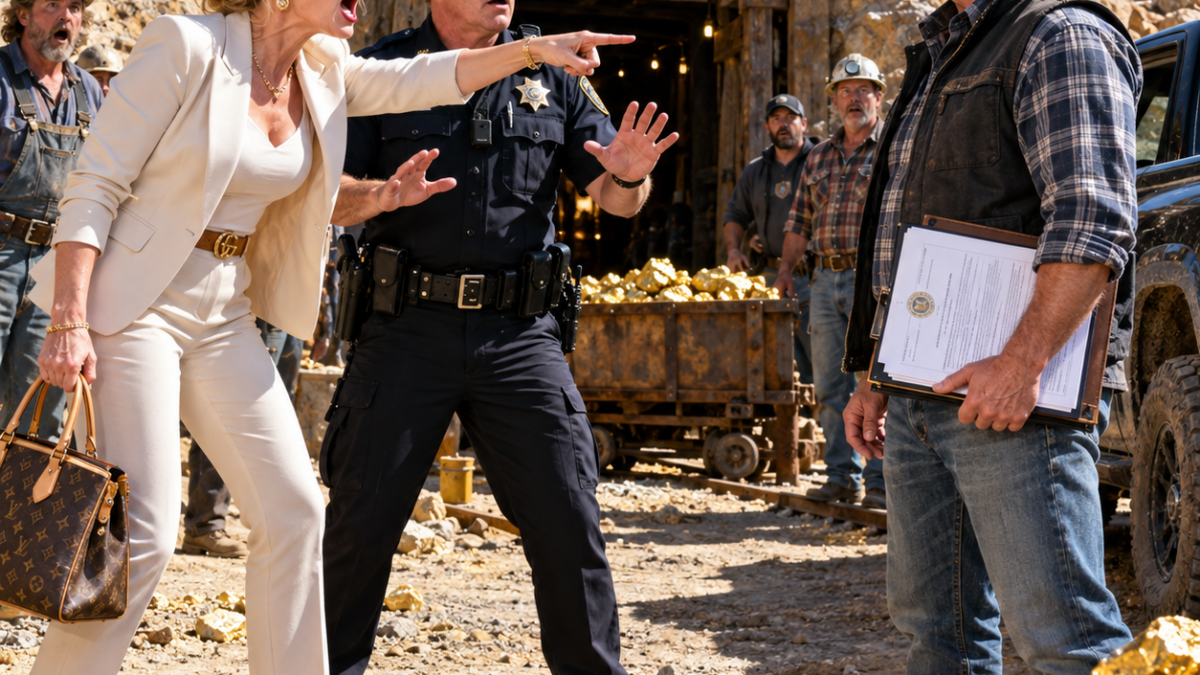
PART 2
I read Elizabeth Howard’s letters three times.
Not because they were complicated.
Because they were absurdly simple.
The first accused me of conducting “unauthorized industrial activities inconsistent with Golden Ridge Estates community standards.”
The second alleged possible contamination of Miller Creek.
The third demanded that all mining activity cease within seventy-two hours pending HOA review.
I laid them across my desk.
Then I pulled up the recorded boundaries of Golden Ridge Estates.
The subdivision covered roughly 240 homes and about three hundred acres of privately owned residential property.
My father’s claim sat more than half a mile away.
Miller Creek separated the two.
There was no overlap.
No shared boundary.
No easement placing the mine under HOA authority.
Nothing.
Elizabeth had signed three official-looking documents demanding control over land her association had no recorded claim to.
If she genuinely believed otherwise, the boundary map would correct her in less than five minutes.
Which meant either she was spectacularly careless or she expected intimidation to work faster than facts.
I was beginning to suspect the second possibility.
I called the Bureau of Land Management office and verified my father’s claim records.
Current.
Properly maintained.
Annual filings complete.
Fees paid.
My father had been meticulous.
Even during his final year.
That hurt.
I sat in my office looking at his signature on the most recent maintenance paperwork.
Raymond Mendoza.
My father’s handwriting had always leaned slightly to the right.
I had seen that signature on birthday cards, permission slips, tax returns, checks, and eventually estate papers.
Now it sat beneath a federal mining filing completed only months before his death.
The mine had mattered to him until the end.
And somehow Travis and Elizabeth Howard had become part of his final years without me knowing anything about it.
I started with Travis.
Twenty-two years in the sheriff’s department.
A long career.
Good evaluations publicly.
Several commendations.
But complaints existed too.
Three excessive-force or intimidation complaints over six years.
All found unfounded after internal review.
The names were not publicly available.
The locations were.
Two incidents occurred within a few miles of Golden Ridge Estates.
That alone proved nothing.
Complaints against officers are not convictions.
I knew that.
I also knew patterns mattered.
So I drove back toward the mountain.
Not to the mine.
To a general store four miles away.
RUBY’S MARKET had been there since I was a teenager.
The bell above the door still made the same metallic sound.
A woman behind the counter looked up.
Late sixties.
Gray streaks in dark hair.
Sharp eyes.
“Can I help you?”
“My name is Raymond Mendoza Jr.”
Her face changed instantly.
“You’re Ray’s boy?”
“Yes, ma’am.”
She came around the counter.
“Oh, honey.”
Nobody had called me that in twenty years.
She hugged me.
“I’m Ruby Vasquez.”
“I remember you.”
She pulled back.
“Your father used to buy coffee here every morning.”
“I know.”
Her expression softened.
“I’m sorry.”
“Thank you.”
Then I showed her Elizabeth’s HOA letters.
Ruby read the first page.
Her mouth tightened.
By the time she reached the signature, she wasn’t surprised.
“She started already.”
Those words changed everything.
“Started what?”
Ruby glanced toward the front windows.
Then locked the door.
It was two in the afternoon.
“Come sit.”
We moved to a table near the back.
“What do you mean, started?”
Ruby folded her hands.
“How much did your father tell you?”
“About Elizabeth?”
“About them.”
“Nothing.”
Ruby closed her eyes briefly.
“That sounds like Ray.”
“Why?”
“He didn’t want his son worrying.”
A knot formed in my stomach.
“Ruby.”
She leaned forward.
“Travis Howard had been showing up at that mine for years.”
“How many?”
“I don’t know. More than I can count.”
“For what?”
“Whatever Elizabeth needed him to be there for.”
I said nothing.
Ruby told me about an elderly landowner named Ed Martinez.
Seventy-two.
He owned forty acres that developers had wanted.
He refused to sell.
Within weeks, Deputy Howard began visiting.
Permit questions.
Code complaints.
Vehicle checks.
Noise complaints.
Trespass allegations.
Nothing serious individually.
Together, relentless.
Six visits in two months.
Ed eventually sold.
“Who bought it?”
“A development company.”
“Connected to Elizabeth?”
Ruby looked at me carefully.
“You’re a lawyer, right?”
“Yes.”
“Then you look it up.”
I understood.
She didn’t want rumor confused with evidence.
“Who else?”
Ruby told me about Jacqueline and Terry Sanders, owners of a local restaurant.
They hosted a meeting for residents angry about Elizabeth’s HOA leadership.
The next month, inspectors appeared repeatedly.
Then another story.
Joseph Mendoza.
No relation to me.
A Black contractor who drove through the county for work.
Eleven traffic stops in two years.
No citations.
Often Travis.
Then Ruby told me her own story.
Two years earlier, she refused an offer to sell the general store to a buyer associated with one of Elizabeth’s development contacts.
After that, Travis began appearing regularly.
Parking complaints.
Suspicious-person checks.
Questions about deliveries.
Patrol car sitting across the road for long stretches.
“Did he threaten you?”
“Not the way you mean.”
“What way do I mean?”
Ruby looked directly at me.
“You want words you can put in court.”
“Yes.”
“He was smarter than that.”
She looked toward the window.
“The badge was the threat.”
That sentence stayed with me.
“What about Dad?”
Ruby’s face softened.
“He knew.”
“Knew what?”
“That they wanted the mine.”
My chest tightened.
“Why?”
“Development.”
“Golden Ridge doesn’t touch the claim.”
“Not now.”
She got up and disappeared into a back office.
When she returned, she carried a folded planning map.
She spread it across the table.
A conceptual expansion plan for Golden Ridge Estates.
Luxury homes.
Trail system.
Creekfront parcels.
And one proposed access corridor running toward my father’s claim.
I stared at it.
“Where did you get this?”
“Your father.”
“Why did he have it?”
“Because Elizabeth showed it at a planning meeting years ago.”
The mine area was labeled FUTURE OPEN-SPACE / RECREATIONAL OPPORTUNITY.
My stomach turned.
“She was planning around land she didn’t own.”
Ruby nodded.
“Your father objected.”
“And then Travis started visiting.”
“Yes.”
“How long?”
“About five years.”
Five years.
I thought about all the times Dad called me and said everything was fine.
All the times I asked if he needed anything.
“No, son. Just busy.”
All the times I believed him because believing him was easier than driving three hours and checking.
“What exactly did Travis do?”
Ruby hesitated.
“Ask Ed.”
“Where?”
“He stays with his nephew now.”
“Why?”
She gave me a look.
Because he had sold.
Of course.
I contacted Ed that evening.
He agreed to meet the following afternoon.
His nephew lived in a small house outside town.
Ed answered the door himself.
Thin.
Weathered.
Hands permanently shaped by decades of physical work.
When I introduced myself, he stared for several seconds.
“Ray’s boy.”
“Yes.”
“Your dad was stubborn.”
“So I’ve been told.”
Ed smiled.
“So were you.”
I sat with him at the kitchen table.
For nearly two hours, he described what happened after he refused to sell his property.
Travis arrived once.
Then again.
Then twice in the same week.
Questions about permits Ed had held for decades.
Warnings.
Complaints.
Someone slashed two tires.
Nobody was ever charged.
Then Travis appeared again and suggested selling might “simplify things.”
“Did he say who you should sell to?”
“No.”
“Did Elizabeth?”
Ed looked at me.
“She didn’t have to.”
The development company making offers used a business address connected to one of her ventures.
Ed finally sold.
Below what he believed the property was worth.
“What happened to the harassment afterward?”
“It stopped.”
Immediately.
He stared at his hands.
“I wasn’t in their way anymore.”
His voice contained something worse than anger.
Shame.
“Ed, why didn’t you report it?”
“I did.”
“To whom?”
“Sheriff’s department.”
“What happened?”
“They investigated their own deputy.”
“And?”
“You know the answer.”
Unfounded.
I drove back to my motel angry enough to make mistakes.
So I did nothing.
That sounds passive.
It wasn’t.
Sometimes the most professional thing you can do with anger is refuse to use it until you have evidence strong enough to survive it.
The next morning, I met Joseph Mendoza.
We chose a coffee shop twenty miles away.
Joseph arrived carrying a black notebook.
He placed it on the table.
“What’s this?”
“My last two years.”
Inside were entries.
Date.
Time.
Location.
Officer.
Reason given.
Outcome.
Eleven traffic stops.
Zero tickets.
Travis Howard’s name appeared repeatedly.
“He ever search you?”
“Once.”
“Consent?”
“I said yes.”
“Why?”
Joseph laughed.
It wasn’t humorous.
“Because when a white deputy has his hand resting near his weapon and you’re a Black contractor alone on a rural road, ‘consent’ can mean a lot of things.”
I nodded.
“What did he say?”
“Usually nothing important.”
“Threats?”
“No.”
“Comments about Elizabeth?”
“Once.”
I leaned forward.
“What?”
Joseph flipped three pages.
“There.”
He had written the quote immediately afterward.
Deputy Howard: “Some people around here make life harder than it needs to be. Best thing you can do is stay out of local politics.”
“When was this?”
Two days after Joseph had publicly criticized a Golden Ridge development proposal.
I photographed the page with his permission.
Then I asked the question I would eventually ask everyone.
“If there were an outside investigation, would you testify?”
Joseph stared at me.
“Outside?”
“Yes.”
“Not local?”
“No.”
He closed the notebook.
“Yes.”
The Sanders agreed too.
Their story followed the same rhythm.
They hosted a community meeting critical of Elizabeth.
Then health inspections multiplied.
Insurance complications followed.
A hostile review appeared online.
When they stopped hosting meetings, the pressure disappeared.
“Can you prove Elizabeth caused the inspections?” I asked.
“No,” Jacqueline said.
“Can you prove Travis did?”
“No.”
“Then what can you prove?”
Terry pushed a folder toward me.
Dates.
Emails.
Inspection records.
HOA meeting announcements.
A timeline.
Good.
Facts.
Not conclusions.
I could work with facts.
Ruby was the last person I formally interviewed.
She invited me to her home.
Photographs covered nearly every wall.
Her late husband.
Children.
Grandchildren.
At the kitchen table, she told me about her son Daniel.
Thirty-two when Travis arrested him for DUI.
Daniel had consumed two beers across three hours at a birthday gathering.
Travis stopped him.
Said he smelled alcohol.
Arrested him.
Six weeks later, charges were dropped after video evidence undermined the arrest.
But Daniel’s employer had already fired him.
His mugshot circulated.
His reputation was damaged.
Three months later he moved to Nevada.
Ruby never forgot the timing.
Two weeks before Daniel’s arrest, she had rejected the land buyer tied to Elizabeth’s circle.
“Can you prove one caused the other?” I asked gently.
“No.”
Her eyes filled.
“But I know.”
I reached across the table.
“I need more than knowing.”
“I know that too.”
Then Ruby stood.
She went to a cabinet and returned with a USB drive.
“What’s this?”
“My cameras.”
My pulse changed.
She inserted the drive into my laptop.
Three files.
The first showed Travis inside her store wearing his uniform.
Ruby stood behind the counter.
The audio was clear.
Travis leaned closer.
“Elizabeth doesn’t like being told no.”
Ruby responded, “Elizabeth doesn’t own my store.”
He smiled.
“You should think about that offer again.”
Second file.
Different day.
Same counter.
Travis:
“Things get complicated for people who don’t cooperate.”
Third file.
Exterior camera.
His patrol car sat across the road.
Forty-seven minutes.
Timestamp visible.
No call.
No traffic stop.
No apparent police activity.
Just watching.
I replayed the first clip.
Then the second.
Ruby folded her arms.
“Is that enough words for court?”
It was the first time I had seen her smile.
“Yes.”
For the next two weeks, my life became paper.
Statements.
Maps.
Mining claim records.
HOA minutes.
Public planning documents.
Complaint histories.
Video files.
Property records.
I refused to call it a prosecution file.
That wasn’t my role.
I was organizing potential evidence.
There is a difference.
Late one night, I found an old Golden Ridge meeting record.
Elizabeth had discussed my father’s mine.
Not by name.
But unmistakably.
“The obsolete mining operation beyond Miller Creek presents an obstacle to the long-term recreational and residential vision for the area.”
Three months later, according to Ruby’s notes, Travis made one of his first visits to Dad.
Then another meeting record.
Elizabeth complaining about “resistant commercial owners.”
Weeks later, Ruby’s son was arrested.
Individually, those things proved little.
Together?
They deserved investigation.
At two in the morning, surrounded by paper, I found myself staring at my father’s photograph.
He was sixty in the picture.
Standing beside the sluice box.
Smiling.
I realized something ugly.
I had spent fifteen years becoming exactly the kind of attorney my father could have used.
And I had never asked enough questions to realize he needed one.
The guilt was unbearable.
I had clients whose emergencies made me answer at midnight.
I had flown across states for hearings.
I had spent weekends protecting strangers’ property.
My father was three hours away.
And for five years he faced Travis Howard largely alone.
I pressed both hands against my face.
Then I said aloud to an empty room, “I’m sorry, Dad.”
Nothing answered.
There are apologies you make because forgiveness is possible.
And apologies you make because confession is all you have left.
I worked until dawn.
A week later, I returned to the mine.
This time I brought a licensed surveyor.
Marcus Chen.
Twenty years’ experience.
Careful.
Methodical.
He had another habit I didn’t know would matter.
He recorded site visits on his phone to protect himself in boundary disputes.
We arrived at eight.
Cool air.
Blue sky.
Creek water moving through rocks.
Marcus set up equipment near the eastern boundary.
I photographed structures.
Pump house.
Storage shed.
Generator.
Access road.
Everything was quiet for almost an hour.
Then engines.
Fast.
Gravel sprayed at the turn.
Two patrol cars appeared.
My stomach dropped.
Marcus looked at me.
“Expecting company?”
“No.”
Deputy Travis Howard stepped out of the first cruiser.
Another deputy remained near the second.
Travis walked toward me.
His face looked different.
Not controlled like our first meeting.
Angry.
“You.”
I said nothing.
He came within three feet.
“You were ordered to cease operations.”
“I’m conducting a boundary survey.”
“You’re trespassing on private property.”
“No, I’m not.”
“You’re under arrest.”
Marcus froze.
I kept my hands visible.
“For what?”
“Trespassing and operating an illegal mining facility.”
“This is a federal mining claim.”
“I have jurisdiction everywhere in this county.”
I knew that statement would matter later.
At the time, what mattered was the way his hand moved toward me.
“Turn around.”
I didn’t resist.
“Deputy Howard, I’m complying.”
“Hands behind your back.”
I turned.
He grabbed my arm hard enough to twist my shoulder.
Then pushed me forward.
My face hit the hood of his cruiser.
The metal was already warm.
The handcuffs closed.
Too tight.
Pain shot into my wrists.
“Deputy, loosen the restraints.”
“Stop resisting.”
“I’m not resisting.”
He leaned toward my ear.
His voice dropped.
“Elizabeth told me you were stubborn.”
Everything inside me went still.
He continued.
“She said you wouldn’t take the hint.”
I stared at the dust on the hood.
“So here’s one you’ll understand. Spend a night in a cell. Think about whether this piece of dirt is worth destroying your life over.”
He had no idea Marcus was filming.
Marcus stood about forty feet away.
Phone raised.
Recording.
Travis turned toward him.
“What are you doing?”
Marcus answered calmly.
“Documenting my survey.”
“Put the phone down.”
“No.”
The second deputy moved toward him.
Marcus took one step backward.
“I’m on a professional site visit. My recording is for liability documentation.”
Travis looked at me.
Then at Marcus.
For the first time, doubt appeared.
But pride had already committed him.
“Take him in,” Travis told the other deputy.
Marcus said, “Am I under arrest?”
Silence.
“For what?”
The deputy stopped.
Travis swore.
“Get him off the property.”
Marcus walked toward his vehicle.
Still recording.
They took me to county detention.
Booked me for trespassing and unpermitted mining activity.
I asked repeatedly for the specific statute or order establishing that I had no right to occupy the claim.
No clear answer came.
I spent six hours in a holding cell.
Six hours is not a long time compared with what some people endure.
But when you know you are there because someone wanted to frighten you, every minute feels deliberate.
I thought about Dad.
Had Travis ever done this to him?
Put him in a cruiser?
Threatened him somewhere Ruby never saw?
Dad would never have told me.
That knowledge hurt worse than the cuffs.
Eventually the charges collapsed.
My documentation made the trespassing allegation impossible to sustain as presented.
I was released.
The desk sergeant returned my belongings in a plastic bag.
Wallet.
Keys.
Phone.
Belt.
He did not look at me.
That told me enough.
Outside, Marcus waited beside his truck.
He walked toward me.
“Are you okay?”
“Yes.”
“No, you’re not.”
“My wrists hurt.”
He handed me his phone.
“Watch.”
Seven minutes and twenty-three seconds.
Timestamp.
Audio.
Location metadata.
Travis grabbing me.
My repeated compliance.
His claim of universal county authority.
And then the sentence.
Elizabeth told me you were stubborn.
I watched it twice.
Marcus had already backed it up.
I looked at him.
“Would you give a sworn statement?”
“Yes.”
“Even if the sheriff’s department pushes back?”
His face hardened.
“I watched a deputy arrest a property owner during a survey after invoking his wife’s name. I’m not pretending that didn’t happen.”
That night, I made the call I had been avoiding.
Not Internal Affairs.
Not the local district attorney.
Not Travis’s department.
I contacted federal civil-rights investigators.
I explained the mine.
The HOA.
Ruby.
Ed.
Joseph.
The Sanders.
The videos.
The complaint pattern.
The false arrest.
The survey recording.
When I finished, the woman on the phone asked one question.
“Would you cooperate with a federal investigation?”
“Yes.”
Three days later, I met Special Agent Sarah Taylor at a diner outside the county.
She wore no dramatic suit.
No movie-star sunglasses.
Just slacks, a simple jacket, and an expression that suggested she had learned to distrust impressive stories until evidence caught up.
She placed a folder between us.
“Before we begin, understand something.”
“What?”
“You are not running this investigation.”
“I know.”
“Your legal experience doesn’t change that.”
“I understand.”
“You will not contact witnesses on our behalf. You will not obtain evidence through methods we haven’t approved. You will not confront Deputy Howard or his wife.”
“Agreed.”
She studied me.
Then opened the folder.
The Bureau already had complaints involving Travis.
Not enough for a case.
Fragments.
Allegations across jurisdictions.
Internal findings of no misconduct.
Settlements.
Witnesses reluctant to participate.
Sarah tapped my survey video.
“This changes things.”
“How much?”
“Enough to investigate harder. Not enough to promise you anything.”
I respected that answer.
She showed me nothing she wasn’t authorized to show.
But she made one thing clear.
My father’s experience did not exist in isolation.
“Why hasn’t anything happened before?”
“Because suspicion is not admissible evidence.”
“I have five witnesses.”
“We interview them independently.”
“I understand.”
“Some may change their minds.”
“They might.”
“Some evidence may not survive challenge.”
“I know.”
“Your video will be attacked.”
“I know.”
“Your motives will be attacked.”
“I’m expecting that.”
She closed the folder.
“Good.”
Then she said something harder.
“Go back to your life.”
I stared at her.
“Excuse me?”
“Return to the mine when you normally would.”
“With Travis still working?”
“Yes.”
“You’re asking me to pretend nothing happened.”
“I’m asking you not to warn our targets.”
“What about Ruby?”
“Do not tell her there is an active federal operation unless we authorize it.”
“She deserves to know.”
“She deserves an investigation that survives.”
That shut me up.
Sarah continued.
“If Elizabeth learns we’re looking at finances, records disappear. If Travis learns witnesses are cooperating, behavior changes. If other officials are involved, they start coordinating stories.”
I hated it.
She was right.
So I waited.
That became the hardest phase.
Elizabeth continued holding HOA meetings.
Her name still appeared on notices.
Travis still wore a badge.
I visited the mine twice.
He didn’t come.
Every time a vehicle appeared in my mirror on the mountain road, my body reacted before my mind did.
I learned something about intimidation then.
It doesn’t end when the person leaves.
It teaches your nervous system to expect them.
Weeks passed.
Federal agents independently interviewed Ruby.
Ed.
Joseph.
The Sanders.
Marcus.
They subpoenaed records.
Financial documents.
Communications.
Body-camera retention data.
Internal complaint files.
Sarah called occasionally.
Always careful.
Always saying less than I wanted.
One day she mentioned Captain Timothy Bailey.
Head of Internal Affairs.
He had approved multiple unfounded findings involving Travis.
“Is he part of it?” I asked.
“We’re determining that.”
“Helpful answer.”
“It’s the only one you’re getting.”
Bailey initially resisted.
Then subpoenas arrived.
Potential obstruction exposure changed his attitude.
He began providing documents.
Not out of courage.
Self-preservation.
Sarah called that kind of witness useful but dangerous.
“He will tell the truth until the truth stops serving him.”
“That sounds reassuring.”
“It shouldn’t.”
The investigation expanded.
Financial irregularities surfaced involving development projects connected to Elizabeth.
HOA funds.
Property ventures.
Contacts across several counties.
Still, no arrests.
I started wondering whether there ever would be.
Then Tuesday came.
I was in Sacramento when Sarah called.
“It’s happening today.”
My pulse jumped.
“What?”
“You’ll see the news.”
“Sarah—”
“Do not travel here.”
Then she hung up.
Travis always ate breakfast Tuesday mornings at Pinecrest Diner before his shift.
Federal agents entered at 7:43.
Ruby happened to be there buying coffee.
She called me hours later.
Her voice was almost emotionless.
“They got him.”
I sat down.
“You saw?”
“Yes.”
“What happened?”
“He laughed.”
“Travis?”
“When the woman gave him the warrant.”
Ruby inhaled shakily.
“He laughed because he thought it was some kind of joke.”
Then the laughter stopped.
Agents cuffed him inside the diner.
Badge still pinned to his uniform.
Coffee on the table.
People watching.
No one intervened.
No one defended him.
Ruby’s voice cracked.
“I thought I’d feel happy.”
“What do you feel?”
“Tired.”
I closed my eyes.
“That makes sense.”
“I thought about Daniel.”
Her son.
“I kept thinking if this had happened five years ago, maybe my boy would still live here.”
I had no answer.
Fifteen minutes after Travis was taken, federal agents arrived at the Howard home.
Elizabeth answered the door.
She reportedly tried first to call Travis.
Then her attorney.
Then to shut the door.
None of it stopped the warrant.
Agents searched the property.
What they found transformed an investigation into something far larger.
Financial documents tied Elizabeth to multiple development deals.
Emails discussing “problem residents.”
Communications involving Internal Affairs Captain Bailey.
Then a folder.
Physical.
Labeled:
LEVERAGE.
When Sarah eventually told me about it, I thought I had misunderstood.
“What was inside?”
“Profiles.”
“On who?”
“Residents. Business owners. People Elizabeth considered obstacles.”
Debt.
Divorce.
Medical problems.
Family conflicts.
Licensing issues.
Anything that could create pressure.
Ruby’s name.
Ed’s.
Others.
My father’s.
I stopped breathing for a moment.
“You found Dad?”
“Yes.”
“What did it say?”
Sarah hesitated.
“Raymond—”
“What did it say?”
“Your father had health problems. They knew.”
My eyes closed.
Dad’s heart.
He had been taking medication.
“How?”
“We’re investigating.”
“Did Travis know?”
“I can’t answer that yet.”
The anger that hit me was different from everything before.
Not hot.
Cold.
They knew an elderly man living alone had heart problems.
And they kept pressuring him.
I stood from my desk.
“Raymond.”
“I’m here.”
“Do not act on this.”
“I’m not going to.”
“I mean it.”
“So do I.”
After the arrests, Golden Ridge collapsed politically almost overnight.
Residents who had defended Elizabeth stopped answering reporters.
Board members claimed ignorance.
Some probably were ignorant.
Others suddenly remembered conversations differently.
Lawyers appeared everywhere.
Business owners came forward.
Former residents called federal investigators.
The case grew.
Ruby said something during that period I never forgot.
“Arrest isn’t justice.”
“No.”
“It just means they can’t keep doing it tomorrow.”
Exactly.
Months passed.
Defense attorneys challenged the investigation aggressively.
The survey recording.
Witness memories.
Federal jurisdiction.
Searches.
Records.
Bailey’s credibility.
They portrayed Travis as a decorated officer making difficult decisions.
Elizabeth as a community volunteer whose development work had been misunderstood.
Me?
I became the grieving son with a financial interest in valuable mining property.
A lawyer looking for revenge.
That was predictable.
During cross-examination, Travis’s attorney asked why I waited instead of immediately challenging his authority at the first mine encounter.
“Because he was armed, I was alone, and arguing with an officer on a remote road would have accomplished nothing.”
“You were afraid?”
“I was cautious.”
“You claim expertise in jurisdiction.”
“Yes.”
“Yet you obeyed.”
“Yes.”
“So perhaps Deputy Howard’s authority was not as obviously illegitimate as you now suggest.”
I looked toward the jury.
“No. It means knowing your rights and surviving an encounter are sometimes two different tasks.”
The courtroom went quiet.
The attorney changed subjects.
Ruby testified.
That was harder to watch.
She looked small in the witness chair.
Then the government played the store footage.
Travis’s voice filled the courtroom.
“Elizabeth doesn’t like being told no.”
Then:
“Things have a way of getting complicated for people who don’t cooperate.”
Ruby didn’t look at Travis.
She looked at the jury.
“My son’s life became complicated two weeks after I said no.”
The defense attacked the connection.
Timing isn’t causation.
True.
But the case didn’t depend on Ruby alone.
Ed testified.
Joseph testified.
Jacqueline and Terry testified.
Marcus testified.
Then investigators introduced records.
Emails.
Financial transactions.
Internal complaint files.
The leverage folder.
Captain Bailey testified under his cooperation arrangement.
He admitted complaints involving Travis had not always received proper scrutiny.
The defense tore into him.
“You’re blaming Deputy Howard to save your own career.”
“My career is already over.”
“To avoid prosecution.”
“Yes.”
“Then you have every reason to lie.”
Bailey looked toward the prosecutor.
Then back at the attorney.
“I have every reason to tell you why I lied before.”
That landed.
The trial lasted weeks.
I attended whenever my schedule allowed.
Ruby sat beside Ed.
Joseph usually sat one row ahead.
None of us celebrated evidence.
There was no joy in watching people explain the worst years of their lives to strangers.
Three days of deliberations followed.
Those three days felt longer than the entire investigation.
Then the jury returned.
Guilty on the major counts.
Travis Howard was convicted in connection with civil-rights abuses and the coordinated intimidation scheme.
Elizabeth was convicted for her role in directing and benefiting from that system, along with financial misconduct supported by the recovered records.
Ruby grabbed my hand.
Hard.
I looked at her.
She was crying.
“Is this what relief feels like?”
“I don’t know.”
“Me either.”
Sentencing came later.
Travis stood before the judge.
For years, his badge had amplified every sentence he spoke.
Now it lay somewhere in an evidence file or departmental storage.
The judge talked about public trust.
About power.
About the damage caused when government authority becomes a private weapon.
Seven years in federal prison.
Lifetime prohibition from serving in law enforcement.
Travis showed almost no expression.
Elizabeth received five years.
Restitution and financial penalties followed.
The court discussed the leverage files.
The planning.
The repeated targeting of people who obstructed projects, deals, or influence.
Elizabeth cried when her sentence was announced.
I felt less satisfaction than I expected.
Maybe because by then I understood punishment could not reverse time.
Seven years wouldn’t give Ruby five years with Daniel back in town.
Five years wouldn’t return Ed’s peace.
Money wouldn’t erase eleven traffic stops from Joseph’s memory.
Nothing would give my father his last years without fear.
But Ruby had been right.
They couldn’t take more.
That mattered.
Captain Bailey avoided prosecution under his cooperation arrangement but lost his career.
Civil lawsuits followed.
Ruby received a settlement.
More importantly to her, Daniel’s false arrest record was cleared.
She called me that day.
“They erased it.”
“Good.”
“It doesn’t erase what happened.”
“No.”
“But when employers run his name now…”
She started crying.
“They won’t see it.”
I let her cry.
Ed began fighting to recover his land.
The developer suddenly became much more willing to negotiate once federal evidence tied the acquisition climate to misconduct.
Joseph settled his civil-rights claim.
The county adopted documentation rules for traffic stops.
Body-camera recording requirements tightened.
Civilian-accessible review procedures followed.
Joseph told me over coffee:
“I don’t care about the check.”
“I know.”
“I want the next guy to know why he was stopped.”
“That matters.”
“It matters more.”
Jacqueline and Terry had their disputed health violations removed.
Fees reimbursed.
Insurance-related losses partially compensated.
Months later, they hosted a dinner for everyone who testified.
Ruby sent me a picture.
Long table.
Food everywhere.
Ed smiling.
Joseph laughing.
People who had once avoided being seen together now sitting in one room without checking the windows.
Golden Ridge Estates rewrote its governing rules.
Term limits.
Independent audits.
Transparent voting.
Conflict disclosures.
No informal use of law enforcement connections for HOA disputes.
Clear complaint procedures.
Independent review requirements.
Rules alone cannot manufacture courage.
But they can make abuse harder.
That was worth something.
As for the mine, I still didn’t know what to do with it.
I visited most weekends.
Not to extract gold.
Not at first.
I walked.
I repaired small things.
Tightened bolts.
Replaced rotted boards.
Cleared brush from the pump house.
Dad’s coffee mug was still on a shelf.
Blue ceramic.
Chipped near the handle.
I left it there.
One Saturday morning, I found a notebook inside an old metal cabinet.
My father’s handwriting.
Maintenance records mostly.
Fuel purchases.
Weather notes.
Equipment repairs.
Then near the back, the entries changed.
May 14.
Howard came again. Says complaint from neighborhood.
June 2.
Howard says Elizabeth wants meeting. Declined.
June 19.
White SUV near access road.
July 7.
Ruby says Ed sold. Bad feeling.
August 11.
Howard says “things easier if I cooperate.”
I sat on the floor.
Kept reading.
September 3.
Called Raymond. Didn’t tell him. He has his own life.
I stopped.
My hands started shaking.
He had called me that day.
I remembered.
I had been preparing for trial.
Dad asked when I might visit.
I told him maybe next month.
He said, “No hurry.”
There was always hurry.
We just don’t recognize which things deserve it until later.
The final entry involving Travis came less than two months before Dad died.
Howard again. Told him claim is legal. He laughed. I’m tired.
Three words.
I’m tired.
I closed the notebook.
Then I cried harder than I had at the funeral.
At the funeral, there were people.
Responsibilities.
Handshakes.
Arrangements.
You perform grief because there are tasks.
At the mine there was nobody.
Just pine trees.
Creek water.
Old equipment.
And my father admitting on paper that he had been tired while I lived three hours away believing he was fine.
“I’m sorry,” I said.
The mountains didn’t answer.
I stayed until sunset.
Then I took the notebook home.
For a while, I thought about suing everyone connected to the harassment.
Maybe I could have.
Some victims did.
But I didn’t want the mine to spend another five years as evidence.
Dad hadn’t worked that land because he loved litigation.
He worked it because the place made sense to him.
Earth.
Water.
Labor.
Patience.
Gold if you were lucky.
Nothing if you weren’t.
I wanted some part of that simplicity back.
So I hired a small licensed crew.
Not to turn it into a large commercial operation.
Just enough to restore the equipment safely and assess whether Dad’s old workings still had value.
Marcus Chen came back to survey updated boundaries.
The first morning he arrived, he held up his phone.
“Recording.”
I laughed.
“You planning to get me arrested again?”
“I’m trying to avoid it.”
We walked to the place where Travis had shoved me against his patrol car.
No marks remained.
Of course not.
Places heal faster than people.
Marcus stopped.
“You ever think about that day?”
“All the time.”
“You knew I was recording?”
“No.”
“You looked like you did.”
“I was busy being handcuffed.”
“You were very calm.”
“I was terrified.”
He looked surprised.
“Really?”
“Marcus, two armed deputies arrived at a remote mine and one announced I was being arrested under authority I believed was improper. Of course I was afraid.”
“You didn’t look afraid.”
“Fear doesn’t always look dramatic.”
That reminded me of Ruby.
Ed.
Joseph.
People who lived afraid for years while strangers described them as quiet.
Silence had never meant weakness.
Sometimes silence meant calculation.
Sometimes survival.
Sometimes waiting for one safe opening.
A year after the trial, Ruby’s son Daniel came home.
Not permanently.
Just for a visit.
Ruby called me.
“You’re coming to dinner.”
“That sounded less like an invitation.”
“It wasn’t.”
I went.
Daniel was older than the photographs.
Of course he was.
Life had moved even while Ruby waited.
He shook my hand.
“My mom talks about you like you’re Batman.”
Ruby shouted from the kitchen, “I do not!”
Daniel smiled.
“She absolutely does.”
“I’m a property lawyer.”
“Less exciting.”
“Much.”
During dinner, nobody mentioned Travis for almost an hour.
That felt important.
Eventually Daniel brought it up.
“I used to dream about seeing him arrested.”
Ruby looked down.
Daniel continued.
“When Mom told me it happened, I thought I’d feel something.”
“What did you feel?” I asked.
“Nothing.”
He shrugged.
“Then guilty for feeling nothing.”
“You don’t owe anyone the correct emotional reaction.”
He looked at me.
“Did you feel good?”
“No.”
That seemed to relieve him.
“I felt like everyone kept waiting for me to say justice had been done.”
He stirred his drink.
“But my old job didn’t come back.”
“No.”
“My marriage ended partly because I became impossible to live with after the arrest.”
Ruby’s eyes filled.
“My friends believed the mugshot before they believed me.”
Nobody spoke.
Daniel smiled sadly.
“So yeah. His conviction was good.”
Then he looked at his mother.
“But I’d rather have my five years.”
Ruby reached across the table.
Their hands met.
That was when I finally understood the limit of revenge.
There is a fantasy people have when they are wronged.
That if the person who hurt you suffers enough, some invisible scale becomes balanced.
But pain does not reverse pain.
Prison does not rewind calendars.
A guilty verdict does not restore lost birthdays.
Accountability matters because it stops repetition and acknowledges truth.
Not because suffering can be refunded.
That lesson changed what I wanted from the mine.
I stopped thinking of it as something Travis and Elizabeth had tried to steal.
I started thinking of it as the last place where my father had left me something unfinished.
Not gold.
A relationship.
One I could no longer repair with him.
But maybe I could repair what his final years had done to my memory of him.
I began going every Sunday.
Sometimes I worked.
Sometimes I sat by the creek.
Sometimes I read his notebook.
I learned things I had forgotten.
Dad hated cold mornings.
Loved canned peaches.
Complained constantly about fuel prices.
Named machinery.
His oldest generator was Betty.
Nobody knew why.
One Sunday, I found a small envelope taped beneath his workbench.
My name was on it.
RAY.
My father called me Ray even though he was Raymond and I was technically Raymond Jr.
Inside was a single sheet of paper.
Son,
If you’re reading this, I probably didn’t get around to saying what I should have.
Don’t keep the mine because of me.
Don’t sell it because of me either.
Do what gives you peace.
Land isn’t family.
Gold isn’t family.
Work isn’t family.
I learned that too late.
Don’t make the same mistake.
Dad.
I sat there for a long time.
Then I laughed.
Because even dead, the stubborn old man had found a way to win an argument I hadn’t known we were having.
Land isn’t family.
That sentence was almost offensive coming from him.
He had spent thirty-five years at that mine.
Then I understood.
Maybe that was why he wrote it.
I folded the letter.
Put it in my wallet.
Two months later, I made my decision.
I kept the claim.
But not as an obsession.
I hired an operator for limited seasonal work.
I reserved part of the property around the creek and old pump house as a family area.
No major expansion.
No development.
No luxury subdivision.
No fight.
Just enough mining to keep the claim active and preserve what Dad built.
I started bringing my niece and nephew there.
The first time my nephew saw the sluice box, he asked:
“Is there really gold?”
“Yes.”
“How much?”
“If I knew that, life would be easier.”
He stared into the creek.
“Can I find some?”
“Maybe.”
Two hours later, he found a tiny flake.
So small I almost missed it.
He screamed like he had discovered California.
My niece rolled her eyes.
“It’s microscopic.”
“It’s gold!”
Dad would have loved it.
That thought nearly broke me.
But this time the grief was warm.
Not sharp.
That mattered too.
Golden Ridge changed after Elizabeth.
New board.
Independent accountants.
Open meetings.
Residents who once whispered now spoke openly.
Not everyone became friends.
Accountability doesn’t turn a community into a fairy tale.
People still argued about gates.
Landscaping.
Parking.
Roof colors.
Someone once spent twenty minutes fighting over decorative flags.
But those arguments were normal.
Nobody had a deputy husband appearing at a dissenter’s property afterward.
That was progress.
Ruby kept her store.
Ed eventually reached a settlement that returned a large portion of his property control to him.
The first morning he went back onto his land, he called me.
“You busy?”
“Always.”
“Come anyway.”
I drove out.
Ed stood beside an old fence line.
“This is mine again.”
His voice broke.
I shook his hand.
“I’m glad.”
He looked toward the hills.
“You know what I’m going to do with it?”
“What?”
“Nothing.”
I laughed.
“Perfect.”
“I spent eighteen months dreaming about getting it back. Everybody asks what I’m building.”
“And?”
“Nothing.”
He smiled.
“I want to sit on it and annoy developers.”
“That’s legally sophisticated.”
“I learned from a lawyer.”
Joseph became involved in county oversight meetings.
He hated them.
Went anyway.
At one meeting, a deputy complained new traffic-stop documentation took too much time.
Joseph responded:
“Then imagine how much time eleven unnecessary stops took from me.”
The room became silent.
Policy remained.
Jacqueline and Terry’s restaurant became the unofficial meeting place for a new community oversight group.
They joked that Elizabeth accidentally increased their dinner business.
Ruby framed the settlement apology.
Not because she respected it.
Because beneath it she taped Daniel’s cleared record.
When I asked why, she said:
“One is what they said. The other is what they finally fixed.”
Two years after the arrests, I received a letter from Elizabeth.
Federal prison mail.
I almost threw it away unopened.
Instead, I sat at my desk.
The letter was short.
She did not apologize cleanly.
People rarely transform into different human beings because a judge sentences them.
She wrote about stress.
Pressure.
Believing development would benefit the region.
Believing my father stood in the way of progress.
Believing Travis could “manage resistance.”
That phrase made me stop.
Manage resistance.
As if people were weeds.
Then near the end:
I see now that we stopped seeing people as people. Everyone became an obstacle or asset. Your father was an obstacle. Ruby was an obstacle. Ed was an obstacle. You became an obstacle. Once we thought that way, almost anything seemed justified.
I read that paragraph twice.
Then:
I do not expect forgiveness. I am writing because your father deserved better than what we did to him.
I sat back.
For twenty minutes, I stared at the wall.
Then I folded the letter.
I did not write back.
Forgiveness is not something another person can demand because they finally understand the shape of their damage.
Maybe someday I would forgive her.
Maybe I already had in ways I didn’t recognize.
But I didn’t need to answer.
I drove to the mine instead.
Dad’s notebook sat inside the pump house.
I placed Elizabeth’s letter beside it.
Not permanently.
Just long enough to see the two objects together.
One notebook from a man who endured.
One letter from a woman who helped make him endure.
I thought I would feel victorious.
I didn’t.
I took Elizabeth’s letter home.
Dad’s notebook stayed.
That was his place.
Years after the case, people still told the story incorrectly.
They said Elizabeth Howard called her cop husband to my gold mine.
True.
They said Travis tried to intimidate me off the property.
True.
They said he arrested the wrong man because I was a mining-rights attorney.
Partly true.
They said the FBI arrived because I knew the law better than he did.
Too simple.
Travis and Elizabeth didn’t lose because I was brilliant.
They lost because Ruby kept videos.
Joseph kept a notebook.
Ed remembered dates.
The Sanders kept inspection records.
Marcus kept his camera running.
My father kept documents.
Witnesses finally spoke.
Federal investigators did the slow work local systems had failed to do.
A jury listened.
That is less dramatic than revenge.
But it is more important.
The most satisfying moment wasn’t Travis being handcuffed at the diner.
It wasn’t Elizabeth crying at sentencing.
It wasn’t hearing seven years.
Or five.
The most satisfying moment happened one Sunday afternoon when my nephew came running toward me holding a small gold flake in a plastic vial.
“Uncle Ray!”
He nearly tripped over a hose.
“Slow down.”
“Look!”
He held the vial toward the sun.
Inside was almost nothing.
A tiny glint.
But his entire face shone.
“I found it!”
My niece walked behind him.
“He’s been yelling for ten minutes.”
“It’s gold!”
“We know.”
I looked at the creek.
At Dad’s pump house.
At equipment that had once felt like evidence of everything I neglected.
Now children were laughing around it.
No patrol cars.
No threats.
No HOA notices.
No fear.
Just family.
I pulled Dad’s letter from my wallet.
The paper was soft from being folded too many times.
Land isn’t family.
Gold isn’t family.
Work isn’t family.
I finally understood.
Dad didn’t leave me a mine so I could spend the rest of my life defending dirt.
He left me a choice.
The Howards had tried to turn that choice into surrender.
They failed.
Not because I destroyed them.
Because eventually the truth removed their ability to decide for everyone else.
I put the letter back into my wallet.
My nephew tugged my sleeve.
“Can we find more?”
“Probably.”
“How much?”
“Maybe enough to buy lunch.”
He looked disappointed.
“That’s it?”
My niece laughed.
I pointed toward the sluice.
“Get to work, prospector.”
He ran.
I watched him go.
For years, I thought justice would feel like watching Travis Howard lose his badge.
It didn’t.
Justice felt like standing on my father’s land without looking over my shoulder.
It felt like Ruby unlocking her store in the morning without wondering whether a patrol car would be waiting.
It felt like Joseph driving home without automatically checking his mirror every time he saw a deputy.
It felt like Ed standing behind his own fence again.
It felt like Jacqueline and Terry hosting a community meeting without four inspectors appearing the following week.
It felt like Marcus returning to my mine carrying surveying equipment instead of evidence.
And it felt like my father’s gold claim becoming a place where children could laugh again.
One evening, I stayed until after sunset.
The Sierra Nevada sky went orange, then purple.
The temperature dropped quickly.
Creek water moved through the darkness.
I sat on the steps of the pump house.
For a moment, I imagined Dad beside me.
“What would you have done?” I asked.
No answer.
Then I laughed.
I already knew.
He would have complained that I hired too many lawyers.
I was the lawyer.
He would have said I overcomplicated everything.
Then he would have checked whether I maintained the pump correctly.
That was Dad.
I looked toward the access road where Travis’s patrol car had once blocked my way.
Nothing there.
Just gravel disappearing between the trees.
There had been a time when a badge at the top of that road made everyone in the valley believe resistance was dangerous.
Travis thought authority came from metal pinned to his uniform.
Elizabeth thought authority came from a title printed beneath her name.
They both misunderstood power.
Real authority has limits.
That is what makes it legitimate.
The moment Travis began using public authority to enforce his wife’s private ambitions, the badge stopped protecting his behavior.
It became evidence of the abuse.
The moment Elizabeth treated homeowners and landowners as obstacles to manipulate, her presidency stopped being community leadership.
It became infrastructure for coercion.
They had spent years believing nobody could touch them.
Internal complaints disappeared.
People moved.
Businesses went quiet.
Families surrendered.
And every successful intimidation taught them the same lesson:
Push harder.
Then they reached my father’s mine.
They thought I was another grieving heir who would look at a uniform, read an HOA letter, and decide twelve acres of mountain land wasn’t worth the trouble.
For a few hours in that holding cell, part of me understood why other people had surrendered.
I was angry.
Humiliated.
Worried about my reputation.
Worried what false charges could do professionally.
And exhausted.
That was the mechanism.
Not physical force alone.
Exhaustion.
Make resistance cost more than surrender.
Make the victim calculate whether truth is worth another week of fear.
Ruby understood.
Ed understood.
Joseph understood.
My father understood.
What Travis and Elizabeth never anticipated was what happened when all those isolated stories finally touched each other.
One story can be dismissed.
Five become a pattern.
A video becomes corroboration.
An email becomes intent.
A folder labeled LEVERAGE becomes something no speech can explain away.
And a system that looked invincible can collapse surprisingly fast once fear changes sides.
I don’t say that with pleasure.
Fear is not justice either.
But consequences matter.
Travis will never wear a badge again.
Elizabeth will never turn HOA authority into private enforcement again.
Captain Bailey will never decide another complaint is easier to bury than investigate.
That is enough for me.
The last time I spoke with Ruby about the case, we were standing outside her store.
Daniel had returned to Nevada.
Ed was doing better.
Joseph had just spoken at another county meeting.
Ruby handed me coffee.
“You know what your father would say?”
“What?”
“He’d tell you to stop coming up here and pretending you know how to mine.”
I laughed.
“That sounds right.”
She looked toward the mountains.
“He was proud of you.”
The words hit unexpectedly.
“He told you that?”
“All the time.”
I swallowed.
“He also complained you never visited.”
“That sounds even more like him.”
Ruby smiled.
“He could do both.”
I looked down at the coffee cup.
“I should have been here.”
“Yes.”
I looked at her, surprised.
She shrugged.
“You want me to lie?”
“No.”
“You should’ve come more.”
“I know.”
“But you came when you came.”
“That doesn’t fix it.”
“No.”
Ruby looked toward the mine road.
“Not everything gets fixed.”
She took a breath.
“Some things just get carried differently.”
I remember that sentence more than anything a judge said.
Some things get carried differently.
My guilt never disappeared.
Neither did Ruby’s anger.
Neither did Daniel’s lost years.
Justice did not erase anything.
It changed what happened next.
That was enough.
Three years after Dad died, I installed a small bench near the creek.
No plaque.
No giant memorial.
Dad would have hated that.
Just cedar wood facing the water.
Sometimes I sit there after everyone leaves.
The old mine behind me.
The creek ahead.
And when I think about the morning Travis first arrived, the strangest part is remembering how powerful he looked.
Patrol car across the road.
Badge catching sunlight.
Voice certain.
Elizabeth watching behind him.
They seemed untouchable.
Then I remember how it ended.
Not with me drawing a weapon.
Not with a screaming confrontation.
Not with revenge.
With records.
Cameras.
Witnesses.
Federal warrants.
A courtroom.
Limits finally enforced.
They came to my father’s mine believing the badge made the land theirs to command.
They left the story having learned the opposite.
A badge can give a person authority.
It can never give them ownership of someone else’s rights.
And the gold?
There was never enough of it to explain why my father stayed thirty-five years.
I eventually understood that too.
He wasn’t protecting treasure.
He was protecting a place where he had spent most of his adult life becoming himself.
That was what Elizabeth never understood when she called the mine an obstacle.
That was what Travis never understood when he called it “a piece of dirt.”
To them, land was leverage.
To Dad, it was memory.
To me, eventually, it became reconciliation.
The Howards thought forcing me away would be simple.
Instead, their visit gave five frightened people a reason to speak, gave federal investigators the evidence they had been missing, exposed years of abuse, ended a deputy’s career, destroyed an intimidation network, and finally let an entire community understand that fear was never the same thing as authority.
And every time I walk through that clearing now, I think about the day Travis Howard shoved me against his patrol car and whispered that one night in a cell would teach me whether the mine was worth fighting for.
He was wrong about one thing.
The mine itself was never the most important thing worth fighting for.
The right to say no was.
[END OF FULL STORY]








