PART 2: HOA KAREN CALLED 911 TO THROW ME OUT OF MY CABIN—THEN FROZE WHEN SHE LEARNED MY FAMILY STILL HELD THE RIGHTS BENEATH HER ENTIRE COMMUNITY
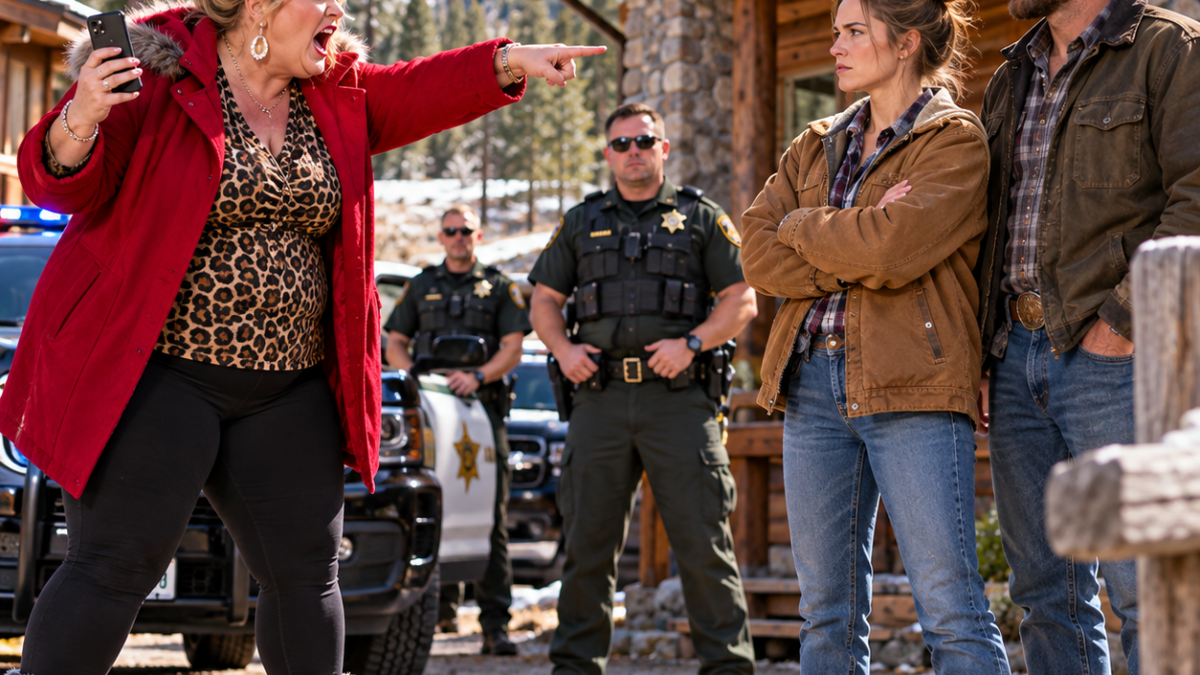
Three sheriff’s cruisers came screaming up my dirt road at seven in the morning because an HOA president claimed I was trespassing inside the cabin my great-grandfather built with his own hands. She stood behind the deputies in designer heels, pointing at me like I was some dangerous squatter while I drank coffee from my grandfather’s old rocking chair. But the moment the sheriff recognized the yellowed document I pulled from my flannel pocket, the expression on her face changed in a way I will never forget.
My name is Rex Caldwell. I’m fifty-four years old, a third-generation logger, and I spent almost twenty years working oil rigs in Alaska before finally coming home to the mountains of Pineville County, Montana.
Two years earlier, my father had died and left me the family cabin.
Calling it a cabin barely described what that place meant to us. My great-grandfather Josiah built the original log structure in 1890. My grandfather added the porch. My father replaced the roof. I rewired the place in my twenties before Alaska took me north.
Forty acres of timber surrounded it, with a creek running cold and clear beneath the pines.
As a boy, I learned to fish there.
As a teenager, I learned to split oak behind the woodshed.
And when my father’s health failed, that porch became the place where we talked about everything we had been too stubborn to say earlier.
After he died, I came home for good.
I thought I was coming back for peace.
Instead, I came back to Alpine Vista Estates.
While I had been away, developers transformed part of the valley below our old property into forty-something luxury mountain homes, each one polished enough to appear on a real-estate magazine cover.
The person running the place was Delilah Thornfield.
Former corporate lawyer.
White Tesla.
Perfect hair.
Expensive clothes.
And, according to nearly everyone I met, an exhausting obsession with something she called community standards.
I first met her while splitting firewood.
Her heels clicked across my porch before she even introduced herself.
“Mr. Caldwell?”
I set down my axe.
“That’s me.”
“I’m Dr. Delilah Thornfield, president of the Alpine Vista Homeowners Association.”
She said doctor like it belonged on a courthouse seal.
Then she handed me a certified notice demanding nearly twenty-five thousand dollars in improvements.
New siding.
Approved exterior colors.
Professional landscaping.
Fence modifications.
Storage restrictions.
Thirty days to comply.
After that, daily fines.
I read the first page.
Then looked up.
“Ma’am, I’m not in your HOA.”
Her smile stayed perfectly still.
“Sweetie, your cabin sits inside our community boundaries.”
“My cabin was standing here before your grandparents were born.”
“That doesn’t exempt you from modern community standards.”
I went inside and returned with my grandfather’s survey.
Yellowed paper.
Old stamps.
Recorded legal description.
Delilah barely looked at it.
“That old paperwork is irrelevant in today’s legal environment.”
I remember the exact way she said it.
Like history disappeared whenever it became inconvenient.
Three days later, county inspectors arrived after anonymous complaints about structural hazards.
My cabin passed.
Then she blocked my driveway with her Tesla because a survey commissioned by the HOA supposedly moved the boundary around my access road.
Then came noise complaints.
Firewood complaints.
Parking complaints.
Even complaints about General Patton, my hundred-pound bloodhound, apparently violating landscaping standards by existing too close to expensive lawns.
I documented everything.
And then Delilah made the mistake that changed the fight.
She called 911.
That morning, she told dispatch an aggressive trespasser had illegally occupied HOA-controlled property and refused to leave.
The trespasser was me.
The property was my home.
Sheriff Martinez stepped out of the lead cruiser already looking uncomfortable.
“Rex.”
“Morning, Sheriff.”
Delilah rushed forward.
“Officer, this man has refused repeated lawful orders to vacate association property.”
Martinez looked from her to me.
Then to the cabin.
“Rex, you got your deed handy?”
I reached into my jacket.
Delilah smiled like she had finally cornered me.
But I didn’t pull out the deed she expected.
I unfolded an older document.
Much older.
The paper was yellow enough to look fragile.
Martinez read the heading.
Then read it again.
His eyes widened.
Delilah stepped closer.
“What is that?”
The sheriff slowly raised his head.
And before he answered her, I saw something in his face that told me this fight had just become much bigger than my cabin.
PART 2
Sheriff Martinez looked at the document for a long time.
Then he looked at me.
“Rex, where did you get this?”
“My grandfather’s lockbox.”
Delilah stepped closer.
“What document?”
Martinez didn’t answer immediately.
The morning was cold enough that steam rose from my coffee mug. Pine needles crunched beneath the deputies’ boots. General Patton sat beside the rocking chair with the deep, disappointed expression of a dog wondering why humans needed three patrol cars to discuss property records.
Delilah pointed at the cabin.
“Sheriff, the issue is simple. He is occupying land under Alpine Vista jurisdiction and refuses to comply with association restrictions.”
Martinez finally looked at her.
“Mrs. Thornfield, this is an original territorial land record connected to the Caldwell family.”
Her expression barely moved.
“So?”
“So Mr. Caldwell’s ownership history predates Alpine Vista.”
“I already know his structure is old.”
“It’s not just the structure.”
That made her pause.
I stood.
“Sheriff, I think we should slow this down.”
One of the deputies glanced toward Delilah’s Tesla.
Another looked at the handwritten legal description.
Delilah’s voice sharpened.
“There is nothing complicated here. Our survey clearly establishes HOA boundaries.”
I looked at her.
“Your survey says a lot of things.”
“My survey was prepared by licensed professionals.”
“So were mine.”
She crossed her arms.
“I have spent twenty-three years practicing corporate law, Mr. Caldwell.”
“Then you should know old deeds don’t disappear because somebody builds expensive houses nearby.”
Her mouth tightened.
Martinez handed the document back.
“I’m not removing Rex from his cabin.”
Delilah stared at him.
“You’re refusing to enforce the law?”
“No, ma’am. I’m refusing to treat a disputed title issue like criminal trespass when the man standing in front of me has documents showing longstanding ownership.”
“This is outrageous.”
“Take it to civil court.”
“I already have.”
“Then let the judge handle it.”
Her face changed.
Not defeated.
Angrier.
She turned toward me.
“You think that piece of antique paper protects you?”
“I think the truth protects me better than your clipboard.”
Sheriff Martinez coughed to hide what might have been a laugh.
Delilah’s eyes narrowed.
“This isn’t over.”
“I figured.”
She marched to her Tesla.
The door slammed.
Her tires threw gravel when she left.
Martinez watched her disappear.
Then he looked at me.
“Rex.”
“Yeah?”
“You need a lawyer.”
“Already looking.”
“No. I mean a good lawyer.”
That was the second warning I took seriously.
The first had come from my grandfather twenty-five years earlier.
Know your boundaries before somebody else redraws them.
My grandfather, Samuel Caldwell, believed property lines mattered almost as much as promises.
When I was twelve, he walked me along the western ridge carrying an old compass and a canvas survey bag.
He stopped beside an iron marker buried in the ground.
“See that?”
I barely could.
“Piece of metal.”
He laughed.
“That piece of metal tells the world where one man’s responsibility stops and another man’s begins.”
At twelve, I thought that was boring.
At fifty-four, I understood.
Delilah had spent months trying to blur exactly that distinction.
Her standards.
Her surveys.
Her supposed common areas.
Her fines.
Her authority.
Everything depended on convincing people that the line belonged wherever she said it belonged.
That morning, after the cruisers left, I opened every box in the cabin containing family records.
I found tax receipts from the 1930s.
Timber agreements.
Water permits.
Survey plats.
Mining notices.
Handwritten ledgers.
Land sales.
Old correspondence between my grandfather and county offices.
Some pages smelled like mildew.
Others still carried faint traces of cedar from the trunk where Dad had stored them.
I worked until midnight.
General Patton slept beneath the table.
By morning, I understood one thing.
The forty acres surrounding my cabin were only the visible piece of the Caldwell story.
There was more.
Much more.
I needed someone who knew how to read it.
That person turned out to be Ephraim Jacobs.
Ephraim was seventy-eight years old and had surveyed half of western Montana before GPS units became something people carried in their pockets.
His office was above a feed store.
The room smelled like pipe tobacco, old paper, and leather.
Maps covered every wall.
He greeted me with the same sentence he’d used since I was seventeen.
“Rexboy, you still too stubborn to cut your hair?”
“Good to see you too, Ephraim.”
He laughed.
Then I put Delilah’s survey on his desk.
His smile disappeared.
“Where did you get this?”
“HOA commissioned it.”
He adjusted his glasses.
“Who signed it?”
I pointed.
He knew the company.
Not impressed.
Ephraim spent thirty minutes comparing their legal description to mine.
Then he stood.
“Come with me.”
He unlocked a metal cabinet and removed a tube.
Inside was a hand-drawn survey from the 1970s.
“My dad surveyed your grandfather’s land before I took over the business.”
He unrolled it.
The old Caldwell boundary was much larger than the forty acres surrounding my cabin.
Nearly four hundred acres.
A huge portion overlapped what was now Alpine Vista.
I stared.
“This can’t be right.”
“It’s right historically.”
“What happened to the rest?”
“Sold.”
“So Delilah’s right?”
“Not exactly.”
He traced a clause.
“Your grandfather sold surface parcels.”
“So?”
“Read.”
I leaned closer.
Mineral estate reserved.
Water rights reserved.
Subsurface rights retained by grantor and successors.
I looked at Ephraim.
“You’re telling me my family sold the ground people could build houses on but kept what was underneath?”
“In several transfers, yes.”
I felt my heartbeat increase.
“All of Alpine Vista?”
“Some of it.”
“How much?”
He smiled.
“Enough to make your HOA president wish she’d done better title research.”
I took the documents to the courthouse.
Margaret Peterson worked in the clerk’s office.
She had been recording deeds since Jimmy Carter was president and possessed the terrifying ability to remember property families better than most people remember cousins.
“Caldwell?”
She looked over her glasses.
“Which generation are you?”
“Rex.”
“Samuel’s grandson?”
“Yes.”
“Josiah’s great-grandson?”
“Yes.”
She smiled.
“Haven’t had one of you digging through the old books in years.”
I spent four days there.
Margaret pulled volumes nobody had requested in decades.
We traced parcel after parcel.
The history was messy.
My family had once controlled far more land than I knew.
Some parcels had been sold outright.
Some contained reservations.
Some rights had expired.
Some had been transferred.
Others remained attached to Caldwell heirs.
The picture was more complicated than saying I owned everybody’s house.
I didn’t.
Those families owned their homes and surface parcels.
But beneath hundreds of acres, my family still held significant water and mineral interests that had never been conveyed away.
Delilah had spent months arguing about surface control.
She hadn’t looked under it.
Then Margaret found the ledger.
“Rex.”
I looked up.
She was standing beside a locked cabinet.
“You need to see this.”
She carried out a leather-bound volume.
The spine was cracked.
Pages yellowed.
The record dated to Montana’s territorial era and the early statehood years.
Margaret opened to a bookmarked section.
The Caldwell name appeared repeatedly.
Not forty acres.
Not four hundred.
Thousands.
Original territorial assignments, government-service grants, acquisitions, and family consolidations had once placed roughly twelve thousand acres of Pineville valley property under Caldwell ownership or control.
Not literally every modern parcel in fee simple today.
That would have been nonsense.
But the old Caldwell holdings had been the skeleton from which much of modern Pineville had been carved.
Margaret traced transfer after transfer.
“Your family sold most surface holdings over generations.”
“I can see that.”
“But look at the reservations.”
Water.
Timber in some tracts.
Minerals.
Underground access in others.
Spring rights.
Creek usage.
I sat back.
“How much is still valid?”
“That’s a lawyer question.”
“Best guess?”
She smiled.
“Enough that I wouldn’t pick a fight with you before reading every deed.”
I thought about Delilah.
Too late.
The discovery scared me more than it thrilled me.
I drove home with certified copies locked behind my truck seat.
The mountains looked different.
Every ridge had a story.
Every creek might carry an old clause.
Every luxury house represented somebody’s mortgage, retirement savings, or family future.
For the first ten minutes, I imagined revenge.
I’m not proud of it.
I imagined billing Alpine Vista for water rights.
Demanding access fees.
Filing claims against the development.
Dragging Delilah into the same kind of legal uncertainty she had forced on me.
Maybe then she would understand.
Then I passed the Avery house.
Sarah Avery, a nurse, was watering tomatoes beside her porch.
Delilah had been fining her for what she called an unapproved vegetable garden.
Sarah waved.
I waved back.
Her teenage daughter was doing homework at the picnic table.
Those people weren’t my enemies.
A mile later I passed the Henderson place.
Retired couple.
Their savings were tied up in the house.
Delilah had bullied them too.
I reached my cabin with the documents capable of causing enormous trouble and understood something immediately.
Power does not tell you what to do.
It tells you who you are.
I sat on the porch.
General Patton rested his head on my knee.
Grandpa’s voice came back to me.
The difference between a good man and a great man is what he does when nobody’s watching and everybody’s counting on him.
I looked toward Alpine Vista.
I could hurt Delilah.
But if my revenge destroyed innocent families, then Delilah would have succeeded in turning me into her.
I needed another way.
Before I could find it, she sued me.
Formal complaint.
Boundary dispute.
Back assessments.
Legal fees.
HOA fines.
Three years of alleged obligations.
They wanted more than fifty thousand dollars immediately and reserved the right to seek more.
I read the complaint on my porch.
Delilah arrived personally ten minutes later.
No coincidence.
She stood beside her Tesla.
“Received your papers?”
“Sure did.”
“You could still avoid all this.”
“How?”
“Sell.”
There it was.
“What?”
“Your cabin.”
She smiled.
“A buyer has expressed interest.”
“Who?”
“That isn’t important.”
“It’s important to me.”
“The structure is incompatible with Alpine Vista. Your land could be integrated into the development far more efficiently.”
I looked toward the cabin.
My great-grandfather’s axe marks were still visible on the porch beams.
“How much?”
Her smile brightened.
Now she thought she had me.
“Seven hundred thousand.”
I laughed.
She stopped smiling.
“What?”
“You called my cabin dangerous, ugly, noncompliant, and worthless to property values.”
“It has redevelopment potential.”
“Meaning you want the land.”
She stepped closer.
“You’re sitting on an opportunity, Rex.”
“So are you.”
Her eyes narrowed.
“What does that mean?”
“Nothing yet.”
I walked inside.
Delilah remained in my driveway for another minute.
Then left.
The next morning, I hired Sarah Blackwood.
Sarah Blackwood was an environmental and property lawyer out of Missoula.
She had represented ranchers, conservation groups, housing cooperatives, and small towns that found themselves trapped between developers and economics.
She drove to Pineville in an old Subaru with three coffee cups in the passenger seat and hiking boots in the back.
I liked her immediately.
We spent six hours going through the Caldwell documents.
She did not celebrate.
That also made me trust her.
“Rex, some of these rights are extremely valuable.”
“I figured.”
“Some need title confirmation.”
“Fine.”
“Some may be limited by later agreements.”
“Fine.”
“Some could create enormous leverage.”
“Also figured.”
She studied me.
“What do you want?”
“Delilah off my back.”
“That’s the small answer.”
I looked toward Alpine Vista.
“I don’t want those families hurt.”
“That’s more useful.”
“What can we do?”
Sarah thought for a moment.
“Have you ever heard of a community land trust?”
“No.”
She smiled.
“Then we need more coffee.”
The idea sounded strange at first.
A trust could hold certain land or rights for long-term community benefit while individual homeowners retained defined ownership interests in their houses and improvements.
Structures varied.
Local law mattered.
Existing titles had to be respected.
Nobody could simply wave an old Caldwell deed and convert private houses into trust property.
Sarah was very clear about that.
But the significant retained rights, remaining Caldwell acreage, conservation land, and future development rights could become the foundation for something new.
Something voluntary.
Democratic.
Protected from speculation.
We invited Dr. Ruby Sterling to inspect the wilderness portions of the remaining Caldwell holdings.
Ruby was a conservation biologist.
She walked three miles the first afternoon and returned looking like she’d discovered buried treasure.
“Rex, do you know what’s back there?”
“Trees?”
She stared at me.
“Old-growth habitat.”
“Okay.”
“Wildlife corridor.”
“Okay.”
“Sensitive species.”
“Still waiting for the part where I understand.”
Sarah laughed.
Ruby pointed toward the ridge.
“This valley matters ecologically.”
That opened another door.
Conservation easements.
Federal and state grants.
Protected habitat.
Low-impact tourism.
Educational programs.
Trails.
Long-term water protection.
Suddenly my fight with Delilah was no longer about preserving one cabin.
It was about deciding what the whole valley could become.
Harold Finch joined us next.
Harold ran the local bank and had financed half the houses in Pineville.
He was sixty-seven, bald, patient, and allergic to nonsense.
We showed him the concept.
He removed his glasses.
“So let me understand.”
Sarah nodded.
“Please.”
“Rex contributes defined Caldwell land interests and certain rights into the trust.”
“Yes.”
“Residents participate voluntarily.”
“Yes.”
“Existing homeowners keep lawful ownership of their homes subject to negotiated trust structures only if they choose to join.”
“Yes.”
“No forced seizure.”
“Absolutely not.”
“Governance?”
“One resident, one vote for major trust matters.”
Harold looked at me.
“No HOA president acting like Napoleon?”
“That’s the dream.”
He smiled.
“Now you’ve got my attention.”
Harold ran numbers.
Conservation funding.
Infrastructure.
Housing affordability.
Trail tourism.
Environmental education.
Local jobs.
Revenue from carefully managed natural-resource agreements.
The plan grew.
Not because it would make me rich.
Because it could prevent the valley from becoming a never-ending cycle of developers buying land, raising costs, and turning neighbors against each other.
Sarah called it the Pineville County Conservation Trust.
I called it a way to stop Delilah without destroying everybody else.
Delilah noticed the meetings.
Sarah’s car.
Ruby’s state vehicle.
Harold’s truck.
She began telling residents I was preparing to bankrupt Alpine Vista.
Then came the community safety patrol.
People parked near my road taking photographs.
Volunteers recorded license plates of visitors.
One man even followed Ruby’s truck through town.
Sheriff Martinez shut that down quickly.
Then Delilah filed for a restraining order.
She claimed I had threatened to “make her pay.”
I had said her harassment would eventually backfire.
Apparently that became a death threat after enough rewriting.
A temporary order restricted my access near some HOA facilities until the hearing.
It effectively made driving through parts of the development absurdly difficult.
Martinez served the papers himself.
He looked ashamed.
“Rex, I don’t write the orders.”
“I know.”
“You fighting it?”
“Sarah already is.”
He nodded.
“Good.”
Then he lowered his voice.
“She’s losing people.”
“What?”
“HOA members.”
I looked toward Alpine Vista.
“Why?”
“Because sane folks eventually notice when every week brings another emergency.”
He handed me the papers.
“Hang in there.”
Delilah’s next complaint was environmental.
She accused my cabin of contaminating groundwater.
That one worried me.
Not because it was true.
Because water mattered to the whole valley.
An inspector arrived.
Took samples.
Tested soil.
Checked the creek.
Ruby attended.
Delilah watched from across the road.
Three days later, the results came back.
Clean.
Better than clean.
The undeveloped Caldwell land acted as a natural filtration zone for groundwater feeding portions of the valley.
Ruby nearly danced.
“This helps the conservation application.”
I laughed.
“Delilah accidentally strengthened our case?”
“She keeps doing that.”
That became the pattern.
Every attack forced us to document another advantage.
Noise complaint?
Confirmed forestry zoning.
Structural complaint?
Certified cabin integrity.
Water complaint?
Environmental quality evidence.
Property dispute?
Historical title research.
Delilah was digging for weaknesses and uncovering foundations.
Her support began cracking.
Sarah Avery visited one evening carrying vegetables.
“Half the board wants her gone.”
I looked at the basket.
“Is that zucchini?”
“Don’t change the subject.”
“I’m trying to avoid zucchini.”
She shoved it at me.
“Take it.”
I sighed.
“What’s happening?”
“Legal bills.”
“Meaning?”
“She’s spending association money on investigators and outside counsel.”
“How much?”
“People are asking.”
“Good.”
“She hired a private investigator to follow you.”
“I met him.”
Sarah’s eyes widened.
“You did?”
“Offered him sweet tea.”
She laughed.
Then became serious.
“People are worried about where this ends.”
“So am I.”
“Some residents believed her when she said your cabin lowered values.”
“And now?”
“Now they think fighting you is lowering values.”
That was the first major shift.
The problem was no longer my old cabin.
The problem was the civil war Delilah had created.
Then she crossed the line even her supporters couldn’t ignore.
Jake Morrison came tearing up my driveway on an October morning.
He jumped out before the truck fully stopped.
“Rex.”
“What happened?”
“She tried bribing Commissioner Hicks.”
I stared at him.
“What?”
“Fifty thousand dollar campaign contribution.”
“For what?”
“To condemn your property.”
I set down the axe.
“How do you know?”
“Hicks called Martinez.”
Jake lowered his voice.
“And apparently federal investigators are already interested.”
That afternoon Sarah confirmed it.
Commissioner Hicks had reported the approach.
Law enforcement was reviewing the circumstances.
Attempted bribery of a public official was a very different animal from HOA harassment.
Delilah had spent so long convincing herself she represented the community that apparently she had stopped recognizing boundaries completely.
Then she hired Mountain Property Solutions.
That may have been the decision that finished her political support.
Mountain Property Solutions operated from Denver.
Their representatives arrived in expensive SUVs wearing suits better suited to financial conferences than mountain roads.
Their leader, Marcus Brennan, spoke in corporate language.
“Property-value enhancement.”
“Strategic enforcement.”
“Asset optimization.”
What residents heard was simpler.
Higher fees.
Stricter rules.
More lawsuits.
Sarah Avery’s vegetable garden became a violation.
Jake’s teenager’s old pickup became a vehicle-standard issue.
A retired veteran’s flagpole required architectural review.
My cabin accumulated seventy-three thousand dollars in claimed assessments, retroactive dues, penalties, and legal fees.
When I showed Sarah Blackwood the letter, she laughed.
“Why are you laughing?”
“Because they’re claiming three years of HOA dues against property that predates the subdivision and was never validly annexed.”
“So?”
“So their aggression is becoming evidence.”
I put the letter down.
“Everybody keeps saying that.”
“Because it’s true.”
“What if evidence doesn’t stop them?”
Sarah looked at me.
“Then courts do.”
What none of us knew initially was that Mountain Property Solutions had legal problems elsewhere.
Federal investigators examining Delilah’s bribery attempt encountered the company.
Other jurisdictions had complaints involving aggressive HOA takeovers and disputed enforcement practices.
Suddenly Delilah wasn’t just connected to a local property dispute.
She had invited a company under broader scrutiny into Pineville.
Her timing was almost artistic.
Federal agents began requesting records.
Board members panicked.
Two resigned.
Then another.
Delilah kept going.
She scheduled an emergency public meeting.
Her stated purpose:
Protect Alpine Vista from Rex Caldwell.
She invited television stations.
County officials.
Residents.
Outside property managers.
The whole valley.
She intended to destroy me publicly.
Sarah Blackwood smiled when she heard.
“What?”
“She just gave us the room.”
“For what?”
“The trust proposal.”
I looked at her.
“You want to announce it at her meeting?”
“She invited the county commissioners.”
I smiled.
“She really did.”
“Ruby’s conservation findings are ready.”
“Okay.”
“Harold has financing projections.”
“Okay.”
“And your title documentation is finalized enough to explain the retained rights without overstating them.”
I leaned back.
“So while she tries to convince everybody I’m destroying the community…”
“We offer them a different community.”
That was better than revenge.
And Delilah had scheduled the stage herself.
The night before the meeting, I barely slept.
I sat on the porch.
General Patton lay beside me.
The old dog was getting gray around the muzzle.
I spread the documents across the table.
Caldwell records.
Trust proposal.
Environmental report.
Financial projections.
Maps.
For months, I’d imagined the moment Delilah discovered how much leverage my family still held.
In my angriest fantasies, I would threaten every water right.
Every mineral clause.
Every underground easement.
I would make her million-dollar house feel as uncertain as she’d made my cabin.
Now I knew I wouldn’t.
I had watched good people move into Alpine Vista.
Teachers.
Nurses.
Retirees.
Families.
Most wanted the same thing I did.
A home.
Punishing them for Delilah’s behavior would be cowardly.
So the presentation contained no threats to seize houses.
No declarations that I “owned the county.”
Only the truth.
My family had historically owned much of the valley and retained significant rights beneath land later developed by others.
Those rights created leverage.
I intended to use that leverage to protect the valley rather than exploit it.
Grandpa would’ve understood.
I think.
The community center was packed.
Cars lined the road.
Cameras filled the back wall.
Sheriff Martinez stood near the exit.
Two federal agents sat beside him.
I didn’t know whether Delilah noticed them.
If she did, she ignored them.
Commissioner Hicks sat at the front.
He looked exhausted.
Mountain Property Solutions occupied one side of the room.
Marcus Brennan carried a leather folder and the confidence of a man who believed everybody else existed to sign something.
I sat with Sarah Blackwood, Ruby Sterling, Harold Finch, Jake Morrison, Sarah Avery, and General Patton.
Technically Patton wasn’t invited.
Nobody volunteered to remove him.
Delilah entered five minutes late.
White blazer.
Dark trousers.
Perfect hair.
Her strongest armor.
She walked to the podium.
“Ladies and gentlemen.”
The room quieted.
“We are here tonight because our community faces an unprecedented threat.”
She clicked the first slide.
My cabin.
A red circle around it.
“Mr. Rex Caldwell has repeatedly refused reasonable community regulations.”
Next slide.
My woodpile.
Next.
My pickup.
Next.
General Patton.
I whispered, “You made the presentation, buddy.”
His tail thumped.
Delilah continued.
“He has filed disruptive legal actions.”
I hadn’t.
She had sued me.
“He has threatened the stability of property values.”
No evidence.
“He has invited outside interests into our community.”
Sarah whispered, “That would be me.”
I nodded.
“And most dangerously, he has attempted to undermine lawful HOA governance.”
Polite applause.
Not much.
Months earlier, it would have been louder.
Delilah noticed.
Her voice grew stronger.
“This cabin represents refusal.”
Another slide.
“It represents disorder.”
Another.
“It represents the idea that one individual can put personal preference above collective prosperity.”
I almost admired the speech.
If you ignored the facts, it was excellent.
Then she reached her conclusion.
“I am formally requesting that county authorities condemn the Caldwell property as a nuisance and that the association proceed with all available legal remedies to acquire and redevelop the parcel.”
There.
Acquire.
Not regulate.
Acquire.
The room murmured.
Commissioner Hicks leaned toward his microphone.
“Thank you, Mrs. Thornfield.”
He looked at me.
“Mr. Caldwell?”
I stood.
General Patton tried standing too.
“Stay.”
He sighed dramatically.
I carried one manila folder.
Work boots echoed across the floor.
Delilah smiled.
She expected an angry mountain man.
I had stopped being angry enough to be useful.
“Commissioner Hicks. Neighbors.”
I opened the folder.
“Mrs. Thornfield has talked a lot about property rights.”
Delilah folded her arms.
“So I’d like to talk about property rights too.”
I held up the certified territorial record.
“This document forms part of the historical Caldwell land record.”
Cameras zoomed.
“My family’s original holdings were not limited to the forty acres surrounding my cabin.”
Murmurs.
“Over generations, the Caldwells held or controlled thousands of acres across this valley.”
Delilah scoffed.
“Historical trivia.”
I looked at her.
“It would be trivia if every right had been sold.”
She stopped.
I continued.
“Many surface parcels were sold.”
I pointed toward the audience.
“People here lawfully own their homes and land. I am not claiming otherwise.”
That mattered.
You could feel the tension ease.
“But a series of Caldwell deeds retained water, mineral, and other subsurface rights beneath significant portions of the valley.”
Silence.
I displayed copies.
Recorded clauses.
Parcel references.
Title analysis.
Delilah leaned toward Marcus Brennan.
He was reading rapidly.
His face changed.
I continued.
“Alpine Vista researched surface boundaries.”
I looked directly at Delilah.
“You didn’t research what was reserved underneath them.”
Her face went pale.
“That is impossible.”
Sarah Blackwood stood.
“It’s recorded.”
Delilah pointed toward me.
“He’s threatening our water supply!”
“No.”
I raised my voice.
“I’m doing the opposite.”
The room quieted again.
“I could spend the next decade fighting over these rights.”
I looked around.
“And everybody here would lose money.”
I saw Henderson.
Sarah Avery.
Families I barely knew.
“I could demand every legal advantage available to me.”
Delilah stared.
“But that would punish innocent people for one person’s obsession.”
I let the words settle.
“So I’m not doing that.”
That confused her more than any threat could have.
I nodded toward Sarah.
She walked to the front.
Then Ruby.
Then Harold.
A new slide appeared.
PINEVILLE COUNTY CONSERVATION TRUST.
Sarah explained the concept.
Voluntary participation.
Democratic governance.
Clear title structures.
Conservation protections.
Resident representation.
No president with unilateral authority.
No hidden legal fees.
No retroactive fines invented after the fact.
Every major decision voted through transparent procedures.
Ruby presented the environmental map.
Eight thousand acres of broader surrounding land identified for potential conservation treatment through participating holdings, public partnerships, and protected corridors.
Habitat.
Water protection.
Old-growth forest.
Trail systems.
Harold presented the financial projections.
Sustainable tourism.
Educational facilities.
Local jobs.
Community infrastructure.
Reduced speculative pressure.
People leaned forward.
Not because the plan was perfect.
It wasn’t.
It required negotiations.
Approvals.
Voluntary participation.
Legal restructuring.
Funding.
Years of work.
But it offered something Delilah never had.
A future people could choose.
A man in the audience raised his hand.
“What happens to our houses?”
Sarah answered.
“You keep whatever property rights you lawfully own. Nobody is confiscating your home.”
Another resident.
“Are we forced into the trust?”
“No.”
Another.
“What happens to the HOA?”
“That depends on its members and governing documents.”
Sarah paused.
“But the trust itself will not depend on coercive membership.”
People started talking.
Delilah rushed forward.
“This is socialism!”
Someone laughed.
Another shouted, “It’s voting, Delilah!”
The room erupted.
Commissioner Hicks struck the gavel.
Delilah grabbed the microphone.
“This man is threatening every homeowner in this valley!”
I shook my head.
“I just said the opposite.”
“You claimed you own our water!”
“I said my family retained recorded rights.”
“You said you could destroy Alpine Vista!”
“No, you heard what you were afraid I might do.”
Her face twisted.
“Because that’s what anyone would do!”
And there it was.
The difference between us.
She genuinely believed power existed to be used against whoever stood in your way.
I looked at her.
“No, Delilah.”
The room quieted.
“That’s what you would do.”
For the first time all night, she had no answer.
Then one of the federal agents stood.
The woman beside Sheriff Martinez stepped into the aisle.
“Mrs. Thornfield?”
Delilah turned.
“Yes?”
The agent displayed identification.
Delilah’s face changed.
Not confusion.
Recognition.
Maybe Commissioner Hicks had warned her.
Maybe her lawyer had.
Maybe she had spent every morning wondering whether this moment was coming.
The agent spoke quietly.
“Would you step away from the podium, please?”
Marcus Brennan began packing his folder.
Very quickly.
Delilah stared at Commissioner Hicks.
“What is this?”
Hicks didn’t answer.
The agent did.
“We have a federal warrant related to an investigation into an attempted unlawful payment offered to influence a public official.”
The room went silent.
Delilah looked at the agent.
Then Hicks.
Then me.
“This is his doing.”
I didn’t move.
The agent repeated the instruction.
“Please step away from the podium.”
Delilah’s voice rose.
“I was making a lawful campaign contribution!”
Hicks closed his eyes.
The agent said nothing.
Delilah pointed at me.
“He set me up!”
I almost laughed.
I hadn’t even known about the offer until after Hicks reported it.
Security cameras rolled.
Phones came out.
Delilah stepped backward.
“This entire meeting is a conspiracy!”
No one responded.
The agent approached.
Sheriff Martinez remained near the wall.
His expression wasn’t triumphant.
Just sad.
Delilah looked toward her former supporters.
“Say something!”
Nobody did.
One board member stared at the floor.
Another turned away.
Marcus Brennan was halfway to the exit.
A deputy stopped him for questioning.
The federal agent guided Delilah away from the podium.
Metal clicked.
Handcuffs.
The woman who had called 911 trying to remove me from my cabin was led past the same sheriff she’d expected to use as her weapon.
She looked at me.
Pure hatred.
I didn’t smile.
That surprised me.
For months, I had imagined enjoying that moment.
Instead, all I felt was tired.
She had destroyed herself long before the cuffs appeared.
The cuffs simply made it visible.
Thirty days later, we held what Jake Morrison named the Great Decision Barbecue.
Sarah Blackwood hated the name.
Everyone else loved it.
Tables filled the meadow beside my cabin.
Hickory smoke rolled between the pines.
Children ran around General Patton until he surrendered beneath a picnic table.
Former Delilah supporters came.
Old mountain families came.
Alpine Vista residents came.
Nobody was forced to vote.
The proposal had gone through weeks of revision.
Lawyers reviewed it.
Property owners asked questions.
Some rights would go into trust.
Some wouldn’t.
Some homeowners chose participation.
Others kept existing arrangements.
Conservation partners negotiated separate agreements.
It wasn’t magic.
Real solutions rarely are.
But people had something Delilah never gave them.
A choice.
The final tally among eligible participants approving the transition framework was eighty-seven percent.
When Sarah announced it, applause rolled across the field.
I looked toward the cabin.
For a second, I imagined Grandpa sitting in his rocking chair.
Probably complaining that we were cooking the steaks too long.
They elected me first president of the trust council.
I tried declining.
People ignored me.
“I don’t want to run anything.”
Jake laughed.
“That’s why we trust you.”
Bad logic.
But I accepted one term.
The first rule I pushed through limited executive authority.
Major decisions required board review and resident voting.
No permanent president.
No unilateral fines.
No hidden contracts.
No surprise legal bills.
If the Caldwell story taught me anything, it was that anybody trusted with power should design the system as though the next person holding it might be terrible.
Because eventually, somebody will be.
Conservation funding came later.
Not overnight.
Applications took months.
Environmental reviews.
Surveys.
Public meetings.
Ruby loved every minute.
I did not.
Eventually, thousands of acres entered various conservation protections through participating owners, trust holdings, and cooperative agreements.
Trails opened.
A small environmental education center followed.
University researchers came to study wildlife corridors.
Local teenagers got summer jobs maintaining trails.
Harold Finch helped finance small businesses serving visitors.
Guides.
Cabins.
Equipment rental.
Restaurants.
A sustainable tourism economy grew slowly.
Not forty-seven jobs immediately, as Harold’s optimistic first spreadsheet promised.
But enough.
Then more.
A former mill worker became a trail supervisor.
Sarah Avery’s daughter worked summers at the ecology center.
Jake Morrison sold enough outdoor equipment that he expanded the hardware store.
People started realizing preservation and prosperity didn’t have to be enemies.
Alpine Vista changed too.
Delilah lost the presidency immediately after her arrest.
The remaining board suspended the Mountain Property Solutions contract.
Residents demanded a forensic review of legal spending.
Marcus Brennan and his company disappeared from Pineville almost overnight as broader investigations continued elsewhere.
The next HOA election drew nearly every household.
Sarah Avery ran.
I asked why.
She shrugged.
“Somebody has to make sure nobody bans tomatoes again.”
She won.
Her first proposal simplified the architectural standards.
Her second created transparent spending reports.
Her third eliminated several petty restrictions Delilah loved.
General Patton’s bathroom habits were never officially discussed.
I considered that victory.
Delilah’s criminal case ended less dramatically than television would have preferred.
No twenty-year sentence.
No courtroom screaming.
She reached a resolution involving the attempted bribery investigation and related misconduct.
Her professional standing suffered severely.
Her law license became part of separate disciplinary proceedings.
The court imposed probation, extensive community-service obligations, and financial consequences.
Some people complained that she should have gone to prison.
Maybe.
That wasn’t my decision.
I cared more that she could no longer use the HOA as a weapon.
Her mansion eventually went on the market.
Sold for less than she’d hoped.
The buyers were a young teacher and her husband.
The first thing they did was plant raised vegetable beds in the front yard.
Sarah Avery sent me a picture.
I laughed for five straight minutes.
Six months after the public meeting, I received a letter from Texas.
A rancher named Owen McCall had property outside a fast-growing subdivision.
The HOA was trying to impose landscaping restrictions on land that predated the development.
He’d read a newspaper story about Pineville.
He asked one question.
How did you beat them?
I sat on the porch.
General Patton slept beside me.
I thought about the answer.
The easy version was:
Old land rights.
Federal investigation.
Community trust.
Lawyers.
But none of those were the beginning.
I wrote back.
Start with the deed.
Then check every claim.
Document everything.
Talk to your neighbors.
Do not assume the loudest person has the strongest title.
And don’t seek revenge so aggressively that you hurt the people you’re trying to protect.
I read the letter to Patton.
He snored.
Tough audience.
My cabin became something of an accidental meeting place.
Property-rights advocates stopped by.
Conservation people.
Reporters.
Law students.
I disliked most interviews.
Sarah said that made me believable.
One university professor asked whether I understood something called the Caldwell Doctrine.
“No.”
“Heard of it?”
“No.”
“He says legal scholars use your case as an example of inherited property leverage being converted into community benefit.”
“That sounds unnecessarily complicated.”
“He agrees.”
I shook my head.
I didn’t want a doctrine.
Grandpa wouldn’t have wanted one either.
He would have wanted people to quit moving his fence markers.
The strangest change was inside me.
For months, I woke angry.
Every Tesla in the distance raised my blood pressure.
Every certified envelope made my stomach tighten.
Every county truck looked like another attack.
After Delilah was gone, those reactions stayed.
Fear has muscle memory.
It took time.
One morning I found an envelope in the mailbox.
Certified.
My pulse jumped.
Inside was approval for a conservation grant.
I laughed so hard I had to sit on the porch steps.
That’s healing sometimes.
The same thing that once frightened you arrives carrying good news.
General Patton retired from active political duty.
Age did what Delilah never could.
He slowed down.
His face turned gray.
His hips stiffened.
He stopped making his daily trips near the old Tesla parking area.
Instead, he slept beside the porch.
Children visiting the conservation center always asked about him.
“Is that the famous dog?”
He would open one eye.
Sometimes allow a child to scratch his head.
Celebrity went straight to him.
One winter morning, I sat beside him wrapped in a blanket.
Snow covered the ridge.
“Getting old, partner.”
His tail tapped once.
“So am I.”
Another tap.
I looked across the valley.
Smoke rose from houses.
Cabins.
Alpine Vista.
Homes owned by people with complicated deeds and ordinary lives.
For years, Delilah had talked about community as though it meant conformity.
Same lawns.
Same colors.
Same approved appearance.
But the valley looked better now.
Different houses.
Gardens.
Old cabins.
New homes.
Working trucks.
Electric cars.
People who disagreed and still showed up for each other.
That was community.
Messier.
Realer.
Stronger.
Sarah Blackwood eventually opened a nonprofit practice focused partly on community land structures and rural ownership disputes.
Ruby expanded the research program.
Harold retired from banking but refused to retire from telling everybody how the trust should spend money.
We ignored half his advice.
He complained.
Then showed up anyway.
Sarah Avery served two terms on the HOA board and refused a third.
“Power is supposed to be temporary,” she told me.
I smiled.
“Best HOA president I ever met.”
“Low bar.”
Jake Morrison’s hardware store became unofficial headquarters for every rural property argument in the county.
He installed a coffee maker beside the register.
A sign above it read:
BRING YOUR DEED BEFORE YOUR ATTITUDE.
I asked whether it was about me.
He refused to answer.
Every October, Pineville held a Freedom Festival.
I hated the name at first.
Then children took over.
Bluegrass.
Local crafts.
Environmental workshops.
Fishing demonstrations.
Property-rights clinics.
Scholarship fundraising.
One year we raised enough to help twelve local students with college expenses.
That meant more to me than any legal victory.
Grandpa had left school young.
Dad finished high school but never had the money for college.
I went to work.
Nothing wrong with that.
But options matter.
That’s what land had given our family.
Options.
Now the land could give somebody else’s kids options too.
One festival evening, I noticed a woman standing alone near the old Caldwell display.
She was looking at the territorial map.
I walked over.
“You lost?”
She smiled.
“No.”
She pointed.
“My house is there.”
Alpine Vista.
“Nice area.”
“It is now.”
I laughed.
She looked at me.
“I supported Delilah at first.”
I didn’t know what to say.
She continued.
“I thought you were refusing to cooperate because you hated change.”
“Sometimes I do hate change.”
She smiled.
“Still.”
She looked toward the map.
“She told us you’d destroy our property values.”
“I remember.”
“When you revealed the rights, I thought you were going to.”
“So did Delilah.”
“Why didn’t you?”
I looked across the festival.
Children.
Families.
Music.
General Patton sleeping beneath a table despite strict instructions not to eat sausage.
“Because your house wasn’t the problem.”
Her eyes filled.
“Thank you.”
I shrugged.
“Take care of your neighbors.”
She nodded.
Then walked away.
That conversation stayed with me.
Because revenge would have been easier to explain.
Mercy is harder.
I don’t use that word often.
Mercy sounds soft.
It isn’t.
Revenge would have meant taking every advantage available.
Filing every claim.
Maximizing every dollar.
Making Delilah and anyone associated with Alpine Vista feel the same fear I felt.
Mercy meant separating guilty people from innocent ones.
It meant recognizing that being legally powerful didn’t automatically make every use of that power right.
It meant protecting the people who had once believed lies about me.
That was harder.
And it gave me something revenge never could.
Peace without shame.
Years after the fight ended, Sheriff Martinez stopped by.
He was nearing retirement.
We sat on the porch.
He looked at the rocking chair.
“Still got it?”
“Grandpa’s chair? Of course.”
He laughed.
“I mean the yellow document.”
“Copies everywhere.”
“Good.”
He took coffee.
For a while we watched the trees.
Then he said, “You know, that first morning scared the hell out of me.”
“Why?”
“Three cruisers. Delilah screaming about an armed trespasser.”
“I wasn’t armed.”
“She said you were.”
I looked at him.
That was news.
“She told dispatch you had threatened residents and might possess weapons.”
I stared toward the mountains.
“That woman really wanted me out.”
“Yes.”
Martinez sipped coffee.
“When I saw you sitting in the rocking chair with Patton, I knew something didn’t fit.”
“Glad you checked.”
“So am I.”
He looked embarrassed.
“I’ve thought about that morning a lot.”
“Why?”
“Police get called into property disputes all the time. Person who calls first frames the story.”
I nodded.
“Dangerous.”
“Can be.”
He looked toward me.
“You did the right thing staying calm.”
I laughed.
“I was not calm.”
“Looked calm.”
“That’s because my coffee mug was hiding my hand.”
Martinez laughed.
After he left, I thought about how close everything had come to going badly.
If I’d screamed.
If I’d grabbed a deputy.
If I’d threatened Delilah.
If Martinez had refused to inspect the deed.
If the old documents had been lost.
If Margaret hadn’t found the ledger.
If Sarah had encouraged revenge.
If the residents had stayed divided.
Big stories often look inevitable after they’re finished.
They aren’t.
They turn on tiny decisions.
A person chooses to make a copy.
A sheriff reads a document.
A neighbor speaks.
A commissioner reports a bribe.
A lawyer says, “There is another way.”
That is how mountains move.
Not all at once.
One decision at a time.
The original cabin still stands.
The logs are dark with age.
The porch leans slightly even after three repairs.
The fireplace smokes when the wind comes from the northwest.
I could replace the whole structure.
I have enough money.
I don’t.
I repaired what needed repairing.
Kept everything safe.
But I left the marks.
The axe cuts.
The old joints.
The worn step where four generations of Caldwells have entered the house.
Delilah saw those imperfections and called them blight.
I see fingerprints.
History shouldn’t always be polished until nobody can tell who touched it.
One afternoon, Sarah Blackwood brought a group of law students.
They wanted to see the territorial records.
I spread copies across the kitchen table.
One student asked, “Mr. Caldwell, when did you realize you owned the county?”
I laughed.
“I don’t.”
He looked confused.
“But the articles—”
“Headlines like simple things.”
I pointed toward the map.
“My family historically held much of this valley. We retained important rights under many parcels. That’s not the same as owning everybody’s home.”
“So the title is exaggerated?”
“Most titles are.”
Sarah laughed.
The student looked embarrassed.
I continued.
“The important part isn’t whether I could say I owned the county.”
“What is?”
“That Delilah believed ownership was about domination.”
I tapped the map.
“It’s responsibility.”
He wrote that down.
I wished he hadn’t.
It sounded too much like something people might quote later.
That night, I sat outside with General Patton.
He was very old now.
Breathing slowly.
I scratched behind his ears.
“Remember Delilah?”
His eyes stayed closed.
“Probably not.”
Tail moved once.
“I do.”
I looked toward the valley.
“Used to think the best ending would be watching her lose everything.”
Patton sighed.
“Yeah, yeah.”
I smiled.
“Turns out the better ending was everybody else keeping what mattered.”
The wind moved through the pines.
Somewhere below, children shouted near the trailhead.
A bell rang at the education center.
A truck started.
Ordinary life.
We had fought so hard for ordinary life.
People underestimate it.
Delilah’s name eventually stopped dominating conversations.
New residents didn’t know every detail.
Some knew only that an HOA president once picked a fight with an old cabin and lost.
That was fine.
I didn’t need her remembered forever.
Punishment shouldn’t become a community identity.
Pineville had better stories.
Kids graduating.
Businesses opening.
A grizzly crossing photographed safely on a wildlife camera.
Scholarships.
Trail restorations.
Families buying homes they could afford.
Farmers sharing equipment.
Neighbors splitting firewood.
Real community grows by replacing the story of the bully with stories that have nothing to do with the bully.
The rocking chair still sits on my porch.
Same chair from the morning the cruisers came.
Sometimes visitors ask to photograph it.
I tell them no.
It’s a chair.
Not a museum exhibit.
I sit there at sunrise with coffee.
The mountains turn gold.
Mist hangs above the creek.
The old Caldwell land documents stay in a climate-controlled archive now.
Sarah insisted.
Copies sit in my safe.
One hangs framed inside the cabin.
Not the biggest land grant.
Not the most valuable rights clause.
A smaller document.
My grandfather’s handwritten note.
He wrote it on the back of a survey.
Rex—
Land can make a man rich.
But neighbors make him home.
I had never noticed it before the dispute.
Maybe he’d written it for Dad.
Maybe for himself.
Now it was for me.
Delilah called 911 because she believed authority belonged to whoever could sound most official.
She had a law degree.
An HOA title.
Expensive surveys.
A management company.
Media connections.
People willing to repeat whatever she said.
I had an old cabin.
A bloodhound.
A pickup.
A folder full of papers nobody had read in fifty years.
On paper, she looked stronger.
But power built on intimidation has a weakness.
It needs everyone else to stay afraid.
Once the sheriff checked the deed, the illusion cracked.
Once neighbors compared stories, it cracked more.
Once the old records came out, the entire structure changed.
And when Delilah finally tried to buy government power with money, she finished the job herself.
If I had used every Caldwell right to crush Alpine Vista, people would probably call that a satisfying ending.
Maybe it would make a better headline.
MOUNTAIN MAN TAKES REVENGE ON HOA.
But I would wake every morning knowing families paid for a war they didn’t start.
Instead, Delilah lost her power.
The HOA changed.
The residents kept their homes.
The valley protected its forests.
The trust gave people votes.
The rights my ancestors retained became tools for preservation instead of weapons.
That’s the ending I can live with.
Grandpa would’ve approved.
Probably after complaining about the paperwork.
One fall morning, I walked to the edge of the original forty acres.
The leaves had turned.
General Patton couldn’t make the whole walk anymore, so he stayed on the porch.
I stopped beside an old iron marker.
Same kind Grandpa showed me as a boy.
I knelt.
Brushed away pine needles.
Cold metal beneath my fingers.
Boundary.
Responsibility.
I finally understood his lesson.
A boundary doesn’t just tell you what is yours.
It tells you what isn’t.
Delilah never learned that.
She looked at my cabin and saw something she had the right to control.
She looked at neighbors and saw people she could regulate.
She looked at county officials and saw influence she could purchase.
She looked at an HOA presidency and saw a crown.
Every disaster that followed began with her refusal to respect boundaries.
I stood.
Looked toward Alpine Vista.
Then toward the wilderness beyond.
Mine.
Theirs.
Ours in different ways.
That was healthier.
When I returned, Patton lifted his head.
I sat beside him.
“You know, old boy, that woman said I was dangerous.”
His tail tapped.
“She wasn’t entirely wrong.”
Another tap.
“I had enough old paperwork to ruin a lot of people’s week.”
Patton sighed.
“But we didn’t.”
I scratched his ears.
“We built something instead.”
The old dog leaned against my boot.
Sunlight crossed the porch.
Smoke rose from the chimney.
Somewhere in Alpine Vista, somebody was probably planting vegetables in violation of one of Delilah’s old rules.
I smiled.
I came home from Alaska believing peace meant being left alone.
I was wrong.
Peace can mean having neighbors who show up.
People who challenge you when you’re wrong.
People who stand beside you when somebody else is wrong.
A sheriff who checks the document before making an arrest.
A lawyer who asks what outcome you actually want.
A community willing to vote instead of obey.
A man with leverage deciding not to use it against innocent families.
That’s the part nobody put in the first headline.
And it’s the part I remember most.
Delilah Thornfield called 911 because I refused to leave my own cabin.
She thought the sheriff would drag me off property she claimed belonged under her control.
She had no idea the old Caldwell papers beneath my coffee table reached far beyond those forty acres.
She had no idea her subdivision had been built across land my family once held and beneath rights our deeds had never fully surrendered.
And she certainly had no idea what I would choose when I finally understood the power those documents gave me.
I could have destroyed her community.
Instead, I helped free it from her.
That was the revenge she never expected.
Not losing her house.
Not losing money.
Not even losing her HOA presidency.
It was standing there while the people she had frightened discovered they could govern themselves without her.
It was watching old mountain families and luxury-home newcomers vote at the same tables.
It was watching Sarah Avery grow tomatoes wherever she pleased.
It was watching children run along trails protected because the land she wanted to exploit became conservation ground.
It was watching her entire philosophy lose.
She believed power meant control.
We proved power could mean stewardship.
She believed standards came from the top.
We proved communities worked better when everyone had a voice.
She believed an old cabin represented failure to progress.
We proved progress doesn’t require erasing the people who were there first.
One evening, years later, I sat in Grandpa’s rocking chair with coffee.
No cruisers.
No Tesla.
No violation notices.
No reporters.
Just mountains.
Patton sleeping beside me.
The sound of wind through pine.
The distant lights of Alpine Vista.
I thought about that first morning.
Delilah’s finger pointed at me.
“Arrest him.”
Martinez reading the document.
Her face changing.
At the time, I believed that was the moment I won.
It wasn’t.
Winning came later.
Winning was deciding what not to do with the power I discovered.
Anybody can use leverage to hurt an enemy.
The harder thing is using it to build something your enemy never understood.
So when people ask whether I really owned the whole county, I tell them the truth.
No.
Families owned their homes.
Businesses owned their properties.
The county owned public land.
My family once controlled much of the valley and retained valuable rights that history had nearly forgotten.
Enough rights to change the outcome.
Enough leverage to make Delilah finally listen.
But ownership wasn’t the thing that saved Pineville.
Choice was.
We chose not to destroy each other.
And that choice became stronger than every fine, lawsuit, threat, survey, and title Delilah tried to use against us.
I took one last sip of coffee.
The sun slipped behind Eagle Ridge.
The valley lights came on below.
Home after home.
Different families.
Different stories.
Still standing.
I smiled.
Because the sweetest revenge was never proving I owned everything beneath them.
It was proving I never needed to.
THE END.








