PART 2: HOA KAREN CALLED 911 ON MY WIFE FOR CHANGING OUR CABIN LOCK—THEN WENT SILENT WHEN SHE SAW THE FEDERAL BADGE
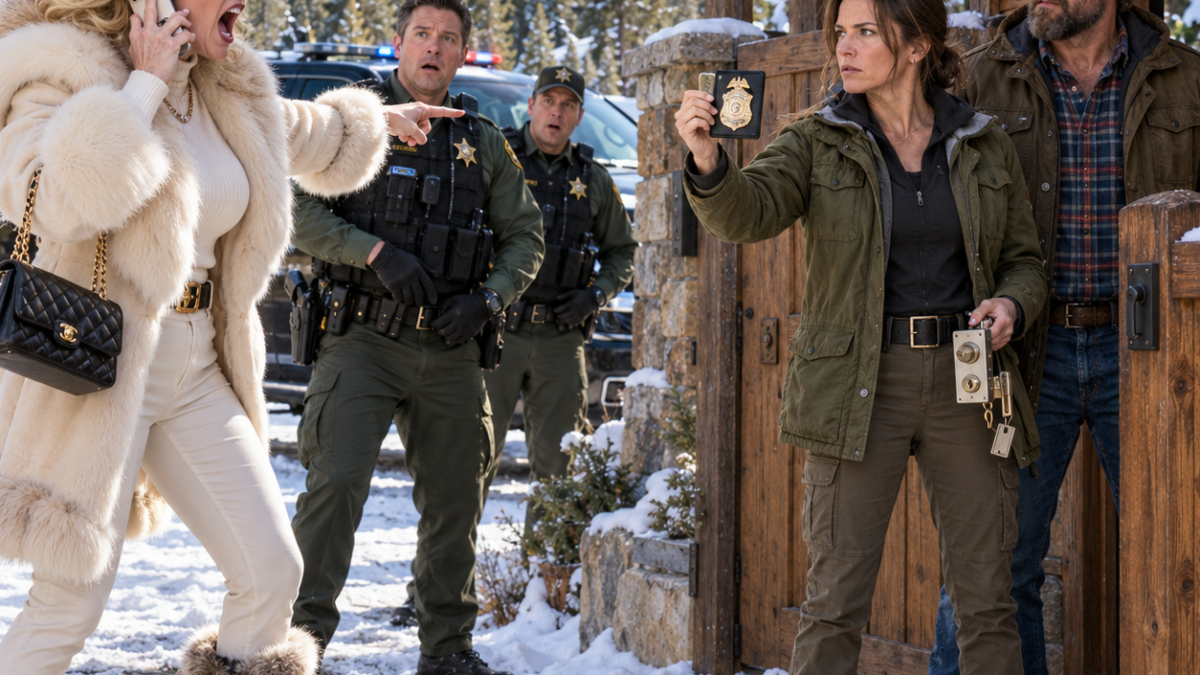
The woman who called 911 on my wife expected the deputies to drag Sarah away from the cabin we had spent years rebuilding. She stood in our driveway pointing at the new lock like it was evidence from a crime scene, completely certain the HOA gave her more authority than our own deed. What she didn’t understand was that Sarah had been letting her talk, threaten, and document herself for a reason.
My name is Jake Morrison, and at forty-five, I thought I had already met every kind of person who confused a title with actual authority.
I spent twenty-three years as an Air Force mechanic. That career taught me two useful things: machines usually warn you before they fail, and people do too.
Sarah and I had inherited her grandmother’s mountain cabin two years earlier. The place sat on an old parcel in Colorado that predated the surrounding Pine Ridge development by decades. Grandma Morrison built the original cabin in the 1960s, back when the road was gravel, the nearest neighbor was a mile away, and nobody cared what color your front door was.
By the time Sarah and I moved in, expensive homes covered the hills around us.
We didn’t mind.
We spent nearly $180,000 bringing the cabin back to life—new roof, safer wiring, restored deck, insulated windows, and a heavy oak front door with stained-glass panels that Sarah chose herself.
That door was apparently the beginning of civilization’s collapse.
Karen Whitfield arrived one morning in a white Escalade, stepped out wearing a fitted blazer and enough jewelry to sparkle from the road, and marched onto our porch carrying a manila envelope.
“Mr. Morrison?”
“That’s me.”
“I’m Karen Whitfield, president of the Pine Ridge Homeowners Association.”
I knew who she was.
Everybody did.
Eight years as HOA president had convinced Karen that every mailbox, flowerbed, trash can, driveway, and human personality within sight required her supervision.
She held out the envelope.
“Formal violation notice. Unauthorized exterior modification.”
I looked at the oak door.
“You mean that?”
“It violates architectural harmony.”
Sarah came outside carrying coffee.
She was dressed casually—jeans, hiking boots, flannel shirt—but even after eighteen years of marriage, there were moments when something in her posture reminded me that her federal job involved far more than office paperwork.
“We reviewed the governing documents before renovating,” Sarah said. “There’s no recorded restriction covering that door on our parcel.”
Karen gave her the kind of smile people use when they’re trying to be insulting without technically raising their voice.
“Honey, I’ve been protecting standards here since before you people moved up the mountain.”
Sarah’s wedding ring tapped once against her mug.
That tiny sound should have warned Karen.
It always warned me.
Karen continued.
“Five-hundred-dollar fine. Immediate correction. Failure to comply can result in additional penalties and possible lien action.”
I stepped closer.
“Our property predates the HOA.”
“Grandfathered properties still have responsibilities.”
“Show us where we agreed to yours.”
Her smile vanished.
“You’ll receive everything you need.”
Three days later, she came back with two board members and a contractor named Rick Whitfield—her brother-in-law—claiming they had authority to conduct an emergency safety inspection.
Sarah asked Rick for his professional credentials.
He couldn’t produce the inspection license Karen implied he had.
Sarah asked for the written emergency authorization.
Karen couldn’t produce that either.
Then Karen demanded something that changed the tone completely.
A master key.
“For community safety,” she said.
Sarah looked at her.
“No.”
Forty-eight hours later, anonymous complaints began arriving.
My workshop.
Our security cameras.
Electrical usage.
Noise.
Then a certified cease-and-desist letter from a law firm connected to Karen’s husband.
Sarah barely reacted.
She just started collecting records.
Invoices.
Assessments.
Vendor names.
Property sales.
By the end of the week, our dining table looked less like a place to eat dinner and more like an evidence room.
I asked her what she was finding.
She stared at one spreadsheet for a long moment.
Then said, “Jake, this stopped being about our door days ago.”
The next morning, two sheriff’s cruisers turned into our driveway.
Karen’s Escalade came behind them.
She stepped out before the deputies had even reached the porch.
“That woman changed the locks to hide illegal activity,” she shouted, pointing directly at my wife. “She’s interfering with HOA access. I want her arrested.”
Sarah set down her coffee.
One deputy asked for identification.
Karen smiled.
My wife reached slowly toward her back pocket.
And for the first time since I’d met Karen Whitfield, she stopped talking.
PART 2
Sarah opened the leather credential case.
The deputy closest to her looked down.
Then looked again.
The change in his face happened so quickly that Karen noticed it too.
“Deputy U.S. Marshal Sarah Morrison,” my wife said calmly. “I live here. This is my residence, and the lock Mrs. Whitfield is complaining about is attached to property my family lawfully owns.”
Deputy Martinez—the younger of the two officers—straightened almost instinctively.
His partner, Deputy Johnson, lowered the notebook he’d been writing in.
Karen blinked.
“What?”
Sarah turned the credentials just enough for them to verify the photograph and identification.
Then she closed the case.
Karen gave a sharp laugh.
It didn’t sound convincing.
“This is ridiculous. Anybody can buy a fake badge online.”
Martinez looked at her.
“Ma’am, let’s not do that.”
Her smile disappeared.
Sarah folded her arms.
“I’d also like the incident number for this call.”
Karen pointed at her.
“You don’t get to intimidate local law enforcement because you work for the federal government.”
“I haven’t intimidated anyone.”
“You flashed a badge!”
“Because an officer asked me for identification.”
Martinez nodded.
“That is exactly what happened.”
Karen turned toward him as though he’d betrayed her personally.
“But she’s under investigation.”
Johnson frowned.
“By whom?”
“The HOA.”
There was a silence so complete that I heard pine needles brushing across the cabin roof.
Johnson looked at me.
Then at Sarah.
Then back at Karen.
“The homeowners association is not a criminal investigative agency.”
Karen’s face reddened.
“We have documented violations involving unauthorized security modifications, aggressive surveillance, unapproved commercial activity, and interference with emergency access.”
Sarah spoke.
“Please identify the recorded easement giving the HOA emergency access through our locked door.”
Karen snapped, “I’ve already provided it.”
“No. You provided a document your board created. I’m asking for the county recording information showing that right runs with this property.”
Karen looked toward the deputies.
“This is exactly what I’ve been dealing with. Endless legal games. These people think they’re above community rules.”
I couldn’t help myself.
“Funny choice of words from someone demanding a key to our house.”
Sarah shot me a look.
I shut up.
Mostly.
Martinez asked Karen why she had told dispatch we were threatening residents.
She launched into a story about intimidation, surveillance cameras, hostile behavior, and my supposed physical threats.
I asked him to watch the video from our porch camera.
Sarah didn’t say anything.
She didn’t need to.
Our cameras had captured every encounter with Karen since the day she first came onto our property.
Martinez watched the relevant clips on Sarah’s phone.
Karen demanding access.
Karen threatening fines.
Karen telling us “community harmony requires financial commitment.”
Karen’s brother-in-law circling our cabin while pretending to conduct an inspection.
My own responses weren’t perfect. I sounded irritated more than once.
But there were no threats.
Nothing close.
Martinez handed the phone back.
“Mrs. Whitfield, I’m not seeing probable cause for an arrest here.”
Karen’s mouth dropped open.
“What about the locks?”
“They’re allowed to secure their residence unless you have a lawful order or enforceable access right saying otherwise.”
“I am the HOA president!”
Johnson’s face stayed neutral.
“That doesn’t make you a police officer.”
The words hit her harder than shouting would have.
Karen stepped closer to Sarah.
“You think because you have a federal badge you can bully me?”
Sarah’s expression didn’t change.
“No, Karen. I think because I own this house, I can decide who gets a key.”
Then she added something that made Karen’s face lose another shade of color.
“And I think you should be very careful about knowingly making false statements to law enforcement.”
Karen stared at her.
For three seconds, nobody moved.
Then she turned toward her Escalade.
“This is not over.”
Sarah nodded.
“I know.”
Karen stopped.
Maybe it was the way Sarah said it.
No anger.
No bravado.
Just certainty.
Karen looked over her shoulder.
For the first time, I saw something new behind her eyes.
Not rage.
Fear.
Then she got into the Escalade and drove away.
I waited until the vehicle disappeared around the bend.
Then I turned to my wife.
“Okay.”
Sarah picked up her coffee.
“What?”
“You’ve got some explaining to do.”
She raised an eyebrow.
“About what?”
I pointed toward the pocket where she’d put the badge.
“That.”
She took a sip.
“You know I work for the Marshals Service.”
“I know you told me you work in federal law enforcement. I apparently missed the part where you turn our breakfast table into a financial-crimes task force.”
Martinez tried very hard not to smile.
Sarah looked at the deputies.
“Gentlemen, can we get a copy of the report when it’s ready?”
“Absolutely.”
They left a few minutes later.
I waited until their cruisers disappeared.
Then I looked at my wife again.
She sighed.
“Come inside.”
That was how I learned that Karen Whitfield hadn’t picked a fight with an ordinary homeowner.
She had picked a fight with a woman who had already spent three months quietly figuring out where nearly half a million dollars of her neighbors’ money had gone.
***
Sarah made fresh coffee.
That worried me.
My wife only made a second pot before ten in the morning when the conversation was going to be expensive, dangerous, or both.
She sat across from me at our dining table.
Stacks of HOA records covered half of it.
I picked up one invoice.
PINE RIDGE CONSTRUCTION SERVICES.
Emergency drainage repair.
$38,500.
“Start talking.”
Sarah rested both hands around her mug.
“About three months ago, I noticed inconsistencies in the HOA financial statements.”
“Three months?”
“Yes.”
“And you didn’t tell me?”
“I didn’t know what they meant.”
“You didn’t think your husband deserved to know you suspected our HOA president was stealing money?”
“I suspected irregularities.”
“Sarah.”
She gave me the look.
The one that said my emotional argument had been acknowledged and would now be ignored in favor of facts.
“You remember the community-center roof assessment?”
“Eight hundred dollars per household.”
“Correct.”
“Karen said hail damage.”
“Yes.”
“So?”
Sarah opened a folder.
Photographs.
Insurance papers.
Vendor invoices.
Board minutes.
“The roof was never replaced.”
I looked at her.
“What?”
“No permit. No contractor inspection. No material deliveries that I can verify through public records. And the roof photographs from before and after the supposed project show the same wear patterns.”
“How much?”
“Eighty-five thousand dollars from the insurance claim, plus the assessment collected from residents.”
I stared at the page.
“Where did it go?”
She slid over another document.
“Pine Ridge Construction Services.”
“The contractor from our house?”
“Rick Whitfield.”
“Karen’s brother-in-law.”
“Yes.”
I leaned back.
The cabin suddenly felt colder.
Sarah continued.
“Then I checked the emergency road project.”
“What road project?”
“Exactly.”
Another invoice.
Sixty-two thousand dollars.
“Security-camera upgrades.”
Another.
Thirty-one thousand.
“Drainage remediation.”
Forty-seven thousand.
“Retaining-wall stabilization.”
Thirty-eight thousand.
I looked through the paperwork.
“Did any of this work happen?”
“Some minor work did. Most appears grossly inflated, undocumented, or nonexistent.”
“How much are we talking?”
“Potentially more than four hundred thousand dollars in questionable transfers over three years.”
I stopped.
“You’re serious.”
“Completely.”
“And you discovered this before Karen complained about our door?”
“Yes.”
“Why were you investigating the HOA at all?”
Sarah looked toward the window.
“I wasn’t. Not initially.”
She tapped the insurance statement.
“I review our finances every quarter. I noticed the special assessments didn’t match the reserve reports. Then I noticed vendor names repeating.”
My wife had spent much of her federal career assisting investigations involving asset tracing, forfeiture, and financial records.
She saw patterns the way I saw worn bearings.
A sound nobody else noticed.
A vibration that meant the machine was about to fail.
Once she saw the first mismatch, she kept looking.
All through records available to her as an HOA member, county filings, state business registrations, insurance correspondence we lawfully possessed, and documents residents had voluntarily shared.
When those records began suggesting possible criminal activity, Sarah notified her supervisors.
That part mattered to her.
“This isn’t my personal federal investigation,” she said. “Once I realized there could be crimes within federal jurisdiction, I made a referral and stepped carefully.”
“But you said you were documenting her.”
“I am. As a homeowner and witness.”
“So there’s actually a case?”
“There is a review. I can’t tell you more than that.”
“Because I’m your husband?”
“Especially because you’re my husband.”
I rubbed my face.
“That’s romantic.”
“You married me anyway.”
“Apparently without reading the fine print.”
That almost made her smile.
Then she opened another folder.
The smile disappeared.
“Jake, the money isn’t the worst part.”
“What is?”
“Property sales.”
She showed me a spreadsheet.
Fourteen homes.
Three years.
Owners.
Violation histories.
Fines.
Special assessments.
Sale dates.
Listing agents.
Prices.
Every property had been sold below neighborhood market trends after months of escalating HOA pressure.
Every transaction involved Karen Whitfield’s real-estate agency.
I felt sick.
“She was fining people until they sold?”
“That’s the pattern.”
“And then collecting commission?”
“In many cases.”
“Can you prove she deliberately forced them?”
“Not yet.”
Sarah looked toward our oak door.
“But I think we’re finding out what happens when a homeowner resists.”
I understood.
The fake inspection.
The complaints.
The cease-and-desist letter.
The 911 call.
Karen wasn’t trying to enforce standards.
She was applying pressure.
And Sarah and I had just become the next test case.
***
The irony was that I’d almost paid the first fine.
Five hundred dollars wasn’t nothing, but compared with lawyers and stress, it would have been cheaper.
When Karen first left the violation notice, I told Sarah maybe we should just write the check and appeal later.
She looked at me as if I’d suggested feeding a bear from the kitchen window.
“You pay someone who doesn’t have authority once,” she said, “and the next payment becomes easier for them to demand.”
At the time, I thought she was being stubborn.
Now I understood.
Karen didn’t need every homeowner to believe she was right.
She needed them to believe resistance cost more than obedience.
Margaret Riley proved that.
She lived three roads below us in a cedar-sided house she’d shared with her husband for thirty-six years.
Her husband died the previous winter.
Karen hit her with a $6,400 emergency assessment four months later.
When Margaret asked for records, she received three violation notices within two weeks.
Unapproved porch railing.
Improper exterior storage.
Driveway discoloration.
Margaret paid.
Not because she believed the violations.
Because she was grieving and afraid.
Sarah invited her to our cabin.
Margaret arrived carrying a grocery bag full of documents.
“I kept everything,” she said.
Her hands shook as she placed the papers on our table.
“My husband always said never throw away anything with a signature.”
Sarah smiled gently.
“He was right.”
Margaret looked embarrassed.
“I feel stupid.”
“For paying?”
She nodded.
Sarah leaned forward.
“Don’t.”
“I should have fought.”
“You were surviving.”
Margaret looked down.
“I didn’t even know who to ask.”
That sentence made something change in me.
Karen’s entire system depended on people being too embarrassed to admit they’d been frightened.
One by one.
Separate.
Ashamed.
The same trick bullies have used forever.
Convince every target they’re alone.
Sarah looked at me after Margaret left.
“We need more witnesses.”
I nodded.
“And we need them talking to each other.”
***
Tom Buckley became the next.
Retired accountant.
Seventy-one.
Gray mustache.
Owned every calculator ever manufactured.
Tom had served as volunteer treasurer on a church board for twenty years, which apparently trained him to distrust financial statements that looked too clean.
He came to our cabin with two banker boxes.
Sarah stared at them.
“You’ve been keeping records?”
“Two years.”
“Why?”
Tom shrugged.
“Because the numbers stink.”
I liked him immediately.
He had tracked assessment totals against reported expenses.
Pine Ridge had eight hundred forty-seven residents spread across expensive mountain properties.
Regular dues already produced significant revenue.
Yet special assessments appeared constantly.
Emergency roof.
Emergency drainage.
Emergency legal fund.
Emergency road repairs.
Emergency security upgrades.
Everything was an emergency.
Nothing seemed to improve.
Tom opened a spreadsheet.
“Look here.”
He pointed at three invoices.
Same formatting.
Different projects.
Same spelling error in the address.
Same invoice-number pattern.
Different supposed vendors.
Sarah leaned closer.
“These companies share ownership?”
“Two trace to Whitfield relatives. One uses a mailbox service.”
She looked at him.
“You’ve done good work.”
Tom smiled.
“Retirement is boring.”
I looked at the mountain of paperwork.
“Your hobbies are terrifying.”
Between Tom’s records and Sarah’s analysis, the case became uglier.
Invoices marked up three or four times beyond reasonable market cost.
Payments for materials that could not possibly have been used in the quantities billed.
Jobs supposedly completed in a day that would have required crews working for a week.
And then I found one.
Roofing materials.
$47,000.
Installed in one afternoon.
I stared at it.
“No.”
Sarah looked over.
“What?”
“This is impossible.”
“How impossible?”
“Physically impossible.”
My Air Force years had been spent around machines, hangars, logistics, maintenance scheduling, and contractors.
After retirement I built custom furniture and did occasional cabin renovations.
I knew what materials cost.
I knew how long work took.
“This amount of roofing material would cover several buildings.”
Sarah pulled the invoice closer.
“And labor?”
“Unless Rick Whitfield has twelve hands and can teleport shingles, no.”
She wrote it down.
For the first time, my practical experience became part of the evidence.
Not speculation.
Not legal conclusions.
Just simple facts.
This much material.
This much time.
These claimed workers.
It didn’t add up.
***
Karen escalated at the HOA meeting.
Friday night.
Community center.
Stale coffee.
Rows of folding chairs.
Sarah had just returned from one of her trips and slipped into the back row wearing jeans and a flannel shirt.
Karen stood at the podium.
PowerPoint ready.
I should’ve known we were in trouble when the first slide had our house on it.
The title read:
ONGOING THREATS TO COMMUNITY HARMONY.
I whispered to Sarah, “We made PowerPoint.”
She whispered back, “Try to contain your pride.”
Karen spent twenty minutes presenting our crimes.
Door.
Locks.
Cameras.
Workshop.
Failure to cooperate.
Aggressive questioning of board authority.
That last one was apparently now a violation category.
Then she proposed legal action against us.
Immediate fines.
Association attorney fees.
Possible lien enforcement.
Board authorization to pursue “all remedies necessary.”
A few people applauded.
Many didn’t.
Sarah raised her hand.
Karen ignored her.
Sarah raised it again.
Finally:
“Mrs. Morrison.”
Sarah stood.
“Before voting, can the secretary confirm member notice and valid proxy documentation?”
Karen stared.
“We have enough representation.”
“That wasn’t my question.”
“Procedural technicalities should not obstruct community safety.”
“They aren’t technicalities if they determine whether your vote is valid.”
You could feel the room shift.
Sarah continued.
“How many written proxies were submitted?”
Karen looked toward Carol Martinez, the board secretary.
Carol looked like she wanted the floor to open.
“Carol?”
Karen’s tone became sharp.
Carol swallowed.
“I don’t have written proxies.”
Tom Buckley spoke from the second row.
“Then where did the proxy count come from?”
Karen glared.
“We have verbal commitments.”
Sarah shook her head.
“Then present them as verbal statements, not formal proxy votes.”
Karen’s face reddened.
“This is exactly the kind of administrative harassment we’re discussing!”
I almost laughed.
Residents demanding that their board follow its own procedures had become harassment.
Tom didn’t laugh.
“Karen, are we actually authorized to vote tonight or not?”
Vice President Bradley looked at the documents.
“I don’t think we are.”
That was the moment Karen lost control.
Not completely.
Just enough.
“You people don’t understand what leadership requires.”
Sarah’s voice stayed calm.
“Leadership usually starts with following the rules you’re enforcing on everybody else.”
The meeting dissolved without a vote.
As people headed for the exits, Karen cornered Sarah.
I stayed close enough to hear.
“You think your legal research makes you untouchable?”
“No.”
“People like you come here and think money buys you the right to change everything.”
Sarah looked at her.
“We inherited a sixty-year-old cabin.”
Karen leaned closer.
“Some people simply don’t belong in communities like Pine Ridge.”
The words hung there.
Several residents heard them.
Sarah’s expression barely moved.
Then she answered.
“You may be right about that.”
Karen smiled as if she’d won.
She didn’t understand.
Neither did I.
Not yet.
***
Saturday morning, Sarah finally showed me the full scope of what she’d found.
Fraudulent assessments.
Shell companies.
Insurance claims.
Real-estate commissions.
Fourteen distressed sales.
Potential direct losses well beyond $400,000.
Indirect financial harm much higher.
“You think Karen is intentionally driving people out?”
“Yes.”
“To sell their houses?”
“To control the listing, commission, replacement buyer, and new assessment cycle.”
“That’s insane.”
“It’s profitable.”
That sentence silenced me.
Sarah clicked through properties.
The Henderson home.
Fined repeatedly for landscaping and parking.
Sold eighteen percent below comparable sales.
Karen represented the sale.
New owner received special assessment two months later.
The Ramirez house.
Roof-color dispute.
Drainage fine.
Legal fee.
Sold.
Karen represented buyer and seller through affiliated agents.
The Greer property.
Widowed owner.
Repeated fines.
Sold after eight months.
Again, Karen’s agency.
I stared at the names.
“These aren’t transactions.”
“No.”
“They’re people.”
“Yes.”
Sarah closed the laptop.
“That is why you never look only at numbers.”
I thought about Margaret Riley sitting at our kitchen table ashamed because she’d paid.
How many others had paid and disappeared?
***
The harassment changed after the failed HOA vote.
Flower beds destroyed.
Irrigation lines cut.
Orange spray paint across two security cameras.
MIND YOUR BUSINESS.
I found the words just after sunrise.
My first instinct was to rip the camera down.
Sarah stopped me.
“Don’t touch it.”
“It says MIND YOUR BUSINESS on our house.”
“Exactly.”
She photographed everything.
Wide shot.
Close.
Measurements.
Time stamps.
Camera angles.
Backup footage.
I watched her work.
There was something unsettling about seeing your wife transform anger into procedure.
“Should I call the sheriff?”
“Already reported through the appropriate channel.”
I frowned.
“You said nothing.”
“I don’t announce every call I make.”
“Noted.”
She looked at the ruined flowers.
“Somebody wants us angry.”
“They succeeded.”
“No.”
She looked at me.
“They want us careless.”
That was different.
And she was right.
***
Margaret called two nights later.
Someone had tried her back door around two in the morning.
Then walked around her foundation.
She turned on exterior lights and the person ran.
No face.
No plate.
Just bootprints.
Margaret had photographed them with a ruler.
Forty years as a paralegal had apparently trained her better than half the crime shows on television.
Sarah examined the pictures.
Distinctive sole pattern.
Probably work boots.
Not enough to identify anyone.
Enough to preserve.
Margaret was frightened.
“I don’t want to quit.”
“You don’t have to,” Sarah said.
“But I don’t want somebody coming back.”
“We’re going to work through law enforcement on safety planning.”
“What if Karen says I’m confused?”
“Then your photographs speak.”
Margaret was silent.
Finally she said, “I wish my husband were here.”
Sarah’s face softened.
“I know.”
I watched my wife listening to her.
No federal authority.
No investigation voice.
Just one woman helping another stay steady.
That’s the Sarah I knew best.
The badge was only one piece of her.
***
Rick Whitfield destroyed our fence on Friday.
He arrived while Sarah was in Denver.
Pickup.
Three workers.
Chainsaw.
Claimed a pine near our boundary was a hazard.
I told him to leave.
He claimed the HOA had emergency vegetation authority.
I started recording.
Rick pointed at the tree.
“That limb could fall.”
“Then don’t touch it until you have lawful permission.”
He ignored me.
The chainsaw started.
Twenty minutes later, a massive limb fell exactly where any competent operator could have predicted.
Across our cedar fence.
Thirty feet crushed.
Rick shut off the saw.
“Damn.”
I stared at him.
He smiled.
“Old trees.”
Then he handed me an estimate.
$3,200.
“For what?”
“Fence repair.”
“You broke the fence.”
“Tree failed during authorized safety work.”
“I told you not to touch the tree.”
“Community hazard rules override individual preference.”
I looked at the cut.
Directional notch.
Back cut.
The branch hadn’t accidentally fallen toward the fence.
It had been guided.
I photographed everything.
Rick tapped the estimate.
“Fifteen days.”
I almost hit him.
I’m not proud of that either.
Twenty-three years in the Air Force taught me discipline.
Retirement hadn’t erased anger.
My fists tightened.
Then I heard Sarah in my head.
They want you careless.
So I stepped back.
“You need to leave.”
Rick smiled.
“Or what?”
“Or the recording gets longer.”
His smile disappeared.
He left.
When Sarah came home, I showed her the fence.
Then the estimate.
Then the video.
She read the invoice.
“Three thousand two hundred?”
“Eight hundred dollar repair. Maybe a thousand if you use premium cedar.”
She looked at the cut.
Then at me.
“You didn’t touch him?”
“No.”
“I’m proud of you.”
“That’s insulting.”
“It was meant sincerely.”
She kissed my cheek.
Then she pulled out her phone and made a call.
***
By then the federal review had become a formal investigation led through appropriate channels outside our household.
Sarah’s supervisor knew her personal connection.
Other investigators handled decisions that required independence.
That distinction mattered deeply to her.
Karen would later accuse Sarah of using federal power for revenge.
But Sarah documented every recusal, every referral, every point where another official made the call.
She wanted the case strong enough that Karen’s best defense attorney couldn’t dismiss it as an angry homeowner with a badge.
Tom’s records went in.
Margaret’s statements.
Our invoices.
Insurance documentation.
State business filings.
Rick’s vendor records.
Affected homeowners.
Real-estate transactions.
The false police complaint became another piece.
The vandalism.
Witness intimidation.
Property damage.
Every time Karen escalated, investigators received something new.
Desperation does that.
People who believe they are losing control often grab harder.
And fingerprints become easier to see when someone is squeezing.
***
The second 911 call was Karen’s masterpiece.
Monday morning.
Two cruisers.
Karen behind them in her Escalade.
The same scene that had started this story.
Only now I knew what Sarah knew.
The deputies approached carefully.
Someone had told dispatch we were threatening neighbors.
Karen claimed I’d physically intimidated her.
She claimed Sarah was conducting “illegal surveillance.”
Then she added the locks.
That was the part she thought would win.
“They changed them to conceal illegal activity,” she said. “The HOA requires access.”
Deputy Johnson asked whether she had authority to enter our home.
“As president, yes.”
Sarah stood on the porch.
“No.”
Karen spun toward her.
“You don’t get to decide that.”
“My deed does.”
“This is exactly the obstruction I’ve reported!”
Then Johnson asked Sarah for identification.
The badge came out.
Karen froze.
But what happened after that mattered more.
Sarah didn’t arrest her.
Didn’t threaten her.
Didn’t announce charges.
She simply stated who she was, disclosed that potential financial crimes had already been referred and were under investigation, and warned everyone that the situation needed to proceed through lawful channels.
Karen’s reaction did the rest.
She accused Sarah of government corruption.
Claimed the investigation was personal.
Then said:
“You’ve been going through our finances without authorization!”
Sarah looked at her.
“Which finances are you concerned about?”
Karen stopped.
It was subtle.
But everyone heard it.
Sarah hadn’t accused her of a specific transaction.
Karen had volunteered concern.
Then she changed direction.
“This is harassment!”
Deputy Martinez said, “Mrs. Whitfield, you called us.”
That nearly ended me.
I coughed into my fist.
Karen glared at me.
“Laugh now.”
Sarah’s eyes sharpened.
Karen continued.
“You won’t be laughing when you lose this house.”
Sarah spoke quietly.
“Is that a threat?”
Karen opened her mouth.
Then shut it.
Finally, some instinct told her she’d said enough.
She left.
The deputies stayed another fifteen minutes.
Report taken.
Statements recorded.
No arrest.
No drama.
Just documentation.
Karen probably went home convinced Sarah had embarrassed her.
She still didn’t understand that she’d just placed another piece of evidence into a case much larger than our lock.
***
That evening, I asked Sarah when this would end.
We were sitting beside the fireplace.
Outside, snow had begun falling.
She stared at the flames.
“I don’t know.”
That scared me more than if she’d given me a date.
“Can she take our cabin?”
“No.”
“Can she put a lien on it?”
“She can try to file things. That doesn’t mean they survive challenge.”
“Can she hurt Margaret?”
Sarah looked down.
“That worries me more.”
I nodded.
“What about us?”
She reached for my hand.
“We’re going to be careful.”
“That’s not an answer.”
“No.”
We sat quietly.
Then she said, “I’m sorry.”
“For what?”
“This was supposed to be our peaceful place.”
I laughed softly.
“You didn’t elect Karen.”
“No.”
“You didn’t steal the money.”
“No.”
“You didn’t cut our fence.”
“No.”
“Then stop apologizing.”
Sarah looked at me.
“I’ve spent years telling witnesses that exact thing.”
“Maybe listen to yourself.”
She leaned against my shoulder.
Eighteen years married.
Thousands of days together.
I knew when my wife was tired.
Not physically.
Deep tired.
The kind that makes every responsibility heavier.
I kissed her forehead.
“We finish it together.”
She squeezed my hand.
“Together.”
***
The emergency HOA meeting came Thursday night.
Karen sent an email to every resident.
FEDERAL OVERREACH THREATENS PINE RIDGE.
That was the subject line.
She framed herself as a volunteer leader being persecuted by powerful outsiders.
She accused Sarah of weaponizing her job.
She accused me of intimidation.
She claimed criminal investigators were attempting to destroy local self-governance.
A surprising number of people believed enough of it to attend.
The community center filled early.
Tom sat in front with banker boxes.
Margaret sat beside him.
Several former homeowners had returned to testify.
Local news crews waited along the wall.
Sarah and I sat near the middle.
No tactical entrance.
No dramatic badges.
Karen walked to the podium.
For twenty minutes, she described herself as a victim.
Her voice trembled at the right places.
She spoke about years of unpaid service.
Sacrifice.
Property values.
Community safety.
Then she pointed toward Sarah.
“The federal marshal sitting among us tonight has used her government position to investigate private citizens because she disagrees with HOA rules.”
People turned.
Sarah remained seated.
Karen continued.
“This is corruption.”
I felt my jaw tighten.
“Government intimidation.”
Sarah touched my hand.
Don’t react.
Karen was almost shouting now.
“No federal officer should be able to weaponize a badge because she doesn’t like paying assessments.”
That was when Sarah stood.
Slowly.
The room quieted.
She walked to the front.
Karen backed away from the microphone.
Not much.
But enough.
Sarah turned toward the residents.
“Mrs. Whitfield has chosen to disclose my occupation publicly.”
She opened her credential case.
“I’m Deputy U.S. Marshal Sarah Morrison.”
Murmurs moved through the room.
“My role has included work supporting financial investigations and asset recovery. Because I am also a homeowner here, when I identified transactions that appeared potentially criminal, I reported those concerns through supervisory channels. Other investigators assumed responsibility for decisions requiring independence.”
Karen laughed.
“Convenient.”
Sarah ignored her.
“I will not disclose protected investigative information. But I can discuss financial records provided to association members and documents now properly available for this meeting.”
She nodded toward Tom.
He stood.
The projector came on.
First slide.
Three years of special assessments.
$340,000 beyond ordinary dues in one category of charges.
Second slide.
Community-center roof.
Assessment collected.
Insurance claim paid.
Vendor invoice issued.
No evidence of corresponding replacement work.
Third slide.
Pine Ridge Construction Services.
Owner:
Rick Whitfield.
Karen’s brother-in-law.
The room changed.
You could feel it.
People stopped looking at Sarah.
They started looking at Karen.
***
Tom approached the microphone.
“I am a retired accountant. I’ve reviewed these books independently.”
Karen shouted, “You had no authorization!”
Tom looked at her.
“I’m an HOA member. These were financial statements supplied to members.”
He turned back.
“I found repeated transactions that do not reconcile with documented work.”
Next slide.
Drainage project.
Paid.
No permit.
No inspection.
Residents whispered.
Next.
Security upgrades.
Paid.
Equipment unaccounted for.
Next.
Road stabilization.
Paid.
No matching project documentation.
Then I stood.
Sarah nodded.
I explained the construction invoices.
Material quantities.
Labor estimates.
Physical impossibilities.
“This one claims forty-seven thousand dollars in roofing material installed in a single afternoon.”
I pointed at the invoice.
“You would need a substantial crew and far more roof than exists on the community building.”
Someone laughed nervously.
Rick sat near the back.
His face was red.
I continued.
“The same company later damaged thirty feet of our fence during work we explicitly refused to authorize, then billed us $3,200 to repair damage its own crew caused.”
I displayed photographs.
The cut.
The limb.
The fence.
Rick stood.
“This is character assassination!”
I looked at him.
“That’s your signature on the estimate.”
He sat.
***
Then Margaret walked forward.
That hurt.
Her hands were shaking.
But she didn’t turn around.
“My husband died last year.”
The room quieted.
“Four months later, I received a special assessment I could not afford.”
She swallowed.
“I asked Karen for financial records.”
Karen stared at her.
Margaret continued.
“Within two weeks, I received three violation notices.”
People murmured.
“Karen came to my house. She told me residents who couldn’t afford Pine Ridge standards should consider more appropriate housing.”
Karen shook her head.
“I never said that.”
Margaret opened her folder.
“I wrote it down fifteen minutes after you left.”
She showed the dated note.
Karen laughed.
“Anyone can write anything.”
Margaret looked at her.
“Yes.”
Then her voice steadied.
“That’s why I also saved your email the next morning.”
Tom projected it.
There it was.
Polished language.
Same message.
Financial obligations were part of maintaining a high-value community.
Residents unable to meet those obligations should explore alternatives.
Margaret looked at the audience.
“I thought I was going to lose my home.”
Her voice broke.
“I almost sold.”
A woman in the second row began crying.
Margaret looked at Karen.
“You knew my husband had just died.”
Karen said nothing.
That was the first moment the meeting stopped being about accounting.
Numbers became people.
***
Then came the sales.
Fourteen properties.
Violation histories.
Special assessments.
Below-market transfers.
Karen’s brokerage involvement.
Sarah was careful.
“These correlations do not alone prove criminal intent.”
I noticed several reporters writing that down.
“But they warranted independent review.”
One former resident stood.
The Henderson family.
Mr. Henderson spoke.
“We didn’t want to sell.”
His wife held his arm.
“We had thirty-seven thousand dollars in fines, assessments, and threatened legal costs.”
Someone gasped.
Henderson continued.
“Karen told us selling would make the problems disappear.”
Karen slammed her palm on the table.
“That is a lie!”
Mrs. Henderson raised a phone.
“We kept the voicemail.”
The room went silent.
Sarah looked toward her.
“Only play it if counsel has cleared it.”
Mrs. Henderson nodded.
Their attorney had.
The recording played.
Karen’s voice.
Calm.
Professional.
Suggesting that continued ownership might be financially unrealistic.
Mentioning that her agency could assist with a quick sale.
No explicit confession.
No movie-villain statement.
Worse.
It sounded practiced.
A system.
The room erupted in angry whispers.
Karen started talking over everyone.
“You’re twisting ordinary real-estate advice!”
Then the community-center doors opened.
Three federal agents entered.
Not running.
Not shouting.
Just walking.
That calm frightened Karen more than anything else that night.
***
Sarah stepped away from the podium.
This was not her arrest to make.
That mattered.
A senior agent approached Karen.
“Karen Whitfield?”
Karen stared.
“Yes.”
He identified himself.
Produced documents.
Informed her that she was being taken into custody pursuant to a federal warrant connected to fraud and conspiracy allegations under investigation.
Karen backed away.
“No.”
The agent repeated the instruction.
“This is a political setup.”
Nobody moved.
She looked toward Sarah.
“You did this.”
Sarah’s voice was quiet.
“No, Karen. The records did.”
Karen pointed at her.
“You used your badge!”
Sarah shook her head.
“You used everyone’s money.”
That was the line people remembered.
Not because Sarah shouted.
Because she didn’t.
Rick Whitfield stood near the rear exit.
Another agent approached him.
He turned.
Took three steps toward the door.
Then stopped when a deputy blocked it.
Nobody tackled anyone.
No dramatic chase through the snow.
Just reality finally closing every exit that intimidation had kept open.
Karen began crying.
Real tears this time.
“You don’t understand. I protected this community.”
Margaret whispered from the front row:
“From us?”
Karen heard her.
Her face collapsed.
The cuffs went on.
That metallic click echoed through the room.
I thought about the first time Karen came to our porch.
Her clipboard.
Her smile.
Her five-hundred-dollar fine.
Her certainty that we would either pay or leave.
Now she walked past the same residents she’d spent years convincing were powerless.
Nobody applauded at first.
That surprised me.
People watched.
Some angry.
Some shocked.
Some grieving.
Because discovering that someone you trusted may have stolen from you doesn’t feel like victory.
It feels like betrayal.
Only after the doors closed did the room begin to breathe again.
***
Tom sat down heavily.
Margaret cried.
I went to her.
“You okay?”
She nodded.
Then shook her head.
“I believed her.”
I sat beside her.
“So did a lot of people.”
“I voted for her.”
“That doesn’t make this your fault.”
“She came to my husband’s funeral.”
That hit me.
Margaret looked toward the door.
“She hugged me.”
I had no answer.
Sarah knelt beside her.
“People who exploit trust often understand exactly how to look trustworthy.”
Margaret wiped her eyes.
“I want my money back.”
Sarah smiled faintly.
“That’s a reasonable place to start.”
***
The criminal case did not end that night.
Real cases don’t.
There were months of motions, interviews, audits, account tracing, plea negotiations, and separate determinations about who knew what.
Investigators found enough financial evidence to establish a broad pattern of fraudulent billing and diverted community funds.
The eventual documented losses exceeded $400,000 across assessments, insurance-related proceeds, and connected transactions examined in the case.
Not every dollar Karen touched was criminal.
Not every unpopular decision was fraud.
That distinction mattered.
But enough was proven.
Pine Ridge Construction Services had received large payments tied to work that was inflated, incomplete, or unsupported.
Insurance claims contained material misrepresentations.
Electronic transfers created records.
Mailings created records.
Real-estate transactions created records.
Karen’s greatest mistake was thinking paperwork made wrongdoing look legitimate.
Paperwork did the opposite once the right people read all of it together.
***
Karen eventually entered a guilty plea to multiple federal offenses arising from the scheme.
Her attorney negotiated.
Prosecutors weighed evidence.
Victims submitted statements.
Sarah did not participate in sentencing recommendations because of our personal connection.
When the judge finally pronounced sentence, Karen received four years in federal custody, followed by supervision and substantial restitution obligations.
The courtroom remained quiet.
Karen looked smaller than I remembered.
No designer confidence.
No HOA binder.
No Escalade waiting outside.
Just a defendant listening to a judge explain that leadership positions do not create permission to exploit the people who trusted you.
I expected satisfaction.
Instead, I thought about how unnecessary all of it had been.
Karen had lived in a beautiful house.
Had a successful real-estate career.
A husband with connections.
Neighbors who initially trusted her.
She didn’t need to steal.
That somehow made it worse.
Greed had not rescued her from desperation.
Greed had manufactured the desperation.
***
Rick’s outcome was different.
He cooperated after the financial evidence became overwhelming.
He admitted submitting inflated invoices and participating in transactions tied to projects that did not match what had actually been performed.
He received a shorter custodial sentence followed by supervision and lost the ability to continue operating the same contracting business.
I never celebrated that either.
The last time I saw Rick before sentencing, we passed in a courthouse hallway.
He looked at me.
Then at the floor.
For a second, I remembered him standing beside my broken fence, smiling as he handed me a $3,200 estimate.
Now he couldn’t meet my eyes.
That was enough.
***
Asset recovery produced approximately $380,000 from accounts and property linked to recoverable proceeds and other available assets, with additional restitution handled through the court process.
Residents received reimbursement based on documented losses.
Some checks were large.
Others smaller.
Margaret’s arrived on a Tuesday.
She walked up our driveway carrying the envelope.
Sarah opened the door.
Margaret held it up.
“I got it.”
Sarah smiled.
“Come in.”
She sat at our table.
Opened the envelope again even though she’d obviously already read it.
Then started crying.
“I can fix the porch.”
I looked at her.
“The railing?”
“My husband wanted to repair it before he got sick.”
She wiped her face.
“I kept putting it off because of the assessment.”
Sarah took her hand.
“Then fix it.”
Margaret nodded.
“I am.”
Three weeks later, I helped.
Not because she couldn’t hire someone.
Because neighbors should sometimes build things together.
We replaced the old railing with cedar.
Exactly the style Karen had once cited as noncompliant.
Margaret stood back.
“What do you think?”
I smiled.
“Dangerously individual.”
She laughed until she cried again.
***
Tom Buckley was elected interim HOA president.
The vote took four minutes.
Nobody ran against him.
When the results were announced, he looked horrified.
“I only wanted to audit the books.”
Someone shouted, “Too late!”
His first act required independent financial reviews.
His second created online access to budgets, contracts, and meeting records.
His third prohibited related-party vendor contracts without disclosure, competitive review, and member oversight.
His fourth eliminated Karen’s collection of invented “emergency standards.”
At the next meeting, he fed copies of several obsolete policy sheets into an office shredder.
The room applauded.
Tom frowned.
“This is an administrative procedure, not entertainment.”
People applauded louder.
I liked him even more.
***
The HOA didn’t disappear.
That mattered.
I know stories like ours tempt people to believe every HOA is evil.
They’re not.
An HOA is paperwork and governance.
People decide whether it becomes useful or abusive.
Pine Ridge still needed road maintenance.
Snow removal.
Shared drainage.
Common-area insurance.
Fire mitigation.
Those responsibilities didn’t disappear because Karen committed crimes.
What changed was the assumption that the board could do anything it wanted.
Members started attending meetings.
Actually reading budgets.
Asking questions.
Running for board seats.
Requesting competing bids.
The first budget meeting after Karen’s conviction lasted nearly four hours.
It was boring.
Gloriously boring.
No shouting.
No threats.
No mysterious emergency assessments.
Just people arguing about snowplow pricing.
I nearly fell asleep.
It was beautiful.
***
Our oak door stayed exactly where it was.
Tom visited one afternoon.
He stood on the porch staring at the stained glass.
“So this is the dangerous door.”
“Apparently.”
He looked at it.
“Looks fine.”
“Careful. That’s radical.”
He laughed.
Then pointed toward the lock.
“And the infamous security device?”
“Still works.”
“Any interest in giving the HOA a master key?”
I stared at him.
He held up both hands.
“Joke.”
“Bad one.”
“Fair.”
He handed me a folder.
Inside was a formal rescission of our violations.
Door.
Locks.
Cameras.
Workshop noise.
All withdrawn.
At the bottom was an apology signed by the new board.
I read it slowly.
Tom shifted awkwardly.
“We should’ve asked questions sooner.”
“You weren’t president.”
“I was a resident.”
“So was I.”
He nodded.
“That’s the lesson, I guess.”
We shook hands.
After he left, I framed the apology.
Sarah laughed when she saw it.
“You framed an HOA letter?”
“I wanted something near the door.”
“Why?”
“So the door knows it won.”
She shook her head.
“You need hobbies.”
“I build furniture.”
“You need another hobby.”
***
My furniture business unexpectedly took off.
Neighbors started hiring me.
At first, I suspected pity.
Then referrals came from outside Pine Ridge.
Custom tables.
Built-ins.
Cabinet work.
Restored doors.
One customer specifically asked whether I could build him “one of those doors that gets federal agents involved.”
I told him that package cost extra.
Within a year, I was booked three months ahead.
I hired a young veteran named Luis who had recently left the Air Force.
First week, he asked why there were so many security cameras.
I pointed toward Sarah.
“Ask the federal marshal.”
He looked at my wife.
Then at me.
“You’re married to a marshal?”
“Apparently.”
Sarah rolled her eyes.
The joke never got old.
Not to me.
***
Sarah’s career changed too.
The Pine Ridge investigation led to broader reviews of similar financial schemes.
Not because HOAs were inherently criminal.
Because bad actors often reuse successful methods.
Inflated related-party contracts.
Fake repair emergencies.
Manipulated insurance claims.
Fines used as pressure.
Residents too busy or intimidated to compare records.
Sarah later moved into a supervisory role supporting a multi-agency financial-crime effort.
She traveled more.
I complained.
Then bragged about her when she wasn’t around.
She knew.
Wives always know.
One evening she came home after a week away.
I had dinner waiting.
She dropped her bag.
“You cleaned.”
“I always clean.”
She stared at me.
“I cleaned enough that you noticed.”
“Better.”
We sat on the deck.
For the first time in months, there was no case to discuss.
No Karen.
No assessments.
No vandalism.
Just mountains.
Sarah leaned back.
“I missed this.”
“The deck?”
“Quiet.”
I looked toward the new door.
“Expensive quiet.”
She smiled.
“Worth every dollar.”
***
We created a community scholarship with part of the recovered funds and voluntary donations.
Tom wanted something that would outlast the scandal.
Margaret suggested supporting students studying accounting, public administration, law enforcement, construction management, or other fields connected to ethical community service.
The first year, the scholarship went to a young woman named Emily Reyes.
Her parents lived near the lower ridge.
She planned to study forensic accounting.
When Sarah handed her the award, Emily said, “I want to do what you do.”
My wife’s eyes filled immediately.
Sarah tried hiding it.
Failed.
Afterward, I nudged her.
“Federal marshals cry at scholarship ceremonies?”
“Classified.”
“Thought so.”
The irony wasn’t lost on anyone.
Money recovered from fraudulent community assessments was now helping train someone who wanted to catch financial fraud.
Karen would have hated it.
That made the scholarship slightly more satisfying.
***
The common garden was Margaret’s idea.
There was a patch of unused HOA land near the community center.
Karen had once refused resident requests for gardens because raised beds allegedly damaged Pine Ridge’s luxury character.
Tom approved the project unanimously.
Within months there were tomatoes.
Peppers.
Beans.
Herbs.
Enough zucchini to threaten regional stability.
Margaret managed everything.
One Saturday she handed Sarah a basket.
“This is revenge.”
Sarah looked inside.
“Against whom?”
“Everyone. Take the zucchini.”
We laughed.
The garden donated surplus produce to a local food pantry.
I liked walking past it.
Karen had believed value meant uniform appearance.
Turns out vegetables had value too.
Especially to people who needed dinner.
***
Not everyone healed quickly.
The Hendersons never moved back.
Their old house belonged to another family.
Karen’s restitution couldn’t reverse that.
Mrs. Greer had already relocated to Arizona.
One older resident told us he still experienced anxiety whenever certified mail arrived.
Margaret checked her bank balance twice a day for almost a year.
I sometimes woke when headlights appeared outside the cabin.
Sarah still noticed every unfamiliar vehicle.
Justice stops ongoing harm.
It doesn’t erase memory.
That was something the television stories never captured.
They loved the badge reveal.
The arrest.
Karen’s shocked face.
The dramatic headline.
They rarely showed Margaret sitting at our kitchen table crying because the person who exploited her had once attended her husband’s funeral.
They didn’t show Sarah waking at three in the morning because she thought she heard someone near our cameras.
They didn’t show me touching the repaired fence and remembering how close I’d come to losing control when Rick smiled at me.
Recovery was less cinematic.
It was repetition.
A normal day.
Then another.
Then another.
Until the abnormal years became something behind you instead of something surrounding you.
***
A year after Karen’s arrest, Deputy Martinez stopped by.
He was off duty.
He brought beer.
I let him in.
Sarah was making chili.
Martinez stood beside the infamous oak door.
“I owe you both an apology.”
Sarah looked over.
“For what?”
“That morning.”
“You did your job.”
“I almost believed her before I arrived.”
I opened the beers.
“Why?”
“Dispatch notes.”
He looked embarrassed.
“She described you as aggressive. Armed. Possibly dangerous.”
I stopped.
“Armed?”
Sarah looked at him.
“Was that in the original call?”
“Yes.”
My jaw tightened.
Martinez continued.
“She framed the whole thing as an escalating threat.”
Sarah’s face became very still.
Then she nodded.
“Thank you for telling us.”
Martinez rubbed his hands together.
“When I saw you two standing there drinking coffee, I realized the call didn’t match the scene.”
I handed him a beer.
“Glad you noticed.”
“So am I.”
We sat on the deck.
He told us how easily first reports shape perception.
Sarah talked about the importance of verification.
Nobody blamed him for arriving cautiously.
The dangerous part wasn’t that police responded.
They should respond when someone reports a threat.
The dangerous part was Karen believing she could manufacture a criminal narrative simply by calling first.
That lesson stayed with Martinez.
It stayed with us too.
***
Two years later, we held the first Pine Ridge winter festival.
Nothing fancy.
Bonfire.
Food trucks.
Kids sledding.
Local crafts.
Luis sold cutting boards from our workshop.
Margaret sold jam.
Tom spent most of the afternoon complaining because nobody followed his parking diagram.
I told him power had corrupted him.
He told me to move my truck.
Sarah walked beside me carrying hot cider.
We reached the hill above the community center.
Children raced sleds below.
Christmas lights wrapped the trees.
I looked at her.
“Remember when you wanted a quiet cabin?”
She smiled.
“Terrible judgment.”
“Should’ve bought a condo.”
“Absolutely not.”
We stood there.
A woman walked past and waved at Sarah.
Another resident stopped to ask me about a dining table.
Nobody looked over their shoulder.
Nobody whispered.
Nobody wondered which violation notice would arrive tomorrow.
That was when I understood how much Karen had stolen without appearing to take anything.
She stole ease.
Trust.
The feeling that home was home.
Getting those things back mattered more than the refund checks.
***
People still ask about the badge.
That’s always the part they want.
“What did Karen’s face look like?”
White.
Completely white.
“Did Sarah arrest her?”
No.
“Did she threaten her?”
No.
“Did the deputies salute?”
Absolutely not.
Reality is less dramatic than social media.
But in one way, the truth is better.
Sarah didn’t win because she had a badge.
She won because Karen thought the badge was the only thing that mattered.
Karen understood visible authority.
Titles.
President.
Attorney.
Contractor.
Inspector.
Police.
Federal officer.
She believed the person with the most impressive title controlled the room.
Sarah understood something different.
Authority is only legitimate when it’s bounded by rules.
That’s why she didn’t personally turn our dispute into a federal crusade.
She documented.
Reported.
Recused where necessary.
Let other investigators verify.
Let prosecutors decide.
Let judges decide.
Karen couldn’t understand that kind of restraint.
To her, power existed to be used.
That difference destroyed her.
***
One evening, I asked Sarah whether she had known from the beginning.
We were sitting beside the fireplace.
“Knew what?”
“That Karen was stealing.”
“No.”
“When did you know?”
“Know? Much later.”
“Suspect?”
“The roof.”
“You really noticed the roof?”
She smiled.
“I notice invoices.”
“That is deeply unattractive.”
“You married me.”
“Before I knew.”
She threw a pillow.
I caught it.
Then she grew serious.
“The first thing that bothered me wasn’t the money.”
“What was?”
“The pressure.”
She looked toward the window.
“Legitimate organizations can make mistakes. They can even have bad rules.”
I nodded.
“But Karen reacted to questions like questions themselves were disloyal.”
That was true.
“She didn’t defend the numbers,” Sarah said. “She attacked the person asking.”
I thought about our door.
Our lock.
Our workshop.
Margaret’s porch.
The Hendersons’ home.
Every time someone questioned Karen, a new violation appeared.
“That was the warning?”
“Yes.”
Sarah took my hand.
“People who are accountable don’t usually fear accountability.”
***
The scar on our fence remained visible.
I could have replaced the whole section.
I didn’t.
One afternoon Luis asked why.
“You can see the repair line.”
“I know.”
“Customer would reject that.”
“Good thing I’m the customer.”
He frowned.
“Sentimental?”
“No.”
I looked at the cedar.
“Maybe.”
The broken fence reminded me of the moment I nearly made everything worse.
Rick standing there.
Smiling.
Three-thousand-dollar estimate in his hand.
Every part of me wanted immediate justice.
Sarah taught me something I should have learned in the Air Force.
Not every problem gets fixed the second you identify it.
Sometimes you stabilize.
Document.
Trace the failure.
Wait until you understand the whole system.
Then repair the system, not just the broken part.
Karen was never just the broken part.
The system that allowed her to operate without scrutiny was.
That’s why replacing her wasn’t enough.
Pine Ridge had to change how it governed itself.
***
Tom eventually retired as president.
He celebrated by burning his meeting calendar.
Not literally.
Margaret wouldn’t let him.
A younger homeowner named Aisha Coleman took over.
Corporate compliance attorney.
I told her that sounded dangerously qualified.
She promised never to inspect my door.
Good start.
Under Aisha, the HOA created a resident audit committee.
Vendor conflicts were posted.
Budgets were searchable.
Board meetings were streamed.
Major assessments required detailed project documentation and independent bids.
Nothing revolutionary.
Transparency only feels revolutionary after secrecy.
The community improved.
Not because everyone agreed.
We still fought.
Snowplow contracts.
Trail maintenance.
Short-term rentals.
Dogs.
Always dogs.
One meeting lasted ninety minutes because two neighbors disagreed about whether decorative string lights were tasteful.
I sat beside Sarah.
She whispered, “I miss federal fraud.”
I almost choked laughing.
That was normal community life.
Annoying.
Slow.
Human.
Perfect.
***
Margaret’s porch became one of my favorite places.
The cedar railing we installed weathered into a warm gray.
She added flower boxes.
No approval required beyond basic safety rules.
One summer evening, she invited us over.
We drank lemonade.
She looked toward the mountains.
“My husband wanted to retire here.”
“You did.”
“For a while, I thought Karen was going to make me leave.”
Sarah touched her arm.
Margaret smiled.
“But I stayed.”
“Yes.”
She looked toward me.
“You know the strange part?”
“What?”
“If you two hadn’t changed that lock…”
I laughed.
“Don’t tell Sarah. She’ll start changing locks everywhere.”
Margaret laughed.
Then she became serious.
“If Karen hadn’t called police over something so stupid, would anybody have discovered the money?”
Sarah considered it.
“Eventually, maybe.”
“But maybe not in time for me.”
Nobody spoke for a moment.
Then Margaret raised her glass.
“To the lock.”
I raised mine.
“To the most expensive hardware upgrade in Colorado.”
Sarah groaned.
***
Our original renovation budget included $1,200 for the security system.
By the time the entire saga ended, that system had preserved evidence of vandalism, threats, unauthorized entry attempts, and the fence incident.
I added a second backup.
Then a third.
Military habits.
Sarah approved.
One night she found me checking camera storage.
“You know Karen’s in prison.”
“I know.”
“Rick can’t come here.”
“I know.”
“So why are you checking retention settings at midnight?”
I looked at the screen.
“Because ninety days isn’t enough.”
Sarah sat beside me.
For a while, neither of us spoke.
Then she closed the laptop.
“Jake.”
“What?”
“We’re safe.”
I looked at her.
She waited.
Those two words were harder to believe than I expected.
We’re safe.
Eventually I nodded.
She took my hand.
“Come to bed.”
I left the cameras alone.
That was progress.
***
Karen was released years later under supervision.
I learned through a reporter who emailed for comment.
I didn’t provide one.
The reporter asked whether I was worried she’d return to Pine Ridge.
No.
Her house had been sold.
The old white Escalade was gone through asset recovery.
She was barred from association leadership under the terms and consequences surrounding her case.
More importantly, Pine Ridge wasn’t the same community she’d controlled.
She could return physically.
She couldn’t recreate the silence that had protected her.
Too many people had learned to ask questions.
That was permanent.
I deleted the reporter’s email.
Sarah noticed.
“No statement?”
“Nope.”
“I’m impressed.”
“I’m maturing.”
“Let’s not exaggerate.”
Fair.
***
The cabin looks different now.
The oak door has weathered slightly.
The stained glass catches sunrise in shades of amber and blue.
I built a bench beside it.
Sarah planted wildflowers.
Our workshop is bigger.
Business forced that.
The roof is new.
The deck is stronger.
Grandma Morrison’s original stone fireplace remains.
So does one section of the 1960s wall paneling Sarah refuses to let me replace because it reminds her of childhood.
Every Christmas, we hang a wreath on the door Karen hated.
The first year after the case, Tom brought us a plaque.
AUTHORIZED EXTERIOR MODIFICATION.
I laughed until my stomach hurt.
Sarah refused to hang it.
I hung it in the workshop.
Marriage is compromise.
***
At the fifth Pine Ridge scholarship dinner, Emily Reyes returned.
She was graduating with an accounting degree.
She’d accepted a position with a state regulatory agency.
She approached Sarah.
“I wanted to tell you something.”
“What?”
“That first scholarship changed everything.”
Sarah smiled.
“You earned it.”
Emily shook her head.
“My parents couldn’t have covered tuition without help.”
Her eyes watered.
“I know the money came out of something terrible.”
Sarah looked toward the room.
“Then make it become something good.”
Emily hugged her.
I watched from across the table.
Karen stole money to strengthen her control.
Years later, recovered money was helping train a young woman whose job would include spotting financial misconduct.
Consequences travel in strange circles.
***
I don’t know whether Karen ever understood what she destroyed.
Maybe she believed until the end that she was the victim.
Some people would rather rebuild reality than admit they chose greed.
That wasn’t my problem anymore.
The only thing I needed to understand was why we’d won.
It wasn’t because Sarah had a federal badge.
That badge produced one unforgettable moment.
But a badge alone can’t save a community.
Documents did.
Neighbors did.
Tom’s spreadsheets.
Margaret’s saved emails.
The Henderson voicemail.
My construction knowledge.
Camera footage.
Invoices.
Bank transfers.
Insurance records.
People finally comparing experiences.
That’s what broke Karen’s system.
She had power because everyone saw isolated pieces.
Once the pieces were placed on the same table, the picture became obvious.
***
Years after everything ended, Sarah and I sat on our deck during the first snowfall of December.
The mountain was quiet.
Real quiet.
Not the tense silence of people waiting for the next certified letter.
Snow gathered on the railing.
Sarah wrapped both hands around her coffee.
I looked toward the front door.
“You ever regret choosing that thing?”
“The door?”
“Yep.”
“No.”
“It nearly started a federal case.”
She smiled.
“Karen started the case.”
“Door helped.”
“The door was innocent.”
“That’s what all doors say.”
She leaned against me.
We sat quietly.
Then she asked, “Do you remember what you said after Karen first left?”
I thought.
“No.”
“You said we should pay the fine.”
I groaned.
“I was hoping you’d forgotten.”
“I don’t forget financial stupidity.”
“Apparently.”
She laughed.
Then I looked at her.
“You know why I wanted to pay?”
“To avoid conflict.”
“Yeah.”
I stared at the snow.
“I thought peace meant making the problem disappear.”
Sarah’s expression softened.
“And now?”
“Sometimes peace means refusing to let the wrong person decide what you have to surrender.”
She smiled.
“That was almost profound.”
“Write it down.”
“I’ll put it in an evidence binder.”
***
The next morning, I changed the front-door lock again.
Not because we needed it.
The old mechanism had begun sticking.
I removed the plate.
Installed a newer unit.
Tested it twice.
Sarah came outside.
“What are you doing?”
“Changing the lock.”
She stared.
“Should I call Karen?”
I looked at her.
We both started laughing.
The kind of laughter that comes only when something that once terrified you no longer has power.
I finished tightening the screws.
Closed the door.
Locked it.
Then handed Sarah the key.
She looked at it.
“You know, technically, this is the second unauthorized lock change.”
“Good.”
“Reckless.”
“Absolutely.”
“What if the HOA finds out?”
I glanced toward Tom’s house.
“I’m sure they’ll assemble a federal task force.”
Sarah slipped the key into her pocket.
Then she kissed me.
Behind us stood the cabin her grandmother built.
Ahead of us stretched a neighborhood that had survived a woman who mistook control for leadership.
And for the first time in years, changing a lock was exactly what it should have been.
A boring home repair.
***
Karen Whitfield once stood in our driveway demanding that police arrest my wife because we had changed the lock on our own cabin.
She believed the HOA gave her automatic access.
She believed a violation notice could turn preference into law.
She believed a 911 call could transform homeowners into criminals.
She believed nobody would inspect the money.
And when Sarah opened her credential case, Karen finally understood she’d made a catastrophic mistake.
But the badge wasn’t the mistake.
The mistake had happened years earlier.
The first fake invoice.
The first inflated contract.
The first frightened homeowner who paid because fighting seemed impossible.
The first family pressured into selling.
Every time Karen got away with something, she mistook silence for permission.
By the time she reached our cabin, she believed there was no difference between what she wanted and what she was entitled to demand.
Sarah didn’t destroy her.
I didn’t destroy her.
Karen built the record that eventually destroyed the power she had abused.
One invoice at a time.
One threat at a time.
One false complaint at a time.
One terrified neighbor at a time.
We simply stopped keeping those pieces separate.
***
The sweetest part of our ending wasn’t the federal sentence.
It wasn’t the restitution checks.
It wasn’t Karen losing her HOA presidency, Rick losing his crooked contracting business, or the old Escalade disappearing.
It was the first neighborhood meeting where Margaret disagreed with the board and nobody threatened her home.
It was Tom publishing the budget before anyone had to ask.
It was children pulling tomatoes from a garden Karen once would have banned.
It was Emily using scholarship money born from recovered funds to begin a career protecting other people.
It was Sarah coming home from a federal trip and being greeted by neighbors instead of suspicion.
It was me standing in my workshop building furniture while our cameras recorded nothing more criminal than deer eating flowers.
And it was that oak door.
Still there.
Still ours.
Still opening and closing whenever we choose.
Because after everything Karen tried to take from Pine Ridge, the final victory was remarkably simple.
We got our homes back.
Not the deeds.
We had always had those.
We got back the feeling that home belonged to us.
***
One evening, I found Sarah standing beside the door.
The setting sun was coming through the stained glass.
Blue.
Gold.
Red.
It covered her face in patches of color.
“What are you looking at?”
She touched the wood.
“Grandma would have loved this.”
I smiled.
“You think?”
“She hated beige.”
That sounded right.
Sarah looked toward me.
“Jake?”
“Yeah?”
“If you could go back to that morning when Karen first showed up, would you change anything?”
I thought about it.
The harassment.
The vandalism.
Margaret’s fear.
The Hendersons.
The courtrooms.
The sleepless nights.
I wanted to say yes.
Then I looked around.
The neighborhood beyond our property.
Lights coming on.
Families home.
People no longer afraid.
“No.”
Sarah raised an eyebrow.
“Not even the part where you almost yelled at two deputies?”
“I said almost.”
“You were definitely going to.”
“You stopped me.”
“Correct.”
I smiled.
“Then I guess I’d keep that part too.”
She slipped her hand into mine.
We stood quietly.
After a while, she said:
“Lock the door.”
I did.
No permission requested.
No master key provided.
No 911 call.
Just the click of our own lock inside our own home.
And that tiny sound felt better than every courtroom victory that came before it.
**Karen called the police because she believed a locked door meant we were hiding something.**
**She was right about one thing.**
**Something had been hidden in Pine Ridge for years.**
**It just wasn’t behind our door.**
It was buried inside invoices, insurance claims, shell companies, real-estate commissions, frightened families, and financial records she thought nobody would ever examine.
My wife flashed a federal badge that morning.
Karen froze.
But badges weren’t what finally brought her down.
**The truth did.**
And once our neighbors stopped being afraid to look at it together, there wasn’t an HOA title, an expensive attorney, a fake emergency rule, or a white Escalade in the world big enough to hide what she’d done.
**THE END.**








