PART 2: HOA Karen Bulldozed My Late Wife’s Garden While I Was Away—Then a $86,400 State Fine Arrived in Her Mailbox
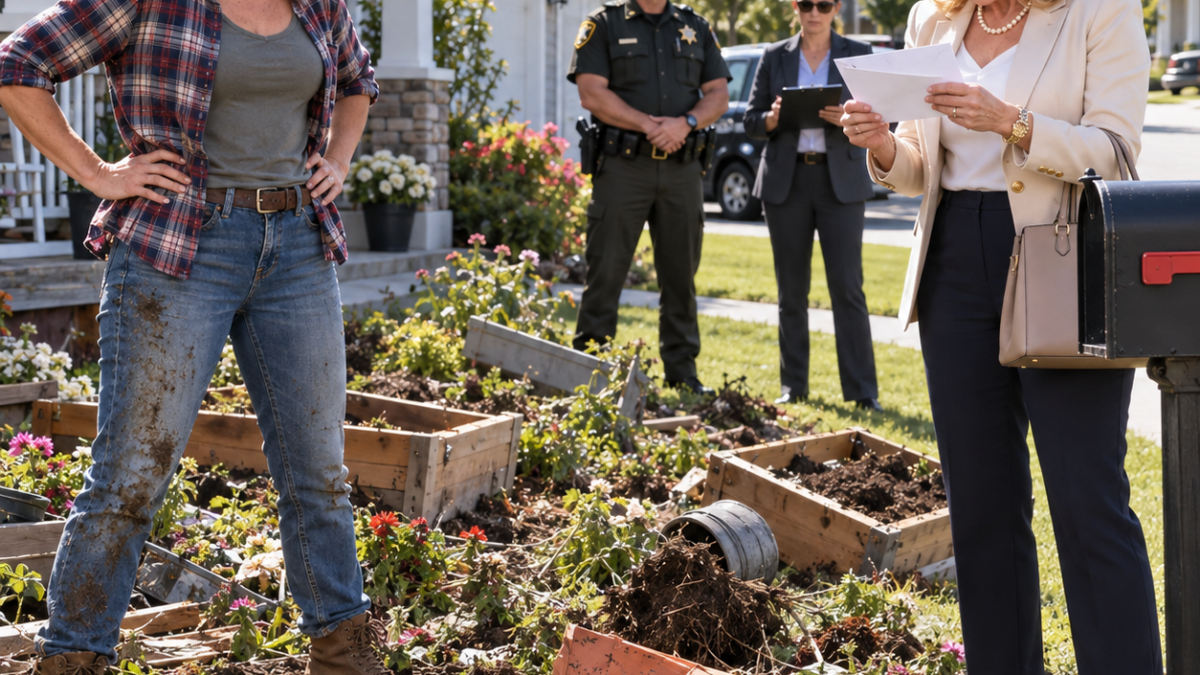
I came home from a five-day trip and found the garden my wife had spent her final summer designing scraped down to bare dirt.
The HOA president was standing across the street beside a landscaping truck, smiling as workers loaded my roses, native flowers, and the little cedar bench with my wife’s name carved underneath into a trailer like they were yard waste.
She thought she’d finally forced me to obey the neighborhood’s landscaping rules, but the envelope that arrived from the state twelve days later would make her sit down before she finished reading the first page.
My name is Daniel Mercer. I’m forty-seven years old, a civil engineer, a widower, and until that Monday afternoon I honestly believed I’d already learned everything grief could take from a man.
My wife, Claire, died from ovarian cancer three years earlier.
During the final good summer we had together, when she still had enough strength to spend mornings outside, she designed a garden along the back half of our property in Cedar Glen, a quiet planned neighborhood outside Raleigh, North Carolina.
Calling it a garden never really described what it was.
There were black-eyed Susans, coneflowers, native asters, switchgrass, milkweed, blueberries, two young dogwoods, and a shallow stone-lined rain basin that collected runoff from our roof and the uphill properties behind us.
Claire had studied every plant.
She wanted butterflies.
She wanted birds.
She wanted somewhere our daughter Lily could sit when college became too stressful.
And after Claire’s diagnosis turned terminal, she wanted one thing more.
“Promise me you won’t turn this place back into grass just because I’m not here to complain.”
I laughed when she said it.
Then I promised.
After she died, that garden became the only part of the house that didn’t feel empty.
Every spring, the milkweed came back.
Every June, monarchs appeared.
Every October, the asters bloomed so heavily that the whole back corner looked purple in the afternoon light.
Then Delaney Cross became HOA president.
Delaney was fifty-one, polished, wealthy, permanently dressed as if she were leaving a charity luncheon, and absolutely obsessed with what she called “visual continuity.”
Her first violation notice accused me of maintaining an overgrown landscape.
I responded with photographs, the approved site plan, and documentation showing that the garden had been installed through a state-supported watershed program.
She sent another notice.
Then another.
One cited “nonuniform vegetation.”
Another called Claire’s native grasses “weeds.”
The third demanded I replace the entire area with approved turf within thirty days.
I requested a hearing.
Delaney canceled it twice.
I requested mediation.
She ignored the email.
Then she appeared at my house one Saturday morning with two board members and pointed toward the garden.
“This isn’t a nature preserve, Mr. Mercer.”
“No,” I said. “It’s my backyard.”
“It affects neighboring property values.”
“It’s screened by my fence.”
“Standards are standards.”
I looked at her.
“My wife built that garden while she was dying.”
For half a second, I thought that might reach her.
It didn’t.
“I’m sorry for your loss,” she said. “But grief doesn’t create an exemption from community rules.”
Two weeks later, I flew to Nashville for Lily’s college ceremony.
I was gone five days.
My neighbor, seventy-year-old Ruth Alvarez, called me on the third morning.
“Daniel, are you sitting down?”
I wasn’t.
“What happened?”
“There are trucks at your house.”
My stomach tightened.
“What trucks?”
“Landscaping trucks.”
Then I heard machinery through her phone.
A skid steer.
I knew that sound.
“Ruth, go outside and record everything.”
“Daniel—”
“Please.”
By the time I reached the airport the next morning, she had sent me twenty-three videos.
Workers tearing out Claire’s flowers.
A man cutting down one of the dogwoods.
The rain basin being filled with topsoil.
The cedar bench thrown onto a trailer.
And standing beside the crew in white pants and dark sunglasses was Delaney Cross.
At one point Ruth confronted her from the sidewalk.
“You can’t do this.”
Delaney looked directly toward the camera.
“The association has the authority to correct violations when owners refuse compliance.”
Then she pointed toward my garden.
“By tomorrow, this eyesore will finally be gone.”
When I pulled into my driveway Monday afternoon, Delaney was waiting across the street.
She smiled.
I stepped out of my truck and looked at the brown rectangle where Claire’s garden had been.
Then I noticed something beside the exposed drainage pipe.
A metal marker the crew had uncovered but apparently hadn’t understood.
Stamped into it were six words Delaney had never bothered to research:
**STATE STORMWATER FACILITY — DO NOT DISTURB.**
PART 2
For several seconds, I couldn’t move.
The whole backyard looked wrong.
Not messy.
Not damaged.
Wrong.
The way a room looks after someone has died and strangers start carrying away the furniture.
Claire’s coneflowers were gone.
The asters were gone.
The milkweed she’d planted specifically for monarch butterflies was gone.
The blueberry bushes Lily had helped us put in when she was fourteen had been ripped out by the roots.
The two dogwoods had been cut almost flush with the ground.
And the shallow rain garden—the feature I’d spent months helping design with the county watershed office—had been filled with dirt until it was nearly level with the rest of the yard.
The cedar bench was gone too.
That bench hurt most.
I’d made it myself during Claire’s last winter.
Nothing fancy.
Three cedar planks.
Black iron legs.
A small brass plate underneath where nobody saw it unless they crouched down.
**CLAIRE MERCER
1978–2023
SHE MADE THINGS GROW**
I stood there staring at the place where it had been.
Then Delaney crossed the street.
Her heels clicked against the pavement.
She stopped at the edge of my driveway.
“I assume you saw the correction.”
I turned slowly.
“The correction?”
“The landscaping correction.”
I looked behind her.
Her white Lexus was parked at the curb.
Two HOA board members sat inside.
Watching.
“I want the name of the contractor.”
She sighed.
“Daniel, don’t start.”
“The contractor.”
“The association’s landscaping vendor.”
“Name.”
“GreenLine Property Services.”
I pulled out my phone.
She folded her arms.
“You were given repeated notices.”
“Who authorized entry onto my property?”
“The board.”
“Show me the vote.”
Her expression changed slightly.
“The association documents authorize corrective maintenance.”
“Show me the vote.”
“I don’t carry meeting minutes in my purse.”
I looked toward the destroyed garden.
“Did you tell them that rain basin was state-funded infrastructure?”
She laughed.
Not loudly.
Just a little dismissive breath.
“Daniel, it was a muddy hole surrounded by weeds.”
I stared at her.
“Did you tell them?”
“No.”
“Did you check?”
“I don’t need permission from the state to remove unapproved landscaping inside Cedar Glen.”
I looked at the metal marker.
She followed my eyes.
Her smile faded.
“What is that?”
I walked over and brushed soil from the plate.
The crew had exposed it when they graded the basin.
I read it aloud.
“State Stormwater Facility. Do Not Disturb.”
Delaney’s face didn’t change immediately.
Then she gave a little shrug.
“Old marker.”
“No.”
I crouched beside it.
“Installed four years ago.”
She looked at me.
“You never told the board this was state property.”
“It’s not state property.”
“Then it doesn’t matter.”
“It matters.”
“Why?”
I stood.
“Because this garden wasn’t decorative.”
For the first time, she stopped talking.
I continued.
“It was a permitted stormwater management system installed under the Upper Neuse Watershed Residential Mitigation Program.”
Her eyes narrowed.
“You’re making that up.”
“I’m a civil engineer, Delaney.”
“So?”
“So I designed part of it.”
That landed.
I watched uncertainty move across her face.
“The state paid sixty percent of the installation cost.”
She looked toward the dirt.
“And?”
“And in return, I signed a ten-year maintenance agreement.”
Her lips parted slightly.
“The basin collects runoff from six uphill lots and part of the HOA greenbelt before releasing filtered water into Cedar Creek.”
The silence between us changed.
I pointed toward the filled depression.
“You didn’t remove my garden.”
My voice was quiet.
“You destroyed a regulated stormwater facility.”
Delaney recovered quickly.
“Then you should have informed us.”
“I did.”
“No.”
“I sent the permit package with my original architectural request.”
She stared at me.
“That was years ago.”
“Correct.”
“Board members change.”
“Records don’t.”
She shook her head.
“This sounds like intimidation.”
“No.”
I put my phone away.
“This sounds like paperwork.”
Then I walked inside.
***
I locked the door.
Made it as far as the kitchen.
Then I broke.
Not because of Delaney.
Not because of the HOA.
Because Claire’s gardening gloves were still hanging beside the back door.
Blue canvas.
Dirty fingertips.
She’d written her name inside one cuff because I kept borrowing them.
I picked them up.
And suddenly I was forty-four again, standing beside her while she knelt in that rain garden wearing a sun hat too big for her head because chemotherapy had taken her hair.
She was planting milkweed.
I was telling her she should be resting.
She looked up at me and said, “I’m going to be dead a long time, Daniel. Let me garden while I’m alive.”
I sat on the kitchen floor with those gloves in my hands.
The grief came back as if three years hadn’t passed.
There are things people don’t understand about losing someone.
You don’t move on.
You build around the hole.
Eventually you learn where the edges are.
You learn how to walk through the house without falling into it every day.
That garden had been part of the structure I’d built around Claire’s absence.
Delaney hadn’t simply removed plants.
She had reached into the safest part of my grief and torn it apart because she didn’t like how native grasses looked from the sidewalk.
My phone rang.
Ruth.
I answered.
“Daniel?”
“I’m here.”
“Oh, honey.”
That almost broke me again.
“I recorded everything.”
“I know.”
“I’m sorry.”
“Not your fault.”
“She was laughing.”
I closed my eyes.
“I know.”
“I heard one worker ask if they should stop when they found a pipe. Delaney told him to keep going.”
My eyes opened.
“What pipe?”
“I don’t know. Gray PVC, maybe six inches.”
I stood.
“Did they damage it?”
“I couldn’t see.”
That mattered.
A lot.
The rain garden wasn’t just a depression full of plants.
Beneath it was an underdrain and overflow system connected to Cedar Glen’s stormwater network.
If they had crushed or blocked that line, the next heavy storm could push runoff somewhere it wasn’t supposed to go.
“Send me that video separately.”
“I will.”
Then Ruth hesitated.
“Daniel?”
“Yeah?”
“What are you going to do?”
I looked through the kitchen window at the brown scar behind my house.
“I’m going to make sure nobody can ever do this again.”
***
My first call was to the North Carolina Department of Environmental Quality regional office.
Not the HOA.
Not a lawyer.
The state.
I explained the situation to a watershed compliance coordinator named Angela Price.
She pulled the project number.
“Mercer residence?”
“Yes.”
“Installed 2022?”
“Correct.”
“Bioretention area with native planting and underdrain?”
“Correct.”
“Ten-year stewardship agreement?”
“Correct.”
Then she asked, “What happened?”
“The HOA removed it.”
Silence.
“Removed what?”
“Everything.”
Another pause.
“You mean vegetation?”
“And filled the basin.”
“Filled?”
“Yes.”
“Did they alter the overflow structure?”
“I don’t know yet.”
Her tone changed completely.
“Don’t excavate anything.”
“I won’t.”
“Do not attempt repairs until we inspect.”
“Understood.”
“Can you send photographs?”
“I have video of the demolition.”
“Send all of it.”
Then she asked the question that mattered.
“Did the HOA have written authorization from you or from the program administrator?”
“No.”
“Was there an emergency?”
“No.”
“Was the facility failing?”
“No.”
“Any state-approved modification?”
“No.”
Angela exhaled.
“All right.”
“How bad is this?”
“I need to inspect before making enforcement conclusions.”
Engineer answer.
Careful.
Precise.
The kind of answer I trusted.
“When?”
“Tomorrow morning.”
***
My second call was to a lawyer.
Her name was Maya Patel.
She’d handled construction-liability cases for my firm and had the rare ability to turn fury into organized paragraphs.
I told her everything.
When I finished, she said, “Do not speak to Delaney again without recording or witnesses.”
“North Carolina is one-party consent.”
“I know.”
“Good.”
“Do you have the HOA notices?”
“Every one.”
“Your architectural approval?”
“Yes.”
“State grant agreement?”
“Yes.”
“Maintenance covenant?”
“Yes.”
“Videos?”
“Twenty-three.”
“Excellent.”
“Excellent isn’t the word I’d use.”
“For litigation, Daniel, excellent is exactly the word.”
I almost smiled.
“What about the garden itself?”
“We’ll pursue restoration costs, trespass, conversion or property-damage theories as appropriate, and whatever else the evidence supports.”
“Conversion?”
“Your bench. Plants. Anything they removed and retained or disposed of.”
“They threw the bench in a trailer.”
“Then we find out where it went.”
I looked at Claire’s gloves on the table.
“Maya.”
“Yeah?”
“I don’t want money.”
“I know.”
“I want it restored.”
“We’ll make that the priority.”
“And Delaney?”
Maya paused.
“What about her?”
“I want consequences.”
“Then don’t help her escape them by giving her something reckless to use against you.”
I knew what she meant.
No angry emails.
No threats.
No Facebook war.
Evidence.
I could do evidence.
***
Angela arrived at eight the next morning.
State truck.
Orange vest.
Tablet.
No nonsense.
Her colleague, Marcus Bell, came with her.
They spent nearly three hours inspecting the site.
The more they looked, the quieter they became.
Marcus uncovered part of the overflow box.
“Compacted.”
Angela crouched beside him.
“How much?”
“Looks like they ran equipment over it.”
She photographed the damage.
Then they located the underdrain inspection port.
Cracked.
The outlet line itself appeared blocked with soil.
Angela stood.
“Who operated the skid steer?”
“I don’t know.”
“We’ll need contractor information.”
“I have it.”
She looked toward me.
“Good.”
Ruth came outside carrying coffee.
“I have video of everything.”
Angela looked at her.
“Everything?”
Ruth smiled.
“I am seventy years old and retired. I have time.”
That was the first time I’d laughed since coming home.
***
We watched Ruth’s footage on my television.
Video fourteen showed the moment the crew discovered the inspection port.
One worker shouted toward Delaney.
“There’s some drainage equipment here.”
Delaney walked over.
She looked directly at the pipe.
“What does it do?”
“Don’t know.”
“Can you remove it?”
The worker hesitated.
“Probably shouldn’t.”
Delaney pointed toward the garden.
“We were hired to clear all unauthorized materials.”
The worker said something I couldn’t hear.
Then Delaney replied clearly:
“The homeowner has ignored us for months. Take it out.”
Angela paused the video.
She rewound it.
Watched again.
Then wrote something on her tablet.
I looked at her.
“That bad?”
She stayed professional.
“It establishes notice that there was infrastructure present before work continued.”
Maya would later translate that sentence.
It was very bad.
***
By noon, the state had issued an immediate restoration directive requiring stabilization of the disturbed site.
Not full reconstruction yet.
First they needed to prevent erosion and uncontrolled runoff.
The contractor received notice too.
So did Cedar Glen HOA.
And because Delaney was president and the person who authorized the work, a certified copy went to her address.
That wasn’t the fine.
Not yet.
That came later.
The first letter simply told them that the state knew.
Delaney appeared at my door forty minutes after the mail carrier left.
I didn’t open it.
She rang again.
Then knocked.
“Daniel!”
I activated my doorbell camera.
“What do you need?”
She looked toward the lens.
“What exactly did you tell the state?”
“The truth.”
“They’ve issued some ridiculous environmental order.”
“I know.”
“This is your fault.”
I almost laughed.
“You entered my property.”
“You refused compliance.”
“You destroyed a permitted stormwater facility.”
“You never adequately disclosed that.”
“I have the approved HOA application.”
Silence.
Then:
“What application?”
“The one your architectural committee signed in 2022.”
Her face changed.
“Who signed it?”
“Previous president. Previous landscape chair. Management company.”
She looked away.
“Those records weren’t transferred properly.”
“That’s not my problem.”
“You deliberately let us make a mistake.”
That stunned me.
“Delaney.”
“What?”
“You sent contractors onto private property while I was out of town.”
“After multiple notices.”
“You ordered them to continue after they found drainage infrastructure.”
Her eyes flickered toward the camera.
She remembered Ruth’s phone.
“I wasn’t supervising technical work.”
“The video says otherwise.”
Then she made her second major mistake.
She stepped closer to the camera.
“If you think you’re going to bankrupt this neighborhood over some flowers your dead wife planted, you’re insane.”
Everything inside me stopped.
Not anger.
Something colder.
I said nothing.
Delaney realized too late what she’d said.
Her eyes moved toward the doorbell camera.
“That’s not what I meant.”
I still said nothing.
“Daniel.”
I ended the connection.
Then I saved the recording in three different places.
***
By evening, half the neighborhood knew something was happening.
Cedar Glen had one hundred and eighty-six houses and a private Facebook group that normally spent its energy arguing about trash pickup and teenagers driving golf carts.
That night, somebody posted a photograph of the state truck outside my home.
Delaney responded within seven minutes.
**The board is addressing a technical matter caused by an unapproved drainage feature installed by one homeowner. There is no risk to residents.**
I took a screenshot.
Then did nothing.
Ruth did.
She commented:
**The garden was approved. I watched the board’s contractor destroy it after workers warned the president about buried drainage equipment. I have video.**
Forty-three reactions in an hour.
Then questions.
Lots of them.
Was HOA money paying for the demolition?
How much?
Did the board vote?
Did the HOA insurance know?
Could residents be liable for state penalties?
Why was a memorial garden removed while the owner was away?
Then someone named Eric Madden posted:
**Wait. Daniel’s rain garden handles runoff from the upper cul-de-sac. My builder told us that when we purchased. What happens when it rains?**
Good question.
We found out two days later.
***
The forecast called for two inches overnight.
Normally, the bioretention area would have captured part of the runoff, held it temporarily, filtered it through engineered soil and plant roots, then released it gradually.
Now the basin was flat.
The outlet was partly obstructed.
At 1:18 a.m., my drainage alarm woke me.
I ran outside wearing boots and sweatpants.
Water was moving across the upper yard in sheets.
Instead of sinking into the rain garden, it crossed the freshly graded soil and ran toward the side fence.
Then it cut a channel.
Fast.
I called Angela.
She answered on the third ring.
“How high?”
“Surface flow over the south edge.”
“Any structure threatened?”
“Not mine yet.”
“Do not enter fast-moving water.”
“I know.”
“County emergency stormwater crew is being notified.”
Twenty minutes later, water crossed the rear corner of my property and moved toward the HOA walking path.
Then toward the clubhouse parking area downhill.
By dawn, six inches of muddy water covered part of the lot.
Nothing catastrophic.
No homes flooded.
But the message was obvious.
The garden Delaney called weeds had been doing work.
***
At seven-thirty, Delaney arrived furious.
She pointed at the muddy clubhouse lot.
“You did this.”
I was standing beside Angela.
That helped.
Angela turned.
“Mrs. Cross?”
Delaney stopped.
Angela introduced herself.
“State watershed compliance.”
Delaney immediately changed tone.
“Yes, I understand there’s been some confusion.”
“No confusion.”
Angela held up a tablet.
“The permitted stormwater feature on Mr. Mercer’s property was removed without authorization.”
Delaney looked at me.
“His private landscaping failed.”
Angela shook her head.
“The system didn’t fail.”
She pointed toward the bare yard.
“It was destroyed.”
The word hit harder coming from the state.
Destroyed.
Delaney folded her arms.
“We’re willing to repair whatever was accidentally damaged.”
Angela looked at her.
“That’s not your only issue.”
“What else?”
“Unauthorized disturbance of a funded stormwater control measure.”
Delaney’s face tightened.
“Which is?”
“An enforcement matter.”
“How serious?”
Angela gave the same careful answer she’d given me.
“That will be determined after review.”
Delaney looked suddenly less certain.
For the first time, I saw her understand that she wasn’t dealing with me anymore.
She was dealing with an agency whose rules did not care that she was HOA president.
***
The investigation widened.
The state requested the HOA’s records.
Board minutes.
Contracts.
Invoices.
Approval documents.
Emails.
Communications concerning my property.
Delaney initially produced only selected records.
That was a mistake.
One board member, Harold Price, contacted me privately.
He was sixty-four and had served as treasurer for two years.
“Daniel, can we talk?”
We met at a coffee shop outside Cedar Glen.
Harold looked exhausted.
“I didn’t vote to remove your garden.”
I studied him.
“Was there a vote?”
His silence answered.
“No.”
“Then who authorized the contractor?”
“Delaney.”
“Using HOA funds?”
He looked down.
“Yes.”
“How much?”
“Twelve thousand six hundred.”
My eyebrows went up.
“For one backyard?”
“She classified it as emergency landscape remediation.”
“Emergency?”
“I objected.”
“Why didn’t you stop payment?”
Harold rubbed his forehead.
“Because Delaney said counsel had approved it.”
“Did counsel?”
“I haven’t seen anything.”
I leaned back.
“What else should I know?”
He hesitated.
Then pulled a folder from his bag.
“She’d been planning this for months.”
Inside were emails.
One from Delaney to GreenLine:
**Homeowner will be out of state May 14–19. Preferred remediation window is during absence to avoid confrontation.**
I read it twice.
My stomach tightened.
This wasn’t an impulsive mistake.
She scheduled the destruction for when she knew I would be away.
Another email:
**Remove all nonconforming vegetation, wood furnishings, edging, and drainage-related materials not part of approved HOA standard landscape.**
Drainage-related materials.
She knew.
Not technically what they were.
But she specifically ordered their removal.
Then Harold showed me something else.
A preliminary landscaping proposal for the common area behind my house.
Expanded walking path.
Decorative lawn.
Possible gazebo.
The line crossed the back edge of my property on an outdated map.
I looked at him.
“She wanted the garden gone for this?”
“I don’t know.”
“Harold.”
He sighed.
“Delaney has been pushing to create what she calls the Cedar Glen Signature Greenway.”
I laughed without humor.
“And my property ruins the line.”
“Your garden doesn’t match the design.”
There it was.
Claire’s garden wasn’t just weeds.
It was in Delaney’s way.
***
When Maya saw the emails, she went silent.
That was when I knew we had something serious.
“Intentional trespass,” she said.
“Potentially.”
She looked at the state approval documents.
“Intentional property destruction.”
Then the email mentioning my travel.
“Planned to avoid you.”
She looked up.
“Daniel, this is significantly worse than an overzealous HOA enforcement mistake.”
“I know.”
“We send preservation notices immediately.”
“For what?”
“Every email, text, board record, contractor communication, insurance document, and financial record connected to you, the garden, GreenLine, the greenway, and state communications.”
I nodded.
Then asked the question I’d avoided.
“What about Claire’s bench?”
Maya’s expression softened.
“We’re looking.”
GreenLine claimed they’d transported debris to their yard before disposal.
Maya obtained an agreement preventing anything remaining from being destroyed.
Two days later, the owner called.
They found the bench.
One leg broken.
One cedar board cracked.
Mud across the seat.
But the brass plate was still underneath.
When I picked it up, I ran my fingers across Claire’s name.
The owner of GreenLine stood beside me.
His name was Thomas Greer.
He looked miserable.
“Mr. Mercer, I’m sorry.”
“You knew you were entering private property.”
“We were told the HOA had legal authority.”
“Your worker warned Delaney about the drainage system.”
Thomas nodded.
“He did.”
“And you kept going.”
His eyes dropped.
“Yes.”
“Why?”
“Because she said she had written authority.”
“Did you ask to see it?”
“No.”
I looked at him.
“Then don’t tell me you’re sorry like you had no choice.”
He nodded slowly.
“You’re right.”
That mattered.
Not because I wanted to humiliate him.
Because apologies without responsibility are just noise.
***
Seven days after the demolition, the state issued a formal notice of violation.
The document listed unauthorized disturbance of a permitted bioretention facility.
Damage to an underdrain component.
Failure to maintain required stormwater controls.
Unapproved grading affecting designated runoff flow.
Potential sediment discharge.
And failure to provide required notice before modification.
The HOA received it.
So did GreenLine.
The board called an emergency meeting that evening.
I attended.
First time in months they’d successfully scheduled a hearing when I was actually present.
The clubhouse was packed.
Delaney sat at the front beside the HOA attorney, a man named Steven Larkin.
Harold sat two chairs away from her.
He wouldn’t look at her.
Delaney called the meeting to order.
“This board has recently become aware of complications associated with Mr. Mercer’s backyard landscaping.”
Someone laughed.
Delaney ignored it.
“We are cooperating fully with state officials.”
Ruth raised her hand.
Delaney didn’t call on her.
Ruth spoke anyway.
“You told the workers to tear it out.”
Murmurs.
Delaney hit the gavel.
“Please follow procedure.”
Ruth smiled.
“You didn’t.”
That got applause.
Delaney’s face tightened.
Then she looked at me.
“Mr. Mercer, would you like to address the board?”
I stood.
“Yes.”
I carried three things.
Claire’s repaired bench plate.
The 2022 HOA approval.
And the state permit.
I placed them on the table.
“This is the application your association approved.”
Steven picked it up.
His expression changed as he read.
“This is signed.”
“Yes.”
“By the architectural chair.”
“Yes.”
“Management company too.”
“Yes.”
Delaney interrupted.
“That board no longer exists.”
I looked at her.
“The approval didn’t evaporate when officers changed.”
Several residents nodded.
Then I held up the state maintenance agreement.
“This garden was part of a permitted stormwater facility receiving public watershed funding.”
I pointed toward the windows.
“That facility handled runoff originating not only from my roof but from several uphill lots and portions of common area.”
A homeowner shouted, “Including mine?”
“Probably.”
I continued.
“The state has ordered restoration.”
Then I placed Claire’s brass plate on the table.
“This was attached to a bench the HOA removed from my property.”
The room quieted.
I read the inscription.
**SHE MADE THINGS GROW.**
I swallowed.
“My wife designed that garden while dying of cancer.”
Nobody moved.
“The board president knew that.”
Delaney looked away.
“She scheduled demolition while I was out of state.”
Murmurs spread.
“She used twelve thousand six hundred dollars of your association money to destroy an approved garden without a board vote.”
Now the room erupted.
Delaney struck the gavel.
“That characterization is inaccurate.”
Harold finally spoke.
“No.”
Everybody turned.
The treasurer stood.
“It’s accurate.”
Delaney stared.
“Harold.”
“There was no board vote.”
“Counsel advised—”
Steven Larkin interrupted.
“I did not authorize demolition.”
Silence.
It was one of those moments when a room changes shape without anyone moving.
Delaney turned toward him.
“We discussed enforcement options.”
“We discussed notices and mediation.”
Her face went pale.
Steven continued.
“I did not advise entry onto Mr. Mercer’s property or removal of state-regulated infrastructure.”
Someone whispered, “Oh my God.”
Harold opened his folder.
“I also have the email where Delaney scheduled the contractor during Daniel’s trip.”
The clubhouse exploded.
***
Residents weren’t angry because they all loved native plants.
Some hated my garden.
That was fine.
They were angry because twelve thousand six hundred dollars of their money had been spent without a vote on a demolition that now exposed the association to state penalties and a lawsuit.
Money has a remarkable ability to improve people’s interest in governance.
A man named Greg Wilson stood.
“Did our insurance approve this?”
Delaney answered too quickly.
“It’s covered.”
Steven looked at her.
“That hasn’t been determined.”
Another homeowner asked, “Will insurance pay state fines?”
“No,” Steven said.
That changed everything.
People began shouting.
“Then who pays?”
“Us?”
“How much?”
Delaney struck the gavel again.
“The state hasn’t issued a monetary penalty.”
Not yet.
I said nothing.
Because I knew Angela’s office was still calculating restoration costs and statutory penalties.
And Delaney didn’t know the worst part.
The state wasn’t evaluating only the garden.
After the storm event, inspectors reviewed the wider Cedar Glen drainage system.
They discovered the HOA had been discharging runoff from a newer clubhouse parking expansion into the same network without updating its stormwater documentation.
That wasn’t my doing.
But destroying my garden had exposed it.
Sometimes when you kick down one door, you discover the whole house has problems.
***
Two days later, Cedar Glen received a second state notice.
The expanded review required engineering plans for the clubhouse runoff.
Drainage records for three common areas.
Maintenance logs.
Erosion-control documentation.
Delaney sent an email blaming me.
She wrote:
**Because one resident escalated a private landscaping disagreement to state authorities, Cedar Glen now faces unnecessary regulatory review.**
I didn’t answer.
Ruth did.
**The state is reviewing us because you bulldozed state-funded drainage infrastructure.**
Thirty-eight likes.
Delaney deleted the thread.
Screenshots survived.
Of course they did.
***
Then came the certified envelope.
Twelve days after I returned home.
Ruth called me at 11:20 in the morning.
Her voice was barely controlled.
“Daniel.”
“What?”
“Delaney just got certified mail.”
“Okay.”
“State letterhead.”
I smiled despite myself.
“Ruth.”
“What?”
“Stop watching her mailbox.”
“I am watering roses.”
“Her mailbox is across the street.”
“I have excellent peripheral vision.”
Twenty minutes later, Maya called.
“Enforcement order issued.”
I sat up.
“How much?”
“Administrative civil penalty to Cedar Glen HOA: eighty-six thousand four hundred dollars.”
I didn’t speak.
“Daniel?”
“I’m here.”
“Separate restoration obligations.”
“How much restoration?”
“Engineering estimate currently around forty thousand, depending on final design and monitoring.”
I leaned back.
“One hundred twenty-six thousand.”
“Potentially more, including legal costs.”
I thought about Delaney dismissing the garden as weeds.
“Who is legally responsible for the penalty?”
“The HOA received it. Allocation within the association and claims against individual decision-makers are separate questions.”
“So homeowners might pay?”
“Possibly, unless insurance, indemnity, recovery from responsible parties, or other arrangements apply.”
That ruined the satisfaction immediately.
I didn’t want Ruth paying for Delaney’s arrogance.
Or Eric.
Or families who had nothing to do with this.
“Can the association pursue Delaney personally?”
“Potentially, depending on governing documents, fiduciary duties, insurance exclusions, and evidence of unauthorized conduct.”
“Then that’s what I want.”
Maya paused.
“You don’t control the association’s claims.”
“I know.”
“But you can present evidence.”
“I have plenty.”
***
Ruth called again.
This time she whispered.
“You need to look outside.”
I walked to my front window.
Delaney stood beside her mailbox.
White envelope in one hand.
Phone in the other.
She wasn’t moving.
Just staring at the pages.
Then she sat down on the curb.
Actually sat.
The woman who never appeared outside without perfect posture was sitting on asphalt in designer pants.
Her husband came out.
She handed him the letter.
He read.
His face changed.
Then he looked toward my house.
I stepped away from the window.
I had imagined enjoying that moment.
Instead, I felt tired.
Claire was still dead.
The garden was still gone.
A fine wasn’t going to bring either back.
But consequences mattered.
Especially when someone had been repeatedly warned and chose power over caution.
***
That evening, another emergency meeting was announced.
This one wasn’t called by Delaney.
Residents had collected enough signatures under the bylaws to demand it.
The subject line:
**REMOVAL OF PRESIDENT / FINANCIAL LIABILITY / SPECIAL ASSESSMENT PREVENTION**
The clubhouse was so crowded people stood outside.
Delaney arrived with her husband.
No gavel.
No attorney beside her.
Steven sat with the board separately.
Harold opened the meeting.
“We’re here because the association has received an $86,400 civil penalty from the state, along with a mandatory restoration order.”
Angry voices rose.
He continued.
“The board’s current estimate of total exposure, excluding Mr. Mercer’s civil claims, exceeds one hundred thirty thousand dollars.”
A woman near the front shouted, “Are we paying this?”
Harold looked toward the board.
“That’s one of the issues we must decide.”
Delaney stood.
“This penalty is excessive and will be appealed.”
Steven spoke carefully.
“An appeal is possible. Success is not guaranteed.”
Delaney turned toward residents.
“Daniel Mercer deliberately involved regulators rather than resolving a simple dispute with the association.”
I stood.
This time people made room before I even asked.
I walked to the front.
“Delaney.”
She glared.
“You keep saying I did this to the HOA.”
“You reported us.”
“I reported destroyed state infrastructure on my property.”
“You could have come to me first.”
I laughed once.
“I did.”
The room became quiet.
“I requested a hearing.”
I held up an email.
“Canceled.”
Another.
“Mediation.”
Another.
“I asked for an extension.”
Another.
“I sent you the permit.”
I put the papers down one by one.
“You ignored all of it.”
She said nothing.
“You waited until I was out of state.”
I placed Harold’s email printout on the table.
“You chose the demolition date because you knew I wouldn’t be home.”
Someone shouted, “Is that true?”
Delaney looked toward Steven.
He didn’t save her.
I continued.
“Your contractor warned you about drainage equipment.”
I turned toward the screen.
Ruth’s video played.
**There’s some drainage equipment here.**
Delaney’s recorded voice:
**Take it out.**
The room erupted.
I stopped the video.
“That’s why the state fined this association.”
Delaney’s face was red.
Then I said the thing that mattered.
“But I don’t believe innocent homeowners should pay for a decision they never approved.”
The room quieted again.
“I will support any lawful effort by this association to recover costs from the people and companies responsible for unauthorized destruction.”
Harold nodded.
“So will I.”
Another board member raised her hand.
Then another.
Delaney stared around the room.
For years, she’d treated the HOA presidency like ownership.
Now every vote she ignored was returning at once.
***
The removal vote was overwhelming.
Delaney lost the presidency that night.
One hundred twelve votes for removal.
Nine against.
Seven abstentions.
The rest of eligible members voted by proxy or did not participate.
Harold became interim president only long enough to organize a full election.
The first motion under temporary leadership was to prohibit any special assessment related to the garden penalty until the association completed claims against GreenLine, Delaney, and applicable insurance policies.
The second required independent counsel.
The third opened all board financial records to members.
The fourth rescinded every unresolved landscaping violation issued against my property.
Nobody applauded that one.
They didn’t need to.
I just sat there.
Three years earlier, Claire had asked me to promise I wouldn’t turn her garden back into lawn.
For twelve days, Delaney had succeeded in doing exactly that.
Now, for the first time since coming home, I believed I could keep my promise.
***
The civil case moved quickly once the videos and emails surfaced.
GreenLine’s insurer entered negotiations.
The company acknowledged its crew had continued after discovering infrastructure.
Delaney’s directors-and-officers insurer disputed coverage because she had allegedly acted outside board authorization.
That created another fight.
Not mine.
Maya handled it.
The state required a licensed engineer to produce restoration drawings.
I refused to design them myself.
Too personal.
Instead, Angela recommended an independent firm.
They recreated the original bioretention geometry, improved the overflow protection, and designed restoration around Claire’s original planting list.
When I saw the plan, I had to leave the meeting.
The planting schedule included:
Purple coneflower.
Butterfly weed.
Swamp milkweed.
Little bluestem.
Black-eyed Susan.
New England aster.
Blueberry.
Native sedges.
Two dogwoods.
Almost exactly what Claire had chosen.
Rosa—sorry, Angela—noticed my face.
“You okay?”
“Yeah.”
“Need a minute?”
“Maybe five.”
I stepped outside.
Maya followed.
“You don’t have to watch every part of this.”
“I know.”
“You don’t have to supervise grief like a construction project.”
That sounded like something Claire would’ve said.
I looked toward Maya.
“Did my wife talk to you from beyond the grave?”
“No.”
“Because that’s very much her tone.”
Maya smiled.
“Then she was smart.”
“Annoyingly.”
***
The first restoration day came in September.
I expected contractors.
Instead, thirty-seven neighbors showed up.
Ruth brought coffee.
Eric brought wheelbarrows.
Harold came in old jeans.
Families brought children.
Even GreenLine sent a crew at no charge as part of its settlement obligations.
Thomas Greer walked over before work began.
“I wanted to tell you again.”
I looked at him.
“We should’ve stopped.”
“Yes.”
“We’ve changed our policy. No HOA corrective entry without written owner authorization, court order, or documented emergency authority reviewed by counsel.”
“Good.”
He looked toward the site.
“We found your wife’s bench.”
“I know.”
“I repaired the leg personally.”
That surprised me.
“Thank you.”
“I’m sorry we broke it.”
This time, the apology felt different.
Because he’d done something after saying it.
I nodded.
“Let’s build the garden.”
***
Lily came home from Nashville for the weekend.
She stood at the edge of the yard holding Claire’s old planting notebook.
Her mother’s handwriting filled the pages.
Tiny sketches.
Plant combinations.
Notes about bloom seasons.
One page had a coffee stain.
Another had a line written in the margin:
**More milkweed. Daniel will complain. Ignore Daniel.**
Lily laughed when she read it.
“I forgot Mom wrote this.”
“I didn’t.”
“Did you complain?”
“Constantly.”
“She ignored you?”
“Constantly.”
We planted together.
At one point Lily stopped.
“Dad.”
“Yeah?”
“Why didn’t you tell me how bad this got?”
“You had finals.”
She stared at me.
“Dad.”
I knew that tone.
“I’m your daughter.”
“I know.”
“You don’t have to protect me from every sad thing.”
I looked down at the shovel.
“Kind of feels like my job.”
“No.”
She stepped closer.
“Your job is letting me be part of the family.”
That hit.
Hard.
“I’m sorry.”
She hugged me.
Then whispered, “Mom would’ve destroyed that HOA lady.”
I burst out laughing.
“Your mother once called customer service three times over a defective blender.”
“Exactly.”
We laughed so hard Ruth came over to check on us.
For a few minutes, the garden felt like Claire was there.
Not as a ghost.
As influence.
The way she still shaped the people who loved her.
***
We rebuilt the cedar bench last.
I could’ve replaced it.
Instead, I repaired the original boards.
The crack remained visible.
I filled it but didn’t hide it completely.
Lily ran her fingers over the line.
“You could sand this smoother.”
“I know.”
“Why didn’t you?”
I looked at the scar in the wood.
“Because it happened.”
She nodded.
We turned the bench over.
The brass plate was scratched but readable.
**CLAIRE MERCER
1978–2023
SHE MADE THINGS GROW**
Lily touched her mother’s name.
Then she cried.
So did I.
We sat on the unfinished bench in the middle of the half-planted garden and let everyone work around us.
Nobody tried to comfort us.
That was kind.
Sometimes grief doesn’t need fixing.
It needs room.
***
By October, the state approved the restored system.
The underdrain was repaired.
The basin profile restored.
New monitoring markers installed.
A larger metal plaque went near the fence:
**PERMITTED STORMWATER CONTROL MEASURE
MODIFICATION REQUIRES PRIOR AUTHORIZATION**
Ruth loved it.
“Can we make the letters bigger?”
“No.”
“Maybe flashing lights?”
“No.”
“Electric fence?”
“Absolutely not.”
She looked disappointed.
***
The financial consequences landed over the following months.
GreenLine’s insurer funded a significant portion of restoration and property-damage costs.
The HOA pursued recovery connected to Delaney’s unauthorized actions.
Her D&O coverage dispute ended in a negotiated contribution.
Delaney personally agreed to repay part of the association’s uninsured losses rather than face broader fiduciary litigation.
The $86,400 state penalty was reduced modestly after cooperation, restoration, and compliance measures, but it did not disappear.
The final amount still hurt.
Importantly, the reformed board structured recovery so ordinary homeowners avoided the massive special assessment they had feared.
That mattered to me more than watching Delaney suffer financially.
I’d never wanted Ruth losing grocery money because Delaney couldn’t distinguish leadership from control.
***
The state investigation also uncovered issues unrelated to my garden.
The clubhouse parking expansion had altered runoff patterns without proper documentation.
Several common-area drainage features had been neglected.
Maintenance logs were incomplete.
The new board addressed them.
Not glamorous work.
No viral videos.
No dramatic confrontations.
Engineers.
Inspectors.
Invoices.
Actual governance.
Funny how boring competence becomes beautiful after chaos.
***
Delaney put her house up for sale the following spring.
I learned from Ruth, naturally.
“I am not spying,” she insisted.
“You know the listing price.”
“It’s on the internet.”
“You know they had three showings Tuesday.”
“The cars blocked my hydrangeas.”
“Ruth.”
“What?”
I smiled.
“Never change.”
One afternoon, Delaney came to my house.
Alone.
No designer sunglasses.
No board folder.
She stood on the walkway.
I opened the door but stayed inside.
“What do you need?”
She looked toward the backyard.
“Can I see it?”
“The garden?”
She nodded.
I considered saying no.
Then stepped outside.
We walked around the house.
The garden was blooming.
Young plants, but healthy.
A monarch floated above the milkweed.
Delaney stopped when she saw the bench.
Her face changed.
“I didn’t know.”
I looked at her.
“You did.”
She shook her head.
“I knew your wife had planted it. I didn’t understand what it meant.”
“That’s different.”
She looked down.
“Yes.”
We stood quietly.
Then she said, “I’m leaving Cedar Glen.”
“I heard.”
“Of course you did.”
“Ruth.”
That almost made her smile.
Then she looked toward the stormwater plaque.
“I really thought the HOA had authority.”
“You had authority.”
She looked at me.
“Limited authority.”
I continued.
“That’s the part you forgot.”
She nodded.
“I thought if people were allowed exceptions, everything would start looking messy.”
I looked around.
Bees moved between coneflowers.
Sedges bent in the breeze.
Blueberries filled one corner.
“Does this look messy?”
“No.”
Her eyes filled.
“It looks beautiful.”
I didn’t say anything.
“I was wrong.”
“Yes.”
“I hurt you.”
“Yes.”
“I don’t expect you to forgive me.”
“Good.”
She looked surprised.
I wasn’t trying to be cruel.
I was being truthful.
Forgiveness isn’t a receipt someone gets because they finally admit what happened.
I continued.
“I hope you learn from it.”
She nodded.
Then she looked at Claire’s bench.
“Can I ask you something?”
“What?”
“Why didn’t you try to bankrupt me?”
I almost laughed.
“You think I didn’t have moments when I wanted to?”
She looked embarrassed.
“I probably deserved it.”
“Maybe.”
I looked toward Ruth’s house.
Then the other homes.
“But revenge doesn’t happen in isolation.”
She waited.
“If I’d pushed the HOA into bankruptcy, neighbors who never voted for your decision would’ve paid.”
I looked at her.
“You already taught me what it looks like when someone hurts other people because they believe their own goal matters more.”
Her eyes dropped.
“I didn’t want to become you.”
That one hurt her.
I saw it.
But it was true.
***
Before leaving, Delaney stopped beside the gate.
“For what it’s worth…”
She turned.
“I’m sorry about Claire.”
I looked at the garden.
“So am I.”
Then she left.
No dramatic humiliation.
No police.
No screaming.
Just a woman walking away from a neighborhood she once controlled.
Sometimes losing power is quieter than gaining it.
***
Cedar Glen elected a new board that fall.
Harold refused to run for president.
“Absolutely not,” he told everyone.
Ruth immediately nominated him.
He nearly left the room.
Eventually, a pediatrician named Monica Reyes became president.
Her first meeting lasted forty-eight minutes.
No speeches.
No threats.
No theatrics.
She approved minutes.
Reviewed finances.
Scheduled storm-drain maintenance.
Then asked if anyone had new business.
Ruth raised her hand.
“We should have a pollinator garden tour.”
Monica looked at me.
“Daniel?”
I sighed.
“Fine.”
That’s how Claire’s garden became an annual neighborhood event.
***
The first Cedar Glen Pollinator Day drew more than a hundred residents.
Kids painted flowerpots.
A state biologist gave a talk about monarch migration.
Angela explained rain gardens and runoff.
I gave the shortest speech possible.
Then Ruth took the microphone away because apparently I was “emotionally constipated.”
Her words.
Not mine.
Lily came down from Nashville.
She stood beside the bench.
A little girl asked her who Claire was.
“My mom.”
“Did she make this whole garden?”
“She started it.”
The girl looked around.
“Why?”
Lily smiled.
“Because she liked things that came back.”
I had to walk away.
There are sentences your children say that reveal they understand their parents better than you expected.
That was one.
Claire loved perennials because they returned.
Even after winter.
Especially after winter.
***
Two years after the demolition, the garden looked stronger than before.
The new dogwoods reached above the fence.
Milkweed multiplied.
Butterflies returned.
The rain basin worked exactly as intended.
After heavy storms, water pooled for a few hours, then slowly disappeared into soil and underdrain.
No clubhouse flooding.
No erosion.
No drama.
Just good design doing its job.
Sometimes I’d stand there after rain and think about how Delaney called it a muddy hole.
People often destroy things they don’t understand because they mistake unfamiliarity for uselessness.
Native plants looked disorderly to her.
Grief looked like weakness.
My refusal looked like disobedience.
Regulation looked like something she could outrank.
She was wrong about all four.
***
The state fine became neighborhood legend.
New residents would eventually hear some version.
“Didn’t an old HOA president get fined eighty grand for removing somebody’s flowers?”
I’d usually correct them.
“It wasn’t for flowers.”
They’d look confused.
“It was for destroying regulated stormwater infrastructure.”
Less exciting.
More accurate.
Ruth preferred the first version.
“HOA Karen bulldozed widower’s garden and got an eighty-six-thousand-dollar love letter from the state.”
I told her she’d spent too much time online.
She said I sounded old.
She’s seventy-two now.
I stopped arguing.
***
One April morning, I found Lily sitting on Claire’s bench.
She had graduated.
Moved back closer to Raleigh.
Started working for a nonprofit that built community gardens in neighborhoods with limited access to fresh food.
I brought her coffee.
She looked around.
“You know this ruined regular gardens for me.”
“What?”
“Everything else feels boring.”
“Your mother would consider that a success.”
Lily smiled.
Then she looked at the brass plate.
“I’m glad you kept the old bench.”
“So am I.”
“The crack too.”
I nodded.
She touched the repaired wood.
“It looks better like this.”
“Scarred?”
“Real.”
We sat quietly.
A monarch floated past.
Lily watched it.
Then she asked, “Do you still hate Delaney?”
I thought about it.
“No.”
“Really?”
“No.”
“Why?”
“Hate’s expensive.”
She laughed.
“That sounds like Grandpa.”
“Probably where I stole it.”
I looked toward the flowers.
“I hated her for a while.”
“What changed?”
“Everything she took came back.”
Lily considered that.
“The dogwoods aren’t the same.”
“No.”
“Mom isn’t coming back.”
“No.”
The word hurt.
Still.
Always.
“But the garden came back,” she said.
“Yeah.”
“And better.”
I smiled.
“Yeah.”
She rested her head against my shoulder.
“Then maybe that’s enough.”
***
That afternoon, Angela stopped by for the final monitoring inspection required under the restoration agreement.
She checked infiltration.
Vegetation coverage.
Overflow.
Underdrain performance.
Then she closed her tablet.
“Passed.”
“That’s it?”
“That’s it.”
“After all this?”
“What were you expecting?”
“Trumpets.”
She laughed.
“Government doesn’t budget for trumpets.”
She handed me the final compliance letter.
I looked at it.
Two years earlier, state letters had represented enforcement.
Penalties.
Damage.
Now this one said the system was restored.
Complete.
Healthy.
I carried it inside.
Placed it beside Claire’s planting notebook.
Then thought better of it.
I framed it.
Ruth saw it later.
“You framed a stormwater compliance letter?”
“Yes.”
“That might be the most engineer thing you’ve ever done.”
“Thank you.”
“That wasn’t praise.”
“I accepted it anyway.”
***
Cedar Glen changed in small ways.
Residents planted more native landscapes.
Not because the HOA required them.
Because people had seen mine.
The new guidelines allowed meadow sections, pollinator strips, vegetable beds, rain gardens, and other environmentally useful designs with reasonable maintenance standards.
People still argued.
One man wanted a twelve-foot metal sculpture in his front yard.
The board said no.
He threatened constitutional litigation.
So Cedar Glen remained Cedar Glen.
But nobody entered private property to “correct” a garden again.
The bylaws were amended.
No self-help landscaping enforcement except true emergencies involving immediate safety threats.
Written notice.
Hearing rights.
Board vote.
Legal review.
And when property contained regulated infrastructure, coordination with the appropriate agency.
Boring.
Procedural.
Exactly the point.
***
Sometimes people ask whether I consider what happened revenge.
I understand why.
Delaney destroyed Claire’s garden.
Twelve days later an $86,400 state penalty arrived.
She lost the presidency.
The association pursued recovery.
She eventually sold her home.
The garden returned.
From the outside, it reads like perfect revenge.
But when you’ve actually lived something like that, revenge isn’t the part you remember at three in the morning.
I remember coming home and seeing bare dirt.
I remember holding Claire’s gloves on the kitchen floor.
I remember Lily touching her mother’s name beneath a broken bench.
I remember Ruth standing outside with her phone because she refused to let someone else’s power erase the truth.
I remember neighbors carrying shovels.
I remember planting milkweed with my daughter.
Those are the pieces that stayed.
Not the fine.
Not Delaney’s expression when she opened the letter.
Not even the removal vote.
The rebuilding.
That’s what mattered.
***
On the third anniversary of Claire’s death, Lily and I sat in the garden just before sunset.
She brought two glasses of lemonade.
Claire used to make it too sour.
Lily apparently inherited that defect.
I took one sip.
“Jesus.”
She laughed.
“Mom’s recipe.”
“Your mother hated sugar.”
“Exactly.”
We sat on the cedar bench.
The repaired crack ran between us.
Birds moved through the dogwoods.
Bees worked the coneflowers.
Stormwater from an afternoon shower still shimmered in the shallow basin.
Claire would’ve loved it.
That thought no longer destroyed me.
It still hurt.
But hurt and love had finally learned how to occupy the same place.
Lily raised her glass.
“To Mom.”
I lifted mine.
“To Mom.”
Then she smiled.
“And to the eighty-six-thousand-dollar garden.”
I nearly spit out the lemonade.
“Do not call it that.”
“Ruth does.”
“Ruth is a menace.”
“Ruth is a legend.”
Hard to argue.
***
After Lily left, I stayed outside.
Sunset turned the garden orange.
The same light Claire used to chase with her camera.
I walked toward the rain basin and pulled one weed.
Then another.
I heard her voice in memory.
*Don’t turn it back into grass.*
I smiled.
“Still haven’t.”
Wind moved through the switchgrass.
The sound was soft.
Almost like water.
I looked toward the place where Delaney once stood watching contractors destroy everything.
If you’d asked me that day what justice looked like, I would’ve said punishment.
A fine.
A lawsuit.
Removal.
Something that hurt enough to match what I felt.
I know better now.
Punishment mattered.
Accountability mattered.
But justice wasn’t the letter Delaney opened beside her mailbox.
Justice was the restored soil under my boots.
It was monarch eggs on the milkweed.
It was runoff being filtered before reaching Cedar Creek.
It was a neighborhood learning that leadership doesn’t mean ownership.
It was my daughter coming home and sitting where her mother once sat.
It was Claire’s bench, repaired instead of replaced.
A visible crack running through the cedar.
Proof that broken didn’t always mean finished.
***
The next spring, a storm rolled through Cedar Glen just after midnight.
Three inches of rain in less than two hours.
Years earlier, that would’ve worried me.
I put on boots and went outside.
The rain garden was full.
Exactly as designed.
Water from uphill lots flowed into the basin.
Native grasses bent but didn’t break.
The overflow structure handled the peak.
The underdrain released water gradually.
No erosion.
No flooding.
No clubhouse parking lot covered in mud.
I stood under the porch roof watching.
Ruth texted.
**IS THE FAMOUS GARDEN SAVING US AGAIN?**
I answered:
**GO TO BED.**
She replied:
**THAT’S A YES.**
I laughed.
Then lightning illuminated the flowers.
For one bright second, the whole garden appeared silver.
I thought about all the people who once called it weeds.
All the notices.
All the hearings Delaney canceled.
All the reasons she gave for why it didn’t belong.
Yet there it was.
Doing exactly what Claire and I had designed it to do.
Holding water.
Protecting homes.
Giving birds and butterflies somewhere to live.
Returning every spring.
***
By morning the storm had passed.
I walked through wet grass carrying coffee.
A few flowers leaned sideways.
Nothing serious.
I straightened one.
Then sat on Claire’s bench.
My phone buzzed.
A message from Monica, the HOA president.
**No drainage incidents reported. Thanks again for maintaining the basin.**
Five years earlier, an HOA president had called the same basin a violation.
Now the HOA thanked me for it.
Funny how much can change when people replace certainty with understanding.
I looked at Claire’s brass plate.
**SHE MADE THINGS GROW.**
For years I assumed those words described flowers.
Now I realized they described people too.
Claire made Lily grow brave.
She made me grow patient.
Even after she was gone, the garden made a neighborhood grow wiser.
And, in a strange way, Delaney helped too.
Not intentionally.
But by trying to erase something she didn’t understand, she forced all of us to understand why it mattered.
***
I still have the photograph Ruth took the day Delaney received the state letter.
Not because I enjoy looking at her shock.
I don’t.
The picture shows Delaney standing beside her mailbox holding the envelope.
In the background, barely visible across the street, is my backyard.
Bare dirt.
Nothing growing.
That’s why I kept it.
Beside that photograph, I keep another one taken two summers later.
Same angle.
Same street.
But behind me, the garden is exploding with purple, yellow, green, and white.
Dogwoods leafed out.
Butterflies above the milkweed.
Lily sitting on Claire’s bench.
Ruth waving from the sidewalk because apparently subtlety has never interested her.
Two photographs.
One after destruction.
One after restoration.
If I ever forget what happened, I don’t look at the fine.
I look at those.
Because the best part of the story was never watching Delaney freeze when the state penalty arrived.
The best part was watching everything she tried to erase return.
***
Some people still call what I did revenge.
Maybe there was a little revenge in refusing to protect Delaney from consequences.
I’m human.
When Maya told me the amount—eighty-six thousand four hundred dollars—I won’t pretend I felt nothing.
For one brief moment, I remembered Delaney standing beside those landscaping trucks.
I remembered her telling Ruth that the eyesore would finally be gone.
I remembered her saying grief didn’t exempt me from standards.
And yes, part of me thought:
**Now read your own notice.**
But that feeling lasted seconds.
What stayed was something calmer.
A sense that power had finally encountered a boundary.
Not my anger.
Not my threat.
A boundary written into law.
That’s what Delaney never understood.
Rules don’t exist only for homeowners.
They bind boards too.
Permits bind presidents.
Property rights bind committees.
Environmental protections bind people who dislike how native grass looks.
Authority has edges.
And once Delaney crossed them, the title on her HOA email signature couldn’t save her.
***
Today, the garden is five years old in its restored form.
Lily got married there last October.
Small ceremony.
Thirty people.
No elaborate venue.
No hotel ballroom.
Just family beneath the dogwoods.
Ruth cried before anyone else.
Monica brought flowers from her own native garden.
Harold handled chairs.
Even Thomas Greer, the contractor who demolished the original garden, sent a cedar planter as a wedding gift.
Inside it he planted milkweed.
His card said:
**For what should have been protected the first time.**
I kept that card.
During the ceremony, Lily left one chair empty beside mine.
Claire’s chair.
On it she placed her mother’s gardening gloves.
Blue canvas.
Dirty fingertips still stained from years ago.
When I saw them, I stopped breathing.
Lily took my arm.
“You okay?”
“No.”
She smiled through tears.
“Me neither.”
We walked anyway.
That’s what families do.
You walk with the absence.
You don’t pretend it isn’t there.
***
After the wedding guests left, I sat alone on Claire’s bench.
String lights glowed above the garden.
The rain basin reflected small pieces of light.
The brass plate beneath me was still scratched from the demolition.
I ran my fingers across the repaired cedar.
For years, I thought keeping my promise to Claire meant protecting every plant exactly as she left it.
I was wrong.
Plants die.
Trees break.
Storms come.
People make terrible decisions.
Nothing living stays unchanged.
Keeping the promise meant something else.
It meant refusing to let destruction become the final version of the story.
Delaney tore the garden out.
We planted again.
She filled the rain basin.
We dug it back.
She broke the bench.
We repaired it.
She called native flowers weeds.
Children now come here to learn their names.
She tried to use an HOA rule to erase Claire’s final project.
Instead, the garden became permanently protected, documented, and understood by an entire community.
I looked across the flowers.
“Not bad, Claire.”
The night was quiet.
Then a breeze moved through the grasses.
I smiled.
“I know. More milkweed.”
***
People think the most satisfying ending is that Delaney received an $86,400 state fine in the mail.
I understand why.
She destroyed something precious.
Then an authority bigger than hers arrived with consequences she couldn’t dismiss.
But that’s not the ending I carry with me.
The ending is this:
The HOA didn’t take the garden.
Not permanently.
Delaney didn’t erase Claire.
Nobody could.
And I didn’t have to destroy anyone to defend what mattered.
I documented.
I called the right people.
I let the truth become more expensive than the lie.
Then I rebuilt.
Today, when I sit beneath the dogwoods and watch monarch butterflies land on the milkweed Claire insisted we plant, I rarely think about Delaney Cross.
I think about my wife kneeling in the dirt with a ridiculous sun hat on her head.
I think about Lily laughing beside her.
I think about the promise I made.
And I think about the lesson Cedar Glen learned the hard way:
**Never mistake something you don’t understand for something that has no value.**
The garden wasn’t weeds.
The rain basin wasn’t a hole.
My grief wasn’t weakness.
And an HOA presidency was never permission to enter someone’s property and destroy what they loved.
Delaney learned that from the state.
I learned something better from Claire.
Things can be cut down.
Dug up.
Broken.
Buried.
Even reduced to bare earth.
But if the roots are deep enough—and if people care enough to plant again—
**they come back.**
And every spring, when Claire’s garden blooms brighter than it did before, that’s the only revenge I need.
**THE END.**








