PART 2: HOA Karen Built a $1 Million Clubhouse on My Land—Then Her $480,000 Demolition Bill Exposed the Lie That Destroyed Her
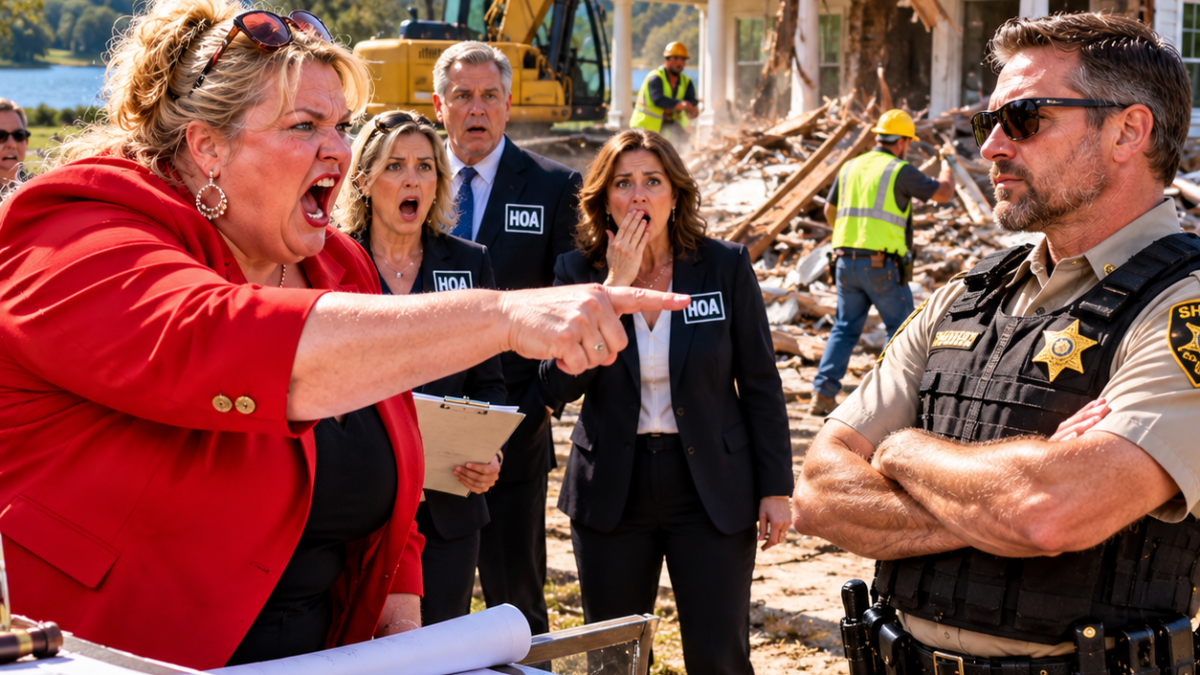
PART 2
My family purchased those fourteen acres decades before Silver Creek Estates existed.
Back then, the western edge of the county was farmland, wooded parcels, gravel roads, and small family businesses.
There were no decorative stone entrances.
No security patrols.
No homeowners association issuing fines because somebody’s grass was an inch too tall.
Just ordinary people trying to make a living on land they owned.
My father kept the property as a working parcel.
After he retired, I used most of it for my excavation and demolition company.
I had a gravel equipment yard, a modest office, two storage buildings, and enough room to park excavators, loaders, trailers, and dump trucks without crowding my neighbors.
I wasn’t wealthy.
Construction work has good years and bad years.
Equipment breaks.
Fuel prices rise.
Customers delay payments.
And every time you think the business is finally getting ahead, somebody brings you a machine that needs twenty thousand dollars in repairs.
But I’d built something stable.
I employed a small crew of hardworking men who depended on me to keep jobs moving.
We demolished unsafe buildings, cleared construction sites, repaired drainage systems, and handled excavation projects throughout the county.
I liked the work.
I liked knowing that when something needed to be done, I could see the result at the end of the day.
The northeastern corner of my property was different.
I had never developed it.
Tall grass grew beneath a line of old oak trees, and the land sloped gently toward the boundary with Silver Creek.
My father had always liked that corner.
He used to say there was no reason to turn every square foot into something profitable.
Sometimes land deserved to remain land.
I’d kept it mostly untouched for that reason.
Then Silver Creek Estates expanded.
The development began as a collection of expensive homes east of my property.
Over time, it grew into a gated community with landscaped streets, private recreation areas, and strict neighborhood rules.
I had no problem with any of that.
People could live however they wanted on their side of the boundary.
I wasn’t a member of the HOA.
I never signed its covenants.
My property had never been annexed into the development.
And I paid no association dues.
That arrangement worked fine for years.
Then the HOA announced plans for a new clubhouse.
A very expensive clubhouse.
According to the promotional materials, the building would include a banquet hall, meeting rooms, an adults-only pool, a fitness center, and a landscaped courtyard.
It was supposed to become the centerpiece of a major effort to rebrand Silver Creek as a more luxurious community.
I remember seeing the architectural rendering in a brochure someone left at the county diner.
The building looked impressive.
Glass walls.
Wide entrances.
Decorative landscaping.
I glanced at it, finished my coffee, and went back to work.
I never imagined the association planned to build the thing on my property.
Until one morning, I drove toward the equipment yard and heard the unmistakable sound of excavators operating beyond the oak trees.
At first, I thought one of my crews had arrived early.
Then I saw the concrete trucks.
Three of them.
A large construction trailer stood near the northeastern corner of the property.
Workers were moving forms.
A bulldozer had already stripped away a substantial section of grass.
And a tall sign announced:
SILVER CREEK GRAND CLUBHOUSE.
PROPERTY OF SILVER CREEK ESTATES HOA.
I stopped my truck.
Turned off the engine.
And stared.
The project wasn’t a small shed.
It wasn’t a fence that had crossed the boundary by a few feet.
It was a major construction site.
And the foundation was being poured directly onto my land.
I got out.
Walked toward the nearest survey marker.
Then checked the line against the county plat I’d kept in my truck for years.
My stomach dropped.
They weren’t merely encroaching on the edge.
The entire main clubhouse structure was positioned inside my property.
Lot 117.
My lot.
The HOA’s own adjoining parcel was Lot 118.
I knew those numbers as well as I knew my own address.
Somebody had built a million-dollar project on the wrong lot.
And judging by the construction activity, they were moving quickly.
I approached the site supervisor.
“Who’s running this job?”
A man wearing a yellow hard hat turned toward me.
“That’d be me. Can I help you?”
“You’re building on private property.”
He frowned.
“This is the Silver Creek clubhouse project.”
“I can see that.”
“We have permits.”
“Then your permits have the wrong location.”
He looked toward the concrete crew.
Then back at me.
“Sir, we’re working from the approved site plan.”
I pointed toward the boundary marker.
“That marker is the edge of Lot 117.”
He glanced at it.
“So?”
“Lot 117 belongs to me.”
His expression changed.
“You’re the neighboring owner?”
“I’m the owner of the ground your crew is standing on.”
He pulled a folded drawing from his clipboard.
We spread it across the hood of his truck.
The drawing showed the clubhouse.
Parking.
Courtyard.
Pool.
And a landscaped entrance.
The official property descriptions on the plans didn’t align with the actual location being constructed.
I traced the line with my finger.
“This building is supposed to be on Lot 118.”
He looked confused.
“That’s what the project file says.”
“But you’re pouring the foundation on Lot 117.”
For several seconds, he didn’t speak.
Then he reached for his phone.
“I need to call the association.”
I nodded.
“Do that. And stop the concrete work until this is resolved.”
He hesitated.
“We’ve got trucks waiting.”
“Then tell them there’s a property issue.”
He made the call.
Twenty minutes later, Evelyn Rork arrived.
She stepped out of a spotless white SUV wearing a tailored jacket and shoes that looked completely unsuited for walking through a construction site.
Her hair was perfect.
Her expression was calm.
And she approached me like a woman who had already decided I was going to be a problem.
“Mr. Holloway.”
“Evelyn.”
“I understand there’s some confusion.”
I pointed toward the foundation.
“Your contractor is building on my land.”
She glanced at the construction.
“The original community development plan designated this section for future recreational use.”
“That’s not a deed.”
She gave me a small smile.
“These matters are more complicated than a single piece of paper.”
I walked to my truck.
Retrieved the recorded plat and property documents.
Then spread them across the hood.
“Here’s Lot 117.”
I pointed.
“Here’s Lot 118.”
I traced the boundary.
“And here’s where your clubhouse is being built.”
Evelyn glanced at the documents.
Barely.
“The original sales materials clearly identified this as a future community amenity site.”
I looked at her.
“Sales materials don’t transfer ownership.”
She sighed.
“Grant, I understand that landowners sometimes become nervous when nearby property values increase.”
I stared at her.
“What does that have to do with anything?”
“Some people see community investment and immediately begin looking for compensation.”
I felt my jaw tighten.
“Are you suggesting I’m trying to get money from you?”
She gave a practiced smile.
“I’m suggesting that we handle this constructively.”
I pointed toward the foundation.
“Then stop building.”
She looked past me at the workers.
“We’ve already committed substantial funds.”
“On land you don’t own.”
“The association has relied on the approved development map.”
“Then somebody approved a map that doesn’t match the recorded parcel.”
Her expression hardened.
“Mr. Holloway, we’re not stopping a major construction project because one neighboring landowner disagrees with the planning documents.”
I took a slow breath.
“Let me make this simple. Lot 117 is mine. Your clubhouse is on Lot 117. You don’t have permission to build here.”
She turned toward the site supervisor.
“Continue.”
He looked between us.
“Mrs. Rork, he has a survey—”
“I said continue.”
I watched the man’s face.
He seemed deeply uncomfortable.
But the concrete trucks were still waiting.
The crew had a schedule.
And Evelyn was the person paying the bills.
I looked at her.
“You’re making a serious mistake.”
She smiled.
“I think you’ll find the community has more resources than you realize.”
Then she walked back toward her SUV.
I stood beside the construction site, listening as the equipment resumed.
That was the first moment I understood something was wrong beyond an ordinary boundary error.
A reasonable person would have stopped.
Checked the deed.
Called the surveyor.
Verified the permits.
Evelyn had done none of those things.
She’d glanced at my documents and ordered the crew to keep pouring concrete.
I drove back to my office.
And started writing notices.
The Survey Stakes That Had Been Moved
Within forty-eight hours, I had sent formal written demands to the HOA, its property management company, and the general contractor.
I included copies of the recorded deed.
The county plat.
Photographs showing the construction site.
And my objection to any continued building activity on Lot 117.
The contractor acknowledged receiving the notice.
The management company said it was reviewing the issue.
Evelyn answered with a letter claiming Silver Creek did not recognize my objections to what she called established community property.
I read that sentence three times.
She didn’t say the deed was wrong.
She didn’t provide a competing deed.
She didn’t explain the discrepancy.
She simply declared that the HOA didn’t recognize my ownership claim.
As though refusing to recognize something could make it disappear.
Two days later, construction was still underway.
The foundation had cured.
Framing crews had arrived.
Steel supports were being installed.
I knew what Evelyn was doing.
She was racing.
If the project reached a point where removing it seemed unthinkable, she could try to force me into a settlement.
A building worth more than a million dollars creates pressure.
Especially when hundreds of homeowners believe it belongs to them.
I decided I needed a completely independent survey.
Not one prepared by my company.
Not one connected to the HOA.
A licensed survey firm from the county seat with no financial relationship to either of us.
The survey crew arrived three days later.
They used the recorded descriptions, reference monuments, and modern measuring equipment to establish the boundaries.
I walked the property with them.
By late afternoon, orange stakes marked the line.
And the result was worse than I’d feared.
The clubhouse was entirely within Lot 117.
My property.
Not partly.
Not by an inch.
The whole structure.
The building’s footprint, supporting improvements, and major portions of the construction area were inside my recorded boundary.
I stood beside the surveyor and stared at the stakes.
“There’s no possibility the old plat was wrong?”
He shook his head.
“We’ve checked the recorded calls and reference monuments.”
“And?”
“The structure is on your lot.”
I looked toward the construction.
Workers were installing large windows.
“Then they’re building an entire clubhouse on land they don’t own.”
The surveyor nodded.
“That’s what the survey establishes.”
I felt a cold anger settle in my chest.
Then one of the crew members called us over.
“Sir, you should look at this.”
Near an old corner marker, he’d uncovered a damaged stake.
It appeared to have been cut and repositioned.
The markings were inconsistent with the original monument location.
Fresh tool marks were visible beneath a thin layer of weathering.
The surveyor crouched beside it.
“That’s interesting.”
I looked down.
“What is it?”
“Evidence that a marker may have been altered.”
I stared at the metal.
“Deliberately?”
He considered the question.
“I can document the physical condition. Determining who changed it and why is a separate matter.”
That distinction mattered.
But the sight of the damaged marker made my stomach turn.
A careless construction error was one thing.
A boundary marker that appeared to have been cut and moved before construction began was another.
Someone had wanted the physical layout to look different from the recorded boundary.
I photographed the marker.
The survey crew documented it.
And I immediately sent the findings to my attorney.
Her name was Tessa Langford.
And when she saw what the surveyors had uncovered, she told me we needed to examine the entire project from the beginning.
The First Person Who Told Evelyn No
Tessa Langford didn’t waste time telling me how outrageous everything was.
She spread the documents across her conference table, studied them for nearly an hour, and began asking questions.
“Who submitted the building permit?”
“The association’s contractor.”
“Who approved the construction location?”
“I’m not sure.”
“Who performed the original site survey?”
“There’s a company listed on the development plans.”
She circled a name.
Preston Hall.
Tessa leaned back.
“I want to talk to him.”
“Why?”
“Because the permit and the building don’t agree.”
She turned the approved permit toward me.
The location was clearly identified.
Lot 118.
Silver Creek’s property.
Then she placed the independent survey beside it.
The actual clubhouse stood on Lot 117.
Mine.
The distinction was impossible to ignore.
“Grant,” she said, “someone obtained permission to build on one parcel and then placed the structure on another.”
I nodded.
“That’s what I’ve been telling Evelyn.”
“But here’s the important question. Did somebody make an honest mistake, or did someone know the correct boundary and deliberately proceed anyway?”
I thought about the altered marker.
The construction supervisor’s reaction.
Evelyn ordering the concrete trucks to continue after I’d shown her the deed.
“What’s the difference legally?”
“A great deal, depending on what the evidence establishes.”
She tapped the permit.
“An accidental encroachment is one kind of dispute. Knowingly constructing on another person’s land after receiving clear notice is a very different kind of conduct.”
I looked toward the window.
“She already knew after I confronted her.”
“Yes. But I want to know what she knew before construction started.”
Three days later, Preston Hall agreed to meet with us.
He chose a small diner near the highway.
When we arrived, he was already sitting in a booth near the back, with a worn accordion folder beside his coffee.
Preston was in his late fifties, with the careful manner of a man who spent his career making measurements that other people depended on.
He didn’t look eager to become involved.
Tessa sat across from him.
“Thank you for meeting with us.”
He nodded.
“I figured somebody was eventually going to ask.”
I looked at him.
“Ask what?”
He opened the folder.
“I told them not to build there.”
For several seconds, nobody spoke.
Then Tessa leaned forward.
“Would you explain that?”
Preston removed an original site survey and placed it on the table.
His company had been hired six months earlier to establish the boundaries for the proposed Silver Creek clubhouse.
The original design included the banquet hall, fitness area, pool, parking, and landscaping.
When Preston checked the dimensions against the recorded parcel, he discovered the problem immediately.
Lot 118 wasn’t large enough to accommodate the planned project.
Not without reducing the building’s footprint, moving parking, or obtaining additional land.
He prepared a written report.
The relevant conclusion was unmistakable.
The proposed clubhouse development encroached upon privately owned Lot 117.
I stared at the page.
“You told them?”
“Yes.”
“When?”
“Before site preparation.”
“Who received it?”
He slid another document toward us.
An email.
Addressed directly to Evelyn Rork.
The attached report identified the encroachment and recommended that the association revise the design or acquire the necessary property rights before construction.
I felt my pulse quicken.
“Did she answer?”
Preston nodded.
He produced another printed email.
Evelyn had instructed him to proceed according to the community development plan.
She wrote that the property issue would be handled separately.
I read the message.
Then looked up.
“She knew.”
Preston met my eyes.
“She was told.”
Tessa asked, “What happened after that?”
Preston sighed.
“Several weeks later, they asked me to revise the survey to match their preferred site layout.”
“Did the actual boundary change?”
“No.”
“Did you revise it?”
“No.”
“Why not?”
He looked almost offended.
“Because the coordinates didn’t change just because they didn’t like them.”
I couldn’t help smiling briefly.
It was the first sensible thing I’d heard from anyone connected to the project.
Preston continued.
“My company was terminated shortly afterward.”
Tessa looked at him.
“Who replaced you?”
“Another firm. I don’t know what they were told.”
I thought about the damaged marker.
“Did you notice anything unusual at the property before your contract ended?”
He hesitated.
“Some of our original stakes went missing.”
“All of them?”
“Enough that I became concerned.”
“Did you report it?”
He looked down at his coffee.
“I should have.”
Tessa waited.
Preston rubbed his forehead.
“I’d just lost a major client. I had no proof who moved the markers. I didn’t want to accuse somebody without evidence and end up defending myself.”
I understood his hesitation.
It didn’t make the silence harmless.
But it was human.
People have businesses to protect.
Families to support.
And reputations that can be damaged by a public accusation.
Preston looked at me.
“I’m sorry, Mr. Holloway. I thought the contractor would eventually discover the discrepancy.”
I nodded slowly.
“Well, they didn’t stop.”
“No.”
I looked at the email again.
Evelyn had known the property issue existed before the first shovel entered the ground.
She had received a professional warning.
She had refused to change the design.
She had dismissed the surveyor who wouldn’t alter his findings.
And she had continued building.
Suddenly, the altered marker made a terrible kind of sense.
The project hadn’t simply drifted onto my land.
The association had pursued a design that couldn’t fit on its own property.
And Evelyn had apparently decided that finishing the building was more important than obtaining my permission.
Tessa carefully gathered the documents.
“Preston, would you be willing to authenticate these records if necessary?”
He looked at her.
“Yes.”
“Even if that means testifying?”
He considered it.
Then nodded.
“I should have spoken up sooner.”
On the drive home, I barely said a word.
Tessa didn’t press me.
Finally, I asked, “How does somebody spend a million dollars building on land she knows isn’t hers?”
Tessa looked ahead.
“Because she believes the expense itself will give her leverage.”
I thought about the giant clubhouse rising beyond my oak trees.
“Build it first. Force me to accept it afterward.”
“That’s what the correspondence suggests.”
I stared through the windshield.
It was a cold strategy.
If Evelyn completed the building, she could argue that removing it would hurt hundreds of innocent residents.
She could present me as the unreasonable neighbor who wanted to destroy their community investment.
She could offer me a fraction of the land’s value and claim she was being generous.
And if I refused, she could count on public anger and legal expense to exhaust me.
I tightened my grip on the steering wheel.
The most disturbing part was how close the plan might have come to working.
Eighteen Thousand Six Hundred Dollars in Fake Fines
Tessa recommended that I make one final attempt to resolve the dispute without litigation.
We requested a meeting with Evelyn and the full HOA board.
This time, I brought everything.
My original deed.
The independent survey.
County tax records.
Photographs of the property markers.
Copies of my notices.
Preston Hall’s original report.
His email to Evelyn.
And evidence confirming that Lot 117 had never been annexed into Silver Creek.
The clubhouse was already more than seventy percent complete.
Walking past the construction site on my way to the meeting, I could see finished exterior walls and windows being installed.
The building looked expensive.
And permanent.
That was exactly the impression Evelyn wanted.
We met in a conference room at the association’s management office.
Several board members sat around the table.
Evelyn occupied the chair at the head.
Tessa began calmly.
“The recorded ownership is clear. Mr. Holloway owns Lot 117. The association owns Lot 118. The approved permit identifies Lot 118, but the structure was placed on Lot 117.”
She spread the survey across the table.
One board member leaned forward.
“Are those the original property lines?”
“Yes.”
Evelyn interrupted.
“The project was approved under the community’s master development plan.”
Tessa looked at her.
“A master development plan does not transfer title.”
Evelyn’s expression hardened.
“Our legal position is more complicated.”
“Then we’d like to see the deed or easement supporting it.”
Nobody produced one.
Tessa continued.
“Your original surveyor identified the encroachment before construction began.”
A board member turned toward Evelyn.
“He did?”
She waved dismissively.
“There were preliminary planning concerns.”
Tessa placed the email on the table.
“The report specifically states that the clubhouse design encroaches on Lot 117.”
Evelyn leaned back.
“We’ve already invested over a million dollars in this project.”
I looked at her.
“That’s exactly why you should have checked the land before building.”
She ignored me.
“At this point, stopping construction would be devastating to the community.”
One of the directors looked uncomfortable.
Another began reviewing the survey more closely.
Evelyn opened a folder.
“We’re prepared to make Mr. Holloway a settlement offer.”
She slid a document toward me.
It proposed that I transfer the portion of Lot 117 occupied by the clubhouse to the association.
The compensation was far below what the land was worth.
More importantly, the agreement was written as though I were selling willingly rather than being pressured by a building already constructed without my consent.
I pushed it back.
“No.”
Evelyn’s jaw tightened.
“Grant, be reasonable.”
“I am being reasonable.”
“You’re refusing a substantial payment.”
“You’re asking me to reward the association for building on my property.”
She pointed toward the window.
“That clubhouse is nearly finished.”
“Because you kept building after being told to stop.”
“You can’t expect us to tear down a million-dollar improvement.”
I looked around the table.
“I expect you to respect the property line.”
Evelyn leaned forward.
“You understand what people will think if you force the destruction of a community amenity?”
I met her eyes.
“People can think whatever they want. That doesn’t change who owns the ground.”
For a moment, the room was silent.
Then she smiled.
Not warmly.
“Perhaps you should consider what this dispute could cost you.”
I stood.
“Perhaps you should have considered what it would cost before pouring the foundation.”
The meeting ended without an agreement.
A week later, the violation notices began arriving.
The first accused me of storing industrial equipment in violation of neighborhood appearance standards.
The second cited commercial vehicles.
The third complained about grass height.
Then came additional charges involving property aesthetics and landscaping.
The notices were absurd.
I owned an excavation and demolition company.
Of course there were excavators and dump trucks on my property.
And I wasn’t a member of Silver Creek.
The association had no contractual authority to enforce its residential standards against my independent lot.
Still, the notices kept coming.
By the time I organized them, the total reached $18,600.
I sat at my desk studying the signatures.
Every notice carried Evelyn’s approval initials.
I called the association’s management company.
“Can you identify the provision giving Silver Creek authority to fine Lot 117?”
The woman on the phone hesitated.
“I’ll need to check.”
“I’ve asked three times.”
“Sir, the president has approved the enforcement action.”
“That isn’t what I asked.”
She went quiet.
I continued.
“I’m not a member of the HOA. What recorded instrument gives you jurisdiction?”
“I’ll have to refer that question to legal.”
“Please do.”
No legal explanation arrived.
Instead, someone installed a large sign at the entrance to my property.
ASSOCIATION PROPERTY.
AUTHORIZED PERSONNEL ONLY.
I stood looking at it for a long moment.
Then pulled it out of the ground.
The next morning, another sign appeared.
This one had been driven deeper.
I removed it as well.
After that, Evelyn hired private security to patrol the clubhouse construction site.
The guards treated the area as association land.
Which meant they were trying to keep me away from my own property.
I remember standing beside the fence while one guard told me I wasn’t permitted to enter the construction zone.
I asked whether he had reviewed the deed.
He said the association had assured him it owned the site.
I told him the association was wrong.
He shrugged.
“Sir, I just follow the assignment.”
I looked past him toward the building.
The glass windows were almost finished.
The landscaping crews were preparing the courtyard.
Evelyn was turning the property dispute into a physical reality.
A building.
A fence.
Security guards.
Signs.
Fines.
And the expectation that I would eventually become too exhausted to keep fighting.
I went home that evening with a headache so severe I could barely eat dinner.
For the first time, I understood that she wasn’t merely trying to acquire a corner of my land.
She was trying to make me feel like a trespasser on it.
The Thirty-Day Notice
Tessa was furious when I brought her the fines.
Not visibly.
She didn’t slam her fist on the desk or raise her voice.
But she read each notice with the particular concentration she reserved for documents that insulted both law and common sense.
“Eighteen thousand six hundred dollars,” she said.
“That’s what they claim.”
“For violations of covenants that don’t apply to you.”
“Correct.”
“And Evelyn personally approved them.”
“Every one.”
She set the notices aside.
“Preserve the originals.”
“I already have.”
“Good.”
Then she returned to the construction records.
The permit discrepancy remained unresolved.
The HOA had continued construction despite receiving written notice of the encroachment.
The independent survey confirmed the location.
And Preston Hall’s original correspondence established that Evelyn had been warned before construction began.
Tessa spent the following weeks coordinating the formal property and building-compliance process.
She was careful about every step.
I owned demolition equipment.
That didn’t mean I could simply drive an excavator onto the site and knock down a building without following the law.
The distinction mattered.
Just as Evelyn couldn’t claim ownership because she had built there, I couldn’t assume that being the landowner excused me from every safety, permitting, notice, and court-related requirement involved in removing a substantial structure.
Tessa wanted the record clean.
And so did I.
We sent a final formal notice to the association.
It identified the unlawful encroachment and demanded a lawful resolution within thirty days.
The HOA could remove the structure at its own expense.
It could propose a purchase at fair market value, which I remained free to reject.
Or the dispute would proceed through the necessary legal process.
Evelyn chose none of those options.
Instead, she announced the grand opening.
When I saw the invitation, I thought it had to be a mistake.
The building still stood on my land.
The boundary dispute was unresolved.
The association had received formal notice.
And the county was reviewing the permit discrepancy.
Yet Evelyn was inviting residents to celebrate.
Hundreds of them.
The invitation described the clubhouse as the community’s newest achievement.
A banner appeared across the entrance.
OUR LAND. OUR COMMUNITY. OUR FUTURE.
I stood near my fence watching residents arrive in expensive cars.
Women in summer dresses.
Men in golf shirts.
Families excited to see the pool and fitness center.
They had no idea that the building they were entering stood on property belonging to somebody outside their association.
I felt a mixture of anger and sadness.
Those people had paid dues.
They had trusted their board.
They were celebrating something they believed the HOA had legitimately built.
Evelyn was using that trust as leverage against me.
She spotted me near the fence.
Then walked over with a smile.
“Enjoying the celebration, Grant?”
I looked toward the banner.
“You’re celebrating a building that shouldn’t be here.”
She laughed.
“The clubhouse is finished.”
“That doesn’t change the property line.”
She leaned closer.
“Do you really think anyone is going to tear down a building worth more than a million dollars?”
I didn’t answer immediately.
Behind her, music drifted through the open doors.
Guests were taking photographs beneath the banner.
A server carried a tray of drinks toward the banquet hall.
Evelyn followed my gaze.
“Look at those people, Grant.”
I looked.
“Families. Retirees. Neighbors who worked hard for this community.”
I turned toward her.
“They trusted you.”
She smiled.
“Exactly.”
“No,” I said quietly. “You don’t understand.”
Her expression changed.
I continued.
“They trusted you to build something legitimate.”
She scoffed.
“You’re still obsessing over paperwork.”
I looked at the clubhouse.
Then back at her.
“That paperwork is the only reason you know where one person’s land ends and another person’s begins.”
She waved a hand.
“Nobody’s demolishing this building.”
I said nothing.
Instead, I walked back to my truck.
Took out my phone.
And called Tessa.
She answered immediately.
“Grant?”
I looked toward the crowded clubhouse.
“File it.”
She was quiet for a moment.
Then said, “All right.”
I ended the call.
Evelyn watched from beside the fence.
She looked satisfied.
She apparently thought my silence meant surrender.
But the next stage of the dispute would no longer be controlled by her speeches, signs, or the number of residents enjoying her new clubhouse.
It would be controlled by the recorded property lines and the county’s building records.
The Clubhouse Gets Shut Down
The county’s review took several weeks.
Inspectors examined the approved permit.
The actual location.
The independent survey.
The original planning documents.
And the association’s response to the boundary dispute.
The discrepancy was undeniable.
The permit authorized construction on Lot 118.
The clubhouse stood on Lot 117.
My property.
A building inspector contacted Tessa with the findings.
She called me that afternoon.
“Grant, the county has confirmed the location problem.”
I set down the equipment invoice I was reviewing.
“What happens now?”
“The structure was not built on the parcel identified in its approved permit.”
I closed my eyes.
“Finally.”
“The county is taking compliance action.”
I looked toward the northeastern corner of the property.
The clubhouse windows reflected the afternoon sun.
Residents had already begun using the facilities.
That concerned me.
I didn’t want anyone injured.
I didn’t want a confrontation with families who believed the building was legitimate.
And I didn’t want the association using continued occupancy as another reason to delay compliance.
The county posted a suspension notice on the clubhouse doors.
Occupancy was prohibited while the unauthorized construction issue remained unresolved.
Evelyn immediately described the notice as a minor administrative problem.
According to one resident, she told the board that the county had misunderstood the project file.
She insisted the clubhouse would reopen after a simple correction.
But no correction could move an entire structure from Lot 117 to Lot 118.
The real problem wasn’t a missing signature.
It was the ground beneath the building.
The association had built on land it didn’t own.
And the county’s records now confirmed that the structure wasn’t located where its permit authorized construction.
Tessa continued through the required legal process.
There were notices.
Waiting periods.
Reviews of the property rights and building-compliance orders.
Formal confirmation of the removal authority.
And an opportunity for the association to respond through the proper channels.
I followed her advice precisely.
I didn’t bring machinery onto the site early.
I didn’t threaten workers.
I didn’t attempt to change the locks while residents were inside.
And I didn’t treat the building as abandoned simply because the county suspended its occupancy.
The stakes were too high.
If the structure had to come down, I wanted it removed safely, openly, and with every necessary legal requirement satisfied.
Eventually, after the applicable procedures had been completed and the necessary authority confirmed, Tessa told me the removal could proceed.
I sat across from her in silence.
She placed the completed file on the desk.
“Grant, you have the legal basis to move forward under the documented process.”
I looked down at the file.
“You’re certain?”
“We’ve reviewed the permits, orders, notices, property records, and removal requirements. The remaining work has to follow the approved safety and demolition plan.”
I nodded.
For months, Evelyn had insisted nobody would ever demolish the clubhouse.
Now I faced the decision I’d hoped she would spare me from making.
I wasn’t happy.
Demolishing a million-dollar building isn’t something a responsible contractor celebrates.
It represents materials, labor, money, and time that can never be recovered.
But leaving the clubhouse in place would have rewarded deliberate construction on private property.
It would have turned Evelyn’s strategy into a success.
And I couldn’t accept that.
I contacted an independent demolition firm to inspect the building and review the removal plan.
They assessed the structural conditions.
Utility connections.
Hazardous materials requirements.
Access routes.
Equipment needs.
And the safest sequence for dismantling the structure.
I also coordinated the necessary utility disconnections through the proper providers.
Electricity.
Water.
Gas.
Everything was shut off and verified before demolition.
The clubhouse was confirmed empty.
The site was secured.
The independent surveyor marked the boundary and demolition perimeter.
My own equipment was suitable for the work, and after reviewing the plan, I decided my company would perform the removal.
Not secretly.
Not at night.
Not in anger.
I sent Silver Creek written notice stating exactly when the demolition would begin.
Seven o’clock Monday morning.
Evelyn answered within an hour.
Her email contained one sentence that stayed with me.
Touch our clubhouse and you will personally pay to rebuild it.
I saved the message.
Printed a copy.
Placed it in the file.
And didn’t respond.
Seven Minutes Before the First Wall Fell
The morning of the demolition was cold and clear.
At 6:30, two excavators entered the prepared work area.
My crew had arrived earlier to check the perimeter fencing, equipment, and safety controls.
Tessa was there.
So was a representative from the independent surveying company.
We confirmed the location one final time.
Lot 117.
My property.
The structure stood entirely inside the boundary established by the recorded documents.
The utility disconnects were verified.
The building was empty.
The removal plan had been reviewed.
Cameras positioned around the worksite recorded the operation.
At 6:58, Evelyn arrived.
Her white SUV stopped beyond the marked safety perimeter.
Several board members followed in other vehicles.
Behind them came a private security team.
I recognized Cole Brennan, their supervisor.
He wore a dark shirt and carried a radio.
Evelyn stepped out and immediately began shouting.
“Grant! Stop those machines!”
I walked toward the edge of the secured area.
Not inside the active equipment zone.
At the boundary, I handed Cole copies of the relevant documents.
My deed.
The independent survey.
The county’s building-compliance notice.
And the documentation supporting the authorized removal.
He examined them.
His expression changed.
“Mrs. Rork,” he said, “I need to review this.”
Evelyn snapped, “There’s nothing to review.”
Cole looked at the papers again.
“The county has identified a different lot number.”
“He’s misrepresenting the documents.”
I kept my voice calm.
“You’re welcome to verify the parcel with the county.”
She pointed toward the excavators.
“Those machines are about to destroy our building!”
Tessa stepped forward.
“The association has received the required notices and had the opportunity to address the encroachment.”
Evelyn glared at her.
“This is outrageous.”
Cole looked toward the security guards.
Then back at Evelyn.
He didn’t direct anyone into the work zone.
Evelyn noticed.
“Cole! I hired you to stop this!”
He shook his head.
“My team isn’t entering an active demolition area.”
“Then you’re not doing your job!”
“My job doesn’t include putting people in danger.”
Evelyn turned toward me.
“You’ll regret this for the rest of your life.”
I looked at the clubhouse.
For a moment, I remembered the day I’d first discovered the concrete trucks.
How certain I had been that the construction crew had simply crossed the wrong line.
How easily the problem could have been corrected before the foundation was poured.
I thought about my father.
The oak trees.
The quiet corner of land he’d wanted to remain untouched.
I didn’t enjoy what was about to happen.
But I knew why it was happening.
At seven o’clock, the site supervisor confirmed that the safety perimeter was clear.
At 7:03, I gave the signal.
The excavator moved forward.
Its bucket met the front of the clubhouse.
Glass fractured.
Metal framing bent.
The first section of wall folded inward.
A sound like a violent crack of thunder rolled across the property.
Evelyn screamed.
“STOP!”
The machine continued its planned movement.
A section of the grand entrance collapsed.
Dust rose into the morning air.
My crew controlled the debris carefully, following the demolition plan.
The elegant facade Evelyn had shown off only weeks earlier disappeared beneath the excavator bucket.
The banquet hall followed.
Then the adjoining sections.
The structure came apart in stages.
Not through reckless smashing.
Through a controlled dismantling operation performed by people who understood exactly how dangerous heavy demolition could become when done carelessly.
Evelyn stood outside the safety perimeter, watching the building disappear.
She looked almost unable to believe what she was seeing.
“You’ve destroyed your life!” she shouted.
I didn’t answer.
I was watching the equipment.
Checking the crew.
Making sure nobody crossed into the danger zone.
By late afternoon, the clubhouse was gone.
Organized salvage piles stood where the building had been.
Broken concrete was separated for removal.
Metal and other recoverable material had been sorted.
The main structure no longer occupied Lot 117.
I stood beside my equipment as the sun dropped behind the oak trees.
For the first time in months, I could see across the northeastern corner of my property without a million-dollar building blocking the view.
But the land didn’t look the way it had before.
The grass was gone.
The soil had been disturbed.
The trees stood beside a scarred construction site.
It would take time and money to restore.
I felt no triumph.
Only exhaustion.
And a quiet certainty that I had done what Evelyn had spent months insisting I never would.
I drove home expecting the HOA to challenge the demolition through attorneys and courts.
I was prepared for that.
What I wasn’t prepared for was waking up the next morning to six private security guards blocking my gate.
And Evelyn holding a $480,000 invoice she apparently believed would force me to surrender after all.
The Morning Evelyn Tried to Arrest Me
By the time I finished reading Evelyn’s invoice, the guards were beginning to look less certain about their assignment.
Cole Brennan stood near my truck.
His radio crackled occasionally.
Two guards remained beside the gate, while the others watched Evelyn as though waiting for another instruction.
She kept staring at me.
“Well?”
I folded the invoice.
“Well what?”
“Are you going to pay?”
“No.”
She smiled tightly.
“Then we’ll proceed with the lien.”
“On what basis?”
“Destruction of association property.”
I glanced toward the guard supervisor.
“Cole, have you seen a recorded deed showing the clubhouse site belongs to Silver Creek?”
He looked toward Evelyn.
She interrupted.
“We’ve already been through this.”
I ignored her.
“Cole?”
He cleared his throat.
“We were instructed that you entered association land and demolished a community facility.”
“Did you independently verify the ownership?”
“No, sir.”
“Then I recommend you look at the documents before anybody makes another decision.”
Evelyn stepped closer.
“You’re not going to intimidate my security team.”
I looked at her.
“I’m asking them to check the deed.”
She pointed at Cole.
“Detain him.”
He didn’t move.
“Cole!”
He looked at me.
Then at Evelyn.
“Mrs. Rork, I’m not comfortable physically restraining someone without confirming the basis for the assignment.”
Her face reddened.
“You signed a contract.”
“Yes, ma’am.”
“Then fulfill it.”
Cole took a slow breath.
“Our contract doesn’t authorize us to arrest people because the HOA president tells us to.”
For a moment, nobody spoke.
Evelyn looked furious.
I retrieved the folder I’d prepared the previous night and handed Cole the relevant documents.
He reviewed the deed.
The survey.
The county building notice.
And the removal records.
His eyes moved from one page to another.
Then he looked toward the northeastern corner.
“Lot 117?”
“Yes.”
“That’s this property?”
“Yes.”
He checked the legal description again.
Then looked at Evelyn.
“Mrs. Rork, these documents identify Mr. Holloway as the owner.”
She waved a hand.
“They’re being manipulated.”
Cole frowned.
“Manipulated how?”
“He’s using technicalities to steal community property.”
I looked at her.
“You’re welcome to identify a competing deed.”
She didn’t.
Instead, she said, “My attorney will explain everything.”
Cole looked down at the papers again.
“Then your attorney should probably speak with our company’s legal department before you ask us to detain anybody.”
One of the younger guards glanced toward me.
I could see relief on his face.
He’d probably expected a simple security assignment.
Protect a construction site.
Prevent damage.
Maintain a boundary.
Instead, he’d been brought onto private property and ordered to detain the owner.
I didn’t blame him for not understanding the situation immediately.
But I wanted the entire encounter documented.
The deputies arrived soon afterward.
I gave them the same records.
Cole explained what he’d been instructed to do.
Evelyn accused me of destroying association property and demanded that I be taken into custody.
The responding deputies explained that they would document the allegations and preserve the evidence, but a private HOA’s declaration wasn’t an arrest warrant.
The ownership dispute had already been addressed through recorded documents and the relevant legal proceedings.
Nobody arrested me.
The guards withdrew.
Their vehicles moved away from the gate.
Cole apologized briefly before leaving.
“I’m sorry this happened, Mr. Holloway.”
I nodded.
“Next time, check the deed before you put yourself in the middle.”
He looked embarrassed.
“You’re right.”
Evelyn remained beside her SUV.
She looked at the officers.
Then at me.
“This isn’t finished.”
I held up the invoice.
“I know.”
She pointed toward it.
“Ten days, Grant.”
I looked at her.
“Have your attorney call mine.”
She climbed into the SUV and slammed the door.
A moment later, the vehicle disappeared down the road.
I stood beside the gate holding the bill.
Then I went inside and called Tessa.
“I have something you’re going to want to see.”
She sounded tired.
“Please tell me Evelyn finally sent a deed.”
“No.”
“What did she send?”
“A bill.”
“How much?”
“Four hundred eighty thousand dollars.”
There was silence.
Then Tessa said, “Bring it to my office.”
I looked down at the paper.
“There’s something interesting in the description.”
“What’s that?”
“It identifies the clubhouse as being on Lot 117.”
Another pause.
Then she said, very quietly, “Grant, bring me the original.”
The $480,000 Invoice
Tessa read the invoice three times.
The first time, she studied the amounts.
The second time, the legal basis.
The third time, the wording.
Then she leaned back in her chair and looked at me.
“Did Evelyn personally give you this?”
“Yes.”
“Was it sent on behalf of the association?”
“Official letterhead. Her signature. Ten-day deadline.”
“Did she say the board approved it?”
“She acted like the whole thing was already decided.”
Tessa looked down again.
The invoice demanded:
$315,000 for reconstruction contribution.
$92,000 for loss of community amenity value.
$48,000 for emergency security response.
$25,000 for administrative and enforcement costs.
Total: $480,000.
The numbers were enormous.
But Tessa wasn’t focused on the total.
She pointed to the cited authority.
“Article Nine.”
I frowned.
“What about it?”
“That’s the enforcement provision she’s relying on.”
Tessa retrieved Silver Creek’s recorded covenants and opened the relevant section.
Article Nine addressed assessments and enforcement obligations involving association members and designated HOA lots.
I wasn’t a member.
Lot 117 wasn’t an association lot.
And Silver Creek’s rules had never applied to my property.
“So they can’t use Article Nine against me,” I said.
“That’s one problem.”
“One?”
She looked at the invoice.
“The other is more important.”
She pointed toward a paragraph describing the claimed damages.
The invoice characterized the losses as arising from the removal of association improvements situated upon Lot 117.
I read it slowly.
Then looked at her.
“They actually wrote that.”
“Yes.”
“Lot 117.”
“Yes.”
“My lot.”
Tessa nodded.
“Your recorded lot.”
I stared at the paper.
For months, Evelyn had insisted the clubhouse was on association property.
She’d denied the survey.
Rejected the deed.
Dismissed my objections.
And threatened to ruin me if I removed the structure.
Now her own demand for payment identified the destroyed improvements as being situated on Lot 117.
It didn’t prove by itself that the demolition was lawful.
It didn’t automatically resolve every remaining claim about the building.
But it directly contradicted the story she’d been telling residents, security guards, and the board.
Tessa smiled slightly.
“Grant, this is why I keep telling clients to save every threatening letter.”
I almost laughed.
“She’s charging me for demolishing a building on my own lot.”
“That’s what her invoice says.”
“And she’s claiming an HOA enforcement provision applies to land outside the HOA.”
“Correct.”
I shook my head.
“How does somebody make that mistake?”
Tessa looked at me.
“By becoming so confident that nobody will challenge the paperwork that they stop checking what it actually admits.”
She set the invoice beside the original deed.
Two documents.
One recorded decades earlier.
One issued yesterday.
Both identifying Lot 117.
Except one established my ownership, while the other attempted to make me pay for the association’s unauthorized construction on it.
Tessa made copies.
Then asked for the envelope and proof of delivery.
I provided everything.
She placed the original in an evidence sleeve.
“Don’t respond directly.”
“Wasn’t planning to.”
“Don’t argue with Evelyn about the amount.”
“I don’t even know how she calculated half these charges.”
“We’ll address that through the appropriate channels.”
I watched her organize the documents.
“Do you think this ends it?”
She shook her head.
“No. But I think it changes the direction of the case.”
She was right.
Because the invoice led her to another document.
One Evelyn had signed months earlier.
And that document exposed a financial risk far greater than the $480,000 she was demanding from me.
The Loan Nobody Wanted to Explain
The clubhouse had been financed through a substantial construction loan.
That fact wasn’t surprising.
A project worth more than a million dollars would require significant funding, and the association had presented the clubhouse as a long-term investment in community property values.
What surprised Tessa was the certification attached to the loan documents.
Evelyn had personally signed a statement representing that the association possessed the necessary legal control over the land supporting the clubhouse improvements.
The lender had relied on the association’s representations when evaluating the project.
But the building was on Lot 117.
And Preston Hall had warned Evelyn about that before construction began.
Tessa placed the two documents beside each other.
The surveyor’s warning.
And Evelyn’s later loan certification.
The dates mattered.
The warning came first.
The certification came afterward.
I stared at them.
“She told the lender the association controlled the land.”
“That’s what the certification represents.”
“After being told the clubhouse was on my property.”
“Yes.”
I felt my stomach tighten.
“Could this affect the loan?”
“Potentially. The lender will need to evaluate what it was told, what security supports the financing, and whether those representations were accurate.”
I looked toward the window.
For months, I’d been defending my land against an association with far greater financial resources than my small company.
Now I understood that the association itself might be facing a serious financial problem.
It had borrowed money to build an improvement on land it didn’t control.
That wasn’t merely a bad construction decision.
It raised questions about the information provided during financing.
Tessa was careful not to accuse the lender of wrongdoing.
There was no evidence it knew the building stood on my property.
The concern was what Evelyn had represented.
She prepared a complete record.
The deed.
Independent survey.
Original surveyor’s report.
Email correspondence.
Permit discrepancy.
County findings.
Removal documents.
The $480,000 invoice.
And the loan certification.
Then she sent the necessary materials to the association’s attorney, management company, insurer, and lender.
No dramatic press conference.
No threats.
No social media campaign.
Just documents.
Organized.
Dated.
And difficult to explain away.
I asked whether we should make the information public.
Tessa shook her head.
“Let the institutions responsible for reviewing these matters do their work.”
I nodded.
I’d spent months watching Evelyn turn every disagreement into a performance.
I didn’t want to imitate her now that the evidence favored me.
But I couldn’t stop wondering how much the board actually knew.
Had they approved the decision to build on my land?
Had they seen Preston Hall’s warning?
Had they understood the loan certification?
Or had Evelyn simply told them everything was under control?
The answer came from someone I hadn’t expected to hear from.
The association’s treasurer.
Margery Vance.
Margery called me on a Thursday afternoon.
Her voice was tense.
“Mr. Holloway?”
“Speaking.”
“My name is Margery Vance. I’m the treasurer of Silver Creek Estates.”
“I know the name.”
She hesitated.
“I hope you won’t hang up.”
I leaned back in my chair.
“Depends on what you’re calling about.”
“I need to ask you something.”
“Go ahead.”
“Do you actually own Lot 117?”
I was silent for a moment.
Then said, “Yes.”
She took a breath.
“Not merely agricultural access rights?”
I frowned.
“What?”
“That’s what Evelyn told the board.”
I sat forward.
“She told you I only had agricultural access rights?”
“Yes.”
I closed my eyes.
My father had purchased the entire parcel decades earlier.
The deed was recorded.
The taxes were in my name.
There had never been a question about ownership until Evelyn decided she needed that corner for the clubhouse.
I looked at the property file beside my desk.
“Margery, I own Lot 117 outright. I have the deed, county tax records, and independent surveys.”
Her voice became quieter.
“Would you send them to me?”
“Of course.”
I emailed certified copies through an appropriate channel.
She reviewed them while we remained on the phone.
For a long time, she said nothing.
Then I heard her exhale.
“Oh, my God.”
I waited.
“She told us you were trying to claim land reserved for community use.”
“That isn’t true.”
“I can see that now.”
I felt a mixture of anger and sympathy.
Margery had spent years managing the association’s finances.
She was responsible for budgets, dues, reserves, and payments.
She’d apparently assumed that the board president and project professionals had verified the property rights before committing so much money.
Why wouldn’t she?
Building a major community facility on land the HOA didn’t own seemed too reckless to contemplate.
Margery spoke again.
“Mr. Holloway, there may be other records you need to see.”
I waited.
“What records?”
“An old email thread. From before construction.”
My pulse quickened.
“About the clubhouse?”
“Yes.”
She hesitated.
“I remember somebody asking what would happen if you refused to sell.”
I sat completely still.
“What did Evelyn say?”
Margery’s voice sounded strained.
“I’d rather send you the original than try to quote it from memory.”
“That’s fine.”
We arranged for the documents to be provided through Tessa.
When the email arrived, I understood why Margery had sounded so upset.
A board member had asked what would happen if I refused to sell the necessary portion of my land.
Evelyn’s answer was short.
Once the clubhouse is finished, he won’t have a practical choice.
I read it.
Then read it again.
I felt something cold settle in my stomach.
There was the plan.
Not hidden in a complicated contract.
Not buried in a technical property description.
Written in ordinary language.
Finish the building.
Make the investment too large to undo.
Then force the landowner to accept the situation.
I thought about the day Evelyn first arrived at the construction site.
How she’d barely looked at my deed.
How she’d ordered the concrete trucks to continue.
How she’d later laughed at the idea that anyone would demolish a million-dollar building.
She hadn’t been relying on a mistaken boundary.
She’d been relying on the cost of her own misconduct to become my problem.
I looked at Tessa.
“She knew exactly what she was doing.”
Tessa nodded.
“The evidence of knowledge and intent is now much stronger.”
I stared at the email.
“She built the clubhouse because she thought I’d be forced to sell afterward.”
“That’s what the message supports.”
I shook my head.
“And when I didn’t sell, she sent me fines.”
“Yes.”
“And when those didn’t work, she threatened lawsuits.”
“Yes.”
“And when I lawfully removed the building, she sent guards to detain me.”
Tessa remained silent.
I looked down at the invoice.
“Then she tried to charge me $480,000.”
Tessa folded her hands.
“Grant, the documents are beginning to tell one consistent story.”
I stared at them.
For months, Evelyn had tried to make me look like the unreasonable person.
Now the association’s own records were showing why the entire conflict had happened.
She’d chosen a design that didn’t fit on the land Silver Creek owned.
She’d been told the boundary was wrong.
She’d proceeded anyway.
She’d planned to use the completed building as leverage.
And she’d threatened the rightful owner when he refused to surrender.
The clubhouse was gone.
But the consequences were only beginning.
The Residents Finally Hear the Truth
Word spread through Silver Creek that the association’s clubhouse project was under serious scrutiny.
Residents began asking questions.
Not just about the demolition.
About the original construction.
The financing.
The fines against me.
And why the president had never shown the board a deed establishing ownership of Lot 117.
A group of longtime homeowners organized a special meeting.
They invited me to attend.
At first, I didn’t want to go.
I’d spent months being described as the man who wanted to destroy the community clubhouse.
I wasn’t eager to stand in a room full of angry residents.
But Margery called.
“Grant, they need to see the records.”
I sighed.
“Your president won’t let me finish a sentence.”
“She won’t control this meeting.”
I thought about it.
Then agreed.
The meeting was held in a temporary community room.
The clubhouse had been demolished, and the association no longer had its grand new banquet hall.
When I arrived, the room was crowded.
Some residents looked angry.
Others appeared curious.
A few watched me with open suspicion.
Evelyn sat near the front.
She looked furious when she saw me.
“He isn’t a member of this association,” she announced.
Margery stood.
“He was invited because the meeting concerns the association’s construction on his property.”
Evelyn turned sharply.
“That matter is in litigation.”
“Then we should understand the documents.”
Margery placed a folder on the table.
She looked nervous.
But she didn’t sit down.
“Before we discuss the cost of the clubhouse, I want everyone to hear something.”
She opened the email thread.
Then read Evelyn’s statement aloud.
“Once the clubhouse is finished, he won’t have a practical choice.”
The room fell silent.
A man in the second row frowned.
“Who wrote that?”
Margery looked toward Evelyn.
“The president.”
Evelyn stood.
“That message has been taken out of context.”
Margery looked at her.
“Then explain it.”
Evelyn’s face reddened.
“We were discussing how to resolve a complicated property issue.”
I stood slowly.
“May I show the documents?”
Margery nodded.
I approached the table.
Placed three records side by side.
My deed.
Preston Hall’s original survey report.
And the clubhouse building permit.
I pointed to the first.
“Lot 117 belongs to my family.”
Then the survey.
“The original project surveyor warned the association that the building would encroach on Lot 117.”
Finally, the permit.
“The county authorized construction on Lot 118. The clubhouse was built on Lot 117.”
An older resident leaned forward.
“Why?”
I looked toward Evelyn.
“That’s a question for the person who approved the project.”
Evelyn crossed her arms.
“The original master plan designated that site for community use.”
I shook my head.
“A development map doesn’t transfer ownership.”
A woman near the back spoke.
“Did you offer to sell the land?”
“Evelyn offered to buy it after construction was already more than seventy percent complete.”
The woman frowned.
“After?”
“Yes.”
Another resident asked, “And you refused?”
“Yes.”
“Why?”
I looked around the room.
“Because I wasn’t selling.”
Evelyn laughed bitterly.
“Which is why he destroyed a million-dollar asset.”
I turned toward her.
“No, Evelyn. The building was removed because it was constructed without authorization on land you knew the association didn’t own.”
She pointed at me.
“You still owe us four hundred eighty thousand dollars.”
The room murmured.
I remained calm.
“Then don’t cancel the invoice.”
Evelyn stared.
“What?”
“Keep it.”
She laughed.
“Gladly.”
I looked toward Tessa, who stood near the side wall.
She understood immediately.
Evelyn was so focused on the amount that she still hadn’t recognized the significance of the wording.
The invoice identified the removed clubhouse improvements as being located on Lot 117.
And Lot 117 was mine.
Margery looked confused.
Then Tessa approached the table.
She placed a copy of the invoice beside the deed.
“Mrs. Rork, your own demand for payment identifies the clubhouse as an association improvement situated on Lot 117.”
Evelyn’s expression changed.
Tessa continued.
“The association’s recorded covenants do not establish jurisdiction over that lot.”
Several residents leaned forward.
One asked, “Then why did we build there?”
Nobody answered.
Another stood.
“Did the board know the land belonged to Mr. Holloway?”
Margery shook her head.
“Not based on the records I was given.”
A third resident turned toward Evelyn.
“Did you tell us he owned it?”
Evelyn’s face tightened.
“The property situation was complicated.”
The older man shook his head.
“No. You either owned the land or you didn’t.”
Evelyn tried to interrupt.
But the room had changed.
For months, residents had believed I was attacking their community.
Now they were beginning to understand that the clubhouse had been constructed on property the association never acquired.
A woman near the front looked close to tears.
“My husband and I paid the special assessment because we thought the building was fully approved.”
I looked toward her.
I didn’t know what to say.
She wasn’t responsible for what Evelyn had done.
Neither were most of the people in that room.
They’d trusted the board.
And their money had been used to build something that couldn’t legally remain where it stood.
Margery closed the folder.
“We need an independent financial review.”
Several residents nodded.
Evelyn stood abruptly.
“This meeting is over.”
But nobody left.
For the first time, the association’s president had lost the ability to end a conversation simply because she didn’t like where it was going.
The next morning, Silver Creek’s attorney issued an urgent instruction to the board.
No direct contact with me.
No additional fines.
No attempt to record a lien.
And no destruction or alteration of relevant records.
Evelyn had spent months treating documents as weapons.
Now the documents were beginning to turn against her.
The Evidence Nobody Could Explain Away
The next several weeks were quieter than the months before them.
That didn’t mean nothing was happening.
It meant the people responsible for reviewing the evidence were finally doing their jobs without Evelyn controlling the conversation.
Silver Creek’s insurer requested the complete clubhouse file.
The lender demanded an explanation of the ownership problem affecting the construction site.
The management company began examining how the permit discrepancy had been overlooked and why the association continued the project after receiving formal warnings.
Margery ordered a detailed financial review.
And Cole Brennan, the security supervisor who had refused to detain me, submitted an independent incident report.
Tessa called me when she received the security company’s records.
“Grant, there’s a recording you need to know about.”
I was at the equipment yard inspecting a damaged hydraulic line.
“What recording?”
“From the morning Evelyn brought the guards to your gate.”
I remembered the encounter.
The black SUVs.
The tactical uniforms.
Evelyn insisting I was under arrest.
“What does it show?”
“Her instructions to the security team.”
The recording captured the conversation as the guards questioned whether they had authority to detain me.
At one point, Cole raised the ownership issue.
Evelyn responded with a sentence that made even Tessa pause.
“For the record, I don’t care whose name is on the deed. Keep him here.”
I stood motionless.
Then asked, “She actually said that?”
“Yes.”
I closed my eyes.
For months, Evelyn had claimed she genuinely believed the clubhouse site belonged to Silver Creek.
Now there was a recording of her telling security personnel that the name on the deed didn’t matter.
Tessa continued.
“This doesn’t resolve every factual question by itself, but it’s powerful evidence of her attitude toward the ownership issue.”
I nodded.
“And Cole preserved it?”
“Yes.”
I thought about the guard’s face when he read my deed.
How he’d hesitated.
How he’d refused to carry out Evelyn’s order.
At the time, I’d been grateful he hadn’t made a bad situation worse.
Now his decision to document what happened was helping establish the truth.
The financial review produced more problems.
Margery found cost increases that Evelyn had authorized without obtaining the approvals required by the HOA’s governing documents.
Several project expenses had risen substantially beyond their original estimates.
Some decisions had been made without a proper board vote.
Others were supported by vague records.
I didn’t pretend to understand every financial line.
But I understood the pattern.
Evelyn had acted as though the association’s money was hers to spend whenever she believed the project justified it.
And now the people who had trusted her were discovering the consequences.
The insurer was also examining whether the construction loss fell within the relevant policy coverage.
The lender was reviewing the land-control representations.
The management company was investigating its own role.
Evelyn tried to blame the surveyor.
Then the contractor.
Then the management company.
Then the association attorney.
But Preston Hall’s original email remained in the file.
Dated.
Preserved.
And addressed directly to Evelyn.
She had been warned before construction began.
That fact didn’t disappear no matter how many other people she blamed.
The Day the Court Asked One Simple Question
The hearing took place on a gray Tuesday morning.
I arrived early with Tessa.
The courthouse smelled faintly of old paper and floor polish.
I’d been there before for business matters, but never for anything that felt this personal.
I carried a folder containing my family’s deed.
It was the same document I’d shown Evelyn on the first day.
The same document she’d barely bothered to examine.
And now it was part of a court record built around a building that no longer existed.
Evelyn arrived with her attorney.
She didn’t acknowledge me.
Her expression was severe.
Several Silver Creek residents sat in the gallery.
Margery was there.
So was Preston Hall.
Cole Brennan had been listed as a potential witness.
Tessa arranged our documents.
Then looked at me.
“Remember, we don’t have to win an argument about who was angrier.”
I nodded.
“We have to establish the facts.”
“Exactly.”
The association’s attorney opened by describing the clubhouse as a substantial community investment.
He emphasized its value.
The damage residents had suffered by losing access to their new amenities.
The disruption to community plans.
And the seriousness of demolishing a building worth more than a million dollars.
I listened.
I didn’t deny the building had been expensive.
I didn’t deny that residents were disappointed.
But none of that explained why the structure had been built on my land after the association had been warned.
When it was Tessa’s turn, she stood.
She didn’t begin with the demolition photographs.
She didn’t discuss Evelyn’s behavior at the gate.
She didn’t even mention the $480,000 invoice immediately.
She began with one question.
“Who owns Lot 117?”
The evidence was introduced.
My recorded deed.
County tax records.
The original property descriptions.
The independent survey.
And the title history establishing that my family’s parcel had never become part of Silver Creek Estates.
There was no legitimate dispute over the ownership shown by those records.
Lot 117 belonged to me.
Tessa moved to the next question.
“Where was the clubhouse constructed?”
The county permit identified Lot 118.
The as-built location was Lot 117.
The independent survey confirmed it.
The county’s compliance review confirmed the discrepancy.
The physical construction records showed the same thing.
Then she asked when the association first learned that the proposed building extended onto Lot 117.
Preston Hall’s original report answered that question.
It had been delivered before the foundation was poured.
His email warned that the planned clubhouse footprint encroached on my property.
Evelyn’s response instructed him to proceed using the development plan and said the land issue would be handled separately.
Tessa paused after the correspondence was admitted and reviewed.
The room was silent.
Then she introduced the email Margery had provided.
The message saying I wouldn’t have a practical choice once the clubhouse was finished.
I watched Evelyn.
Her face was rigid.
For months, she’d told everyone the building was community property.
Now the court was examining the evidence that she knew the project couldn’t fit on the association’s own land.
Then Tessa reached for the invoice.
The original $480,000 demand.
The same paper Evelyn had thrown at my feet.
Tessa placed it with the other documents.
“This is the association’s own demand for payment arising from the demolition.”
The judge examined it.
The association’s attorney argued that the language described the claimed improvements rather than conceding any legal conclusion about ownership.
That was a fair distinction to examine.
A building can be owned or financed by one party while standing on land owned by another.
But the invoice still mattered.
Because it explicitly located the structure on Lot 117.
And Evelyn had spent months insisting the clubhouse was properly situated on association land.
Tessa questioned Evelyn about the document.
“Mrs. Rork, did the association send Mr. Holloway this demand for $480,000?”
“Yes.”
“Did you approve it?”
“Yes.”
“Does the invoice describe the demolished improvements as situated on Lot 117?”
Evelyn hesitated.
Then answered.
“That’s what the document says.”
Tessa nodded.
“And Lot 117 belongs to Mr. Holloway, according to the recorded deed?”
Evelyn looked toward her attorney.
The judge allowed the question to be answered.
Finally, Evelyn said, “According to the deed, yes.”
A quiet murmur passed through the gallery.
Tessa continued.
“Before construction began, were you informed that the clubhouse design encroached on Lot 117?”
Evelyn shifted in her chair.
“We were informed of a possible boundary concern.”
“Did Preston Hall provide you with a written report?”
“Yes.”
“Did that report identify Lot 117 as privately owned?”
“Yes.”
“Did you instruct him to proceed according to the development plan?”
Evelyn hesitated again.
“That was part of the project coordination.”
Tessa placed the original email before her.
“Is this your response?”
Evelyn stared at it.
Then nodded.
Tessa waited.
“Yes.”
I sat completely still.
The courtroom didn’t erupt.
Nobody shouted.
No dramatic music played.
The significance came from the simplicity of the answers.
She knew about the boundary.
She continued building.
She demanded payment after I removed the structure.
And her own invoice identified the building’s location as Lot 117.
The court considered the full record, including the legal process completed before the demolition and the association’s unsupported claims over my property.
The $480,000 demand was rejected.
The attempt to impose a lien based on those claims failed.
The court confirmed that Lot 117 lay outside Silver Creek’s HOA jurisdiction.
And the association faced responsibility for appropriate costs arising from its unauthorized construction and the measures required to protect and restore my property.
I sat beside Tessa listening to the ruling.
For months, I’d imagined feeling triumphant when somebody finally told Evelyn she was wrong.
But when the moment came, I mostly felt tired.
Tessa leaned toward me.
“Grant.”
I looked at her.
“It’s over on the ownership question.”
I took a slow breath.
Then looked down at my father’s deed.
The paper hadn’t changed.
The property description was the same.
The ownership had been clear from the beginning.
Everything that followed had happened because Evelyn refused to accept it.
The Last Meeting
I thought the court ruling would end the matter.
Then Margery called.
“Grant, we have a special meeting tonight.”
I was standing beside the equipment shed.
“About what?”
“Evelyn.”
I sighed.
“What about her?”
“She still thinks she should remain president.”
I looked toward the oak trees.
For nearly a year, I’d watched that woman turn one bad decision into a long campaign against anyone who questioned her.
It was difficult to believe she still wanted to control the association.
Then again, perhaps control was the only thing she cared about.
The clubhouse no longer existed.
Its banquet hall was gone.
Its meeting rooms had been demolished.
So the special meeting was held in a rented conference facility across town.
I attended at Margery’s request.
When I entered, several residents turned toward me.
Some nodded.
Others looked embarrassed.
One elderly man approached.
“Mr. Holloway?”
“Yes.”
“I owe you an apology.”
I looked at him.
He continued.
“I defended Evelyn when she said you were trying to hold the community hostage for money.”
I nodded.
“I understand.”
“I didn’t know she’d been warned before construction.”
“Most people didn’t.”
He looked toward the conference room.
“We trusted her.”
I didn’t know what to say.
Trust is necessary in any community.
But it becomes dangerous when nobody verifies the decisions made in its name.
Inside, Evelyn sat near the front.
She wore the same polished expression she’d carried through nearly every confrontation.
But the board members were no longer looking toward her for direction.
Margery had organized the financial documents.
Other directors had prepared a formal review.
The meeting began.
Homeowners stood one after another.
They asked why the clubhouse had been built on Lot 117.
Why Evelyn ignored Preston Hall’s warning.
Why the project continued after receiving my cease-and-desist notices.
Why the association issued fines against a nonmember.
Why private guards had been sent to my gate.
Why the $480,000 invoice was created.
And why the lender had been told the association controlled the land supporting the building.
Evelyn attempted to answer.
Sometimes she blamed contractors.
Sometimes she described the situation as a complicated property dispute.
Sometimes she accused me of destroying the community’s future.
But every explanation led back to the same question.
If she knew the land belonged to someone else, why had she continued building?
Eventually, a woman in the front row stood.
“My husband and I paid into that clubhouse because we believed the board had done its job.”
Her voice trembled.
“We didn’t ask for anything unreasonable. We just expected the building to be on land the community actually owned.”
Several residents nodded.
She looked directly at Evelyn.
“You didn’t protect our investment. You gambled it.”
The room became silent.
Evelyn’s expression tightened.
Then another resident spoke.
“You gambled with someone else’s property, too.”
For the first time, I saw genuine anger directed not toward the man who had demolished the clubhouse, but toward the person who had made its demolition necessary.
Margery presented the motion to suspend Evelyn’s authority.
The board voted.
It passed.
The formal removal process proceeded under the association’s governing rules, and Evelyn lost the presidency.
She was directed to surrender the association’s keys, financial credentials, electronic access, and remaining administrative records.
The woman who had once ordered six guards to detain me on my own land now had no authority to issue instructions on behalf of Silver Creek.
She stood for a moment, looking around the room.
Then gathered her papers.
I remained near the back.
I didn’t applaud.
Didn’t smile.
Didn’t say a word.
There was nothing I needed to add.
The records had done the work.
What the HOA Had to Fix
The financial consequences took months to sort out.
The lender required the association to restructure its financing arrangements before any new construction funding could proceed.
The insurer reviewed the circumstances of the loss and applied the relevant policy terms, including restrictions concerning knowing or deliberate conduct.
The management company examined its own records and oversight.
The new board had to make decisions about a project that had consumed enormous resources without producing the facility residents expected.
They couldn’t simply rebuild the original clubhouse.
Not on Lot 117.
Not with the same design.
Not without proper approval and control of the land.
The association eventually chose a smaller project.
A modest clubhouse built entirely within Lot 118.
It wouldn’t have the original building’s enormous banquet hall or elaborate recreation facilities.
But it would be on land Silver Creek actually owned.
With boundaries reviewed before construction.
With permits identifying the correct site.
And with approval procedures the board could document.
That seemed like progress to me.
Not because the smaller clubhouse was better or worse than the original.
But because it was legitimate.
Through Tessa, I finalized the remaining property-related claims.
All improper fines were withdrawn.
The $480,000 invoice was canceled.
No HOA lien would be recorded against my parcel.
Silver Creek formally acknowledged that Lot 117 had never been within its jurisdiction.
The association addressed my reasonable survey, legal, demolition, debris-removal, and restoration costs through the resolution of the dispute.
The damaged ground had to be repaired.
The remaining construction materials had to be removed.
And the property markers needed to be made unmistakable.
I didn’t ask for revenge.
I didn’t demand that ordinary homeowners suffer beyond the consequences they were already facing.
Most of those people had been misled.
They’d paid dues.
Trusted their board.
And believed the construction had been properly authorized.
I wanted the association to correct what it had done.
Then leave me alone.
That was enough.
Fourteen Acres, Exactly Where They’d Always Been
A few weeks later, I brought my equipment back to the northeastern corner.
Not to demolish another building.
To repair the land.
My crew removed the remaining foundation fragments.
We separated the last construction debris.
Leveled the disturbed soil.
And restored the drainage contours that had been changed during the unauthorized work.
The surveyors returned and installed new permanent markers.
Steel.
Clearly stamped.
Documented.
Lot 117.
I walked the line with them one final time.
Every marker matched the recorded survey.
Every boundary was where it had always been.
The clubhouse was gone.
But the old oak trees were still standing beyond the area that had been disturbed.
I stopped beside one of them.
My father used to rest in its shade after working around the property.
I remembered sitting there with him years earlier, drinking lemonade from a thermos while he told stories about the land before the subdivision existed.
He wasn’t a man who spoke often about money.
He valued independence.
Privacy.
And the knowledge that when he finished a day’s work, he could walk across his own ground without asking permission.
I looked toward the empty space where the clubhouse had stood.
For months, Evelyn had made me feel as though defending those simple rights was somehow an offense against the community.
Now the property was quiet again.
The construction fence was gone.
The security patrols had stopped.
And the county records reflected what they’d always shown.
Fourteen acres.
Grant Holloway.
Outside Silver Creek Estates.
I installed a small sign near the boundary.
PRIVATE PROPERTY.
LOT 117.
Nothing else.
No insults.
No references to Evelyn.
No threats.
Just the truth.
Several weeks afterward, Cole Brennan stopped outside my gate.
He didn’t enter.
He waited beside his vehicle until I approached.
“Mr. Holloway.”
“Cole.”
He looked toward the restored property.
“Looks different.”
“Getting there.”
He hesitated.
Then said, “I should have verified the deed before showing up that morning.”
I studied him.
He wasn’t the person who designed the clubhouse project.
He hadn’t moved the boundary markers.
He hadn’t signed the loan certification.
But he’d accepted an assignment based on Evelyn’s version of events.
And he’d come close to being used to intimidate a landowner.
“You checked before you did something you couldn’t take back,” I said.
Cole nodded.
“Still should’ve checked sooner.”
“Probably.”
He looked relieved that I wasn’t interested in starting another argument.
I extended my hand.
He shook it.
Then returned to his vehicle.
As he drove away, I thought about how different the outcome might have been if he’d followed Evelyn’s order without questioning it.
Instead, he’d stopped.
Read the documents.
And preserved the evidence of what happened.
Sometimes doing the right thing doesn’t require a grand gesture.
Sometimes it simply requires refusing to continue when the facts no longer support the orders you’ve been given.
The Invoice on My Office Wall
When the final case documents were closed, Tessa brought the file to my office.
It was a thick folder.
Much thicker than anything I’d imagined needing when I first drove up and discovered concrete trucks on my property.
She set it on my desk.
“Everything’s organized.”
I looked at the stack.
“The deed?”
“Included.”
“The final survey?”
“Included.”
“County records?”
“Included.”
“Settlement documents?”
“All there.”
Then she placed one last piece of paper on top.
The original invoice.
$480,000.
The same bill Evelyn had thrown at my feet beside the gate.
I stared at it.
Then started laughing.
Not loudly.
Not triumphantly.
Just the exhausted laugh of a man who could finally see the ridiculous shape of everything he’d been through.
Tessa smiled.
“I thought you’d want that.”
I picked it up.
“She really believed this would scare me into surrendering.”
“It was designed to apply pressure.”
I studied the itemized charges.
Reconstruction contribution.
Loss of amenity value.
Emergency security response.
Administrative enforcement costs.
And beneath those numbers, the description identifying the demolished improvements as having stood on Lot 117.
My property.
The land Evelyn had insisted belonged to her association.
I looked at Tessa.
“Do you remember what she said?”
“Which time?”
“When she told me nobody would ever demolish a million-dollar building.”
Tessa nodded.
“I remember.”
I looked toward the window.
Beyond the equipment yard, I could see the line of oak trees.
The northeastern corner was clear.
The restored ground was beginning to settle.
There were no walls.
No glass entrance.
No sign announcing community property.
Just my land.
I looked back at the invoice.
For months, Evelyn had tried to use paperwork to make me doubt what I knew.
First, the development map.
Then the HOA fines.
Then the construction signs.
Then the threats.
Then the $480,000 demand.
She believed a document carrying an official logo and a large enough number could force me to obey.
What she hadn’t considered was that written claims could be examined.
Compared.
Dated.
And used to establish what their author knew.
The invoice didn’t defeat her case alone.
The deed mattered.
The surveys mattered.
The permit mattered.
Preston Hall’s warning mattered.
The county’s compliance record mattered.
The loan certification mattered.
The emails and security footage mattered.
And the lawful removal process mattered.
But the invoice brought one contradiction into painfully clear focus.
She demanded that I pay for demolishing association improvements while identifying their location as the very lot she had spent months denying belonged to me.
Her own words supported the ownership record she’d tried to ignore.
Tessa looked at the paper.
“Want me to dispose of that?”
I shook my head.
“No.”
I opened a drawer and took out an empty picture frame.
She raised an eyebrow.
“You’re going to frame it?”
“Absolutely.”
I placed the invoice inside.
Then hung it on the wall across from my desk.
Underneath, I put a small label.
ALWAYS GET IT IN WRITING.
Tessa laughed.
“That’s one way to remember the case.”
I stepped back.
For the first time in nearly a year, the entire story felt finished.
I didn’t need to see Evelyn arrested.
I didn’t need to hear her apologize.
I didn’t need to watch the association struggle.
I needed the ownership of my land respected.
The improper claims removed.
And the damage repaired.
Those things had finally happened.
A few days later, I stood at the edge of Lot 117 just before sunset.
The oak leaves had begun turning orange.
A light breeze moved through the grass.
From the equipment yard, I could hear one of my crew shutting down an excavator after a long afternoon.
The sound was familiar.
Comforting.
A reminder that my business was still here.
My family land was still here.
And I was still free to decide what happened on it.
I thought about the first day I confronted Evelyn.
She’d looked at my deed for barely a second before ordering the contractor to continue pouring concrete.
She’d believed that if the building became expensive enough, complete enough, and important enough to the neighborhood, I would have no choice but to surrender.
Then she watched it come down.
And when intimidation failed, she tried to turn the financial consequences of her decisions into a debt I owed her.
Four hundred eighty thousand dollars.
Ten days to pay.
A lien if I refused.
She was so confident in her authority that she signed the very demand that helped expose her claim.
In the end, the clubhouse didn’t make her the owner of my property.
The security guards didn’t make her the owner.
The fines didn’t make her the owner.
And the invoice certainly didn’t.
I walked toward the new boundary marker and rested one hand on the steel.
Lot 117.
The same ground my father had owned.
The same boundary the records had always shown.
The same fourteen acres Evelyn believed she could take by building first and forcing me to negotiate afterward.
The clubhouse was gone.
Her presidency was gone.
The $480,000 demand was gone.
And Silver Creek’s new, smaller clubhouse would stand where it should have stood from the beginning.
On the association’s own land.
I turned toward my office.
Inside, the framed invoice waited on the wall.
A reminder that the most dangerous document Evelyn ever sent me wasn’t the deed, the violation notice, or the threatened lien.
It was the bill she thought would make me afraid.
Evelyn built a million-dollar clubhouse on land she knew wasn’t hers, then tried to charge me $480,000 for removing it—but the very invoice she used to threaten me helped prove the one thing she’d spent nearly a year refusing to admit: Lot 117 had belonged to me all along.








