PART 2: HOA Karen Blocked My Family’s Bridge With 12 SUVs to Humiliate Me—Then I Climbed Into a Heavy Tow Truck and Destroyed Her Plan
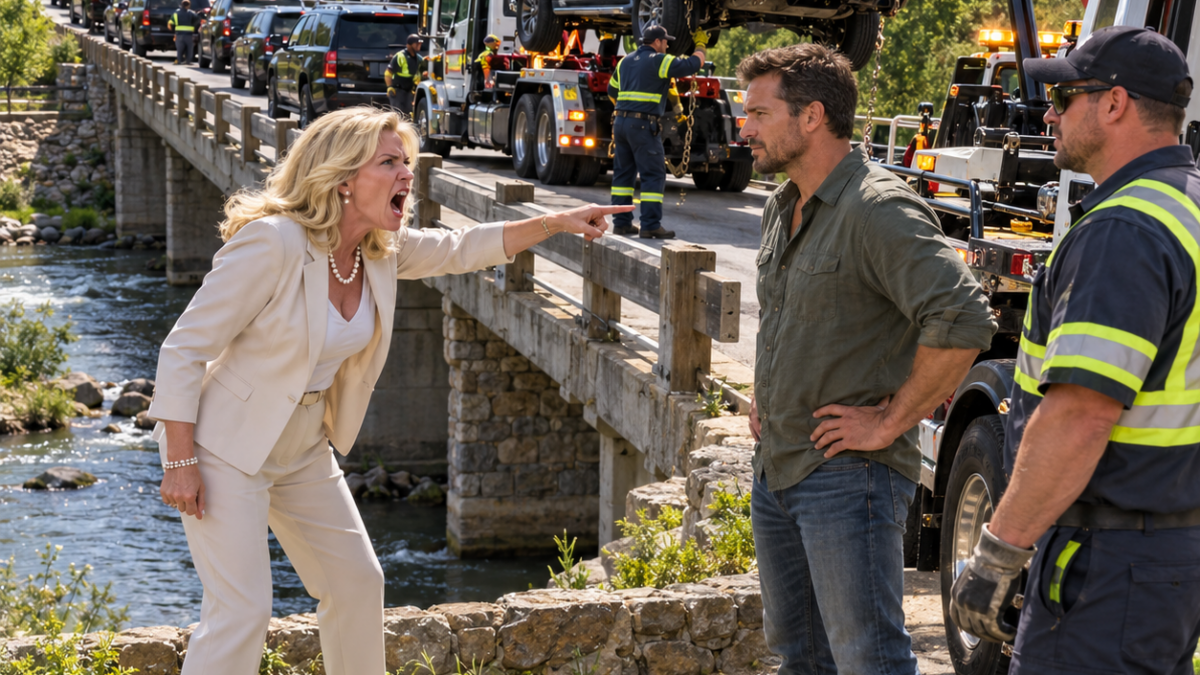
PART 2
Three Months Before the Blockade
While Ross searched the county records, I stood beside my truck and watched Valery turn the bridge into a performance.
Her camera operator moved closer whenever she raised her voice. One board member held a phone vertically, apparently streaming the confrontation. Another kept looking toward me, as though waiting for the moment I’d finally lose my temper.
Valery wanted a scene. She wanted the sheriff shouting, making threats, ordering arrests, and dragging people away from his family’s bridge. More than anything, she wanted a recording she could edit into proof that I had used public authority to protect a private financial interest.
I understood why she’d chosen this particular strategy.
I’d spent three months watching her turn a straightforward property question into a personal campaign. And the whole thing had started with a contract she carried to my farm one afternoon.
She arrived in a luxury SUV shortly after lunch, wearing a tailored blue jacket and carrying a thick folder embossed with the Brier Ridge logo. I’d just finished repairing a hydraulic cylinder when she pulled up beside my equipment shed. She stepped out without appearing especially interested in the mud covering my boots.
“Grant Holloway?”
“That’s me.”
“I’m Valery Slone, president of the Brier Ridge Homeowners Association.”
“I know who you are.”
She smiled and held up the folder. “Then perhaps you know why I’m here.”
I didn’t, although I’d heard that the neighborhood was planning another major expansion. Brier Ridge sat across the creek from my family’s property, on land that had once belonged to a dairy farmer. Over the previous decade, the development had grown into a collection of expensive homes, private amenities, landscaped roads, and carefully controlled entrances.
Its main road connected to the county highway by a winding route that took nearly eighteen minutes longer than crossing Holloway Bridge.
For years, that inconvenience hadn’t bothered anyone enough to make it my problem.
Then developers began marketing a fourth phase of homes.
Suddenly, eighteen minutes mattered.
Valery opened her folder and spread a contract across the hood of her SUV.
“We’d like to establish a permanent access arrangement across your bridge.”
I looked at the drawing.
It showed the bridge connected directly to a proposed neighborhood road.
Arrows indicated traffic moving in both directions. The agreement would allow residents, contractors, service vehicles, guests, and association-related traffic to use the crossing twenty-four hours a day.
I flipped through the pages.
Nearly forty of them.
“How many homes would this serve?” I asked.
“The entire development, eventually.”
“How many vehicles?”
“Traffic levels would vary.”
“That’s not what I asked.”
She smiled as though dealing with a difficult child.
“Our engineers believe the arrangement is workable.”
“Have they inspected the bridge?”
“Not yet. That would follow execution of the agreement.”
I stared at her.
“You want permanent access before you’ve inspected the structure?”
“We’re prepared to pay for improvements.”
“Which improvements?”
“Whatever the appropriate engineers recommend.”
I looked toward the bridge.
My grandfather had helped build its original foundations. In 1968, my family completed the crossing so farm equipment, delivery trucks, and local residents with permission could travel between the property and the county road.
It was a practical rural bridge.
Not a four-lane entrance to an upscale subdivision.
After years of service, portions had been reinforced, repaired, and replaced. My father spent countless weekends working on the railings and deck. When I inherited responsibility for the property, I continued maintaining it.
The crossing was more than useful.
It was part of my family’s history.
I turned back toward Valery.
“I’m not opening it to unrestricted development traffic.”
She tilted her head.
“You haven’t heard our compensation offer.”
“That isn’t the problem.”
“Eighty-five thousand dollars.”
I said nothing.
She watched my face, apparently waiting for the number to impress me.
When I didn’t respond, she added, “A very generous amount for access across an existing structure.”
“It’s not about the amount.”
“Everybody has a price, Sheriff.”
I looked directly at her.
“Not for everything.”
Her expression changed.
Only slightly.
But enough for me to notice.
She wasn’t used to being refused.
“Grant, this bridge would substantially improve access for hundreds of residents.”
“Then the association should plan and finance a route it has the legal right to use.”
“That would be enormously expensive.”
“That’s a problem for the development.”
Her smile disappeared.
“You’re being unreasonable.”
“No. I’m protecting a bridge that’s been in my family for generations.”
She closed the folder sharply.
“I think you should reconsider.”
“I’ve considered it.”
“You might be surprised how strongly the community feels about this.”
I wiped my hands on a shop towel.
“Feelings don’t establish an easement.”
She gave me a cold look.
Then climbed into her SUV.
Before closing the door, she said, “We’ll continue this conversation.”
I watched her drive away.
At the time, I believed the matter was finished.
I couldn’t have been more mistaken.
The First Threats
The second offer came two weeks later.
Same amount.
Slightly different agreement.
This version included additional language giving the association broad access for maintenance, emergency response, utility service, and community operations. Some provisions were so expansive that the HOA could have argued for almost any ordinary traffic once the agreement was signed.
I rejected it.
Valery responded through an attorney.
The letter suggested my refusal might interfere with community transportation needs and raised the possibility of litigation over access rights.
I passed it to my attorney, who confirmed what I already knew.
The bridge was privately owned.
Brier Ridge had no recorded permanent access agreement.
And no court had granted the HOA authority to treat the crossing as part of its street network.
I sent a short response declining the proposal again.
A third offer followed.
By then, Valery had stopped pretending the negotiation was friendly.
She called me one afternoon while I was at the sheriff’s office reviewing departmental budgets.
“Grant, we’re running out of patience.”
I looked at the phone.
“With what?”
“Your refusal to cooperate.”
“I’ve given you my answer.”
“This is about the long-term interests of an entire community.”
“And the structural condition of a bridge that was never designed for that traffic.”
“We’ve offered engineering improvements.”
“After I give you permanent access.”
“You’re twisting the terms.”
“No, Valery. I’ve read them.”
She went quiet.
Then she said, “Perhaps voters should know how their sheriff treats his neighbors.”
I leaned back in my chair.
“Are you threatening my office because I won’t sign a private agreement?”
“I’m suggesting that public officials should be held to higher standards.”
I felt my jaw tighten.
“My office has nothing to do with the ownership of that bridge.”
“That’s convenient.”
“No. It’s a distinction you need to respect.”
She ended the call.
A week later, Brier Ridge residents began talking about me as though I were deliberately preventing them from reaching a road they had always possessed the right to use.
I heard it from people at the grocery store.
From a county employee whose sister lived in the development.
From a mechanic who had worked on one of the HOA’s security vehicles.
According to Valery, I was holding a community roadway hostage.
Some residents believed I wanted more money.
Others thought I was using my position as sheriff to protect an exclusive private crossing.
One woman stopped me outside a hardware store and asked why I wouldn’t let people use “their bridge.”
I looked at her.
“Whose bridge?”
“The one between Brier Ridge and the county road.”
“My family owns that bridge.”
She frowned.
“Valery said the association was negotiating a public-access dispute.”
“We were discussing a proposed private agreement. I declined.”
She looked embarrassed.
“I didn’t know that.”
I believed her.
Most of the residents weren’t dishonest.
They were simply repeating what they’d been told.
That was part of the problem.
Valery had learned that if she described her plans confidently enough, people would begin treating them as established facts.
Soon afterward, signs appeared near my property directing drivers toward Holloway Bridge.
They used the colors and branding of Brier Ridge.
One marked the crossing as a future community entrance.
Another suggested the road would provide direct county access.
Nobody asked my permission.
I photographed the signs and removed those placed on my land.
Then I sent copies to Valery’s attorney.
No angry confrontation.
No public statement.
Just a request that the association stop representing private property as community infrastructure.
Valery apparently found my calmness infuriating.
Because she needed me to react.
A recording of an angry sheriff threatening an HOA president would be far more useful to her than a stack of unanswered letters.
And by the time she drove twelve SUVs onto my bridge, I understood that provoking me had become part of her strategy.
The Forgotten Easement
Back at the blockade, Valery was still talking to her camera operator when my phone rang.
It was Maren Fisk, a member of the county council who had spent years overseeing land-use and infrastructure matters.
“Grant, Ross asked me to look at your family’s bridge records.”
“Did you find anything?”
“Yes.”
Her voice sounded unusually serious.
“I need to confirm something. Your father was still the recorded owner when the county repaired the bridge after the flood, correct?”
“Yes.”
“And he signed the cost-sharing documents?”
“I remember him mentioning them.”
“Well, one of those documents is attached to the recorded bridge property file.”
I looked toward Valery’s SUVs.
“What does it say?”
Maren paused.
“Book 214, page 77. The county records include a 1989 emergency transportation easement.”
I frowned.
“Across our bridge?”
“Yes.”
The agreement had been created after flooding damaged portions of the original foundations.
The county helped fund reinforcement work because the bridge could serve an important transportation function during emergencies.
In exchange, my father granted the county a defined right to use the full crossing when it was formally designated for emergency-support traffic.
The agreement didn’t give ordinary development traffic unlimited access.
It didn’t transfer ownership.
And it didn’t create a general public roadway.
But it did establish something Valery hadn’t anticipated.
During an authorized emergency transportation operation, the county had a recorded right to keep that corridor usable.
Maren continued.
“Grant, Public Works designated Holloway Bridge as Emergency Access Route Four six weeks ago.”
I felt my stomach tighten.
“Why?”
“County Road 16 is closed for repairs. Your bridge is part of the approved backup network.”
I looked toward the barricades.
“You’re telling me that was already in effect?”
“Yes.”
“And the county has a recorded right to use the crossing when that designation applies?”
“Under the conditions in the easement, yes.”
I was silent for a moment.
Valery had spent months arguing that I was preventing her neighborhood from using the bridge.
Now she’d physically blocked a crossing that the county itself had a limited, legally protected reason to keep available.
The irony was difficult to miss.
But I didn’t celebrate.
The situation had become more serious, and I wanted every step documented.
“Maren, I own the bridge. I don’t want to make any enforcement decisions.”
“You won’t have to.”
She explained that the public works department had already established the emergency-access designation.
Ross, acting independently of me, could coordinate with Public Works to determine whether the parked vehicles were obstructing an authorized county operation.
The county’s right didn’t depend on my personal opinion.
It depended on the recorded agreement and the existing designation.
That distinction mattered.
A great deal.
“Who’s handling the county side?” I asked.
“Boyd Hensley. He’s reviewing the file now.”
Boyd had worked in county public works for nearly three decades. He was careful, methodical, and notoriously unwilling to approve anything without supporting documentation.
If Boyd said the county had access rights, I knew he’d checked them.
Maren continued.
“Grant, stay away from the barricades. Let Ross and Boyd handle it.”
“That’s exactly what I intend to do.”
I ended the call.
Across the bridge, Valery raised her voice again.
“Anything interesting, Sheriff?”
I looked at her.
“Apparently.”
She smiled.
“Have you decided to surrender the crossing?”
“No.”
“Then what have you decided?”
I put my phone away.
“That you should have read the deed.”
Her smile tightened.
But she still didn’t understand.
Not yet.
The County Arrives
Boyd reached the bridge shortly afterward.
His county pickup stopped behind the sheriff’s vehicles, and he climbed out carrying a rolled transportation map under one arm.
Maren arrived separately.
Ross had already established a controlled perimeter around the blockade, with deputies managing traffic at both approaches.
Nobody had been arrested.
No vehicles had been touched.
And I hadn’t issued a single enforcement instruction.
Valery seemed pleased by that.
She stood near the center of the blocked entrance, telling her audience that the sheriff’s department had arrived to intimidate peaceful residents.
“Look at this,” she announced to the camera. “County resources being brought into a private dispute because one man refuses to share a road!”
Ross approached her.
“Mrs. Slone, I’m Undersheriff Ross Dempsey. I’m the supervising law enforcement officer for this incident.”
She smiled brightly.
“Wonderful. Then perhaps you can explain why your sheriff is trying to use his badge against our residents.”
Ross didn’t react.
“Sheriff Holloway has recused himself. He is not directing this response.”
Valery’s smile faltered.
“He’s standing right there.”
“He’s the property owner. He’s entitled to observe from a safe location.”
“This is clearly retaliation.”
“That’s your position, ma’am. I’m here to determine why twelve vehicles are blocking the crossing.”
Valery gestured toward the SUVs.
“A peaceful community demonstration.”
Ross looked at the barricades.
“Did you organize it?”
“The association organized it.”
“Under whose authority?”
“Our community traffic management responsibilities.”
Ross glanced at Boyd.
Then looked back at her.
“Do you have a county-issued authorization?”
Valery opened her folder.
She produced a paper bearing the Brier Ridge letterhead.
It described temporary association traffic-control authority for community safety operations.
Ross examined it.
No county signature.
No permit number.
No authorization from Public Works.
He handed it back.
“This doesn’t establish authority to close the bridge.”
Valery looked offended.
“It’s an official association notice.”
“That doesn’t make it a county traffic order.”
Before she could respond, Boyd unrolled his map across the hood of his truck.
Maren stood beside him.
The map showed the county’s emergency access network.
Holloway Bridge was clearly marked as Route Four.
Boyd placed a copy of the 1989 easement beside it.
“Mrs. Slone, this crossing is part of the county’s designated emergency-support network while County Road 16 remains unavailable.”
She stared at the map.
Then looked toward me.
“He’s arranged this.”
Boyd shook his head.
“The route designation was entered six weeks ago.”
“Before this morning?”
“Yes.”
“Nobody told our association.”
“The designation was part of the county’s transportation planning records.”
She folded her arms.
“Then your notification process is defective.”
Boyd didn’t argue about whether she had read the public notice.
He simply pointed toward the roadside.
“See those orange reflective markers?”
I followed his hand.
Several short stakes stood along the approach, marked with route identifiers.
I’d noticed them before but hadn’t paid much attention.
They were part of the temporary emergency access marking system.
Boyd continued.
“Those markers identify the corridor.”
Ross walked toward the barricade.
Three stakes were missing near the entrance.
Fresh holes remained in the gravel shoulder.
One displaced marker lay beside a parked SUV.
Boyd examined the locations.
“Those were installed by Public Works.”
Valery shrugged.
“Our volunteers may have moved some temporary road markers while arranging the demonstration.”
Ross looked at her.
“Who instructed them to do that?”
She hesitated.
Then said, “We needed room for the barricades.”
He made a note.
Boyd photographed the disturbed markers.
Marcus Hale, one of the responding deputies, photographed the barricade placement and surrounding roadway.
I remained beside my truck.
Valery kept glancing toward me as though frustrated that I wasn’t participating.
Finally, she shouted, “Grant! Are you really going to hide behind county employees while they threaten your neighbors?”
I looked at her.
“I’m not directing them, Valery.”
“Then tell them to leave!”
“That isn’t my decision.”
She turned toward the camera.
“There! You heard him! The sheriff refuses to help his own community!”
I almost shook my head.
She was trying to make my refusal to interfere sound like interference.
Ross stepped forward.
“Mrs. Slone, I need you to focus on the roadway.”
She turned back.
He looked toward the vehicles.
“We’re going to speak with the drivers and establish who is responsible for each SUV.”
Valery immediately raised one hand.
“Nobody moves.”
Several drivers looked toward her.
Ross noticed.
So did Tessa Lane, the HOA vice president, who had been standing among the board members near the far barricade.
Tessa walked closer.
“Valery, maybe we should let them inspect the route.”
Valery glared at her.
“We’re not backing down.”
“But if it’s designated for emergency access—”
“This is a negotiation, Tessa.”
Ross looked at both women.
“Is the association negotiating by obstructing the crossing?”
Valery turned toward him.
“We’re exercising our rights.”
“Which rights?”
“Our rights as neighboring property owners.”
Ross gestured toward the easement.
“Then show me the document granting your association the right to block this route.”
Valery had no answer.
For the first time that morning, the people filming began exchanging uncertain looks.
Ten Minutes to Clear the Bridge
Maren formally requested that the blockade be removed.
She explained that the county had a recorded interest in keeping the route available for designated emergency-support operations.
Valery refused.
Not hesitantly.
Not after consulting an attorney.
She refused immediately.
“This demonstration continues until Grant Holloway agrees to negotiate.”
Ross looked at her.
“He’s declined your proposal. That doesn’t authorize blocking the bridge.”
“Then let him sue us.”
Maren stepped forward.
“The county is also affected.”
Valery pointed toward the cameras.
“And I hope everybody sees exactly how this county treats its taxpayers.”
One of the SUV drivers shifted uncomfortably.
A middle-aged man in a gray polo shirt approached Ross.
“Sir, if I want to move my vehicle, can I?”
Ross nodded.
“Yes. We’re asking for voluntary removal.”
The man looked relieved.
Then Valery snapped, “Nobody breaks the line!”
The driver stopped.
I watched his face.
He looked from Valery to Ross, suddenly realizing that the woman who’d brought him there was treating his vehicle as a bargaining chip.
Ross kept his tone calm.
“Sir, you’re free to comply with the lawful request to clear the road. Mrs. Slone doesn’t determine whether you can leave.”
Valery folded her arms.
“You are undermining a peaceful protest.”
Ross looked toward the barricades.
“You’re blocking a designated county emergency route.”
She waved dismissively.
“Nobody needs it right now.”
That statement lasted less than five minutes.
Boyd’s phone rang.
He stepped away to answer.
I watched his expression change as he listened.
When he returned, he was moving faster.
“Ross, we need to clear this crossing.”
Ross looked at him.
“What’s happened?”
Boyd explained that heavy rains during the previous days had damaged electrical equipment serving a regional pumping station.
A public works repair crew needed to move a heavy service vehicle to the site.
County Road 16 remained closed and couldn’t accommodate the required route.
The approved alternative was Holloway Bridge.
If the crossing stayed blocked, the crew faced a detour of more than an hour, delaying repairs the county considered urgent.
This wasn’t a hypothetical emergency.
A crew was preparing to move.
Equipment needed attention.
And twelve SUVs were standing directly in the way.
Boyd formally activated the crossing’s priority status for the operation.
Maren reviewed the records.
Ross then approached Valery.
“Mrs. Slone, Public Works has an active operational need to use this bridge.”
She crossed her arms.
“So?”
“So the vehicles must be moved.”
“We’re not moving until the access question is resolved.”
“That isn’t an option.”
She laughed.
“Are you going to tow twelve SUVs?”
Ross remained calm.
“If voluntary compliance fails, authorized removal may be necessary.”
Her smile widened.
“Good luck finding enough tow trucks.”
For a moment, she had a point.
The nearest commercial towing companies were already responding to a serious traffic accident north of the county.
Their heavy equipment wasn’t immediately available.
Moving twelve tightly parked vehicles from a narrow bridge would require careful planning.
Valery knew it.
She turned toward her camera operator.
“You hear that? They don’t even have the equipment to back up their threats.”
Ross didn’t answer.
Instead, he conferred with Boyd and Maren.
At 6:31, the official request to clear the bridge was issued and documented.
Valery refused again.
At 6:42, after additional warnings and an opportunity for voluntary removal, she directed drivers to maintain the blockade.
One deputy placed written notices on the vehicles.
Valery pulled one notice from a windshield and tore it in half in full view of several cameras.
I watched from the bank.
Every action was being documented.
Every warning.
Every refusal.
Every opportunity to end the confrontation peacefully.
She could have told her drivers to leave.
She could have moved her own Range Rover.
She could have let the county’s service crew pass and pursued whatever legal claim she believed existed.
Instead, she kept escalating.
She wanted somebody to lose control.
And she couldn’t understand why nobody was giving her the confrontation she’d planned.
Ross walked over to me.
“Grant, we have a problem.”
“I can see that.”
“We need heavy recovery equipment.”
I looked toward the county vehicles.
“Where’s the department’s heavy wrecker?”
“At the impound yard.”
“Is it operational?”
Ross nodded.
“Maintenance signed it off last week.”
I glanced toward the SUVs.
Then back at him.
For years before becoming sheriff, I’d worked in heavy vehicle recovery.
Nearly eight years operating tow trucks, winches, and recovery equipment.
I’d pulled loaded trucks out of ditches.
Recovered overturned machinery.
And worked enough complicated roadside jobs to know that the safest recovery was usually the one nobody hurried.
My certification for operating the county’s heavy equipment remained current.
Ross knew that.
I knew that.
But I also knew the obvious problem.
This was my bridge.
These vehicles were blocking my property.
And I had already recused myself from enforcement decisions.
I looked toward Maren.
“Who’s authorized to order the removals?”
“Ross, in coordination with the county’s public works operation.”
“And who determines whether I’m permitted to operate the wrecker?”
Ross answered.
“The county can authorize qualified equipment operators for the response.”
I looked at him carefully.
“I’m not making that decision.”
“I understand.”
Boyd approached.
“We have a priority service vehicle waiting for access. We need the crossing cleared safely.”
I nodded.
“Then document the authority first.”
Ross gave me a long look.
Then smiled faintly.
“That’s exactly what I was going to do.”
At 6:47, the necessary towing authorization was issued.
Ross signed the enforcement order.
Boyd documented the active emergency-corridor obstruction.
Maren reviewed the authority and procedural separation.
The county’s operational command remained with officials independent of my personal property dispute.
I would be operating equipment.
Not deciding whose vehicle should be seized.
Not selecting penalties.
Not directing arrests.
Not using the badge to win a private argument.
For the first time all morning, I felt certain how the blockade would end.
I looked toward Valery.
She was still smiling for her cameras.
She had no idea what Ross had just authorized.
And somewhere down the road, the county’s old heavy-duty wrecker was starting its engine.
The Heavy Wrecker
The county’s heavy-duty wrecker arrived with a deep diesel rumble that carried across the creek.
It was an older recovery truck, built for work that ordinary tow trucks couldn’t handle. I’d operated it many times during my years in vehicle recovery, long before anyone called me Sheriff Holloway.
When it pulled up beside the county staging area, Valery stopped speaking to her camera.
She watched the truck.
Then looked at me.
For the first time, I saw something other than confidence in her expression.
I walked toward the cab.
Ross met me beside the front wheel.
“All authorizations are documented,” he said.
“Good.”
“Public Works has confirmed the operation.”
“Good.”
“The bridge approaches are secured, and the drivers have received final notice.”
I nodded.
Ross lowered his voice.
“Grant, one more thing.”
“What?”
“She’s going to try to make this about you.”
I glanced toward Valery.
“She already has.”
“Don’t give her anything.”
I looked at the wrecker.
“I know how to tow a vehicle, Ross.”
He smiled slightly.
“I’m not worried about the vehicle.”
I appreciated the reminder.
The actual towing wouldn’t be especially complicated if we had enough room to work. What made the situation dangerous was the narrow bridge, the tightly packed SUVs, and the people trying to turn every movement into a political confrontation.
I checked the equipment with the recovery team.
The winch.
The recovery gear.
The stabilizers.
The connections.
The available working space.
The bridge wasn’t designed for careless maneuvering, and I wasn’t about to damage a family structure simply to satisfy somebody’s appetite for spectacle.
Boyd and his crew confirmed the recovery approach would remain within the approved operational limits.
Then I climbed into the cab.
The diesel engine vibrated beneath me.
I adjusted the mirrors.
Checked the controls.
And eased the truck toward the first barricade.
Valery stepped directly into my path.
I stopped immediately.
She stood several feet in front of the wrecker with her phone raised.
“Touch one of those vehicles, Grant, and I’ll sue you personally!”
I shut off the engine.
Climbed down.
And approached only as far as Ross had established as safe.
I didn’t argue.
I simply handed her a copy of the signed removal authorization.
She looked at it.
Then looked back at me.
“You arranged this.”
“No.”
“You’re the sheriff!”
“I’m the equipment operator for this removal.”
“That’s ridiculous.”
“The order was issued by the officials responsible for the county operation.”
She waved the paper.
“This is your bridge!”
“That’s why I removed myself from the enforcement decisions.”
Her face reddened.
“You’re hiding behind technicalities.”
I looked at her steadily.
“You’re welcome to challenge the authorization through the proper legal process.”
She stared.
Then said, “I intend to.”
“That’s your right.”
I turned back toward the truck.
Ross stepped forward.
“Mrs. Slone, please move outside the equipment operating area.”
She hesitated.
Her camera operator kept filming.
Finally, she stepped aside.
I climbed back into the cab.
Started the engine.
And moved into position.
At 6:55, the first removal began.
Twelve Vehicles, One Very Expensive Mistake
The first SUV was parked near the western approach.
Its owner stood beside the barricade with his hands shoved into his pockets.
He looked nervous.
I couldn’t blame him.
He’d apparently arrived expecting a short demonstration that would pressure a landowner into signing an agreement.
Now his vehicle was being processed as part of an authorized removal from an emergency access corridor.
A deputy documented the license plate.
Another photographed the vehicle’s condition.
Ross confirmed the removal status.
The recovery crew secured the vehicle using the appropriate equipment and loading procedure.
Nothing happened quickly.
I wasn’t interested in damaging somebody’s car.
I wasn’t interested in embarrassing the owner.
And I certainly wasn’t interested in giving Valery a clip of a county truck recklessly dragging expensive SUVs across an old bridge.
I moved the first vehicle into the designated staging area for impound processing.
Then returned for the second.
Valery shouted something about illegal seizure.
I ignored her.
The second SUV came off without incident.
Then the third.
By then, the camera operator was moving constantly, searching for a dramatic angle.
Valery raised her voice.
“This is what happens when you let one man control a bridge and the sheriff’s office!”
Ross answered from beside the barricade.
“Mrs. Slone, the county’s public works designation and the removal order are available for review.”
She pointed toward me.
“He’s driving the truck!”
Ross nodded.
“Yes.”
“Then he’s responsible!”
“He’s operating equipment under the documented authorization.”
Valery turned toward her camera.
“Do you hear how they justify it?”
I kept working.
Vehicle after vehicle.
The fourth removal was more difficult because the SUV had been parked at an angle with limited clearance.
I took extra time checking the approach.
The owner, a woman in a Brier Ridge jacket, looked increasingly uncomfortable.
She approached Ross.
“Sir, I didn’t know this was an emergency road.”
Ross nodded.
“Your statement has been documented.”
“Valery told us the association had temporary traffic authority.”
“Did she show you county authorization?”
The woman looked down.
“No.”
Ross remained professional.
“You’re free to provide a statement about what you were told.”
She glanced toward me.
“Is he angry?”
Ross looked in my direction.
I was checking the recovery connection.
“He’s doing the job.”
The woman nodded slowly.
“I’m sorry.”
I heard her, but I didn’t stop the operation to respond.
There would be time for conversations later.
Right now, the county needed the bridge.
The fourth vehicle cleared.
Then the fifth.
Valery’s confidence was fading visibly.
She paced beside the entrance, making phone calls and demanding that the association’s attorney obtain an emergency injunction.
She told one caller the county had launched an organized campaign against the neighborhood.
She told another that the sheriff was personally destroying residents’ property.
Yet the body cameras showed the vehicles being moved carefully.
The documentation was complete.
And nobody had been injured.
At the sixth vehicle, the gray-polo-shirt driver approached Ross again.
“Could I just move my SUV myself?”
Ross considered the request.
“Once we can provide a safe path, yes.”
The man looked relieved.
Valery heard the exchange.
“No! Nobody moves voluntarily!”
The driver turned toward her.
“Valery, this has gone far enough.”
She stared at him.
“We agreed to hold the line.”
“I agreed to attend a demonstration. I didn’t agree to block an emergency repair crew.”
Several people nearby heard him.
One of the board members lowered his phone.
The driver continued.
“I’ve got a family and a job. I’m not getting dragged into some larger fight you didn’t explain.”
Valery’s face tightened.
“You’re betraying the entire community.”
He shook his head.
“No. I’m going home.”
Once the recovery team created enough space, Ross permitted him to drive his vehicle away under supervision.
The departure was documented.
The remaining SUVs were still subject to the removal operation.
Valery watched him leave.
I saw something important happen then.
The blockade had depended on unity.
Not legal authority.
Not ownership.
Not even physical necessity.
It depended on people continuing to obey Valery after the facts changed.
The moment one driver chose to leave, that unity began falling apart.
I returned to work.
The seventh SUV was removed.
Then the eighth.
The recovery team was finding its rhythm.
Every vehicle was photographed.
Every plate recorded.
Every condition noted.
Some owners protested.
Others stayed silent.
A few asked questions that Valery clearly didn’t want them asking.
By the ninth removal, the shouting had nearly stopped.
The people who’d arrived expecting a triumphant livestream now stood watching a slow, documented operation that made their demonstration look less like a political protest and more like a costly mistake.
Tessa Lane, the HOA vice president, walked toward Valery.
“You said they couldn’t tow us.”
Valery didn’t look at her.
“Our attorneys will reverse this.”
“Reverse what? The vehicles are already being removed.”
“We’ll seek damages.”
Tessa gestured toward Boyd and the county documents.
“Did you know the bridge was an emergency route?”
Valery’s jaw tightened.
“No one informed me.”
“Did you check?”
Valery turned sharply.
“What is that supposed to mean?”
Tessa looked toward the SUVs.
“It means we should have verified the authority before organizing this.”
Valery stared at her.
Then said, “If you don’t have the stomach to protect this community, perhaps you shouldn’t be on the board.”
Tessa didn’t answer.
She simply walked away.
I noticed where she went.
Not toward Valery’s supporters.
Toward Ross.
And for the first time that morning, one of the HOA’s own leaders began asking to see the actual county records instead of accepting whatever Valery told her.
The Last Range Rover
By the time the next vehicles were cleared, the public works repair crew had arrived near the western staging area.
Their heavy service vehicle waited with its engine idling.
The driver remained patient, but Boyd was checking his watch more frequently.
The longer the bridge remained blocked, the longer the urgent pumping-station repairs would be delayed.
I could see the equipment waiting.
It reminded me that this wasn’t simply a symbolic contest.
Real public infrastructure depended on the road.
And the road was blocked because Valery wanted footage of a sheriff losing his temper.
I continued the recovery.
Soon, only her Range Rover remained.
She’d parked it crosswise near the center of the bridge, carefully positioned to prevent any easy passage.
The paint was glossy black.
The windows were dark.
A Brier Ridge placard sat on the dashboard.
Valery stood beside it with one hand resting on the driver’s door.
“You’re not touching this vehicle.”
I stopped the wrecker.
Ross approached.
“Mrs. Slone, this vehicle must be removed.”
“This is my personal property.”
I looked toward the eleven other vehicles that had been cleared.
“So were theirs.”
She glared at me.
“You’ve wanted to humiliate me from the beginning.”
I shook my head.
“I wanted to drive across my bridge this morning.”
For a moment, she didn’t answer.
Then she reached into the Range Rover to retrieve her phone charger.
As she opened the door, a loose sheet of paper slid from a thick folder on the passenger seat.
It fluttered to the pavement.
Tessa, standing nearby, bent to pick it up.
She glanced at the page.
Then stopped moving.
I noticed the change in her expression.
“What is it?” Valery snapped.
Tessa didn’t answer immediately.
She looked at the heading.
Then toward Valery.
“Why is this in your vehicle?”
Valery stepped closer.
“Give that back.”
The paper had landed openly on the roadway, and Tessa was a board member who recognized the association document. No officer had searched the Range Rover or opened the folder.
Tessa held the page carefully.
It was titled:
BRIER RIDGE PHASE FOUR — ACCESS MARKETING PLAN.
I could see the heading from where I stood.
Beneath it was a description of the planned expansion.
The language promised direct private bridge access as a feature included with the new homes.
My stomach tightened.
I hadn’t signed an access agreement.
I’d refused three separate offers.
Yet the association’s marketing materials were already describing bridge access as an established benefit.
Tessa read another paragraph.
Her face changed.
“Valery, these materials tell buyers they’ll have direct access across Holloway Bridge.”
Valery reached for the paper.
“It’s a preliminary marketing document.”
Tessa stepped back.
“Preliminary? This says access is included.”
“Give me the page.”
“Have you been telling buyers the bridge is secured?”
Valery’s voice sharpened.
“Tessa, this is not the place to discuss internal project matters.”
Tessa stared at her.
“You told the board the agreement was almost finalized.”
“It was.”
I looked at her.
“No, Valery. It wasn’t.”
She turned toward me.
“You were obstructing negotiations.”
“I declined your offer in writing. Three times.”
Tessa looked between us.
Then down at the document.
I could see the pieces connecting in her mind.
If the expansion had already been sold around the promise of bridge access, Valery was under far more pressure than she’d admitted.
The bridge wasn’t simply a convenient shortcut.
It was part of the financial value being promised to future homeowners.
Without that access, the development might have to revise its sales claims, redesign its transportation plans, or deal with buyers who believed they’d purchased something the association couldn’t legally provide.
Valery hadn’t merely wanted my signature.
She needed it.
And the longer I refused, the worse her position became.
Tessa looked at her.
“You marketed access before obtaining it?”
Valery’s expression hardened.
“We were operating under the expectation that negotiations would succeed.”
“Grant says he refused.”
“He was being unreasonable.”
“That doesn’t answer the question.”
I felt an unpleasant clarity settle over me.
For months, Valery had accused me of holding the community hostage.
But she’d already built a marketing strategy around property she didn’t control.
Then she’d tried to make my refusal look like an attack on the people who relied on her promises.
Now she’d brought twelve SUVs to the bridge, hoping a public confrontation would force me to give in.
Tessa looked at the page again.
Then said quietly, “You never told us the access wasn’t secured.”
Valery stared at her.
For the first time that morning, she had no answer ready.
Ross approached.
“Mrs. Slone, we need to complete the removal.”
Valery looked toward the waiting service vehicle.
Then toward the wrecker.
Then back at Tessa.
Her phone was still recording.
But the woman who’d spent the entire morning speaking for the camera suddenly seemed to have nothing she wanted the camera to hear.
I climbed back into the recovery truck.
The final Range Rover was documented.
The crew secured it.
I checked the connection.
Then carefully lifted it clear of the roadway.
Valery watched in silence.
As I moved the vehicle toward the staging area, she shouted one final accusation.
“This isn’t over, Grant!”
I stopped only long enough to make sure the equipment remained properly aligned.
Then answered through the open cab window.
“You’re right.”
She looked almost encouraged.
I continued.
“You wanted these vehicles to become evidence supporting your claim to this bridge.”
I glanced toward Ross.
“Now they’re evidence of the blockade you organized.”
I returned my attention to the controls.
And moved the Range Rover off Holloway Bridge.
The Bridge Opens
The last obstruction was cleared.
County workers inspected the roadway.
The displaced route markers were documented for replacement.
The barricades were removed under the public works team’s direction.
Ross confirmed that the bridge was open for the authorized emergency-support operation.
Then the heavy service vehicle began moving.
I stood beside the wrecker as it approached.
The driver slowed.
Boyd gave the signal.
And the truck crossed Holloway Bridge toward the damaged pumping station.
I watched until it disappeared beyond the trees.
For several seconds, I felt an emotion I couldn’t immediately identify.
Relief, certainly.
But something else, too.
My family had built that bridge to serve a practical purpose.
To connect people and equipment to the roads they needed.
My father had agreed to the emergency easement after the flood because he believed the crossing should remain useful when the county genuinely needed it.
That morning, it did exactly what he’d intended.
It carried a crew toward urgent infrastructure repairs.
It didn’t become a permanent subdivision shortcut.
It didn’t become Valery’s private negotiating tool.
And it didn’t require me to abuse my office.
The county had exercised an existing, limited right under a recorded agreement.
Everything had been documented.
Valery’s cameras had captured the entire process.
I looked toward her.
She stood near the far barricade with the phone lowered at her side.
Her board members were scattered.
Some were talking to deputies.
Others had already left.
Tessa remained near Boyd’s truck, asking questions about the emergency corridor and the documents supporting it.
Valery looked smaller than she had at sunrise.
Not physically.
But in the way people sometimes do when their confidence has been stripped of the assumptions supporting it.
She’d arrived believing the badge was my weakness.
Instead, the county’s procedures had protected the response from becoming personal.
I thought the incident might finally be over.
Then Ross approached with another discovery.
“Grant, there’s something you should know.”
I looked at him.
“What now?”
“We’ve started reviewing the vehicles’ rental information.”
I frowned.
“Rental information?”
He nodded.
“All twelve SUVs appear to have been rented through arrangements connected to Brier Ridge.”
“All twelve?”
“That’s what the initial documentation indicates.”
I looked toward Valery.
Ross continued.
“And it looks like association money paid for them.”
I stared at him.
“She used HOA funds to rent twelve SUVs just to block my bridge?”
“That’s what the records suggest.”
I glanced toward the empty roadway.
Then toward the camera crew packing up its equipment.
“Did the board authorize it?”
Ross shook his head.
“That’s a question for the association.”
I took a slow breath.
Valery had spent months telling residents she was protecting their investments.
Now it appeared she’d spent their own money staging a confrontation designed to protect promises she’d made without securing the underlying property rights.
And from the look on Tessa Lane’s face, I suspected the Brier Ridge board was about to discover just how expensive their president’s little demonstration had become.
Valery’s Edited Video
By lunchtime, the blockade was over.
By dinner, Valery had launched another attack.
A video appeared on local social media with a headline accusing the county sheriff of using government equipment to seize HOA vehicles during a private property dispute.
I watched it at my kitchen table.
The footage opened with me climbing into the heavy wrecker.
Then it showed the first SUV being lifted.
Then Valery shouting about abuse of power.
The clip cut directly to another vehicle leaving the bridge.
It was carefully edited.
There was no mention of the 1989 emergency easement.
No explanation that County Road 16 was closed.
No footage of Boyd presenting the official route designation.
No mention of the pumping-station repairs.
No signed authorization.
No record of my recusal.
And no footage showing Valery ordering drivers to maintain the blockade after receiving formal notice to clear the corridor.
The entire video presented the removal operation as though I’d simply decided to use county machinery to settle a personal argument.
I stared at the screen.
Then watched it again.
The second time, I noticed how deliberately the clips had been arranged.
Every moment showing me operating equipment remained.
Almost every moment explaining why the equipment was being operated had been removed.
Within hours, people who hadn’t been at the bridge began posting angry comments.
Some accused me of abusing public office.
Others demanded an investigation.
A few insisted I should resign.
Valery appeared in a separate interview describing herself as a victim of government intimidation.
I felt anger rise as I listened.
Not because people were questioning a sheriff.
Public officials should be questioned when they exercise authority.
But because the accusation had been built around missing evidence.
I could have responded personally.
I could have posted the original footage.
I could have gone on camera and explained every detail.
Instead, I called Ross.
“Have you seen the video?”
“Yes.”
“She’s leaving out almost everything.”
“I noticed.”
“What are we doing?”
He paused.
“The county’s preparing a factual release under its transparency procedures.”
I leaned back.
“Good.”
“Grant, don’t turn this into an argument online.”
“I wasn’t planning to.”
“Let the records speak.”
I looked toward the bridge visible beyond my kitchen window.
“I’ve been doing that all morning.”
Ross chuckled.
“And it’s been working.”
The following day, the appropriate county office released the documented timeline and available records.
The report established that the blockade was discovered at 5:47 a.m.
At 5:53, I formally recused myself from enforcement decisions related to my property.
At 6:11, the emergency easement and route designation were confirmed.
At 6:24, Public Works identified the obstruction as affecting the protected corridor.
At 6:31, the formal request to clear the route was issued.
At 6:42, Valery maintained the blockade despite notice.
At 6:47, towing authorization was documented.
And at 6:55, the first vehicle removal began.
The release included the relevant signed orders, the emergency-access designation, and body-camera footage showing the warnings and Valery’s refusal.
One clip showed her instructing the SUV owners not to move.
Another showed Boyd explaining the county’s active operational need.
A third showed me asking who had authority to authorize the removal rather than issuing an order myself.
Suddenly, the edited video looked very different.
Residents who had originally supported Valery began asking questions.
Why had she blocked an emergency route?
Why had she ignored an opportunity to move the SUVs?
Why had she described the bridge as community infrastructure when no agreement existed?
And perhaps most troubling for Brier Ridge residents, why had association funds been used to stage the entire event?
The discussion shifted.
People stopped asking why the sheriff had removed the vehicles.
They began asking why the HOA president had put them there.
The Email Valery Never Expected Anyone to Read
Tessa Lane contacted me two days later.
She sounded nervous.
“Grant, I need to show you something.”
“About the bridge?”
“About why Valery organized the blockade.”
We agreed to meet in a public setting with the appropriate records preserved for review.
Tessa arrived carrying a folder.
She looked exhausted.
“I’ve been going through the board emails.”
I nodded.
“And?”
“Valery wasn’t simply trying to pressure you.”
She opened the folder.
“There was a strategy.”
The first document was an internal email sent six weeks before the blockade.
It concerned the Phase Four access plan.
Valery had written that once Brier Ridge established a regular pattern of bridge use, it would become increasingly difficult for the owner to prevent future crossings.
I read the sentence twice.
“She thought repeated use would somehow give the association a legal advantage?”
“That’s what she told the project team.”
I shook my head.
Regular unauthorized use doesn’t automatically create a legal easement. The law isn’t that simple, and the recorded rights mattered.
But Valery appeared to believe that creating enough evidence of routine use could help her pressure me in later negotiations or litigation.
Tessa handed me another email.
This one was worse.
It discussed the public demonstration.
Valery wanted cameras present.
She wanted a direct confrontation with me.
And she specifically mentioned the possibility of obtaining what she called an “ethics angle” if I responded while exercising my official authority.
I looked up slowly.
“She planned to accuse me of abusing my office.”
Tessa nodded.
“She was counting on it.”
I sat quietly for a moment.
I’d suspected that from the beginning.
The cameras.
The provocative language.
The demands that I arrest her.
The repeated references to my badge.
But seeing the strategy written down was different.
Valery hadn’t merely lost her temper during an HOA disagreement.
She’d planned a confrontation that she hoped would damage my professional reputation unless I surrendered my family’s access rights.
And she’d paid for the performance with association money.
Tessa continued.
“The board never approved renting those vehicles.”
I looked at her.
“None of them?”
“No.”
“What about the camera crew?”
“Also paid through association accounts.”
“And the barricades?”
“Same budget.”
She looked deeply embarrassed.
“Valery approved expenditures that required board authorization. Some were placed under ordinary operating categories.”
I thought about the residents.
Families paying dues to maintain common areas.
Retirees on fixed incomes.
Homeowners believing their association was using funds responsibly.
Their money had been spent on a blockade designed to intimidate someone who didn’t even belong to their HOA.
“Do the other board members know?” I asked.
“They’re finding out now.”
“Then they need the complete records.”
She nodded.
“That’s why I’m here.”
I made sure the material was routed to the appropriate county authorities and my private attorney.
I didn’t open an investigation myself.
My recusal still mattered.
Even now, when the evidence appeared to support everything I’d suspected.
Especially now.
The Lawsuit That Exposed Another Property Line
Valery responded to the growing scrutiny by filing a lawsuit.
She challenged my family’s right to restrict access across Holloway Bridge and argued that Brier Ridge had legitimate claims to the crossing.
When the papers arrived, I read them without much surprise.
She’d threatened litigation for months.
Now that her political strategy was falling apart, she was trying the courts.
I brought the complaint to my attorney.
He reviewed it alongside the recorded deeds and easements.
Then he noticed something important.
The lawsuit didn’t concern only the bridge.
It also depended on a short connecting road between the edge of Brier Ridge and the crossing.
The association had been treating that strip as though it formed part of its own road network.
My attorney requested the full chain of title.
A new survey followed.
And the results revealed another mistake in Valery’s assumptions.
Approximately forty feet of the connecting roadway crossed land belonging to the original Holloway family property.
Brier Ridge had no recorded permanent easement establishing the unrestricted access it was claiming.
Years earlier, my family had permitted occasional local passage as a courtesy.
That informal permission had never been converted into an unlimited legal right for a major subdivision.
I stood beside the surveyor when he showed me the boundary.
“You’re telling me this section is ours?”
He nodded.
“According to the records and the survey, yes.”
I looked toward the development.
For years, I hadn’t worried about the occasional neighbor using the connecting stretch with permission.
It had never created a problem.
But now Valery was relying on that same road as part of her claim to permanent bridge access.
She’d brought a lawsuit to force control over the crossing.
And that lawsuit had triggered a detailed review revealing that the association lacked permanent rights over a key part of the approach as well.
My attorney looked at me.
“That makes their access argument considerably more difficult.”
I nodded.
“But I don’t want to close the road just to punish residents.”
“You don’t have to.”
He explained that we could demand proper verification of any claimed rights and prevent the association from marketing unrecorded access as though it were guaranteed.
That was enough for me.
I wasn’t trying to isolate Brier Ridge.
I wasn’t interested in creating unnecessary problems for ordinary families.
I simply refused to let Valery turn a courtesy into an entitlement.
The association’s Phase Four marketing materials had to be corrected.
References to guaranteed direct bridge access were withdrawn.
Prospective buyers began asking questions the sales team hadn’t expected.
Was bridge access included?
Was there a recorded easement?
Could residents use the crossing twenty-four hours a day?
The answers were no longer hidden behind phrases like “almost finalized.”
The actual documents had to be examined.
And those documents didn’t support the promises Valery had made.
The Meeting That Ended Her Presidency
The emergency HOA meeting was held at the Brier Ridge clubhouse.
By the time I arrived, the parking lot was full.
Residents stood in small groups near the entrance.
Some looked angry.
Others looked anxious.
A few approached me and apologized for believing the edited video.
I thanked them but kept my answers short.
I wasn’t there to campaign against Valery.
I was there because the association had spent months making false claims about my property, and its board was finally reviewing the evidence.
Tessa opened the meeting.
Valery sat near the head of the table, surrounded by folders.
She still carried herself like the person in charge.
But something had changed.
The other board members weren’t looking toward her for permission before speaking.
Tessa began with the financial review.
The twelve SUVs had been rented using association funds.
The camera crew had also been paid from HOA accounts.
The barricades, logistics, and other demonstration expenses had been charged to community operating budgets.
The required board approvals were missing.
Valery attempted to interrupt.
“Those expenses were necessary to protect community interests.”
Tessa remained calm.
“The board never authorized a bridge blockade.”
“We authorized the waterfront access initiative.”
“Not this operation.”
Valery leaned forward.
“You knew we were negotiating.”
Tessa looked at her.
“Negotiating isn’t the same as using residents’ dues to block an emergency corridor.”
Several homeowners murmured.
Then one stood.
“Did you know the bridge was privately owned?”
Valery answered immediately.
“We believed the association had a legitimate claim.”
The man frowned.
“That’s not what I asked.”
A woman near the front raised her hand.
“Did you tell buyers they would have permanent bridge access?”
Valery shifted in her chair.
“The access arrangement was under active negotiation.”
Another resident spoke.
“Then why did the brochure say access was included?”
The room grew louder.
Tessa called for order.
Then she presented the emails.
The first described Valery’s plan to establish repeated bridge use.
The second discussed obtaining video of me reacting in my official capacity.
Tessa read the relevant language aloud.
When she reached the words “ethics angle,” the room fell quiet.
Valery stood abruptly.
“That correspondence has been taken out of context.”
Tessa looked at her.
“Then please explain the context.”
Valery gestured toward me.
“He’s the county sheriff. He has enormous influence over local government.”
I remained seated.
Tessa answered.
“He recused himself before the county ordered a single vehicle removed.”
Valery’s face reddened.
“That doesn’t change the fact that he drove the tow truck.”
“No,” Tessa said. “But the authorization records explain exactly why.”
An older homeowner stood.
“I’ve lived here eight years. I don’t care whether Sheriff Holloway likes our neighborhood. I care whether my dues were used properly.”
Several people nodded.
He continued.
“Did you spend our money trying to provoke him into doing something you could report to the ethics board?”
Valery stared at him.
For once, she didn’t have a polished response.
Then she said, “Everything I did was intended to improve property values.”
The man shook his head.
“That wasn’t the question.”
Tessa moved to the next item.
The board’s independent review showed that Valery had approved spending without the required authorization.
She had also allowed Phase Four marketing materials to promise access rights that hadn’t been secured.
Several members demanded a complete financial audit.
Valery tried to end the meeting.
“I think this discussion has become unproductive.”
She reached for her papers.
“We’re adjourned.”
Tessa remained seated.
“No, Valery.”
The room went still.
Valery stared at her.
“Excuse me?”
“The board has authority to continue this meeting under the bylaws.”
“You can’t overrule the president.”
“The required majority is present.”
Tessa looked toward the other members.
“And we have a motion pending.”
One board member moved to suspend Valery’s discretionary spending authority.
Another seconded.
The vote passed.
Valery sat motionless.
For years, she’d controlled the budget, the meeting agenda, and the information residents received.
Now the board had taken control of its finances out of her hands.
The formal removal process followed.
After the audit and necessary proceedings, Valery was removed as president.
There were no handcuffs.
No deputies escorting her from the room.
No dramatic arrest.
Her authority disappeared through the very governance process she’d spent years controlling.
A vote.
A financial review.
A set of records.
And the loss of trust from people who once believed every word she said.
Before leaving, she turned toward me.
“You’ve ruined this community.”
I looked at her.
“No, Valery.”
She stopped.
“I didn’t put twelve SUVs across that bridge.”
Her expression hardened.
Then she walked away.
The Bill Nobody Wanted to Pay
Valery’s blockade had cost the county money.
Not merely the price of operating a heavy wrecker.
There were personnel hours.
Traffic control.
Vehicle processing.
Equipment deployment.
The public works delay.
Replacement of the emergency route markers.
And administrative costs associated with clearing the obstruction.
The county finance department prepared an itemized invoice under the applicable procedures.
I didn’t determine the charges.
I didn’t select the rates.
And I didn’t add a single dollar because I was angry.
Every item carried the appropriate county reference and documented basis.
At a subsequent meeting, I placed a copy of the official invoice before the board.
Tessa read it.
Then looked toward the association’s financial records.
Nobody needed an explanation of where those expenses had originated.
Valery had approved the blockade.
She’d used association funds to rent the vehicles.
She’d brought the cameras.
She’d refused the county’s warnings.
And she’d ordered the drivers not to move.
The association ultimately paid the county’s properly assessed charges.
Its leadership also began reviewing Valery’s individual responsibility under its governing documents, contracts, and insurance arrangements.
The vehicles were released and returned through the required process once their removal and impound documentation was complete.
No SUV was damaged as part of the recovery operation.
Nobody had been injured.
No physical confrontation had occurred.
What Valery had designed as an explosive public showdown ended as a very expensive lesson in recorded authority and lawful procedures.
The fourth phase of Brier Ridge was also forced to change.
Every claim promising permanent direct access across Holloway Bridge had to be removed from the association’s sales materials.
Buyers were given accurate information about the route.
The original development plans could no longer rely on a right the association didn’t possess.
Tessa remained on the board and helped establish stronger financial controls.
Large expenditures would require documented approval.
Marketing materials involving outside property rights had to be reviewed before being presented to buyers.
No president would be permitted to authorize a major community expense merely by declaring it necessary.
Those changes mattered more to me than Valery losing her title.
Because an HOA can survive one dishonest or reckless leader.
But only if its rules prevent the next one from making the same decisions without oversight.
Back Across Holloway Bridge
Several weeks later, I drove across Holloway Bridge on a quiet afternoon.
The barricades were gone.
The twelve SUVs were gone.
The cameras were gone.
And Valery was nowhere to be seen.
The bridge looked exactly as it should.
Weathered decking.
Steel railings.
The familiar bend in the approach.
My grandfather’s old foundations still holding everything above the creek.
Boyd was standing near the far end when I arrived.
He waved.
I pulled over and climbed out.
“Afternoon, Boyd.”
“Afternoon, Sheriff.”
He smiled.
“Nice to see you crossing without bringing the wrecker.”
I laughed.
“Let’s hope that stays unnecessary for a long time.”
He gestured toward a new sign installed near the entrance.
EMERGENCY ACCESS ROUTE — DO NOT BLOCK.
Beneath it was a smaller notice warning that unauthorized vehicles obstructing the designated corridor could be removed under the applicable county rules.
I looked at the sign.
Then at Boyd.
“Seems clear enough.”
He chuckled.
“Thought we’d make it easy for everybody.”
We stood beside the bridge for a few minutes.
The creek moved quietly below us.
I thought about my grandfather pouring the foundations.
About my father repairing the deck.
About the flood that led to the 1989 emergency easement.
And about how a document my family had signed decades earlier became the key to resolving a dispute nobody could have imagined at the time.
My father hadn’t granted the county emergency access because he wanted government control over our property.
He’d done it because the bridge could serve an important purpose when ordinary roads failed.
He’d understood the difference between a limited public need and unrestricted private use.
Valery never did.
She treated every boundary as something to negotiate around.
Every refusal as a personal insult.
Every piece of community property or private infrastructure as something that could be brought under her influence if she applied enough pressure.
And in the end, she destroyed her own authority by trying to manufacture authority over something she didn’t own.
I looked toward Boyd.
“Funny how it came down to an old file.”
He nodded.
“Most important things do.”
Then he glanced toward the creek.
“Your father kept good records.”
I smiled.
“He kept everything.”
“Good habit.”
“Apparently.”
I returned to my truck.
As I crossed the bridge, I slowed near the place where Valery’s Range Rover had stood.
I remembered her shouting that I’d regret touching it.
I remembered the cameras.
The threats.
The twelve SUVs arranged like a barricade across my family’s history.
Then I looked ahead.
The road was clear.
Exactly as it should have been.
What I Remember Most
A few weeks afterward, Ross showed me a photograph hanging in the records area at the county impound yard.
It showed the twelve black SUVs as they’d been documented during the blockade.
Bumper-to-bumper.
Association placards visible in the windows.
Barricades at the approaches.
And the old bridge beneath them.
Ross had kept the photograph as a reminder of one of the strangest operations our department had handled.
He stood beside me while I looked at it.
“Remember how certain she was?” he asked.
I smiled faintly.
“Hard to forget.”
“She thought you’d come charging across that bridge, badge first.”
“I know.”
Ross folded his arms.
“She built the whole thing around making you angry.”
I nodded.
For a moment, I remembered Valery standing in front of the camera.
Telling me to arrest her.
Accusing me of abusing power before I’d done anything.
Demanding that I surrender the bridge or face public humiliation.
I looked down at the old property file in my hands.
Inside were copies of the original deed, the 1989 easement, and the records establishing the county’s limited emergency rights.
Ross glanced at the folder.
“What do you remember most about that morning?”
I considered the question.
Not the first tow.
Not Valery’s expression when her Range Rover left the bridge.
Not even the moment the service truck finally crossed toward the pumping station.
What stayed with me was how close she’d come to creating the exact confrontation she wanted.
If I’d allowed my anger to make the decisions, she might have succeeded.
If I’d ordered the vehicles removed because I owned the bridge, she could have claimed I’d used public authority for personal advantage.
If I’d threatened arrests, shouted at the drivers, or ignored the proper chain of command, the real issue might have been buried under questions about my conduct.
Instead, I stepped away from enforcement.
I let independent officials verify the records.
And when they needed a qualified heavy-recovery operator, I performed the work under their documented authorization.
The bridge was cleared.
The emergency route was restored.
The public works crew reached its destination.
And the records showed exactly who had created the obstruction.
Ross watched me.
“Well?”
I closed the folder.
“Valery thought the badge was the strongest thing I had that morning.”
Ross raised an eyebrow.
“Wasn’t it?”
I shook my head.
“No.”
I looked once more at the photograph.
“The strongest thing I had was knowing when not to use it.”
Ross nodded slowly.
Then smiled.
“That’s probably why you’re still wearing it.”
I didn’t answer.
I just looked at the photograph one last time before heading home.
Valery Slone had arrived at Holloway Bridge believing twelve SUVs and a few cameras could force me to surrender something my family had protected for generations.
She expected a furious sheriff.
She got a documented county response, a heavy wrecker, and an investigation into her own decisions.
She thought the vehicles would become proof that the neighborhood had established control over the crossing.
Instead, they became the evidence that exposed her blockade.
I drove home that evening and crossed Holloway Bridge without stopping.
The creek moved beneath me.
The railings stood straight.
The road ahead was empty.
And for the first time in months, I didn’t have to wonder what Valery might try next.
Her authority was gone.
Her access claims had failed.
The association had paid for the consequences of the blockade.
And my family’s bridge remained exactly what it had always been: private property, subject to a limited recorded emergency easement, not an HOA road.
Valery thought twelve SUVs could force me to choose between my badge and my bridge. She never understood that I didn’t have to sacrifice either one to make her move.








