PART 2: HOA Hit Me With an $1,800 Porch Fine—Then My Tape Measure Proved I Built It Exactly to THEIR Rules
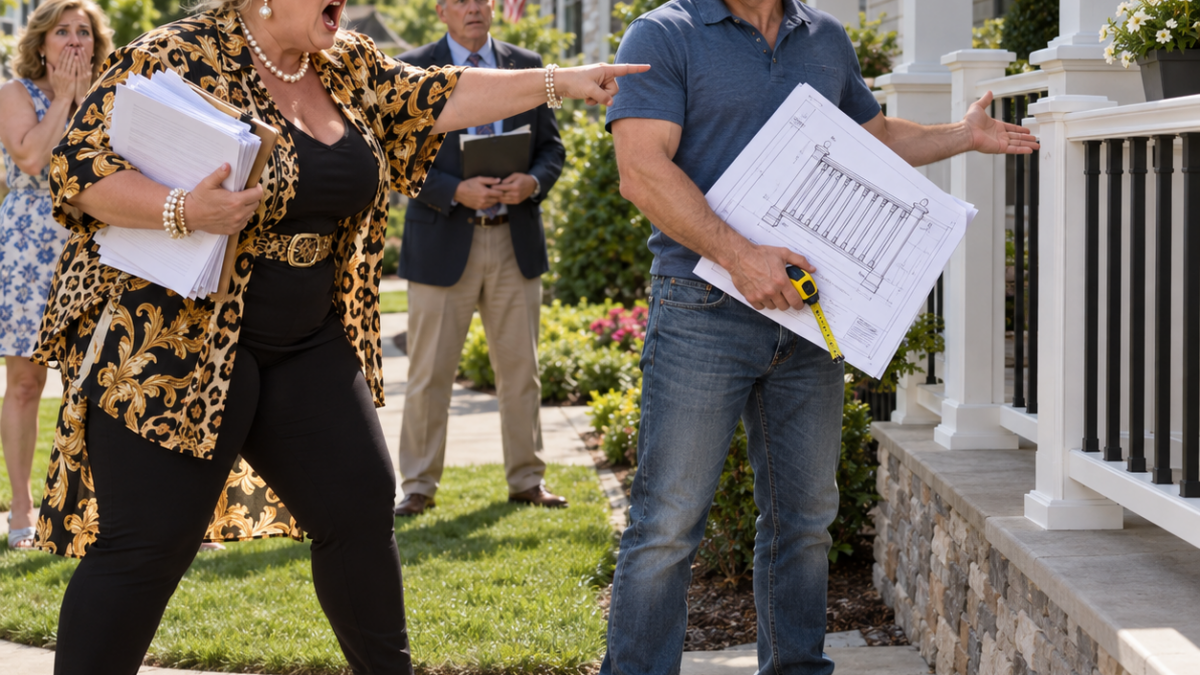
PART 2
I started with the top rail.
Thirty-eight inches.
Exactly where I remembered putting it.
The covenant allowed anything from thirty-six to forty-two.
I photographed the tape measure from three different angles so nobody could later claim perspective distortion.
Then I measured the baluster spacing.
Three and three-quarter inches.
Maximum permitted: four.
I photographed that too.
Next came the lumber.
Pressure-treated southern yellow pine.
One of the exact materials named in the governing documents.
I still had the product tags from the home improvement store in a folder because Sarah had once joked that I saved receipts like I was preparing for congressional testimony.
That night, the joke stopped being funny.
I placed the product label beside the railing and took a photograph.
Then the galvanized screw heads.
Then the corners.
Then the post anchors.
Then a wide shot of the finished structure.
Sarah stood in the doorway watching me.
“You’re photographing screws?”
“Yes.”
“Every screw?”
“Not every one.”
She raised an eyebrow.
“Yet.”
I smiled despite myself.
By ten that evening, our dining room table was covered with photographs, receipts, covenant pages, measurements, and a legal pad.
Lily wandered downstairs wearing pajama pants and carrying a bowl of cereal.
“What happened?”
“Your father has declared war on porch furniture.”
“It’s not furniture.”
Sarah looked at her.
“See?”
Lily glanced at the railing photographs.
“What did the HOA do?”
“Fined us.”
“For what?”
“The railing.”
She stared.
“The one they told you how to build?”
I pointed at her.
“Exactly.”
Apparently the logic was obvious even to a fifteen-year-old.
I spent another hour compiling everything into a report.
Not an angry letter.
Not a rant.
A report.
Page one contained the violation notice.
Page two contained the governing language.
Page three had a side-by-side comparison:
**HOA requirement:** Pressure-treated pine, cedar, or approved composite.
**As built:** Pressure-treated pine.
**HOA requirement:** Top rail between thirty-six and forty-two inches.
**As built:** Thirty-eight inches.
**HOA requirement:** Baluster openings not exceeding four inches.
**As built:** Three and three-quarter inches.
There was nowhere to hide.
I attached photographs to every point.
I labeled them the same way I had labeled engineering inspection photographs for years.
Figure 1.
Figure 2.
Figure 3.
Sarah read the finished document shortly before midnight.
“This is terrifying.”
I looked up.
“The railing?”
“No. You.”
That got a laugh out of me.
The next morning I emailed the entire package to the HOA board.
My message was brief.
I requested immediate withdrawal of violation number 734 and written confirmation that the railing complied with Article 4, Section 3, Subsection B.
Then I waited.
One day.
Nothing.
Two days.
Nothing.
Three days.
Nothing.
I sent a follow-up.
Silence.
I called the HOA office.
Voicemail.
Mailbox full.
I stopped at the clubhouse during posted office hours.
Locked.
There was a handwritten sign on the door.
FOR ASSISTANCE PLEASE EMAIL THE BOARD.
I stood there for several seconds staring at it.
They weren’t reviewing my appeal.
They were waiting for me to become tired enough to pay.
That tactic probably worked often.
Most people had jobs.
Children.
Mortgages.
Doctor appointments.
Aging parents.
Nobody wanted to spend evenings reading association bylaws because somebody disliked their porch railing.
The system depended on exhaustion.
Unfortunately for Karen, I was retired.
And I had spent almost three decades working inside bureaucracies far larger and more stubborn than the Oak Creek Estates HOA.
The next morning, I was sitting on my porch at eight o’clock with coffee and my printed report.
Karen appeared at 8:03 wearing a bright pink tracksuit.
Her daily walks weren’t really walks.
They were inspections.
I had watched her stop in front of houses to photograph garbage cans, landscaping, parked vehicles, and decorations.
She noticed me waiting.
Her pace slowed.
“Good morning, Mrs. Miller.”
“Mr. Davies.”
“I’ve been trying to contact the board.”
“You should use the official email.”
“I did.”
“Then someone will respond.”
“I emailed three days ago.”
She shrugged.
“We’re volunteers.”
I stood and carried the binder to the sidewalk.
“I’ve documented my railing’s compliance.”
“I’m aware of your position.”
I held out the binder.
She didn’t take it.
“It’s not my position. It’s measurement.”
“The Architectural Review Committee disagrees.”
“With a tape measure?”
Karen crossed her arms.
“With your interpretation.”
I almost smiled.
“Thirty-eight inches is an interpretation?”
She was getting irritated.
“Mr. Davies, you’re being deliberately difficult.”
“No. I’m being specific.”
She glanced toward my house.
“The issue is not simply dimensions.”
“Your notice says materials and design.”
“Yes.”
“The material is permitted.”
“That isn’t the point.”
“The dimensions are permitted.”
“That isn’t the point either.”
“What is the point?”
Her face tightened.
“The railing does not reflect the aesthetic harmony of Oak Creek.”
There it was.
The phrase people use when they want authority without standards.
“What does that mean?”
“It means the ARC has discretion.”
“Show me the standard I violated.”
“The covenant is a guideline.”
I actually thought I had misheard her.
“A guideline?”
“Yes.”
“The governing covenant?”
“Obviously the committee must interpret it.”
I looked at her for several seconds.
I wanted to make sure I remembered the statement exactly.
“So even when a homeowner follows the written specification, the committee can still fine him because you subjectively dislike the result?”
“That is an oversimplification.”
“Is it inaccurate?”
Karen stepped closer.
“The committee’s authority is binding, Mr. Davies.”
I lowered the binder.
“Thank you.”
She frowned.
“For what?”
“For clarifying your position.”
I turned around.
“Your appeal is still denied,” she called behind me.
I kept walking.
That conversation changed the entire dispute.
Before that morning, I had allowed for the possibility of administrative error.
Maybe Karen hadn’t read the measurements.
Maybe the committee saw a bad photograph.
Maybe someone confused my property with another.
That possibility was now gone.
She knew the railing complied with the written specifications.
She simply believed her personal judgment outranked the rules.
That afternoon I visited my next-door neighbor, Bill Hemlock.
Bill was sixty-eight, retired from the postal service, and maintained one of the best gardens in Oak Creek.
He was spreading mulch around an azalea bed when I approached.
“You got a minute?”
“For you, sure.”
I told him about the fine.
He leaned on his shovel.
“Eighteen hundred?”
“Yes.”
“For your railing?”
“Yes.”
He whistled.
“Karen really doesn’t like being ignored.”
“What does that mean?”
Bill glanced toward the street.
Then toward Karen’s direction.
“She likes people asking permission.”
“That isn’t exactly the same as following rules.”
“No.”
He smiled without humor.
“It isn’t.”
Then he pointed toward his flower bed.
“See that mulch?”
“Yes.”
“Two hundred dollars.”
“For mulch?”
“Apparently too red.”
I thought he was joking.
He went inside and returned with a violation notice.
There it was.
UNAPPROVED LANDSCAPE MATERIAL — COLOR INCONSISTENT WITH NATURAL EARTH-TONE STANDARD.
I read it twice.
“Does the covenant specify mulch color?”
“Nope.”
“Approved brands?”
“Nope.”
“Approved materials?”
“Nope.”
“What did you do?”
Bill shrugged.
“Paid it.”
“Why?”
“What else was I going to do? Spend five hundred dollars fighting a two-hundred-dollar fine?”
That sentence explained the entire business model.
Make resistance more expensive than surrender.
A few houses farther down lived Carlos and Maria Garcia with their two young children.
Their backyard contained a bright wooden swing set.
I had noticed it when we moved in.
Or more accurately, I had noticed how strangely far back in their yard it sat, almost against a drainage ditch.
Carlos explained why.
“Karen made us move it.”
“Why?”
“Visible from the street.”
“Is that prohibited?”
“No.”
“Then why move it?”
He laughed bitterly.
“Because they fined us five hundred dollars and threatened another hundred a week.”
Maria came outside holding a folder.
“You’re fighting them?”
“Yes.”
She handed it to me.
“Then take these.”
Inside were notices for the swing set.
Trash bins.
A garden hose.
A children’s inflatable pool.
One fine cited a section that didn’t exist.
I checked twice.
Article 11, Section 8.
Oak Creek’s Article 11 stopped at Section 6.
That evening I sat at the dining table staring at the invented citation.
Sarah put a cup of coffee beside me.
“This is bigger, isn’t it?”
“Yes.”
“How much bigger?”
“I don’t know yet.”
She sat across from me.
“Be careful.”
“I will.”
“I mean it, Eli.”
“So do I.”
She looked exhausted.
“We came here because you were finally done fighting.”
That sentence hurt.
Sarah had followed my career for twenty-seven years.
Moves.
Deployments.
Long separations.
Last-minute changes.
Birthdays I missed.
Christmas calls made over bad connections.
Oak Creek was supposed to be where all of that stopped.
“I don’t want another fight,” I said.
“Then pay the money.”
I looked at her.
She held my gaze.
“I know that isn’t what you want to hear.”
“No.”
“Eighteen hundred dollars hurts. But a lawyer will cost more.”
“This isn’t just eighteen hundred anymore.”
“I know.”
“If she can invent a rule and fine us, what happens next month?”
Sarah rubbed her forehead.
“I don’t know.”
“What if she decides Lily’s car is unacceptable when she starts driving? What if she dislikes our flowers? What if we replace the mailbox?”
“Eli—”
“This is our home.”
My voice wasn’t loud.
That made Sarah listen more carefully.
“We followed their rules. Every one of them. If following the rules still means Karen gets to punish us whenever she wants, then we don’t own this house. We’re renting our peace from her.”
Sarah looked toward the window.
After a long silence, she said, “So what do you need?”
That was Sarah.
She didn’t always agree with the battle.
But once she understood why I was standing, she stood beside me.
“I need legal advice.”
“Marcus?”
“Marcus.”
She smiled faintly.
“God help Karen.”
Marcus Thorne and I had met in basic training almost thirty years earlier.
He was loud where I was quiet.
Fast where I was methodical.
The kind of man who could turn a miserable twelve-hour work detail into something people remembered fondly.
After leaving active duty, he went to law school using the GI Bill and eventually became a real estate attorney.
He answered on the second ring.
“Eli Davies. Either you’re dying or you need free legal advice.”
“Neither.”
“Then I’m hanging up.”
“I have an HOA problem.”
He became quiet.
Then laughed.
“My favorite.”
I explained everything.
The specifications.
The photographs.
Karen’s fine.
Her statement that the covenant was only a guideline.
When I finished, Marcus said, “Tell me you recorded that.”
“No.”
“Damn.”
“But I documented it immediately afterward.”
“That helps.”
“Am I missing something?”
“No.”
His voice changed.
The joking disappeared.
“If the governing documents say pressure-treated pine and you used pressure-treated pine, they cannot transform pine into an unauthorized material because Karen dislikes knots in wood.”
“That was my thought.”
“And dimensions?”
“Exactly compliant.”
“Then the fine lacks a contractual basis.”
“What about interpretive authority?”
“Interpretation means resolving ambiguity. It does not mean writing a new rule after the homeowner finishes construction.”
I leaned back.
“Good.”
“Don’t celebrate.”
“I’m not.”
“She can still make your life expensive.”
“I know.”
“What’s the lien threat?”
I paused.
“What lien threat?”
“You said the fine has a thirty-day deadline. HOA fine systems often escalate.”
As if Karen had been listening, the next notice arrived two days later.
The fine was now $1,900.
One hundred dollars had been added as a late-payment penalty.
And beneath it:
**FAILURE TO REMIT PAYMENT WITHIN FIFTEEN DAYS MAY RESULT IN COLLECTION ACTION INCLUDING A LIEN AGAINST THE PROPERTY.**
Sarah read the line twice.
Her face drained.
“Eli.”
“I know.”
“A lien?”
“I know.”
“On our house?”
“Yes.”
“For a railing that follows the rules?”
“Yes.”
She pushed the paper away.
For the first time, I saw real fear in her expression.
We had spent years saving for that house.
It represented more than property.
It was the place we had finally unpacked boxes without wondering when orders would come telling us to move again.
Lily had painted her bedroom exactly how she wanted because, for once, there was no expected departure date.
Sarah had planted hydrangeas knowing she might actually see them mature.
Home wasn’t supposed to be temporary anymore.
Karen had found the one threat capable of making Sarah question whether fighting was worth it.
“Maybe we pay,” she whispered.
I reached across the table and took her hand.
“If the debt were legitimate, yes.”
“But it isn’t.”
“Exactly.”
“Does that matter if they file the lien anyway?”
“That’s what Marcus is going to answer.”
I called him immediately.
When I read the letter, his response was simple.
“Good.”
I stared at the phone.
“Good?”
“She escalated in writing.”
“My wife doesn’t think this is good.”
Sarah pointed at the phone.
“He can hear me.”
Marcus laughed.
“I understand, Sarah. But legally, this helps.”
“How?”
“Because now we have measurable damages and a concrete threat based on a fine we can show lacks foundation.”
He paused.
“Eli, we stop asking nicely.”
The next letter carried Marcus’s law-firm letterhead.
It demanded immediate rescission of the railing fine and every related penalty.
It cited the governing documents.
It cited state law concerning association records and board duties.
It warned against recording any lien based on a disputed and unsupported charge.
Then Marcus added the request that changed everything.
We demanded twenty-four months of Architectural Review Committee meeting minutes.
All written standards used to evaluate structures.
All fine schedules.
All records showing fines assessed.
All accounting records showing fine income.
When I read that section, I smiled.
“Paperwork.”
“Exactly,” Marcus said.
“Why the fine records?”
“Because your neighbors’ stories bother me.”
“You think there’s more?”
“There’s always more when someone tells you written rules don’t matter.”
We sent the demand by certified mail.
Karen signed for it herself.
For eight days, silence.
On day nine, an email arrived.
The board would hear my appeal Tuesday at seven.
Sarah read it.
“You already appealed.”
“Apparently now I’m appealing again.”
“Are you going alone?”
“Marcus says I should.”
She frowned.
“He isn’t coming?”
“He wants them talking freely.”
“That sounds ominous.”
“It’s useful.”
Tuesday night I entered the clubhouse carrying my binder, laptop, and a small projector.
Karen sat at the center table.
Brenda Lowry sat to her right.
Janice Gable sat to her left.
Both were longtime friends of Karen’s.
At the far end sat Arthur Penright, the HOA treasurer.
He looked like a man who wanted to be anywhere else.
Nobody else attended.
Karen looked at the projector.
“What is that?”
“Visual aid.”
“You have five minutes.”
“More than enough.”
I plugged in the laptop.
A photograph of the railing appeared on the wall.
I began.
“Article 4, Section 3, Subsection B identifies three relevant physical requirements.”
Click.
Pressure-treated pine.
Click.
Photograph of the product label.
Click.
Thirty-six to forty-two inches.
Click.
Measurement: thirty-eight.
Click.
Four-inch maximum spacing.
Click.
Measurement: three and three-quarter.
I spoke for less than four minutes.
No emotion.
No accusations.
Just specifications.
Then I displayed a chart.
**REQUIREMENT / ACTUAL CONDITION**
Every row matched.
I shut off the projector.
“The violation does not exist.”
Silence.
Arthur looked down at the documents.
Brenda whispered to Karen.
Janice frowned.
Then Karen smiled.
“Your presentation is very thorough.”
“Thank you.”
“But incomplete.”
“How?”
“The ARC considers overall aesthetic quality.”
“Show me that requirement.”
Karen’s smile disappeared.
“Visible knots in the lumber diminish the premium appearance of the neighborhood.”
“Where is knot grade specified?”
“The committee has interpretive discretion.”
“Where is lumber grade specified?”
“Mr. Davies—”
“Where?”
Karen slapped one palm against the table.
“This is not a courtroom.”
“No. If it were, you would have to answer.”
Arthur’s head snapped up.
Karen’s face reddened.
“You are here to appeal a decision, not interrogate this board.”
“Then I’m appealing it. Identify the rule.”
Brenda leaned toward Karen.
Janice whispered something.
Karen finally said, “The committee finds your railing noncompliant.”
“On an unwritten standard.”
“On our interpretation.”
I opened my binder.
“Then provide the committee minutes where that interpretation was adopted.”
Karen froze.
“Those are internal records.”
“No.”
I pulled out Marcus’s letter.
“As requested by certified mail, I am entitled to inspect association records as provided under the governing documents and applicable state law.”
Arthur shifted in his seat.
Karen glared at him.
I noticed.
That tiny look mattered.
“The records request is being reviewed,” she said.
“When?”
“When appropriate.”
“The statutory period is running.”
“The board considers this appeal concluded.”
She picked up the gavel.
Bang.
“The fine stands.”
I packed the projector.
Nobody spoke.
As I reached the door, Arthur hurried behind me.
“Mr. Davies.”
I stopped.
He glanced back toward the meeting room.
“You should be careful.”
“Why?”
“Karen doesn’t respond well to challenges.”
I studied him.
“Arthur, are the fine records accurate?”
His eyes changed.
Fear.
Not confusion.
Fear.
“I don’t know what you mean.”
“You’re the treasurer.”
He swallowed.
“You should just pay the fine.”
“That wasn’t my question.”
He looked back again.
Then whispered, “I really can’t talk.”
He walked away.
I stood in the parking lot for several seconds watching him.
People who have nothing to hide usually don’t whisper.
The next morning I created a one-page notice.
No insults.
No accusations of theft.
No dramatic language.
Just facts.
**ARE YOU SATISFIED WITH OUR HOA?**
I described my railing dispute.
Bill’s mulch.
The Garcias’ swing set.
Then I asked one question.
**Have you been fined for a rule you could not find in the governing documents?**
I created an email address for responses.
Bill and Carlos helped me distribute the notices to doorsteps.
We did not place them inside mailboxes.
By midnight, there were four replies.
By the next evening, thirty-two.
By the end of the week, eighty-seven.
A hose reel in an unapproved beige.
Blue Christmas lights.
Red petunias.
A decorative welcome flag.
A satellite dish.
A visible child’s bicycle.
A bird feeder.
A basketball goal.
A temporary graduation sign.
A mailbox post.
The details were almost funny.
The money wasn’t.
Sarah built a spreadsheet.
Resident.
Date.
Violation.
Fine amount.
Rule cited.
Actual rule.
Paid or unpaid.
Then she added one final column.
**VALID CITATION?**
The answer was frequently no.
Some notices cited provisions that did not exist.
Others stretched generic maintenance language into standards nobody could reasonably predict.
We totaled the fines documented by participating homeowners.
$52,750.
I stared at the number.
“That can’t be right.”
Sarah recalculated.
Same result.
I pulled out the annual HOA budget.
Reported fine income: roughly three thousand dollars.
I called Marcus.
He became quiet when I gave him both numbers.
“How confident are you?”
“Every entry has a notice attached.”
“Paid?”
“Some. Not all.”
“How much confirmed paid?”
Sarah gave me the subtotal.
Marcus was silent again.
“Request the bank statements.”
“All of them?”
“Five years.”
“Karen will refuse.”
“I hope so.”
“Why?”
“Because either the records explain the discrepancy, or the refusal becomes another problem.”
The second certified letter requested full financial records permitted for homeowner inspection, including bank statements, check registers, fine receipts, and ARC accounting.
This time we copied the homeowners who had joined the group.
Karen could no longer pretend one retired sergeant major was causing trouble.
The Oak Creek Homeowners Alliance now represented dozens of households.
A week later, the HOA responded through an attorney.
The letter accused me of harassment.
It called our records request excessive.
It described detailed financial statements as confidential and proprietary.
Attached were several bank statements.
Almost every useful line had been blacked out.
Payees.
Check numbers.
Descriptions.
Transfers.
All hidden.
Marcus read the package.
“She’s panicking.”
“Or her lawyer thinks she’s right.”
“Her lawyer may only know what she told him.”
“What now?”
“We preserve this response and make the appropriate regulatory complaint.”
The larger process would take time.
Karen didn’t want time.
She wanted fear.
And fear was exactly what she tried next.
The tow truck arrived at 6:42 on a Thursday morning.
I woke to the backup alarm.
Beep.
Beep.
Beep.
For one disoriented second I thought a delivery truck had entered the driveway.
Then I looked through the bedroom window.
A tow truck sat behind my 1998 Ford F-150.
Karen stood on the sidewalk.
Fully dressed.
Waiting.
My truck was more than transportation.
I had bought it cheap after retirement, rust along the fenders and an engine that needed more patience than money.
I rebuilt it slowly.
Suspension.
Brakes.
Interior.
Bodywork.
Paint.
Deep metallic blue.
It was one of the first projects in years I had completed without deadlines, inspections, deployment schedules, or mission requirements.
I worked on it because I wanted to.
I loved that truck.
Seeing a chain beneath the rear axle triggered an anger I had managed to avoid throughout the entire railing dispute.
I was outside in jeans and boots within thirty seconds.
“Stop.”
The driver looked at me.
Karen didn’t.
“This vehicle is being removed for a covenant violation.”
I walked toward the truck.
“What violation?”
“Commercial vehicles may not be stored overnight in residential driveways.”
“It isn’t commercial.”
Karen gestured dismissively.
“It clearly resembles a work vehicle.”
The tow driver paused.
“Ma’am, you told dispatch commercial truck.”
“It is.”
I pointed at the F-150.
“No company markings. No commercial plates. No equipment racks. Personal registration.”
Karen crossed her arms.
“The ARC determined otherwise.”
I looked at her.
“The ARC determines vehicle-registration classes now?”
“Don’t be difficult.”
The driver straightened.
“Do you have paperwork?”
Karen held up an HOA notice.
“I’m the association president.”
“Police tow authorization?”
“We don’t need one.”
The driver looked at me.
I took out my phone.
Karen laughed.
“Calling your lawyer?”
“No.”
I dialed emergency dispatch.
“I need to report an attempted unauthorized towing of a privately owned vehicle currently occurring on my property.”
Karen’s smile vanished.
“Eli.”
I continued speaking to dispatch.
The tow driver immediately stopped touching the chain.
Within minutes, a sheriff’s deputy arrived.
Neighbors had started appearing.
Garage doors opened.
Curtains moved.
Bill stood across the street holding coffee.
Carlos walked down his driveway.
Karen began talking before the deputy had fully closed his cruiser door.
“Officer, thank heavens. This homeowner is obstructing lawful covenant enforcement.”
The deputy looked at the tow truck.
Then my pickup.
Then Karen.
“Sir?”
I handed him my registration.
“This is my personal vehicle. Mrs. Miller directed this company to tow it because she claims it is commercial.”
The deputy examined the paper.
“Personal registration.”
“Yes.”
He walked around the truck.
No business decals.
No commercial equipment.
He looked at Karen.
“Why do you believe it’s commercial?”
“It’s a large work truck.”
“It’s an F-150.”
“It looks commercial.”
The deputy blinked.
That was the moment Karen’s invented reality collided with actual authority.
“Ma’am, appearance doesn’t change registration classification.”
“Our covenants prohibit commercial vehicles.”
“Maybe they do.”
He pointed toward the truck.
“This isn’t one.”
Karen became louder.
“We have broad authority to maintain community standards.”
The deputy sighed.
“I’m not here to interpret your HOA documents. I am telling you that taking a privately registered vehicle without lawful authority could create serious legal problems.”
Then he looked at the tow driver.
“I’d unhook it.”
The driver needed no second invitation.
He removed the chain.
Karen stepped toward him.
“I hired you.”
“And now I’m leaving.”
“You’ll lose our contract.”
The driver looked at my truck, the deputy, and the growing audience.
“Fine.”
He got inside and drove away.
The deputy returned my registration.
“Keep documentation.”
I almost laughed.
“I have plenty.”
“I figured.”
After he left, Karen stood alone on the sidewalk.
For the first time since I had met her, nobody looked afraid of her.
Carlos spoke first.
“You tried to steal his truck?”
Karen turned on him.
“Mind your own business.”
Bill laughed.
“It became our business about fifty thousand dollars ago.”
Karen’s head snapped toward him.
“What did you say?”
Nobody answered.
She looked from house to house.
Faces in windows.
People on sidewalks.
Phones recording.
Something had shifted.
She walked away.
The failed tow accomplished what a dozen letters couldn’t.
It exposed the limits of her power.
The emails exploded that day.
People who had stayed silent joined the alliance.
Former board volunteers contacted us.
One resident had saved meeting agendas going back six years.
Another had copies of old financial summaries.
A woman who previously served on the social committee remembered Karen insisting that ARC fine money was “separate” from the regular budget.
And Arthur Penright finally cracked.
Bill spoke with him first.
Then Arthur called me.
“Can we meet?”
“Where?”
“Not the clubhouse.”
He came to my house after dark.
Sarah made coffee.
Arthur sat at the dining table staring at his cup for almost a minute.
Then he said, “There’s another account.”
I didn’t react.
“What account?”
“Karen calls it the Community Enhancement Fund.”
“Is it listed in the annual budget?”
“No.”
“Do you have statements?”
“No.”
“You’re the treasurer.”
“I know.”
“Who does?”
“Karen.”
Sarah stopped writing.
Arthur looked ashamed.
“She told me ARC fines needed flexibility. She said putting them through the operating account created accounting problems.”
“Who deposits the checks?”
“She does.”
“Who has signing authority?”
“I don’t know.”
“You authorized the account?”
His face reddened.
“She brought bank paperwork to a meeting. She said it was routine.”
“Did Brenda and Janice vote?”
“I don’t remember.”
“Minutes?”
His silence answered.
Marcus came over the next morning.
Arthur repeated everything.
Marcus asked careful questions.
No accusations.
No leading.
At the end he said, “Arthur, you need independent counsel.”
Arthur looked sick.
“Am I in trouble?”
“I’m not your attorney, so I’m not giving you personal legal advice. But you need to preserve every document you possess and stop destroying or altering anything.”
“I never took money.”
“I didn’t say you did.”
Arthur covered his face.
“I should have asked more questions.”
“Yes.”
That answer hurt him.
But it was true.
Oak Creek’s bylaws allowed homeowners to call a special membership meeting with signatures from twenty-five percent of properties.
There were two hundred homes.
We needed fifty.
Within three days, we had ninety-three.
By Sunday evening, 112 homeowners had signed.
More than half the neighborhood.
Our petition stated four grounds:
Arbitrary and inconsistent covenant enforcement.
Failure to maintain and provide required association records.
Potential financial mismanagement.
Loss of confidence in the board.
The requested action:
Recall Karen Miller, Brenda Lowry, and Janice Gable.
I personally delivered the petition to the HOA’s registered agent.
The meeting had to be scheduled.
Karen had spent months forcing me to defend my porch.
Now she had to defend her presidency.
The special meeting was held on a warm Thursday evening.
Cars filled the clubhouse parking lot.
Others lined both sides of the street.
Inside, every chair was occupied.
People stood along the walls.
Children sat on parents’ laps.
Homeowners who had never attended a board meeting were packed into the hallway.
Karen sat at the center table.
Brenda beside her.
Janice beside Brenda.
Arthur at the far end.
Nobody looked comfortable.
Karen struck the gavel.
“Before we begin, I want to address the campaign of misinformation that has poisoned this neighborhood—”
People groaned.
She raised her voice.
“For eight years, I have volunteered countless hours protecting your property values!”
Someone shouted, “With our money?”
The room erupted.
Bang.
Bang.
Bang.
“ORDER!”
I remained standing near the projector.
The petition gave our group the right to present its case.
Karen attempted to speak for nearly fifteen minutes before homeowners began shouting for the meeting agenda.
Eventually she sat.
I walked forward.
The projector came on.
First slide.
My porch.
“This began with an $1,800 fine.”
Second slide.
The covenant.
Third.
My railing measurements.
I explained each one.
No adjectives.
No insults.
Then Bill’s mulch.
Two hundred dollars.
The Garcias’ swing set.
Five hundred.
The hose caddy.
The Christmas lights.
Petunias.
Welcome flag.
Satellite dish.
Each image appeared beside the violation notice.
Some people laughed.
Others became angrier.
I clicked to the final enforcement slide.
“Seventy-one percent of the documented violations we reviewed relied either on provisions we could not locate or interpretations unsupported by any objective standard.”
Karen jumped up.
“That analysis was prepared by unqualified residents!”
“Yes.”
I looked directly at her.
“Residents who can read.”
Laughter swept through the room.
Karen slammed the gavel.
I continued.
“Now we come to money.”
The room quieted.
I projected the official HOA budget.
Fine revenue.
Then our documented total.
$52,750.
The sound in the room changed.
Not laughter.
Shock.
A man near the back shouted, “Where is it?”
Someone else called, “Show us the accounts!”
Karen stood.
“These numbers are fabricated.”
Every entry on our spreadsheet had documentation.
“Then the board can easily disprove them by releasing the records.”
“We have provided financial statements.”
“Redacted statements.”
“Confidentiality is necessary.”
“From the homeowners whose money it is?”
The crowd roared.
Karen struck the gavel again.
I turned toward Arthur.
This was the moment I had dreaded.
He had told Marcus he was willing to speak.
But willingness in my dining room was different from courage in front of two hundred neighbors.
“Mr. Penright.”
Arthur looked at me.
“As treasurer, can you reconcile the difference between reported fine income and the notices collected by homeowners?”
Karen stared at him.
Arthur’s mouth opened.
Nothing came out.
I waited.
The room waited.
Karen finally smiled.
Then Arthur stood.
“I can’t.”
Karen’s smile widened.
Arthur continued.
“I can’t because I never controlled the fine money.”
Karen’s face changed.
Brenda went pale.
Arthur swallowed.
“There is another bank account.”
The room became so quiet I could hear the ventilation system.
Karen shot to her feet.
“Arthur, sit down.”
He didn’t.
“She called it the Community Enhancement Fund.”
“Sit down!”
Arthur’s voice shook.
“She collected the fine checks.”
“YOU’RE LYING!”
“She handled the deposits.”
People began shouting.
Arthur raised his voice for the first time.
“I NEVER RECEIVED THE STATEMENTS!”
Chaos.
Karen was screaming.
Brenda was crying.
Janice kept repeating, “I didn’t know.”
Several homeowners stood.
I raised both hands.
“Please.”
Nobody heard me.
Then Marcus stood at the rear.
He had attended as my attorney and as a guest of homeowners.
“I strongly recommend that everyone stop making criminal accusations in this room.”
That worked.
People quieted.
Marcus continued.
“What has been described raises serious questions requiring independent review. The appropriate response is not speculation. It is preservation of records, temporary financial controls, and a forensic audit.”
Karen pointed at him.
“You orchestrated this.”
“No.”
He looked at her.
“Your records did.”
The recall vote proceeded.
Ballots were distributed.
One per eligible property.
Volunteers counted them at a side table where observers from both sides could watch.
Karen paced.
Brenda sat frozen.
Janice stared at the floor.
When the result was announced, the room seemed to stop breathing.
Karen recalled.
Brenda recalled.
Janice recalled.
The margin wasn’t close.
Karen stared at the tally.
“No.”
The meeting chair repeated the result.
“This vote is invalid.”
Nobody moved.
“You cannot do this.”
Arthur looked at her.
“The bylaws say we can.”
She turned on him.
“You spineless little traitor.”
That ended any remaining sympathy.
Karen grabbed the gavel.
For a second, I thought she might throw it.
Instead she slammed it onto the table.
“You’ll all regret this.”
Then she stormed out.
The door closed.
Silence.
Then applause began.
Not cheering at first.
Applause.
Slow.
Then louder.
People stood.
Sarah was near the front.
Our eyes met.
I felt no triumph.
Only release.
Bill nominated me as interim president.
I refused immediately.
The crowd laughed.
“I’m serious.”
Bill stood.
“We’re serious too.”
“I didn’t do this to become Karen.”
“You won’t.”
“That’s what everybody says before somebody gives them a gavel.”
That got another laugh.
Eventually I agreed to serve temporarily until a full election, on one condition.
All major decisions would require public documentation.
The first motion I made was simple.
“Pending legal review and the audit, I move that collection activity on disputed ARC fines issued under the removed board be suspended immediately.”
Passed unanimously.
Second motion.
Secure all records.
Passed.
Third.
Freeze changes to account signatories until bank records could be reconciled through counsel.
Passed.
Then I took the original $1,800 notice from my binder.
The paper was creased from being carried everywhere.
Bill smiled.
“Frame it.”
I considered that.
Then tore it in half.
The room applauded.
I tore it again.
Sarah shook her head.
“You know we have a shredder at home.”
“I waited too long for this.”
She laughed.
The next morning we changed the locks on the HOA office with counsel’s approval.
Karen sent eleven emails before noon.
The recall was fraudulent.
The meeting was improper.
The interim board lacked authority.
The records belonged to the prior board.
She demanded office access.
Marcus gave us one approved response.
**Your correspondence has been received and forwarded to legal counsel.**
Every time she wrote, we sent the same sentence.
By the seventh response, I could almost feel her rage through the screen.
Then the forensic accountant arrived.
Her name was Evelyn Albright.
She wore dark glasses, carried two laptops, and had the humor of someone who had spent twenty years discovering where people hid numbers.
We showed her the office.
Boxes.
Statements.
Receipts.
Old meeting packets.
She looked around.
“Anybody touch anything?”
“No.”
“Anybody throw anything away?”
“No.”
“Anybody reorganize?”
“No.”
She smiled.
“I like you already.”
For the next two weeks, Evelyn worked.
Bank subpoenas and law-enforcement access would require proper process, but the materials already in association custody told a troubling story.
The Community Enhancement Fund existed.
Deposits corresponded closely with periods of heavy ARC fines.
Many expenditures lacked clear board authorization.
Some appeared personal.
Restaurant bills labeled planning meetings.
Department-store purchases labeled event materials.
Spa charges categorized as volunteer wellness expenses.
When Evelyn showed me that one, I stared.
“Volunteer wellness?”
“Apparently governing mulch colors is stressful.”
I laughed once.
Then she turned the page.
A payment to the county tax office.
It matched Karen’s residential property-tax amount.
My laughter disappeared.
“How much?”
Evelyn told me.
“Association purpose?”
“Ledger says administrative reimbursement.”
“For what?”
“No documentation.”
The deeper she went, the worse it became.
Brenda and Janice had received repeated payments described as committee stipends despite bylaws stating board and committee service was unpaid.
Some expenditures might have legitimate explanations.
Others clearly required investigation.
The total questionable transactions exceeded seventy thousand dollars.
Marcus advised us to turn the audit over to the appropriate authorities.
We did.
A financial-crimes detective interviewed us.
Then Arthur.
Then former board members.
Neighbors gave copies of fine checks.
Bank records were requested through proper legal channels.
The investigation stopped being neighborhood gossip.
It became real.
Karen still lived three streets away.
That created strange encounters.
I saw her once at the grocery store.
She turned into another aisle.
Sarah spotted her at the pharmacy.
Karen left without picking up her prescription.
Lily came home one afternoon angry.
“Mom says not to engage with Mrs. Miller, right?”
“Correct.”
“She called me disrespectful.”
“Where?”
“At the bus stop.”
“What did you say?”
“Nothing.”
“Good.”
“She said your father is destroying this neighborhood.”
I stood very still.
“And?”
“I told her the railing is thirty-eight inches.”
I tried not to laugh.
Failed.
“Lily.”
“What? It is.”
Sarah walked in.
“What happened?”
“Your daughter has inherited my sense of diplomacy.”
“She never had a chance.”
Despite moments like that, the pressure on our family was real.
Cars slowed near the house.
People wanted updates.
Reporters from a small local paper began asking questions after learning about the recall.
Sarah worried constantly that something would happen to our property.
I installed another camera.
Then another.
One night, while sitting beside her in bed, I said, “I’m sorry.”
“For what?”
“This wasn’t the retirement I promised.”
Sarah closed her book.
“You didn’t promise me anything.”
“Yes, I did.”
“You promised we’d finally have a home.”
“And instead—”
“This is our home.”
She took my hand.
“That’s why you’re fighting.”
I looked at her.
“Still wish I’d paid?”
She thought for several seconds.
“Ask me again when nobody is investigating our former HOA president for missing money.”
Fair enough.
Several weeks later, two police cruisers turned onto Karen’s street.
I didn’t know they were coming.
Nobody on our interim board did.
Bill called me.
“Eli.”
“What?”
“You may want to look outside.”
I walked to the end of our driveway.
Neighbors were already standing quietly on porches.
The cruisers stopped at Karen’s house.
A detective knocked.
From where I stood, I could see movement behind the large front window.
Karen gestured.
Another officer entered.
Ten minutes passed.
Then the door opened.
Karen stepped outside accompanied by officers.
Her hands were restrained behind her.
The neighborhood became completely silent.
No shouting.
No celebration.
Just silence.
She looked smaller than I remembered.
Not physically.
Humanly.
The floral suits, clipboard, gavel, warnings, fines, threats—all of those props were gone.
She was simply a woman facing consequences.
Someone two houses away began clapping.
A second person joined.
Then stopped.
The applause never became a cheer.
I was glad.
This wasn’t a football game.
A family was falling apart.
However responsible Karen was for bringing that pain upon herself, I didn’t need to enjoy the spectacle.
Sarah stood beside me.
“You okay?”
“Yes.”
“You don’t look happy.”
“I thought I would.”
“Do you want to be?”
I watched the cruiser leave.
“No.”
The criminal case took months.
So did the civil recovery process.
Nobody got the cinematic courtroom explosion neighbors expected.
Real accountability moves slower.
Documents.
Hearings.
Negotiations.
Restitution calculations.
Plea discussions.
Legal fees.
Karen eventually accepted a plea arrangement involving probation, repayment obligations, and restrictions that prevented her from again occupying similar fiduciary authority.
Brenda and Janice faced separate consequences related to the money they had received and their roles in the secret account.
The details mattered less to me than what happened inside Oak Creek.
We held elections.
I refused to run for permanent president.
Bill tried to nominate me anyway.
“No.”
“Why?”
“Because I want my porch back.”
The room laughed.
Maria Garcia joined the board.
Arthur remained long enough to help transition the books, then stepped away voluntarily.
He apologized at a membership meeting.
Not the defensive kind.
A real apology.
“I knew things were wrong,” he said. “I told myself that because I wasn’t taking money, I wasn’t responsible. But I had a duty to ask questions, and I didn’t.”
That took courage.
People forgave him.
Not everyone.
But enough.
The new board rewrote the enforcement process.
No fine could be issued without a specific citation to an existing rule.
Photographic evidence had to accompany structural violations.
Homeowners received notice and an opportunity to correct genuine problems before monetary penalties, except in emergencies.
Appeals were heard by people who had not issued the original violation.
Financial reports showed fine income separately.
Bank statements were reviewed by more than one officer.
Large expenditures required votes.
Vendor relationships had to be disclosed.
Committee meetings had minutes.
And the phrase *aesthetic harmony* could no longer magically create a rule that nobody had voted on.
Then came the refunds.
Evelyn’s audit identified improperly assessed or unsupported fines.
Recovered association funds, restitution, and available reserves were used according to legal advice to repay homeowners where appropriate.
Bill received his mulch money.
Carlos and Maria received their swing-set fine back.
A woman named Denise received a refund for the infamous beige hose-caddy violation.
She brought the hose caddy to the next annual picnic and placed it in the center of a table as a flowerpot.
Everyone laughed.
A man who had fought over his satellite dish received his money back.
And one afternoon, an envelope arrived at my house from Oak Creek Estates.
Sarah handed it to me.
“You’re going to like this.”
Inside was an official letter.
**Violation 734 — rescinded.**
Fine balance: $0.
Administrative fee: $0.
Late charge: $0.
Property lien activity: none.
A second paragraph acknowledged that the porch railing conformed to the governing specifications in effect when it was constructed.
I read that sentence twice.
Then I took the letter outside.
The railing had begun weathering from golden pine toward a soft silver-gray.
I ran one hand across the top.
Solid.
Level.
Thirty-eight inches.
Sarah came outside with iced tea.
“Thinking about everything?”
“Yes.”
She sat.
“It was never really about the railing.”
“No.”
“The money?”
“No.”
“Karen?”
I thought about that one.
“Not exactly.”
“What, then?”
I looked down the street.
Children were riding bicycles.
Bill was spreading whatever shade of mulch he pleased.
Carlos’s kids were swinging high enough that I could hear them laughing from our porch.
“It was about whether home still belongs to you after you sign the deed.”
Sarah nodded.
“We almost paid.”
“I know.”
“I really wanted to.”
“I know that too.”
She looked embarrassed.
“I was scared.”
“So was I.”
“You never looked scared.”
“Occupational defect.”
She smiled.
“What were you afraid of?”
I looked toward Lily’s bedroom window.
“That I would turn our home into another deployment.”
Sarah studied me.
“Did you?”
“Sometimes.”
“Yes.”
That answer hurt because it was honest.
Then she touched my arm.
“But you also finished it.”
A year passed.
Oak Creek changed.
Not dramatically.
That was the best part.
Homes still looked cared for.
Lawns were still trimmed.
Nobody painted a giant neon skull across a garage.
Property values did not collapse because somebody used reddish mulch.
The world continued turning despite visible swing sets.
Board meetings became boring.
Beautifully boring.
Financial reports took twenty minutes.
Residents asked questions.
Board members answered them.
Arguments happened.
People voted.
Then everybody went home.
The neighborhood barbecue became crowded again.
Children played near the clubhouse.
Nobody walked around with a clipboard photographing violations.
People actually knew one another.
One summer evening, Marcus visited.
We sat on the porch.
He leaned against the railing.
“This the famous structure?”
“That’s it.”
He pushed against it.
“Pretty solid.”
“Thirty-eight inches.”
He laughed.
“You’re never letting that go, are you?”
“No.”
“Three and three-quarter spacing?”
“Correct.”
“Pressure-treated pine?”
“Obviously.”
He shook his head.
“All of this because somebody didn’t like knots in wood.”
“No.”
Marcus looked over.
“All of this because people paid her for too long.”
He nodded slowly.
“That too.”
“What would have happened if I had paid the first fine?”
Marcus thought about it.
“Probably nothing.”
“Exactly.”
“Until the next person.”
“Exactly.”
The front door opened.
Lily stepped outside.
She was sixteen now.
Driver’s license.
College brochures.
Far too independent for my comfort.
“Dad?”
“Yes?”
“Can I park in the driveway tonight?”
Marcus laughed immediately.
I knew why.
“Is the vehicle commercially registered?”
Lily rolled her eyes.
“Mom!”
Sarah shouted from inside.
“Stop torturing your daughter!”
Lily pointed at Marcus.
“You encouraged him.”
“I absolutely did.”
Life was normal.
That felt like victory.
Then, almost eighteen months after the original fine, a moving truck appeared outside Karen’s former house.
She had sold after the legal case and moved away.
The new owners were a young couple named Dave and Rachel Warren.
They had a little boy who spent his first afternoon running through piles of moving boxes pretending they were a fortress.
I introduced myself.
Dave shook my hand.
“Elias?”
“Eli.”
“We heard you’re the guy who knows everything around here.”
“That rumor is dangerous.”
He laughed.
Then his eyes landed on my porch.
“That’s a good railing.”
I almost looked at Sarah through the window because I knew she would find the moment hilarious.
“Thanks.”
“Our railing’s rotting.”
“I noticed.”
“I want to rebuild it.”
“Good idea.”
He rubbed the top rail.
“You do this yourself?”
“Yes.”
“HOA difficult about approvals?”
I looked down the street.
The evening sun filtered through the oak trees.
Bill was watering flowers.
Children were playing.
Somewhere a dog barked.
“No.”
Dave looked relieved.
“We have rules.”
“Sure.”
“But now the people enforcing them have to follow them too.”
He smiled.
“I can live with that.”
“I’ll get you the railing section.”
“You have it?”
I laughed.
“You have no idea.”
The next Saturday Dave came over carrying lumber plans.
His design was nearly identical to mine.
Pressure-treated pine.
Thirty-eight-inch top rail.
Three-and-three-quarter-inch baluster gaps.
He asked whether I could help.
I spent the day beside him cutting boards, setting posts, and checking levels.
His little boy brought us screws one at a time.
At one point Dave held the tape measure.
“Thirty-eight.”
I looked over.
“Perfect.”
“You sound emotional.”
“You wouldn’t understand.”
By sunset, the railing was finished.
Dave leaned against it.
“Solid.”
“Should be.”
His wife came outside.
“It looks great.”
Their little boy grabbed the rail and shook it as hard as he could.
Nothing moved.
I smiled.
That was how the story ended for me.
Not with Karen being arrested.
Not with the recall vote.
Not with my fine being torn apart.
Not even with the refund letters.
It ended with another homeowner building something on his own property without being afraid that one person’s mood could cost him thousands of dollars.
Later that evening, I sat beside Sarah on our porch.
The railing between us and the yard had weathered beautifully.
Sarah ran her hand along the top.
“You realize this thing is probably going to outlive us.”
“That was the plan.”
“You always overbuild.”
“I build correctly.”
“Of course.”
She rested her head against my shoulder.
The sky turned orange behind the oak trees.
For years, I had imagined retirement as absence.
No alarms.
No orders.
No deployment schedules.
No crises.
I eventually learned peace isn’t simply the absence of conflict.
Sometimes peace is knowing that when conflict comes, you won’t have to face it alone.
Bill had stood beside me.
The Garcias had stood beside me.
Sarah had organized every document when she would have preferred the whole thing disappear.
Lily reminded me that rules obvious to a teenager should not require a legal battle.
Arthur eventually told the truth.
Marcus made sure our anger stayed inside the law.
Dozens of homeowners stopped whispering separately and began speaking together.
Karen’s greatest source of power had never been the covenant.
It had been isolation.
Each homeowner believed his absurd fine was his problem.
Bill thought the mulch fine was just two hundred dollars.
The Garcias thought moving a swing set was easier than fighting five hundred.
Another neighbor thought changing Christmas lights was cheaper than arguing.
Each surrendered a little.
Each surrender made the next demand easier.
Until Karen fined the wrong railing.
Not because I was tougher than everyone else.
Not because I had military experience.
Not because I was smarter.
Because she finally picked something that could be measured.
Thirty-eight inches.
Three and three-quarter inches.
Pressure-treated pine.
Facts.
Once people saw that the written rule and the enforcement had become two different things, they started comparing their own experiences.
Then the entire structure collapsed.
There is a lesson engineers learn early.
A failure rarely begins at the point where a structure finally breaks.
The visible break is only where accumulated stress becomes impossible to hide.
Oak Creek had been accumulating stress for years.
My railing was simply where the crack became visible.
Karen thought she was punishing one homeowner.
Instead she gave two hundred households a measurement they could understand.
Either rules mean what they say or they don’t.
Either they bind everyone or they bind nobody.
Either authority has limits or it is merely power wearing a name tag.
The following spring, the HOA held its annual meeting.
I attended because Sarah insisted.
“You started this.”
“I did not start anything.”
She looked at me.
“You distributed rebellion flyers.”
“Fact sheets.”
“You called them an alliance.”
“That was Carlos.”
“You had a projector.”
“That proves nothing.”
She pushed me toward the door.
The meeting lasted forty-eight minutes.
Treasurer’s report.
Landscaping contract.
Pool maintenance.
Insurance renewal.
One architectural application for a backyard pergola.
One question about trash collection.
No screaming.
No gavel.
No fabricated fines.
When the meeting ended, I remained seated for a moment.
Bill approached.
“Something wrong?”
“No.”
“You look disappointed.”
“I’m impressed.”
“By what?”
“That was incredibly boring.”
Bill grinned.
“Best meeting we’ve ever had.”
Outside, I passed the clubhouse bulletin board.
Pinned near the top was a notice explaining the updated architectural-review process.
It included a sentence our new board had insisted upon:
**All architectural determinations must cite specific provisions of the association’s governing documents or properly adopted published standards.**
I read it twice.
Then went home.
A few weeks later, I finally cleaned out the giant binder from the dispute.
Sarah found me sitting on the floor of my office surrounded by documents.
“Throwing things away?”
“Trying.”
She picked up the original violation notice.
“This one stays.”
“Why?”
She smiled.
“Because someday you’re going to be eighty-five years old and telling this story to people who think you’re exaggerating.”
“They’ll believe me.”
“Eli, you’re going to tell them you took down an HOA president with a tape measure.”
“That is essentially what happened.”
She laughed.
I placed the fine notice inside a clear sleeve.
Beside it went the photograph of the railing measurements.
The certified mail receipt.
The recall petition.
The rescission letter.
And the final photograph of Dave and me standing beside his newly completed railing.
I labeled the binder:
**OAK CREEK — RAILING**
Sarah read it.
“That’s all?”
“What should it say?”
“THE GREAT WAR OF THIRTY-EIGHT INCHES.”
I stared at her.
“That’s actually pretty good.”
“Don’t you dare.”
I kept the simple label.
Life moved forward.
Lily eventually left for college.
Her first apartment had a terrible balcony railing.
She sent me a photograph.
**Dad, don’t measure it.**
I called immediately.
She declined the call.
I sent:
**Looks under 36 inches.**
Her response came seconds later.
**YOU ARE THE PROBLEM.**
Sarah laughed for five straight minutes.
Oak Creek became the neighborhood we thought we were buying into from the beginning.
Not perfect.
Real.
Neighbors disagreed.
Someone complained about barking dogs.
Somebody else hated the pool hours.
There was a heated debate over whether the entrance landscaping needed replacement.
One meeting ran almost two hours because three grown adults could not agree on what kind of tree should go near the clubhouse.
That was fine.
Healthy communities do not eliminate disagreement.
They eliminate fear.
Years later, the original railing still stood.
The pine turned silver.
The galvanized screws held.
The posts remained straight.
Every time I leaned against it, I remembered Karen standing on those boards holding her clipboard.
She had looked so powerful.
At the time, I believed the fight ahead would be about proving her wrong.
Eventually I understood proving Karen wrong was the easy part.
The difficult part was convincing everyone else they were allowed to question her.
Once that happened, her power disappeared astonishingly quickly.
Bullies often look strongest right before people stop obeying them.
Karen had rules.
She had a title.
She had a committee.
She had fines.
She had threats.
She even tried to take my truck.
What she did not have was unlimited authority.
And when 112 homeowners finally opened the same rule book she had been waving at them for years, they discovered something almost funny.
The rules constrained Karen too.
That was the part she had forgotten.
One evening, long after the legal cases had ended, I sat outside alone.
The neighborhood was quiet.
The Garcias’ old house had new owners.
Bill had moved closer to his grandchildren, though he still came back for the summer barbecue.
Arthur sent Christmas cards.
Marcus still occasionally introduced me at parties as “the man who defeated organized crime with porch lumber.”
I hated that description.
Sarah loved it.
A little boy rode his bicycle down the sidewalk.
Someone grilled burgers.
A sprinkler clicked across a lawn.
I rested both arms on the railing.
No clipboard.
No violation envelope.
No countdown.
No threat against our house.
Just home.
Sarah opened the front door.
“You coming inside?”
“In a minute.”
She looked at me.
“You’re measuring it in your head again, aren’t you?”
“No.”
“Liar.”
I smiled.
“Thirty-eight inches.”
She shook her head.
Then disappeared inside.
I ran my hand across the weathered pine one last time.
Karen had once said the railing did not belong in Oak Creek.
She was wrong.
It belonged there more than anything she ever built.
Because those boards represented something stronger than aesthetic harmony.
They represented a line.
A simple, measurable line between legitimate rules and arbitrary power.
She crossed it.
We held it.
And once my neighbors realized they could stand on that line together, nobody in Oak Creek ever had to be afraid of an $1,800 piece of paper again.
My porch railing was still standing.
So was my home.
So was the community.
Karen’s little kingdom was gone.
And after everything it took to get there, that quiet evening on my porch felt better than revenge ever could.
It felt like peace.








