PART 2: HOA Hired a Crew to Cut My Power in Front of the Whole Street—Then One Spark Exposed What Their President Had Been Hiding
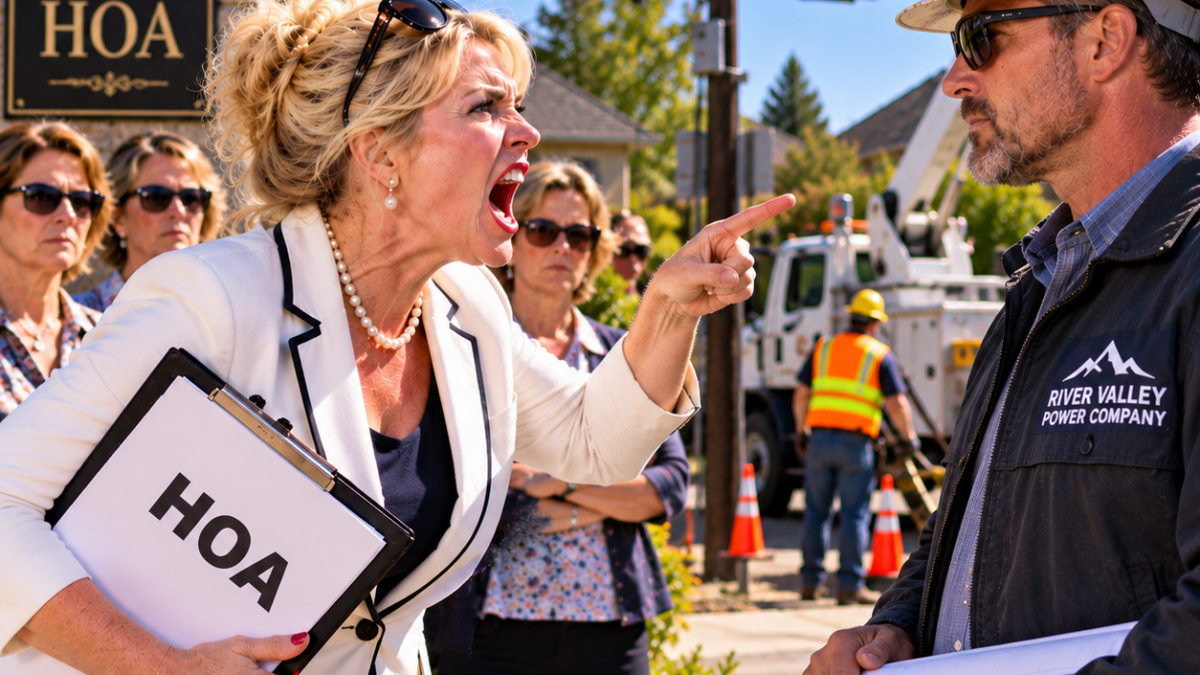
The first spark hit my lawn at 9:17 on a Thursday morning, and for one terrible second the entire cul-de-sac went silent as two men in orange vests cut through a live electrical service cable attached to my house because our HOA president had paid them to “teach me a lesson.”
She stood ten feet away in a bright red suit, filming the whole thing on her phone and smiling as if she had finally won a two-year war, while behind the fence my seventy-eight-year-old neighbor’s medical equipment suddenly began screaming because the line they had cut affected more than just me.
I already knew Cynthia Langford had crossed a line she couldn’t uncross, but when the first emergency trucks turned onto our street, I realized the truth she was about to face was far bigger than the petty neighborhood fight she thought she was winning.
“Ethan, you’re wasting your time,” Cynthia called when she saw my phone against my ear. “Nobody is going to stop lawful HOA enforcement.”
I looked at the two men near my meter box.
One was holding bolt cutters.
The other looked increasingly uncomfortable.
“Angela,” I said into the phone, keeping my voice even, “they’re about to cut an energized service line.”
There was no hesitation on the other end.
“Location confirmed?”
“My house.”
“People nearby?”
“Whole street.”
“Medical customer on the shared service?”
I looked toward the small brick house next door.
“Dolores Finch.”
Angela’s voice sharpened.
“Understood. Emergency crew rolling now.”
Cynthia laughed loudly enough for the neighbors gathering on their porches to hear.
“Calling your mommy?”
I lowered the phone.
“Something like that.”
The foreman, Hector Salas, stared at the green seal on my meter.
I had already warned him.
“That seal means the equipment belongs to the utility,” I said. “You cut beyond it, you’re damaging regulated infrastructure.”
Hector looked at Cynthia.
“You said this was homeowner-owned.”
“It is.”
“No,” I said.
Cynthia stepped between us and opened a thick envelope.
Cash.
She held it toward him.
“Double what we agreed.”
Hector didn’t move.
“Ms. Langford—”
“Cut it.”
“Hector,” I said, “you don’t have a utility permit, you don’t have authorization from the service provider, and you told me yourself you aren’t licensed for energized line work.”
Cynthia’s head snapped toward him.
“You told him that?”
“He asked.”
“You’re not here to answer his questions.”
“I’m trying not to get somebody killed.”
That was the first moment her smile slipped.
Then she leaned closer to him and lowered her voice, but not enough.
“You’ve already been paid. Finish the job.”
Hector looked at the money.
Then at me.
Then at the growing line of neighbors holding phones.
Finally, he turned toward his partner.
“Dale.”
Dale lifted the cutters.
My hands stayed in my pockets because if I stepped forward, Cynthia would tell everyone I had interfered.
I wanted witnesses.
I wanted the truth clean.
The jaws closed around the cable.
“Don’t,” I said.
Hector flinched.
Cynthia didn’t.
“Cut it.”
The cutters closed.
A violent crack tore through the morning.
Orange sparks sprayed across the grass.
Dale stumbled backward.
Hector shouted.
The severed cable slapped against the lawn.
Then another sound reached me from next door.
A high electronic alarm.
My stomach dropped.
“Dolores.”
I ran.
Behind me Cynthia was still talking, but I never heard what she said.
I jumped the low fence separating our yards and reached Dolores’s back door.
Unlocked.
“Dolores!”
“In here!”
I found her beside her oxygen concentrator.
The machine had gone dark.
Its battery backup was chirping.
Dolores was sitting upright, frightened but alert, one hand gripping the tubing beneath her nose.
“Ethan, what happened?”
“Someone cut the service.”
“Why?”
“I’ll explain later.”
I checked the battery indicator.
A few hours under ideal conditions.
I wasn’t interested in testing ideal conditions.
“Stay with me.”
“I’m fine.”
“You’re seventy-eight and your oxygen machine is running on backup because my HOA president hired strangers to cut a live cable.”
She blinked.
“Well, when you say it like that…”
Despite everything, I almost laughed.
Then I heard diesel engines outside.
Not one.
Several.
Dolores looked toward the window.
“Is that the electric company?”
I stood.
“Yes.”
“How did they get here that fast?”
I looked through the blinds as three white utility trucks with green logos swung into the cul-de-sac, amber lights flashing, followed by vehicles I hadn’t expected Cynthia to see quite so soon.
“Because,” I said quietly, “they were waiting for my call.”
PART 2
The first truck stopped crooked across the end of my driveway.
Doors opened before the wheels had fully settled.
Linemen jumped down wearing hard hats, arc-rated shirts, gloves, and face shields clipped back above their helmets. They moved with the calm speed of people who understood that a damaged energized service line was not a neighborhood disagreement but a hazard that could kill someone who happened to stand in the wrong patch of grass.
Angela Ruiz stepped out of the second truck.
She was my operations director, and I had known her long enough to read her expression before she said a word.
She was furious.
Not loud.
Angela was rarely loud when something was dangerous.
She walked straight past Cynthia.
“Hector, Dale, everybody away from the cable.”
Hector obeyed immediately.
Cynthia did not.
“You can’t just take over—”
Angela raised one hand without looking at her.
“Back behind the sidewalk.”
Cynthia’s mouth opened.
Angela turned.
“Now.”
Something in her tone worked where every argument of mine had failed.
Cynthia stepped back.
Angela pointed toward one of our crew leads.
“Isolate upstream. Confirm zero energy before anyone touches the drop.”
“On it.”
Another lineman moved toward Dolores’s side of the shared service.
“Medical customer?”
I came through the gate.
“Battery backup holding.”
“How long?”
“Few hours.”
“We’ll have her restored first.”
“Thank you.”
Angela looked at me from head to toe.
“You hurt?”
“No.”
She glanced toward the burned grass.
“Anybody shocked?”
“Not that I saw.”
“Hector?”
He shook his head.
“Dale?”
“No, ma’am.”
Then Angela said the word that broke Cynthia’s face.
“Chairman.”
It wasn’t dramatic.
She said it because that was my title.
But everyone heard.
Hector slowly looked at me.
Dale lowered the bolt cutters.
One of my neighbors whispered:
“Chairman?”
Cynthia stared at Angela.
“What did you call him?”
Angela didn’t answer her.
I did.
“My name is Ethan Marlowe.”
“I know your name.”
“No, Cynthia. You know the name on my mailbox.”
Her expression hardened.
“What is this supposed to mean?”
I looked toward the utility trucks.
Green Ridgeline logos.
The same logos on every power bill in Pine Ridge.
“The meter box you ordered them to break into belongs to Ridgeline Power and Light.”
Her eyes moved from me to the trucks.
“So?”
“So does the service cable.”
She said nothing.
“The poles.”
Nothing.
“The transformers.”
I pointed down the street.
“The primary lines running through this neighborhood.”
Her face began to lose color.
“Ridgeline provides electricity to Pine Ridge.”
“I know who our utility is.”
“I should hope so.”
She folded her arms.
“You work there?”
Angela stared at me for half a second.
I could almost hear her thinking: *How does she not know?*
I answered anyway.
“I own it.”
Cynthia actually laughed.
A short, sharp sound.
“No, you don’t.”
I took out my wallet.
Not because I needed to prove anything to her.
Mostly because Hector looked like he might pass out.
I handed him my company identification.
His eyes widened.
**ETHAN MARLOWE — CHAIRMAN & CHIEF EXECUTIVE OFFICER — RIDGELINE POWER & LIGHT.**
He looked at me.
Then at Cynthia.
Then at the cut cable.
“Jesus.”
Dale took off his hard hat.
Cynthia shook her head.
“This is ridiculous.”
“It’s really not.”
“You moved here in an old pickup.”
I almost smiled.
“That part is true.”
“You mow your own lawn.”
“Also true.”
“You never said—”
“I never needed to.”
Her voice rose.
“So you’ve been hiding who you are?”
That accusation was so strange that several neighbors murmured.
“I’ve been living in my house.”
“You let this association treat you like any other homeowner.”
“I am any other homeowner.”
“No, apparently you’re not.”
I looked at her.
“That might be the biggest difference between us.”
She blinked.
I continued.
“I never thought my job made HOA rules disappear. You thought your HOA title gave you control over a utility system.”
Cynthia opened her mouth.
Hector interrupted.
“Sir.”
I turned.
He held out his phone.
His hand was shaking.
“She paid me.”
Cynthia snapped:
“Don’t.”
Hector ignored her.
“Twenty-five hundred cash.”
Angela stepped closer.
“For what?”
“To disconnect his service.”
“Under whose authorization?”
Hector looked toward Cynthia.
“She said he was an illegal tenant stealing power.”
A neighbor laughed in disbelief.
Cynthia’s head jerked toward the sound.
Hector continued.
“She said the HOA had authority to correct unauthorized electrical work.”
Angela stared at him.
“Did you call Ridgeline before touching our equipment?”
“No.”
“Utility permit?”
“No.”
“Energized-line qualification?”
“No, ma’am.”
“Then why did you do it?”
He looked down at the envelope in Cynthia’s hand.
Nobody needed the answer.
Still, he gave it.
“Money.”
Dale said quietly:
“I told him we should walk.”
Hector nodded.
“He did.”
“Then why didn’t you?”
Hector swallowed.
“Because I needed the job.”
That answer made the situation uglier, not simpler.
Hector wasn’t some cartoon criminal.
He looked like a forty-year-old man who had made a terrible decision for money.
Angela said:
“Give me your phone.”
Hector hesitated.
“Why?”
“Because if she texted you about utility infrastructure, I need those messages preserved.”
Cynthia stepped forward.
“No one is handing over private communications.”
A new voice came from behind her.
“Actually, that’s probably a conversation you should let him have with law enforcement.”
Deputy Tom Haskell walked into the cul-de-sac.
I knew Tom casually.
He had responded to a transformer fire the previous winter.
He looked first at the cable.
Then at the bolt cutters.
Then at the Ridgeline trucks.
Then at Cynthia.
“Who ordered this?”
Cynthia immediately straightened.
“I did, but this is HOA business.”
Tom’s expression did not change.
“Explain.”
“Mr. Marlowe installed unauthorized electrical modifications.”
“No.”
The word came from Angela.
Tom looked at her.
She introduced herself.
“Angela Ruiz, operations director for Ridgeline Power and Light.”
Tom nodded.
“This was utility-owned equipment?”
“Yes.”
“Energized?”
“Yes.”
“Permit for third-party work?”
“No.”
“Utility authorization?”
“No.”
“Service disconnect order?”
“No.”
Tom looked at Cynthia.
She tried again.
“This is a private community with private rules.”
Tom rubbed his jaw.
“Pine Ridge doesn’t own the electric grid.”
“Our covenants allow enforcement against exterior modifications.”
“Not utility infrastructure.”
“You don’t know our covenants.”
“I don’t need to.”
That stung.
Cynthia pointed at my house.
“He intentionally altered the property without architectural approval.”
I said:
“The utility replaced a service line and meter as part of a reliability upgrade.”
Tom looked at me.
“Your company?”
“Yes.”
“You personally order that work for yourself?”
“No. It’s part of the neighborhood hardening project.”
That got neighbors’ attention.
One man across the street called:
“What hardening project?”
I looked toward Angela.
She nodded.
I answered.
“After last winter’s ice storm, Ridgeline approved upgrades throughout Pine Ridge—new poles where needed, transformer work, stronger service lines, improved sectionalizing.”
A woman two doors down stared.
“You were upgrading all of us?”
“Yes.”
Cynthia’s face tightened.
She had spent weeks describing the work at my house as some personal attempt to break association rules.
It was actually the first phase of a project benefiting every resident.
She said:
“You never brought that proposal to the HOA.”
Angela answered this time.
“We don’t ask homeowners associations for permission to maintain regulated utility infrastructure in recorded utility easements.”
Cynthia’s jaw tightened.
“Then maybe you should.”
Angela looked almost amused.
“No.”
Behind us, a lineman called:
“Feed isolated.”
Another:
“Verified.”
Angela turned away immediately.
“Restore medical customer first.”
The crew moved.
Within minutes, a temporary safe configuration was underway.
I went back to Dolores.
Her battery alarm was still chirping.
She looked at me.
“Well?”
“Crew’s repairing it.”
“Did that woman finally figure out who you are?”
I sighed.
“Yes.”
Dolores smiled.
“Took her long enough.”
“You knew?”
“Ethan.”
She gave me the look only an older neighbor can give a grown man.
“Your name is on the Ridgeline annual report.”
I laughed.
“You read utility annual reports?”
“I’m retired.”
“From what?”
“Being nosy professionally.”
That answer made me laugh harder than I should have.
Her expression softened.
“You didn’t want people to know.”
“No.”
“Why?”
I sat beside her.
“Because I spent forty years being introduced as the power company guy.”
“And?”
“I wanted one place where I was Ethan.”
Dolores touched my hand.
“You still are.”
That simple sentence hit harder than I expected.
Outside, a generator started.
Then the lights inside Dolores’s house came back.
Her concentrator clicked.
Paused.
Then began its steady hum.
She closed her eyes.
Not dramatically.
Just relief.
I felt it too.
Eleven minutes after the line was cut, Dolores had stable utility service again.
She opened her eyes.
“Thank you for running.”
“That was nothing.”
“No.”
She squeezed my hand.
“It wasn’t.”
When I stepped back outside, Cynthia was still arguing.
Of course she was.
“You’re going to retaliate now,” she said.
I stopped.
“What?”
“You’re going to cut power to Pine Ridge.”
The neighbors went quiet.
Cynthia looked around, searching for support.
“You own the company. You’ll punish all of us because I enforced the rules.”
I stared at her.
Then at my neighbors.
Many looked genuinely worried.
That angered me in a different way.
Cynthia had spent years training these people to believe authority existed to punish.
So naturally she assumed I would use mine the same way.
“No.”
She blinked.
“No?”
“Ridgeline doesn’t cut power to families because I’m angry at an HOA president.”
“You expect us to believe that?”
“Yes.”
I stepped closer.
“Because the grid is not my personal weapon.”
Silence.
“We follow tariff rules, public utility regulations, safety standards, and customer protections.”
I looked at the cut cable.
“What you did today is exactly what happens when somebody thinks authority means doing whatever they want.”
A quiet clap came from somewhere near the corner.
Then another.
Then more.
I did not want applause.
But I understood what it meant.
For six years, Cynthia had made every disagreement about obedience.
Someone had finally said no in public.
Tom Haskell approached Hector.
“I need your phone voluntarily, or we can handle it through a warrant.”
Hector looked at me.
Then at Cynthia.
He handed it over.
“I’ll cooperate.”
Dale did too.
Cynthia pulled out her own phone.
“I’m calling our attorney.”
Tom nodded.
“That’s a good idea.”
“I want all of these people removed from HOA property.”
Tom looked around at the public street.
“Which people?”
“The utility crews.”
“They’re working in utility easements.”
“The deputy.”
“That one’s me.”
A few neighbors laughed.
Cynthia hated it.
She turned away.
The investigation could have ended with the illegal cut.
It didn’t.
Because there had already been another problem.
Two hundred twelve thousand dollars.
That number had been sitting in my mind for weeks.
The reserve fund.
Pine Ridge had entered the spring budget meeting with projected major capital expenses.
Drainage.
Clubhouse roof.
Pool resurfacing.
Emergency reserves.
But when the financial report was distributed, the reserve line looked wrong.
I had spent most of my adult life running a regulated utility.
Balance sheets didn’t intimidate me.
Neither did cash flow statements.
I looked at the numbers and knew something did not reconcile.
So I raised my hand.
Cynthia was at the front.
Bill Tanner, the HOA treasurer, sat beside her.
“Where did the $212,000 reserve balance go?”
The room went silent.
Cynthia smiled.
That smile.
Always perfect.
“Mr. Marlowe, we’re discussing operating expenditures.”
“The reserve statement was part of the packet.”
“Questions can be submitted later.”
“The beginning balance and ending balance don’t reconcile with the listed projects.”
Bill looked down.
That was what caught me.
Not Cynthia.
Bill.
His forehead shone under the fluorescent lights.
The room was cold.
He would not look at me.
Cynthia said:
“You’re out of order.”
“I’m asking where association money went.”
“Sit down or you’ll be removed.”
I should have pushed.
I didn’t.
That bothered me later.
I sat.
Maybe because I had come to Pine Ridge specifically to stop being the man who controlled rooms.
Maybe because I didn’t want people to think I was using business experience to grandstand.
Maybe because I convinced myself the board had an explanation.
Whatever the reason, I sat.
Within weeks, the violations against me increased.
Trash can.
Grass height.
Mailbox paint.
Then electrical modification.
I had paid earlier fines because fighting over fifty dollars felt ridiculous.
That had been a mistake.
Not because of the money.
Because compliance had taught Cynthia that I was easier to pressure than challenge.
When I finally challenged the reserve fund, she took it personally.
Three days after Ridgeline’s crew upgraded my service, the pink violation notice appeared.
**UNAUTHORIZED ELECTRICAL MODIFICATION**
**IMMEDIATE REMOVAL REQUIRED**
**FAILURE TO COMPLY MAY RESULT IN UTILITY TERMINATION BY THE ASSOCIATION**
I remember standing on my porch reading that last line twice.
Then laughing.
Not because it was harmless.
Because it was absurd.
I wrote Cynthia a letter.
Polite.
Short.
I explained that the meter and service equipment were owned by Ridgeline.
That the work was performed under utility authority.
That the HOA could not disconnect utility infrastructure.
I sent it certified.
Dolores saw Cynthia open the envelope on her porch.
According to Dolores, Cynthia read it once.
Then tore it in half.
A few days later, Cynthia cornered me in my driveway.
“Funny thing about power,” she said.
I looked up from unloading groceries.
“What?”
“It can go out at any time.”
Her voice was sweet.
That made it worse.
“You threatening me?”
“No.”
She smiled.
“Just observing.”
I stared at her.
For the first time, I believed she might actually do something reckless.
That evening, I called Angela.
“Document everything.”
“Everything?”
“Any request tied to my address or Pine Ridge coming from an outside contractor or HOA.”
“Why?”
“I think their president may try to interfere with service.”
Angela went quiet.
“Do you want us to issue a warning?”
“No.”
“Ethan.”
“If we warn her, she’ll deny it and change tactics.”
“You’re asking me to wait until she does something.”
“I’m asking you to keep crews ready and intervene if safety is at risk.”
“I don’t like this.”
“Neither do I.”
“You’re too personally involved.”
“Correct.”
“Then let legal handle it.”
“I’ve already forwarded everything.”
Angela sighed.
“You know what this sounds like?”
“What?”
“You’re setting a trap.”
“No.”
I looked toward Cynthia’s house.
“I’m refusing to stop her from showing us what she’s willing to do.”
That distinction mattered to me.
Still does.
I did not hire Apex.
Did not ask Cynthia to cut my line.
Did not provoke Hector.
I warned him clearly.
I called operations before he touched anything.
I wanted the event stopped safely.
But by the time the contractor arrived, I also wanted documentation.
Because Cynthia had spent years surviving by making every incident sound ambiguous after the fact.
This one would not be.
The next morning, State Utilities Commission investigator Lena Park arrived.
She had a laptop case, evidence bags, and the expression of someone who disliked preventable stupidity.
She examined the cut cable.
Photographed the seal.
Collected the bolt cutters.
Downloaded photographs from neighbors.
Copied Hector’s messages.
Interviewed Angela.
Interviewed me.
Then Cynthia.
That interview lasted longer.
Afterward, Lena came back toward my porch.
“This is going to be a very thorough file.”
“Good.”
She looked toward Pine Ridge’s clubhouse.
“Your attorney contacted us too.”
“Naomi?”
“Yes.”
“What now?”
“Utility tampering investigation.”
“And the HOA money?”
She raised an eyebrow.
“What HOA money?”
I told her about the $212,000.
Her expression changed.
“That isn’t my jurisdiction.”
“I know.”
“But?”
“But Cynthia’s reaction to one accounting question started the escalation.”
Lena nodded slowly.
“Then somebody should probably look.”
Naomi Brooks already was.
Naomi had been my personal attorney for years and had done corporate work with Ridgeline when conflicts allowed.
She was the sort of lawyer who never raised her voice because documents usually did enough talking.
The afternoon after the cut, she walked into Pine Ridge’s clubhouse with a subpoena request process already moving and a formal preservation letter for bank records, emails, vendor contracts, and board minutes.
Bill Tanner was there.
Naomi later told me his face turned white when she said “bank records.”
That night, Bill called me.
Not Naomi.
Me.
I almost didn’t answer.
“Ethan?”
“Bill.”
“I need to talk.”
“About?”
He hesitated.
“The reserves.”
I sat down.
“What about them?”
“You were right.”
Those three words made my stomach tighten more than I expected.
“Where’s the money?”
“I don’t know all of it.”
“Bill.”
“I signed things.”
“What things?”
“Transfers.”
“Where?”
“She said vendors.”
“Cynthia?”
“Yes.”
“How much?”
Silence.
“Bill.”
“Almost all of it.”
I closed my eyes.
“Why didn’t you speak up?”
“I tried.”
“When?”
“She told me expenditures were confidential board matters.”
“You’re treasurer.”
“I know.”
“You had access.”
“Not to everything.”
“That doesn’t make sense.”
“She changed online credentials.”
That got my attention.
“She locked the treasurer out of accounts?”
“Some.”
“Did the board approve that?”
“No.”
I stood.
“Bill, call Naomi.”
“I don’t want police at my house.”
“If you signed transfers, hiding now is the worst thing you can do.”
“I didn’t steal anything.”
“Then prove it.”
He started crying.
Not loudly.
A grown man trying not to.
“I knew something was wrong.”
I sat back down.
“Then tell the truth.”
“I should’ve done it sooner.”
“Yes.”
Harsh.
But true.
Then I softened.
“Do it now.”
Bill met investigators the next morning.
He brought copies he had quietly saved.
Transfers.
Statements.
Emails.
Approval requests.
One payment went to a contractor that had never performed work in Pine Ridge.
Another went to a vehicle leasing company.
Another to a construction supplier near a lake two counties away.
That location mattered.
Cynthia owned a lake house there.
The audit began.
Within a week, the number was clear.
The $212,000 reserve fund was gone.
Not misclassified.
Not temporarily shifted.
Gone.
Some of it paid for renovations on Cynthia’s lake house.
New deck.
Kitchen work.
Roof.
Landscaping.
Some helped cover lease payments on a luxury SUV.
Other withdrawals came back as cash.
Bill’s signatures appeared on several authorizations.
But emails showed Cynthia instructing him how to code them.
**Emergency maintenance.**
**Exterior capital preservation.**
**Consulting.**
The categories were vague enough to slip past casual review.
Until somebody asked why the reserve balance didn’t reconcile.
I remember sitting in Naomi’s office when she laid the first audit summary in front of me.
“So that’s why she targeted me.”
Naomi shook her head.
“Partly.”
“What’s the other part?”
“Control.”
I looked at her.
“You challenged the money. Then your utility began work she couldn’t regulate.”
“She didn’t know it was mine.”
“No.”
Naomi leaned back.
“But she knew you were becoming a problem.”
I read the report.
“She could’ve backed off.”
“Yes.”
“Instead she cut a live wire.”
“Yes.”
“Why?”
Naomi shrugged.
“People who survive small abuses of power sometimes conclude the solution to resistance is more power.”
That sounded like Cynthia.
The board called an emergency meeting Saturday.
The clubhouse filled before the doors officially opened.
Neighbors lined the walls.
Some stood outside.
I did not want to go.
Dolores insisted.
“You’re coming.”
“I’ve had enough HOA meetings.”
“You’re coming.”
“Why?”
“Because I made lemon cake.”
“That is not a legal argument.”
“It is in this house.”
So I went.
Dolores sat beside me with a small portable oxygen unit.
Ridgeline had already provided it as a temporary backup while we developed a more permanent program.
Cynthia entered wearing red again.
Same color as the day she cut my power.
Maybe coincidence.
Maybe defiance.
Nobody stood.
A voice near the back said:
“Resign.”
Cynthia stopped.
Then continued toward the front.
Another voice:
“Resign.”
Then several.
Soon the word moved around the room.
Not shouted in rhythm.
Just repeated.
Resign.
Resign.
Cynthia reached the table.
Hit the gavel.
“Enough.”
People quieted slowly.
“I will not resign because of a politically motivated attack by one disgruntled homeowner.”
Every head turned toward me.
I stayed seated.
Cynthia pointed.
“Mr. Marlowe has used his corporate influence to intimidate this board.”
Dolores whispered:
“She practiced that.”
I almost laughed.
Cynthia continued.
“He concealed his financial interest in the utility serving this community.”
Someone shouted:
“Financial interest? He owns it!”
Another person laughed.
Cynthia slammed the gavel.
“This is exactly the mob behavior I have warned about.”
Bill Tanner stood.
That silenced more people than the gavel.
He carried a folder.
Cynthia looked at him.
“Sit down, Bill.”
“No.”
One word.
Quiet.
He walked toward the front.
“I need to make a statement.”
“You are no longer authorized to discuss privileged financial matters.”
Bill looked at her.
“You spent the reserves.”
The room erupted.
Cynthia’s face hardened.
“That is false.”
Bill opened the folder.
“Two hundred twelve thousand dollars.”
“Misleading.”
“Lake house contractors.”
“Association vendors.”
“Luxury vehicle payments.”
“Reimbursement.”
“For what?”
Cynthia grabbed her phone.
“My attorney will handle this.”
She called.
We could only hear her side.
“David, I need you here.”
Pause.
“No, now.”
Longer pause.
“This has become hostile.”
Then she went quiet.
Her expression changed.
“What do you mean?”
Everyone watched.
“You represent the association.”
Pause.
“And me.”
Another pause.
“No, you cannot—”
Her voice stopped.
She stared at the phone.
Naomi, sitting two rows ahead, leaned toward me.
“Conflict.”
“What?”
“Her lawyer represents the HOA. If her interests diverge, he may have to step out personally.”
Cynthia lowered the phone.
For once, no speech came.
Then the clubhouse door opened.
Deputy Haskell entered.
Two investigators followed.
Cynthia saw them.
Her shoulders dropped half an inch.
That was all.
But after six years of watching her stand like no one could touch her, half an inch felt enormous.
Tom approached the front.
“Cynthia Langford?”
She gripped the table.
“This is a private board meeting.”
“No, ma’am.”
“This is harassment.”
“I need you to step away from the table.”
“On what authority?”
He looked at her.
“The kind you kept pretending the HOA had.”
A few people gasped.
Tom did not smile.
Neither did I.
Cynthia looked around the room.
At Bill.
At Naomi.
At me.
At Dolores.
At neighbors she had fined, threatened, silenced, and intimidated.
Nobody stepped forward.
She was taken into custody there.
Charges initially included conspiracy related to tampering with utility infrastructure, fraud, and misuse of association funds.
Additional allegations were refined as prosecutors worked through the evidence.
Hector cooperated.
So did Dale.
Bill testified.
The bank records were devastating.
The utility evidence was cleaner.
Hector had kept Cynthia’s text messages.
One read:
**Need his service physically disconnected Thursday morning. HOA authority already established.**
Another:
**No need to contact Ridgeline. This is private enforcement.**
Then:
**Cash bonus if completed before 10.**
Her attorney tried to argue she did not understand the technical ownership of service equipment.
That might have mattered if I had not sent her a certified letter explaining it.
Or if she had not torn it in half.
Dolores had watched that.
So had her doorbell camera.
The recording showed Cynthia on her porch reading my letter.
Then tearing it.
One more piece.
Not dramatic alone.
Powerful in sequence.
She had been told.
She ignored it.
She hired someone anyway.
She doubled the rate when Hector hesitated.
The cable sparked.
Dolores’s oxygen failed over to battery.
The case stopped looking like misunderstanding.
Cynthia eventually accepted a plea rather than face a full trial.
The sentence included prison time.
Restitution of the stolen reserve funds.
And a lifetime ban from serving on an HOA board.
Hector received probation and community service.
Some neighbors were furious that he avoided prison.
I understood.
He had cut the cable.
I also understood why prosecutors valued cooperation.
He admitted what he did.
Turned over messages.
Explained the cash.
Testified.
Then something happened I never expected.
Hector applied to Ridgeline’s apprenticeship program.
Angela brought the application to me.
“You’re joking.”
“No.”
“He cut one of our live service lines.”
“Yes.”
“Without authorization.”
“Yes.”
“For cash.”
“Yes.”
“And now he wants to be a lineman?”
“Apprentice.”
“That distinction is doing a lot of work.”
Angela sat.
“He completed the safety prerequisites.”
“That doesn’t make me comfortable.”
“It shouldn’t.”
“Then why are we talking?”
“Because he asked for a chance to learn how to do the job legally.”
I stared at the application.
“He could’ve killed himself.”
“Yes.”
“Or Dale.”
“Yes.”
“Or Dolores.”
“Yes.”
Angela waited.
“You think we should hire him.”
“I think he should go through the same background, aptitude, interview, probationary training, and safety evaluation as anyone else.”
“That wasn’t my question.”
“No.”
She smiled.
“I think he should get the interview.”
I looked at her.
“Why?”
“Because people can either learn from the worst thing they’ve done or become trapped inside it.”
“That sounds suspiciously philosophical.”
“I’m getting older.”
I agreed to the interview.
I did not participate.
Conflict.
Angela insisted.
He got into the apprenticeship program.
Not because of me.
Despite me, probably.
His first months were brutal.
Safety classroom.
Grounding.
Clearance rules.
Lockout procedures.
Arc-flash training.
Supervised field work.
He was not allowed near energized work for a long time.
The first time I saw him in Ridgeline gear, he looked embarrassed.
“Sir.”
“Hector.”
“I know this is weird.”
“Yes.”
“I appreciate the opportunity.”
“Don’t thank me.”
He nodded.
“Angela said that.”
“Good.”
He started to leave.
I stopped him.
“Hector.”
He turned.
“You ever touch utility equipment again without proper clearance, you’re gone.”
“Yes, sir.”
“No speeches.”
“Understood.”
Years later, he became a competent journeyman.
That still surprises me.
Maybe it always will.
Bill Tanner also surprised me.
After the criminal case, he resigned as treasurer.
Nobody blamed him the way he blamed himself.
He had signed documents.
Failed to push harder.
Stayed quiet.
But he had also preserved records and testified.
The new HOA board asked him to help rebuild the accounting system.
He refused at first.
Dolores convinced him.
I don’t know what she said.
Probably threatened him with lemon cake.
Eventually, Bill agreed to serve six months as a volunteer financial advisor without voting authority.
They implemented dual approvals.
Monthly bank reconciliations available to homeowners.
Reserve reports.
Independent audits.
No single officer could change banking access.
Boring controls.
Beautiful controls.
Pine Ridge became less dramatic.
That was the best possible outcome.
Ridgeline finished the hardening project the following month.
New poles where needed.
Improved transformers.
Stronger service drops.
Better sectionalizing.
Vegetation work.
The neighborhood that Cynthia had told people I intended to punish received the full investment anyway.
I never considered cancelling it.
Angela asked once:
“Any part of you want to?”
“No.”
“Not even for ten seconds?”
I looked down the street.
“Maybe ten.”
She laughed.
“But no.”
“Why?”
“Because Dolores lives here.”
“Anyone else?”
“Two hundred families who didn’t cut my line.”
“Fair.”
We also launched a medical backup power program.
That idea came from Dolores’s concentrator alarm.
I hated the sound.
It stayed with me.
So Ridgeline created a pilot for customers dependent on medically necessary electric equipment.
Battery systems.
Enrollment.
Priority restoration flags.
Coordination with local emergency services.
Dolores received the first unit.
The installation day, she stood in her kitchen supervising three technicians like a general.
“This is too big.”
“It needs capacity.”
“It’s ugly.”
“Put a tablecloth over it.”
“Very funny.”
After the crew left, she cut lemon cake.
“You’re staying.”
“I have meetings.”
“You own the company.”
“That is not how meetings work.”
“Then owning it is overrated.”
I sat.
She poured coffee.
For a while, we said nothing.
Then she asked:
“Do you regret not telling people?”
“About Ridgeline?”
“Yes.”
I thought.
“No.”
“Even after all this?”
“Yes.”
“Why?”
“Because if Cynthia treated me differently because I owned the utility, that wouldn’t prove she had changed.”
Dolores nodded.
“You wanted to see who she was.”
“Maybe.”
“And?”
“I did.”
She took a bite of cake.
“Expensive way to learn.”
“Very.”
“You paid those fines too long.”
That surprised me.
“I know.”
“Why?”
“Didn’t seem worth fighting.”
She pointed her fork at me.
“That’s how bullies shop for targets.”
I laughed.
“Where’d you learn that?”
“Seventy-eight years.”
Fair enough.
She continued.
“You kept being reasonable after she stopped being reasonable.”
“That sounds like criticism.”
“It is.”
“What should I have done?”
“Not become her.”
“That’s not an answer.”
“It’s the only one that matters.”
I understood what she meant later.
After Cynthia went to prison, neighbors expected me to take some kind of victory lap.
A few wanted her house seized immediately.
Others wanted every past fine she had ever issued invalidated.
Some wanted lawsuits.
Some wanted her name removed from every board record.
Anger spreads.
It can become another form of control.
I was angry too.
Especially when I thought about Dolores.
But I did not want Pine Ridge to simply replace one person’s abuse with a crowd’s.
The new board reviewed fines systematically.
Refunded unsupported ones.
Upheld legitimate ones.
Changed procedures.
Cynthia’s name remained in historical minutes because erasing records would have repeated one of her habits—reshaping history to make it comfortable.
We did not need comfort.
We needed accuracy.
Months later, I walked through the clubhouse for the first time after repairs.
Someone had removed the oversized president’s chair.
Every board member had the same chair now.
I laughed.
The new president, Sarah Bell, asked:
“What?”
“Nothing.”
“No, really.”
“That chair.”
She smiled.
“We thought symbolism mattered.”
“It does.”
Sarah was almost aggressively ordinary.
School counselor.
Two kids.
Terrible at using a gavel.
Excellent at saying:
“I don’t know. Let’s check.”
That phrase became my favorite form of leadership.
Pine Ridge improved.
People still complained.
Of course.
One homeowner fought over fence color.
Another demanded the pool stay open later.
Someone hated the new transformer box near their yard.
Normal conflict.
No threats.
No cash envelopes.
No cutting live cables.
Sometimes progress is disappointingly boring.
I loved it.
The reserve fund took time to rebuild even after restitution orders.
Insurance covered some losses.
Recovered assets covered others.
Cynthia had to repay what she could.
The lake house renovation became evidence and eventually part of the financial recovery process.
Her luxury SUV disappeared early.
Neighbors who had once admired it stopped mentioning it.
I saw the lake house once in a photograph from the case file.
New deck.
Stonework.
Expensive kitchen.
Paid partly with money from people who thought their dues were being saved for roofs and roads.
That betrayal angered residents more than what she did to me.
I understood.
My cable could be repaired in eleven minutes.
Trust took years.
Ridgeline replaced the burned patch in my lawn too.
Our safety team insisted.
The cut cable had scorched a black arc through the grass.
For several weeks, the new sod was a different shade.
Every morning I saw the rectangle.
Then summer blended it in.
One day I realized I could no longer tell exactly where the spark hit.
That felt important.
Scars fade unevenly.
Some physical marks vanish before memory does.
The sound of Dolores’s alarm stayed with me longer than the burned grass.
For months, every electronic beep made me tense.
Microwave.
Truck reversing alarm.
Smoke detector battery.
My body remembered before my brain did.
I never told anyone except Angela.
She caught me flinch during a substation visit.
“You okay?”
“Fine.”
“That’s a lie.”
I told her.
She listened.
Then said:
“You know you can be upset even if nobody died.”
“I know.”
“Do you?”
Apparently not.
Running a utility for decades teaches you to measure success in avoided catastrophe.
No fatality.
No serious injury.
Service restored.
System stable.
Move on.
But sometimes avoiding the worst outcome still leaves something behind.
Dolores had been frightened.
I had been frightened.
Hector had been seconds from electrocuting himself.
Dale could have been killed.
A live severed service cable could have started a fire.
“Almost” is not nothing.
I started talking more openly at Ridgeline safety meetings about near misses.
Not only technical causes.
Human causes.
Pressure.
Money.
Assumed authority.
Embarrassment.
Someone telling a worker:
**Just do it.**
Hector eventually spoke at one of those trainings.
I did not ask him.
Angela did.
He stood before a group of apprentices.
No dramatic speech.
He held up an old pair of bolt cutters.
Not the evidence pair.
Similar.
“I knew I shouldn’t cut.”
The room was quiet.
“My partner knew.”
He looked around.
“We both had reasons to stop.”
He paused.
“Then someone doubled the money.”
Nobody laughed.
“I told myself the homeowner was probably wrong. That the HOA must have paperwork. That maybe the utility didn’t care.”
He shook his head.
“Mostly I told myself what I needed to hear to take the cash.”
One apprentice asked:
“What stopped you later?”
“Nothing.”
Hector looked down.
“I cut it.”
That was the point.
People often tell safety stories as if the hero always stops before the bad act.
Real lessons sometimes come from the person who didn’t.
He continued.
“Don’t wait for somebody more important to save you from your own decision.”
I sat in the back.
Proud was not exactly the word.
But close.
Two years after Cynthia’s arrest, Pine Ridge held a summer block party.
I almost skipped it.
Dolores threatened me again.
“You’re coming.”
“Why?”
“Lemon cake.”
“You use cake like extortion.”
“Yes.”
I went.
Kids rode bikes.
Someone grilled too many hamburgers.
Sarah Bell argued with a man about where folding tables belonged.
Ridgeline had a small booth for storm-preparedness kits.
No corporate banner with my face.
I insisted.
Dolores sat beneath a shade tent with her medical backup unit brochure on the table like she was personally selling the program.
A new family moved into Cynthia’s old house.
They had no connection to her.
A young couple.
Two little girls.
The first time I met them, the husband looked nervous.
“You’re Ethan?”
“Yes.”
“We heard about…”
He gestured vaguely toward my house.
“The wire?”
“Yes.”
“You’re not mad we bought her place?”
I laughed.
“Why would I be?”
“I don’t know.”
“You bought a house, not a criminal history.”
He relaxed.
That mattered too.
Consequences should land where they belong.
Not on whoever comes next.
As evening settled, streetlights came on one by one.
Not dramatically.
Photocells doing what they do.
A row of soft pools of light down the cul-de-sac.
Dolores sat beside me.
“Pretty.”
“They’re streetlights.”
“You really ruin moments.”
“Occupational hazard.”
She pointed toward my house.
“Remember the sparks?”
“Yes.”
“Think Cynthia does?”
“Probably.”
“Good.”
I looked at her.
“That’s vindictive.”
“I’m seventy-nine now. I’ve earned it.”
Fair.
She handed me a slice of cake.
The neighborhood had changed.
Not because one bad president went away.
Because people had finally learned to look at how power was being used.
Meeting packets were read.
Financial statements questioned.
Contracts checked.
Utility work left to utilities.
When someone said, “The board says,” somebody else asked, “Where is that written?”
Healthy communities are annoying that way.
They require questions.
I used to think peace meant nobody challenging anybody.
Now I knew better.
Silence can be peaceful.
It can also be fear.
The night Cynthia ordered my cable cut, half the street watched from behind curtains before anyone stepped outside.
By the time the board removed her, those same people were standing shoulder to shoulder in the clubhouse saying:
“Resign.”
That transformation mattered more than my reveal.
People loved the reveal.
The chairman.
The owner.
The utility trucks.
It made a good story.
But if I had been an ordinary customer, Cynthia still would have been wrong.
That was important to me.
I told Sarah that once.
She said:
“You know everybody says she picked the worst possible house.”
“I hate that.”
“Why?”
“Because it implies cutting someone else’s line would’ve been less serious.”
Sarah nodded.
“You’re right.”
“She didn’t lose because she picked me.”
“Then how do you say it?”
“She lost because eventually she did something so reckless people finally checked what authority she actually had.”
That was the truth.
Ownership made the reversal dramatic.
It did not make the act illegal.
Utility infrastructure is regulated for a reason.
Electricity doesn’t care about HOA bylaws.
A live line doesn’t know who won a board election.
That physics lesson should not require sparks.
Years later, I still lived in the same house.
Still drove an old pickup more often than the company sedan.
Still mowed my own lawn.
People knew who I was now.
That part could not be undone.
At barbecues, someone inevitably asked about rates.
Storm outages.
Solar interconnection.
Transformers.
I had lost my anonymity.
At first, I resented that.
Then Dolores told me:
“You wanted to be Ethan.”
“I did.”
“You still are.”
“Everyone calls me power company guy.”
“So?”
She shrugged.
“Be a good one.”
Simple.
Annoying.
Correct.
Ridgeline grew.
Two hundred thousand customers became more over time.
We modernized substations.
Added storage.
Improved storm response.
The Pine Ridge hardening project became a model for other neighborhoods with medical-vulnerability programs attached.
Dolores’s incident changed internal policy.
Not because she demanded anything.
She never did.
Because once you hear a medical device alarm after someone deliberately cuts power, “resilience” stops being a boardroom word.
Dolores lived several more years.
When her health declined, her daughter moved in.
The backup system never needed to carry her through another malicious outage.
It did carry her through two storms.
She bragged about that.
“Your machine works.”
“I should hope so.”
“You want cake?”
“Always.”
The last time I sat with her on the porch, she asked me something unexpected.
“Did you ever forgive Cynthia?”
I looked down the street.
“I stopped thinking about her.”
“That wasn’t my question.”
“No.”
“Why not?”
“I don’t know if forgiveness is something I owe.”
“Correct.”
That surprised me.
She continued.
“But anger can become rent you pay for a house you don’t live in.”
I stared at her.
“Did you rehearse that?”
“Maybe.”
“You should write greeting cards.”
“I’m serious.”
“So am I.”
She smiled.
I thought about Cynthia.
Prison.
Restitution.
Her name gone from the clubhouse office.
Her house sold later.
Her power over Pine Ridge finished.
I did not need more.
“I don’t hate her.”
Dolores nodded.
“That’ll do.”
Maybe it did.
Cynthia eventually completed her sentence.
I heard through other people she moved out of the county.
I never contacted her.
She never contacted me.
Good.
Not every conflict needs a final private confrontation.
The courtroom, the board meeting, the cut line—those were enough.
The real conclusion was quieter.
Pine Ridge kept its lights.
That was what I wanted from the beginning.
No retaliation.
No neighborhood blackout.
No corporate revenge.
Cynthia had assumed I would use ownership the way she used the presidency.
Punishment.
Leverage.
Fear.
I refused.
Ridgeline served her house while she still lived there, right up until ordinary billing rules and the sale transferred the account.
Same reliability standards.
Same outage response.
Same customer protections.
That fact gave me more satisfaction than cutting her off ever could have.
Power means very little if you only know how to use it against people.
One autumn evening, Angela and I walked the upgraded feeder serving Pine Ridge.
Routine inspection.
New poles stood where old ones had failed during the ice storm.
Transformers had been replaced.
Vegetation cleared.
The service line to my house was ordinary again.
She pointed toward the spot where Cynthia’s contractor had cut it.
“You ever think about that day?”
“Less.”
“Good.”
“Hector does.”
“He should.”
“He’s one of our better safety mentors now.”
“I know.”
“You saw that coming?”
“No.”
We walked farther.
Then Angela smiled.
“I remember Cynthia asking if you were going to punish the neighborhood.”
“So do I.”
“You looked angry.”
“I was.”
“Very.”
“Probably.”
“I thought for a second you might say yes.”
I stopped.
“You really thought I’d disconnect two hundred homes?”
“No.”
She laughed.
“I thought you wanted to.”
I considered it.
“Maybe for half a second.”
“Human.”
“Then Dolores’s oxygen alarm would’ve played in my head.”
Angela nodded.
“That’s probably why you own a utility and Cynthia ran an HOA into the ground.”
I shook my head.
“Too neat.”
“Let me have the line.”
We finished the inspection.
As we drove away, Pine Ridge’s streetlights flickered on behind us.
One by one.
That image stayed with me.
Not because it was beautiful.
Because each light represented a system functioning without caring who was angry at whom.
Electricity is indifferent to ego.
So are good rules.
That’s why both need safeguards.
The last artifact from the case sat in my garage for years.
Cynthia’s bright pink violation notice.
**UNAUTHORIZED ELECTRICAL MODIFICATION.**
I had kept it almost accidentally.
One day I found it beneath old tools.
The paper was faded.
Her signature still sat at the bottom with that little flourish.
I took it outside.
Dolores was gone by then.
Her daughter had sold the house.
A young family lived there.
Kids’ bicycles leaned against the garage.
The street was louder.
Messier.
Healthier, somehow.
I looked at the notice again.
For years, Cynthia’s signature had frightened people.
Not because ink has power.
Because everyone agreed to treat the person signing as if she could not be challenged.
That agreement ended.
I put the notice into my desk drawer at home instead of throwing it away.
Not as a trophy.
As a reminder.
Authority should survive questions.
If it cannot, it is probably only intimidation wearing formal clothes.
I retired from day-to-day Ridgeline management years later.
The board threw a dinner.
Too many speeches.
Too much applause.
Angela became CEO.
Better choice than me by then.
At the end, she handed me a framed photograph.
I expected a substation.
Or my grandfather’s first truck.
Instead, it was Pine Ridge.
Night.
Streetlights glowing.
The upgraded poles barely visible.
No sparks.
No chaos.
Just houses.
At the bottom was a small brass plate.
**KEEP THE LIGHTS ON.**
I stared at it longer than I meant to.
Angela said:
“Too sentimental?”
“Yes.”
“You’re keeping it.”
“Yes.”
My grandfather started Ridgeline in 1952 with one truck and a spool of wire because rural families near us had been told bringing electricity to them cost too much.
He believed power should be dependable.
Not glamorous.
Not political.
Dependable.
I spent forty years trying to scale that idea.
Cynthia almost made me forget it for one angry morning.
She saw electricity as leverage.
Cut his power.
Break him.
Make an example.
She thought control of access was control of people.
Maybe that was why she stole reserve money too.
Once you begin believing the office exists for you instead of the people you serve, lines move quickly.
The reserve fund becomes your money.
The HOA contractor becomes your enforcer.
The utility wire becomes your property.
A neighbor becomes an enemy.
And eventually somebody gets hurt.
The night after my retirement dinner, I sat on my old porch.
Same house.
Same street.
Different board.
Different era.
A light breeze moved through the trees.
Kids called to each other somewhere down the block.
The Ridgeline streetlight across from my driveway clicked on.
Then the next.
Then the next.
The framed photograph leaned against the chair beside me.
I thought about the first spark.
Cynthia in red.
Hector with the cutters.
Dolores’s alarm.
Angela jumping out of the truck.
Deputy Haskell asking who gave the order.
Bill finally telling the truth.
The clubhouse full of neighbors saying resign.
All of it had begun because one woman believed she could turn off someone else’s home to prove she was in charge.
In the end, the most satisfying answer was not watching her lose power.
It was refusing to become the kind of person who would use mine the same way.
I sat there until the entire cul-de-sac was lit.
Every porch.
Every kitchen.
Every streetlight.
Including the house where Cynthia used to live.
And for the first time in years, the only thing I heard from next door was children laughing through an open window.
No alarm.
No spark.
No shouting.
Just the low, steady hum of a neighborhood with the power on.
[END OF STORY]








