PART 2: HOA Had My Dad’s $165,000 Peterbilt Impounded at Dawn—They Had No Idea I Was a U.S. Marshal
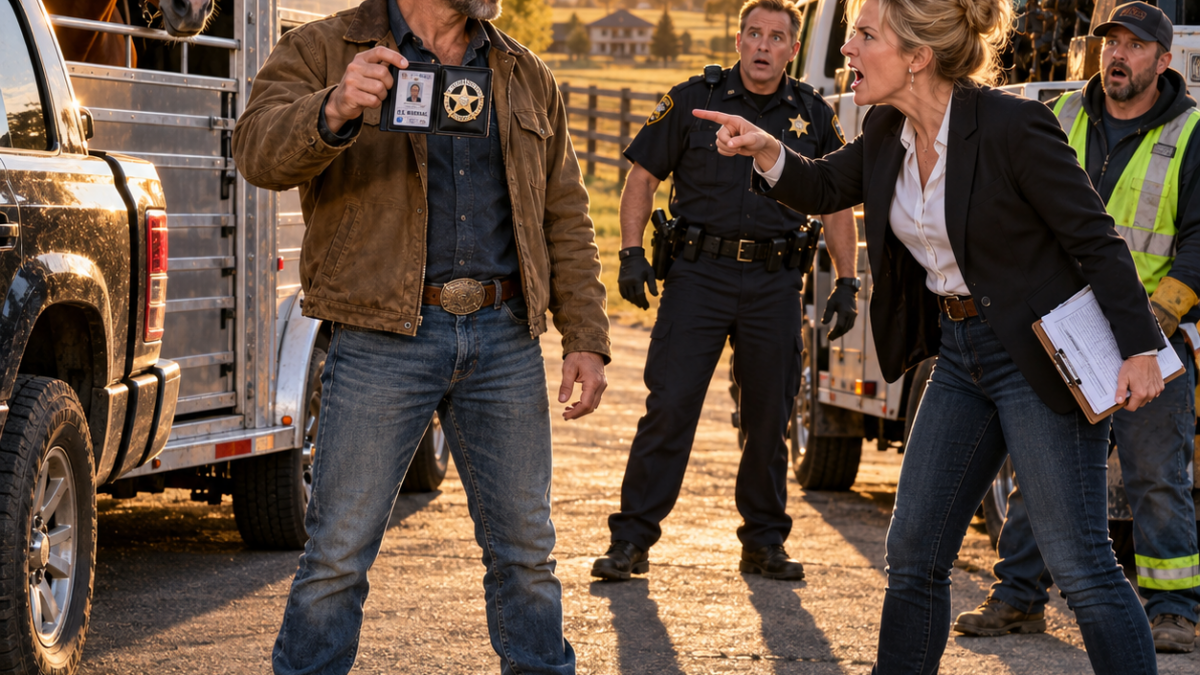
PART 2
I didn’t call Karen back.
That surprised me.
Not because I am naturally patient.
I’m not.
Twenty years in federal law enforcement doesn’t erase anger. It teaches you what anger costs when you let somebody else control it.
Karen wanted a reaction.
She wanted me driving to the clubhouse.
She wanted shouting.
Threats.
A dramatic confrontation she could summarize later as:
**Aggressive homeowner refuses to comply with rules.**
I had watched criminals use that tactic more times than I could count.
Create chaos.
Provoke the person asking questions.
Then make the reaction the story.
So I did the opposite.
I walked back to the house.
Made coffee.
Closed the study door.
And started a file.
My study had belonged to the previous owner’s grandfather.
Dark wood.
Built-in shelves.
A heavy oak desk overlooking the pasture.
When I bought the property, I filled those shelves with law books, histories, old case binders, and photographs I couldn’t bring myself to put anywhere else.
One of them showed Dad standing beside the Peterbilt before the restoration was finished.
The hood was open.
He was pointing toward the engine.
I was pretending to listen.
He was laughing.
That photograph stayed beside my monitor.
I looked at it once.
Then I opened a blank document.
**OAKRIDGE / MILLER**
Time.
Date.
Discovery.
Tow marks.
Notice.
Call to A-1 Heavy Duty Recovery.
Quoted release fee.
Cash requirement.
Call to Karen Miller.
Her confirmation.
Her exact phrase:
**I am the authority in this community.**
I typed the words.
Stopped.
Read them again.
People often tell you who they are when they think they’ve already won.
Next came the governing documents.
I had downloaded the covenants years earlier.
Covenant 7.4 was exactly as I remembered.
Oversized recreational or commercial-type vehicles could not be parked or stored where visible from roadways or adjacent properties.
My barn was set back approximately half a mile.
Trees on three sides.
Terrain dropped six feet toward the structure.
I walked outside with my phone and took photographs.
County road.
Nothing.
Nearest neighbor’s fence.
Nothing.
My own front drive.
Only the roofline if you stood in one particular spot.
Peterbilt?
Invisible.
I photographed the NO TRESPASSING sign.
The chain at the gate.
The tire ruts.
The scrape along the grass where the recovery truck had turned too wide.
Then I checked the gate camera.
I had installed it after buying the ranch, mostly because packages disappeared from rural properties sometimes.
At 5:17 a.m., a heavy-duty tow truck entered.
The driver got out.
Cut the plastic security seal I used on the secondary latch.
Opened the gate.
Drove in.
No emergency.
No attempt to call.
At 5:31, it returned carrying my father’s truck.
I froze the video.
Zoomed.
A-1 logo.
Clear.
I saved three copies.
Now I had something Karen didn’t know existed.
Evidence of entry.
The first temptation was to call the county sheriff.
I considered it.
Then I stopped.
Could I report the vehicle taken?
Absolutely.
But the more I thought about Karen’s confidence, the tow company’s cash-only demand, and the speed with which this had been arranged, the more one question bothered me.
Why was A-1 so comfortable?
Nobody had hesitated.
Nobody had checked.
Karen signed.
A-1 rolled through my gate before sunrise.
Truck vanished.
Two-thousand-dollar cash demand followed.
That didn’t feel like a first-time mistake.
It felt practiced.
I had built enough cases to recognize rhythm.
A criminal act committed by an amateur often looks confused.
Too much talking.
Uncertainty.
Contradictory instructions.
People improvising.
This had been clean.
Paper on the fence.
Vehicle removed.
Fee quoted.
Storage meter started.
Simple.
Professional.
Routine.
That made me wonder how many routines existed in Oakridge that I had never noticed.
I had lived there a little over two years.
The ranch was a place to disappear between assignments.
My job had taken me from courthouse corridors to fugitive searches in desert motels, farmhouses, back alleys, airports, border towns and swamp roads.
When I came home, I didn’t want committees.
I didn’t want neighborhood politics.
I didn’t want to debate mailbox colors.
I wanted acreage.
Quiet.
Dad’s truck.
Maybe a beer on the porch when the sun went down.
That isolation had made me exactly the kind of homeowner Karen probably liked.
Quiet.
Pays dues.
Doesn’t attend meetings.
Doesn’t ask questions.
That changed at 5:17 that morning.
I pulled the Texas corporate records for A-1 Heavy Duty Recovery.
Registered owner:
**Donald “Donnie” Henderson.**
Address in the county.
Years in business.
Heavy towing.
Impound.
Recovery.
Nothing automatically suspicious.
Then I searched Karen Miller.
Fifty-eight.
Widowed.
Her husband, Thomas Miller, had been a real-estate developer.
Property holdings.
Board service.
Oakridge HOA president for six years.
Then I searched public social media.
The internet rarely forgets as completely as people think.
Three years earlier, Karen had posted photographs from a family barbecue.
There she was.
Hair shorter.
Glass of wine.
Arm around a large man wearing an A-1 Heavy Duty Recovery shirt.
Caption:
**Proud of my cousin Donnie for building his business from nothing. Family works hard!**
I leaned back.
Well.
There you are.
Family relationships are not crimes.
HOAs can contract with relatives if proper disclosure, competitive procedures, and governing rules allow it.
But Karen had never mentioned that the towing company charging me two thousand dollars belonged to her cousin.
That made the next step obvious.
Records.
The association was required to maintain financial and governance records accessible through proper homeowner requests.
I drafted the request carefully.
Meeting minutes.
Board votes.
Budgets.
Fine revenue.
Vendor contracts.
Payment histories.
Bid materials.
Conflict disclosures.
A-1 towing agreement.
Landscaping agreements.
Seven years.
I sent it certified mail.
Copied every board member.
Copied the management contact.
No accusation.
No emotion.
Just records.
Then I went to meet the neighbors.
The Garcias lived east of me.
I had seen Mr. Garcia dozens of times.
Retired teacher.
Seventies.
Always outside.
Always wearing a hat that looked too big for his head.
His front yard contained what I considered the finest collection of ridiculous garden gnomes in Texas.
Fishermen.
Firefighters.
Cowboys.
One holding a tiny guitar.
I pulled into the drive.
He looked up from a flower bed.
“Jack Callahan.”
“Mr. Garcia.”
“Please. If you call me Mr. Garcia I’ll assume I owe taxes. Miguel.”
“Jack.”
We shook hands.
His wife Elena appeared with iced tea before I had even explained why I was there.
That kind of hospitality still survives in pockets of Texas.
I started gently.
“Had a little disagreement with the HOA.”
Miguel’s smile disappeared.
“How little?”
“They towed my Peterbilt.”
His eyes widened.
“From the barn?”
“You know where it was?”
“Of course. I’ve seen it when you leave the doors open.”
“From your property?”
Miguel laughed.
“No.”
There was my first independent witness.
“How do you see it?”
“When I’m invited onto your place.”
“Exactly.”
Elena sat across from me.
“Karen?”
“Signed the order.”
Miguel leaned back.
“I’m sorry.”
“Why?”
“Because once she decides she doesn’t like something…”
He didn’t finish.
Elena did.
“She doesn’t stop.”
They showed me their violations.
A hundred dollars for “unapproved yard ornamentation.”
Miguel pointed through the window.
“Fisherman Fred.”
“The gnome?”
“The criminal.”
I almost smiled.
“How long has Fred been there?”
“Fifteen years.”
“Any previous violation?”
“No.”
Elena pulled out another notice.
Two hundred dollars.
Trash cans visible beyond pickup period.
“We were at my oncology appointment,” she said.
That changed the tone.
“You appealed?”
“Yes.”
“Result?”
“Denied.”
“Who denied it?”
“Karen.”
Another.
Rose bushes over approved height.
Another.
Flag bracket color inconsistent with aesthetic standard.
Another.
Driveway crack.
By the time they finished, the Garcias had paid more than three thousand dollars in two years.
Miguel was embarrassed by the number.
He shouldn’t have been.
That became a pattern too.
Victims apologizing for compliance.
“We didn’t know what else to do,” he said.
Elena’s hands tightened around her glass.
“They write lien in bold letters, Jack.”
I understood.
A retired couple living on fixed income sees the word LIEN from an organization attached to their property.
They don’t think:
Maybe this is legally questionable.
They think:
Can we lose our home?
Fear converts small authority into enormous authority.
That is true in criminal organizations.
It is true in bureaucracies.
It is true in families.
It is true anywhere one person knows the rules better than another and is willing to lie about what those rules mean.
“Do you know who does the neighborhood landscaping?” I asked.
Miguel frowned.
“Evergreen something.”
“Elena?”
“Evergreen Solutions.”
“How long?”
“Maybe two years.”
“Good service?”
They looked at each other.
Miguel laughed.
“They killed the north entrance roses.”
Elena nodded.
“And irrigation leaks constantly.”
“Why keep them?”
“Karen says the contract is exclusive.”
I wrote the name down.
The Lees lived west of me.
Young family.
Two children.
When I arrived, Daniel Lee was taking down a portable basketball hoop.
His son sat on the curb.
Maybe seven.
Trying very hard not to cry.
I stepped out.
“Everything okay?”
Daniel recognized me.
“HOA.”
That word again.
He showed me the notice.
Five hundred dollars for a permanent recreational structure without architectural approval.
I looked at the hoop.
Wheels on the base.
Portable.
“You move this?”
“Every night.”
“Garage?”
“Yes.”
Sarah Lee came out.
“They threatened a lien.”
“How long have you had it?”
“Six months.”
“Any complaint?”
“One.”
“From?”
She looked toward Karen’s side of the development.
“Guess.”
The boy spoke quietly.
“Dad says we can’t play anymore.”
Daniel closed his eyes.
“No, buddy. I said we can’t leave it up.”
“Same thing.”
I remembered Dad.
The truck.
The way objects become containers for memory.
To Karen, the basketball hoop was a line item.
To that kid, it was afternoons with his father.
I asked Daniel if he would be willing to keep every notice.
Every envelope.
Every payment record.
“Why?”
“Because I’m looking at something.”
“What?”
“I don’t know yet.”
Sarah studied me.
“Are you a lawyer?”
“No.”
“What do you do?”
I hesitated.
Then answered truthfully.
“U.S. Marshals Service.”
Daniel stopped touching the bolt on the hoop.
“You’re a Marshal?”
“Yes.”
His son looked up like I had just become significantly more interesting.
Sarah said, “Does Karen know?”
“No.”
Daniel smiled for the first time.
“Oh.”
“No,” I said immediately.
He looked at me.
“This is not an ‘oh’ situation.”
“Sounds like an ‘oh’ situation.”
“It isn’t.”
I crouched beside the boy.
“You like basketball?”
He nodded.
“Keep the hoop.”
Daniel raised an eyebrow.
I stood.
“Store it according to the rule while we figure out whether the rule applies the way they claim.”
The kid smiled.
Good enough for the moment.
Back home, I searched Evergreen Solutions.
Owner:
**Gerald Miller.**
I pulled Karen’s family records.
Gerald was her late husband’s brother.
Brother-in-law.
Two major HOA vendors.
Two relatives.
Now the pattern had financial shape.
Towing contractor: cousin.
Landscaping contractor: brother-in-law.
Fine revenue rising.
Residents pressured.
Vendor quality questionable.
Still not proof of fraud.
But enough to keep digging.
I waited for the records request.
The tenth business day, a delivery truck brought me three banker boxes.
No index.
No folders.
Minutes mixed with invoices.
Vendor agreements stuffed between newsletters.
Receipts unsorted.
Financial reports out of sequence.
A document dump.
I had seen the tactic from defense teams, corporations, shell companies, government offices and defendants who technically complied with subpoenas while hoping volume would defeat attention.
Karen did not know volume was one of my favorite problems.
I cleared the dining-room table.
Made three pots of coffee.
Started sorting.
Year.
Vendor.
Contract.
Minutes.
Payment.
Fine.
Bid.
Conflict disclosure.
By midnight, the pattern sharpened.
A-1 had received an exclusive towing agreement.
Board vote: three to two.
Two directors absent.
Karen cast the deciding vote.
Conflict disclosure?
None.
Competitive bid documentation?
Minimal.
I found one alternate quote, significantly lower, rejected for “service concerns.”
No explanation.
Evergreen Solutions.
Same problem.
Previous landscaping contract had cost roughly one-third less.
Evergreen increased costs dramatically.
Board vote narrowly approved.
Karen pushed it.
Conflict disclosure?
None.
Family relationship?
Not recorded.
Then the fines.
Year one under Karen:
Moderate.
Year two:
Higher.
Most recent two years:
Exploded.
Hundreds of citations.
Tiny infractions.
Escalating fees.
Administrative charges.
Late charges.
Special assessments.
The revenue from those fines helped cover rising vendor expenses.
Expenses flowing to Karen’s relatives.
It was not enough to call RICO.
Not yet.
But it looked like self-dealing wrapped in governance.
I built a spreadsheet.
Fine revenue by quarter.
Vendor payments.
Contract dates.
Board votes.
Related-party connections.
Then I found something worse.
A-1 invoices contained tow charges where no tow had actually occurred.
“Standby enforcement.”
“Compliance monitoring.”
“Patrol mobilization.”
Charges from $400 to $1,200.
What was A-1 monitoring?
There was no patrol authority in the contract.
No board approval for surveillance.
Yet Oakridge had paid thousands.
Evergreen invoices had similar padding.
“Emergency irrigation remediation.”
“Landscape recovery.”
“Priority aesthetic response.”
Amounts round.
Descriptions vague.
Checks approved through Karen’s signature authority.
I called Mark Ellis, a forensic accountant I knew from an old fugitive asset case.
He was retired from federal service and now consulted privately.
“Jack.”
“Need a favor.”
“That phrase has cost me weekends.”
“I’ll pay.”
“That means it’s bad.”
I sent him public and homeowner-accessible records.
Nothing restricted.
Nothing from federal databases.
He called the next afternoon.
“You have related-party transactions with no disclosure.”
“I know.”
“Vendor prices appear materially inflated.”
“I know.”
“Fine revenue tracks expense increases unusually closely.”
“I know.”
“Why are you calling me?”
“Tell me what I don’t know.”
Mark was silent.
Then:
“I’d want bank records.”
“So would I.”
“You won’t get those as a homeowner.”
“No.”
“Who took your truck?”
“Related towing company.”
Mark laughed softly.
“Some people really do volunteer to become evidence.”
The truck.
Until then, I had treated the Peterbilt primarily as personal property.
Now I needed an official valuation.
I contacted a certified specialty appraiser.
A-1 initially refused access.
I paid a portion of disputed storage fees under written protest solely to inspect my property.
I documented that too.
The impound lot sat behind chain-link fencing outside town.
Rows of wrecked trucks.
Trailers.
Construction equipment.
My Peterbilt stood near the back.
Dust on the hood.
Still beautiful.
Seeing it behind someone else’s fence did something to me.
Dad and I had spent hundreds of hours restoring it.
He had chosen the red.
I wanted black.
He said black hid fear.
I told him that made no sense.
He said most wisdom doesn’t until you’re older.
The appraiser circled the truck.
Photographs.
Engine.
Interior.
Paint.
Frame.
Restoration records.
Receipts.
Original components.
Custom work.
When he finished, he looked at me.
“You drive this?”
“Sometimes.”
“You should.”
“That appraisal advice?”
“Life advice.”
His written valuation came two days later.
**$165,000.**
I stared at the number.
Karen had treated it like an oversized nuisance.
The towing company had treated it like collateral for two thousand dollars cash.
But on paper, it was a high-value asset removed from posted private property under a disputed HOA authorization.
That changed the stakes.
I met Donnie Henderson once during the appraisal process.
He waddled out of the office chewing gum.
“You the owner?”
“Yes.”
“Marshal guy?”
My expression didn’t change.
He knew.
Interesting.
“Who told you?”
He shrugged.
“Small county.”
Maybe.
Or Karen had started asking questions.
He pointed at the truck.
“That thing’s costing you a hundred a day.”
“I’m aware.”
“You should pay.”
“I’m aware.”
“Karen says it can’t go back.”
I looked at him.
“Karen doesn’t own my ranch.”
Donnie smiled.
“HOA owns rules.”
“So I hear.”
He stepped closer.
“Some advice?”
“No.”
“I’m giving it anyway.”
He smelled like cigarettes and motor oil.
“People who fight HOAs spend more than people who pay.”
That was not legal advice.
That was the language of leverage.
I held his gaze.
“Some advice for you?”
He smiled.
“No.”
“I’m giving it anyway.”
His smile faded.
“Keep every document related to this tow.”
He stared.
“Why?”
“You’ll understand later.”
I left.
The annual HOA meeting was two weeks away.
I could have gone to the sheriff immediately.
I could have filed civil action.
But the records suggested an association-wide problem.
If I moved only on the truck, Karen would frame everything as one disputed enforcement decision.
I wanted the homeowners to see the pattern before she had time to isolate each allegation.
So I created a flyer.
Not accusations.
Questions.
**IS YOUR HOA WORKING FOR YOU — OR FOR THE PRESIDENT’S FAMILY?**
Are homeowners aware that Oakridge’s exclusive towing vendor is owned by President Karen Miller’s first cousin?
Are homeowners aware that Oakridge’s landscaping contractor is owned by President Miller’s brother-in-law?
Were these relationships disclosed before contracts were approved?
Why has fine revenue increased dramatically during the same period that related vendor spending increased?
Ask questions.
Review the records.
Attend the annual meeting.
I printed copies.
Then I made one adjustment.
I did not put them in mailboxes.
Federal law regarding mailboxes is something I actually know.
Instead, I placed them at doors, on community notice points where allowed, and handed them directly to neighbors.
If I was going to challenge Karen on rules, I wasn’t going to break one to do it.
By meeting night, the clubhouse parking lot overflowed.
Oakridge had nearly two hundred homes.
Usually maybe twenty people attended.
That night, well over a hundred came.
I stood near the back.
Binder in my hand.
Garcias near the front.
Lees beside them.
Karen sat at the board table wearing a bright floral suit and enough gold jewelry to fund a small investigation.
She looked pleased.
That amused me.
She thought turnout meant importance.
The meeting began.
Minutes.
Budget.
Gate repairs.
Road maintenance.
Then Karen’s president’s report.
She adjusted the microphone.
“I want to address the malicious materials distributed throughout Oakridge this week.”
Murmurs.
She smiled.
“These anonymous attacks are filled with misleading information and appear to come from an individual angry about being required to follow the same rules as everyone else.”
She was looking through the crowd.
Searching.
I stayed still.
“Our association is financially strong. Property values have increased. Our vendors provide excellent service. We will not allow personal vendettas to undermine this community.”
There it was.
Narrative established before evidence.
Classic.
Public comments opened.
Several homeowners complained.
Landscaping.
Fines.
Tow threats.
Karen responded the same way each time.
Rules are rules.
Procedure was followed.
People should comply.
Then Miguel Garcia stood.
His hands shook slightly.
But his voice did not.
“Mrs. Miller.”
Karen smiled.
“Mr. Garcia.”
“My wife and I have lived here twenty years.”
“Yes.”
“We’ve paid more than three thousand dollars in fines in two years.”
Karen’s smile thinned.
“If violations are corrected promptly—”
Miguel lifted one hand.
“I’m not finished.”
The room went quiet.
Karen looked offended.
Miguel continued.
“One fine was for garden gnomes we’ve had fifteen years.”
A few people laughed.
“One was because our trash cans remained visible while my wife was receiving cancer treatment.”
No one laughed.
Elena sat straight.
Karen’s face hardened.
Miguel said, “We appealed.”
“And the board upheld—”
“You upheld it.”
Silence.
“Why?”
Karen leaned toward the microphone.
“Mr. Garcia, community rules are not suspended because individual homeowners find compliance inconvenient.”
Something shifted in the room.
You can feel when authority loses moral ground.
It isn’t noise.
It is stillness.
I stepped away from the wall.
Karen saw me.
Her eyes narrowed.
“Mr. Callahan.”
“Mrs. Miller.”
“I should have known.”
“Knew what?”
“That you were behind this disruption.”
“I have questions.”
“This is not an interrogation.”
“No.”
I lifted the binder.
“It’s a homeowners meeting.”
Someone laughed quietly.
Karen looked toward the board.
“Proceed.”
I walked toward the microphone.
“My first question is for all five directors.”
The other board members watched me cautiously.
“Before approving the exclusive contract with A-1 Heavy Duty Recovery, were you informed that its owner, Donald Henderson, is President Miller’s first cousin?”
Nothing.
One director, Paul Merritt, turned toward Karen.
“What?”
Karen stiffened.
“That is irrelevant.”
I looked at Paul.
“Were you informed?”
“No.”
Another board member shook her head.
“No.”
A third said nothing but looked furious.
Karen grabbed the microphone.
“This is a private family relationship and has no bearing on vendor performance.”
I nodded.
“Next question.”
She stared.
“Were directors informed that Gerald Miller, owner of Evergreen Solutions, is your late husband’s brother?”
The room erupted.
Voices.
Questions.
Board members turning toward Karen.
She raised her voice.
“Enough.”
I waited.
When noise settled, I opened the binder.
“HOA records show both contracts were approved through narrow votes. I found no conflict-of-interest disclosure associated with either vendor relationship.”
Karen’s face paled.
“That doesn’t make them improper.”
“Maybe not.”
I turned one page.
“But there’s more.”
I showed copies of financial reports.
“Fine revenue has increased substantially during the same period.”
Karen said, “Because violations increased.”
“Maybe.”
I held up another page.
“Vendor spending also increased.”
“Costs rise.”
“Maybe.”
Another.
“Evergreen’s contract cost approximately three times the previous landscaping agreement.”
Murmurs.
“A-1 invoices include thousands in charges for ‘compliance monitoring’ and ‘standby enforcement’ that are not clearly described in the contract.”
Paul reached for the page.
I handed him a copy.
Karen snapped:
“Those documents are association property.”
“They were produced to me through a homeowner records request.”
“They are being misrepresented.”
“Then correct me.”
She opened her mouth.
I waited.
Nothing.
I continued.
“My Peterbilt was removed from inside my barn before sunrise.”
Karen’s expression sharpened.
“There was a violation.”
“The cited restriction applies where the vehicle is visible.”
“It was visible.”
“From where?”
“A complaint was received.”
“From where could the complainant see it?”
“That person’s identity is confidential.”
I expected that.
“Was the complainant standing on my property?”
Karen hesitated.
The room noticed.
I continued.
“The barn is approximately half a mile from the road and screened by trees.”
“That is your interpretation.”
“No.”
I looked toward Miguel.
“Mr. Garcia, can you see the Peterbilt from your property?”
“No.”
Toward another neighbor.
“Mrs. Henderson?”
“No.”
Another.
“No.”
Karen slapped the table.
“This is ridiculous.”
I opened the appraisal.
“The truck was appraised at one hundred sixty-five thousand dollars.”
The room became quiet.
Karen stared.
I continued.
“A-1 entered posted private property and removed that asset on an order signed by you.”
“This association has towing authority.”
“Show me the section.”
She looked toward the management representative.
No answer.
I said, “A-1 then demanded two thousand dollars cash for release.”
Someone behind me said, “Cash?”
“Yes.”
Another homeowner shouted, “They demanded cash from me too.”
I turned.
Older man.
Back row.
“What was your tow?”
“Boat trailer.”
Karen interrupted.
“This meeting is out of order.”
More voices.
“My son’s truck.”
“They threatened my RV.”
“They charged me twelve hundred.”
Suddenly, stories.
Separate grievances becoming pattern.
Exactly what Karen had avoided for years.
She stood.
“This meeting is over.”
Paul grabbed the microphone.
“No, it isn’t.”
Karen turned.
He looked at her.
“We need answers.”
“I am president.”
“And we are directors.”
Her face changed.
That was the first moment she realized this was not Jack Callahan versus Karen Miller.
The board itself had stopped moving as a unit.
“Sit down,” Paul said.
She stared at him.
Then at me.
“This is slander.”
“No,” I said.
My voice stayed calm.
“This is documentation.”
“I have served this community for six years.”
“No one is disputing the length of your service.”
“You think because you wear a badge somewhere else you can threaten me here?”
The room went quiet.
So she knew.
Interesting.
I had not told her.
“Who said anything about a badge?”
Her expression flickered.
Too late.
I looked at Donnie’s direction mentally.
Small county indeed.
Karen pointed at me.
“You are trying to intimidate the board with your federal position.”
I shook my head.
“I haven’t invoked federal authority once tonight.”
Then I placed my credentials on the table anyway.
Not open.
Just the leather case.
“I am here as a homeowner.”
That was important.
“I am not using my office to settle a private dispute. I am presenting association records to association members.”
Karen’s face burned red.
“Then stop pretending you’re some investigator.”
I looked at the binder.
“Karen, I don’t need to pretend.”
The room reacted.
Not loudly.
Just enough.
She knew she had lost the emotional battlefield.
And people who depend on control often become reckless the moment control leaves.
“You people are ungrateful,” she snapped.
Elena Garcia flinched.
Karen pointed across the room.
“All of you want perfect roads, landscaping, gates, property values—but the second enforcement affects you personally, suddenly I’m a tyrant.”
Miguel stood.
“You fined my wife during cancer treatment.”
“I enforced the rule.”
“That’s the problem.”
Karen’s hand trembled.
“You don’t understand what it takes to run this community.”
Paul said, “Apparently neither did we.”
That cut deeper than anything I said.
Karen gathered papers.
“This meeting is adjourned.”
Paul responded, “The board has not voted to adjourn.”
She froze.
Another director said, “I move that we suspend new enforcement actions pending independent review of all contracts and financial records.”
“Second,” said Paul.
Karen shouted, “You cannot do this.”
Vote.
Four to one.
Karen against.
Motion passed.
The room erupted.
Not cheering exactly.
Relief.
Karen stood behind the table while people who had feared her for years realized four hands in the air could limit her.
Paper authority runs on consent.
That night, consent disappeared.
I went home.
But I didn’t feel victorious.
The barn was still empty.
Dad’s truck was still behind A-1’s fence.
The next morning, I drove into the city with the binder.
My destination was not Karen’s lawyer.
Not the HOA office.
Not a civil litigator.
I had spent enough time with the records to see potential crimes beyond my property dispute.
Fraud.
Self-dealing.
Potential misuse of association funds.
Possibly mail or wire activity depending on how notices, payments and transfers were handled.
Potential conspiracy.
I knew exactly what I did not know.
Bank records.
Communications.
Internal vendor arrangements.
Intent.
Those required proper investigative authority.
I was not going to use my federal access to investigate my own private matter.
That boundary mattered.
So I did what any citizen can do.
I reported what I had.
The difference was that I knew how to organize it.
Assistant U.S. Attorney Mark Jenkins had worked with me before.
Smart.
Dry humor.
Zero patience for theatrics.
He walked into a conference room.
Saw the binder.
“Why do I feel like you’re ruining my afternoon?”
“Because I respect your instincts.”
“What is it?”
“Possible HOA-related fraud scheme.”
He looked at me.
“You bought a condo?”
“Ranch.”
“Worse.”
I pushed the binder toward him.
“I’m here privately.”
“You keep saying that.”
“Because it matters.”
He sat.
I walked him through the structure.
Karen.
A-1.
Donnie.
Evergreen.
Gerald.
Undisclosed family relationships.
Contract votes.
Fine revenue.
Inflated vendor costs.
My tow.
Cash release demand.
Other homeowners.
Mark barely spoke.
He turned pages.
Highlighted statements.
Looked at the appraisal.
“One sixty-five?”
“It was Dad’s.”
That changed him.
Not legally.
Humanly.
He closed the report.
“What do you want?”
“Someone independent to determine whether this is criminal.”
“Not revenge?”
I looked at him.
“If I wanted revenge, I would’ve made different choices already.”
He nodded.
“Fair.”
He opened the financial section again.
“You understand RICO is not a magic word.”
“Yes.”
“Every angry citizen thinks three people and money equals racketeering.”
“I know.”
“Mail fraud requires specific elements.”
“I know.”
“Wire fraud too.”
“I know.”
He smiled.
“You’re annoying when you’re on this side of the table.”
“I’m annoying on every side.”
“That’s true.”
He studied the records again.
“What I see is enough to refer.”
That was all I wanted.
“Who?”
“FBI public corruption or financial crimes, probably state partners too. Maybe local prosecutor first depending on facts.”
“Good.”
“Do not investigate this yourself using federal tools.”
“I haven’t.”
“Do not start interviewing people as a Marshal.”
“I haven’t.”
“Do not tell the neighborhood there’s a federal investigation.”
“I won’t.”
“Do not antagonize Karen.”
“That one will be difficult.”
“Jack.”
“I won’t.”
Mark closed the binder.
“Go home.”
“That’s it?”
“That’s how this works when you’re not the investigating officer.”
I knew.
Still hated it.
He smiled.
“Welcome to being a civilian.”
I left.
For a week, Oakridge went quiet.
No new fines.
No emails.
No public posts.
Karen’s vehicle appeared at the clubhouse every morning.
I saw it because I started driving past on the way into town.
Not surveillance.
My road went there.
That is what I told myself.
Dad’s barn stayed empty.
The absence became physical.
I kept expecting to see red chrome when I walked past.
Nothing.
On the seventh day, Jenkins called.
“Free in ten minutes?”
“Yes.”
“Take a drive near the clubhouse.”
My pulse changed.
“Why?”
“Fresh air.”
“Mark.”
“As a private citizen.”
He hung up.
I did not speed.
That detail matters to me.
I drove the F-250 to the clubhouse.
Parked across the lot.
9:04 a.m.
Karen’s white van arrived.
She stepped out wearing a magenta suit that looked like it had been designed to win arguments by brightness alone.
Travel mug.
Briefcase.
She walked toward the door.
Two dark sedans entered behind her.
Stopped.
Doors opened.
Federal agents.
FBI jackets.
Professional movement.
No drama.
No shouting.
One agent called:
“Karen Miller?”
She turned.
“Yes?”
They approached.
I could not hear every word from where I stood.
But I heard enough.
Federal warrant.
Conspiracy.
Fraud-related charges.
Karen’s briefcase fell.
Coffee followed.
She said:
“This is insane.”
The agent asked her to turn around.
Cuffs.
Miranda warning.
Then Karen looked across the parking lot.
Saw me.
Her face changed.
Shock.
Then realization.
Then pure fury.
She shouted something I couldn’t hear.
Maybe my name.
Maybe an insult.
Maybe both.
I stayed beside my truck.
Didn’t smile.
That surprised me too.
I had imagined that moment.
Thought I would feel triumph.
Instead, I felt tired.
Because arrests aren’t endings.
They are doorways.
And behind that doorway were months of court proceedings, financial reconstruction, victim interviews and uncertainty.
Still, one thing was undeniable.
Karen was no longer the authority in Oakridge Estates.
Across town, agents executed warrants at A-1.
Donnie was detained.
Evergreen offices were searched.
Gerald was questioned and later charged depending on his role.
The exact scope unfolded over weeks.
Bank records showed transfers.
Vendor payments.
Side agreements.
Reimbursements.
Invoices that did not match work performed.
Kickback-like flows hidden as consulting reimbursements.
Some transactions were legitimate.
Others were not.
That distinction mattered.
I refused to flatten every dollar into corruption just because I hated Karen.
The truth was already enough.
She had abused association authority.
Steered contracts toward relatives without proper disclosure.
Supported aggressive enforcement that increased association revenue.
Approved questionable vendor billing.
And my tow had provided one of the clearest examples of the system operating at its most arrogant.
A-1’s lot was sealed during the investigation.
Two days later, an agent called.
“Mr. Callahan?”
“Yes.”
“Your Peterbilt has been processed and cleared for release.”
I closed my eyes.
“When?”
“Whenever you can come.”
“I’m coming now.”
The lot looked different under federal control.
Yellow tape.
Agents.
Evidence tags.
No smug employee at the window.
A young agent checked my identification.
“Beautiful truck.”
“Thanks.”
“Agent said it belonged to your father?”
“Yeah.”
He handed me the keys.
“Glad you’re getting it back.”
I walked through the gate.
There it was.
Dusty.
Still red.
Still ours.
I ran my hand along the hood.
For a moment, I couldn’t move.
Memory is strange.
I didn’t see the impound yard.
I saw Dad in the barn.
Cancer had taken thirty pounds off him.
He wore an old denim shirt because he was always cold.
He was sitting on a stool.
“Too much polish,” he told me.
“You can’t have too much polish.”
“You absolutely can.”
“It’s chrome.”
“Chrome can look desperate.”
“What does that mean?”
“No idea.”
He laughed.
That laugh returned to me now.
I opened the cab.
Leather smell.
Old diesel.
Dad’s work gloves were still behind the seat.
I had left them there.
I put one hand on the steering wheel.
The agent stood back.
Gave me privacy without making a show of giving it.
I turned the key.
The Caterpillar engine came alive.
Deep.
Heavy.
Beautiful.
I sat there listening.
Justice has quieter sounds than people expect.
Sometimes it sounds like a courtroom.
Sometimes a lock clicking.
Sometimes an elderly couple being told their lien threat was invalid.
That day it sounded like a diesel engine my father had helped rebuild.
I drove through the Oakridge gates.
Past the clubhouse.
Past the Garcias.
Miguel was outside.
He saw the Peterbilt.
Raised both arms.
Elena came running from the porch.
Fisherman Fred stood beneath the rose bushes like he had personally survived persecution.
I blew the air horn.
Miguel laughed so hard he bent over.
At the Lees’ house, the basketball hoop was back.
Daniel and his son were playing.
The boy froze.
Then shouted:
“THE TRUCK!”
Daniel waved.
I honked again.
I drove home.
Down the gravel road.
Through my gate.
Past the NO TRESPASSING sign.
Into the barn.
Then stopped.
Looked at the doors.
I backed the truck out.
Parked it beside the barn instead.
Visible only from my own interior acreage.
Not road.
Not neighbors.
Not violation.
I left it there.
Because I wanted to see it from the porch.
The HOA held an emergency town hall.
The remaining directors resigned or stepped aside depending on their level of involvement.
Paul stayed long enough to help transition records.
Miguel Garcia was nominated interim president.
He tried to refuse.
Elena said:
“You’ve complained for two years. Now fix it.”
The room laughed.
Miguel looked at me.
“You did this.”
“Don’t look at me.”
“Marshal.”
“No.”
“Please.”
“Absolutely not.”
I wanted no HOA office.
Ever.
The new interim board included Sarah Lee.
Paul temporarily for continuity.
Two other homeowners.
First action:
Suspend disputed fines from the previous two years.
Second:
Terminate A-1 and Evergreen contracts.
Third:
Independent forensic audit.
Fourth:
Review every lien threat.
Fifth:
Publish vendor relationships.
Simple governance.
Transparent.
Boring.
Exactly what an HOA should be.
Weeks became months.
The federal case developed.
Some charges shifted.
Some counts were dropped.
Others strengthened.
Karen eventually negotiated a plea involving conspiracy to commit wire fraud tied to the vendor scheme.
Donnie entered his own agreement.
Gerald faced lesser charges and financial penalties connected to improper billing.
Karen received thirty-six months in federal prison.
Restitution.
Asset forfeiture tied to criminal proceeds.
Her home was sold.
Investment accounts liquidated within lawful orders.
Some jewelry seized.
Money returned through restitution mechanisms to the association and affected residents.
When the sentence came down, several neighbors wanted me in court.
I went.
Not because I wanted to see Karen suffer.
Because Miguel asked.
He sat beside me.
Elena held his hand.
Daniel and Sarah were behind us.
Karen entered wearing prison-issued clothing.
No magenta.
No gold.
No clipboard.
She looked smaller.
The judge spoke at length about fiduciary trust.
About organizations relying on volunteer officials.
About the difference between enforcing rules and using institutional control for personal benefit.
Karen’s lawyer described her years of service.
Charitable work.
Age.
Widowhood.
Lack of prior criminal record.
All true.
The prosecutor described financial harm.
Coercive fines.
Related-party contracts.
The towing operation.
All true.
People are complicated enough that both columns can exist.
Karen had done legitimate service.
She had also abused power.
One does not erase the other.
Before sentencing, Karen spoke.
She faced the judge.
Not us.
“I believed I was protecting the community.”
Her voice shook.
“At some point, I stopped listening to people who disagreed with me.”
The courtroom stayed silent.
“I convinced myself resistance meant they were selfish. I convinced myself that because I worked harder than other board members, I deserved more authority.”
She swallowed.
“I was wrong.”
I expected satisfaction.
Instead, I thought about Dad.
He used to say:
**The hardest lie to catch is the one you’ve told yourself long enough to call it a principle.**
Karen had spent years doing exactly that.
Rules are rules.
Property values.
Community standards.
Order.
Responsibility.
All true concepts.
Used as cover until she could no longer distinguish service from control.
The judge sentenced her.
Thirty-six months.
Restitution.
Supervision after release.
When deputies turned her toward the exit, she looked across the gallery.
Our eyes met.
No hatred this time.
Just exhaustion.
I nodded once.
I’m not sure why.
Maybe because it was over.
Maybe because winning had stopped feeling like winning.
Outside the courthouse, Miguel said:
“You all right?”
“Yeah.”
“You don’t look happy.”
“She’s going to prison.”
“Exactly.”
I looked at him.
“That’s not happiness.”
He nodded slowly.
“You’re right.”
We drove home separately.
Life in Oakridge changed fast.
The fine structure was rewritten.
Minor violations received warnings before money penalties.
Appeals went to multiple directors rather than one president.
Vendor contracts above a threshold required competitive bids.
Related-party relationships had to be disclosed publicly.
Lien threats required legal review.
Rules that were vague were rewritten.
Some ridiculous ones disappeared entirely.
The Garcias placed every gnome they owned along the front garden.
Twenty-three.
Miguel added one.
A tiny policeman holding a ticket book.
He named it Karen.
Elena made him rename it.
“Bad karma.”
He called it Accountability.
The Lees’ basketball hoop remained.
Approved in six minutes.
At the first neighborhood barbecue after the new board took control, the boy challenged me to play.
“I’m fifty-two.”
“So?”
“So my knees have federal immunity.”
“That’s not real.”
“Smart kid.”
I played anyway.
Lost.
Badly.
Miguel grilled brisket.
Elena made enough food for three subdivisions.
People brought folding chairs.
For the first time since I moved there, I learned names.
Not case names.
Neighbor names.
Amy worked at the hospital.
Ron restored tractors.
Beth taught piano.
Marcus raised goats.
Mrs. Henderson—not related to Donnie—grew roses that really were prize-worthy.
I had come to Oakridge looking for isolation.
Karen’s abuse forced me into community.
That irony took me a long time to appreciate.
Near sunset, Miguel found me by the barn.
The Peterbilt sat outside.
Freshly washed.
Chrome bright.
He handed me a beer.
We stood in silence.
“You know,” he said, “Elena and I were going to sell.”
I looked at him.
“Really?”
“Last year.”
“Why didn’t you?”
“Couldn’t afford to move somewhere we liked more.”
He smiled weakly.
“Good reason.”
He looked across the pasture.
“But mostly because this is where our lives are.”
I knew.
“Our daughter learned to ride a bicycle on that road. We buried two dogs under those oaks. Elena planted roses after her mother died. You accumulate a life.”
His voice lowered.
“Then Karen made it feel like none of that belonged to us anymore.”
I stared at the truck.
“That’s what bothered me too.”
“The fines?”
“No.”
“The tow?”
“No.”
Miguel looked confused.
“The entitlement.”
He waited.
“She thought the deed meant less than her title.”
Miguel nodded.
“Exactly.”
We drank.
Then he said:
“You gave us our homes back.”
I shook my head.
“No.”
“You did.”
“No. Karen overreached. Records existed. People spoke. Board members finally looked.”
“You started it.”
“Because she stole Dad’s truck.”
Miguel smiled.
“So revenge.”
“Initially?”
I considered.
“Maybe.”
“And now?”
I looked toward the clubhouse lights in the distance.
“Now I think I just wanted the rules to mean what they said.”
Miguel laughed.
“You really are a Marshal.”
“No comment.”
The civil side continued after criminal sentencing.
The association’s forensic audit identified improper vendor overpayments.
Some homeowners received restitution through the criminal case.
Others received HOA reimbursements.
The Garcias got back fines tied to questionable enforcement.
Daniel and Sarah received theirs.
Several liens were released.
Some cases remained valid.
That mattered.
A homeowner with a genuine unapproved structure still had to fix it.
A property with serious safety problems still received notice.
The new board refused to solve abuse by abandoning governance.
They solved it by adding fairness.
That impressed me more than dramatic reform.
Power needs limits.
Not absence.
Months after sentencing, I finally moved the Peterbilt fully back into the barn.
Miguel noticed.
“I thought you were leaving it out as a statement.”
“I was.”
“What changed?”
“I got tired of dust.”
He laughed.
Dad would have approved.
The truck became part of my life again instead of evidence.
That was important.
For almost a year, I couldn’t look at it without seeing the tow lot.
Karen.
Donnie.
The investigation.
Court.
Eventually, I wanted to see Dad again.
Not the case.
So I started driving it on Sunday mornings.
No destination.
County roads.
Small towns.
Breakfast places with terrible coffee and excellent biscuits.
Sometimes I imagined Dad in the passenger seat.
Criticizing shifts.
Complaining that I babied the engine.
One Sunday, I stopped at a gas station.
An older man approached.
“Eighty-nine?”
“Yep.”
“Three seventy-nine?”
“Yep.”
“Beautiful.”
“Thanks.”
“Restore it?”
“My father and I.”
The man nodded.
“Good thing to keep.”
“Yeah.”
That simple conversation nearly broke me.
Because that was what Karen had never understood.
To her:
Oversized vehicle.
Violation.
Tow opportunity.
Fine.
To me:
Dad.
There are laws for property because property is not only money.
Sometimes the law protects memory without knowing it.
My federal career continued.
Fugitives.
Warrants.
Court security.
Witness protection coordination.
Cases where people ran because they feared consequences.
I rarely talked about Oakridge at work.
But my colleagues eventually heard.
One deputy marshal asked:
“So you took down your HOA?”
“No.”
“Sounds like you did.”
“I filed records requests.”
“That is somehow more terrifying.”
Another said:
“Remind me never to fine your mailbox.”
“Read the covenant first.”
They laughed.
But privately, the case changed the way I thought about power.
I had spent years focused on obviously dangerous people.
Armed fugitives.
Traffickers.
Fraudsters.
Violent offenders.
People society already agreed were threats.
Karen was different.
Her power looked boring.
Meeting agendas.
Certified mail.
Fines.
Contracts.
A president’s chair.
No gun.
No gang.
No dramatic criminal persona.
Yet she had made elderly residents afraid of losing homes.
Made parents dismantle a child’s basketball hoop.
Used association money to benefit relatives.
Sent a tow company into private land before dawn.
Ordinary structures can become dangerous when no one asks ordinary questions.
Who approved this?
Who benefits?
Where is the rule?
Where is the vote?
Was the conflict disclosed?
Why cash?
Why this vendor?
Why this resident?
That became the lesson I shared whenever someone asked.
Not:
Be a U.S. Marshal.
Most people aren’t.
Not:
Call the FBI over every HOA dispute.
Please don’t.
The lesson was simpler.
Read.
Document.
Ask.
Organize.
Talk to neighbors.
Use the correct process.
Do not let someone’s confidence substitute for legal authority.
And don’t hand them your anger when evidence will do more.
About a year after the tow, Oakridge held another annual meeting.
Same clubhouse.
Different atmosphere.
Miguel sat at the president’s table.
He hated every second.
Elena sat in the front row smiling like a woman enjoying justice.
The financial report came first.
Projected surplus.
Vendor bids published.
Audit complete.
Fine revenue down nearly seventy percent.
Property values had not collapsed.
Lawns had not turned into jungles.
Nobody had parked a semi in the swimming pool.
The apocalypse Karen predicted when residents questioned her never arrived.
Miguel opened homeowner comments.
A man complained about a neighbor’s rooster.
For twenty minutes.
I loved it.
Normal problems.
Petty.
Boring.
Safe.
Then Miguel looked at me.
“Jack?”
“No.”
“I didn’t ask anything.”
“You were going to.”
People laughed.
“Board seat opens next year.”
“No.”
“Committee?”
“No.”
“Vendor review?”
“Absolutely not.”
Elena called:
“He’ll help unofficially.”
I pointed at her.
“Traitor.”
More laughter.
Then Daniel’s son stood.
He was eight now.
“Mr. Callahan?”
“Yes?”
“Can your big truck be in the parade?”
“What parade?”
Miguel looked guilty.
“We’re starting a Founders Day thing.”
“Of course you are.”
Kid continued.
“Dad says it’s the coolest truck.”
Daniel shrugged.
“He’s right.”
I looked at the boy.
“When?”
“Saturday.”
“Fine.”
He grinned.
That Saturday, I drove Dad’s Peterbilt slowly through Oakridge Estates.
Not as evidence.
Not as rebellion.
Not as an oversized violation.
As the lead vehicle in a neighborhood parade.
Kids rode bicycles.
Golf carts decorated with flags.
Miguel rode in a trailer surrounded by gnomes because Elena thought humiliation built character.
The Lees’ basketball team walked behind us.
When I passed Karen’s old house, I noticed the new owners on the lawn.
Young couple.
Two children.
They waved.
No history in their faces.
Good.
Communities should outlive their worst people.
I tapped the horn.
Deep blast.
Children cheered.
For one second, I heard Dad laughing.
That was enough.
Later that year, I received a letter forwarded through attorneys.
Karen.
I almost didn’t open it.
Inside was one page.
No excuse.
No request.
She wrote:
**Mr. Callahan, I owe you an apology for the removal of your father’s truck. At the time, I saw it only as a violation issue. I understand now that my authority did not extend to entering your land and taking property simply because I believed the rule justified it. I was wrong.**
I read that twice.
Then:
**I also owe the community more than I can repay. I spent years convincing myself that because I worked harder than everyone else, my judgment should prevail. I mistook control for stewardship.**
I set the paper down.
Dad’s photograph sat beside the desk.
I wondered what he would say.
Probably:
**Took her long enough.**
Then maybe:
**Doesn’t mean you get to be smug forever.**
I did not answer Karen.
Forgiveness is not always correspondence.
But I kept the letter.
Not in the evidence file.
A different folder.
Lessons.
Years later, the NO TRESPASSING sign is still on my fence.
The barn still sits in the hollow.
The Peterbilt still gleams when I keep up with the polish.
Miguel eventually stepped down as HOA president after two years.
He said the job had taught him three things.
One: everyone hates dues.
Two: nobody reads meeting packets.
Three: power should come with an expiration date.
Sarah Lee took his place.
She lasted one year.
Then the board implemented rotating terms.
Nobody stayed long enough to become the association.
That was probably the healthiest reform they ever made.
The Garcias still live east of me.
Elena’s cancer went into remission.
Miguel added six more gnomes.
Fisherman Fred remains.
So does Accountability, the tiny policeman.
Daniel’s son made middle-school basketball.
The portable hoop survived.
Evergreen was replaced by a local landscaping company chosen through bids.
Their work is better.
Their prices are lower.
A-1 eventually folded after Donnie’s legal problems and lost contracts.
The old impound yard changed owners.
I drove past once.
Different sign.
Different trucks.
Nothing dramatic.
That is how the world moves on.
Karen’s house belongs to someone else.
The clubhouse has been repainted.
The magenta suit is probably gone.
My father is still gone.
That is the one outcome no court ever changes.
Sometimes people hear this story and focus on the U.S. Marshal part.
They say:
“Well, Karen picked the wrong guy.”
I understand why.
It makes the story satisfying.
Petty tyrant targets federal officer.
Big mistake.
But that isn’t really why she lost.
If I had flashed my badge on the first morning and shouted about federal authority, I might have gotten my truck released faster.
Maybe.
I also might have turned a larger pattern into one personal dispute.
Karen lost because the Garcias kept their notices.
Because the Lees kept the lien threat.
Because association law required records.
Because Karen signed contracts.
Because board votes produced minutes.
Because money moved through accounts.
Because relatives existed in public records.
Because Donnie demanded cash.
Because a camera recorded the tow.
Because an appraiser documented value.
Because people who felt isolated finally spoke to each other.
My career helped me recognize the pattern.
It did not create the evidence.
That difference matters.
You do not need a federal badge to ask for records.
You do not need law-enforcement training to save letters.
You do not need to chase fugitives for twenty years to ask:
**Where in the rule does it say you can do this?**
Karen’s greatest weapon was never the HOA.
It was the assumption that everyone else would remain separate.
Miguel believed the gnomes were his private problem.
Daniel believed the basketball hoop was his private problem.
Someone else believed the boat tow was his private problem.
I believed the Peterbilt was my private problem.
Once we put the problems on the same table, they stopped looking private.
They became a system.
Systems leave patterns.
Patterns leave evidence.
Evidence changes power.
The last time Miguel and I talked about Karen, we were standing near my barn.
He had brought beer.
Of course.
The sun was low.
Peterbilt parked inside.
Doors open.
He pointed toward it.
“Your dad would’ve liked the parade.”
“You never met him.”
“Doesn’t matter.”
“How do you know?”
“Old men know old men.”
I laughed.
He took a drink.
“You know what I remember most?”
“What?”
“That first meeting.”
“Karen screaming?”
“No.”
“The contracts?”
“No.”
“Then what?”
“Her saying rules apply to everyone.”
I looked at him.
“She wasn’t wrong.”
Miguel smiled.
“Exactly.”
We stood there.
Because that was the whole story.
Karen’s mistake wasn’t believing in rules.
It was believing they applied downward.
Homeowners.
Children.
Retirees.
Quiet ranchers.
But not upward.
Not to presidents.
Not to contracts.
Not to conflicts.
Not to her.
Real accountability begins when the same principle travels in both directions.
Rules apply to homeowners.
And boards.
Property owners.
And presidents.
Residents.
And vendors.
Me.
Karen.
Everyone.
That realization changed Oakridge more than any arrest.
The arrest removed one person.
The lesson changed the system.
One dawn, years after everything ended, I woke early.
Same hour.
Almost the same season.
The ranch was dark.
For a second, I heard a diesel engine.
My entire body tensed.
I sat up.
Listened.
Then realized what it was.
A delivery truck on the county road.
Nothing more.
I laughed quietly at myself.
Got dressed.
Walked to the barn.
Mist over the pasture.
Cold air.
Peterbilt waiting.
I opened the driver’s door.
Climbed inside.
Dad’s gloves still behind the seat.
I keep them there on purpose.
I put one hand on the wheel.
Started the engine.
The rumble filled the barn.
Years earlier, that sound had vanished at dawn because somebody else decided she had the right to take it.
Now it filled my own property because I decided to start it.
Choice matters.
Ownership matters.
Boundaries matter.
I drove toward the road.
Passed the fence post.
Same NO TRESPASSING sign.
New wood where Karen’s violation notice had once been stapled.
I never replaced that piece of fence.
The tiny staple holes remain.
You can barely see them.
I like that.
Not every scar needs to disappear.
Some are useful markers.
They tell you where the boundary was tested.
And where it held.
I turned onto the county road.
The sky was beginning to brighten.
Chrome catching first light.
Engine steady beneath me.
For a moment, I imagined Dad beside me.
He would have looked at the dashboard.
Listened to the engine.
Then said something irritating.
Probably:
“You still shift too early.”
I smiled.
“Yeah, Dad.”
The empty passenger seat said nothing.
I drove anyway.
Because in the end, getting the truck back was never only about property.
It was about memory.
Home.
Peace.
And the right to decide what happens on land I paid for with years of work.
Karen Miller believed the HOA made her powerful enough to override those things.
She learned otherwise.
Not because I was a U.S. Marshal.
Not because federal agents eventually put her in handcuffs.
Not because she went to prison.
She learned because the minute one quiet homeowner stopped being afraid of the paperwork, everyone else started reading theirs too.
That was the moment her kingdom actually collapsed.
Everything after that was procedure.
And when I think about that morning now—the empty barn, the tire marks, the white violation notice snapping in the Texas wind—I no longer remember the anger first.
I remember the silence.
Then Dad’s truck returning.
The engine echoing across my pasture.
The Garcias waving.
A basketball bouncing in the Lees’ driveway.
Neighbors laughing at a barbecue.
A ridiculous army of garden gnomes standing proudly where somebody once said they didn’t belong.
That is what justice finally sounded like.
Not Karen screaming.
Not handcuffs clicking.
Not a judge pronouncing sentence.
It sounded like people enjoying their homes again.
And after twenty years of chasing men who ran from the law, that little HOA taught me something I should probably have understood long before:
The best victory is not watching someone powerful fall.
It is looking around after they are gone and realizing everyone else can finally stand up straight.








