PART 2: HOA Guards Shoved My Wife Off Our Private Road—Then One Fake Easement Put Federal Agents at Their Door
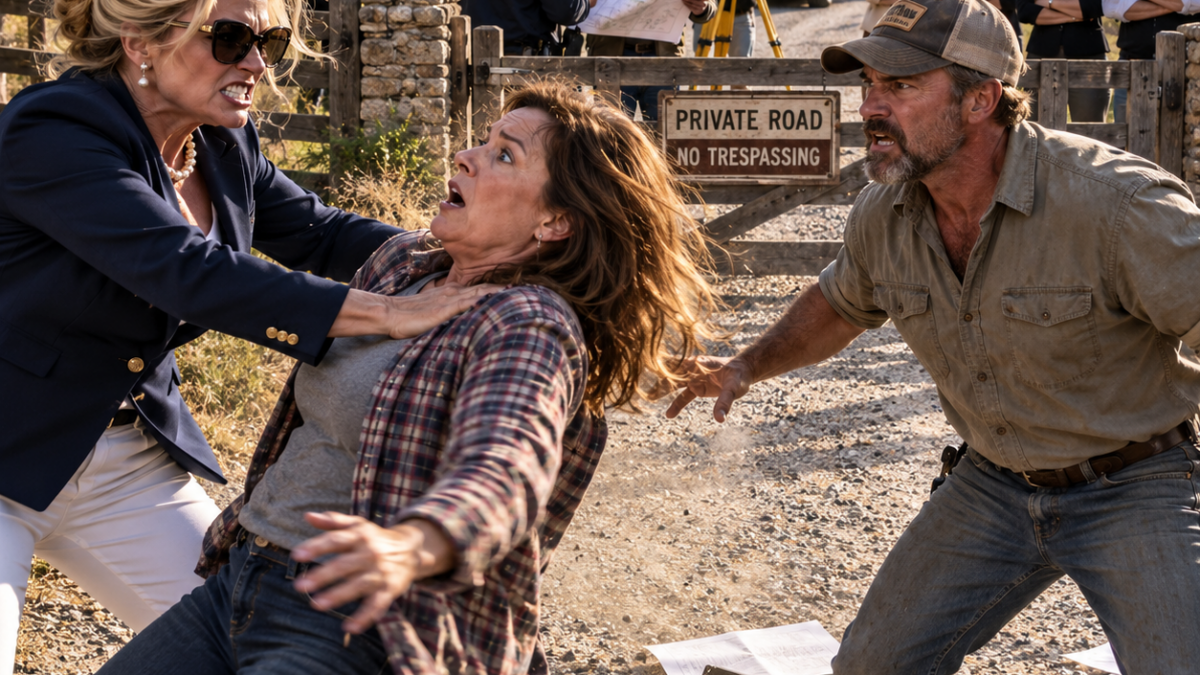
PART 2
It was built to get somebody else in.
“Clare,” I said, “move away from the road.”
“I’m already off the pavement.”
“Farther.”
“What did you hear?”
“A construction convoy.”
There was silence on the line.
Then she said, “So this was timed.”
“That’s what it sounds like.”
I checked the clock.
I couldn’t leave my assignment simply because I was furious. I was working with a fugitive task force, and my responsibilities that day involved people who had nothing to do with my private property problem.
More importantly, the fact that I carried a badge did not turn a land dispute into my case.
If anything, it made restraint more important.
“Call Sheriff’s Dispatch,” I said. “Tell them you were physically shoved and that a barrier was installed on disputed private property. Don’t argue about easement law on the phone. Let Dana handle that part.”
“I want this thing gone.”
“So do I.”
“They pushed me off my own road, Grant.”
I gripped the edge of the transport van.
“I know.”
“What would you do if you were here?”
That was the dangerous question.
If I had been standing beside her, watching blood run down her knee while Lenora ordered a man to change a lock on my family’s road, I wasn’t sure I would have made the smart choice.
So I gave Clare the answer I needed to hear myself.
“I’d document it.”
She exhaled.
“That is not the answer I wanted.”
“Me either.”
—
A deputy arrived about forty minutes later.
Clare kept me on speaker for part of the conversation, but I deliberately stayed quiet.
The deputy photographed her knee, the steel barrier, the fresh bolts in the pavement, the cameras, and the Cedar Hollow sign.
Travis produced the supposed 1998 amendment.
According to Clare, the deputy read it twice.
“This says the association has access rights,” he said.
“It’s fake,” Clare replied.
“I’m not saying it isn’t. I’m saying I can’t adjudicate that beside the road.”
“Can they block me from my house?”
The deputy looked toward Travis.
“I’m telling everyone here that nobody is using force again.”
Travis folded his arms.
“We’ve been instructed to control access.”
The deputy’s expression hardened.
“Your paperwork doesn’t authorize you to put your hands on her.”
“She attempted to interfere with security infrastructure.”
“On land she claims to own.”
“She doesn’t.”
The deputy held up one hand.
“That’s exactly the issue I’m not deciding here.”
Clare later told me that was the moment she understood how easily people could misunderstand what police could accomplish in a property dispute.
A deputy could stop another shove.
He could document an assault allegation.
He could photograph damage.
He could preserve order.
He could not stand on the shoulder of Mercer Ridge Road and rewrite seventy-three years of title history.
Dana filed for a temporary restraining order that afternoon.
The court scheduled an emergency hearing ten days later.
When Dana called me, her tone was controlled.
“We have ten days to prove what the easement actually says.”
“That seems straightforward.”
“It should be.”
I heard the hesitation.
“But?”
“They have ten days, too.”
“To do what?”
“To make their version look more established than it is.”
—
I got home the following evening.
At least, I got close to home.
The checkpoint had expanded.
There was now a portable guard booth beside the steel arm, multiple camera posts, two black SUVs, temporary lighting, and a second sign directing Cedar Hollow residents to display electronic access cards.
I stopped before the entrance.
Travis came out of the booth.
He recognized me.
“Mr. Mercer.”
“Travis.”
“You’ll need to use the visitor procedure.”
I stared at him.
“For my own house?”
“The HOA has assumed control of the access point.”
“You’re standing on my property.”
“Our documentation says otherwise.”
“Then we’ll let the court decide.”
He glanced toward my truck.
“You can’t proceed without authorization.”
Every muscle in my neck tightened.
I had grown up on that road.
I’d driven it to high school.
I’d followed my father’s pickup down it the first winter he let me help clear storm debris.
I’d carried my grandfather’s coffin along it after his funeral.
Now a private guard hired by people who didn’t own an inch of it was telling me I needed permission to go home.
I wanted to drive forward.
Instead I backed away.
Clare met me at a narrow service trail behind our south pasture.
We walked nearly half a mile carrying my luggage between us.
When we reached the kitchen, she put my bag down and said, “I know what you’re thinking.”
“No, you don’t.”
“You’re thinking about a chain and your truck.”
I looked at her.
“Maybe.”
“Dana specifically told me you would think about a chain and your truck.”
Despite myself, I laughed once.
It disappeared when Clare rolled up her jeans.
Her right knee was swollen and purple.
A dark scab crossed the skin beneath the kneecap.
I crouched.
“Does it hurt?”
“Yes.”
“You said you were fine.”
“I was trying to keep you from doing something stupid three states away.”
“That worked.”
“Barely.”
She touched my shoulder.
“Watch the video.”
We sat at the kitchen table.
Clare connected her phone to the laptop.
I watched Travis approach her truck.
I heard him call Mercer Ridge Road HOA-controlled property.
I watched Lenora arrive.
I watched Clare point toward the pavement.
Then Travis grabbed her arm.
He shoved.
She fell.
The camera tumbled sideways.
For a moment, the image showed nothing except gravel and the bottom of the steel barrier.
But the microphone kept recording.
“Change the lock,” Lenora said.
Then a radio crackled.
“Construction convoy is two minutes out.”
I rewound it.
Played it again.
Clare leaned closer.
“You heard that on the phone.”
“Yeah.”
“What does it tell you?”
“That they knew trucks were coming before they blocked you.”
“Exactly.”
I looked at the timestamp.
6:24 a.m.
This hadn’t been an HOA installing security equipment and later deciding to use a road.
The checkpoint and construction traffic had been coordinated.
At 5:40 the next morning, the coordination became undeniable.
Three dump trucks and a concrete pump came through Mercer Ridge Road.
Clare filmed from behind our fence.
The first truck rolled over the old culvert slowly.
The second didn’t.
Its rear tires bounced against the edge.
The third clipped a timber marker my father had installed years earlier.
Then the concrete pump crossed.
A crack appeared along the culvert shoulder.
Within an hour, muddy water was cutting a brown channel through the gravel.
I called the sheriff.
Again.
A different deputy arrived.
Again, he documented everything.
Again, the HOA produced the amendment.
Again, the central question returned to title.
Dana sent Cedar Hollow a formal preservation notice and demanded that all non-emergency traffic stop.
Lenora answered that afternoon.
Not with an apology.
Not with engineering records.
With an invoice.
**SECURITY INTERFERENCE ASSESSMENT: \$18,500.**
I read it twice.
“Can they fine us?” Clare asked.
“We’re not members.”
“I know that.”
Dana called five minutes later.
Her first words were, “Do not pay this.”
“I wasn’t planning to.”
“They’ve created a useful document for us.”
“How?”
“Look at the bottom.”
Below the Cedar Hollow logo was the name of the contractor operating the checkpoint.
**VANCE COMMUNITY SECURITY LLC.**
Clare pulled up the state business registry.
The company had been formed four months earlier.
Its mailing address was a post office box less than two miles from Lenora’s house.
The listed manager was a man named Nolan Price.
Clare turned the laptop toward me.
“Know him?”
I didn’t answer immediately.
The name bothered me.
Not because Nolan Price had ever been one of my fugitives.
He hadn’t.
But six months earlier, our task force had helped locate a financial broker wanted in another state.
Price’s name had appeared more than once among the broker’s shell-company contacts.
That did not mean Price was guilty of anything.
A name in a file was not evidence of a new crime.
But it was enough to create a problem for me.
I picked up my phone.
“Who are you calling?” Clare asked.
“My supervisor.”
“Before Dana?”
“Yes.”
My supervisor listened without interrupting as I explained the road dispute, Clare’s assault allegation, our financial interest in the property, the name on the security company, and the connection I remembered from a prior investigation.
When I finished, he responded immediately.
“You’re recused.”
“I assumed so.”
“No file access. No database searches. Do not contact Price. Do not call anyone from the old investigation. If your attorney has public records she believes are relevant, she can submit them through the proper intake channel.”
“Understood.”
“And Grant?”
“Yeah?”
“Don’t get creative.”
I almost smiled.
“I won’t.”
After I hung up, Clare asked, “Does that help us or hurt us?”
“It protects us.”
“From what?”
“From anyone later saying I used federal resources to win a private land fight.”
That mattered.
More than I knew then.
—
Everett Shaw arrived that afternoon.
He drove an old white pickup that looked as if it had survived every gravel road in the county.
From the bed, he unloaded a tripod, survey instrument, stakes, measuring rods, and decades of quiet skepticism.
He was not an excitable man.
That was one reason I trusted him.
People could argue about intentions.
Everett preferred iron pins.
He located the original monuments and began retracing the parcel boundary.
Clare and I followed at a distance.
Eventually he stopped beside the checkpoint and stared at the steel barrier.
“Well,” he said.
“What?”
“It isn’t close.”
“How far?”
He checked his instrument again.
“Forty-one feet.”
Clare frowned.
“Forty-one feet what?”
“Inside your parcel.”
I looked toward the booth.
“So even if their easement were valid—”
“This gate isn’t inside the strip described by the original document.”
The emergency easement began farther east and covered only a narrow twelve-foot route.
Lenora had installed her barrier outside even the right she claimed to be enforcing.
Clare folded her arms.
“That’s a remarkable mistake.”
Everett looked over his glasses.
“A mistake wanders a few inches. Forty-one feet is a decision.”
He then asked to see the photocopied amendment.
I handed it to him.
He studied the recording stamp.
“There’s an instrument number.”
“We saw it.”
“Did anyone check what it belongs to?”
I looked at Dana.
She was already opening the county index on her laptop.
Everett read the number aloud.
Dana entered it.
A document appeared.
Not an easement.
Not even a record involving Cedar Hollow.
It was a sewer release associated with a shopping center nine miles away.
No one spoke.
Dana looked at the amendment again.
Then at the county record.
“Same instrument number,” she said.
Clare pulled her chair closer.
“So somebody copied a real recording stamp.”
“That is what it looks like.”
I stared at the paper that had been used to shut us out of our home.
The copied seal.
The wrong parcel.
My father’s incorrect middle initial.
Until that moment, I had believed Lenora might have received bad paperwork and chosen to rely on it because it benefited her.
Now another possibility sat on the table.
Someone had manufactured the appearance of recording.
“We still don’t know who made it,” Dana said.
“Or who knew,” I replied.
“Correct.”
She closed the file.
“Don’t outrun the evidence.”
It was the same discipline my job demanded.
Facts first.
Conclusions later.
But the facts were getting harder to explain innocently.
—
Two days later, Cedar Hollow held a special HOA meeting.
Dana wanted us there.
She also wanted us quiet.
“The restraining-order hearing is seven days away,” she reminded me before we walked into the clubhouse. “Do not give them a useful angry quote.”
“What counts as useful?”
“Anything that feels satisfying to say.”
Clare smiled.
“That covers most things Grant wants to say.”
The meeting room was packed.
Residents filled folding chairs and lined the rear wall.
At the front, Lenora stood beneath a projected map.
Mercer Ridge Road glowed green.
Not the twelve-foot emergency strip.
The entire road.
Travis stood near the entrance wearing a Cedar Hollow security jacket.
Several residents had blue access cards hanging from lanyards.
Lenora began with safety.
She described Mercer Ridge Road as a necessary second evacuation route.
She mentioned wildfire danger.
She talked about emergency response.
Then she shifted to the planned sixty-two-home expansion and said the road improvement would increase property values throughout Cedar Hollow.
It was smart framing.
Nobody wanted to be the person opposing wildfire evacuation.
Then she announced the cost.
Each household would be assessed \$2,400.
Cedar Hollow had 255 homes.
I did the math.
\$612,000.
Clare leaned toward me.
“That is a lot of security.”
I nodded.
Lenora opened the floor for questions.
An older woman in the second row raised her hand.
Her name was Ruth Calder.
I’d seen her around town but never spoken with her.
“Did the board obtain an independent title opinion?” Ruth asked.
Lenora smiled.
“Our counsel reviewed the matter.”
“That wasn’t my question.”
A few heads turned.
Ruth continued.
“Did an independent title professional confirm that Cedar Hollow has permanent access rights?”
“Our legal position is well supported.”
Ruth remained seated.
“So no?”
Lenora ignored that.
She took two more questions about paving.
Then she looked directly at Clare.
“Mrs. Mercer, perhaps we can resolve this tonight.”
An assistant placed a document on the front table.
Its title read:
**ACKNOWLEDGMENT OF EXISTING EASEMENT.**
Dana’s hand touched my forearm.
I hadn’t moved.
But apparently my face had.
Lenora motioned toward the paper.
“This simply confirms the access rights that have existed for years.”
Clare walked to the front.
She did not touch the document.
“If the easement already exists, why do you need my signature?”
Lenora’s smile held.
“It’s administrative.”
“For whom?”
“The parties involved in the development need clean documentation.”
“What parties?”
“Investors. Contractors. County reviewers.”
Clare pointed at the paper.
“So the supposed 1998 amendment isn’t enough?”
A murmur moved through the room.
Lenora’s jaw tightened.
“You are making a routine process unnecessarily adversarial.”
“For whom do you need my signature?”
Lenora leaned slightly closer.
Her voice lowered.
“For people with enough money to make this very painful for you.”
The room went silent.
Dana looked at me.
This time I stepped forward.
“Is financing for the second phase contingent on our signature?”
Lenora’s eyes moved to mine.
For half a second, she didn’t answer.
That half second told me more than the speech that followed.
She turned toward the residents.
“The Mercers are willing to jeopardize emergency access for every family in Cedar Hollow because they believe one private road matters more than this entire community.”
I started to respond.
Dana tightened her hand on my arm.
Clare beat me to it.
She pointed toward the projected map.
“Show them where the twelve-foot emergency easement actually is.”
Lenora stared at her.
Clare continued.
“Not the green road you’ve drawn. The recorded easement. Put the legal description on the screen and show everyone.”
Lenora did not.
Because she couldn’t.
The green line on her slide included the section where Everett had measured the checkpoint forty-one feet inside our property.
Residents began whispering.
Lenora ended the meeting early.
As we walked toward the exit, Ruth Calder approached Clare.
She didn’t stop.
She simply pressed a folded piece of paper into Clare’s hand and kept walking.
Outside, beneath the parking-lot lights, Clare opened it.
Five words.
**Check the February board packet.**
—
We met Ruth at a diner the next morning.
She chose a booth in the back.
A thick folder sat beside her coffee.
“I was Cedar Hollow’s volunteer treasurer for eight years,” she told us.
“Was?” I asked.
“Lenora removed me from the finance committee.”
“Why?”
“I ask questions she dislikes.”
Dana almost smiled.
Ruth opened the folder.
Inside was the February board packet she’d kept after a planning meeting.
Page after page covered the proposed expansion.
Traffic.
Drainage.
Construction staging.
Preliminary budgets.
Then Ruth turned to a traffic study.
The existing Cedar Hollow entrance did not meet the preferred conditions for two-way construction traffic.
A second legally usable access route was considered necessary before investors would release the next financing round.
There was our pressure point.
No road.
No financing.
Ruth turned to page forty-seven.
A payment schedule.
**VANCE COMMUNITY SECURITY LLC**
Installation payment: \$153,000.
Thirty-day operational payment: \$153,000.
Final payment: balance due following execution of Mercer access acknowledgment.
Clare stared at the page.
“The final payment depends on our signature.”
Ruth nodded.
“How much of the \$612,000 assessment goes to this company?”
“About half, directly. More through related site-security work.”
I sat back.
The homeowners had been told they were paying to improve an evacuation route.
A huge portion of that assessment was actually being directed toward a security operation tied to the same person pushing the development.
Dana photographed the packet.
“Do you still have the original electronic version?”
“No. Board access was removed when Lenora took me off the committee.”
“Then this paper copy matters.”
Ruth looked uncomfortable.
“I kept everything. My husband calls it hoarding.”
“Today,” Dana said, “it’s preservation.”
Ruth turned another page.
“There is someone else you should talk to.”
“Who?”
“Martin Weller.”
The name meant nothing to me.
“He developed Cedar Hollow originally.”
“Still alive?”
“Eighty-four. Lives in Arizona.”
Dana contacted him that afternoon.
The video call began with Martin squinting at us through thick glasses.
When Dana mentioned Mercer Ridge Road, his expression changed.
“Mercer?”
“Yes,” I said. “I’m Grant Mercer.”
“Whose boy?”
I almost laughed.
“David Mercer’s.”
Martin leaned closer to his screen.
“David rebuilt that culvert.”
“He did.”
“Hardheaded man.”
“Also true.”
Martin remembered the 1998 negotiations.
He remembered my father refusing to grant permanent subdivision access.
“The county fire chief wanted an emergency backup,” Martin explained. “Your father agreed to that. Nothing more.”
“Was permanent access discussed?”
“Absolutely.”
“And?”
“He said no.”
Martin disappeared from camera.
We heard drawers opening.
Then he returned carrying a yellowed binder.
“My wife keeps telling me to throw this stuff away.”
He opened it.
Inside was a signed closing letter from Cedar Hollow’s original development company.
The language was clear.
Mercer Ridge Road would remain private.
Neither the HOA nor future development phases would receive residential or construction access without a new written agreement from the Mercer family.
Clare covered her mouth.
Dana leaned toward the camera.
“Mr. Weller, would you be willing to provide the original and testify?”
“Yes.”
“Even if Cedar Hollow’s current board disputes your recollection?”
Martin shrugged.
“They can dispute me. They can’t dispute my signature very well.”
After the call ended, Dana arranged the evidence across her conference table.
Everett’s survey established the physical boundary.
The county index showed Lenora’s instrument number belonged to another document.
Martin’s binder established what the original parties intended.
Three independent forms of evidence.
All pointing the same direction.
For the first time since Clare had called me from the road, I felt the balance shifting.
Lenora apparently felt it, too.
Because the next night, somebody came for Everett’s survey stakes.
—
Our trail camera captured a Cedar Hollow security SUV at 1:13 a.m.
The driver’s face never turned toward the lens.
But the vehicle stopped near the damaged culvert.
A person in a Cedar Hollow jacket got out.
Two survey stakes disappeared.
By sunrise, Everett was back.
He looked at the empty holes.
“They moved your boundary?” Clare asked.
“No.”
She smiled faintly.
“Good.”
“They moved two pieces of wood.”
He reset the stakes and documented everything.
The sheriff opened a vandalism report.
Dana added the footage to our court filing.
Lenora answered with another escalation.
Cedar Hollow announced that paving would begin forty-eight hours before the hearing.
The plan included widening part of Mercer Ridge Road.
That could destroy shoulder evidence, change drainage patterns, and create exactly the kind of finished condition Lenora might later argue was too expensive to reverse.
Dana requested emergency relief.
Before the judge ruled, something unexpected happened inside Cedar Hollow.
A resident posted the paving notice on the community forum.
The caption asked a simple question:
**Why are we spending \$612,000 on a road before proving we own it?**
Within an hour, thirty-seven homeowners demanded an emergency board vote.
Lenora deleted the thread.
Screenshots spread anyway.
That evening, someone called from our back fence.
“Grant?”
I stepped onto the porch.
Travis Boone stood on the other side.
His SUV remained on Cedar Hollow property.
Both hands were visible.
Clare came out behind me.
“I need to talk,” he said.
I held up my phone.
“I’m recording.”
He nodded.
“Okay.”
“Then talk.”
Travis shifted his weight.
“When Lenora hired us, she said the easement was valid.”
“You shoved my wife.”
His eyes dropped.
“I know.”
“You knew she lived here.”
“Yes.”
“You knew the road was disputed.”
“Not at first.”
Clare crossed her arms.
“When did you know?”
“The morning of the checkpoint.”
That answer surprised me.
“Before or after you shoved her?”
He swallowed.
“Before.”
Clare’s expression didn’t change.
Travis continued.
“Lenora told us the Mercers had already agreed to sell and were trying to increase the price at the last minute.”
“We never agreed to sell,” I said.
“I know that now.”
“What did she tell you that morning?”
He looked toward the road.
“That the construction convoy had to get through before you could obtain an injunction.”
Clare stepped closer to the fence.
“Did she tell you to remove me?”
“Yes.”
“By force?”
“She said clear the controlled area.”
“You grabbed my arm.”
“I know.”
“Then you pushed me.”
“Yes.”
There was no point making him say it a fourth time.
I asked, “Why are you here?”
“Because I don’t want to get buried with her.”
At least that answer sounded honest.
“Do you have records of her instructions?”
Travis hesitated.
“The company phones back up voice messages.”
“Where?”
“Nolan set it up.”
“Nolan Price?”
He looked at me sharply.
“You know him?”
“I know the name.”
“Backups go through the company system.”
“Where is the server?”
He shook his head.
“I came to tell you what happened. I’m not giving you access.”
“I didn’t ask for access.”
Clare asked, “Will you tell investigators?”
Travis looked at her injured knee.
“I’ll tell the truth.”
“That’s not an answer.”
His face tightened.
“No. Not yet.”
Then he walked back toward his SUV.
I didn’t stop him.
I didn’t threaten him.
And I definitely didn’t offer protection I had no authority to provide.
Dana documented the conversation and forwarded it to the sheriff and the federal intake contact handling the materials she had already submitted.
The next morning, the judge issued a short emergency order.
No paving.
No widening.
No removal of roadside features.
The road would remain unchanged until the hearing.
At 6:05 a.m., two paving machines and a milling unit arrived anyway.
Lenora stood beside them in a red coat, phone pressed to her ear.
Dana had taped a copy of the order to the gate.
The paving supervisor read it.
Lenora waved a hand.
“That document is fraudulent.”
The supervisor looked at her.
“Ma’am, it has a judge’s signature.”
“My attorneys are dealing with it.”
“That’s fine.”
“Proceed.”
“No.”
I was watching from farther up the road.
That single word changed something.
For weeks, people had obeyed Lenora because she spoke as if refusal were impossible.
The supervisor called his office.
Then his crews turned around.
One machine after another disappeared back toward the highway.
Lenora remained beside the checkpoint.
For the first time, I saw her give an order and watched the world simply refuse.
It should have made her more cautious.
Instead, she sent an email to every Cedar Hollow homeowner accusing Clare and me of fabricating our survey, manipulating a local judge, and endangering community safety.
She ordered residents to pay the \$2,400 assessment immediately.
Late fees would follow.
Collections would begin against anyone who refused.
The messages went through Cedar Hollow’s management platform.
Payments were processed electronically through an out-of-state financial company.
Dana read the email in silence.
Then she said, “This keeps becoming less local.”
I understood exactly what she meant.
Bad behavior was not automatically a federal crime.
Neither was an ugly HOA dispute.
Even a forged-looking document did not magically turn every related act into federal jurisdiction.
Intent mattered.
Money flow mattered.
Communications mattered.
Evidence mattered.
And Lenora kept generating all four.
—
Two days before our hearing, the county recorder’s certified response arrived.
Dana called us immediately.
“No 1998 amendment exists in the official index.”
We already suspected that.
But certified records mattered more than suspicion.
She continued.
“The instrument number is the shopping-center sewer release, exactly as Everett found.”
“Good.”
“There’s more.”
I stopped pacing.
“What?”
“Three weeks ago, someone tried to record a corrected copy of the amendment.”
Clare looked at me.
“Someone tried to file it recently?”
“Yes.”
“When?”
Dana checked the response.
“Five days after you rejected Lenora’s \$75,000 offer.”
That changed the timeline completely.
Lenora had presented the document as something discovered in old archives.
But someone connected to Cedar Hollow had attempted to insert a corrected version into the public record only after we refused to sell.
“Who filed it?” I asked.
“A woman identifying herself as an employee of Cedar Hollow’s management company.”
“Did it record?”
“No. The clerk rejected it. The acknowledgment was defective, and the legal description didn’t match the parcel.”
Clare sat down.
“So they tried to create the history after we said no.”
Dana chose her words carefully.
“Someone tried to record an instrument after you said no. We will not say more than the evidence supports.”
I knew she was right.
But I also knew what that evidence looked like.
The supposedly ancient amendment wasn’t simply missing.
It had been offered for recording weeks ago.
—
The morning before the hearing, Dana asked us to come to her office.
Two strangers were waiting.
A woman introduced herself as Special Agent Lena Ortiz with the FBI.
The man beside her was Marcus Bell, a United States Postal Inspector.
Ortiz didn’t waste time.
“Mr. Mercer, I understand you’re federal law enforcement.”
“Yes.”
“You and your spouse are also victims with a direct financial interest in this property.”
“Yes.”
“You will have no role in our investigation.”
“Understood.”
“No informal database checks. No calls to colleagues. No attempts to obtain information through your position.”
“Understood.”
Clare looked at me.
I nodded.
Ortiz turned to her.
“We’d like to begin with the original phone recording.”
Clare handed over the device according to their instructions.
They documented the transfer.
They collected certified copies rather than relying solely on the papers Dana had assembled.
They interviewed Clare about the shove.
Ruth about the board packet.
Everett about the survey and instrument number.
Bell asked detailed questions about notices sent through the mail.
Ortiz focused on electronic assessments, bank processors, security-company payments, and the expansion investors.
They told us almost nothing about whatever else they were investigating.
That was normal.
Before leaving, Ortiz closed her notebook.
“One more question.”
“Okay.”
“Either of you ever heard of Brier Glenn?”
I looked at Clare.
She shook her head.
“No,” I said.
Ortiz stood.
“Then don’t search for it.”
That instruction was aimed mostly at me.
“Let us do that.”
They left.
I watched their car pull away.
Clare stood beside me.
“Brier Glenn.”
“Don’t.”
“I just repeated the name.”
“That’s how it starts.”
She almost smiled.
“You really hate being recused.”
“No. I hate mysteries.”
The following morning, we went to court knowing Mercer Ridge Road might not be the first road involved.
But we still didn’t know why.
—
Lenora arrived with two attorneys and a binder thick enough to impress anyone judging cases by paper weight.
She wasn’t wearing red.
She had chosen gray.
Cedar Hollow argued that the HOA had relied in good faith on an amendment discovered in archived management files.
Its attorney emphasized historical use.
Residents had occasionally crossed Mercer Ridge Road.
Emergency vehicles had used it.
Maintenance personnel had been present near it.
According to the HOA, the checkpoint merely formalized an existing access right.
Dana began with geography.
Everett took the stand.
He displayed the recorded plat.
The original boundary monuments.
The twelve-foot emergency strip.
The location of the culvert.
Then he placed the checkpoint on the survey.
Forty-one feet inside our parcel.
One of Cedar Hollow’s attorneys stood.
“Surveying historical boundaries can involve professional judgment, correct?”
“Of course.”
“Measurements can vary.”
“Yes.”
“Monuments can move.”
“Yes.”
“So your location is an interpretation.”
Everett looked at him.
“The barrier is forty-one feet from the relevant recorded line.”
“Is that a yes?”
“It’s an answer.”
A few people shifted in the gallery.
The attorney tried again.
“You cannot testify that every surveyor would produce precisely identical measurements.”
“No.”
“Thank you.”
Everett waited.
Dana asked, “Would professional variation explain forty-one feet?”
“No.”
“How much variation would you ordinarily expect in a retracement like this?”
“Inches. Depending on conditions, sometimes more. Not forty-one feet when the controlling monuments are intact.”
That was the end of the question.
Next came the county recorder’s custodian.
She authenticated the official index.
No 1998 easement amendment had ever been recorded.
The stamp number on Lenora’s document belonged to a sewer release.
She also testified about the recent rejected filing.
Cedar Hollow’s attorneys objected repeatedly to suggestions about who had created the document.
Dana didn’t push farther than the evidence.
She didn’t need to.
The timeline was already on the record.
Then Martin Weller appeared by video from Arizona.
He held up the old closing binder.
Cedar Hollow’s attorney suggested that an eighty-four-year-old man’s memory of negotiations decades earlier might be imperfect.
Martin nodded.
“Absolutely.”
The attorney seemed encouraged.
Then Martin continued.
“That’s why I kept the paperwork.”
He identified his signature.
My father’s signature.
The original company’s letter.
No permanent residential or construction access without a new Mercer agreement.
The attorney asked, “Wasn’t emergency access intended for community safety?”
“Yes.”
“And couldn’t a secondary route improve safety today?”
“Maybe.”
“So expanded access could benefit residents.”
“Maybe.”
“Then why would the developer oppose it?”
Martin looked confused.
“I didn’t say anyone opposed discussing it.”
He lifted the letter.
“I said we didn’t own it.”
That distinction landed harder than any dramatic speech could have.
Finally, Dana played Clare’s video.
The courtroom watched Lenora arrive.
Heard her declare Mercer Ridge Road a controlled area.
Saw Travis step between Clare and the gate.
Heard Clare say, “Don’t touch me.”
Watched him shove her.
Then came Lenora’s voice.
“Change the lock.”
The radio crackled.
“Construction convoy is two minutes out.”
No one spoke.
The footage continued long enough to establish context.
Then Dana stopped it.
Lenora’s attorney requested a recess.
The judge granted fifteen minutes.
—
We were standing in the hallway when Ruth appeared.
She moved quickly toward Dana.
“I have something.”
Dana frowned.
“What?”
“A board member emailed me this morning.”
“Who?”
“I can’t say until they agree.”
Ruth handed her several printed pages.
Dana read the first.
Then the second.
Her expression changed.
“Where did this come from?”
“The development file.”
“What is it?”
Ruth looked at me.
“The private term sheet.”
Dana led us into a conference room and closed the door.
At the top of the document was the sixty-two-home expansion.
Below that were investor conditions.
Verified permanent secondary access through Mercer Ridge Road had to be secured before the end of the month.
Not claimed.
Not assumed.
Verified.
Then came the compensation section.
An entity controlled by Lenora Vance would receive a **\$1.8 million consulting success fee** if permanent Mercer Ridge access was delivered and the financing closed.
I stared at the number.
Clare sat beside me.
“That’s twenty-four times what she offered us.”
No one answered.
The term sheet contained something even more important.
The investors would not rely solely on the disputed 1998 amendment.
They required either fresh written consent from the current owners or a final court ruling confirming permanent access.
Suddenly the acknowledgment Lenora had placed in front of Clare at the HOA meeting made perfect sense.
She had not been asking us to confirm a right she already possessed.
She had been asking us to create the right her investors demanded.
And if Clare had signed, Lenora stood to collect an enormous personal fee.
Dana looked at Ruth.
“Can the board member authenticate this?”
“Yes.”
“Today?”
Ruth nodded.
The bailiff called us back.
When the hearing resumed, Cedar Hollow’s attorneys looked as if they’d spent the recess arguing with their own client.
One stood.
“Your Honor, in light of newly raised questions concerning the provenance of certain historical records, the association requests permission to withdraw reliance on the 1998 amendment pending internal review.”
Dana rose.
“We object to any attempt to make this dispute disappear without relief.”
The judge looked over his glasses.
“Explain.”
“The association has already installed a barrier on our clients’ property, allowed non-emergency construction traffic, damaged a culvert, issued monetary demands, attempted to pave the road, and physically removed Mrs. Mercer from land she owns. Withdrawal of one exhibit does not restore the status quo.”
Cedar Hollow’s lawyer responded.
“The association is attempting to de-escalate.”
Dana placed the term sheet on the podium.
“Then the court should understand why escalation occurred in the first place.”
Lenora turned sharply toward her attorney.
He looked at the document.
Then at her.
The judge called counsel forward.
For several minutes, we heard nothing.
Then Lenora’s attorney returned to his table and whispered something to her.
Her face lost color.
Dana called Ruth.
Then the current board member who had produced the term sheet.
The document was authenticated.
The \$1.8 million fee entered the record.
Dana asked one question.
“Was this financial arrangement disclosed to the full HOA board?”
“No.”
“Was it disclosed to the homeowners before the \$2,400 road assessment?”
“No.”
“Did the investors require Mercer consent or a final judgment?”
“Yes.”
“Would the disputed 1998 amendment alone satisfy them?”
“No.”
Lenora stared straight ahead.
The judge recessed again.
This time for almost an hour.
When he returned, he granted a preliminary injunction.
Cedar Hollow, its residents, contractors, and security agents were barred from using Mercer Ridge Road for residential, construction, commercial, or routine access.
The original emergency provision remained intact.
Fire.
Medical.
Rescue.
Nothing else.
The barrier, cameras, and guard booth had to be removed within seventy-two hours under documented supervision.
The HOA could not collect or spend money from the road assessment.
Relevant records had to be preserved.
The decision was not a final trial judgment.
It did not decide every damage claim.
It did not convict anyone of a crime.
But it gave us our road back.
—
At 6:30 the next morning, Clare and I stood beside the damaged culvert waiting for the removal crew.
Two guards we had never seen before unlocked the steel arm.
Travis wasn’t there.
At 6:46, black vehicles appeared on the county road.
For one strange second, I assumed they were connected to the barrier removal.
They weren’t.
They passed Mercer Ridge Road.
Turned toward Cedar Hollow’s main entrance.
Clare looked at me.
“Federal?”
“Yes.”
“Yours?”
“No.”
“And you’re staying here.”
“Absolutely.”
That detail mattered.
I did not put on a vest.
I didn’t flash credentials.
I didn’t make a call.
I didn’t even walk toward Cedar Hollow.
Because this was the reason my supervisor had recused me.
If I had touched that investigation, Lenora’s attorneys could later argue that federal power had been weaponized to settle my private dispute.
Instead, I stood beside my wife while agents who had built their own case went where their evidence took them.
Special Agent Ortiz entered Cedar Hollow’s management office with a federal search warrant.
Postal inspectors secured mailed assessment notices and vendor files.
Another team searched Vance Community Security’s office.
State investigators executed separate warrants relating to the land-record filing and the assault investigation.
Residents gathered along sidewalks.
Phones came out.
Nobody celebrated.
Most people looked stunned.
For weeks they’d been told Clare and I were threatening their safety.
Now investigators were carrying boxes out of the office that had sent those warnings.
At 7:12, the removal crew cut the first bolts from our pavement.
The steel arm lifted.
Clare watched it swing upward.
“That looked bigger when it belonged to them.”
I glanced at her.
“It never belonged to them.”
The crew removed the cameras.
The guard booth.
The posts.
Everett documented every hole before restoration began.
When the last obstruction was gone, Clare got into her truck.
She drove from our house to the county road.
No access card.
No guard.
No camera following her license plate.
No stranger telling her she was trespassing.
When she returned, she parked beside me.
“I didn’t realize how angry that trip was making me.”
“What trip?”
“Just leaving home.”
She looked back toward the curve.
“Every time I drove down there, I expected somebody to stop me.”
I understood.
Getting the gate removed restored legal access.
It would take longer to make the road feel like ours again.
—
The federal search didn’t produce an instant confession.
Real investigations rarely do.
Weeks passed.
Agents copied servers.
They traced financial transfers.
They compared versions of board minutes.
They examined metadata.
They interviewed contractors, residents, employees, investors, and former advisers.
I received no internal updates.
I didn’t ask.
Dana handled our civil case.
The sheriff handled local reports.
I went back to work and did my best not to wonder about Brier Glenn every hour.
Then a federal criminal complaint was unsealed.
Lenora Vance and Nolan Price were accused of participating in a broader scheme involving electronic payments, mailed demands, forged access documents, and shell companies.
The allegations still had to be proved.
But one name in the complaint answered the question Agent Ortiz had asked us.
Brier Glenn.
It was a subdivision about eighty miles north.
Two years earlier, its management company had claimed unrestricted access over a widow’s farm road.
The widow was named Evelyn Hart.
The document used to pressure her was supposedly an amendment to an older limited easement.
It carried a notary seal.
A recording stamp.
Language expanding access rights.
It also contained formatting similarities to ours.
Evelyn could not afford a prolonged lawsuit.
The management company offered \$12,000 for an agreement.
She accepted.
Later appraisals suggested the access she signed away was worth more than \$200,000.
Nolan Price had been a consultant to that management company.
Investigators searching his records reportedly found templates for access amendments.
Names changed.
Parcel numbers changed.
Dates changed.
Certain formatting mistakes remained.
The method described in the complaint was brutally simple.
Find property that blocked a valuable development or access route.
Produce paperwork that looked old and official.
Threaten litigation.
Create operational pressure.
Then offer the landowner far less than the actual value of the access right.
Some owners signed.
Some moved.
Some lacked the money to challenge the papers.
Lenora had not invented the idea.
According to the allegations, she’d adapted it to Mercer Ridge Road.
Nolan supplied the document infrastructure.
Vance Community Security supplied the physical pressure.
Lenora supplied the HOA’s apparent authority and the target.
Our road was supposed to become their largest deal.
The \$1.8 million success fee was to be divided through multiple entities after the development financing closed.
Then investigators recovered an email exchange.
Five days before the checkpoint went up, Lenora emailed Nolan.
The subject line was:
**Merc signature**
Her message said that if Clare would not sign voluntarily, daily access pressure should make our property increasingly difficult to use and force us to accept the \$75,000 offer.
Nolan’s reply was short.
**Do not create video.**
Lenora responded:
**Security controls the cameras.**
She had thought about her cameras.
She hadn’t thought about Clare’s phone.
—
That recording became more important than either of us had imagined on the morning of the shove.
Not because it captured violence dramatic enough to decide everything by itself.
It didn’t.
It mattered because of context.
The timestamp showed the checkpoint operation was active before the convoy arrived.
The radio established that construction traffic was coordinated.
Lenora’s phrase “controlled area” showed how she was representing our property to the security staff.
Her order to “change the lock” showed control over the checkpoint.
Her instruction to document Clare as a trespasser showed how she intended to frame our resistance.
Combined with the emails, the recording supported a much darker interpretation of the gate.
It wasn’t simply security.
It was leverage.
The HOA attorney who had sent us the first easement letter eventually turned over his file.
According to his statement, Lenora had provided the 1998 amendment to him as an already recorded instrument.
When he later asked for a certified copy, she told him the county’s electronic index was incomplete.
He withdrew from representing Cedar Hollow after the hearing.
Several board members claimed they’d never seen the \$1.8 million term sheet.
Others said they hadn’t understood how much of the \$612,000 assessment would go to Vance Community Security.
Then investigators compared meeting records.
Some electronic minutes had been edited after votes.
Language had been added.
Details had disappeared.
Ruth’s paper packets did not always match the files on the HOA server.
I called her after learning that.
“Your husband still call you a hoarder?”
She laughed.
“Every day.”
“Tell him he owes your filing cabinet an apology.”
“I already did.”
She became quiet.
“Grant, I keep thinking about what would have happened if I’d thrown those packets away.”
“So do I.”
“It’s frightening.”
“Yes.”
“Not because one paper saved you.”
“No.”
“Because without all the boring pieces together, they might have kept arguing.”
That was exactly right.
No magical document had rescued us.
It was accumulation.
Survey pins.
Old letters.
Phone video.
Board packets.
County records.
Emails.
Vendor payments.
Each piece limited another escape route.
—
Cedar Hollow itself began to unravel.
A civil court appointed an independent receiver to protect association funds during the financial review.
Payments to Lenora-linked companies were frozen.
Collection of the \$2,400 road assessment stopped.
Residents who had already paid were notified that refunds would be addressed after the audit.
I did not enjoy watching ordinary homeowners panic.
Some had repeated ugly things Lenora said about us.
A few had driven through our road while the dispute was active despite knowing we objected.
But many had done nothing more than trust paperwork presented by people elected to manage their community.
They had been told the assessment was about safety.
They had been shown a map colored to suggest the HOA had rights it did not possess.
They had been warned that questioning the board would endanger neighbors during wildfires.
That kind of pressure worked because decent people generally wanted to protect their community.
Lenora had used that instinct.
Ruth helped organize a recall effort.
Before the vote could happen, several remaining directors resigned.
Cedar Hollow hired an independent management company.
New rules required dual signatures for major contracts.
Vendor payments were published monthly.
Conflict disclosures became mandatory.
Title verification was required before the HOA spent money asserting rights over property outside its recorded boundaries.
The sixty-two-home expansion missed its financing deadline.
The project was not permanently banned.
It simply had to solve its own access problem legally.
The developer eventually produced a new design with a longer second entrance across land it actually controlled.
The route required additional drainage work.
More road construction.
Fresh county review.
And significantly more money.
In other words, the project finally had to absorb its true cost instead of transferring that cost to Clare and me.
—
Travis’s case moved separately.
He faced state charges related to shoving Clare and allegations involving the later handling of evidence.
Eventually he began cooperating.
Months after the checkpoint came down, Clare and I saw him in court.
He looked thinner.
His lawyer spoke first.
Then Travis turned toward Clare.
“I am sorry.”
She watched him.
He continued.
“I knew there was a dispute. I should have stopped. I should never have put my hands on you.”
Clare didn’t answer immediately.
The judge waited.
Finally she said, “Thank you for saying that.”
That was all.
Outside, I asked how she felt.
“Angry.”
“Still?”
“Yes.”
“Even after the apology?”
She looked at me.
“An apology isn’t a time machine.”
I nodded.
She added, “But I’d rather hear him admit it than spend the rest of his life claiming I fell.”
That made sense.
Travis eventually entered a plea to state offenses, agreed to testify about the security operation, and was ordered to stay away from our property.
Clare did not forgive him because a courtroom expected a tidy ending.
She accepted the admission for what it was.
Nothing more.
—
Lenora’s case lasted longer.
By then, the story I’d once viewed as a fight over my family’s road had expanded far beyond us.
Other landowners were contacted.
Records from other developments were reviewed.
Nolan Price continued contesting the charges against him.
Lenora eventually entered a guilty plea to federal conspiracy and wire-fraud charges.
The plea did not say that every decision she’d ever made as HOA president was criminal.
It focused on the scheme prosecutors could prove.
False representations.
Money.
Communications.
Pressure designed to secure property access.
When sentencing day came, I almost stayed home.
Clare surprised me.
“I want to go.”
“You sure?”
“Yes.”
“For the sentence?”
“No.”
“Then why?”
“I want to hear her stop calling our road hers.”
So we went.
Lenora looked different without the boardroom around her.
No projected map.
No access cards.
No security staff.
No red suit commanding attention at the front of a clubhouse.
Her attorney spoke about reputation, pressure, financial judgment, and the consequences she’d already suffered.
The prosecutor described the forged documents and the pattern of pressure.
Other victims were discussed.
So was Brier Glenn.
Then Lenora spoke.
She acknowledged participating in a plan that used false access claims to pressure property owners.
She acknowledged communications about making our property harder to use.
She acknowledged the financial interest tied to our signature.
She did not look at Clare.
I thought I would feel victorious.
Instead, I kept remembering the morning of the call.
Clare bleeding on gravel.
A camera pointed at her truck.
A man saying she needed permission to use the road to her own home.
The judge imposed sentence.
Restitution and other financial consequences followed the plea.
I listened.
When it was over, Clare touched my hand.
“Ready?”
“Yeah.”
We left.
Outside, reporters were waiting.
I ignored them.
So did Clare.
We crossed the parking lot together.
For once, there was nothing Lenora could make us sign before we were allowed to leave.
—
Our civil case ended with a permanent order confirming exactly what the original documents had said.
Cedar Hollow had no permanent residential, construction, or commercial right to Mercer Ridge Road.
The narrow emergency provision remained.
I wanted that.
So did Clare.
If a wildfire blocked Cedar Hollow’s entrance and a fire engine needed our road, it could use it.
If an ambulance needed to cross during a genuine emergency, it could cross.
My father had agreed to that because it was reasonable.
Nothing Lenora had done changed the value of that agreement.
Cedar Hollow’s insurer paid for restoration of the damage associated with the checkpoint operation.
The culvert was repaired.
Fence sections were rebuilt.
Every bolt hole drilled into the pavement was restored.
The damaged shoulder was reconstructed.
Everett returned on a cool morning to set protected boundary monuments.
He arrived with the same old white truck.
Clare brought coffee.
Ruth came too.
Martin Weller joined us by video from Arizona.
When Everett finished the first monument, he stood and brushed soil from his knees.
“There.”
I looked down.
“Think forty-one feet will happen again?”
He gave me the same expression he’d used months earlier.
“Someone can still make a bad decision.”
“That reassuring?”
“No.”
“But the monument helps.”
“It always did.”
The final truck arrived that afternoon for the last damaged pieces of the old guard booth.
Clare watched the crew load them.
When the flatbed pulled away, she turned toward me.
“We should put up a gate.”
I looked down Mercer Ridge Road.
The oak trees leaned over the familiar curve.
Fresh pavement covered the bolt holes.
The repaired culvert carried clear water beneath the shoulder.
“A big one?” I asked.
“Bigger than theirs.”
“With cameras?”
“Ten.”
“Spotlights?”
“Obviously.”
I knew from her face that she was only half joking.
Then she looked toward the house.
“No,” she said.
“No?”
“I don’t want her deciding what our home looks like after she’s gone.”
That sentence stayed with me.
We didn’t install a steel barrier.
We didn’t build a guard booth.
We didn’t put cameras on poles to track every vehicle.
Instead, I found the old wooden post where my father’s private-road sign had once stood.
We replaced it with a simple one.
Six words.
**PRIVATE ROAD — EMERGENCY ACCESS ONLY**
Nothing threatening.
Nothing triumphant.
Just the legal truth.
Clare stood beside me while I tightened the last bolt.
“Crooked,” she said.
“It is not crooked.”
“Your left side is low.”
I stepped back.
She was right.
I fixed it.
“Better?”
“Barely.”
I handed her the wrench.
“Next time you install it.”
She smiled.
That sound—the small laugh she made while standing in the same place where months earlier a guard had shoved her onto gravel—meant more to me than the court order.
—
Her knee healed before the road did.
The cut closed.
The bruising faded.
But for weeks after the checkpoint disappeared, she slowed every time she approached that curve.
Sometimes she’d touch the brake without realizing it.
I’d notice from the passenger seat.
I never mentioned it.
One morning we were taking an owl to a release site.
The carrier was secured behind us.
Sunlight moved through the oak branches.
Clare drove toward the old checkpoint location.
I felt myself waiting for the brake lights.
She didn’t slow.
We passed the repaired pavement.
The new boundary monument.
The private-road sign.
Then the curve disappeared behind us.
Clare kept driving.
A few seconds later she said, “What?”
“Nothing.”
“You’re staring at me.”
“No, I’m not.”
“You are.”
I looked out the window.
She smiled.
Then I realized what had just happened.
The road was hers again.
Not merely in a survey.
Not merely in a court order.
Not because federal agents had carried boxes out of Cedar Hollow’s office.
It was hers because she had driven through the place where someone once told her she needed permission to go home, and this time her body had not prepared for a confrontation.
That mattered more than I expected.
—
Sometimes I think about how easily the outcome could have been different.
If Clare had stopped recording after she fell, the timing of the construction convoy might have been harder to establish.
If Everett had trusted the recording stamp instead of checking its instrument number, the fake amendment might have survived longer.
If Ruth had thrown away the February packet, the security-company payment schedule could have been harder to reconstruct.
If Martin Weller had discarded his closing binder, we’d still have had the deed—but one more independent piece of history would have been missing.
If the county clerk had casually accepted the attempted amended filing, Lenora’s story might have become more complicated to unwind.
If I had used my badge to push the investigation, I might have handed her lawyers the argument they desperately needed.
No single piece won the case.
That was the lesson the entire mess forced on me.
The phone video showed what happened.
The survey established where it happened.
The county index showed that the “recorded” amendment wasn’t recorded.
The old closing letter showed what the original parties had intended.
Ruth’s packet revealed the financial structure.
The investor term sheet explained why our signatures mattered.
And Lenora’s own communications supplied the pressure behind it.
Confidence had carried her surprisingly far.
Records carried farther.
—
Today, Mercer Ridge Road is quiet again.
Fire engines can still cross during a genuine emergency, just as my father intended.
Cedar Hollow residents use Cedar Hollow’s entrance.
Future development has to build access across land it actually owns.
Ruth occasionally calls Clare.
Martin still sends us notes from Arizona whenever he finds another piece of old Cedar Hollow paperwork in one of his boxes.
Everett claims he is retiring every year and continues accepting survey work anyway.
The wildlife barn remains full of animals that do not care about property law.
The owl from that morning eventually recovered.
Clare released it near the western ridge.
We stood together in the grass while she opened the carrier.
For a moment, the bird stayed perfectly still.
Then its wings spread.
It lifted over the fence and disappeared into the trees.
On the drive home, we turned onto Mercer Ridge Road just before sunset.
No barrier.
No security booth.
No blue access cards.
No camera pivoting toward our license plate.
Only oak shadows stretched across the pavement and the small sign beside the shoulder.
**PRIVATE ROAD — EMERGENCY ACCESS ONLY.**
I thought about the first phone call.
Clare bleeding in the gravel.
Lenora telling her to leave.
Travis changing the lock.
All of it had begun because Lenora believed that if she moved fast enough, installed enough hardware, produced enough official-looking paper, and repeated the word “easement” with enough certainty, possession would eventually become permission.
Instead, the gate marked exactly where her story stopped matching the ground.
Clare drove past the repaired culvert without slowing.
I looked through the windshield at the road my grandfather cut, my father rebuilt, and my wife had been shoved from for refusing to surrender.
There was nothing dramatic waiting at the end of it.
Just our house.
Our barn.
A porch light beginning to glow beneath the trees.
And for the first time in a long time, getting home required nothing from anyone except turning into our own road and continuing forward.
[END OF STORY]








