PART 2: HOA Guards Shoved My Wife Off Our Private Road—The Next Morning I Came Back as the U.S. Marshal Leading Their Arrests
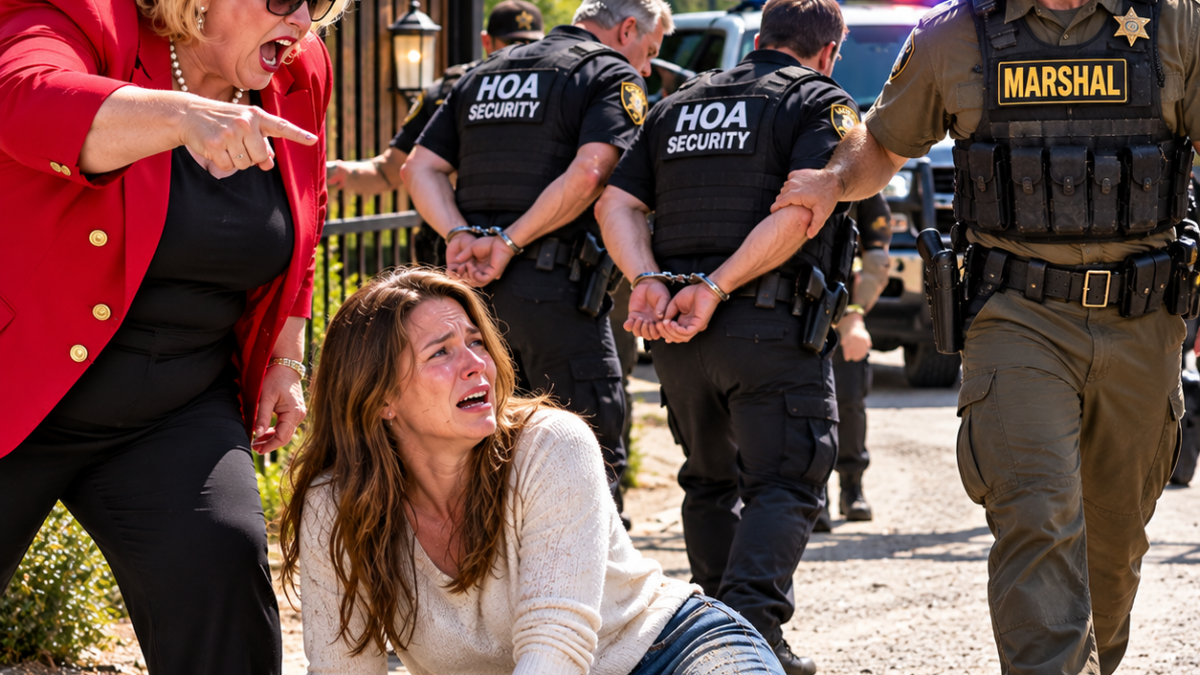
PART 2
I stayed in that parking lot for almost a minute after Claire hung up.
The coffee in my console had gone cold.
The sun was dropping behind the courthouse across the street, turning the windows gold, and all I could see was Claire’s phone lying screen-up in the gravel, still recording while Lenora stood over her with that practiced HOA smile.
I had known Cedar Hollow was going to push.
I had expected another letter, another legal bluff, maybe another fake invoice with “community road conversion” typed across the top in bold letters.
I had not expected them to shove my wife.
That was the difference between a scheme and a crime people could feel in their bones.
Paper can be argued over.
A woman hitting gravel cannot.
I opened the secure folder beside me and pulled out the top sheet.
CEDAR HOLLOW / VANCE MANAGEMENT CONNECTIONS.
Lenora’s name was already there.
So was the management company that had been printed at the bottom of her latest violation notice.
So was a property security vendor that had appeared in three other easement-pressure cases across two states.
For six months, I had been helping an independent federal task force connect a pattern that most victims had experienced as isolated private disputes.
A widow in Morgan County pressured into signing away access rights for twelve thousand dollars.
A family farm outside Brighton threatened with fines until they allowed construction traffic through a private lane.
A retired couple in Dale County forced into a “maintenance agreement” after a homeowners association produced a suspicious amendment nobody could locate in official records.
Every case looked small when viewed alone.
Every victim had been told the same thing.
It is already settled.
The documents exist.
Our attorneys reviewed it.
You are standing in the way.
Sign now, or pay later.
But patterns do not stay hidden forever.
Not if someone keeps the letters.
Not if someone preserves metadata.
Not if bank transfers move through the same shell companies.
Not if the same forged notary stamp appears on supposedly unrelated documents.
And not if an HOA president gets arrogant enough to install a checkpoint on land she does not own.
My phone buzzed.
Claire had sent the video.
I opened it.
The recording began with the barrier ahead of her car.
Two black SUVs flanking the road.
A camera post angled toward oncoming traffic.
A fresh sign bolted to the steel arm.
CEDAR HOLLOW HOMEOWNERS ASSOCIATION
AUTHORIZED VEHICLES ONLY
Then Travis Boone stepped into frame.
Dark uniform.
Security patch.
Hand near the radio at his chest.
“Turn the vehicle around, ma’am.”
“This is my road,” Claire said.
“As of six this morning, Cedar Hollow has taken control under a newly discovered easement amendment.”
“My husband and I own every inch of this road.”
“Paperwork isn’t my department.”
“Then move out of my way until someone whose department it is gets here.”
A few moments later, Lenora arrived in a silver sedan.
She stepped out wearing a cream blazer and sunglasses, moving with the calm confidence of a woman who had rehearsed her entrance.
“Claire,” she said, as if they were meeting at a charity luncheon instead of an illegal checkpoint. “I hoped we could avoid this kind of behavior.”
“What behavior?”
“Interference.”
“This is my property.”
“This road now serves Cedar Hollow Estates as a secondary access route. The board has a responsibility to protect shared community infrastructure.”
“It is not shared. It is not community. And it is not yours.”
Claire pulled up the parcel map on her phone.
The video shook slightly as she held it toward Lenora.
Lenora barely glanced at it.
“Your husband can argue with our attorneys when he gets home.”
That sentence made something in my chest go very still.
Claire moved toward the lock.
“I’m removing this from my property.”
Lenora’s voice sharpened.
“Travis, remove her.”
The guard stepped in front of Claire.
“Don’t touch me,” she said.
He shoved forward.
The camera pitched violently.
The sky flashed.
Gravel scraped.
Claire hit the ground with a sound I felt behind my teeth.
Her phone landed screen-up.
It kept recording.
For several seconds, all it captured was dust, the lower half of Travis’s boots, and Claire’s hand pressing into gravel.
Then Lenora stepped into view.
Not rushing to help.
Not checking whether Claire was hurt.
She stepped over her like Claire was an inconvenience lying in the road.
“Change the lock,” Lenora said. “And log the plate as attempted trespass.”
I watched the video twice.
Then a third time.
By the time I finished, my anger had become useful.
I forwarded the original file to Assistant United States Attorney Mallory Keene with the headers and metadata intact.
Then I called her.
She answered on the second ring.
“Tell me you’re not calling because you did something stupid.”
“I did not do something stupid.”
“Good.”
“Cedar Hollow did.”
She went silent as the file landed.
I heard clicking as she opened it.
Then nothing.
For nearly two minutes, all I heard was her breathing through the phone.
When she finally spoke, her voice was lower.
“That’s your wife?”
“Yes.”
“Is she injured?”
“Minor, according to her. Knee, palms. She’s documenting it.”
“Local report?”
“I told her to preserve everything first. The physical assault needs to go through local channels cleanly. I’m not touching that.”
“And the federal side?”
“Lenora just converted an ongoing paper scheme into active coercion at a controlled checkpoint.”
Mallory exhaled.
“That may be enough to move the warrant schedule up.”
“It should be.”
“I’ll call the team.”
“Mallory.”
“Yes?”
“I’m disclosing again, clearly, that Mercer Ridge Road is my property and Claire is my wife.”
“I know.”
“I cannot investigate my own road dispute.”
“You won’t.”
“But I can participate in the execution of warrants tied to the broader federal case if the operational plan keeps independent agents on evidence connected to my property.”
“That’s exactly how we’ll structure it.”
I closed the folder.
“Then let’s end it before she hurts someone else.”
The dispute over Mercer Ridge Road had begun quietly, which is how most serious property fights begin.
No gates.
No guards.
No cameras.
Just a letter.
Three months before Claire was shoved, Lenora Vance offered us forty-five thousand dollars for permanent use of Mercer Ridge Road.
The offer came dressed up in neighborly language.
Community improvement.
Emergency readiness.
Shared benefit.
Rising property values.
I read it once and set it on the kitchen table.
Claire read it after dinner and frowned.
“She wants daily traffic, doesn’t she?”
“Yes.”
“Construction trucks too?”
“Eventually.”
“She doesn’t say that.”
“She doesn’t have to.”
Cedar Hollow Estates was planning sixty-two additional luxury homes on the back ridge. The existing entrance was too narrow, too steep, and too congested to support construction and future traffic without expensive upgrades.
Mercer Ridge Road was the cheap answer.
Our road cut along the edge of the development, wide enough for trucks, graded well enough for equipment, and connected to the county route in a way investors loved.
If Lenora could secure it, the expansion became financially attractive.
If she could not, the project slowed, costs rose, and financing got harder.
I wrote back declining the offer.
No drama.
No insults.
Just no.
Two weeks later, the offer rose to seventy-five thousand.
I declined again.
Not because the money was small, although compared to what the access was worth to her project, it was insulting.
I declined because Claire and I had built our life around quiet.
Mercer Ridge Road ran past our lower pasture, our workshop, the orchard Claire planted, the stone wall my grandfather built, and the old springhouse we had restored piece by piece.
Daily construction traffic would tear the road apart, break the culvert, coat our fields in dust, and turn our home into a shortcut for a subdivision we had deliberately not joined.
Lenora did not accept no.
The next letter came from Cedar Hollow’s attorney.
It claimed the HOA had “recently discovered” an amendment to the original emergency easement.
According to that photocopy, Cedar Hollow held permanent and unrestricted use rights over Mercer Ridge Road.
I remember standing in my kitchen under the yellow light above the table, reading that document while Claire watched my face.
“What?” she asked.
I did not answer immediately.
The amendment looked wrong in three different ways.
The font did not match the original easement.
The parcel number referenced land in a different section of the county.
The notary stamp had a commissioning date that did not line up with public records I already knew how to check.
I folded the document.
“What?” Claire asked again.
“It’s bad paper.”
“Fake?”
“Maybe.”
“Then we should call them out.”
“No.”
She stared at me.
“No?”
“Not yet.”
That answer angered her at the time.
I understood why.
Claire believes problems should be met directly, with the truth in one hand and a shovel in the other if necessary. She wanted to march into Cedar Hollow’s next board meeting and put the deed on the table.
But I had seen enough fraud cases to know that the first person to shout “forgery” often teaches the forger what to destroy.
So I waited.
I filed the letter.
I made copies.
I checked the management company name.
And that was when the bottom of my stomach tightened.
The same company had appeared in a federal briefing six weeks earlier.
A different county.
A different HOA.
A different landowner.
Same style of document.
Same pressure tactics.
Same attempt to turn a narrow emergency easement into permanent daily access.
I contacted Mallory Keene that night.
I told her exactly what I had, exactly how I was connected, and exactly why I could not be the investigator on anything involving my own land.
She asked me to send the original email with full headers.
I did.
Then I stepped back as far as I ethically could while still providing source documents as a victim and landowner.
Mallory’s team pulled threads I was not allowed to pull.
Bank records.
Corporate filings.
Digital signatures.
Notary databases.
Prior civil complaints.
Insurance claims.
Resident assessment accounts.
Management contracts.
The more they looked, the more Mercer Ridge Road began looking less like a local fight and more like the latest pressure point in a regional scheme.
Claire did her part without fully knowing how far the federal side had already gone.
She hired Everett Shaw, an independent surveyor who had worked county land for thirty years and trusted dirt more than people.
Everett came out in a battered white truck with orange stakes, old maps, modern equipment, and a face that looked permanently skeptical.
He spent days walking the road, checking the chain of title, comparing recorded plats, and reviewing every easement document tied to Cedar Hollow and our property.
At the end, he stood in our kitchen with mud on his boots and a folder in his hand.
“The HOA doesn’t own one inch of Mercer Ridge Road,” he said.
Claire looked at me.
I said nothing.
Everett continued.
“The only recorded right is emergency access. Very narrow. Specific use. No daily traffic. No security checkpoint. No construction hauling. No association access card system.”
“What about this amendment?” Claire asked.
Everett’s mouth twisted.
“That amendment is garbage.”
He opened the folder.
“Notary commission expired years before the date on the document. Parcel number is wrong. No matching recorder index entry. No filing fee receipt. No book and page reference. Whoever made it either got careless or assumed nobody would look closely.”
Claire looked furious.
I felt colder.
Careless did not fit.
The money behind this scheme was too large for carelessness.
What looked clumsy might have been deliberate in another way—good enough to scare ordinary people, not good enough to survive forensic review.
Because most victims never got to forensic review.
Most victims saw letterhead, attorney language, and a number big enough to ruin them.
Then they signed.
Or sold cheap.
Or gave up.
That was what Lenora counted on.
After Everett’s report, Claire requested the original amendment.
Lenora refused.
No explanation.
No inspection date.
No county record reference.
Just refusal.
Instead, Cedar Hollow sent us a violation notice demanding eighteen thousand five hundred dollars for “interference with HOA security operations.”
Claire read that one aloud at breakfast.
When she reached the amount, she laughed.
Then she looked at me and stopped laughing.
Because I was staring at the letterhead.
“What?” she asked.
“The management company name again.”
“That same one?”
“Yes.”
“What does that mean?”
“It means we keep everything.”
Lenora escalated fast after that.
Within days, she had six guards stationed along Mercer Ridge Road.
Then cameras.
Then an RFID card system.
Then a temporary guardhouse.
Then access cards issued to Cedar Hollow residents.
Then a “road conversion assessment” added to their accounts.
Two thousand four hundred dollars per household.
For paving.
Drainage.
Security.
Long-term maintenance.
That was how Lenora sold it at board meetings.
But Claire pulled state business registry records one night and discovered something else.
A portion of those payments was flowing to Vance Community Security, LLC.
Formed four months earlier.
Post office box two miles from Lenora’s home.
Connected through filings to two other real estate consulting companies.
When Claire printed the registry pages and set them on the kitchen table, I almost told her everything.
About the task force.
About Mallory’s case.
About the other counties.
About the warrant drafts moving quietly through federal review.
But I did not.
Not yet.
Because the less Claire knew about the investigation, the cleaner her role stayed.
She was not bait.
She was my wife.
And that distinction mattered.
Still, Lenora kept pushing her.
Construction trucks began using the road before any legal decision had been made.
One cracked the edge of our culvert.
Another clipped a fence post near the lower pasture and kept going.
Claire recorded everything.
Travis pressured her every time she approached the checkpoint.
“Sign the access acknowledgment,” he told her one afternoon. “This all goes away.”
Claire asked him the question that became the center of the case.
“If the HOA already has legal access, why does Lenora need my signature?”
Travis had no answer.
Because there was none.
A valid easement does not need the victim’s signature after the fact.
A fraud does.
Lenora eventually invited Claire to a special Cedar Hollow board meeting.
I told Claire not to go.
She went anyway.
That is marriage.
She sat in a crowded room while Lenora performed for the residents.
I was away on official business, which Lenora made sure to mention more than once.
“Grant Mercer has dragged this out long enough,” she told the room. “This community cannot be held hostage by one couple’s selfish refusal to acknowledge existing rights.”
Claire sat still.
Lenora slid a document across the table.
ACKNOWLEDGMENT OF EXISTING EASEMENT.
All Claire had to do, Lenora said, was sign.
That signature would “clarify” the record.
That signature would “end confusion.”
That signature would “protect everyone.”
Claire looked at the pages.
She did not react when Lenora accused her of blocking rising property values.
She did not react when a few residents murmured agreement.
She did not react when Lenora hinted that Cedar Hollow could bankrupt us in court if we forced the issue.
Instead, Claire noticed the fourth page.
A cleaner copy of the forged amendment.
Sharper stamp.
Better image.
More detail.
She reached forward as if reading carefully and took a photo with her phone.
Lenora saw too late.
“Give that back,” Lenora snapped.
Claire stood.
“No.”
“That document is association property.”
“It’s evidence now.”
Then she walked out.
That photograph hit Mallory’s desk that evening.
Federal document examiners compared the notary stamp to other suspicious records from unrelated disputes.
Same pattern.
Same forged structure.
Same false authority.
That one image tied Cedar Hollow more tightly to the broader case than anything else had.
Lenora thought she had staged a humiliation.
Instead, she gave Claire exactly what investigators needed.
By the time I drove home the night after Claire was shoved, the federal warrants were nearly ready.
I came alone in my ordinary pickup.
No vest.
No convoy.
No badge visible.
Just Grant Mercer, husband, landowner, tired man on his own road.
The checkpoint sat on our property under portable lights.
The guardhouse looked absurdly confident.
Steel barrier bolted into pavement.
Cameras humming.
Two SUVs idling nearby.
Travis stepped out as I stopped.
“You got a valid resident pass?”
I lowered my window.
“Who authorized drilling those bolts into private property?”
His expression shifted when he heard my voice.
Then he recognized the last name.
“You’re Claire’s husband.”
“Yes.”
He smirked.
“She already tried this.”
“Tried what?”
“Making it personal.”
“It is personal. It’s my road.”
“Not anymore.”
I got out slowly.
Travis put his hand near his radio.
I took photographs.
Barrier.
Bolts.
Camera angles.
Guardhouse.
SUV plates.
Access card reader.
The lock.
Names on uniforms.
“Full names of everyone on duty,” I said.
Travis laughed.
“You planning to sue?”
I looked at him.
“No.”
One word.
Flat.
Quiet.
It unsettled him more than anger would have.
“No?”
“No.”
He glanced toward the guardhouse.
I took another photo.
Then I walked past the checkpoint using the service path that ran entirely through the back of our land.
He did not stop me.
That told me his orders covered the road, not the property.
Important detail.
Small, but important.
When I reached the house, Claire was waiting in the kitchen.
Her knee was bandaged.
Her palms were scraped.
Her eyes were furious.
“You just walked away from him?”
“Yes.”
“He shoved me.”
“I know.”
“He stood there like he owned the road.”
“I know.”
“You took pictures and walked away.”
I set my phone on the counter.
“Yes.”
She stared at me like she did not recognize me.
“Grant, I needed you angry.”
“I am angry.”
“No, I needed you acting angry.”
“That would help Lenora.”
She turned away, wiping at her eyes with the heel of her hand.
That hurt worse than Travis’s smirk.
So I told her what I had not told her before.
Not everything.
Enough.
I told her Cedar Hollow was part of a broader federal investigation.
I told her the forged easement was not the first.
I told her Mallory Keene had independent teams already reviewing bank records, communications, property records, corporate filings, and electronic transfers.
I told her the management company had appeared in multiple cases.
I told her the warrants were close.
Then I told her the part that made her sit down slowly.
“I’m a supervisory deputy United States Marshal.”
Claire blinked.
She knew I worked federal law enforcement.
She knew the hours, the travel, the security protocols, the general shape of my work.
But I had always kept the operational details away from home, partly for safety, partly because I wanted our house to remain our house.
“Supervisory,” she repeated.
“Yes.”
“And Lenora doesn’t know.”
“No.”
“Travis doesn’t know.”
“No.”
She looked toward the road.
“So when she told me my husband could argue with her attorneys…”
“She did not know which door she had opened.”
Claire was quiet for a long time.
Then she said, “Are you going to arrest her?”
“I am not going to arrest her because she hurt you.”
Her face tightened.
“Grant.”
“I want to. But I won’t. The shove goes through local authorities. Clean. Separate. Proper. No shortcuts.”
“She deserves—”
“She deserves a case that holds.”
That stopped her.
I sat across from her.
“The federal warrants are tied to the fraud scheme. Forged property records. Wire fraud. Mail fraud. Conspiracy. Security coercion. Shell companies. Illegal assessments. If I turn this into revenge for you, I give her attorneys a gift.”
Claire looked down at her bandaged hands.
“She shoved me on our road.”
“I know.”
“I wanted you to tear that gate down.”
“So did I.”
“Why didn’t you?”
“Because tomorrow morning, we’re going to take it down the right way.”
At 4:30 a.m., I was already dressed.
Not like the man Travis had seen the night before.
No work jacket.
No old pickup.
No quiet landowner standing under portable lights.
This time, I wore body armor.
Across my chest, in bold block letters, were the words Travis should have worried about long before he put hands on my wife.
UNITED STATES MARSHAL.
Claire stood in the bedroom doorway as I checked my gear.
“You okay?” she asked.
“No.”
She nodded.
I looked up.
“But I’m steady.”
“That’s not the same thing.”
“No.”
She crossed the room and touched the front of my vest.
“Bring it home clean.”
That was Claire.
Not “make them pay.”
Not “hurt them.”
Not “ruin them.”
Bring it home clean.
I kissed her forehead.
Then I left.
The convoy assembled before dawn on the county road below the ridge.
No sirens.
No flashing circus.
Just vehicles in line.
Federal marshals.
Investigators.
Mallory Keene.
Digital evidence specialists.
Financial crimes agents.
Local officers assigned to support but not lead.
Everything structured.
Everything documented.
Everything clean.
Mallory stood beside her vehicle with the warrant packet in hand.
“You know the separation protocol,” she said.
“I do.”
“You oversee perimeter and entry execution. Independent team handles Mercer-specific evidence.”
“Understood.”
“If Lenora talks about Claire—”
“I do not engage.”
“If Travis talks about the shove—”
“Local case.”
“If anyone claims personal retaliation—”
“The record shows this investigation predates the checkpoint.”
Mallory studied my face.
“You ready?”
“No.”
She almost smiled.
“Good answer.”
We moved at first light.
One vehicle.
Then two.
Then six.
Then more.
The convoy came over the rise toward Mercer Ridge Road in the pale gray morning.
Travis was on duty.
Same posture.
Same radio.
Same arrogance, at least until he saw the vehicles.
He stepped out from the guardhouse, frowning as the convoy rolled forward.
I got out of the lead vehicle.
For a second, he looked irritated.
Then his eyes dropped to my vest.
UNITED STATES MARSHAL.
His face emptied.
All the confidence drained out of him so completely that he seemed smaller inside his own uniform.
“What is this?” he asked.
I walked to the barrier.
“Federal warrant.”
I held it where he could see it.
“Open the gate.”
He stared at me.
“You’re—”
“Open the gate.”
He swallowed.
“I need to call Mrs. Vance.”
“No.”
His hand twitched toward his radio.
One of the other guards behind him took a step back.
I repeated the order once.
Calm.
Final.
“Open the gate.”
For several seconds, Travis stood frozen between the woman who had hired him and the federal authority now standing on the road she had stolen.
Then another guard moved first.
He walked to the control box and lifted the barrier.
The steel arm rose with a groan.
For the first time in nearly two weeks, Mercer Ridge Road opened under its own sky.
No HOA permission.
No access card.
No fake easement.
Just the road, clear again.
The team split exactly as planned.
One group moved toward the Cedar Hollow Association office.
Another toward Lenora’s residence.
A digital evidence unit headed for servers and financial systems.
Local support secured the checkpoint.
Mallory took the evidence team.
I stayed where protocol placed me—operational lead for warrant execution, not investigator of my own property dispute.
That distinction mattered.
Even as residents began stepping onto porches with phones in their hands.
Even as Travis stood pale beside the lifted barrier.
Even as the guardhouse cameras recorded the moment their own power ended.
We reached Lenora’s house at 6:12 a.m.
It was a large stone-front home at the end of a cul-de-sac, with manicured boxwoods, copper lanterns, and a Cedar Hollow flag hanging beside the porch.
The kind of house built to project certainty.
Lenora opened the door before anyone knocked.
She had clearly been warned by someone at the checkpoint.
Her hair was perfect.
Her blazer was buttoned.
But her face betrayed her.
Then she saw me.
For one unguarded second, shock broke through everything.
“You,” she said.
Mallory stepped forward.
“Lenora Vance?”
Lenora ignored her and looked at me.
“Claire called you to do this?”
I said nothing.
Mallory held up the warrant.
“Lenora Vance, we have a federal warrant authorizing search and seizure of records, devices, accounts, and materials connected to Cedar Hollow Homeowners Association, Vance Community Security, and associated entities. You are also named in a federal arrest warrant.”
Lenora’s eyes snapped to Mallory.
“Arrest warrant?”
Mallory handed her the document.
Lenora scanned the first page.
Conspiracy.
Wire fraud.
Mail fraud.
Fraudulent property records.
Obstruction.
Her face changed as each phrase landed.
“This is because of that road,” she said.
I should not have answered.
But Mallory had not asked a question, and my response was not investigative.
It was the truth.
“No, Lenora. The road didn’t cause this. It exposed it.”
Her eyes flashed.
“You used your wife to set me up.”
Mallory spoke before I could.
“This investigation predates the Mercer incident by several months.”
Lenora’s lips parted.
Then closed.
Because for the first time, she understood she had not been fighting one angry couple.
She had walked into a case already built around her.
Agents moved past her into the house.
Lenora looked over my shoulder toward the street, where federal vehicles lined the curb and neighbors watched from behind curtains.
“This is unnecessary,” she said.
Mallory replied, “So was shoving a woman off her own road.”
Lenora looked at me again.
“I didn’t touch her.”
“No,” I said. “You just ordered it.”
Her face hardened.
Then she did what people like Lenora do when denial starts failing.
She changed the story.
“Travis misunderstood.”
Mallory’s voice stayed flat.
“We have your text messages.”
That landed.
I saw it.
Not fear exactly.
Recognition.
Lenora had forgotten the first rule of conspiracy.
Someone always keeps the messages.
She was taken into custody at 6:31 a.m.
No screaming.
No dramatic confession.
Just a pair of cuffs, a lowered head, and a woman who had spent years making people afraid of paperwork now being led past her own neighbors under the authority of paperwork she could not ignore.
Travis was arrested under a separate warrant tied to the security operation and coercive enforcement.
He tried to speak to me as they cuffed him at the checkpoint.
“Marshal Mercer, she told us it was legal.”
I looked at him.
“You shoved my wife.”
His face drained.
“I was following orders.”
“That’s not a complete sentence in court.”
He looked away.
The search of Cedar Hollow’s association office revealed more than even Mallory expected.
There were folders for the sixty-two-home expansion.
Investor agreements.
Internal board communications.
Resident assessment records.
Contractor invoices.
Forged easement files.
Draft amendments.
Digital stamps.
Email chains.
Payment schedules.
And buried in a file marked CONSULTING STRUCTURE was the document that reframed the entire road dispute.
Lenora had a private agreement with the development’s investors.
If she secured guaranteed access through Mercer Ridge Road, she would be paid one million eight hundred thousand dollars.
Not to the HOA.
Not to residents.
To her.
Structured as consulting fees routed partly through companies tied to her own financial network.
That explained everything.
The insulting forty-five-thousand-dollar offer.
The seventy-five-thousand-dollar offer.
The forged amendment.
The guardhouse.
The access cards.
The illegal assessment.
The demand for Claire’s signature.
Lenora had not been protecting Cedar Hollow.
She had been monetizing our road.
The original offer had never been negotiation.
It was an attempt to buy something worth nearly two million dollars to her for pennies on the dollar.
When we refused, she tried to take it.
Investigators recovered a message she had sent Travis before Claire arrived at the checkpoint.
Do not let her through. Remove her if she refuses to comply.
There was no misunderstanding after that.
Another message sent before the board meeting said:
Need Claire’s signature before financing closes.
That explained why Lenora wanted the acknowledgment document so badly.
Her forged amendment was not enough.
The investors needed clean reliance.
A current signature from one of the owners would make the stolen access look legitimate.
Claire’s refusal had threatened the money.
Her photo of the notary stamp had threatened the scheme.
And her phone recording had captured the violence behind the polite language.
Travis began cooperating quickly once he understood Lenora intended to blame him.
He turned over messages.
Work orders.
Security instructions.
Payment records.
He described how Lenora had personally directed the checkpoint installation, the access card rollout, the resident billing, and the removal of “unauthorized vehicles,” including ours.
He claimed he believed the easement was valid at first.
Maybe he did.
Maybe he only believed the paycheck.
Either way, he had crossed a line when he put hands on Claire.
The court saw the video.
Everyone saw the video.
Claire testified only briefly because the recording told the story better than any speech.
It showed Lenora watching.
It showed Travis shoving.
It showed Claire hitting gravel.
It showed Lenora stepping past her and ordering the lock changed.
No lawyer could soften that.
The judge issued a permanent injunction barring Cedar Hollow from using Mercer Ridge Road in any capacity beyond the original emergency easement.
The illegal checkpoint had to be removed.
The access cards were invalidated.
The road conversion assessment was frozen.
An independent receiver was appointed to oversee Cedar Hollow’s finances.
Payments to Vance Community Security and related companies were stopped.
Residents who had paid the $2,400 assessment began receiving notices about repayment.
The sixty-two-home expansion lost financing almost immediately.
Without Mercer Ridge Road, the project no longer had the secondary access investors required.
Lenora had not been destroyed by us.
She had been destroyed by the truth of her own numbers.
Weeks later, a crew returned to our road.
This time, they were not there to build.
They were there to remove.
The steel barrier came down first.
Workers cut the bolts Lenora had driven into our pavement and lifted the arm onto a flatbed.
Then the cameras.
Then the RFID post.
Then the guardhouse.
The black SUVs were long gone.
Everett Shaw returned to reset the boundary markers.
He worked slowly, driving each stake into the correct line with the same quiet precision he had used when he first proved the forgery.
Claire stood beside me watching the guardhouse being hauled away.
Her knee had healed, but a small mark remained where the gravel had cut her skin.
She looked at the empty space where the checkpoint had stood.
“Do you want a bigger gate?” she asked.
“No.”
“Not even now?”
“No.”
“Why?”
I looked down the road.
“Because I don’t want Lenora deciding how we live after she’s gone.”
Claire slipped her hand into mine.
“I thought you would.”
“I thought about it.”
“And?”
“And I remembered we bought quiet. Not a fortress.”
So we put the old sign back.
PRIVATE ROAD
AUTHORIZED ACCESS ONLY
Small.
Plain.
Enough.
Cedar Hollow continued existing, but not the way it had before.
Its board lost control under receivership.
Its finances were audited.
Its residents learned their dues had funded guards, cameras, false assessments, shell companies, and a fraudulent expansion scheme built around land the HOA never owned.
Some residents apologized to Claire.
Some avoided eye contact.
Some admitted they had suspected Lenora was lying but were afraid to challenge her.
That angered Claire most of all.
Not the silence itself.
The familiarity of it.
People had watched Lenora punish dissent for years, then acted surprised when she finally aimed that same machinery outside the neighborhood.
One afternoon, Claire stood at the top of the road looking toward the empty curve.
“She told me this road belonged to the community now,” she said.
“I remember.”
“She sounded so certain.”
“She needed you to believe certainty was proof.”
Claire looked at me.
“And if I had signed?”
I did not answer immediately.
If Claire had signed, Lenora would have used it to close financing.
The expansion would have moved forward.
Construction traffic would have poured down the road.
Our legal fight would have become harder.
Other landowners in other counties might have taken longer to be heard.
“That’s why she pushed so hard,” I said.
Claire wrapped her arms around herself.
“She almost got it.”
“No.”
“You don’t think so?”
“I think she underestimated you.”
Claire smiled faintly.
“She underestimated my phone.”
“That too.”
The broader investigation continued for months.
Fourteen other easement files were recovered from Lenora’s hard drive.
Some victims had sold access rights far below value.
Some had settled under pressure.
One elderly widow in a neighboring county had accepted twelve thousand dollars for an easement later estimated to be worth more than two hundred thousand.
When Mallory told me that, I sat with the number for a long time.
Twelve thousand dollars.
That was the price of exhaustion.
The price of fear.
The price of a person deciding she could not afford truth.
That was what Lenora and people like her counted on.
They did not need every document to survive court.
They only needed most people never to get there.
Claire and I were not special because we owned better land or loved our road more than anyone else loved theirs.
We were different because we had the resources, the evidence, and the timing to refuse.
That responsibility weighed on me more than the badge did.
The day the final section of damaged pavement was repaired, I walked Mercer Ridge Road alone before sunset.
No guards.
No cameras.
No steel barrier.
The oak trees leaned over the curve the way they always had.
Fresh gravel lined the shoulder where Claire had fallen.
I stopped there.
For a moment, I could see the video again.
The shove.
The phone dropping.
Lenora stepping past.
I crouched and picked up a small piece of gravel.
Sharp.
Gray.
Ordinary.
I put it in my pocket.
Not as a trophy.
As a reminder.
Cases are made of documents, yes.
Warrants.
Emails.
Bank records.
Corporate filings.
Notary stamps.
But justice begins somewhere physical.
A road.
A hand.
A fall.
A woman refusing to stay down.
When I got back to the house, Claire was on the porch with two cups of coffee.
“You walked the whole road?”
“Yes.”
“How does it look?”
“Like ours.”
She handed me a cup.
“That’s good.”
We sat together as the light faded.
For the first time in weeks, no headlights stopped at the bend.
No radios crackled.
No engines idled.
No one watched us from the trees.
The quiet felt almost unfamiliar.
Then Claire said, “Lenora was wrong about something.”
I smiled.
“Only one thing?”
“She thought taking the road would bury the crime.”
I looked toward Mercer Ridge Road.
The road stretched dark and open under the trees.
“No,” I said. “Taking the road gave investigators a path straight to her front door.”
Claire leaned against my shoulder.
That was the ending Lenora never saw coming.
She believed the barrier made her powerful.
She believed the fake amendment made her legal.
She believed the guards made her untouchable.
She believed my wife was alone on that road.
She was wrong every time.
Mercer Ridge Road had never left our hands.
Not legally.
Not morally.
Not even when her steel gate blocked the way.
A road does not become someone else’s because they bolt a barrier across it.
A right does not disappear because a bully prints a letter.
And a crime does not become community business because an HOA president says it loudly enough in a meeting.
The next morning, Claire and I drove down Mercer Ridge Road together.
No checkpoint.
No camera post.
No Travis Boone.
No Lenora Vance.
No access cards.
No fake sign.
Just the familiar crunch of tires over gravel and the low morning light slipping through the oaks.
When we reached the spot where the barrier had stood, Claire reached over and took my hand.
I slowed the truck but did not stop.
There was nothing left there that deserved our pause.
Only road.
Our road.
And for the first time since the day Lenora tried to take it, we drove through without asking anyone’s permission.
[EXPANDED CONTINUATION — 4000 WORDS]
The morning after the federal convoy came through Mercer Ridge Road, the quiet felt different.
It was not peaceful yet.
Peace comes later, after the paperwork is filed, after the last truck leaves, after your wife stops glancing toward the bend every time an engine slows near the house.
That morning, the quiet felt like a held breath.
The steel barrier was still there, raised now and useless, its bolts drilled into our pavement like scars. The portable guardhouse sat on the shoulder with its blinds half-open. The camera pole still leaned over the road, though the system had been disabled and tagged by the evidence team before sunrise.
Claire stood beside me at the kitchen window, one hand wrapped around a coffee mug she had barely touched.
Her knee was bandaged beneath her jeans.
The scrape on her palm had darkened overnight.
She did not complain about either one.
That was Claire.
She would limp through the house, wince when she thought I was not looking, and still ask whether I wanted eggs.
Outside, two federal vehicles remained near the road while evidence technicians worked through the guardhouse. A county cruiser was parked behind them, assigned to keep curious residents from wandering into a secured scene.
Claire watched them for a long time.
“She really thought she had it,” she said.
I knew she meant Lenora.
“Yes.”
“She thought if she got the gate in, the cameras up, the residents using cards, the trucks rolling, then we would just have to accept it.”
“That was the strategy.”
Claire turned toward me.
“Does that work?”
I wanted to say no.
I wanted to say people do not get away with taking land by installing a sign and speaking confidently in board meetings.
But I had spent too many years reading case files from people who had lost exactly that way.
So I told her the truth.
“Sometimes.”
Her mouth tightened.
I hated that answer too.
But lies do not heal anything.
Sometimes it works.
Sometimes an elderly widow signs because a lawyer’s letter scares her.
Sometimes a farmer takes a bad settlement because the legal bills would destroy him.
Sometimes a retired couple stops fighting because every hearing costs money they do not have.
Sometimes the wrong person puts up a gate, and the right person gets tired first.
That is what Lenora Vance had built her scheme around.
Not law.
Exhaustion.
The legal part came afterward, if anyone had enough strength left to challenge her.
Claire looked back at the road.
“She picked the wrong family.”
I smiled faintly.
“She picked the wrong phone camera.”
That got the smallest laugh out of her.
Then the laugh disappeared, and her eyes went back to the checkpoint.
“I keep thinking about the moment I fell.”
I said nothing.
“When he shoved me, I was more shocked than hurt. For a second, I couldn’t understand how I ended up in the gravel. I remember looking at my hand and seeing the dirt in my skin, and all I could think was, this is our road.”
Her voice broke just enough to make me step closer.
She did not let me touch her at first.
She needed to finish.
“She stepped over me, Grant. She didn’t even look down to see if I was all right.”
“I know.”
“She looked at the lock.”
I nodded.
“And that’s what I can’t get out of my head. Not Travis. Not the shove. Lenora looking at that lock like the only thing that mattered was making sure the gate stayed closed.”
I had watched the video enough times to know exactly what she meant.
Lenora’s coldest act was not the command.
It was the indifference afterward.
She had not lost control.
She had revealed it.
By noon, Mallory Keene arrived at the house.
She came up the porch steps with a folder under one arm, dark circles beneath her eyes, and that clipped federal calm people often mistake for lack of feeling.
Claire let her in.
Mallory looked at the bandage on Claire’s hand.
“How are you holding up?”
Claire gave the same answer she had given everyone.
“I’m fine.”
Mallory looked at me.
I looked back.
Neither of us believed her.
But Claire was allowed to choose the pace of her own honesty.
We sat at the kitchen table.
The same table where the first fake easement letter had been unfolded. The same table where Claire had spread out Everett Shaw’s survey. The same table where I had finally told her the truth about the federal case.
Mallory opened the folder.
“I can’t discuss everything yet,” she said, “but I can tell you what is now public through the warrants and initial filings.”
Claire sat straight.
“Tell me.”
Mallory glanced at me, then back at Claire.
“Lenora Vance had a private compensation arrangement tied to securing secondary access for the Cedar Hollow expansion.”
Claire’s eyes narrowed.
“How much?”
“Up to one point eight million dollars.”
The room went silent.
Claire blinked once.
“One point eight million.”
“Yes.”
“For our road.”
“For guaranteed access through your road.”
Claire leaned back slowly.
“She offered us forty-five thousand.”
“Yes.”
“Then seventy-five.”
“Yes.”
“And she stood in front of those people acting like we were selfish.”
Mallory’s voice remained even.
“That contrast will matter.”
Claire laughed once, but there was no humor in it.
“She was going to make almost two million dollars and told everyone we were hurting property values.”
“That is the allegation supported by the recovered documents.”
I watched Claire absorb it.
Anger is different when numbers arrive.
Before that, Lenora’s behavior had been cruel, arrogant, illegal.
Now it was measurable.
Forty-five thousand offered.
One point eight million hidden.
A road nearly stolen for profit.
Claire looked toward the window.
“She didn’t just want access.”
“No,” Mallory said. “She wanted a payout.”
The search warrants had opened everything.
Inside the Cedar Hollow association office, investigators found financial records tied to Vance Community Security and two other limited liability companies. Money from the “road conversion assessment” had not simply funded cameras, guards, and the checkpoint. Portions had been routed into entities connected to Lenora or people close to her.
There were investor emails describing Mercer Ridge Road as “essential to Phase Two viability.”
There were internal notes discussing “owner resistance.”
There were drafts of settlement language that would have made Claire’s signature look like acknowledgment of an existing easement rather than pressured consent.
There were messages from Lenora telling Travis to keep us off the road until we understood we had “no leverage left.”
And there was the text sent shortly before Claire arrived at the checkpoint.
Do not let her through. Remove her if she refuses to comply.
Claire sat perfectly still when Mallory read that line.
I watched her knuckles whiten around the coffee mug.
Mallory did not soften it.
She knew Claire deserved the actual words.
Not a summary.
Not a cleaned-up version.
The words.
Remove her if she refuses to comply.
That was not a misunderstanding.
It was not one guard acting badly.
It was not confusion over a property line.
It was an instruction.
Claire set the mug down with careful precision.
“So he did exactly what she told him.”
“Yes,” Mallory said.
“And then she tried to blame him.”
“Yes.”
Claire nodded once.
It was the kind of nod people give when something painful becomes clear enough to stop arguing with.
“What happens to Travis?”
“His attorney has indicated he may cooperate.”
Claire’s eyes sharpened.
“Of course he will.”
“He has already turned over messages.”
“Because Lenora tried to sacrifice him.”
Mallory did not deny it.
That was another thing I had learned over the years.
Criminal loyalty often lasts only until the first person realizes they are the designated fall guy.
Travis Boone had been smug when he shoved my wife.
He had been pale when he saw my vest.
He became cooperative when he learned Lenora had described his actions as “unauthorized security overreach.”
By afternoon, he was giving investigators messages, verbal instructions, security schedules, payment details, and names.
He admitted Lenora had personally approved the checkpoint layout.
He admitted the guards had been instructed not to let either Mercer vehicle pass.
He admitted residents were told the road belonged to the HOA before any court had ruled on anything.
He admitted he had been ordered to pressure Claire into signing if she tried to challenge the barrier.
And he admitted something else that stayed with me.
“She said the wife would be easier.”
Mallory told us that carefully.
Claire looked at me.
Neither of us spoke.
Lenora had believed I was the obstacle but Claire was the opening.
I was away.
Claire was home.
Claire was alone on the road.
Claire, Lenora assumed, could be embarrassed, frightened, isolated, and shoved into accepting something I had refused.
That was Lenora’s real mistake.
Not underestimating me.
Underestimating Claire.
Because Claire did not break.
She recorded.
She documented.
She refused to sign.
She took the photo of the clearer notary stamp at the board meeting.
She pulled the business registry records.
She asked the question Travis could not answer.
If the HOA already had access, why did they need her signature?
That question would appear later in more than one legal filing.
It cut straight through the fraud.
After Mallory left, Claire went outside alone.
I watched from the kitchen as she walked down toward the road.
She moved slowly, favoring her knee.
For a moment, every part of me wanted to follow.
Then I stopped myself.
That road belonged to both of us.
So did the fear now attached to it.
She needed to stand there without me managing the moment.
She stopped at the place where she had fallen.
The gravel had been disturbed by investigators, tire tracks, boots, and evidence markers. But she knew the spot.
She stood there for a long time.
Then she bent down and picked up one small stone.
When she came back, she placed it on the windowsill above the kitchen sink.
Neither of us said anything about it.
We did not have to.
Over the next several weeks, the case widened.
That always happens when a scheme is real.
At first, people think one incident caused it.
One shove.
One road.
One forged amendment.
Then the records open, and the one incident becomes a doorway.
Fourteen other easement files were recovered from Lenora’s hard drive.
Fourteen.
Some were incomplete.
Some were drafts.
Some tied to homeowners associations in other counties.
Some connected to management companies that had changed names more than once.
Some involved landowners who had settled quietly.
One involved an elderly widow named Marian Phelps.
She lived two counties over on a small property her husband had bought before he died. A private lane crossed the corner of her land. A development group wanted it widened. Documents appeared claiming an old access right had been expanded years earlier.
Marian fought for three months.
Then the letters became too much.
The legal threats.
The survey costs.
The certified mail.
The phone calls.
The men in trucks measuring her fence line.
She accepted twelve thousand dollars.
Later, investigators estimated the easement was worth more than two hundred thousand.
When Mallory told me that, I had to leave the room.
I walked outside and stood by the barn until my breathing settled.
Not because Marian’s number surprised me.
Because it did not.
Because I had seen that pattern too many times.
People with power rarely need to win in court if they can make getting to court expensive enough.
Lenora understood that.
She had built her whole strategy around the gap between being right and being able to prove it.
Claire joined me outside.
“You okay?”
“No.”
She slipped her hand into mine.
“Marian?”
I nodded.
“She signed because she was tired,” I said.
Claire looked toward the road.
“That could have been us.”
“No.”
“You don’t think so?”
I looked at her.
“I think you would have burned the gate down before signing.”
For the first time in days, she laughed for real.
Then she wiped her eyes.
“Maybe.”
The Cedar Hollow residents had their own reckoning.
Many of them had paid the $2,400 road conversion assessment believing it would improve community access and property values. They had been told we were obstructing progress, that the legal rights were settled, that the checkpoint was necessary because the Mercers were being difficult.
After the arrests, embarrassment turned to anger.
Anger turned to demands.
Demands turned to meetings.
The first emergency resident meeting after Lenora’s arrest was held in the Cedar Hollow clubhouse under receivership supervision.
Claire and I did not attend.
We were not members.
We had no desire to sit in a room full of people who had accepted access cards to our road without asking why their HOA suddenly controlled private land.
But a resident sent Claire a recording afterward.
In it, a man stood and said he had asked at an earlier meeting whether the road was definitely HOA property. Lenora had told him the legal department had verified it.
There was no legal department.
There was an outside attorney who had been shown selective documents and later withdrew from representation.
A woman admitted she had felt uneasy when the access cards were distributed.
Another asked whether residents could be personally liable for using the road.
The receiver told them the legal process would determine financial remedies, but the road was permanently off-limits except for genuine emergency access.
Then came the question everyone had been avoiding.
“Where did our money go?”
The receiver answered with the kind of careful language that makes people angrier because it confirms the worst without saying too much.
“Substantial funds appear to have been transferred to entities requiring further review.”
That meant Lenora.
Everyone understood it.
Residents who had cheered her “protective leadership” now had to face the possibility that she had used their trust, their dues, and their fear of declining property values to fund her private payday.
Claire turned off the recording halfway through.
“I thought it would make me feel better,” she said.
“It didn’t?”
“No.”
“Why?”
“Because some of them believed her because they wanted to.”
I nodded.
That was true.
Lenora had lied.
But lies become powerful when they offer people something they want.
A new entrance.
Higher home values.
A prestigious expansion.
A road someone else had to maintain.
The comfort of believing any objection came from selfish outsiders.
That comfort had cost them dearly.
The physical removal of the checkpoint happened under court order.
I insisted on being there.
So did Claire.
A construction crew arrived just after eight on a clear morning. Everett Shaw came too, carrying fresh survey stakes and wearing the same battered hat he had worn the first day he walked the road.
He nodded to Claire.
“Ma’am.”
She smiled faintly.
“Everett.”
He looked at the barrier.
“Ugly thing.”
“Very.”
Workers started with the cameras.
One by one, they removed the posts from the roadside. The license plate reader came down next. Then the RFID panel. Then the temporary guardhouse was hooked to a flatbed and hauled away like a carnival booth after a failed fair.
The steel barrier took the longest.
The bolts had been drilled deep into our pavement.
Every time the saw bit into metal, Claire flinched slightly.
Not from fear.
Memory.
I stood beside her but did not speak.
Finally, the barrier arm lifted free.
The crew lowered it onto the trailer.
The road looked wider immediately.
Open.
Wounded, but open.
Everett walked the boundary line and reset the markers where they belonged.
He drove each stake with methodical force.
Tap.
Tap.
Tap.
Every strike sounded like correction.
When he finished, he stood beside us and looked down the road.
“Rare thing,” he said.
“What is?” Claire asked.
“Seeing a bad line put back right.”
He packed his tools and left before either of us could answer.
A settlement later required Cedar Hollow’s insurer and receivership-controlled funds to repair every damaged section of road.
The drilled pavement.
The cracked culvert edge.
The torn shoulder.
The fence clipped by the construction truck.
Lenora had treated Mercer Ridge Road as a tool.
Now every mark she left had to be measured, priced, and repaired.
That part mattered to Claire more than I expected.
She walked the repaired edge of the culvert three times after the crew left.
“It looks like before,” she said.
“Almost.”
“No,” she said. “Not almost. Like before.”
I understood what she needed.
Before mattered.
Before the barrier.
Before the shove.
Before the cameras.
Before Lenora made our own road feel like hostile ground.
But there is no perfect return to before.
Not really.
There is only repair.
And repair, if done honestly, can become its own kind of peace.
The legal proceedings stretched on.
They always do.
Headlines make it sound like arrests are endings.
They are not.
They are beginnings wrapped in noise.
After the cameras leave, there are motions, hearings, discovery disputes, plea negotiations, forensic reports, banking subpoenas, receivership updates, victim statements, restitution calculations, and long afternoons in courtrooms where everyone speaks carefully because every word is being preserved.
Lenora’s story changed repeatedly.
At first, the easements were valid.
Then she had relied on advisers.
Then the management company had mishandled records.
Then Travis had acted independently.
Then the board had misunderstood.
Then investors pressured her.
Then Cedar Hollow’s future depended on access.
Every explanation had the same missing piece.
Why forge documents if you already have the right?
Why demand Claire’s signature if the easement is valid?
Why route resident assessments into companies tied to yourself?
Why instruct guards to remove a property owner?
Why lie about a road you supposedly own?
Those questions did not need shouting.
They only needed to be asked in order.
Travis’s cooperation damaged her badly.
So did the digital records.
But what hurt her most was the money.
The $1.8 million consulting agreement turned greed from a suspicion into a structure.
The $612,000 in association funds routed through connected entities turned abuse into accounting.
The fourteen recovered easement files turned a dispute into a pattern.
And Claire’s video turned the pattern into something no one could dismiss as paperwork.
A woman on gravel.
A guard’s shove.
An HOA president stepping over her.
There are images even expensive lawyers cannot explain away.
One afternoon, months after the checkpoint came down, Claire and I received a letter from Marian Phelps.
Mallory had asked if we were willing to have our contact information shared with certain victims who wanted to reach out. Claire said yes before I did.
Marian’s handwriting was careful and slightly shaky.
She wrote that she had seen a news segment about Mercer Ridge Road and recognized the language immediately.
Existing easement.
Community necessity.
Shared infrastructure.
Administrative resolution.
Legal exposure.
She wrote that for two years she had believed she was foolish for signing. She had told herself she should have fought harder, should have hired a better attorney, should have asked more questions.
Then she saw Claire’s video.
She wrote one line that Claire read aloud and then could not continue.
When I saw you get back up, I felt like I did too.
Claire folded the letter and pressed it to her chest.
That was the first time I saw her cry about the whole thing.
Not when she fell.
Not when Lenora was arrested.
Not when the gate came down.
When a widow she had never met told her the act of standing back up had traveled farther than she knew.
That letter changed something in Claire.
Before that, she had seen herself mostly as someone who had been shoved.
Afterward, she began to see herself as someone who had refused to stay down.
There is a difference.
Winter came early that year.
Cold rain turned the road shoulders soft, and the repaired culvert carried runoff cleanly beneath the gravel. The oak trees dropped leaves across the bend where the checkpoint had stood.
Sometimes I would stop there on my way home and sit for a minute with the truck idling.
No guardhouse.
No barrier.
No cameras.
Just wet leaves and road.
I kept thinking about Lenora’s one true statement.
She had told Claire, “The road belongs to the community now.”
Not legally true.
Not morally true.
But revealing.
Lenora believed ownership could be created by use, noise, paperwork, and pressure.
She believed if enough people acted as though the road belonged to Cedar Hollow, then one day the law might bend to match the performance.
That was why she needed the access cards.
The cameras.
The assessment.
The board meeting.
Claire’s signature.
The construction trucks.
The residents driving through.
She was not merely stealing a road.
She was trying to manufacture history.
That may be the most dangerous kind of theft.
The kind that wants future people to forget there was ever a boundary at all.
After the injunction became permanent, Claire asked me if I wanted to put up a stronger gate.
A real one.
Stone columns.
Keypad.
Cameras.
Maybe even a heavy arm across the entrance.
I knew why she asked.
Part of her wanted visible proof that nobody could do it again.
I considered it.
Then I imagined Lenora’s barrier replaced by mine.
Different authority.
Same posture.
A road turned into a statement.
“No,” I told her.
She looked surprised.
“No?”
“I don’t want our home to become a reaction to her.”
“What if someone tries again?”
“Then we handle it.”
“With just a sign?”
“With a deed, a survey, a court order, and every lesson we learned.”
She looked down Mercer Ridge Road.
Then she nodded.
So we put back the old sign.
PRIVATE ROAD
AUTHORIZED ACCESS ONLY
Small.
Wooden.
Weathered.
Ours.
Not a threat.
A boundary.
By spring, Cedar Hollow’s expansion was still stalled.
The investors had pulled back.
The developer had to redesign access around land they actually had rights to use, which turned out to be expensive enough to make the original plan almost unrecognizable.
Several board members resigned.
The receiver remained in place longer than residents wanted, which was exactly why receivers exist.
Illegal assessments were scheduled for reimbursement.
Civil claims continued.
Lenora’s house went up for sale quietly, though whether by choice or financial necessity was none of my business.
Travis stopped working private security.
At least under his own name.
I heard through a local officer that he had taken a warehouse job two counties over.
I did not celebrate that.
I did not pity him either.
Consequences are sometimes ordinary.
A different job.
A smaller life.
The loss of the ability to pretend you were only following orders.
One evening, Claire and I drove the full length of Mercer Ridge Road together.
We did not need to.
That was the point.
The sun was low, throwing gold through the oak branches. The road curved past the repaired culvert, the old stone wall, the pasture gate, and the spot where the steel barrier had once blocked the way.
Claire reached over and took my hand.
I slowed.
“Do you want to stop?” I asked.
She looked out the windshield.
For a moment, I thought she might say yes.
Then she shook her head.
“No. Keep going.”
So I did.
We drove through the place where Lenora had tried to make us ask permission.
We did not stop.
We did not look back.
At the far end of the road, Claire let out a breath that sounded like it had been waiting months to leave her body.
“It feels like ours again,” she said.
“It always was.”
“I know.”
She looked at me.
“But now it feels like it.”
That mattered.
Law can say what is true.
Records can preserve it.
Courts can enforce it.
But the body has to believe it again.
Claire’s body had remembered the shove longer than the bruise lasted.
That evening, it began remembering something else.
The road open.
The truck moving.
No barrier.
No voice telling her to turn around.
A few weeks later, I placed Marian’s letter in the same folder as the final court order, Everett’s survey, Claire’s photographs, and the injunction.
Not because Marian’s letter was legal evidence.
Because it was evidence of another kind.
Evidence that refusing to fold can echo.
Evidence that one person’s boundary can help someone else question the line they were forced to surrender.
Evidence that Claire’s fall had not become the end of the story.
I also placed the small piece of gravel in that folder.
Claire laughed when she saw it.
“You kept that?”
“Yes.”
“That’s very dramatic of you.”
“I prefer evidentiary.”
She rolled her eyes.
But she did not make me throw it away.
The final hearing I attended in person was not dramatic.
Most important hearings are not.
Lenora sat at the defense table, thinner than before, dressed in a dark suit instead of her usual bright HOA armor. She did not look at me. She did not look at Claire.
Her attorney spoke.
Mallory spoke.
The judge asked questions about restitution, receivership, document preservation, and the status of the related easement victims.
There were no speeches about good and evil.
No one gasped.
No one slammed a fist on the table.
Justice, when it is real, often sounds like scheduling.
But at one point, the judge looked down from the bench and said something I wrote down afterward.
“This case demonstrates the danger of private authority being used to simulate lawful power.”
That was it.
That was Lenora’s crime in one sentence.
She had simulated lawful power.
With signs.
With guards.
With cameras.
With fake documents.
With board votes.
With assessment notices.
With legal threats.
With a checkpoint on a road she did not own.
And for a little while, the simulation had looked real enough to hurt people.
After the hearing, Claire and I walked out together.
Reporters waited near the courthouse steps.
I did not speak to them.
Claire did.
Only once.
A woman with a microphone asked, “Mrs. Mercer, what do you want people to take from this?”
Claire looked at me, then back at the cameras.
She said, “If someone tells you they own what you know is yours, make them prove it before you surrender.”
That clip ran on the local news that night.
Claire hated seeing herself on television.
But Marian called Graham’s office the next day just to say she had seen it.
That was worth it.
Months later, long after most people stopped talking about Cedar Hollow, a delivery driver turned wrong onto Mercer Ridge Road and slowed near the old checkpoint site.
He rolled down his window.
“Is this Cedar Hollow access?”
Claire happened to be near the mailbox.
She pointed to the sign.
“No. Private road.”
He glanced at his GPS.
“It says—”
“It’s wrong.”
Something in her tone made him stop arguing immediately.
He apologized, backed up carefully, and left.
Claire watched him go.
Then she turned toward the house and saw me on the porch.
I raised my coffee cup.
She shook her head, smiling.
It was a small moment.
Almost nothing.
But sometimes healing shows itself in small moments.
No trembling hands.
No second-guessing.
No fear that saying “private road” might bring another shove.
Just Claire standing on our land, correcting a stranger, and walking home.
That night, we sat on the porch as the last light faded over the ridge.
The road lay quiet below us.
Crickets started in the ditch.
Somewhere beyond the trees, Cedar Hollow’s porch lights blinked on one by one.
I thought of Lenora in that federal courtroom.
Travis at the checkpoint.
Marian’s letter.
Everett driving stakes into the earth.
Mallory reading the warrant.
Claire’s phone in the gravel.
The steel barrier lifting at dawn.
So many pieces, all connected by one strip of road.
Claire leaned against my shoulder.
“Do you ever wish none of it happened?”
“Yes.”
“Even with everything it exposed?”
“Yes.”
She was quiet.
Then she said, “Me too.”
That is another truth people do not like in stories.
Good outcomes do not make bad events desirable.
I was glad Lenora was exposed.
I was glad the other victims were found.
I was glad the road was open.
I was glad Claire’s video helped build a case that might stop the same thing happening elsewhere.
But I would still erase the moment Travis shoved her if I could.
I would erase the gravel in her palms.
I would erase the way she looked at that bend for weeks afterward.
Justice does not mean you become grateful for harm.
It means harm does not get the final word.
And on Mercer Ridge Road, it did not.
The final word belonged to the quiet.
To the open curve under the oak trees.
To Claire driving through without slowing.
To the modest wooden sign standing where it had always belonged.
To the corrected boundary markers.
To the court order filed in the county records.
To every resident who got a refund.
To every landowner who reopened an old wound and finally asked whether the paper used against them had ever been real.
And to the fact that Lenora Vance, who had tried to take our road to bury her crimes beneath it, accidentally built the clearest path investigators could have asked for.
She thought the road would lead Cedar Hollow’s expansion to profit.
Instead, it led federal agents straight to her door.
The next morning, Claire and I drove Mercer Ridge Road again.
No reason.
No errand.
Just because we could.
The tires rolled over gravel, then asphalt, then the repaired patch near the culvert.
At the bend, sunlight cut through the oaks.
Claire reached over and took my hand.
This time, I did not slow down.
She did not ask me to.
We passed the place where the barrier had stood, the place where she had fallen, the place where I had returned in a marshal’s vest with warrants in my hand.
There was nothing there now but road.
Our road.
And sometimes, after everything, that is the strongest ending you can get.
[END]








