PART 2: HOA Guards Locked Me in Their Private Cell Overnight—By Sunrise, the Sheriff Had Them Face-Down in Handcuffs
PART 2
A man in a gray association polo came out of the guardhouse carrying a thick folder.
He held it against his chest like it was something holy.
Vanessa extended her hand.
“Bring it here.”
The man obeyed.
She opened the folder on the hood of my truck without asking permission.
Inside was a document with a title so long it might have been designed to exhaust whoever read it.
PERMANENT ACCESS, MAINTENANCE, AND ROADWAY ADMINISTRATION AGREEMENT.
I looked at the first page.
Then the second.
Then the signature line.
My name had already been typed at the bottom.
GIDEON PRICE.
Vanessa tapped the paper with one fingernail.
“If you sign this today, we can make the accumulated access violations disappear.”
I lifted my eyes.
“Access violations?”
“You have repeatedly used a controlled roadway without community authorization.”
“It’s the only road to my property.”
“That is one interpretation.”
“That is the legal description.”
“Mr. Price, please don’t make this difficult.”
Brock moved closer to the driver’s-side door.
The second guard drifted behind my truck.
I noticed positions. Hands. Faces. Timing.
Old habit.
Vanessa continued.
“The board has been patient with you. You’ve ignored prior notices.”
“I never received any lawful notice.”
“You refused to participate in access restructuring discussions.”
“Because I’m not a member of your HOA.”
“You benefit from our security infrastructure.”
“I didn’t ask you to build security infrastructure across my road.”
Her smile sharpened.
“That attitude is why we are here.”
I read the next section of the agreement.
The words were dressed up in legal language, but the meaning was obvious.
If I signed, Blackridge would gain control over maintenance and access rules for Hawthorne Access Road.
They would gain the ability to regulate who came to my property.
They would gain a right of first refusal if I ever sold.
And near the back, buried under several harmless-looking paragraphs, was a waiver.
By signing, I would give up my right to challenge future HOA resolutions affecting the road.
I looked up slowly.
“This isn’t an agreement.”
Vanessa tilted her head.
“It is a generous resolution to an unnecessary conflict.”
“No. It’s a surrender document.”
For the first time, something flickered across her face.
Anger.
Not surprise.
Anger that I had read far enough to understand it.
“You currently owe forty-six thousand eight hundred dollars in road-use penalties.”
I closed the folder.
“No, I don’t.”
“These charges are fully documented.”
“By whom?”
“By Blackridge compliance.”
“You mean by you.”
Her jaw tightened.
“Sign the agreement, and the board will waive the penalties.”
“And if I don’t?”
Vanessa looked toward Brock.
Then back at me.
“Then we will proceed accordingly.”
I couldn’t help it.
I laughed.
Not loudly.
Just enough.
That laugh landed harder than any insult.
Vanessa’s face turned red.
“You think this is funny?”
“I think you built a fake toll gate on a road you don’t own, invented fines against a man who doesn’t answer to your HOA, and now you want me to sign away property rights because you printed the demand on nice paper.”
Brock reached toward my door.
“Step out of the truck.”
I looked at him.
“Do not touch me.”
Vanessa’s voice turned cold.
“Remove him.”
The younger guard hesitated.
Brock did not.
He opened my truck door and reached inside.
I stayed seated, both hands visible.
“I am stating clearly that I do not consent to being touched, removed, detained, or searched.”
Brock grabbed my wrist.
The recorder in my jacket caught the scrape of his glove against my sleeve.
The second guard came around the passenger side.
Together they pulled me from the cab.
My boots hit the ground.
I did not fight.
Fighting would have given them exactly the story they wanted.
Instead, I spoke calmly.
“My name is Gideon Price. I am being physically removed from my vehicle. I do not consent. I am being blocked from accessing my legal property.”
Vanessa’s eyes narrowed.
“Stop narrating.”
Brock pulled my phone from my hand.
“Hey,” I said. “That is my property.”
He passed it to Vanessa.
She glanced at the screen.
“Turn it off.”
The younger guard took my keys from the ignition.
I looked at him.
“You understand you have no legal authority to do that.”
His eyes flicked toward Brock.
Brock said, “Don’t talk to him.”
Vanessa stepped closer.
“Mr. Price, this can still end politely.”
“You just took my phone and keys.”
“Temporarily.”
“You trapped my truck between two gates.”
“For security purposes.”
“You physically removed me from my vehicle.”
“Because you refused to cooperate.”
“You’re detaining me.”
She smiled again.
“You’re being given time to reconsider.”
I looked straight at her sunglasses.
“Am I free to leave?”
She didn’t answer immediately.
That silence mattered.
Then she said, “You will be free to leave once this matter is resolved.”
“And by resolved, you mean once I sign.”
She tapped the folder.
“Yes.”
The wind moved through the pine trees.
Somewhere behind the guardhouse, a camera clicked as it adjusted on its mount.
I let the silence stretch long enough that she started to shift her weight.
Then I said, “Vanessa, that is a very dangerous sentence.”
She mistook that for a threat.
It wasn’t.
It was a warning.
One she was already too arrogant to understand.
Brock shoved the folder against my chest.
“Inside.”
I looked at the guardhouse.
It was larger than I had first realized.
Not just a booth with a desk.
It had a side addition with a steel door and no windows.
My stomach tightened.
I had seen enough unlawful detention spaces in my career to recognize one even when someone dressed it up as private security infrastructure.
Vanessa turned to Brock.
“Put him in compliance holding.”
I repeated the phrase aloud.
“Compliance holding.”
Her head snapped back toward me.
“What?”
“That’s what you called it.”
She leaned close.
“You’re going to spend a few hours thinking about whether that road is worth all this trouble.”
I could have told her then.
I could have identified my job, my contacts, my training, the kind of evidence systems I kept in place.
But I didn’t.
Because people like Vanessa revealed more when they believed they held all the power.
So I walked.
Brock opened the steel door.
The room inside was cold, narrow, and windowless.
A metal chair was bolted to the floor.
A camera sat in one upper corner.
An electronic lock was built into the door.
A clipboard hung from a nail on the wall.
At the bottom of one wall were scratches.
Not fresh.
Not old enough to ignore.
The air smelled faintly of disinfectant.
Brock pushed me inside.
The younger guard looked uneasy.
Vanessa stood in the doorway with the folder under one arm.
“Last chance before this becomes unpleasant.”
“It became unpleasant when you stole my phone.”
“Dramatic.”
“And my keys.”
“Necessary.”
“And locked me in a room.”
Her expression hardened.
“You are here because you refused a reasonable resolution.”
“No,” I said. “I’m here because you need my signature and you think fear will get it.”
Her eyes darkened.
For one second, her mask slipped.
Then she stepped back.
Brock shut the door.
The lock clicked.
The sound was small.
The meaning was not.
I was now sealed inside a private detention room built by a homeowners association on a road they had no lawful right to control.
And Vanessa Whitmore had just crossed the line from property dispute into something far more serious.
False imprisonment.
Coercion.
Conspiracy, possibly.
Depending on who knew what.
I stood still until their footsteps faded.
Then I took one slow breath.
Another.
I checked the recorder inside my jacket.
Still running.
Battery steady.
Audio good.
Vanessa had no idea.
The room was quiet except for the faint hum of the camera.
I walked its perimeter.
Three steps wide.
Seven steps long.
Concrete floor.
Steel door.
No interior handle.
Camera angled toward the chair.
A small vent above the door.
Clipboard on the wall.
I stepped close and read it.
TEMPORARY COMPLIANCE HOLDING LOG.
My pulse changed.
Not sped up exactly.
Focused.
There were dates.
Seven of them.
Initials.
Times in.
Times out.
No full names.
No explanations.
Seven entries in less than a year.
I memorized every line.
J.T.
M.P.
W.R.
D.L.
C.A.
H.N.
R.P.
Time in. Time out.
Some had been held for under an hour.
One for nearly five.
One for six and a half.
I looked at the scratches near the wall again.
This room had not been built for me.
I was only the latest person Vanessa thought she could pressure behind a locked door.
I sat in the metal chair and listened.
Voices moved beyond the wall.
Brock’s low tone.
The younger guard asking something.
Vanessa cutting him off.
I caught pieces.
“…won’t take long…”
“…others signed…”
“…don’t call anyone…”
“…no outside report…”
No outside report.
That phrase told me almost as much as the log.
I had spent years investigating abuses by people who mistook private authority for public power.
Most cases didn’t begin with dramatic villains.
They began with small permissions.
A guard told to “handle it internally.”
A manager deciding official channels were too slow.
A board realizing people were less likely to fight back if they were tired, frightened, isolated, or embarrassed.
By the time someone finally called it what it was, there was usually a file full of earlier victims who had convinced themselves it wasn’t worth the trouble.
Vanessa was counting on me being one of those people.
She had chosen poorly.
My full-time job was not something I mentioned casually.
Most of my neighbors knew me as quiet, private, and boring.
That suited me.
I owned a modest piece of land beyond Blackridge, kept to myself, repaired my own fences, and drove an old truck.
What I did not advertise was that I worked as a senior investigator with the state civil rights enforcement unit.
My work involved coercion, unlawful detention, abuse of private security power, and systems designed to make ordinary people believe they had no rights.
That did not make me untouchable.
It did not make my rights more important than anyone else’s.
But it did mean I knew exactly how to preserve evidence while someone like Vanessa talked herself into a felony.
At 7:42 that evening, the door opened.
Brock entered first.
Vanessa came behind him.
The folder was still in her hand.
She looked mildly irritated, like I had wasted her afternoon by refusing to break quickly.
“Are we ready to be practical?” she asked.
I glanced at the camera.
“Are you recording this?”
Brock looked up automatically.
Vanessa noticed.
Her expression tightened.
“This facility is monitored for safety.”
“Good.”
I leaned back.
“Then the recording should show that I have been locked in this room against my will, after your security staff took my phone and keys, because I refused to sign a property document.”
Vanessa said nothing.
Brock shifted.
I continued.
“It should also show you entering with that same document and offering to release me if I sign.”
She turned to Brock.
“Turn that camera off.”
Brock hesitated.
“Now.”
He stepped outside.
A second later, the small red indicator on the camera went dark.
Vanessa smiled faintly.
“There. Better?”
I almost pitied her.
Almost.
She had just made the second worst mistake of the night.
The first was locking me in.
The second was believing the camera she controlled was the only one that mattered.
My recorder was still running inside my jacket lining.
“Vanessa,” I said, “do you understand what you’re doing?”
“I understand that you are being given an opportunity.”
“To do what?”
“To avoid a costly legal fight.”
“By signing away my road rights.”
“By accepting a community access structure that benefits everyone.”
“Everyone except me.”
“You are one person standing in the way of a necessary expansion.”
There it was.
Expansion.
She hadn’t used that word earlier.
I kept my face neutral.
“What expansion?”
Her eyes narrowed.
“You know exactly what I mean.”
“No. Explain it.”
Brock returned to the doorway and stood behind her.
Vanessa caught herself.
“We are not discussing future development plans.”
“Then what are we discussing?”
She placed the agreement on the metal chair beside me.
“You sign tonight, and this ends tonight.”
“And if I don’t?”
“You stay here until morning.”
The sentence was clear.
Clean.
Unambiguous.
The recorder caught every word.
I looked at the dark camera.
“You’re keeping me in this room overnight unless I sign?”
Vanessa’s voice dropped.
“I am giving you time to make the right decision.”
“That wasn’t my question.”
Brock stepped forward.
“You heard her.”
I looked at him.
“And you’re participating in this?”
His jaw flexed.
“You’re on Blackridge property.”
“No, Brock. I’m not.”
He laughed.
“You’re sitting inside our guardhouse.”
“That’s what makes this even worse.”
Vanessa gave a short, impatient exhale.
“You’re trying to sound clever because you’re frightened.”
I looked directly at her.
“No. I’m trying to make sure you say everything clearly.”
For the first time, Vanessa looked uncertain.
Only for a second.
Then pride repaired the crack.
“You will not leave until I decide you leave.”
I nodded once.
“Thank you.”
Her face changed.
“Thank you?”
“For making it clear.”
She stared at me.
Then she grabbed the folder and turned toward the door.
“Leave him.”
Brock stepped out after her.
The door closed.
The lock engaged.
I sat in the silence, listening to their footsteps move away.
Then I checked the recorder again.
Twenty-nine percent battery.
Enough.
Outside, evening sank into night.
No one offered water.
No one allowed a phone call.
No one asked whether I needed medication, food, or a restroom.
Every hour that passed took this farther away from a heated dispute and deeper into deliberate confinement.
At 9:13 p.m., I heard Brock talking outside the door.
“He’ll fold.”
Another voice answered.
“You sure?”
“Vanessa says they always do.”
They always do.
That phrase stayed with me.
I stood and studied the room again.
The scratches.
The clipboard.
The zip ties visible through the crack of a small wall cabinet.
The dark camera.
The metal chair.
This place had a purpose.
And it had been used.
At 10:04, someone opened the door just enough to slide a paper cup of water inside.
The younger guard stood there.
His badge patch read T. Wallace.
He looked maybe twenty-five.
Too young to have fully understood what kind of machine he had joined.
“You okay?” he asked quietly.
I picked up the cup.
“Are you asking as a person or as a guard?”
He swallowed.
“As a person.”
“Then no.”
He glanced down the hall.
“I can’t let you out.”
“Who told you that?”
“Brock.”
“And who told Brock?”
He didn’t answer.
I stepped closer.
“Wallace, listen carefully. At some point, someone is going to ask who locked this door, who took my property, who heard me say I wanted to leave, and who did nothing.”
His face went pale.
“I didn’t touch you.”
“But you know I’m here.”
He looked over his shoulder again.
“I’m new.”
“That may matter later. It doesn’t change what’s happening now.”
His lips parted, but Brock shouted from somewhere down the hall.
“Wallace!”
The young guard flinched.
He shut the door.
The lock clicked again.
At 10:58, my truck’s emergency system did exactly what it was designed to do.
I couldn’t see it happen, but I knew the timeline.
My dash camera had been recording since the first barrier lowered.
The guardhouse Wi-Fi, powerful enough to cover the gate area, had unknowingly given my system the signal it needed to sync footage to secure cloud storage.
My vehicle had remained stationary far beyond the alert threshold.
So the system sent a notification to my designated emergency contact.
Elise Marlow.
Assistant prosecutor.
Close colleague.
One of the sharpest warrant attorneys I had ever worked with.
She would see the location.
She would see the vehicle status.
She would try to call.
She would get no answer because Vanessa had my phone.
Then she would open the secure video link.
And the moment Elise saw Brock taking my keys and Vanessa ordering me into the guardhouse, the night would change.
I did not know exactly when law enforcement would move.
I did not know how much evidence they would gather before dawn.
But I knew one thing.
Vanessa believed I had disappeared.
In reality, she had created a record.
At 12:26 a.m., the hallway outside went quiet.
I dozed lightly in the chair, never fully asleep.
Every sound woke me.
A radio crackle.
A door.
Boots.
Wind against the building.
At 1:41, I heard Vanessa again.
She was angry.
Not loud.
Controlled angry.
That was worse.
“…he needs to understand the morning consequences…”
Brock said something I couldn’t make out.
Then Vanessa’s voice came clear.
“Price only leaves after we have the easement.”
I opened my eyes.
The recorder was still running.
That sentence would matter.
Price only leaves after we have the easement.
Not after we resolve the dispute.
Not after police arrive.
Not after a lawyer reviews it.
After we have the easement.
Intent.
Motive.
Coercion.
At 3:52 a.m., Brock returned.
He looked tired, irritated, and less confident than before.
He carried the folder and slapped it onto the chair.
“Sign.”
I looked at the wall clock.
Almost four in the morning.
“No.”
His eyes reddened.
“You think this is a game?”
“No.”
“You think somebody’s coming?”
I held his stare.
“I think you should hope nobody is.”
He leaned close.
“Nobody knows where you are.”
I glanced at the clock again.
“Brock, for your sake, I hope you’re right.”
He stared at me, trying to understand whether I was bluffing.
A small tremor moved through his confidence.
Wallace stood in the doorway behind him.
His face looked tight with fear.
“Brock,” he said quietly, “do we actually have authority to hold him overnight?”
Brock spun on him.
“Vanessa cleared it.”
“With who?”
“With legal.”
“Did you see anything from legal?”
Brock’s voice rose.
“You want to keep your job?”
Wallace looked at the floor.
I saw the opening.
So I asked calmly, “Who ordered the door locked?”
Brock turned back.
“Shut up.”
“Was it you?”
“Shut up.”
“Who took my keys?”
He stepped closer.
“You’re not running an interview.”
“Who decided I wasn’t allowed to leave?”
Brock’s face twisted.
“I did.”
The recorder caught it.
“You did?”
“Yes. I did. Because Blackridge has the right to detain anyone violating association-controlled property.”
I let that sit for half a second.
Then I said, “This isn’t association-controlled property.”
He laughed once.
“You’re literally inside our guardhouse.”
“No,” I said. “I’m inside a structure Blackridge built partly over my property line.”
His expression froze.
Vanessa had either not told him or had chosen not to understand it herself.
I continued.
“The edge of my tract runs across this road. Your gate is over my access easement. And according to the boundary records I reviewed last month, this room sits just over the line.”
Brock looked at Wallace.
Wallace looked terrified.
“You’re lying,” Brock said.
“No.”
“You’re lying.”
“Ask Vanessa why she needed my signature so badly.”
He took one step back.
That was when another guard shouted from down the hall.
“Brock?”
“What?”
“You need to see this.”
Brock looked toward the hallway.
“What is it?”
“There are headlights outside.”
He left fast.
The door stayed open for three seconds before Wallace pushed it shut.
This time, his hand shook.
The lock clicked.
I stood still in the dark room and listened.
The building had changed.
You can feel when confidence drains out of a place.
Voices quickened.
Footsteps multiplied.
Radios crackled.
Somebody cursed.
A drawer slammed.
Then Vanessa’s voice cut through everything.
“Delete it. Now.”
Another voice said, “All of it?”
“Yes. Pull the drives if you have to.”
I smiled for the first time all night.
They had finally realized this was bigger than a stubborn landowner.
But they had realized it too late.
Outside, Sheriff Conrad Bell had already sealed both ends of Hawthorne Access Road.
I learned the details later.
Elise had opened the dash-camera footage just after 11 p.m.
She saw the gate trap my truck.
She saw Brock take my phone.
She saw Vanessa present the document.
She saw me state clearly that I wanted to leave.
She saw the guards walk me into the side entrance.
Then the vehicle remained parked.
No exit.
No return.
No phone answer.
Elise called Conrad directly.
Conrad had served the county for more than twenty years.
He was not a man who panicked.
He watched the footage once.
Then again.
Then he said, “That is not security. That is detention.”
Elise and Conrad spent the next hours building the case carefully.
They checked land records and confirmed that Blackridge had no ownership of Hawthorne Access Road.
They pulled permit records and discovered the guardhouse had been approved as a decorative access structure, not as a detention facility.
They reviewed licensing files and confirmed Blackridge security had no authority to confine people over civil property disputes.
Then they cross-checked prior complaints.
Three reports over eighteen months.
Aggressive stops.
Confiscated items.
Residents or nearby landowners held for hours in the same guardhouse.
Each complaint had been quietly routed back through Blackridge’s internal compliance office.
Not law enforcement.
Not the county.
Not an independent review.
Blackridge had investigated itself and declared itself satisfied.
Then Elise found the budget line.
RESIDENT COMPLIANCE DETENTION.
Tens of thousands of dollars allocated across several months.
The phrase was so brazen it almost sounded fake.
But there it was in the records.
Not an accident.
Not a misunderstanding.
A funded system.
At 3:17 a.m., a judge signed the emergency warrants.
Search warrants.
Arrest warrants.
Evidence preservation orders.
By the time Brock was yelling at Wallace outside my door, deputies were already in position beyond the gate.
At 5:09 a.m., the guardhouse phone rang.
I heard it through the wall.
Brock answered.
His voice had lost its swagger.
“Blackridge security.”
A pause.
“This is private property.”
Another pause.
“I said this is private property.”
Then silence.
I could imagine Conrad’s voice on the other end.
Calm.
Deep.
Unimpressed.
A moment later Vanessa snatched the phone.
“Sheriff Bell, you have no authority to enter this facility without proper documentation.”
Another pause.
“You can show me the warrant at the gate.”
Silence.
Then her voice sharpened.
“No. No one comes through until I verify it with counsel.”
The phone slammed down.
Vanessa barked orders.
“Block the barrier. Nobody opens anything. Remove the recordings. Get those logs out of here.”
That was the third major mistake.
Because deputies were already filming the guardhouse from multiple angles.
They captured the attempted destruction.
A guard carrying clipboards toward a back exit.
Another pulling cables behind the security monitors.
Brock directing men into a line at the gate.
Vanessa trying to convert a search warrant into a negotiation.
The sky outside was beginning to lighten.
I could see a thin gray glow beneath the door.
Dawn.
After all those hours in a windowless room, that strip of light felt like a verdict arriving.
A loudspeaker crackled outside.
“Blackridge security personnel. This is Sheriff Conrad Bell. Step away from the gate. Put your hands where deputies can see them.”
No one moved.
Brock shouted something I couldn’t hear clearly.
Then Conrad’s voice came again.
“This is your final instruction. Step away from the gate.”
Vanessa yelled, “Do not move!”
For several seconds, the whole building held its breath.
Then Conrad gave one order.
“Cut it.”
The sound that followed was sharp and metallic.
A lock breaking.
A chain dropping.
A gate mechanism giving way under lawful force.
Boots hit pavement.
Voices shouted commands.
Not panicked.
Disciplined.
Precise.
“Hands visible!”
“Step back!”
“Down on the ground!”
“Do not reach!”
Brock yelled, “You can’t—”
Then I heard his body hit the pavement.
Not hard enough to injure.
Hard enough to end the illusion.
One by one, the guards who had spent weeks intimidating people behind that gate were ordered down, cuffed, and moved into a line on the asphalt.
Someone’s radio clattered to the ground.
Wallace’s voice cracked.
“I’m complying! I’m complying!”
The door to the main hall opened.
Deputies entered the guardhouse.
Vanessa screamed something about private property.
Conrad’s voice answered, closer now.
“It isn’t.”
That was all he said.
It wasn’t shouted.
It didn’t need to be.
A few seconds later, footsteps stopped outside my door.
A hand tested the knob.
Locked.
Conrad spoke through the steel.
“Gideon? You in there?”
I stood.
“Yes.”
“You injured?”
“No.”
“Step back from the door.”
I moved to the far wall.
A deputy used a tool near the lock.
Metal snapped.
The door swung open.
For the first time in almost twelve hours, fresh morning air entered that room.
Sheriff Conrad Bell stood in the doorway.
Behind him were two deputies, Elise Marlow, and a crime-scene technician holding a camera.
Conrad looked at me.
His face was controlled, but his eyes were not.
“You okay?”
I stepped out slowly.
“My phone and keys are in this building. So is the document they tried to force me to sign.”
“We’ll find them.”
“There’s a cabinet behind the chair. Zip ties inside. Clipboard on the wall with detention dates. Camera was turned off after Vanessa realized it was recording.”
Elise looked past me into the room.
“Recorder?”
I touched my jacket.
“Still running.”
For the first time all night, Elise exhaled.
“Good.”
Conrad looked toward the open hallway.
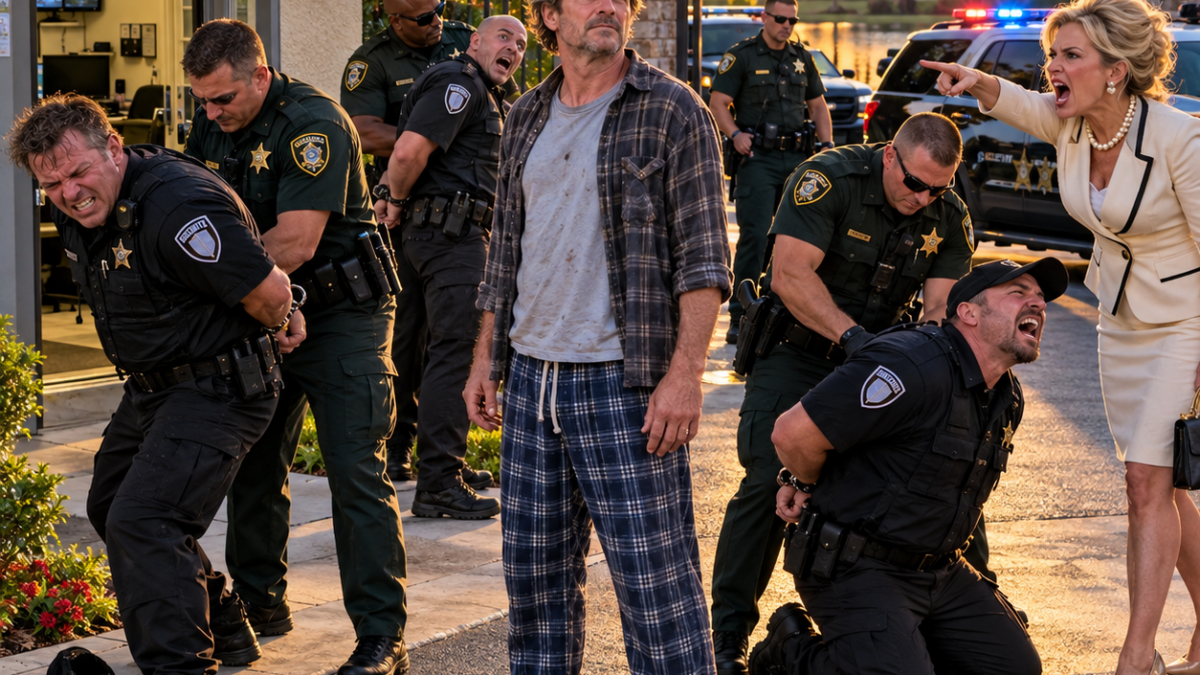
Outside, through the guardhouse glass, I could see Brock on his knees with his hands cuffed behind his back.
The man who had dragged me out of my truck would not meet my eyes.
Vanessa stood near the front desk, surrounded by deputies.
She had not been cuffed yet.
She was still trying to talk.
That was Vanessa’s final defense.
Words.
Explanations.
Reframing.
Control.
But the room behind me ruined every sentence she tried to construct.
The metal chair.
The locked door.
The clipboard.
The zip ties.
The stolen phone.
The forced agreement.
The disabled camera.
The recordings.
The dash footage.
The prior victims.
No amount of polished HOA language could turn that into community safety.
A deputy opened the wall cabinet.
Inside were plastic restraints, spare access cards, confiscated key tags, and a small tray containing personal items.
My truck keys were there.
My phone was there.
So were two other phones that did not belong to me.
Conrad’s jaw tightened when he saw them.
Elise photographed the clipboard before anyone touched it.
Seven dates.
Seven sets of initials.
Seven people who had likely been told it was easier to sign than fight.
Then deputies opened the filing room.
That was where the story became bigger than me.
Boxes lined the shelves.
One folder was labeled:
COMPLIANCE ACQUISITIONS — ROADWAY AND LAND ACCESS
Inside were records of disputes with landowners around Blackridge.
Letters threatening fines.
Proposed easement agreements.
Settlement forms.
Vehicle tow authorizations.
Internal notes.
Several files referenced people whose initials matched the holding log.
Vanessa had not improvised that room because I irritated her.
She had built a pressure system.
The goal was land.
Access.
Expansion.
Blackridge Estates wanted to develop a new luxury section beyond its current boundary.
My road rights stood in the way.
So did other property owners.
Vanessa had turned private security into a weapon for forcing signatures.
Elise found the email just after sunrise.
It was printed in a folder and later confirmed in the digital system.
From Vanessa Whitmore to Brock Hansley.
Subject: PRICE ACCESS RESOLUTION
The key sentence was only seven words.
Price leaves after we have the easement.
There was no misunderstanding left after that.
No confusion.
No overheated moment.
No security mistake.
It was written before they ever trapped my truck between those gates.
By 6:12 a.m., Conrad walked toward Vanessa.
She stood near the front desk, pale now, one hand pressed against the polished counter as if the building itself might still protect her.
“Vanessa Whitmore,” Conrad said.
Her mouth opened.
“Sheriff, this has been blown completely out of proportion.”
“Turn around.”
“You need to speak with association counsel.”
“Turn around.”
“This was an internal access matter.”
Conrad’s expression did not change.
“You detained a man overnight in a locked room.”
“He refused to cooperate.”
“You took his phone.”
“For safety.”
“His keys.”
“To prevent escalation.”
“You demanded a property signature as a condition of release.”
Her lips tightened.
“That is not accurate.”
Elise stepped beside Conrad, holding a printed copy of the email.
Vanessa saw it.
Everything in her face changed.
Not guilt.
Not remorse.
Recognition.
She knew that sentence.
She knew what it proved.
Conrad said again, “Turn around.”
This time, she did.
The metal cuffs clicked around her wrists in the same guardhouse she had built to frighten other people into obedience.
There was no dramatic speech.
No screaming confession.
No last-minute collapse.
Just a woman who had mistaken control for authority being placed under the only authority that mattered in that moment.
The law.
Outside, dawn had fully arrived.
The guards were lined along the pavement, cuffed and silent.
Brock kept his head down.
Wallace sat apart, shaking, already telling a deputy he wanted to cooperate.
Vanessa was escorted past them.
She did not look at me.
Maybe she couldn’t.
Maybe she understood that fourteen hours earlier, she had looked at my old pickup, my quiet manner, my refusal to shout, and decided I was easy prey.
She had been wrong.
But that was not the real lesson.
The real lesson was worse.
Vanessa had been wrong to believe anyone was easy prey.
Even if I had not been a civil rights investigator.
Even if I had not had a dash camera.
Even if Elise had not seen the alert.
Even if I had been a landscaper, a retiree, a delivery driver, or a scared homeowner without a lawyer’s number in my phone.
She still had no right to lock me in that room.
That was what I told her when a deputy paused near the entrance and she finally looked back.
Her face was gray.
“You never said who you were,” she whispered.
“No,” I said.
Her eyes hardened with a final scrap of pride.
“If we had known—”
“That’s the problem, Vanessa.”
She blinked.
I stepped closer, stopping a few feet away.
“You think this is wrong because of who I turned out to be.”
She said nothing.
“It was wrong before you knew my job. It was wrong when you did it to the others. It was wrong the moment you decided a private board could build a room and put people in it until they signed.”
For once, she had no answer.
The deputy guided her outside.
By then, local news vans were beginning to gather beyond the roadblock.
Neighbors from Blackridge stood on sidewalks in robes, jackets, and stunned silence.
Some filmed with their phones.
Others simply stared.
They had driven past that guardhouse every day.
They had admired it, complained about its cost, or ignored it.
Almost none of them had known there was a locked room inside.
Almost none of them had known their HOA dues had helped fund something called resident compliance detention.
That phrase would haunt Blackridge for a long time.
In the days that followed, the charges became public.
False imprisonment.
Coercion.
Conspiracy.
Tampering with evidence.
Unlawful restraint.
Related property fraud allegations tied to the forced easement scheme.
The exact legal counts shifted as prosecutors reviewed the evidence, but the heart of the case remained the same.
Vanessa and her inner circle had used private security to intimidate, detain, and pressure people into surrendering property rights.
Brock tried to blame Vanessa.
Vanessa tried to blame Brock.
Wallace cooperated and described the informal training new guards received: keep disputes inside the gate, do not involve outside authorities, and let compliance handle signatures.
That testimony opened the older cases.
Investigators contacted the people listed by initials on the holding log.
J.T. had been a contractor who refused to pay a made-up road impact fee.
M.P. was a widow who had disputed a landscaping lien.
W.R. was Wade Prater, a retired survey engineer who had fought Blackridge for two years over a boundary line Vanessa wanted moved.
D.L. had been threatened with towing and held until signing a payment plan.
Some had been too embarrassed to report what happened.
Some thought no one would believe them.
Some believed an HOA with lawyers must have had the right to do what it did.
That belief was exactly what Vanessa had exploited.
Wade Prater became one of the most important witnesses.
He was sixty-one, meticulous, and angry in the quiet way only a retired surveyor can be angry when someone abuses a boundary map.
When investigators contacted him, he produced original survey records showing Blackridge had repeatedly asserted control over land it did not own.
He had complained for years.
His complaints had vanished into the same compliance department Vanessa controlled.
With Wade’s documents, my dash footage, the holding log, the email, the recorder, and the seized files, the pattern became impossible to dismiss.
Blackridge Estates was forced into emergency governance.
The board removed Vanessa unanimously.
Security contracts were suspended.
The guardhouse was sealed and later partially dismantled.
The county reviewed every gate, barrier, and access claim tied to the association.
Most importantly for me, the records were corrected and reaffirmed.
Hawthorne Access Road remained what it had always been.
My legal access.
Not Blackridge property.
Not association-controlled.
Not subject to Vanessa’s emergency resolutions.
The steel gate came down within a week.
I watched crews remove it.
Not because I wanted a victory show.
Because I wanted to see the road open again with my own eyes.
A machine lifted the barrier that had trapped my truck.
The Blackridge sign was unbolted.
The access-card reader was disconnected.
The heavy arm dropped onto a flatbed trailer with a dull metallic thud.
I stood near the old shoulder where pine needles collected in the ditch.
Conrad was there too.
He had come to oversee the final county inspection.
“You sure you’re all right?” he asked.
“I’m all right.”
“You were in there a long time.”
“Long enough.”
He looked toward the guardhouse shell.
“You knew they’d made mistakes.”
“I knew they were making them.”
“That calm act of yours,” he said. “That real?”
I thought about the windowless room.
The scratches.
The log.
The hours of silence.
“No,” I admitted. “Not entirely.”
Conrad nodded.
“Most brave things aren’t.”
We watched the crew remove another section of fencing.
He asked, “Was the road worth it?”
I looked down Hawthorne Access Road.
Morning light lay across the pavement.
Beyond the curve were my trees, my field, my house, the fence line I had repaired the previous spring.
A road is easy to underestimate until someone takes it.
It is not just pavement.
It is access to your home.
Your work.
Your privacy.
Your right to come and go without asking permission from someone who bought a blazer and called herself president.
“Yes,” I said. “It matters more now than it did before.”
Conrad looked at me.
“How so?”
“Before, it was just my way home.”
I watched the gate arm being hauled away.
“Now it’s proof of what happens when people stop defending small rights because the fight looks inconvenient.”
He didn’t answer.
He didn’t need to.
A few days later, I had a sign installed beside the place where the barrier had lowered behind my truck.
It was simple.
PRIVATE ROAD
NO HOA AUTHORITY
LEGAL ACCESS PROTECTED
I did not put Vanessa’s name on it.
I did not mention the arrests.
I did not need to.
People who knew would know.
People who didn’t would still understand the point.
The road was open.
That was enough.
Weeks passed.
Then months.
The criminal cases moved forward slowly, as they always do.
But Blackridge changed quickly.
Residents demanded financial transparency.
The phrase “compliance holding” became radioactive.
The new board opened records Vanessa had kept hidden.
Several prior property agreements were reviewed.
Some were challenged.
A few were rescinded.
People who had once whispered complaints at mailbox clusters now spoke openly in meetings.
The culture of fear cracked.
Not all at once.
Not perfectly.
But enough.
One afternoon, I received a letter from a woman named Margaret Pell.
M.P. from the clipboard.
She wrote that two years earlier, she had been held in that same room for nearly three hours after refusing to sign a payment agreement tied to a disputed fine.
Her husband had recently died at the time.
She had been exhausted.
Scared.
Alone.
Eventually, she signed.
She wrote that when she saw the news, she cried—not because she was happy I had been locked up too, but because for the first time she realized she had not imagined the wrongness of what happened to her.
I read her letter twice.
Then a third time.
That was the part that stayed with me.
Not Brock on the pavement.
Not Vanessa in cuffs.
Not the news cameras.
Margaret’s sentence.
I realized I had not imagined it.
People like Vanessa depend on that doubt.
They build systems that make victims question themselves.
Was it really illegal?
Was I overreacting?
Should I have just signed?
Would anyone believe me?
By dawn, the answer had finally become visible.
Yes, it was real.
Yes, it was wrong.
Yes, it mattered.
And yes, someone believed it.
The last time I drove past the guardhouse, most of it was gone.
Only a concrete foundation remained.
Grass had begun growing through cracks near the edge.
The road was quiet again.
No guard.
No gate.
No cameras turning to follow me.
I slowed my truck near the spot where Brock had first stepped in front of me.
For a second, I could almost see the morning replay.
The fresh sign.
The black SUV.
Vanessa’s sunglasses.
The folder on my hood.
The steel arm lowering behind me.
I remembered the sound of that lock closing.
Then I looked at the open road ahead.
The same road my deed protected.
The same road they tried to steal with fear.
The same road I drove now without lowering my window for anyone.
I continued forward.
At the curve, I glanced in the rearview mirror.
The old gate was gone.
So was the illusion behind it.
Vanessa Whitmore had thought authority was something she could print on letterhead, bolt to a steel post, and enforce with men in tactical vests.
She thought a locked room could turn an unlawful demand into a signed agreement.
She thought silence would protect her.
She thought fear would finish the job before sunrise.
But dawn has a way of exposing what people build in the dark.
By the time the sun came over Blackridge Estates, every guard who had stood between me and my own property was in handcuffs.
Vanessa was under arrest inside the very guardhouse she had built to control others.
The road was reopened.
The files were seized.
The prior victims were finally being heard.
And I drove home on Hawthorne Access Road without asking one person for permission.
Because the truth had been simple from the beginning.
The HOA never owned that road.
They never owned my rights.
And no private association, no matter how expensive its gate or how polished its president, gets to build a prison and call it community rules.
[EXPANDED FULL STORY CONTINUATION — ADDITIONAL 3000 WORDS]
The moment Sheriff Conrad Bell’s deputies opened the cabinet inside that windowless room, the entire atmosphere in the guardhouse changed.
Until then, Vanessa Whitmore had still been trying to talk.
That was her gift.
Her weapon, really.
She could take any fact and wrap it in polished language until it sounded less like wrongdoing and more like procedure. A locked door became a safety measure. A stolen phone became temporary custody of personal property. A forced signature became dispute resolution. A private cell became a compliance room.
But when those zip ties came out of the cabinet, followed by my phone, my keys, two other phones, and the clipboard with old detention initials, words stopped helping her.
A deputy lifted the plastic restraints with gloved fingers.
Sheriff Bell stared at them for a long second.
Then he looked toward the hallway where Vanessa stood between two officers, her white blazer wrinkled now, her face pale beneath the fluorescent lights.
“Mrs. Whitmore,” he said, “why are there restraint ties in a private HOA guardhouse?”
Vanessa did not answer.
Not immediately.
Her lips moved once, but nothing came out.
Brock Hansley, still cuffed outside on the pavement, shouted through the open door, “Those are standard security supplies!”
Conrad turned his head slightly.
“For what?”
Brock’s mouth shut.
That was the first time I saw real fear settle into him.
Not irritation. Not anger. Fear.
Because the question was simple, and there was no clean answer.
Private HOA guards did not need restraint ties to manage landscaping complaints, parking disputes, road-access arguments, or mailbox violations. They did not need a locked windowless room. They did not need a holding log. They did not need a system for confiscating phones and keys.
They needed those things only if they had already decided they were allowed to hold people.
And they were not.
Elise Marlow stepped carefully into the room where I had spent the night and began photographing everything.
The chair bolted to the floor.
The scratches near the wall.
The camera in the corner, now dark.
The clipboard.
The cabinet.
The floor.
The door lock.
Every detail mattered.
I stood outside the room with my jacket still on, feeling the recorder press lightly against my ribs. It had become warm from running all night.
Elise noticed my hand near it.
“Still have it?” she asked.
I nodded.
“Good,” she said quietly. “Do not stop it yet.”
So I didn’t.
The recorder kept running while deputies moved through the guardhouse with search authority, opening drawers, photographing files, bagging drives, and collecting the physical evidence Vanessa had ordered her people to destroy.
One deputy came out of the rear office holding a stack of clipboards.
Another carried a hard drive.
Another had a plastic evidence bag filled with access cards.
Then a younger deputy stepped into the hallway with a folder in his hand and an expression that made Conrad walk toward him immediately.
“What is it?” the sheriff asked.
The deputy turned the folder around.
The label read:
COMPLIANCE ACQUISITIONS — ROADWAY AND LAND ACCESS
Conrad looked at Elise.
Elise’s jaw tightened.
I knew that look.
She had found the spine of the whole operation.
Not a random detention.
Not one bad guard.
Not one HOA president losing her temper.
A system.
Vanessa saw the folder too.
For the first time since the deputies entered, her composure cracked badly enough that everyone noticed.
“That file contains privileged association material,” she said.
Conrad did not even look back at her.
“Bag it.”
“Sheriff, you are exceeding—”
“Bag it,” he repeated.
The deputy placed the folder in an evidence bag.
Vanessa’s breathing changed.
Shorter. Sharper.
Brock had been the muscle. The guards had been the wall. The gate had been the symbol.
But those files were Vanessa’s brain on paper.
And she knew it.
Inside that folder were letters to property owners outside Blackridge. Draft easement agreements. Internal notes ranking which owners were “resistant,” “vulnerable,” or “likely to settle under pressure.” There were spreadsheets listing potential access routes for a luxury expansion project Blackridge had not yet publicly announced. There were legal threat templates. There were fee schedules that appeared to have been invented not to recover actual costs, but to frighten people with numbers large enough to make surrender look cheaper than resistance.
And then there was my name.
PRICE — HAWTHORNE ACCESS CRITICAL.
Critical.
I stared at that word when Elise later showed me a copy.
Not important.
Not pending.
Critical.
My land and my road rights were not an inconvenience to Vanessa.
They were an obstacle.
Blackridge wanted to push a high-end expansion beyond its existing boundary, a private enclave of luxury homes tucked into the hills past my property. Hawthorne Access Road was the cleanest route. Without control of that road, their expansion became slower, more expensive, and legally fragile.
So they had decided to take control.
Not by buying it.
Not by negotiating honestly.
By pressure.
By fines.
By fear.
By locking people in a room until the paper got signed.
I looked across the guardhouse toward Vanessa.
She still would not look at me.
That told me everything.
Conrad walked back into the main lobby where she stood.
“Mrs. Whitmore,” he said, “you are going to hear these rights clearly.”
Her chin lifted.
“I want my attorney.”
“You will have that opportunity.”
“This is a civil matter.”
“No,” Conrad said. “It stopped being a civil matter when you locked a man in a room overnight and made his release conditional on signing away property rights.”
Vanessa swallowed.
“That is your interpretation.”
Elise stepped forward then.
“No. That is your email.”
The room became still.
Elise held up a printed page sealed in an evidence sleeve.
Vanessa’s eyes moved to it.
I saw the exact moment she recognized it.
PRICE LEAVES AFTER WE HAVE THE EASEMENT.
Seven words.
Seven words that stripped away every excuse.
There was no misunderstanding in that sentence. No emergency safety concern. No confusion over who controlled the road. No temporary hold while tempers cooled.
Price leaves after we have the easement.
I had spent nearly twelve hours inside that room because Vanessa Whitmore wanted my signature, and she had written the motive herself.
Conrad turned her around.
The cuffs closed around her wrists.
No one cheered.
That surprised me, though I don’t know why.
Maybe a part of me expected some cinematic release. Some burst of satisfaction. Some clean emotional victory after a night of being locked away.
But when Vanessa was cuffed, the feeling was not triumph.
It was gravity.
A heavy, sobering recognition of how far she had gone and how many people had let her go that far.
She was walked past me in silence.
At the door, she stopped just long enough to turn her head.
Her eyes were wet now, but not with remorse.
With disbelief.
“You should have told me who you were,” she whispered.
That sentence stayed with me longer than the threats.
Because in her mind, that was still the mistake.
Not the room.
Not the lock.
Not the stolen phone.
Not the forced agreement.
Not the others before me.
Her mistake, as she saw it, was choosing the wrong person to abuse.
I stepped closer, keeping my voice low.
“Vanessa, the law was the same before you knew my job.”
She stared at me.
“If I had been a landscaper, a widower, a retiree, or a single mother trying to get home, you still would have had no right to do this.”
Her face hardened, because people like Vanessa hate being denied the comfort of a technical excuse.
A deputy guided her outside.
The morning sun had just cleared the trees.
On the pavement beyond the broken gate, every guard involved in blocking the road was cuffed or being questioned. Brock sat apart from the others, his tactical vest removed, his shaved head bowed.
Wallace, the young guard who had asked whether they had authority to hold me, was speaking quickly to a deputy.
He kept looking toward me, shame written across his face.
I did not hate him.
That surprised me too.
I hated what he had helped do. I hated his silence. I hated that he had stood outside the door while I was locked inside.
But I also knew the look of someone who had joined a machine before understanding what it was built to do.
That did not erase responsibility.
It did explain why he was the first to cooperate.
And his cooperation mattered.
Within hours, he told investigators about the informal instructions Brock gave new guards. Do not call the sheriff unless Vanessa approves it. Keep access disputes inside the gate. Bring resistant owners to the compliance room. Let the paperwork team handle signatures. Never describe it as detention in writing.
Except they had described it in writing.
That was the arrogance of the whole operation.
They had become so accustomed to control that they stopped being careful.
By noon, Blackridge residents were gathered in clusters near the entrance, watching deputies carry boxes from the guardhouse.
Some looked angry.
Some frightened.
Some embarrassed.
A few would not meet my eyes.
One older man approached slowly while I stood beside my truck, now released from between the barriers.
“Mr. Price?”
I turned.
He held a baseball cap in both hands.
“My name is Daniel Kerr. I live on Briar Court.”
I nodded.
“I know this is probably not the time,” he said, “but my wife and I saw them take you in yesterday.”
I looked at him.
He swallowed.
“We thought you must have done something.”
The sentence was honest enough to hurt.
“You watched?”
He lowered his eyes.
“From our porch.”
“And you didn’t call anyone?”
His face flushed.
“No.”
I waited.
He gripped the cap tighter.
“Vanessa told everyone the guardhouse was part of the new safety plan. She said outsiders had been threatening the community. She said if security brought someone inside, it meant there was a serious reason.”
I looked toward the building.
“And you believed her.”
He nodded slowly.
“I did.”
His voice cracked.
“I’m sorry.”
For a moment, I said nothing.
Because apology is easy when the handcuffs are already out and the danger has passed.
But I could also see that Daniel Kerr was not trying to save face. He looked genuinely shaken.
So I said, “Next time, don’t assume a locked door is justified because the person holding the key sounds official.”
He nodded.
“Yes, sir.”
Then he walked away.
I leaned against my truck and felt exhaustion finally begin to settle into my bones.
The adrenaline was fading.
My hands shook slightly when I picked up my keys.
Elise noticed.
“You need to sit down.”
“I’ve been sitting all night.”
“Not like this.”
She guided me to the back of an ambulance that had arrived as a precaution.
A medic checked my blood pressure, asked about injuries, asked whether I had been given food or water, asked whether I had lost consciousness.
I answered mechanically.
No major injuries.
No loss of consciousness.
Little water.
No food.
No phone call.
No lawful release.
No consent.
When the medic stepped away, Elise sat beside me.
“You did everything right,” she said.
I looked at the guardhouse.
“That doesn’t make it feel right.”
“No.”
“I kept thinking about the clipboard.”
She nodded.
“We’ll find them.”
“They were in that room before me.”
“We’ll find them,” she repeated.
Her voice made it a promise.
In the following days, that promise became real.
Investigators contacted every set of initials on the holding log. Some matched quickly through internal files. Others took time. A few people did not want to talk at first.
I understood why.
There is a special shame that comes from being bullied into signing something. Even when you are the victim, some part of your mind keeps asking why you didn’t fight harder.
Vanessa had counted on that shame.
Margaret Pell was one of the first to give a full statement.
She was a widow in her late sixties who lived alone near Blackridge but outside the HOA boundary. Vanessa’s compliance office had accused her of using an association-maintained drainage lane and demanded a retroactive access fee. Margaret disputed it. Security escorted her to the guardhouse “to speak privately.”
They kept her there almost three hours.
No phone.
No family.
No lawyer.
She signed a payment plan because she was scared and wanted to go home.
When she told investigators the story, she cried so hard they had to pause the interview.
Wade Prater was different.
He arrived with boxes.
A retired survey engineer, Wade had been fighting Blackridge for almost two years over a boundary claim Vanessa used to support her future expansion plan. He had maps, measurements, historical records, and letters he had sent to the county that somehow never turned into action.
“They treated me like a crank,” he told me later. “Old man yelling about survey pins.”
He gave a tired smile.
“Turns out the pins were right.”
His records helped show that Blackridge had been pushing beyond its legal reach long before I reached that gate.
The story spread.
Local news called it the Blackridge Guardhouse Scandal.
I hated that phrase.
It sounded too neat.
Too packaged.
Scandal made it sound like gossip.
This was not gossip.
This was a private organization building an unofficial jail and using it to pressure property owners.
At an emergency meeting one week later, the Blackridge board removed Vanessa from every role connected to the HOA.
They suspended the security contract.
They voted to cooperate with the investigation.
They promised an independent review of all access agreements signed under Vanessa’s presidency.
That meeting was packed.
I did not speak at first.
I sat near the back, the same way I had sat in courtrooms, hearings, and public meetings for years.
Residents argued. Some cried. Some insisted they had known nothing. Others demanded to know how dues had been used to build a detention room without disclosure.
Then Margaret Pell stood.
The room quieted.
She held a folded paper in both hands.
“I signed because I was afraid,” she said.
Her voice trembled, but she did not sit down.
“I paid money I did not owe because I thought nobody would believe me.”
No one interrupted her.
She turned toward the board.
“You let her become bigger than the rules.”
That sentence broke something open.
After Margaret, others spoke.
A contractor.
A delivery company owner.
A resident who had been threatened with towing.
Wade Prater.
One by one, the private humiliations became public facts.
That was the moment Blackridge changed.
Not when Vanessa was arrested.
Not when the gate came down.
When people stopped whispering and started naming what had happened.
When it was my turn, I stood slowly.
I did not bring drama.
The room already had enough.
“I am not here to punish residents for what Vanessa did,” I said. “I am not here to take your homes, block your roads, or turn this into a war between neighbors.”
People listened.
“But every person in this room needs to understand something. An HOA is not a government. A private security guard is not a sheriff. A board resolution is not a deed. And a locked room does not become legal because someone calls it compliance.”
A woman in the front row wiped her eyes.
I continued.
“Blackridge tried to take control of Hawthorne Access Road because it wanted expansion power. That road is my lawful access. It always was. It remains so now.”
I looked at the board.
“I will cooperate with lawful corrections. I will not cooperate with intimidation disguised as procedure.”
No one clapped.
I was glad.
It was not a clapping moment.
It was a moment for remembering.
Two weeks later, the steel gate was removed completely.
I went to watch.
Sheriff Bell stood with me as workers unbolted the last section.
The road looked strangely naked without the barrier.
Open.
Normal.
Like nothing had happened.
But of course something had happened.
A place can be changed by what people tried to do there.
Even after the gate was gone, I could still see it.
The black steel arm lowering behind my truck.
Brock’s hand reaching for my phone.
Vanessa holding the folder.
The room.
The lock.
The clock on the wall.
“Road looks better this way,” Conrad said.
“Yes,” I replied.
“Going to put up a sign?”
“I already ordered one.”
“What’s it say?”
“Private road. No HOA authority. Legal access protected.”
He smiled slightly.
“Plain enough.”
“I’ve learned plain language saves time.”
The sign went up three days later.
Not large.
Not angry.
Just clear.
Every time I passed it, I felt something in my chest loosen.
The criminal cases would take time. Lawyers would argue. Hearings would be scheduled. Vanessa would have her defense. Brock would have his. The board would try to repair its reputation. Residents would debate refunds, reforms, and responsibility.
But the road was open.
That mattered.
One evening, months after the arrest, I drove home along Hawthorne Access Road just before sunset.
The sky was orange behind the pines.
My truck rolled over the same stretch of pavement where I had been trapped between two gates.
No guard stepped out.
No barrier lowered.
No one asked for my name.
I slowed beside the concrete scar where the guardhouse used to stand.
Most of it had been dismantled. Grass had begun growing around the broken edges.
For a moment, I imagined the room still there.
The chair.
The scratches.
The dark camera.
Then I looked ahead.
My land waited beyond the curve.
Quiet.
Untouched.
Still mine.
I drove on.
At my driveway, I stopped and looked back once.
Vanessa had believed power was something you could build out of steel, cameras, uniforms, and fear.
She had believed people would surrender if you isolated them long enough.
She had believed a signature taken under pressure could erase the truth beneath it.
But by sunrise, the truth had walked straight through her gate with a warrant in its hand.
The guards were cuffed.
The files were seized.
The road was reopened.
The victims were heard.
And the room she built to silence people became the evidence that finally exposed her.
I never forgot the sound of that lock closing behind me.
But I remember another sound more clearly now.
The sound of the steel gate being cut open at dawn.
Because that was the sound of fear losing its authority.
And when I drove home that evening, past the new sign and onto the road they had tried to steal, I understood something my father once told me after a long fence dispute with a neighbor.
“Rights don’t defend themselves, Gideon. People do.”
He was right.
That road had always been mine by deed.
But after that night, it became mine by defense too.
And no HOA president, no private guard, no fake resolution, and no locked room would ever make me ask permission to go home again.
[END]








