PART 2: HOA Gave Me Four Days to Scrap My Grandfather’s Rusted Gas Pump—Then an Appraiser Found a Mark They’d Never Bothered to See
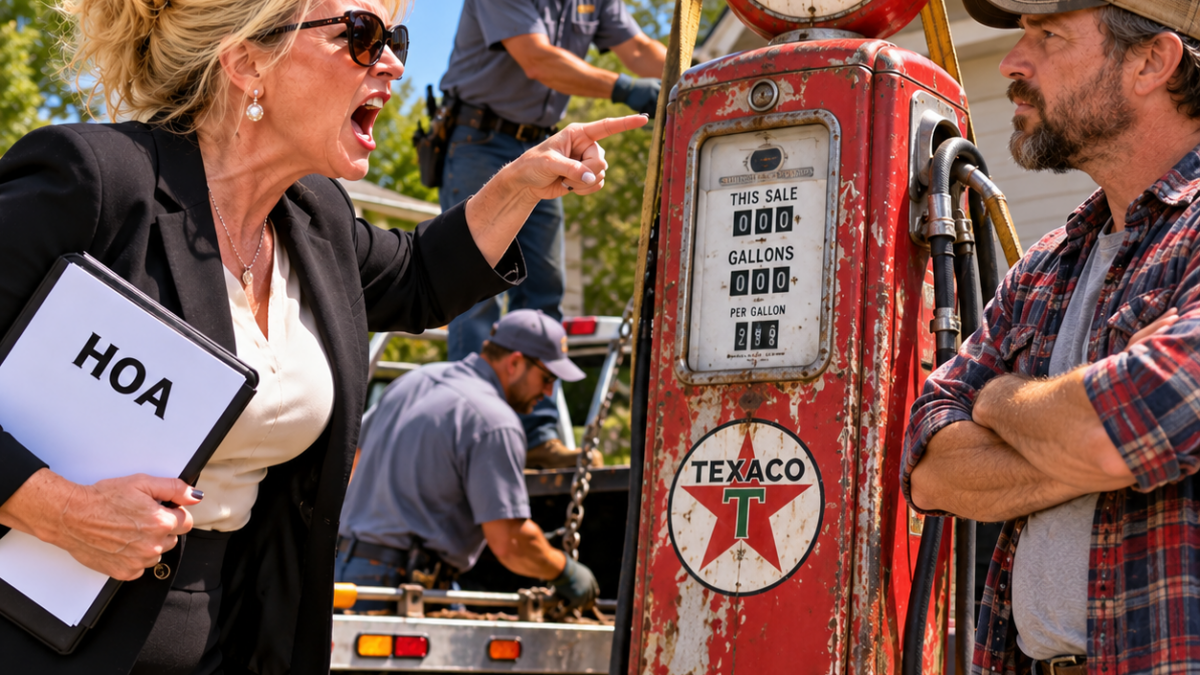
PART 2
The brass identification plate sat low on the side of the housing, half hidden beneath oxidation and old paint.
WAYNE COMPANY
FORT WAYNE, INDIANA
MODEL 60
I leaned closer to the screen.
Then I looked through the kitchen window at the pump.
Back to the screen.
Back to the pump.
I had seen that little plate hundreds of times as a kid without ever wondering what it meant.
Now search results filled my laptop with photographs of beautifully restored gas pumps that looked startlingly similar to the rusting machine outside.
Some were bright red.
Some green.
Some yellow.
All had the same tall Art Deco body and distinctive clock-face display.
I kept reading.
The term collectors used was petroliana—old service-station signs, pumps, globes, oil cans, advertising displays, and other pieces of early American roadside history.
Apparently, people took it very seriously.
One restored Wayne Model 60 had sold for more money than I expected.
Another had sold for less.
Condition mattered.
Original parts mattered.
Branding mattered.
Production details mattered.
Provenance mattered.
My pump looked rough enough that I refused to get excited.
Internet asking prices were not appraisals.
Still, the discovery changed my thinking.
Karen had called it scrap without knowing what it was.
The HOA had threatened to remove it without asking what it was.
And, if the online collector forums were even partly accurate, sending it to a scrapyard might destroy considerably more value than Karen imagined.
I printed my formal HOA response anyway.
The next morning, I mailed it certified with return receipt requested and sent a duplicate by email.
Then I went outside with a camera.
I photographed every surface of the pump.
The dent.
The clock face.
The nozzle bracket.
The base.
The brass manufacturer plate.
A smaller round tag I had never paid attention to.
I got on my knees with a soft cloth and carefully cleaned the tag.
Numbers slowly emerged.
I took more photographs.
By noon, I had found the name of an appraiser in Dallas named Arthur Vance.
Every serious collector forum I checked seemed to mention him.
Some people praised him.
Some complained that he was blunt.
One post described him as “the man you call when you want the truth instead of the price you hoped for.”
That sounded perfect.
I emailed him photographs without mentioning the HOA.
I told him I had inherited a vintage gasoline pump and wanted a formal valuation for insurance and estate purposes.
His response came two days later.
**Looks promising. Rough, but unusually complete from the photos. On-site appraisal is $500 plus travel.**
I stared at the number.
Five hundred dollars was not nothing.
My grandfather would have called spending five hundred dollars to have somebody look at an old gas pump proof that I had lost my mind.
But Karen had threatened to remove it.
I needed more than guesses.
I wrote back.
**Schedule me.**
Arthur could come Tuesday.
The HOA answered first.
A white envelope appeared in my mailbox the following Monday.
Official letterhead.
No individual signature except a printed name beneath the architectural committee title.
I opened it at the kitchen counter.
They acknowledged my appeal.
Then dismissed nearly every point.
The letter claimed the thirty-day provision did not prevent fines from accruing while the alleged violation remained unresolved.
It did not explain how the pump qualified as a newly installed structure.
It did not address the fact that it predated the subdivision.
It did not provide the requested board minutes.
Instead, attached to the letter was a photocopy of Section 7 with the word **STRUCTURES** circled in black marker.
My original $100 fine was now $200.
The last sentence read:
**The committee’s determination remains final. The object must be removed.**
I put the letter down.
For a few seconds, I felt the old temptation to solve the matter the simple way.
Walk across the neighborhood.
Knock on Karen’s door.
Ask her how exactly she thought a pump installed before her house existed had become an unauthorized addition.
But I knew myself well enough to stay home.
My biggest mistake so far had been ignoring the first two notices.
I had assumed common sense would eventually enter the process.
Common sense had not been invited.
So I started a file.
Every letter.
Every envelope.
Every date.
Photographs.
Certified-mail receipts.
Screenshots of emails.
I created a timeline.
The military had taught me something that civilian life kept confirming: when a dispute becomes serious, memory is weak and documentation is strong.
Tuesday morning, a dusty Ford F-150 turned into my driveway.
Arthur Vance climbed out.
He was probably in his late sixties, thin, sun-browned, with white hair and a work shirt that looked older than some of my Air Force lieutenants.
I walked toward him.
“Mr. Vance?”
He glanced at me, then at the pump.
“Jack Riley?”
“Yes.”
He pointed at the pump.
“That it?”
“Yes.”
He walked past me.
No handshake.
No small talk.
For the next hour, Arthur barely spoke.
He opened access panels.
Used a flashlight.
Slid a small inspection mirror into the pump body.
Tested the clock mechanism gently.
Examined screws.
Scraped an area on the back no larger than a fingernail.
Layers of paint appeared.
He photographed markings I had never seen.
At one point, he crouched beside the small brass tag and stayed there so long that I finally asked, “Something wrong?”
“No.”
He kept looking.
“That’s usually good,” I said.
Arthur grunted.
“That depends.”
I went back to the porch.
My nerves surprised me.
I had dealt with aircraft stuck overseas, shipments worth millions delayed at foreign customs posts, senior officers demanding impossible timelines, and contractors who promised equipment that did not exist.
Yet I found myself watching an old man inspect my grandfather’s gas pump like I was waiting for medical test results.
Finally, Arthur stood.
He wiped his hands on a rag.
“Well.”
I walked closer.
“What?”
“Your grandfather didn’t gut it.”
“I don’t know what that means.”
“Most old pumps that survived got stripped. Motors removed. Computing assemblies removed. Brass fittings scavenged. People wanted parts or scrap.”
He tapped the housing.
“This one is remarkably complete.”
“Good?”
“Very.”
He showed me the paint layers.
“Original Texaco red underneath. Later repainting on top. Common for a working station that changed branding or refreshed equipment.”
Then he pointed toward the small round tag.
“This is what interests me.”
“The tag?”
“First production group.”
I looked at him.
“How rare?”
Arthur took off his glasses and cleaned them.
“You asking what it’s worth?”
“That would be the reason I paid you five hundred dollars.”
For the first time, he smiled.
“Fair enough.”
He walked to his truck and retrieved a clipboard.
“In this condition, if this were an ordinary complete Model 60, I’d probably put it somewhere around fifteen to twenty thousand to the right buyer, depending on how the market is behaving.”
I laughed once because I genuinely thought I had misheard.
“Fifteen thousand?”
“At least.”
“For that?”
Arthur looked offended.
“For that? Son, half the country would have thrown that machine away forty years ago. That is exactly why good survivors matter.”
I stared at the pump.
Karen’s phrase came back to me.
**Rusty piece of trash.**
Arthur continued.
“But yours has another factor.”
“The tag.”
“The tag. Early production. Mechanically complete. Provenance tied to one property for decades. If you can document your grandfather’s station history, even better.”
He clicked his pen.
“For insurance purposes, I’m comfortable certifying an appraised value of forty-five thousand dollars.”
I stopped breathing for a second.
“Forty-five?”
“Thousand.”
“My truck didn’t cost that.”
“Then don’t trade it for your truck.”
I looked from Arthur to the pump.
My grandfather had leaned against a $45,000 collectible while drinking coffee from a chipped thermos.
He had probably used it as a place to hang oily rags.
“Are you sure?”
Arthur gave me a look.
“You hired me because I’m sure.”
He began filling out paperwork.
I walked slowly around the pump.
The rust had not changed.
The missing globe had not reappeared.
The dent was still there.
Yet the object looked different because I knew something I had not known an hour earlier.
Karen had threatened to send forty-five thousand dollars of my property to a scrapyard.
More importantly, she had threatened the one tangible piece of my grandfather’s working life that remained.
Arthur handed me a receipt.
“I’ll email the formal appraisal tomorrow.”
“Would you stand behind it?”
He raised an eyebrow.
“In what sense?”
“If somebody disputed the valuation.”
“You mean in court?”
“Possibly.”
He looked toward the houses surrounding us.
“HOA?”
I stared at him.
“How’d you know?”
Arthur laughed.
“Because nobody gets an emergency appraisal on a rusty gas pump unless there’s an insurer, an estate fight, a divorce, or an HOA involved.”
“It’s the HOA.”
“Of course it is.”
He shook his head.
“What do they want?”
“It gone.”
“Why?”
“Ugly.”
Arthur looked at the pump, then at the nearly identical beige houses.
“I suppose beauty is complicated.”
“Karen says she’ll have it hauled away herself.”
Arthur’s amusement disappeared.
“Does she know what it’s worth?”
“She will.”
He tucked his clipboard under one arm.
“Put the appraisal in writing to the whole board. Not just her.”
“That was my plan.”
“And if they’re stupid enough to touch it after that, call your lawyer before you call me.”
I held out my hand.
This time he shook it.
“Arthur?”
“Yeah?”
“If this becomes a case, would you testify?”
His grin came back.
“Against somebody who wants to scrap a first-run Wayne 60?”
He opened his truck door.
“Try keeping me away.”
The appraisal arrived the next afternoon.
Forty-five thousand dollars.
Signed.
Detailed.
Photographed.
The report identified the pump as a 1932 Wayne Model 60 from an early production run, noted the intact internal components and surviving original features, and explained how those characteristics affected collector value.
I printed three copies.
One went into my file.
One went into a fireproof box.
The third sat on my kitchen table while I considered my next step.
My instinct was to send Karen a short message.
**Still think it’s junk?**
I even typed it.
Then deleted it.
That would feel good for thirty seconds and accomplish nothing.
Instead, I walked next door.
David Garcia was mowing his yard.
I had met him only briefly.
He was around forty, with two boys who spent half their lives bouncing a basketball in the driveway.
Except lately I had noticed the hoop disappearing into the garage every evening.
I carried him a cold bottle of water.
“Figured you could use this.”
He shut off the mower.
“Man, thank you.”
“Jack Riley.”
“David Garcia. You’re Thomas Riley’s grandson.”
“You knew him?”
“Everybody knew him.”
That sentence surprised me.
David was too young to have bought gasoline from my grandfather for long, but Thomas Riley’s name had apparently survived better than I realized.
We talked for a few minutes.
Then I nodded toward the garage.
“You guys move that basketball hoop every night?”
David gave me a strange look.
“How’d you know?”
“I see it out during the afternoon and gone after dinner.”
He laughed without humor.
“Karen.”
“What about her?”
“She fined us because we left it out overnight.”
“The portable hoop?”
“Apparently it becomes a permanent structure after sunset.”
He lowered his voice.
“Three notices. One fine. My wife finally said just move the stupid thing because she couldn’t sleep every time an HOA envelope showed up.”
I understood that more than I wanted to.
“She’s after my grandfather’s pump.”
David stopped smiling.
“What?”
“She wants it removed.”
“That thing’s been there forever.”
“That’s what I said.”
“What did she say?”
“That it’s junk.”
David looked toward my yard.
“My dad used to point that pump out when we drove past here. Said your grandfather would patch a tire for anybody even if they couldn’t pay.”
I swallowed.
“He did that a lot.”
“Karen wants to throw it away?”
“Yes.”
David shook his head.
Then he glanced down the street.
“She threatened a guy near Chestnut with a lien over his mailbox.”
“A lien?”
“Wrong black paint.”
I thought he was joking.
He was not.
David wiped sweat from his forehead.
“Everybody complains about her privately, but nobody wants to be next.”
“What if everyone stopped being private?”
He looked at me.
“Jack, I have two kids and a mortgage.”
“So do most people here.”
“Exactly. That’s why she wins.”
I could not argue with that.
Being right did not make fighting free.
I told him I understood and left my phone number.
Then I walked to Mrs. Gable’s house.
Eleanor Gable was in her seventies and had lived there long enough to remember when Oakmont Meadows was pasture.
She was tending rose bushes along her front walk.
Yellow, pink, white, deep red.
“Thomas Riley’s grandson,” she called before I reached her.
“That obvious?”
“You have his walk.”
I smiled.
“I’m not sure that’s a compliment.”
“It is.”
We talked about my grandfather.
Unlike David, Mrs. Gable had known him well.
Her late husband, Charles, had bought gas at the station for decades.
“When our first child was born, Charlie’s car refused to start at the hospital,” she said. “Your grandfather drove out at eleven at night and fixed it in the parking lot.”
“That sounds like him.”
“He wouldn’t take money.”
“That also sounds like him.”
She clipped a dead flower.
“So, what is Karen bothering you about?”
I laughed.
“You know already?”
“That woman doesn’t visit people to bring pie.”
I told her.
Mrs. Gable stopped clipping.
“She called Thomas’s pump junk?”
“Yes.”
“Oh, I’d like five minutes with her.”
“I’m trying to keep this nonviolent.”
“So am I.”
Her eyes narrowed.
“I’m talking about words.”
Then she told me about the roses.
Karen had decided the neighborhood needed a more unified landscaping palette.
Yellow roses were apparently too visually disruptive.
Mrs. Gable had received multiple notices.
“What did you do?”
She smiled.
“Planted two more.”
I laughed.
“But she fined me,” she said. “My son paid it without telling me. Said he didn’t want me stressed.”
Her smile disappeared.
“That angered me more than the fine. I spent fifty years building a home with my husband, and now my son thinks an association president can frighten me into changing it.”
“Would you tell other people that?”
“Gladly.”
“Publicly?”
She looked toward the pump.
“For Thomas?”
Then back at me.
“For all of us.”
“Yes.”
That night, I created a private neighborhood messaging group.
I called it Oakmont Neighborhood Alliance.
The name felt grandiose when there were only three members.
Within a week, there were fifteen.
The stories came quickly.
A garden hose left visible.
A welcome mat Karen classified as an unapproved sign because it had words on it.
Driveway stains.
A portable basketball hoop.
Flower-bed bricks half an inch too high.
Holiday decorations displayed one day beyond the approved date.
The mailbox David had mentioned belonged to a quiet accountant named Mark Peterson.
He sent photographs.
His original mailbox was black.
The replacement was black.
Karen had insisted the sheen was wrong.
Mark had sanded and repainted a brand-new mailbox rather than risk escalating fines.
His message in the group chat was simple.
**I know it sounds stupid, but it made me feel like I wasn’t allowed to own my own house.**
That sentence stayed with me.
Because that was the real problem.
None of these individual rules mattered enough to start a revolution.
That was why the system worked.
Five dollars here.
A hundred dollars there.
Move the hoop.
Change the mat.
Paint the mailbox.
Dig up the bricks.
Remove the yellow flowers.
Each demand was just small enough that resisting seemed more exhausting than obeying.
I had spent my career studying logistics.
Karen had created a logistics system for submission.
Make resistance expensive.
Make compliance easy.
Keep everyone isolated.
The pump disrupted that system because Karen chose the wrong object.
It was too old.
Too personal.
And now too valuable.
I needed a lawyer.
Fortunately, I already knew one.
Ben Carter had served in the Air Force JAG Corps while I was on active duty.
We had worked on several contracting disputes together overseas.
He had left the service before I did and now practiced property and contract law.
I called him.
He answered on the third ring.
“Jack Riley. Either you’re finally buying me dinner or someone has made a catastrophic mistake.”
“The second one.”
“That’s usually more interesting.”
“I have an HOA problem.”
Silence.
Then he said, “My condolences.”
I explained everything.
The pump.
Karen.
The four-day deadline.
The thirty-day appeal language.
The fines.
The $45,000 appraisal.
Ben interrupted for the first time.
“Back up.”
“What?”
“How much?”
“Forty-five thousand.”
“You have that in writing?”
“Certified appraisal.”
“And she threatened to have it removed?”
“Yes.”
“Before or after you told her it had value?”
“Before. She doesn’t know yet.”
Ben made a sound halfway between a laugh and a groan.
“Jack, do not communicate with her casually anymore.”
“I haven’t.”
“Good.”
“Am I actually protected here?”
“Maybe.”
That answer grounded me.
“Maybe?”
“HOA law is state-specific. Covenants matter. Property history matters. How and when the property became subject to the association matters. The exact status of that pump matters. Don’t assume ‘it was there first’ automatically means you win.”
I appreciated him immediately for not telling me what I wanted to hear.
“But,” he continued, “the board has procedural obligations under its own documents, and the threat to physically take or destroy valuable property creates a separate risk for them.”
“So what do we do?”
“We make them slow down.”
“How?”
“Paper.”
I smiled.
“I knew I called the right man.”
Ben asked me to send everything.
I scanned the HOA documents, correspondence, appraisal, property records, and my timeline.
He called the next evening.
“First thing: Karen’s four-day threat was reckless.”
“Agreed.”
“The thirty-day appeal language gives us a clean procedural objection.”
“What about the pump being grandfathered?”
“Don’t use that word like it’s magic.”
“Fair.”
“We can argue the object predates the HOA and that decades of non-enforcement matter. Depending on the facts, waiver, laches, estoppel, or related equitable arguments may help. But I’m not promising a judge accepts any of them.”
“Understood.”
“The strongest immediate point is simpler.”
“The appraisal?”
“The board now has notice that they are dealing with a documented $45,000 asset. If they send a tow company to destroy it after receiving that notice, they’re taking a very different risk.”
I leaned back in my chair.
“I want the letter addressed to every board member.”
“Already planning that.”
“Why?”
“So Karen cannot filter the information.”
That turned out to matter more than either of us knew.
Ben drafted a three-page letter.
Professional.
Measured.
Unpleasant in exactly the right places.
It disputed the fines and enforcement procedure.
It noted the pump’s documented presence predating the HOA.
It reserved every legal argument we might later make regarding prolonged non-enforcement and reliance.
Then it introduced the appraisal.
**The property at issue is not scrap, refuse, or ordinary yard clutter. It is a documented 1932 Wayne Model 60 gasoline pump with a certified current appraised value of $45,000.**
The next paragraph stated that any unauthorized attempt to remove, damage, dispose of, or destroy the pump would expose the responsible parties to substantial civil liability and could result in further legal action.
Ben did not make cartoonish threats.
He did something more effective.
He named possibilities.
Property damage.
Conversion.
Injunctive relief.
Fees where recoverable.
Claims against the association.
Potential claims against individuals depending on conduct and applicable protections.
Every board member received the same letter.
Karen Miller.
George Whitaker.
Susan Bell.
Ron Hayes.
Margaret Flynn.
Certified mail.
Email.
Delivery confirmation.
Ben gave them fifteen business days to rescind the fines, suspend enforcement, recognize the dispute formally, and confirm that nobody would touch the pump while the matter was being reviewed.
I carried a copy to Mrs. Gable.
She read it at her dining table.
When she reached the appraisal figure, she looked up.
“Forty-five thousand dollars?”
“That’s what Arthur says.”
She laughed.
Then covered her mouth.
“Oh, Thomas.”
“What?”
“Your grandfather used to leave his coffee on top of that thing.”
“I know.”
“He once tied Charlie’s dog to it.”
I laughed too.
She looked at the letter again.
“This is beautiful.”
“Ben wrote it.”
“It’s polite.”
“He does that.”
“It’s also terrifying.”
“He does that too.”
She tapped the paper.
“Poetry with teeth.”
That evening, I sent a sanitized version to the neighborhood group.
Responses came immediately.
David:
**I almost feel sorry for Karen.**
Then thirty seconds later:
**Nope. False alarm.**
Mark:
**Please tell me she signed for it personally.**
She had.
For several days, Oakmont Meadows was quiet.
No letters.
No fines.
No visits.
I began to wonder whether the matter might end sensibly.
Then a bright pink flyer appeared on my front door.
**SPECIAL COMMUNITY MEETING**
**PROTECT OUR PROPERTY VALUES**
Below that:
**Agenda: Ongoing flagrant violation of community standards at Lot 7, 121 Oakmont Drive, and consideration of decisive enforcement action.**
My address.
Printed for the entire subdivision.
I stood on the porch reading it twice.
Then my phone began buzzing.
The group chat exploded.
David called first.
“She put your address on every door?”
“Yes.”
“What the hell is wrong with her?”
“She thinks this is a campaign.”
“A campaign against you.”
“Yes.”
Ben called ten minutes later.
I emailed him the flyer.
He laughed.
Not because it was funny.
Because Karen had just done something strategically useful.
“She’s calling a public meeting after receiving our letter?”
“Yes.”
“And the agenda is your alleged violation?”
“Yes.”
“Perfect.”
“That’s not the word I was using.”
“Jack, she wants an audience.”
“I noticed.”
“Give her one.”
I walked inside.
“What are you thinking?”
“She has apparently decided that public pressure will succeed where procedure didn’t.”
“Probably.”
“So let her present her entire case.”
“And then?”
“You answer with documents.”
I thought about the alliance.
Ben apparently had the same thought.
“Do your neighbors still want to speak?”
“Some of them.”
“Good. But don’t turn it into an ambush.”
“It already is one.”
“Her ambush. That distinction matters.”
He paused.
“Stay calm. Do not insult her. Do not call her corrupt. Do not say the HOA committed crimes. State only what you can prove.”
“What about the $45,000?”
“Absolutely state that.”
I smiled.
“That might get their attention.”
“Jack, if it doesn’t, move.”
The week before the meeting was ugly.
Karen canvassed the neighborhood.
I saw her standing in driveways talking to residents.
David heard her describe me as “a recently arrived outsider who believes military service places him above community rules.”
That one got under my skin.
I had never used my service as an excuse for anything.
If anything, the Air Force had taught me the opposite.
Rules mattered.
Process mattered.
Authority mattered.
But authority also had limits.
I started composing a response in my head while lying awake at night.
Then I hated myself for letting Karen occupy that much mental space.
One evening I walked outside after midnight.
The pump stood beside the driveway in darkness.
I rested my hand on its cold side panel.
As a boy, I had asked my grandfather why he kept fixing things that were easier to replace.
He had handed me a wrench.
“Because somebody made it right the first time,” he said. “You owe good work a chance.”
At eight years old, I thought he was talking about machinery.
Standing there forty years later, I understood it differently.
Some things deserved the effort because replacing them would erase more than an object.
The special meeting was Thursday.
The clubhouse held fewer than a hundred chairs.
More than a hundred people came.
Some stood against the back wall.
Others remained in the doorway.
Karen sat in the center of the five-member board wearing a red blazer.
George Whitaker sat two seats away.
I recognized him only because his photograph appeared on the HOA website.
He looked uncomfortable before the meeting even began.
That interested me.
The other three board members looked much the same.
Karen struck the small wooden gavel.
“Good evening.”
The room settled.
“Thank you for coming on such short notice. It’s encouraging to see so many residents invested in preserving the character and value of Oakmont Meadows.”
I sat in the rear.
Ben had advised me not to bring him.
“This isn’t court,” he said. “If you arrive with counsel, Karen will tell everyone you threatened the neighborhood with lawyers. Let her underestimate you one more time.”
So I sat alone.
Karen began talking about standards.
Uniformity.
Shared obligations.
Protecting investment.
Precedent.
Then the projector screen behind her lit up.
My pump filled the wall.
The photograph had been taken at an angle that emphasized every patch of rust.
Across the image, in red capital letters:
**UNAPPROVED INDUSTRIAL STRUCTURE**
I almost admired the effort.
Karen pointed at it.
“This is the object at issue.”
A few people laughed quietly.
Karen waited for silence.
“This seven-foot piece of deteriorating industrial equipment sits in full exterior view and has never received architectural approval.”
That was technically true.
Because it had been there forty years before the architectural committee existed.
She clicked to another slide.
A photograph of a manicured yard.
Birdbath.
Flowers.
No personality.
“This is the standard residents chose when they purchased here.”
Another click.
A list of my alleged violations.
Another.
The fines.
She claimed I owed more than eight hundred dollars.
That was the first number I wrote down.
Then she said something more interesting.
“Mr. Riley has refused every reasonable attempt at resolution.”
I wrote that down too.
She did not mention my formal appeal.
She did not mention Ben’s letter.
She did not mention the appraisal.
I looked at George.
His brow had tightened.
He leaned toward Susan Bell and whispered something.
Susan shook her head.
Karen continued.
“One homeowner cannot be allowed to hold the entire community hostage because he has a sentimental attachment to junk.”
There it was.
Junk.
She still had not told them.
I realized then that the other board members might not know.
Karen finished with her proposal.
“I am requesting board authorization for immediate removal of the structure and the initiation of lien procedures to secure outstanding fines and removal costs.”
The room went still.
George turned toward her.
“Immediate removal?”
Karen did not look at him.
“The homeowner has had ample notice.”
George leaned closer.
“I thought we were meeting to discuss enforcement options.”
“We are.”
“Karen—”
She lifted her hand.
Then looked toward the back.
“Mr. Riley, you may respond.”
I stood.
My legs felt heavier than I expected.
Not fear exactly.
Awareness.
This was no longer a private disagreement.
If I lost control of myself, Karen would use it.
I walked forward carrying one manila folder.
No laptop.
No slideshow.
I stopped where everyone could see me.
“My name is Jack Riley. I live at 121 Oakmont Drive.”
I looked around the room.
“I retired from the Air Force after twenty-two years as a logistics officer, and I inherited that property from my grandfather, Thomas Riley.”
Several older residents nodded at his name.
“The gas pump Mrs. Miller just showed you has been standing on the same property since 1948.”
Murmurs.
“Approximately forty years before Oakmont Meadows existed.”
Karen interrupted.
“That does not exempt it—”
I looked at her.
“You gave me an opportunity to respond.”
George spoke quietly.
“Let him finish, Karen.”
Her lips pressed together.
I continued.
“When I received the notices, I made a mistake.”
That surprised people.
I could see it.
“I ignored the first two because I assumed nobody seriously intended to classify a seventy-year-old fixture as a new unauthorized structure.”
I opened the folder.
“That was my error.”
I held up the covenants.
“But when Mrs. Miller visited my property, she gave me four days to remove the pump or face removal costs, a five-hundred-dollar penalty, and a possible lien.”
I opened to Section 12.
“The governing documents provide a thirty-day period to cure or appeal following written notice.”
Karen leaned forward.
“The fines are still valid during—”
“I’m not debating you, Mrs. Miller. I’m giving the board the timeline.”
A few people shifted.
I lifted my certified-mail receipt.
“I appealed.”
Then Ben’s letter.
“My attorney also wrote to the entire board.”
George sat straighter.
Susan Bell looked toward Karen.
I saw it.
A tiny reaction.
Confirmation.
Some of them had not seen the letter.
I kept going.
“Mrs. Miller said several times tonight that I refused every attempt at resolution. That is incorrect.”
I held up the document.
“This letter offered a structured resolution fifteen business days ago.”
I passed copies to the board.
George immediately began reading.
Susan did too.
Karen did not touch hers.
Then I pulled out Arthur’s appraisal.
The room changed before I even spoke.
People sensed I had held something back.
“Mrs. Miller has repeatedly referred to my grandfather’s pump as junk, scrap metal, and something suitable for a scrapyard.”
I looked toward the projector.
“Before taking her opinion as fact, I hired Arthur Vance, a professional appraiser specializing in antique service-station collectibles, to inspect it.”
I held up the report.
“He identified it as a 1932 Wayne Model 60 from an early production run.”
Karen rolled her eyes.
I saw it.
So did half the room.
Then I read the number.
“The certified current appraised value is forty-five thousand dollars.”
Nobody moved.
Then someone near the center whispered, “What?”
A woman repeated louder, “Forty-five thousand?”
I nodded.
“Forty-five thousand.”
George stopped reading.
Susan’s mouth opened.
One of the other board members actually removed his glasses.
Karen stared at me.
For the first time since I had met her, she had no immediate response.
I let the silence work.
“This does not automatically decide the HOA dispute,” I said. “I understand that.”
That distinction mattered.
“But it does mean this board has been asked to authorize the forcible removal of a documented $45,000 asset despite a pending dispute, a written legal objection, and questions about whether the HOA can suddenly enforce this provision against an object that has existed on the property for decades.”
I placed the appraisal on the table.
“My lawyer advised the board in writing that anyone who touches, damages, removes, or destroys the pump without lawful authority may expose the association—and potentially the people involved—to significant liability.”
George turned toward Karen.
“When did we receive this?”
She blinked.
“What?”
“The attorney letter.”
“It came to the office.”
“When?”
“Last week.”
“Why didn’t I see it?”
“I summarized it.”
George’s face changed.
“You summarized a letter involving a forty-five-thousand-dollar asset and potential claims against board members individually?”
“It was legal intimidation.”
“You didn’t send it to us?”
Karen’s voice rose.
“I am president. It is my responsibility to manage frivolous homeowner complaints.”
George looked down at Ben’s letter.
“This is addressed to all five directors.”
“It came to the association mailbox.”
“And you withheld it?”
“I did not withhold anything.”
Susan spoke.
“You never sent this to me.”
“Because it was nonsense.”
Ron Hayes flipped to the appraisal attachment.
“Karen, this has my name on it.”
The room began murmuring.
I stepped away from the table.
I had said enough.
Then Mrs. Gable stood.
She did not wait for permission.
“My name is Eleanor Gable.”
Karen closed her eyes briefly.
“I’ve lived at 119 Oakmont Drive for fifty-two years.”
Mrs. Gable’s voice was not loud.
It did not need to be.
“I knew Thomas Riley. I knew that pump when it still sold gasoline. My late husband used to stop there every Saturday.”
She looked toward Karen.
“And I have watched this association become something I no longer recognize.”
Karen grabbed the gavel.
“Mrs. Gable, this meeting concerns Lot Seven.”
“No.”
Mrs. Gable’s answer was immediate.
“This meeting concerns what you have done with authority.”
The room went silent.
Karen’s hand froze over the gavel.
Mrs. Gable continued.
“You send me violation notices about my yellow roses.”
A few people laughed.
She did not.
“My husband planted those roses with me. Some of them are older than half the houses here.”
Karen said, “The landscaping palette—”
“Is not my marriage.”
That landed hard.
Mrs. Gable’s voice trembled for the first time.
“My husband is dead. Those roses are one of the things I still tend because he tended them with me.”
Karen looked down.
Mrs. Gable pointed toward the board.
“You made me pay a fine because one of them was yellow.”
Nobody laughed now.
Mark Peterson stood next.
He looked terrified.
I knew from the group chat that he hated public speaking.
“My name is Mark Peterson. I live on Chestnut.”
His hands shook.
“Last year I replaced my mailbox.”
He explained the black paint.
The fine.
The threat.
The weekend sanding and repainting a brand-new mailbox.
“I know that sounds small,” he said.
His voice cracked slightly.
“But my daughter had just started college. Money was tight. Every letter from the HOA made my stomach hurt because I didn’t know what they were going to charge me next.”
He swallowed.
“I felt stupid being afraid of a mailbox.”
A woman near him said, “You weren’t stupid.”
Mark nodded without looking at her.
“I’m tired of feeling like I need permission to live in the house I pay for.”
Then David stood.
“My sons play basketball.”
He described wheeling the hoop into the garage every night.
“At first, I thought it was easier just to comply.”
He looked at Karen.
“Then my oldest asked me why Mrs. Miller hated basketball.”
A few people laughed softly.
David did not.
“He was nine.”
He turned toward the room.
“My kid thought a woman he barely knew hated something he loved because we had trained him to panic every time her SUV slowed near our driveway.”
Karen struck the gavel.
“This is completely out of order!”
A woman in the rear stood.
“You fined my welcome mat.”
A man near the wall called out, “She made me pull up my flower border.”
Another voice:
“She threatened us over our trash cans.”
Another:
“Christmas lights.”
Another:
“My shed.”
Another:
“My garden.”
The room erupted.
Not into violence.
Into testimony.
That was worse for Karen.
Anger can be dismissed as emotion.
Stories accumulate.
Karen banged the gavel again.
“Order!”
Nobody stopped.
“ORDER!”
George stood.
“Everybody, please.”
Slowly, the noise lowered.
He looked exhausted.
Then he turned toward Karen.
“I think we need to end this meeting.”
“You don’t have authority to end my meeting.”
“Karen.”
“I am president.”
“And I am a director with fiduciary responsibilities to this association.”
She stared at him.
George held up Ben’s letter.
“You received direct notice of potential legal exposure addressed to the full board and apparently chose not to circulate it.”
“I handled it.”
“You did not handle it.”
His voice became firmer.
“You hid it.”
Karen shoved her chair backward.
“That is a lie.”
“Then explain why four directors are reading it for the first time tonight.”
She looked toward Susan.
Susan did not meet her eyes.
Karen turned to Ron.
He looked down.
Margaret Flynn folded her hands tightly.
Karen’s face reddened.
“You’re all panicking because he waved around some ridiculous appraisal.”
Arthur’s report lay on the table between them.
George tapped it.
“This is exactly why counsel should have reviewed the matter before anybody threatened forcible removal.”
“I had authority.”
“Maybe.”
That word hit her harder than a direct accusation.
Maybe.
Not yes.
Not anymore.
George looked toward me.
“Mr. Riley, I apologize that I did not personally review your attorney’s letter when it arrived.”
Then he faced the residents.
“And I apologize to anyone who believes this board has failed to provide a fair process.”
Karen laughed bitterly.
“Oh, please.”
George ignored her.
“I am calling for an emergency board session tomorrow evening with association counsel present.”
“You cannot do that without me.”
“All five directors can request one.”
Susan spoke.
“I request it.”
Ron said, “Second.”
Margaret nodded.
Karen slowly looked from one face to another.
The power shift was almost physical.
For years, she had been strongest because nobody wanted conflict.
Now the people beside her were more afraid of following her than opposing her.
That was the moment she lost.
She knew it.
So did everyone else.
The meeting ended without the removal vote Karen wanted.
Residents crowded around me.
A woman I did not know took my hand.
“Thank you,” she said.
“For what?”
“For making it safe to say something.”
That answer unsettled me.
I had come to save a gas pump.
I had not understood how many people were waiting for somebody else to move first.
David slapped my shoulder.
“You just started a revolution.”
“No.”
I looked toward Karen.
She was gathering papers at the board table.
Her movements were jerky.
Angry.
Humiliated.
“I think she did.”
Mrs. Gable squeezed my arm.
“Thomas would have enjoyed tonight.”
“My grandfather hated meetings.”
“He would have enjoyed this one.”
I laughed.
Then Karen approached.
People went quiet around us.
Her face was pale except for two red patches along her cheeks.
“You think you’re clever.”
I did not answer.
“You moved here and within months you’ve turned the entire community against me.”
“I inherited my grandfather’s house.”
“You know what I mean.”
“No, Karen. I don’t.”
“You humiliated me.”
“I corrected things you said about me in a meeting you called.”
“You organized these people.”
“I gave them a place to talk.”
“That’s the same thing.”
“No.”
Her hands were trembling.
“You have no idea what this neighborhood was like before I took control of the board.”
That wording caught my attention.
“Took control?”
“Before I became president.”
Her voice dropped.
“People did whatever they wanted. Boats in driveways. Dead lawns. Houses painted ridiculous colors. Property values were sliding. Nobody cared.”
There it was.
Not greed.
Not madness.
Fear.
Karen believed disorder was contagious.
Somewhere along the way, keeping standards had become controlling people.
“Rules can matter without you owning everyone,” I said.
“You don’t understand.”
“I understand more than you think.”
“No. You came from the military. You should understand discipline.”
I almost smiled.
“Discipline applies to the people exercising authority too.”
That stopped her.
“You don’t get to ignore your own process because you think the outcome is correct.”
Her jaw clenched.
“You’ve ruined this community.”
I shook my head.
“No, Karen.”
I looked at the room behind her.
“You taught everyone exactly how much they had been afraid of you.”
She stared at me.
Then pushed through the clubhouse doors.
They slammed behind her.
The next afternoon, George called.
“Jack.”
“George.”
“I owe you an apology.”
“You already gave me one.”
“That was before I knew the rest.”
I sat down at my kitchen table.
“What happened?”
“We met with association counsel this morning.”
“How bad?”
George exhaled.
“Bad enough.”
He explained.
The lawyer had reviewed my appeal, Ben’s letter, the governing documents, the property history, the appraisal, and Karen’s communications.
He did not tell the board that I automatically won every argument.
Real lawyers rarely speak that way.
Instead, he told them continuing toward forcible removal would be extraordinarily unwise.
Especially after receiving notice of the pump’s value.
Especially with the procedural dispute unresolved.
Especially after the full board had not been informed.
“What about the fines?” I asked.
“We voted to suspend them.”
“Good.”
“Actually, we did more than that.”
I waited.
“Karen is no longer president.”
I sat straighter.
“What happened?”
“The board asked for her resignation.”
“And?”
“She refused.”
“That sounds like Karen.”
“So we told her we would call a formal removal vote if permitted under the governing procedures and record the entire dispute in the minutes.”
George paused.
“She resigned.”
I looked through the kitchen window.
The pump stood in the same place.
Nothing visibly changed.
But the neighborhood had changed completely in twenty-four hours.
“From the presidency?”
“From the board.”
“All of it?”
“Yes.”
George continued.
“We elected me interim president until the next regular election.”
“Congratulations. I think.”
“I’m already regretting it.”
That made me laugh.
Then his tone became serious.
“The board voted unanimously to rescind every fine connected to your pump.”
I said nothing.
“We’re also issuing written confirmation that the association will take no enforcement action against the pump based on the current violation notice.”
“That’s what Ben asked for.”
“There’s more.”
I waited.
“We’re recognizing it as a preexisting historic feature of the property and referring any future issue to counsel before action.”
“That sounds reasonable.”
“And we will reimburse your documented legal consultation and appraisal expenses.”
I leaned back.
That one surprised me.
“George, the HOA members shouldn’t have to pay a fortune because Karen and I fought.”
“We’re not talking about punitive damages. We’re talking about the money you spent responding to an enforcement action the board mishandled.”
I considered it.
“Send the proposal to Ben.”
“I will.”
Then I asked the question I cared about almost as much as my own case.
“What about everybody else?”
Silence.
“The roses,” I said. “The mailbox. David’s basketball hoop.”
“I know.”
“Do you?”
“We placed a ninety-day hold on collection of discretionary fines issued under Karen’s architectural policies during the past year.”
That was more than I expected.
“We’re reviewing them individually.”
“And the rules?”
“We’re forming a resident committee.”
I groaned.
George laughed.
“I know.”
“Committees created half this problem.”
“This one will include residents.”
“Still dangerous.”
“We want you on it.”
“No.”
His response came instantly.
“Please.”
“No.”
“Jack.”
“I retired so I wouldn’t have meetings about policies.”
“You’re exactly the person who should be there.”
“That is emotional blackmail.”
“Yes.”
I sighed.
“How often?”
“Twice a month.”
“Once.”
“Deal.”
I had just been outmaneuvered by the new HOA president.
Two days later, the official apology arrived.
It was concise.
No vague language about unfortunate misunderstandings.
The board acknowledged that prior handling of the matter had failed to follow an appropriate review process, rescinded the fines, withdrew the removal threat, recognized the pump as a preexisting feature, and apologized for the distress caused.
Ben approved the resolution.
“So that’s it?” I asked.
“For your immediate dispute.”
“No lawsuit?”
“Do you want one?”
I thought about that.
Part of me did.
Not because I needed money.
Because I wanted Karen to feel what she had made everyone else feel.
That realization embarrassed me.
Ben seemed to hear my silence.
“Jack.”
“What?”
“Winning and punishing are different goals.”
“I know.”
“Do you?”
I looked at the pump.
“Yes.”
“Then decide which one you actually need.”
That evening, I walked to Mrs. Gable’s.
She was watering her roses.
“All fines rescinded,” I told her.
She smiled.
“About time.”
“They’re reviewing yours too.”
“Mine?”
“Everyone’s.”
She turned off the hose.
“Did Karen resign?”
“Yes.”
Mrs. Gable was quiet.
I expected satisfaction.
Instead, she sighed.
“That woman made herself miserable.”
“You feel sorry for her?”
“No.”
Then, after a moment:
“A little.”
I laughed.
“You’re better than me.”
“No, dear. I’m older. It looks similar from far away.”
A week later, Karen put her house on the market.
I saw the sign while driving home.
For the first time, I felt something close to regret.
Not because she had been right.
She had not.
But because nobody should need a position on an HOA board so badly that losing it makes home feel unlivable.
I saw her outside one morning loading boxes into her SUV.
Our eyes met.
I considered driving past.
Instead, I stopped.
She walked toward the curb.
“What do you want?”
“Nothing.”
“Then why did you stop?”
“I don’t know.”
That was true.
She folded her arms.
“Come to enjoy the view?”
“No.”
“You won, Jack.”
I hated the bitterness in her voice.
“I kept the pump.”
“You took everything else.”
“I didn’t remove you.”
“You created the mob that did.”
“No.”
Her eyes flashed.
“Stop pretending you’re innocent.”
I stepped out of the truck.
“I’m not pretending anything.”
“You built that little group.”
“Yes.”
“You brought in a lawyer.”
“Yes.”
“You embarrassed me publicly.”
“You called the meeting.”
“That doesn’t mean you had to humiliate me.”
I took a breath.
“You hid the letter from your own board.”
Her face changed.
Barely.
“You had no right to know that.”
“George told me.”
“He talks too much.”
“You threatened to remove forty-five thousand dollars of property without telling the directors what it was worth.”
“I didn’t know.”
“Then after you did know, you still asked them to authorize removal.”
She looked away.
There was the truth.
Not ignorance.
Pride.
She could have backed down.
She chose not to because backing down in front of me felt worse than being wrong.
“I thought if I let you ignore the rules,” she said, “everyone would ignore everything.”
“The pump had been there before the rules.”
“That wasn’t the point.”
“That was exactly the point.”
“No. The point was authority.”
She said it before she could stop herself.
We both heard it.
Karen’s shoulders lowered.
For the first time, the woman with the clipboard disappeared.
She looked tired.
“When I joined the board, this neighborhood was a mess.”
“So you said.”
“Nobody enforced anything. People screamed at meetings. One family parked three broken cars on their lawn. Another painted their house orange.”
“That sounds ugly.”
“It was.”
“And?”
“I fixed it.”
“I believe you.”
That surprised her.
“I believe you probably solved real problems.”
She stared at me.
“Then you understand.”
“No.”
I shook my head.
“I understand how you started.”
Her face hardened again.
“That’s very generous.”
“I’m not trying to be generous.”
I pointed toward her house.
“You stopped distinguishing between protecting standards and controlling people.”
She looked toward Mrs. Gable’s property.
Yellow roses were visible from the street.
“You think those flowers hurt property values?”
Karen did not answer.
“David’s basketball hoop?”
Silence.
“Mark’s mailbox?”
Her eyes dropped.
“My grandfather’s pump?”
She finally said, “It looked terrible.”
I laughed.
“Fair.”
That almost made her smile.
Almost.
“It did.”
“Still does a little.”
“I’m restoring it.”
“I heard.”
We stood there awkwardly.
“I don’t hate you, Karen.”
She looked at me.
“I’m not asking for forgiveness.”
“I didn’t offer it.”
That earned the faintest exhale.
“You’re infuriating.”
“I’ve been told.”
She glanced at my truck.
“You really think that rusty thing is worth forty-five thousand dollars?”
“Apparently.”
“That’s absurd.”
“Completely.”
She shook her head.
Then she surprised me.
“Your grandfather would probably laugh.”
“He absolutely would.”
For a few seconds, neither of us was fighting.
Then Karen looked at the FOR SALE sign.
“I’m moving closer to my daughter.”
“That sounds good.”
“She’s been asking for years.”
“Maybe something good comes out of it.”
Karen looked at me sharply.
“Don’t turn this into a lesson.”
“Wasn’t planning to.”
“Good.”
She stepped back.
“Goodbye, Jack.”
“Goodbye, Karen.”
That was the last real conversation we ever had.
She moved six weeks later.
The new owners painted the front door blue.
Nobody fined them.
The bylaw committee met for the first time on a Wednesday evening.
I hated it exactly as much as I predicted.
George brought coffee.
David attended.
Mark did too.
Mrs. Gable refused.
“I fought one war,” she told me. “I’m not joining government.”
Our first meeting lasted two hours.
We reviewed the appeal process.
Fine schedules.
Architectural standards.
Definitions.
Resident notice.
Conflict resolution.
The biggest issue was discretion.
The old documents used phrases like “harmonious appearance,” “consistent character,” and “community aesthetic.”
None of those phrases were inherently unreasonable.
But under Karen, they had become whatever she wanted them to mean.
Mark made the best point of the evening.
“If a homeowner can’t look at the rule and reasonably know whether they’re violating it, the rule is too vague.”
I wrote that down.
We created clearer standards.
Portable basketball hoops were not permanent structures.
Ordinary welcome mats were not signs.
Existing landscaping would not become violations simply because a committee changed its preferred color palette.
Preexisting historic features got their own provision.
Residents received written notice and meaningful appeal rights before escalating penalties.
Liens required additional board review and legal consultation.
No single officer could initiate physical removal of property.
Vendor access to private lots required clear lawful authority.
George looked at me after we finished that section.
“Think we should call it the Gas Pump Clause?”
“No.”
“Rusty Justice Rule?”
“Absolutely not.”
David laughed.
“I vote Rusty Justice.”
“Motion denied.”
“You aren’t president.”
“Then I resign.”
By the third meeting, people were laughing during HOA work.
That alone felt revolutionary.
But I still had a gas pump to restore.
The weekend after the last fine disappeared from my account, I rolled my tool chest into the driveway.
I stood in front of the Wayne 60 with a camera, painter’s tape, bags, labels, penetrating oil, screwdrivers, sockets, and far more confidence than expertise.
I had watched restoration videos.
Read manuals.
Talked to collectors.
Arthur had given me one warning.
“Don’t make it pretty by destroying what makes it original.”
So I planned carefully.
Every part photographed before removal.
Every screw labeled.
Every original component preserved whenever possible.
I had removed only three bolts when David walked over carrying beer.
“What are you doing?”
“Beginning a project I may regret.”
He set the beer down.
“Need help?”
“Do you know anything about antique gas pumps?”
“No.”
“Perfect. Neither do I.”
His boys came with him.
Miguel, the older one, stared at the open body.
“That’s what’s inside?”
“Apparently.”
“Does it still pump gas?”
“No.”
“Can we make it?”
“No.”
“Why?”
“Because I enjoy having homeowners insurance.”
He accepted that reluctantly.
By noon, Mark arrived.
Unlike David, he was meticulous.
Painfully meticulous.
Every screw went into a labeled plastic bag.
Every label included location, orientation, and removal sequence.
I watched him work for ten minutes.
“You should have been in logistics.”
He shook his head.
“I like sleeping indoors.”
Mrs. Gable sent her son with sandwiches.
Around three, a retired mechanic named Earl stopped after seeing us outside.
“I used to work on these.”
All three of us turned.
“You did?”
“Not that model. But similar.”
He put on reading glasses.
“Who removed this coupling?”
David pointed at me.
Earl sighed.
“Well, at least you haven’t broken anything yet.”
He stayed for four hours.
That was how the restoration grew.
One neighbor brought tools.
Another found old photographs of my grandfather’s station.
A woman named Denise discovered a 1961 photograph from a local parade showing the station in the background.
The pump was visible.
Red body.
Texaco globe.
White trim.
I stared at that photograph for a long time.
My grandfather stood near the garage bay.
Young.
Broad-shouldered.
Alive.
I had never seen the image.
Denise touched my arm.
“I found it in my mother’s photo album.”
“Can I scan it?”
“It’s yours.”
“I can’t take it.”
“My mother would want you to.”
That photograph became our restoration reference.
Arthur nearly shouted when I emailed it.
**That provenance matters. Preserve the image and document the source.**
We stripped paint carefully.
Under later coats, the original red appeared exactly where Arthur predicted.
We found manufacturer markings.
Old service notes in pencil.
A number scratched inside one panel that Earl believed was probably a mechanic’s maintenance mark.
Every discovery made the pump feel less like an object and more like a record.
One Saturday, while cleaning an internal bracket, I found initials.
**TR**
I stopped.
David noticed.
“What?”
I pointed.
The letters were crudely scratched into the metal.
Thomas Riley.
Maybe.
Probably.
No proof.
Still, my throat tightened.
I remembered sitting on an overturned bucket in my grandfather’s station while he repaired a lawn mower.
I must have been ten.
He handed me a greasy washer.
“Don’t lose that.”
I immediately lost it.
He made me crawl around the floor for twenty minutes.
When I finally found it under a cabinet, I expected him to be angry.
Instead, he said, “Now you’ll remember why little things matter.”
Standing over the open pump decades later, I understood how many little things remained after a person was gone.
Scratched initials.
A dent.
A photograph.
A tool.
A story somebody else remembered.
That evening, after everyone left, I sat alone in the driveway.
Parts covered two tables.
The empty pump cabinet looked skeletal.
For months, I had defined success as preventing Karen from taking it.
Now I wondered what would happen when the restoration was finished.
Maybe that was why I had postponed the project for so many years.
As long as the pump remained unrestored, I was still planning something with my grandfather.
Once I finished it, the last unfinished job between us would be done.
That realization hit harder than anything Karen had said.
I sat there until darkness settled.
Then Mrs. Gable’s voice came from the sidewalk.
“You look miserable for a man who won.”
I laughed.
She walked over.
“I’m thinking.”
“Dangerous.”
“Apparently.”
She sat beside me.
“I don’t know if I want to finish it.”
“Why?”
I told her.
She listened.
When I finished, she looked at the disassembled pump.
“Jack, your grandfather finished plenty of things.”
“I know.”
“He built a station. Built a house. Raised a family.”
“I know.”
“He didn’t disappear because the projects ended.”
I looked at her.
“He’s already gone.”
She nodded.
“That’s the part you’re avoiding.”
It hurt because she was right.
Mrs. Gable touched my hand.
“Finish the pump.”
I said nothing.
“Then find something new to do with what he taught you.”
She stood.
“Preferably something that doesn’t involve HOAs.”
I smiled.
“I’ll try.”
We kept working.
Weeks passed.
Rust vanished.
Chrome returned.
Replacement parts arrived from collectors across the country.
A reproduction globe.
A period-correct hose.
A polished nozzle.
Electrical components for safe low-voltage interior lighting.
I chose not to make the pumping mechanism operational.
This would be a display.
Not a fuel system.
Arthur approved.
“Good,” he said. “People get stupid when they decide antiques need to function exactly as originally designed.”
George stopped by one afternoon while we were priming the housing.
He surveyed the crowd.
David.
Mark.
Earl.
Two teenagers.
Mrs. Gable supervising from a lawn chair.
“You realize there are more people here than at our last HOA meeting.”
“That means you’re doing your job.”
“How?”
“Healthy communities don’t need emergency meetings every Thursday.”
George laughed.
He looked at the pump.
“This caused all of that.”
“No.”
I shook my head.
“Karen caused all of that.”
Mrs. Gable called from her chair.
“Pride caused all of it.”
George pointed toward her.
“That’s why I asked her to join the board.”
“And that’s why I said no,” she called back.
The authentic red paint went on last.
Three coats.
The transformation was almost shocking.
For months, I had defended the right of an ugly object to exist.
Now the ugly object disappeared.
In its place stood a gleaming Art Deco machine.
Deep Texaco red.
White details.
Chrome shining in the Texas sun.
The clock face restored.
The new globe waiting to be mounted.
David stood back.
“Karen would hate this even more.”
“Why?”
“It attracts attention.”
He was right.
The original pump had looked forgotten.
The restored one looked important.
We installed the globe on a Saturday evening.
I had invited everyone who helped.
Maybe twenty people came.
Someone brought burgers.
Someone else brought folding chairs.
Mrs. Gable brought pie.
The Garcia boys had made a cardboard sign:
**THOMAS RILEY’S PUMP — STILL NOT JUNK**
I told them it was disrespectful.
Then taped it to the garage.
At sunset, I connected the lighting.
For half a second, nothing happened.
My stomach dropped.
Earl muttered something.
Then the globe flickered.
Once.
Twice.
And glowed.
The red Texaco star illuminated against the darkening sky.
Nobody spoke at first.
The pump looked almost exactly like the photograph from 1961.
For one irrational second, I expected my grandfather to step out of the garage bay wiping his hands on a rag.
Then David’s youngest son yelled, “That is awesome!”
Everyone laughed.
Applause followed.
Mrs. Gable stood beside me.
Her eyes were wet.
“Thomas would complain you spent too much money.”
I nodded.
“He’d ask why I didn’t just spray-paint it.”
“And then he’d stand outside all night looking at it.”
“Absolutely.”
She squeezed my hand.
I raised my voice.
“I want to say something.”
The group quieted.
I looked at the pump.
Then at the people around it.
“When this started, I thought I was protecting something my grandfather left me.”
I paused.
“That’s still true.”
I looked at David.
Mark.
George.
Mrs. Gable.
“But I think the pump did something my grandfather would have appreciated more than being restored.”
David smiled.
“It got neighbors talking.”
“It did.”
I nodded.
“So thank you.”
The words caught unexpectedly in my throat.
“I couldn’t have done this alone.”
David lifted his beer.
“To junk.”
Everyone laughed.
“To junk,” Mark said.
Mrs. Gable rolled her eyes.
“To Thomas.”
That was better.
We raised our cups.
“To Thomas.”
The barbecue lasted until almost midnight.
Children ran between lawns.
The basketball hoop stayed outside.
Mrs. Gable’s yellow roses moved gently in the warm air.
Mark’s mailbox was still black.
But it was whatever shade of black he wanted.
Nobody discussed property values.
Nobody measured anything.
Two weeks later, Arthur emailed.
The subject line read:
**YOU’VE CREATED A PROBLEM**
I opened it immediately.
Arthur had seen photographs of the restoration through a collector contact.
He congratulated me.
Then explained that a museum in California was assembling an exhibit about the American roadside and wanted a centerpiece.
They had seen photographs of my Wayne 60.
Given the early production tag, documented history, original components, restoration quality, and provenance, Arthur believed they might offer around seventy-five thousand dollars.
I stared at the number.
$75,000.
The original $45,000 appraisal had already felt absurd.
Seventy-five thousand felt fictional.
I called Arthur.
“You’re serious?”
“Unfortunately.”
“Why unfortunately?”
“Because now you have to decide whether you love the pump or money.”
“I like both.”
“Most people do.”
“Seventy-five?”
“That’s not a formal written offer yet. It’s the range they’re discussing.”
I walked outside while we spoke.
The pump stood at the end of the driveway.
Morning sun caught the chrome.
“You’d sell it?” I asked.
Arthur laughed.
“I sell everything eventually.”
“That’s depressing.”
“That’s collecting.”
I ended the call and sat on my porch.
Seventy-five thousand dollars was real money.
I could invest it.
Travel.
Buy a newer truck.
Put some away for my nieces.
It would be financially irrational not to consider it.
I went inside.
Opened a spreadsheet.
Because I am who I am.
I calculated what $75,000 could become invested conservatively over ten years.
Then fifteen.
Then twenty.
I closed the spreadsheet.
That afternoon, David came over.
“You look like somebody died.”
“I may have a problem.”
“What?”
I told him.
His eyes widened.
“Sell it.”
“That was quick.”
“Jack. Seventy-five grand.”
“I know.”
“You could buy another one.”
“It wouldn’t be this one.”
He looked at the pump.
“Okay. Fair.”
Mark arrived while we were talking.
David told him.
Mark, being an accountant, immediately said, “Sell it.”
“Thank you for the emotional complexity.”
“I have a daughter in college.”
“That explains everything.”
Mrs. Gable came later.
I told her too.
She did not answer immediately.
Instead, she walked to the pump.
Touched the side.
Looked at the globe.
“Would Thomas sell it?”
“I don’t know.”
“Yes, you do.”
I laughed.
“He’d take the money before they finished the sentence.”
“Exactly.”
“So I should sell?”
Mrs. Gable smiled.
“No.”
“That makes no sense.”
“Thomas would sell it because to him it was equipment.”
She looked at me.
“To you, it isn’t.”
That night, I opened the old photograph again.
My grandfather beside the station.
The pump behind him.
Nothing in the image was valuable then.
Not financially.
A service bay.
An old pump.
A working man.
A piece of road.
Yet decades later, those ordinary things had become the most important evidence I had that his life had occupied that place.
Money measures scarcity.
It does not always measure meaning.
I wrote Arthur the next morning.
**Thank you for thinking of me. Please thank the museum for its interest, but the pump is not for sale.**
I hesitated.
Then added:
**It finally has the job it was meant to have.**
Arthur replied ten minutes later.
**Sentimental fool. Good decision.**
I laughed.
Months passed.
Oakmont changed.
Not dramatically.
That was the point.
The houses did not collapse into chaos.
Nobody parked a tank on the lawn.
Property values did not plummet because Mrs. Gable grew yellow roses.
David’s basketball hoop remained at the driveway.
Kids used it.
Sometimes they forgot to bring it in.
Nothing happened.
The revised rules passed overwhelmingly.
Meetings became boring.
George considered that success.
Mark volunteered as treasurer.
I accused him of betraying everything we had fought for.
He said somebody needed to watch George.
Mrs. Gable refused every nomination offered to her.
“I already have a government,” she said. “It’s called my garden.”
One afternoon, almost a year after Karen first stood on my lawn, I received a letter forwarded from her old address.
For a moment, I expected trouble.
Instead, it was handwritten.
Jack,
I saw a photograph of the restored pump online.
I was wrong about it.
That does not mean I agree with everything that happened, and I still believe communities need standards.
But I was wrong to threaten removal before the board fully reviewed the situation, and I was wrong not to give the other directors your attorney’s letter.
I do not expect an answer.
Karen
I read it twice.
Then put it in the file.
No triumphant reply.
No sarcastic photograph.
No victory lap.
Just another document.
But unlike the others, I did not label it evidence.
I labeled it closure.
That evening, I took a folding chair outside.
The restored Wayne 60 glowed near the driveway.
The neighborhood was noisy.
The Garcia boys argued over a foul.
Someone was mowing grass.
Mrs. Gable’s wind chimes rang across the street.
A dog barked.
A delivery truck rolled past and slowed so the driver could look at the pump.
I remembered Karen standing in the same spot a year earlier.
**That rusty piece of trash is a blight on my community.**
At the time, I thought the most satisfying ending would be proving her wrong.
Proving the pump was valuable.
Proving the HOA could not scare me.
Watching her lose the presidency.
Those things felt good.
I will not pretend they did not.
But they were not what stayed with me.
What stayed with me was Mark standing in front of a room full of neighbors even though his hands shook.
Mrs. Gable talking about her husband.
David realizing his boys had learned to fear an HOA letter.
George admitting the board had failed.
People showing up every weekend with tools, sandwiches, beer, photographs, stories, and absolutely no obligation to help me.
The pump was worth forty-five thousand dollars when it was rusty.
A museum might have paid seventy-five thousand after we restored it.
Neither number explained why I kept it.
One evening, David’s youngest boy walked over while I was polishing the chrome.
“Mr. Riley?”
“Yeah?”
“When you die, who gets the pump?”
I nearly dropped the cloth.
“Planning ahead?”
He shrugged.
“My dad says I ask inappropriate questions.”
“Your dad is right.”
He waited anyway.
I looked at the old machine.
“I don’t know.”
“You should leave it here.”
“Here where?”
“The neighborhood.”
I smiled.
“Why?”
He looked at me as if the answer were obvious.
“Because it belongs here.”
Then he ran back to the basketball hoop.
I stood there for a long time after he left.
My grandfather bought the pump used.
It had belonged somewhere else before him.
He worked beside it for forty years.
Then he left it to me.
Maybe ownership was always temporary.
Maybe the best things become valuable because enough people decide not to throw them away.
I rested my palm against the smooth red metal.
No rust now.
No faded paint.
But the dent remained.
I had refused to remove it during restoration.
Arthur approved.
“Part of the history,” he said.
He was right.
Perfection would have erased the evidence that my grandfather had actually used the thing.
So the dent stayed.
That became my favorite part.
Not the chrome.
Not the glowing globe.
Not the rare production tag that made collectors excited.
The dent.
A mistake preserved on purpose.
Years later, when people asked about the pump, that was the story I usually told first.
Not Karen.
Not the HOA.
Not the $45,000 appraisal.
I told them about Thomas Riley backing a truck into his own gas pump, climbing out, staring at the damage, and laughing until tears ran down his face.
I told them he refused to fix the dent because he said any machine that survived forty years of customers deserved one scar.
And sometimes, late in the evening, when the Texaco globe glowed against the dark Texas sky and voices drifted between the neighboring yards, I understood why I had fought so hard to keep it.
Karen had looked at that old Wayne Model 60 and seen something that did not match.
Something rusty.
Something inconvenient.
Something easier to remove than understand.
My grandfather had taught me differently.
Good things were often worth repairing precisely because time had marked them.
The HOA once gave me four days to get rid of his pump.
Years later, it was still standing exactly where he left it.
Only now the red paint shone, the chrome caught the sunset, children stopped to stare at it, and nobody in Oakmont Meadows called it junk anymore.
[END OF STORY]








